EP2515545A2 - Appareil de réception vidéo et procédé de commutation de mode d'affichage - Google Patents
Appareil de réception vidéo et procédé de commutation de mode d'affichage Download PDFInfo
- Publication number
- EP2515545A2 EP2515545A2 EP11191977A EP11191977A EP2515545A2 EP 2515545 A2 EP2515545 A2 EP 2515545A2 EP 11191977 A EP11191977 A EP 11191977A EP 11191977 A EP11191977 A EP 11191977A EP 2515545 A2 EP2515545 A2 EP 2515545A2
- Authority
- EP
- European Patent Office
- Prior art keywords
- video signal
- setting
- display mode
- signal
- dimensional
- Prior art date
- Legal status (The legal status is an assumption and is not a legal conclusion. Google has not performed a legal analysis and makes no representation as to the accuracy of the status listed.)
- Withdrawn
Links
- 238000000034 method Methods 0.000 title claims abstract description 14
- 230000007274 generation of a signal involved in cell-cell signaling Effects 0.000 claims description 17
- 230000005236 sound signal Effects 0.000 description 13
- 238000001514 detection method Methods 0.000 description 9
- 239000011521 glass Substances 0.000 description 7
- 230000006870 function Effects 0.000 description 5
- 239000004973 liquid crystal related substance Substances 0.000 description 3
- 230000000694 effects Effects 0.000 description 2
- 230000001360 synchronised effect Effects 0.000 description 2
- OVGWMUWIRHGGJP-WVDJAODQSA-N (z)-7-[(1s,3r,4r,5s)-3-[(e,3r)-3-hydroxyoct-1-enyl]-6-thiabicyclo[3.1.1]heptan-4-yl]hept-5-enoic acid Chemical compound OC(=O)CCC\C=C/C[C@@H]1[C@@H](/C=C/[C@H](O)CCCCC)C[C@@H]2S[C@H]1C2 OVGWMUWIRHGGJP-WVDJAODQSA-N 0.000 description 1
- 102100021689 Rho guanine nucleotide exchange factor 3 Human genes 0.000 description 1
- 238000010586 diagram Methods 0.000 description 1
- 230000010363 phase shift Effects 0.000 description 1
- 230000004044 response Effects 0.000 description 1
Images


Classifications
-
- H—ELECTRICITY
- H04—ELECTRIC COMMUNICATION TECHNIQUE
- H04N—PICTORIAL COMMUNICATION, e.g. TELEVISION
- H04N21/00—Selective content distribution, e.g. interactive television or video on demand [VOD]
- H04N21/80—Generation or processing of content or additional data by content creator independently of the distribution process; Content per se
- H04N21/81—Monomedia components thereof
- H04N21/816—Monomedia components thereof involving special video data, e.g 3D video
-
- H—ELECTRICITY
- H04—ELECTRIC COMMUNICATION TECHNIQUE
- H04N—PICTORIAL COMMUNICATION, e.g. TELEVISION
- H04N13/00—Stereoscopic video systems; Multi-view video systems; Details thereof
- H04N13/10—Processing, recording or transmission of stereoscopic or multi-view image signals
- H04N13/106—Processing image signals
- H04N13/172—Processing image signals image signals comprising non-image signal components, e.g. headers or format information
-
- H—ELECTRICITY
- H04—ELECTRIC COMMUNICATION TECHNIQUE
- H04N—PICTORIAL COMMUNICATION, e.g. TELEVISION
- H04N13/00—Stereoscopic video systems; Multi-view video systems; Details thereof
- H04N13/30—Image reproducers
- H04N13/356—Image reproducers having separate monoscopic and stereoscopic modes
-
- H—ELECTRICITY
- H04—ELECTRIC COMMUNICATION TECHNIQUE
- H04N—PICTORIAL COMMUNICATION, e.g. TELEVISION
- H04N21/00—Selective content distribution, e.g. interactive television or video on demand [VOD]
- H04N21/20—Servers specifically adapted for the distribution of content, e.g. VOD servers; Operations thereof
- H04N21/23—Processing of content or additional data; Elementary server operations; Server middleware
- H04N21/234—Processing of video elementary streams, e.g. splicing of video streams or manipulating encoded video stream scene graphs
- H04N21/2343—Processing of video elementary streams, e.g. splicing of video streams or manipulating encoded video stream scene graphs involving reformatting operations of video signals for distribution or compliance with end-user requests or end-user device requirements
Definitions
- Embodiments described herein relate generally to a video receiving apparatus and a display mode switching method.
- a plurality of techniques, which allow a viewer to view right- and left-eye images by the right and left eyes, respectively, thus allowing to view a three-dimensional (3D) video picture have been proposed.
- 3D glasses when 3D glasses are used, a liquid crystal lens on the right eye side of the glasses is shielded upon displaying an image for the left eye on a screen, and a liquid crystal lens on the left eye side of the glasses is shielded upon displaying an image for the right eye on the screen, thus allowing to view a 3D video picture.
- a "side-by-side” mode, “line-by-line” mode, “top-and-bottom” mode, and the like have been proposed.
- the "side-by-side” mode of these modes only a width of an image is compressed to 1/2 of an original image, and two images viewed from the right and left viewpoints are transmitted side by side.
- the widths of the images transmitted in the "side-by-side” mode are expanded to be doubled on a receiving apparatus side, thus obtaining the two images for the right and left eyes.
- top-and-bottom only a height of an image is compressed to 1/2 of an original image, and two images viewed from the right and left viewpoints are transmitted in tandem.
- the heights of the images transmitted in the "top-and-bottom” mode are expanded to be doubled on a receiving apparatus side, thus obtaining the two images for the right and left eyes.
- a practical use of a video receiving apparatus which selectively displays a 3D video picture and a two-dimensional (2D) video picture using an identifier used to identify whether a transmitted content includes a video signal to be three-dimensionally displayed (3D-display video signal) or a video signal to be two-dimensionally displayed (2D-display video signal) has been examined.
- a video receiving apparatus comprises a signal processor configured to receive a video signal including an identifier indicating a video signal to be three-dimensionally displayed or a video signal to be two-dimensionally displayed, and to process the video signal to be able to be two-dimensionally and three-dimensionally displayed; and a three-dimensional setting module configured to control the signal processor according to an automatic switching setting of display modes, which setting is configured to include a first setting for automatically setting a three-dimensional display mode when the identifier indicating a video signal to be three-dimensionally displayed is detected, and a second setting for two-dimensionally displaying a video signal to be three-dimensionally displayed and a video signal to be two-dimensionally displayed irrespective of the identifier.
- the three-dimensional setting module is configured to set a two-dimensional display mode irrespective of the identifier until a program ends when a display mode is switched to a two-dimensional display mode in the first setting, or the three-dimensional setting module is configured to automatically set a three-dimensional display mode when the display mode is switched to the three-dimensional display mode in the second setting and the identifier indicating a video signal to be three-dimensionally displayed is detected until the program ends.
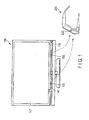
- FIG. 1 schematically shows the outer appearance of the video receiving apparatus according to this embodiment, and an arrangement example together with 3D glasses used upon viewing a 3D video picture.
- video signals received by the video receiving apparatus of this embodiment include those of a broadcast signal, a content supplied from a recording medium such as a DVD, and a content supplied via a network.
- signals for the right- and left-eye video pictures may be sent from an external device, or may be generated in a pseudo manner from a 2D-display video signal inside a television receiving apparatus.
- a video receiving apparatus 100 includes transmitters 102 which output right/left identification information indicating whether a currently displayed video picture is that for the right or left eye.
- a carrier of the right/left identification information may be any of wired lines, radio waves, and infrared rays.
- 3D glasses 200 include receivers 202, which receive the right/left identification information from the transmitters 102 to control shutter operations of right and left liquid crystal glasses to be synchronized with a displayed right or left video picture.
- a viewer can perceive a stereoscopic video picture by viewing a right-eye video picture by the right eye and a left-eye video picture by the left eye.
- FIG. 2 shows a principal signal processing system of the video receiving apparatus 100.
- the video receiving apparatus 100 of this embodiment includes a signal processor which processes a video signal including an identifier indicating a 3D- or 2D-display video signal to be able to be three- and two-dimensionally displayed, and a controller including a 3D setting module which detects the identifier of the video signal, which identifier indicates a 3D- or 2D-display video signal, and controls the signal processor according to an automatic switching setting of the display mode which allows a setting for automatically setting a 3D display mode when the identifier indicating a 3D-display video signal is detected, and a setting for two-dimensionally displaying 3D and 2D-display video signals regardless of the identifier.
- a signal processor which processes a video signal including an identifier indicating a 3D- or 2D-display video signal to be able to be three- and two-dimensionally displayed
- a controller including a 3D setting module which detects the identifier of the video signal, which identifier indicates a 3D- or 2
- the video receiving apparatus 100 includes, as receivers, a BS (broadcasting satellite)/CS (communication satellite) digital broadcast receiving antenna 103, a satellite digital broadcast tuner 105, a digitalized terrestrial broadcast receiving antenna 108, and a digitalized terrestrial broadcast tuner 110. That is, a satellite digital television broadcast signal received by the BS/CS digital broadcast receiving antenna 103 is supplied to the satellite digital broadcast tuner 105 via an input terminal 104, thus tuning a broadcast signal of a desired channel.
- BS broadcasting satellite
- CS communication satellite
- the broadcast signal tuned by the tuner 105 is supplied to a PSK (Phase Shift Keying) demodulator 106 to be demodulated into digital video and audio signals, which are then output to a signal processor 107.
- PSK Phase Shift Keying
- a digitalized terrestrial television broadcast signal received by the digitalized terrestrial broadcast receiving antenna 108 is supplied to the digitalized terrestrial broadcast tuner 110 via an input terminal 109, thus tuning a broadcast signal of a desired channel.
- the broadcast signal tuned by the tuner 110 is supplied to an OFDM (Orthogonal Frequency Division Multiplexing) demodulator 111 to be demodulated into digital video and audio signals, which are then output to the signal processor 107.
- OFDM Orthogonal Frequency Division Multiplexing
- an analog tuner 118 used to receive an analog terrestrial signal is arranged.
- a signal received by the analog tuner 118 is demodulated by an analog demodulator 119 into video and audio signals, which are then output to the signal processor 107.
- a digital or analog audio signal and video signal including an identifier indicating a 3D- or 2D-display video signal can be input from an external device to the signal processor 107 via external input terminals 101.
- the signal processor 107 selectively applies predetermined digital signal processing to the digital video and audio signals supplied from the PSK demodulator 106, the digital video and audio signals supplied from the OFDM demodulator 111, the video and audio signals supplied from the analog demodulator 119, and video and audio signals from line input terminals, and outputs processed signals to a graphic processor 112 and audio processor 113.
- the signal processor 107 includes a 3D signal processor 107A which executes signal processing for the input video and audio signals according to a control signal from a controller 121 (to be described later) to obtain 3D video signals required to display right- and left-eye video pictures and an audio signal synchronized with those video signals.
- the 3D signal processor 107A expands the widths (or heights) of right- and left-eye images included in one frame to be doubled, so as to generate right- and left-eye video pictures, and outputs the right- and left-eye video pictures to alternately display them.
- the 3D signal processor 107A expands the width (or height) of, for example, a left-eye image included in one frame to be doubled, and outputs it to display a left-eye video picture alone.
- the graphic processor 112 has a function of superimposing an OSD (On Screen Display) signal generated by an OSD signal generation module 114 on a digital video signal supplied from the signal processor 107, and outputting the superimposed signal. Also, the graphic processor 112 can selectively output an output video signal of the signal processor 107 and an output OSD signal of the OSD signal generation module 114, can superimpose these outputs, or can combine and output these outputs to respectively form halves of a screen.
- OSD On Screen Display
- the digital video signal output from the graphic processor 112 is supplied to a video processor 115.
- the video processor 115 converts the input digital video signal into an analog video signal of a format that can be displayed by a video display 117, and outputs the analog video signal to the video display 117, thus displaying a video picture.
- the audio processor 113 converts the input digital audio signal into an analog audio signal of a format which can be played back by a loudspeaker 116, and outputs the analog audio signal to the loudspeaker 116, thus outputting a sound.
- the controller 121 incorporates a CPU (Central Processing Unit) and the like. Upon reception of operation information from an operation module 131 or upon reception of operation information output from a remote controller 140 via a light-receiver 142, the controller 121 systematically controls the respective modules to reflect the operation contents to the apparatus.
- a CPU Central Processing Unit
- the controller 121 mainly uses a ROM (Read Only Memory) 611 which stores control programs to be executed by the CPU, a RAM (Random Access Memory) 612 which provides a work area to the CPU, and a nonvolatile memory 613 which stores various kinds of setting information and control information.
- ROM Read Only Memory
- RAM Random Access Memory
- the controller 121 is connected, via a card I/F (Interface) 145, to a card holder 146 which can receive a first memory card 147. Then, the controller 121 can exchange information such as a video signal including an identifier indicating a 3D- or 2D-display video signal with the first memory card 147 attached to the card holder 146 via the card I/F 145. Although not shown, the controller 121 may be connected to another card holder, which can receive a second memory card, via another card I/F.
- a card I/F Interface
- the controller 121 is connected to a brightness sensor 148. Then, the controller 121 can acquire ambient brightness information from this sensor, and can automatically control, for example, the brightness of a screen.
- the controller 121 is connected to a first LAN terminal 152 via a communication I/F 151. Then, the controller 121 can exchange information such as a video signal, which is included in a content provided via, for example, a network, and which includes an identifier indicating a 3D- or 2D-display video signal, with a LAN-compatible HDD (hard disk drive) connected to the first LAN terminal 152 via the communication I/F 151.
- the controller 121 has a DHCP (Dynamic Host Configuration Protocol) server function, and controls the LAN-compatible HDD connected to the first LAN terminal 152 by assigning an IP (Internet Protocol) address to the HDD.
- the controller 121 may be connected to a second LAN terminal via another communication I/F although not shown.
- the controller 121 is connected to a USB terminal 154 via a USB I/F 153. Then, the controller 121 can exchange information such as a video signal, which is included in a content provided from a recording medium such as a DVD, and which includes an identifier indicating a 3D- or 2D-display video signal, with each device connected to the USB terminal 154 via the USB I/F 153.
- a video signal which is included in a content provided from a recording medium such as a DVD, and which includes an identifier indicating a 3D- or 2D-display video signal
- the controller 121 is connected to an i.Link® terminal 156 via an i.Link® I/F 155. Then, the controller 121 can exchange information such as a video signal including an identifier indicating a 3D- or 2D-display video signal with each device connected to the i.Link® terminal 156 via the i.Link® I/F 155.
- the controller 121 can exchange information such as a video signal including an identifier indicating a 3D- or 2D-display video signal with each device connected to an HDMI (High Definition Multimedia Interface) terminal 158 via an HDMI I/F 157 which is compliant with the HDMI standard.
- HDMI High Definition Multimedia Interface
- the controller 121 has a 3D setting module 121A which switches a display mode between 3D and 2D display modes based on a viewer's command supplied from the operation module 131 or the remote controller 140 via the light-receiver 142.
- the 3D setting module 121A includes a selector A1 which allows to select a 2D or 3D display mode in response to, for example, an operation of the remote controller 140 by the viewer.
- the selector A1 outputs right/left identification signals to the transmitters 102 in synchronism with output timings of video signals to the video display 117.
- FIG. 3 shows the outer appearance of the remote controller 140.
- This remote controller 140 mainly includes a power key 140a, input selection key 140b, 3D key 140c, setting menu key 140d, direct tuning keys 140e of broadcast channels, cursor keys 140f, enter key 140g, program guide key 140h, page selection keys 140i, time shift key 140j, back key 140k, end key 1401, blue, red, green, and yellow color keys 140mb, 140mr, 140mg, and 140my, channel up/down key 140n, tone volume adjustment key 140o, and the like.
- Examples of display mode setting and switching operations of the video receiving apparatus will be described below.
- a viewer wants to make an automatic switching setting of a 3D display mode, he or she selects the setting menu key 140d of the remote controller 140.
- the controller 121 controls the OSD signal generation module 114 to display a menu screen.
- the controller 121 controls the OSD signal generation module 114 to display a function setting screen.
- the controller 121 controls the OSD signal generation module 114 to display a 3D setting screen.
- FIG. 4 shows an example of the 3D setting screen.
- the 3D setting screen displays items “3D automatic switching”, “set 3D parental lock”, “set 3D passcode”, “delete 3D passcode”, “display 3D attention”, and “attention at 3D viewing”.
- the controller 121 controls the OSD signal generation module 114 to display a 3D automatic switching screen.
- FIG. 5 shows an example of the 3D automatic switching screen.
- the 3D automatic switching screen displays items "3D", "2D", and "OFF".
- the 3D setting module 121A is set to automatically set the 3D display mode when an identifier indicating a 3D-display video signal is detected. Therefore, when, for example, a main title of a program is a video signal including an identifier indicating a 3D-display video signal, and a commercial message is a video signal including an identifier indicating a 2D-display video signal (or a video signal which does not include any identifier indicating a 3D-display video signal), the main title is three-dimensionally displayed, and the commercial message is two-dimensionally displayed.
- the 3D setting module 121A is set to automatically two-dimensionally display a 3D-display video signal and two-dimensionally display a 2D-display video signal, when an identifier indicating a 3D-display video signal is detected. Therefore, when, for example, a main title of a program is a video signal including an identifier indicating a 3D-display video signal, and a commercial message is a video signal including an identifier indicating a 2D-display video signal, both the main title and commercial message are two-dimensionally displayed.
- the 3D setting module 121A When the viewer selects "OFF", the 3D setting module 121A is set to display a screen which prompts the viewer to select a 3D or 2D display mode when an identifier indicating a 3D-display video signal is detected. Therefore, when a main title of a program is a video signal including an identifier indicating a 3D-display video signal, and a commercial message is a video signal including an identifier indicating a 2D-display video signal, the screen which prompts the viewer to select the 3D or 2D display mode is displayed before the main title is displayed.
- FIG. 6 shows another example of the 3D automatic switching screen.
- the 3D automatic switching screen shown in FIG. 6 displays items "ON” and "OFF".
- the 3D setting module 121A is set to automatically set the 3D display mode when an identifier indicating a 3D-display video signal is detected. Therefore, when, for example, a main title of a program is a video signal including an identifier indicating a 3D-display video signal, and a commercial message is a video signal including an identifier indicating a 2D-display video signal, the main title is three-dimensionally displayed, and the commercial message is two-dimensionally displayed.
- the 3D setting module 121A When the viewer selects "OFF", the 3D setting module 121A is set to display a screen which prompts the viewer to select a 3D or 2D display mode when an identifier indicating a 3D-display video signal is detected. Therefore, when a main title of a program is a video signal including an identifier indicating a 3D-display video signal, and a commercial message is a video signal including an identifier indicating a 2D-display video signal, the screen which prompts the viewer to select the 3D or 2D display mode is displayed before the main title is displayed.
- the 3D setting module 121A may be set to automatically two-dimensionally display a 3D-display video signal and two-dimensionally display a 2D-display video signal, when an identifier indicating a 3D-display video signal is detected. Therefore, when, for example, a main title of a program is a video signal including an identifier indicating a 3D-display video signal, and a commercial message is a video signal including an identifier indicating a 2D-display video signal, both the main title and commercial message are two-dimensionally displayed.
- the viewer can switch the 3D and 2D display modes by selecting the 3D key 140c of the remote controller 140 during viewing of a program.
- the video receiving apparatus 100 maintains the 2D display mode (or 3D display mode) irrespective of the display setting set on the 3D automatic switching screen until the program ends.
- the 3D setting module 121A displays a video signal according to a display mode set on the 3D automatic switching screen (step STA1).
- FIG. 8 shows a case in which, for example, the viewer selects "3D" on the 3D automatic switching screen to automatically set the 3D display mode. If the viewer selects the 3D key 140c of the remote controller 140 (step STA2), the selector A1 of the 3D setting module 121A controls the OSD signal generation module 114 to display a 3D menu (step STA3).
- FIG. 7 shows an example of the 3D menu.
- the 3D menu displays a 3D icon, 2D3D icon, and 2D icon. The viewer can select one of these icons using the cursor keys 140f and enter key 140g of the remote controller 140.
- a 3D-display video signal is three-dimensionally displayed, and a 2D-display video signal is two-dimensionally displayed.
- a 2D-display video signal is converted into a 3D-display video signal, and the converted video signal is displayed.
- 2D and 3D-display video signals are two-dimensionally displayed.
- the selector A1 of the 3D setting module 121A judges whether or not the viewer selects the 2D icon (step STA4). If the viewer selects the 2D icon, the 3D setting module 121A controls the signal processor 107 to two-dimensionally display a 3D-display video signal when an identifier indicating a 3D-display video signal is detected, and to two-dimensionally display a 2D-display video signal when an identifier indicating a 2D-display video signal is detected (step STA5).
- the 3D setting module 121A judges based on the received video signal whether or not an event (program) which is being viewed by the viewer ends (step STA6), and maintains the 3D display setting on the 3D menu screen until the program ends.
- a video signal includes a first video signal including an identifier indicating a 3D-display video signal and a second video signal including an identifier indicating a 2D-display video signal
- the 3D setting module 121A two-dimensionally displays the first and second video signals. Therefore, when, for example, a main title of a program is a video signal including an identifier indicating a 3D-display video signal, and a commercial message is a video signal including an identifier indicating a 2D-display video signal, both the main title and commercial message are two-dimensionally displayed.
- a main title of a program includes a video signal including an identifier indicating a 3D-display video signal, and a video signal including an identifier indicating a 2D-display video signal
- the main title is two-dimensionally displayed irrespective of the identifiers.
- the 3D setting module 121A displays an image in the display mode set on the 3D automatic switching screen. In the example shown in FIG. 8 , the setting is restored to that for automatically setting the 3D display mode. Therefore, the 3D setting module 121A controls the signal processor 107 to automatically set the 3D display mode when an identifier indicating a 3D-display video signal is detected, and to set the 2D display mode when an identifier indicating a 2D-display video signal is detected, and the 3D signal processor 107A executes predetermined signal processing.
- the 3D setting module 121A controls the OSD signal generation module 114 to display a message that advises accordingly on a display screen, thus presenting to the viewer that the video signal can be three-dimensionally displayed by changing the setting.
- the 3D setting module 121A controls the 3D signal processor 107A of the signal processor 107 to automatically set the 3D display mode when the identifier indicating a 3D-display video signal is detected, and to automatically set the 2D display mode when the identifier indicating a 2D-display video signal is detected.
- the 3D setting module 121A similarly controls the signal processor 107 to automatically set the 3D display mode when the identifier indicating a 3D-display video signal is detected, and to automatically set the 2D display mode when the identifier indicating a 2D-display video signal is detected.
- the 3D setting module 121A controls the 3D signal processor 107A of the signal processor 107 to automatically set the 3D display mode when the identifier indicating a 3D-display video signal is detected, and to form a 3D-display video signal from a 2D-display video signal and three-dimensionally display that video signal when the identifier indicating a 2D-display video signal is detected.
- the 3D setting module 121A controls the signal processor 107 to automatically set the 3D display mode when the identifier indicating a 3D-display video signal is detected, and to automatically set the 2D display mode when the identifier indicating a 2D-display video signal is detected.
- the 3D setting module 121A controls the 3D signal processor 107A of the signal processor 107 to automatically set the 3D display mode when the identifier indicating a 3D-display video signal is detected, and to automatically set the 2D display mode when the identifier indicating a 2D-display video signal is detected.
- the 3D setting module 121A controls the signal processor 107 to two-dimensionally display 3D- and 2D-display video signals irrespective of identifiers.
- a video signal includes a first video signal including an identifier indicating a 3D-display video signal and a second video signal including an identifier indicating a 2D-display video signal
- the 3D setting module 121A three-dimensionally displays the first video signal, and two-dimensionally displays the second video signal.
- a main title of a program is a video signal including an identifier indicating a 3D-display video signal
- a commercial message is a video signal including an identifier indicating a 2D-display video signal
- the main title is three-dimensionally displayed
- the commercial message is two-dimensionally displayed.
- a main title of a program includes a video signal including an identifier indicating a 3D-display video signal and a video signal including an identifier indicating a 2D-display video signal
- the 3D display mode is automatically set upon detection of the identifier indicating a 3D-display video signal in the main title
- the 2D display mode is automatically set upon detection of the identifier indicating a 2D-display video signal.
- the 3D setting module 121A controls the 3D signal processor 107A of the signal processor 107 to automatically set the 2D display mode irrespective of the identifiers. Even after a program ends, the 3D setting module 121A controls the signal processor 107 to two-dimensionally display 3D- and 2D-display video signals irrespective of the identifiers.
- the 3D setting module 121A controls the 3D signal processor 107A of the signal processor 107 to automatically set the 3D or 2D display mode when an identifier indicating a 3D-display video signal is detected, and to form a 3D-display video signal from a 2D-display video signal and three-dimensionally display that video signal when an identifier indicating a 2D-display video signal is detected.
- the 3D setting module 121A controls the signal processor 107 to two-dimensionally display 3D- and 2D-display video signals irrespective of the identifiers.
- the 3D setting module 121A controls the 3D signal processor 107A of the signal processor 107 to automatically set the 3D display mode when the identifier indicating a 3D-display video signal is detected, and to automatically set the 2D display mode when the identifier indicating a 2D-display video signal is detected.
- the 3D setting module 121A controls the OSD signal generation module 114 to display the screen which prompts the viewer to select the 2D or 3D display mode upon detection of an identifier indicating a 3D-display video signal, and follows the display mode selected on the displayed screen.
- the 3D setting module 121A controls the 3D signal processor 107A of the signal processor 107 to automatically two-dimensionally display 3D- and 2D-display video signals.
- the 3D setting module 121A controls the OSD signal generation module 114 to display the screen which prompts the viewer to select the 2D or 3D display mode upon detection of an identifier indicating a 3D-display video signal, and follows the display mode selected on the displayed screen.
- the 3D setting module 121A controls the 3D signal processor 107A of the signal processor 107 to automatically set the 3D or 2D display mode when an identifier indicating a 3D-display video signal is detected, and to form a 3D-display video signal from a 2D-display video signal and three-dimensionally display that video signal when an identifier indicating a 2D-display video signal is detected.
- the 3D setting module 121A controls the OSD signal generation module 114 to display the screen which prompts the viewer to select the 2D or 3D display mode upon detection of an identifier indicating a 3D-display video signal, and follows the display mode selected on the displayed screen.
- the video receiving apparatus executes a display operation selected by the viewer irrespective of the automatic switching setting in the program which is being viewed. Therefore, comfortable viewing by the viewer can be ensured without disturbance due to alternate viewing of 3D and 2D video pictures. Also, only a program to be viewed by a specific viewer such as a child can be avoided from being three-dimensionally displayed.
- the apparatus since the setting on the 3D menu is maintained within a single program, when a 3D-display video signal is received in the next program, the apparatus follows the 3D automatic switching setting, thus assuring high usability for the viewer.
- a video receiving apparatus and display mode switching method which can attain switching between 3D and 2D display modes while allowing for the viewer's intention, and can assure high usability, can be provided.
- the video receiving apparatus of this embodiment is configured to restore the automatic switching setting from the display mode set by the viewer on the 3D menu after a program ends.
- the video receiving apparatus may be configured to restore the automatic switching setting from the display mode set on the 3D menu when the viewer changes a channel or turns off the power switch of the apparatus. Even in this case, the same effects as in the aforementioned embodiment can be obtained.
- the video receiving apparatus includes the video display and loudspeaker.
- the video display and loudspeaker may be externally attached to the apparatus without being built in. Even in this case, the same effects as in the aforementioned embodiment can be obtained.
- a video signal including an identifier indicating a 2D-display video signal may be that which does not include any identifier indicating a 3D-video signal.
Landscapes
- Engineering & Computer Science (AREA)
- Multimedia (AREA)
- Signal Processing (AREA)
- Testing, Inspecting, Measuring Of Stereoscopic Televisions And Televisions (AREA)
- Controls And Circuits For Display Device (AREA)
Applications Claiming Priority (1)
| Application Number | Priority Date | Filing Date | Title |
|---|---|---|---|
| JP2011093412A JP5092032B2 (ja) | 2011-04-19 | 2011-04-19 | 映像受信装置および表示方式切換方法 |
Publications (2)
| Publication Number | Publication Date |
|---|---|
| EP2515545A2 true EP2515545A2 (fr) | 2012-10-24 |
| EP2515545A3 EP2515545A3 (fr) | 2013-05-08 |
Family
ID=45464232
Family Applications (1)
| Application Number | Title | Priority Date | Filing Date |
|---|---|---|---|
| EP11191977.5A Withdrawn EP2515545A3 (fr) | 2011-04-19 | 2011-12-05 | Appareil de réception vidéo et procédé de commutation de mode d'affichage |
Country Status (2)
| Country | Link |
|---|---|
| EP (1) | EP2515545A3 (fr) |
| JP (1) | JP5092032B2 (fr) |
Family Cites Families (5)
| Publication number | Priority date | Publication date | Assignee | Title |
|---|---|---|---|---|
| US20100182404A1 (en) * | 2008-12-05 | 2010-07-22 | Panasonic Corporation | Three dimensional video reproduction apparatus, three dimensional video reproduction system, three dimensional video reproduction method, and semiconductor device for three dimensional video reproduction |
| JP4525831B1 (ja) * | 2009-03-31 | 2010-08-18 | 株式会社カシオ日立モバイルコミュニケーションズ | 画像受信装置、および、プログラム |
| JP5433862B2 (ja) * | 2009-09-30 | 2014-03-05 | 日立マクセル株式会社 | 受信装置及び表示制御方法 |
| JP2011082666A (ja) * | 2009-10-05 | 2011-04-21 | Sony Corp | 信号伝送方法、信号送信装置及び信号受信装置 |
| JP5510097B2 (ja) * | 2010-06-16 | 2014-06-04 | ソニー株式会社 | 信号伝送方法、信号送信装置および信号受信装置 |
-
2011
- 2011-04-19 JP JP2011093412A patent/JP5092032B2/ja not_active Expired - Fee Related
- 2011-12-05 EP EP11191977.5A patent/EP2515545A3/fr not_active Withdrawn
Non-Patent Citations (1)
| Title |
|---|
| None |
Also Published As
| Publication number | Publication date |
|---|---|
| EP2515545A3 (fr) | 2013-05-08 |
| JP5092032B2 (ja) | 2012-12-05 |
| JP2012227723A (ja) | 2012-11-15 |
Similar Documents
| Publication | Publication Date | Title |
|---|---|---|
| CN102918847B (zh) | 显示图像的方法和设备 | |
| US9549165B2 (en) | Method for displaying three-dimensional user interface | |
| EP2611162A1 (fr) | Appareil et procédé d'affichage | |
| EP2611161A2 (fr) | Dispositif de traitement de signaux pour traiter plusieurs contenus 3D, dispositif d'affichage pour afficher le contenu et procédés associés | |
| US20120169852A1 (en) | Display apparatus and system | |
| JP2006121553A (ja) | 映像表示装置 | |
| CN102577410A (zh) | 指示3d内容的方法和处理信号的装置 | |
| KR20110096494A (ko) | 전자 장치 및 입체영상 재생 방법 | |
| US20140015941A1 (en) | Image display apparatus, method for displaying image and glasses apparatus | |
| EP2424259A2 (fr) | Système d'affichage vidéo stéréoscopique avec lunettes 2D/3D à obturateurs | |
| CN102387394B (zh) | 显示装置及其图像生成方法 | |
| KR20120126458A (ko) | 방송 신호 처리 방법 및 그를 이용한 영상 표시 장치 | |
| JP5066244B2 (ja) | 映像再生装置及び映像再生方法 | |
| JP4908624B1 (ja) | 立体映像信号処理装置及び方法 | |
| CN103188513A (zh) | 用于显示视频的装置和方法 | |
| KR20130076674A (ko) | 복수의 컨텐츠를 처리하는 신호 처리 장치와 이를 디스플레이하는 디스플레이 장치 및 그 방법들 | |
| EP2515545A2 (fr) | Appareil de réception vidéo et procédé de commutation de mode d'affichage | |
| JP5377731B2 (ja) | 映像処理装置および映像処理方法 | |
| JP2012100159A (ja) | 映像表示装置,テレビジョン受像機 | |
| US20120050499A1 (en) | Information Output Control Apparatus | |
| US20120057004A1 (en) | Display apparatus and method of controlling the same, shutter glasses and method of controlling the same, and display system | |
| JP2012133555A (ja) | 画像処理装置および画像処理方法 | |
| US20120218383A1 (en) | Video output apparatus and video output method | |
| US20120019630A1 (en) | Image output apparatus and image output method | |
| US20120019521A1 (en) | Image output control apparatus and image output contol method |
Legal Events
| Date | Code | Title | Description |
|---|---|---|---|
| PUAI | Public reference made under article 153(3) epc to a published international application that has entered the european phase |
Free format text: ORIGINAL CODE: 0009012 |
|
| 17P | Request for examination filed |
Effective date: 20111205 |
|
| AK | Designated contracting states |
Kind code of ref document: A2 Designated state(s): AL AT BE BG CH CY CZ DE DK EE ES FI FR GB GR HR HU IE IS IT LI LT LU LV MC MK MT NL NO PL PT RO RS SE SI SK SM TR |
|
| AX | Request for extension of the european patent |
Extension state: BA ME |
|
| PUAL | Search report despatched |
Free format text: ORIGINAL CODE: 0009013 |
|
| AK | Designated contracting states |
Kind code of ref document: A3 Designated state(s): AL AT BE BG CH CY CZ DE DK EE ES FI FR GB GR HR HU IE IS IT LI LT LU LV MC MK MT NL NO PL PT RO RS SE SI SK SM TR |
|
| AX | Request for extension of the european patent |
Extension state: BA ME |
|
| RIC1 | Information provided on ipc code assigned before grant |
Ipc: H04N 13/04 20060101AFI20130402BHEP Ipc: H04N 21/2343 20110101ALI20130402BHEP Ipc: H04N 13/00 20060101ALI20130402BHEP Ipc: H04N 21/81 20110101ALI20130402BHEP |
|
| STAA | Information on the status of an ep patent application or granted ep patent |
Free format text: STATUS: THE APPLICATION HAS BEEN WITHDRAWN |
|
| 18W | Application withdrawn |
Effective date: 20150603 |