EP2515660B1 - Formulations avec des nanoparticules d'argent - Google Patents
Formulations avec des nanoparticules d'argent Download PDFInfo
- Publication number
- EP2515660B1 EP2515660B1 EP10805411.5A EP10805411A EP2515660B1 EP 2515660 B1 EP2515660 B1 EP 2515660B1 EP 10805411 A EP10805411 A EP 10805411A EP 2515660 B1 EP2515660 B1 EP 2515660B1
- Authority
- EP
- European Patent Office
- Prior art keywords
- polyoxyethylene
- silver
- formulation
- acid esters
- alkyl acid
- Prior art date
- Legal status (The legal status is an assumption and is not a legal conclusion. Google has not performed a legal analysis and makes no representation as to the accuracy of the status listed.)
- Active
Links
Images



Classifications
-
- A—HUMAN NECESSITIES
- A61—MEDICAL OR VETERINARY SCIENCE; HYGIENE
- A61L—METHODS OR APPARATUS FOR STERILISING MATERIALS OR OBJECTS IN GENERAL; DISINFECTION, STERILISATION OR DEODORISATION OF AIR; CHEMICAL ASPECTS OF BANDAGES, DRESSINGS, ABSORBENT PADS OR SURGICAL ARTICLES; MATERIALS FOR BANDAGES, DRESSINGS, ABSORBENT PADS OR SURGICAL ARTICLES
- A61L27/00—Materials for grafts or prostheses or for coating grafts or prostheses
- A61L27/50—Materials characterised by their function or physical properties, e.g. injectable or lubricating compositions, shape-memory materials, surface modified materials
- A61L27/54—Biologically active materials, e.g. therapeutic substances
-
- A—HUMAN NECESSITIES
- A01—AGRICULTURE; FORESTRY; ANIMAL HUSBANDRY; HUNTING; TRAPPING; FISHING
- A01N—PRESERVATION OF BODIES OF HUMANS OR ANIMALS OR PLANTS OR PARTS THEREOF; BIOCIDES, e.g. AS DISINFECTANTS, AS PESTICIDES OR AS HERBICIDES; PEST REPELLANTS OR ATTRACTANTS; PLANT GROWTH REGULATORS
- A01N59/00—Biocides, pest repellants or attractants, or plant growth regulators containing elements or inorganic compounds
- A01N59/16—Heavy metals; Compounds thereof
-
- A—HUMAN NECESSITIES
- A01—AGRICULTURE; FORESTRY; ANIMAL HUSBANDRY; HUNTING; TRAPPING; FISHING
- A01N—PRESERVATION OF BODIES OF HUMANS OR ANIMALS OR PLANTS OR PARTS THEREOF; BIOCIDES, e.g. AS DISINFECTANTS, AS PESTICIDES OR AS HERBICIDES; PEST REPELLANTS OR ATTRACTANTS; PLANT GROWTH REGULATORS
- A01N59/00—Biocides, pest repellants or attractants, or plant growth regulators containing elements or inorganic compounds
- A01N59/16—Heavy metals; Compounds thereof
- A01N59/20—Copper
-
- A—HUMAN NECESSITIES
- A61—MEDICAL OR VETERINARY SCIENCE; HYGIENE
- A61L—METHODS OR APPARATUS FOR STERILISING MATERIALS OR OBJECTS IN GENERAL; DISINFECTION, STERILISATION OR DEODORISATION OF AIR; CHEMICAL ASPECTS OF BANDAGES, DRESSINGS, ABSORBENT PADS OR SURGICAL ARTICLES; MATERIALS FOR BANDAGES, DRESSINGS, ABSORBENT PADS OR SURGICAL ARTICLES
- A61L27/00—Materials for grafts or prostheses or for coating grafts or prostheses
- A61L27/14—Macromolecular materials
- A61L27/16—Macromolecular materials obtained by reactions only involving carbon-to-carbon unsaturated bonds
-
- A—HUMAN NECESSITIES
- A61—MEDICAL OR VETERINARY SCIENCE; HYGIENE
- A61L—METHODS OR APPARATUS FOR STERILISING MATERIALS OR OBJECTS IN GENERAL; DISINFECTION, STERILISATION OR DEODORISATION OF AIR; CHEMICAL ASPECTS OF BANDAGES, DRESSINGS, ABSORBENT PADS OR SURGICAL ARTICLES; MATERIALS FOR BANDAGES, DRESSINGS, ABSORBENT PADS OR SURGICAL ARTICLES
- A61L27/00—Materials for grafts or prostheses or for coating grafts or prostheses
- A61L27/28—Materials for coating prostheses
- A61L27/34—Macromolecular materials
-
- A—HUMAN NECESSITIES
- A61—MEDICAL OR VETERINARY SCIENCE; HYGIENE
- A61L—METHODS OR APPARATUS FOR STERILISING MATERIALS OR OBJECTS IN GENERAL; DISINFECTION, STERILISATION OR DEODORISATION OF AIR; CHEMICAL ASPECTS OF BANDAGES, DRESSINGS, ABSORBENT PADS OR SURGICAL ARTICLES; MATERIALS FOR BANDAGES, DRESSINGS, ABSORBENT PADS OR SURGICAL ARTICLES
- A61L31/00—Materials for other surgical articles, e.g. stents, stent-grafts, shunts, surgical drapes, guide wires, materials for adhesion prevention, occluding devices, surgical gloves, tissue fixation devices
- A61L31/08—Materials for coatings
- A61L31/10—Macromolecular materials
-
- A—HUMAN NECESSITIES
- A61—MEDICAL OR VETERINARY SCIENCE; HYGIENE
- A61L—METHODS OR APPARATUS FOR STERILISING MATERIALS OR OBJECTS IN GENERAL; DISINFECTION, STERILISATION OR DEODORISATION OF AIR; CHEMICAL ASPECTS OF BANDAGES, DRESSINGS, ABSORBENT PADS OR SURGICAL ARTICLES; MATERIALS FOR BANDAGES, DRESSINGS, ABSORBENT PADS OR SURGICAL ARTICLES
- A61L31/00—Materials for other surgical articles, e.g. stents, stent-grafts, shunts, surgical drapes, guide wires, materials for adhesion prevention, occluding devices, surgical gloves, tissue fixation devices
- A61L31/14—Materials characterised by their function or physical properties, e.g. injectable or lubricating compositions, shape-memory materials, surface modified materials
- A61L31/16—Biologically active materials, e.g. therapeutic substances
-
- B—PERFORMING OPERATIONS; TRANSPORTING
- B82—NANOTECHNOLOGY
- B82Y—SPECIFIC USES OR APPLICATIONS OF NANOSTRUCTURES; MEASUREMENT OR ANALYSIS OF NANOSTRUCTURES; MANUFACTURE OR TREATMENT OF NANOSTRUCTURES
- B82Y30/00—Nanotechnology for materials or surface science, e.g. nanocomposites
-
- B—PERFORMING OPERATIONS; TRANSPORTING
- B82—NANOTECHNOLOGY
- B82Y—SPECIFIC USES OR APPLICATIONS OF NANOSTRUCTURES; MEASUREMENT OR ANALYSIS OF NANOSTRUCTURES; MANUFACTURE OR TREATMENT OF NANOSTRUCTURES
- B82Y40/00—Manufacture or treatment of nanostructures
-
- C—CHEMISTRY; METALLURGY
- C09—DYES; PAINTS; POLISHES; NATURAL RESINS; ADHESIVES; COMPOSITIONS NOT OTHERWISE PROVIDED FOR; APPLICATIONS OF MATERIALS NOT OTHERWISE PROVIDED FOR
- C09C—TREATMENT OF INORGANIC MATERIALS, OTHER THAN FIBROUS FILLERS, TO ENHANCE THEIR PIGMENTING OR FILLING PROPERTIES ; PREPARATION OF CARBON BLACK ; PREPARATION OF INORGANIC MATERIALS WHICH ARE NO SINGLE CHEMICAL COMPOUNDS AND WHICH ARE MAINLY USED AS PIGMENTS OR FILLERS
- C09C1/00—Treatment of specific inorganic materials other than fibrous fillers; Preparation of carbon black
- C09C1/62—Metallic pigments or fillers
-
- C—CHEMISTRY; METALLURGY
- C09—DYES; PAINTS; POLISHES; NATURAL RESINS; ADHESIVES; COMPOSITIONS NOT OTHERWISE PROVIDED FOR; APPLICATIONS OF MATERIALS NOT OTHERWISE PROVIDED FOR
- C09C—TREATMENT OF INORGANIC MATERIALS, OTHER THAN FIBROUS FILLERS, TO ENHANCE THEIR PIGMENTING OR FILLING PROPERTIES ; PREPARATION OF CARBON BLACK ; PREPARATION OF INORGANIC MATERIALS WHICH ARE NO SINGLE CHEMICAL COMPOUNDS AND WHICH ARE MAINLY USED AS PIGMENTS OR FILLERS
- C09C1/00—Treatment of specific inorganic materials other than fibrous fillers; Preparation of carbon black
- C09C1/62—Metallic pigments or fillers
- C09C1/627—Copper
-
- A—HUMAN NECESSITIES
- A61—MEDICAL OR VETERINARY SCIENCE; HYGIENE
- A61L—METHODS OR APPARATUS FOR STERILISING MATERIALS OR OBJECTS IN GENERAL; DISINFECTION, STERILISATION OR DEODORISATION OF AIR; CHEMICAL ASPECTS OF BANDAGES, DRESSINGS, ABSORBENT PADS OR SURGICAL ARTICLES; MATERIALS FOR BANDAGES, DRESSINGS, ABSORBENT PADS OR SURGICAL ARTICLES
- A61L2300/00—Biologically active materials used in bandages, wound dressings, absorbent pads or medical devices
- A61L2300/10—Biologically active materials used in bandages, wound dressings, absorbent pads or medical devices containing or releasing inorganic materials
- A61L2300/102—Metals or metal compounds, e.g. salts such as bicarbonates, carbonates, oxides, zeolites, silicates
- A61L2300/104—Silver, e.g. silver sulfadiazine
-
- A—HUMAN NECESSITIES
- A61—MEDICAL OR VETERINARY SCIENCE; HYGIENE
- A61L—METHODS OR APPARATUS FOR STERILISING MATERIALS OR OBJECTS IN GENERAL; DISINFECTION, STERILISATION OR DEODORISATION OF AIR; CHEMICAL ASPECTS OF BANDAGES, DRESSINGS, ABSORBENT PADS OR SURGICAL ARTICLES; MATERIALS FOR BANDAGES, DRESSINGS, ABSORBENT PADS OR SURGICAL ARTICLES
- A61L2300/00—Biologically active materials used in bandages, wound dressings, absorbent pads or medical devices
- A61L2300/40—Biologically active materials used in bandages, wound dressings, absorbent pads or medical devices characterised by a specific therapeutic activity or mode of action
- A61L2300/404—Biocides, antimicrobial agents, antiseptic agents
-
- A—HUMAN NECESSITIES
- A61—MEDICAL OR VETERINARY SCIENCE; HYGIENE
- A61L—METHODS OR APPARATUS FOR STERILISING MATERIALS OR OBJECTS IN GENERAL; DISINFECTION, STERILISATION OR DEODORISATION OF AIR; CHEMICAL ASPECTS OF BANDAGES, DRESSINGS, ABSORBENT PADS OR SURGICAL ARTICLES; MATERIALS FOR BANDAGES, DRESSINGS, ABSORBENT PADS OR SURGICAL ARTICLES
- A61L2420/00—Materials or methods for coatings medical devices
- A61L2420/06—Coatings containing a mixture of two or more compounds
-
- A—HUMAN NECESSITIES
- A61—MEDICAL OR VETERINARY SCIENCE; HYGIENE
- A61L—METHODS OR APPARATUS FOR STERILISING MATERIALS OR OBJECTS IN GENERAL; DISINFECTION, STERILISATION OR DEODORISATION OF AIR; CHEMICAL ASPECTS OF BANDAGES, DRESSINGS, ABSORBENT PADS OR SURGICAL ARTICLES; MATERIALS FOR BANDAGES, DRESSINGS, ABSORBENT PADS OR SURGICAL ARTICLES
- A61L2430/00—Materials or treatment for tissue regeneration
- A61L2430/02—Materials or treatment for tissue regeneration for reconstruction of bones; weight-bearing implants
-
- C—CHEMISTRY; METALLURGY
- C01—INORGANIC CHEMISTRY
- C01P—INDEXING SCHEME RELATING TO STRUCTURAL AND PHYSICAL ASPECTS OF SOLID INORGANIC COMPOUNDS
- C01P2002/00—Crystal-structural characteristics
- C01P2002/80—Crystal-structural characteristics defined by measured data other than those specified in group C01P2002/70
- C01P2002/84—Crystal-structural characteristics defined by measured data other than those specified in group C01P2002/70 by UV- or VIS- data
-
- C—CHEMISTRY; METALLURGY
- C01—INORGANIC CHEMISTRY
- C01P—INDEXING SCHEME RELATING TO STRUCTURAL AND PHYSICAL ASPECTS OF SOLID INORGANIC COMPOUNDS
- C01P2004/00—Particle morphology
- C01P2004/01—Particle morphology depicted by an image
- C01P2004/03—Particle morphology depicted by an image obtained by SEM
-
- C—CHEMISTRY; METALLURGY
- C01—INORGANIC CHEMISTRY
- C01P—INDEXING SCHEME RELATING TO STRUCTURAL AND PHYSICAL ASPECTS OF SOLID INORGANIC COMPOUNDS
- C01P2004/00—Particle morphology
- C01P2004/01—Particle morphology depicted by an image
- C01P2004/04—Particle morphology depicted by an image obtained by TEM, STEM, STM or AFM
-
- C—CHEMISTRY; METALLURGY
- C01—INORGANIC CHEMISTRY
- C01P—INDEXING SCHEME RELATING TO STRUCTURAL AND PHYSICAL ASPECTS OF SOLID INORGANIC COMPOUNDS
- C01P2004/00—Particle morphology
- C01P2004/60—Particles characterised by their size
- C01P2004/64—Nanometer sized, i.e. from 1-100 nanometer
Definitions
- the invention relates to a silver nanoparticle-containing, disperse, aqueous formulation and to processes for their preparation.
- nanoparticles is a term for particles having a size in the range smaller than 100 nm.
- the use of the prefix “nano” thus represents, according to the official definition according to ISO TC 229, a distinction to particles in the sub-micrometer range (> 100 nm).
- nanomaterials e.g. Gold and metal other colors than the corresponding metals, namely red or yellow.
- nanoparticles of a substance have an increased surface energy.
- nanoparticles are generally considered to be unstable because they react easily to new compounds or larger, more stable aggregates due to their high surface energy.
- Technologically usable nanoparticles are thus obtained only if their surfaces are chemically or physically protected and thus stabilized.
- technological usable can be defined as nanoparticles that retain or conserve their original particle size from production through processing to application.
- EP 1 889 810 A1 and DE 10 2008 025 108 A1 described falls to the cluster consisting of micro- and nanoparticles as a solid, which must first redispersed consuming for further use, which is often no longer completely possible due to storage influences.
- the distribution of nanoparticles can never be optimal, as it can be at most as good as the distribution of the microparticles on which they are deposited.
- a second route of the process consists in the synthesis of metal nanoparticles by stabilization by means of polymers such as polyvinylpyrrolidone in the polyol process, which is frequently described in the literature as a standard method.
- polymers such as polyvinylpyrrolidone in the polyol process, which is frequently described in the literature as a standard method.
- only small metal nanoparticle concentrations are achieved here (range less than 0.1% by weight of metal).
- the third variant for the production of metalinanoparticles is a PVD process (Physical Vapor Deposition), in which the underlying metal is vaporized.
- PVD process Physical Vapor Deposition
- polymers or silicones are used.
- the production of metal vapor is a very energy consuming process that requires evacuated process chambers. These production methods are therefore uneconomical.
- the polymers and silicones used during processing prepare considerable process engineering problems, since redispersion is often impossible.
- an antimicrobial aqueous dispersion by mixing an aqueous dispersion of nanoscale particles containing at least one antimicrobial metal, with an aqueous dispersion of a polymerization, polycondensation or polyaddition known.
- the preparation of the metal nanoparticles takes place by a chemical reduction in water. Sodium chloride is used to stabilize the metal nanoparticles
- a disadvantage that all manufacturing variants show is the poor processability of the metal nanoparticles in polymer melts, such as in the case of the addition of thermoplastic polymers. Solids can not be homogeneously incorporated without prior dispersion.
- the present invention provides a silver nanoparticle-containing, disperse, aqueous formulation comprising from 0.5 to 60% by weight silver nanoparticles and at least two stabilizers from the group of nonionic surfactants, wherein the silver nanoparticle to stabilizer ratio ranges from 10: 2 to 10: 50 wherein the at least two stabilizers are selected from the group consisting of polyoxyethylene mono-alkyl esters, polyoxypropylene mono-alkyl esters, polyoxyethylene di-alkyl esters, polyoxypropylene di-alkyl esters, polyoxyethylene tri-alkyl esters, polyoxypropylene tri-alkyl esters and their mixtures are available.
- the formulation of the invention comprises at least two stabilizers selected from the group consisting of polyoxyethylene mono-alkyl esters, polyoxypropylene mono-alkyl esters, polyoxyethylene di-alkyl esters, polyoxypropylene di-alkyl esters, polyoxyethylene tri-alkyl esters and polyoxypropylene tri-alkyl esters.
- stabilizers are compounds with surface-active properties from the group of nonionic surfactants, which are in liquid form at room temperature.
- Nonionic surfactants in the sense of the invention are surface-active chemical components which have uncharged polar and nonpolar regions in one molecule. In addition, nonionic surfactants have no dissociable functional groups.
- a silver nanoparticle-containing formulation according to the invention contains dispersion-stabilized silver nanoparticles which do not lead to larger agglomerates can aggregate, since the stabilizers used in the temperature range of 0-240 ° C are liquid.
- the state of the art for example, provides many silver nanoparticle products that are offered as dry powders, but due to their tendency to agglomerate during transport and storage for dispersion in organic solvents, such as acrylic and epoxy resins, only under high mechanical energy input and then incompletely redispersible.
- the at least two stabilizers may be different stabilizers of one of the mentioned classes of chemical compounds or stabilizers of different classes of compounds.
- three different polyoxyethylene mono-alkyl esters may be used in a combination of three different stabilizers, but for example two different polyoxyethylene mono-alkyl esters and one polyoxypropylene mono-alkyl ester or, for example, a polyoxypropylene di-alkyl ester, a polyoxyethylene tri-alkyl acid esters and a polyoxypropylene tri-alkyl acid ester can be used. Any combination of these nonionic surfactants is possible.
- Stabilizers in the form of a combination of nonionic surfactants from two different of the above-mentioned classes of compounds are particularly preferably included in the formulation.
- the stabilizers are selected from the group consisting of polyoxyethylene sorbitan monolaurate, polyoxyethylene sorbitan monopalmitate, polyoxyethylene sorbitan monostearate, polyoxyethylene sorbitan monooleate, polyoxyethylene sorbitan tristearate, polyoxyethylene glyceryl trioleate, Polyoxyethylene glyceryl monolaurate, polyoxyethylene glyceryl monooleate, polyoxyethylene glyceryl monostearate, polyoxyethylene glyceryl monoricinoleate, castor oil, hydrogenated castor oil and soybean oil.
- the stabilizers are often not known under their chemical name but under their respective trade name. In the context of the present disclosure
- Invention preferred stabilizers are Tween20 TM , Tween40 TM , Tween60 TM , Tween80 TM , Polysorbate TM , Tagat TO TM , Tagat TO V TM , Tagat L2 TM , Tagat S2 TM , Tagat R40 TM , Triton X 100 TM , Hydrogenated Castoroil TM , PEG 20 glyceryl stearate TM .
- the at least two stabilizers are preferably present in the formulation in a quantitative ratio in the range from 1: 1 to 2: 1.
- the formulation according to the invention has a silver to stabilizer ratio in the range from 10: 2 to 10: 50.
- the quantity ratio of silver to stabilizers is preferably from 10: 5 to 10: 20, more preferably from 10: 6 to 10: 10.
- the "silver to stabilizer ratio" is to be understood as meaning the "silver to total amount of stabilizers present".
- the silver nanoparticles preferably have a particle size of 1 nm to 100 nm, particularly preferably 1 nm to 50 nm, particularly preferably 1 nm to 20 nm.
- the formulation according to the invention is liquid and otherwise contains no solid secondary constituents which would limit the possibilities of further use.
- the formulation according to the invention contains one or more surface-active components as stabilizers which, in addition to the stabilization of the silver nanoparticles, also make possible the further processing (by repeated dispersion, emulsification) into all other substrates.
- the most technologically demanding finishing is the processing in thermoplastic materials.
- the applied temperatures reach up to 300 ° C. Up to this temperature, it is desirable for the formulation used for the additive formulation to be liquid, which is satisfied by the use of one or more surface-active components which are liquid up to a temperature of briefly 300 ° C.
- the content of a first stabilizer is in the range from 30% by weight to 90% by weight, preferably from 40% by weight to 60% by weight, particularly preferably from 45% by weight to 55% by weight. -%.
- the remaining proportion by weight of up to 100 percent is divided among the further stabilizers according to the invention used in combination, which in turn are divided in proportions of from 0 to 100% by weight.
- the weight percentages given here thus refer to the total weight of stabilizers as a 100% basis, in deviation to other details.
- one or more stabilizers selected from the group consisting of Tagat TO V TM , Tween 20 TM , Tween 80 TM and Tagat L2 TM are present in the formulation. Using these stabilizers particularly stable and universally applicable dispersions are obtained.
- a mixture of Tagat TO V TM and Tween20 TM is present in the formulation as stabilizer.
- Particularly preferred are formulations in which the amount ratio of Tagat TO V TM to Tween 20 TM in the range of 1: 2 to 2: 1, and especially preferred are formulations in which the amount ratio of Tagat TO V TM to Tween20 TM approximately 1: 1 is.
- the silver nanoparticles have a particle size of less than 100 nm.
- the silver nanoparticles are present in a particle size of 1 nm to 100 nm, preferably 1 nm to 50 nm, more preferably 1 nm to 20 nm.
- the morphology of the silver nanoparticles can have shapes of triangles, cubes, spheres, rods or platelets.
- the formulation contains stable, nanoscale silver particles in a concentration of 0.5 wt .-% to 60 wt .-%, wherein the ratio of silver nanoparticles to stabilizer in the range of 10: 5 to 10: 10.
- the ratio of silver nanoparticles to stabilizer in the range of 10: 5 to 10: 10.
- particularly stable dispersions of silver nanoparticles which can be used universally are obtained.
- the silver nanoparticles are particularly preferably present in a proportion of from 1% by weight to 40% by weight, preferably in a proportion of from 5% by weight to 30% by weight, in the formulation.
- the silver nanoparticle-containing, disperse, aqueous formulation particularly preferably contains at least 70% by weight of water.
- the present invention also encompasses a process for preparing the silver nanoparticle-containing, disperse, aqueous formulations described above comprising the steps of providing a silver salt, providing at least two stabilizers selected from the group consisting of polyoxyethylene mono-alkyl esters, polyoxypropylene mono-alkyl esters, polyoxyethylene di-alkyl acid esters, polyoxypropylene-di-alkyl acid esters, polyoxyethylene tri-alkyl acid esters, polyoxypropylene tri-alkyl acid esters and mixtures, providing a reducing agent, providing the solvent water, preparing a solution of silver salt, stabilizer and reducing agent, adding a base to the solution wherein the addition of the base is carried out continuously over a period of 5 h to 48 h such that the pH of the formulation is between 0 and 6.
- the production process according to the invention gives a formulation having a very narrow particle size distribution of the nanoparticles.
- the addition of the base is carried out continuously over a period of 9 h to 30 h.
- a formulation with a particularly narrow particle size distribution of the nanoparticles is obtained.
- the production process according to the invention is a reductive chemical process. Accordingly, the silver particles are prepared by chemical reduction of their salts.
- any chemical or physical reducing agent can be used to prepare the silver nanoparticles of the invention.
- physical reducing agents is meant here temperature increase or irradiation with light.
- the use of a chemical reducing agent is advantageous since it is possible to achieve substance conversions of 100 percent and very high reaction rates.
- the chemical reducing agents are those which do not produce reaction by-products remaining in the reaction mixture, such as the corresponding oxidized form of the particular reducing agent, which would reduce the quality of the silver nanoparticle-containing disperse aqueous formulation. According to a preferred embodiment, therefore, a reducing agent is used which reacts with the silver ions of the silver salt to form elemental silver and otherwise predominantly gaseous reaction products.
- reducing agents which can leave the reaction solution in their oxidized form as a gaseous substance, such as hydrazine hydrate.
- the silver nanoparticles of the invention may also be obtained with any other reducing agent.
- any desired silver salt can be used to prepare the formulation according to the invention.
- the choice of silver salt depends on the solvent used, since different salts have different solubility properties.
- the silver salt which has the best solubility in the particular solvent is always preferred.
- some solvents and the respective suitable silver salt are described.
- the process according to the invention is not restricted to the aforementioned examples of silver salt / solvent pairings.
- the reductive production of silver can be formulated as a pair of redox equations.
- the first partial equation is the reduction equation, according to which the silver cation is reduced from the silver salt to the elemental silver.
- the second partial equation describes the corresponding oxidative process for the oxidation of the reducing agent to the corresponding oxidation product, which ideally leaves the reaction solution in the gaseous state. All reducing agents have in common that each electron transferred creates a proton. This proton contributes to the fact that the pH of the entire reaction solution falls very strong. The decrease in pH is responsible for the undesirable termination of the reaction. Therefore, a caustic must be added to trap the resulting protons that slow down the overall reaction.
- the base used is preferably ammonia, potassium bicarbonate or sodium hydroxide. When using these bases, particularly stable dispersions are obtained with a narrow distribution of the particle sizes of the nanoparticles.
- the added amount of lye is to be such that after Abschschtuss the reaction, a pH neutral dispersion is obtained.
- the pH is then between pH 5 and pH 9.
- Alkalis or proton acceptors are defined by their pK b values.
- the pK b value is the negative decadic logarithm of the proton concentration in equilibrium and is thus a measure of the strength of the base.
- bases are suitable which have a pK b value in the range from -2 to 10.5, preferably 1.5 to 9.1, particularly preferably in the range 3.5 to 7.5.
- the rate of addition into the reaction solution is also decisive for the preparation of the formulation according to the invention. If the addition is too fast, the particle size spectrum shifts towards larger particles, which are in the extreme case in the micrometer range. If, on the other hand, the addition is too slow, no material yields greater than 90% are obtained since already formed nanosilver catalytically causes the degradation of reducing agents and thus no reaction partner is present for the production of silver nanoparticles.
- the addition rate of the liquor should be in the range of 9 to 30 hours at a batch size of 50 kg in order to achieve the high quality of silver nanoparticles according to the invention.
- the time of lye addition is reduced in a similar manner.
- the addition time can not be extended arbitrarily, since the catalytic degradation of the reducing agent by already formed nanosilver noticeably affects the overall yield after 48 h at the latest.
- the rate of addition of the liquor is such that the pH of the dispersion is always between 0 and 6. A higher pH leads to a too fast reaction and thus to uncontrolled particle growth. Too low a pH will cause the reaction to stop and prevent nanosilver from forming.
- the formulation according to the invention can be used in a large number of applications, with significantly advantageous properties being achieved in a wide variety of uses.
- the silver nanoparticles of the formulation according to the invention or the silver nanoparticles of a formulation prepared by the process according to the invention can be incorporated into various substrates, in particular to achieve the following functions: antimicrobial activity, promotion of plant growth, electrical conductivity, antistatic, colouration, catalysis etc.
- a nanoparticle-containing mixture can be obtained by adding an inorganic salt from a corresponding nanoparticle-containing formulation. However, it is irrelevant whether the nanoparticle-containing formulation was prepared by dispersing a nanoparticle-containing mixture or whether the nanoparticle-containing formulation was obtained by reduction of a silver salt in solution.
- Phase 1 contains the silver nanoparticles in the liquid stabilizer mixture used.
- the solvent, the inorganic salts and the by-product ammonium nitrate are in the Phase 2 phase.
- the two phases can now be easily separated from each other by the upper Phase 2 is decanted off. What remains is Phase 1, which consists only of silver nanoparticles and liquid stabilizers.
- the present in the form of a dispersion silver nanoparticles which generally have particle sizes of 1 nm - 20 nm and are chemically stabilized, are separated in this way from the by-product ammonium nitrate contained in the dispersion and the solvent used, ie in particular water.
- the silver nanoparticulate formulations according to the invention can thereby be made available to additional fields of application. These application fields include applications in which the solvent used and the by-product interfere with ammonium nitrate. In particular, in applications with polar or aprotic solvents, water and ammonium nitrate oppose dispersion of the stabilized silver nanoparticles.
- the solvent is water and the inorganic salts are water-soluble inorganic salts.
- the dispersion obtained by adding a base to the solution of silver salt, stabilizer and reducing agent is separated into two chemical phases 1 and 2.
- Phase 1 again contains the silver nanoparticles in the liquid stabilizer mixture used.
- the solvent water, the water-soluble salts and the by-product ammonium nitrate are in phase 2, which is above phase 1.
- the two phases can be separated by decanting off the upper aqueous phase 2. What remains is Phase 1, which consists only of silver nanoparticles and liquid stabilizers.
- Salts generally consist of at least one cation and at least one anion.
- An undesirable interaction of cations with the stabilized silver nanoparticle-containing formulation is not to be expected since the silver and in particular the preferred silver used is present either as uncharged silver or as a positively charged cation.
- the stabilizers used according to the invention are nonionic macromolecules which are in connection with the water molecules only by weak dipole-dipole interactions.
- the addition of salts therefore intends to remove the stabilizing influence of the hydrogen bonds on the total dispersion by introducing electrically charged ions, which undergo much stronger interactions with the water dipoles.
- the degree of interaction with water depends on the ionic radius and the ionic charge in the form that the interaction increases with decreasing ionic radii and increasing ionic charge.
- their solubility in water is also important. With increasing solubility of the salts in water, the formation of interaction forces with the water molecules also increases.
- anions are also limited by the need to avoid unwanted interactions with existing silver cations. Thus, all anions are eliminated which form sparingly soluble compounds with the silver used and in particular with silver, e.g. Halides, chalcogenides and their oxygenates.
- the inorganic salt therefore particularly preferably comprises at least one cation of period 3 or period 4 of the Periodic Table of the Elements and at least one element of the fifth main group of the Periodic Table of the Elements as constituent of the anion, with the inorganic salt particularly preferably comprising nitrogen as constituent of the anion.
- the decanting of the phase forming after addition of the inorganic salt is particularly preferably carried out by the silver nanoparticle-containing mixture consisting essentially of silver nanoparticles and stabilizers.
- One of the silver nanoparticle-containing formulations described in more detail above can be prepared by a process comprising the steps of providing one of the silver nanoparticle-containing mixture, providing the solvent water, adding the silver nanoparticle-containing mixture to the solvent.
- the chemically stabilized silver nanoparticles with a preferred particle size of 1 nm-20 nm can thus, with the aid of wetting and dispersing additives u.a. in organic solvents, in particular in acrylic and epoxy resins are incorporated.
- This incorporation can be carried out with the simplest stirring or mixing techniques, since a redispersion of the silver nanoparticles by the use of the stabilizers according to the invention is not required.
- stable dispersions of, for example, silver nanoparticles with a particle size of preferably less than 20 nm in organic solvents, preferably in acrylic and epoxy resins, in a concentration of 500 mg / kg to 5,000 mg / kg silver content obtained.
- the present invention also encompasses the use of the formulation according to the invention for the surface treatment of wood.
- the particular advantages achieved with this type of use are explained in more detail in the following examples.
- the present invention also encompasses the use of the formulation according to the invention in impregnating oils for air filters.
- the present invention also encompasses the use of the formulation according to the invention as a textile dyeing solution.
- the formulation according to the invention is added to textile dyebaths.
- the present invention also encompasses the use of the formulation according to the invention for growth promotion of plants.
- the particular advantages achieved with this type of use are explained in more detail in the following examples.
- the present invention also encompasses the use of the formulation according to the invention for the production of antimicrobial surfaces.
- the particular advantages achieved with this type of use are explained in more detail in the following examples.
- the present invention also encompasses the use of the formulation according to the invention for the production of coatings for nonwoven / film laminates.
- the particular advantages achieved with this type of use are explained in more detail in the following examples.
- the present invention also encompasses the use of the formulation according to the invention for the production of coatings for textile decorative fabrics.
- the particular advantages achieved with this type of use are explained in more detail in the following examples.
- the present invention also encompasses the use of the formulation of the invention in paints and adhesives.
- the particular advantages achieved with this type of use are explained in more detail in the following examples.
- the present invention also encompasses the use of the formulation of the invention in silicones.
- the particular advantages achieved with this type of use are explained in more detail in the following examples.
- the present invention also encompasses the use of the formulation according to the invention in thermoplastics, preferably in polypropylene.
- thermoplastics preferably in polypropylene.
- the present invention also encompasses the use of the formulation of the invention in Wood Plastic Composites (WPC).
- WPC Wood Plastic Composites
- the present invention also encompasses the use of the formulation of the invention in polyolefin moldings.
- the particular advantages achieved with this type of use are explained in more detail in the following examples.
- the present invention also encompasses the use of the formulation according to the invention in PVC and plastisols, preferably the use for the production of PVC plastisol coated textiles.
- PVC and plastisols preferably the use for the production of PVC plastisol coated textiles.
- the present invention also encompasses the use of the formulation according to the invention for the production of fibers, in particular for the production of synthetic fibers and regenerated fibers.
- the particular advantages achieved with this type of use are explained in more detail in the following examples.
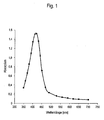
- the absorption spectrum is carried out on a 5,000-fold diluted aqueous solution containing 20 ppm nanosilver, which is clear and deep yellow in color.
- the UVvis spectrum is recorded in the wavelength range from 750 nm to 350 nm.
- the measured absorbance values give a peak with a maximum at 410 nm-420 nm and a peak half-width of about 80 nm.
- the dispersing properties of the resulting 10 percent dispersion are excellent both in polar and in non-polar solvents, that is, without further chemical effort (dispersing aids) or mechanical effort (ultrasound, Ultraturax, etc.) an absolutely clear solution, the only one by the plasmonic effect of the silver caused staining.
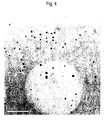
- FIG. 4 shows a transmission electron micrograph (TEM) of the dilute dispersion of Example 1.
- TEM transmission electron micrograph
- the aqueous dispersion containing silver nanoparticles obtained in Example 1 is contaminated with by-product ammonium nitrate.
- the silver nanoparticles have particle sizes of 1-20 nm and are chemically stabilized.
- the content of silver is 25 wt .-%.
- the content of water is 366 g and the content of ammonium nitrate 185 g.
- 1000 g are placed in a beaker and heated to 45 ° C with stirring.
- the separation of the dispersion into two phases is initiated by adding 78 g of potassium nitrate. After the addition and the complete dissolution of the potassium nitrate, the heater is removed and the stirrer is switched off. The separation of the phases can be observed after cooling.
- the upper, clear, aqueous phase 1 is completely decanted off.
- the remaining phase 2 has a dark brown color with a syrupy flow and a weight of 449 g.
- the stable dispersion is now ready for incorporation in any organic solvent, in particular in an acrylic or epoxy resin.
- nano-silver dispersion from Example is incorporated at a concentration of 150 mg / kg (based on the silver content in the coating), as known from the prior art, into a commercially available fluoropolymer dispersion intended for coating films.
- a stable, slightly yellow colored dispersion of nanosilver particles and fluoropolymer particles is obtained.
- This coating is knife-coated onto a PP spunbond / film laminate and thermally dried / fixed / crosslinked.
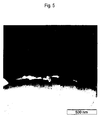
- FIG. 5 a TEM image of the coating with nanosilver is shown.
- the typically 20 nm nanosilver particles black dots in the TEM image) are not aggregated and are distributed very uniformly in the polymer coating.
- FIG. 6 The kinetics of the killing of bacteria ( E.coli .) applied to the coated nonwoven / foil laminate are shown. After only 3.5 hours, 90% of the applied germs are killed.
- Table 1 shows the result of a microbiological test according to JIS 2801 for the nonwoven / film laminate described.
- 2X10 5 bacteria are placed on the nano-silver coated nonwoven / foil laminate, on an uncoated nonwoven / foil laminate and on a standard polystyrene surface.
- the number of living germs is determined.
- the number of nuclei on the nano-silver coated nonwoven / foil laminate is reduced by 99.8% compared to the standard polystyrene, while the uncoated nonwoven / foil laminate has no germ reduction within the biological fluctuation range.
- the nano-silver coated nonwoven / foil laminate is considered to be highly antimicrobial effective.
- Table 2 shows the result of the determination of the antimycotic activity of the nano-silver coated nonwoven / foil laminate.
- the nano-silver coated nonwoven / film laminate shows significant activity against the 5 fungi tested.
- Table 1 Microbiological test according to JIS 2801 for nano-silver coated nonwoven / foil laminate with 150 ppm silver in the coating.
- the nanosilver dispersion from Example 1 is incorporated in concentrations of 100 mg / kg and 200 mg / kg (based on the silver content in the coating) with the agents of the prior art in a commercial, intended for coating textiles fluoropolymer dispersion.
- a stable, slightly yellow colored dispersion of nanosilver particles and fluoropolymer particles is obtained. This coating is applied to a textile decorative material and thermally dried / fixed / crosslinked.
- Table 3 shows the results of microbiological tests on footmuff decorative textiles with 2 different hydrophobic, aqueous coatings and two nanosilver doses each JIS 1902 shown.
- the hydrophobic, aqueous coatings AG4 and AG8 are commercially available fluoropolymer coatings.
- coating AG4 by means of a nanosilver additive of 100 mg / kg or 200 mg / kg, a strong reduction in germs is observed in each case compared to an untreated textile.
- the addition of nanosilver of 100 mg / kg is insufficient to prevent germ growth.
- An addition of 200 mg / kg causes a strong germ reduction compared to an untreated textile.
- the nano-silver dispersion of Example 1 is prepared in typical concentrations of from 1000 mg / kg to 20000 mg / kg (based on the silver content) by extrusion into commercially available thermoplastics, such as e.g. Polypropylene, polyester, polyamide incorporated. This masterbatches are obtained with predominantly isolated nanosilver particles.
- FIG. 7 shows, for example, the TEM image of a polyester masterbatch with 6500 mg / kg silver.
- the dark dots in FIG. 7 show the homogeneous distribution and the low agglomeration of the nanosilver particles in the polyester.
- the masterbatches are diluted according to the prior art to produce synthetic fibers, e.g. made of polypropylene, polyester or polyamide.
- FIG. 8 shows several microfibre strands of PET / PA with 200 mg / kg nanosilver.
- the individual nanosilver particles (bright spots) are clearly visible in the segmented yarns.
- Typical silver levels for antimicrobial effects range from 100 mg / kg to 300 mg / kg.
- monofilament and bicomponent fibers are also produced for clothing, bedding, wipes and technical textiles as well as nonwoven materials.
- the silver-containing synthetic fibers can also be used in the form of staple fibers for finishing other fibers (including natural fibers such as cotton).
- the silver levels used are at a higher level, as diluted by other fibers, compared to the direct equipment of the synthetic fibers.
- FIG. 9 shows the elution behavior ( ⁇ ) and the antimicrobial activity ( ⁇ ) of various polyester microfibers.
- the silver content of the various fibers ranges from 150 mg / kg to 195 mg / kg.
- the fibers were each in for 3 h Water elutes.
- the eluted silver content is in the range of 120 ⁇ g / kg to 200 ⁇ g / kg of water; the antimicrobial inhibition is above 96%.
- Table 4 shows the results of the antimicrobial tests according to JIS 1902 of these 5 microfibers.
- Table 4 Microbiological tests according to JIS 1902 on 5 different microfibers 1st test result After 0 h Bacterial count average value [cfu] inoculum 1,4x10⁵ After 18 h Bacterial count average value [cfu] F value Polyester fiber A0 (blank) 2.1x10 7 2.18 2-fold determination of independent samples After 18 h Bacterial count average value [cfu] % Reduction 1 R-value Polyester fiber DTY 160 / 200F with 240 ppm Ag 1.2x10 3 99.9944% 4.25 1)% reduction and R value based on Blank 2nd test method: JIS Japanese Industrial Standard JIS L 1902: 2002 * Testing for antibacterial activity and efficacy on textile products ".
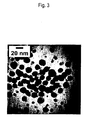
- Example 5 For the preparation of a formulation of silver nanoparticles in an epoxy resin, the product of Example 5 is used. For this purpose, 992 g of epoxy resin (Araldit TM, Huntsman) are placed in a 2 L beaker and stirred on the magnetic stirrer at room temperature. After addition of 8.0 g of the product from Example 5, the color of the solution changes to orange brown. By pivoting the glass, a thin film can be generated on the glass wall, which is light yellow, clearly colored and contains no visible particles. There are obtained 1,000 g of a dispersion having a silver content of 4,480 mg / kg. Particle size and distribution correspond to the representation in the Figures 2 and 3 ,
Landscapes
- Chemical & Material Sciences (AREA)
- Health & Medical Sciences (AREA)
- Life Sciences & Earth Sciences (AREA)
- Engineering & Computer Science (AREA)
- General Health & Medical Sciences (AREA)
- Nanotechnology (AREA)
- Veterinary Medicine (AREA)
- Public Health (AREA)
- Animal Behavior & Ethology (AREA)
- Epidemiology (AREA)
- Medicinal Chemistry (AREA)
- Organic Chemistry (AREA)
- Dentistry (AREA)
- Physics & Mathematics (AREA)
- Agronomy & Crop Science (AREA)
- Condensed Matter Physics & Semiconductors (AREA)
- General Physics & Mathematics (AREA)
- Inorganic Chemistry (AREA)
- Crystallography & Structural Chemistry (AREA)
- Zoology (AREA)
- Pest Control & Pesticides (AREA)
- Wood Science & Technology (AREA)
- Plant Pathology (AREA)
- Environmental Sciences (AREA)
- Oral & Maxillofacial Surgery (AREA)
- Transplantation (AREA)
- Dermatology (AREA)
- Surgery (AREA)
- Biomedical Technology (AREA)
- Heart & Thoracic Surgery (AREA)
- Molecular Biology (AREA)
- Vascular Medicine (AREA)
- Materials Engineering (AREA)
- Composite Materials (AREA)
- Manufacturing & Machinery (AREA)
- Chemical Kinetics & Catalysis (AREA)
- Manufacture Of Metal Powder And Suspensions Thereof (AREA)
- Materials For Medical Uses (AREA)
- Powder Metallurgy (AREA)
- Medicinal Preparation (AREA)
Claims (15)
- Formulation aqueuse en dispersion contenant des nanoparticules d'argent, comprenant de 0,5 à 60 % en poids de nanoparticules d'argent et au moins deux stabilisateurs du groupe des tensioactifs non ioniques, la proportion des nanoparticules d'argent par rapport au stabilisateur se situant dans l'ordre de 10 : 2 à 10 : 50, les au moins deux stabilisateurs étant choisis dans le groupe constitué de l'ester d'acide polyoxyéthylène-mono-alkyle, l'ester d'acide polyoxypropylène-mono-alkyle, l'ester d'acide polyoxyéthylène-di-alkyle, l'ester d'acide polyoxypropylène-di-alkyle, l'ester d'acide polyoxyéthylène-tri-alkyle, l'ester d'acide polyoxypropylène-tri-alkyle et de leurs mélanges.
- Formulation selon la revendication 1, caractérisée en ce que les stabilisateurs sont choisis dans le groupe constitué du monolaurate de polyoxyéthylène sorbitane, du monopalmitate de polyoxyéthylène sorbitane, du monostéarate de polyoxyéthylène sorbitane, du monooléate de polyoxyéthylène sorbitane, du tristéarate de polyoxyéthylène sorbitane, du trioléate de polyoxyéthylène glycéryle, du monolaurate de polyoxyéthylène glycéryle, du monooléate de polyoxyéthylène glycéryle, du monostéarate de polyoxyéthylène glycéryle, du monoricinoléate de polyéthylène glycéryle, de l'huile de ricin, de l'huile de ricin hydrogénée, de l'huile de soja et de leurs mélanges.
- Formulation selon l'une quelconque des revendications 1 et 2, caractérisée en ce que les stabilisateurs sont présents dans une proportion de l'ordre de 1 : 1 à 2:1.
- Formulation selon l'une quelconque des revendications 1 à 3, caractérisée en ce que les nanoparticules d'argent sont présentes avec une taille de particules de 1 nm à 50 nm.
- Formulation selon l'une quelconque des revendications 1 à 4, caractérisée en ce que les nanoparticules d'argent sont présentes avec une taille de particules de 1 nm à 20 nm.
- Formulation selon l'une quelconque des revendications 1 à 5, caractérisée en ce que la proportion de nanoparticules d'argent en rapport au stabilisateur se situe dans l'ordre de 10 : 5 à 10 : 10.
- Formulation selon la revendication 6, caractérisée en ce que les nanoparticules d'argent sont contenues dans la formulation dans une part de 1 % en poids à 40 % en poids.
- Formulation selon l'une quelconque des revendications 1 à 7, caractérisée en ce que la formulation contient au moins 70 % en poids d'eau.
- Procédé destiné à la préparation d'une formulation aqueuse en dispersion contenant des nanoparticules d'argent selon les revendications 1 à 8, comprenant les étapes :- Mise à disposition d'un sel d'argent,- Mise à disposition d'au moins deux stabilisateurs choisis dans le groupe contenant l'ester d'acide polyoxyéthylène-mono-alkyle, l'ester d'acide polyoxypropylène-mono-alkyle, l'ester d'acide polyoxyéthylène-di-alkyle, l'ester d'acide polyoxypropylène-di-alkyle, l'ester d'acide polyoxyéthylène-tri-alkyle, l'ester d'acide polyoxypropylène-tri-alkyle et de leurs mélanges,- Mise à disposition d'un agent réducteur,- Mise à disposition du solvant eau,- Préparation d'une solution de sel d'argent, de stabilisateur et d'agent réducteur,- Ajout d'une base à la solution, l'ajout de la base s'effectuant en continu sur une période de 5 h à 48 h, de sorte que la valeur pH de la formulation se situe entre 0 et 6.
- Procédé selon la revendication 9, caractérisé en ce que l'agent réducteur réagit avec les ions d'argent du sel d'argent en formant de l'argent élémentaire et par ailleurs principalement des produits de réaction gazeux.
- Procédé selon l'une quelconque des revendications 9 et 10, caractérisé en ce qu'on met en oeuvre de l'hydrate d'hydrazine en tant qu'agent réducteur.
- Procédé selon l'une quelconque des revendications 9 à 11, caractérisé en ce qu'en tant que base, on met en oeuvre une base avec une valeur pKb de l'ordre de -2 à 10,5.
- Procédé selon l'une quelconque des revendications 9 à 12, caractérisé en ce qu'en tant que base, on met en oeuvre de l'ammoniac, de l'hydrogénocarbonate de potassium ou de l'hydroxyde de sodium.
- Procédé selon l'une quelconque des revendications 9 à 13, caractérisé en ce que l'ajout de la base s'effectue en continu sur une période de 9 h à 30 h.
- Utilisation d'une formulation selon l'une quelconque des revendications 1 à 8 ou d'une formulation préparée selon l'une quelconque des revendications 9 à 14 pour le traitement de surfaces de bois et/ou dans des huiles d'imprégnation pour des filtres à air et/ou en tant que solution de teinture textile et/ou pour stimuler la croissance de plantes et/ou pour fabriquer des surfaces antimicrobiennes et/ou pour obtenir une conductibilité électrique et/ou pour obtenir des caractéristiques antistatiques et/ou en tant que catalyseur et/ou pour revêtir des stratifiés de film/de non-tissé et/ou pour le revêtement de matières textiles décoratives et/ou dans des laques et des agents adhésifs et/ou dans des silicones et/ou dans des matières thermoplastiques et/ou dans des bois composites (Wood Plastic Composites WPC) et/ou dans des PVC et/ou dans des plastisols et/ou pour la fabrication de textiles revêtus de PVC plastisol et/ou dans des résines thermodurcissables et/ou pour la fabrication de fibres, notamment pour la fabrication de fibres synthétiques et de fibres régénérées.
Applications Claiming Priority (2)
| Application Number | Priority Date | Filing Date | Title |
|---|---|---|---|
| DE102009059276A DE102009059276A1 (de) | 2009-12-22 | 2009-12-22 | Formulierung mit Metallnanopartikel |
| PCT/DE2010/075165 WO2011076203A1 (fr) | 2009-12-22 | 2010-12-21 | Formulation comprenant une nanoparticules métalliques |
Publications (2)
| Publication Number | Publication Date |
|---|---|
| EP2515660A1 EP2515660A1 (fr) | 2012-10-31 |
| EP2515660B1 true EP2515660B1 (fr) | 2015-02-25 |
Family
ID=43778690
Family Applications (1)
| Application Number | Title | Priority Date | Filing Date |
|---|---|---|---|
| EP10805411.5A Active EP2515660B1 (fr) | 2009-12-22 | 2010-12-21 | Formulations avec des nanoparticules d'argent |
Country Status (6)
| Country | Link |
|---|---|
| US (2) | US20150190550A1 (fr) |
| EP (1) | EP2515660B1 (fr) |
| DE (1) | DE102009059276A1 (fr) |
| ES (1) | ES2690695T3 (fr) |
| TR (1) | TR201815494T4 (fr) |
| WO (1) | WO2011076203A1 (fr) |
Cited By (1)
| Publication number | Priority date | Publication date | Assignee | Title |
|---|---|---|---|---|
| EP4119148A1 (fr) | 2021-07-16 | 2023-01-18 | BHS Medical Solutions GmbH | Nanoparticules d'argent destinées à être utilisées comme médicament |
Families Citing this family (22)
| Publication number | Priority date | Publication date | Assignee | Title |
|---|---|---|---|---|
| DE102012004841A1 (de) | 2012-03-13 | 2013-09-19 | Aap Biomaterials Gmbh | Antibakterielles, als Wundauflage verwendbares Flächengebilde und Verfahren zu dessen Herstellung |
| DE102012004842A1 (de) | 2012-03-13 | 2013-09-19 | Aap Biomaterials Gmbh | Kollagenhaltiges Flächengebilde |
| DE102012106839B4 (de) | 2012-07-27 | 2014-05-22 | Ley & Co. Farbenwerke Wunsiedel KG | WPC-Verbundwerkstoff, Verwendung desselben und Verfahren zu dessen Herstellung |
| EP2910124A4 (fr) * | 2012-10-19 | 2016-04-27 | Obshchestvo S Ogranichennoy Otvetstvennostyu Nanobiotekh | Stimulant et procédé de stimulation de la croissance et du développement de plantes |
| GB2511528A (en) | 2013-03-06 | 2014-09-10 | Speciality Fibres And Materials Ltd | Absorbent materials |
| JP6092145B2 (ja) * | 2014-03-28 | 2017-03-08 | 富士フイルム株式会社 | 抗菌層付き基材、抗菌シート、放射線撮影装置、タッチパネル |
| US12610952B2 (en) | 2014-09-23 | 2026-04-28 | Evoq Nano, Inc. | Antimicrobial compositions and methods |
| DE102015102210A1 (de) | 2015-02-16 | 2016-08-18 | Heraeus Medical Gmbh | Antimykotischer polymerisierbarer Knochenzement und ein Verfahren zu seiner Herstellung |
| US9839652B2 (en) | 2015-04-01 | 2017-12-12 | Attostat, Inc. | Nanoparticle compositions and methods for treating or preventing tissue infections and diseases |
| US11473202B2 (en) * | 2015-04-13 | 2022-10-18 | Attostat, Inc. | Anti-corrosion nanoparticle compositions |
| WO2016168346A1 (fr) * | 2015-04-13 | 2016-10-20 | Attostat, Inc. | Compositions de nanoparticules anti-corrosion |
| DE102015105831A1 (de) * | 2015-04-16 | 2016-10-20 | Rent-A-Scientist Gmbh | Metallnanopartikelhaltige, disperse Formulierung |
| IT201700007091A1 (it) * | 2017-01-24 | 2018-07-24 | Angelo Bruno Basile | Processi di semplice preparazione di plastiche fluorurate contenenti particelle di nanoargento con attivita' antibatterica |
| CA3056939A1 (fr) * | 2017-03-24 | 2018-09-27 | Koppers Performance Chemicals Inc. | Compositions de conservation de bois a base de solvant |
| US11646453B2 (en) | 2017-11-28 | 2023-05-09 | Attostat, Inc. | Nanoparticle compositions and methods for enhancing lead-acid batteries |
| US11018376B2 (en) | 2017-11-28 | 2021-05-25 | Attostat, Inc. | Nanoparticle compositions and methods for enhancing lead-acid batteries |
| CN108324994B (zh) * | 2018-04-26 | 2020-12-01 | 海口市人民医院(中南大学湘雅医学院附属海口医院) | 珍珠粉人工骨的制备方法 |
| CN109592728B (zh) * | 2019-01-28 | 2021-11-09 | 东北林业大学 | 一种纳米银粒子/木材复合水处理材料 |
| US12115250B2 (en) | 2019-07-12 | 2024-10-15 | Evoq Nano, Inc. | Use of nanoparticles for treating respiratory infections associated with cystic fibrosis |
| US12456759B2 (en) | 2021-03-30 | 2025-10-28 | Evoq Nano, Inc. | Nanoparticle-enhanced lead-acid electrode paste and improved lead-acid batteries made therefrom |
| US12594359B2 (en) * | 2022-06-16 | 2026-04-07 | Cyrus Talebpour | Antimicrobial bone cement |
| KR102776496B1 (ko) * | 2022-06-27 | 2025-03-06 | 덕산하이메탈(주) | 하드 코팅 조성물 및 그 제조방법 |
Family Cites Families (14)
| Publication number | Priority date | Publication date | Assignee | Title |
|---|---|---|---|---|
| US5147841A (en) * | 1990-11-23 | 1992-09-15 | The United States Of America As Represented By The United States Department Of Energy | Method for the preparation of metal colloids in inverse micelles and product preferred by the method |
| CN101010003B (zh) * | 2004-07-30 | 2012-07-04 | 金佰利-克拉克国际公司 | 抗微生物的银组合物 |
| US20060083694A1 (en) * | 2004-08-07 | 2006-04-20 | Cabot Corporation | Multi-component particles comprising inorganic nanoparticles distributed in an organic matrix and processes for making and using same |
| US20100096601A1 (en) * | 2005-10-27 | 2010-04-22 | Distefano Frank Vito | Molecules with complexing groups for aqueous nanoparticle dispersions and uses thereof |
| CN101296744A (zh) * | 2005-10-27 | 2008-10-29 | 气体产品与化学公司 | 用于纳米颗粒水分散体的具有络合基团的分子及其用途 |
| JP4026663B1 (ja) * | 2006-08-03 | 2007-12-26 | 大日本インキ化学工業株式会社 | 金属ナノ粒子分散体の製造方法 |
| US20090198009A1 (en) * | 2006-08-09 | 2009-08-06 | Dic Corporation | Metal nanoparticle dispersion and production process of the same |
| EP1889810A1 (fr) | 2006-08-10 | 2008-02-20 | HeiQ Materials AG | Procédé pour produire des poudres contenant des nanoparticules realisées par pyrolyse au pistolet à flamme et leurs applications |
| DE102006056284A1 (de) * | 2006-11-29 | 2008-06-05 | Helling, Günter, Dr. | Polymere mit nanoscaligen Teilchen antimikrobieller Metalle oder Metallverbindungen |
| WO2008094876A1 (fr) * | 2007-01-31 | 2008-08-07 | Novartis Ag | Dispositifs médicaux antimicrobiens comportant des nanoparticules d'argent |
| JP2008231489A (ja) * | 2007-03-19 | 2008-10-02 | Dai Ichi Kogyo Seiyaku Co Ltd | 金属ナノ粒子の製造方法及びその粒子径の制御方法 |
| US20120164073A1 (en) * | 2007-11-30 | 2012-06-28 | Old Dominion University | Stable nanoparticles, nanoparticle-based imaging systems, nanoparticle-based assays, and in vivo assays for screening biocompatibility and toxicity of nanoparticles |
| PL383968A1 (pl) | 2007-12-06 | 2009-06-08 | Poch Spółka Akcyjna | Proszek składający się z nanocząsteczek srebra metalicznego osadzonych na nośniku krzemionkowym, sposób jego otrzymywania i zastosowania |
| DE102008025108B4 (de) | 2008-05-23 | 2012-02-23 | Verein zur Förderung von Innovationen durch Forschung, Entwicklung und Technologietransfer e.V. (Verein INNOVENT e.V.) | Verfahren zur Herstellung von nanoskaligen elektrisch leitfähigen Mehrschichtsystemen |
-
2009
- 2009-12-22 DE DE102009059276A patent/DE102009059276A1/de not_active Withdrawn
-
2010
- 2010-12-21 WO PCT/DE2010/075165 patent/WO2011076203A1/fr not_active Ceased
- 2010-12-21 EP EP10805411.5A patent/EP2515660B1/fr active Active
-
2011
- 2011-08-22 US US14/408,467 patent/US20150190550A1/en not_active Abandoned
- 2011-08-22 ES ES11758380.7T patent/ES2690695T3/es active Active
- 2011-08-22 TR TR2018/15494T patent/TR201815494T4/tr unknown
-
2017
- 2017-10-18 US US15/787,238 patent/US20180055975A1/en not_active Abandoned
Cited By (1)
| Publication number | Priority date | Publication date | Assignee | Title |
|---|---|---|---|---|
| EP4119148A1 (fr) | 2021-07-16 | 2023-01-18 | BHS Medical Solutions GmbH | Nanoparticules d'argent destinées à être utilisées comme médicament |
Also Published As
| Publication number | Publication date |
|---|---|
| ES2690695T3 (es) | 2018-11-21 |
| WO2011076203A1 (fr) | 2011-06-30 |
| EP2515660A1 (fr) | 2012-10-31 |
| TR201815494T4 (tr) | 2018-11-21 |
| US20150190550A1 (en) | 2015-07-09 |
| DE102009059276A1 (de) | 2011-06-30 |
| US20180055975A1 (en) | 2018-03-01 |
Similar Documents
| Publication | Publication Date | Title |
|---|---|---|
| EP2515660B1 (fr) | Formulations avec des nanoparticules d'argent | |
| EP2140958B1 (fr) | Procédé de fabrication de dispersions de nanoparticules de métal | |
| EP2654429B1 (fr) | Procede de preparation d'une dispersion contenant des nanoparticules d'argent et utilisation comme revetement d'une composition contenant des nanoparticules d'argent | |
| EP2988794B1 (fr) | Procédé de production d'un oxyde mixte dopé pour un matériau composite et matériau composite comprenant ledit oxyde mixte | |
| DE69109351T2 (de) | Antimikrobielle Zusammensetzung. | |
| DE4106165C2 (de) | Mikrobizide | |
| WO2008131720A1 (fr) | Procédé de production d'une fibre cellulosique bioactive à haut degré de blanc | |
| EP2176329A1 (fr) | Produits antimicrobiens en matière plastique et leur procédé de réalisation | |
| EP1298092A1 (fr) | Morphogénèse controllée de sels de cuivre | |
| DE202014011236U1 (de) | Antimikrobiell wirksamer Verbundwerkstoff | |
| EP3915376A1 (fr) | Système hybride antimicrobien particulaire | |
| EP1927694A1 (fr) | Procédé de traitement des textiles avec un composant d'argent désensibilisé | |
| WO2010085945A1 (fr) | Procédé de production de nanoparticules contenant du métal, enrobées de polymères et articles pouvant être obtenus à partir desdites nanoparticules | |
| EP3949736A1 (fr) | Système hybride antimicrobien particulaire | |
| EP4187004A1 (fr) | Matière fibreuse à effet antimicrobien et neutralisant les odeurs | |
| EP3869965A1 (fr) | Molybdate de zinc à structure cristalline triclinique utilisé comme agent antimicrobien | |
| DE69126520T2 (de) | Antimikrobielle Zusammensetzung mit einer Hitze- und Witterungsbeständigkeit | |
| EP1968891B1 (fr) | Particules à l'échelle nanométrique à base de sio2 et oxydes mixtes correspondants, leur production et leur utilisation pour le traitement de materiaux textiles | |
| EP2016825A1 (fr) | Agent actif inorganique antimicrobien faiblement abrasif | |
| DE112021001600T5 (de) | Verfahren zur Herstellung eines hybriden antimikrobiellen und antiviralen Mittels aus Kupfer-Nanopartikeln und aktiven organischen Verbindungen, so hergestelltes antimikrobielles und antivirales Mittel und die Verwendung eines antimikrobiellen und antiviralen Mittels | |
| DE102011102636B3 (de) | Verfahren zur Herstellung eines antimikrobiellen Kunststoffproduktes | |
| DE102007008026A1 (de) | Biozide Zusammensetzung | |
| DE10151060B4 (de) | Kontrollierte Morphoginese von Kupfersalzen | |
| EP4120838A1 (fr) | Matériaux composites antimicrobiens améliorés contenant du tungstène | |
| DE102011102635B4 (de) | Verfahren zur Herstellung eines antimikrobiellen Kunststoffproduktes unter Verwendung eines Reduktons |
Legal Events
| Date | Code | Title | Description |
|---|---|---|---|
| PUAI | Public reference made under article 153(3) epc to a published international application that has entered the european phase |
Free format text: ORIGINAL CODE: 0009012 |
|
| 17P | Request for examination filed |
Effective date: 20120723 |
|
| AK | Designated contracting states |
Kind code of ref document: A1 Designated state(s): AL AT BE BG CH CY CZ DE DK EE ES FI FR GB GR HR HU IE IS IT LI LT LU LV MC MK MT NL NO PL PT RO RS SE SI SK SM TR |
|
| DAX | Request for extension of the european patent (deleted) | ||
| REG | Reference to a national code |
Ref country code: DE Ref legal event code: R079 Ref document number: 502010009016 Country of ref document: DE Free format text: PREVIOUS MAIN CLASS: A01N0059160000 Ipc: A01N0025040000 |
|
| RIC1 | Information provided on ipc code assigned before grant |
Ipc: B82Y 30/00 20110101ALI20140630BHEP Ipc: A01N 59/16 20060101ALI20140630BHEP Ipc: A01N 25/22 20060101ALI20140630BHEP Ipc: A01N 25/04 20060101AFI20140630BHEP Ipc: C09C 1/62 20060101ALI20140630BHEP Ipc: B82Y 40/00 20110101ALI20140630BHEP Ipc: A01N 25/34 20060101ALI20140630BHEP |
|
| GRAP | Despatch of communication of intention to grant a patent |
Free format text: ORIGINAL CODE: EPIDOSNIGR1 |
|
| INTG | Intention to grant announced |
Effective date: 20141007 |
|
| GRAS | Grant fee paid |
Free format text: ORIGINAL CODE: EPIDOSNIGR3 |
|
| GRAA | (expected) grant |
Free format text: ORIGINAL CODE: 0009210 |
|
| AK | Designated contracting states |
Kind code of ref document: B1 Designated state(s): AL AT BE BG CH CY CZ DE DK EE ES FI FR GB GR HR HU IE IS IT LI LT LU LV MC MK MT NL NO PL PT RO RS SE SI SK SM TR |
|
| REG | Reference to a national code |
Ref country code: GB Ref legal event code: FG4D Free format text: NOT ENGLISH |
|
| REG | Reference to a national code |
Ref country code: CH Ref legal event code: EP |
|
| REG | Reference to a national code |
Ref country code: IE Ref legal event code: FG4D Free format text: LANGUAGE OF EP DOCUMENT: GERMAN |
|
| REG | Reference to a national code |
Ref country code: DE Ref legal event code: R096 Ref document number: 502010009016 Country of ref document: DE Effective date: 20150402 |
|
| REG | Reference to a national code |
Ref country code: AT Ref legal event code: REF Ref document number: 711117 Country of ref document: AT Kind code of ref document: T Effective date: 20150415 Ref country code: CH Ref legal event code: NV Representative=s name: MICHELI AND CIE SA, CH |
|
| REG | Reference to a national code |
Ref country code: NL Ref legal event code: VDEP Effective date: 20150225 |
|
| REG | Reference to a national code |
Ref country code: LT Ref legal event code: MG4D |
|
| PG25 | Lapsed in a contracting state [announced via postgrant information from national office to epo] |
Ref country code: LT Free format text: LAPSE BECAUSE OF FAILURE TO SUBMIT A TRANSLATION OF THE DESCRIPTION OR TO PAY THE FEE WITHIN THE PRESCRIBED TIME-LIMIT Effective date: 20150225 Ref country code: HR Free format text: LAPSE BECAUSE OF FAILURE TO SUBMIT A TRANSLATION OF THE DESCRIPTION OR TO PAY THE FEE WITHIN THE PRESCRIBED TIME-LIMIT Effective date: 20150225 Ref country code: ES Free format text: LAPSE BECAUSE OF FAILURE TO SUBMIT A TRANSLATION OF THE DESCRIPTION OR TO PAY THE FEE WITHIN THE PRESCRIBED TIME-LIMIT Effective date: 20150225 Ref country code: NO Free format text: LAPSE BECAUSE OF FAILURE TO SUBMIT A TRANSLATION OF THE DESCRIPTION OR TO PAY THE FEE WITHIN THE PRESCRIBED TIME-LIMIT Effective date: 20150525 Ref country code: FI Free format text: LAPSE BECAUSE OF FAILURE TO SUBMIT A TRANSLATION OF THE DESCRIPTION OR TO PAY THE FEE WITHIN THE PRESCRIBED TIME-LIMIT Effective date: 20150225 Ref country code: SE Free format text: LAPSE BECAUSE OF FAILURE TO SUBMIT A TRANSLATION OF THE DESCRIPTION OR TO PAY THE FEE WITHIN THE PRESCRIBED TIME-LIMIT Effective date: 20150225 |
|
| PG25 | Lapsed in a contracting state [announced via postgrant information from national office to epo] |
Ref country code: GR Free format text: LAPSE BECAUSE OF FAILURE TO SUBMIT A TRANSLATION OF THE DESCRIPTION OR TO PAY THE FEE WITHIN THE PRESCRIBED TIME-LIMIT Effective date: 20150526 Ref country code: IS Free format text: LAPSE BECAUSE OF FAILURE TO SUBMIT A TRANSLATION OF THE DESCRIPTION OR TO PAY THE FEE WITHIN THE PRESCRIBED TIME-LIMIT Effective date: 20150625 Ref country code: LV Free format text: LAPSE BECAUSE OF FAILURE TO SUBMIT A TRANSLATION OF THE DESCRIPTION OR TO PAY THE FEE WITHIN THE PRESCRIBED TIME-LIMIT Effective date: 20150225 Ref country code: RS Free format text: LAPSE BECAUSE OF FAILURE TO SUBMIT A TRANSLATION OF THE DESCRIPTION OR TO PAY THE FEE WITHIN THE PRESCRIBED TIME-LIMIT Effective date: 20150225 |
|
| PG25 | Lapsed in a contracting state [announced via postgrant information from national office to epo] |
Ref country code: NL Free format text: LAPSE BECAUSE OF FAILURE TO SUBMIT A TRANSLATION OF THE DESCRIPTION OR TO PAY THE FEE WITHIN THE PRESCRIBED TIME-LIMIT Effective date: 20150225 |
|
| PG25 | Lapsed in a contracting state [announced via postgrant information from national office to epo] |
Ref country code: EE Free format text: LAPSE BECAUSE OF FAILURE TO SUBMIT A TRANSLATION OF THE DESCRIPTION OR TO PAY THE FEE WITHIN THE PRESCRIBED TIME-LIMIT Effective date: 20150225 Ref country code: DK Free format text: LAPSE BECAUSE OF FAILURE TO SUBMIT A TRANSLATION OF THE DESCRIPTION OR TO PAY THE FEE WITHIN THE PRESCRIBED TIME-LIMIT Effective date: 20150225 Ref country code: SK Free format text: LAPSE BECAUSE OF FAILURE TO SUBMIT A TRANSLATION OF THE DESCRIPTION OR TO PAY THE FEE WITHIN THE PRESCRIBED TIME-LIMIT Effective date: 20150225 Ref country code: CZ Free format text: LAPSE BECAUSE OF FAILURE TO SUBMIT A TRANSLATION OF THE DESCRIPTION OR TO PAY THE FEE WITHIN THE PRESCRIBED TIME-LIMIT Effective date: 20150225 Ref country code: RO Free format text: LAPSE BECAUSE OF FAILURE TO SUBMIT A TRANSLATION OF THE DESCRIPTION OR TO PAY THE FEE WITHIN THE PRESCRIBED TIME-LIMIT Effective date: 20150225 |
|
| REG | Reference to a national code |
Ref country code: DE Ref legal event code: R097 Ref document number: 502010009016 Country of ref document: DE |
|
| PG25 | Lapsed in a contracting state [announced via postgrant information from national office to epo] |
Ref country code: PL Free format text: LAPSE BECAUSE OF FAILURE TO SUBMIT A TRANSLATION OF THE DESCRIPTION OR TO PAY THE FEE WITHIN THE PRESCRIBED TIME-LIMIT Effective date: 20150225 |
|
| REG | Reference to a national code |
Ref country code: FR Ref legal event code: PLFP Year of fee payment: 6 |
|
| PLBE | No opposition filed within time limit |
Free format text: ORIGINAL CODE: 0009261 |
|
| STAA | Information on the status of an ep patent application or granted ep patent |
Free format text: STATUS: NO OPPOSITION FILED WITHIN TIME LIMIT |
|
| 26N | No opposition filed |
Effective date: 20151126 |
|
| PG25 | Lapsed in a contracting state [announced via postgrant information from national office to epo] |
Ref country code: SI Free format text: LAPSE BECAUSE OF FAILURE TO SUBMIT A TRANSLATION OF THE DESCRIPTION OR TO PAY THE FEE WITHIN THE PRESCRIBED TIME-LIMIT Effective date: 20150225 |
|
| PG25 | Lapsed in a contracting state [announced via postgrant information from national office to epo] |
Ref country code: BE Free format text: LAPSE BECAUSE OF NON-PAYMENT OF DUE FEES Effective date: 20151231 |
|
| PG25 | Lapsed in a contracting state [announced via postgrant information from national office to epo] |
Ref country code: LU Free format text: LAPSE BECAUSE OF FAILURE TO SUBMIT A TRANSLATION OF THE DESCRIPTION OR TO PAY THE FEE WITHIN THE PRESCRIBED TIME-LIMIT Effective date: 20151221 Ref country code: MC Free format text: LAPSE BECAUSE OF FAILURE TO SUBMIT A TRANSLATION OF THE DESCRIPTION OR TO PAY THE FEE WITHIN THE PRESCRIBED TIME-LIMIT Effective date: 20150225 |
|
| REG | Reference to a national code |
Ref country code: IE Ref legal event code: MM4A |
|
| PG25 | Lapsed in a contracting state [announced via postgrant information from national office to epo] |
Ref country code: IE Free format text: LAPSE BECAUSE OF NON-PAYMENT OF DUE FEES Effective date: 20151221 |
|
| REG | Reference to a national code |
Ref country code: FR Ref legal event code: PLFP Year of fee payment: 7 |
|
| PG25 | Lapsed in a contracting state [announced via postgrant information from national office to epo] |
Ref country code: HU Free format text: LAPSE BECAUSE OF FAILURE TO SUBMIT A TRANSLATION OF THE DESCRIPTION OR TO PAY THE FEE WITHIN THE PRESCRIBED TIME-LIMIT; INVALID AB INITIO Effective date: 20101221 Ref country code: BG Free format text: LAPSE BECAUSE OF FAILURE TO SUBMIT A TRANSLATION OF THE DESCRIPTION OR TO PAY THE FEE WITHIN THE PRESCRIBED TIME-LIMIT Effective date: 20150225 Ref country code: SM Free format text: LAPSE BECAUSE OF FAILURE TO SUBMIT A TRANSLATION OF THE DESCRIPTION OR TO PAY THE FEE WITHIN THE PRESCRIBED TIME-LIMIT Effective date: 20150225 |
|
| PG25 | Lapsed in a contracting state [announced via postgrant information from national office to epo] |
Ref country code: CY Free format text: LAPSE BECAUSE OF FAILURE TO SUBMIT A TRANSLATION OF THE DESCRIPTION OR TO PAY THE FEE WITHIN THE PRESCRIBED TIME-LIMIT Effective date: 20150225 |
|
| PG25 | Lapsed in a contracting state [announced via postgrant information from national office to epo] |
Ref country code: MT Free format text: LAPSE BECAUSE OF FAILURE TO SUBMIT A TRANSLATION OF THE DESCRIPTION OR TO PAY THE FEE WITHIN THE PRESCRIBED TIME-LIMIT Effective date: 20150225 |
|
| REG | Reference to a national code |
Ref country code: FR Ref legal event code: PLFP Year of fee payment: 8 |
|
| PG25 | Lapsed in a contracting state [announced via postgrant information from national office to epo] |
Ref country code: TR Free format text: LAPSE BECAUSE OF FAILURE TO SUBMIT A TRANSLATION OF THE DESCRIPTION OR TO PAY THE FEE WITHIN THE PRESCRIBED TIME-LIMIT Effective date: 20150225 Ref country code: MK Free format text: LAPSE BECAUSE OF FAILURE TO SUBMIT A TRANSLATION OF THE DESCRIPTION OR TO PAY THE FEE WITHIN THE PRESCRIBED TIME-LIMIT Effective date: 20150225 Ref country code: PT Free format text: LAPSE BECAUSE OF FAILURE TO SUBMIT A TRANSLATION OF THE DESCRIPTION OR TO PAY THE FEE WITHIN THE PRESCRIBED TIME-LIMIT Effective date: 20150225 |
|
| PG25 | Lapsed in a contracting state [announced via postgrant information from national office to epo] |
Ref country code: AL Free format text: LAPSE BECAUSE OF FAILURE TO SUBMIT A TRANSLATION OF THE DESCRIPTION OR TO PAY THE FEE WITHIN THE PRESCRIBED TIME-LIMIT Effective date: 20150225 |
|
| REG | Reference to a national code |
Ref country code: DE Ref legal event code: R081 Ref document number: 502010009016 Country of ref document: DE Owner name: MH INVESTMENT GMBH, DE Free format text: FORMER OWNER: RENT-A-SCIENTIST GMBH, 93059 REGENSBURG, DE Ref country code: DE Ref legal event code: R081 Ref document number: 502010009016 Country of ref document: DE Owner name: HEIQ RAS AG, DE Free format text: FORMER OWNER: RENT-A-SCIENTIST GMBH, 93059 REGENSBURG, DE |
|
| REG | Reference to a national code |
Ref country code: DE Ref legal event code: R081 Ref document number: 502010009016 Country of ref document: DE Owner name: MH INVESTMENT GMBH, DE Free format text: FORMER OWNER: HEIQ RAS AG, 93053 REGENSBURG, DE |
|
| REG | Reference to a national code |
Ref country code: GB Ref legal event code: 732E Free format text: REGISTERED BETWEEN 20241024 AND 20241030 |
|
| REG | Reference to a national code |
Ref country code: AT Ref legal event code: PC Ref document number: 711117 Country of ref document: AT Kind code of ref document: T Owner name: HEIQ RAS AG, DE Effective date: 20241210 |
|
| REG | Reference to a national code |
Ref country code: AT Ref legal event code: PC Ref document number: 711117 Country of ref document: AT Kind code of ref document: T Owner name: MH INVESTMENT GMBH, DE Effective date: 20250317 |
|
| REG | Reference to a national code |
Ref country code: CH Ref legal event code: U11 Free format text: ST27 STATUS EVENT CODE: U-0-0-U10-U11 (AS PROVIDED BY THE NATIONAL OFFICE) Effective date: 20260101 |
|
| PGFP | Annual fee paid to national office [announced via postgrant information from national office to epo] |
Ref country code: GB Payment date: 20251219 Year of fee payment: 16 |
|
| PGFP | Annual fee paid to national office [announced via postgrant information from national office to epo] |
Ref country code: AT Payment date: 20251222 Year of fee payment: 16 |
|
| PGFP | Annual fee paid to national office [announced via postgrant information from national office to epo] |
Ref country code: IT Payment date: 20251223 Year of fee payment: 16 |
|
| PGFP | Annual fee paid to national office [announced via postgrant information from national office to epo] |
Ref country code: FR Payment date: 20251222 Year of fee payment: 16 |
|
| PGFP | Annual fee paid to national office [announced via postgrant information from national office to epo] |
Ref country code: DE Payment date: 20251230 Year of fee payment: 16 |
|
| PGFP | Annual fee paid to national office [announced via postgrant information from national office to epo] |
Ref country code: CH Payment date: 20260101 Year of fee payment: 16 |