EP2517856A1 - Mehrschichtige Laminatstruktur mit reversibler Verklebung - Google Patents
Mehrschichtige Laminatstruktur mit reversibler Verklebung Download PDFInfo
- Publication number
- EP2517856A1 EP2517856A1 EP11163007A EP11163007A EP2517856A1 EP 2517856 A1 EP2517856 A1 EP 2517856A1 EP 11163007 A EP11163007 A EP 11163007A EP 11163007 A EP11163007 A EP 11163007A EP 2517856 A1 EP2517856 A1 EP 2517856A1
- Authority
- EP
- European Patent Office
- Prior art keywords
- layer
- laminate structure
- substrate layer
- adhesive film
- decorative
- Prior art date
- Legal status (The legal status is an assumption and is not a legal conclusion. Google has not performed a legal analysis and makes no representation as to the accuracy of the status listed.)
- Ceased
Links
Images


Classifications
-
- B—PERFORMING OPERATIONS; TRANSPORTING
- B32—LAYERED PRODUCTS
- B32B—LAYERED PRODUCTS, i.e. PRODUCTS BUILT-UP OF STRATA OF FLAT OR NON-FLAT, e.g. CELLULAR OR HONEYCOMB, FORM
- B32B43/00—Operations specially adapted for layered products and not otherwise provided for, e.g. repairing; Apparatus therefor
- B32B43/006—Delaminating
-
- B—PERFORMING OPERATIONS; TRANSPORTING
- B29—WORKING OF PLASTICS; WORKING OF SUBSTANCES IN A PLASTIC STATE IN GENERAL
- B29C—SHAPING OR JOINING OF PLASTICS; SHAPING OF MATERIAL IN A PLASTIC STATE, NOT OTHERWISE PROVIDED FOR; AFTER-TREATMENT OF THE SHAPED PRODUCTS, e.g. REPAIRING
- B29C53/00—Shaping by bending, folding, twisting, straightening or flattening; Apparatus therefor
- B29C53/02—Bending or folding
- B29C53/04—Bending or folding of plates or sheets
-
- B—PERFORMING OPERATIONS; TRANSPORTING
- B32—LAYERED PRODUCTS
- B32B—LAYERED PRODUCTS, i.e. PRODUCTS BUILT-UP OF STRATA OF FLAT OR NON-FLAT, e.g. CELLULAR OR HONEYCOMB, FORM
- B32B27/00—Layered products comprising a layer of synthetic resin
- B32B27/06—Layered products comprising a layer of synthetic resin as the main or only constituent of a layer, which is next to another layer of the same or of a different material
-
- B—PERFORMING OPERATIONS; TRANSPORTING
- B32—LAYERED PRODUCTS
- B32B—LAYERED PRODUCTS, i.e. PRODUCTS BUILT-UP OF STRATA OF FLAT OR NON-FLAT, e.g. CELLULAR OR HONEYCOMB, FORM
- B32B27/00—Layered products comprising a layer of synthetic resin
- B32B27/32—Layered products comprising a layer of synthetic resin comprising polyolefins
-
- B—PERFORMING OPERATIONS; TRANSPORTING
- B32—LAYERED PRODUCTS
- B32B—LAYERED PRODUCTS, i.e. PRODUCTS BUILT-UP OF STRATA OF FLAT OR NON-FLAT, e.g. CELLULAR OR HONEYCOMB, FORM
- B32B7/00—Layered products characterised by the relation between layers; Layered products characterised by the relative orientation of features between layers, or by the relative values of a measurable parameter between layers, i.e. products comprising layers having different physical, chemical or physicochemical properties; Layered products characterised by the interconnection of layers
- B32B7/04—Interconnection of layers
- B32B7/06—Interconnection of layers permitting easy separation
-
- B—PERFORMING OPERATIONS; TRANSPORTING
- B29—WORKING OF PLASTICS; WORKING OF SUBSTANCES IN A PLASTIC STATE IN GENERAL
- B29C—SHAPING OR JOINING OF PLASTICS; SHAPING OF MATERIAL IN A PLASTIC STATE, NOT OTHERWISE PROVIDED FOR; AFTER-TREATMENT OF THE SHAPED PRODUCTS, e.g. REPAIRING
- B29C51/00—Shaping by thermoforming, i.e. shaping sheets or sheet like preforms after heating, e.g. shaping sheets in matched moulds or by deep-drawing; Apparatus therefor
- B29C51/14—Shaping by thermoforming, i.e. shaping sheets or sheet like preforms after heating, e.g. shaping sheets in matched moulds or by deep-drawing; Apparatus therefor using multilayered preforms or sheets
-
- B—PERFORMING OPERATIONS; TRANSPORTING
- B29—WORKING OF PLASTICS; WORKING OF SUBSTANCES IN A PLASTIC STATE IN GENERAL
- B29L—INDEXING SCHEME ASSOCIATED WITH SUBCLASS B29C, RELATING TO PARTICULAR ARTICLES
- B29L2009/00—Layered products
-
- B—PERFORMING OPERATIONS; TRANSPORTING
- B32—LAYERED PRODUCTS
- B32B—LAYERED PRODUCTS, i.e. PRODUCTS BUILT-UP OF STRATA OF FLAT OR NON-FLAT, e.g. CELLULAR OR HONEYCOMB, FORM
- B32B2317/00—Animal or vegetable based
- B32B2317/12—Paper, e.g. cardboard
-
- B—PERFORMING OPERATIONS; TRANSPORTING
- B32—LAYERED PRODUCTS
- B32B—LAYERED PRODUCTS, i.e. PRODUCTS BUILT-UP OF STRATA OF FLAT OR NON-FLAT, e.g. CELLULAR OR HONEYCOMB, FORM
- B32B2317/00—Animal or vegetable based
- B32B2317/12—Paper, e.g. cardboard
- B32B2317/125—Paper, e.g. cardboard impregnated with thermosetting resin
-
- B—PERFORMING OPERATIONS; TRANSPORTING
- B32—LAYERED PRODUCTS
- B32B—LAYERED PRODUCTS, i.e. PRODUCTS BUILT-UP OF STRATA OF FLAT OR NON-FLAT, e.g. CELLULAR OR HONEYCOMB, FORM
- B32B2317/00—Animal or vegetable based
- B32B2317/16—Wood, e.g. woodboard, fibreboard, woodchips
-
- B—PERFORMING OPERATIONS; TRANSPORTING
- B32—LAYERED PRODUCTS
- B32B—LAYERED PRODUCTS, i.e. PRODUCTS BUILT-UP OF STRATA OF FLAT OR NON-FLAT, e.g. CELLULAR OR HONEYCOMB, FORM
- B32B2323/00—Polyalkenes
-
- B—PERFORMING OPERATIONS; TRANSPORTING
- B32—LAYERED PRODUCTS
- B32B—LAYERED PRODUCTS, i.e. PRODUCTS BUILT-UP OF STRATA OF FLAT OR NON-FLAT, e.g. CELLULAR OR HONEYCOMB, FORM
- B32B2607/00—Walls, panels
-
- B—PERFORMING OPERATIONS; TRANSPORTING
- B32—LAYERED PRODUCTS
- B32B—LAYERED PRODUCTS, i.e. PRODUCTS BUILT-UP OF STRATA OF FLAT OR NON-FLAT, e.g. CELLULAR OR HONEYCOMB, FORM
- B32B37/00—Methods or apparatus for laminating, e.g. by curing or by ultrasonic bonding
- B32B37/08—Methods or apparatus for laminating, e.g. by curing or by ultrasonic bonding characterised by the cooling method
-
- B—PERFORMING OPERATIONS; TRANSPORTING
- B32—LAYERED PRODUCTS
- B32B—LAYERED PRODUCTS, i.e. PRODUCTS BUILT-UP OF STRATA OF FLAT OR NON-FLAT, e.g. CELLULAR OR HONEYCOMB, FORM
- B32B37/00—Methods or apparatus for laminating, e.g. by curing or by ultrasonic bonding
- B32B37/12—Methods or apparatus for laminating, e.g. by curing or by ultrasonic bonding characterised by using adhesives
- B32B37/1207—Heat-activated adhesive
-
- B—PERFORMING OPERATIONS; TRANSPORTING
- B32—LAYERED PRODUCTS
- B32B—LAYERED PRODUCTS, i.e. PRODUCTS BUILT-UP OF STRATA OF FLAT OR NON-FLAT, e.g. CELLULAR OR HONEYCOMB, FORM
- B32B37/00—Methods or apparatus for laminating, e.g. by curing or by ultrasonic bonding
- B32B37/14—Methods or apparatus for laminating, e.g. by curing or by ultrasonic bonding characterised by the properties of the layers
- B32B37/15—Methods or apparatus for laminating, e.g. by curing or by ultrasonic bonding characterised by the properties of the layers with at least one layer being manufactured and immediately laminated before reaching its stable state, e.g. in which a layer is extruded and laminated while in semi-molten state
- B32B37/153—Methods or apparatus for laminating, e.g. by curing or by ultrasonic bonding characterised by the properties of the layers with at least one layer being manufactured and immediately laminated before reaching its stable state, e.g. in which a layer is extruded and laminated while in semi-molten state at least one layer is extruded and immediately laminated while in semi-molten state
Definitions
- the present invention relates to a multi-layer laminate structure, to a process for forming the multi-layer laminate structure and to a process for dismantling the multi-layer laminate structure.
- the multi-layer laminate structure comprises a substrate layer and at least one decorative layer bonded to the substrate layer.
- Multi-layer laminate structures are used for decorative and construction purposes, in particular for demanding applications e.g. flooring, office furniture, wall cladding and wet rooms. These structures are in general produced in panels and may be formed to a desired product shape.
- the substrate layer consists of polyolefin and the decorative layer of a high pressure laminate (HPL).
- HPL high pressure laminate
- the substrate layer may have a decorative layers on one or both sides.
- EP 2 186 636 discloses a multi-layer laminate structure and a process for the production of such structure.
- This multi-layer laminate structure is based on thermoplastic resins and decorative plastic laminates. According to the method disclosed the bonding of the thermoplastic resins with the decorative plastic laminate is thermally induced. This method requires plasma surface activation. Plasma surface activation is complicated. The method is restricted to the production of flat panel multi-layer laminate structures.
- the multi-layer laminate structure tolerates only a restricted (thermal) shape forming and not every desired shape may be formed. Moreover deformation of the laminate structures introduces undesired tensions in the structure. End of product life this multi-layer structure may not be dismantled in separate layers. Recycling in reusable starting material is not possible and therefore the structure and method according to EP 2 186 636 do not meet the cradle-to-cradle principle.
- WO2009/033673 describes a multi-layer laminate structure and a process for the production of such structure.
- the substrate layer consists of fibre reinforced porous thermoplastic.
- the adhesive is anchored in the pores of the porous thermoplastic.
- a decorative layer is attached to the substrate layer by the adhesive.
- This multi-layer laminate structure is designed such that it is stiff and inflexible and accordingly does not tolerate (thermal) shape forming. End of product life this multi-layer structure may not be dismantled in separate layers. Recycling in reusable starting material is not possible and therefore also the structure and method according to WO2009/033672 do not meet the cradle-to-cradle principle.
- the present invention intends to solve the problems of the prior art as described above, and it is in particular an objective of the invention to provide a multi-layer laminate structure that is more easily to be produced, that provides more design freedom and that is recyclable (in the individual components) at the end of product life. Moreover the invention intends to provide a process to produce such multi-layer laminate structure as well as a process for dismantling such multi-layer laminate structure.
- the multi-layer laminate structure according to the invention comprises a substrate layer and a decorative layer which are reversible bonded.
- This structure has an optimal bend ability and requires less complicated bending techniques, for instance readily available vacuum table- and thermoforming techniques may be used. Simply by bending the structure before bonding or by reversing the bonding between the substrate layer and the decorative layer, followed by bending the structure and bonding (again), a large design freedom is obtained. The obtained shapes are more stable due to less internal tension. Also the difference between forward and backward bending is negligible. Moreover the structure is easily to dismantle in a separate substrate layer and a separate decorative layer. The structures meets in this the cradle-to-cradle principle for recycling of products at end of their life.
- the reversible bonding may consist of an adhesive film on the substrate layer and/or an adhesive film on the decorative layer.
- the adhesive film may be a polyolefin resin which has good reversible bonding characteristics.
- the first adhesive film on the substrate layer and the second adhesive film on the decorative layer may be compatible such that an optimal bonding/disconnection is obtained.
- thermoplastic will in general provide optimal shape forming conditions to the substrate layer and in particular polyolefin's such as polypropylene and polyethylene are suitable.
- a substrate layer at least partly made of polypropylene may be provided with a living hinge.
- the substrate layer and the adhesive film may be co extruded.
- This intermediate product may be produced at lower costs and in different shapes. Such intermediate product may be kept longer in stock without the need to have it integrated in the final product before an expiration date on short time. This provides flexibility to the production of finished products as in a later stage it may be decided which decorative layer will be applied for the finished multi-layer laminate structure.
- the substrate layer may be provided with a reinforced top layer, in particular a glass fiber top layer. This will result in a strong substrate layer with large impact resistance.
- the adhesive layer is provided on the reinforced top layer.
- the substrate layer may be provided with a top layer having which laminate or wood flour embedded in the surface. This will result in an easy to adhere surface with a high surface energy compared to polyolefin based substrates.
- the decorative layer is preferably a pressure laminate, such as high pressure laminate (HPL), continuous pressure laminate (CPL) or direct pressure laminate (DPL).
- HPL high pressure laminate
- CPL continuous pressure laminate
- DPL direct pressure laminate
- the decorative layer may, for instance, also comprise decorative (melamine faced) paper sheet, veneer sheets, metallic sheets, non-woven fabrics, polymeric films or leather.
- the substrate layer has preferably a thickness in the range of 1 to 25 mm to obtain sufficient strength on one hand and sufficient bend ability on the other hand.
- the decorative layer has preferably a thickness in the range of 0,1 to 2,5 mm.
- the process according to the invention for the production of a multi-layer laminate structure comprises the steps of a) providing an adhesive film on a substrate layer and/or on a decorative layer, b) placing the decorative layer on the substrate layer, and c) fusion of the adhesive film(s).
- This is a uncomplicated process that may be performed on readily available equipment without expensive pre-treatments.
- Both the substrate layer and the decorative layer may be provided with a first respectively second compatible adhesive layer.
- the process may comprise the step of co extrusion of the substrate layer and the adhesive film. This reduces the number or required steps, reduces costs and is less time consuming. Moreover the co extruded substrate may be produced in different shapes.
- the process may comprise a preceding step in which a reinforce top layer is provided on the substrate layer.
- the top layer may be bonded to the substrate layer by an additional adhesive film or by hot melt adhesion.
- This step may be performed on a readily available flatbed laminator or a roller coat laminator.
- the multi-layer laminate structure may be bend in a desired shape.
- This intermediate step may be performed before fusion of the adhesive film(s).
- this bending step may also be performed at any time after fusion. This requires the additional step of reversing the bonding. After bending, both adhesive layers will be bonded (again).
- heat treatment may include a forced cooling after bending in order to improve shape stability.
- This process makes it also possible to correct products by reheating and re-bending. Mistakes during the process may therefore be corrected. The number of rejections is reduced and unnecessary scrap is avoided.
- the invention also provides a process for the dismantling the multilayer laminate structure comprising the steps of a) heating the multi-layer laminate structure and b) separating the substrate layer and the decorative layer. This process is uncomplicated and may be performed on readily available equipment. The hybrid product is in this way separated in base material ready for recycling.
- the multi-layer laminate structure meets the cradle-to-cradle principle.
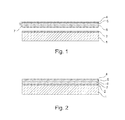
- the multi-layer laminate structure of Figure 1 consists of a substrate layer 1.
- This layer is in general a flexible thermoplastic such as polyolefin, in particular polypropylene or polyethylene, however, also other materials may be applied (MDF, OSB, Plywood, Chipboard).
- MDF polypropylene
- OSB polypropylene
- Plywood Plywood
- Chipboard Polypropylene
- the substrate layer is provided with a first adhesive film 2.
- This is a polyolefin adhesive film.
- This first adhesive film 2 is co extruded with the substrate layer 1.
- the co extruded substrate layer 1 and the first adhesive film have a panel shape. However, by applying co extrusion the substrate layer may have different shapes and may therefore be preformed.
- the substrate layer is single sided provided with an adhesive film, however, also double sided is possible in case on both sides a decorative layer should be provided. It is also possible to cover the substrate layer with a reinforce top layer. The adhesive film will then be provided on the reinforce top layer.
- the reinforce top layer which may consist of glass fibre, will provide additional strength, improved flame retardation and improved impact resistance to the substrate layer.
- the decorative layer 3 of this example itself consists of several layers (4,5,6) and is typically made of a pressure laminate such as high pressure laminate (HPL), continuous pressure laminate (CPL) or direct pressure laminate (DPL).
- HPL consists of layers of specially selected kraft and printed decorative papers impregnated with thermosetting synthetic resins. These are fused together under heat and high pressure in a controlled environment so that the component parts consolidate to form a single high density decorative layer.
- the decorative layer 3 is provided with a second adhesive film 7.
- This second adhesive film 7 is compatible with the first adhesive film 2 on the substrate layer.
- the first and second adhesive film will fuse, when brought together under high temperature. This is presented in Figure 2 .
- By fusion a strong bonding is obtained. Additional pressure during heating may even enhance the strength of the bonding.
- the bonding is reversible. After heating the bonding will loosen.
- the multi-layer laminate structure may then be separated in the substrate layer 1 and the decorative layer 3. Both layers may then be recycled at the end of life, meeting accordingly the cradle to cradle principle.
- Another beneficial aspect of the reversible bonding is that after reversing the bonding by heating the multi-layer laminate structure may be more easily formed in a desired shape, which provides large design freedom. While cooling down the bonding will recover.
- the multi-layer laminate structure will observe considerable lower internal tensions compared to prior art laminate structures and has therefore a more stable shape. Forced cooling will further enhance shape stability. Also the differences between forward and backward bending are negligible.
- Figure 3 shows the example structure of Figures 1 and 2 after strong bending.
- Such strong bending is in particular possible in case the thicknesses of both the substrate layer and the decorative layer are designed in ranges provided for by the invention. In this way an optimum of strength and formability is obtained.
- FIG. 4 provides a schematic illustration of a process for the production of a multi-layer laminate structure according to the invention.
- a substrate layer 9 is co extruded with a first adhesive film 16 to a flat panel.
- first adhesive film 16 to a flat panel.
- process step 10 a decorative layer 11 of high pressure laminate is provide with a second adhesive layer 17.
- the decorative layer 11 is placed on the substrate layer 9 such that both the first and second adhesive film 16 respectively 17 are in close contact.
- the assembly is then placed in a heating equipment 12.
- the compatible first and second adhesive layer will fuse under high temperature, resulting in a strong bonding after cooling down. Forced cooling may enhance shape stability.
- the strength of the bonding is further enhanced by putting pressure on heating blocks 13,14 of the heating equipment.
- FIG. 5 An example process including bending of the multi-layer laminate structure of the invention is illustrated in Figure 5 .
- the laminate panel 18 of the structure according to the invention is placed in heating equipment 12 where under high temperature the bonding of the first and second adhesive film are reversed.
- the substrate layer 19 and the decorative layer 22 are then separated until the temperature is sufficient low and no fusion between both adhesive films 20, 21 will occur.
- a contact area 23 remains between them, along which both layer may move relative to each other without introducing strong tensions in the layers.
- the assembly is then placed on a bending equipment 15. After bending the bend multi-layer structure is heated again such that fusion occurs and the substrate layer 19 and the decorative layer 20 are bonded again.
- An additional step may be forced cooling of the structure after bending. This will result in a more stable shape.
Landscapes
- Engineering & Computer Science (AREA)
- Mechanical Engineering (AREA)
- Laminated Bodies (AREA)
Priority Applications (2)
| Application Number | Priority Date | Filing Date | Title |
|---|---|---|---|
| EP11163007A EP2517856A1 (de) | 2011-04-19 | 2011-04-19 | Mehrschichtige Laminatstruktur mit reversibler Verklebung |
| PCT/EP2012/054774 WO2012143190A1 (en) | 2011-04-19 | 2012-03-19 | Multi-layer laminate structure with reversible bonding |
Applications Claiming Priority (1)
| Application Number | Priority Date | Filing Date | Title |
|---|---|---|---|
| EP11163007A EP2517856A1 (de) | 2011-04-19 | 2011-04-19 | Mehrschichtige Laminatstruktur mit reversibler Verklebung |
Publications (1)
| Publication Number | Publication Date |
|---|---|
| EP2517856A1 true EP2517856A1 (de) | 2012-10-31 |
Family
ID=45888190
Family Applications (1)
| Application Number | Title | Priority Date | Filing Date |
|---|---|---|---|
| EP11163007A Ceased EP2517856A1 (de) | 2011-04-19 | 2011-04-19 | Mehrschichtige Laminatstruktur mit reversibler Verklebung |
Country Status (2)
| Country | Link |
|---|---|
| EP (1) | EP2517856A1 (de) |
| WO (1) | WO2012143190A1 (de) |
Cited By (3)
| Publication number | Priority date | Publication date | Assignee | Title |
|---|---|---|---|---|
| WO2014181031A1 (en) | 2013-05-10 | 2014-11-13 | Upm-Kymmene Wood Oy | A panel comprising a solid surface coating on a thermally deformable support |
| CN104196194A (zh) * | 2014-09-25 | 2014-12-10 | 广州市致盛建筑材料有限公司 | 建筑装饰用弯曲hpl板及其制造方法 |
| FR3006937A1 (fr) * | 2013-06-14 | 2014-12-19 | Yann Maurice Gastel | Procede d'obtention d'une cale pelable non plane et cale pelable non plane ainsi obtenue |
Families Citing this family (2)
| Publication number | Priority date | Publication date | Assignee | Title |
|---|---|---|---|---|
| CN103496173B (zh) * | 2013-09-11 | 2016-06-08 | 重庆大学 | 一种具有孔洞的复合材料层合板制造方法 |
| CN112622246B (zh) * | 2020-12-02 | 2023-02-10 | 翟骏龙 | 针对汽车内饰边角料的平整方法 |
Citations (9)
| Publication number | Priority date | Publication date | Assignee | Title |
|---|---|---|---|---|
| EP0015316A1 (de) * | 1978-12-27 | 1980-09-17 | RESOPAL WERK H. Römmler GmbH | Nachformbare dekorative Schichtpressstoffplatte und Verfahren zu ihrer Herstellung |
| US5047456A (en) * | 1989-04-21 | 1991-09-10 | Kimberly-Clark Corporation | Thermally reversible superabsorbent polymers |
| WO1998030386A1 (de) * | 1997-01-13 | 1998-07-16 | Symalit Ag | Thermoplastisch verformbarer verbundkörper |
| DE19936304A1 (de) * | 1998-09-19 | 2000-03-23 | Alkor Gmbh | Mehrschichtige thermoverformbare Möbelkunststoffverbundfolie oder damit hergestellte Möbelteile sowie Verfahren zur Herstellung der Möbel-Kunststoffverbundfolie |
| DE19919181A1 (de) * | 1999-04-29 | 2000-11-02 | Univ Magdeburg Tech | Verfahren und Vorrichtung zum Separieren von biegesteifen Metall-Hartschaumstoff-Sandwichverbundplatten |
| WO2009033673A1 (de) | 2007-09-12 | 2009-03-19 | Phoenix Contact Gmbh & Co. Kg | Elektrische vorrichtung |
| WO2009033672A1 (de) | 2007-09-11 | 2009-03-19 | Quadrant Plastic Composites Ag | Verbundplatte auf basis von hochdruck-schichtpressstoffplatten (hpl-platten) |
| EP2186636A1 (de) | 2008-11-13 | 2010-05-19 | ABET LAMINATI S.p.A. | Verfahren zur Herstellung dekorativer Platten basierend auf einem thermoplastischen Harz, Anlage zur Durchführung des Verfahren und damit hergestellte Platten |
| CA2681897A1 (en) * | 2009-10-08 | 2011-04-08 | National Research Council Of Canada | Microfluidic device, composition and method of forming |
-
2011
- 2011-04-19 EP EP11163007A patent/EP2517856A1/de not_active Ceased
-
2012
- 2012-03-19 WO PCT/EP2012/054774 patent/WO2012143190A1/en not_active Ceased
Patent Citations (9)
| Publication number | Priority date | Publication date | Assignee | Title |
|---|---|---|---|---|
| EP0015316A1 (de) * | 1978-12-27 | 1980-09-17 | RESOPAL WERK H. Römmler GmbH | Nachformbare dekorative Schichtpressstoffplatte und Verfahren zu ihrer Herstellung |
| US5047456A (en) * | 1989-04-21 | 1991-09-10 | Kimberly-Clark Corporation | Thermally reversible superabsorbent polymers |
| WO1998030386A1 (de) * | 1997-01-13 | 1998-07-16 | Symalit Ag | Thermoplastisch verformbarer verbundkörper |
| DE19936304A1 (de) * | 1998-09-19 | 2000-03-23 | Alkor Gmbh | Mehrschichtige thermoverformbare Möbelkunststoffverbundfolie oder damit hergestellte Möbelteile sowie Verfahren zur Herstellung der Möbel-Kunststoffverbundfolie |
| DE19919181A1 (de) * | 1999-04-29 | 2000-11-02 | Univ Magdeburg Tech | Verfahren und Vorrichtung zum Separieren von biegesteifen Metall-Hartschaumstoff-Sandwichverbundplatten |
| WO2009033672A1 (de) | 2007-09-11 | 2009-03-19 | Quadrant Plastic Composites Ag | Verbundplatte auf basis von hochdruck-schichtpressstoffplatten (hpl-platten) |
| WO2009033673A1 (de) | 2007-09-12 | 2009-03-19 | Phoenix Contact Gmbh & Co. Kg | Elektrische vorrichtung |
| EP2186636A1 (de) | 2008-11-13 | 2010-05-19 | ABET LAMINATI S.p.A. | Verfahren zur Herstellung dekorativer Platten basierend auf einem thermoplastischen Harz, Anlage zur Durchführung des Verfahren und damit hergestellte Platten |
| CA2681897A1 (en) * | 2009-10-08 | 2011-04-08 | National Research Council Of Canada | Microfluidic device, composition and method of forming |
Non-Patent Citations (4)
| Title |
|---|
| ""Cradle to Cradle Certification"", 2008, MCDONOUGH BRAUNGART DESIGN CHEMISTRY, LLC, pages: 21 - 22 * |
| "TKH-4 Merkblatt "Schmelzklebstoffe"", January 2006 (2006-01-01), pages 1 - 12, XP002646952, Retrieved from the Internet <URL:http://www.klebstoffe.com/07_publikation/pdf/050601_MB_TKH_4_RZ-navi.pdf> [retrieved on 20110629] * |
| J.M.G. COWIE: "Polymers: Chemistry and Physics of Modern Materials", NELSON THORNES, pages: 17 - 17 * |
| RAMANI K ET AL: "DIE-LESS FORMING OF THERMOPLASTIC-MATRIX CONTINUOUS FIBER COMPOSITEMATERIALS - PROCESS AND DEMONSTRATION", TRANSACTIONS OF THE AMERICAN SOCIETY OF MECHANICAL ENGINEERS,SERIES B: JOURNAL OF ENGINEERING FOR INDUSTRY, vol. 117, no. 4, 1 November 1995 (1995-11-01), ASME. NEW YORK, US, pages 501 - 507, XP000541187, ISSN: 0022-0817 * |
Cited By (5)
| Publication number | Priority date | Publication date | Assignee | Title |
|---|---|---|---|---|
| WO2014181031A1 (en) | 2013-05-10 | 2014-11-13 | Upm-Kymmene Wood Oy | A panel comprising a solid surface coating on a thermally deformable support |
| FR3006937A1 (fr) * | 2013-06-14 | 2014-12-19 | Yann Maurice Gastel | Procede d'obtention d'une cale pelable non plane et cale pelable non plane ainsi obtenue |
| WO2014199080A3 (fr) * | 2013-06-14 | 2015-04-16 | Gastel Yann Maurice | Procédé d'obtention d'une cale pelable non plane et cale pelable non plane ainsi obtenue |
| CN105377544A (zh) * | 2013-06-14 | 2016-03-02 | 雅恩·莫里斯·加斯特尔 | 一种非平面可剥离楔块的获取方法以及由此取得的非平面可剥离楔块 |
| CN104196194A (zh) * | 2014-09-25 | 2014-12-10 | 广州市致盛建筑材料有限公司 | 建筑装饰用弯曲hpl板及其制造方法 |
Also Published As
| Publication number | Publication date |
|---|---|
| WO2012143190A1 (en) | 2012-10-26 |
Similar Documents
| Publication | Publication Date | Title |
|---|---|---|
| EP3744924B1 (de) | Zur montage einer wasserfesten boden- oder wandabdeckung geeignetes paneel, verfahren zur herstellung eines paneels | |
| KR101519555B1 (ko) | 섬유 복합재 재질의 부품을 제조하는 방법, 프리폼, 및 부품 | |
| EP3020885B1 (de) | Zur montage einer wasserfesten boden- oder wandabdeckung geeignetes paneel, verfahren zur herstellung eines paneels | |
| EP1504888B1 (de) | Verfahren zur Herstellung eines Laminats mit einem Falz | |
| CN108883595B (zh) | 折叠式蜂窝状结构及其制造方法 | |
| CN103153608A (zh) | 一种包括聚合物复合材料层的板及制造该板的方法 | |
| KR101543600B1 (ko) | 경량성 다층 복합 기재 및 그 제조방법 | |
| WO2012143190A1 (en) | Multi-layer laminate structure with reversible bonding | |
| JP5074096B2 (ja) | 端部処理された複層板、並びにその製造方法 | |
| CN106313863A (zh) | 用于制造镶板部件的方法 | |
| HUP9903573A2 (hu) | Profillal ellátott tömör felületű laminátumok, eljárás előállításukra és alkalmazásuk | |
| US20070020441A1 (en) | Core for a sandwich panel manufactured by deep drawing and a sandwich panel thereby | |
| WO2011075046A1 (en) | A laminate | |
| KR101726164B1 (ko) | 천연섬유 복합소재를 이용한 자동차의 내장재 제조방법 | |
| US20060213137A1 (en) | Thermofused reinforced decorative composite material with thermoplastic stiffener core | |
| US20210370624A1 (en) | Method for producing a thermoplastically deformable, fiber-reinforced flat semi-finished product | |
| SK81496A3 (en) | Plastics-paper laminated composite and its use and a method of producing laminated pressed board | |
| US10751984B2 (en) | Method of bonding a thermoplastic component to a carpeted component and the carpeted component to a cellulose-based core in a single pressing step | |
| WO2011031223A1 (en) | Method for manufacturing a panel | |
| EP1570984A1 (de) | Leichteres, verstärktes, dekoratives Verbundmaterial | |
| US20240308198A1 (en) | Composite panel | |
| KR20140004432U (ko) | 플라스틱 적층 포장판재구조 | |
| EP4234266A1 (de) | Laminat und verfahren zur herstellung eines laminats | |
| TW201307060A (zh) | 多層板及其製法與發泡產品 | |
| JP7208626B2 (ja) | 化粧複合板及び絞り加工された化粧複合板の製造方法 |
Legal Events
| Date | Code | Title | Description |
|---|---|---|---|
| PUAI | Public reference made under article 153(3) epc to a published international application that has entered the european phase |
Free format text: ORIGINAL CODE: 0009012 |
|
| AK | Designated contracting states |
Kind code of ref document: A1 Designated state(s): AL AT BE BG CH CY CZ DE DK EE ES FI FR GB GR HR HU IE IS IT LI LT LU LV MC MK MT NL NO PL PT RO RS SE SI SK SM TR |
|
| AX | Request for extension of the european patent |
Extension state: BA ME |
|
| 17P | Request for examination filed |
Effective date: 20130226 |
|
| 17Q | First examination report despatched |
Effective date: 20130422 |
|
| STAA | Information on the status of an ep patent application or granted ep patent |
Free format text: STATUS: THE APPLICATION HAS BEEN REFUSED |
|
| 18R | Application refused |
Effective date: 20141120 |