EP2520166A1 - Neue Bisaminpropylamide und Verwendungen davon in Landwirtschafts- und Reinigungsmittelzusammensetzungen - Google Patents
Neue Bisaminpropylamide und Verwendungen davon in Landwirtschafts- und Reinigungsmittelzusammensetzungen Download PDFInfo
- Publication number
- EP2520166A1 EP2520166A1 EP11164846A EP11164846A EP2520166A1 EP 2520166 A1 EP2520166 A1 EP 2520166A1 EP 11164846 A EP11164846 A EP 11164846A EP 11164846 A EP11164846 A EP 11164846A EP 2520166 A1 EP2520166 A1 EP 2520166A1
- Authority
- EP
- European Patent Office
- Prior art keywords
- formula
- tertiary amide
- carbon atoms
- amine
- amide
- Prior art date
- Legal status (The legal status is an assumption and is not a legal conclusion. Google has not performed a legal analysis and makes no representation as to the accuracy of the status listed.)
- Withdrawn
Links
- 239000000203 mixture Substances 0.000 title claims abstract description 52
- 239000003599 detergent Substances 0.000 title claims abstract description 19
- 239000002671 adjuvant Substances 0.000 claims abstract description 55
- 239000004094 surface-active agent Substances 0.000 claims abstract description 44
- 150000001875 compounds Chemical class 0.000 claims abstract description 27
- 239000000575 pesticide Substances 0.000 claims abstract description 22
- 239000002904 solvent Substances 0.000 claims abstract description 19
- 239000003337 fertilizer Substances 0.000 claims abstract description 10
- 150000003511 tertiary amides Chemical class 0.000 claims description 39
- 239000004009 herbicide Substances 0.000 claims description 37
- 125000004432 carbon atom Chemical group C* 0.000 claims description 34
- 230000002363 herbicidal effect Effects 0.000 claims description 32
- XLYOFNOQVPJJNP-UHFFFAOYSA-N water Substances O XLYOFNOQVPJJNP-UHFFFAOYSA-N 0.000 claims description 27
- 125000002496 methyl group Chemical group [H]C([H])([H])* 0.000 claims description 26
- 238000000034 method Methods 0.000 claims description 22
- 125000001931 aliphatic group Chemical group 0.000 claims description 21
- 150000001408 amides Chemical class 0.000 claims description 20
- 238000006243 chemical reaction Methods 0.000 claims description 17
- 238000004519 manufacturing process Methods 0.000 claims description 17
- 239000003945 anionic surfactant Substances 0.000 claims description 14
- 239000003054 catalyst Substances 0.000 claims description 13
- 239000007795 chemical reaction product Substances 0.000 claims description 8
- 125000000217 alkyl group Chemical group 0.000 claims description 7
- 229910052739 hydrogen Inorganic materials 0.000 claims description 7
- 239000001257 hydrogen Substances 0.000 claims description 7
- 239000007788 liquid Substances 0.000 claims description 6
- 150000003334 secondary amides Chemical class 0.000 claims description 6
- 239000012872 agrochemical composition Substances 0.000 claims description 5
- 150000001732 carboxylic acid derivatives Chemical class 0.000 claims description 5
- 239000000417 fungicide Substances 0.000 claims description 5
- 125000002924 primary amino group Chemical class [H]N([H])* 0.000 claims description 5
- UFHFLCQGNIYNRP-UHFFFAOYSA-N Hydrogen Chemical compound [H][H] UFHFLCQGNIYNRP-UHFFFAOYSA-N 0.000 claims description 4
- 230000000895 acaricidal effect Effects 0.000 claims description 4
- 239000000642 acaricide Substances 0.000 claims description 4
- 230000000855 fungicidal effect Effects 0.000 claims description 4
- 238000005984 hydrogenation reaction Methods 0.000 claims description 4
- 239000002917 insecticide Substances 0.000 claims description 4
- 150000001266 acyl halides Chemical class 0.000 claims description 3
- 125000003277 amino group Chemical group 0.000 claims description 3
- 150000001450 anions Chemical class 0.000 claims description 3
- 125000004435 hydrogen atom Chemical group [H]* 0.000 claims description 3
- 150000002825 nitriles Chemical class 0.000 claims description 3
- 239000000344 soap Substances 0.000 claims description 3
- 150000003512 tertiary amines Chemical class 0.000 claims description 3
- 230000002152 alkylating effect Effects 0.000 claims description 2
- 125000003118 aryl group Chemical group 0.000 claims description 2
- 150000001244 carboxylic acid anhydrides Chemical class 0.000 claims description 2
- 150000001733 carboxylic acid esters Chemical class 0.000 claims description 2
- 125000002560 nitrile group Chemical group 0.000 claims description 2
- 125000000467 secondary amino group Chemical class [H]N([*:1])[*:2] 0.000 claims 7
- 239000000243 solution Substances 0.000 description 26
- 241000196324 Embryophyta Species 0.000 description 25
- 150000003335 secondary amines Chemical class 0.000 description 24
- 239000003752 hydrotrope Substances 0.000 description 17
- 238000012360 testing method Methods 0.000 description 17
- 239000005562 Glyphosate Substances 0.000 description 16
- XDDAORKBJWWYJS-UHFFFAOYSA-N glyphosate Chemical class OC(=O)CNCP(O)(O)=O XDDAORKBJWWYJS-UHFFFAOYSA-N 0.000 description 16
- 229940097068 glyphosate Drugs 0.000 description 16
- -1 aliphatic amines Chemical class 0.000 description 15
- IUNMPGNGSSIWFP-UHFFFAOYSA-N dimethylaminopropylamine Chemical compound CN(C)CCCN IUNMPGNGSSIWFP-UHFFFAOYSA-N 0.000 description 13
- 150000003141 primary amines Chemical class 0.000 description 13
- 238000002474 experimental method Methods 0.000 description 12
- 150000001412 amines Chemical class 0.000 description 11
- 239000006260 foam Substances 0.000 description 11
- 244000061457 Solanum nigrum Species 0.000 description 10
- 235000002594 Solanum nigrum Nutrition 0.000 description 10
- 239000006227 byproduct Substances 0.000 description 10
- 238000009472 formulation Methods 0.000 description 10
- 230000002209 hydrophobic effect Effects 0.000 description 10
- 239000000047 product Substances 0.000 description 10
- RTZKZFJDLAIYFH-UHFFFAOYSA-N Diethyl ether Chemical compound CCOCC RTZKZFJDLAIYFH-UHFFFAOYSA-N 0.000 description 9
- 241000209140 Triticum Species 0.000 description 9
- 150000003839 salts Chemical class 0.000 description 9
- QGZKDVFQNNGYKY-UHFFFAOYSA-N Ammonia Chemical compound N QGZKDVFQNNGYKY-UHFFFAOYSA-N 0.000 description 8
- 235000021307 Triticum Nutrition 0.000 description 8
- 239000002253 acid Substances 0.000 description 8
- 230000008901 benefit Effects 0.000 description 8
- IWEDIXLBFLAXBO-UHFFFAOYSA-N dicamba Chemical class COC1=C(Cl)C=CC(Cl)=C1C(O)=O IWEDIXLBFLAXBO-UHFFFAOYSA-N 0.000 description 8
- 230000012010 growth Effects 0.000 description 8
- 238000002360 preparation method Methods 0.000 description 8
- QUCDWLYKDRVKMI-UHFFFAOYSA-M sodium;3,4-dimethylbenzenesulfonate Chemical compound [Na+].CC1=CC=C(S([O-])(=O)=O)C=C1C QUCDWLYKDRVKMI-UHFFFAOYSA-M 0.000 description 8
- 238000005063 solubilization Methods 0.000 description 8
- 230000007928 solubilization Effects 0.000 description 8
- VEXZGXHMUGYJMC-UHFFFAOYSA-N Hydrochloric acid Chemical group Cl VEXZGXHMUGYJMC-UHFFFAOYSA-N 0.000 description 7
- DBMJMQXJHONAFJ-UHFFFAOYSA-M Sodium laurylsulphate Chemical compound [Na+].CCCCCCCCCCCCOS([O-])(=O)=O DBMJMQXJHONAFJ-UHFFFAOYSA-M 0.000 description 7
- 238000005917 acylation reaction Methods 0.000 description 7
- XJWSAJYUBXQQDR-UHFFFAOYSA-M dodecyltrimethylammonium bromide Chemical compound [Br-].CCCCCCCCCCCC[N+](C)(C)C XJWSAJYUBXQQDR-UHFFFAOYSA-M 0.000 description 7
- 239000002244 precipitate Substances 0.000 description 7
- 239000005504 Dicamba Chemical class 0.000 description 6
- LYCAIKOWRPUZTN-UHFFFAOYSA-N Ethylene glycol Chemical compound OCCO LYCAIKOWRPUZTN-UHFFFAOYSA-N 0.000 description 6
- ZMANZCXQSJIPKH-UHFFFAOYSA-N Triethylamine Chemical compound CCN(CC)CC ZMANZCXQSJIPKH-UHFFFAOYSA-N 0.000 description 6
- 239000000654 additive Substances 0.000 description 6
- 230000015572 biosynthetic process Effects 0.000 description 6
- 235000014113 dietary fatty acids Nutrition 0.000 description 6
- SNRUBQQJIBEYMU-UHFFFAOYSA-N dodecane Chemical compound CCCCCCCCCCCC SNRUBQQJIBEYMU-UHFFFAOYSA-N 0.000 description 6
- 150000002148 esters Chemical class 0.000 description 6
- 239000000194 fatty acid Substances 0.000 description 6
- 229930195729 fatty acid Natural products 0.000 description 6
- 240000006122 Chenopodium album Species 0.000 description 5
- 230000010933 acylation Effects 0.000 description 5
- 238000004220 aggregation Methods 0.000 description 5
- 150000001735 carboxylic acids Chemical class 0.000 description 5
- 150000001767 cationic compounds Chemical class 0.000 description 5
- 150000001805 chlorine compounds Chemical class 0.000 description 5
- 230000000694 effects Effects 0.000 description 5
- PQKBPHSEKWERTG-LLVKDONJSA-N ethyl (2r)-2-[4-[(6-chloro-1,3-benzoxazol-2-yl)oxy]phenoxy]propanoate Chemical group C1=CC(O[C@H](C)C(=O)OCC)=CC=C1OC1=NC2=CC=C(Cl)C=C2O1 PQKBPHSEKWERTG-LLVKDONJSA-N 0.000 description 5
- 150000004665 fatty acids Chemical class 0.000 description 5
- FOTVCCRFPBEZEL-UHFFFAOYSA-N n,n-bis[3-(dimethylamino)propyl]octanamide Chemical compound CCCCCCCC(=O)N(CCCN(C)C)CCCN(C)C FOTVCCRFPBEZEL-UHFFFAOYSA-N 0.000 description 5
- 230000008569 process Effects 0.000 description 5
- 230000009467 reduction Effects 0.000 description 5
- FEJPWLNPOFOBSP-UHFFFAOYSA-N 2-[4-[(2-chloro-4-nitrophenyl)diazenyl]-n-ethylanilino]ethanol Chemical compound C1=CC(N(CCO)CC)=CC=C1N=NC1=CC=C([N+]([O-])=O)C=C1Cl FEJPWLNPOFOBSP-UHFFFAOYSA-N 0.000 description 4
- CSNNHWWHGAXBCP-UHFFFAOYSA-L Magnesium sulfate Chemical compound [Mg+2].[O-][S+2]([O-])([O-])[O-] CSNNHWWHGAXBCP-UHFFFAOYSA-L 0.000 description 4
- JUJWROOIHBZHMG-UHFFFAOYSA-N Pyridine Chemical compound C1=CC=NC=C1 JUJWROOIHBZHMG-UHFFFAOYSA-N 0.000 description 4
- WYURNTSHIVDZCO-UHFFFAOYSA-N Tetrahydrofuran Chemical compound C1CCOC1 WYURNTSHIVDZCO-UHFFFAOYSA-N 0.000 description 4
- 230000000240 adjuvant effect Effects 0.000 description 4
- 239000003905 agrochemical Substances 0.000 description 4
- 229910021529 ammonia Inorganic materials 0.000 description 4
- NEHMKBQYUWJMIP-UHFFFAOYSA-N chloromethane Chemical compound ClC NEHMKBQYUWJMIP-UHFFFAOYSA-N 0.000 description 4
- 230000002354 daily effect Effects 0.000 description 4
- 238000004821 distillation Methods 0.000 description 4
- 239000000975 dye Substances 0.000 description 4
- 239000000463 material Substances 0.000 description 4
- QSHDDOUJBYECFT-UHFFFAOYSA-N mercury Chemical compound [Hg] QSHDDOUJBYECFT-UHFFFAOYSA-N 0.000 description 4
- 229910052753 mercury Inorganic materials 0.000 description 4
- 239000011785 micronutrient Substances 0.000 description 4
- 235000013369 micronutrients Nutrition 0.000 description 4
- 235000015097 nutrients Nutrition 0.000 description 4
- WWZKQHOCKIZLMA-UHFFFAOYSA-N octanoic acid Chemical compound CCCCCCCC(O)=O WWZKQHOCKIZLMA-UHFFFAOYSA-N 0.000 description 4
- 239000004033 plastic Substances 0.000 description 4
- 229920003023 plastic Polymers 0.000 description 4
- 230000003389 potentiating effect Effects 0.000 description 4
- 238000004382 potting Methods 0.000 description 4
- 239000004576 sand Substances 0.000 description 4
- 239000007787 solid Substances 0.000 description 4
- 239000000126 substance Substances 0.000 description 4
- LZZYPRNAOMGNLH-UHFFFAOYSA-M Cetrimonium bromide Chemical compound [Br-].CCCCCCCCCCCCCCCC[N+](C)(C)C LZZYPRNAOMGNLH-UHFFFAOYSA-M 0.000 description 3
- 235000011498 Chenopodium album var missouriense Nutrition 0.000 description 3
- 235000013328 Chenopodium album var. album Nutrition 0.000 description 3
- 235000014052 Chenopodium album var. microphyllum Nutrition 0.000 description 3
- 235000014050 Chenopodium album var. stevensii Nutrition 0.000 description 3
- 235000013012 Chenopodium album var. striatum Nutrition 0.000 description 3
- YMWUJEATGCHHMB-UHFFFAOYSA-N Dichloromethane Chemical compound ClCCl YMWUJEATGCHHMB-UHFFFAOYSA-N 0.000 description 3
- LFQSCWFLJHTTHZ-UHFFFAOYSA-N Ethanol Chemical compound CCO LFQSCWFLJHTTHZ-UHFFFAOYSA-N 0.000 description 3
- PEDCQBHIVMGVHV-UHFFFAOYSA-N Glycerine Chemical compound OCC(O)CO PEDCQBHIVMGVHV-UHFFFAOYSA-N 0.000 description 3
- DNIAPMSPPWPWGF-UHFFFAOYSA-N Propylene glycol Chemical compound CC(O)CO DNIAPMSPPWPWGF-UHFFFAOYSA-N 0.000 description 3
- HEMHJVSKTPXQMS-UHFFFAOYSA-M Sodium hydroxide Chemical compound [OH-].[Na+] HEMHJVSKTPXQMS-UHFFFAOYSA-M 0.000 description 3
- 230000000996 additive effect Effects 0.000 description 3
- 239000003093 cationic surfactant Substances 0.000 description 3
- 239000003795 chemical substances by application Substances 0.000 description 3
- 238000003053 completely randomized design Methods 0.000 description 3
- 238000007405 data analysis Methods 0.000 description 3
- 238000013401 experimental design Methods 0.000 description 3
- JJWLVOIRVHMVIS-UHFFFAOYSA-N isopropylamine Chemical class CC(C)N JJWLVOIRVHMVIS-UHFFFAOYSA-N 0.000 description 3
- 238000002156 mixing Methods 0.000 description 3
- SWVGZFQJXVPIKM-UHFFFAOYSA-N n,n-bis(methylamino)propan-1-amine Chemical compound CCCN(NC)NC SWVGZFQJXVPIKM-UHFFFAOYSA-N 0.000 description 3
- 229920002635 polyurethane Polymers 0.000 description 3
- 239000004814 polyurethane Substances 0.000 description 3
- 229940057950 sodium laureth sulfate Drugs 0.000 description 3
- 229940048842 sodium xylenesulfonate Drugs 0.000 description 3
- SXHLENDCVBIJFO-UHFFFAOYSA-M sodium;2-[2-(2-dodecoxyethoxy)ethoxy]ethyl sulfate Chemical compound [Na+].CCCCCCCCCCCCOCCOCCOCCOS([O-])(=O)=O SXHLENDCVBIJFO-UHFFFAOYSA-M 0.000 description 3
- 239000002689 soil Substances 0.000 description 3
- 239000007858 starting material Substances 0.000 description 3
- 231100000419 toxicity Toxicity 0.000 description 3
- 230000001988 toxicity Effects 0.000 description 3
- NGNBDVOYPDDBFK-UHFFFAOYSA-N 2-[2,4-di(pentan-2-yl)phenoxy]acetyl chloride Chemical compound CCCC(C)C1=CC=C(OCC(Cl)=O)C(C(C)CCC)=C1 NGNBDVOYPDDBFK-UHFFFAOYSA-N 0.000 description 2
- IJGRMHOSHXDMSA-UHFFFAOYSA-N Atomic nitrogen Chemical compound N#N IJGRMHOSHXDMSA-UHFFFAOYSA-N 0.000 description 2
- 241000209764 Avena fatua Species 0.000 description 2
- 235000007320 Avena fatua Nutrition 0.000 description 2
- OKTJSMMVPCPJKN-UHFFFAOYSA-N Carbon Chemical group [C] OKTJSMMVPCPJKN-UHFFFAOYSA-N 0.000 description 2
- 239000005492 Carfentrazone-ethyl Substances 0.000 description 2
- 235000009344 Chenopodium album Nutrition 0.000 description 2
- HEDRZPFGACZZDS-UHFFFAOYSA-N Chloroform Chemical compound ClC(Cl)Cl HEDRZPFGACZZDS-UHFFFAOYSA-N 0.000 description 2
- 239000005630 Diquat Substances 0.000 description 2
- DGAQECJNVWCQMB-PUAWFVPOSA-M Ilexoside XXIX Chemical compound C[C@@H]1CC[C@@]2(CC[C@@]3(C(=CC[C@H]4[C@]3(CC[C@@H]5[C@@]4(CC[C@@H](C5(C)C)OS(=O)(=O)[O-])C)C)[C@@H]2[C@]1(C)O)C)C(=O)O[C@H]6[C@@H]([C@H]([C@@H]([C@H](O6)CO)O)O)O.[Na+] DGAQECJNVWCQMB-PUAWFVPOSA-M 0.000 description 2
- XEEYBQQBJWHFJM-UHFFFAOYSA-N Iron Chemical compound [Fe] XEEYBQQBJWHFJM-UHFFFAOYSA-N 0.000 description 2
- CDBYLPFSWZWCQE-UHFFFAOYSA-L Sodium Carbonate Chemical compound [Na+].[Na+].[O-]C([O-])=O CDBYLPFSWZWCQE-UHFFFAOYSA-L 0.000 description 2
- WQDUMFSSJAZKTM-UHFFFAOYSA-N Sodium methoxide Chemical compound [Na+].[O-]C WQDUMFSSJAZKTM-UHFFFAOYSA-N 0.000 description 2
- QAOWNCQODCNURD-UHFFFAOYSA-L Sulfate Chemical compound [O-]S([O-])(=O)=O QAOWNCQODCNURD-UHFFFAOYSA-L 0.000 description 2
- 230000002776 aggregation Effects 0.000 description 2
- OBETXYAYXDNJHR-UHFFFAOYSA-N alpha-ethylcaproic acid Natural products CCCCC(CC)C(O)=O OBETXYAYXDNJHR-UHFFFAOYSA-N 0.000 description 2
- 238000007112 amidation reaction Methods 0.000 description 2
- 125000003368 amide group Chemical group 0.000 description 2
- BFNBIHQBYMNNAN-UHFFFAOYSA-N ammonium sulfate Chemical compound N.N.OS(O)(=O)=O BFNBIHQBYMNNAN-UHFFFAOYSA-N 0.000 description 2
- 229910052921 ammonium sulfate Inorganic materials 0.000 description 2
- 239000001166 ammonium sulphate Substances 0.000 description 2
- 235000011130 ammonium sulphate Nutrition 0.000 description 2
- 239000007864 aqueous solution Substances 0.000 description 2
- 125000001797 benzyl group Chemical group [H]C1=C([H])C([H])=C(C([H])=C1[H])C([H])([H])* 0.000 description 2
- 125000002091 cationic group Chemical group 0.000 description 2
- 238000004140 cleaning Methods 0.000 description 2
- 239000007859 condensation product Substances 0.000 description 2
- 230000003750 conditioning effect Effects 0.000 description 2
- 230000007797 corrosion Effects 0.000 description 2
- 238000005260 corrosion Methods 0.000 description 2
- 239000006184 cosolvent Substances 0.000 description 2
- 150000004985 diamines Chemical class 0.000 description 2
- 238000009792 diffusion process Methods 0.000 description 2
- SYJFEGQWDCRVNX-UHFFFAOYSA-N diquat Chemical compound C1=CC=[N+]2CC[N+]3=CC=CC=C3C2=C1 SYJFEGQWDCRVNX-UHFFFAOYSA-N 0.000 description 2
- 239000003814 drug Substances 0.000 description 2
- 230000002708 enhancing effect Effects 0.000 description 2
- 150000002170 ethers Chemical class 0.000 description 2
- MLKCGVHIFJBRCD-UHFFFAOYSA-N ethyl 2-chloro-3-{2-chloro-5-[4-(difluoromethyl)-3-methyl-5-oxo-4,5-dihydro-1H-1,2,4-triazol-1-yl]-4-fluorophenyl}propanoate Chemical group C1=C(Cl)C(CC(Cl)C(=O)OCC)=CC(N2C(N(C(F)F)C(C)=N2)=O)=C1F MLKCGVHIFJBRCD-UHFFFAOYSA-N 0.000 description 2
- SFNALCNOMXIBKG-UHFFFAOYSA-N ethylene glycol monododecyl ether Chemical compound CCCCCCCCCCCCOCCO SFNALCNOMXIBKG-UHFFFAOYSA-N 0.000 description 2
- 238000001914 filtration Methods 0.000 description 2
- 238000005187 foaming Methods 0.000 description 2
- 150000004820 halides Chemical class 0.000 description 2
- 239000004615 ingredient Substances 0.000 description 2
- 229910052943 magnesium sulfate Inorganic materials 0.000 description 2
- 229940050176 methyl chloride Drugs 0.000 description 2
- 150000004702 methyl esters Chemical class 0.000 description 2
- 239000000693 micelle Substances 0.000 description 2
- PSHKMPUSSFXUIA-UHFFFAOYSA-N n,n-dimethylpyridin-2-amine Chemical compound CN(C)C1=CC=CC=N1 PSHKMPUSSFXUIA-UHFFFAOYSA-N 0.000 description 2
- 239000012074 organic phase Substances 0.000 description 2
- 239000003960 organic solvent Substances 0.000 description 2
- 238000005191 phase separation Methods 0.000 description 2
- 229920000768 polyamine Polymers 0.000 description 2
- UMJSCPRVCHMLSP-UHFFFAOYSA-N pyridine Natural products COC1=CC=CN=C1 UMJSCPRVCHMLSP-UHFFFAOYSA-N 0.000 description 2
- 239000002453 shampoo Substances 0.000 description 2
- 239000011734 sodium Substances 0.000 description 2
- 229910052708 sodium Inorganic materials 0.000 description 2
- 229910021653 sulphate ion Inorganic materials 0.000 description 2
- 125000002948 undecyl group Chemical group [H]C([*])([H])C([H])([H])C([H])([H])C([H])([H])C([H])([H])C([H])([H])C([H])([H])C([H])([H])C([H])([H])C([H])([H])C([H])([H])[H] 0.000 description 2
- 239000002699 waste material Substances 0.000 description 2
- ZMYFCFLJBGAQRS-IRXDYDNUSA-N (2R,3S)-epoxiconazole Chemical compound C1=CC(F)=CC=C1[C@@]1(CN2N=CN=C2)[C@H](C=2C(=CC=CC=2)Cl)O1 ZMYFCFLJBGAQRS-IRXDYDNUSA-N 0.000 description 1
- 0 *C(N(CCCN(*)*)CCCN(*)*)=O Chemical compound *C(N(CCCN(*)*)CCCN(*)*)=O 0.000 description 1
- GYSCBCSGKXNZRH-UHFFFAOYSA-N 1-benzothiophene-2-carboxamide Chemical compound C1=CC=C2SC(C(=O)N)=CC2=C1 GYSCBCSGKXNZRH-UHFFFAOYSA-N 0.000 description 1
- PFFANLXVTHIIBE-UHFFFAOYSA-N 1-methyl-4-pyridin-4-ylpyridin-1-ium Chemical compound C1=C[N+](C)=CC=C1C1=CC=NC=C1 PFFANLXVTHIIBE-UHFFFAOYSA-N 0.000 description 1
- OVSKIKFHRZPJSS-DOMIDYPGSA-N 2-(2,4-dichlorophenoxy)acetic acid Chemical class OC(=O)[14CH2]OC1=CC=C(Cl)C=C1Cl OVSKIKFHRZPJSS-DOMIDYPGSA-N 0.000 description 1
- SFJPGSCMZIUEDJ-UHFFFAOYSA-N 2-[2-[[carboxy-(2-hydroxy-4-methylphenyl)methyl]amino]ethylamino]-2-(2-hydroxy-4-methylphenyl)acetic acid Chemical compound OC1=CC(C)=CC=C1C(C(O)=O)NCCNC(C(O)=O)C1=CC=C(C)C=C1O SFJPGSCMZIUEDJ-UHFFFAOYSA-N 0.000 description 1
- URDCARMUOSMFFI-UHFFFAOYSA-N 2-[2-[bis(carboxymethyl)amino]ethyl-(2-hydroxyethyl)amino]acetic acid Chemical compound OCCN(CC(O)=O)CCN(CC(O)=O)CC(O)=O URDCARMUOSMFFI-UHFFFAOYSA-N 0.000 description 1
- IAJOBQBIJHVGMQ-UHFFFAOYSA-N 2-amino-4-[hydroxy(methyl)phosphoryl]butanoic acid Chemical compound CP(O)(=O)CCC(N)C(O)=O IAJOBQBIJHVGMQ-UHFFFAOYSA-N 0.000 description 1
- CAAMSDWKXXPUJR-UHFFFAOYSA-N 3,5-dihydro-4H-imidazol-4-one Chemical class O=C1CNC=N1 CAAMSDWKXXPUJR-UHFFFAOYSA-N 0.000 description 1
- NLHHRLWOUZZQLW-UHFFFAOYSA-N Acrylonitrile Chemical compound C=CC#N NLHHRLWOUZZQLW-UHFFFAOYSA-N 0.000 description 1
- 235000004535 Avena sterilis Nutrition 0.000 description 1
- 239000005730 Azoxystrobin Substances 0.000 description 1
- ZOXJGFHDIHLPTG-UHFFFAOYSA-N Boron Chemical compound [B] ZOXJGFHDIHLPTG-UHFFFAOYSA-N 0.000 description 1
- KXDHJXZQYSOELW-UHFFFAOYSA-N Carbamic acid Chemical class NC(O)=O KXDHJXZQYSOELW-UHFFFAOYSA-N 0.000 description 1
- 239000004215 Carbon black (E152) Substances 0.000 description 1
- VEXZGXHMUGYJMC-UHFFFAOYSA-M Chloride anion Chemical compound [Cl-] VEXZGXHMUGYJMC-UHFFFAOYSA-M 0.000 description 1
- RYGMFSIKBFXOCR-UHFFFAOYSA-N Copper Chemical compound [Cu] RYGMFSIKBFXOCR-UHFFFAOYSA-N 0.000 description 1
- GHVNFZFCNZKVNT-UHFFFAOYSA-N Decanoic acid Natural products CCCCCCCCCC(O)=O GHVNFZFCNZKVNT-UHFFFAOYSA-N 0.000 description 1
- KCXVZYZYPLLWCC-UHFFFAOYSA-N EDTA Chemical compound OC(=O)CN(CC(O)=O)CCN(CC(O)=O)CC(O)=O KCXVZYZYPLLWCC-UHFFFAOYSA-N 0.000 description 1
- 102000004190 Enzymes Human genes 0.000 description 1
- 108090000790 Enzymes Proteins 0.000 description 1
- 239000005767 Epoxiconazole Substances 0.000 description 1
- PIICEJLVQHRZGT-UHFFFAOYSA-N Ethylenediamine Chemical class NCCN PIICEJLVQHRZGT-UHFFFAOYSA-N 0.000 description 1
- 239000005561 Glufosinate Substances 0.000 description 1
- 239000005800 Kresoxim-methyl Substances 0.000 description 1
- 239000004367 Lipase Substances 0.000 description 1
- 102000004882 Lipase Human genes 0.000 description 1
- 108090001060 Lipase Proteins 0.000 description 1
- FYYHWMGAXLPEAU-UHFFFAOYSA-N Magnesium Chemical compound [Mg] FYYHWMGAXLPEAU-UHFFFAOYSA-N 0.000 description 1
- ZOKXTWBITQBERF-UHFFFAOYSA-N Molybdenum Chemical compound [Mo] ZOKXTWBITQBERF-UHFFFAOYSA-N 0.000 description 1
- QPCDCPDFJACHGM-UHFFFAOYSA-N N,N-bis{2-[bis(carboxymethyl)amino]ethyl}glycine Chemical compound OC(=O)CN(CC(O)=O)CCN(CC(=O)O)CCN(CC(O)=O)CC(O)=O QPCDCPDFJACHGM-UHFFFAOYSA-N 0.000 description 1
- 102000035195 Peptidases Human genes 0.000 description 1
- 108091005804 Peptidases Proteins 0.000 description 1
- OAICVXFJPJFONN-UHFFFAOYSA-N Phosphorus Chemical compound [P] OAICVXFJPJFONN-UHFFFAOYSA-N 0.000 description 1
- 241000209504 Poaceae Species 0.000 description 1
- 239000004698 Polyethylene Substances 0.000 description 1
- ZLMJMSJWJFRBEC-UHFFFAOYSA-N Potassium Chemical compound [K] ZLMJMSJWJFRBEC-UHFFFAOYSA-N 0.000 description 1
- 239000005822 Propiconazole Substances 0.000 description 1
- 239000004365 Protease Substances 0.000 description 1
- 238000003436 Schotten-Baumann reaction Methods 0.000 description 1
- UIIMBOGNXHQVGW-UHFFFAOYSA-M Sodium bicarbonate Chemical class [Na+].OC([O-])=O UIIMBOGNXHQVGW-UHFFFAOYSA-M 0.000 description 1
- 229930182692 Strobilurin Natural products 0.000 description 1
- NINIDFKCEFEMDL-UHFFFAOYSA-N Sulfur Chemical compound [S] NINIDFKCEFEMDL-UHFFFAOYSA-N 0.000 description 1
- 239000005864 Sulphur Substances 0.000 description 1
- WHKUVVPPKQRRBV-UHFFFAOYSA-N Trasan Chemical class CC1=CC(Cl)=CC=C1OCC(O)=O WHKUVVPPKQRRBV-UHFFFAOYSA-N 0.000 description 1
- HCHKCACWOHOZIP-UHFFFAOYSA-N Zinc Chemical compound [Zn] HCHKCACWOHOZIP-UHFFFAOYSA-N 0.000 description 1
- 150000007513 acids Chemical class 0.000 description 1
- 239000004480 active ingredient Substances 0.000 description 1
- 239000011149 active material Substances 0.000 description 1
- 150000001335 aliphatic alkanes Chemical class 0.000 description 1
- 239000002168 alkylating agent Substances 0.000 description 1
- 230000009435 amidation Effects 0.000 description 1
- 150000008064 anhydrides Chemical class 0.000 description 1
- 125000000129 anionic group Chemical group 0.000 description 1
- 239000002518 antifoaming agent Substances 0.000 description 1
- 239000007798 antifreeze agent Substances 0.000 description 1
- 238000013459 approach Methods 0.000 description 1
- 239000008346 aqueous phase Substances 0.000 description 1
- WFDXOXNFNRHQEC-GHRIWEEISA-N azoxystrobin Chemical compound CO\C=C(\C(=O)OC)C1=CC=CC=C1OC1=CC(OC=2C(=CC=CC=2)C#N)=NC=N1 WFDXOXNFNRHQEC-GHRIWEEISA-N 0.000 description 1
- GINJFDRNADDBIN-FXQIFTODSA-N bilanafos Chemical class OC(=O)[C@H](C)NC(=O)[C@H](C)NC(=O)[C@@H](N)CCP(C)(O)=O GINJFDRNADDBIN-FXQIFTODSA-N 0.000 description 1
- 231100000209 biodegradability test Toxicity 0.000 description 1
- 238000006065 biodegradation reaction Methods 0.000 description 1
- 230000033228 biological regulation Effects 0.000 description 1
- OTBHHUPVCYLGQO-UHFFFAOYSA-N bis(3-aminopropyl)amine Chemical group NCCCNCCCN OTBHHUPVCYLGQO-UHFFFAOYSA-N 0.000 description 1
- 230000000740 bleeding effect Effects 0.000 description 1
- KGBXLFKZBHKPEV-UHFFFAOYSA-N boric acid Chemical compound OB(O)O KGBXLFKZBHKPEV-UHFFFAOYSA-N 0.000 description 1
- 239000004327 boric acid Substances 0.000 description 1
- 229910052796 boron Inorganic materials 0.000 description 1
- 235000013877 carbamide Nutrition 0.000 description 1
- 229910052799 carbon Inorganic materials 0.000 description 1
- 238000009903 catalytic hydrogenation reaction Methods 0.000 description 1
- 229960000800 cetrimonium bromide Drugs 0.000 description 1
- 239000002738 chelating agent Substances 0.000 description 1
- 239000003153 chemical reaction reagent Substances 0.000 description 1
- 239000003638 chemical reducing agent Substances 0.000 description 1
- 238000000576 coating method Methods 0.000 description 1
- 239000003086 colorant Substances 0.000 description 1
- 239000012141 concentrate Substances 0.000 description 1
- 238000006482 condensation reaction Methods 0.000 description 1
- 238000011109 contamination Methods 0.000 description 1
- 229910052802 copper Inorganic materials 0.000 description 1
- 239000010949 copper Substances 0.000 description 1
- 230000003247 decreasing effect Effects 0.000 description 1
- 238000005238 degreasing Methods 0.000 description 1
- 150000004656 dimethylamines Chemical class 0.000 description 1
- USIUVYZYUHIAEV-UHFFFAOYSA-N diphenyl ether Chemical class C=1C=CC=CC=1OC1=CC=CC=C1 USIUVYZYUHIAEV-UHFFFAOYSA-N 0.000 description 1
- 238000004090 dissolution Methods 0.000 description 1
- 125000003438 dodecyl group Chemical group [H]C([H])([H])C([H])([H])C([H])([H])C([H])([H])C([H])([H])C([H])([H])C([H])([H])C([H])([H])C([H])([H])C([H])([H])C([H])([H])C([H])([H])* 0.000 description 1
- 229940079593 drug Drugs 0.000 description 1
- PZZHMLOHNYWKIK-UHFFFAOYSA-N eddha Chemical compound C=1C=CC=C(O)C=1C(C(=O)O)NCCNC(C(O)=O)C1=CC=CC=C1O PZZHMLOHNYWKIK-UHFFFAOYSA-N 0.000 description 1
- 239000007938 effervescent tablet Substances 0.000 description 1
- 239000000839 emulsion Substances 0.000 description 1
- 230000007613 environmental effect Effects 0.000 description 1
- 238000001704 evaporation Methods 0.000 description 1
- 230000008020 evaporation Effects 0.000 description 1
- 230000003203 everyday effect Effects 0.000 description 1
- 150000002194 fatty esters Chemical class 0.000 description 1
- 239000012065 filter cake Substances 0.000 description 1
- 239000000706 filtrate Substances 0.000 description 1
- 239000008394 flocculating agent Substances 0.000 description 1
- 239000003349 gelling agent Substances 0.000 description 1
- 150000002334 glycols Chemical class 0.000 description 1
- ZEKANFGSDXODPD-UHFFFAOYSA-N glyphosate-isopropylammonium Chemical compound CC(C)N.OC(=O)CNCP(O)(O)=O ZEKANFGSDXODPD-UHFFFAOYSA-N 0.000 description 1
- 125000005843 halogen group Chemical group 0.000 description 1
- 229930195733 hydrocarbon Natural products 0.000 description 1
- 150000002430 hydrocarbons Chemical class 0.000 description 1
- 150000002462 imidazolines Chemical class 0.000 description 1
- 238000010348 incorporation Methods 0.000 description 1
- 239000003112 inhibitor Substances 0.000 description 1
- 230000005764 inhibitory process Effects 0.000 description 1
- 239000000976 ink Substances 0.000 description 1
- 150000007529 inorganic bases Chemical class 0.000 description 1
- 150000002484 inorganic compounds Chemical class 0.000 description 1
- 125000003010 ionic group Chemical group 0.000 description 1
- 150000002500 ions Chemical class 0.000 description 1
- 229910052742 iron Inorganic materials 0.000 description 1
- ZOTBXTZVPHCKPN-HTXNQAPBSA-N kresoxim-methyl Chemical group CO\N=C(\C(=O)OC)C1=CC=CC=C1COC1=CC=CC=C1C ZOTBXTZVPHCKPN-HTXNQAPBSA-N 0.000 description 1
- 231100001231 less toxic Toxicity 0.000 description 1
- 235000019421 lipase Nutrition 0.000 description 1
- 238000011068 loading method Methods 0.000 description 1
- 235000021073 macronutrients Nutrition 0.000 description 1
- 229910052749 magnesium Inorganic materials 0.000 description 1
- 239000011777 magnesium Substances 0.000 description 1
- 235000019341 magnesium sulphate Nutrition 0.000 description 1
- WPBNNNQJVZRUHP-UHFFFAOYSA-L manganese(2+);methyl n-[[2-(methoxycarbonylcarbamothioylamino)phenyl]carbamothioyl]carbamate;n-[2-(sulfidocarbothioylamino)ethyl]carbamodithioate Chemical compound [Mn+2].[S-]C(=S)NCCNC([S-])=S.COC(=O)NC(=S)NC1=CC=CC=C1NC(=S)NC(=O)OC WPBNNNQJVZRUHP-UHFFFAOYSA-L 0.000 description 1
- 125000002960 margaryl group Chemical group [H]C([*])([H])C([H])([H])C([H])([H])C([H])([H])C([H])([H])C([H])([H])C([H])([H])C([H])([H])C([H])([H])C([H])([H])C([H])([H])C([H])([H])C([H])([H])C([H])([H])C([H])([H])C([H])([H])C([H])([H])[H] 0.000 description 1
- FQPSGWSUVKBHSU-UHFFFAOYSA-N methacrylamide Chemical compound CC(=C)C(N)=O FQPSGWSUVKBHSU-UHFFFAOYSA-N 0.000 description 1
- 239000004530 micro-emulsion Substances 0.000 description 1
- 229910052750 molybdenum Inorganic materials 0.000 description 1
- 239000011733 molybdenum Substances 0.000 description 1
- WGYKZJWCGVVSQN-UHFFFAOYSA-N mono-n-propyl amine Natural products CCCN WGYKZJWCGVVSQN-UHFFFAOYSA-N 0.000 description 1
- 239000010705 motor oil Substances 0.000 description 1
- BCQUAPZHHHGNNN-UHFFFAOYSA-N n,n-bis[3-(dimethylamino)propyl]acetamide Chemical compound CN(C)CCCN(C(C)=O)CCCN(C)C BCQUAPZHHHGNNN-UHFFFAOYSA-N 0.000 description 1
- CAAWLEUNKIZZLS-UHFFFAOYSA-N n,n-bis[3-(dimethylamino)propyl]formamide Chemical compound CN(C)CCCN(C=O)CCCN(C)C CAAWLEUNKIZZLS-UHFFFAOYSA-N 0.000 description 1
- PZYDAVFRVJXFHS-UHFFFAOYSA-N n-cyclohexyl-2-pyrrolidone Chemical compound O=C1CCCN1C1CCCCC1 PZYDAVFRVJXFHS-UHFFFAOYSA-N 0.000 description 1
- 229910052757 nitrogen Inorganic materials 0.000 description 1
- QJGQUHMNIGDVPM-UHFFFAOYSA-N nitrogen group Chemical group [N] QJGQUHMNIGDVPM-UHFFFAOYSA-N 0.000 description 1
- 239000012454 non-polar solvent Substances 0.000 description 1
- 238000003415 nucleophilic catalysis Methods 0.000 description 1
- 230000000269 nucleophilic effect Effects 0.000 description 1
- IOQPZZOEVPZRBK-UHFFFAOYSA-N octan-1-amine Chemical compound CCCCCCCCN IOQPZZOEVPZRBK-UHFFFAOYSA-N 0.000 description 1
- REEZZSHJLXOIHL-UHFFFAOYSA-N octanoyl chloride Chemical compound CCCCCCCC(Cl)=O REEZZSHJLXOIHL-UHFFFAOYSA-N 0.000 description 1
- 239000003921 oil Substances 0.000 description 1
- 238000005457 optimization Methods 0.000 description 1
- 150000002894 organic compounds Chemical class 0.000 description 1
- 239000003973 paint Substances 0.000 description 1
- 230000035515 penetration Effects 0.000 description 1
- 125000002958 pentadecyl group Chemical group [H]C([*])([H])C([H])([H])C([H])([H])C([H])([H])C([H])([H])C([H])([H])C([H])([H])C([H])([H])C([H])([H])C([H])([H])C([H])([H])C([H])([H])C([H])([H])C([H])([H])C([H])([H])[H] 0.000 description 1
- 239000012466 permeate Substances 0.000 description 1
- 230000000361 pesticidal effect Effects 0.000 description 1
- 239000003090 pesticide formulation Substances 0.000 description 1
- 229910052698 phosphorus Inorganic materials 0.000 description 1
- 239000011574 phosphorus Substances 0.000 description 1
- 239000005648 plant growth regulator Substances 0.000 description 1
- 229920001223 polyethylene glycol Polymers 0.000 description 1
- 229920005862 polyol Polymers 0.000 description 1
- 229920001451 polypropylene glycol Polymers 0.000 description 1
- 229910052700 potassium Inorganic materials 0.000 description 1
- 239000011591 potassium Substances 0.000 description 1
- 239000000843 powder Substances 0.000 description 1
- 238000001556 precipitation Methods 0.000 description 1
- 239000003755 preservative agent Substances 0.000 description 1
- BDERNNFJNOPAEC-UHFFFAOYSA-N propan-1-ol Chemical group CCCO BDERNNFJNOPAEC-UHFFFAOYSA-N 0.000 description 1
- STJLVHWMYQXCPB-UHFFFAOYSA-N propiconazole Chemical compound O1C(CCC)COC1(C=1C(=CC(Cl)=CC=1)Cl)CN1N=CN=C1 STJLVHWMYQXCPB-UHFFFAOYSA-N 0.000 description 1
- 125000001453 quaternary ammonium group Chemical group 0.000 description 1
- 150000003242 quaternary ammonium salts Chemical group 0.000 description 1
- 239000012429 reaction media Substances 0.000 description 1
- 239000011541 reaction mixture Substances 0.000 description 1
- 238000011084 recovery Methods 0.000 description 1
- 238000004064 recycling Methods 0.000 description 1
- 231100001260 reprotoxic Toxicity 0.000 description 1
- 229920006395 saturated elastomer Polymers 0.000 description 1
- 238000012216 screening Methods 0.000 description 1
- 239000003352 sequestering agent Substances 0.000 description 1
- 229910000029 sodium carbonate Inorganic materials 0.000 description 1
- BTURAGWYSMTVOW-UHFFFAOYSA-M sodium dodecanoate Chemical compound [Na+].CCCCCCCCCCCC([O-])=O BTURAGWYSMTVOW-UHFFFAOYSA-M 0.000 description 1
- 229940082004 sodium laurate Drugs 0.000 description 1
- KVCGISUBCHHTDD-UHFFFAOYSA-M sodium;4-methylbenzenesulfonate Chemical compound [Na+].CC1=CC=C(S([O-])(=O)=O)C=C1 KVCGISUBCHHTDD-UHFFFAOYSA-M 0.000 description 1
- 230000003381 solubilizing effect Effects 0.000 description 1
- 230000002269 spontaneous effect Effects 0.000 description 1
- 238000003860 storage Methods 0.000 description 1
- 239000000725 suspension Substances 0.000 description 1
- 230000009885 systemic effect Effects 0.000 description 1
- 239000003760 tallow Substances 0.000 description 1
- 239000002562 thickening agent Substances 0.000 description 1
- 231100000041 toxicology testing Toxicity 0.000 description 1
- 238000005809 transesterification reaction Methods 0.000 description 1
- 230000005945 translocation Effects 0.000 description 1
- 125000002889 tridecyl group Chemical group [H]C([*])([H])C([H])([H])C([H])([H])C([H])([H])C([H])([H])C([H])([H])C([H])([H])C([H])([H])C([H])([H])C([H])([H])C([H])([H])C([H])([H])C([H])([H])[H] 0.000 description 1
- XFNJVJPLKCPIBV-UHFFFAOYSA-N trimethylenediamine Chemical class NCCCN XFNJVJPLKCPIBV-UHFFFAOYSA-N 0.000 description 1
- NRZWQKGABZFFKE-UHFFFAOYSA-N trimethylsulfonium Chemical class C[S+](C)C NRZWQKGABZFFKE-UHFFFAOYSA-N 0.000 description 1
- 238000013022 venting Methods 0.000 description 1
- 238000009736 wetting Methods 0.000 description 1
- 239000000080 wetting agent Substances 0.000 description 1
- 239000011701 zinc Substances 0.000 description 1
- 229910052725 zinc Inorganic materials 0.000 description 1
Images

Classifications
-
- A—HUMAN NECESSITIES
- A01—AGRICULTURE; FORESTRY; ANIMAL HUSBANDRY; HUNTING; TRAPPING; FISHING
- A01N—PRESERVATION OF BODIES OF HUMANS OR ANIMALS OR PLANTS OR PARTS THEREOF; BIOCIDES, e.g. AS DISINFECTANTS, AS PESTICIDES OR AS HERBICIDES; PEST REPELLANTS OR ATTRACTANTS; PLANT GROWTH REGULATORS
- A01N25/00—Biocides, pest repellants or attractants, or plant growth regulators, characterised by their forms, or by their non-active ingredients or by their methods of application, e.g. seed treatment or sequential application; Substances for reducing the noxious effect of the active ingredients to organisms other than pests
- A01N25/30—Biocides, pest repellants or attractants, or plant growth regulators, characterised by their forms, or by their non-active ingredients or by their methods of application, e.g. seed treatment or sequential application; Substances for reducing the noxious effect of the active ingredients to organisms other than pests characterised by the surfactants
-
- C—CHEMISTRY; METALLURGY
- C07—ORGANIC CHEMISTRY
- C07C—ACYCLIC OR CARBOCYCLIC COMPOUNDS
- C07C233/00—Carboxylic acid amides
- C07C233/01—Carboxylic acid amides having carbon atoms of carboxamide groups bound to hydrogen atoms or to acyclic carbon atoms
- C07C233/34—Carboxylic acid amides having carbon atoms of carboxamide groups bound to hydrogen atoms or to acyclic carbon atoms having the nitrogen atom of at least one of the carboxamide groups bound to a carbon atom of a hydrocarbon radical substituted by amino groups
- C07C233/35—Carboxylic acid amides having carbon atoms of carboxamide groups bound to hydrogen atoms or to acyclic carbon atoms having the nitrogen atom of at least one of the carboxamide groups bound to a carbon atom of a hydrocarbon radical substituted by amino groups with the substituted hydrocarbon radical bound to the nitrogen atom of the carboxamide group by an acyclic carbon atom
- C07C233/36—Carboxylic acid amides having carbon atoms of carboxamide groups bound to hydrogen atoms or to acyclic carbon atoms having the nitrogen atom of at least one of the carboxamide groups bound to a carbon atom of a hydrocarbon radical substituted by amino groups with the substituted hydrocarbon radical bound to the nitrogen atom of the carboxamide group by an acyclic carbon atom having the carbon atom of the carboxamide group bound to a hydrogen atom or to a carbon atom of an acyclic saturated carbon skeleton
-
- C—CHEMISTRY; METALLURGY
- C11—ANIMAL OR VEGETABLE OILS, FATS, FATTY SUBSTANCES OR WAXES; FATTY ACIDS THEREFROM; DETERGENTS; CANDLES
- C11D—DETERGENT COMPOSITIONS; USE OF SINGLE SUBSTANCES AS DETERGENTS; SOAP OR SOAP-MAKING; RESIN SOAPS; RECOVERY OF GLYCEROL
- C11D1/00—Detergent compositions based essentially on surface-active compounds; Use of these compounds as a detergent
- C11D1/38—Cationic compounds
- C11D1/62—Quaternary ammonium compounds
-
- C—CHEMISTRY; METALLURGY
- C11—ANIMAL OR VEGETABLE OILS, FATS, FATTY SUBSTANCES OR WAXES; FATTY ACIDS THEREFROM; DETERGENTS; CANDLES
- C11D—DETERGENT COMPOSITIONS; USE OF SINGLE SUBSTANCES AS DETERGENTS; SOAP OR SOAP-MAKING; RESIN SOAPS; RECOVERY OF GLYCEROL
- C11D3/00—Other compounding ingredients of detergent compositions covered in group C11D1/00
- C11D3/16—Organic compounds
- C11D3/26—Organic compounds containing nitrogen
- C11D3/32—Amides; Substituted amides
-
- C—CHEMISTRY; METALLURGY
- C11—ANIMAL OR VEGETABLE OILS, FATS, FATTY SUBSTANCES OR WAXES; FATTY ACIDS THEREFROM; DETERGENTS; CANDLES
- C11D—DETERGENT COMPOSITIONS; USE OF SINGLE SUBSTANCES AS DETERGENTS; SOAP OR SOAP-MAKING; RESIN SOAPS; RECOVERY OF GLYCEROL
- C11D7/00—Compositions of detergents based essentially on non-surface-active compounds
- C11D7/22—Organic compounds
- C11D7/32—Organic compounds containing nitrogen
- C11D7/3263—Amides or imides
Definitions
- the present invention relates to new bisaminopropylamides and to uses of these new bisaminopropylamindes in agricultural and detergent compositions.
- Agricultural compositions comprising a pesticide or a fertilizer and amidoamines, in particular diethanolaminopropylamines or dialkylaminopropylamides, as a biodegradable adjuvant are already disclosed in EP-B-1 289 362 .
- the amidoamines described in this European patent are secondary amides, i.e. they comprise a -CONH- amide group.
- DMAPA is for example an important intermediate as a surfactant for the production of soft soaps and other products, as an intermediate for the production of betaines and fatty amine oxides.
- N, N-dimethylaminopropylamine is also used as a starting product in the production of flocculating agents (by conversion to methacrylamide), road marking paints, and polyurethanes.
- DMAPA has also been shown to inhibit corrosion in boiler water treatment, and is an intermediate for gasoline and motor oil additives. Owing to DMAPA's wide utility, and the fact that the products it is associated with are produced at the multi-million pound per year level, there is a constant challenge to produce the N, N-dimethylaminopropylamine in high yield and selectivity, due to the high costs associated with byproduct contamination. These costs could of course also be reduced when new valuable applications of the byproducts could be found.
- DMAPA dimethylaminopropylamine
- ammonia to inhibit secondary amine formation
- bisdimethylaminopropylamine or bisDMAPA bisdimethylaminopropylamine
- substantial amounts of ammonia are needed to be effective, and even then, several percent of secondary amine coproduct is formed.
- the handling of ammonia is expensive in that it requires pressurized storage, increases cycle time for loading and venting and it can present an environmental problem unless expensive recovery equipment is provided.
- Other processes and special hydrogenation catalyst have thus been developed to enable to produce DMAPA without ammonia. Reference can be made for example to the process disclosed in US 5 869 653 .
- a problem remains that often a small percentage of the secondary amine coproduct is still produced for which there are in practice only small-scale applications so that relatively large amounts thereof remain as waste material.
- a first possible application of the secondary amine bisDMAPA is its use in the production of a polyurethane catalyst. This application is described for example in US 3 234 153 ; US 4 049 591 and US 6 458 860 .
- US 3 234 153 discloses more particularly the use of N,N-bis(dimethylaminopropyl) acetamide, and US 6 458 860 the use of N,N-bis(dimethylaminopropyl) formamide, as a polyurethane catalyst.
- bisDMAPA for these applications only limited amounts of bisDMAPA are needed.
- bisDMAPA can also be used as such in effervescent tablets which are used in particular to pre-treat new garment before it is washed for the first time to lock in colours and prevent dye bleeding.
- BisDMAPA can moreover also be used as amine capping unit in the production of complex polyol compounds for use in cleaning compositions. Such applications are disclosed in US 7 332 467 and US 7 678 755 .
- An object of the present invention is therefore to find new, preferably larger-scale commercial applications for these secondary amine byproducts.
- the present invention provides a new tertiary amide of formula (I) or of formula (II) wherein:
- an aliphatic group having x-y carbon atoms or "an aliphatic group with x-y carbon atoms” is meant in the present specification a linear or brached Cx to Cy carbon chain (Cx and Cy included) which may be saturated or not.
- these new tertiary amides can be used in different applications, in particular as adjuvant for agrochemically active compounds such as pesticides and fertilizers and as solubilizer or surfactant in detergent compositions.
- An important advantage of these tertiary amides is that they can be made starting from the secondary amine byproducts, such as bisDMAPA, instead of from the primary amines such as DMAPA.
- a further important advantage of these tertiary amides is that they are also biodegradable.
- the R2 and R3 groups are the same as the R4 and R5 groups, i.e. the amide is a symmetric amide.
- this amide is preferably free of the corresponding secondary amides of formula (III) and (IV): (wherein the different R groups have the same meaning as in formula's (I) and (II)) or comprises per 100 moles of said tertiary amide at the most 10 moles, preferably at the most 1 mole, of these corresponding secondary amides of formula (III) and (IV).
- R1 is preferably an aliphatic group, in particular a fatty chain, having 5-13 carbon atoms (i.e. a C5 to C13 carbon chain), preferably 5-9 carbon atoms.
- This embodiment is especially advantageous when the amide is a diamine of formula (I). It has indeed been found rather surprisingly that notwithstanding the absence of ionic groups, such tertiary amides are completely soluble in water and also in more apolar solvents such as dodecane. This is not only the case when one or more of the R2, R3, R4 and R5 groups are ethanol and/or tertiary propanol groups, but also when these groups are alkyl groups, in particular C1 to C3 alkyl groups.
- the R2, R3, R4 and R5 groups are preferably methyl groups.
- R1 may also be a longer chain aliphatic group, in particular an aliphatic group having 7-21 carbon atoms, preferably 9-17 carbon atoms.
- This embodiment is especially advantageous when the amide is a diammonium salt of formula (II). It has been found that such a diammonium salt is can also act as a solubilizer (in particular in water) but especially as a surfactant.
- a surfactant it is compatible with anionic surfactants, especially when R6 is hydrogen or an aliphatic group having 1 to 3 carbon atoms, with R6 being preferably a methyl group.
- R1 is an aliphatic group having 9 to 15 carbon atoms, preferably 9 to 13 carbon atoms, in order to achieve optimal foam building properties.
- the present invention also relates to a method for producing the tertiary amide according to the invention.
- a nitrile of formula (V) R2R3N(CH 2 ) 3 CN (V) is contacted with hydrogen in the presence of a hydrogenation catalyst under conditions for effecting conversion of the nitrile group to the primary amine of formula (VI) R2R3N(CH 2 ) 3 CNH 2 (VI) to produce a reaction product comprising said primary amine of formula (VI) and a secondary amine of formula (VII) R2R3N(CH 2 ) 3 CNH(CH 2 ) 3 NR2R3 (VII), the secondary amine of formula (VII) being separated off from said reaction product, for example by distillation, and the secondary amine group of this secondary amine being acylated to obtain said tertiary amide.
- the nitrile used in this method is preferably made by reaction of an amine of formula R2R3NH with acrylonitrile.
- An important advantage of this method is that the secondary amine can be recovered from the production of the primary amine and that no or less efforts have to be made in the production of this primary amine to avoid the formation of the secondary amine.
- a first advantage of the method according to the present invention is that the secondary amine byproducts are no longer wasted and do no longer require costs for their disposal.
- a second advantage is that the production process can be simplified and rendered more efficient since the formation of secondary amines has no longer to be inhibited or at least to a smaller extent.
- either the -NR2R3 and -NR4R5 amine groups of said secondary amine or the -NR2R3 and -NR4R5 of said tertiary amide are quaternized with at least one alkylating or aralkylating compound of formula R6Y, wherein Y is preferably an halogen atom for example a chloride atom.
- the present invention also relates to the use of a tertiary amide of the invention as an adjuvant in an agrochemical composition.
- This agrochemical composition preferably comprises a pesticide and/or a fertiliser.
- the pesticide is in particular an herbicide, a fungicide, an insecticide and/or an acaricide.
- the pesticide is preferably a systemic pesticide and the fertiliser is in particular a foliar fertilizer, i.e. a fertilizer which is applied onto the leaves of the plant and taken up by these leaves.
- the present invention moreover relates to the agrochemical compositions themselves.
- the present invention further relates to a detergent composition which contains at least one a tertiary amide of the present invention.
- the detergent composition preferably comprises additionally at least one surfactant (different from the tertiary amide of the invention) and/or at least one soap.
- the detergent composition may be a solid, in particular a powder, but usually it is a water-based liquid composition containing water.
- the tertiary amide of the invention can first of all be used as a solubilizer.
- the tertiary amide is preferably a diamine of formula (I) wherein R1 is an aliphatic group having 5-11 carbon atoms and R2, R3, R4 and R5 are alkyl groups with 1-3 carbon atoms, preferably methyl groups.
- the tertiary amide of the invention can also be used as a surfactant in the detergent composition, in particular when it is a quaternary ammonium salt (di-quat) of formula (II).
- the detergent composition may contain at least one anionic surfactant in addition to a tertiary amide surfactant of formula (II).
- R6 is preferably an aliphatic group with 1-3 carbon atoms, more preferably a methyl group.
- the present invention relates to a new type of multifunctional polyamine based additive, i.e. the tertiary amide of formula (I) or (II).
- This additive is a condensation product of a polyamine building block, in particular bisdimethylaminopropylamine (bisDMAPA), and a fatty ester, fatty acid or fatty acid chloride.
- bisDMAPA bisdimethylaminopropylamine
- the properties of this multifunctional additive can be altered by modifying the lipophilic backbone (R1 group which is preferably a fatty chain) and/or counter ions of the hydrophilic head group.
- the tertiary amide can be uncharged (see formula (I)), with R1 being an aliphatic group (preferably a fatty chain) containing 5-23 carbon atoms and R2, R3, R4 and R5 being independently -CH 2 CH 2 OH, -CH 2 CH(CH 3 )OH or an alkyl group with 1-5 carbon atoms, preferably 1-3 carbon atoms.
- the tertiary amide can be charged (see formula (II)), by reacting the previous mentioned compound (or the secondary amine form which it is produced) with a alkylating compound R6Y, wherein R6 can be an aliphatic group containing 7-22 carbon atoms and Y - can be an anion, in particular a halide such as chloride.
- this di-quat surfactant was less toxic and irritating than a mono-quat surfactant (prepared from the corresponding primary amine) and it was also surprisingly found that this di-quat showed good compatibility with anionic surfactants and even showed foam boosting properties.
- BisDMAPA amide adjuvants can be made starting from bisDMAPA and a suitable acylating agent.
- Carboxylic acid, esters, anhydrides or acyl halides (for example acid chloride) can be used as acylating agent.
- the bisDMAPA amide is obtained together with hydrochloric acid.
- the hydrochloric acid is scavenged by addition of a base. This can be an excess of starting amine, or a cheaper tertiary amine which is not susceptible to acylation, exemplified by but not limited to triethylamine, pyridine, etc...
- the end product still has basic tertiary amine groups that could serve to capture liberated hydrochloric acid. It is known that acid chlorides are highly reactive towards primary and secondary amines, releasing a lot of reaction heat.
- acylations using acid chlorides are generally, but not necessarily, performed at temperatures well below 100°C to allow fast removal of reaction heat and diluted in a suitable solvent.
- a suitable solvent is usually a solvent that dissolves both starting materials and end products.
- any side products generated during the acylation reaction could precipitate from the reaction medium.
- Suitable solvents can be, as an example: ethers such as diethyl ether, tetrahydrofurane (THF), etc.
- Halogenated alkanes such as dichloromethane, chloroform, etc...
- Acylations of highly nucleophilic amines with acid chlorides can be performed in water with addition of inorganic bases such as NaOH or sodium carbonate (the so-called Schotten-Baumann reaction).
- organic catalysts may be used to increase the kinetics of the desired acylation reaction according to a principle that is known in the art as "nucleophilic catalysis”. Catalysts such a dimethylamino pyridine (DMAP) or pyridine can be used for this purpose.
- DMAP dimethylamino pyridine
- pyridine can be used for this purpose.
- Carboxylic acids or esters are generally cheaper reagents than the corresponding acid chlorides. Yet, they are less reactive. Nevertheless, bisDMAPA amides can also be formed starting from carboxylic acids or esters using procedures that are known to people skilled in the art. In the case of carboxylic acids, a salt is easily formed upon addition of the amine. Conversion to the corresponding amide is generally performed by applying heat and by removing the reaction water. Temperatures above 100°C are generally required. Catalysts may be added to facilitate the condensation reaction, such as (solid) acids. Also boric acid has been described as a suitable amidation catalyst for carboxylic acids. For esters on the other hand, basic catalysts are usually used.
- transesterification catalysts such as sodium methoxide, titanates, etc.
- the reaction benefits from the removal of the alcohol co-product.
- enzymes lipases and proteases can be applied as catalysts, allowing lower temperatures to be used.
- BisDMAPA was found to react rather difficultly with carboxylic acids and esters under random conditions. However, optimization of reaction parameters allows to obtain the amides in satisfying yield and purity.
- a 1 to 1 molar mixture of bisDMAPA and octanoic acid was heated to a temperature 200°C in an atmospheric reactor equipped with a stirred and a distillation head. During the course of the reaction, water was removed by the distillation. After four hours, the conversion of octanoic acid was 72%. Then the pressure was reduced slowly to 20 mbar allowing the unconverted starting materials to distill. After the starting materials are removed and collected for recycling, the pressure was decreased further to 10 mbar and the bisDMAPA could be collected in the distillation head at 95% purity.
- EP-B1-1 289 362 describes the use of amine compounds with improved biodegradability as adjuvants for pesticides and fertilizers.
- the compounds are based on dialkylamino propylamine, wherein the alkyl groups are C1 to C5 fatty chains and which are converted into an amidoamine by reaction with a C8 to C22 fatty acid.
- EP-A1-0 638 236 describes an agricultural chemical composition containing as an adjuvant compounds of the esteramine.
- the esteramines disclosed in that publication all referred to compounds having two fatty alkylchains.
- plant protection compositions containing water-soluble active materials and one or more polyethoxylated amidoamines containing two carbon atoms between the amido and amino groups were claimed.
- EP 0 257 686 the incorporation of certain alkoxylated fatty amines, amidoamines or imidazolines is shown to enhance the activity of herbicidal and fungicidal compositions.
- a common strategy is to use both a hydrophilic and a lipophilic pesticide in one application.
- Adjuvants that work well with hydrophilic pesticides sometimes work antagonistically with lipophilic pesticides and vice versa. Therefore there is a need for adjuvants that are effective with a broad range of pesticides, from very hydrophilic to very lipophilic.
- the amino compounds of the present invention can be added as effective adjuvants to both liquid, such as aqueous and solid agricultural compositions containing pesticides, such as herbicides, acaricides, fungicides and insecticides, as well as plant growth regulators and fertilisers.
- the liquid composition could be in the form of a solution, a microemulsion, an emulsion or a suspension.
- Typical examples of herbicides are different amine salts of glyphosate, such as the isopropylamine salt, the dimethylamine salt and the ethylenediamine salts; other salts of glyphosate, such as the sesquisodium salt and the trimethylsulphonium salt; glufosinate, salts of 2,4-dichlorophenoxyacetic acid, salts of 4-chloro-2-methylphenoxyacetic acid, bialaphos, dicamba, diphenylethers, imidazolinones and sulphonyl ureas.
- the amino compounds of the present invention are excellent adjuvants for the water soluble herbicides, e.g.
- glyphosate N-(phosphonomethyl)-glycine
- fungicides e.g. azoxystrobin, epoxiconazole, kresoximmethyl and propiconazole.
- formulations where the amino compounds may be used as adjuvants are micronutrient solutions containing one or several micronutrients, such as iron, manganese, copper, zinc, boron and molybdenum.
- the micronutrients may be complexed to e.g. aminocarboxylates, such as EDTA, DTPA, HEDTA, EDDHMA and EDDHA.
- the formulations may also contain macronutrients, such as nitrogen, phosphorus, potassium, magnesium and sulphur, and pesticides may also be included. These above-mentioned formulations are particularly suitable for foliar applications.
- the formulations according to the invention may also contain other additives, such as other surfactants, hydrotropes and preservatives; additives to further enhance pesticidal activity, such as ammonium sulphate; solvents, corrosion inhibitors, thickeners, sequestering agents, antifreeze agents, anti-foam agents, anti-gelling agents and dyes.
- additives such as other surfactants, hydrotropes and preservatives
- additives to further enhance pesticidal activity such as ammonium sulphate
- solvents such as corrosion inhibitors, thickeners, sequestering agents, antifreeze agents, anti-foam agents, anti-gelling agents and dyes.
- compositions could also contain viscosity reducing agents such as glycerol, ethylene glycol, propylene glycol and low molecular weight polyethylene or polypropylene glycols.
- viscosity reducing agents such as glycerol, ethylene glycol, propylene glycol and low molecular weight polyethylene or polypropylene glycols.
- compositions could be concentrates as well as diluted, "ready to use", solutions.
- concentrations may vary within wide limits, and a pesticide formulation could contain 0.01-99.9% by weight of a pesticide, 0-40% by weight of ammonium sulphate and an amount of 0.01-70% by weight of an amino compound according to the invention.
- a suitable herbicide is glyphosate, or a salt thereof, which is preferably present in an amount of 0.02-70% by weight.
- An adjuvant according to the present invention can also advantageously be used in combination with solid agrochemical substances such as strobilurin.
- solubilizer i.e. hydrotrope
- inorganic and organic compounds are an essential operation in everyday life as well as in chemistry. It can be achieved by molecular solubilization in water or organic solvents. However, for different reasons (toxicity, biodegradability, simultaneous solubilization of both polar and unpolar compounds, etc.) chemists and formulators often prefer solubilization with the help of added surfactants.
- surfactants are also referred to as wetting agents and foamers. Surfactants lower the surface tension of the medium in which it is dissolved.
- hydrophobic compounds in water is the use of amphiphilic solvents, which present an attempt to combine the advantages of solvents and surfactants. They are commonly used in the fields of coatings, degreasing and numerous other applications (perfumery, inks, etc.). They exhibit the properties of both, the solvents such as volatility and solubilization of organics, and the surfactants, e.g. surface activity, self aggregation in water and co-micellization with surfactants. They are commonly named hydrotropes. Sometimes hydrotropes are added to detergent composition to prevent phase separation and hence increase the stability and reduce the viscosity.
- hydrotrope is a compound that solubilises hydrophobic compounds in aqueous solutions.
- hydrotropes consist of a hydrophilic part and a hydrophobic part (like surfactants) but the hydrophobic part is generally too small to cause spontaneous self-aggregation.
- Hydrotropes do not have a critical concentration above which self-aggregation 'suddenly' starts to occur (as found for micelle-and vesicle-forming surfactants, which have a critical micelle concentration or cmc and a critical vesicle concentration or cvc, respectively).
- hydrotropes aggregate in a step-wise self-aggregation process, gradually increasing aggregation size.
- many hydrotropes do not seem to self-aggregate at all, unless a solubilisate has been added.
- Hydrotropes are in use industrially. Hydrotropes are used in detergent formulations to allow more concentrated formulations of surfactants. Examples of hydrotropes include sodium p-toluenesulfonate and sodium xylene sulfonate.
- N,N-bis(3-(dimethylamino)propyl)octanamide displayed good hydrotrope properties.
- this compound is completely soluble in water and in dodecane, and thus displays an amphiphilic character.
- Detergents, cleaning products, shampoos and other personal care products usually are based on an anionic surfactant.
- anionic surfactants are for instance sodium laureth sulfate (LES) or linear alkylbenzene sulphonates (LAS).
- Further ingredients for stability and property enhancing reasons are added, like cationic compounds, mainly surfactants, to increase foam stability and improve the conditioning properties of the product.
- the cationic surfactants will adsorb on the negatively charged surface of the hair and reduce friction as the hydrophobic tails will protrude to the air.
- concentration range of cationic amphiphiles is restricted for such applications due to the formation of insoluble precipitates with anionic surfactants at a certain mixing ratio. To find alternatives that are in performance and toxicity equivalent or even more potent to the classically used cationic compounds are still in the focus of interest.
- amidoamine of formula (II) having two quaternary ammonium groups in the hydrophilic head group showed improved compatibility with anionic surfactants.
- Biodegradability test of N,N-bis(3-(dimethylamino) propyl)-octanamide was tested in a Manometric Respirometry Test according to Commission Regulation 440/2008/EC, Method C.4-D of May 30, 2008: Manometric Respirometry Test (EEC Publication N° L142/496, May 2008).
- the percentage of biodegradation was 65% after 28days. As a consequence the compound was considered Readily Biodegradable.
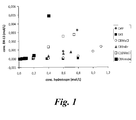
- the solubilising properties of the compound is examined by studying spectroscopically the solubilisation of the hydrophobic dye disperse red 13 (DR-13) in water with the help of co-solvents.
- the solubilization of a hydrophobic compound in water by a co-solvent is known to increase slightly and monotonically at low and moderate co-solvent concentrations and to increase exponentially at very high concentrations.
- the DR-13 solubilization curve obtained with a surfactant exhibits the classical evolution observed in the case of micellar solubilization; i.e. the DR-13 solubilization increases suddenly when micelles are formed for concentrations above the cmc.
- Shampoos and other personal care products usually are based on an anionic surfactant, most commonly sodium laureth sulfate (LES).
- an anionic surfactant most commonly sodium laureth sulfate (LES).
- Further ingredients for stability and property enhancing reasons are added, like cationic compounds, mainly surfactants, to increase foam stability and improve the conditioning properties of the product.
- the cationic surfactants will adsorb on the negatively charged surface of the hair and reduce friction as the hydrophobic tails will protrude to the air.
- the concentration range of cationic amphiphiles is restricted for such applications due to the formation of insoluble precipitates with anionic surfactants at a certain mixing ratio. To find alternatives that are in performance and toxicity equivalent or even more potent to the classically used cationic compounds are still in the focus of interest.
- Table 2 Compatibility observations at ambient temperature of mixtures of Sodium Laureth Sulfate (Texapon N70) with diquats (Formula II type compounds: abbreviations see Table 1) of 1wt% total surfactant in water % of Diquat 10% 20% 30% 40% 50% 60% 70% 80% 90% 100% C8MeCl Cl. Cl. Cl. Cl. Cl. Cl. Cl. Cl. C10MeCl Cl. Cl. Cl. Turb. Cl. Cl. Cl. Cl. Cl. C12MeCl Cl. Cl. Cl. Blu. Cl. Cl. Cl. Cl. Cl. Cl. Cl. C14MeCl Cl. Cl. Cl. Prec. Cl. Cl. Cl. Cl. Cl. C16MeCl Cl.
- di-quat surfactants of formula (II) generally foam can be produced with higher efficacy than with classical surfactants like SDS (Sodium Dodecyl Sulfate) and DTAB (Dodecyl trimethyl ammonium bromide).
- SDS sodium Dodecyl Sulfate
- DTAB Dodecyl trimethyl ammonium bromide
- the aim of this study is to test different tertiary amide compounds of the present invention on their potency to function as adjuvant for the herbicide glyphosate.
- a good adjuvant for glyphosate seen from the technical point of view, has to fulfill different functions.
- the adjuvant must provide a good wetting of the leaf surface, must facilitate the foliar penetration of glyphosate under a wide range of climatic conditions and should have a low or no phytotoxity to prevent inhibition of glyphosate translocation in the weeds and to prevent crop damage when used in glyphosate-resistent crops.
- a screening procedure for testing adjuvants for glyphosate was developed (de Ruiter et al 1998). Wheat plants are used as a model for difficult to wet grasses and black nightshade is used as a model for a plant with an easy to wet but difficult to permeate leaf surface.
- Plant material Black nightshade and winter wheat (cv. Ilias) are grown in a growth chamber under 14 h of light, at 18/12 ( ⁇ 0.5) °C (day/night) temperature, and in 70/80 ( ⁇ 5)% (day/night) relative humidity. Light was provided by high-pressure mercury lamps and fluorescent tubes to give 160 pmol m-2 s-1 at leaf level.
- the plants are grown in 11-cm-diam plastic pots filled with a mixture of sand and humic potting soil1 (1:2 by volume). The pots are placed on subirrigation matting, which is wetted daily with half-strength nutrient solution. After emergence, the wheat seedlings are thinned to six plants per pot for the efficacy experiments.
- Black nightshade seedlings are thinned to one plant per pot. black nightshade and wheat and are treated at the four- and the three-leaf stage, respectively. The fresh weights of the plants are measured 14 days after treatment (14 DAT; black nightshade) or 21 days after treatment (21 DAT; wheat).
- Herbicide application The glyphosate solutions are applied with an air-pressured laboratory track sprayer having 1.2-mm nozzles fitted with a perforated (0.6 mm) whirling pin and delivering 200 L/ha at 303 kPa. Treatment solutions.
- a list of the adjuvants tested is presented in Table 3.
- a sub-optimal rate of glyphosate giving (ideally) a 0-20% growth reduction without adjuvant, is used to demonstrate the adjuvant effects. Based on previous work, these rates are 20.3 g ae/ha(equivalent to 0.6 mM) on black nightshade and 77.8 g ae/ha (equivalent to 2.3 mM at 200 L/ha) on wheat.
- Results The results are listed in Table 3.
- the fresh weight of the untreated plant are taking as a reference (100%). The lower the fresh weight of the treated plant, the more potent the adjuvant. An industrial standard was also included in the test series.
- Table 3 Results of the adjuvant for glyfosate tests
- the aim of this study is to test if the N,N-bis(3-(dimethylamino) propyl)octanamide adjuvant displays potency towards other (more lipophilic) herbicides.
- This test we looked at the performance with Carfentrazone-ethyl (Spotlight Plus from FMC) on common lambsquarter (Chenopodium album L.; CHEAL) was looked at. Plant material. Common lambsquarters (Chenopodium album L.; CHEAL) are grown in a growth chamber under 14 h of light, at 18/12 ( ⁇ 0.5) °C (day/night) temperature, and in 70/80 ( ⁇ 5)% (day/night) relative humidity.
- Light was provided by high-pressure mercury lamps and fluorescent tubes to give 250 pmol m-2 s-1 at leaf level.
- the plants are grown in 11-cm-diam plastic pots filled with a mixture of sand and humic potting soil (1:2 by volume).
- the pots are placed on subirrigation matting, which is wetted daily with half-strength nutrient solution.
- the seedlings are thinned to two plants per pot for the efficacy experiments.
- the common lambsquarters are treated at the four-leaf stage.
- the fresh weights of the plants are measured 7 days after treatment (7 DAT). Herbicide application.
- the treatment solutions are applied with an air-pressured laboratory track sprayer having 1.2-mm nozzles fitted with a perforated (0.6 mm) whirling pin and delivering 200 L/ha at 303 kPa.
- the following herbicide was used in the treatment solutions: Carfentrazone-ethyl, Spotlight Plus (FMC) ME formulation, 60 g a.i./L.
- the adjuvant is included in the treatment solution at a concentration of 0.25% (w/v) active adjuvant compound. Demineralized water is used as the carrier.
- a sub-optimal rate of the herbicide, giving (ideally) a 0-20% growth reduction without adjuvant, is used to demonstrate the adjuvant effects.
- Experimental design and data analysis .
- the aim of this study is to test if the N,N-bis(3-(dimethylamino) propyl)octanamide adjuvant displays potency towards other (more lipophilic) herbicides.
- Dicamba DMA-salt (Banvel formulation) on Black nightshade was looked at.
- Plant material Black nightshade ( Solanum nigrum L.; SOLNI) is grown in a growth chamber under 14 h of light, at 18/12 ( ⁇ 0.5) °C (day/night) temperature, and in 70/80 ( ⁇ 5)% (day/night) relative humidity. Light was provided by high-pressure mercury lamps and fluorescent tubes to give 250 pmol m -2 s -1 at leaf level.
- the plants are grown in 11-cm-diam plastic pots filled with a mixture of sand and humic potting soil (1:2 by volume).
- the pots are placed on subirrigation matting, which is wetted daily with half-strength nutrient solution.
- the seedlings are thinned to one plant per pot for the efficacy experiments.
- Black nightshade is treated at the four-leaf stage.
- the fresh weights of the plants are measured 16 days after treatment (16 DAT).
- Herbicide application The treatment solutions are applied with an air-pressured laboratory track sprayer having 1.2-mm nozzles fitted with a perforated (0.6 mm) whirling pin and delivering 200 L/ha at 303 kPa.
- the following herbicide was used in the treatment solutions: Dicamba DMA-salt, Banvel formulation, 480 g a.e./L Treatment solutions .
- the adjuvant is included in the treatment solution at a concentration of 0.25% (w/v) active adjuvant compound. Demineralized water is used as the carrier.
- Experimental design and data analysis The experiment was conducted with four replicates per experiment according to a completely randomized design. Two separate experiments are conducted. Results . The results (average values) are listed in Table 5. Adding the adjuvant to the herbicide clearly increases the potency of the herbicide.
- the aim of this study is to test if the N,N-bis(3-(dimethylamino) propyl)octanamide adjuvant displays potency towards other (more lipophilic) herbicides.
- the performance with Fenoxaprop-P-ethyl was looked at.
- Plant material Wild oat ( Avena fatua L.; AVEFA) is grown in a growth chamber under 14 h of light, at 18/12 ( ⁇ 0.5) °C (day/night) temperature, and in 70/80 ( ⁇ 5)% (day/night) relative humidity. Light was provided by high-pressure mercury lamps and fluorescent tubes to give 250 pmol m -2 s -1 at leaf level.
- the plants are grown in 11-cm-diam plastic pots filled with a mixture of sand and humic potting soil (1:2 by volume). The pots are placed on subirrigation matting, which is wetted daily with half-strength nutrient solution. After emergence, the seedlings are thinned to four plants per pot for the efficacy experiments. The plants are treated at the three-leaf stage. The fresh weights of the plants are measured 21 days after treatment (21 DAT). Herbicide application. The treatment solutions are applied with an air-pressured laboratory track sprayer having 1.2-mm nozzles fitted with a perforated (0.6 mm) whirling pin and delivering 200 L/ha at 303 kPa.
- the following herbicide was included in the treatment solutions: Fenoxaprop-P-ethyl, Puma EW formulation, 69 g a.i./L.
- Treatment solutions .
- the adjuvant is included in the treatment solution at a concentration of 0.25% (w/v) active adjuvant compound. Demineralized water is used as the carrier.
- a sub-optimal rate of the herbicide, giving (ideally) a 0-20% growth reduction without adjuvant, is used to demonstrate the adjuvant effects.
- Experimental design and data analysis The test was conducted with four replicates per experiment according to a completely randomized design. Two separate experiments are conducted. Results . The results (average values) are listed in Table 6. Adding the adjuvant to the herbicide clearly increases the potency of the herbicide.
Landscapes
- Chemical & Material Sciences (AREA)
- Life Sciences & Earth Sciences (AREA)
- Organic Chemistry (AREA)
- Engineering & Computer Science (AREA)
- Wood Science & Technology (AREA)
- Chemical Kinetics & Catalysis (AREA)
- Oil, Petroleum & Natural Gas (AREA)
- General Health & Medical Sciences (AREA)
- Health & Medical Sciences (AREA)
- Agronomy & Crop Science (AREA)
- Pest Control & Pesticides (AREA)
- Plant Pathology (AREA)
- Dentistry (AREA)
- Zoology (AREA)
- Environmental Sciences (AREA)
- Toxicology (AREA)
- Agricultural Chemicals And Associated Chemicals (AREA)
- Organic Low-Molecular-Weight Compounds And Preparation Thereof (AREA)
- Fertilizers (AREA)
Priority Applications (8)
| Application Number | Priority Date | Filing Date | Title |
|---|---|---|---|
| EP11164846A EP2520166A1 (de) | 2011-05-04 | 2011-05-04 | Neue Bisaminpropylamide und Verwendungen davon in Landwirtschafts- und Reinigungsmittelzusammensetzungen |
| BE2012/0297A BE1021290B1 (nl) | 2011-05-04 | 2012-05-04 | Nieuwe landbouw- en detergentsamenstellingen die een tertiair amide bevatten als hulpstof of als oppervlakte-actieve stof |
| US14/115,059 US9992994B2 (en) | 2011-05-04 | 2012-05-04 | Agricultural and detergent compositions containing a tertiary amide as adjuvant or as surfactant |
| ARP120101577A AR086273A1 (es) | 2011-05-04 | 2012-05-04 | Composiciones agricolas y detergentes que contienen una amida terciaria como adyuvante o como tensioactivo |
| PCT/EP2012/058270 WO2012150343A1 (en) | 2011-05-04 | 2012-05-04 | New agricultural and detergent compositions containing a tertiary amide as adjuvant or as surfactant |
| CN201280021624.0A CN103547151B (zh) | 2011-05-04 | 2012-05-04 | 含有叔酰胺作为助剂或作为表面活性剂的农业和清洁剂组合物 |
| BR112013028013-1A BR112013028013B1 (pt) | 2011-05-04 | 2012-05-04 | Composição agroquímica, e, uso de uma amida terciária |
| EP12721459.1A EP2704567B1 (de) | 2011-05-04 | 2012-05-04 | Landwirtschaftsmittelzusammensetzungen mit einem tertiären amid als adjuvans oder als tensid |
Applications Claiming Priority (1)
| Application Number | Priority Date | Filing Date | Title |
|---|---|---|---|
| EP11164846A EP2520166A1 (de) | 2011-05-04 | 2011-05-04 | Neue Bisaminpropylamide und Verwendungen davon in Landwirtschafts- und Reinigungsmittelzusammensetzungen |
Publications (1)
| Publication Number | Publication Date |
|---|---|
| EP2520166A1 true EP2520166A1 (de) | 2012-11-07 |
Family
ID=44484781
Family Applications (2)
| Application Number | Title | Priority Date | Filing Date |
|---|---|---|---|
| EP11164846A Withdrawn EP2520166A1 (de) | 2011-05-04 | 2011-05-04 | Neue Bisaminpropylamide und Verwendungen davon in Landwirtschafts- und Reinigungsmittelzusammensetzungen |
| EP12721459.1A Not-in-force EP2704567B1 (de) | 2011-05-04 | 2012-05-04 | Landwirtschaftsmittelzusammensetzungen mit einem tertiären amid als adjuvans oder als tensid |
Family Applications After (1)
| Application Number | Title | Priority Date | Filing Date |
|---|---|---|---|
| EP12721459.1A Not-in-force EP2704567B1 (de) | 2011-05-04 | 2012-05-04 | Landwirtschaftsmittelzusammensetzungen mit einem tertiären amid als adjuvans oder als tensid |
Country Status (7)
| Country | Link |
|---|---|
| US (1) | US9992994B2 (de) |
| EP (2) | EP2520166A1 (de) |
| CN (1) | CN103547151B (de) |
| AR (1) | AR086273A1 (de) |
| BE (1) | BE1021290B1 (de) |
| BR (1) | BR112013028013B1 (de) |
| WO (1) | WO2012150343A1 (de) |
Cited By (1)
| Publication number | Priority date | Publication date | Assignee | Title |
|---|---|---|---|---|
| US20230119694A1 (en) * | 2020-06-05 | 2023-04-20 | Reckitt Benckiser Finish B.V. | Bleach catalyst |
Families Citing this family (9)
| Publication number | Priority date | Publication date | Assignee | Title |
|---|---|---|---|---|
| CN104447380B (zh) * | 2014-11-21 | 2016-01-13 | 广州天赐高新材料股份有限公司 | 一种Bola型甜菜碱表面活性剂的制备方法 |
| EP3534707A4 (de) | 2016-11-02 | 2020-09-16 | Paramount Products 1 LLC | Adjuvanszusammensetzungen für chemikalien zur pflanzenbehandlung |
| US11186538B2 (en) | 2016-11-08 | 2021-11-30 | Rhodia Operations | Twin tail amine compounds and their zwitterionic derivatives |
| WO2018156457A1 (en) | 2017-02-24 | 2018-08-30 | Paramount Products 1 Llc | Treatment for plants in conjunction with harvesting |
| RU2645080C1 (ru) * | 2017-07-13 | 2018-02-15 | Федеральное государственное бюджетное образовательное учреждение высшего образования "Московский технологический университет" (МИРЭА) | N,N-бис(2-(диалкиламино)этил)карбоксамиды и их дигидрохлориды, проявляющие антиаритмическую активность, и фармацевтические композиции на их основе |
| US11236283B2 (en) * | 2018-05-08 | 2022-02-01 | Nouryon Chemicals International B.V. | Alkyliminoderivatives for use in diesel fuel emulsions |
| CN109160885B (zh) * | 2018-08-08 | 2021-04-23 | 百合花集团股份有限公司 | 脂肪酸型季铵盐阳离子表面活性剂及其制备方法与应用 |
| CN109221106B (zh) * | 2018-11-19 | 2021-11-02 | 江苏钟山化工有限公司 | 一种用于草铵膦和二甲四氯的增稠组合物及其制备和应用 |
| WO2022261391A1 (en) * | 2021-06-10 | 2022-12-15 | Trademark Nitrogen Corp. | Micronutrient formulations that control plant pathogens |
Citations (18)
| Publication number | Priority date | Publication date | Assignee | Title |
|---|---|---|---|---|
| US3234153A (en) | 1964-09-08 | 1966-02-08 | Mobay Chemical Corp | Preparation of a cellular polyurethane plastic |
| US4049591A (en) | 1976-10-18 | 1977-09-20 | Texaco Development Corporation | Foams and elastomers prepared in the presence of high tertiary amine content polyurethane catalysts |
| EP0257686A1 (de) | 1986-08-20 | 1988-03-02 | Akzo N.V. | Herbizide und Fungizide, die wirkungserhöhende Zusätze enthalten |
| EP0638236A1 (de) | 1993-08-03 | 1995-02-15 | Kao Corporation | Landwirtschaftliche chemische Zusammensetzungen |
| FR2720742A1 (fr) * | 1994-06-01 | 1995-12-08 | Rhone Poulenc Chimie | Nouvelles amidoamines polyglycérolées. |
| FR2737390A1 (fr) * | 1995-08-04 | 1997-02-07 | Rhone Poulenc Chimie | Composition phytosanitaire hydrosoluble comprenant au moins des amidoamines polyacoxylees |
| WO1998047860A1 (en) | 1997-04-22 | 1998-10-29 | Akzo Nobel N.V. | Process for making carboxylic amides |
| US5869653A (en) | 1997-10-30 | 1999-02-09 | Air Products And Chemicals, Inc. | Hydrogenation of nitriles to produce amines |
| EP0911384A2 (de) * | 1997-10-22 | 1999-04-28 | Polygon Chemie AG | Schmiermittel für Transportbänder |
| US6172262B1 (en) * | 1999-01-27 | 2001-01-09 | Wisconsin Alumni Research Foundation | Amphiphilic agents for membrane protein solubilization |
| WO2001095720A1 (en) * | 2000-06-15 | 2001-12-20 | Akzo Nobel Nv | Use of amine compounds with improved biodegradability as adjuvants for pesticides and fertilisers |
| US6458860B1 (en) | 2001-06-01 | 2002-10-01 | Huntsman Petrochemical Corporation | Advances in urethane foam catalysis |
| EP1314718A1 (de) * | 2001-11-23 | 2003-05-28 | Cognis Iberia, S.L. | Quaternisierte Fettsäureamidoamine |
| US20050202990A1 (en) | 2000-05-11 | 2005-09-15 | The Procter & Gamble Company | Laundry system having unitized dosing |
| US7332467B2 (en) | 2004-12-17 | 2008-02-19 | Procter & Gamble Company | Hydrophilically modified polyols for improved hydrophobic soil cleaning |
| US20080161611A1 (en) | 2005-02-01 | 2008-07-03 | Basf Aktiengesellschaft | Method for Producing Bis-[(3-Dimethylamino)Propyl]Amine (Bisdmapa) |
| US7678755B2 (en) | 2003-12-19 | 2010-03-16 | The Procter & Gamble Company | Modified alkoxylated polyol compounds |
| PL388525A1 (pl) * | 2009-07-13 | 2011-01-17 | Politechnika Wroclawska | Bis-amoniowe sole alifatycznych amidów 3,3'-iminobis(N, N-dimetylopropyloaminy) i sposób ich wytwarzania |
Family Cites Families (6)
| Publication number | Priority date | Publication date | Assignee | Title |
|---|---|---|---|---|
| WO2006034426A1 (en) | 2004-09-23 | 2006-03-30 | Akzo Nobel N.V. | Alkoxylated alkylamine quaternary surfactants for glyphosate |
| US8293683B2 (en) * | 2006-12-06 | 2012-10-23 | Akzo Nobel N.V. | Alkylamidopropyl dialkylamine surfactants as adjuvants |
| US9012365B2 (en) * | 2006-12-06 | 2015-04-21 | Akzo Nobel N.V. | Compatibility agents for herbicidal formulations comprising 2,4-(Dichlorophenoxy) acetic acid salts |
| WO2008105964A1 (en) | 2007-02-26 | 2008-09-04 | Stepan Company | Adjuvants for agricultural applications |
| CN102215695B (zh) * | 2008-09-29 | 2014-10-08 | 孟山都技术公司 | 包含酰胺基烷基胺表面活性剂的草甘膦制剂 |
| US9137988B2 (en) | 2009-09-02 | 2015-09-22 | Akzo Nobel Chemicals International B.V. | Nitrogen containing surfactants for agricultural use |
-
2011
- 2011-05-04 EP EP11164846A patent/EP2520166A1/de not_active Withdrawn
-
2012
- 2012-05-04 AR ARP120101577A patent/AR086273A1/es active IP Right Grant
- 2012-05-04 US US14/115,059 patent/US9992994B2/en active Active
- 2012-05-04 WO PCT/EP2012/058270 patent/WO2012150343A1/en not_active Ceased
- 2012-05-04 CN CN201280021624.0A patent/CN103547151B/zh not_active Expired - Fee Related
- 2012-05-04 BR BR112013028013-1A patent/BR112013028013B1/pt not_active IP Right Cessation
- 2012-05-04 EP EP12721459.1A patent/EP2704567B1/de not_active Not-in-force
- 2012-05-04 BE BE2012/0297A patent/BE1021290B1/nl not_active IP Right Cessation
Patent Citations (21)
| Publication number | Priority date | Publication date | Assignee | Title |
|---|---|---|---|---|
| US3234153A (en) | 1964-09-08 | 1966-02-08 | Mobay Chemical Corp | Preparation of a cellular polyurethane plastic |
| US4049591A (en) | 1976-10-18 | 1977-09-20 | Texaco Development Corporation | Foams and elastomers prepared in the presence of high tertiary amine content polyurethane catalysts |
| EP0257686A1 (de) | 1986-08-20 | 1988-03-02 | Akzo N.V. | Herbizide und Fungizide, die wirkungserhöhende Zusätze enthalten |
| EP0638236A1 (de) | 1993-08-03 | 1995-02-15 | Kao Corporation | Landwirtschaftliche chemische Zusammensetzungen |
| FR2720742A1 (fr) * | 1994-06-01 | 1995-12-08 | Rhone Poulenc Chimie | Nouvelles amidoamines polyglycérolées. |
| FR2737390A1 (fr) * | 1995-08-04 | 1997-02-07 | Rhone Poulenc Chimie | Composition phytosanitaire hydrosoluble comprenant au moins des amidoamines polyacoxylees |
| WO1997005779A1 (fr) | 1995-08-04 | 1997-02-20 | Rhone-Poulenc Chimie | Composition phytosanitaire comprenant au moins une matiere active hydrosoluble et au moins une amidoamine polyalcoxylee |
| EP0977727B1 (de) | 1997-04-22 | 2003-05-28 | Akzo Nobel N.V. | Verfahren zur herstellung von carbonsäureamiden |
| WO1998047860A1 (en) | 1997-04-22 | 1998-10-29 | Akzo Nobel N.V. | Process for making carboxylic amides |
| EP0911384A2 (de) * | 1997-10-22 | 1999-04-28 | Polygon Chemie AG | Schmiermittel für Transportbänder |
| US5869653A (en) | 1997-10-30 | 1999-02-09 | Air Products And Chemicals, Inc. | Hydrogenation of nitriles to produce amines |
| US6172262B1 (en) * | 1999-01-27 | 2001-01-09 | Wisconsin Alumni Research Foundation | Amphiphilic agents for membrane protein solubilization |
| US20050202990A1 (en) | 2000-05-11 | 2005-09-15 | The Procter & Gamble Company | Laundry system having unitized dosing |
| WO2001095720A1 (en) * | 2000-06-15 | 2001-12-20 | Akzo Nobel Nv | Use of amine compounds with improved biodegradability as adjuvants for pesticides and fertilisers |
| EP1289362B1 (de) | 2000-06-15 | 2004-10-06 | Akzo Nobel NV | Verwendung von aminverbindungen mit verbesserter bioabbaubarkeit als zusatz für pestizide und düngemittel |
| US6458860B1 (en) | 2001-06-01 | 2002-10-01 | Huntsman Petrochemical Corporation | Advances in urethane foam catalysis |
| EP1314718A1 (de) * | 2001-11-23 | 2003-05-28 | Cognis Iberia, S.L. | Quaternisierte Fettsäureamidoamine |
| US7678755B2 (en) | 2003-12-19 | 2010-03-16 | The Procter & Gamble Company | Modified alkoxylated polyol compounds |
| US7332467B2 (en) | 2004-12-17 | 2008-02-19 | Procter & Gamble Company | Hydrophilically modified polyols for improved hydrophobic soil cleaning |
| US20080161611A1 (en) | 2005-02-01 | 2008-07-03 | Basf Aktiengesellschaft | Method for Producing Bis-[(3-Dimethylamino)Propyl]Amine (Bisdmapa) |
| PL388525A1 (pl) * | 2009-07-13 | 2011-01-17 | Politechnika Wroclawska | Bis-amoniowe sole alifatycznych amidów 3,3'-iminobis(N, N-dimetylopropyloaminy) i sposób ich wytwarzania |
Non-Patent Citations (5)
| Title |
|---|
| A. KOTZEV ET AL: "Micellar Polymers with Hydrocarbon and Fluorocarbon Hydrophobic Chains. A Strategy to Multicompartment Micelles", MACROMOLECULES, vol. 35, no. 3, 1 January 2002 (2002-01-01), pages 1091 - 1101, XP055005767, ISSN: 0024-9297, DOI: 10.1021/ma011047n * |
| LOUIS T. WEINSTOCK ET AL: "Synthesis of new polyamine derivatives for cancer chemotherapeutic studies", JOURNAL OF PHARMACEUTICAL SCIENCES, vol. 70, no. 8, 1 August 1981 (1981-08-01), pages 956 - 959, XP055005766, ISSN: 0022-3549, DOI: 10.1002/jps.2600700835 * |
| MORRIS KUPCHAN S ET AL: "Tumor Inhibitors. 70. Structure-Cytotoxicity Relationships among N-Acyltriamines Related to Solapalmitine", JOURNAL OF MEDICINAL AND PHARMACEUTICAL CHEMISTRY, AMERICAN CHEMICAL SOCIETY. EASTON, US, vol. 15, no. 1, 1 January 1972 (1972-01-01), pages 65 - 68, XP002214904, DOI: 10.1021/JM00271A017 * |
| RENATA SKRZELA ET AL: "Experimental and Theoretical Approach to Nonequivalent Adsorption of Novel Dicephalic Ammonium Surfactants at the Air/Solution Interface", THE JOURNAL OF PHYSICAL CHEMISTRY B, vol. 114, no. 32, 19 August 2010 (2010-08-19), pages 10471 - 10480, XP055005887, ISSN: 1520-6106, DOI: 10.1021/jp1049809 * |
| TOMAS FRØMYR ET AL: "Adsorption and Surface Elastic Properties of Corresponding Fluorinated and Nonfluorinated Cationic Polymer Films Measured by Drop Shape Analysis", LANGMUIR, vol. 17, no. 17, 1 August 2001 (2001-08-01), pages 5256 - 5264, XP055005885, ISSN: 0743-7463, DOI: 10.1021/la001407k * |
Cited By (2)
| Publication number | Priority date | Publication date | Assignee | Title |
|---|---|---|---|---|
| US20230119694A1 (en) * | 2020-06-05 | 2023-04-20 | Reckitt Benckiser Finish B.V. | Bleach catalyst |
| US12077732B2 (en) * | 2020-06-05 | 2024-09-03 | Reckitt Benckiser Finish B.V. | Bleach catalyst |
Also Published As
| Publication number | Publication date |
|---|---|
| BR112013028013B1 (pt) | 2021-06-01 |
| EP2704567B1 (de) | 2018-06-27 |
| CN103547151A (zh) | 2014-01-29 |
| BE1021290B1 (nl) | 2015-10-22 |
| WO2012150343A1 (en) | 2012-11-08 |
| EP2704567A1 (de) | 2014-03-12 |
| AR086273A1 (es) | 2013-12-04 |
| CN103547151B (zh) | 2016-05-25 |
| US9992994B2 (en) | 2018-06-12 |
| US20140080708A1 (en) | 2014-03-20 |
| BR112013028013A2 (pt) | 2020-07-21 |
Similar Documents
| Publication | Publication Date | Title |
|---|---|---|
| EP2704567B1 (de) | Landwirtschaftsmittelzusammensetzungen mit einem tertiären amid als adjuvans oder als tensid | |
| AU771929B2 (en) | Cationic gemini and related multiple hydrophilic/hydrophobic functional compounds and their use as surfactants | |
| DE69524748T2 (de) | Methode zur Wirkungssteigerung von Agrarchemikalien | |
| EP2235134B1 (de) | Pestizid-zubereitung enthaltend ein amidoamin-alkoxylat als adjuvans | |
| EP2094083B1 (de) | Alkylamidopropyl-dialkylamin-tenside als adjuvanzien | |
| JP4860887B2 (ja) | 改善された生分解性を有するアミン化合物の、農薬および肥料に対する補助剤としての使用 | |
| EP3092898B1 (de) | Herbizid wirkende ionische flüssigkeiten die betaine-typ kationen enthalten | |
| AU2001264457A1 (en) | Use of amine compounds with improved biodegradability as adjuvants for pesticides and fertilisers | |
| US6331648B1 (en) | Ether amines and derivatives | |
| AU780563B2 (en) | Surfactant adjuvants useful in herbicide compositions | |
| JP6537328B2 (ja) | アミノ酸系農薬用効力増強剤組成物 | |
| AU2012280927B2 (en) | Alkali metal glyphosate compositions | |
| WO1998049898A1 (en) | Novel biocidal agents comprising quarternary bisimidazoline surfactants | |
| RU2405792C2 (ru) | Олигомерные амидоамины или амидозамещенные четвертичные аммониевые соединения для обработки ткани или волос | |
| AU2015202443B2 (en) | Method of preparing amidoamine alkoxylates and compositions thereof | |
| AU2013224668A1 (en) | Method of preparing amidoamine alkoxylates and compositions thereof |
Legal Events
| Date | Code | Title | Description |
|---|---|---|---|
| PUAI | Public reference made under article 153(3) epc to a published international application that has entered the european phase |
Free format text: ORIGINAL CODE: 0009012 |
|
| AK | Designated contracting states |
Kind code of ref document: A1 Designated state(s): AL AT BE BG CH CY CZ DE DK EE ES FI FR GB GR HR HU IE IS IT LI LT LU LV MC MK MT NL NO PL PT RO RS SE SI SK SM TR |
|
| AX | Request for extension of the european patent |
Extension state: BA ME |
|
| STAA | Information on the status of an ep patent application or granted ep patent |
Free format text: STATUS: THE APPLICATION IS DEEMED TO BE WITHDRAWN |
|
| 18D | Application deemed to be withdrawn |
Effective date: 20130508 |