EP2521717B1 - Procédé pour la préparation de rivaroxaban - Google Patents
Procédé pour la préparation de rivaroxaban Download PDFInfo
- Publication number
- EP2521717B1 EP2521717B1 EP11702646.8A EP11702646A EP2521717B1 EP 2521717 B1 EP2521717 B1 EP 2521717B1 EP 11702646 A EP11702646 A EP 11702646A EP 2521717 B1 EP2521717 B1 EP 2521717B1
- Authority
- EP
- European Patent Office
- Prior art keywords
- compound
- formula
- reaction
- pseudohalogen
- hal
- Prior art date
- Legal status (The legal status is an assumption and is not a legal conclusion. Google has not performed a legal analysis and makes no representation as to the accuracy of the status listed.)
- Active
Links
- 238000000034 method Methods 0.000 title claims description 49
- 238000002360 preparation method Methods 0.000 title claims description 16
- KGFYHTZWPPHNLQ-AWEZNQCLSA-N rivaroxaban Chemical compound S1C(Cl)=CC=C1C(=O)NC[C@@H]1OC(=O)N(C=2C=CC(=CC=2)N2C(COCC2)=O)C1 KGFYHTZWPPHNLQ-AWEZNQCLSA-N 0.000 title description 6
- 229960001148 rivaroxaban Drugs 0.000 title description 2
- 150000001875 compounds Chemical class 0.000 claims description 235
- 125000004178 (C1-C4) alkyl group Chemical group 0.000 claims description 30
- YGYAWVDWMABLBF-UHFFFAOYSA-N Phosgene Chemical compound ClC(Cl)=O YGYAWVDWMABLBF-UHFFFAOYSA-N 0.000 claims description 29
- 125000005843 halogen group Chemical group 0.000 claims description 27
- 125000002577 pseudohalo group Chemical group 0.000 claims description 27
- 125000001997 phenyl group Chemical group [H]C1=C([H])C([H])=C(*)C([H])=C1[H] 0.000 claims description 17
- 239000007795 chemical reaction product Substances 0.000 claims description 5
- 125000002496 methyl group Chemical group [H]C([H])([H])* 0.000 claims description 5
- 125000004169 (C1-C6) alkyl group Chemical group 0.000 claims description 3
- 125000003944 tolyl group Chemical group 0.000 claims description 3
- 125000001797 benzyl group Chemical group [H]C1=C([H])C([H])=C(C([H])=C1[H])C([H])([H])* 0.000 claims description 2
- 238000006243 chemical reaction Methods 0.000 description 79
- YMWUJEATGCHHMB-UHFFFAOYSA-N Dichloromethane Chemical compound ClCCl YMWUJEATGCHHMB-UHFFFAOYSA-N 0.000 description 57
- YXFVVABEGXRONW-UHFFFAOYSA-N Toluene Chemical compound CC1=CC=CC=C1 YXFVVABEGXRONW-UHFFFAOYSA-N 0.000 description 51
- WEVYAHXRMPXWCK-UHFFFAOYSA-N Acetonitrile Chemical compound CC#N WEVYAHXRMPXWCK-UHFFFAOYSA-N 0.000 description 45
- 239000002904 solvent Substances 0.000 description 31
- -1 DMF) Chemical class 0.000 description 26
- 239000002585 base Substances 0.000 description 22
- 239000000203 mixture Substances 0.000 description 21
- XLYOFNOQVPJJNP-UHFFFAOYSA-N water Substances O XLYOFNOQVPJJNP-UHFFFAOYSA-N 0.000 description 18
- WYURNTSHIVDZCO-UHFFFAOYSA-N Tetrahydrofuran Chemical compound C1CCOC1 WYURNTSHIVDZCO-UHFFFAOYSA-N 0.000 description 16
- 238000003756 stirring Methods 0.000 description 15
- JUJWROOIHBZHMG-UHFFFAOYSA-N Pyridine Chemical compound C1=CC=NC=C1 JUJWROOIHBZHMG-UHFFFAOYSA-N 0.000 description 14
- 239000011541 reaction mixture Substances 0.000 description 13
- 239000000725 suspension Substances 0.000 description 13
- IJGRMHOSHXDMSA-UHFFFAOYSA-N Atomic nitrogen Chemical compound N#N IJGRMHOSHXDMSA-UHFFFAOYSA-N 0.000 description 12
- 239000000047 product Substances 0.000 description 11
- MHCRLDZZHOVFEE-UHFFFAOYSA-N 4-(4-aminophenyl)morpholin-3-one Chemical compound C1=CC(N)=CC=C1N1C(=O)COCC1 MHCRLDZZHOVFEE-UHFFFAOYSA-N 0.000 description 10
- 229930195733 hydrocarbon Natural products 0.000 description 10
- 150000002430 hydrocarbons Chemical class 0.000 description 10
- ZMANZCXQSJIPKH-UHFFFAOYSA-N Triethylamine Chemical compound CCN(CC)CC ZMANZCXQSJIPKH-UHFFFAOYSA-N 0.000 description 9
- 150000001298 alcohols Chemical class 0.000 description 9
- 150000008282 halocarbons Chemical class 0.000 description 9
- 238000000746 purification Methods 0.000 description 9
- 0 *c1ccc(C(NC[C@@](CN2c(cc3)ccc3N(CCOC3)C3=O)OC2=O)=O)[s]1 Chemical compound *c1ccc(C(NC[C@@](CN2c(cc3)ccc3N(CCOC3)C3=O)OC2=O)=O)[s]1 0.000 description 8
- IAZDPXIOMUYVGZ-WFGJKAKNSA-N Dimethyl sulfoxide Chemical compound [2H]C([2H])([2H])S(=O)C([2H])([2H])[2H] IAZDPXIOMUYVGZ-WFGJKAKNSA-N 0.000 description 8
- 238000002425 crystallisation Methods 0.000 description 8
- 230000008025 crystallization Effects 0.000 description 8
- 238000001914 filtration Methods 0.000 description 8
- LFQSCWFLJHTTHZ-UHFFFAOYSA-N Ethanol Chemical compound CCO LFQSCWFLJHTTHZ-UHFFFAOYSA-N 0.000 description 7
- 239000013078 crystal Substances 0.000 description 7
- 239000000543 intermediate Substances 0.000 description 7
- 150000002825 nitriles Chemical class 0.000 description 7
- UMJSCPRVCHMLSP-UHFFFAOYSA-N pyridine Natural products COC1=CC=CN=C1 UMJSCPRVCHMLSP-UHFFFAOYSA-N 0.000 description 7
- WFDIJRYMOXRFFG-UHFFFAOYSA-N Acetic anhydride Chemical compound CC(=O)OC(C)=O WFDIJRYMOXRFFG-UHFFFAOYSA-N 0.000 description 6
- CSCPPACGZOOCGX-UHFFFAOYSA-N Acetone Chemical compound CC(C)=O CSCPPACGZOOCGX-UHFFFAOYSA-N 0.000 description 6
- VEXZGXHMUGYJMC-UHFFFAOYSA-N Hydrochloric acid Chemical compound Cl VEXZGXHMUGYJMC-UHFFFAOYSA-N 0.000 description 6
- KFZMGEQAYNKOFK-UHFFFAOYSA-N Isopropanol Chemical compound CC(C)O KFZMGEQAYNKOFK-UHFFFAOYSA-N 0.000 description 6
- OKKJLVBELUTLKV-UHFFFAOYSA-N Methanol Chemical compound OC OKKJLVBELUTLKV-UHFFFAOYSA-N 0.000 description 6
- 150000001412 amines Chemical class 0.000 description 6
- 238000007796 conventional method Methods 0.000 description 6
- 239000010410 layer Substances 0.000 description 6
- 229910052757 nitrogen Inorganic materials 0.000 description 6
- 239000000243 solution Substances 0.000 description 6
- 150000002170 ethers Chemical class 0.000 description 5
- 239000012065 filter cake Substances 0.000 description 5
- 150000007530 organic bases Chemical class 0.000 description 5
- KQIGMPWTAHJUMN-VKHMYHEASA-N 3-aminopropane-1,2-diol Chemical compound NC[C@H](O)CO KQIGMPWTAHJUMN-VKHMYHEASA-N 0.000 description 4
- BMYNFMYTOJXKLE-UHFFFAOYSA-N 3-azaniumyl-2-hydroxypropanoate Chemical compound NCC(O)C(O)=O BMYNFMYTOJXKLE-UHFFFAOYSA-N 0.000 description 4
- YYROPELSRYBVMQ-UHFFFAOYSA-N 4-toluenesulfonyl chloride Chemical compound CC1=CC=C(S(Cl)(=O)=O)C=C1 YYROPELSRYBVMQ-UHFFFAOYSA-N 0.000 description 4
- UIIMBOGNXHQVGW-UHFFFAOYSA-M Sodium bicarbonate Chemical compound [Na+].OC([O-])=O UIIMBOGNXHQVGW-UHFFFAOYSA-M 0.000 description 4
- DKGAVHZHDRPRBM-UHFFFAOYSA-N Tert-Butanol Chemical compound CC(C)(C)O DKGAVHZHDRPRBM-UHFFFAOYSA-N 0.000 description 4
- 125000002777 acetyl group Chemical group [H]C([H])([H])C(*)=O 0.000 description 4
- 150000001408 amides Chemical class 0.000 description 4
- 239000000010 aprotic solvent Substances 0.000 description 4
- ZCSHNCUQKCANBX-UHFFFAOYSA-N lithium diisopropylamide Chemical compound [Li+].CC(C)[N-]C(C)C ZCSHNCUQKCANBX-UHFFFAOYSA-N 0.000 description 4
- 238000007363 ring formation reaction Methods 0.000 description 4
- 238000001644 13C nuclear magnetic resonance spectroscopy Methods 0.000 description 3
- 238000005160 1H NMR spectroscopy Methods 0.000 description 3
- LLRCNCXTSFGOGG-YFKPBYRVSA-N 5-chloro-n-[[(2s)-oxiran-2-yl]methyl]thiophene-2-carboxamide Chemical compound S1C(Cl)=CC=C1C(=O)NC[C@@H]1OC1 LLRCNCXTSFGOGG-YFKPBYRVSA-N 0.000 description 3
- WHXSMMKQMYFTQS-UHFFFAOYSA-N Lithium Chemical compound [Li] WHXSMMKQMYFTQS-UHFFFAOYSA-N 0.000 description 3
- SECXISVLQFMRJM-UHFFFAOYSA-N N-Methylpyrrolidone Chemical compound CN1CCCC1=O SECXISVLQFMRJM-UHFFFAOYSA-N 0.000 description 3
- PMZURENOXWZQFD-UHFFFAOYSA-L Sodium Sulfate Chemical compound [Na+].[Na+].[O-]S([O-])(=O)=O PMZURENOXWZQFD-UHFFFAOYSA-L 0.000 description 3
- 238000005917 acylation reaction Methods 0.000 description 3
- 229910052783 alkali metal Inorganic materials 0.000 description 3
- 150000001340 alkali metals Chemical class 0.000 description 3
- 229910052784 alkaline earth metal Inorganic materials 0.000 description 3
- HCUYBXPSSCRKRF-UHFFFAOYSA-N diphosgene Chemical compound ClC(=O)OC(Cl)(Cl)Cl HCUYBXPSSCRKRF-UHFFFAOYSA-N 0.000 description 3
- 208000037265 diseases, disorders, signs and symptoms Diseases 0.000 description 3
- 125000004005 formimidoyl group Chemical group [H]\N=C(/[H])* 0.000 description 3
- 150000007529 inorganic bases Chemical class 0.000 description 3
- 229910052744 lithium Inorganic materials 0.000 description 3
- 239000012044 organic layer Substances 0.000 description 3
- 230000035484 reaction time Effects 0.000 description 3
- 229910052938 sodium sulfate Inorganic materials 0.000 description 3
- 235000011152 sodium sulphate Nutrition 0.000 description 3
- HXJUTPCZVOIRIF-UHFFFAOYSA-N sulfolane Chemical compound O=S1(=O)CCCC1 HXJUTPCZVOIRIF-UHFFFAOYSA-N 0.000 description 3
- 150000003457 sulfones Chemical class 0.000 description 3
- YLQBMQCUIZJEEH-UHFFFAOYSA-N tetrahydrofuran Natural products C=1C=COC=1 YLQBMQCUIZJEEH-UHFFFAOYSA-N 0.000 description 3
- UCPYLLCMEDAXFR-UHFFFAOYSA-N triphosgene Chemical compound ClC(Cl)(Cl)OC(=O)OC(Cl)(Cl)Cl UCPYLLCMEDAXFR-UHFFFAOYSA-N 0.000 description 3
- MNZAKDODWSQONA-UHFFFAOYSA-N 1-dibutylphosphorylbutane Chemical compound CCCCP(=O)(CCCC)CCCC MNZAKDODWSQONA-UHFFFAOYSA-N 0.000 description 2
- FDFOJITXAKYSPI-UHFFFAOYSA-N 4-(2-isocyanatophenyl)morpholin-3-one Chemical compound O=C=NC1=CC=CC=C1N1C(=O)COCC1 FDFOJITXAKYSPI-UHFFFAOYSA-N 0.000 description 2
- RTEGUCGMXQSZGZ-UHFFFAOYSA-N 5-[(3,4-dichlorophenoxy)methyl]-4,5-dihydro-1,3-oxazol-2-amine Chemical compound O1C(N)=NCC1COC1=CC=C(Cl)C(Cl)=C1 RTEGUCGMXQSZGZ-UHFFFAOYSA-N 0.000 description 2
- OKMRQXXUAFSBCM-CQSZACIVSA-N 5-chloro-n-[(2r)-2-hydroxy-3-[4-(3-oxomorpholin-4-yl)anilino]propyl]thiophene-2-carboxamide Chemical compound C([C@H](O)CNC=1C=CC(=CC=1)N1C(COCC1)=O)NC(=O)C1=CC=C(Cl)S1 OKMRQXXUAFSBCM-CQSZACIVSA-N 0.000 description 2
- NLXLAEXVIDQMFP-UHFFFAOYSA-N Ammonia chloride Chemical compound [NH4+].[Cl-] NLXLAEXVIDQMFP-UHFFFAOYSA-N 0.000 description 2
- BZLVMXJERCGZMT-UHFFFAOYSA-N Methyl tert-butyl ether Chemical compound COC(C)(C)C BZLVMXJERCGZMT-UHFFFAOYSA-N 0.000 description 2
- LRHPLDYGYMQRHN-UHFFFAOYSA-N N-Butanol Chemical compound CCCCO LRHPLDYGYMQRHN-UHFFFAOYSA-N 0.000 description 2
- JRNZFWQRNLXFTR-UHFFFAOYSA-N O=C(COCC1)N1c(cc1)ccc1N=C=O Chemical compound O=C(COCC1)N1c(cc1)ccc1N=C=O JRNZFWQRNLXFTR-UHFFFAOYSA-N 0.000 description 2
- WEVYAHXRMPXWCK-FIBGUPNXSA-N acetonitrile-d3 Chemical compound [2H]C([2H])([2H])C#N WEVYAHXRMPXWCK-FIBGUPNXSA-N 0.000 description 2
- 230000010933 acylation Effects 0.000 description 2
- 239000003513 alkali Substances 0.000 description 2
- 150000001342 alkaline earth metals Chemical class 0.000 description 2
- 150000004703 alkoxides Chemical class 0.000 description 2
- HOPRXXXSABQWAV-UHFFFAOYSA-N anhydrous collidine Natural products CC1=CC=NC(C)=C1C HOPRXXXSABQWAV-UHFFFAOYSA-N 0.000 description 2
- GNEOLGPJVCVBRF-UHFFFAOYSA-N benzyl n-[4-(3-oxomorpholin-4-yl)phenyl]carbamate Chemical compound C=1C=CC=CC=1COC(=O)NC(C=C1)=CC=C1N1CCOCC1=O GNEOLGPJVCVBRF-UHFFFAOYSA-N 0.000 description 2
- 229910052794 bromium Inorganic materials 0.000 description 2
- 239000006227 byproduct Substances 0.000 description 2
- 150000004649 carbonic acid derivatives Chemical class 0.000 description 2
- 238000005119 centrifugation Methods 0.000 description 2
- 239000007810 chemical reaction solvent Substances 0.000 description 2
- 229910052801 chlorine Inorganic materials 0.000 description 2
- UTBIMNXEDGNJFE-UHFFFAOYSA-N collidine Natural products CC1=CC=C(C)C(C)=N1 UTBIMNXEDGNJFE-UHFFFAOYSA-N 0.000 description 2
- 230000020176 deacylation Effects 0.000 description 2
- 238000005947 deacylation reaction Methods 0.000 description 2
- JGFBRKRYDCGYKD-UHFFFAOYSA-N dibutyl(oxo)tin Chemical group CCCC[Sn](=O)CCCC JGFBRKRYDCGYKD-UHFFFAOYSA-N 0.000 description 2
- 201000010099 disease Diseases 0.000 description 2
- CCGKOQOJPYTBIH-UHFFFAOYSA-N ethenone Chemical compound C=C=O CCGKOQOJPYTBIH-UHFFFAOYSA-N 0.000 description 2
- 238000001704 evaporation Methods 0.000 description 2
- 230000008020 evaporation Effects 0.000 description 2
- 239000000706 filtrate Substances 0.000 description 2
- 229910052731 fluorine Inorganic materials 0.000 description 2
- 239000011261 inert gas Substances 0.000 description 2
- 229910052740 iodine Inorganic materials 0.000 description 2
- 238000002955 isolation Methods 0.000 description 2
- YNESATAKKCNGOF-UHFFFAOYSA-N lithium bis(trimethylsilyl)amide Chemical compound [Li+].C[Si](C)(C)[N-][Si](C)(C)C YNESATAKKCNGOF-UHFFFAOYSA-N 0.000 description 2
- AMXOYNBUYSYVKV-UHFFFAOYSA-M lithium bromide Chemical compound [Li+].[Br-] AMXOYNBUYSYVKV-UHFFFAOYSA-M 0.000 description 2
- 239000000463 material Substances 0.000 description 2
- 239000003960 organic solvent Substances 0.000 description 2
- 239000002798 polar solvent Substances 0.000 description 2
- BWHMMNNQKKPAPP-UHFFFAOYSA-L potassium carbonate Chemical compound [K+].[K+].[O-]C([O-])=O BWHMMNNQKKPAPP-UHFFFAOYSA-L 0.000 description 2
- 239000000843 powder Substances 0.000 description 2
- 238000000926 separation method Methods 0.000 description 2
- 239000002002 slurry Substances 0.000 description 2
- 229910000030 sodium bicarbonate Inorganic materials 0.000 description 2
- 235000017557 sodium bicarbonate Nutrition 0.000 description 2
- 239000011877 solvent mixture Substances 0.000 description 2
- GFYHSKONPJXCDE-UHFFFAOYSA-N sym-collidine Natural products CC1=CN=C(C)C(C)=C1 GFYHSKONPJXCDE-UHFFFAOYSA-N 0.000 description 2
- GQHTUMJGOHRCHB-UHFFFAOYSA-N 2,3,4,6,7,8,9,10-octahydropyrimido[1,2-a]azepine Chemical compound C1CCCCN2CCCN=C21 GQHTUMJGOHRCHB-UHFFFAOYSA-N 0.000 description 1
- YOYAIZYFCNQIRF-UHFFFAOYSA-N 2,6-dichlorobenzonitrile Chemical compound ClC1=CC=CC(Cl)=C1C#N YOYAIZYFCNQIRF-UHFFFAOYSA-N 0.000 description 1
- MSXVEPNJUHWQHW-UHFFFAOYSA-N 2-methylbutan-2-ol Chemical compound CCC(C)(C)O MSXVEPNJUHWQHW-UHFFFAOYSA-N 0.000 description 1
- SDTMFDGELKWGFT-UHFFFAOYSA-N 2-methylpropan-2-olate Chemical compound CC(C)(C)[O-] SDTMFDGELKWGFT-UHFFFAOYSA-N 0.000 description 1
- KPLVWXBCSNCNJA-YFKPBYRVSA-N 5-chloro-n-[(2s)-2,3-dihydroxypropyl]thiophene-2-carboxamide Chemical compound OC[C@@H](O)CNC(=O)C1=CC=C(Cl)S1 KPLVWXBCSNCNJA-YFKPBYRVSA-N 0.000 description 1
- 206010002383 Angina Pectoris Diseases 0.000 description 1
- 206010002388 Angina unstable Diseases 0.000 description 1
- 108010039209 Blood Coagulation Factors Proteins 0.000 description 1
- 102000015081 Blood Coagulation Factors Human genes 0.000 description 1
- WSFSSNUMVMOOMR-UHFFFAOYSA-N Formaldehyde Chemical compound O=C WSFSSNUMVMOOMR-UHFFFAOYSA-N 0.000 description 1
- MHABMANUFPZXEB-UHFFFAOYSA-N O-demethyl-aloesaponarin I Natural products O=C1C2=CC=CC(O)=C2C(=O)C2=C1C=C(O)C(C(O)=O)=C2C MHABMANUFPZXEB-UHFFFAOYSA-N 0.000 description 1
- 208000030831 Peripheral arterial occlusive disease Diseases 0.000 description 1
- 208000010378 Pulmonary Embolism Diseases 0.000 description 1
- 206010038563 Reocclusion Diseases 0.000 description 1
- 229910006080 SO2X Inorganic materials 0.000 description 1
- 208000006011 Stroke Diseases 0.000 description 1
- 208000032109 Transient ischaemic attack Diseases 0.000 description 1
- 208000007814 Unstable Angina Diseases 0.000 description 1
- 206010047249 Venous thrombosis Diseases 0.000 description 1
- 230000002378 acidificating effect Effects 0.000 description 1
- 229910001854 alkali hydroxide Inorganic materials 0.000 description 1
- 150000008044 alkali metal hydroxides Chemical class 0.000 description 1
- 125000003545 alkoxy group Chemical group 0.000 description 1
- 125000000217 alkyl group Chemical group 0.000 description 1
- 235000019270 ammonium chloride Nutrition 0.000 description 1
- 238000002399 angioplasty Methods 0.000 description 1
- 150000008064 anhydrides Chemical class 0.000 description 1
- 239000007864 aqueous solution Substances 0.000 description 1
- 239000003849 aromatic solvent Substances 0.000 description 1
- 125000003118 aryl group Chemical group 0.000 description 1
- HSDAJNMJOMSNEV-UHFFFAOYSA-N benzyl chloroformate Chemical compound ClC(=O)OCC1=CC=CC=C1 HSDAJNMJOMSNEV-UHFFFAOYSA-N 0.000 description 1
- 239000003114 blood coagulation factor Substances 0.000 description 1
- 239000012267 brine Substances 0.000 description 1
- 125000004432 carbon atom Chemical group C* 0.000 description 1
- BVKZGUZCCUSVTD-UHFFFAOYSA-N carbonic acid Chemical class OC(O)=O BVKZGUZCCUSVTD-UHFFFAOYSA-N 0.000 description 1
- PFKFTWBEEFSNDU-UHFFFAOYSA-N carbonyldiimidazole Chemical compound C1=CN=CN1C(=O)N1C=CN=C1 PFKFTWBEEFSNDU-UHFFFAOYSA-N 0.000 description 1
- 150000007942 carboxylates Chemical class 0.000 description 1
- 239000003795 chemical substances by application Substances 0.000 description 1
- 239000012141 concentrate Substances 0.000 description 1
- 208000035475 disorder Diseases 0.000 description 1
- 238000004821 distillation Methods 0.000 description 1
- 239000003814 drug Substances 0.000 description 1
- 238000001035 drying Methods 0.000 description 1
- 239000004210 ether based solvent Substances 0.000 description 1
- 229910052736 halogen Inorganic materials 0.000 description 1
- 150000002391 heterocyclic compounds Chemical class 0.000 description 1
- 238000004128 high performance liquid chromatography Methods 0.000 description 1
- 150000004678 hydrides Chemical class 0.000 description 1
- 150000004679 hydroxides Chemical class 0.000 description 1
- 125000002887 hydroxy group Chemical group [H]O* 0.000 description 1
- 239000003112 inhibitor Substances 0.000 description 1
- 201000004332 intermediate coronary syndrome Diseases 0.000 description 1
- 150000002576 ketones Chemical class 0.000 description 1
- 239000007788 liquid Substances 0.000 description 1
- LZWQNOHZMQIFBX-UHFFFAOYSA-N lithium;2-methylpropan-2-olate Chemical compound [Li+].CC(C)(C)[O-] LZWQNOHZMQIFBX-UHFFFAOYSA-N 0.000 description 1
- 238000004519 manufacturing process Methods 0.000 description 1
- 208000010125 myocardial infarction Diseases 0.000 description 1
- PSHKMPUSSFXUIA-UHFFFAOYSA-N n,n-dimethylpyridin-2-amine Chemical compound CN(C)C1=CC=CC=N1 PSHKMPUSSFXUIA-UHFFFAOYSA-N 0.000 description 1
- 239000012454 non-polar solvent Substances 0.000 description 1
- 238000005580 one pot reaction Methods 0.000 description 1
- 150000002900 organolithium compounds Chemical class 0.000 description 1
- 125000002524 organometallic group Chemical group 0.000 description 1
- 239000003880 polar aprotic solvent Substances 0.000 description 1
- 229910000027 potassium carbonate Inorganic materials 0.000 description 1
- 150000003138 primary alcohols Chemical class 0.000 description 1
- 238000011321 prophylaxis Methods 0.000 description 1
- 239000003586 protic polar solvent Substances 0.000 description 1
- 238000001953 recrystallisation Methods 0.000 description 1
- 238000004064 recycling Methods 0.000 description 1
- 238000010992 reflux Methods 0.000 description 1
- 229920006395 saturated elastomer Polymers 0.000 description 1
- HPALAKNZSZLMCH-UHFFFAOYSA-M sodium;chloride;hydrate Chemical compound O.[Na+].[Cl-] HPALAKNZSZLMCH-UHFFFAOYSA-M 0.000 description 1
- 239000007858 starting material Substances 0.000 description 1
- 230000009424 thromboembolic effect Effects 0.000 description 1
- 201000010875 transient cerebral ischemia Diseases 0.000 description 1
- 238000011282 treatment Methods 0.000 description 1
- 125000005270 trialkylamine group Chemical group 0.000 description 1
- 238000005406 washing Methods 0.000 description 1
- 229940055725 xarelto Drugs 0.000 description 1
Images


Classifications
-
- C—CHEMISTRY; METALLURGY
- C07—ORGANIC CHEMISTRY
- C07D—HETEROCYCLIC COMPOUNDS
- C07D413/00—Heterocyclic compounds containing two or more hetero rings, at least one ring having nitrogen and oxygen atoms as the only ring hetero atoms
- C07D413/14—Heterocyclic compounds containing two or more hetero rings, at least one ring having nitrogen and oxygen atoms as the only ring hetero atoms containing three or more hetero rings
-
- C—CHEMISTRY; METALLURGY
- C07—ORGANIC CHEMISTRY
- C07D—HETEROCYCLIC COMPOUNDS
- C07D265/00—Heterocyclic compounds containing six-membered rings having one nitrogen atom and one oxygen atom as the only ring hetero atoms
- C07D265/28—1,4-Oxazines; Hydrogenated 1,4-oxazines
- C07D265/30—1,4-Oxazines; Hydrogenated 1,4-oxazines not condensed with other rings
- C07D265/32—1,4-Oxazines; Hydrogenated 1,4-oxazines not condensed with other rings with oxygen atoms directly attached to ring carbon atoms
-
- C—CHEMISTRY; METALLURGY
- C07—ORGANIC CHEMISTRY
- C07D—HETEROCYCLIC COMPOUNDS
- C07D333/00—Heterocyclic compounds containing five-membered rings having one sulfur atom as the only ring hetero atom
- C07D333/02—Heterocyclic compounds containing five-membered rings having one sulfur atom as the only ring hetero atom not condensed with other rings
- C07D333/04—Heterocyclic compounds containing five-membered rings having one sulfur atom as the only ring hetero atom not condensed with other rings not substituted on the ring sulphur atom
- C07D333/26—Heterocyclic compounds containing five-membered rings having one sulfur atom as the only ring hetero atom not condensed with other rings not substituted on the ring sulphur atom with hetero atoms or with carbon atoms having three bonds to hetero atoms with at the most one bond to halogen, e.g. ester or nitrile radicals, directly attached to ring carbon atoms
- C07D333/38—Carbon atoms having three bonds to hetero atoms with at the most one bond to halogen, e.g. ester or nitrile radicals
-
- C—CHEMISTRY; METALLURGY
- C07—ORGANIC CHEMISTRY
- C07D—HETEROCYCLIC COMPOUNDS
- C07D409/00—Heterocyclic compounds containing two or more hetero rings, at least one ring having sulfur atoms as the only ring hetero atoms
- C07D409/02—Heterocyclic compounds containing two or more hetero rings, at least one ring having sulfur atoms as the only ring hetero atoms containing two hetero rings
- C07D409/12—Heterocyclic compounds containing two or more hetero rings, at least one ring having sulfur atoms as the only ring hetero atoms containing two hetero rings linked by a chain containing hetero atoms as chain links
-
- C—CHEMISTRY; METALLURGY
- C07—ORGANIC CHEMISTRY
- C07D—HETEROCYCLIC COMPOUNDS
- C07D413/00—Heterocyclic compounds containing two or more hetero rings, at least one ring having nitrogen and oxygen atoms as the only ring hetero atoms
- C07D413/02—Heterocyclic compounds containing two or more hetero rings, at least one ring having nitrogen and oxygen atoms as the only ring hetero atoms containing two hetero rings
- C07D413/12—Heterocyclic compounds containing two or more hetero rings, at least one ring having nitrogen and oxygen atoms as the only ring hetero atoms containing two hetero rings linked by a chain containing hetero atoms as chain links
Definitions
- the present invention relates to the use of a compound having the formula (II) for the preparation of a compound having the formula (V). Methods of preparing the compound having the formula (V) using the compound having the formula (II) are also described. Individual reaction steps as well as intermediates are additionally claimed.
- the compound having the formula (V) acts as an inhibitor of clotting factor Xa and may be used as an agent for the prophylaxis and/or treatment of thromboembolic disorders, especially myocardial infarction, angina pectoris (including unstable angina), reocclusions and restenoses after angioplasty or aortocoronary bypass, stroke, transient ischemic attacks, peripheral arterial occlusive diseases, pulmonary embolisms or deep venous thromboses.
- myocardial infarction especially myocardial infarction, angina pectoris (including unstable angina), reocclusions and restenoses after angioplasty or aortocoronary bypass, stroke, transient ischemic attacks, peripheral arterial occlusive diseases, pulmonary embolisms or deep venous thromboses.
- One method for preparing the compound having the formula (V) is disclosed in WO 2004/060887 .
- the method disclosed therein uses a brominated compound as an intermediate which is prepared using hydrobromic acid at elevated temperatures. Hydrobromic acid is corrosive and is therefore undesirable.
- WO 2004/101557 concerns certain heterocyclic compounds, methods for the production thereof, their use for treating and/or preventing diseases, and their use for producing medicaments for treating and/or preventing diseases. It discloses the compound 5-chloro-N-[(2S)-2-oxiranylmethyl]-2-thiophenecarboxamide.
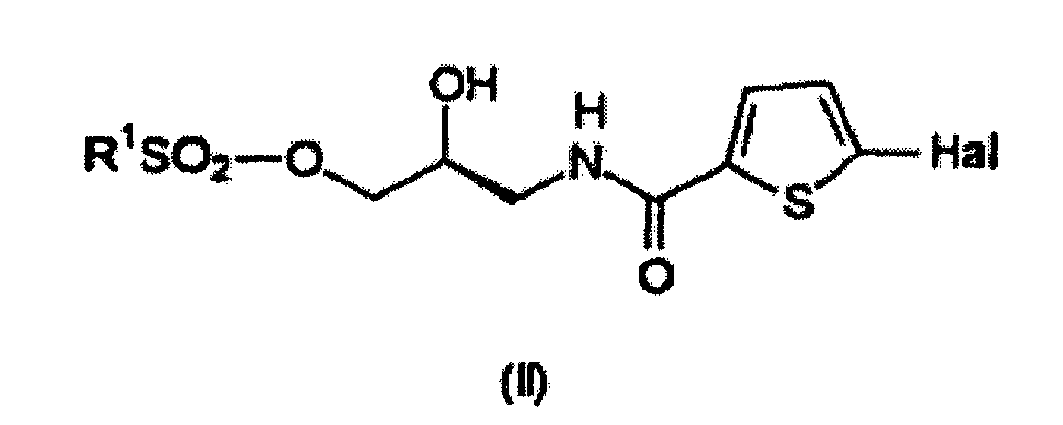
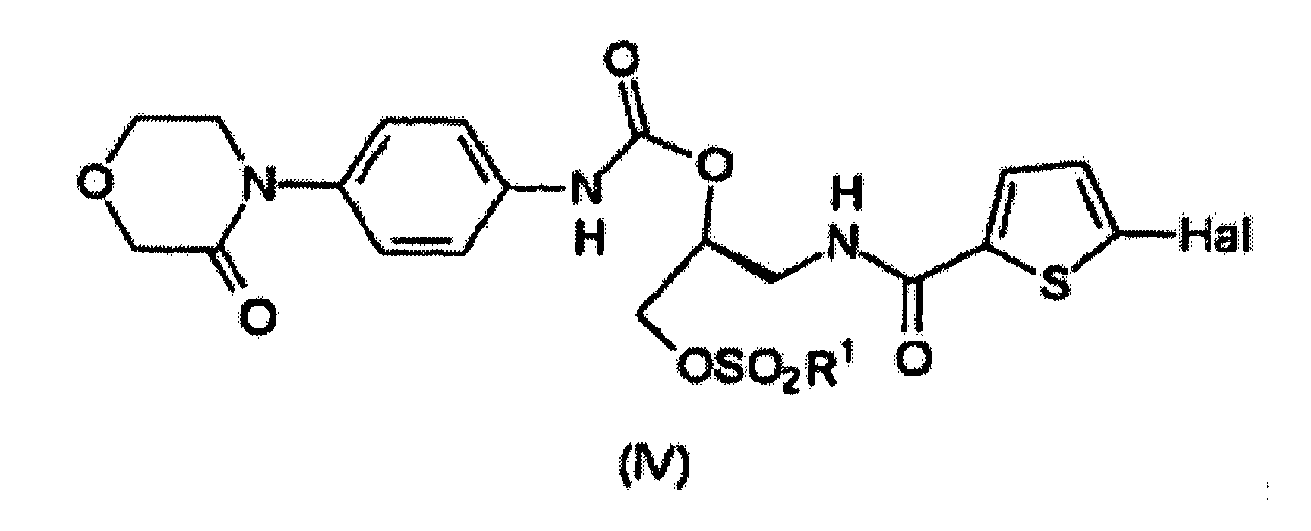
- R 1 is selected from the group consisting of C 1-4 alkyl groups and a phenyl group optionally substituted with a C 1-4 alkyl group.
- R 1 is selected from the group consisting of methyl, phenyl and tolyl, more preferably R 1 is tolyl.
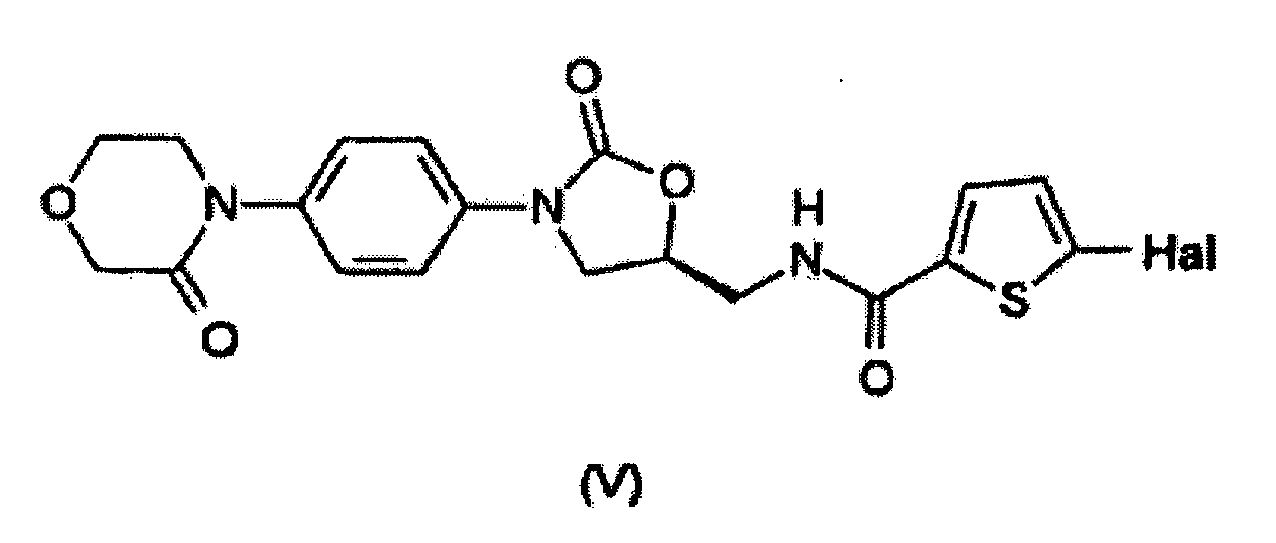
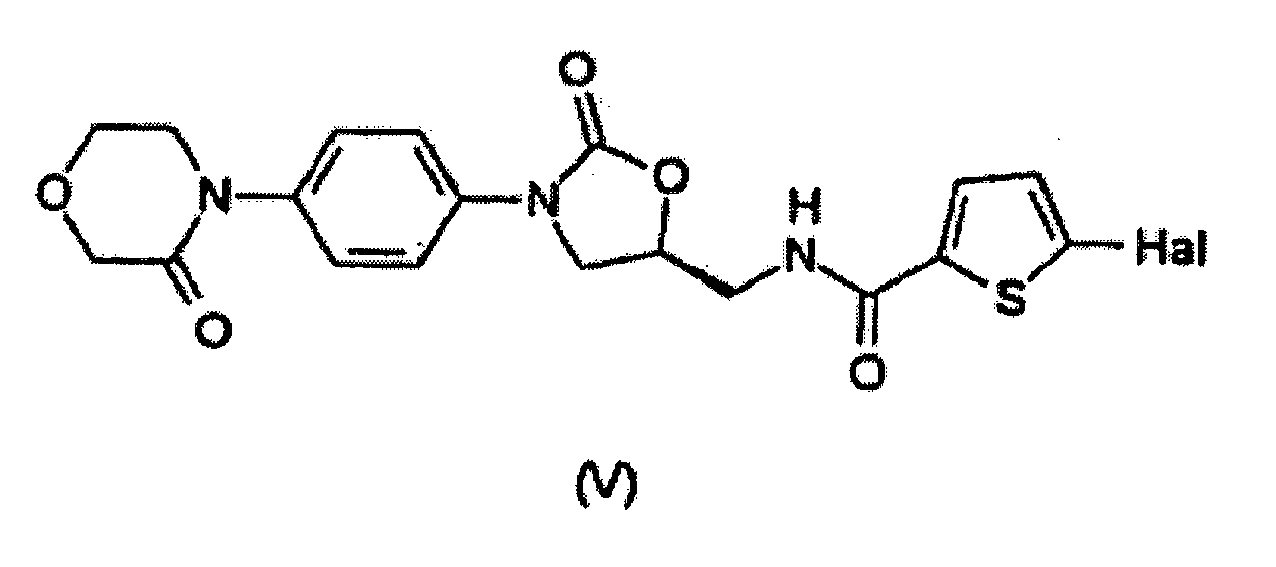
- Hal is a halogen atom such as F, Cl, Br or I or a pseudohalogen such as CN.
- Hal is Cl.
- R 2 is a C 1-6 alkyl group or a benzyl group.
- R 2 is a C 1-4 alkyl group, more preferably R 2 is methyl.
- X is a suitable leaving group such as a halogen atom (such as F, Cl, Br or I) or a pseudohalogen (such as CN).
- R 1 SO 2 X X can also be a carboxylate such as an anhydride.
- X is a halogen such as Cl.
- Phosgene is COCl 2 .
- Phosgene equivalents can be employed in the methods of the present invention instead of phosgene itself. These include trichloromethyl chloroformate (“diphosgene”) and bis(trichloromethyl) carbonate (“triphosgene”) as well as CO equivalents such as 1,1-carbonyldiimidazol.
- the present invention refers to the use of a compound having the formula (II) for the preparation of the compound having the formula (V).
- the present invention relates to a method for the preparation of the compound having the formula (V) wherein the method comprises reacting (i) a compound having the formula (II); (ii) a compound having the formula (III) and (iii) phosgene or an equivalent thereof.
- the invention pertains to a method for preparing a compound having the formula (II) wherein a compound having the formula (I) is converted to the compound having the formula (II).
- Subject matter of the present invention is also a method for preparing a compound having the formula (VI) wherein a compound having the formula (II) is reacted with a compound having the formula (III).
- the invention relates to a method for preparing a compound having the formula (IV) wherein a compound having the formula (II) is first reacted with phosgene or an equivalent thereof and the reaction product thereof is subsequently reacted with a compound having the formula (III).
- a method for preparing a compound having the formula (V) wherein a compound having the formula (IV) is converted to the compound having the formula (V) is also subject matter of the present invention.
- the present invention relates to a method for preparing a compound having the formula (V) wherein a compound having the formula (II) is reacted with a compound having the formula (VIII).
- a method comprising the step of reacting a compound having the formula (II) with a compound having the formula (VII) to provide a compound having the formula (V).
- the present invention further relates to a method comprising the step of converting a compound having the formula (II) into a compound having the formula (IX).
- a method which comprises the step of reacting a compound having the formula (IX) with a compound having the formula (VII) to obtain a compound having the formula (V).
- the present invention relates to a method for preparing a compound having the formula (V) wherein a compound having the formula (II) is converted into a compound having the formula (IX) and the compound having the formula (IX) is reacted with a compound having the formula (VII).
- Examples of the compound having the formula (I) are known. They can be prepared by conventional methods such as those which are analogous to the method which is disclosed in WO 2004/060887 . For example, (2S)-3-aminopropane-1,2-diol can be reacted with 5-halogenothiophene-2-carbonyl halide under basic conditions.
- the compound having the formula (II) can be prepared from a compound having the formula (I).
- the reaction can be conducted using any suitable reaction conditions. Typically the compound having the formula (I) will be reacted with a compound having the formula R 1 SO 2 -X.
- the molar ratio of compound having the formula R 1 SO 2 -X to the compound having the formula (II) is preferably in the range of about 1.0 to about 1.5, more preferably about 1.0 to about 1.1.
- the solvent used in this reaction step will typically be a polar aprotic solvent, which e.g. can be selected from nitrile-type solvents (such as acetonitrile), amides (such as DMF), sulfones (such as sulfolane), cyclic amines (such as pyridine) as well as mixtures thereof.
- Apolar solvents such as halogenated hydrocarbons (such as dichloromethane) or aromatic solvents (such as toluene) or mixtures thereof can also be used.
- the solvent is preferably a nitrile-type solvent such as acetonitrile because it is easy to crystallize the compound having the formula (II) from this solvent.
- the reaction can be conducted at any suitable temperature. Typical reaction temperatures range from about -20 °C to about 100 °C, preferably about 0 °C to about 50 °C. More preferably the reaction is conducted at room temperature (e.g., 20 to 25 °C).
- the reaction can be conducted in the presence of an auxiliary which facilitates the regioselective reaction of the compound having the formula R 1 SO 2 -X with the primary alcohol.
- auxiliaries include organotin compounds such as dialkyltin oxide (wherein alkyl is e.g., C 1-6 alkyl).
- a preferred auxiliary is dibutyltin oxide.
- the molar ratio of auxiliary to the compound having the formula R 1 SO 2 -X is preferably in the range of about 0.01 to about 0.10, more preferably about 0.01 to about 0.05.
- the presence of the auxiliary is preferred because it can significantly reduce the amount of by-product in which both of the hydroxy groups of the compound having the formula (I) have reacted with the compound having the formula R 1 SO 2 -X. This improves the yield of the desired compound having the formula (II) as well as its purity. Furthermore, it has been surprisingly found that the reaction time can be significantly reduced if an auxiliary is used. Due to the reduced amount of by-products the purification of the compound having the formula (II) is also simplified.
- the reaction can be conducted in the presence of a base.
- bases include organic and inorganic bases such as amine compounds.
- Amine compounds such as tri(C 1-4 alkyl)amines are preferably used. They can be employed in a molar ratio in the range of about 1.0 to about 1.5, preferably about 1.0 to about 1.2 compared to the compound having the formula R 1 SO 2 -X.
- the duration of the reaction will depend on the other reaction conditions chosen and can range from about 0.5 h to about 5 h, more typically from about 1 h to about 2 h.
- the compound having the formula (II) will be usually isolated from the reaction mixture.
- One method of isolating the compound having the formula (II) is to induce crystallization by adding water and adjusting the pH to be acidic. The crystals can then be separated from the solvent by conventional methods such as filtration, centrifugation etc. and optionally be washed and/or dried.
- the instant method is advantageous because it is possible to conduct the reaction at room temperature. Furthermore, the yield is surprisingly higher.
- the isolation of the desired compound having the formula (II) is significantly simplified because it is not necessary to remove the reaction solvents first by distillation and then to induce crystallization using a different solvent mixture as described in WO 2004/060887 . Rather crystallization can be induced directly in the reaction solvent. Because it is possible to use a single solvent instead of two different solvent mixtures, recycling and disposal of the solvents are also facilitated. The duration of the reaction can also be shorter using the process according to the invention.
- the compound having the formula (V) can be obtained by reacting the compound having the formula (II), a compound having the formula (III) and phosgene or an equivalent thereof.
- the sequence of the reaction steps is not particularly limited.
- the compound having the formula (II) is first reacted with the compound having the formula (III) to obtain a compound having the formula (VI) and then the compound having the formula (VI) is reacted with phosgene or an equivalent thereof to obtain the compound having the formula (V).
- the compound having the formula (II) is first reacted with phosgene or an equivalent thereof; the reaction product thereof is subsequently reacted with a compound having the formula (III) to obtain a compound having the formula (IV) and the compound having the formula (IV) is converted to the compound having the formula (V).
- These reactions can be conducted as a one pot reaction. Alternatively it is possible to isolate the intermediates and optionally purify them before the second reaction step is conducted.
- the compound having the formula (II) is first reacted with phosgene or an equivalent thereof and the reaction product thereof is subsequently reacted with a compound having the formula (III) to obtain a compound having the formula (IV).
- the reaction of the compound having the formula (II) with phosgene can be conducted using any suitable conditions.
- the conditions will differ depending on whether phosgene or a phosgene equivalent is employed.
- the compound having the formula (II) will be provided in a suitable solvent.
- the solvent will usually be a polar solvent.
- suitable solvents include halogenated hydrocarbons (such as dichloromethane), ethers (such as THF), amides (such as NMP), mixtures of hydrocarbons and alcohols (such as mixtures of toluene and C 1-4 alcohols) and nitriles (such as acetonitrile). Mixtures of the foregoing solvents are also possible.
- Preferred solvents are halogentated hydrocarbons and ethers.
- the phosgene or equivalent thereof will typically be used in a molar ratio of the compound having the formula (II) to phosgene in the range of about 1.0 to about 1.5, more preferably about 1.0 to about 1.1. If phosgene equivalents are used, the molar ratio will be calculated based on the amount of phosgene equivalents which are provided by these compounds.
- a base In order to facilitate the reaction it can be conducted in the presence of a base.
- suitable bases include organic amines, preferably organic cyclic amines such as pyridine. They can be employed in a molar ratio in the range of about 2.0 to about 5.0, preferably about 2.5 to about 3.5 compared to the compound having the formula (II).
- the reaction temperature is not particularly limited. It will typically be in the range of about -60 °C to about 60 °C, preferably about -40 °C to about 20 °C.
- the reaction will usually be completed with about 1 min to about 1 h, more typically about 5 min to about 30 min.
- the intermediate can be isolated.
- the subsequent reaction to the compound having the formula (IV) can be conducted without isolation of the intermediate.
- reaction of the intermediate with the compound having the formula (III) can be conducted in the same solvent as mentioned above with respect to the phosgene reaction.
- the compound having the formula (III) is preferably added in an amount, so that the molar ratio of the compound having the formula (III) to the compound having the formula (II) is in the range of about 1.0 to about 1.5, more preferably about 1.0 to about 1.1.
- reaction can be conducted under an inert gas atmosphere.
- the reaction of the intermediate with the compound having the formula (III) can be, e.g., conducted at a temperature in the range of about -40 °C to about 50 °C, more preferably about 0 °C to about 30 °C.
- the reaction will typically take about 1 h to about 24 h, more typically about 1 h to about 2 h.
- the compound having the formula (IV) can be isolated and/or purified, if desired.
- Conventional purification methods such as evaporation of the solvent can be employed. This step has the advantage of an additional purification by crystallization which improves the yield and purity in a subsequent synthetic step.
- the method to convert the compound having the formula (IV) to the compound having the formula (V) is a cyclization reaction which is not particularly limited.
- the compound can be provided in a solvent.
- solvents include protic and aprotic organic solvents.
- Preferred solvents include ether solvents (such as THF), nitrile solvents (such as acetonitrile) and alcohols (such as C 1-4 alcohols, e.g. isopropanol).
- the reaction is typically conducted in the presence of a base to facilitate the cyclization.
- suitable bases include organometallic and organic bases.
- Preferred bases are, e.g., organolithium compounds (such as lithium bis(trimethylsilyl)amide (LiHMDS) and lithium diisopropylamide (LDA)), hydrides and alcoholates (such as alkali or alkali earth C 1-6 alkoxides).
- the base will be usually present in a molar ratio of base to compound having the formula (IV) in the range of about 1.0 to about 1.5, preferably about 1.0 to about 1.1.
- reaction can be conducted under an inert gas atmosphere.
- the reaction can be conducted at any suitable temperature.
- the temperature will typically be in the range of about -40 °C to about 40 °C, preferably about -10 °C to about 30 °C.
- the reaction will usually be completed with about 0.5 h to about 2 h, more typically about 0.5 h to about 1 h.
- the compound having the formula (V) can be easily isolated from the reaction mixture by conventional methods such as evaporation of the solvent. Further purification steps such as washing, drying and/or recrystallization will conducted by a person skilled in the field according to his specific desires.
- the compound having the formula (II) can be reacted with a compound having the formula (III) to render the compound having the formula (VI) using any suitable method.
- the molar ratio of the compound having the formula (II) to the compound having the formula (III) can be chosen suitably and will usually be in the range of about 1.0 to about 1.5, preferably about 1.0 to about 1.2.
- the reaction can be conducted in a solvent.
- solvents for this step include hydrocarbons (such as toluene) and nitriles (such as acetonitrile).
- a base can assist the reaction.
- suitable bases include organic bases (such as tri(C 1-6 alkyl)amines and collidine) and inorganic bases (such as alkali hydroxides).
- the base can be added in an amount which is, e.g., in the range of about 0.8 to about 1.5 based on the amount of the compound having the formula (II) (mol : mol).
- the reaction temperature can vary in broad ranges. Typical temperatures will be in the range of about 30 °C to about 200 °C, more typically about 70 °C to about 120 °C.
- the reaction will usually proceed for about 1 h to about 8 h, for example about 2 h to about 6 h.
- the method for isolating and/or purifying the compound having the formula (VI) are not restricted and can be chosen from conventional methods.
- the compound having the formula (VI) can be reacted with phosgene or an equivalent thereof to prepare the compound having the formula (V).
- the molar ratio of phosgene to the compound having the formula (VI) will be chosen suitably.
- the molar ratio will typically be in the range of about 1 to about 5, preferably about 1 to about 2, more preferably about 1.0 to about 1.3. If phosgene equivalents are used, the molar ratio will be calculated based on the amount of phosgene equivalents which are provided by these compounds.
- the solvent for this reaction step can be chosen from a wide range of solvents.
- Possible illustrative examples include aprotic organic solvents, preferably hydrocarbons (such as toluene), nitriles (such as acetonitrile) and ethers (such as THF).
- the reaction can proceed at any suitable temperature. Specific examples include a temperature in the range of about 20 °C to about 150 °C, preferably from about 30 °C to about 130 °C, more preferably about 75 °C to about 120 °C.
- the duration of this reaction step will often range from about 0.5 h to about 15 h, e.g., from about 2 h to about 3 h.
- the method of isolating the compound having the formula (V) (if desired) is not particularly limited.
- crystallization can be induced and the resultant crystals can be separated by filtration. If desired, the crystals can be washed, dried and/or recrystallized or treated by any other suitable purification method.
- the compound having the formula (IV) can be prepared from the compound having the formula (II) by reaction with a compound having the formula (VII). In the first part of this reaction the compound having the formula (II) is converted to the compound having the formula (IX).
- the reaction can proceed under any suitable conditions to conduct the cyclisation reaction.
- One option is to conduct the cyclisation in the presence of a base.
- Any suitable base can be used. Examples are inorganic bases (such as carbonates, hydrocarbonates, hydroxides with alkali metals, alkali earth metals or ammonium cations or organic bases (such as C 1-8 alkoxides of alkali metals and alkaline earth metals).
- the pH of the reaction mixture should be adjusted, so that it is above 8.
- the molar ratio of base to compound having the formula (II) is generally in the range of about 10 to about 1, preferably about 6 to about 1.5.
- the reaction will be typically conducted in an polar solvent such as halogenated hydrocarbons (such as methylene chloride), nitriles (such as acetonitrile); ethers (such as THF) and alcohols (such as t-butanol).
- polar solvent such as halogenated hydrocarbons (such as methylene chloride), nitriles (such as acetonitrile); ethers (such as THF) and alcohols (such as t-butanol).
- the reaction temperature is not particularly limited and can vary, for example, from about -30 °C to about 30 °C, preferably about -25 °C to about 25 °C.
- the duration of the reaction will depend on the other conditions chosen. Typical values are in the range of about 1 h to about 120 h, more typically about 5 h to about 85 h.
- the compound having the formula (IX) can be used as such in the further reaction or can be isolated and/or purified using conventional techniques.
- the compound having the formula (IX) can be reacted with a compound having the formula (VII) to the compound having the formula (V).
- the compound having the formula (VII) can be prepared by reacting 4-(4-amino-phenyl)-morpholin-3-one with phosgene or an equivalent thereof.
- 4-(4-Amino-phenyl)-morpholin-3-one is commercially available or can be prepared as described in WO 2004/060887 .
- the reaction will be typically conducted in an aprotic solvent.
- halogenated hydrocarbons such as methylene chloride
- hydrocarbons such as toluene
- mixtures thereof are halogenated hydrocarbons (such as methylene chloride), hydrocarbons (such as toluene) or mixtures thereof.
- the reaction temperature is not particularly limited and will typically be in the range of about -4.0 °C to about 200 °C, more typically about 0 °C to about 120 °C.
- the reaction can be conducted in the presence of an amine (such as mono-, di- or tri(C 1-4 alkyl) amines).
- an amine such as mono-, di- or tri(C 1-4 alkyl) amines.
- the molar ratio of amine to 4-(4-amino-phenyl)-morpholin-3-one is usually from about 1 to about 3, such as about 1.8 to about 2.2.
- reaction times will be from about 0.5 h to about 10 h, such as about 1 h to about 5 h.
- the compound having the formula (VII) can be purified (e.g., by crystallization) or used per se in the reaction with the compound having the formula (IX).
- reaction between the compound having the formula (IX) and the compound having the formula (VII) can be conducted under any suitable conditions. It will be typically conducted in an aprotic solvent.
- suitable solvents include hydrocarbons (such as toluene), halogenated hydrocarbons (such as methylene chloride) or mixtures thereof.
- the reaction can be conducted in the presence of lithium halogenide or tributylphosphine oxide.
- the molar ratio of lithium halogenide to the compound having the formula (IX) will typically be from about 0.02 to about 0.1, more typically about 0.04 to about 0.06.
- the molar ratio of tributylphosphine oxide to the compound having the formula (IX) will typically be from about 0.02 to about 0.1, more typically about 0.04 to about 0.06.
- the reaction temperature is not particularly limited. It can suitably range from about 0 °C to about 200 °C, more suitably from about 20 °C to about 120 °C.
- the reaction will be typically completed in about 1 h to about 24 h, more typically about 2 h to about 6 h.
- the method of isolating the compound having the formula (V) is not particularly limited. It can, for example, be isolated by filtration. If desired, the crystals can be washed, dried and/or recrystalized or treated by any other suitable purification method.
- the compound having the formula (II) can be reacted with the compound having the formula (VII) to obtain the compound having the formula (IV).
- the reaction will be typically conducted in an aprotic solvent.
- suitable solvents include halogenated hydrocarbons (such as methylene chloride), hydrocarbons (such as toluene) and mixtures thereof.
- the molar ratio of the compound having the formula (II) to the compound having the formula (VII) will typically be from about 1 to about 1.5, more typically about 1 to about 1.1.
- the reaction temperature is not particularly limited and can be in the range of about 0 °C to about 150 °C, preferably about 20 °C to about 120 °C.
- the duration of the reaction can be, for example about 0.5 h to about 24 h, e.g., about 1 h to about 12 h.
- the compound having the formula (IV) can be isolated and/or purified or used as such in a further reaction.
- the compound having the formula (IV) can be converted into the compound having the formula (V) as explained above.
- the compound having the formula (II) can be reacted with a compound having the formula (VIII) to prepare the compound having the formula (V).
- the compound having the formula (VIII) can be prepared according to any suitable method.
- One possibility is to prepare it by reacting 4-(4-amino-phenyl)-morpholin-3-one with X-C(O)-O-R 2 .
- the reaction will be typically conducted in a solvent.
- suitable solvents include hydrocarbons (such as toluene), halogenated hydrocarbons (such as methylene chloride), ketones (such as acetone), nitriles (such as acetonitrile), mixtures of acetone/water, mixtures of acetonitrile/water and mixtures thereof.
- the reaction temperature is not particularly limited and can, e.g., be from about -20 °C to about 60 °C, more particularly from about -10°C to about 40 °C.
- the reaction time can vary and, e.g., be from about 1 h to about 4 h, such as from about 1.5 h to about 2.5 h.
- the molar ratio of 4-(4-amino-phenyl)-morpholin-3-one to X-C(O)-O-R 2 will typically be from about 1 to about 1.5, more typically about 1.0 to about 1.1. If desired, the reaction can be conducted in the presence of an inorganic or an organic base. Preferred bases are, e.g., sodium bicarbonate and triethylamine. The molar ratio of base to compound having the formula (II) is in the range of about 1.0 to about 3, preferably about 1.0 to about 2.5.
- the compound having the formula (VIII) will be usually isolated from the reaction mixture.
- One method of isolating the compound having the formula (VIII) is to induce crystallization by adding water. The crystals can then be separated from the solvent by conventional methods such as filtration, centrifugation etc. and optionally be washed and/or dried.
- reaction of the compound having the formula (II) with the compound having the formula (VIII) can be conducted using any suitable conditions.
- a possible reaction route including acylation, cyclization and deacylation is described in the following.
- the compound having the formula (II) can be first reacted with acetic acid anhydride to obtain the corresponding acetyl derivative of the compound having the formula (II).
- the acylation reaction will be typically conducted in a protic or aprotic solvent.
- suitable solvents include halogenated hydrocarbons (such as methylene chloride), hydrocarbons (such as toluene), amides (such as DMF), sulfones (such as sulfolane), aromatic bases (such as pyridine), alcohols (such as isopropanol) and mixtures thereof.
- the molar ratio of the compound having the formula (II) to acetic acid anhydride will typically be from about 1 to about 1.5, more typically about 1 to about 1.1.
- the reaction temperature is not particularly limited and can be in the range of about -20 °C to about 80 °C, preferably about -10 °C to about 50 °C.
- the duration of the reaction can be, for example about 0.5 h to about 24 h, e.g., about 0.5 h to about 5 h.
- the acetyl derivative of the compound having the formula (II) can be purified (e.g., by crystallization) or used per se in the reaction with the compound having the formula (VIII).
- the acetyl derivative of the compound having the formula (II) can be reacted with the compound having the formula (VIII) to obtain the compound having the formula (V).
- suitable solvents include amides (such as DMF and DMAC), ethers (such as THF, methyl-t.-butyl ether), sulfones (such as sulfolane), nitriles (such as acetonitrile), halogenated hydrocarbons (such as methylene chloride), hydrocarbons (such as toluene), alcohols (such as t-butanol and t-amyl alcohol) and mixtures thereof.
- amides such as DMF and DMAC
- ethers such as THF, methyl-t.-butyl ether
- sulfones such as sulfolane
- nitriles such as acetonitrile
- halogenated hydrocarbons such as methylene chloride
- hydrocarbons such as toluene
- alcohols such as t-butanol and t-amyl alcohol
- the molar ratio of the acetyl derivative of the compound having the formula (II) to the compound having the formula (VIII) will typically be from about 0.7 to about 1.4, more typically about 0.7 to about 1.1.
- the reaction is preferably conducted in presence of a base and an alcohol.
- Suitable bases include alkoxy compounds having one to seven carbon atoms (such as tert.-butoxides or tert.-amylates of alkali metals or alkaline earth metals), carbonates, trialkylamines, DBU, DBN and phosphacene bases.
- the molar ratio of the base to the compound having the formula (II) will typically be from about 1 to about 3, more typically about 1.4 to about 2.5.
- Suitable alcohols are C 1-4 alcohols such as methanol, ethanol and isopropanol.
- the molar ratio of the alcohol to the compound having the formula (II) will typically be from about 0.7 to about 4, more typically about 0.7 to about 2.
- the reaction temperature can vary in the range of about -40 °C to about 50 °C, more typically about -20 °C to about 30 °C.
- the reaction will usually proceed for about 2 h to about 24 h, for example about 6 h to about 18 h.
- the method of isolating the compound having the formula (V) is not particularly limited. It can, for example, be isolated by filtration. If desired, the crystals can be washed, dried and/or recrystalized or treated by any other suitable purification method.
- All of the reactions mentioned above can be conducted at ambient pressure or other pressures such as a pressure in the range of about 50 kPa to about 500 kPa. Typically they will be conducted at ambient pressure.
- the starting material 4-[4-[(5R)-5-(chlorothiopheno-2-carboxylic acid (S)-2,3-dihydroxypropylamide was prepared as described in WO 2004/06088 .
- the combined methylene chloride layers were washed with 400mL of water, dried with sodium sulfate and concentrated in vacuo to a weight of 86g.
- the concentrate was dissolved in 200mL of acetonitrile at 40°C and then allowed to cool to ambient temperature. The resulting slurry was stirred for 1 hour at ambient temperature and cooled to 0°C. After stirring for 2 hours at this temperature the suspension was filtered and the filter cake was washed with 50mL of acetonitrile. The wet product was dried at 30°C in vacuo to yield 21.1g of the title compound in form of crystalline powder (78 % by theory).
Landscapes
- Chemical & Material Sciences (AREA)
- Organic Chemistry (AREA)
- Plural Heterocyclic Compounds (AREA)
- Pharmaceuticals Containing Other Organic And Inorganic Compounds (AREA)
- Heterocyclic Carbon Compounds Containing A Hetero Ring Having Nitrogen And Oxygen As The Only Ring Hetero Atoms (AREA)
- Heterocyclic Carbon Compounds Containing A Hetero Ring Having Oxygen Or Sulfur (AREA)
- Organic Low-Molecular-Weight Compounds And Preparation Thereof (AREA)
- Heterocyclic Compounds Containing Sulfur Atoms (AREA)
Claims (18)
- Utilisation d'un composé ayant la formule (II)
pour la préparation du composé ayant la formule (V)
- Utilisation selon la revendication 1, dans laquelle R1 est choisi parmi un méthyle, un phényle et un tolyle.
- Procédé pour la préparation d'un composé ayant la formule (V)
dans lequel le procédé comprend la réaction(i) d'un composé ayant la formule (II) (ii) d'un composé ayant la formule (III)
 (iii) de phosgène ou d'un équivalent de celui-ci.
 - Procédé selon la revendication 3, dans lequel le composé ayant la formule (II) est d'abord fait réagir avec un composé ayant la formule (III) pour obtenir un composé ayant la formule (VI)

et le composé ayant la formule (VI) est ensuite fait réagir avec du phosgène ou un équivalent de celui-ci pour obtenir le composé ayant la formule (V). - Procédé selon la revendication 3, dans lequel le composé ayant la formule (II) est d'abord fait réagir avec du phosgène ou un équivalent de celui-ci ; le produit de réaction de celui-ci est par la suite fait réagir avec un composé ayant la formule (III) pour obtenir un composé ayant la formule (IV)
et le composé ayant la formule (IV) est converti en le composé ayant la formule (V). - Utilisation selon la revendication 1 ou 2 ou le procédé selon l'une quelconque des revendications 3 à 5, dans laquelle(lequel) le composé ayant la formule (II) est préparé à partir d'un composé ayant la formule (I)

- Procédé de préparation d'un composé ayant la formule (II)

dans lequel un composé ayant la formule (I)
est converti en le composé ayant la formule (II). - Procédé de préparation d'un composé ayant la formule (VI)

dans lequel un composé ayant la formule (II)
est fait réagir avec un composé ayant la formule (III)
- Procédé de préparation d'un composé ayant la formule (IV)

dans lequel un composé ayant la formule (II)
est d'abord fait réagir avec du phosgène ou un équivalent de celui-ci et le produit de réaction de celui-ci est par la suite fait réagir avec un composé ayant la formule (III)
- Procédé de préparation d'un composé ayant la formule (V)

dans lequel un composé ayant la formule (IV)
est converti en le composé ayant la formule (V). - Procédé de préparation d'un composé ayant la formule (V)
dans lequel un composé ayant la formule (II)
est fait réagir avec un composé ayant la formule (VIII)
- Procédé comprenant l'étape consistant à faire réagir un composé ayant la formule (II)

avec un composé ayant la formule (VII)

- Procédé comprenant l'étape de conversion d'un composé ayant la formule (II)

en un composé ayant la formule (IX)
- Procédé comprenant l'étape consistant à faire réagir un composé ayant la formule (IX)

avec un composé ayant la formule (VII)

- Composé ayant la formule (II)
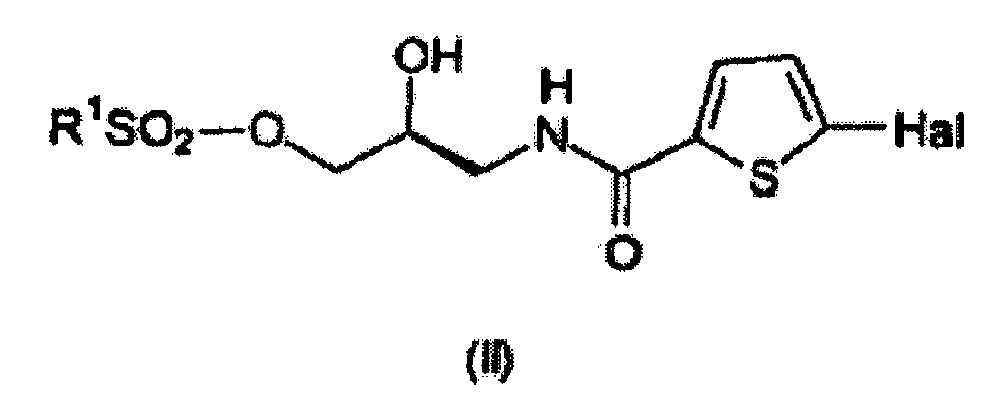
- Composé ayant la formule (IV)

- Composé ayant la formule (VII)

- Composé ayant la formule (IX)

Priority Applications (1)
| Application Number | Priority Date | Filing Date | Title |
|---|---|---|---|
| EP11702646.8A EP2521717B1 (fr) | 2010-02-10 | 2011-02-10 | Procédé pour la préparation de rivaroxaban |
Applications Claiming Priority (3)
| Application Number | Priority Date | Filing Date | Title |
|---|---|---|---|
| EP10153160A EP2354128A1 (fr) | 2010-02-10 | 2010-02-10 | Procédé pour la préparation de rivaroxaban |
| PCT/EP2011/051920 WO2011098501A1 (fr) | 2010-02-10 | 2011-02-10 | Procédé de préparation du rivaroxaban |
| EP11702646.8A EP2521717B1 (fr) | 2010-02-10 | 2011-02-10 | Procédé pour la préparation de rivaroxaban |
Publications (2)
| Publication Number | Publication Date |
|---|---|
| EP2521717A1 EP2521717A1 (fr) | 2012-11-14 |
| EP2521717B1 true EP2521717B1 (fr) | 2013-05-22 |
Family
ID=42355383
Family Applications (2)
| Application Number | Title | Priority Date | Filing Date |
|---|---|---|---|
| EP10153160A Ceased EP2354128A1 (fr) | 2010-02-10 | 2010-02-10 | Procédé pour la préparation de rivaroxaban |
| EP11702646.8A Active EP2521717B1 (fr) | 2010-02-10 | 2011-02-10 | Procédé pour la préparation de rivaroxaban |
Family Applications Before (1)
| Application Number | Title | Priority Date | Filing Date |
|---|---|---|---|
| EP10153160A Ceased EP2354128A1 (fr) | 2010-02-10 | 2010-02-10 | Procédé pour la préparation de rivaroxaban |
Country Status (9)
| Country | Link |
|---|---|
| US (1) | US8648189B2 (fr) |
| EP (2) | EP2354128A1 (fr) |
| JP (1) | JP5274725B2 (fr) |
| CN (1) | CN102753537B (fr) |
| AU (1) | AU2011214423B2 (fr) |
| BR (1) | BR112012019936A2 (fr) |
| CA (1) | CA2788755C (fr) |
| RU (1) | RU2012138259A (fr) |
| WO (1) | WO2011098501A1 (fr) |
Cited By (1)
| Publication number | Priority date | Publication date | Assignee | Title |
|---|---|---|---|---|
| EP3505520A1 (fr) | 2013-12-06 | 2019-07-03 | Eisai R&D Management Co., Ltd. | Procédés utiles dans la synthèse d'analogues d'halichondrine b |
Families Citing this family (28)
| Publication number | Priority date | Publication date | Assignee | Title |
|---|---|---|---|---|
| EP2404920A1 (fr) | 2010-07-06 | 2012-01-11 | Sandoz AG | Form cristalline de Rivaroxaban dihydrate |
| CN102584738B (zh) * | 2011-01-07 | 2015-04-29 | 浙江九洲药业股份有限公司 | 一种合成利伐沙班中间体的工艺 |
| CN103254148B (zh) | 2012-02-15 | 2016-04-13 | 浙江海正药业股份有限公司 | 利奈唑胺中间体的制备方法 |
| CZ2012111A3 (cs) | 2012-02-16 | 2013-08-28 | Zentiva, K.S. | Zpusob prípravy rivaroxabanu zalozený na vyuzití (S)-epichlorhydrinu |
| CN103288814B (zh) | 2012-02-24 | 2016-07-06 | 国药集团国瑞药业有限公司 | 一种利伐沙班中间体的制备方法 |
| US9562040B2 (en) * | 2012-04-06 | 2017-02-07 | Indiana University Research And Technology Corporation | Processes for preparing Rivaroxaban |
| EP2838897A1 (fr) | 2012-04-16 | 2015-02-25 | Ranbaxy Laboratories Limited | Procédé pour la préparation de rivaroxaban et d'intermédiaires de celui-ci |
| US9376427B2 (en) * | 2012-05-02 | 2016-06-28 | Symed Labs Limited | Process for preparing rivaroxaban using intermediates |
| IN2014DN10209A (fr) * | 2012-05-24 | 2015-08-07 | Ranbaxy Lab Ltd | |
| CN102702186B (zh) * | 2012-06-20 | 2014-11-19 | 安润医药科技(苏州)有限公司 | 利伐沙班的合成方法 |
| US20150218145A1 (en) * | 2012-09-26 | 2015-08-06 | Ranbaxy Laboratories Limited | Process for the preparation of rivaroxaban |
| US9394292B2 (en) | 2012-12-26 | 2016-07-19 | Wanbury Ltd. | Rivaroxaban intermediate and preparation thereof |
| AU2013368847B2 (en) | 2012-12-26 | 2017-03-16 | Wanbury Ltd. | Aldehyde derivative of substitute oxazolidinones |
| IN2013MU01113A (fr) | 2013-03-25 | 2015-06-19 | Glenmark Generics Ltd | |
| CN104098556B (zh) * | 2013-04-09 | 2019-01-08 | 浙江九洲药物科技有限公司 | 一种利伐沙班的合成工艺 |
| CN104109158A (zh) * | 2013-04-16 | 2014-10-22 | 上海医药工业研究院 | 一种纯化利伐沙班的方法 |
| CN103351385A (zh) * | 2013-06-28 | 2013-10-16 | 浙江燎原药业有限公司 | 一种利伐沙班中间体的制备方法 |
| CN103819468A (zh) * | 2013-12-05 | 2014-05-28 | 浙江天宇药业股份有限公司 | 一种利伐沙班及其中间体的合成方法 |
| WO2015104605A1 (fr) | 2014-01-08 | 2015-07-16 | Wockhardt Limited | Procédé de préparation de rivaroxaban ou d'un sel pharmaceutiquement acceptable de ce dernier |
| IN2014CH00290A (fr) | 2014-01-23 | 2015-08-14 | Symed Labs Ltd | |
| CN105085370B (zh) * | 2014-04-22 | 2017-04-12 | 北大方正集团有限公司 | (s)‑1‑卤代‑2‑[2‑(1,3‑二氧异吲哚)基]乙基氯甲酸酯及其制备方法 |
| CN105085508B (zh) * | 2014-04-22 | 2017-12-08 | 北大方正集团有限公司 | 一种合成利伐沙班关键中间体的方法 |
| CN105085507B (zh) * | 2014-04-22 | 2017-11-24 | 北大方正集团有限公司 | 一种合成利伐沙班的方法 |
| CN105085371B (zh) * | 2014-04-22 | 2017-06-16 | 北大方正集团有限公司 | (s)‑{1‑(氯甲酸酯基)‑2‑[2‑(1,3‑二氧异吲哚)基]乙基}卤化盐及其制备方法 |
| CN105566310A (zh) * | 2014-10-15 | 2016-05-11 | 常州诺贝朗生物医药科技有限公司 | 一种利伐沙班中间体的制备方法 |
| CN106588905A (zh) * | 2016-12-13 | 2017-04-26 | 重庆英斯凯化工有限公司 | 一种利伐沙班中间体的制备方法 |
| CN112500403B (zh) * | 2020-12-28 | 2022-04-05 | 南京法恩化学有限公司 | 一种利伐沙班的制备方法 |
| WO2023088229A1 (fr) | 2021-11-17 | 2023-05-25 | 浙江华海药业股份有限公司 | Procédé de synthèse de rivaroxaban |
Family Cites Families (7)
| Publication number | Priority date | Publication date | Assignee | Title |
|---|---|---|---|---|
| GB9318641D0 (en) * | 1993-09-08 | 1993-10-27 | Edko Trading Representation | Compositions |
| DE19962924A1 (de) | 1999-12-24 | 2001-07-05 | Bayer Ag | Substituierte Oxazolidinone und ihre Verwendung |
| FR2841997B1 (fr) | 2002-07-08 | 2005-11-11 | Gemplus Card Int | Securisation d'application telechargee notamment dans une carte a puce |
| DE10300111A1 (de) * | 2003-01-07 | 2004-07-15 | Bayer Healthcare Ag | Verfahren zur Herstellung von 5-Chlor-N-({(5S)-2-oxo-3-[4-(3-oxo-4-morpholinyl)-phenyl]-1,3-oxazolidin-5-yl}-methyl)-2-thiophencarboxamid |
| DE10322469A1 (de) * | 2003-05-19 | 2004-12-16 | Bayer Healthcare Ag | Heterocyclische Verbindungen |
| DE102005052174A1 (de) * | 2005-11-02 | 2007-06-06 | Bayer Healthcare Ag | Phenylen-bis-oxazolidin-Derivate und ihre Verwendung |
| CN1772750A (zh) * | 2005-11-15 | 2006-05-17 | 郑州大学 | (r)-n-(3-氟-4-吗啉苯基)-噁唑酮-5-甲基醇制备工艺 |
-
2010
- 2010-02-10 EP EP10153160A patent/EP2354128A1/fr not_active Ceased
-
2011
- 2011-02-10 WO PCT/EP2011/051920 patent/WO2011098501A1/fr not_active Ceased
- 2011-02-10 CA CA2788755A patent/CA2788755C/fr not_active Expired - Fee Related
- 2011-02-10 BR BR112012019936A patent/BR112012019936A2/pt not_active IP Right Cessation
- 2011-02-10 US US13/577,441 patent/US8648189B2/en not_active Expired - Fee Related
- 2011-02-10 JP JP2012552389A patent/JP5274725B2/ja not_active Expired - Fee Related
- 2011-02-10 CN CN201180009134.4A patent/CN102753537B/zh not_active Expired - Fee Related
- 2011-02-10 RU RU2012138259/04A patent/RU2012138259A/ru not_active Application Discontinuation
- 2011-02-10 EP EP11702646.8A patent/EP2521717B1/fr active Active
- 2011-02-10 AU AU2011214423A patent/AU2011214423B2/en not_active Ceased
Cited By (1)
| Publication number | Priority date | Publication date | Assignee | Title |
|---|---|---|---|---|
| EP3505520A1 (fr) | 2013-12-06 | 2019-07-03 | Eisai R&D Management Co., Ltd. | Procédés utiles dans la synthèse d'analogues d'halichondrine b |
Also Published As
| Publication number | Publication date |
|---|---|
| JP2013519650A (ja) | 2013-05-30 |
| RU2012138259A (ru) | 2014-03-20 |
| JP5274725B2 (ja) | 2013-08-28 |
| CN102753537B (zh) | 2015-09-02 |
| US8648189B2 (en) | 2014-02-11 |
| CA2788755A1 (fr) | 2011-08-18 |
| BR112012019936A2 (pt) | 2015-09-22 |
| CN102753537A (zh) | 2012-10-24 |
| AU2011214423A1 (en) | 2012-08-30 |
| WO2011098501A1 (fr) | 2011-08-18 |
| EP2354128A1 (fr) | 2011-08-10 |
| EP2521717A1 (fr) | 2012-11-14 |
| CA2788755C (fr) | 2015-03-31 |
| US20130184457A1 (en) | 2013-07-18 |
| AU2011214423B2 (en) | 2015-06-11 |
Similar Documents
| Publication | Publication Date | Title |
|---|---|---|
| EP2521717B1 (fr) | Procédé pour la préparation de rivaroxaban | |
| US7351823B2 (en) | Preparation process | |
| US20070149522A1 (en) | Method for producing 5-chloro-n-({(5s)-2-oxo-3-[4-(3-oxo-4-morpholinyl)phenyl]-1,3-oxazolidin-5-yl}methyl)-2-thiophenecarboxamide | |
| CN112955426A (zh) | 制备光学富集的羟醛化合物的方法 | |
| EP2697209B1 (fr) | Procédé de préparation d'oxazolidinones substituées | |
| US9663505B2 (en) | Process for the preparation of rivaroxaban | |
| EP2855465A1 (fr) | Procédé pour la préparation de rivaroxaban | |
| CN106397292A (zh) | 依替米贝的中间体及其合成方法与依替米贝的合成方法 | |
| CN105873904A (zh) | 2-氨基烟酸苄酯衍生物的制造方法 | |
| JP2010265274A (ja) | N−デベンゾイルパクリタキセルの製造のための半合成法 | |
| WO2014020458A1 (fr) | Procédé amélioré de préparation du rivaroxaban | |
| KR101206598B1 (ko) | 제조 방법 | |
| CN107089974A (zh) | 一种利伐沙班的制备方法 | |
| JP4745315B2 (ja) | 3−アミノチオフェン誘導体 | |
| MXPA06007902A (en) | Production method | |
| HK1103722B (en) | Production method |
Legal Events
| Date | Code | Title | Description |
|---|---|---|---|
| PUAI | Public reference made under article 153(3) epc to a published international application that has entered the european phase |
Free format text: ORIGINAL CODE: 0009012 |
|
| 17P | Request for examination filed |
Effective date: 20120807 |
|
| AK | Designated contracting states |
Kind code of ref document: A1 Designated state(s): AL AT BE BG CH CY CZ DE DK EE ES FI FR GB GR HR HU IE IS IT LI LT LU LV MC MK MT NL NO PL PT RO RS SE SI SK SM TR |
|
| GRAP | Despatch of communication of intention to grant a patent |
Free format text: ORIGINAL CODE: EPIDOSNIGR1 |
|
| DAX | Request for extension of the european patent (deleted) | ||
| GRAS | Grant fee paid |
Free format text: ORIGINAL CODE: EPIDOSNIGR3 |
|
| GRAA | (expected) grant |
Free format text: ORIGINAL CODE: 0009210 |
|
| AK | Designated contracting states |
Kind code of ref document: B1 Designated state(s): AL AT BE BG CH CY CZ DE DK EE ES FI FR GB GR HR HU IE IS IT LI LT LU LV MC MK MT NL NO PL PT RO RS SE SI SK SM TR |
|
| REG | Reference to a national code |
Ref country code: GB Ref legal event code: FG4D |
|
| REG | Reference to a national code |
Ref country code: CH Ref legal event code: EP |
|
| REG | Reference to a national code |
Ref country code: CH Ref legal event code: NV Representative=s name: SCHMAUDER AND PARTNER AG PATENT- UND MARKENANW, CH |
|
| REG | Reference to a national code |
Ref country code: AT Ref legal event code: REF Ref document number: 613158 Country of ref document: AT Kind code of ref document: T Effective date: 20130615 |
|
| REG | Reference to a national code |
Ref country code: IE Ref legal event code: FG4D |
|
| REG | Reference to a national code |
Ref country code: DE Ref legal event code: R096 Ref document number: 602011001747 Country of ref document: DE Effective date: 20130718 |
|
| REG | Reference to a national code |
Ref country code: AT Ref legal event code: MK05 Ref document number: 613158 Country of ref document: AT Kind code of ref document: T Effective date: 20130522 |
|
| REG | Reference to a national code |
Ref country code: LT Ref legal event code: MG4D |
|
| PG25 | Lapsed in a contracting state [announced via postgrant information from national office to epo] |
Ref country code: SI Free format text: LAPSE BECAUSE OF FAILURE TO SUBMIT A TRANSLATION OF THE DESCRIPTION OR TO PAY THE FEE WITHIN THE PRESCRIBED TIME-LIMIT Effective date: 20130522 Ref country code: ES Free format text: LAPSE BECAUSE OF FAILURE TO SUBMIT A TRANSLATION OF THE DESCRIPTION OR TO PAY THE FEE WITHIN THE PRESCRIBED TIME-LIMIT Effective date: 20130902 Ref country code: AT Free format text: LAPSE BECAUSE OF FAILURE TO SUBMIT A TRANSLATION OF THE DESCRIPTION OR TO PAY THE FEE WITHIN THE PRESCRIBED TIME-LIMIT Effective date: 20130522 Ref country code: GR Free format text: LAPSE BECAUSE OF FAILURE TO SUBMIT A TRANSLATION OF THE DESCRIPTION OR TO PAY THE FEE WITHIN THE PRESCRIBED TIME-LIMIT Effective date: 20130823 Ref country code: PT Free format text: LAPSE BECAUSE OF FAILURE TO SUBMIT A TRANSLATION OF THE DESCRIPTION OR TO PAY THE FEE WITHIN THE PRESCRIBED TIME-LIMIT Effective date: 20130923 Ref country code: LT Free format text: LAPSE BECAUSE OF FAILURE TO SUBMIT A TRANSLATION OF THE DESCRIPTION OR TO PAY THE FEE WITHIN THE PRESCRIBED TIME-LIMIT Effective date: 20130522 Ref country code: SE Free format text: LAPSE BECAUSE OF FAILURE TO SUBMIT A TRANSLATION OF THE DESCRIPTION OR TO PAY THE FEE WITHIN THE PRESCRIBED TIME-LIMIT Effective date: 20130522 Ref country code: FI Free format text: LAPSE BECAUSE OF FAILURE TO SUBMIT A TRANSLATION OF THE DESCRIPTION OR TO PAY THE FEE WITHIN THE PRESCRIBED TIME-LIMIT Effective date: 20130522 Ref country code: NO Free format text: LAPSE BECAUSE OF FAILURE TO SUBMIT A TRANSLATION OF THE DESCRIPTION OR TO PAY THE FEE WITHIN THE PRESCRIBED TIME-LIMIT Effective date: 20130822 |
|
| REG | Reference to a national code |
Ref country code: NL Ref legal event code: VDEP Effective date: 20130522 |
|
| PG25 | Lapsed in a contracting state [announced via postgrant information from national office to epo] |
Ref country code: PL Free format text: LAPSE BECAUSE OF FAILURE TO SUBMIT A TRANSLATION OF THE DESCRIPTION OR TO PAY THE FEE WITHIN THE PRESCRIBED TIME-LIMIT Effective date: 20130522 Ref country code: RS Free format text: LAPSE BECAUSE OF FAILURE TO SUBMIT A TRANSLATION OF THE DESCRIPTION OR TO PAY THE FEE WITHIN THE PRESCRIBED TIME-LIMIT Effective date: 20130522 Ref country code: BG Free format text: LAPSE BECAUSE OF FAILURE TO SUBMIT A TRANSLATION OF THE DESCRIPTION OR TO PAY THE FEE WITHIN THE PRESCRIBED TIME-LIMIT Effective date: 20130822 Ref country code: HR Free format text: LAPSE BECAUSE OF FAILURE TO SUBMIT A TRANSLATION OF THE DESCRIPTION OR TO PAY THE FEE WITHIN THE PRESCRIBED TIME-LIMIT Effective date: 20130522 |
|
| PG25 | Lapsed in a contracting state [announced via postgrant information from national office to epo] |
Ref country code: LV Free format text: LAPSE BECAUSE OF FAILURE TO SUBMIT A TRANSLATION OF THE DESCRIPTION OR TO PAY THE FEE WITHIN THE PRESCRIBED TIME-LIMIT Effective date: 20130522 |
|
| PG25 | Lapsed in a contracting state [announced via postgrant information from national office to epo] |
Ref country code: BE Free format text: LAPSE BECAUSE OF FAILURE TO SUBMIT A TRANSLATION OF THE DESCRIPTION OR TO PAY THE FEE WITHIN THE PRESCRIBED TIME-LIMIT Effective date: 20130522 Ref country code: SK Free format text: LAPSE BECAUSE OF FAILURE TO SUBMIT A TRANSLATION OF THE DESCRIPTION OR TO PAY THE FEE WITHIN THE PRESCRIBED TIME-LIMIT Effective date: 20130522 Ref country code: CZ Free format text: LAPSE BECAUSE OF FAILURE TO SUBMIT A TRANSLATION OF THE DESCRIPTION OR TO PAY THE FEE WITHIN THE PRESCRIBED TIME-LIMIT Effective date: 20130522 Ref country code: EE Free format text: LAPSE BECAUSE OF FAILURE TO SUBMIT A TRANSLATION OF THE DESCRIPTION OR TO PAY THE FEE WITHIN THE PRESCRIBED TIME-LIMIT Effective date: 20130522 Ref country code: DK Free format text: LAPSE BECAUSE OF FAILURE TO SUBMIT A TRANSLATION OF THE DESCRIPTION OR TO PAY THE FEE WITHIN THE PRESCRIBED TIME-LIMIT Effective date: 20130522 |
|
| PG25 | Lapsed in a contracting state [announced via postgrant information from national office to epo] |
Ref country code: IT Free format text: LAPSE BECAUSE OF FAILURE TO SUBMIT A TRANSLATION OF THE DESCRIPTION OR TO PAY THE FEE WITHIN THE PRESCRIBED TIME-LIMIT Effective date: 20130522 Ref country code: NL Free format text: LAPSE BECAUSE OF FAILURE TO SUBMIT A TRANSLATION OF THE DESCRIPTION OR TO PAY THE FEE WITHIN THE PRESCRIBED TIME-LIMIT Effective date: 20130522 Ref country code: RO Free format text: LAPSE BECAUSE OF FAILURE TO SUBMIT A TRANSLATION OF THE DESCRIPTION OR TO PAY THE FEE WITHIN THE PRESCRIBED TIME-LIMIT Effective date: 20130522 |
|
| PLBE | No opposition filed within time limit |
Free format text: ORIGINAL CODE: 0009261 |
|
| STAA | Information on the status of an ep patent application or granted ep patent |
Free format text: STATUS: NO OPPOSITION FILED WITHIN TIME LIMIT |
|
| 26N | No opposition filed |
Effective date: 20140225 |
|
| REG | Reference to a national code |
Ref country code: DE Ref legal event code: R097 Ref document number: 602011001747 Country of ref document: DE Effective date: 20140225 |
|
| PG25 | Lapsed in a contracting state [announced via postgrant information from national office to epo] |
Ref country code: LU Free format text: LAPSE BECAUSE OF FAILURE TO SUBMIT A TRANSLATION OF THE DESCRIPTION OR TO PAY THE FEE WITHIN THE PRESCRIBED TIME-LIMIT Effective date: 20140210 Ref country code: MC Free format text: LAPSE BECAUSE OF FAILURE TO SUBMIT A TRANSLATION OF THE DESCRIPTION OR TO PAY THE FEE WITHIN THE PRESCRIBED TIME-LIMIT Effective date: 20130522 |
|
| REG | Reference to a national code |
Ref country code: IE Ref legal event code: MM4A |
|
| PG25 | Lapsed in a contracting state [announced via postgrant information from national office to epo] |
Ref country code: IE Free format text: LAPSE BECAUSE OF NON-PAYMENT OF DUE FEES Effective date: 20140210 |
|
| REG | Reference to a national code |
Ref country code: FR Ref legal event code: PLFP Year of fee payment: 6 |
|
| PG25 | Lapsed in a contracting state [announced via postgrant information from national office to epo] |
Ref country code: MT Free format text: LAPSE BECAUSE OF FAILURE TO SUBMIT A TRANSLATION OF THE DESCRIPTION OR TO PAY THE FEE WITHIN THE PRESCRIBED TIME-LIMIT Effective date: 20130522 |
|
| PG25 | Lapsed in a contracting state [announced via postgrant information from national office to epo] |
Ref country code: SM Free format text: LAPSE BECAUSE OF FAILURE TO SUBMIT A TRANSLATION OF THE DESCRIPTION OR TO PAY THE FEE WITHIN THE PRESCRIBED TIME-LIMIT Effective date: 20130522 |
|
| PG25 | Lapsed in a contracting state [announced via postgrant information from national office to epo] |
Ref country code: IS Free format text: LAPSE BECAUSE OF FAILURE TO SUBMIT A TRANSLATION OF THE DESCRIPTION OR TO PAY THE FEE WITHIN THE PRESCRIBED TIME-LIMIT Effective date: 20130522 Ref country code: CY Free format text: LAPSE BECAUSE OF FAILURE TO SUBMIT A TRANSLATION OF THE DESCRIPTION OR TO PAY THE FEE WITHIN THE PRESCRIBED TIME-LIMIT Effective date: 20130522 |
|
| PG25 | Lapsed in a contracting state [announced via postgrant information from national office to epo] |
Ref country code: TR Free format text: LAPSE BECAUSE OF FAILURE TO SUBMIT A TRANSLATION OF THE DESCRIPTION OR TO PAY THE FEE WITHIN THE PRESCRIBED TIME-LIMIT Effective date: 20130522 Ref country code: HU Free format text: LAPSE BECAUSE OF FAILURE TO SUBMIT A TRANSLATION OF THE DESCRIPTION OR TO PAY THE FEE WITHIN THE PRESCRIBED TIME-LIMIT; INVALID AB INITIO Effective date: 20110210 |
|
| REG | Reference to a national code |
Ref country code: FR Ref legal event code: PLFP Year of fee payment: 7 |
|
| REG | Reference to a national code |
Ref country code: FR Ref legal event code: PLFP Year of fee payment: 8 |
|
| PG25 | Lapsed in a contracting state [announced via postgrant information from national office to epo] |
Ref country code: MK Free format text: LAPSE BECAUSE OF FAILURE TO SUBMIT A TRANSLATION OF THE DESCRIPTION OR TO PAY THE FEE WITHIN THE PRESCRIBED TIME-LIMIT Effective date: 20130522 |
|
| PG25 | Lapsed in a contracting state [announced via postgrant information from national office to epo] |
Ref country code: AL Free format text: LAPSE BECAUSE OF FAILURE TO SUBMIT A TRANSLATION OF THE DESCRIPTION OR TO PAY THE FEE WITHIN THE PRESCRIBED TIME-LIMIT Effective date: 20130522 |
|
| PGFP | Annual fee paid to national office [announced via postgrant information from national office to epo] |
Ref country code: FR Payment date: 20230123 Year of fee payment: 13 Ref country code: CH Payment date: 20230307 Year of fee payment: 13 |
|
| PGFP | Annual fee paid to national office [announced via postgrant information from national office to epo] |
Ref country code: GB Payment date: 20230119 Year of fee payment: 13 Ref country code: DE Payment date: 20230117 Year of fee payment: 13 |
|
| REG | Reference to a national code |
Ref country code: DE Ref legal event code: R119 Ref document number: 602011001747 Country of ref document: DE |
|
| REG | Reference to a national code |
Ref country code: CH Ref legal event code: PL |
|
| PG25 | Lapsed in a contracting state [announced via postgrant information from national office to epo] |
Ref country code: CH Free format text: LAPSE BECAUSE OF NON-PAYMENT OF DUE FEES Effective date: 20240229 |
|
| GBPC | Gb: european patent ceased through non-payment of renewal fee |
Effective date: 20240210 |
|
| PG25 | Lapsed in a contracting state [announced via postgrant information from national office to epo] |
Ref country code: CH Free format text: LAPSE BECAUSE OF NON-PAYMENT OF DUE FEES Effective date: 20240229 |
|
| PG25 | Lapsed in a contracting state [announced via postgrant information from national office to epo] |
Ref country code: DE Free format text: LAPSE BECAUSE OF NON-PAYMENT OF DUE FEES Effective date: 20240903 |
|
| PG25 | Lapsed in a contracting state [announced via postgrant information from national office to epo] |
Ref country code: GB Free format text: LAPSE BECAUSE OF NON-PAYMENT OF DUE FEES Effective date: 20240210 |
|
| PG25 | Lapsed in a contracting state [announced via postgrant information from national office to epo] |
Ref country code: FR Free format text: LAPSE BECAUSE OF NON-PAYMENT OF DUE FEES Effective date: 20240229 |
|
| PG25 | Lapsed in a contracting state [announced via postgrant information from national office to epo] |
Ref country code: GB Free format text: LAPSE BECAUSE OF NON-PAYMENT OF DUE FEES Effective date: 20240210 Ref country code: FR Free format text: LAPSE BECAUSE OF NON-PAYMENT OF DUE FEES Effective date: 20240229 Ref country code: DE Free format text: LAPSE BECAUSE OF NON-PAYMENT OF DUE FEES Effective date: 20240903 |