EP2521725B1 - Arylsulfonamidpyridin-pyridinon-derivate, deren herstellung und therapeutische verwendung davon - Google Patents
Arylsulfonamidpyridin-pyridinon-derivate, deren herstellung und therapeutische verwendung davon Download PDFInfo
- Publication number
- EP2521725B1 EP2521725B1 EP11704257.2A EP11704257A EP2521725B1 EP 2521725 B1 EP2521725 B1 EP 2521725B1 EP 11704257 A EP11704257 A EP 11704257A EP 2521725 B1 EP2521725 B1 EP 2521725B1
- Authority
- EP
- European Patent Office
- Prior art keywords
- amino
- group
- ethyl
- methyl
- dihydro
- Prior art date
- Legal status (The legal status is an assumption and is not a legal conclusion. Google has not performed a legal analysis and makes no representation as to the accuracy of the status listed.)
- Active
Links
- 0 CCC(C)C(**C(C)N)N(*)S(N*)(=O)=O Chemical compound CCC(C)C(**C(C)N)N(*)S(N*)(=O)=O 0.000 description 5
- JBSPCUPUJSRHNR-UHFFFAOYSA-N CCc(cc1)cnc1N1CCOCC1 Chemical compound CCc(cc1)cnc1N1CCOCC1 JBSPCUPUJSRHNR-UHFFFAOYSA-N 0.000 description 1
Classifications
-
- C—CHEMISTRY; METALLURGY
- C07—ORGANIC CHEMISTRY
- C07D—HETEROCYCLIC COMPOUNDS
- C07D471/00—Heterocyclic compounds containing nitrogen atoms as the only ring hetero atoms in the condensed system, at least one ring being a six-membered ring with one nitrogen atom, not provided for by groups C07D451/00 - C07D463/00
- C07D471/02—Heterocyclic compounds containing nitrogen atoms as the only ring hetero atoms in the condensed system, at least one ring being a six-membered ring with one nitrogen atom, not provided for by groups C07D451/00 - C07D463/00 in which the condensed system contains two hetero rings
- C07D471/04—Ortho-condensed systems
-
- A—HUMAN NECESSITIES
- A61—MEDICAL OR VETERINARY SCIENCE; HYGIENE
- A61K—PREPARATIONS FOR MEDICAL, DENTAL OR TOILETRY PURPOSES
- A61K31/00—Medicinal preparations containing organic active ingredients
- A61K31/33—Heterocyclic compounds
- A61K31/395—Heterocyclic compounds having nitrogen as a ring hetero atom, e.g. guanethidine or rifamycins
- A61K31/435—Heterocyclic compounds having nitrogen as a ring hetero atom, e.g. guanethidine or rifamycins having six-membered rings with one nitrogen as the only ring hetero atom
- A61K31/4353—Heterocyclic compounds having nitrogen as a ring hetero atom, e.g. guanethidine or rifamycins having six-membered rings with one nitrogen as the only ring hetero atom ortho- or peri-condensed with heterocyclic ring systems
- A61K31/4375—Heterocyclic compounds having nitrogen as a ring hetero atom, e.g. guanethidine or rifamycins having six-membered rings with one nitrogen as the only ring hetero atom ortho- or peri-condensed with heterocyclic ring systems the heterocyclic ring system containing a six-membered ring having nitrogen as a ring heteroatom, e.g. quinolizines, naphthyridines, berberine, vincamine
-
- A—HUMAN NECESSITIES
- A61—MEDICAL OR VETERINARY SCIENCE; HYGIENE
- A61K—PREPARATIONS FOR MEDICAL, DENTAL OR TOILETRY PURPOSES
- A61K31/00—Medicinal preparations containing organic active ingredients
- A61K31/33—Heterocyclic compounds
- A61K31/395—Heterocyclic compounds having nitrogen as a ring hetero atom, e.g. guanethidine or rifamycins
- A61K31/435—Heterocyclic compounds having nitrogen as a ring hetero atom, e.g. guanethidine or rifamycins having six-membered rings with one nitrogen as the only ring hetero atom
- A61K31/44—Non condensed pyridines; Hydrogenated derivatives thereof
- A61K31/4427—Non condensed pyridines; Hydrogenated derivatives thereof containing further heterocyclic ring systems
- A61K31/444—Non condensed pyridines; Hydrogenated derivatives thereof containing further heterocyclic ring systems containing a six-membered ring with nitrogen as a ring heteroatom, e.g. amrinone
-
- A—HUMAN NECESSITIES
- A61—MEDICAL OR VETERINARY SCIENCE; HYGIENE
- A61K—PREPARATIONS FOR MEDICAL, DENTAL OR TOILETRY PURPOSES
- A61K31/00—Medicinal preparations containing organic active ingredients
- A61K31/33—Heterocyclic compounds
- A61K31/395—Heterocyclic compounds having nitrogen as a ring hetero atom, e.g. guanethidine or rifamycins
- A61K31/535—Heterocyclic compounds having nitrogen as a ring hetero atom, e.g. guanethidine or rifamycins having six-membered rings with at least one nitrogen and one oxygen as the ring hetero atoms, e.g. 1,2-oxazines
- A61K31/5375—1,4-Oxazines, e.g. morpholine
- A61K31/5377—1,4-Oxazines, e.g. morpholine not condensed and containing further heterocyclic rings, e.g. timolol
-
- A—HUMAN NECESSITIES
- A61—MEDICAL OR VETERINARY SCIENCE; HYGIENE
- A61K—PREPARATIONS FOR MEDICAL, DENTAL OR TOILETRY PURPOSES
- A61K45/00—Medicinal preparations containing active ingredients not provided for in groups A61K31/00 - A61K41/00
- A61K45/06—Mixtures of active ingredients without chemical characterisation, e.g. antiphlogistics and cardiaca
-
- A—HUMAN NECESSITIES
- A61—MEDICAL OR VETERINARY SCIENCE; HYGIENE
- A61P—SPECIFIC THERAPEUTIC ACTIVITY OF CHEMICAL COMPOUNDS OR MEDICINAL PREPARATIONS
- A61P11/00—Drugs for disorders of the respiratory system
-
- A—HUMAN NECESSITIES
- A61—MEDICAL OR VETERINARY SCIENCE; HYGIENE
- A61P—SPECIFIC THERAPEUTIC ACTIVITY OF CHEMICAL COMPOUNDS OR MEDICINAL PREPARATIONS
- A61P13/00—Drugs for disorders of the urinary system
- A61P13/12—Drugs for disorders of the urinary system of the kidneys
-
- A—HUMAN NECESSITIES
- A61—MEDICAL OR VETERINARY SCIENCE; HYGIENE
- A61P—SPECIFIC THERAPEUTIC ACTIVITY OF CHEMICAL COMPOUNDS OR MEDICINAL PREPARATIONS
- A61P17/00—Drugs for dermatological disorders
-
- A—HUMAN NECESSITIES
- A61—MEDICAL OR VETERINARY SCIENCE; HYGIENE
- A61P—SPECIFIC THERAPEUTIC ACTIVITY OF CHEMICAL COMPOUNDS OR MEDICINAL PREPARATIONS
- A61P17/00—Drugs for dermatological disorders
- A61P17/06—Antipsoriatics
-
- A—HUMAN NECESSITIES
- A61—MEDICAL OR VETERINARY SCIENCE; HYGIENE
- A61P—SPECIFIC THERAPEUTIC ACTIVITY OF CHEMICAL COMPOUNDS OR MEDICINAL PREPARATIONS
- A61P35/00—Antineoplastic agents
-
- A—HUMAN NECESSITIES
- A61—MEDICAL OR VETERINARY SCIENCE; HYGIENE
- A61P—SPECIFIC THERAPEUTIC ACTIVITY OF CHEMICAL COMPOUNDS OR MEDICINAL PREPARATIONS
- A61P35/00—Antineoplastic agents
- A61P35/02—Antineoplastic agents specific for leukemia
-
- A—HUMAN NECESSITIES
- A61—MEDICAL OR VETERINARY SCIENCE; HYGIENE
- A61P—SPECIFIC THERAPEUTIC ACTIVITY OF CHEMICAL COMPOUNDS OR MEDICINAL PREPARATIONS
- A61P37/00—Drugs for immunological or allergic disorders
-
- A—HUMAN NECESSITIES
- A61—MEDICAL OR VETERINARY SCIENCE; HYGIENE
- A61P—SPECIFIC THERAPEUTIC ACTIVITY OF CHEMICAL COMPOUNDS OR MEDICINAL PREPARATIONS
- A61P37/00—Drugs for immunological or allergic disorders
- A61P37/02—Immunomodulators
- A61P37/04—Immunostimulants
-
- A—HUMAN NECESSITIES
- A61—MEDICAL OR VETERINARY SCIENCE; HYGIENE
- A61P—SPECIFIC THERAPEUTIC ACTIVITY OF CHEMICAL COMPOUNDS OR MEDICINAL PREPARATIONS
- A61P43/00—Drugs for specific purposes, not provided for in groups A61P1/00-A61P41/00
-
- A—HUMAN NECESSITIES
- A61—MEDICAL OR VETERINARY SCIENCE; HYGIENE
- A61P—SPECIFIC THERAPEUTIC ACTIVITY OF CHEMICAL COMPOUNDS OR MEDICINAL PREPARATIONS
- A61P7/00—Drugs for disorders of the blood or the extracellular fluid
- A61P7/02—Antithrombotic agents; Anticoagulants; Platelet aggregation inhibitors
-
- A—HUMAN NECESSITIES
- A61—MEDICAL OR VETERINARY SCIENCE; HYGIENE
- A61P—SPECIFIC THERAPEUTIC ACTIVITY OF CHEMICAL COMPOUNDS OR MEDICINAL PREPARATIONS
- A61P9/00—Drugs for disorders of the cardiovascular system
-
- A—HUMAN NECESSITIES
- A61—MEDICAL OR VETERINARY SCIENCE; HYGIENE
- A61P—SPECIFIC THERAPEUTIC ACTIVITY OF CHEMICAL COMPOUNDS OR MEDICINAL PREPARATIONS
- A61P9/00—Drugs for disorders of the cardiovascular system
- A61P9/10—Drugs for disorders of the cardiovascular system for treating ischaemic or atherosclerotic diseases, e.g. antianginal drugs, coronary vasodilators, drugs for myocardial infarction, retinopathy, cerebrovascula insufficiency, renal arteriosclerosis
-
- C—CHEMISTRY; METALLURGY
- C07—ORGANIC CHEMISTRY
- C07D—HETEROCYCLIC COMPOUNDS
- C07D403/00—Heterocyclic compounds containing two or more hetero rings, having nitrogen atoms as the only ring hetero atoms, not provided for by group C07D401/00
- C07D403/02—Heterocyclic compounds containing two or more hetero rings, having nitrogen atoms as the only ring hetero atoms, not provided for by group C07D401/00 containing two hetero rings
- C07D403/04—Heterocyclic compounds containing two or more hetero rings, having nitrogen atoms as the only ring hetero atoms, not provided for by group C07D401/00 containing two hetero rings directly linked by a ring-member-to-ring-member bond
-
- C—CHEMISTRY; METALLURGY
- C07—ORGANIC CHEMISTRY
- C07F—ACYCLIC, CARBOCYCLIC OR HETEROCYCLIC COMPOUNDS CONTAINING ELEMENTS OTHER THAN CARBON, HYDROGEN, HALOGEN, OXYGEN, NITROGEN, SULFUR, SELENIUM OR TELLURIUM
- C07F5/00—Compounds containing elements of Groups 3 or 13 of the Periodic Table
- C07F5/02—Boron compounds
- C07F5/025—Boronic and borinic acid compounds
Definitions
- the present invention relates to pyridinopyridinone derivatives substituted at the 7-position by an arylsulfonamide, to their preparation and to their therapeutic application as protein kinase inhibitors such as p70S6 (S6K1) and / or PDGFR-TK (Platelet derived growth factors), or other kinases.
- protein kinase inhibitors such as p70S6 (S6K1) and / or PDGFR-TK (Platelet derived growth factors), or other kinases.
- the ribosomal S6 Kinase p70 (S6K1, previously p70S6K) is a serine / threonine kinase (family of AGC kinases) of the PI3-Kinase / mTOR pathway among the first described as being activated by insulin and many growth factors. This kinase participates in the regulation of two cellular processes: protein synthesis and cell growth (cell proliferation and size), via its main substrate, the ribosomal protein S6 of the 40S subunit. (Avruch J. 2001). Cloned in 1991 by Grove et al .
- S6K1 has a 70% amino acid homology with S6K2 (previously p70 beta S6 kinase), also activated by mTOR, in which 7 phosphorylation sites (serine or threonine) are conserved.
- the structure of S6K1 comprises four modules: a non-catalytic domain at the N-terminus (I), a central catalytic domain (II), an extension of the kinase domain (III) and finally a self-inhibiting domain at the C-terminal end (IV).
- Activation of this kinase requires the sequential phosphorylation in 4 steps of serine or threonine sites located on different domains that will modify its global conformation allowing it to acquire its enzymatic activity (Pollen N. 1997, Dennis JBC1998 ).
- the upstream signaling of the S6K1 results from the activation of many G protein (GPCR) Coupled Receptors, which control cell growth, proliferation and differentiation.
- GPCR G protein Coupled Receptors
- ligands such as growth factors (eg PDGF, EGF), nutrients or hormones (eg amino acids, glucose or insulin)
- activation of their receptors results in recruitment of PI3-Kinase triggering a cascade of phosphorylation via PDK1 which phosphorylates Akt, activating mTOR (via TSC1 / 2 and Rheb) which finally activates S6K1, one of the two main effectors of mTOR.
- the proapoptotic protein BAD is phosphorylated in S136 by S6K1 which inactivates it and improves cell survival ( Harada et al. PNAS 2001 )
- TCP1-containing Chaperonin CCT has been reported as a substrate for S6K1 and plays a role in the folding of neo-synthesized proteins such as actin, tubulin, and several cell cycle proteins that also suggest a role for S6K1 in cell cycle regulation ( Abe et al. JBC2009 )
- S6K1 Because of its regulatory activity of cell growth and protein synthesis, S6K1 is involved in many pathophysiological processes. Inhibitors of S6K1 can therefore find applications in many therapeutic areas: cardiovascular diseases such as cardiac insufficiency following myocardial hypertrophy, atherosclerosis and re-stenosis following excessive proliferation of smooth muscle cells of the arteries or kidney failure. Metabolic disorders including diabetes and obesity represent other potential therapeutic applications for S6K1 inhibitors. Fibrotic diseases, such as hepatic, pancreatic, pulmonary, cardiac and perivascular fibrosis resulting from an excess of extracellular matrix synthesis and proliferation of fibroblasts, stellar cells or smooth muscle cells, regulated inter alia by the activity S6K1 are also therapeutic indications for these inhibitors. Finally, all tumors with deregulation of PI3K / Akt / mTOR pathway could benefit from treatment with S6K1 inhibitors.
- cardiovascular diseases such as cardiac insufficiency following myocardial hypertrophy, atherosclerosis and re
- mTOR / S6K1 signaling pathway is one of the main systems regulating cell growth by regulating protein synthesis and cell proliferation. Numerous in vivo studies have shown the therapeutic potential of inhibitors of this pathway including rapamycin, mTOR inhibitor (mTORC1 complex) which blocks the activation of S6K1. Rapamycin decreases cardiac hypertrophy following cardiac overload by constricting the aorta in mice or rats ( Gao et al. Hypertension 2006 , Boluyt M. et al. Cardiovasc. Drug Therap. 2004 , Shioi et al. Circulation 2003 ).
- Rapamycin decreases left ventricular hypertrophy, preserves contractile function, and decreases cardiac fibrosis (decreased collagen) by a mechanism via the mTOR / S6K1 pathway, since phosphorylation of ribosomal protein S6 and elF4E is inhibited ( Gao J Hypertension 2006 ).
- rapamycin The involvement of the mTOR / S6K1 pathway in hyperplasia of smooth muscle artery cells is demonstrated by the inhibitory role of rapamycin in the smooth muscle cell growth of arterial in vitro and has been used in the prevention of restenosis of the coronary artery after transluminal angioplasty using stents coated with rapamycin ( Moses et al. N Engl. J. Med. 2003 ) or after systemic injection (ORAR Trial, Rodriguez et al. J. Invasive cardiol. 2003 ).
- rapamycin-impregnated stents significantly reduce the risk of re-stenosis after coronary angioplasty (SIRIUS Substudy, Moussa et al. Circulation 2004 ).
- the compounds of the present invention could therefore have an application in the prevention of restenosis and atherosclerosis.
- S6K1 Excessive tissue repair following chronic lesions / stimuli resulting in an excess of extracellular matrix synthesis and fibroblast differentiation to myofibroblast characterizes the fibrotic process that occurs in many tissues. Because of its regulatory activity of protein synthesis and cell growth, S6K1 is very involved in fibrosis; the inhibitors of the present invention can therefore find applications in fibrosis of the liver, pancreas, skin, lung, heart or kidney. The role of S6K1 in hepatic fibrosis and especially in the activation process of hepatic stellate cells (for review cf Parsons J. Gastro. Hepatol.
- rapamycin prevents the initiation and progression of pulmonary fibrosis in a transgenic mice mouse over-expressing TGF ⁇ in the lung.
- this inhibitor blocks the phosphorylation of S6K1 induced by TGF ⁇ and collagen deposits in the lung ( Korfhagen et al. Am. J. resp. Cell Mol. Biol. 2009 )
- PDGF-R receptors are class III members of the tyrosine kinase (RTK) receptor family.
- RTK tyrosine kinase
- the binding of ligands on RTK induces receptor dimerization, activation of their tyrosine kinase moiety which leads to transphosphorylation of tyrosine residues (Weiss & Schlessinger, 1998).
- the binding of ligands on these RTK induces the dimerization of receptors, the activation of their tyrosine kinase part which leads to the transphosphorylation of tyrosine residues (Weiss & Schlessinger, 1998).
- These phosphorylated residues thus serve as an anchor point for the intracellular signaling proteins that ultimately cause different cellular responses: maintenance, division, proliferation, differentiation, or even cell migration. (Claesson-Welsh, 1994).
- PDGF receptors Two isoforms of PDGF receptors have been identified, the PDGF-Ralpha chain and the PDGF-Rbeta chain, which, following the binding of their ligands, homogenize or heterodimerize and induce intracellular signaling.
- PDGF receptors are mainly expressed by cells of mesenchymal origin and are notably found on fibroblasts, smooth muscle cells, pericytes and glial cells (Ross et al. 1986, Heldin, 1992).
- the "Platelet Derived Growth Factor” PDGF a protein of molecular weight around 30,000 daltons, is secreted mainly by platelets, incidentally by endothelium, vascular smooth muscle and monocytes.
- PDGF-AA for the receptor alpha isoform
- PDGF-D for the BB form
- PDGF-C for the alpha and alpha / beta form.
- PDGFs ligands are potent mitogens, but are also involved in migration, survival, apoptosis and cell transformation.
- Inhibitors of the function of PDGF-R alpha, beta are involved in different therapeutic areas.
- PDGF-R alpha, beta are involved in different therapeutic areas.
- physiopathological phenomena where these receptors may be involved are cancers with or without metastases targeting tumor cells and / or cells of the tumor environment (vascular, fibroblastic), fibrosis and vascular diseases: Interestingly, blast cells of the AML type (acute myeloid leukemia) can also overexpress other kinase-like receptors like c-kit or even PDGF-R.
- the PDGF-R beta kinase-based fusion proteins consist of the intracellular portion of PDGF-R-beta and on the other hand an N-ter domain of another protein (usually a transcription factor).
- LMMC chronic myelomonocytic leukemia
- Rab5 / PDGF-Rbeta H4-PDGF-Rbeta
- HIP1-PDGF-RB Tel / PDGF-R beta.
- Tel / PDGF-R beta The latter is the most represented. It is derived from the t (5; 12) (q31; p12) translocation and encodes a fusion protein consisting of the N-terminal portion of the Tel transcription factor and the C-terminal portion of PDGF-Rbeta.
- oligomerization domain present in the Tel moiety results in a dimerized form of the fusion protein and constitutive activity of the kinase domain.
- This protein has been shown in vitro to be able to transform hematopoietic cells several times, and in particular in detail in the article of Carrol et al. (PNAS, 1996, 93, 14845-14850 ). In vivo, this fusion protein leads to hyperproliferation syndrome of myeloid cells (Ritchie et al., 1999). Moreover, in animals as well as clinically in humans, it has been shown that inhibitors of tyrosine kinase activity inhibit the proliferation of blast cells and make it possible to stop the process of leukemogenesis.
- bcr-PDGF-Ralpha present in atypical chronic myeloid leukemia (CML) and FIP1L1-PDGF-Ralpha found in a subpopulation of leukemias, eosinophilic leukemia CELs from hyper-eosinophilia syndrome (Griffin et al., 2003).
- This fusion protein carries a constitutive activity of the kinase domain of PDGF-R alpha and is responsible for the anarchic proliferation of these cells.
- Inhibitors of PDGF-R alpha kinase activity have shown efficacy on the proliferation of FIP1L1-PDGF-R alpha positive cells and recently an inhibitory compound has been indicated for HES / CEL.
- Inhibitors of the tyrosine kinase activity of PDGF-R alpha and beta receptors may be of interest for solid cancers either by directly targeting the tumor cell which by autocrinism or paracrine is sensitive to PDGF-TK inhibitory activity. R, by targeting the cells of the environment by destabilizing the network to promote the association with other therapeutic agents.
- solid cancers are Ewing's sarcoma, gastrointestinal stromal tumors (GIST), dermatofibrosarcomas, gliomas, glioblastomas, hemangiomas and desmoid tumors.
- the compounds of the invention are of interest for the treatment of such solid cancers.
- Angiogenesis is a process of generating new capillaries from preexisting vessels or by mobilizing and differentiating bone marrow cells.
- PDGF-R is abundant in tumor stroma and is found on activated fibroblasts (myofibroblasts). It has been shown in two studies that the combination of PDGF-R inhibitors or antagonists with cytotoxic agents leads to a decrease in the microdensity of ovarian cancer vessels (Apte et al. 2004) and cancers of the ovary. pancreas (Hwang et al., 2003).
- PDGF-R beta regulates tumor interstitial tissue pressure (Heuchel et al., 1999) and co-administration of PDGF-R inhibitors and chemotherapy agents enhances delivery to tumor cells by decreasing intraoperative pressure. tumor (Griffon-Etienne, 1999).
- Fibrosis is often the cause of a primary event such as cancer, treatment with radiotherapy, hepatitis, alcohol.
- the involvement of PDGF is clearly demonstrated in pulmonary fibrosis (including asbestosis), renal (glomerulonephritis), medullary (often associated with megakaryocytic leukemia), induced by radiotherapy as well as liver and pancreatic fibrosis (related to alcohol or to hepatitis) (for review see JC Bonner, 2004).
- overexpression of PDGF has been clearly demonstrated and results in vivo models with inhibitors of PDGF-R TK activity have also been reported.
- PDGF-CC is a potent inducer of renal fibrosis.
- Another study conducted in a Bleomycin-induced lung fibrosis model in mice showed the efficacy of an inhibitor of PDGF-R TK activity on the prevention of fibrosis by inhibiting the proliferation of mesenchymal cells ( Aono et al., 2005).
- PDGFBB and DD possess pro-fibrogenic characteristics on hepatic stellate cells (Rovida et al., 2008, Borkham-Kamphorst et al., 2007).
- an inhibitor of PDGF-R TK is able to reduce the early fibrogenesis in a rat ductal ligation model (Neef et al., 2006).
- the compounds of the invention seem of therapeutic interest for the different types of fibrosis.
- Proliferation and migration of vascular smooth muscle cells contribute to intimal hypertrophy of the arteries and thus play a prominent role in atherosclerosis and restenosis after angioplasty and endoarterectomy. It has been clearly demonstrated in vitro and in vivo in animal models that PDGF is involved in these phenomena. In vivo, it has been shown in particular an increase in the expression of PDGF in a model "Vein graft" in pigs.
- inhibitors of the PDGF-R tyrosine kinase activity represent a therapy of choice, either alone or in combination with antagonistic compounds of other growth factors involved in such pathologies such as FGF, in the treatment of pathologies related to the proliferation of vascular smooth muscle cells such as atherosclerosis, post-angioplasty restenosis or following the installation of endovascular prostheses (stents) or during coronary artery bypass grafts.
- the compounds of the invention by virtue of their inhibitory activity of the TK activity of PDGF-R, are of interest for treating these vascular diseases.
- PAH idiopathic pulmonary arterial hypertension
- pulmonary arterial hypertension characterized by a significant and continuous elevation of pressure in the pulmonary artery, leads to right ventricular failure and, often, to patient death. It is associated with increased proliferation and cell migration smooth muscles of the pulmonary vessels.
- Schermuly et al. (2005) have shown that inhibition of PDGF receptor tyrosine kinase activity significantly improves the course of the disease. For this, they used, among other things, a model of experimental pulmonary arterial hypertension in the rat obtained by administration of monocrotaline for 28 days. All treated rats survived, while 50% of them died in the untreated control group.
- FR2917412 discloses 7-alkynyl-1,8-naphthyridone derivatives useful as a VEGFR-3 inhibitor for medical use.
- the compounds of formula (I) may comprise one or more asymmetric carbon atoms. They can therefore exist as enantiomers or diastereoisomers. These enantiomers, diastereoisomers, as well as their mixtures, including the racemic mixtures, form part of the invention.
- R4 represents a heterocycle
- the absolute configuration of a carbon substituted on said heterocycle may be R or S.
- the compounds of formula (I) may exist in the form of bases or addition salts with acids. Such addition salts are part of the invention.
- salts can be prepared with pharmaceutically acceptable acids, but the salts of other acids that are useful, for example, for the purification or the isolation of the compounds of formula (I) are also part of the invention.
- the compounds of formula (I) may also exist in the form of solvates or hydrates, namely in the form of associations or combinations with one or more molecules of solvent or water, in crystalline or amorphous form. Such solvates and hydrates are also part of the invention.
- the subject of the invention is also a process for the preparation of a compound of formula (I) according to the invention, characterized in that a compound of formula (IXa) is reacted: with a compound of formula (VII), in the presence of a coupling catalyst and a base as defined below, wherein R 1, R 2, R 3, R 4, n, n ', V, W, Y, Z and Ar are as defined above, X represents a leaving group defined below, advantageously X represents a halogen, even more advantageously X represents a chlorine atom and M is as defined above.
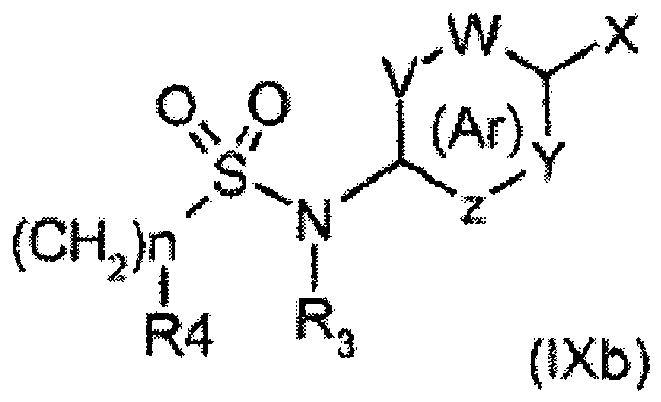
- the subject of the invention is also a process for preparing a compound of formula (I) according to the invention, characterized in that a compound of formula (IXb) is reacted with a compound of formula (VIII), wherein R 1, R 2, R 3, R 4, n, n ', V, W, Y, Z and Ar are as defined above, X represents a leaving group defined below, advantageously X represents a halogen, even more advantageously X represents a bromine or iodine atom and M is as defined above.
- R4 represents a group chosen from phenyl, pyridinyl and imidazolyl groups.
- the compounds of general formula (I) can be prepared according to the following process.
- a 2,6-dihalogenonicotinic acid of formula (II), in which X and X 'represent, independently of one another, a halogen atom advantageously chosen from among the F, Cl and Br, advantageously X and X 'represent a chlorine atom, is mono-substituted in the 2-position by an amine of formula R2- (CH2) n -NH 2 in which R2 and n' are as defined previously in relation to the compounds of formula (I), objects of the invention.
- This reaction can take place at room temperature, or at a temperature of 50 ° C to 100 ° C, in conventional heating or by microwave and in a protic solvent such as an alcohol, for example ethanol, n-butanol, tert- butanol or water.
- a protic solvent such as an alcohol, for example ethanol, n-butanol, tert- butanol or water.
- a base such as sodium hydride or potassium tert-butoxide
- N-alkylcyanoacetamides of formula (V) are prepared according to stage (iii) by reacting ethyl cyanoacetate with an excess of amine of formula R 1 -NH 2 (where R 1 is as defined above in relation to with the compounds of formula (I) objects of the invention) in a solvent such as THF or ethanol, at a temperature ranging from room temperature to the reflux temperature of the solvent.
- a solvent such as THF or ethanol
- the intermediate (VII) in which X represents a leaving group advantageously a halogen atom, advantageously an atom selected from F, Cl and Br, still more advantageously a Cl atom and in which n ', R1 and R2 are as defined above according to the invention, is engaged in step (vi) in a coupling reaction of SUZUKI with a boronic acid or a boronic ester of bispinacol (IXa) in wherein n, R 3, R 4, V, W, Y and Z are as defined above in relation to the compounds of formula (I) which are the subject of the invention, M being as defined in scheme 2 and it being understood that the cycle (Ar), defined above according to the invention, must comprise between 5 and 6 members.
- X represents a leaving group advantageously a halogen atom, advantageously an atom selected from F, Cl and Br, still more advantageously a Cl atom and in which n ', R1 and R2 are as defined above according to the invention
- This reaction (vi) is carried out in the presence of a catalyst such as a palladium complex (in the oxidation state (O) or (II)) such as, for example, Pd (PPh 3 ) 4 , PdCl 2 ( PPh 3 ) 2 , Pd 2 dba 3 , Xphos or PdCl 2 (dppf), in a polar solvent, protic or not, such as DME, ethanol, DMF, dioxane, or mixtures of these solvents, in the presence of a base such as cesium carbonate, aqueous sodium hydrogencarbonate, or K 3 PO 4 , by heating conventionally between 80 and 120 ° C or under the action of microwaves between 130 and 170 ° C.
- a catalyst such as a palladium complex (in the oxidation state (O) or (II))
- a catalyst such as a palladium complex (in the oxidation state (O) or (II))
- a catalyst such
- a second route can be used from the halogenated intermediate of formula (VII), this route 2 is described in scheme 2.
- the halogenated intermediate of formula (VII), as defined above, can be converted into boronic acid of formula (VIII), wherein M is as defined in scheme 2 and R1, R2, being as defined above according to The invention, according to step (vii), by reaction with bis (pinacolato) diborane in the presence of [1,1'-bis (diphenylphosphino) ferrocene] dichloropalladium (II) and potassium acetate or potassium carbonate in a polar solvent such as DMSO, DMF, DME or dioxane, at a temperature between 50 and 100 ° C, according to the methodology described by ISHIYAMA, T.
- a polar solvent such as DMSO, DMF, DME or dioxane
- step (viii) said boronic acid compound (VIII) is engaged in a Suzuki type reaction, with a halogenated aromatic compound of formula (IXb) in which X represents a leaving group, advantageously a halogen atom, advantageously X is chosen from bromine and iodine atoms and wherein R 3 , R 4 , V, W, Y and Z are as defined above in relation to the compounds of formula (I) which are the subject of the invention, being understood that the ring (Ar), aryl or heteroaryl, must comprise between 5 and 6 members.
- a halogenated aromatic compound of formula (IXb) in which X represents a leaving group, advantageously a halogen atom, advantageously X is chosen from bromine and iodine atoms and wherein R 3 , R 4 , V, W, Y and Z are as defined above in relation to the compounds of formula (I) which are the subject of the invention, being understood that the ring (Ar), aryl
- the DMF is evaporated off under reduced pressure and then the residue is taken up in water and the product is extracted twice with a mixture of dichloromethane: methanol in proportions of 95 to 5, then once with a mixture of ethyl acetate: THF (2: 1).
- the combined organic phases are dried over MgSO 4 and the solvents are then evaporated under reduced pressure. 19.0 g of product used as such in the next step are obtained.
- a suspension of 1.0 g (5.77 mmol) of 4-aminobenzeneboronic acid hydrochloride in 10 ml of a saturated aqueous solution of NaHCO 3 is cooled in ice and 2 ml (25.8 mmol) is added.
- methanesulfonyl chloride and adjust the pH to 7.2 by adding about 10 ml of a saturated aqueous solution of NaHCO 3 and stir for 2 h at 5 ° C.
- 1 ml of methanesulfonyl chloride and 5 ml of a saturated aqueous solution of NaHCO 3 are added .
- the temperature of the medium is allowed to rise to 20 ° C.
- This product was prepared according to the protocol described in paragraph 2.3 (method A) from 0.300 g (0.76 mmol) of the compound obtained from the preceding step and 0.195 g (0.69 mmol) of chloronaphthyridine derived from the step 1.6. 200 mg of product is obtained in the form of a white powder.
- This product was prepared according to the protocol described in section 2.3 (method A) starting from 0.496 g (1.25 mmol) of the compound obtained from the preceding step and 0.320 g (1.14 mmol) of chloronaphthyridine derived from the step 1.6. 0.287 g of product under beige powder form. Yield: 49%. Melting point: 256 ° C.
- This product was prepared according to the protocol described in paragraph 2.3 (method A) starting from 0.447 g (1.1 mmol) of the compound obtained from the preceding step and 0.280 g (1.0 mmol) of chloronaphthyridine derived from the Step 1.6. 0.19 g of product in the form of a white powder is obtained. Yield: 36%. Melting point:> 260 ° C.
- Example 8 2-amino-1-ethyl-7- (3-fluoro-4 - ⁇ [(4-fluorophenyl) sulfonyl] amino ⁇ phenyl) -N-methyl-4-oxo-1,4-dihydro-1 8-naphthyridine-3-carboxamide:
- This product was prepared according to the protocol described in section 2.3 (method A) starting from 0.542 g (1.37 mmol) of the compound obtained from the preceding step and 0.350 g (1.25 mmol) of chloronaphthyridine derived from the step 1.6. 0.186 g of product is obtained in the form of a white powder. Yield: 29%. Melting point:> 260 ° C.
- This product was prepared according to the protocol described in paragraph 2.3 (method A) from 0.408 g (0.99 mmol) of the compound obtained from the preceding step and 0.253 g (0.90 mmol) of chloronaphthyridine from the step 1.6. 0.402 g of product is obtained in the form of a yellow powder. Yield: 84%. Melting point:> 260 ° C.
- This product was prepared according to the protocol described in section 2.3 (method A) starting from 0.528 g (1.34 mmol) of the compound obtained from the preceding step and 0.341 g (1.21 mmol) of chloronaphthyridine derived from the step 1.6. 0.097 g of product is obtained in the form of a pale yellow powder. Yield: 16%. Melting point:> 260 ° C.
- This product was prepared according to the protocol described in section 2.5 (method B) from 2.0 g (4.48 mmol) of the compound from the previous step and 2.0 g (6.89 mmol) of boronic acid from step 1.7. 0.700 g of product is obtained in the form of a white powder. Yield: 28%. Melting point: 321 ° C.
- Example 12 2-amino-7- ⁇ 2-chloro-4 - ⁇ [(2,3-dichlorophenyl) sulfonyl] amino ⁇ phenyl) -1-ethyl-N-methyl-4-oxo-1,4-dihydro- 1,8-naphthyridine-3-carboxamide
- This product was prepared according to the protocol described in section 2.3 (method A) starting from 0.943 g (2.04 mmol) of the compound obtained from the preceding step and 0.515 g (1.84 mmol) of chloronaphthyridine derived from the step 1.6. 0.630 g of product is obtained in the form of a beige powder. Yield: 53%. Melting point: 239 ° C.
- Example 13 2-Amino-7- (4 - ⁇ [(4-chlorophenyl) sulfonyl] amino ⁇ -3-fluorophenyl) -1-ethyl-N-methyl-4-oxo-1,4-dihydro-1,8 -naphthyridine-3-carboxamide
- This product was prepared according to the protocol described in paragraph 2.3 (method A) from 0.613 g (1.49 mmol) of the compound obtained from the preceding step and 0.380 g (1.35 mmol) of chloronaphthyridine derived from the step 1.6. 0.407 g of product is obtained in the form of a yellow powder. Yield: 57%. Melting point:> 260 ° C.
- Example 14 2-Amino-7- (4 - ⁇ [(3,4-difluorophenyl) sulfonyl] amino) -3-fluorophenyl) -1-ethyl-N-methyl-4-oxo-1,4-dihydro-1 , 8-naphthyridine-3-carboxamide
- This product was prepared according to the protocol described in paragraph 2.3 (method A) from 0.400 g (0.97 mmol) of the compound obtained from the preceding step and 0.259 g (0.92 mmol) of chloronaphthyridine derived from the step 1.6. 0.228 g of product under white powder form. Yield: 46%. Melting point:> 260 ° C.
- Example 15 2-amino-1-ethyl-7- [3-fluoro-4 - ( ⁇ [6- (morpholin-4-yl) pyridin-3-yl] sulfonyl ⁇ amino) phenyl] -N-methyl hydrochloride -4-oxo-1,4-dihydro-1,8-naphthyridine-3-carboxamide
- This product was prepared according to the protocol described in paragraph 5.1 from 0.5 g (2.11 mmol) of the compound obtained in step 2.1 and 0.743 g (2.74 mmol) of 6- (morpholine) chloride. -4-yl) pyridine-3-sulfonyl chloride. 0.614 g of product is obtained in the form of a white powder. Yield: 70%. Melting point: 206 ° C.
- This product was prepared according to the protocol described in section 2.3 (method A) starting from 0.599 g (1.29 mmol) of the compound obtained from the preceding step and 0.330 g (1.18 mmol) of chloronaphthyridine derived from the step 1.6. 0.360 g of product is obtained in the form of a yellow powder. Yield: 53%. Melting point: 260 ° C.
- This product was prepared according to the protocol described in paragraph 5.1 from 028 g (1.18 mmol) of the compound obtained in step 2.1 and 0.493 g (1.30 mmol) of pyridin-2-ylmethanesulfonyltrifluoromethanesulfonate chloride. . 0.441 g of product is obtained in the form of a white powder. Yield: 95%.
- This product was prepared according to the protocol described in section 2.3 (method A) starting from 0.400 g (1.02 mmol) of the compound obtained from the preceding step and 0.260 g (0.93 mmol) of chloronaphthyridine derived from the step 1.6. 0.204 g of product is obtained in the form of a yellow powder. Yield: 43%.
- Example 17 2-Amino-7- ⁇ 4 - [(ethenylsulfonyl) amino] -3-fluorophenyl ⁇ -1-ethyl-N-methyl-4-oxo-1,4-dihydro-1,8-naphthyridine-3 carboxamide:
- This product was prepared according to the protocol described in section 2.3 (method A) starting from 0.390 g (1.2 mmol) of the compound obtained from the preceding step and 0.280 g (1.0 mmol) of chloronaphthyridine derived from the step 1.6. 0.095 g of product is obtained in the form of a white powder. Yield: 21%. Melting point:> 260 ° C.
- the product resulting from the preceding reaction (0.200 g -0.41 mmol) is salified according to the protocol used in section 5.3 using 0.2 ml of a 2N solution of HCl in ether. 0.055 g of product is isolated in the form of a yellow powder. Yield: 25%; Melting point: 268-270 ° C.
- Example 20 2-Amino-7- ⁇ 4 - [(butylsulfonyl) amino] -3-fluorophenyl ⁇ -1-ethyl-N-methyl-4-oxo-1,4-dihydro-1,8-naphthyridine-3 carboxamide:
- This product was prepared according to the protocol described in paragraph 2.3 (method A) starting from 0.636 g (1.34 mmol) of the compound obtained from the preceding step and 0.326 g (1.16 mmol) of chloronaphthyridine derived from the step 1.6. 0.200 g of product is obtained in the form of a white powder. Yield: 36%. Melting point: 165-167 ° C.
- Example 21 2-amino-7- (4 - ⁇ [(3-aminobenzyl) sulfonyl] amino ⁇ -3-fluorophenyl) -1-ethyl-N-methyl-4-oxo-1,4-dihydro-1 hydrochloride , 8-naphthyridine-3-carboxamide
- the product resulting from the preceding reaction (0.160 g -0.31 mmol) is salified according to the protocol used in section 5.3 using 0.15 ml of a 2N solution of HCl in ether. 0.100 g of product is isolated in the form of a beige powder. Yield: 58%; Melting point:> 260 ° C.
- This product was prepared according to the protocol described in 1.8-A from 0.660 g (3.01 mmol) of 4- (4,4,5,5-tetramethyl-1,3,2-dioxaborolan-2-yl). ) aniline and 0.635 g (3.01 mmol) of 2-chlorobenzenesulfonylsulfonyl chloride. 1.13 g of product is obtained in the form of a dark red powder. Yield: 96%.
- This product was prepared according to the protocol described in paragraph 2.3 (method A) from 0.413 g (1.05 mmol) of the compound obtained from the previous step and 0.280 g (1.0 mmol) of chloronaphthyridine derived from the step 1.6. 0.180 g of product is obtained in the form of a white powder. Yield: 35%. Melting point:> 260 ° C.
- This product was prepared according to the protocol described in section 2.1 (method A) from 5.0 g (24.22 mmol) of 4-bromo-2-chloroaniline and 6.76 g (26.64 mmol) of bis (pinacolato) diborane. 3.14 g of product is obtained in the form of a brown oil used in the next step without further purification.
- This product was prepared according to the protocol described in section 2.2 (method A) from 1.5 g (5.92 mmol) of the compound obtained from the preceding step and 2.18 g (8.87 mmol) of 2,3-dichlorobenzenesulfonyl chloride. 1.57 g of product is obtained in the form of a beige powder. Yield: 57%. Melting point: 156 ° C.
- This product was prepared according to the protocol described in section 2.3 (method A) from 1.02 g (2.68 mmol) of the compound obtained from the preceding step and 0.565 g (2.24 mmol) of chloronaphthyridine from step 1.6. 0.698 g of product is obtained in the form of a light yellow powder. Yield: 54%. Melting point: 311 ° C.
- This product was prepared according to the protocol described in section 2.1 (Method A) from 5.0 g (26.3 mmol) of 4-bromo-3-fluoroaniline and 7.34 g (28.9 mmol) of bis (pinacolato) diborane. 2.45 g of product are obtained in the form of a brown oil used in the next step without additional purification.
- This product was prepared according to the protocol described in section 2.3 (method A) from 2.6 g (5.82 mmol) of the compound obtained from the previous step and 1.36 g (4.84 mmol) of chloronaphthyridine obtained from step 1.6. 1.89 g of product in the form of a light yellow powder are obtained. Yield: 69%. Melting point: 340 ° C.
- This product was prepared according to the protocol described in section 2.3 (method A) starting from 0.700 g (1.58 mmol) of the compound obtained from the preceding step and 0.370 g (1.32 mmol) of chloronaphthyridine derived from the Step 1.6. 0.224 g of product in powder form is obtained. Yield: 30%. Melting point: 299 ° C.
- This product was prepared according to the protocol described in section 2.3 (method A) from 0.703 g (1.52 mmol) of the compound obtained from the preceding step and from 0.388 g (1.38 mmol) chloronaphthyridine obtained from step 1.6. 0.224 g of product in the form of a white powder is obtained. Yield: 28%. Melting point: 323 ° C.
- Table 1 which follows illustrates compounds of formula (I) according to the invention for which R1 and R2 represent a methyl (abbreviated Me), n ' represents 1, R3 represents a hydrogen atom and Ar represents a phenyl, these compounds are hereinafter called compounds of formula (I ').
- the compounds according to the invention have been the subject of pharmacological tests for determining their inhibitory effect on protein kinases. For example, their inhibitory effects of p70S6 serine / threonine kinase activity and / or tyrosine kinase of PDGF-R were measured in vitro in biochemical tests.
- the inhibitory activity with respect to PDGF receptor kinases is given by the concentration which inhibits 50% of proliferation activity respectively of Baf3 tel / PDGF cells.
- the inhibitory activity with respect to p70S6 kinase is given by the concentration which inhibits 50% of the phosphorylation of the peptide substrate derived from the ribosomal protein S6 (AKRRRLSSLRA, Upstate).
- PDGF beta receptor tyrosine kinase activity (Baf-3 tel / PDGFR ⁇ ):
- This test consists in evaluating the effects of the compounds on the tyrosine kinase activity of the PDGF beta receptor.
- the inhibitory effect of the compounds according to the invention on the PDGF-R receptor tyrosine kinase activity was evaluated on the BaF / 3 murine hematopoietic cell line transfected with a plasmid encoding the Tel / PDGF-R fusion protein. beta.
- This fusion protein is found in chronic myelomonocytic myeloid leukemia (CMML). It includes the N-terminal portion of the transcription factor Tel and the transmembrane and intracellular portion of the PDGF-R beta receptor.
- This fusion protein is present in dimerized form (presence of an oligomerization domain in the N-terminal part of Tel) and thus leads to the constitutive activity of the kinase domain of PDGF-R beta.
- This line BaF3 Tel / PDGF has been described in the literature on several occasions and in particular in detail in the article by M CARROLL et al., PNAS, 1996, 93, 14845-14850 , CARROLL M et al., Blood 2002, 99, 14845-14850 .
- BaF3 Tel / PDGF cells are washed with phosphate buffer and inoculated in 96-well plates, at a density of 5 ⁇ 10 4 cells / ml (100 ml per well), in RPMI 1640 containing 10% FCS, in the presence or absence of in the absence of test compounds. After 72 h of incubation, the viable cells are quantified by measuring cellular ATP through the use of the CellTiter-Glo ® kit (Promega, Cat G7571). The cells are processed according to the instructions given by the kit supplier and the luminescence is measured using a Luminoskan (Ascent, Labsystem) with the following parameters: measurement: single; integration time: 1000 ms, lag time: 5 s.
- the compounds according to the invention have an inhibitory activity on the tyrosine kinase activity of PDGF-R beta. This activity is given by the concentration which inhibits 50% proliferation of Baf3 tel / PDGF cells (Cl 50 ). Cl 50 of the compounds according to the invention are less than 10.0 ⁇ M.
- Compounds Nos. 2, 18, 20 and 24 showed an IC 50 of 36, 12, 280 and 24 nM, respectively, in the test for measuring the tyrosine kinase inhibitory activity of the PDGF receptor.
- Recombinant mutant S6K1 (1-421, T412E) (ref 14-333, Upstate USA, Inc. Charlottesville VA) (specific activity 298 U / mg) is incubated (20 mU / 10 ⁇ l) with 8 concentrations of inhibitors solubilized at 1 mM in DMSO in the presence of the peptide substrate derived from the ribosomal protein S6 (AKRRRLSSLRA, Upstate) (50 ⁇ M final) and a cold ATP mixture (100 ⁇ M) and 1 ⁇ Ci / well of [ ⁇ -33] ATP (NEN, Courtaboeuf, France).
- the enzymatic reaction is carried out in a final volume of 50 ⁇ l in a 96-well filter plate (MultiScreen TM-PH opaque plate with Phospho-Cellulose cat # MAPHNOB, Millipore) previously wetted with 100 ⁇ l 1M Tris buffer pH 7.4, adding the S6Kinase Assay kit reagents (# 17-136, Upstate) in the following order: 10 ⁇ l of 5% DMSO or different inhibitors at 5X concentration 30 ⁇ l of reaction mixture containing ADBI buffer (# 20-108 Upstate, 20mM MOPS pH 7.2, 25mM beta glycerol phosphate, 5mM EGTA, 1mM sodium orthovanadate, 1mM dithiothreitol), S6K1 (20mU) and 250 ⁇ M peptide substrate [AKRRRLSSLRA] in ADBI buffer (# 20- 122, Upstate).
- ADBI buffer # 20-108 Upstate, 20mM MOPS pH 7.2, 25
- the reaction is initiated by adding 10 ⁇ l of cold ATP / 33 ⁇ ATP mixture (1 ⁇ Ci / 50 ⁇ l in 500 ⁇ M ATP in ADBI buffer, 75 mM MgCl 2 ) and then incubated for 20 minutes at 30 ° C. before being stopped by addition of 20 ⁇ l of 7.5% phosphoric acid.
- the reaction mixture is vacuum filtered (Vacuum manifold, Millipore), the wells are rinsed twice with 200 ⁇ l of 7.5% phosphoric acid (2 minutes) and then twice with 200 ⁇ l of distilled H 2 O (2 minutes).
- the compounds according to the invention have an inhibitory activity on the kinase activity of p70S6. This activity is given by the concentration that inhibits 50% of the phosphorylation of the peptide substrate derived from the ribosomal protein S6 (AKRRRLSSLRA, Upstate). Cl 50 of the compounds according to the invention are less than 10.0 ⁇ M.
- Compounds Nos. 8, 9, 14 and 18 showed an IC 50 of 412, 240, 224 and 132 nM, respectively, in the p70S6 kinase inhibitory activity assay.
- the compounds according to the invention are therefore protein kinase inhibitors, in particular PDGF tyrosine kinase receptors and, for some of them, also p70S6 kinase.
- the compounds according to the invention can therefore be used for the preparation of medicaments intended for the treatment and / or the prevention of diseases linked to the activation of protein kinases, in particular of protein kinase inhibitory drugs.
- protein kinase inhibitory drugs including drugs that inhibit the PDGF-R tyrosine kinase receptor and possibly p70S6 kinase.
- the subject of the invention is medicaments which comprise a compound of formula (I), or an addition salt thereof to a pharmaceutically acceptable acid, or a solvate of the compound of formula (I).
- medicaments find use in therapy, particularly in the treatment and / or prevention of diseases related to the activity of protein kinases and in particular proliferative diseases such as cancers, for example lung cancers (NSCLC), pancreas, skin, Kaposi's syndrome, intraocular melanoma, breast, uterine, cervical, ovarian, endometrial, vaginal, vulvar, urethral cancers , penis, prostate, carcinoma of the fallopian tubes, cancers such as GIST and anal region, rectum, small intestine, colon, stomach, esophagus, endocrine, thyroid, parathyroid or adrenal glands, soft tissue sarcomas, Ewing's sarcomas, ostearcomas, dermatofibrosarcoma and other fibrosarcomas, bladder or kidney cancers, central nervous system neoplasms, spinal tumors and desmoid, glioma brainstem and glioblastomas, pituitary
- Another aspect of the invention comprises an association between at least one compound according to the invention and at least one chemotherapy agent.
- the compounds of the present invention may be used alone or in admixture with at least one chemotherapeutic agent which may be chosen from cytotoxic agents and / or antiangiogens.
- chemotherapeutic agent which may be chosen from cytotoxic agents and / or antiangiogens.
- antiangiogenic agents may be an inhibitory compound of VEGF-R kinase activity or a growth factor antagonist compound.
- Combinations of the compounds of the invention with the chemotherapy agents mentioned above and / or radiation are another object of the present invention.
- the chemotherapy agents mentioned above and / or the radiation can be administered simultaneously, separately or sequentially.
- the treatment will be adapted by the practitioner according to the patient to be treated.
- drugs are also used therapeutically in non-malignant proliferative diseases, such as, for example, restenosis, atherosclerosis, thrombosis, heart failure, cardiac hypertrophy, pulmonary arterial hypertension, fibrosis, diabetic nephropathy. , glomerulonephritis, chronic pyelonephritis, hemangiomas, autoimmune diseases such as psoriasis, sclerodermatitis, immunosuppression (transplant rejection for example).
- non-malignant proliferative diseases such as, for example, restenosis, atherosclerosis, thrombosis, heart failure, cardiac hypertrophy, pulmonary arterial hypertension, fibrosis, diabetic nephropathy. , glomerulonephritis, chronic pyelonephritis, hemangiomas, autoimmune diseases such as psoriasis, sclerodermatitis, immunosuppression (transplant rejection for example).
- the present invention relates to pharmaceutical compositions comprising, as active principle, a compound according to the invention.
- These pharmaceutical compositions contain an effective dose of at least one compound according to the invention, or a pharmaceutically acceptable salt thereof, or a solvate of said compound, as well as at least one pharmaceutically acceptable excipient.
- Said excipients are chosen according to the pharmaceutical form and the desired mode of administration, from the usual excipients which are known to those skilled in the art.
- compositions of the present invention for oral, sublingual, subcutaneous, intramuscular, intravenous, topical, intratracheal, intranasal, transdermal or rectal administration the active ingredient of formula (I) above, or its salt or solvate, may be administered in unit dosage form, in admixture with conventional pharmaceutical excipients, to animals and humans for prophylaxis or treatment and / or prevention of the above disorders or diseases.
- Suitable unit dosage forms include oral forms such as tablets, soft or hard capsules, powders, granules and oral solutions or suspensions, sublingual, oral, intratracheal, intraocular, intranasal forms of administration. by inhalation, topical, transdermal, subcutaneous, intramuscular or intravenous administration forms, rectal administration forms and implants.
- the compounds according to the invention can be used in creams, gels, ointments or lotions.
- a unitary form of administration of a compound according to the invention in tablet form may comprise the following components: Compound according to the invention 50.0 mg mannitol 223.75 mg Croscaramellose sodium 6.0 mg Corn starch 15.0 mg Hydroxypropylmethylcellulose 2.25 mg Magnesium stearate 3.0 mg
- the present invention also relates to the use of a compound of formula (I) for the preparation of a medicament for the treatment and / or prevention of diseases related to the activity of proteins kinases, the treatment and / or prevention of proliferative diseases such as cancers, chronic or acute leukemias, lymphocytic lymphomas, Hodgkin's disease, and myeloproliferative syndromes, and myelodysplastic syndromes, treatment and / or prevention of proliferative diseases such as cancers with solid tumors for example lung cancer (NSCLC), bone, pancreas, skin, Kaposi syndrome, intraocular melanoma, breast, uterine, cervical, ovarian, endometrium, vagina, vulva, urethra, penis, prostate, carcinoma of the fallopian tubes, cancers such as GIST and anal region, rectum, small bowel, colon, stomach, esophagus, endocrine, thyroid, parathyroid or adrenal gland
- proliferative diseases
Landscapes
- Health & Medical Sciences (AREA)
- Chemical & Material Sciences (AREA)
- Organic Chemistry (AREA)
- Public Health (AREA)
- Pharmacology & Pharmacy (AREA)
- Veterinary Medicine (AREA)
- General Health & Medical Sciences (AREA)
- Medicinal Chemistry (AREA)
- Animal Behavior & Ethology (AREA)
- Life Sciences & Earth Sciences (AREA)
- Nuclear Medicine, Radiotherapy & Molecular Imaging (AREA)
- General Chemical & Material Sciences (AREA)
- Chemical Kinetics & Catalysis (AREA)
- Bioinformatics & Cheminformatics (AREA)
- Engineering & Computer Science (AREA)
- Epidemiology (AREA)
- Immunology (AREA)
- Hematology (AREA)
- Cardiology (AREA)
- Heart & Thoracic Surgery (AREA)
- Urology & Nephrology (AREA)
- Dermatology (AREA)
- Diabetes (AREA)
- Vascular Medicine (AREA)
- Pulmonology (AREA)
- Oncology (AREA)
- Pharmaceuticals Containing Other Organic And Inorganic Compounds (AREA)
- Pyridine Compounds (AREA)
- Nitrogen Condensed Heterocyclic Rings (AREA)
- Medicines That Contain Protein Lipid Enzymes And Other Medicines (AREA)
Claims (18)
- Verbindung der Formel (I):
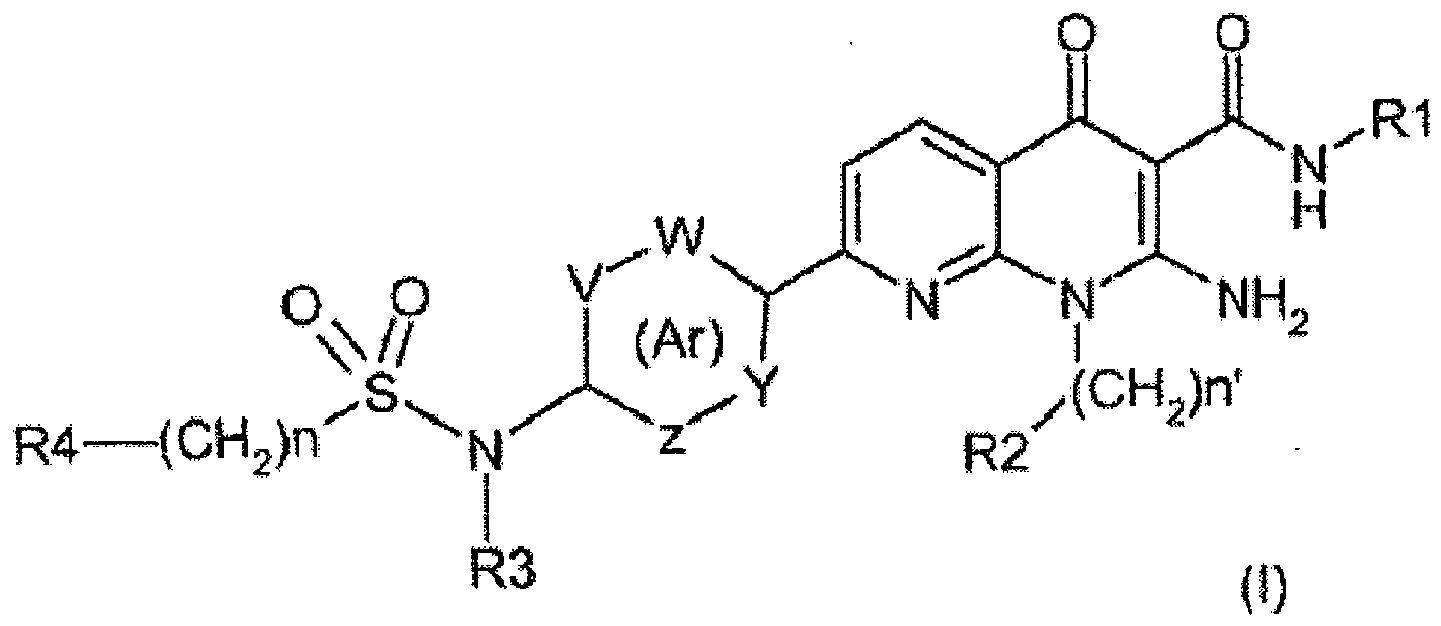 • n für 0, 1, 2 oder 3 steht;• n' für 0, 1, 2, 3 oder 4 steht;• R1 für eine Alkylgruppe steht;• R2 für:(i) eine Cycloalkylgruppe,(ii) eine Alkylgruppe oder(iii)eine Alkoxygruppesteht, wobei die Cycloalkyl-, Alkyl- oder Alkoxygruppen gegebenenfalls durch ein oder mehrere Halogenatome substituiert sind;• R3 für:(i) ein Wasserstoffatom oder(ii) eine -C(O)-Alkylgruppesteht;• Ar für einen 5- oder 6-gliedrigen Aryl- oder Heteroarylring stehen, wobei Y, Z, V und W:(a) unabhängig voneinander für(i) eine =CH-Gruppe,(ii) eine =C(R5)-Gruppe, worin R5 für:o eine Alkylgruppe,o ein Halogenatom odero eine Alkoxygruppe
steht,(iii) ein aus dem Stickstoffatom, dem Schwefelatom oder dem Sauerstoffatom ausgewähltes Heteroatom
stehen,(b) wobei höchstens eine der Variablen Y, Z, V und W fehlen kann,mit der Maßgabe, dass dann, wenn Ar für ein aus Pyrrolyl, Imidazolyl, Pyrazolyl und Triazolylgruppen ausgewähltes Heteroaryl steht, mindestens eines der Stickstoffatome des Heteroaryls gegebenenfalls durch eine aus einer Alkylgruppe ausgewählte Gruppe R6 substituiert sein kann,• R4 für eine Gruppe steht, die ausgewählt ist aus:in Säuren-, Basen- oder Säureadditionssalz- oder Basenadditionssalzform.o einer Alkylgruppe,o einer Alkoxyalkylgruppe,o einer -NRR`-Gruppe, wobei R und R' gleich oder verschieden sein können und unabhängig voneinander für ein Wasserstoffatom, eine Alkylgruppe oder eine -(C3-C6)-Cycloalkylgruppe stehen,○ einer Cycloalkylgruppe,○ einer Alkenylgruppe,○ einer Arylgruppe, wobei die Gruppe gegebenenfalls durch mindestens ein Halogenatom und/oder durch mindestens eine aus -(C1-C5)-Alkyl-, Halogenalkyl-, Nitril-, Halogenalkyloxy-, Alkoxy-, Nitro- und -NRR'-Gruppen ausgewählte Gruppe substituiert ist, wobei R und R' gleich oder verschieden sein können und unabhängig voneinander für ein Wasserstoffatom oder eine aus Alkylgruppen und -(C3-C6)-Cycloalkylgruppen ausgewählte Gruppe stehen,○ einer Heteroarylgruppe, wobei die Gruppe mindestens ein aus dem Stickstoff- oder Schwefelatom ausgewähltes Heteroatom umfasst, wobei die Heteroarylgruppen gegebenenfalls durch mindestens eine aus Alkylgruppen und Heterocycloalkylgruppen mit mindestens einem aus dem Stickstoff- und Sauerstoffatom ausgewählten Heteroatom ausgewählte Gruppe substituiert sind;
mit der Maßgabe, dass dann, wenn die Heteroarylgruppe aus Pyrrolyl, Imidazolyl, Pyrazolyl und Triazolylgruppen ausgewählt ist, mindestens eines der Stickstoffatome des Heteroaryls gegebenenfalls durch eine aus einer Alkylgruppe ausgewählte Gruppe R6 substituiert sein kann,o einer Heterocycloalkylgruppe, die mindestens ein aus dem Stickstoff-, Schwefel- und Sauerstoffatom ausgewähltes Heteroatom umfasst und gegebenenfalls durch mindestens einen aus (i) Halogenatomen, (ii) Halogenalkylgruppen, (iii) linearen oder verzweigten Alkylgruppen und (iv) Cycloalkylgruppen ausgewählten Substituenten substituiert ist,
mit der Maßgabe, dass dann, wenn die Heterocycloalkylgruppen aus Pyrrolinyl, Pyrrolidinyl, Imidazolidinyl, Imidazolinyl, Pyrazolinyl, Pyrazolidinyl, Piperidinyl, Morpholinyl, Piperazinyl und Thiomorpholinyl ausgewählt sind, mindestens eines der Stickstoffatome des Heterocycloalkyls gegebenenfalls durch eine aus einer Alkylgruppe ausgewählte Gruppe R6 substituiert sein kann, - Verbindung der Formel (I) nach Anspruch 1, dadurch gekennzeichnet, dass:R1 für eine -(C1-C4)-Alkylgruppe steht,wobei die Verbindungen in Basen- oder Säureadditionssalzform vorliegen.
- Verbindung der Formel (I) nach einem der Ansprüche 1 oder 2, dadurch gekennzeichnet, dass:R2 für eine -(C1-C4)-Alkylgruppe steht,wobei die Verbindungen in Basen- oder Säureadditionssalzform vorliegen.
- Verbindung der Formel (I) nach einem der Ansprüche 1 bis 3, dadurch gekennzeichnet, dass:n' für 1 steht,wobei die Verbindungen in Basen- oder Säureadditionssalzform vorliegen.
- Verbindungen der Formel (I) nach einem der Ansprüche 1 bis 4, dadurch gekennzeichnet, dass:R3 für ein Wasserstoffatom steht,wobei die Verbindungen in Basen- oder Säureadditionssalzform vorliegen.
- Verbindung der Formel (I) nach einem der Ansprüche 1 bis 5, dadurch gekennzeichnet, dass:Ar für ein Phenyl steht,wobei die Verbindungen in Basen- oder Säureadditionssalzform vorliegen.
- Verbindung der Formel (I) nach einem der Ansprüche 1 bis 6, dadurch gekennzeichnet, dass:R4 für eine Gruppe steht, die ausgewählt ist aus:mit der Maßgabe, dass dann, wenn die Heteroarylgruppe aus Pyrrolyl, Imidazolyl, Pyrazolyl und Triazolylgruppen ausgewählt ist, mindestens eines der Stickstoffatome des Heteroaryls gegebenenfalls durch eine Gruppe R6 substituiert sein kann, wobei R6 für eine aus einer Alkylgruppe ausgewählte Gruppe steht.○ einer Alkylgruppe;○ einer -NRR`-Gruppe, wobei R und R' gleich ○ der verschieden sein können und unabhängig voneinander für ein Wasserstoffatom, eine Alkylgruppe oder eine -(C3-C6)-Cycloalkylgruppe stehen,o einer Alkenylgruppe,o einer Arylgruppe, wobei die Gruppe gegebenenfalls durch mindestens ein Halogenatom und/oder durch mindestens eine aus Alkoxy- und -NRR'-Gruppen ausgewählte Gruppe substituiert ist, wobei R und R' wie oben definiert sind,o einer Heteroarylgruppe, wobei die Heteroarylgruppe gegebenenfalls durch mindestens eine aus Alkylgruppen und Heterocycloalkylgruppen mit mindestens einem aus dem Stickstoff- und Sauerstoffatom ausgewählten Heteroatom ausgewählte Gruppe substituiert ist;
- Verbindung der Formel (I) nach einem der Ansprüche 1 bis 7, dadurch gekennzeichnet, dass R4 für eine aus Phenyl-, Pyridinyl- und Imidazolylgruppen ausgewählte Gruppe steht.
- Verbindung der Formel (I) nach einem der Ansprüche 1 bis 8, dadurch gekennzeichnet, dass Y, Z, V und W jeweils für eine =CH-Gruppe und/oder eine =C(R5)-Gruppe stehen, wobei R5 für ein Chlor- oder Fluoratom steht, wobei Y, Z, V und W somit in einer gegebenenfalls substituierten Phenylgruppe enthalten sind.
- Verbindung der Formel (I) nach einem der Ansprüche 1 bis 9, ausgewählt aus den folgenden Verbindungen:2-Amino-1-ethyl-7-(3-fluor-4-{[(pyridin-3-ylmethyl)sulfonyl]amino}phenyl)-N-methyl-4-oxo-1,4-dihydro-1,8-naphthyridin-3-carboxamid;2-Amino-1-ethyl-7-(3-fluor-4-{[(3-fluorphenyl)sulfonyl]amino}phenyl)-N-methyl-4-oxo-1,4-dihydro-1,8-naphthyridin-3-carboxamid;2-Amino-7-{4-[(ethenylsulfonyl)amino]-3-fluorphenyl}-1-ethyl-N-methyl-4-oxo-1,4-dihydro-1,8-naphthyridin-3-carboxamid;2-Amino-7-[4-({[2-(dimethylamino)ethyl]sulfonyl}amino)-3-fluorphenyl]-1-ethyl-N-methyl-4-oxo-1,4-dihydro-1,8-naphthyridin-3-carboxamid;2-Amino-7-(4-{[(3-aminobenzyl)sulfonyl]amino}-3-fluorphenyl)-1-ethyl-N-methyl-4-oxo-1,4-dihydro-1,8-naphthyridin-3-carboxamid;2-Amino-1-ethyl-7-(3-fluor-4-{[(1-methyl-1H-imidazol-4-yl)sulfonyl]amino}phenyl)-N-methyl-4-oxo-1,4-dihydro-1,8-naphthyridin-3-carboxamid;2-Amino-7-{4-[(butylsulfonyl)amino]-3-fluorphenyl}-1-ethyl-N-methyl-4-oxo-1,4-dihydro-1,8-naphthyridin-3-carboxamid;2-Amino-7-(3-chlor-4{[(2,3-dichlorphenyl)sulfonyl]amino}phenyl)-1-ethyl-N-methyl-4-oxo-1,4-dihydro-1,8-naphthyridin-3-carboxamid;2-Amino-7-(4-{[(2,5-dichlorphenyl)sulfonyl]amino}-3-fluorphenyl)-1-ethyl-N-methyl-4-oxo-1,4-dihydro-1,8-naphthyridin-3-carboxamid;2-Amino-1-ethyl-N-methyl-4-oxo-7-{4-[(pyridin-3-ylsulfonyl)amino]phenyl}-1,4-dihydro-1,8-naphthyridin-3-carboxamid;2-Amino-7-(4-{[(2,6-dichlorphenyl)sulfonyl]amino}-3-fluorphenyl)-1-ethyl-N-methyl-4-oxo-1,4-dihydro-1,8-naphthyridin-3-carboxamid;2-Amino-7-(2-chlor-4-{[(2,5-dichlorphenyl)sulfonyl]amino}phenyl)-1-ethyl-N-methyl-4-oxo-1,4-dihydro-1,8-naphthyridin-3-carboxamid;2-Amino-7-(2-chlor-4-{[(2,3-dichlorphenyl)sulfonyl]amino}phenyl)-1-ethyl-N-methyl-4-oxo-1,4-dihydro-1,8-naphthyridin-3-carboxamid;2-Amino-7-(4-{[(2,3-dichlorphenyl)sulfonyl]amino}-2-fluorphenyl)-1-ethyl-N-methyl-4-oxo-1,4-dihydro-1,8-naphthyridin-3-carboxamid;2-Amino-7-(4-{[(2,3-dichlorphenyl)sulfonyl]amino}-3-methylphenyl)-1-ethyl-N-methyl-4-oxo-1,4-dihydro-1,8-naphthyridin-3-carboxamid;2-Amino-1-ethyl-N-methyl-7-{4-[(methylsulfonyl)amino]phenyl}-4-oxo-1,4-dihydro-1,8-naphthyridin-3-carboxamid;2-Amino-7-(4-{[(2,3-dichlorphenyl)sulfonyl]amino}phenyl)-1-ethyl-N-methyl-4-oxo-1,4-dihydro-1,8-naphthyridin-3-carboxamid;2-Amino-7-(4-{[(2,3-dichlorphenyl)sulfonyl]amino}-3-fluorphenyl)-1-ethyl-N-methyl-4-oxo-1,4-dihydro-1,8-naphthyridin-3-carboxamid;2-Amino-7-(4-{[(2-chlorphenyl)sulfonyl]amino}phenyl)-1-ethyl-N-methyl-4-oxo-1,4-dihydro-1,8-naphthyridin-3-carboxamid;2-Amino-1-ethyl-7-(3-fluor-4-{[(2-fluorphenyl)sulfonyl]amino}phenyl)-N-methyl-4-oxo-1,4-dihydro-1,8-naphthyridin-3-carboxamid;2-Amino-7-(4-{[(4-chlorphenyl)sulfonyl]amino}-3-fluorphenyl)-1-ethyl-N-methyl-4-oxo-1,4-dihydro-1,8-naphthyridin-3-carboxamid;2-Amino-7-(4-{[(3-chlorphenyl)sulfonyl]amino}-3-fluorphenyl)-1-ethyl-N-methyl-4-oxo-1,4-dihydro-1,8-naphthyridin-3-carboxamid;2-Amino-7-(4-{[(3,4-difluorphenyl)sulfonyl]amino}-3-fluorphenyl)-1-ethyl-N-methyl-4-oxo-1,4-dihydro-1,8-naphthyridin-3-carboxamid;2-Amino-1-ethyl-7-(3-fluor-4-{[(4-fluorphenyl)sulfonyl]amino}phenyl)-N-methyl-4-oxo-1,4-dihydro-1,8-naphthyridin-3-carboxamid;2-Amino-1-ethyl-7-(3-fluor-4-{[(3-methoxyphenyl)sulfonyl]amino}phenyl)-N-methyl-4-oxo-1,4-dihydro-1,8-naphthyridin-3-carboxamid;2-Amino-1-ethyl-7-[3-fluor-4-({[6-(morpholin-4-yl)pyridin-3-yl]sulfonyl}amino)phenyl]-N-methyl-4-oxo-1,4-dihydro-1,8-naphthyridin-3-carboxamid;2-Amino-1-ethyl-7-(3-fluor-4-{[(pyridin-2-ylmethyl)sulfonyl]amino}phenyl)-N-methyl-4-oxo-1,4-dihydro-1,8-naphthyridin-3-carboxamid.
- Verfahren zur Herstellung einer Verbindung der Formel (I) nach einem der Ansprüche 1 bis 10, dadurch gekennzeichnet, dass man eine Verbindung der Formel (IXa):


- Verfahren zur Herstellung einer Verbindung der Formel (I) nach einem der Ansprüche 1 bis 10, dadurch gekennzeichnet, dass man eine Verbindung der Formel (IXb)

- Medikament, dadurch gekennzeichnet, dass es eine Verbindung der Formel (I) nach einem der Ansprüche 1 bis 10 oder ein Additionssalz dieser Verbindung mit einer pharmazeutisch unbedenklichen Säure oder auch ein Solvat der Verbindung der Formel (I) umfasst.
- Pharmazeutische Zusammensetzung, dadurch gekennzeichnet, dass sie eine Verbindung der Formel (I) nach einem der Ansprüche 1 bis 10 oder ein pharmazeutisch unbedenkliches Salz oder ein Solvat dieser Verbindung sowie mindestens einen pharmazeutisch unbedenklichen Hilfsstoff umfasst.
- Verbindung der Formel (I) nach einem der Ansprüche 1 bis 10 zur Verwendung bei der Behandlung und/oder Prävention von proliferativen Erkrankungen wie Krebserkrankungen, chronischen oder akuten Leukämien, lymphozytischen Lymphomen, Hodgkin-Krankheit, myeloproliferativen Syndromen und myelodysplastischen Syndromen.
- Verbindung der Formel (I) nach einem der Ansprüche 1 bis 10 zur Verwendung bei der Behandlung und/oder Prävention von proliferativen Erkrankungen wie Krebserkrankungen mit soliden Tumoren, beispielsweise Krebserkrankungen der Lunge (NSCLC), der Knochen, der Bauchspeicheldrüse, der Haut, Kaposi-Sarkom, intraokulären Melanomen, Krebserkrankungen der Brust, der Gebärmutter, des Gebärmutterhalses, der Eierstöcke, des Endometriums, der Vagina, der Vulva, der Harnröhre, des Penis, der Prostata, Eileiterkarzinomen, Krebserkrankungen wie GIST und der Analregion, des Rektums, des Dünndarms, des Kolons, des Magens, der Speiseröhre, der endokrinen Drüsen, der Schilddrüse, der Nebenschilddrüse oder der Nebenniere, Weichteilsarkomen, Ewing-Sarkomen, Osteosarkomen, Dermatofibrosarkom und anderen Fibrosarkomen, Krebserkrankungen der Blase oder der Nieren, Neoplasmen des Zentralnervensystems, Tumoren der Wirbelsäule und Desmoiden, Hirnstammgliomen und Glioblastomen, Hypophysenadenom und Metastasen davon, chronischen oder akuten Leukämien, lymphozytischen Lymphomen, Hodgkin-Krankheit und myeloproliferativen Syndromen und myelodysplastischen Syndromen.
- Verbindung der Formel (I) nach einem der Ansprüche 1 bis 10 zur Verwendung bei der Behandlung und/oder Prävention von nichtmalignen proliferativen Erkrankungen wie Restenose, Atherosklerose, Thrombose, Herzinsuffizienz, Herzhypertrophie, Pulmonalarterienhypertonie, Fibrose, diabetischer Nephropathie, Glomerulonephritis, chronischer Pyelonephritis, Hämangiomen, Autoimmunkrankheiten wie Psoriasis, Sklerodermatitis und Immunsuppression.
- Kombination mindestens einer Verbindung der Formel (I) nach einem der Ansprüche 1 bis 10 mit einem Chemotherapeutikum.
Applications Claiming Priority (2)
| Application Number | Priority Date | Filing Date | Title |
|---|---|---|---|
| FR1050081A FR2954943B1 (fr) | 2010-01-07 | 2010-01-07 | Derives de pyridino-pyridinones arylsulfonamides, leur preparation et leur application en therapeutique |
| PCT/FR2011/050018 WO2011083275A1 (fr) | 2010-01-07 | 2011-01-06 | Dérivés de pyridino-pyridinones arylsulfonamides, leur préparation et leur application en thérapeutique |
Publications (2)
| Publication Number | Publication Date |
|---|---|
| EP2521725A1 EP2521725A1 (de) | 2012-11-14 |
| EP2521725B1 true EP2521725B1 (de) | 2013-11-27 |
Family
ID=42359441
Family Applications (1)
| Application Number | Title | Priority Date | Filing Date |
|---|---|---|---|
| EP11704257.2A Active EP2521725B1 (de) | 2010-01-07 | 2011-01-06 | Arylsulfonamidpyridin-pyridinon-derivate, deren herstellung und therapeutische verwendung davon |
Country Status (14)
| Country | Link |
|---|---|
| US (1) | US20130178472A1 (de) |
| EP (1) | EP2521725B1 (de) |
| JP (1) | JP2013516446A (de) |
| KR (1) | KR20120112748A (de) |
| CN (1) | CN102791709A (de) |
| AU (1) | AU2011204515A1 (de) |
| BR (1) | BR112012016802A2 (de) |
| CA (1) | CA2786534A1 (de) |
| FR (1) | FR2954943B1 (de) |
| IL (1) | IL220738A (de) |
| MX (1) | MX2012007896A (de) |
| RU (1) | RU2012133686A (de) |
| SG (2) | SG182418A1 (de) |
| WO (1) | WO2011083275A1 (de) |
Families Citing this family (9)
| Publication number | Priority date | Publication date | Assignee | Title |
|---|---|---|---|---|
| FR2952934B1 (fr) | 2009-11-23 | 2012-06-22 | Sanofi Aventis | Derives de pyridino-pyridinones, leur preparation et leur application en therapeutique |
| FR2955109B1 (fr) * | 2010-01-08 | 2012-09-07 | Sanofi Aventis | Derives de 5-oxo-5,8-dihydro-pyrido[2, 3-d]pyrimidine, leur preparation et leur application en therapeutique |
| US8628554B2 (en) | 2010-06-13 | 2014-01-14 | Virender K. Sharma | Intragastric device for treating obesity |
| US9526648B2 (en) | 2010-06-13 | 2016-12-27 | Synerz Medical, Inc. | Intragastric device for treating obesity |
| US10010439B2 (en) | 2010-06-13 | 2018-07-03 | Synerz Medical, Inc. | Intragastric device for treating obesity |
| US10420665B2 (en) | 2010-06-13 | 2019-09-24 | W. L. Gore & Associates, Inc. | Intragastric device for treating obesity |
| CN103183676B (zh) * | 2013-03-12 | 2015-04-08 | 中国医学科学院医药生物技术研究所 | 一组1-取代-1,8萘啶甲酰胺衍生物及制备和应用 |
| JP2017510552A (ja) * | 2014-02-07 | 2017-04-13 | イーフェクター セラピューティクス, インコーポレイテッド | 線維性疾患を治療するための方法 |
| US10779980B2 (en) | 2016-04-27 | 2020-09-22 | Synerz Medical, Inc. | Intragastric device for treating obesity |
Family Cites Families (12)
| Publication number | Priority date | Publication date | Assignee | Title |
|---|---|---|---|---|
| JP2991382B2 (ja) * | 1990-07-18 | 1999-12-20 | 大日本製薬株式会社 | 縮合三環式化合物およびその塩 |
| AU645159B2 (en) * | 1991-01-17 | 1994-01-06 | Ici Pharma | Sulphonamide derivatives |
| WO2005060692A2 (en) * | 2003-12-19 | 2005-07-07 | Smithkline Beecham Corporation | Biphenyl compounds and methods |
| US20060194823A1 (en) * | 2004-12-22 | 2006-08-31 | Georg Kettschau | Sulfonamido-macrocycles as Tie2 inhibitors and the salts thereof, a pharmaceutical composition comprising these compounds, the method of preparing and the use thereof |
| FR2889526B1 (fr) * | 2005-08-04 | 2012-02-17 | Aventis Pharma Sa | 7-aza-indazoles substitues, compositions les contenant, procede de fabrication et utilisation |
| GB0624187D0 (en) * | 2006-12-04 | 2007-01-10 | Jackson William P | HDAC inhibitors |
| FR2917413B1 (fr) * | 2007-06-13 | 2009-08-21 | Sanofi Aventis Sa | Derives de 7-alkynyl-1,8-naphthyridones, leur preparation et leur application en therapeutique |
| FR2917412B1 (fr) * | 2007-06-13 | 2009-08-21 | Sanofi Aventis Sa | Derives de 7-alkynyl, 1,8-naphthyridones, leur preparation et leur application en therapeutique |
| KR20100031732A (ko) * | 2007-07-10 | 2010-03-24 | 사노피-아벤티스 | 항혈전 활성을 갖는 말론아미드 유도체 |
| FR2933701A1 (fr) * | 2008-07-08 | 2010-01-15 | Sanofi Aventis | Derives anticancereux, leur preparation et leur application en therapeutique |
| FR2933700B1 (fr) * | 2008-07-08 | 2010-07-30 | Sanofi Aventis | Derives de pyridino-pyridinones, leur preparation et leur application en therapeutique |
| FR2955109B1 (fr) * | 2010-01-08 | 2012-09-07 | Sanofi Aventis | Derives de 5-oxo-5,8-dihydro-pyrido[2, 3-d]pyrimidine, leur preparation et leur application en therapeutique |
-
2010
- 2010-01-07 FR FR1050081A patent/FR2954943B1/fr not_active Expired - Fee Related
-
2011
- 2011-01-06 EP EP11704257.2A patent/EP2521725B1/de active Active
- 2011-01-06 SG SG2012050258A patent/SG182418A1/en unknown
- 2011-01-06 MX MX2012007896A patent/MX2012007896A/es active IP Right Grant
- 2011-01-06 WO PCT/FR2011/050018 patent/WO2011083275A1/fr not_active Ceased
- 2011-01-06 JP JP2012547531A patent/JP2013516446A/ja not_active Ceased
- 2011-01-06 RU RU2012133686/04A patent/RU2012133686A/ru unknown
- 2011-01-06 KR KR1020127020580A patent/KR20120112748A/ko not_active Withdrawn
- 2011-01-06 CA CA2786534A patent/CA2786534A1/fr not_active Abandoned
- 2011-01-06 SG SG10201408109UA patent/SG10201408109UA/en unknown
- 2011-01-06 BR BR112012016802A patent/BR112012016802A2/pt not_active IP Right Cessation
- 2011-01-06 AU AU2011204515A patent/AU2011204515A1/en not_active Abandoned
- 2011-01-06 CN CN2011800128029A patent/CN102791709A/zh active Pending
-
2012
- 2012-07-02 US US13/539,706 patent/US20130178472A1/en not_active Abandoned
- 2012-07-03 IL IL220738A patent/IL220738A/en not_active IP Right Cessation
Also Published As
| Publication number | Publication date |
|---|---|
| SG182418A1 (en) | 2012-08-30 |
| KR20120112748A (ko) | 2012-10-11 |
| IL220738A0 (en) | 2012-08-30 |
| RU2012133686A (ru) | 2014-02-20 |
| HK1176936A1 (en) | 2013-08-09 |
| AU2011204515A1 (en) | 2012-07-26 |
| BR112012016802A2 (pt) | 2016-04-19 |
| FR2954943B1 (fr) | 2013-03-01 |
| CN102791709A (zh) | 2012-11-21 |
| IL220738A (en) | 2015-01-29 |
| WO2011083275A1 (fr) | 2011-07-14 |
| SG10201408109UA (en) | 2015-02-27 |
| FR2954943A1 (fr) | 2011-07-08 |
| EP2521725A1 (de) | 2012-11-14 |
| JP2013516446A (ja) | 2013-05-13 |
| CA2786534A1 (fr) | 2011-07-14 |
| MX2012007896A (es) | 2012-08-01 |
| US20130178472A1 (en) | 2013-07-11 |
Similar Documents
| Publication | Publication Date | Title |
|---|---|---|
| EP2521725B1 (de) | Arylsulfonamidpyridin-pyridinon-derivate, deren herstellung und therapeutische verwendung davon | |
| EP2315767B1 (de) | Pyridino-pyridinonderivate, deren herstellung und deren therapeutische verwendung | |
| EP2504338B1 (de) | Pyridin-pyridinon-derivate, ihre herstellung und therapeutische verwendung | |
| JP2016521721A (ja) | 膀胱がんの治療で使用するためのピラゾロピリジン誘導体 | |
| CZ294648B6 (cs) | Pyridin-substituované deriváty pyrazolpyridinu, způsob jejich výroby, léčiva tyto látky obsahující a jejich použití | |
| FR2962437A1 (fr) | Derives d'imidazopyridine, leur procede de preparation et leur application en therapeutique | |
| JP2015514802A (ja) | Rafキナーゼ媒介疾患用の方法及び組成物 | |
| FR2984325A1 (fr) | Derives de pyrazolopyridine, leur procede de preparation et leur application en therapeutique | |
| KR101274986B1 (ko) | 이미다조피리딘 유도체, 이를 포함하는 PI3K 및/또는 mTOR 저해제용 약학 조성물 및 PI3K 및/또는 mTOR과 연관된 질환 치료용 약학 조성물 | |
| JP2004517828A (ja) | 新規なスルホンアミド置換ピラゾロピリジン誘導体 | |
| JP6850361B2 (ja) | キナーゼを選択的に阻害する化合物及びその使用 | |
| TW202342444A (zh) | 特定化學實體、組合物及方法 | |
| HK1176936B (en) | Arylsulfonamide pyridine-pyridinone derivatives, preparation of same, and therapeutic use thereof | |
| CA3144891C (en) | Estrogen-related receptor alpha (err.alpha.) modulators | |
| IL220783A (en) | Use of salt of bistrazolilamine | |
| CA3144891A1 (en) | Estrogen-related receptor alpha (err.alpha.) modulators |
Legal Events
| Date | Code | Title | Description |
|---|---|---|---|
| PUAI | Public reference made under article 153(3) epc to a published international application that has entered the european phase |
Free format text: ORIGINAL CODE: 0009012 |
|
| 17P | Request for examination filed |
Effective date: 20120807 |
|
| AK | Designated contracting states |
Kind code of ref document: A1 Designated state(s): AL AT BE BG CH CY CZ DE DK EE ES FI FR GB GR HR HU IE IS IT LI LT LU LV MC MK MT NL NO PL PT RO RS SE SI SK SM TR |
|
| AX | Request for extension of the european patent |
Extension state: BA ME |
|
| GRAP | Despatch of communication of intention to grant a patent |
Free format text: ORIGINAL CODE: EPIDOSNIGR1 |
|
| INTG | Intention to grant announced |
Effective date: 20130613 |
|
| REG | Reference to a national code |
Ref country code: HK Ref legal event code: DE Ref document number: 1176936 Country of ref document: HK |
|
| GRAS | Grant fee paid |
Free format text: ORIGINAL CODE: EPIDOSNIGR3 |
|
| GRAA | (expected) grant |
Free format text: ORIGINAL CODE: 0009210 |
|
| AK | Designated contracting states |
Kind code of ref document: B1 Designated state(s): AL AT BE BG CH CY CZ DE DK EE ES FI FR GB GR HR HU IE IS IT LI LT LU LV MC MK MT NL NO PL PT RO RS SE SI SK SM TR |
|
| AX | Request for extension of the european patent |
Extension state: BA ME |
|
| REG | Reference to a national code |
Ref country code: GB Ref legal event code: FG4D Free format text: NOT ENGLISH |
|
| REG | Reference to a national code |
Ref country code: CH Ref legal event code: EP |
|
| REG | Reference to a national code |
Ref country code: AT Ref legal event code: REF Ref document number: 642658 Country of ref document: AT Kind code of ref document: T Effective date: 20131215 |
|
| REG | Reference to a national code |
Ref country code: IE Ref legal event code: FG4D Free format text: LANGUAGE OF EP DOCUMENT: FRENCH |
|
| REG | Reference to a national code |
Ref country code: DE Ref legal event code: R096 Ref document number: 602011003967 Country of ref document: DE Effective date: 20140123 |
|
| REG | Reference to a national code |
Ref country code: NL Ref legal event code: VDEP Effective date: 20131127 |
|
| REG | Reference to a national code |
Ref country code: AT Ref legal event code: MK05 Ref document number: 642658 Country of ref document: AT Kind code of ref document: T Effective date: 20131127 |
|
| REG | Reference to a national code |
Ref country code: LT Ref legal event code: MG4D |
|
| PG25 | Lapsed in a contracting state [announced via postgrant information from national office to epo] |
Ref country code: LT Free format text: LAPSE BECAUSE OF FAILURE TO SUBMIT A TRANSLATION OF THE DESCRIPTION OR TO PAY THE FEE WITHIN THE PRESCRIBED TIME-LIMIT Effective date: 20131127 Ref country code: HR Free format text: LAPSE BECAUSE OF FAILURE TO SUBMIT A TRANSLATION OF THE DESCRIPTION OR TO PAY THE FEE WITHIN THE PRESCRIBED TIME-LIMIT Effective date: 20131127 Ref country code: SE Free format text: LAPSE BECAUSE OF FAILURE TO SUBMIT A TRANSLATION OF THE DESCRIPTION OR TO PAY THE FEE WITHIN THE PRESCRIBED TIME-LIMIT Effective date: 20131127 Ref country code: IS Free format text: LAPSE BECAUSE OF FAILURE TO SUBMIT A TRANSLATION OF THE DESCRIPTION OR TO PAY THE FEE WITHIN THE PRESCRIBED TIME-LIMIT Effective date: 20140327 Ref country code: FI Free format text: LAPSE BECAUSE OF FAILURE TO SUBMIT A TRANSLATION OF THE DESCRIPTION OR TO PAY THE FEE WITHIN THE PRESCRIBED TIME-LIMIT Effective date: 20131127 Ref country code: NO Free format text: LAPSE BECAUSE OF FAILURE TO SUBMIT A TRANSLATION OF THE DESCRIPTION OR TO PAY THE FEE WITHIN THE PRESCRIBED TIME-LIMIT Effective date: 20140227 Ref country code: NL Free format text: LAPSE BECAUSE OF FAILURE TO SUBMIT A TRANSLATION OF THE DESCRIPTION OR TO PAY THE FEE WITHIN THE PRESCRIBED TIME-LIMIT Effective date: 20131127 |
|
| PG25 | Lapsed in a contracting state [announced via postgrant information from national office to epo] |
Ref country code: CY Free format text: LAPSE BECAUSE OF FAILURE TO SUBMIT A TRANSLATION OF THE DESCRIPTION OR TO PAY THE FEE WITHIN THE PRESCRIBED TIME-LIMIT Effective date: 20131127 Ref country code: RS Free format text: LAPSE BECAUSE OF FAILURE TO SUBMIT A TRANSLATION OF THE DESCRIPTION OR TO PAY THE FEE WITHIN THE PRESCRIBED TIME-LIMIT Effective date: 20131127 Ref country code: ES Free format text: LAPSE BECAUSE OF FAILURE TO SUBMIT A TRANSLATION OF THE DESCRIPTION OR TO PAY THE FEE WITHIN THE PRESCRIBED TIME-LIMIT Effective date: 20131127 Ref country code: LV Free format text: LAPSE BECAUSE OF FAILURE TO SUBMIT A TRANSLATION OF THE DESCRIPTION OR TO PAY THE FEE WITHIN THE PRESCRIBED TIME-LIMIT Effective date: 20131127 Ref country code: AT Free format text: LAPSE BECAUSE OF FAILURE TO SUBMIT A TRANSLATION OF THE DESCRIPTION OR TO PAY THE FEE WITHIN THE PRESCRIBED TIME-LIMIT Effective date: 20131127 |
|
| PG25 | Lapsed in a contracting state [announced via postgrant information from national office to epo] |
Ref country code: PT Free format text: LAPSE BECAUSE OF FAILURE TO SUBMIT A TRANSLATION OF THE DESCRIPTION OR TO PAY THE FEE WITHIN THE PRESCRIBED TIME-LIMIT Effective date: 20140327 |
|
| REG | Reference to a national code |
Ref country code: HK Ref legal event code: GR Ref document number: 1176936 Country of ref document: HK |
|
| BERE | Be: lapsed |
Owner name: SANOFI Effective date: 20140131 |
|
| PG25 | Lapsed in a contracting state [announced via postgrant information from national office to epo] |
Ref country code: EE Free format text: LAPSE BECAUSE OF FAILURE TO SUBMIT A TRANSLATION OF THE DESCRIPTION OR TO PAY THE FEE WITHIN THE PRESCRIBED TIME-LIMIT Effective date: 20131127 |
|
| REG | Reference to a national code |
Ref country code: DE Ref legal event code: R097 Ref document number: 602011003967 Country of ref document: DE |
|
| PG25 | Lapsed in a contracting state [announced via postgrant information from national office to epo] |
Ref country code: PL Free format text: LAPSE BECAUSE OF FAILURE TO SUBMIT A TRANSLATION OF THE DESCRIPTION OR TO PAY THE FEE WITHIN THE PRESCRIBED TIME-LIMIT Effective date: 20131127 Ref country code: CZ Free format text: LAPSE BECAUSE OF FAILURE TO SUBMIT A TRANSLATION OF THE DESCRIPTION OR TO PAY THE FEE WITHIN THE PRESCRIBED TIME-LIMIT Effective date: 20131127 Ref country code: LU Free format text: LAPSE BECAUSE OF FAILURE TO SUBMIT A TRANSLATION OF THE DESCRIPTION OR TO PAY THE FEE WITHIN THE PRESCRIBED TIME-LIMIT Effective date: 20140106 Ref country code: RO Free format text: LAPSE BECAUSE OF FAILURE TO SUBMIT A TRANSLATION OF THE DESCRIPTION OR TO PAY THE FEE WITHIN THE PRESCRIBED TIME-LIMIT Effective date: 20131127 Ref country code: SK Free format text: LAPSE BECAUSE OF FAILURE TO SUBMIT A TRANSLATION OF THE DESCRIPTION OR TO PAY THE FEE WITHIN THE PRESCRIBED TIME-LIMIT Effective date: 20131127 |
|
| REG | Reference to a national code |
Ref country code: CH Ref legal event code: PL |
|
| PG25 | Lapsed in a contracting state [announced via postgrant information from national office to epo] |
Ref country code: DK Free format text: LAPSE BECAUSE OF FAILURE TO SUBMIT A TRANSLATION OF THE DESCRIPTION OR TO PAY THE FEE WITHIN THE PRESCRIBED TIME-LIMIT Effective date: 20131127 |
|
| PLBE | No opposition filed within time limit |
Free format text: ORIGINAL CODE: 0009261 |
|
| STAA | Information on the status of an ep patent application or granted ep patent |
Free format text: STATUS: NO OPPOSITION FILED WITHIN TIME LIMIT |
|
| PG25 | Lapsed in a contracting state [announced via postgrant information from national office to epo] |
Ref country code: LI Free format text: LAPSE BECAUSE OF NON-PAYMENT OF DUE FEES Effective date: 20140131 Ref country code: CH Free format text: LAPSE BECAUSE OF NON-PAYMENT OF DUE FEES Effective date: 20140131 |
|
| 26N | No opposition filed |
Effective date: 20140828 |
|
| REG | Reference to a national code |
Ref country code: IE Ref legal event code: MM4A |
|
| REG | Reference to a national code |
Ref country code: DE Ref legal event code: R097 Ref document number: 602011003967 Country of ref document: DE Effective date: 20140828 |
|
| REG | Reference to a national code |
Ref country code: FR Ref legal event code: PLFP Year of fee payment: 5 |
|
| PG25 | Lapsed in a contracting state [announced via postgrant information from national office to epo] |
Ref country code: IE Free format text: LAPSE BECAUSE OF NON-PAYMENT OF DUE FEES Effective date: 20140106 Ref country code: BE Free format text: LAPSE BECAUSE OF NON-PAYMENT OF DUE FEES Effective date: 20140131 |
|
| PGFP | Annual fee paid to national office [announced via postgrant information from national office to epo] |
Ref country code: GB Payment date: 20141231 Year of fee payment: 5 |
|
| PG25 | Lapsed in a contracting state [announced via postgrant information from national office to epo] |
Ref country code: SI Free format text: LAPSE BECAUSE OF FAILURE TO SUBMIT A TRANSLATION OF THE DESCRIPTION OR TO PAY THE FEE WITHIN THE PRESCRIBED TIME-LIMIT Effective date: 20131127 |
|
| PG25 | Lapsed in a contracting state [announced via postgrant information from national office to epo] |
Ref country code: MC Free format text: LAPSE BECAUSE OF FAILURE TO SUBMIT A TRANSLATION OF THE DESCRIPTION OR TO PAY THE FEE WITHIN THE PRESCRIBED TIME-LIMIT Effective date: 20131127 |
|
| PGFP | Annual fee paid to national office [announced via postgrant information from national office to epo] |
Ref country code: DE Payment date: 20141231 Year of fee payment: 5 |
|
| PGFP | Annual fee paid to national office [announced via postgrant information from national office to epo] |
Ref country code: FR Payment date: 20150108 Year of fee payment: 5 |
|
| PG25 | Lapsed in a contracting state [announced via postgrant information from national office to epo] |
Ref country code: MT Free format text: LAPSE BECAUSE OF FAILURE TO SUBMIT A TRANSLATION OF THE DESCRIPTION OR TO PAY THE FEE WITHIN THE PRESCRIBED TIME-LIMIT Effective date: 20131127 |
|
| PG25 | Lapsed in a contracting state [announced via postgrant information from national office to epo] |
Ref country code: SM Free format text: LAPSE BECAUSE OF FAILURE TO SUBMIT A TRANSLATION OF THE DESCRIPTION OR TO PAY THE FEE WITHIN THE PRESCRIBED TIME-LIMIT Effective date: 20131127 |
|
| PG25 | Lapsed in a contracting state [announced via postgrant information from national office to epo] |
Ref country code: BG Free format text: LAPSE BECAUSE OF FAILURE TO SUBMIT A TRANSLATION OF THE DESCRIPTION OR TO PAY THE FEE WITHIN THE PRESCRIBED TIME-LIMIT Effective date: 20131127 Ref country code: GR Free format text: LAPSE BECAUSE OF FAILURE TO SUBMIT A TRANSLATION OF THE DESCRIPTION OR TO PAY THE FEE WITHIN THE PRESCRIBED TIME-LIMIT Effective date: 20140228 Ref country code: IT Free format text: LAPSE BECAUSE OF FAILURE TO SUBMIT A TRANSLATION OF THE DESCRIPTION OR TO PAY THE FEE WITHIN THE PRESCRIBED TIME-LIMIT Effective date: 20131127 |
|
| PG25 | Lapsed in a contracting state [announced via postgrant information from national office to epo] |
Ref country code: HU Free format text: LAPSE BECAUSE OF FAILURE TO SUBMIT A TRANSLATION OF THE DESCRIPTION OR TO PAY THE FEE WITHIN THE PRESCRIBED TIME-LIMIT; INVALID AB INITIO Effective date: 20110106 Ref country code: TR Free format text: LAPSE BECAUSE OF FAILURE TO SUBMIT A TRANSLATION OF THE DESCRIPTION OR TO PAY THE FEE WITHIN THE PRESCRIBED TIME-LIMIT Effective date: 20131127 |
|
| REG | Reference to a national code |
Ref country code: DE Ref legal event code: R119 Ref document number: 602011003967 Country of ref document: DE |
|
| GBPC | Gb: european patent ceased through non-payment of renewal fee |
Effective date: 20160106 |
|
| REG | Reference to a national code |
Ref country code: FR Ref legal event code: ST Effective date: 20160930 |
|
| PG25 | Lapsed in a contracting state [announced via postgrant information from national office to epo] |
Ref country code: DE Free format text: LAPSE BECAUSE OF NON-PAYMENT OF DUE FEES Effective date: 20160802 Ref country code: GB Free format text: LAPSE BECAUSE OF NON-PAYMENT OF DUE FEES Effective date: 20160106 |
|
| PG25 | Lapsed in a contracting state [announced via postgrant information from national office to epo] |
Ref country code: FR Free format text: LAPSE BECAUSE OF NON-PAYMENT OF DUE FEES Effective date: 20160201 |
|
| PG25 | Lapsed in a contracting state [announced via postgrant information from national office to epo] |
Ref country code: MK Free format text: LAPSE BECAUSE OF FAILURE TO SUBMIT A TRANSLATION OF THE DESCRIPTION OR TO PAY THE FEE WITHIN THE PRESCRIBED TIME-LIMIT Effective date: 20131127 |
|
| PG25 | Lapsed in a contracting state [announced via postgrant information from national office to epo] |
Ref country code: AL Free format text: LAPSE BECAUSE OF FAILURE TO SUBMIT A TRANSLATION OF THE DESCRIPTION OR TO PAY THE FEE WITHIN THE PRESCRIBED TIME-LIMIT Effective date: 20131127 |