EP2522317A2 - Veste de support d'occupant du fauteuil - Google Patents
Veste de support d'occupant du fauteuil Download PDFInfo
- Publication number
- EP2522317A2 EP2522317A2 EP12166849A EP12166849A EP2522317A2 EP 2522317 A2 EP2522317 A2 EP 2522317A2 EP 12166849 A EP12166849 A EP 12166849A EP 12166849 A EP12166849 A EP 12166849A EP 2522317 A2 EP2522317 A2 EP 2522317A2
- Authority
- EP
- European Patent Office
- Prior art keywords
- layer
- support vest
- recited
- person
- fabric
- Prior art date
- Legal status (The legal status is an assumption and is not a legal conclusion. Google has not performed a legal analysis and makes no representation as to the accuracy of the status listed.)
- Withdrawn
Links
- 239000004744 fabric Substances 0.000 claims abstract description 38
- 239000010410 layer Substances 0.000 claims description 54
- 239000012792 core layer Substances 0.000 claims description 18
- 239000012858 resilient material Substances 0.000 claims description 15
- 229920001410 Microfiber Polymers 0.000 claims description 5
- 239000003658 microfiber Substances 0.000 claims description 5
- 229920000728 polyester Polymers 0.000 claims description 5
- YACLQRRMGMJLJV-UHFFFAOYSA-N chloroprene Chemical compound ClC(=C)C=C YACLQRRMGMJLJV-UHFFFAOYSA-N 0.000 claims description 4
- 238000006116 polymerization reaction Methods 0.000 claims description 4
- 229920003051 synthetic elastomer Polymers 0.000 claims description 4
- 239000005061 synthetic rubber Substances 0.000 claims description 4
- 239000000463 material Substances 0.000 abstract description 6
- 210000001015 abdomen Anatomy 0.000 description 2
- 238000010276 construction Methods 0.000 description 2
- 238000009958 sewing Methods 0.000 description 2
- 239000000853 adhesive Substances 0.000 description 1
- 230000001070 adhesive effect Effects 0.000 description 1
- 230000003466 anti-cipated effect Effects 0.000 description 1
- 229920001084 poly(chloroprene) Polymers 0.000 description 1
- 230000000717 retained effect Effects 0.000 description 1
- 230000003319 supportive effect Effects 0.000 description 1
- 238000004804 winding Methods 0.000 description 1
Images
Classifications
-
- A—HUMAN NECESSITIES
- A61—MEDICAL OR VETERINARY SCIENCE; HYGIENE
- A61F—FILTERS IMPLANTABLE INTO BLOOD VESSELS; PROSTHESES; DEVICES PROVIDING PATENCY TO, OR PREVENTING COLLAPSING OF, TUBULAR STRUCTURES OF THE BODY, e.g. STENTS; ORTHOPAEDIC, NURSING OR CONTRACEPTIVE DEVICES; FOMENTATION; TREATMENT OR PROTECTION OF EYES OR EARS; BANDAGES, DRESSINGS OR ABSORBENT PADS; FIRST-AID KITS
- A61F5/00—Orthopaedic methods or devices for non-surgical treatment of bones or joints; Nursing devices ; Anti-rape devices
- A61F5/37—Restraining devices for the body or for body parts; Restraining shirts
- A61F5/3769—Restraining devices for the body or for body parts; Restraining shirts for attaching the body to beds, wheel-chairs or the like
- A61F5/3776—Restraining devices for the body or for body parts; Restraining shirts for attaching the body to beds, wheel-chairs or the like by means of a blanket or belts
- A61F5/3784—Restraining devices for the body or for body parts; Restraining shirts for attaching the body to beds, wheel-chairs or the like by means of a blanket or belts directly connected to the trunk, e.g. with jacket
Definitions
- the present invention relates to articles for supporting a person seated in a chair, and more particularly to such articles that support and limit the person from leaning too far forward.
- Such posture support while being sufficiently supportive, must be comfortable and able to stretch somewhat to allow the person to move enough to perform normal functions, such as eating and working at a desk.
- a support vest for limiting movement of a person in a chair, has a body adapted to fit against an anterior portion of the trunk of the person.
- the body includes a central section with opposing first and second edges.
- a pair of shoulder straps of the body project from the first edge of the central section and are spaced apart so as to be adapted to fit onto both shoulders of the person.
- a pair of tabs project from the second edge of the central section and are spaced apart, such as for example, so that each tab can fit against opposite sides of the person.
- the body is formed as a multiple layer structure comprising a core layer of a resilient material that has perforations extending between first and second major surfaces.
- the core layer may be a pad of a resilient material.
- a first layer of a mesh fabric abuts the first major surface.
- a cover extends over the second major surface of the core layer or a second layer of a mesh fabric abuts the second major surface and the cover abuts the second layer of a mesh fabric.
- the cover has a nucleus layer of a resilient material that has perforations extending there through and has a first jacket layer of a breathable fabric abutting the nucleus layer on an opposite side from the core layer.
- the mesh fabric has greater stretchability in a first direction extending between the first and second edges than stretchability in a second direction orthogonal to the first direction.
- the support vest also has a second layer of a mesh fabric abutting the second major surface of the core layer, and a second jacket layer of a breathable fabric between the nucleus layer and the core layer.
- the first and second jacket layers may comprise a polyester fabric.
- the first and second jacket layers may comprise a microfiber fabric.
- the resilient material of at least one of the core layers and the nucleus layer may comprise a synthetic rubber.
- the resilient material of a least one of the core layer and the nucleus layer may be a polymerization of chloroprene.
- the support vest may further comprise first and second fastening straps respectively connected to the first and second shoulder straps for attaching the support vest to the chair.
- the support vest may further comprise a pair of side straps, each connected to one of the tabs for attaching the support vest to the chair.
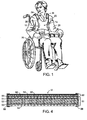
- FIGURE 1 depicts a person retained in a wheelchair by a support vest according to the present invention
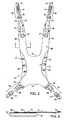
- FIGURE 2 is a front view of the support vest
- FIGURE 3 is an partial cutaway side view of the support vest showing a fastening strap that attaches to the wheelchair;
- FIGURE 4 is a cross-section through the support vest along line 4-4 in Figure 2 .
- references herein to directional relationships and movement such as upper and lower or left and right, refer to the relationship and movement of the components in the orientation illustrated in the drawings, which may not be the orientation of the components when in use.
- a support vest 10 is adapted to fit against the anterior portion of the trunk of a person 28 sitting in a wheelchair 30 and is particularly adapted to fit against the chest of the person. Alternatively the support vest 10 can be place lower on the person's trunk, such as against the lower ribs or upper abdomen.
- the support vest 10 includes a body 12 which has a central portion 14 with opposing first and second edges 16 and 18, respectively.
- a pair of shoulder straps 20 and 22 project upward from the first edge 16 of the central portion 14.
- the two shoulder straps 20 and 22 are spaced apart along the first edge 16 of the vest body 12 so as to extend upward onto both shoulders of the person.
- First and second fastening straps 34 and 36 are connected to the first and second shoulder straps 20 and 22, respectively.
- the details of the first fastening strap 34 will be described with the understanding that the second fastening strap 36 is of identical construction, except it is attached to the other shoulder strap 22.
- one end 33 of the first fastening strap 36 is attached, such as by sewing, to the first shoulder strap 20 slightly spaced from the upper end 35.
- the first fastening strap 34 projects upward from the upper end 35 and winds through the socket portion 38 of a releasable shoulder fastener 39.
- the winding path through the socket portion 38 prevents the first fastening strap 34 from sliding through the socket portion when the strap and releasable shoulder fastener 39 secure the support vest around the person.
- the first fastening strap 34 returns back over itself and the outer surface of the first shoulder strap 20. That returning portion of the first fastening strap 36 passes under a belt loop 40 that is attached, such as by sewing, to the outer surface of the first shoulder strap 20. The other end of the first fastening strap 34 then loops through a pull ring 42 which facilitates an individual grasping that end of the fastening strap for adjustment purposes.
- the tension of the first fastening strap 34 must be relieved and engagement of the strap with the socket portion 38 slackened. In that slackened state, a person can pull on the ring 42 and slide the fastening strap through the fastener socket portion 38 to the desired position.
- the shoulder fastener 39 also has a plug portion 41 that is configured to be inserted into and releasably engage the socket portion 38.
- the plug portion 41 is mounted to an end of a back strap 43 that is attached to the seat back or upper frame of the wheelchair 30 so as to secure the fastening strap 34 to the wheelchair.
- a pair of tabs 24 and 26 project downward from the second edge 18 of the central portion 14 of the vest body 12.
- the tabs 24 and 26 are spaced apart along the second edge 18 so as to be located at opposite lower corners of the body 12.
- the two tabs 24 and 26 extend partially against opposite sides of the person 28 seated in the wheelchair 30.
- Each tab 24 and 26 is attached to a separate side strap 48 and 49, respectively, by a releasable side fastener 45.
- Each side fastener 45 comprises a socket portion 46 and a plug portion 47 adapted to releasably engage the socket portion.
- the plug portion 47 is attached to the respective side strap 48 or 49, which as shown in Figure 1 extends around one side of the person 28 seated in the wheelchair 30 and is secured to either the frame of the wheelchair.
- each side strap 48 or 49 can be secured to seat of the wheelchair so that the support vest 10 is placed lower on the person with the second edge 18 of the vest body 12 laying against the person's lower ribs or abdomen. In this latter position. the tabs 24 and 26 extend against opposite sides of the person's trunk.
- the sets of fasteners 39 and 45 being releasable allow the support vest 10 to be easily fastened around the person seated in the wheelchair so as to limit the motion of that person while seated. Those fasteners 39 and 45 also allow the support vest 10 to be easily removed from around the person.
- the body 12 of the support vest 10 has a unique multiple layer construction which enhances the comfortableness of the vest.
- a foundation 50 extends throughout the entire vest body and specifically from the remote ends of the shoulder straps 20 and 22 through the central portion 14 to the tips of the tabs 24 and 26.
- the foundation 50 comprises a core layer formed by a core pad 52 of a resilient material with perforations extending between its first and second major surfaces.
- the resilient material may be a synthetic rubber, such as a polymerization of chloroprene, one type of which is commonly referred to as neoprene.
- the core pad 52 is at least 5.0 mm thick (e.g.
- a first covering layer 51 is bonded, such as by an adhesive, to one exterior major surface of the core pad 52 and a second covering layer 53 is similarly bonded to the other exterior major surface of the core pad.
- the first and second covering layers 51 and 53 are formed of a breathable material, such as a microfiber polyester fabric, which allows air to pass there through.
- breathable as used herein means that the related material is sufficiently porous to allow air the pass there through.
- first and second covering layers 51 and 53 over the core pad 52 are respectively covered by first and second layers 54 and 56 of a mesh fabric, one type of which is commonly referred to as an air mesh fabric.
- each mesh fabric layer 54 and 56 may be 3 mm thick with openings over approximately one-quarter of the surface area.
- the first layer of 54 of the mesh fabric is proximate to the person 28 wearing the support vest 10.
- cover 60 Most of the outer surface of the foundation 50, i.e., the surface that is remote from the person, is protected by a cover 60 that abuts the second layer of 56 of the mesh fabric.
- the cover is easier to clean than the outer mesh fabric layers 54 and 56 of the foundation.
- the cover 60 extends from near the tips of the shoulder straps 20 and 22 across the center section 14 of the support vest 10 to locations near the tips of the tabs 24 and 26.
- the mid-section of the cover 60 curves inward at section 65 from the lateral edges of the foundation 50.
- the cover 60 comprises a nucleus layer formed by a nucleus pad 62 which may comprise the same resilient material as used for the foundation core pad 52.
- the nucleus pad 62 may be less that 1.5 mm (e.g. 1.0 mm) thick with approximately 1.0 mm diameter perforations in a two dimensional array.
- the exterior surface of the nucleus pad 62 is covered by a first jacket layer 64, and a second jacket layer 66 is provided between the nucleus pad 62 and the foundation 50.
- the first and second jacket layers 64 and 66 are formed of a breathable material, such as a microfiber polyester fabric, which allows air to pass there through.
- the breathable nature of the fabrics and perforations through the other layers allows air to pass through the support vest 10. This breathability enables the body heat of the person to escape and enabled perspiration to evaporate. Furthermore the various layers are formed of materials that wick perspiration away from the vest wearer.
- the edge of the body 12 is wrapped in a band 68, such as a bias tape, that is stitched through the body to not only secure the band to the body but also hold the layers together. Additional stitching at the edges of the cover that extend inward from the edges of the foundation also are stitched through the foundation to further secure the layers of material together.
- a band 68 such as a bias tape
- All the layers of the body are stretchable with at least the mesh fabric layers 54 and 56 having a greater stretchability in a first direction extending between the first and second edges 16 and 18 of the central section, i.e. in the vertical direction, than the stretchability in a second direction that is orthogonal to the first direction, i.e. generally horizontal when the support vest is worn.
- a zipper can extend vertically between the first and second edges 16 and 18 of the central portion 14 of the body 12. This zipper facilitates placing and removing the support vest 10 around the seated person 28 without having the unfasten any of the straps 34, 36, 48 or 49. In fact, providing a zipper could eliminate the need for releasable fasteners on those straps, which while still being adjustable would be non-releasably fastened to the support vest body 12 and the wheelchair 30.
Landscapes
- Health & Medical Sciences (AREA)
- Nursing (AREA)
- Orthopedic Medicine & Surgery (AREA)
- Engineering & Computer Science (AREA)
- Biomedical Technology (AREA)
- Heart & Thoracic Surgery (AREA)
- Vascular Medicine (AREA)
- Life Sciences & Earth Sciences (AREA)
- Animal Behavior & Ethology (AREA)
- General Health & Medical Sciences (AREA)
- Public Health (AREA)
- Veterinary Medicine (AREA)
- Professional, Industrial, Or Sporting Protective Garments (AREA)
- Outer Garments And Coats (AREA)
Applications Claiming Priority (1)
| Application Number | Priority Date | Filing Date | Title |
|---|---|---|---|
| US13/106,512 US8317271B1 (en) | 2011-05-12 | 2011-05-12 | Chair occupant support vest |
Publications (1)
| Publication Number | Publication Date |
|---|---|
| EP2522317A2 true EP2522317A2 (fr) | 2012-11-14 |
Family
ID=46027826
Family Applications (1)
| Application Number | Title | Priority Date | Filing Date |
|---|---|---|---|
| EP12166849A Withdrawn EP2522317A2 (fr) | 2011-05-12 | 2012-05-04 | Veste de support d'occupant du fauteuil |
Country Status (2)
| Country | Link |
|---|---|
| US (1) | US8317271B1 (fr) |
| EP (1) | EP2522317A2 (fr) |
Cited By (1)
| Publication number | Priority date | Publication date | Assignee | Title |
|---|---|---|---|---|
| EP2783672A1 (fr) * | 2013-03-26 | 2014-10-01 | Arjo Hospital Equipment AB | Supports médicaux flexibles |
Families Citing this family (2)
| Publication number | Priority date | Publication date | Assignee | Title |
|---|---|---|---|---|
| USD812307S1 (en) | 2017-08-10 | 2018-03-06 | Digital Three, Inc. | Flight safety vest for a lap child |
| US10596929B2 (en) * | 2017-09-22 | 2020-03-24 | Jodi L. Houin | Child restraint system including harness and adjustment mechanism |
Family Cites Families (10)
| Publication number | Priority date | Publication date | Assignee | Title |
|---|---|---|---|---|
| US4330152A (en) | 1980-08-04 | 1982-05-18 | Legan Sandra K | Support and restraint apron |
| US4891846A (en) | 1988-12-16 | 1990-01-09 | Sager Annette M | Medical absorption garment |
| US5008959A (en) | 1990-02-28 | 1991-04-23 | Coppage Jr Edward A | Bulletproof dress shirt |
| US5327811A (en) | 1991-04-25 | 1994-07-12 | Guardian Technologies International | Lightweight ballistic protective device |
| US5562326A (en) * | 1994-06-21 | 1996-10-08 | Stroud; Robert W. | Personal body restraint device |
| US5730498A (en) * | 1996-11-12 | 1998-03-24 | Jay Medical Ltd. | Quick release closure assembly |
| USD403125S (en) | 1997-03-03 | 1998-12-22 | Larsen Debora M | Nylon covered anterior trunk support |
| US6076527A (en) | 1998-01-08 | 2000-06-20 | Rottinghaus; Herman James | Adaptive patient support and restraint system |
| US7628157B2 (en) | 2004-06-14 | 2009-12-08 | Bodypoint, Inc. | Anterior trunk support or harness |
| USD627072S1 (en) | 2005-05-31 | 2010-11-09 | Bodypoint Designs, Inc. | Anterior trunk support |
-
2011
- 2011-05-12 US US13/106,512 patent/US8317271B1/en active Active
-
2012
- 2012-05-04 EP EP12166849A patent/EP2522317A2/fr not_active Withdrawn
Non-Patent Citations (1)
| Title |
|---|
| None |
Cited By (6)
| Publication number | Priority date | Publication date | Assignee | Title |
|---|---|---|---|---|
| EP2783672A1 (fr) * | 2013-03-26 | 2014-10-01 | Arjo Hospital Equipment AB | Supports médicaux flexibles |
| WO2014154661A1 (fr) * | 2013-03-26 | 2014-10-02 | Arjo Hospital Equipment Ab | Supports médicaux souples |
| CN105101930A (zh) * | 2013-03-26 | 2015-11-25 | 阿乔医用设备有限公司 | 柔性医疗支架 |
| JP2016514519A (ja) * | 2013-03-26 | 2016-05-23 | アルジョ ホスピタル イクイップメント アクチエボラグArjo Hospital Equipment AB | 柔軟な医療用支持体 |
| US10555857B2 (en) | 2013-03-26 | 2020-02-11 | Arjo Ip Holding Ab | Flexible medical supports |
| CN111035497A (zh) * | 2013-03-26 | 2020-04-21 | 侒捷祐知识产权控股有限公司 | 患者支架 |
Also Published As
| Publication number | Publication date |
|---|---|
| US20120284899A1 (en) | 2012-11-15 |
| US8317271B1 (en) | 2012-11-27 |
Similar Documents
| Publication | Publication Date | Title |
|---|---|---|
| JP6530576B1 (ja) | ベビーキャリア | |
| US9545159B2 (en) | Apparatus for a baby carrier | |
| US9949575B2 (en) | Child carrier | |
| US20140231472A1 (en) | Strap-on child carrier with support seating element | |
| GB2476076A (en) | Baby carrier with a pair of crossed slings | |
| CN108024865B (zh) | 附有腰部保护带的裤子 | |
| US20210137282A1 (en) | Baby carrier | |
| JP6718167B2 (ja) | 子守帯 | |
| US10849439B2 (en) | Infant lap support | |
| US12502009B2 (en) | Side hip seat baby carrier | |
| JP5902265B1 (ja) | 子守帯 | |
| WO2005123194A2 (fr) | Support ou harnais facial pour tronc | |
| US20230240401A1 (en) | Pair of trousers comprising a waistband system | |
| KR102690072B1 (ko) | 사이드 힙시트 아기띠 | |
| US8317271B1 (en) | Chair occupant support vest | |
| KR20160035495A (ko) | 아기띠 | |
| KR20100068410A (ko) | 조절가능한 등 지지 장치 | |
| US20190116990A1 (en) | Child carrier | |
| JP6282716B1 (ja) | ベビーキャリア | |
| KR101334101B1 (ko) | 접이식 매트와 베개가 구비된 다용도 낚시조끼 | |
| TW201309239A (zh) | 多功能嬰兒背乘載具 | |
| JP3173539U (ja) | ベスト | |
| KR102873770B1 (ko) | 아기띠 | |
| JP2016016171A (ja) | ベビーキャリア | |
| US20250204617A1 (en) | Separable garment for maintaining secure duty belts with integrated stretchable straps for controlled retraction |
Legal Events
| Date | Code | Title | Description |
|---|---|---|---|
| PUAI | Public reference made under article 153(3) epc to a published international application that has entered the european phase |
Free format text: ORIGINAL CODE: 0009012 |
|
| AK | Designated contracting states |
Kind code of ref document: A2 Designated state(s): AL AT BE BG CH CY CZ DE DK EE ES FI FR GB GR HR HU IE IS IT LI LT LU LV MC MK MT NL NO PL PT RO RS SE SI SK SM TR |
|
| AX | Request for extension of the european patent |
Extension state: BA ME |
|
| STAA | Information on the status of an ep patent application or granted ep patent |
Free format text: STATUS: THE APPLICATION IS DEEMED TO BE WITHDRAWN |
|
| 18D | Application deemed to be withdrawn |
Effective date: 20141202 |