EP2523103A1 - Stabilisierte Binärdifferenzierung - Google Patents
Stabilisierte Binärdifferenzierung Download PDFInfo
- Publication number
- EP2523103A1 EP2523103A1 EP12162247A EP12162247A EP2523103A1 EP 2523103 A1 EP2523103 A1 EP 2523103A1 EP 12162247 A EP12162247 A EP 12162247A EP 12162247 A EP12162247 A EP 12162247A EP 2523103 A1 EP2523103 A1 EP 2523103A1
- Authority
- EP
- European Patent Office
- Prior art keywords
- file
- array
- image
- corresponding section
- report file
- Prior art date
- Legal status (The legal status is an assumption and is not a legal conclusion. Google has not performed a legal analysis and makes no representation as to the accuracy of the status listed.)
- Ceased
Links
Images



Classifications
-
- G—PHYSICS
- G06—COMPUTING OR CALCULATING; COUNTING
- G06F—ELECTRIC DIGITAL DATA PROCESSING
- G06F8/00—Arrangements for software engineering
- G06F8/60—Software deployment
- G06F8/65—Updates
-
- G—PHYSICS
- G06—COMPUTING OR CALCULATING; COUNTING
- G06F—ELECTRIC DIGITAL DATA PROCESSING
- G06F9/00—Arrangements for program control, e.g. control units
- G06F9/06—Arrangements for program control, e.g. control units using stored programs, i.e. using an internal store of processing equipment to receive or retain programs
Definitions
- the present invention relates to an apparatus and method for stabilized binary differencing. More particularly, the present invention relates to an apparatus and method for generating a delta file based on a steering file obtained from a stabilized firmware image.
- Mobile terminals were developed to provide wireless communication between users. As technology has advanced, mobile terminals now provide many additional features beyond simple telephone conversation. For example, mobile terminals are now able to provide additional functions such as an alarm, a Short Messaging Service (SMS), a Multimedia Message Service (MMS), E-mail, games, remote control of short range communication, an image capturing function using a mounted digital camera, a multimedia function for providing audio and video content, a scheduling function, and many more. With the plurality of features now provided, a mobile terminal has effectively become a necessity of daily life.
- SMS Short Messaging Service
- MMS Multimedia Message Service
- E-mail electronic mail
- games remote control of short range communication
- an image capturing function using a mounted digital camera a multimedia function for providing audio and video content
- a scheduling function a scheduling function
- a mobile terminal manufacturer prepares the mobile terminal with the necessary firmware to operate the mobile terminal and provides the mobile terminal to carriers for sale to users.
- the mobile terminal manufacturer often employs a linker offered by the manufacturer of the microprocessor controlling the mobile terminal.
- the linker collects the object code for the program and links them together into a runnable image that can be stored in the memory of the mobile terminal.
- linkers have been modified to output "stabilized” images. According to this modification, when the linker is provided with the same set of object files and archive files in the same sequence, the linker will link the objects together in a highly similar fashion. The output of the linker therefore becomes more “stable” and predictable.
- the mobile terminal manufacturer also makes firmware updates available to the users.
- An update may be necessary to correct bugs, to enhance security, or provide additional features.
- the updates are typically provided to the users via a delta package.
- the delta package includes the new or updated code and data in the firmware update, as well as instructions to permit the mobile terminal to update the previously stored firmware. To reduce size, the delta package generally does not include code or data that has not changed in the updated firmware.
- An aspect of the present invention is to address at least the above-mentioned problems and/or disadvantages and to provide at least the advantages described below. Accordingly, an aspect of the present invention is to provide an apparatus and method for stabilized binary differencing.
- an apparatus and method for stabilized binary differencing includes obtaining a first report file for a first image corresponding to a current firmware version and a second report file for a second image corresponding to an updated firmware version, each report file containing information about a plurality of sections of the corresponding image, generating a first object array corresponding to the first report file and a second object array corresponding to the second report file, comparing the first object array to the second object array, updating the second object array to reflect the results of the comparison, generating a steering file based on the updated object array, performing a binary differencing on the first image and the second image based on the steering file, and generating a delta file based on the binary differencing.
- the apparatus includes a controller for obtaining a first report file for a first image corresponding to a current firmware version and a second report file for a second image corresponding to an updated firmware version, each report file containing information about a plurality of sections of the corresponding image, generating a first object array corresponding to the first report file and a second object array corresponding to the second report file, comparing the first object array to the second object array, updating the second object array to reflect the results of the comparison, generating a steering file based on the updated object array, performing a binary differencing on the first image and the second image based on the steering file, and generating a delta file based on the binary differencing.
- FIG. 1 is a diagram of a mobile terminal according to an exemplary embodiment of the present invention.
- FIG. 2 is a flowchart of a method for generating a delta file according to an exemplary embodiment of the present invention
- FIG. 3 shows a partial output of a linker according to an exemplary embodiment of the present invention
- FIG. 4 is a flowchart of a method for extracting lines from a report file according to an exemplary embodiment of the present invention
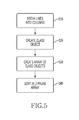
- FIG. 5 is a flowchart of a method for parsing lines extracted from a report file according to an exemplary embodiment of the present invention.
- FIG. 6 shows partial relocation information of an image according to an exemplary embodiment of the present invention.
- mobile terminal The following exemplary embodiments of the present invention are described as applied to a "mobile terminal.” However, it is to be understood that this is merely a generic term and that the invention is equally applicable to any of a mobile phone, a palm sized Personal Computer (PC), a Personal Digital Assistant (PDA), a Hand-held PC (HPC), a smart phone, an International Mobile Telecommunication 2000 (IMT-2000) terminal, a wireless Local Area Network (LAN) terminal, and the like. Accordingly, use of the term “mobile terminal” should not be used to limit application of the present inventive concepts to any certain type of apparatus or device.
- PC Personal Computer
- PDA Personal Digital Assistant
- HPC Hand-held PC
- smart phone an International Mobile Telecommunication 2000 (IMT-2000) terminal
- IMT-2000 International Mobile Telecommunication 2000
- LAN wireless Local Area Network
- Exemplary embodiments of the present invention may be applied to any device having firmware updateable via a delta file.
- many home appliances may be equipped with a firmware and wired or wireless interface, such that the home appliance could receive a delta file to update the firmware to correct bugs or apply new features.
- Delta files created according to exemplary embodiments of the present invention may also be applied to these home appliances, or to any device having firmware updateable by a delta file.
- Exemplary embodiments of the present invention include an apparatus and method for providing stabilized binary differencing. Exemplary embodiments of the present invention are described below with respect to the ARM architecture developed and licensed by ARM Holdings, Inc. However, it would be understood that exemplary embodiments of the present invention may be adapted to other types of processor architectures.
- FIG. 1 is a diagram of a mobile terminal according to an exemplary embodiment of the present invention.
- a mobile terminal 100 includes a processor 110, a storage unit 120, a display unit 130, a communication unit 140, and an input unit 150.
- the mobile terminal 100 may include additional and/or different units. Similarly, the functionality of two or more units may be integrated into a single component.
- the processor 110 controls the overall operations of the mobile terminal 100 using firmware (not shown) stored in the storage unit 120.
- the processor 110 may support the ARM architecture developed and licensed by ARM Holdings, Inc.
- the processor may implement the instructions in the delta file to update the firmware.
- the storage unit 120 stores various files and other data in the mobile terminal.
- the storage unit may be understood as including several types of storages, such as a Random Access Memory (RAM) for storing user data, and storage for storing program data such as the firmware.
- RAM Random Access Memory
- the section for storage data may be flash memory, Read Only Memory (ROM), and the like.
- the display unit 130 displays information to the user of the mobile terminal.
- the display unit 130 may be provided as a Liquid Crystal Display (LCD).
- the display unit 130 may include a controller for controlling the LCD, a video memory in which image data is stored and an LCD element. If the LCD is provided as a touch screen, the display unit 130 may perform a part or all of the functions of the input unit 160.
- the communication unit 140 is configured to include an RF transmitter (not shown) for up-converting the frequency of transmitted signals and amplifying the transmitted signals, and an RF receiver (not shown) for low-noise amplifying of received RF signals and down-converting the frequency of the received RF signals.
- the communication unit 140 may also include a wired interface, such as Ethernet and/or Universal Serial Bus (USB).
- the input unit 160 receives input from the user.
- the input unit 160 may be configured as a component of the display unit 130, as described above.
- the input unit 160 may also be configured as a keypad or a plurality of keys to receive input from the user.
- a delta file is transmitted to the mobile terminal.
- FOTA Firmware Over The Air
- the delta file is typically obtained by executing a Binary Differencing Engine (BDE) to perform a binary comparison of the original firmware with the updated firmware.
- BDE Binary Differencing Engine
- the BDE compares binary images (e.g. a binary image of the original and updated firmware) and prepares a set of delta instructions to cause the processor 110 to update the firmware in the storage unit 120 to the new version.
- the BDE conventionally performs its operations in a purely binary manner on the code itself. The process of matching updated code and identifying updated code is difficult.
- branch and call instructions are position-relative. Even though chunks of identical code may shift (i.e., move up or down relative to one another), the code will not reflect any differences in local transfers of control.
- pointers to code and data are usually absolute pointers. This type of information has typically been hard to compare, because there was no indication as to whether the information was raw data or pointers.
- the linker may be modified to output additional information to address this issue. For example, the linker may be modified to output a report about the components of the image.
- the linker may also be modified to output relocation information identifying, for each relocation (e.g., branch or call instruction), the kind of the relocation and a link to the symbol affected by the relocation.
- the linker If the linker outputs the relocation information, there is no need for reference change tracking.
- the output of the linker itself contains the relocation information identifying the original global symbol name, without the need for another label.
- the linker may output a report indicating the location and attributes of all sections in the image.
- a section refers to a primary set of items that contribute to the image. These sections each include a number of attributes, such as their name, size, and location index within the object file that contributed the section.
- the report may include an index number of the section within the object file that provisioned the section. This index number is a unique number that the linker assigns to each section. The linker uses the index number to manage all of the sections in the image.
- the report may also include an additional column showing the physical address chosen by the linker for the section in the image.
- the index number together with the name and attributes of the sections, permit section matching between the current image (i.e., the image of the current version of the firmware) and the new image (i.e., the image of the updated version).
- the new image i.e., the image of the updated version.
- no new object files are added and no object files are deleted. Accordingly, perfect section matching between the current image and the new image usually occurs, although the deletion of old sections and the addition of new sections may also be accommodated.
- the primary output of the linker is an ELF file.
- the ELF file contains all the binary output provided by the linker, including the binary image.
- the linker can also receive a parameter instructing the linker to provide relocation information in the output ELF file.
- the relocation information identifies each of the pointers in the image as such, enabling the BDE to distinguish between pointers and data. Accordingly, the BDE may use the relocation information to address differences caused by branch or call op-codes in the image.
- FIG. 6 shows partial relocation information of an image according to an exemplary embodiment of the present invention.
- relocation information for a portion of an image is shown. Different types of relocations are used for code and pointers. In addition, code and local private data are frequently intermixed, with the code merely jumping around the included data. This combination of code and data can make the differencing operation difficult. However, the relocation information permits the BDE to more easily identify and operate in a fashion appropriate to these regions. While FIG. 6 shows a few different types of relocations for exemplary purposes, and ELF file may contain dozens of different types of relocations.
- the report file may be used to generate a steering file containing information that can be used to match nearly all of the sections in the images. Accordingly, the steering file may be provided to the BDE to assist in the final binary comparison of the images.
- FIG. 2 is a flowchart of a method for generating a delta file according to an exemplary embodiment of the present invention
- FIG. 3 shows a partial output of a linker according to an exemplary embodiment of the present invention.
- the linker generates a report file in step 210.
- a partial output of the report file is shown in FIG. 3 .
- the partial output includes a list of each section in the image, as well as additional information about the image.
- the additional information includes the size, type, attributes, and index information of each section.
- the output shown in FIG. 3 is only a partial output of the linker; the output may also include additional information not necessary for this process.
- the index information may include a three-digit number in which each digit is separated by a period, such as "2.0.1".
- the first digit in this sequence is the sequence of the file name on the command line given to the linker when the report file was prepared.
- the second digit is a sequence number of the module in the archive that provided the section. If the section corresponds to an object not found in an archive, the second digit may be 0.
- the third digit is the sequence number of the section in the ELF file. While ELF files may have several types of sections, the header of the ELF file will consistently choose the same section number for sections created by the same compiler.
- step 220 the report file is read and lines containing information needed by the BDE are extracted. Step 220 is described in more detail below with respect to FIG. 4 .
- step 230 the extracted lines are parsed to create an array of class objects describing each section in the image. Step 230 is described below with respect to FIG. 5 .
- Steps 210-230 are repeated for both the current image (i.e., the image corresponding to the current version of the firmware) and the new image (i.e., the image corresponding to the updated version of the firmware) to create an array corresponding to the current image and an array corresponding to the new image.
- the array corresponding to the current image is referred to as the BASE array
- the array corresponding to the new image is referred to as the INCREMENTAL array.
- step 240 the BASE array and the INCREMENTAL array are scanned in order, such as alphabetical order.
- the INCREMENTAL array is updated based on the results of the scan. Objects present in the BASE array but not the INCREMENTAL array are ignored. Objects in the INCREMENTAL array that have the same size as the corresponding object in the BASE array are marked in the INCREMENTAL array as "SAME”. Objects in the INCREMENTAL array that have a different size than the corresponding object in the BASE array are marked in the INCREMENTAL array as "CHANGED", and the old size (found in the BASE array) is recorded in the INCREMENTAL object as BASE_SIZE (see Table 1 below).
- step 250 the resulting updated INCREMENTAL array is used to create a steering file.
- the INCREMENTAL array is sorted in ascending order according to the "Load Address" attribute, and a new array (referred to as LONGHORN) is generated based on the sorted INCREMENTAL array.
- LONGHORN a new array
- the LONGHORN array is then converted into a text-based steering file.
- Each line in the steering file corresponds to an object entry in the LONGHORN array, and may include the information shown below in Table 1.
- the value of the OBJECT attribute in Table 1 corresponds to the "Object" column shown in FIG. 3 .
- the OBJECT may be a bare file name of the object, or may be a composite that also includes a reference to an archive where the object is located. For example, the string “call.o” indicates that the object is located in the file “call.o”, while the string “alpha.o(alpha.ar)” indicates that the "alpha.o" object is located within the archive "alpha.ar”.
- the object name is included in the OBJECT attribute, and the archive name is included in the ARCHIVE attribute. If no archive exists, the ARCHIVE attribute may be an empty string.
- Exemplary code for the object "call.o" is provided below:
- the object "call.o” defines four sections: “genesis”, “greeting”, “flash_code _in_ram”, and “galaxy”.
- the corresponding lines for each of these sections in the report file refers to "call.o” as the object in which these sections occur, as shown in FIG. 3 .
- the steering file is provided to the BDE along with ELF files corresponding to the current and new images.
- the ELF files may include the relocation information.
- the BDE compares the images using the steering file.
- the BDE dissects the current and new images according to the information in the steering file.
- the BDE may identify similar sections in both the current and new images (e.g., sections having the same name and/or index number), and may divide the image up according to the sections identified in the steering file. Since the output of the linker is stabilized, the BDE may assume that code in a particular section of the current image is highly similar to code in a corresponding section of the new image, especially if the steering file indicates that the two sections are the same (e.g., not changed or new). Accordingly, the BDE employs the steering image to break down the images so as to reduce processing time.
- the BDE employs the relocation information included in the ELF files to identify segments of the image.
- the relocation information allows the BDE to identify a particular location as "code” or as "data”. If a particular relocation is present in corresponding modules of both the current and new images, the BDE can make assumptions about this similar nature.
- the relocation information indicates that the relocation relates to code or data, this information permits the BDE to treat the relocation in a manner appropriate for each type.
- the BDE generates a minimal delta file reflecting the differences between the current and new images based on the steering file and the current and new images.
- the delta file may be provided to the mobile terminal 100 via FOTA to enable the processor 110 to update the firmware stored in the storage unit 120.
- FIG. 4 is a flowchart of a method for extracting lines from a report file according to an exemplary embodiment of the present invention.
- the operations shown in FIG. 4 may correspond to the step 220 described above with respect to FIG. 2 .
- each line from the report file (also referred to as a map file) is read and discarded until a predetermined text string is read.
- These discarded lines typically include information that is not needed by the BDE or that does not relate to the sections of the image, and are thus discarded.
- the predetermined text string indicates the start of the information used by the BDE. While the particular predetermined text string may vary, an exemplary text string may be "Memory Map of the image", as shown in FIG. 3 .
- step 420 the remaining lines of the report file are read.
- step 430 some of the lines are discarded.
- the discarded lines may be identified as having first predetermined text strings.
- lines that do not have second predetermined text strings may also be discarded.
- the presence of the first predetermined text strings may indicate that the information on the line is not needed by the BDE.
- the absence of the second predetermined text string may indicate that the information is not needed by the BDE.
- the line 310 merely describes the information in each column. Since the information about the sections themselves would include, as the initial characters of the column, the string "0x" identifying an address, any line that does not begin with this string may be displayed. Accordingly, an exemplary first predetermined text string may include "Zero RW", and an exemplary second predetermined text string may include "0x".
- the resulting lines can be converted into an array of object information as described below with respect to FIG. 5 .
- FIG. 5 is a flowchart of a method for parsing lines extracted from a report file according to an exemplary embodiment of the present invention.
- each line is broken into columns based on a predetermined separator.
- the predetermined separator may be, for example, a space or series of spaces.
- certain values in each line that are not needed by the BDE may be ignored and treated as a space.
- the entry point of the image may be represented by a character such as an asterisk (*).
- the character e.g., asterisk
- the character may be ignored and treated as a space.
- a class object is created for each line.
- the class object includes a plurality of text strings, each corresponding to a column in the line.
- the class objects are combined into an array of class objects (e.g., the BASE and INCREMENTAL arrays described above). Since each line corresponds to a section, each class object also corresponds to the same section.
- a class object denotes a grouping of specific data, and has a specific meaning in certain programming languages, such as C++ and Python. However, other programming languages may have a similar structure used to collect related data together. For example, in the C programming language, the term 'structure' is used for this purpose. Accordingly, although the term 'class object' is used herein, a similar grouping concept may be extended to include any meaningful collection of information in any programming language.
- the array is sorted and pruned.
- the array may be sorted according to the values of the ARCHIVE, OBJECT, Index, Type, Attribute, and Size. Class objects having the same archive and object names may be removed. This is because in some cases, the map file may not show the path to the archive or object files, and duplicate files may be provisioned from different directories.
- the resulting array is used to generate the steering file used by the BDE, as described above with respect to FIG. 2 .
- Exemplary embodiments of the present invention can also be embodied as computer readable code on a computer readable recording medium.
- a computer readable recording medium is any tangible information storage device that can store information which can be thereafter read by a computer system. Examples of the computer readable recording medium include ROM, RAM, CD-ROMs, DVDs, magnetic tapes, floppy disks, and optical data storage devices. Also, functional programs, code, and code segments for accomplishing the present invention can be easily construed by programmers skilled in the art to which the present invention pertains.
Landscapes
- Engineering & Computer Science (AREA)
- Software Systems (AREA)
- Theoretical Computer Science (AREA)
- General Engineering & Computer Science (AREA)
- Physics & Mathematics (AREA)
- General Physics & Mathematics (AREA)
- Computer Security & Cryptography (AREA)
- Information Retrieval, Db Structures And Fs Structures Therefor (AREA)
Applications Claiming Priority (1)
| Application Number | Priority Date | Filing Date | Title |
|---|---|---|---|
| US13/106,452 US8473504B2 (en) | 2011-05-12 | 2011-05-12 | Stabilized binary differencing |
Publications (1)
| Publication Number | Publication Date |
|---|---|
| EP2523103A1 true EP2523103A1 (de) | 2012-11-14 |
Family
ID=46027578
Family Applications (1)
| Application Number | Title | Priority Date | Filing Date |
|---|---|---|---|
| EP12162247A Ceased EP2523103A1 (de) | 2011-05-12 | 2012-03-29 | Stabilisierte Binärdifferenzierung |
Country Status (3)
| Country | Link |
|---|---|
| US (1) | US8473504B2 (de) |
| EP (1) | EP2523103A1 (de) |
| KR (1) | KR101882759B1 (de) |
Cited By (1)
| Publication number | Priority date | Publication date | Assignee | Title |
|---|---|---|---|---|
| CN103123588A (zh) * | 2013-02-05 | 2013-05-29 | 东莞宇龙通信科技有限公司 | 一种获取差分升级补丁的方法及系统 |
Families Citing this family (8)
| Publication number | Priority date | Publication date | Assignee | Title |
|---|---|---|---|---|
| US9043778B2 (en) * | 2011-12-01 | 2015-05-26 | Tencent Technology (Shenzhen) Company Limited | Method and system for upgrading software |
| EP2930879B1 (de) | 2012-12-05 | 2021-02-24 | LG Electronics Inc. | Verfahren und vorrichtung zur authentifizierung einer zugriffsberechtigung in einem drahtlosen kommunikationssystem |
| CN104239081A (zh) * | 2013-06-18 | 2014-12-24 | 富泰华工业(深圳)有限公司 | 软件升级系统及方法 |
| US10496395B2 (en) | 2018-03-07 | 2019-12-03 | Haier Us Appliance Solutions, Inc. | Methods and systems for intelligent software updates of an appliance |
| KR102232069B1 (ko) * | 2019-11-26 | 2021-03-25 | (주) 아이스펙 | 회전기기 운용 장치에 대한 펌웨어 업데이트를 위한 장치 및 방법 |
| US20230305836A1 (en) * | 2021-06-18 | 2023-09-28 | Chia-Wen Cheng | Triple-band trigger tool for tire-pressure monitoring system |
| CN113721968B (zh) * | 2021-08-31 | 2024-04-02 | 杭州海康威视数字技术股份有限公司 | 固件升级方法、装置 |
| US20240427592A1 (en) * | 2023-06-21 | 2024-12-26 | Red Hat, Inc. | Dual software version capability through qubit storage |
Citations (3)
| Publication number | Priority date | Publication date | Assignee | Title |
|---|---|---|---|---|
| US20040260734A1 (en) * | 2003-06-20 | 2004-12-23 | Liwei Ren | Processing software images for use in generating difference files |
| US20070079306A1 (en) * | 2004-04-06 | 2007-04-05 | Iyad Qumei | Object ordering tool for facilitating generation of firmware update friendly binary image |
| US20070169082A1 (en) * | 2005-12-09 | 2007-07-19 | Lam Joi K | Method and apparatus for optimizing patching of objects containing references |
Family Cites Families (5)
| Publication number | Priority date | Publication date | Assignee | Title |
|---|---|---|---|---|
| US7661102B2 (en) * | 2004-08-20 | 2010-02-09 | Smith Micro Software, Inc. | Method for reducing binary image update package sizes |
| US20060112113A1 (en) * | 2004-11-08 | 2006-05-25 | Jinsheng Gu | Static file system differencing and updating |
| KR100750169B1 (ko) * | 2006-03-08 | 2007-08-21 | 삼성전자주식회사 | 델타 파일 생성 방법 및 이를 이용한 소프트웨어 업데이트방법 |
| US8055096B2 (en) * | 2006-05-10 | 2011-11-08 | Research In Motion Limited | Method and system for incremental patching of binary files |
| US7779401B2 (en) * | 2006-06-26 | 2010-08-17 | Research In Motion Limited | Method and system for generating a reverse binary patch for undoing a software update |
-
2011
- 2011-05-12 US US13/106,452 patent/US8473504B2/en not_active Expired - Fee Related
-
2012
- 2012-03-29 EP EP12162247A patent/EP2523103A1/de not_active Ceased
- 2012-03-30 KR KR1020120032918A patent/KR101882759B1/ko not_active Expired - Fee Related
Patent Citations (3)
| Publication number | Priority date | Publication date | Assignee | Title |
|---|---|---|---|---|
| US20040260734A1 (en) * | 2003-06-20 | 2004-12-23 | Liwei Ren | Processing software images for use in generating difference files |
| US20070079306A1 (en) * | 2004-04-06 | 2007-04-05 | Iyad Qumei | Object ordering tool for facilitating generation of firmware update friendly binary image |
| US20070169082A1 (en) * | 2005-12-09 | 2007-07-19 | Lam Joi K | Method and apparatus for optimizing patching of objects containing references |
Cited By (1)
| Publication number | Priority date | Publication date | Assignee | Title |
|---|---|---|---|---|
| CN103123588A (zh) * | 2013-02-05 | 2013-05-29 | 东莞宇龙通信科技有限公司 | 一种获取差分升级补丁的方法及系统 |
Also Published As
| Publication number | Publication date |
|---|---|
| US20120290596A1 (en) | 2012-11-15 |
| KR20120127204A (ko) | 2012-11-21 |
| US8473504B2 (en) | 2013-06-25 |
| KR101882759B1 (ko) | 2018-07-27 |
Similar Documents
| Publication | Publication Date | Title |
|---|---|---|
| EP2523103A1 (de) | Stabilisierte Binärdifferenzierung | |
| EP2527938B1 (de) | Programmierbares steuerungssystem und entwicklungssystem | |
| US9384184B2 (en) | Predicting a command in a command line interface | |
| CN108549538B (zh) | 一种代码检测方法、装置、存储介质及测试终端 | |
| US9542461B2 (en) | Enhancing performance of extract, transform, and load (ETL) jobs | |
| US20130111451A1 (en) | Program Log Record Optimization | |
| CN110716739B (zh) | 一种代码变更信息统计方法、系统和可读存储介质 | |
| JP5336965B2 (ja) | 情報処理装置、情報処理装置の制御方法、及びプログラム | |
| CN107368593A (zh) | 数据导入方法、装置及服务器 | |
| US9563635B2 (en) | Automated recognition of patterns in a log file having unknown grammar | |
| CN110879709A (zh) | 无用代码的检测方法、装置、终端设备及存储介质 | |
| US11921496B2 (en) | Information processing apparatus, information processing method and computer readable medium | |
| JP5531583B2 (ja) | ログ出力装置、ログ出力方法、ログ出力用プログラム | |
| CN103544298A (zh) | 组件的日志分析方法和分析装置 | |
| CN111984248A (zh) | 页面编辑方法和装置、存储介质及电子装置 | |
| CN118092973A (zh) | 操作系统的更新方法、装置、电子设备和可读存储介质 | |
| CN109284126B (zh) | 类库自动更新方法、装置、电子设备、存储介质 | |
| CN109684437B (zh) | 用于文件比较的内容对齐方法、装置、存储介质和设备 | |
| CN108255486B (zh) | 用于表单设计的视图转换方法、装置和电子设备 | |
| CN112711435B (zh) | 版本更新方法、版本更新装置、电子设备和存储介质 | |
| CN109710581B (zh) | 一种解压qcow镜像文件中压缩数据的方法 | |
| CN111142965A (zh) | 语言配置方法、装置、电子设备及存储介质 | |
| US8806465B2 (en) | Refactor exception class hierarchy for reduced footprint and faster application start | |
| CN113010482A (zh) | 一种日志处理方法和装置 | |
| CN117093225A (zh) | 代码文件编译方法、系统更新方法、装置、服务器及设备 |
Legal Events
| Date | Code | Title | Description |
|---|---|---|---|
| PUAI | Public reference made under article 153(3) epc to a published international application that has entered the european phase |
Free format text: ORIGINAL CODE: 0009012 |
|
| AK | Designated contracting states |
Kind code of ref document: A1 Designated state(s): AL AT BE BG CH CY CZ DE DK EE ES FI FR GB GR HR HU IE IS IT LI LT LU LV MC MK MT NL NO PL PT RO RS SE SI SK SM TR |
|
| AX | Request for extension of the european patent |
Extension state: BA ME |
|
| 17P | Request for examination filed |
Effective date: 20130514 |
|
| STAA | Information on the status of an ep patent application or granted ep patent |
Free format text: STATUS: EXAMINATION IS IN PROGRESS |
|
| 17Q | First examination report despatched |
Effective date: 20170601 |
|
| STAA | Information on the status of an ep patent application or granted ep patent |
Free format text: STATUS: THE APPLICATION HAS BEEN REFUSED |
|
| 18R | Application refused |
Effective date: 20180918 |