EP2523751B1 - Nanoparticules anti-uv - Google Patents
Nanoparticules anti-uv Download PDFInfo
- Publication number
- EP2523751B1 EP2523751B1 EP11702514.8A EP11702514A EP2523751B1 EP 2523751 B1 EP2523751 B1 EP 2523751B1 EP 11702514 A EP11702514 A EP 11702514A EP 2523751 B1 EP2523751 B1 EP 2523751B1
- Authority
- EP
- European Patent Office
- Prior art keywords
- anyone
- nanoparticles
- nanoparticle
- hydrophilic polymer
- mol
- Prior art date
- Legal status (The legal status is an assumption and is not a legal conclusion. Google has not performed a legal analysis and makes no representation as to the accuracy of the status listed.)
- Not-in-force
Links
- 239000002105 nanoparticle Substances 0.000 title claims description 78
- 239000000463 material Substances 0.000 claims description 32
- 238000000034 method Methods 0.000 claims description 32
- 229920001477 hydrophilic polymer Polymers 0.000 claims description 26
- 239000000839 emulsion Substances 0.000 claims description 25
- 229920000642 polymer Polymers 0.000 claims description 21
- 150000002894 organic compounds Chemical class 0.000 claims description 20
- 239000004094 surface-active agent Substances 0.000 claims description 20
- 239000008346 aqueous phase Substances 0.000 claims description 18
- 150000001875 compounds Chemical class 0.000 claims description 16
- 239000000203 mixture Substances 0.000 claims description 16
- 229920002451 polyvinyl alcohol Polymers 0.000 claims description 16
- 239000012074 organic phase Substances 0.000 claims description 15
- 239000004372 Polyvinyl alcohol Substances 0.000 claims description 14
- ZWEHNKRNPOVVGH-UHFFFAOYSA-N 2-Butanone Chemical compound CCC(C)=O ZWEHNKRNPOVVGH-UHFFFAOYSA-N 0.000 claims description 12
- IJGRMHOSHXDMSA-UHFFFAOYSA-N Atomic nitrogen Chemical compound N#N IJGRMHOSHXDMSA-UHFFFAOYSA-N 0.000 claims description 12
- 230000008569 process Effects 0.000 claims description 12
- 239000007788 liquid Substances 0.000 claims description 9
- 239000004753 textile Substances 0.000 claims description 9
- AMIMRNSIRUDHCM-UHFFFAOYSA-N Isopropylaldehyde Chemical compound CC(C)C=O AMIMRNSIRUDHCM-UHFFFAOYSA-N 0.000 claims description 8
- 229920002125 Sokalan® Polymers 0.000 claims description 8
- 239000004584 polyacrylic acid Substances 0.000 claims description 7
- HJIAMFHSAAEUKR-UHFFFAOYSA-N (2-hydroxyphenyl)-phenylmethanone Chemical class OC1=CC=CC=C1C(=O)C1=CC=CC=C1 HJIAMFHSAAEUKR-UHFFFAOYSA-N 0.000 claims description 6
- 239000000835 fiber Substances 0.000 claims description 6
- 229910052757 nitrogen Inorganic materials 0.000 claims description 6
- 239000002904 solvent Substances 0.000 claims description 6
- XDTMQSROBMDMFD-UHFFFAOYSA-N Cyclohexane Chemical compound C1CCCCC1 XDTMQSROBMDMFD-UHFFFAOYSA-N 0.000 claims description 5
- 230000015572 biosynthetic process Effects 0.000 claims description 5
- 238000002360 preparation method Methods 0.000 claims description 5
- 238000010791 quenching Methods 0.000 claims description 5
- 230000000171 quenching effect Effects 0.000 claims description 5
- 150000001565 benzotriazoles Chemical class 0.000 claims description 4
- 239000003795 chemical substances by application Substances 0.000 claims description 4
- BBEAQIROQSPTKN-UHFFFAOYSA-N pyrene Chemical class C1=CC=C2C=CC3=CC=CC4=CC=C1C2=C43 BBEAQIROQSPTKN-UHFFFAOYSA-N 0.000 claims description 4
- 230000000087 stabilizing effect Effects 0.000 claims description 4
- 239000002243 precursor Substances 0.000 claims description 3
- 230000005855 radiation Effects 0.000 claims description 3
- 230000015556 catabolic process Effects 0.000 claims description 2
- 238000006731 degradation reaction Methods 0.000 claims description 2
- GVEPBJHOBDJJJI-UHFFFAOYSA-N fluoranthrene Chemical class C1=CC(C2=CC=CC=C22)=C3C2=CC=CC3=C1 GVEPBJHOBDJJJI-UHFFFAOYSA-N 0.000 claims description 2
- 230000006641 stabilisation Effects 0.000 claims description 2
- 238000011105 stabilization Methods 0.000 claims description 2
- 230000037072 sun protection Effects 0.000 claims description 2
- 230000002349 favourable effect Effects 0.000 claims 1
- 239000006096 absorbing agent Substances 0.000 description 20
- XLYOFNOQVPJJNP-UHFFFAOYSA-N water Substances O XLYOFNOQVPJJNP-UHFFFAOYSA-N 0.000 description 17
- 239000000243 solution Substances 0.000 description 16
- -1 TiO 2 Chemical class 0.000 description 14
- 235000019422 polyvinyl alcohol Nutrition 0.000 description 12
- 238000003756 stirring Methods 0.000 description 11
- 229920001577 copolymer Polymers 0.000 description 9
- VGGSQFUCUMXWEO-UHFFFAOYSA-N Ethene Chemical compound C=C VGGSQFUCUMXWEO-UHFFFAOYSA-N 0.000 description 8
- 238000000862 absorption spectrum Methods 0.000 description 8
- 239000012736 aqueous medium Substances 0.000 description 7
- 239000003960 organic solvent Substances 0.000 description 7
- 239000012071 phase Substances 0.000 description 7
- 239000000843 powder Substances 0.000 description 7
- 239000007864 aqueous solution Substances 0.000 description 6
- 239000000975 dye Substances 0.000 description 6
- 229920000728 polyester Polymers 0.000 description 6
- 239000004952 Polyamide Substances 0.000 description 5
- 238000010521 absorption reaction Methods 0.000 description 5
- 238000000576 coating method Methods 0.000 description 5
- 229920002647 polyamide Polymers 0.000 description 5
- 239000005977 Ethylene Substances 0.000 description 4
- DBMJMQXJHONAFJ-UHFFFAOYSA-M Sodium laurylsulphate Chemical compound [Na+].CCCCCCCCCCCCOS([O-])(=O)=O DBMJMQXJHONAFJ-UHFFFAOYSA-M 0.000 description 4
- 229920002678 cellulose Polymers 0.000 description 4
- 239000001913 cellulose Substances 0.000 description 4
- 239000002609 medium Substances 0.000 description 4
- 239000003021 water soluble solvent Substances 0.000 description 4
- UHOVQNZJYSORNB-UHFFFAOYSA-N Benzene Chemical compound C1=CC=CC=C1 UHOVQNZJYSORNB-UHFFFAOYSA-N 0.000 description 3
- 102100040515 Delta(3,5)-Delta(2,4)-dienoyl-CoA isomerase, mitochondrial Human genes 0.000 description 3
- LFQSCWFLJHTTHZ-UHFFFAOYSA-N Ethanol Chemical compound CCO LFQSCWFLJHTTHZ-UHFFFAOYSA-N 0.000 description 3
- LYCAIKOWRPUZTN-UHFFFAOYSA-N Ethylene glycol Chemical compound OCCO LYCAIKOWRPUZTN-UHFFFAOYSA-N 0.000 description 3
- 101000966982 Homo sapiens Delta(3,5)-Delta(2,4)-dienoyl-CoA isomerase, mitochondrial Proteins 0.000 description 3
- DNIAPMSPPWPWGF-UHFFFAOYSA-N Propylene glycol Chemical compound CC(O)CO DNIAPMSPPWPWGF-UHFFFAOYSA-N 0.000 description 3
- 238000002835 absorbance Methods 0.000 description 3
- 230000032683 aging Effects 0.000 description 3
- 230000008901 benefit Effects 0.000 description 3
- LPIQUOYDBNQMRZ-UHFFFAOYSA-N cyclopentene Chemical compound C1CC=CC1 LPIQUOYDBNQMRZ-UHFFFAOYSA-N 0.000 description 3
- 238000004108 freeze drying Methods 0.000 description 3
- 230000002209 hydrophobic effect Effects 0.000 description 3
- 239000000178 monomer Substances 0.000 description 3
- HYISVWRHTUCNCS-UHFFFAOYSA-N pyrene-1-carboxylic acid Chemical compound C1=C2C(C(=O)O)=CC=C(C=C3)C2=C2C3=CC=CC2=C1 HYISVWRHTUCNCS-UHFFFAOYSA-N 0.000 description 3
- 235000019333 sodium laurylsulphate Nutrition 0.000 description 3
- PUPZLCDOIYMWBV-UHFFFAOYSA-N (+/-)-1,3-Butanediol Chemical compound CC(O)CCO PUPZLCDOIYMWBV-UHFFFAOYSA-N 0.000 description 2
- FJJYHTVHBVXEEQ-UHFFFAOYSA-N 2,2-dimethylpropanal Chemical compound CC(C)(C)C=O FJJYHTVHBVXEEQ-UHFFFAOYSA-N 0.000 description 2
- OLFNXLXEGXRUOI-UHFFFAOYSA-N 2-(benzotriazol-2-yl)-4,6-bis(2-phenylpropan-2-yl)phenol Chemical compound C=1C(N2N=C3C=CC=CC3=N2)=C(O)C(C(C)(C)C=2C=CC=CC=2)=CC=1C(C)(C)C1=CC=CC=C1 OLFNXLXEGXRUOI-UHFFFAOYSA-N 0.000 description 2
- QQZOPKMRPOGIEB-UHFFFAOYSA-N 2-Oxohexane Chemical group CCCCC(C)=O QQZOPKMRPOGIEB-UHFFFAOYSA-N 0.000 description 2
- BYGQBDHUGHBGMD-UHFFFAOYSA-N 2-methylbutanal Chemical compound CCC(C)C=O BYGQBDHUGHBGMD-UHFFFAOYSA-N 0.000 description 2
- YGHRJJRRZDOVPD-UHFFFAOYSA-N 3-methylbutanal Chemical compound CC(C)CC=O YGHRJJRRZDOVPD-UHFFFAOYSA-N 0.000 description 2
- NIXOWILDQLNWCW-UHFFFAOYSA-N Acrylic acid Chemical compound OC(=O)C=C NIXOWILDQLNWCW-UHFFFAOYSA-N 0.000 description 2
- XKRFYHLGVUSROY-UHFFFAOYSA-N Argon Chemical compound [Ar] XKRFYHLGVUSROY-UHFFFAOYSA-N 0.000 description 2
- ZTQSAGDEMFDKMZ-UHFFFAOYSA-N Butyraldehyde Chemical compound CCCC=O ZTQSAGDEMFDKMZ-UHFFFAOYSA-N 0.000 description 2
- KFZMGEQAYNKOFK-UHFFFAOYSA-N Isopropanol Chemical compound CC(C)O KFZMGEQAYNKOFK-UHFFFAOYSA-N 0.000 description 2
- 239000004642 Polyimide Substances 0.000 description 2
- QQONPFPTGQHPMA-UHFFFAOYSA-N Propene Chemical compound CC=C QQONPFPTGQHPMA-UHFFFAOYSA-N 0.000 description 2
- PPBRXRYQALVLMV-UHFFFAOYSA-N Styrene Chemical compound C=CC1=CC=CC=C1 PPBRXRYQALVLMV-UHFFFAOYSA-N 0.000 description 2
- 229910010413 TiO 2 Inorganic materials 0.000 description 2
- GWEVSGVZZGPLCZ-UHFFFAOYSA-N Titan oxide Chemical compound O=[Ti]=O GWEVSGVZZGPLCZ-UHFFFAOYSA-N 0.000 description 2
- 239000004904 UV filter Substances 0.000 description 2
- 125000002252 acyl group Chemical group 0.000 description 2
- 239000000654 additive Substances 0.000 description 2
- 150000001298 alcohols Chemical class 0.000 description 2
- 150000001408 amides Chemical class 0.000 description 2
- 239000003963 antioxidant agent Substances 0.000 description 2
- 238000013459 approach Methods 0.000 description 2
- 229920003235 aromatic polyamide Polymers 0.000 description 2
- 239000012965 benzophenone Substances 0.000 description 2
- 150000008366 benzophenones Chemical class 0.000 description 2
- 239000011230 binding agent Substances 0.000 description 2
- 125000004432 carbon atom Chemical group C* 0.000 description 2
- 150000004649 carbonic acid derivatives Chemical class 0.000 description 2
- 239000011248 coating agent Substances 0.000 description 2
- 238000004040 coloring Methods 0.000 description 2
- 238000007796 conventional method Methods 0.000 description 2
- JHIVVAPYMSGYDF-UHFFFAOYSA-N cyclohexanone Chemical compound O=C1CCCCC1 JHIVVAPYMSGYDF-UHFFFAOYSA-N 0.000 description 2
- 150000004985 diamines Chemical class 0.000 description 2
- 150000001991 dicarboxylic acids Chemical class 0.000 description 2
- 150000001993 dienes Chemical class 0.000 description 2
- 150000002009 diols Chemical class 0.000 description 2
- 239000002270 dispersing agent Substances 0.000 description 2
- 229920001971 elastomer Polymers 0.000 description 2
- 239000002657 fibrous material Substances 0.000 description 2
- 238000009472 formulation Methods 0.000 description 2
- 238000010438 heat treatment Methods 0.000 description 2
- 150000003949 imides Chemical class 0.000 description 2
- 238000010348 incorporation Methods 0.000 description 2
- 239000000976 ink Substances 0.000 description 2
- 150000002576 ketones Chemical class 0.000 description 2
- 239000010985 leather Substances 0.000 description 2
- 239000003094 microcapsule Substances 0.000 description 2
- 238000002156 mixing Methods 0.000 description 2
- 150000005673 monoalkenes Chemical class 0.000 description 2
- 239000003973 paint Substances 0.000 description 2
- 229920002401 polyacrylamide Polymers 0.000 description 2
- 229920000058 polyacrylate Polymers 0.000 description 2
- 229920002239 polyacrylonitrile Polymers 0.000 description 2
- 229920001515 polyalkylene glycol Polymers 0.000 description 2
- 229920002480 polybenzimidazole Polymers 0.000 description 2
- 239000004417 polycarbonate Substances 0.000 description 2
- 229920000515 polycarbonate Polymers 0.000 description 2
- 229920001721 polyimide Polymers 0.000 description 2
- 238000006116 polymerization reaction Methods 0.000 description 2
- 229920006324 polyoxymethylene Polymers 0.000 description 2
- 229920002635 polyurethane Polymers 0.000 description 2
- 239000004814 polyurethane Substances 0.000 description 2
- 239000003381 stabilizer Substances 0.000 description 2
- 125000001424 substituent group Chemical group 0.000 description 2
- 239000000758 substrate Substances 0.000 description 2
- 238000012360 testing method Methods 0.000 description 2
- 239000001893 (2R)-2-methylbutanal Substances 0.000 description 1
- ULPMRIXXHGUZFA-UHFFFAOYSA-N (R)-4-Methyl-3-hexanone Natural products CCC(C)C(=O)CC ULPMRIXXHGUZFA-UHFFFAOYSA-N 0.000 description 1
- 229940058015 1,3-butylene glycol Drugs 0.000 description 1
- SMZOUWXMTYCWNB-UHFFFAOYSA-N 2-(2-methoxy-5-methylphenyl)ethanamine Chemical compound COC1=CC=C(C)C=C1CCN SMZOUWXMTYCWNB-UHFFFAOYSA-N 0.000 description 1
- UNNGUFMVYQJGTD-UHFFFAOYSA-N 2-Ethylbutanal Chemical compound CCC(CC)C=O UNNGUFMVYQJGTD-UHFFFAOYSA-N 0.000 description 1
- SYBYTAAJFKOIEJ-UHFFFAOYSA-N 3-Methylbutan-2-one Chemical compound CC(C)C(C)=O SYBYTAAJFKOIEJ-UHFFFAOYSA-N 0.000 description 1
- PFCHFHIRKBAQGU-UHFFFAOYSA-N 3-hexanone Chemical compound CCCC(=O)CC PFCHFHIRKBAQGU-UHFFFAOYSA-N 0.000 description 1
- QTBSBXVTEAMEQO-UHFFFAOYSA-N Acetic acid Chemical class CC(O)=O QTBSBXVTEAMEQO-UHFFFAOYSA-N 0.000 description 1
- QGZKDVFQNNGYKY-UHFFFAOYSA-O Ammonium Chemical compound [NH4+] QGZKDVFQNNGYKY-UHFFFAOYSA-O 0.000 description 1
- KXDHJXZQYSOELW-UHFFFAOYSA-N Carbamic acid Chemical class NC(O)=O KXDHJXZQYSOELW-UHFFFAOYSA-N 0.000 description 1
- LZZYPRNAOMGNLH-UHFFFAOYSA-M Cetrimonium bromide Chemical compound [Br-].CCCCCCCCCCCCCCCC[N+](C)(C)C LZZYPRNAOMGNLH-UHFFFAOYSA-M 0.000 description 1
- 240000000491 Corchorus aestuans Species 0.000 description 1
- 235000011777 Corchorus aestuans Nutrition 0.000 description 1
- 235000010862 Corchorus capsularis Nutrition 0.000 description 1
- 229920000742 Cotton Polymers 0.000 description 1
- 229940123457 Free radical scavenger Drugs 0.000 description 1
- 108010010803 Gelatin Proteins 0.000 description 1
- 239000013032 Hydrocarbon resin Substances 0.000 description 1
- RRHGJUQNOFWUDK-UHFFFAOYSA-N Isoprene Chemical compound CC(=C)C=C RRHGJUQNOFWUDK-UHFFFAOYSA-N 0.000 description 1
- GWESVXSMPKAFAS-UHFFFAOYSA-N Isopropylcyclohexane Natural products CC(C)C1CCCCC1 GWESVXSMPKAFAS-UHFFFAOYSA-N 0.000 description 1
- NTIZESTWPVYFNL-UHFFFAOYSA-N Methyl isobutyl ketone Chemical compound CC(C)CC(C)=O NTIZESTWPVYFNL-UHFFFAOYSA-N 0.000 description 1
- UIHCLUNTQKBZGK-UHFFFAOYSA-N Methyl isobutyl ketone Natural products CCC(C)C(C)=O UIHCLUNTQKBZGK-UHFFFAOYSA-N 0.000 description 1
- 229930040373 Paraformaldehyde Natural products 0.000 description 1
- 239000004962 Polyamide-imide Substances 0.000 description 1
- 229920002367 Polyisobutene Polymers 0.000 description 1
- 239000004743 Polypropylene Substances 0.000 description 1
- 239000004793 Polystyrene Substances 0.000 description 1
- 229920002396 Polyurea Polymers 0.000 description 1
- 229920000297 Rayon Polymers 0.000 description 1
- 241001080024 Telles Species 0.000 description 1
- XTXRWKRVRITETP-UHFFFAOYSA-N Vinyl acetate Chemical compound CC(=O)OC=C XTXRWKRVRITETP-UHFFFAOYSA-N 0.000 description 1
- DHKHKXVYLBGOIT-UHFFFAOYSA-N acetaldehyde Diethyl Acetal Chemical class CCOC(C)OCC DHKHKXVYLBGOIT-UHFFFAOYSA-N 0.000 description 1
- 125000002777 acetyl group Chemical class [H]C([H])([H])C(*)=O 0.000 description 1
- 239000002253 acid Substances 0.000 description 1
- 150000007513 acids Chemical class 0.000 description 1
- 230000000996 additive effect Effects 0.000 description 1
- 239000000853 adhesive Substances 0.000 description 1
- 230000001070 adhesive effect Effects 0.000 description 1
- 238000013019 agitation Methods 0.000 description 1
- 150000001299 aldehydes Chemical class 0.000 description 1
- 150000003863 ammonium salts Chemical class 0.000 description 1
- 125000000129 anionic group Chemical group 0.000 description 1
- 239000003945 anionic surfactant Substances 0.000 description 1
- 239000013011 aqueous formulation Substances 0.000 description 1
- 229910052786 argon Inorganic materials 0.000 description 1
- 125000004429 atom Chemical group 0.000 description 1
- ZYGHJZDHTFUPRJ-UHFFFAOYSA-N benzo-alpha-pyrone Natural products C1=CC=C2OC(=O)C=CC2=C1 ZYGHJZDHTFUPRJ-UHFFFAOYSA-N 0.000 description 1
- RWCCWEUUXYIKHB-UHFFFAOYSA-N benzophenone Chemical class C=1C=CC=CC=1C(=O)C1=CC=CC=C1 RWCCWEUUXYIKHB-UHFFFAOYSA-N 0.000 description 1
- XITRBUPOXXBIJN-UHFFFAOYSA-N bis(2,2,6,6-tetramethylpiperidin-4-yl) decanedioate Chemical compound C1C(C)(C)NC(C)(C)CC1OC(=O)CCCCCCCCC(=O)OC1CC(C)(C)NC(C)(C)C1 XITRBUPOXXBIJN-UHFFFAOYSA-N 0.000 description 1
- PVEOYINWKBTPIZ-UHFFFAOYSA-N but-3-enoic acid Chemical compound OC(=O)CC=C PVEOYINWKBTPIZ-UHFFFAOYSA-N 0.000 description 1
- 235000019437 butane-1,3-diol Nutrition 0.000 description 1
- BVKZGUZCCUSVTD-UHFFFAOYSA-N carbonic acid Chemical class OC(O)=O BVKZGUZCCUSVTD-UHFFFAOYSA-N 0.000 description 1
- 150000007942 carboxylates Chemical class 0.000 description 1
- 125000002091 cationic group Chemical group 0.000 description 1
- 239000003093 cationic surfactant Substances 0.000 description 1
- 229920002301 cellulose acetate Polymers 0.000 description 1
- 239000000919 ceramic Substances 0.000 description 1
- CETPSERCERDGAM-UHFFFAOYSA-N ceric oxide Chemical compound O=[Ce]=O CETPSERCERDGAM-UHFFFAOYSA-N 0.000 description 1
- 229910000422 cerium(IV) oxide Inorganic materials 0.000 description 1
- 230000008859 change Effects 0.000 description 1
- 239000003086 colorant Substances 0.000 description 1
- 239000002537 cosmetic Substances 0.000 description 1
- 235000001671 coumarin Nutrition 0.000 description 1
- 125000000332 coumarinyl group Chemical class O1C(=O)C(=CC2=CC=CC=C12)* 0.000 description 1
- 238000005520 cutting process Methods 0.000 description 1
- 150000004292 cyclic ethers Chemical class 0.000 description 1
- 150000001925 cycloalkenes Chemical class 0.000 description 1
- 230000007547 defect Effects 0.000 description 1
- 235000014113 dietary fatty acids Nutrition 0.000 description 1
- FDATWRLUYRHCJE-UHFFFAOYSA-N diethylamino hydroxybenzoyl hexyl benzoate Chemical compound CCCCCCOC(=O)C1=CC=CC=C1C(=O)C1=CC=C(N(CC)CC)C=C1O FDATWRLUYRHCJE-UHFFFAOYSA-N 0.000 description 1
- SZXQTJUDPRGNJN-UHFFFAOYSA-N dipropylene glycol Chemical compound OCCCOCCCO SZXQTJUDPRGNJN-UHFFFAOYSA-N 0.000 description 1
- 239000006185 dispersion Substances 0.000 description 1
- 238000006073 displacement reaction Methods 0.000 description 1
- 238000002296 dynamic light scattering Methods 0.000 description 1
- 230000000694 effects Effects 0.000 description 1
- 239000000806 elastomer Substances 0.000 description 1
- 238000004945 emulsification Methods 0.000 description 1
- 229940082150 encore Drugs 0.000 description 1
- 238000005516 engineering process Methods 0.000 description 1
- 230000007613 environmental effect Effects 0.000 description 1
- 238000001125 extrusion Methods 0.000 description 1
- 239000004744 fabric Substances 0.000 description 1
- 239000000194 fatty acid Substances 0.000 description 1
- 229930195729 fatty acid Natural products 0.000 description 1
- 238000001914 filtration Methods 0.000 description 1
- 239000005357 flat glass Substances 0.000 description 1
- 125000000524 functional group Chemical group 0.000 description 1
- 239000010795 gaseous waste Substances 0.000 description 1
- 229920000159 gelatin Polymers 0.000 description 1
- 239000008273 gelatin Substances 0.000 description 1
- 235000019322 gelatine Nutrition 0.000 description 1
- 235000011852 gelatine desserts Nutrition 0.000 description 1
- 150000002334 glycols Chemical class 0.000 description 1
- 229910052736 halogen Inorganic materials 0.000 description 1
- 150000002367 halogens Chemical class 0.000 description 1
- 229920001519 homopolymer Polymers 0.000 description 1
- 229920006270 hydrocarbon resin Polymers 0.000 description 1
- 238000005470 impregnation Methods 0.000 description 1
- 238000002347 injection Methods 0.000 description 1
- 239000007924 injection Substances 0.000 description 1
- 150000003951 lactams Chemical class 0.000 description 1
- 150000002596 lactones Chemical class 0.000 description 1
- 239000010808 liquid waste Substances 0.000 description 1
- 238000004519 manufacturing process Methods 0.000 description 1
- 230000007246 mechanism Effects 0.000 description 1
- 238000002844 melting Methods 0.000 description 1
- 230000008018 melting Effects 0.000 description 1
- AUHZEENZYGFFBQ-UHFFFAOYSA-N mesitylene Substances CC1=CC(C)=CC(C)=C1 AUHZEENZYGFFBQ-UHFFFAOYSA-N 0.000 description 1
- 125000001827 mesitylenyl group Chemical group [H]C1=C(C(*)=C(C([H])=C1C([H])([H])[H])C([H])([H])[H])C([H])([H])[H] 0.000 description 1
- 229910052751 metal Inorganic materials 0.000 description 1
- 239000002184 metal Substances 0.000 description 1
- 229910044991 metal oxide Inorganic materials 0.000 description 1
- 150000004706 metal oxides Chemical class 0.000 description 1
- 229920005615 natural polymer Polymers 0.000 description 1
- 239000001005 nitro dye Substances 0.000 description 1
- 229910052756 noble gas Inorganic materials 0.000 description 1
- 239000002736 nonionic surfactant Substances 0.000 description 1
- 125000000962 organic group Chemical group 0.000 description 1
- 229920000620 organic polymer Polymers 0.000 description 1
- 238000004806 packaging method and process Methods 0.000 description 1
- RGSFGYAAUTVSQA-UHFFFAOYSA-N pentamethylene Natural products C1CCCC1 RGSFGYAAUTVSQA-UHFFFAOYSA-N 0.000 description 1
- 230000003711 photoprotective effect Effects 0.000 description 1
- 229920003023 plastic Polymers 0.000 description 1
- 239000004033 plastic Substances 0.000 description 1
- 229920001983 poloxamer Polymers 0.000 description 1
- 229920003055 poly(ester-imide) Polymers 0.000 description 1
- 229920002312 polyamide-imide Polymers 0.000 description 1
- 229920001601 polyetherimide Polymers 0.000 description 1
- 229920001195 polyisoprene Polymers 0.000 description 1
- 229920000193 polymethacrylate Polymers 0.000 description 1
- 229920001155 polypropylene Polymers 0.000 description 1
- 229920002223 polystyrene Polymers 0.000 description 1
- 125000004805 propylene group Chemical group [H]C([H])([H])C([H])([*:1])C([H])([H])[*:2] 0.000 description 1
- 230000004224 protection Effects 0.000 description 1
- 239000002516 radical scavenger Substances 0.000 description 1
- 150000003254 radicals Chemical class 0.000 description 1
- 230000009257 reactivity Effects 0.000 description 1
- 239000004627 regenerated cellulose Substances 0.000 description 1
- 230000000717 retained effect Effects 0.000 description 1
- 230000002441 reversible effect Effects 0.000 description 1
- 239000005060 rubber Substances 0.000 description 1
- 229940116351 sebacate Drugs 0.000 description 1
- CXMXRPHRNRROMY-UHFFFAOYSA-L sebacate(2-) Chemical compound [O-]C(=O)CCCCCCCCC([O-])=O CXMXRPHRNRROMY-UHFFFAOYSA-L 0.000 description 1
- 230000007928 solubilization Effects 0.000 description 1
- 238000005063 solubilization Methods 0.000 description 1
- 238000005507 spraying Methods 0.000 description 1
- 239000007858 starting material Substances 0.000 description 1
- 239000000126 substance Substances 0.000 description 1
- BDHFUVZGWQCTTF-UHFFFAOYSA-M sulfonate Chemical compound [O-]S(=O)=O BDHFUVZGWQCTTF-UHFFFAOYSA-M 0.000 description 1
- 239000000725 suspension Substances 0.000 description 1
- 229920005613 synthetic organic polymer Polymers 0.000 description 1
- 229920001169 thermoplastic Polymers 0.000 description 1
- 239000002562 thickening agent Substances 0.000 description 1
- 238000009281 ultraviolet germicidal irradiation Methods 0.000 description 1
- 239000006097 ultraviolet radiation absorber Substances 0.000 description 1
- HGBOYTHUEUWSSQ-UHFFFAOYSA-N valeric aldehyde Natural products CCCCC=O HGBOYTHUEUWSSQ-UHFFFAOYSA-N 0.000 description 1
- 229920003169 water-soluble polymer Polymers 0.000 description 1
- 239000002023 wood Substances 0.000 description 1
- 210000002268 wool Anatomy 0.000 description 1
- 229910052724 xenon Inorganic materials 0.000 description 1
- FHNFHKCVQCLJFQ-UHFFFAOYSA-N xenon atom Chemical compound [Xe] FHNFHKCVQCLJFQ-UHFFFAOYSA-N 0.000 description 1
- 239000008096 xylene Substances 0.000 description 1
- 150000003738 xylenes Chemical class 0.000 description 1
Images

Classifications
-
- G—PHYSICS
- G02—OPTICS
- G02B—OPTICAL ELEMENTS, SYSTEMS OR APPARATUS
- G02B1/00—Optical elements characterised by the material of which they are made; Optical coatings for optical elements
- G02B1/04—Optical elements characterised by the material of which they are made; Optical coatings for optical elements made of organic materials, e.g. plastics
-
- B—PERFORMING OPERATIONS; TRANSPORTING
- B01—PHYSICAL OR CHEMICAL PROCESSES OR APPARATUS IN GENERAL
- B01J—CHEMICAL OR PHYSICAL PROCESSES, e.g. CATALYSIS OR COLLOID CHEMISTRY; THEIR RELEVANT APPARATUS
- B01J13/00—Colloid chemistry, e.g. the production of colloidal materials or their solutions, not otherwise provided for; Making microcapsules or microballoons
- B01J13/02—Making microcapsules or microballoons
- B01J13/06—Making microcapsules or microballoons by phase separation
- B01J13/08—Simple coacervation, i.e. addition of highly hydrophilic material
-
- D—TEXTILES; PAPER
- D06—TREATMENT OF TEXTILES OR THE LIKE; LAUNDERING; FLEXIBLE MATERIALS NOT OTHERWISE PROVIDED FOR
- D06M—TREATMENT, NOT PROVIDED FOR ELSEWHERE IN CLASS D06, OF FIBRES, THREADS, YARNS, FABRICS, FEATHERS OR FIBROUS GOODS MADE FROM SUCH MATERIALS
- D06M23/00—Treatment of fibres, threads, yarns, fabrics or fibrous goods made from such materials, characterised by the process
- D06M23/08—Processes in which the treating agent is applied in powder or granular form
-
- D—TEXTILES; PAPER
- D06—TREATMENT OF TEXTILES OR THE LIKE; LAUNDERING; FLEXIBLE MATERIALS NOT OTHERWISE PROVIDED FOR
- D06M—TREATMENT, NOT PROVIDED FOR ELSEWHERE IN CLASS D06, OF FIBRES, THREADS, YARNS, FABRICS, FEATHERS OR FIBROUS GOODS MADE FROM SUCH MATERIALS
- D06M23/00—Treatment of fibres, threads, yarns, fabrics or fibrous goods made from such materials, characterised by the process
- D06M23/12—Processes in which the treating agent is incorporated in microcapsules
-
- D—TEXTILES; PAPER
- D06—TREATMENT OF TEXTILES OR THE LIKE; LAUNDERING; FLEXIBLE MATERIALS NOT OTHERWISE PROVIDED FOR
- D06M—TREATMENT, NOT PROVIDED FOR ELSEWHERE IN CLASS D06, OF FIBRES, THREADS, YARNS, FABRICS, FEATHERS OR FIBROUS GOODS MADE FROM SUCH MATERIALS
- D06M2200/00—Functionality of the treatment composition and/or properties imparted to the textile material
- D06M2200/25—Resistance to light or sun, i.e. protection of the textile itself as well as UV shielding materials or treatment compositions therefor; Anti-yellowing treatments
-
- Y—GENERAL TAGGING OF NEW TECHNOLOGICAL DEVELOPMENTS; GENERAL TAGGING OF CROSS-SECTIONAL TECHNOLOGIES SPANNING OVER SEVERAL SECTIONS OF THE IPC; TECHNICAL SUBJECTS COVERED BY FORMER USPC CROSS-REFERENCE ART COLLECTIONS [XRACs] AND DIGESTS
- Y10—TECHNICAL SUBJECTS COVERED BY FORMER USPC
- Y10T—TECHNICAL SUBJECTS COVERED BY FORMER US CLASSIFICATION
- Y10T442/00—Fabric [woven, knitted, or nonwoven textile or cloth, etc.]
- Y10T442/20—Coated or impregnated woven, knit, or nonwoven fabric which is not [a] associated with another preformed layer or fiber layer or, [b] with respect to woven and knit, characterized, respectively, by a particular or differential weave or knit, wherein the coating or impregnation is neither a foamed material nor a free metal or alloy layer
- Y10T442/259—Coating or impregnation provides protection from radiation [e.g., U.V., visible light, I.R., micscheme-change-itemave, high energy particle, etc.] or heat retention thru radiation absorption
- Y10T442/2607—Radiation absorptive
Definitions
- the present invention aims to provide nanoparticles with anti-UV function, dispersible in water, with a stable stability over time, and stable under UV radiation.
- UV absorbers are widely used in various applications where it is desired to utilize their UV absorbance property. They make it possible to protect the materials with which they are associated with UV-visible radiation.
- UV absorbers may be of inorganic nature in the image of metal oxides such as TiO 2 , ZnO or CeO 2 , or organic such as substituted benzophenones such as hydroxybenzophenones and substituted benzotriazoles.
- organic UV absorbers have good UV absorbance and stability properties. They also have the advantage of being regenerable, implementing mechanisms of dissipation of energy absorbed by reversible conformational change.
- the grafting of substituents may also present some constraints related to the use of the UV absorbers thus modified in the formulations.
- the grafting of a carboxylic group requires, for example, to disperse the corresponding compound in basic medium.
- US 6,368,577 B1 discloses a nanoparticle having a core formed of an organic UV filter, in crystallized form, coated with an outer layer formed of polyvinyl alcohol.
- WO 2008/061885 A2 discloses a method for preparing microcapsules comprising the steps of: 1) providing a monomeric solution containing a hydrophobic liquid and 2-hydroxybenzophenone in the solute state; 2) having an aqueous phase containing a hydrophilic polymer; 3) adding the monomeric solution to the aqueous phase under conditions conducive to the formation of an emulsion in the presence of a surfactant capable of stabilizing the emulsion; 4) perform polymerization to form microcapsules.
- the present invention aims precisely to meet these needs.
- the subject of the present invention is nanoparticles having a core formed wholly or partly of at least one organic UV absorber compound, in crystallized form, coated with an outer layer formed from less a hydrophilic polymer, said compound (s) organic (s) absorber (s) of UV and hydrophilic polymer (s) being associated in a weight ratio of organic compound (s) / polymer (s) hydrophilic (s) (s) ranging from 0.2 to 0.4.
- the nanoparticles considered according to the invention are water-dispersible.
- the hydrophilic polymers considered according to the invention are a polyvinyl alcohol or a polyacrylic acid and have a molecular weight greater than 20 000 g / mol.
- the outer layer of the nanoparticles is uncrosslinked.
- the nanoparticles according to the invention are non-porous.
- the subject of the invention is also a composition containing such nanoparticles.
- the nanoparticles are isolated from the medium containing them by lyophilization thereof.
- organic UV-absorbing compounds can be formulated in the form of nanoparticles dispersible in an aqueous medium by covering at least part of their external surface with a film of polymer (s) having a high affinity for water.
- the hydrophilic polymer may be chosen from polymers with a strong hydrophilic character having a length of molecular chain sufficiently long to have an affinity with the organic core.
- a hydrophilic polymer suitable for the invention has a molecular weight greater than 20 000 g / mol, and more particularly ranging from 25 000 to 600 000 g / mol.
- the hydrophilic polymer is a polyvinyl alcohol or a polyacrylic acid.
- the polyacrylic acids advantageously have a molecular weight of between 100,000 and 600,000 and in particular of the order of 450,000 g / mol.
- polyvinyl alcohol More particularly, it is a polyvinyl alcohol.
- the polymer considered according to the invention is dedicated to ensure the dispersion of the UV absorber compound associated with it in an aqueous medium.
- its chemical nature, as well as the length of its polymer chain and therefore its molecular weight are parameters for adjusting this solubility in aqueous medium.
- polymers such as polyvinyl alcohols are particularly effective when they have a molecular weight greater than 20 000 g / mol, and more particularly ranging from 25 000 to 500 000 g / mol.
- the nanoparticles have an outer layer formed wholly or partly of at least one polyvinyl alcohol with a molecular weight ranging from 25,000 to 100,000 g / mol, and more particularly from 25,000 to 50,000 g / mol. mole.
- the said organic compound (s) UV absorber (s) and hydrophilic polymer (s) are associated in a weight ratio organic compound (s) / hydrophilic polymer (s) varying from 0.2 to 0.4, in particular of the order of 0.3.
- This ratio can be further appreciated as the charge rate corresponding to the weight of the material forming the core of a nanoparticle based on the total weight of said nanoparticle.
- the nanoparticles according to the invention may advantageously have a mean size of less than 500 nm, preferably less than 300 nm, more preferably less than 200 nm.
- This size can be determined by photon correlation spectroscopy.
- the nanoparticles may have a very small size, in particular ranging from 20 to 100 nm, in particular from 25 to 60 nm. This smaller size can be adjusted by contacting the nanoparticles obtained according to the method described below, with a poor solvent of the polymer forming the outer layer of these nanoparticles.
- the nanoparticles may contain, in their core, in addition to at least one organic UV absorber compound, an ancillary material.
- This auxiliary material can be any compound, with respect to which it is sought or not to overcome a defect of aqueous solubility. This compound is also chosen in view of its non reactivity with respect to the UV absorber considered in parallel.
- the present invention further provides a method useful for the preparation of nanoparticles as described above.
- the method according to the invention involves, on the one hand, having an organic phase in which the UV absorber is, essentially, that is to say at least 90% by weight, in the solute state.
- organic solvent or mixture of organic solvents is therefore advantageously chosen with regard to the nature of the UV absorber compound to be treated according to the invention. Moreover, it is also chosen in view of its lack of solubility in an aqueous medium to precisely obtain a corresponding emulsion when it comes into contact with the aqueous phase.
- the solvent may be volatile or not and preferably is selected from 2-hexanone, 3-hexanone, 4-methyl-2-pentanone, 3-methyl-2-butanone, cyclohexanone, cyclohexane, isobutyraldehyde, butyraldehyde, isovaleraldehyde, 2- methylbutyraldehyde, trimethylacetaldehyde, 2-ethylbutyraldehyde, benzene, xylenes and mesitylene, and methyl ethyl ketone.
- the solvents characterized by a high melting point and among them the aldehydes.
- the organic solvent is chosen from methyl ethyl ketone, cyclohexane and isobutyraldehyde.
- the organic phase may comprise from 5% to 20% by weight relative to its total weight of UV absorber (s).
- the process according to the invention also involves providing, on the other hand, an aqueous phase.
- This aqueous phase contains at least one hydrophilic polymer, especially as defined above.
- the aqueous phase may comprise water and / or at least one water-soluble solvent.
- water-soluble solvent in the present invention a liquid compound at room temperature and miscible with water (miscibility in water greater than 50% by weight at 25 ° C and atmospheric pressure).
- the water-soluble solvents that can be used in the compositions according to the invention may or may not be volatile.
- the hydrophilic polymer may be formulated at a concentration ranging from 2 to 10% by weight or even from 3 to 8% by weight relative to the weight of the organic phase considered.
- the polymer or mixture of polymers and the UV absorber (s) are brought together in amounts of polymer (s) and organic compound (s). adjusted so that the nanoparticles have a weight ratio organic compound (s) / hydrophilic polymer (s) ranging from 0.2 to 0.4.
- the mixing of the two phases is carried out in the presence of a surfactant.
- this surfactant initially appears in the aqueous phase.
- the surfactants that are suitable for the invention may be chosen from any of the classes of surfactants (anionic, cationic, nonionic or amphoteric). More specifically, they may be chosen from the surfactants conventionally used in the emulsification processes of the organic phase under consideration. Thus, in order to obtain organic phase emulsions in water, surfactants having a hydrophilic / lipophilic balance (HLB) greater than 14 are chosen.
- HLB hydrophilic / lipophilic balance
- HLB Hydrophilic Lipophilic Balance
- the surfactants which may be used according to the invention are advantageously non-amphoteric and may be chosen more particularly from anionic surfactants whose hydrophilic part is negatively charged, such as fatty acid salts, nonionic surfactants. whose hydrophilic part is not charged in the image of alcohols and the cationic surfactants whose hydrophilic part is positively charged in the image of a long-chain ammonium salt.
- surfactant s
- care will be taken to solubilize the surfactant (s) in the aqueous phase beforehand in order to avoid any problems of solubilization kinetics.
- the surfactants are used in the process according to the invention in a reduced amount and preferably varying between 0.1% and 10% by weight, expressed relative to the weight of the aqueous phase.
- the surfactant is for example chosen from cetyltrimethylammonium bromide, sodium dodecyl sulfate and surfactants Pluronic ®.
- the surfactant used is sodium dodecyl sulphate (SDS).
- the emulsion is formed by slowly adding, generally dropwise, and vigorously stirring the organic phase to the aqueous phase.
- This agitation usually mechanical, is extended by a sufficient time to obtain the expected emulsion.
- This emulsion can also be obtained by mixing the components in a single-jet continuous reactor, the speed of the gaveuse pump imposing a turbulent regime which thus ensures the quality of the mixture.
- the advantage of this approach lies in the fact that the emulsion thus formed can be consecutively “quenched” in liquid nitrogen continuously to form the expected nanoparticles.
- an emulsion, formed of droplets of organic phase dispersed in an aqueous phase is obtained.
- the method according to the invention then comprises a step of thermally quenching the emulsion.
- This step consists in exposing the emulsion at a very low temperature in order to freeze the droplets of the emulsion in the state of nanoparticles.
- This temperature can vary from 5 ° C to -250 ° C, or from -15 ° C to -200 ° C.
- the thermal quenching is preferably carried out by introducing the emulsion dropwise into liquid nitrogen.
- a liquefied noble gas such as argon, freon, or even a mixture of solvent (alcohol, ketone) / liquid nitrogen.
- the method according to the invention further comprises a step of isolating the nanoparticles obtained in the previous step. They can in particular be isolated by filtration of the liquid medium containing it.
- nanoparticles advantageously undergo lyophilization.
- This lyophilization can be carried out at short notice from the previous step. It aims to eliminate water and residual organic solvents remaining in the nanoparticles.
- nanoparticles considered according to the invention can be used in a wide variety of materials to be protected from UV irradiation.
- polymeric materials it may especially be elastomers, adhesives, paints or other types of coatings.
- the amount of nanoparticles according to the invention to be used depends on the material to be protected and its use.
- the nanoparticles considered according to the invention may be present in these materials in an amount of up to 30% by weight relative to the total weight of the material.
- the nanoparticles considered according to the invention can be used in a proportion of 0.01 to 25% by weight relative to the total weight of the material incorporating it.
- the invention thus relates to a composition, and more particularly to a material comprising nanoparticles according to the invention.
- the invention also relates to a method for stabilizing a material that may be organic or inorganic with respect to a UV degradation, comprising the addition to this material or to a precursor of this material of at least one nanoparticle conforming to the invention as an ultraviolet absorber.
- the nanoparticles considered according to the invention can be implemented directly at the level of the material to be treated but also at a precursor of this material, that is to say one of the starting materials necessary for the preparation of the final material, for example a monomer for the preparation of polymeric material.
- Incorporation into organic polymers for example synthetic organic polymers, and in particular thermoplastic polymers, can be carried out by adding the nanoparticles considered according to the invention and any other additive by the conventional methods in this field.
- the nanoparticles considered according to the invention can be incorporated either directly into the polymer, either before or during the polymerization of the corresponding monomer or before the formation of a network.
- the polymers treated according to this method can then be transformed into articles such as fibers, films, sheets, packaging, tubes and other profiles, by conventional methods such as thermomolding, extrusion or injection.
- the use of the nanoparticles considered according to the invention, for coatings, for example for paints, is particularly interesting.
- the coatings according to the invention can be applied to any substrate, for example metal, wood, plastic or ceramic.
- the nanoparticles considered according to the invention are also suitable for use in a photochemical stabilization process of non-colored, colored or printed fibrous materials, comprising, for example, silk, leather, wool, polyamides, polyesters or polyurethanes and more particularly fibrous materials containing cellulose such as cotton, linen, jute, as well as viscose fibers and regenerated cellulose.
- the invention also relates to a method for increasing the sun protection factor of textile fibers comprising the immobilization on said fibers of at least one nanoparticle according to the invention.
- This immobilization or fixing may for example be performed according to the so-called padding technique.
- This technique consists in producing an aqueous solution containing the nanoparticles, possibly dispersants, an adjusted pH and binders. The textile to be treated is soaked for impregnation and then wrung out.
- Another technique suitable for fixing is that of the coating which consists in coating the textile to be treated with an aqueous viscous solution containing the nanoparticles, a binder, optionally dispersants, an adjusted pH and thickeners.
- the textile material to be protected is preferably a dyed textile material, in particular a textile material dyed with dyes dispersed in an aqueous solution.
- These dyes may be present in the coloring solution in the form of a suspension. They can belong to different classes of dyes such as coumarins or nitro dyes.
- Dye mixtures can also be used according to the present invention. If the nanoparticles considered according to the invention are added during the coloration step, they can be so that the textile material is first treated with said nanoparticles and then with the dye or, preferably, so that the material is simultaneously treated with said nanoparticles and the dye.
- the nanoparticles considered according to the invention can be mixed with the ink pastes.
- nanoparticles considered according to the invention are also suitable as photoprotective agents in cosmetic preparations.
- a solution S1 is prepared from 6 ml of an aqueous solution of polyvinyl alcohol (Mw 31000-50000) (MOWIOL®) at 5% by mass and 0.3 g of sodium dodecyl sulfate.
- Mw 31000-50000 polyvinyl alcohol
- MOWIOL® polyvinyl alcohol
- HMPB2 2- (2H-benzotriazol-2-yl) -4,6-bis (1-methyl-1-phenylethyl) phenol
- the S3 emulsion is then introduced dropwise into liquid nitrogen in order to freeze the droplets in the form of nanoparticles.
- the whole is then filtered and lyophilized using a lyophilizer, or a schlenck maintained under dynamic vacuum by a paddle pump and provided with a cold trap for 24 hours.
- Nanoparticles are prepared according to the procedure described in Example 1 but using as solution S2, a solution S2 ', prepared by dissolving 0.46 g of pyrene carboxylic acid-1 in 70 ml of methyl ethyl ketone with stirring. and moderate heating, that is to say at a temperature below 30 ° C, or even at room temperature.
- the powder thus obtained is easily redispersed in the water and, as illustrated in FIG. figure 2 , has a characteristic absorption spectrum of the starting molecule.
- a tissue sample (ECH1) is impregnated according to the padding technique with an aqueous solution of pyrene carboxylic acid-1 concentrated at 6.82 mg / ml active molecule obtained according to the method described above.
- the sample (ECH1) obtained is white (color of the fabric) and is subjected to an aging test in a SUNTEST enclosure of the ATLAS company.
- the aging conditions are as follows: irradiance at 620W / m2, xenon arc lamp equipped with a so-called “window glass” filter cutting UV below 310 nm, exposure time 24h.
- ECH1 has slightly yellowed, showing the ability of the nanoparticles according to the invention to protect the exposed tissue.
- the treatment of the present invention clearly makes it possible to improve the light resistance of sensitive molecules.
- Nanoparticles are prepared according to the procedure described in Example 1 but using as solution S2, a solution S2 -, prepared by dissolving 0.4515 g of HMPB2 in 18 ml of isobutyraldehyde with stirring and moderate heating, c. that is to say at a temperature below 30 ° C, or even at room temperature.
- the powder thus obtained is easily redispersed in water and has a characteristic absorption spectrum of the starting HMPB2.
- HMPB2 2- (2H-benzotriazol-2-yl) -4,6-bis (1-methyl-1-phenylethyl) phenol
- the S3 emulsion is then introduced dropwise into liquid nitrogen in order to freeze the droplets in the form of nanoparticles.
- the whole is then filtered and freeze-dried using a lyophilizer, or a schlenck maintained under dynamic vacuum by a vane pump and provided with a cold trap for 24 hours.
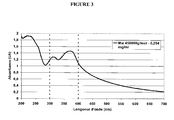
- the powder thus obtained is easily redispersed in the water and, as illustrated in FIG. figure 3 , presents the characteristic absorption spectrum of the starting HMPB2.
- Nanoparticles are prepared according to the procedure described in Example 1 but using as solution S1, a solution S1 'prepared from 6 ml of an aqueous solution of polyvinyl alcohol (Mw 9000-10000) (marketed by the Aldrich company under No. 360627).
- solution S1 a solution S1 'prepared from 6 ml of an aqueous solution of polyvinyl alcohol (Mw 9000-10000) (marketed by the Aldrich company under No. 360627).
- the powder obtained according to Example 1 is dispersed in water.
- the value of the solubility limit is estimated by successive approach by progressively adding the powder to the water.
- the solubility limit is evaluated for the nanoparticle powder obtained according to Example 1.
- nanoparticles according to the invention prepared from a hydrophilic polymer having a higher molecular weight, have an increased dispersibility in water.
Landscapes
- Chemical & Material Sciences (AREA)
- Engineering & Computer Science (AREA)
- Textile Engineering (AREA)
- Organic Chemistry (AREA)
- Physics & Mathematics (AREA)
- Dispersion Chemistry (AREA)
- Chemical Kinetics & Catalysis (AREA)
- General Physics & Mathematics (AREA)
- Optics & Photonics (AREA)
- Compositions Of Macromolecular Compounds (AREA)
- Cosmetics (AREA)
- Processes Of Treating Macromolecular Substances (AREA)
Description
- La présente invention vise à proposer des nanoparticules à fonction anti-UV, dispersables dans l'eau, dotées d'une stabilité prolongée dans le temps, et stables sous rayonnement UV.
- Les absorbeurs d'UV sont largement employés dans des applications diverses où il est souhaité mettre à profit leur propriété d'absorbance UV. Ils permettent de protéger les matériaux auxquels ils sont associés des rayonnements UV-visible.
- Ces absorbeurs d'UV peuvent être de nature inorganique à l'image des oxydes métalliques tels que TiO2, ZnO ou CeO2, ou organiques à l'image des benzophénones substituées telles les hydroxybenzophénones et des benzotriazoles substitués.
- Ces derniers absorbeurs d'UV organiques présentent de bonnes propriétés d'absorbance UV et de stabilité. Ils possèdent en outre l'avantage d'être régénérables, mettant en oeuvre des mécanismes de dissipation de l'énergie absorbée par changement conformationel réversible.
- Toutefois, la plupart de ce type de composés chimiques organiques possède un caractère fortement hydrophobe qui rend difficile, voire impossible leur mise en oeuvre dans des formulations aqueuses. Leur défaut de solubilité en milieu aqueux nécessite de les mettre en oeuvre soit en milieu solvant organique, soit sous une forme modifiée pour leur conférer la solubilité requise en milieu aqueux.
- Concernant la première alternative, il est aujourd'hui nécessaire, dans un souci de protection de l'environnement et de limitation des rejets gazeux ou liquides, de privilégier l'usage de l'eau à celui des solvants organiques.
- Concernant la seconde alternative qui vise à adapter l'affinité d'un composé chimique pour un solvant par greffage d'un groupement organique adapté tel que par exemple ammonium, carboxylate ou sulfonate, elle peut malheureusement porter, par ailleurs, préjudice aux propriétés d'absorbance UV du composé ainsi modifié.
- Ainsi, dans le cas des absorbeurs d'UV organiques régénérables ou non, qui présentent une forte aromaticité, le greffage de substituants peut entraîner des déplacements des spectres d'absorption vers le visible. Ceci pose problème dans les domaines applicatifs où le domaine du visible ne doit pas être affecté.
- En effet, l'usage de matériaux dotés, en outre, de forts coefficients d'absorption à des longueurs d'onde inférieures à 400 nm, a précisément pour avantage de les rendre totalement transparents dans le domaine du visible et donc de ne pas affecter parallèlement l'effet coloriel du matériau colorant susceptible de leur être associé.
- D'autre part, en raison du fort caractère hydrophobe de certains absorbeurs d'UV organiques, la présence d'un groupement fonctionnel hydrophile peut se révéler insuffisante pour assurer leur solubilité dans l'eau.
- Enfin, le greffage de substituants peut également présenter quelques contraintes liées à la mise en oeuvre des absorbeurs d'UV ainsi modifiés dans les formulations. Ainsi, le greffage d'un groupement carboxylique nécessite, par exemple, de disperser le composé correspondant en milieu basique.
-
US 6 368 577 B1 décrit une nanoparticule possédant un coeur formé d'un filtre organique d'UV, sous forme cristallisée, enrobé d'une couche externe formée d'alcool polyvinylique. -
WO 2008/061885 A2 décrit un procédé de préparation de microcapsules comprenant les étapes consistant à : 1) disposer d'une solution monomérique contenant une liquide hydrophobe et 2-hydroxybenzophenone à l'état de soluté; 2) disposer d'une phase aqueuse contenant un polymère hydrophile; 3) ajouter la solution monomérique à la phase aqueuse dans des conditions propices à la formation d'une émulsion en présence d'un tensioactif apte à stabiliser l'émulsion; 4) réaliser une polymérisation pour former des microcapsule. - En conséquence, il demeure un besoin d'une technologie permettant d'accroître la solubilité aqueuse d'absorbeurs d'UV organiques conventionnels sans par ailleurs affecter leurs propriétés absorbantes UV.
- Il demeure également un besoin en absorbeurs d'UV organiques qui présentent une affinité pour l'eau et qui soient en outre compatibles avec une formulation en un milieu aqueux à une concentration élevée. L'accessibilité à une concentration élevée est en effet recherchée au regard du fait que certains absorbeurs d'UV organiques doivent être utilisés en quantités assez importantes par unité de surface pour être efficaces.
- La présente invention vise précisément à répondre à ces besoins.
- Ainsi, selon un de ses aspects, la présente invention a pour objet des nanoparticules possédant un coeur formé en tout ou partie d'au moins un composé organique absorbeur d'UV, sous forme cristallisée, enrobé d'une couche externe formée d'au moins un polymère hydrophile, lesdits composé(s) organique(s) absorbeur(s) d'UV et polymère(s) hydrophile(s) étant associés dans un rapport pondéral composé(s) organique(s)/polymère(s) hydrophile(s) variant de 0,2 à 0,4.
- Avantageusement, les nanoparticules considérées selon l'invention sont hydrodispersibles.
- Les polymères hydrophiles considérés selon l'invention sont un alcool polyvinylique ou un acide polyacrylique et possèdent un poids moléculaire supérieur à 20 000 g/mole. Avantageusement, la couche externe des nanoparticules est non réticulée.
- D'une manière générale, les nanoparticules selon l'invention sont non poreuses.
- L'invention a également pour objet une composition contenant de telles nanoparticules.
- Elle vise également un procédé de préparation de ces nanoparticules comprenant au moins les étapes consistant à :
- disposer d'une phase organique contenant au moins un composé absorbeur d'UV à l'état de soluté,
- disposer d'une phase aqueuse contenant au moins ledit polymère hydrophile,
- ajouter la phase organique à la phase aqueuse dans des conditions propices à la formation d'une émulsion de type phase organique dans phase aqueuse et en présence d'au moins un tensioactif apte à stabiliser ladite émulsion,
- réaliser une trempe thermique de l'émulsion ainsi obtenue pour former lesdites nanoparticules, et
- isoler lesdites nanoparticules,
- Selon un mode de réalisation préféré, les nanoparticules sont isolées du milieu les contenant par lyophilisation de celui-ci.
- Comme démontré par les exemples figurant ci-après, les inventeurs ont ainsi constaté que des composés organiques absorbeurs d'UV peuvent être formulés à l'état de nanoparticules dispersables en milieu aqueux en recouvrant au moins en partie leur surface externe d'un film de polymère(s) présentant une grande affinité pour l'eau.
- Contre toute attente, leurs performances en termes d'absorption UV et de stabilité ne sont pas affectées.
- Le composé organique absorbeur d'UV, formant en partie ou totalement le coeur des nanoparticules, utilisable selon la présente invention peut être choisi parmi :
- les benzotriazoles substitués,
- les benzophénones substituées telles les hydroxybenzophénones,
- le pyrène et ses dérivés,
- autres antioxydants et
- pièges à radicaux, tel le Bis(2,2,6,6-tetramethyl-4-piperidy) sebacate
- l'hexylester de l'acide 2-(4-Diethylamino-2-hydroxybenzoyl) benzoique et leurs mélanges.
- Pour sa part, le polymère hydrophile peut être choisi parmi les polymères à fort caractère hydrophile ayant une longueur de chaîne moléculaire suffisamment longue pour présenter une affinité avec le coeur organique.
- Comme précisé ci-dessus, il permet de s'affranchir du caractère hydrophobe du coeur organique et d'assurer la cohésion du coeur des nanoparticules.
- Un polymère hydrophile convenant à l'invention possèdent un poids moléculaire supérieur à 20 000 g/mole, et plus particulièrement variant de 25 000 à 600 000 g/mole.
- Le polymère hydrophile est un alcool polyvinylique ou un acide polyacrylique.
- Les acides polyacryliques possèdent avantageusement un poids moléculaire compris entre 100 000 et 600 000 et notamment de l'ordre de 450 000 g/mole.
- D'autres polymères hydrosolubles, des copolymères, ou les dérivés de tels matériels seront apparents à l'homme de l'art.
- Plus particulièrement, il s'agit d'un alcool polyvinylique.
- Comme précisé ci-dessus, le polymère considéré selon l'invention est dédié à assurer la dispersion du composé absorbeur d'UV qui lui est associé en milieu aqueux. Pour des raisons évidentes, sa nature chimique, de même que la longueur de sa chaîne polymérique et donc son poids moléculaire sont des paramètres permettant d'ajuster cette solubilité en milieu aqueux.
- Les inventeurs ont notamment constaté que des polymères à l'image des alcools polyvinyliques s'avèrent particulièrement efficaces lorsqu'ils possèdent un poids moléculaire supérieur à 20 000 g/mole, et plus particulièrement variant de 25 000 à 500 000 g/mole.
- Selon une variante de réalisation avantageuse, les nanoparticules possèdent une couche externe formée en tout ou partie d'au moins un alcool polyvinylique de poids moléculaire variant de 25 000 à 100 000 g/mole, et plus particulièrement de 25 000 à 50 000 g/mole.
- Lesdits composé(s) organique(s) absorbeur(s) d'UV et polymère(s) hydrophile(s) sont associés dans un rapport pondéral composé(s) organique(s)/polymère(s) hydrophile(s) variant de 0,2 à 0,4, en particulier de l'ordre de 0,3.
- Ce rapport peut encore être apprécié comme figurant le taux de charge correspondant au poids de la matière formant le coeur d'une nanoparticule rapporté au poids total de ladite nanoparticule.
- Les nanoparticules selon l'invention peuvent avantageusement posséder une taille moyenne inférieure à 500 nm, de préférence inférieure à 300 nm, de préférence encore inférieure à 200 nm.
- Cette taille peut être déterminée par spectroscopie à corrélation de photons.
- Selon un mode de réalisation particulier de l'invention, les nanoparticules peuvent posséder une taille très réduite, notamment variant de 20 à 100 nm, notamment de 25 à 60 nm. Cette taille plus réduite peut être ajustée par mise en contact des nanoparticules obtenues selon le procédé décrit ci-après, avec un mauvais solvant du polymère formant la couche externe de ces nanoparticules.
- Selon une autre variante de réalisation, les nanoparticules peuvent contenir, en leur coeur, outre au moins un composé organique absorbeur d'UV, un matériau annexe.
- Ce matériau annexe peut être tout composé, vis-à-vis duquel il est recherché ou non à pallier un défaut de solubilité aqueuse. Ce composé est par ailleurs choisi au regard de sa non réactivité à l'égard de l'absorbeur d'UV considéré parallèlement.
- A titre de matériau annexe, il peut notamment être cité :
- a) les filtres UV inorganiques tels que TiO2, ZnO, ou encore CeO2,
- b) les additifs tels que les antioxydants ou les désactiveurs de radicaux libres,
- c) les stabilisants,
- d) les agents de colorations organiques ou inorganiques, et
- e) les agents azurants.
- La présente invention vise en outre un procédé utile pour la préparation de nanoparticules telles que décrites précédemment.
- Le procédé selon l'invention implique, d'une part, de disposer d'une phase organique dans laquelle l'absorbeur anti-UV est, pour l'essentiel, c'est-à-dire à raison d'au moins 90 % en poids, à l'état de soluté.
- Le choix du solvant organique ou mélange de solvants organiques est donc avantageusement choisi au regard de la nature du composé absorbeur d'UV à traiter selon l'invention. Par ailleurs, il est également choisi au regard de son défaut de solubilité en milieu aqueux pour précisément obtenir une émulsion correspondante lors de sa mise en contact avec la phase aqueuse.
- Ce choix relève clairement des compétences de l'homme de l'art.
- Le solvant peut être volatil ou non et de préférence est choisi parmi les 2-hexanone, 3-hexanone, 4-methyl-2-pentanone, 3-Methyl-2-butanone, cyclohexanone, cyclohexane, isobutyraldéhyde, butyraldehyde, isovaleraldehyde, 2-methylbutyraldehyde, trimethylacetaldehyde, 2-Ethylbutyraldehyde, benzène, les xylènes et mesitylene, et méthyle éthyl cétone.
- Conviennent tout particulièrement selon l'invention, les solvants caractérisés par un point de fusion élevé et parmi eux les aldéhydes.
- Selon une variante préférée, le solvant organique est choisi parmi la méthyle éthyl cétone, le cyclohexane et l'isobutyraldéhyde.
- La phase organique peut comprendre de 5 % à 20 % en poids par rapport à son poids total d'absorbeur(s) anti-UV.
- Le procédé selon l'invention implique également de disposer, d'autre part, d'une phase aqueuse.
- Cette phase aqueuse contient au moins un polymère hydrophile, notamment tel que défini ci-dessus.
- La phase aqueuse peut comprendre de l'eau et/ou au moins un solvant hydrosoluble.
- Par « solvant hydrosoluble », on désigne dans la présente invention un composé liquide à température ambiante et miscible à l'eau (miscibilité dans l'eau supérieure à 50 % en poids à 25 °C et pression atmosphérique).
- Les solvants hydrosolubles utilisables dans les compositions selon l'invention peuvent ou non être volatils.
- Parmi les solvants hydrosolubles pouvant être utilisés dans les compositions conformes à l'invention, on peut citer notamment les monoalcools inférieurs ayant de 1 à 5 atomes de carbone tels que l'éthanol et l'isopropanol, les glycols ayant de 2 à 8 atomes de carbone tels que l'éthylène glycol, le propylène glycol, le 1,3-butylène glycol et le dipropylène glycol, les cétones en C3-C4 et les aldéhydes en C2-C4.
- Le polymère hydrophile peut être formulé à une concentration variant de 2 à 10 % en poids voire de 3 à 8 % en poids par rapport au poids de la phase organique considérée.
- Comme il ressort de ce qui précède, le polymère ou mélange de polymères et le ou les agent(s) absorbeur(s) d'UV sont mis en présence dans des quantités en polymère(s) et composé(s) organique(s) ajustées pour que les nanoparticules possèdent un rapport pondéral composé(s) organique(s)/polymère(s) hydrophile(s) variant de 0,2 à 0,4.
- Bien entendu, l'homme du métier est à même d'opérer les ajustements nécessaires des concentrations en polymères hydrophiles et en composés organiques pour obtenir des nanoparticules possédant un rapport pondéral composé(s) organique(s)/polymère(s) hydrophile(s) variant de 0,2 à 0,4.
- Le mélange des deux phases est réalisé en présence d'un tensioactif.
- Selon une variante préférée de l'invention, ce tensioactif figure initialement dans la phase aqueuse.
- Les tensioactifs convenant à l'invention peuvent être choisis parmi toutes les catégories de tensioactifs (anioniques, cationiques, non ioniques ou amphotères). Plus précisément, ils peuvent être choisis parmi les tensioactifs conventionnellement mis en oeuvre dans les procédés d'émulsification de la phase organique considérée. C'est ainsi que pour obtenir des émulsions de type phase organique dans eau, on choisit des agents tensioactifs possédant une balance hydrophile/lipophile (HLB) supérieure à 14. Le terme « HLB » (Hydrophilic Lipophilic Balance) désigne le rapport de l'hydrophilie des groupements polaires des molécules de tensioactifs à l'hydrophobie de la partie lipophile de ces mêmes molécules ; il s'agit d'un terme couramment utilisé dans le domaine des agents de surface (voir le Traité « Techniques de l'Ingénieur », chapitre A7610 : « Les agents de surface »).
- Les agents tensio-actifs utilisables selon l'invention sont avantageusement non amphotères et peuvent être plus particulièrement choisis parmi les agents tensioactifs anioniques dont la partie hydrophile est négativement chargée à l'image des sels d'acide gras, les agents tensio-actifs non ioniques dont la partie hydrophile n'est pas chargée à l'image des alcools et les agents tensio-actifs cationiques dont la partie hydrophile est positivement chargée à l'image d'un sel d'ammonium à longue chaîne.
- Avantageusement, on prendra soin de solubiliser préalablement le ou les agents tensioactifs dans la phase aqueuse afin d'éviter d'éventuels problèmes de cinétique de solubilisation. Les agents tensioactifs sont mis en oeuvre dans le procédé selon l'invention à une quantité réduite et de préférence variant entre 0,1 % et 10 % en poids exprimé par rapport au poids de la phase aqueuse.
- Le tensioactif est par exemple choisi parmi le bromure de cétyltriméthylammonium, le dodécyle sulfate de sodium et les surfactants Pluronic®.
- Selon un mode préféré de l'invention le tensioactif utilisé est le dodécyle sulfate de sodium (SDS).
- L'émulsion est formée en ajoutant lentement, généralement au goutte à goutte, et sous agitation vigoureuse la phase organique à la phase aqueuse.
- Cette agitation, généralement mécanique, est prolongée d'un délai suffisant pour obtenir l'émulsion attendue.
- Cette émulsion peut être également obtenue en mélangeant les composantes dans un réacteur continu single-jet, la vitesse de la pompe gaveuse imposant un régime turbulent qui assure ainsi la qualité du mélange. L'avantage de cette approche réside dans le fait que l'émulsion ainsi formée peut être consécutivement « trempée » dans de l'azote liquide en continue pour former les nanoparticules attendues. A l'issue de cette étape, une émulsion, formée de gouttelettes de phase organique dispersées dans une phase aqueuse, est obtenue.
- Il est à la portée de l'homme de l'art de l'ajuster en jouant sur la nature du solvant organique et du ou des tensioactif(s) retenu(s) mais également sur la vitesse d'agitation utilisée.
- Le procédé selon l'invention comprend ensuite une étape de trempe thermique de l'émulsion.
- Cette étape consiste à exposer l'émulsion à une température très basse pour figer les gouttelettes de l'émulsion à l'état de nanoparticules. Cette température peut varier de 5 °C à -250 °C, voire de -15 °C à -200 °C.
- La trempe thermique est de préférence réalisée en introduisant l'émulsion au goutte à goutte dans de l'azote liquide.
- Elle peut toutefois être également réalisée par pulvérisation de l'émulsion sur un gaz noble liquéfié tel que l'argon, du fréon, voire un mélange de solvant (alcool, cétone) /azote liquide.
- Le procédé selon l'invention comprend en outre une étape consistant à isoler les nanoparticules obtenues à l'étape précédente. Elles peuvent notamment être isolées par filtration du milieu liquide le contenant.
- Ces nanoparticules subissent avantageusement une lyophilisation. Cette lyophilisation peut être réalisée à bref délai de l'étape précédente. Elle vise à éliminer l'eau et les solvants organiques résiduels demeurant au niveau des nanoparticules.
- Les nanoparticules considérées selon l'invention peuvent être mises en oeuvre dans une grande diversité de matériaux devant être protégés des irradiations UV.
- Ainsi, dans le domaine des matériaux polymères, il peut notamment s'agir d'élastomères, d'adhésifs, de peintures ou autres types de revêtements.
- Plus précisément, les polymères ou autres substrats dans lesquels les nanoparticules considérées selon l'invention peuvent être incorporées sont par exemple :
- les polymères de monooléfines et dioléfines, par exemple le polypropylène et le polyisobutylène, ainsi que les polymères de cyclooléfines, par exemple le cyclopentène et le norborène,
- les copolymères de monooléfines et de dioléfines, par exemple le copolymère d'éthylène et de propylène, les copolymères d'alkyl méthacrylate et d'éthylène, les copolymères de vinylacétate et d'éthylène, les copolymères d'acide acrylique et d'éthylène, leurs mélanges ainsi que leurs mélanges avec d'autres polymères tels que les polyamides,
- les résines hydrocarbonées,
- les polystyrènes,
- les copolymères de styrène,
- les polymères contenant des halogènes,
- les polymères dérivés d'acides α,β-insaturés, et leurs dérivés tels que les polyacrylates et les polyméthacrylates, les polyacrylamides et les polyacrylonitriles,
- les copolymères de monomères mentionnés ci-dessus,
- les polymères dérivés d'alcools insaturés et d'amides de dérivés acyl ou acétal, tel que par exemple l'alcool polyvinylique,
- les homopolymères et copolymères d'éthers cycliques tels que le polyalkylene glycol,
- les polyacétals tels que le polyoxyméthylène,
- les polyamides et copolyamides dérivés de diamines et d'acides dicarboxyliques, et/ou d'acides aminocarboxyliques ou des lactames correspondants,
- les polyaramides,
- les polyurées, les polyimides, les polyamides-imides, les polyéthers imides, les polyesters imides, les polyhydantoïnes, et les polybenzimidazoles,
- les polyuréthanes,
- les polyesters dérivés d'acides dicarboxyliques et de diols et/ou dérivés d'acides hydroxycarboxyliques ou des lactones correspondantes,
- les polycarbonates et les carbonates de polyesters, et
- les polymères naturels tels que la cellulose, le caoutchouc, la gélatine, la soie, le cuir et leurs dérivés homologues chimiquement modifiés, tels que les acétates de cellulose.
- La quantité de nanoparticules conformes à l'invention à utiliser dépend du matériau à protéger et de son utilisation.
- Avantageusement, les nanoparticules considérées selon l'invention peuvent être présentes dans ces matériaux en une quantité pouvant aller jusqu'à 30 % en poids par rapport au poids total du matériau.
- D'une manière générale, les nanoparticules considérées selon l'invention peuvent être mises en oeuvre à raison de 0,01 à 25% en poids par rapport au poids total du matériau l'incorporant.
- L'invention concerne ainsi une composition, et plus particulièrement un matériau comprenant des nanoparticules conformes à l'invention.
- L'invention concerne également un procédé de stabilisation d'un matériau pouvant être organique ou inorganique à l'égard d'une dégradation UV, comprenant l'addition à ce matériau ou à un précurseur de ce matériau d'au moins une nanoparticule conforme à l'invention, à titre d'agent absorbeur d'ultraviolets.
- Comme il ressort de ce qui suit, les nanoparticules considérées selon l'invention peuvent être mises en oeuvre directement au niveau du matériau à traiter mais également au niveau d'un précurseur de ce matériau c'est-à-dire un des produits de départ nécessaire à la préparation du matériau final, par exemple un monomère pour la préparation de matériau polymérique.
- L'incorporation dans les polymères organiques, par exemple les polymères organiques synthétiques, et en particulier les polymères thermoplastiques, peut être effectuée par addition des nanoparticules considérées selon l'invention et de tout autre additif par les méthodes conventionnelles dans ce domaine.
- Ainsi, lors d'une incorporation au sein d'un matériau polymérique, les nanoparticules considérées selon l'invention peuvent être incorporées soit directement au polymère, soit avant ou pendant la polymérisation du monomère correspondant ou encore avant la formation d'un réseau. Les polymères traités selon cette méthode peuvent ensuite être transformés en articles tels que des fibres, des films, des feuilles, des emballages, des tubes et autres profilés, par des méthodes conventionnelles telles que le thermomoulage, l'extrusion ou encore l'injection.
- De même, l'utilisation des nanoparticules considérées selon l'invention, pour les revêtements, par exemple pour les peintures, est particulièrement intéressante. Les revêtements selon l'invention peuvent être appliqués à n'importe quel substrat, par exemple en métal, en bois, en plastique ou en céramique.
- Les nanoparticules considérées selon l'invention conviennent également pour l'utilisation dans un procédé de stabilisation photochimique de matériaux fibreux non colorés, colorés ou imprimés, comprenant par exemple la soie, le cuir, la laine, les polyamides, les polyesters, ou les polyuréthanes, et plus particulièrement les matériaux fibreux contenant de la cellulose tels que le coton, le lin, la jute, ainsi que les fibres viscoses et la cellulose régénérée.
- L'invention concerne également un procédé pour accroître le facteur de protection solaire de fibres textiles comprenant l'immobilisation sur lesdites fibres d'au moins une nanoparticule conforme à l'invention.
- Cette immobilisation ou encore fixation peut par exemple être réalisée selon la technique dite du foulardage. Cette technique consiste à réaliser une solution aqueuse contenant les nanoparticules, éventuellement des dispersants, un pH ajusté et des liants. Le textile à traiter y est trempé pour imprégnation, puis essoré.
- Une autre technique convenant à la fixation est celle de l'enduction qui consiste à enduire le textile à traiter d'une solution visqueuse aqueuse contenant les nanoparticules, un liant, éventuellement des dispersants, un pH ajusté et des épaississants.
- La mise en oeuvre de ces deux techniques relève également des compétences de l'homme de l'art.
- Le matériau textile à protéger est de préférence un matériau textile teint, en particulier un matériau textile teint avec des colorants dispersés dans une solution aqueuse. Ces colorants peuvent être présents dans la solution colorante sous la forme d'une suspension. Ils peuvent appartenir à différentes classes de colorants tels que les coumarines ou les colorants nitrés. Des mélanges de colorants peuvent également être utilisés selon la présente invention. Si les nanoparticules considérées selon l'invention sont ajoutées pendant l'étape de coloration, elles peuvent l'être de manière à ce que le matériau textile soit d'abord traité avec lesdites nanoparticules puis, ensuite, avec le colorant ou, de préférence, de manière à ce que le matériau soit traité simultanément avec lesdites nanoparticules et le colorant.
- Pour la production d'encres, les nanoparticules considérées selon l'invention peuvent être mélangées aux pâtes d'encres.
- Les nanoparticules considérées selon l'invention conviennent également en tant qu'agents photoprotecteurs dans les préparations cosmétiques.
- Les exemples et figures qui suivent sont présentés à titre illustratif et non limitatif du domaine de l'invention.
-
Figure 1 : Représentation du spectre d'absorption de nanoparticules de HMPB2 conformes à l'invention, possédant une couche externe formée par un alcool polyvinylique. -
Figure 2 : Représentation du spectre d'absorption de nanoparticules d'acide pyrène carboxylique-1 conformes à l'invention, possédant une couche externe formée par un alcool polyvinylique. -
Figure 3 : Représentation du spectre d'absorption de nanoparticules de HMPB2 conformes à l'invention, possédant une couche externe formée par un acide polyacrylique. - Une solution S1 est préparée à partir de 6 ml d'une solution aqueuse d'alcool polyvinylique (Mw 31000-50000) (MOWIOL®) à 5 % massique et 0,3 g de dodécyl sulfate de sodium.
- Une solution S2 de 2-(2H-benzotriazol-2-yl)-4,6-bis(1-méthyl-1-phényléthyl) Phénol (HMPB2) est préparée par dissolution de 0,26 g de HMPB2 dans 22 ml de cyclohexane sous agitation.
- On ajoute au goutte à goutte et à température ambiante la solution S2 à la solution S1 sous forte agitation au sein d'un bécher ou d'une ampoule à décanter. L'agitation est maintenue pendant 2 heures pour que l'émulsion s'homogénéise.
- L'émulsion S3 est ensuite introduite au goutte à goutte dans de l'azote liquide pour figer les gouttelettes à l'état de nanoparticules. L'ensemble est ensuite filtré et lyophilisé à l'aide d'un lyophilisateur, ou d'un schlenck maintenu sous vide dynamique par une pompe à palette et muni d'un piège froid pendant 24 heures.
- La poudre ainsi obtenue se redisperse aisément dans l'eau et comme illustré en
figure 1 présente le spectre d'absorption caractéristique de la HMPB2 de départ. - Des nanoparticules sont préparées selon le mode opératoire décrit en exemple 1 mais en utilisant à titre de solution S2, une solution S2', préparée par dissolution de 0,46 g d'acide pyrène carboxylique-1 dans 70 ml de Methyl Ethyl cétone sous agitation et chauffage modéré, c'est-à-dire à une température inférieure à 30 °C, voire à température ambiante.
- La poudre ainsi obtenue se redisperse aisément dans l'eau et, comme illustré en
figure 2 , présente un spectre d'absorption caractéristique de la molécule de départ. - Un échantillon de tissu (ECH1) est imprégné selon la technique de foulardage par une solution aqueuse d'acide pyrène carboxylique-1 concentrée à 6,82 mg/ml en molécule active obtenu selon le procédé décrit ci-dessus.
- L'échantillon (ECH1) obtenu est blanc (couleur du tissu) et est soumis à un test de vieillissement dans une enceinte SUNTEST de la société ATLAS. Les conditions de vieillissement sont les suivantes: irradiance à 620W/m2, lampe à arc xénon équipée d'un filtre dit « verre à vitre » coupant les UV en dessous de 310 nm, durée d'exposition 24h.
- A l'issu de ce test de vieillissement, ECH1 a très légèrement jauni, montrant la capacité des nanoparticules selon l'invention à protéger le tissu exposé.
- Le traitement de la présente invention permet manifestement d'améliorer la tenue à la lumière de molécules sensibles.
- Des nanoparticules sont préparées selon le mode opératoire décrit dans l'exemple 1 mais en utilisant à titre de solution S2, une solution S2", préparée par dissolution de 0,4515g de HMPB2 dans 18 ml d'isobutyraldéhyde sous agitation et chauffage modéré, c'est-à-dire à une température inférieure à 30 °C, voire à une température ambiante.
- La poudre ainsi obtenue se redisperse aisément dans l'eau et présente un spectre d'absorption caractéristique de la HMPB2 de départ.
- Une solution S1 est préparée à partir de 6 ml d'une solution aqueuse d'acide polyacrylique de poids moléculaire Mw=450000 g/mol (commercialisé par la société Aldrich sous le N°181285) à 5 % massique et 0,3 g de dodécyl sulfate de sodium.
- Une solution S2 de 2-(2H-benzotriazol-2-yl)-4,6-bis(1-méthyl-1-phényléthyl)phénol (HMPB2) est préparée par dissolution de 0,26 g de HMPB2 dans 22 ml de cyclohexane sous agitation.
- On ajoute au goutte à goutte et à température ambiante la solution S2 à la solution S1 sous forte agitation au sein d'un bécher ou d'une ampoule à décanter. L'agitation est maintenue pendant 2 heures pour que l'émulsion s'homogénéise.
- L'émulsion S3 est ensuite introduite au goutte à goutte dans de l'azote liquide pour figer les gouttelettes à l'état de nanoparticules. L'ensemble est ensuite filtré et lyophilisé à l'aide d'un lyophilisateur, ou d'un schlenck maintenu sous vide dynamique par une pompe à palette et muni d'un piège froid pendant 24 heures.
- La poudre ainsi obtenue se redisperse aisément dans l'eau et, comme illustré en
figure 3 , présente le spectre d'absorption caractéristique de la HMPB2 de départ. - Des nanoparticules sont préparées selon le mode opératoire décrit en exemple 1 mais en utilisant à titre de solution S1, une solution S1' préparée à partir de 6 ml d'une solution aqueuse d'alcool polyvinylique (Mw 9000-10000) (commercialisé par la société Aldrich sous le N°360627).
- La poudre obtenue selon l'exemple 1 est dispersée dans l'eau.
- La valeur de la limite de solubilité est estimée par approche successive en ajoutant progressivement la poudre dans l'eau.
- L'agitation est stoppée lorsqu'il reste des insolubles visibles à l'oeil nu.
- Selon le même protocole, la limite de solubilité est évaluée pour la poudre de nanoparticules obtenues selon l'exemple 1.
- Les résultats sont présentés dans le tableau 1 suivant.
TABLEAU 1 Poids moléculaire de l'alcool polyvinylique (g/mol) Limite de solubilité (mg/ml) 31000-50000 10,1 9000-10000 0,45 - Ces résultats montrent que des nanoparticules conformes à l'invention préparées à partir d'un polymère hydrophile présentant un poids moléculaire plus élevé, présentent une dispersibilité dans l'eau accrue.
Claims (16)
- Nanoparticule possédant un coeur formé en tout ou partie d'au moins un composé organique absorbeur d'UV, sous forme cristallisée, enrobé d'une couche externe formée d'au moins un polymère hydrophile, le ou lesdits composé(s) organique(s) absorbeur(s) d'UV et le ou lesdits polymère(s) hydrophile(s) étant associés dans un rapport pondéral composé(s) organique(s)/polymère(s) hydrophile(s) variant de 0,2 à 0,4,
dans laquelle ledit polymère hydrophile est un alcool polyvinylique ou un acide polyacrylique de poids moléculaire supérieur à 20 000 g/mole. - Nanoparticule selon la revendication précédente caractérisée en ce qu'elle est hydrodispersible.
- Nanoparticule selon l'une quelconque des revendications précédentes dans laquelle le polymère hydrophile possède un poids moléculaire variant de 25 000 à 600 000 g/mole.
- Nanoparticule selon l'une quelconque des revendications précédentes, dans laquelle ledit acide polyacrylique possède un poids moléculaire compris entre 100 000 et 600 000 et notamment de l'ordre de 450 000 g/mole.
- Nanoparticule selon l'une quelconque des revendications précédentes, possédant une couche externe formée en tout ou partie d'au moins un alcool polyvinylique de poids moléculaire variant de 25 000 à 50 000 g/mole.
- Nanoparticule selon l'une quelconque des revendications précédentes, possédant une taille moyenne inférieure à 500 nm, de préférence inférieure à 300 nm, de préférence encore inférieure à 200 nm.
- Nanoparticule selon l'une quelconque des revendications précédentes, dans laquelle ledit composé absorbeur d'UV est choisi parmi les benzotriazoles substitués, les hydroxybenzophénones, le pyrène et ses dérivés.
- Procédé de préparation de nanoparticules selon l'une quelconque des revendications 1 à 7 comprenant au moins les étapes consistant à :- disposer d'une phase organique contenant au moins un composé absorbeur d'UV à l'état de soluté,- disposer d'une phase aqueuse contenant au moins un polymère hydrophile, ledit polymère hydrophile étant un alcool polyvinylique ou un acide polyacrylique de poids moléculaire supérieur à 20 000 g/mole,- ajouter la phase organique à la phase aqueuse dans des conditions propices à la formation d'une émulsion de type phase organique dans phase aqueuse et en présence d'au moins un tensioactif apte à stabiliser ladite émulsion,- réaliser une trempe thermique de l'émulsion ainsi obtenue pour former lesdites nanoparticules, et- isoler lesdites nanoparticules,les quantités en polymère(s) et composé(s) organique(s) étant ajustées pour que les nanoparticules possèdent un rapport pondéral composé(s) organique(s)/polymère(s) hydrophile(s) variant de 0,2 à 0,4.
- Procédé selon la revendication précédente dans lequel les nanoparticules isolées sont lyophilisées.
- Procédé selon la revendication 8 ou 9, caractérisé en ce que ledit polymère hydrophile est tel que défini selon l'une quelconque des revendications 3 à 5.
- Procédé selon l'une quelconque des revendications 8 à 10, caractérisé en ce que la phase organique comprend à titre de solvant le cyclohexane, la méthyle éthyle cétone ou l'isobutyraldéhyde.
- Procédé selon l'une quelconque des revendications 8 à 11, dans lequel la trempe thermique est effectuée par mise en contact de l'émulsion avec de l'azote liquide.
- Composition contenant au moins une nanoparticule selon l'une quelconque des revendications 1 à 7.
- Composition selon la revendication précédente, caractérisée en ce qu'il s'agit d'un matériau polymérique et notamment d'un textile.
- Procédé de stabilisation d'un matériau à l'égard d'une dégradation UV, comprenant l'addition à ce matériau ou à un précurseur de ce matériau d'au moins une nanoparticule selon l'une quelconque des revendications 1 à 7, à titre d'agent absorbeur d'ultraviolets.
- Procédé pour accroître le facteur de protection solaire de fibres textiles comprenant l'immobilisation sur lesdites fibres d'au moins une nanoparticule selon l'une quelconque des revendications 1 à 7.
Applications Claiming Priority (2)
| Application Number | Priority Date | Filing Date | Title |
|---|---|---|---|
| FR1050133A FR2955038B1 (fr) | 2010-01-11 | 2010-01-11 | Nanoparticules anti-uv |
| PCT/IB2011/050114 WO2011083447A1 (fr) | 2010-01-11 | 2011-01-11 | Nanoparticules anti-uv |
Publications (2)
| Publication Number | Publication Date |
|---|---|
| EP2523751A1 EP2523751A1 (fr) | 2012-11-21 |
| EP2523751B1 true EP2523751B1 (fr) | 2014-10-22 |
Family
ID=42813507
Family Applications (1)
| Application Number | Title | Priority Date | Filing Date |
|---|---|---|---|
| EP11702514.8A Not-in-force EP2523751B1 (fr) | 2010-01-11 | 2011-01-11 | Nanoparticules anti-uv |
Country Status (5)
| Country | Link |
|---|---|
| US (1) | US9696460B2 (fr) |
| EP (1) | EP2523751B1 (fr) |
| ES (1) | ES2527506T3 (fr) |
| FR (1) | FR2955038B1 (fr) |
| WO (1) | WO2011083447A1 (fr) |
Families Citing this family (7)
| Publication number | Priority date | Publication date | Assignee | Title |
|---|---|---|---|---|
| JP6037607B2 (ja) * | 2011-11-10 | 2016-12-07 | 株式会社日本触媒 | 有機結晶 |
| RU2683837C2 (ru) | 2013-10-14 | 2019-04-02 | Сертайнтиид Джипсум, Инк. | Композиция на основе струвита-к и сингенита для применения в строительных материалах |
| FR3027532A1 (fr) * | 2015-04-10 | 2016-04-29 | Commissariat Energie Atomique | Procede d’elaboration de nanoparticules d’oxyde fonctionnalisees. |
| CN105155256A (zh) * | 2015-09-08 | 2015-12-16 | 湖州新创丝织品有限公司 | 一种天然抗紫外线棉麻织物整理剂 |
| CN107338645A (zh) * | 2017-07-21 | 2017-11-10 | 安徽华锦柏亚纤纺科技有限公司 | 一种抗紫外线辐射的纯棉织物整理剂 |
| FR3105243B1 (fr) * | 2019-12-23 | 2022-04-22 | Oreal | Nanoparticules absorbant les UV et leur procédé de préparation. |
| FR3104951B1 (fr) * | 2019-12-23 | 2023-06-30 | Oreal | Compositions photoprotectrices des matières kératiniques |
Family Cites Families (10)
| Publication number | Priority date | Publication date | Assignee | Title |
|---|---|---|---|---|
| US4369213A (en) * | 1980-12-29 | 1983-01-18 | E. I. Du Pont De Nemours And Company | Process for preparing indigo-dyeable polyester fibers |
| DE3322994A1 (de) * | 1983-06-25 | 1985-01-10 | Basf Ag, 6700 Ludwigshafen | Lichtempfindliches, wasserentwickelbares aufzeichnungsmaterial fuer die herstellung von druck-, reliefformen oder resistmustern |
| EP0545442B1 (fr) * | 1991-12-06 | 1995-04-05 | New Oji Paper Co., Ltd. | Microcapsules contenant un absorbeur d'ultraviolet et matériau d'enregistrement thermosensible l'utilisant |
| US5574166A (en) * | 1995-04-19 | 1996-11-12 | Ciba-Geigy Corporation | Crystalline form of 2-(2-hydroxy-3-α-cumyl-5-tert-octylphenyl)-2H-benzotriazole |
| WO2000035415A1 (fr) * | 1998-12-11 | 2000-06-22 | Cognis Deutschland Gmbh | Utilisation de filtres organiques a nanoparticules, pour la protection contre les uv |
| EP1127567B1 (fr) * | 2000-02-17 | 2010-09-01 | Basf Se | Dispersions aqueuses de filtres solaires organiques et insolubles dans l'eau |
| EP1247568A1 (fr) * | 2001-04-03 | 2002-10-09 | Primacare S.L., c/o Cognis Iberica S.L. | Microcapsules (XIII) |
| US7053034B2 (en) * | 2002-04-10 | 2006-05-30 | Salvona, Llc | Targeted controlled delivery compositions activated by changes in pH or salt concentration |
| GB0623110D0 (en) * | 2006-11-21 | 2006-12-27 | Ciba Sc Holding Ag | Microcapules, their use and processes for their manufacture |
| US20090155371A1 (en) * | 2007-12-17 | 2009-06-18 | Sojka Milan F | Compositions Comprising Solid Particles Entrapped In Collapsed Polymeric Microspheres, And Methods Of Making The Same |
-
2010
- 2010-01-11 FR FR1050133A patent/FR2955038B1/fr not_active Expired - Fee Related
-
2011
- 2011-01-11 ES ES11702514.8T patent/ES2527506T3/es active Active
- 2011-01-11 EP EP11702514.8A patent/EP2523751B1/fr not_active Not-in-force
- 2011-01-11 WO PCT/IB2011/050114 patent/WO2011083447A1/fr not_active Ceased
- 2011-01-11 US US13/521,642 patent/US9696460B2/en not_active Expired - Fee Related
Also Published As
| Publication number | Publication date |
|---|---|
| ES2527506T3 (es) | 2015-01-26 |
| FR2955038A1 (fr) | 2011-07-15 |
| WO2011083447A1 (fr) | 2011-07-14 |
| US20130115838A1 (en) | 2013-05-09 |
| US9696460B2 (en) | 2017-07-04 |
| EP2523751A1 (fr) | 2012-11-21 |
| FR2955038B1 (fr) | 2012-05-11 |
Similar Documents
| Publication | Publication Date | Title |
|---|---|---|
| WO2011083447A1 (fr) | Nanoparticules anti-uv | |
| EP2524011B1 (fr) | Procede de revetement avec des dispersions d'actifs enrobes dans une couche polymere | |
| EP3969166A1 (fr) | Procede de preparation de microcapsules biodegradables et microcapsules ainsi obtenues | |
| FR2955115A1 (fr) | Nouveaux absorbeurs uv organiques | |
| EP4010110B1 (fr) | Procédé de fabrication de microcapsules renfermant un actif lipophile, microcapsules préparées par ce procédé et leur utilisation | |
| FR3116211A1 (fr) | Procede de preparation de microcapsules biodegradables et utilisation des microcapsules ainsi obtenues | |
| EP3092069A1 (fr) | Procédé de fabrication de microcapsules à double paroi, microcapsules préparées par ce procédé et leur utilisation | |
| EP1472408A1 (fr) | Utilisation d' une emulsion inverse a base de silicone reticulable pour la realisation de revetements "imper-respirants" | |
| EP2260085A1 (fr) | Nanocristaux fluorescents enrobes d'une coquille inorganique | |
| FR3082522A1 (fr) | Composition tensioactive a base de sel d'amide de glycine betaine, son procede de preparation et ses utilisations | |
| WO2015000796A1 (fr) | Formulations d'encres a base de nanoparticules | |
| EP2164941A1 (fr) | Procede pour formuler des principes actifs odorants afin de les proteger et d'augmenter leur remanence | |
| FR3072300A1 (fr) | Procede de preparation de capsules sensibles au ph ou au rayonnement uv et capsules obtenues | |
| EP2582622B1 (fr) | Utilisation de nanoparticules pour le stockage "sec" longue duree de radicaux peroxydes | |
| Su et al. | Triazine-based microcapsules with synergistic ultraviolet absorptions | |
| EP3377691B1 (fr) | Article comprenant une couche textile plastifiée et métallisée, en particulier destine a la protection solaire, et procédé de greffage d'une couche métallique pour l'obtention dudit article | |
| FR3027532A1 (fr) | Procede d’elaboration de nanoparticules d’oxyde fonctionnalisees. | |
| FR3105243A1 (fr) | Nanoparticules absorbant les UV et leur procédé de préparation. | |
| WO2015140749A1 (fr) | Particules de melamine-uree-formaldehyde (muf) contenant un marqueur optique a effet chromatique modulable | |
| EP3172375B1 (fr) | Support fibreux comportant des particules contenant un agent actif partiellement soluble dans l'eau, particules et méthodes de fabrication des particules | |
| CA2609765C (fr) | Dispersion de polymere dans un milieu organique reactif, procede de preparation et utilisations | |
| CA3045215C (fr) | Procede de preparation de microcapsules de taille controlee comprenant une etape de photopolymerisation | |
| FR3073850B1 (fr) | Dispersion aqueuse de polymere thermoplastique, applications pour l'impregnation de fibres de renforts | |
| FR3095965A1 (fr) | Procede de preparation de microcapsules biodegradables et microcapsules ainsi obtenues | |
| US20160000071A1 (en) | Photodegradable, biocompatible and efficient nano-encapsulated formulation |
Legal Events
| Date | Code | Title | Description |
|---|---|---|---|
| PUAI | Public reference made under article 153(3) epc to a published international application that has entered the european phase |
Free format text: ORIGINAL CODE: 0009012 |
|
| 17P | Request for examination filed |
Effective date: 20120709 |
|
| AK | Designated contracting states |
Kind code of ref document: A1 Designated state(s): AL AT BE BG CH CY CZ DE DK EE ES FI FR GB GR HR HU IE IS IT LI LT LU LV MC MK MT NL NO PL PT RO RS SE SI SK SM TR |
|
| DAX | Request for extension of the european patent (deleted) | ||
| 17Q | First examination report despatched |
Effective date: 20140320 |
|
| GRAP | Despatch of communication of intention to grant a patent |
Free format text: ORIGINAL CODE: EPIDOSNIGR1 |
|
| INTG | Intention to grant announced |
Effective date: 20140527 |
|
| GRAS | Grant fee paid |
Free format text: ORIGINAL CODE: EPIDOSNIGR3 |
|
| GRAA | (expected) grant |
Free format text: ORIGINAL CODE: 0009210 |
|
| AK | Designated contracting states |
Kind code of ref document: B1 Designated state(s): AL AT BE BG CH CY CZ DE DK EE ES FI FR GB GR HR HU IE IS IT LI LT LU LV MC MK MT NL NO PL PT RO RS SE SI SK SM TR |
|
| REG | Reference to a national code |
Ref country code: GB Ref legal event code: FG4D Free format text: NOT ENGLISH |
|
| REG | Reference to a national code |
Ref country code: CH Ref legal event code: EP |
|
| REG | Reference to a national code |
Ref country code: AT Ref legal event code: REF Ref document number: 692337 Country of ref document: AT Kind code of ref document: T Effective date: 20141115 |
|
| REG | Reference to a national code |
Ref country code: IE Ref legal event code: FG4D Free format text: LANGUAGE OF EP DOCUMENT: FRENCH |
|
| REG | Reference to a national code |
Ref country code: DE Ref legal event code: R096 Ref document number: 602011010748 Country of ref document: DE Effective date: 20141204 |
|
| REG | Reference to a national code |
Ref country code: ES Ref legal event code: FG2A Ref document number: 2527506 Country of ref document: ES Kind code of ref document: T3 Effective date: 20150126 |
|
| REG | Reference to a national code |
Ref country code: NL Ref legal event code: VDEP Effective date: 20141022 |
|
| REG | Reference to a national code |
Ref country code: AT Ref legal event code: MK05 Ref document number: 692337 Country of ref document: AT Kind code of ref document: T Effective date: 20141022 |
|
| REG | Reference to a national code |
Ref country code: LT Ref legal event code: MG4D |
|
| PG25 | Lapsed in a contracting state [announced via postgrant information from national office to epo] |
Ref country code: NO Free format text: LAPSE BECAUSE OF FAILURE TO SUBMIT A TRANSLATION OF THE DESCRIPTION OR TO PAY THE FEE WITHIN THE PRESCRIBED TIME-LIMIT Effective date: 20150122 Ref country code: FI Free format text: LAPSE BECAUSE OF FAILURE TO SUBMIT A TRANSLATION OF THE DESCRIPTION OR TO PAY THE FEE WITHIN THE PRESCRIBED TIME-LIMIT Effective date: 20141022 Ref country code: IS Free format text: LAPSE BECAUSE OF FAILURE TO SUBMIT A TRANSLATION OF THE DESCRIPTION OR TO PAY THE FEE WITHIN THE PRESCRIBED TIME-LIMIT Effective date: 20150222 Ref country code: LT Free format text: LAPSE BECAUSE OF FAILURE TO SUBMIT A TRANSLATION OF THE DESCRIPTION OR TO PAY THE FEE WITHIN THE PRESCRIBED TIME-LIMIT Effective date: 20141022 Ref country code: NL Free format text: LAPSE BECAUSE OF FAILURE TO SUBMIT A TRANSLATION OF THE DESCRIPTION OR TO PAY THE FEE WITHIN THE PRESCRIBED TIME-LIMIT Effective date: 20141022 Ref country code: PT Free format text: LAPSE BECAUSE OF FAILURE TO SUBMIT A TRANSLATION OF THE DESCRIPTION OR TO PAY THE FEE WITHIN THE PRESCRIBED TIME-LIMIT Effective date: 20150223 |
|
| PGFP | Annual fee paid to national office [announced via postgrant information from national office to epo] |
Ref country code: ES Payment date: 20150120 Year of fee payment: 5 Ref country code: IT Payment date: 20141231 Year of fee payment: 5 |
|
| PG25 | Lapsed in a contracting state [announced via postgrant information from national office to epo] |
Ref country code: HR Free format text: LAPSE BECAUSE OF FAILURE TO SUBMIT A TRANSLATION OF THE DESCRIPTION OR TO PAY THE FEE WITHIN THE PRESCRIBED TIME-LIMIT Effective date: 20141022 Ref country code: GR Free format text: LAPSE BECAUSE OF FAILURE TO SUBMIT A TRANSLATION OF THE DESCRIPTION OR TO PAY THE FEE WITHIN THE PRESCRIBED TIME-LIMIT Effective date: 20150123 Ref country code: AT Free format text: LAPSE BECAUSE OF FAILURE TO SUBMIT A TRANSLATION OF THE DESCRIPTION OR TO PAY THE FEE WITHIN THE PRESCRIBED TIME-LIMIT Effective date: 20141022 Ref country code: CY Free format text: LAPSE BECAUSE OF FAILURE TO SUBMIT A TRANSLATION OF THE DESCRIPTION OR TO PAY THE FEE WITHIN THE PRESCRIBED TIME-LIMIT Effective date: 20141022 Ref country code: PL Free format text: LAPSE BECAUSE OF FAILURE TO SUBMIT A TRANSLATION OF THE DESCRIPTION OR TO PAY THE FEE WITHIN THE PRESCRIBED TIME-LIMIT Effective date: 20141022 Ref country code: RS Free format text: LAPSE BECAUSE OF FAILURE TO SUBMIT A TRANSLATION OF THE DESCRIPTION OR TO PAY THE FEE WITHIN THE PRESCRIBED TIME-LIMIT Effective date: 20141022 Ref country code: SE Free format text: LAPSE BECAUSE OF FAILURE TO SUBMIT A TRANSLATION OF THE DESCRIPTION OR TO PAY THE FEE WITHIN THE PRESCRIBED TIME-LIMIT Effective date: 20141022 Ref country code: LV Free format text: LAPSE BECAUSE OF FAILURE TO SUBMIT A TRANSLATION OF THE DESCRIPTION OR TO PAY THE FEE WITHIN THE PRESCRIBED TIME-LIMIT Effective date: 20141022 |
|
| REG | Reference to a national code |
Ref country code: DE Ref legal event code: R097 Ref document number: 602011010748 Country of ref document: DE |
|
| PG25 | Lapsed in a contracting state [announced via postgrant information from national office to epo] |
Ref country code: DK Free format text: LAPSE BECAUSE OF FAILURE TO SUBMIT A TRANSLATION OF THE DESCRIPTION OR TO PAY THE FEE WITHIN THE PRESCRIBED TIME-LIMIT Effective date: 20141022 Ref country code: SK Free format text: LAPSE BECAUSE OF FAILURE TO SUBMIT A TRANSLATION OF THE DESCRIPTION OR TO PAY THE FEE WITHIN THE PRESCRIBED TIME-LIMIT Effective date: 20141022 Ref country code: EE Free format text: LAPSE BECAUSE OF FAILURE TO SUBMIT A TRANSLATION OF THE DESCRIPTION OR TO PAY THE FEE WITHIN THE PRESCRIBED TIME-LIMIT Effective date: 20141022 Ref country code: CZ Free format text: LAPSE BECAUSE OF FAILURE TO SUBMIT A TRANSLATION OF THE DESCRIPTION OR TO PAY THE FEE WITHIN THE PRESCRIBED TIME-LIMIT Effective date: 20141022 Ref country code: RO Free format text: LAPSE BECAUSE OF FAILURE TO SUBMIT A TRANSLATION OF THE DESCRIPTION OR TO PAY THE FEE WITHIN THE PRESCRIBED TIME-LIMIT Effective date: 20141022 |
|
| PLBE | No opposition filed within time limit |
Free format text: ORIGINAL CODE: 0009261 |
|
| REG | Reference to a national code |
Ref country code: CH Ref legal event code: PL |
|
| STAA | Information on the status of an ep patent application or granted ep patent |
Free format text: STATUS: NO OPPOSITION FILED WITHIN TIME LIMIT |
|
| PG25 | Lapsed in a contracting state [announced via postgrant information from national office to epo] |
Ref country code: LU Free format text: LAPSE BECAUSE OF FAILURE TO SUBMIT A TRANSLATION OF THE DESCRIPTION OR TO PAY THE FEE WITHIN THE PRESCRIBED TIME-LIMIT Effective date: 20150111 |
|
| 26N | No opposition filed |
Effective date: 20150723 |
|
| PG25 | Lapsed in a contracting state [announced via postgrant information from national office to epo] |
Ref country code: MC Free format text: LAPSE BECAUSE OF FAILURE TO SUBMIT A TRANSLATION OF THE DESCRIPTION OR TO PAY THE FEE WITHIN THE PRESCRIBED TIME-LIMIT Effective date: 20141022 |
|
| PG25 | Lapsed in a contracting state [announced via postgrant information from national office to epo] |
Ref country code: CH Free format text: LAPSE BECAUSE OF NON-PAYMENT OF DUE FEES Effective date: 20150131 Ref country code: LI Free format text: LAPSE BECAUSE OF NON-PAYMENT OF DUE FEES Effective date: 20150131 |
|
| REG | Reference to a national code |
Ref country code: IE Ref legal event code: MM4A |
|
| PG25 | Lapsed in a contracting state [announced via postgrant information from national office to epo] |
Ref country code: IE Free format text: LAPSE BECAUSE OF NON-PAYMENT OF DUE FEES Effective date: 20150111 |
|
| REG | Reference to a national code |
Ref country code: FR Ref legal event code: PLFP Year of fee payment: 6 |
|
| PG25 | Lapsed in a contracting state [announced via postgrant information from national office to epo] |
Ref country code: SI Free format text: LAPSE BECAUSE OF FAILURE TO SUBMIT A TRANSLATION OF THE DESCRIPTION OR TO PAY THE FEE WITHIN THE PRESCRIBED TIME-LIMIT Effective date: 20141022 |
|
| PG25 | Lapsed in a contracting state [announced via postgrant information from national office to epo] |
Ref country code: MT Free format text: LAPSE BECAUSE OF FAILURE TO SUBMIT A TRANSLATION OF THE DESCRIPTION OR TO PAY THE FEE WITHIN THE PRESCRIBED TIME-LIMIT Effective date: 20141022 Ref country code: IT Free format text: LAPSE BECAUSE OF NON-PAYMENT OF DUE FEES Effective date: 20160111 |
|
| REG | Reference to a national code |
Ref country code: FR Ref legal event code: PLFP Year of fee payment: 7 |
|
| REG | Reference to a national code |
Ref country code: ES Ref legal event code: FD2A Effective date: 20170224 |
|
| PG25 | Lapsed in a contracting state [announced via postgrant information from national office to epo] |
Ref country code: SM Free format text: LAPSE BECAUSE OF FAILURE TO SUBMIT A TRANSLATION OF THE DESCRIPTION OR TO PAY THE FEE WITHIN THE PRESCRIBED TIME-LIMIT Effective date: 20141022 Ref country code: HU Free format text: LAPSE BECAUSE OF FAILURE TO SUBMIT A TRANSLATION OF THE DESCRIPTION OR TO PAY THE FEE WITHIN THE PRESCRIBED TIME-LIMIT; INVALID AB INITIO Effective date: 20110111 Ref country code: ES Free format text: LAPSE BECAUSE OF NON-PAYMENT OF DUE FEES Effective date: 20160112 Ref country code: BG Free format text: LAPSE BECAUSE OF FAILURE TO SUBMIT A TRANSLATION OF THE DESCRIPTION OR TO PAY THE FEE WITHIN THE PRESCRIBED TIME-LIMIT Effective date: 20141022 |
|
| PG25 | Lapsed in a contracting state [announced via postgrant information from national office to epo] |
Ref country code: BE Free format text: LAPSE BECAUSE OF NON-PAYMENT OF DUE FEES Effective date: 20150131 |
|
| PG25 | Lapsed in a contracting state [announced via postgrant information from national office to epo] |
Ref country code: TR Free format text: LAPSE BECAUSE OF FAILURE TO SUBMIT A TRANSLATION OF THE DESCRIPTION OR TO PAY THE FEE WITHIN THE PRESCRIBED TIME-LIMIT Effective date: 20141022 |
|
| REG | Reference to a national code |
Ref country code: FR Ref legal event code: PLFP Year of fee payment: 8 |
|
| PG25 | Lapsed in a contracting state [announced via postgrant information from national office to epo] |
Ref country code: MK Free format text: LAPSE BECAUSE OF FAILURE TO SUBMIT A TRANSLATION OF THE DESCRIPTION OR TO PAY THE FEE WITHIN THE PRESCRIBED TIME-LIMIT Effective date: 20141022 |
|
| PG25 | Lapsed in a contracting state [announced via postgrant information from national office to epo] |
Ref country code: AL Free format text: LAPSE BECAUSE OF FAILURE TO SUBMIT A TRANSLATION OF THE DESCRIPTION OR TO PAY THE FEE WITHIN THE PRESCRIBED TIME-LIMIT Effective date: 20141022 |
|
| PGFP | Annual fee paid to national office [announced via postgrant information from national office to epo] |
Ref country code: GB Payment date: 20220120 Year of fee payment: 12 Ref country code: DE Payment date: 20220114 Year of fee payment: 12 |
|
| PGFP | Annual fee paid to national office [announced via postgrant information from national office to epo] |
Ref country code: FR Payment date: 20220131 Year of fee payment: 12 |
|
| REG | Reference to a national code |
Ref country code: DE Ref legal event code: R119 Ref document number: 602011010748 Country of ref document: DE |
|
| GBPC | Gb: european patent ceased through non-payment of renewal fee |
Effective date: 20230111 |
|
| PG25 | Lapsed in a contracting state [announced via postgrant information from national office to epo] |
Ref country code: GB Free format text: LAPSE BECAUSE OF NON-PAYMENT OF DUE FEES Effective date: 20230111 Ref country code: DE Free format text: LAPSE BECAUSE OF NON-PAYMENT OF DUE FEES Effective date: 20230801 |
|
| PG25 | Lapsed in a contracting state [announced via postgrant information from national office to epo] |
Ref country code: FR Free format text: LAPSE BECAUSE OF NON-PAYMENT OF DUE FEES Effective date: 20230131 |