EP2524014B1 - Système de modification de surface conçu pour revêtir des surfaces de substrat - Google Patents
Système de modification de surface conçu pour revêtir des surfaces de substrat Download PDFInfo
- Publication number
- EP2524014B1 EP2524014B1 EP11723859.2A EP11723859A EP2524014B1 EP 2524014 B1 EP2524014 B1 EP 2524014B1 EP 11723859 A EP11723859 A EP 11723859A EP 2524014 B1 EP2524014 B1 EP 2524014B1
- Authority
- EP
- European Patent Office
- Prior art keywords
- particles
- metal
- polymer
- coating
- stabilizing
- Prior art date
- Legal status (The legal status is an assumption and is not a legal conclusion. Google has not performed a legal analysis and makes no representation as to the accuracy of the status listed.)
- Not-in-force
Links
- 238000000576 coating method Methods 0.000 title claims description 54
- 239000000758 substrate Substances 0.000 title claims description 47
- 239000011248 coating agent Substances 0.000 title claims description 45
- 230000004048 modification Effects 0.000 title description 44
- 238000012986 modification Methods 0.000 title description 44
- 239000002245 particle Substances 0.000 claims description 56
- 229920000642 polymer Polymers 0.000 claims description 36
- 238000000034 method Methods 0.000 claims description 35
- 229910052751 metal Inorganic materials 0.000 claims description 34
- 239000002184 metal Substances 0.000 claims description 34
- 239000002105 nanoparticle Substances 0.000 claims description 19
- 239000006185 dispersion Substances 0.000 claims description 17
- 239000000126 substance Substances 0.000 claims description 14
- 238000006243 chemical reaction Methods 0.000 claims description 13
- 230000003993 interaction Effects 0.000 claims description 13
- 239000002923 metal particle Substances 0.000 claims description 12
- 230000006641 stabilisation Effects 0.000 claims description 9
- 238000011105 stabilization Methods 0.000 claims description 9
- OKTJSMMVPCPJKN-UHFFFAOYSA-N Carbon Chemical compound [C] OKTJSMMVPCPJKN-UHFFFAOYSA-N 0.000 claims description 8
- 239000002904 solvent Substances 0.000 claims description 8
- 230000000087 stabilizing effect Effects 0.000 claims description 8
- 238000000151 deposition Methods 0.000 claims description 7
- 230000008021 deposition Effects 0.000 claims description 6
- 238000007306 functionalization reaction Methods 0.000 claims description 6
- XLYOFNOQVPJJNP-UHFFFAOYSA-N water Substances O XLYOFNOQVPJJNP-UHFFFAOYSA-N 0.000 claims description 6
- 238000004132 cross linking Methods 0.000 claims description 5
- 230000007246 mechanism Effects 0.000 claims description 5
- 150000003839 salts Chemical class 0.000 claims description 5
- 238000005406 washing Methods 0.000 claims description 5
- 239000003814 drug Substances 0.000 claims description 4
- 238000001035 drying Methods 0.000 claims description 4
- 230000000694 effects Effects 0.000 claims description 4
- 238000001652 electrophoretic deposition Methods 0.000 claims description 4
- 239000000017 hydrogel Substances 0.000 claims description 4
- 239000001257 hydrogen Substances 0.000 claims description 4
- 229910052739 hydrogen Inorganic materials 0.000 claims description 4
- 239000002773 nucleotide Substances 0.000 claims description 4
- 125000003729 nucleotide group Chemical group 0.000 claims description 4
- 230000002776 aggregation Effects 0.000 claims description 3
- 238000004220 aggregation Methods 0.000 claims description 3
- 239000000956 alloy Substances 0.000 claims description 3
- 229910045601 alloy Inorganic materials 0.000 claims description 3
- 230000003373 anti-fouling effect Effects 0.000 claims description 3
- 239000004599 antimicrobial Substances 0.000 claims description 3
- 229920000249 biocompatible polymer Polymers 0.000 claims description 3
- 239000002734 clay mineral Substances 0.000 claims description 3
- 238000001784 detoxification Methods 0.000 claims description 3
- 238000011065 in-situ storage Methods 0.000 claims description 3
- 239000003999 initiator Substances 0.000 claims description 3
- 230000000977 initiatory effect Effects 0.000 claims description 3
- 229910052500 inorganic mineral Inorganic materials 0.000 claims description 3
- 229910052747 lanthanoid Inorganic materials 0.000 claims description 3
- 150000002602 lanthanoids Chemical class 0.000 claims description 3
- 150000002632 lipids Chemical class 0.000 claims description 3
- 229910001092 metal group alloy Inorganic materials 0.000 claims description 3
- 229910044991 metal oxide Inorganic materials 0.000 claims description 3
- 150000004706 metal oxides Chemical class 0.000 claims description 3
- 239000011707 mineral Substances 0.000 claims description 3
- 239000000203 mixture Substances 0.000 claims description 3
- 230000000737 periodic effect Effects 0.000 claims description 3
- 239000004094 surface-active agent Substances 0.000 claims description 3
- 238000009736 wetting Methods 0.000 claims description 3
- 229920000858 Cyclodextrin Polymers 0.000 claims description 2
- 102000004190 Enzymes Human genes 0.000 claims description 2
- 108090000790 Enzymes Proteins 0.000 claims description 2
- 108010076504 Protein Sorting Signals Proteins 0.000 claims description 2
- 239000000084 colloidal system Substances 0.000 claims description 2
- 239000003431 cross linking reagent Substances 0.000 claims description 2
- 150000004676 glycans Chemical class 0.000 claims description 2
- 238000011068 loading method Methods 0.000 claims description 2
- 230000001050 lubricating effect Effects 0.000 claims description 2
- 229920001282 polysaccharide Polymers 0.000 claims description 2
- 239000005017 polysaccharide Substances 0.000 claims description 2
- 108090000765 processed proteins & peptides Proteins 0.000 claims description 2
- 102000004196 processed proteins & peptides Human genes 0.000 claims description 2
- HFHDHCJBZVLPGP-UHFFFAOYSA-N schardinger α-dextrin Chemical compound O1C(C(C2O)O)C(CO)OC2OC(C(C2O)O)C(CO)OC2OC(C(C2O)O)C(CO)OC2OC(C(O)C2O)C(CO)OC2OC(C(C2O)O)C(CO)OC2OC2C(O)C(O)C1OC2CO HFHDHCJBZVLPGP-UHFFFAOYSA-N 0.000 claims description 2
- 230000001737 promoting effect Effects 0.000 claims 2
- 230000003592 biomimetic effect Effects 0.000 claims 1
- 239000003795 chemical substances by application Substances 0.000 claims 1
- 239000003086 colorant Substances 0.000 claims 1
- 238000011013 endotoxin removal Methods 0.000 claims 1
- 238000002955 isolation Methods 0.000 claims 1
- 239000010410 layer Substances 0.000 description 28
- 239000002318 adhesion promoter Substances 0.000 description 12
- 239000000463 material Substances 0.000 description 9
- 238000005299 abrasion Methods 0.000 description 6
- 230000008569 process Effects 0.000 description 6
- XEEYBQQBJWHFJM-UHFFFAOYSA-N Iron Chemical compound [Fe] XEEYBQQBJWHFJM-UHFFFAOYSA-N 0.000 description 5
- 238000002360 preparation method Methods 0.000 description 5
- FOIXSVOLVBLSDH-UHFFFAOYSA-N Silver ion Chemical compound [Ag+] FOIXSVOLVBLSDH-UHFFFAOYSA-N 0.000 description 4
- 238000013461 design Methods 0.000 description 4
- 238000005516 engineering process Methods 0.000 description 4
- 238000005530 etching Methods 0.000 description 4
- 230000003746 surface roughness Effects 0.000 description 4
- 239000013543 active substance Substances 0.000 description 3
- 238000004873 anchoring Methods 0.000 description 3
- 230000015572 biosynthetic process Effects 0.000 description 3
- 239000003153 chemical reaction reagent Substances 0.000 description 3
- 150000001875 compounds Chemical class 0.000 description 3
- 229940079593 drug Drugs 0.000 description 3
- 239000000835 fiber Substances 0.000 description 3
- 229910052742 iron Inorganic materials 0.000 description 3
- 238000004519 manufacturing process Methods 0.000 description 3
- 150000002739 metals Chemical group 0.000 description 3
- 239000003973 paint Substances 0.000 description 3
- IJGRMHOSHXDMSA-UHFFFAOYSA-N Atomic nitrogen Chemical compound N#N IJGRMHOSHXDMSA-UHFFFAOYSA-N 0.000 description 2
- 239000004971 Cross linker Substances 0.000 description 2
- 206010013710 Drug interaction Diseases 0.000 description 2
- UQSXHKLRYXJYBZ-UHFFFAOYSA-N Iron oxide Chemical compound [Fe]=O UQSXHKLRYXJYBZ-UHFFFAOYSA-N 0.000 description 2
- WHNWPMSKXPGLAX-UHFFFAOYSA-N N-Vinyl-2-pyrrolidone Chemical compound C=CN1CCCC1=O WHNWPMSKXPGLAX-UHFFFAOYSA-N 0.000 description 2
- OAICVXFJPJFONN-UHFFFAOYSA-N Phosphorus Chemical compound [P] OAICVXFJPJFONN-UHFFFAOYSA-N 0.000 description 2
- VYPSYNLAJGMNEJ-UHFFFAOYSA-N Silicium dioxide Chemical compound O=[Si]=O VYPSYNLAJGMNEJ-UHFFFAOYSA-N 0.000 description 2
- 229920002125 Sokalan® Polymers 0.000 description 2
- 229920002472 Starch Polymers 0.000 description 2
- 239000000654 additive Substances 0.000 description 2
- 239000000853 adhesive Substances 0.000 description 2
- 230000001070 adhesive effect Effects 0.000 description 2
- 230000002421 anti-septic effect Effects 0.000 description 2
- 229910052799 carbon Inorganic materials 0.000 description 2
- 150000007942 carboxylates Chemical group 0.000 description 2
- HVYWMOMLDIMFJA-DPAQBDIFSA-N cholesterol Chemical compound C1C=C2C[C@@H](O)CC[C@]2(C)[C@@H]2[C@@H]1[C@@H]1CC[C@H]([C@H](C)CCCC(C)C)[C@@]1(C)CC2 HVYWMOMLDIMFJA-DPAQBDIFSA-N 0.000 description 2
- 239000008139 complexing agent Substances 0.000 description 2
- 239000002131 composite material Substances 0.000 description 2
- 230000007797 corrosion Effects 0.000 description 2
- 238000005260 corrosion Methods 0.000 description 2
- 230000008878 coupling Effects 0.000 description 2
- 238000010168 coupling process Methods 0.000 description 2
- 238000005859 coupling reaction Methods 0.000 description 2
- 238000005336 cracking Methods 0.000 description 2
- 238000009792 diffusion process Methods 0.000 description 2
- 239000000975 dye Substances 0.000 description 2
- 238000004070 electrodeposition Methods 0.000 description 2
- 238000009713 electroplating Methods 0.000 description 2
- -1 for example Polymers 0.000 description 2
- 239000007789 gas Substances 0.000 description 2
- 230000006872 improvement Effects 0.000 description 2
- 238000010348 incorporation Methods 0.000 description 2
- QRWOVIRDHQJFDB-UHFFFAOYSA-N isobutyl cyanoacrylate Chemical compound CC(C)COC(=O)C(=C)C#N QRWOVIRDHQJFDB-UHFFFAOYSA-N 0.000 description 2
- 239000002346 layers by function Substances 0.000 description 2
- 239000012528 membrane Substances 0.000 description 2
- 239000011156 metal matrix composite Substances 0.000 description 2
- 239000006262 metallic foam Substances 0.000 description 2
- 235000010755 mineral Nutrition 0.000 description 2
- 239000005022 packaging material Substances 0.000 description 2
- 230000035515 penetration Effects 0.000 description 2
- 239000012071 phase Substances 0.000 description 2
- 229910052698 phosphorus Inorganic materials 0.000 description 2
- 239000011574 phosphorus Substances 0.000 description 2
- 230000000704 physical effect Effects 0.000 description 2
- 239000004033 plastic Substances 0.000 description 2
- 229920003023 plastic Polymers 0.000 description 2
- BASFCYQUMIYNBI-UHFFFAOYSA-N platinum Chemical compound [Pt] BASFCYQUMIYNBI-UHFFFAOYSA-N 0.000 description 2
- 229920002401 polyacrylamide Polymers 0.000 description 2
- 239000003505 polymerization initiator Substances 0.000 description 2
- 229920000036 polyvinylpyrrolidone Polymers 0.000 description 2
- 235000013855 polyvinylpyrrolidone Nutrition 0.000 description 2
- 239000011253 protective coating Substances 0.000 description 2
- 230000035484 reaction time Effects 0.000 description 2
- 229910052709 silver Inorganic materials 0.000 description 2
- 239000010935 stainless steel Substances 0.000 description 2
- 229910001220 stainless steel Inorganic materials 0.000 description 2
- 239000008107 starch Substances 0.000 description 2
- 235000019698 starch Nutrition 0.000 description 2
- 238000007740 vapor deposition Methods 0.000 description 2
- 238000009834 vaporization Methods 0.000 description 2
- KIUKXJAPPMFGSW-DNGZLQJQSA-N (2S,3S,4S,5R,6R)-6-[(2S,3R,4R,5S,6R)-3-Acetamido-2-[(2S,3S,4R,5R,6R)-6-[(2R,3R,4R,5S,6R)-3-acetamido-2,5-dihydroxy-6-(hydroxymethyl)oxan-4-yl]oxy-2-carboxy-4,5-dihydroxyoxan-3-yl]oxy-5-hydroxy-6-(hydroxymethyl)oxan-4-yl]oxy-3,4,5-trihydroxyoxane-2-carboxylic acid Chemical compound CC(=O)N[C@H]1[C@H](O)O[C@H](CO)[C@@H](O)[C@@H]1O[C@H]1[C@H](O)[C@@H](O)[C@H](O[C@H]2[C@@H]([C@@H](O[C@H]3[C@@H]([C@@H](O)[C@H](O)[C@H](O3)C(O)=O)O)[C@H](O)[C@@H](CO)O2)NC(C)=O)[C@@H](C(O)=O)O1 KIUKXJAPPMFGSW-DNGZLQJQSA-N 0.000 description 1
- VIYKYVYAKVNDPS-HKGPVOKGSA-N (2s)-2-azanyl-3-[3,4-bis(oxidanyl)phenyl]propanoic acid Chemical compound OC(=O)[C@@H](N)CC1=CC=C(O)C(O)=C1.OC(=O)[C@@H](N)CC1=CC=C(O)C(O)=C1 VIYKYVYAKVNDPS-HKGPVOKGSA-N 0.000 description 1
- IIZPXYDJLKNOIY-JXPKJXOSSA-N 1-palmitoyl-2-arachidonoyl-sn-glycero-3-phosphocholine Chemical compound CCCCCCCCCCCCCCCC(=O)OC[C@H](COP([O-])(=O)OCC[N+](C)(C)C)OC(=O)CCC\C=C/C\C=C/C\C=C/C\C=C/CCCCC IIZPXYDJLKNOIY-JXPKJXOSSA-N 0.000 description 1
- 150000004325 8-hydroxyquinolines Chemical class 0.000 description 1
- 102000009027 Albumins Human genes 0.000 description 1
- 108010088751 Albumins Proteins 0.000 description 1
- 229910000951 Aluminide Inorganic materials 0.000 description 1
- 229920001661 Chitosan Polymers 0.000 description 1
- ZAMOUSCENKQFHK-UHFFFAOYSA-N Chlorine atom Chemical compound [Cl] ZAMOUSCENKQFHK-UHFFFAOYSA-N 0.000 description 1
- 229920002307 Dextran Polymers 0.000 description 1
- 239000004593 Epoxy Substances 0.000 description 1
- CWYNVVGOOAEACU-UHFFFAOYSA-N Fe2+ Chemical compound [Fe+2] CWYNVVGOOAEACU-UHFFFAOYSA-N 0.000 description 1
- 108010010803 Gelatin Proteins 0.000 description 1
- 229920002683 Glycosaminoglycan Polymers 0.000 description 1
- HTTJABKRGRZYRN-UHFFFAOYSA-N Heparin Chemical compound OC1C(NC(=O)C)C(O)OC(COS(O)(=O)=O)C1OC1C(OS(O)(=O)=O)C(O)C(OC2C(C(OS(O)(=O)=O)C(OC3C(C(O)C(O)C(O3)C(O)=O)OS(O)(=O)=O)C(CO)O2)NS(O)(=O)=O)C(C(O)=O)O1 HTTJABKRGRZYRN-UHFFFAOYSA-N 0.000 description 1
- 244000043261 Hevea brasiliensis Species 0.000 description 1
- 239000004831 Hot glue Substances 0.000 description 1
- WTDRDQBEARUVNC-UHFFFAOYSA-N L-Dopa Natural products OC(=O)C(N)CC1=CC=C(O)C(O)=C1 WTDRDQBEARUVNC-UHFFFAOYSA-N 0.000 description 1
- 206010027476 Metastases Diseases 0.000 description 1
- 229910019142 PO4 Inorganic materials 0.000 description 1
- 229920002845 Poly(methacrylic acid) Polymers 0.000 description 1
- 239000004952 Polyamide Substances 0.000 description 1
- 229920000297 Rayon Polymers 0.000 description 1
- 206010070834 Sensitisation Diseases 0.000 description 1
- XUIMIQQOPSSXEZ-UHFFFAOYSA-N Silicon Chemical compound [Si] XUIMIQQOPSSXEZ-UHFFFAOYSA-N 0.000 description 1
- FAPWRFPIFSIZLT-UHFFFAOYSA-M Sodium chloride Chemical compound [Na+].[Cl-] FAPWRFPIFSIZLT-UHFFFAOYSA-M 0.000 description 1
- 229910000831 Steel Inorganic materials 0.000 description 1
- NINIDFKCEFEMDL-UHFFFAOYSA-N Sulfur Chemical compound [S] NINIDFKCEFEMDL-UHFFFAOYSA-N 0.000 description 1
- RTAQQCXQSZGOHL-UHFFFAOYSA-N Titanium Chemical compound [Ti] RTAQQCXQSZGOHL-UHFFFAOYSA-N 0.000 description 1
- 238000010521 absorption reaction Methods 0.000 description 1
- 239000002253 acid Substances 0.000 description 1
- 150000007513 acids Chemical class 0.000 description 1
- 150000001252 acrylic acid derivatives Chemical class 0.000 description 1
- 230000001464 adherent effect Effects 0.000 description 1
- 239000012790 adhesive layer Substances 0.000 description 1
- 230000004931 aggregating effect Effects 0.000 description 1
- 230000000845 anti-microbial effect Effects 0.000 description 1
- QVGXLLKOCUKJST-UHFFFAOYSA-N atomic oxygen Chemical compound [O] QVGXLLKOCUKJST-UHFFFAOYSA-N 0.000 description 1
- 230000005250 beta ray Effects 0.000 description 1
- 239000011230 binding agent Substances 0.000 description 1
- 239000003990 capacitor Substances 0.000 description 1
- 230000003197 catalytic effect Effects 0.000 description 1
- 210000004027 cell Anatomy 0.000 description 1
- 210000003850 cellular structure Anatomy 0.000 description 1
- 229920002678 cellulose Polymers 0.000 description 1
- 239000001913 cellulose Substances 0.000 description 1
- 230000008859 change Effects 0.000 description 1
- 239000002800 charge carrier Substances 0.000 description 1
- 239000013522 chelant Substances 0.000 description 1
- 239000003638 chemical reducing agent Substances 0.000 description 1
- 229940045110 chitosan Drugs 0.000 description 1
- 239000000460 chlorine Substances 0.000 description 1
- 229910052801 chlorine Inorganic materials 0.000 description 1
- 235000012000 cholesterol Nutrition 0.000 description 1
- 238000004587 chromatography analysis Methods 0.000 description 1
- 230000015271 coagulation Effects 0.000 description 1
- 238000005345 coagulation Methods 0.000 description 1
- 238000010668 complexation reaction Methods 0.000 description 1
- 238000006482 condensation reaction Methods 0.000 description 1
- 239000000470 constituent Substances 0.000 description 1
- 238000010276 construction Methods 0.000 description 1
- 238000007796 conventional method Methods 0.000 description 1
- 229920001577 copolymer Polymers 0.000 description 1
- 238000005520 cutting process Methods 0.000 description 1
- 238000000354 decomposition reaction Methods 0.000 description 1
- 238000005034 decoration Methods 0.000 description 1
- 238000001212 derivatisation Methods 0.000 description 1
- 230000000368 destabilizing effect Effects 0.000 description 1
- 239000003599 detergent Substances 0.000 description 1
- 230000001627 detrimental effect Effects 0.000 description 1
- 238000002059 diagnostic imaging Methods 0.000 description 1
- 229910003460 diamond Inorganic materials 0.000 description 1
- 239000010432 diamond Substances 0.000 description 1
- 238000004090 dissolution Methods 0.000 description 1
- 239000003651 drinking water Substances 0.000 description 1
- 235000020188 drinking water Nutrition 0.000 description 1
- 230000005670 electromagnetic radiation Effects 0.000 description 1
- 238000007350 electrophilic reaction Methods 0.000 description 1
- 230000008030 elimination Effects 0.000 description 1
- 238000003379 elimination reaction Methods 0.000 description 1
- 239000002158 endotoxin Substances 0.000 description 1
- 230000007613 environmental effect Effects 0.000 description 1
- 150000002118 epoxides Chemical class 0.000 description 1
- 125000005678 ethenylene group Chemical class [H]C([*:1])=C([H])[*:2] 0.000 description 1
- 125000000816 ethylene group Chemical class [H]C([H])([*:1])C([H])([H])[*:2] 0.000 description 1
- 230000002349 favourable effect Effects 0.000 description 1
- 238000011049 filling Methods 0.000 description 1
- 239000013022 formulation composition Substances 0.000 description 1
- 239000000446 fuel Substances 0.000 description 1
- 230000006870 function Effects 0.000 description 1
- 125000000524 functional group Chemical group 0.000 description 1
- 230000005251 gamma ray Effects 0.000 description 1
- 229920000159 gelatin Polymers 0.000 description 1
- 239000008273 gelatin Substances 0.000 description 1
- 235000019322 gelatine Nutrition 0.000 description 1
- 235000011852 gelatine desserts Nutrition 0.000 description 1
- 229910052737 gold Inorganic materials 0.000 description 1
- 230000036541 health Effects 0.000 description 1
- 229920000669 heparin Polymers 0.000 description 1
- 229960002897 heparin Drugs 0.000 description 1
- 239000004009 herbicide Substances 0.000 description 1
- 229920002674 hyaluronan Polymers 0.000 description 1
- 229960003160 hyaluronic acid Drugs 0.000 description 1
- 230000007062 hydrolysis Effects 0.000 description 1
- 238000006460 hydrolysis reaction Methods 0.000 description 1
- 238000007654 immersion Methods 0.000 description 1
- 239000000976 ink Substances 0.000 description 1
- 239000010954 inorganic particle Substances 0.000 description 1
- 238000009413 insulation Methods 0.000 description 1
- 230000010354 integration Effects 0.000 description 1
- 238000010849 ion bombardment Methods 0.000 description 1
- 235000000396 iron Nutrition 0.000 description 1
- WTFXARWRTYJXII-UHFFFAOYSA-N iron(2+);iron(3+);oxygen(2-) Chemical compound [O-2].[O-2].[O-2].[O-2].[Fe+2].[Fe+3].[Fe+3] WTFXARWRTYJXII-UHFFFAOYSA-N 0.000 description 1
- 239000000990 laser dye Substances 0.000 description 1
- 235000010445 lecithin Nutrition 0.000 description 1
- 239000000787 lecithin Substances 0.000 description 1
- 229940067606 lecithin Drugs 0.000 description 1
- 229960004502 levodopa Drugs 0.000 description 1
- 239000003446 ligand Substances 0.000 description 1
- 239000002502 liposome Substances 0.000 description 1
- 239000000314 lubricant Substances 0.000 description 1
- 229920002521 macromolecule Polymers 0.000 description 1
- 239000006249 magnetic particle Substances 0.000 description 1
- 230000003211 malignant effect Effects 0.000 description 1
- 239000007769 metal material Substances 0.000 description 1
- 239000002082 metal nanoparticle Substances 0.000 description 1
- 230000009401 metastasis Effects 0.000 description 1
- 238000004377 microelectronic Methods 0.000 description 1
- 239000000178 monomer Substances 0.000 description 1
- 239000002159 nanocrystal Substances 0.000 description 1
- 229920003052 natural elastomer Polymers 0.000 description 1
- 229920001194 natural rubber Polymers 0.000 description 1
- 235000001968 nicotinic acid Nutrition 0.000 description 1
- 150000004767 nitrides Chemical class 0.000 description 1
- 229910052757 nitrogen Inorganic materials 0.000 description 1
- 230000000269 nucleophilic effect Effects 0.000 description 1
- 238000007344 nucleophilic reaction Methods 0.000 description 1
- 230000003287 optical effect Effects 0.000 description 1
- 239000011146 organic particle Substances 0.000 description 1
- 230000000399 orthopedic effect Effects 0.000 description 1
- 229910052760 oxygen Inorganic materials 0.000 description 1
- 239000001301 oxygen Substances 0.000 description 1
- 238000010422 painting Methods 0.000 description 1
- 230000035699 permeability Effects 0.000 description 1
- ZTPQLYJGPLYBPS-UHFFFAOYSA-N phosphanylidynechromium Chemical compound [Cr]#P ZTPQLYJGPLYBPS-UHFFFAOYSA-N 0.000 description 1
- NBIIXXVUZAFLBC-UHFFFAOYSA-K phosphate Chemical compound [O-]P([O-])([O-])=O NBIIXXVUZAFLBC-UHFFFAOYSA-K 0.000 description 1
- 239000010452 phosphate Substances 0.000 description 1
- 229910052697 platinum Inorganic materials 0.000 description 1
- 229920000052 poly(p-xylylene) Polymers 0.000 description 1
- 239000004584 polyacrylic acid Substances 0.000 description 1
- 229920002647 polyamide Polymers 0.000 description 1
- 239000002861 polymer material Substances 0.000 description 1
- 238000006116 polymerization reaction Methods 0.000 description 1
- 239000004810 polytetrafluoroethylene Substances 0.000 description 1
- 229920001343 polytetrafluoroethylene Polymers 0.000 description 1
- 229920002635 polyurethane Polymers 0.000 description 1
- 239000004814 polyurethane Substances 0.000 description 1
- 239000001267 polyvinylpyrrolidone Substances 0.000 description 1
- 235000019353 potassium silicate Nutrition 0.000 description 1
- 239000000843 powder Substances 0.000 description 1
- 230000002028 premature Effects 0.000 description 1
- 125000002924 primary amino group Chemical group [H]N([H])* 0.000 description 1
- 239000011241 protective layer Substances 0.000 description 1
- 238000007348 radical reaction Methods 0.000 description 1
- 238000007717 redox polymerization reaction Methods 0.000 description 1
- 239000002990 reinforced plastic Substances 0.000 description 1
- 238000007761 roller coating Methods 0.000 description 1
- 238000012106 screening analysis Methods 0.000 description 1
- 239000004065 semiconductor Substances 0.000 description 1
- 230000008313 sensitization Effects 0.000 description 1
- 229910052710 silicon Inorganic materials 0.000 description 1
- 239000010703 silicon Substances 0.000 description 1
- 239000000377 silicon dioxide Substances 0.000 description 1
- 239000004332 silver Substances 0.000 description 1
- 238000005245 sintering Methods 0.000 description 1
- 239000011780 sodium chloride Substances 0.000 description 1
- NTHWMYGWWRZVTN-UHFFFAOYSA-N sodium silicate Chemical compound [Na+].[Na+].[O-][Si]([O-])=O NTHWMYGWWRZVTN-UHFFFAOYSA-N 0.000 description 1
- 238000001179 sorption measurement Methods 0.000 description 1
- 239000007921 spray Substances 0.000 description 1
- 229940032147 starch Drugs 0.000 description 1
- 239000010959 steel Substances 0.000 description 1
- 238000004659 sterilization and disinfection Methods 0.000 description 1
- 229910052717 sulfur Inorganic materials 0.000 description 1
- 239000011593 sulfur Substances 0.000 description 1
- 238000002198 surface plasmon resonance spectroscopy Methods 0.000 description 1
- 238000003786 synthesis reaction Methods 0.000 description 1
- 238000012360 testing method Methods 0.000 description 1
- 230000001225 therapeutic effect Effects 0.000 description 1
- 239000010936 titanium Substances 0.000 description 1
- 229910052719 titanium Inorganic materials 0.000 description 1
- 230000008016 vaporization Effects 0.000 description 1
- 238000001947 vapour-phase growth Methods 0.000 description 1
Images

Classifications
-
- B—PERFORMING OPERATIONS; TRANSPORTING
- B05—SPRAYING OR ATOMISING IN GENERAL; APPLYING FLUENT MATERIALS TO SURFACES, IN GENERAL
- B05D—PROCESSES FOR APPLYING FLUENT MATERIALS TO SURFACES, IN GENERAL
- B05D7/00—Processes, other than flocking, specially adapted for applying liquids or other fluent materials to particular surfaces or for applying particular liquids or other fluent materials
- B05D7/14—Processes, other than flocking, specially adapted for applying liquids or other fluent materials to particular surfaces or for applying particular liquids or other fluent materials to metal, e.g. car bodies
- B05D7/16—Processes, other than flocking, specially adapted for applying liquids or other fluent materials to particular surfaces or for applying particular liquids or other fluent materials to metal, e.g. car bodies using synthetic lacquers or varnishes
Definitions
- the invention relates to a surface modification system for the coating of substrate surfaces with a metallic character, wherein a dispersion of polymer-protected particles is used.
- a dispersion of polymer-protected particles is used.
- the interaction of the particles with the substrate surface and the anchoring of the polymer chains result in an adhesion promoter layer to which further target molecules can be bound by charge interaction.
- biocompatible polymers are particularly useful for e.g. Medical devices.
- nanoparticles for coating electrodes is in WO2009046382 A2 described.
- the preparation of a primary and secondary nanoparticle layer on metal surfaces is described, wherein the primary nanoparticle layer has better adhesion properties to the metal surface of the electrode than the secondary nanoparticle layer, which in turn forms a compound with the primary nanoparticle layer.
- the US2009087644 A1 discloses a method for coating substrates with a layer of functionalized nanoparticles, wherein the substrate is coated in a solution with a polymeric binder containing the functionalized nanoparticles by immersion. Subsequently, a further coating operation is carried out with a second layer of functionalized nanoparticles, whereby a gradient with respect to a desired material property is formed.
- the US2007036510 A1 discloses methods of making a plastic packaging material for microelectronic products wherein a layer containing nanoparticles is in contact with the substrate. By using nanoparticles, various properties of the packaging material can be adjusted for the respective application.
- US20040055420 describes the adsorption of dispersed polymer-stabilized nanoparticles on electrodes.
- the deposition methods include electrophoretic as well as thermal processes.
- a subsequent etching process increases the surface roughness of the electrode and thus its efficiency.
- Further stabilizing substances for metallic nanoparticles are electron donor compounds in which the electron-rich groups are arranged in a manner favorable for the stabilization of nanoparticles.
- the derivatives of polyacrylic acid Falletta et al J. Phys. Chem. C, 112 2008, 11758-11766
- Poly (meth) acrylic acid Dubas et al Talanta 76 2008 29-33
- polyacrylamide Bonini et al Langmuir 24 2008 12644-12650
- Mainly paints, dip, flow and roller coating or vapor deposition strategies e.g., thermal spray, cold vapor deposition, ultrasonic technique, Parylene coating, PTFE coating, etc. are used.
- metals or colloidal substances eg water-soluble dyes
- electrophoretic effects-based method of electroplating S. Paul, Surface Coating, Science and Technology, J. Wiley Ltd, 1996, p. 497 .
- this metal components of different and complex geometry can be processed with low material losses.
- the use of water-soluble inks reduces solvent emissions.
- the stability and homogeneity of the coating is determined to a large extent by the purity of the metal surface. Therefore, washing or etching steps are usually integrated into the coating method. In this case, chlorine-containing solvents, (chromium-phosphorus, hydrochloric and sulfuric) acids or alkaline media are used.
- the metal surface is often provided with a phosphate coating. A large number of methods are available for this, but only a few result in a homogeneous, extremely thin and microcrystalline coating ( G. Reinhard, Prog. Org. Coat., 15, 1987, p. 125 ).
- the metal surfaces must be treated prior to application of coating reagents.
- etchants or detergents are used, which increase the disposal costs of the respective processes.
- the object of the present invention is therefore to provide an improvement in the adhesion promotion on a surface with a metallic character by coating reagents and the further functionalization of the adhesion promoter layer. Due to the chemical and physical properties of metal surfaces, the wetting and adhesion by adhesion promoters and thus the homogeneous and stable coating is problematic. In addition, the environmental compatibility and the health protection is a challenge.
- the object is achieved by a method according to the main claim. Advantageous embodiments are given in the appended claims. The object is further achieved by a coated metal surface according to claim 15.
- the object is achieved by a method for coating a substrate surface by means of dispersed particles.
- the particles are first dispersed in a solvent with the aid of a stabilizing polymer.
- the substrate surface to be coated is wetted with the stabilized particle solution, wherein a fixation of the polymer chains takes place in the spaces between the metal surface and particles by a clamping mechanism.
- this substrate particle binding can be formed by penetration / diffusion processes of the particles into the surface.
- collapsing and aggregating the colloidal system a stable particle layer is formed on the substrate surface.
- the unbonded particles are removed by washing with a solvent. If a further stabilization of the surface modification system is desired, then stabilizing reactions can be carried out. For this purpose, additives such as free-radical initiators and / or crosslinkers and / or complexing agents and / or surfactants can be helpful. Furthermore, stabilization can be brought about by the formation of interpenetrating networks (IPN).
- IPN interpenetrating networks
- ionic charges now takes place on the coated substrate surface.
- These can be prepared by means of chemical reactions known to those skilled in the art from organic or polymer analog chemistry.
- particle systems with ionically charged stabilizing polymers can also be used.
- Another possibility for the immobilization of target molecules is the application of stereo-complexation. Such complexes arise from the interaction of (D, L) stereoisomers.
- Another possibility for the immobilization of target molecules is the application of hydrogen bonds.
- thermo-reversible hydrogels Due to the system collapse upon temperature increase, adhesion promoter layers can be produced using thermoreversible hydrogels, on-demand.
- the final step is the drying of the coated substrate surface.
- a substrate surface with a metallic character is understood to mean an electrically conductive surface.
- the substrate surface may be part of a metallic article of various geometries (e.g., cable, plate, rod, tube, ball, tissue, stent-like constructs), a porous wafer, a fiber composite, or the like.
- the substrate surface may have a flat or structured surface, which allows the adhesion of the surface modification system.
- the substrate surface may comprise one or more elements selected from groups 3 to 16 and the lanthanides of the Periodic Table of the Elements, their isotopes, salts, as well as mixtures, alloys, etc. thereof.
- the adhesion promoter layer can be stabilized by initiating crosslinking steps.
- crosslinking agents and polymerization initiators are added to the adhesion promoter system. Addition of radical initiators and / or crosslinkers may be helpful in initiating polymerization reactions (eg, radical or condensation reaction) as well as polymer-analogous reactions (e.g., nucleophilic or electrophilic reactions). Additional options for such stabilization are provided by beta and gamma ray crosslinking steps.
- technologies such as lithographic process etching techniques may be employed to provide more or less targeted structural properties to affect surface roughness.
- Such a structuring method can bring about an influence on the surface wetting.
- stabilization of the primer layer may be enforced by rinsing the particle destabilizing LSM.
- the rinse causes a collapse of the particles and thus increases the interaction in the clamping complex substrate-particle polymer.
- the particles used are metal particles / metal alloy particles / metal oxide particles.
- the particles may contain one or more elements selected from groups 3 to 16 and the lanthanides of the Periodic Table of the Elements, their isotopes, salts, as well as mixtures, alloys, etc. thereof.
- the particles can have a wide variety of shapes and structured surfaces.
- the dimensions of the particles used are in the micron / submicron or nanometer range. Particles of this size can be used for surface penetration / diffusion processes and are more easily dispersed and stabilized by stabilizing reagents such as e.g. Protect polymers from premature coagulation.
- electrophoretic deposition eg EPD
- chemical in situ deposition eg in situ nano-particle deposition system (NPDS)
- salts of reducible metals eg Au, Ag or Fe
- reducing agents z eg Au, Ag or Fe
- poly-8-hydroxyquinolines eg Au, Ag or Fe
- NPDS nano-particle deposition system
- the particles are at least partially coated with one or more colloid-stabilizing polymers.
- a differentiated modification e.g. be made possible on the uncoated particle sections.
- the particles have a functionalization by the colloid-stabilizing polymers used. These functionalities can also be generated by a subsequent reaction step. The functionalization is necessary for a stable and homogeneous Represent coating with target molecules.
- the dispersion of inorganic particles with organic particles e.g. Isobutylcyanoacrylaten or gelatin, added.
- organic particles e.g. Isobutylcyanoacrylaten or gelatin
- the polymer used is a biocompatible polymer or hydrogel-forming polymer.
- This is of particular interest for biomedical and biotechnological applications.
- such hydrophilic or bio-functional surfaces can be displayed on medical devices.
- a further embodiment of the invention takes place after the coating of the substrate surface with the functionalized particles, a loading of target molecules, wherein the interaction between the primer layer and target molecule can be ionic, complex, chelate nature. Further interactions may be due to interpenetrating networks (IPN), hydrogen bonds, or other electrostatic effects.
- IPN interpenetrating networks
- a combination of collapsed particles and interpenetrating networks is used, thereby reducing the susceptibility to stress / cracking of the subsequently applied coating with target molecules.
- interpenetrating networks IPNs
- the collapsed particles act as centers of stress relaxation and thereby reduce the susceptibility to stress / cracking of the subsequently applied coating with target molecules.
- so-called 'Pfropff reactions are used for the coupling of target molecules US2010087343A1 .
- functional layers such as sliding films can be produced on the polymer materials.
- the coated substrate surface is functionalized with biologically active molecules, e.g. Antibodies and nucleotides used.
- biologically active molecules e.g. Antibodies and nucleotides used.
- antiseptic monomers such as e.g. Isobutylcyanoacrylate, be reacted on the surface. Further polymer-analogous reactions can be used to show additional surface properties.
- the coated substrate surface is used for functionalization with organic (nano) particles. If e.g. like the isobutylcyanoacrylate particles used in the pharmaceutical industry, their high specific surface area can produce antiseptic coatings with significantly reduced material consumption. At the resulting surface further target molecules can be reacted.
- the coated substrate surface is used for functionalization with glucan-like oligomers / polymers such as cellulose, starch, heparin, chitosan, hyaluronic acid, etc.
- glucan-like oligomers / polymers such as cellulose, starch, heparin, chitosan, hyaluronic acid, etc.
- Such coatings have a high degree of biocompatibility.
- the coated substrate surface is used to immobilize functional coatings (eg non-reflective, antifouling, lubricating film, etc); synthetic / natural target molecules, hydrogel polymers; Drugs; peptides; antimicrobial agents; lipids; polysaccharides; biologically active molecules such as antibodies, nucleotides, enzymes, signal peptides, fluorescent / phosphorescent dyes, minerals, nanoparticles; Clay minerals or activated carbon eg for water treatment; clathrates; Cyclodextrin and other supramolecules, such as for detoxification or endotoxin clearance; electrically conductive metal surfaces, photoelectrically active surfaces, etc. used.
- functional coatings eg non-reflective, antifouling, lubricating film, etc
- synthetic / natural target molecules e.g., hydrogel polymers
- Drugs e.g non-reflective, antifouling, lubricating film, etc
- lipids e.g., lipo
- the substrate to be coated is immersed in a stabilized dispersion of metal particles.
- the temperature of the dispersion may be room temperature.
- the dispersion can also be heated.
- the reaction time can vary over a period of 180 minutes.
- colloidal polymer-stabilized metal particles Fig. 1 , 104
- Fig. 1 , 100 colloidal polymer-stabilized metal particles
- Fig. 1 , Step 101 colloidal polymer-stabilized metal particles
- Fig. 1 , Step 101 By aggregation and collapse ( Fig. 1 , Step 101) of the metal structures results in an additional metal layer with polymer chains immobilized by clamping complexes ( Fig. 1 , 105).
- This step results in a coating acting as a primer, which serves as a basis for further functional coatings.
- a modification of the primer layer is performed. If the metal particle dispersion is stabilized with an amidic polymer such as, for example, polyvinylpyrrolidone or polyacrylamide, amino or carboxylate functions (in the alkaline medium) can be obtained by hydrolysis ( Fig. 1 , 106) are generated. By pH Variation can also change the charge of the surface. Finally, oppositely charged target molecules can be immobilized ( Fig. 1 , Step 103). Subsequently, the drying of the applied coating ( Fig. 1 , 107).
- an amidic polymer such as, for example, polyvinylpyrrolidone or polyacrylamide
- amino or carboxylate functions in the alkaline medium
- hydrolysis Fig. 1 , 106
- pH Variation can also change the charge of the surface.
- oppositely charged target molecules can be immobilized ( Fig. 1 , Step 103). Subsequently, the drying of the applied coating ( Fig. 1 , 107).
- the substrate to be coated is immersed in a stabilized dispersion of metal particles.
- the temperature of the dispersion may be room temperature.
- the dispersion can also be heated.
- the reaction time can vary over a period of 180 minutes.
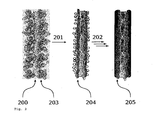
- adsorb ionically charged colloidal polymer-stabilized metal particles Fig. 2 , 203 to the metal substrate surface ( Fig. 2 , 200).
- aggregation and collapse ( Fig. 2 , Step 201) of the metal structures results in an additional metal layer with polymer chains immobilized by clamping complexes ( Fig. 2 , 204).
- This step results in an ionically charged coating acting as an adhesion promoter, which serves as the basis for further functional coatings.
- the metal particle dispersion is stabilized with a polymer such as, for example, polyacrylic acid (PAA), negatively charged functions such as carboxylate functions can be generated in the sufficiently alkaline medium and charged target molecules can be immobilized ( Fig. 2 , Step 202). Subsequently, the drying of the applied coating ( Fig. 2 , 205).
- PAA polyacrylic acid
- the surface modifications according to the invention represent the possibility of incorporation of drug systems or coupling of specific ligands. In this way, biocompatible surfaces can be created.
- the surface modification system of the invention is used for therapeutic and analytical applications. Immobilization of hydrophilic / lubricious / antimicrobial / abrasion-resistant / heat-resistant / corrosion-stable / fracture-resistant substances takes place and / or other functional coatings. Immobilization may be followed by the goal of altering the physical properties of the support material, such as waterproofness, mechanical strength, chemical resistance, light fastness, abrasion resistance, gas and moisture permeability, design, appearance, feel, surface design, and bulk. The method is therefore also suitable for solving technical problems through biologically inspired solutions (bionics).
- the surface modification system of the present invention is used to decorate the substrate surface with charge carriers such as ionic biomolecules (e.g., glycosaminoglycans). So biocompatible or antifouling surfaces can be produced.
- charge carriers such as ionic biomolecules (e.g., glycosaminoglycans). So biocompatible or antifouling surfaces can be produced.
- the surface modification system of the present invention is useful for functionalizing the substrate surface with biologically active molecules, e.g. Antibodies and nucleotides used. This is of particular interest in analytical medical technology.
- the surface modification system according to the invention is used to functionalize the substrate surface with fluorescence / phosphorus molecules for fluorescence / phosphorus determination systems.
- the magnetic particle surface modification system of the present invention is used for medical imaging systems for malignant tissue examination.
- the surface modification system according to the invention is used for the immobilization of lipid membrane viscoses (liposomes) or polymeromas as biocompatible / biodegradable active substance carrier or biological membrane on the substrate surface.
- the surface modification system of the present invention is used to immobilize surfactant oligomers together with lecithin to solubilize cholesterol on the substrate surface.
- the surface modification system of the invention is used to apply a drug-release coating on the substrate surface at a defined rate of release.
- the surface modification system of the present invention is used to immobilize superparamagnetic iron oxide particles for metastasis elimination on the substrate surface.
- the surface modification system according to the invention is used for decoration of water pipes with antimicrobial agents for outdoor use for the disinfection of water.
- the surface modification system according to the invention is used for decoration of water pipes with antimicrobial agents for outdoor use for the disinfection of water.
- the surface modification system according to the invention is used to prepare metal / polymer systems with defined structures by laser-chemical treatment of immobilized metal chelates.
- the surface modification system according to the invention is used for embedding clay minerals or activated carbon for water treatment (detoxification).
- the surface modification system according to the invention is used for further industrial painting or decorative design.
- novel or conventional paint systems may be considered.
- the surface modification system according to the invention is used for embedding fuel cell components.
- the surface modification system according to the invention is used for embedding functional (nano) particles (magnetic, light-emitting, etc.); solid-state hosts (eg polyurethane / silica ORMOSILs) used to store LASER dyes, etc.
- functional particles magnetic, light-emitting, etc.
- solid-state hosts eg polyurethane / silica ORMOSILs
- redox-capable systems eg iron particles
- the incorporation of redox-capable systems can enable redox polymerization on the surface.
- the stabilization of the iron oxide particles is achieved so far by a coating with polymers such as dextran (Ferridex ®), carboxydextran (Resovist ®), albumin and starch or a liposomal envelope.
- polymers such as dextran (Ferridex ®), carboxydextran (Resovist ®), albumin and starch or a liposomal envelope.
- IPN interpenetrating networks
- the surface modification system according to the invention is used as a lubricant substitute in ball bearings.
- the surface modification system according to the invention is used for coating composite materials with sufficient conductivity, such as, for example, carbon black-reinforced plastics (CFRP), short-fiber reinforced metals, so-called metal matrix composites (MMC).
- CFRP carbon black-reinforced plastics
- MMC metal matrix composites
- the surface modification system of the invention is used to coat analytical equipment such as e.g. Chromatography columns used.
- analytical equipment such as e.g. Chromatography columns used.
- the surface modification system according to the invention is used for the adhesion mediation between components of the same or different material / surface properties.
- the surface modification system according to the invention is used for coating materials which are used in concrete constructions similar to the irons.
- the surface modification system of the present invention is used to coat materials used in the testing of plastics materials (e.g., metal strips in natural rubber)
- the surface modification system according to the invention is used for the production of carbide / nitride or similar abrasion-resistant / oxidation-stable / protective Layers (as shown, for example, by physical vapor phase deposition).
- the stabilizing polymer by (partial) decomposition for example, serve as a carbon / nitrogen or other elementary source.
- Strength-enhancing substances could also be obtained by additional additives, such as after in the document DE102004014076B3
- the polymer phase may be used as an intermediate layer for stress absorption.
- the abrasion-resistant systems can be used for example on metallic cutting tools, which have ceramic-like properties on the surface after the appropriate treatment.
- Abrasion resistant layers are also interesting in terms of computer drives. An ever-increasing data density on hard disks requires better resolution and better mechanical stability of the surfaces. Abrasion-resistant surfaces are therefore of great interest in order to avoid damage to the drive.
- the surface modification system of the invention is used in combination with stimuli-responsive adhesion mediators (with stimuli such as temperature, electromagnetic radiation, etc.) for on-demand adhesions.
- stimuli-responsive adhesion mediators with stimuli such as temperature, electromagnetic radiation, etc.
- Such may e.g. as adhesive joints on a car body replace the welds etc. and thus facilitate the recycle process.
- Hot-melt adhesives such as polyamides and Micropearl F30 should be mentioned here as stimuli-responsive adhesion promoters.
- the surface modification system according to the invention itself can act as a stimuli-responsive adhesion mediators. In this way, the adhesive strength and thus the adhesion can be influenced.
- the surface modification system of the invention is used to coat semiconductor surfaces (such as silicon wafer surfaces).
- semiconductor surfaces such as silicon wafer surfaces.
- an increase in the efficiency of the solar cells can be achieved by the plasmon resonance of immobilized metal nanoparticles.
- the surface modification system according to the invention is used for the production of circuits.
- defined structures with a small space requirement can be realized by the use of (laser) optical methods, electron bombardment, ion bombardment or other etching methods.
- the surface modification system according to the invention is used in dental or orthopedic applications.
- a coating of e.g. Titanium components thus an improved compatibility with the body tissue can be achieved.
- the surface modification system according to the invention is used in electrical applications. Strongly adherent, elastic, homogeneous and defect-free insulation can be achieved, for example, by coating with paper fibers. Similar applications are conceivable for capacitors or transformers.
- the surface modification system according to the invention is used for the homogeneous coating of metal foam.
- Bioresorbable components made of ferrous metal foams are very interesting for osteosurgical application.
- the integration of these components is enhanced by pre-immobilized apatites.
- due to different material properties between metal and mineral, such systems are mechanically and thermally unstable.
- the surface modification system of the present invention can stabilize such systems by compensating for any shear forces due to the combination of surface roughness and polymer chain mobility.
- the surface modification system according to the invention is used for the production of protective coatings on e.g. Used steels.
- immobilized powder filled pastes e.g. Aluminide protective coatings which reduce hot air corrosion resistance in e.g. Increase automotive catalytic converters.
- inventive Surface modification system with water glass such as in DE4040153A1 described, coated.
- water- and fire-stable surfaces can be produced, which are break-stabilized by the stress-absorbing effect of the particle-protecting polymers.
- the surface modification system according to the invention is used to display analytical surfaces. Possible applications are in screening analysis such as e.g. To find SPR spectroscopy.
- the immobilized by means of the clamping mechanism polymers completely novel surface functionalities can be displayed, which corresponds to a wider range of applications.
- the surface modification system according to the invention for the diamond coating is used and so abrasion-stable, corrosion-resistant layers combined with lubricious surfaces.
Landscapes
- Life Sciences & Earth Sciences (AREA)
- Engineering & Computer Science (AREA)
- Wood Science & Technology (AREA)
- Paints Or Removers (AREA)
- Application Of Or Painting With Fluid Materials (AREA)
- Other Surface Treatments For Metallic Materials (AREA)
- Materials For Medical Uses (AREA)
- Chemically Coating (AREA)
Claims (13)
- Procédé de revêtement d'une surface de substrat de nature métallique au moyen de particules, comprenant les étapes suivantes :- dispersion des particules dans un solvant, les particules utilisées étant des particules de métal/d'alliage métallique/d'oxyde métallique et présentant une dimension dans le domaine micronique/submicronique/nanométrique,- stabilisation des particules colloïdales avec un polymère, le polymère étant un polymère biocompatible stabilisateur de dispersion ou un polymère formant un hydrogel,- imprégnation de la surface métallique à revêtir avec la solution de particules stabilisée, une fixation des chaînes polymères dans les intervalles entre surface métallique et particules ayant lieu par un mécanisme de pincement,- formation d'une couche stable de particules sur la surface de substrat par collapsus et agrégation du système colloïdal,- élimination des particules non liées à la fin de l'opération de revêtement par lavage avec un solvant,- génération de charges ioniques sur la surface métallique revêtue et- séchage final de la surface métallique revêtue.
- Procédé selon la revendication 1, caractérisé en ce qu'une stabilisation de la couche adhésive est effectuée par initiation d'étapes de réticulation.
- Procédé selon les revendications 1 et 2, caractérisé en ce que les particules de métal/d'alliage métallique/d'oxyde métallique utilisées présentent un ou plusieurs éléments sélectionnés dans les groupes 3 à 16 et les lanthanides du système périodique des éléments, leurs isotopes, sels, ainsi que des mélanges et alliages de ceux-ci.
- Procédé selon l'une des revendications précédentes, caractérisé en ce que les particules sont revêtues au moins partiellement d'un ou plusieurs polymères stabilisateurs de colloïdes.
- Procédé selon l'une des revendications précédentes, caractérisé en ce que différentes stratégies de dépôt, telles que dépôt par électrophorèse et dépôt chimique in situ, sont utilisées en combinaison et séparément.
- Procédé selon l'une des revendications précédentes, caractérisé en ce que les particules présentent une fonctionnalisation par les polymères stabilisateurs de colloïdes utilisés.
- Procédé selon l'une des revendications précédentes, caractérisé en ce que des dispersions sont utilisées, qui présentent des particules stabilisées par un polymère et/ou un ou plusieurs composants oligomères/polymères et/ou initiateurs de radicaux et/ou agents de réticulation et/ou agents complexants et/ou agents tensio-actifs, lesquels permettent des réactions de réticulation stabilisatrices du système.
- Procédé selon l'une des revendications précédentes, caractérisé en ce que d'autres réactions de réticulation sont effectuées pour une stabilisation supplémentaire des surfaces modifiées.
- Procédé selon l'une des revendications précédentes, caractérisé en ce que des charges ioniques sont générées par une étape de réaction sur le polymère stabilisateur de dispersion, la charge ionique de la surface modifiée étant modifiée par variation du pH.
- Procédé selon l'une des revendications précédentes, caractérisé en ce qu'après le revêtement de la surface métallique avec les particules fonctionnalisées, un chargement avec des molécules cibles est effectué, l'interaction entre la couche adhésive et la molécule cible étant basée sur des effets électrostatiques de type stéréocomplexe ou des liaisons hydrogène.
- Procédé selon l'une des revendications précédentes, caractérisé en ce qu'une combinaison de particules collabées et de réseaux interpénétrants est utilisée, ce qui diminue la sensibilité au stress du revêtement avec des molécules cibles appliqué ensuite.
- Surface de substrat revêtue de nature métallique réalisée selon l'une des revendications 1 à 11.
- Utilisation d'une surface métallique revêtue selon la revendication 12 pour immobiliser des revêtements fonctionnels, comme par exemple non réfléchissants, antisalissures, film lubrifiant ; molécules cibles synthétiques/naturelles, polymères d'hydrogel ; médicaments ; peptides ; agents antimicrobiens ; lipides ; polysaccharides ; molécules biologiquement actives telles qu'anticorps, nucléotides, enzymes, peptides signaux, colorants fluorescents/phosphorescents, substances minérales, nanoparticules ; minéraux argileux ou charbon actif par exemple pour le traitement de l'eau ; clathrates ; cyclodextrine et autres supramolécules, par exemple pour la décontamination ou l'élimination des endotoxines ; surfaces isolantes, surfaces photoélectriquement actives, surfaces biomimétiques.
Applications Claiming Priority (2)
| Application Number | Priority Date | Filing Date | Title |
|---|---|---|---|
| DE201010004553 DE102010004553A1 (de) | 2010-01-07 | 2010-01-07 | Oberflächenmodifizierungssystem für die Beschichtung von Substratoberflächen |
| PCT/DE2011/000011 WO2011082706A2 (fr) | 2010-01-07 | 2011-01-05 | Système de modification de surface conçu pour revêtir des surfaces de substrat |
Publications (2)
| Publication Number | Publication Date |
|---|---|
| EP2524014A2 EP2524014A2 (fr) | 2012-11-21 |
| EP2524014B1 true EP2524014B1 (fr) | 2015-08-26 |
Family
ID=44262874
Family Applications (1)
| Application Number | Title | Priority Date | Filing Date |
|---|---|---|---|
| EP11723859.2A Not-in-force EP2524014B1 (fr) | 2010-01-07 | 2011-01-05 | Système de modification de surface conçu pour revêtir des surfaces de substrat |
Country Status (3)
| Country | Link |
|---|---|
| EP (1) | EP2524014B1 (fr) |
| DE (2) | DE102010004553A1 (fr) |
| WO (1) | WO2011082706A2 (fr) |
Families Citing this family (2)
| Publication number | Priority date | Publication date | Assignee | Title |
|---|---|---|---|---|
| DE102014214751A1 (de) | 2014-07-28 | 2016-01-28 | Leibniz-Institut Für Polymerforschung Dresden E.V. | Modifizierte kunststoffoberflächen und verfahren zu ihrer herstellung |
| CN115820046B (zh) * | 2022-12-29 | 2023-07-18 | 广州市白云化工实业有限公司 | 一种硅酮密封胶底涂液及其制备方法 |
Family Cites Families (12)
| Publication number | Priority date | Publication date | Assignee | Title |
|---|---|---|---|---|
| IL89696A0 (en) * | 1988-04-11 | 1989-09-28 | Minnesota Mining & Mfg | Abrasion resistant coatings comprising silicon dioxide dispersions |
| DE4040153A1 (de) | 1990-12-15 | 1992-06-17 | Henkel Kgaa | Bindemittel auf basis waessriger alkalimetallsilicatloesungen und deren verwendung |
| GB2324530A (en) | 1997-04-25 | 1998-10-28 | Polybiomed Ltd | Introduction of functional groups on polymers |
| US20040055420A1 (en) | 2002-05-30 | 2004-03-25 | Arkady Garbar | Method for enhancing surface area of bulk metals |
| WO2005005554A2 (fr) * | 2003-06-13 | 2005-01-20 | Ers Company | Materiau nano-particulaire resistant a l'humidite et ses applications |
| DE102004014076B3 (de) | 2004-03-19 | 2005-12-22 | Fraunhofer-Gesellschaft zur Förderung der angewandten Forschung e.V. | Metallschaumkörper mit offenporiger Struktur sowie Verfahren zu seiner Herstellung |
| US20060029808A1 (en) * | 2004-08-06 | 2006-02-09 | Lei Zhai | Superhydrophobic coatings |
| CA2634339A1 (fr) | 2006-01-09 | 2007-07-19 | Polybiomed Limited | Procede de revetement hydrophile pour dispositifs medicaux |
| US20070248810A1 (en) * | 2006-04-25 | 2007-10-25 | Mcgee Dennis E | Coated polymeric film |
| GB0617644D0 (en) | 2006-09-07 | 2006-10-18 | Polybiomed Ltd | Hydrophilic surfaces for medical devices |
| US8173259B2 (en) | 2007-09-27 | 2012-05-08 | Intel Corporation | Methods to fabricate functionally gradient materials and structures formed thereby |
| US20090092887A1 (en) | 2007-10-05 | 2009-04-09 | Quantumsphere, Inc. | Nanoparticle coated electrode and method of manufacture |
-
2010
- 2010-01-07 DE DE201010004553 patent/DE102010004553A1/de not_active Withdrawn
-
2011
- 2011-01-05 DE DE112011100203T patent/DE112011100203A5/de not_active Withdrawn
- 2011-01-05 WO PCT/DE2011/000011 patent/WO2011082706A2/fr not_active Ceased
- 2011-01-05 EP EP11723859.2A patent/EP2524014B1/fr not_active Not-in-force
Also Published As
| Publication number | Publication date |
|---|---|
| EP2524014A2 (fr) | 2012-11-21 |
| WO2011082706A2 (fr) | 2011-07-14 |
| DE112011100203A5 (de) | 2012-10-18 |
| DE102010004553A1 (de) | 2011-07-14 |
| WO2011082706A9 (fr) | 2011-12-29 |
| WO2011082706A3 (fr) | 2011-10-20 |
Similar Documents
| Publication | Publication Date | Title |
|---|---|---|
| Grigoriev et al. | Nanocontainers for self‐healing coatings | |
| DE112004001096B4 (de) | Polyelektrolyttinte, Verfahren zu deren Herstellung und deren Verwendung zur Herstellung eines Filaments | |
| US20070003749A1 (en) | Process for production of porous reticulated composite materials | |
| DE10162435A1 (de) | Verfahren zur Erzeugung von Oberflächenbeschichtungen, die die Adsorption von Proteinen bzw. die Adhäsion von Bakterien und/oder Zellen vermindern | |
| WO2001092359A1 (fr) | Pigments microencapsules au moyen de polymeres | |
| DE102006038231A1 (de) | Implantat aus einem biokorrodierbaren metallischen Werkstoff mit einer Beschichtung aus einer Organosiliziumverbindung | |
| KR102035115B1 (ko) | 도전성 피막 복합체 및 그 제조방법 | |
| DE102010023490A1 (de) | Dreidimensionale metallbedeckte Nanostrukturen auf Substratoberflächen,Verfahren zu deren Erzeugung sowie deren Verwendung | |
| Fenero et al. | Laponite-based surfaces with holistic self-cleaning functionality by combining antistatics and omniphobicity | |
| Jeong et al. | Zr (IV) coordination chemistry for cell-repellent alginate coatings: the effect of surface functional groups | |
| Behboodi-Sadabad et al. | Surface functionalization and patterning by multifunctional resorcinarenes | |
| Joy et al. | Superhydrophobic Polyaniline–Siloxane Coatings with Excellent Barrier and Active Corrosion Protection Properties for Mild Steel | |
| Choi et al. | Methods and applications of biomolecular surface coatings on individual cells | |
| WO2002068481A1 (fr) | Polymeres contenant du phosphore pour convertisseur optique de signaux | |
| Shen et al. | Inexpensive synthesis of poly (ethylenedioxythiophene‐sulfobetaine) films with high bio‐antifouling ability | |
| Fernández-Solis et al. | Molybdate and phosphate cross-linked chitosan films for corrosion protection of hot-dip galvanized steel | |
| DE112008002441B4 (de) | Metallwerkstoffe mit hybrid-stabilisierter Oxidschicht, Verfahren zu der Herstellung sowie deren Verwendung | |
| WO2011082706A9 (fr) | Système de modification de surface conçu pour revêtir des surfaces de substrat | |
| Baretta et al. | Mechanically Adaptive Metal-Coordinated Electrogel Membranes | |
| Jeong et al. | Universal surface coating with a non-phenolic molecule, sulfonated pyrene | |
| Ghosh et al. | Smart Microgel and Nanogel Platforms for Biomedical Applications | |
| Li et al. | Growth of silver nanoparticles on poly (acrylic acid) brushes and their properties | |
| EP1814919B1 (fr) | Procede de production de structures planes multicouches, de particules, ou de fibres | |
| Vasilev et al. | Template-assisted generation of nanocavities within plasma polymer films | |
| Chinnasamy et al. | Polymer coating for industrial applications |
Legal Events
| Date | Code | Title | Description |
|---|---|---|---|
| PUAI | Public reference made under article 153(3) epc to a published international application that has entered the european phase |
Free format text: ORIGINAL CODE: 0009012 |
|
| 17P | Request for examination filed |
Effective date: 20121011 |
|
| AK | Designated contracting states |
Kind code of ref document: A2 Designated state(s): AL AT BE BG CH CY CZ DE DK EE ES FI FR GB GR HR HU IE IS IT LI LT LU LV MC MK MT NL NO PL PT RO RS SE SI SK SM TR |
|
| DAX | Request for extension of the european patent (deleted) | ||
| 17Q | First examination report despatched |
Effective date: 20130718 |
|
| GRAP | Despatch of communication of intention to grant a patent |
Free format text: ORIGINAL CODE: EPIDOSNIGR1 |
|
| INTG | Intention to grant announced |
Effective date: 20150316 |
|
| RIN1 | Information on inventor provided before grant (corrected) |
Inventor name: GROMBE, RINGO |
|
| GRAP | Despatch of communication of intention to grant a patent |
Free format text: ORIGINAL CODE: EPIDOSNIGR1 |
|
| GRAS | Grant fee paid |
Free format text: ORIGINAL CODE: EPIDOSNIGR3 |
|
| GRAA | (expected) grant |
Free format text: ORIGINAL CODE: 0009210 |
|
| INTG | Intention to grant announced |
Effective date: 20150703 |
|
| AK | Designated contracting states |
Kind code of ref document: B1 Designated state(s): AL AT BE BG CH CY CZ DE DK EE ES FI FR GB GR HR HU IE IS IT LI LT LU LV MC MK MT NL NO PL PT RO RS SE SI SK SM TR |
|
| REG | Reference to a national code |
Ref country code: GB Ref legal event code: FG4D Free format text: NOT ENGLISH |
|
| REG | Reference to a national code |
Ref country code: CH Ref legal event code: EP |
|
| REG | Reference to a national code |
Ref country code: AT Ref legal event code: REF Ref document number: 745194 Country of ref document: AT Kind code of ref document: T Effective date: 20150915 |
|
| REG | Reference to a national code |
Ref country code: IE Ref legal event code: FG4D Free format text: LANGUAGE OF EP DOCUMENT: GERMAN |
|
| REG | Reference to a national code |
Ref country code: DE Ref legal event code: R096 Ref document number: 502011007698 Country of ref document: DE |
|
| REG | Reference to a national code |
Ref country code: CH Ref legal event code: NV Representative=s name: FREI PATENTANWALTSBUERO AG, CH |
|
| REG | Reference to a national code |
Ref country code: FR Ref legal event code: PLFP Year of fee payment: 6 |
|
| REG | Reference to a national code |
Ref country code: LT Ref legal event code: MG4D |
|
| PG25 | Lapsed in a contracting state [announced via postgrant information from national office to epo] |
Ref country code: FI Free format text: LAPSE BECAUSE OF FAILURE TO SUBMIT A TRANSLATION OF THE DESCRIPTION OR TO PAY THE FEE WITHIN THE PRESCRIBED TIME-LIMIT Effective date: 20150826 Ref country code: GR Free format text: LAPSE BECAUSE OF FAILURE TO SUBMIT A TRANSLATION OF THE DESCRIPTION OR TO PAY THE FEE WITHIN THE PRESCRIBED TIME-LIMIT Effective date: 20151127 Ref country code: LT Free format text: LAPSE BECAUSE OF FAILURE TO SUBMIT A TRANSLATION OF THE DESCRIPTION OR TO PAY THE FEE WITHIN THE PRESCRIBED TIME-LIMIT Effective date: 20150826 Ref country code: LV Free format text: LAPSE BECAUSE OF FAILURE TO SUBMIT A TRANSLATION OF THE DESCRIPTION OR TO PAY THE FEE WITHIN THE PRESCRIBED TIME-LIMIT Effective date: 20150826 Ref country code: NO Free format text: LAPSE BECAUSE OF FAILURE TO SUBMIT A TRANSLATION OF THE DESCRIPTION OR TO PAY THE FEE WITHIN THE PRESCRIBED TIME-LIMIT Effective date: 20151126 |
|
| REG | Reference to a national code |
Ref country code: NL Ref legal event code: FP |
|
| PG25 | Lapsed in a contracting state [announced via postgrant information from national office to epo] |
Ref country code: HR Free format text: LAPSE BECAUSE OF FAILURE TO SUBMIT A TRANSLATION OF THE DESCRIPTION OR TO PAY THE FEE WITHIN THE PRESCRIBED TIME-LIMIT Effective date: 20150826 Ref country code: ES Free format text: LAPSE BECAUSE OF FAILURE TO SUBMIT A TRANSLATION OF THE DESCRIPTION OR TO PAY THE FEE WITHIN THE PRESCRIBED TIME-LIMIT Effective date: 20150826 Ref country code: RS Free format text: LAPSE BECAUSE OF FAILURE TO SUBMIT A TRANSLATION OF THE DESCRIPTION OR TO PAY THE FEE WITHIN THE PRESCRIBED TIME-LIMIT Effective date: 20150826 Ref country code: IS Free format text: LAPSE BECAUSE OF FAILURE TO SUBMIT A TRANSLATION OF THE DESCRIPTION OR TO PAY THE FEE WITHIN THE PRESCRIBED TIME-LIMIT Effective date: 20151226 Ref country code: SE Free format text: LAPSE BECAUSE OF FAILURE TO SUBMIT A TRANSLATION OF THE DESCRIPTION OR TO PAY THE FEE WITHIN THE PRESCRIBED TIME-LIMIT Effective date: 20150826 Ref country code: PT Free format text: LAPSE BECAUSE OF FAILURE TO SUBMIT A TRANSLATION OF THE DESCRIPTION OR TO PAY THE FEE WITHIN THE PRESCRIBED TIME-LIMIT Effective date: 20151228 Ref country code: PL Free format text: LAPSE BECAUSE OF FAILURE TO SUBMIT A TRANSLATION OF THE DESCRIPTION OR TO PAY THE FEE WITHIN THE PRESCRIBED TIME-LIMIT Effective date: 20150826 |
|
| PG25 | Lapsed in a contracting state [announced via postgrant information from national office to epo] |
Ref country code: CZ Free format text: LAPSE BECAUSE OF FAILURE TO SUBMIT A TRANSLATION OF THE DESCRIPTION OR TO PAY THE FEE WITHIN THE PRESCRIBED TIME-LIMIT Effective date: 20150826 Ref country code: IT Free format text: LAPSE BECAUSE OF FAILURE TO SUBMIT A TRANSLATION OF THE DESCRIPTION OR TO PAY THE FEE WITHIN THE PRESCRIBED TIME-LIMIT Effective date: 20150826 Ref country code: EE Free format text: LAPSE BECAUSE OF FAILURE TO SUBMIT A TRANSLATION OF THE DESCRIPTION OR TO PAY THE FEE WITHIN THE PRESCRIBED TIME-LIMIT Effective date: 20150826 Ref country code: DK Free format text: LAPSE BECAUSE OF FAILURE TO SUBMIT A TRANSLATION OF THE DESCRIPTION OR TO PAY THE FEE WITHIN THE PRESCRIBED TIME-LIMIT Effective date: 20150826 Ref country code: SK Free format text: LAPSE BECAUSE OF FAILURE TO SUBMIT A TRANSLATION OF THE DESCRIPTION OR TO PAY THE FEE WITHIN THE PRESCRIBED TIME-LIMIT Effective date: 20150826 |
|
| REG | Reference to a national code |
Ref country code: DE Ref legal event code: R097 Ref document number: 502011007698 Country of ref document: DE |
|
| PG25 | Lapsed in a contracting state [announced via postgrant information from national office to epo] |
Ref country code: RO Free format text: LAPSE BECAUSE OF FAILURE TO SUBMIT A TRANSLATION OF THE DESCRIPTION OR TO PAY THE FEE WITHIN THE PRESCRIBED TIME-LIMIT Effective date: 20150826 |
|
| PLBE | No opposition filed within time limit |
Free format text: ORIGINAL CODE: 0009261 |
|
| STAA | Information on the status of an ep patent application or granted ep patent |
Free format text: STATUS: NO OPPOSITION FILED WITHIN TIME LIMIT |
|
| 26N | No opposition filed |
Effective date: 20160530 |
|
| PG25 | Lapsed in a contracting state [announced via postgrant information from national office to epo] |
Ref country code: SI Free format text: LAPSE BECAUSE OF FAILURE TO SUBMIT A TRANSLATION OF THE DESCRIPTION OR TO PAY THE FEE WITHIN THE PRESCRIBED TIME-LIMIT Effective date: 20150826 Ref country code: LU Free format text: LAPSE BECAUSE OF FAILURE TO SUBMIT A TRANSLATION OF THE DESCRIPTION OR TO PAY THE FEE WITHIN THE PRESCRIBED TIME-LIMIT Effective date: 20160105 |
|
| GBPC | Gb: european patent ceased through non-payment of renewal fee |
Effective date: 20160105 |
|
| PG25 | Lapsed in a contracting state [announced via postgrant information from national office to epo] |
Ref country code: MC Free format text: LAPSE BECAUSE OF FAILURE TO SUBMIT A TRANSLATION OF THE DESCRIPTION OR TO PAY THE FEE WITHIN THE PRESCRIBED TIME-LIMIT Effective date: 20150826 |
|
| REG | Reference to a national code |
Ref country code: FR Ref legal event code: PLFP Year of fee payment: 7 |
|
| PG25 | Lapsed in a contracting state [announced via postgrant information from national office to epo] |
Ref country code: GB Free format text: LAPSE BECAUSE OF NON-PAYMENT OF DUE FEES Effective date: 20160105 |
|
| REG | Reference to a national code |
Ref country code: IE Ref legal event code: MM4A |
|
| PG25 | Lapsed in a contracting state [announced via postgrant information from national office to epo] |
Ref country code: IE Free format text: LAPSE BECAUSE OF NON-PAYMENT OF DUE FEES Effective date: 20160105 |
|
| PG25 | Lapsed in a contracting state [announced via postgrant information from national office to epo] |
Ref country code: MT Free format text: LAPSE BECAUSE OF FAILURE TO SUBMIT A TRANSLATION OF THE DESCRIPTION OR TO PAY THE FEE WITHIN THE PRESCRIBED TIME-LIMIT Effective date: 20150826 |
|
| REG | Reference to a national code |
Ref country code: FR Ref legal event code: PLFP Year of fee payment: 8 |
|
| PG25 | Lapsed in a contracting state [announced via postgrant information from national office to epo] |
Ref country code: SM Free format text: LAPSE BECAUSE OF FAILURE TO SUBMIT A TRANSLATION OF THE DESCRIPTION OR TO PAY THE FEE WITHIN THE PRESCRIBED TIME-LIMIT Effective date: 20150826 Ref country code: HU Free format text: LAPSE BECAUSE OF FAILURE TO SUBMIT A TRANSLATION OF THE DESCRIPTION OR TO PAY THE FEE WITHIN THE PRESCRIBED TIME-LIMIT; INVALID AB INITIO Effective date: 20110105 Ref country code: CY Free format text: LAPSE BECAUSE OF FAILURE TO SUBMIT A TRANSLATION OF THE DESCRIPTION OR TO PAY THE FEE WITHIN THE PRESCRIBED TIME-LIMIT Effective date: 20150826 |
|
| PG25 | Lapsed in a contracting state [announced via postgrant information from national office to epo] |
Ref country code: MK Free format text: LAPSE BECAUSE OF FAILURE TO SUBMIT A TRANSLATION OF THE DESCRIPTION OR TO PAY THE FEE WITHIN THE PRESCRIBED TIME-LIMIT Effective date: 20150826 Ref country code: TR Free format text: LAPSE BECAUSE OF FAILURE TO SUBMIT A TRANSLATION OF THE DESCRIPTION OR TO PAY THE FEE WITHIN THE PRESCRIBED TIME-LIMIT Effective date: 20150826 |
|
| PG25 | Lapsed in a contracting state [announced via postgrant information from national office to epo] |
Ref country code: BG Free format text: LAPSE BECAUSE OF FAILURE TO SUBMIT A TRANSLATION OF THE DESCRIPTION OR TO PAY THE FEE WITHIN THE PRESCRIBED TIME-LIMIT Effective date: 20150826 |
|
| PG25 | Lapsed in a contracting state [announced via postgrant information from national office to epo] |
Ref country code: AL Free format text: LAPSE BECAUSE OF FAILURE TO SUBMIT A TRANSLATION OF THE DESCRIPTION OR TO PAY THE FEE WITHIN THE PRESCRIBED TIME-LIMIT Effective date: 20150826 |
|
| REG | Reference to a national code |
Ref country code: CH Ref legal event code: PCAR Free format text: NEW ADDRESS: POSTFACH, 8032 ZUERICH (CH) |
|
| REG | Reference to a national code |
Ref country code: DE Ref legal event code: R082 Ref document number: 502011007698 Country of ref document: DE |
|
| PGFP | Annual fee paid to national office [announced via postgrant information from national office to epo] |
Ref country code: NL Payment date: 20191217 Year of fee payment: 10 |
|
| PGFP | Annual fee paid to national office [announced via postgrant information from national office to epo] |
Ref country code: FR Payment date: 20191230 Year of fee payment: 10 Ref country code: BE Payment date: 20191125 Year of fee payment: 10 |
|
| PGFP | Annual fee paid to national office [announced via postgrant information from national office to epo] |
Ref country code: DE Payment date: 20200127 Year of fee payment: 10 Ref country code: AT Payment date: 20200120 Year of fee payment: 10 |
|
| PGFP | Annual fee paid to national office [announced via postgrant information from national office to epo] |
Ref country code: CH Payment date: 20200109 Year of fee payment: 10 |
|
| REG | Reference to a national code |
Ref country code: DE Ref legal event code: R119 Ref document number: 502011007698 Country of ref document: DE |
|
| REG | Reference to a national code |
Ref country code: CH Ref legal event code: PL |
|
| REG | Reference to a national code |
Ref country code: NL Ref legal event code: MM Effective date: 20210201 |
|
| REG | Reference to a national code |
Ref country code: AT Ref legal event code: MM01 Ref document number: 745194 Country of ref document: AT Kind code of ref document: T Effective date: 20210105 |
|
| REG | Reference to a national code |
Ref country code: BE Ref legal event code: MM Effective date: 20210131 |
|
| PG25 | Lapsed in a contracting state [announced via postgrant information from national office to epo] |
Ref country code: AT Free format text: LAPSE BECAUSE OF NON-PAYMENT OF DUE FEES Effective date: 20210105 Ref country code: NL Free format text: LAPSE BECAUSE OF NON-PAYMENT OF DUE FEES Effective date: 20210201 Ref country code: FR Free format text: LAPSE BECAUSE OF NON-PAYMENT OF DUE FEES Effective date: 20210131 |
|
| PG25 | Lapsed in a contracting state [announced via postgrant information from national office to epo] |
Ref country code: LI Free format text: LAPSE BECAUSE OF NON-PAYMENT OF DUE FEES Effective date: 20210131 Ref country code: CH Free format text: LAPSE BECAUSE OF NON-PAYMENT OF DUE FEES Effective date: 20210131 Ref country code: DE Free format text: LAPSE BECAUSE OF NON-PAYMENT OF DUE FEES Effective date: 20210803 |
|
| PG25 | Lapsed in a contracting state [announced via postgrant information from national office to epo] |
Ref country code: BE Free format text: LAPSE BECAUSE OF NON-PAYMENT OF DUE FEES Effective date: 20210131 |