EP2524646A1 - Système et procédé pour mesurer la pression artérielle par ses effets - Google Patents
Système et procédé pour mesurer la pression artérielle par ses effets Download PDFInfo
- Publication number
- EP2524646A1 EP2524646A1 EP10843299A EP10843299A EP2524646A1 EP 2524646 A1 EP2524646 A1 EP 2524646A1 EP 10843299 A EP10843299 A EP 10843299A EP 10843299 A EP10843299 A EP 10843299A EP 2524646 A1 EP2524646 A1 EP 2524646A1
- Authority
- EP
- European Patent Office
- Prior art keywords
- arterial
- pressure
- diastolic
- period
- systolic
- Prior art date
- Legal status (The legal status is an assumption and is not a legal conclusion. Google has not performed a legal analysis and makes no representation as to the accuracy of the status listed.)
- Granted
Links
- 238000000034 method Methods 0.000 title claims abstract description 131
- 230000004872 arterial blood pressure Effects 0.000 title claims abstract description 56
- 238000005259 measurement Methods 0.000 title claims description 32
- 230000000694 effects Effects 0.000 title abstract description 32
- 230000014509 gene expression Effects 0.000 claims abstract description 138
- 230000003205 diastolic effect Effects 0.000 claims abstract description 130
- 230000004882 diastolic arterial blood pressure Effects 0.000 claims abstract description 77
- 230000004873 systolic arterial blood pressure Effects 0.000 claims abstract description 45
- 210000001367 artery Anatomy 0.000 claims description 126
- 230000017531 blood circulation Effects 0.000 claims description 71
- 239000008280 blood Substances 0.000 claims description 50
- 210000004369 blood Anatomy 0.000 claims description 50
- 238000009530 blood pressure measurement Methods 0.000 claims description 37
- 230000035487 diastolic blood pressure Effects 0.000 claims description 35
- 230000035488 systolic blood pressure Effects 0.000 claims description 29
- 230000036772 blood pressure Effects 0.000 claims description 17
- 238000012545 processing Methods 0.000 claims description 12
- 230000008034 disappearance Effects 0.000 claims description 11
- 238000001514 detection method Methods 0.000 claims description 10
- 230000010355 oscillation Effects 0.000 claims description 10
- 230000004044 response Effects 0.000 claims description 6
- 230000008569 process Effects 0.000 claims description 5
- 238000007405 data analysis Methods 0.000 claims description 3
- 230000006837 decompression Effects 0.000 claims description 3
- 230000003993 interaction Effects 0.000 claims description 3
- 238000001228 spectrum Methods 0.000 claims description 3
- 230000004913 activation Effects 0.000 claims 4
- 238000013480 data collection Methods 0.000 claims 2
- 208000031104 Arterial Occlusive disease Diseases 0.000 abstract description 7
- 208000021328 arterial occlusion Diseases 0.000 abstract description 7
- 230000007423 decrease Effects 0.000 description 12
- 229920000147 Styrene maleic anhydride Polymers 0.000 description 11
- 230000002861 ventricular Effects 0.000 description 11
- 230000002045 lasting effect Effects 0.000 description 8
- 238000004458 analytical method Methods 0.000 description 7
- 230000008321 arterial blood flow Effects 0.000 description 7
- 230000000747 cardiac effect Effects 0.000 description 7
- 230000008859 change Effects 0.000 description 6
- QSHDDOUJBYECFT-UHFFFAOYSA-N mercury Chemical compound [Hg] QSHDDOUJBYECFT-UHFFFAOYSA-N 0.000 description 6
- 229910052753 mercury Inorganic materials 0.000 description 6
- 230000000704 physical effect Effects 0.000 description 6
- 210000000709 aorta Anatomy 0.000 description 5
- 230000000004 hemodynamic effect Effects 0.000 description 5
- 230000008649 adaptation response Effects 0.000 description 4
- 230000008901 benefit Effects 0.000 description 4
- 230000008602 contraction Effects 0.000 description 4
- 238000010586 diagram Methods 0.000 description 4
- 230000006835 compression Effects 0.000 description 3
- 238000007906 compression Methods 0.000 description 3
- 230000004069 differentiation Effects 0.000 description 3
- 239000003814 drug Substances 0.000 description 3
- 238000001595 flow curve Methods 0.000 description 3
- 230000001936 parietal effect Effects 0.000 description 3
- 230000009467 reduction Effects 0.000 description 3
- 241000282414 Homo sapiens Species 0.000 description 2
- 241000360883 Tamaulipa Species 0.000 description 2
- 230000009471 action Effects 0.000 description 2
- 238000002555 auscultation Methods 0.000 description 2
- 238000009833 condensation Methods 0.000 description 2
- 230000005494 condensation Effects 0.000 description 2
- 230000003247 decreasing effect Effects 0.000 description 2
- 238000011161 development Methods 0.000 description 2
- 230000036541 health Effects 0.000 description 2
- 208000019622 heart disease Diseases 0.000 description 2
- 210000005240 left ventricle Anatomy 0.000 description 2
- 230000004962 physiological condition Effects 0.000 description 2
- 230000003252 repetitive effect Effects 0.000 description 2
- 230000007704 transition Effects 0.000 description 2
- MGRVRXRGTBOSHW-UHFFFAOYSA-N (aminomethyl)phosphonic acid Chemical compound NCP(O)(O)=O MGRVRXRGTBOSHW-UHFFFAOYSA-N 0.000 description 1
- 206010000060 Abdominal distension Diseases 0.000 description 1
- 200000000007 Arterial disease Diseases 0.000 description 1
- 206010019280 Heart failures Diseases 0.000 description 1
- 101001039157 Homo sapiens Leucine-rich repeat-containing protein 25 Proteins 0.000 description 1
- 206010021118 Hypotonia Diseases 0.000 description 1
- 102100040695 Leucine-rich repeat-containing protein 25 Human genes 0.000 description 1
- 210000001765 aortic valve Anatomy 0.000 description 1
- 208000028922 artery disease Diseases 0.000 description 1
- 210000000988 bone and bone Anatomy 0.000 description 1
- 210000002302 brachial artery Anatomy 0.000 description 1
- 210000004556 brain Anatomy 0.000 description 1
- 230000004087 circulation Effects 0.000 description 1
- 238000003745 diagnosis Methods 0.000 description 1
- 208000037265 diseases, disorders, signs and symptoms Diseases 0.000 description 1
- 229940079593 drug Drugs 0.000 description 1
- 230000008030 elimination Effects 0.000 description 1
- 238000003379 elimination reaction Methods 0.000 description 1
- 230000001747 exhibiting effect Effects 0.000 description 1
- 210000003414 extremity Anatomy 0.000 description 1
- 239000012530 fluid Substances 0.000 description 1
- 210000000245 forearm Anatomy 0.000 description 1
- 230000006870 function Effects 0.000 description 1
- 238000001361 intraarterial administration Methods 0.000 description 1
- 230000002262 irrigation Effects 0.000 description 1
- 238000003973 irrigation Methods 0.000 description 1
- 238000012544 monitoring process Methods 0.000 description 1
- 230000036640 muscle relaxation Effects 0.000 description 1
- 238000011017 operating method Methods 0.000 description 1
- 230000008520 organization Effects 0.000 description 1
- 238000005381 potential energy Methods 0.000 description 1
- 230000000541 pulsatile effect Effects 0.000 description 1
- 238000011084 recovery Methods 0.000 description 1
- 230000000284 resting effect Effects 0.000 description 1
- 238000005070 sampling Methods 0.000 description 1
- 238000013519 translation Methods 0.000 description 1
- 210000005166 vasculature Anatomy 0.000 description 1
Images


Classifications
-
- A—HUMAN NECESSITIES
- A61—MEDICAL OR VETERINARY SCIENCE; HYGIENE
- A61B—DIAGNOSIS; SURGERY; IDENTIFICATION
- A61B5/00—Measuring for diagnostic purposes; Identification of persons
- A61B5/02—Detecting, measuring or recording for evaluating the cardiovascular system, e.g. pulse, heart rate, blood pressure or blood flow
- A61B5/021—Measuring pressure in heart or blood vessels
- A61B5/022—Measuring pressure in heart or blood vessels by applying pressure to close blood vessels, e.g. against the skin; Ophthalmodynamometers
- A61B5/02208—Measuring pressure in heart or blood vessels by applying pressure to close blood vessels, e.g. against the skin; Ophthalmodynamometers using the Korotkoff method
-
- A—HUMAN NECESSITIES
- A61—MEDICAL OR VETERINARY SCIENCE; HYGIENE
- A61B—DIAGNOSIS; SURGERY; IDENTIFICATION
- A61B5/00—Measuring for diagnostic purposes; Identification of persons
- A61B5/02—Detecting, measuring or recording for evaluating the cardiovascular system, e.g. pulse, heart rate, blood pressure or blood flow
- A61B5/021—Measuring pressure in heart or blood vessels
- A61B5/022—Measuring pressure in heart or blood vessels by applying pressure to close blood vessels, e.g. against the skin; Ophthalmodynamometers
- A61B5/02225—Measuring pressure in heart or blood vessels by applying pressure to close blood vessels, e.g. against the skin; Ophthalmodynamometers using the oscillometric method
Definitions
- the present invention refers to the systems, procedures, and instruments designed in the field of medicine and Biomedical Engineering and which are used in medicine to measure arterial blood pressure. More particularly, it refers to an indirect measurement system and procedure of diastolic arterial pressure based on the effects of the arterial cycle diastolic period.
- Arterial pressure is the force applied by blood on arterial walls.
- the force unit applied by blood is divided by the arterial wall area unit and the resulting measure is the pressure unit, for instance mmHg or pascals.
- Arterial blood force is the pressure applied by blood to the arterial wall, and the measure results from the blood pressure unit multiplied by the arterial segment wall area unit. Its units are dynes or Newtons.
- Cardiac cycle is the set of events related to the blood flow that must occur from the beginning of a heartbeat to the beginning of the next one. Every heartbeat includes two main stages in ventricles: The ventricle systole and diastole. The term diastole means muscle relaxation. Throughout the cardiac cycle, blood pressure increases and decreases in heart and arterial system. The variation of pressure in arteries has two stages: the systolic blood pressure time which is short and a longer time corresponding to the diastolic blood pressure.
- Arterial cycle is the unit for the variation of repetitive physical properties of the artery depending on time, which consists of the events of the blood flow and arterial wall in a higher blood movement period referred to as systolic period and a lower blood movement period referred to as diastolic.
- systolic period a higher blood movement period
- diastolic a lower blood movement period
- the systolic blood pressure is the highest pressure from the two stages and has blood flow all throughout the stage; while the diastolic blood pressure is the lowest pressure from the two stages and its blood flow does not always last the full arterial cycle diastolic time.
- To obliterate To obstruct or close a conduit or cavity.
- Measurement of diastolic arterial pressure through arterial obliteration by applying a gradual external contact force It is the action of applying a gradual external contact force until obliterating an artery to measure the force applied by the blood on the arterial wall in the diastolic period.
- Measurement of diastolic arterial pressure through arterial clearing by removing the gradual external contact force It is the action of removing the gradual external contact force until an artery has been cleared in order to measure the force applied by the blood on the arterial wall in the diastolic period.
- Measurable artery Arterial segment which is used to know the measurement of a magnitude.
- Measurable artery In the present invention, an arterial segment used to know the pressure measurement applied by blood on its wall area unit.
- Parameter is the numerical value or fixed data that is considered in the study or analysis of a certain issue.
- a parameter is a sample of blood flow and arterial wall expressions without being affected by the external force applied. Such values shall be taken into consideration to calculate systolic and diastolic arterial pressure.
- Arterial pressure can be measured in an invasive (direct) manner, which is not relevant for this document, or in a non-invasive (indirect) manner.
- Measuring diastolic and systolic arterial pressure using an indirect method is essential for this invention and in the state of the art such measuring is performed using the auscultatory method and the oscillometric method, which have their origin, description and scientific foundations on the following historical facts:
- systolic and diastolic blood pressure is obtained by identifying the region in which there is, respectively, a rapid increase and a reduction in pulse amplitude.
- Medium arterial pressure is found in the point of the maximum oscillation.
- the instruments that are used to observe arterial expressions being depicted by Korotkoff are the stethoscope, pressure sensor, flow sensor and sphygmomanometer with respect to a manometer, in order to determine arterial pressure.
- measurements are performed by observing the expressions that have been previously depicted by Korotkoff in his thesis.
- the oscillometric procedure is the measure based on amplitude oscillations resulting from the pressure change inside a force application device. It also depends on Korotkoff's observations to measure arterial pressure, as its name indicates, the method uses the oscillometer, which is an electronic device based on the pulse wave analysis.
- the individual's arm is compressed by an inflatable condensation cuff, such that the measurement is based on the pressure change amplitude in the cuff. Therefore, when such a cuff is inflated on systolic pressure, the amplitude suddenly increases with pulse rest periods through occlusion, that is, very near to systolic pressure.
- cuff pressure decreases, amplitude pulse increase reaches a maximum threshold and then rapidly decreases.
- Diastolic pressure index is taken when this transition begins. Therefore, systolic and diastolic blood pressures result from identifying the region in which there is a sudden increase and then a decrease in the amplitude of systolic pulses.
- systolic arterial pressure when overcoming the force applied to the measurable artery and the second one is the pressure in the cuff when it is not able anymore to affect blood systolic pressure.
- the latter pressure is referred to as diastolic arterial pressure, which is not accurate.
- Measuring systolic arterial pressure using Korotkoff's method does determine in fact systolic arterial pressure, but including the error corresponding to pressure overload that heartbeats occurring after occlusion produced in the occluded artery.
- the second systolic pressure phenomenon which is mistakenly known as diastolic arterial pressure, is determined by using the state of the art methods and instruments.
- Such a measurement consists of measuring the pressure applied by the cuff to the arm at the time in which Korotkoff's sounds disappear, since the pressure applied using the cuff decreases to a point at which it does not affect anymore the blood flow of the major systolic pulse wave, allowing that the turbulent systolic arterial blood flow becomes a laminar flow and thus it does not result in expressions (Korotkoff's sounds).
- this measurement corresponds to diastolic arterial pressure.
- diastolic arterial pressure is defined as "the lowest value from both arterial blood pressures values, which corresponds to arterial blood pressure when heart is in a diastolic or resting state".
- the present invention aims to solve some of the following problems in the auscultatory method (classic method): the indirect Von Riva Rocci Recklinghaus' method to measure arterial blood force that is literally stated as follows: "the instrument I have developed measures in a manometric fashion the force that is required to stop the pulse wave progression; sphigmomanometry is performed in one of the major branches of the aorta artery, on the humeral artery, which is a direct continuation of the axillary one, in such a manner that the measurement estimates the full load in a point that is very near to the aorta artery, almost inside the same"...
- Korotkoff refers to the artery producing short tones that their aspect indicates part of the pulse wave, when he states "...the manometric reading continues.", he means that the deflation phenomenon continues and thus the decrease of the pressure applied to the arm by the cuff, as well as that the first tone that appears as a full tone compared to the preceding ones corresponds to the maximum pressure.
- maximum pressure results from measuring the external force with the appearance of the first full tone after an actual occlusion and force release resulting from deflation.
- diastolic arterial pressure is determined based on arterial expressions due to the relationship between the cuff force and the artery with systolic arterial pressure, and not diastolic arterial pressure actual value!
- this novel system and method for measuring arterial pressure by its effects measures diastolic and systolic arterial pressure based on the expression from the artery in the arterial cycle systolic and diastolic period, respectively.
- Arterial cycle is defined as the repetitive physical variation unit of the artery along time, which consists of the arterial wall and blood flow events which are defined in two periods. The first period with a short time, more movement, and more blood pressure is referred to as systolic arterial pressure period. The second period with a time higher than the preceding one, less movement and more blood pressure is referred to as diastolic blood pressure period.
- the present invention measures diastolic arterial blood pressure by observing arterial wall and blood flow expressions which are created or eliminated in the arterial cycle diastolic period by applying a gradual contact force on the measurable artery.
- the present invention furthermore provides a procedure for measuring systolic arterial pressure by using an indirect method in the arterial cycle systolic period and without affecting the blood pressure overload resulting in ventricular ejections after the artery is occluded.
- systolic arterial pressure is furthermore measured based on the effects created or eliminated by obliterating the artery by applying an increasing external contact force, recording and measuring the expressions that are generated by the flow, arterial wall, and manometer in the arterial cycle systolic period at the time of equaling the external force applied with the blood force on the arterial wall.
- Another object of the present invention is providing a procedure that is able to measure diastolic arterial pressure in a sensitive and specific manner using an indirect method.
- Another object of the present invention is providing a system and method for measuring arterial pressure by its effects that is able to measure systolic arterial pressure by its effects on the arterial cycle systolic period and diastolic arterial pressure by its effects on the arterial cycle diastolic period using an indirect method.
- a further object of the present invention is providing a procedure to measure diastolic arterial pressure by the effects generated by diastolic arterial pressure by applying an external contact force using a device applying a measured gradual external contact force, by observing the phenomena produced by arterial wall and blood flow with a blood expression sensor.
- These two elements being the data information source for a device measuring and detecting the arterial cycle diastolic and systolic periods which discriminates between the systolic and diastolic periods in an arterial cycle in order to determine diastolic and systolic arterial pressure by their effects.
- a further object of the present invention is providing a device measuring and detecting arterial cycle diastolic and systolic periods which, in one embodiment, is an electronic motherboard discriminating between the diastolic and systolic periods in an arterial cycle in order to determine, respectively, diastolic and systolic arterial pressures by their effects.
- a further object of the present invention consists of providing a procedure to more accurately measure systolic arterial pressure without the overpressure resulting from heartbeats occurring after occluding the measurable artery.
- the advantages of this invention consist of indirectly measuring for the first time in history diastolic arterial pressure by its effects. By doing this, we will be able to measure, by using an indirect method, the blood pressure exhibited by the artery when the heart begins ventricular ejection and the heart has to overcome said pressure in every heartbeat in order to empty its ventricle blood content to the arterial. This will allow improving the diagnosis and treatment of a great number of heart and artery diseases, mainly heart failure diseases.
- a further advantage of this inventive measurement system is that it contributes to health sciences a procedure and instrument to indirectly measure diastolic arterial pressure. This is relevant for human beings since, "for every increase of 20 mmHg of systolic pressure or 10 mmHg of diastolic pressure, the risk of dying due to a heart disease or brain attack doubles in human beings.”
- An artery is composed of 3 elements: Wall, internal cross section area and blood flow.
- the arterial system starts in the joint of the aortic valve with the left ventricle, while it ends in capillaries.
- the arterial cycle is defined as a continuous phenomenon in which the variation of periodical physical magnitude movement in the artery is performed. Due to the arterial distension energy resulting from the ventricular ejection and the artery adaptation response in a rapid stage (distension or filling up; 25% of the arterial cycle lasting time). And the arterial contraction energy resulting from the resilient potential energy of the arterial wall in the slow stage (contraction or emptying; 75 % of the arterial cycle lasting time). Pressure slow fall in the emptying stage is suddenly interrupted by the onset of the filling up stage and by the rapid pressure increase, whereby the process starts again.
- arteries experience a rapid volume increase until reaching a maximum pressure point (rapid or distention stage), as an adaptation response to blood volume increase, and a slow decrease of pressure fall (slow or contraction stage), in which the highest percentage of volume distribution is performed by resilient recovery and as a capillary resistance response.
- FIG. 7 shows an arterial cycle 700 under normal physiological conditions and having the characteristics detected by a blood flow movement sensor.
- the arterial cycle 700 is represented as a whole and consists of a distension stage and a higher arterial pressure corresponding to the systolic period 705.
- the left ventricle ejects a blood volume to the arterial system, wherein arteries experience a rapid volume increase, distending until reaching a maximum pressure point as an adaptation response to such a blood volume increase.
- This phenomenon is referred to as adaptability stage 710 and it comes to an end in the distension limit stage 715 in which blood flow pressure and speed reach the maximum magnitude in the arterial cycle 700.
- the final systolic stage 720 follows then, in which blood pressure decreases and comes to an end at the beginning of the initial diastolic stage 725, which shows a sudden reduction in blood flow movement. It is at this point that the diastolic period 730 of arterial cycle 700 begins and it corresponds to a slow decrease in pressure fall and takes up the 75% of the full time of such an arterial cycle 700.
- the diastolic period 730 consists of three stages. From these, a first stage corresponds to the initial diastolic stage 725 and continues with an alpha hemodynamic set 735 which, as the other hemodynamic sets, consists of parietal pressure, blood pressure, flow, and speed with a certain magnitude. In order to recognize them, Greek alphabet letters from alpha to the one with the highest magnitude are applied in a decreasing magnitude order letters beta, gamma, and delta are applied. Such an alpha hemodynamic set 735 is joined by low-amplitude frequencies 740 to a beta hemodynamic set 745.
- the diastolic period 730 ends with a sudden interruption of a hemodynamic set or of a low-frequency stage due to the sudden appearance of distension stage 710 of the systolic period 705 of the arterial cycle 700.
- FIG. 8 it shows a flow curve 800 in the various stages resulting from arterial expressions effect that have been previously depicted in Figures 1 to 6 .
- the first stage 100 is shown without being affected by the external contact force and exhibiting the highest blood flow 125 corresponding to the systolic period 105 and the lowest blood flow 120 corresponding to the diastolic period 110; the second stage 200 being affected by the force, wherein only the highest blood flow 125 corresponding to the systolic period 105 is affected and the lowest blood flow 120 corresponding to the diastolic period 110 is not affected;
- in the third stage 300 there are expressions since the highest blood flow 125 corresponding to the systolic period 105 changes and the lowest blood flow 120 corresponding to the diastolic period 110 is also affected;
- the fourth stage 400 there are expressions of change in the highest blood flow 125 corresponding to the systolic period 105, while the lowest blood flow 120 disappears along with its expressions,
- FIG. 9 From the drawings been shown, a plot of a pressure sensor signal is shown.
- pressure was released by recording the signal and an upper plot is seen which shows time depending on pressure in mercury millimeters, as well as a lower plot showing the time depending on pressure wave amplitude 3.
- Both plots show the wave in order to determine the systolic blood pressure of the systolic period of the arterial cycle 3.
- the appearance of the diastolic arterial pressure wave is seen in the arterial cycle diastolic period 4, as well as the first supramaximal wave 2 and the second supramaximal wave 1.
- Figure 10 This plot shows diastolic and systolic arterial pressure measurement using an indirect oscillometric method 4, compared to the diastolic arterial pressure measurement system using an indirect method 2. It is seen a processed flow sensor signal plot 1 showing the systolic period 11, as well as the diastolic period 12, before a certain amount of force being applied; a bar plot of the arterial flow signal 2 which shows the systolic period 11 and the diastolic period 12, before a certain amount of force applied, shows the time to measure the diastolic arterial pressure with the diastolic pressure measurement system using an indirect method in the arterial cycle diastolic period 5, time to measure the systolic arterial pressure with the diastolic pressure measurement system using an indirect method in the arterial cycle diastolic period 6, measurement range of oscillometric systolic arterial pressure 7, pressure range for oscillometric diastolic arterial pressure 8.
- FIG. 11 it shows an electronic device for processing, analysis, and recording of arterial expression 2000. It consists of 6 units: a first main processing board unit 2050, a second pressure sensor board unit 2100, a third flow sensor board unit 2150, a fourth phonogram sensor board unit 2200, a fifth laser sensor board unit 2250, a six vibration sensor board unit 2300 wherein such an electronic board 2000 includes additional boards 2350, inlet or outlet ports 2400, memory 2450, screen outlet 2500, and feeding port 2550.
- FIG. 12 it shows a block diagram of the operation of the elements to measure arterial pressure, including the internal elements of the electronic device for processing, analysis, and recording of arterial expression 2000.
- the pressure sensor 2600 By applying an external pressure on the artery, the pressure sensor 2600 produces and sends a signal to such a board 2100, in parallel to the information received by the flow sensor 2650 and sent to such a board 2150.
- Such boards 2150 y 2100 prepare and send the signals to the main processing board 2050, wherein they are identified due to the fact that every arterial expression is represented by a specific signal in such an electronic board 2050.
- the signal corresponding to arterial expression detection is compared to the pressure sensor board signal 2100 in order to emit the diastolic arterial pressure measurement value.
- pressure sensor 2600 produces and sends a signal to such a board 2100, in parallel to the information received by the sensor being used, which may be the phonogram sensor 2700, laser sensor 2750, and vibration sensor 2800 and sends it to the corresponding board 2200, 2250, 2300.
- the phonogram sensor 2700, laser sensor 2750, and vibration sensor 2800 and sends it to the corresponding board 2200, 2250, 2300.
- such boards 2200, 2250, 2300 and 2100 prepare and send the signals to the main processing board 2050, wherein they are identified due to the fact that every arterial expression is represented by a specific signal in such an electronic board 2050.
- the signal corresponding to arterial expression detection is compared to the pressure sensor board signal 2100 in order to emit the diastolic arterial pressure measurement value.
- the present invention consists of a six-stage procedure and three means: The method to indirectly measure diastolic arterial pressure (MIPAD), which controls the tasks of a first device that applies a measured gradual external contact force (ApFGM); a second device for arterial expression sensing (SMA); and a third device that is a measuring and detection device of the arterial cycle diastolic and systolic period (MDCA).
- MIPAD diastolic arterial pressure
- ApFGM measured gradual external contact force
- SMA second device for arterial expression sensing
- MDCA measuring and detection device of the arterial cycle diastolic and systolic period
- the system and method for measuring arterial pressure by its effects allows measuring the systolic arterial pressure without overpressure due to heartbeats produced after arterial occlusion.
- the present invention refers to a system and method for measuring arterial pressure by its effects, as well as for measuring systolic arterial pressure. Both measurements are made based on Arterial Expression (MA) observations, which is also referred to as Arterial Cycle Expression (MCA), and they are defined as the arterial wall and blood flow physical properties with or without affection of force applied on the artery.
- MA Arterial Expression
- MCA Arterial Cycle Expression
- Blood flow arterial expressions are the arterial cycle systolic and diastolic period lasting time, pressure changes, flow movement changes, speed changes, temperature changes, volume changes, viscosity changes, mass and density changes; and arterial expressions based on the arterial wall are periods lasting time, changes in artery segments or cross section areas, perimeter changes, length changes, parietal pressure changes, and vibration changes.
- the system and method for measuring arterial pressure by its effects comprises a device which must press the artery.
- a device is referred to as "device applying a measured gradual external contact force” and is defined as a device devoted to apply a force on the measurable artery in a gradual and measured manner, in order to obliterate it and know the magnitude of the force applied.
- Such a device is one of the most commonly used in the state of the art and it is preferably a cuff joined to a pressure sensor. In another embodiment, it may be a clip or tip.
- a device to detect arterial expressions referred to as "arterial expression sensor” is defined as a device that, upon being placed in a measurable artery segment, allows detecting and emitting the magnitude of a certain arterial expression during the time corresponding to an arterial cycle systolic period and diastolic period.
- a device is a flow sensor recording and emitting blood movement signals in the measurable artery segment and it has the following embodiments: pressure sensor, laser sensor, vibration sensor, and phonogram sound sensor.
- a device receiving the arterial expression magnitude emitted by the arterial expression sensor and the pressure sensor magnitude to emit the arterial pressure measurement value in the arterial cycle systolic period and diastolic period is referred to as device for measuring and detecting the arterial cycle diastolic and systolic period.
- an "electronic device for processing, analysis, and recording of arterial expressions" which comprises a circuitry central board in a complex electronic equipment and, in a variable fashion, with structural embodiment to be adapted to the structure of several measuring instruments for the same purpose, as well as board programming for the electronic device general interaction.
- a motherboard with critical subsystems, such as ports, connectors, system memory, sound card, flow sensor card, and pressure sensor board with the embodiments of laser sensor card, vibration sensor card, phonogram sound sensor card, and main processing card.
- the latter is the one in which signals received from the pressure sensor are processed with an oscillometric method or compared to the flow sensor, with the following embodiments of the laser sensor, vibration sensor, and phonogram sound sensor, in order to record and emit a systolic or diastolic pressure value based on the arterial expression of the arterial cycle systolic period and diastolic period.
- Such a device may be mechanical in nature through a graduated dial having indicators moving in response to pressure and decompression waves.
- a method to detect the arterial expression corresponding to the arterial cycle systolic period and diastolic period pressure is referred to as procedure to indirectly measure diastolic arterial pressure and it is defined as a procedure to identify and differentiate the arterial cycle systolic period and diastolic period based on the expressions resulting from the measurable artery with or without applying an external contact force, in order to measure diastolic arterial pressure by equaling the external force applied on the artery to the force applied by blood on the arterial wall by obliterating the artery in the arterial cycle diastolic period with an embodiment of arterial clearing in such arterial cycle period; furthermore, measuring systolic arterial pressure without affecting the pressure overload resulting from heartbeats after arterial occlusion and in the arterial cycle systolic period.
- the integral development of the system and method for measuring arterial pressure by its effects comprises the following: First stage: The device applying a measured gradual external contact force (ApFGM) and the arterial expression sensor are placed on the measurable artery. The latter detects arterial expressions and sends them to the device measuring and detecting the arterial cycle diastolic period and systolic period (MDCA).
- the MDCA analyzes and differentiates the arterial expressions, determining high and low magnitudes depending on time with a cyclical character, establishing that an arterial expression containing a high and low magnitude depending on time is referred to as arterial cycle; based on the arterial cycle, a differentiation of the expressions magnitude depending on time is performed.
- a higher magnitude with lesser lasting time is obtained, which is referred to as systolic period, and an arterial expression with lesser magnitude and higher lasting time is also obtained, which is referred to as arterial cycle diastolic period.
- systolic period A higher magnitude with lesser lasting time is obtained, which is referred to as systolic period
- arterial cycle diastolic period An arterial expression with lesser magnitude and higher lasting time is also obtained, which is referred to as arterial cycle diastolic period.
- Second stage It consists of continuing to apply a gradual and measured external contact force, in addition to recording and analyzing the expressions of the arterial cycle systolic period and diastolic period through the devices used in the first stage until detecting arterial expressions corresponding to the systolic period which vary with respect to the physical properties that they exhibited during the first stage.
- Arterial expressions of the diastolic period continue to be the same as in the first stage since only the arterial cycle systolic period is affected by the external contact force applied.
- Third stage It consists of continuing to apply a gradual and measured external contact force, in addition to recording and analyzing the expressions of the arterial cycle systolic period and diastolic period through the devices used in the first stage until detecting that arterial expressions corresponding to the diastolic period vary with respect to the physical properties that they exhibited during the first stage, since the amount of force applied has affected the arterial blood flow in the arterial cycle diastolic period and the systolic period blood flow continues to be affected.
- This third stage is also referred to as diastolic pre-occlusion stage, since it is detected before the artery in the diastolic period is obliterated and it ends a little while before the full obliteration of the arterial cycle diastolic period is achieved.
- Fourth stage It consists of continuing to apply a gradual and measured external contact force, in addition to recording and analyzing the expressions of the arterial cycle systolic period and diastolic period through the devices used in the first stage until detecting that blood expressions corresponding to the diastolic period disappear since the external contact force applied obliterates the artery in the arterial cycle diastolic period, preventing that there is blood flow in this period.
- diastolic arterial pressure is measured by equaling the force applied in the measurable artery to the force magnitude applied by blood on the arterial wall based on the arterial expressions corresponding to the disappearance of the blood flow from the arterial cycle diastolic period.
- Systolic period arterial expressions are still present since blood force in such a period exceeds the contact force externally applied.
- Fifth stage It consists of continuing to apply a gradual and measured external contact force, in addition to recording and analyzing the expressions of the arterial cycle systolic period and diastolic period through the devices used in the first stage, detecting that the artery in the time corresponding to the diastolic period continues to be obliterated and in the systolic arterial period the flow considerably decreases with respect to the fourth stage.
- This fifth stage is also referred to as pre-occlusion systolic stage, since it ends a little while before the artery in the systolic period is obliterated.
- Sixth stage It consists of continuing to apply a gradual and measured external contact force and analyzing the expressions of the arterial cycle systolic period and diastolic period through the devices used in the first stage, and detecting that arterial expressions of the arterial cycle in its systolic period fully disappear since the artery is fully obliterated.
- systolic arterial pressure is measured by equaling the force applied in the measurable artery to the force magnitude applied by blood on the artery wall with no overpressure due to heartbeats produced after arterial occlusion.
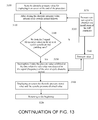
- a procedure to measure diastolic arterial pressure using an indirect method which controls the activities of a device applying a measured gradual external contact force (ApFGM) which, in this embodiment, is a cuff joined to a pressure sensor; an arterial expression sensor (SMA) which in this embodiment is a flow sensor; a device for measuring and detecting arterial cycle diastolic period and systolic period (MDCA), which in this embodiment is an electronic motherboard basically operating, as seen in Figure 13 , in two loops and two subsystems, a first loop and subsystem 3190 to control and measure arterial pressure and a second loop and subsystem 3010 to collect, prepare and analyze the signal data received from the arterial expression sensor SMA 3020.
- ApFGM measured gradual external contact force
- SMA arterial expression sensor
- MDCA device for measuring and detecting arterial cycle diastolic period and systolic period
- This embodiment of the invention includes measuring diastolic and systolic arterial pressure based on the diastolic and systolic periods, respectively, of an arterial cycle. Such measurements are performed through the procedure to measure diastolic arterial pressure using an indirect method (MIPAD) which controls the activities of the ApFGM, SMA, and MDCA devices, until obtaining the measurement of diastolic arterial pressure and additionally the systolic arterial pressure in the systolic period with no overpressure due to heartbeats produced after arterial occlusion.
- MIPAD indirect method
- the following procedure preferably uses as the device applying a measured gradual external contact force (ApFGM) a cuff joined to a pressure sensor and it uses as arterial expression sensor (SMA) in this embodiment a flow sensor.
- ApFGM measured gradual external contact force
- SMA arterial expression sensor
- it may be used as ApFGM any device allowing to apply pressure, such as a tip or a clip and, as SMA, any device allowing to detect and measure changes in pressure, changes in flow movement, changes in speed, changes in temperature, changes in volume, changes in viscosity, changes in mass and density, as well as changes in the artery segment or cross section area, changes in diameter, changes in perimeter, changes in length, changes in parietal pressure, and changes in vibrations.
- the system and method for measuring arterial pressure by its effects integrating MIPAD, ApFGM, SMA, and MDCA comprises the following stages:
- systolic arterial pressure is measured by equaling the force applied to the measurable artery to the magnitude of the forced applied by blood on the arterial wall in the systolic period without overpressure due to heartbeats produced after arterial occlusion.
- the system verifies first if there are at least three values equal to zero or with a minimum range in the diastolic period 3080 and, secondly, at least three values equal to zero or with a minimum range in the systolic period 3140 and a decision is then made in order to determine the value or data found in the pressure sensor 3120, 3180 and determine the diastolic and systolic pressure value.
- a decision is then made in order to determine the value or data found in the pressure sensor 3120, 3180 and determine the diastolic and systolic pressure value.
- For the first interruption 3090 in taking the pressure sensor storage value we use the first value of the three values found in the diastolic period which are equal to zero. We then take the first value of the three values that are equal to zero in the systolic period for the second interruption 3150, which takes the pressure sensor value at this time.
- the MIPAD using as SMA a pressure sensor and the oscillometric method; recording and analyzing signals.
- Pressure oscillation signal for arterial cycle systolic period in this stage disappears and only supramaximal pressure oscillation signals remain, since the external pressure being applied at this moment overcomes the pressure applied by blood on the arterial wall.
- the pulse wave in the adjacent artery transmits to the device applying a measured gradual external contact force the supramaximal arterial pulse waves being detected with the pressure sensor, which are considered to be as the minimum reference range or value or zero.
- systolic arterial pressure is measured by equaling the force applied to the measurable artery to the magnitude of the force applied by the blood on the arterial wall.
- MDA arterial clearing method
- MDA first stage Using an electronic device for processing, analysis and recording of arterial expression, it records and analyzes arterial expression sensor board signals and the board of a device applying a measured gradual external contact force. Placing the arterial expression sensor and the device applying a measured gradual external contact force on the measurable artery, applying a force on the measurable artery until it is obliterated.
- the arterial expression sensor is a pressure sensor and the oscillometric method
- the signals from this sensor shall be recorded and analyzed, since the pressure sensor oscillation signal includes the arterial expression signal from the arterial cycle systolic period and diastolic period and the signal of the device applying a measured gradual external contact force.
- MDA second stage It consists of eliminating the measured gradual external force applied on the measurable artery, recording and analyzing signals in the same manner as in the arterial clearing first stage, including its additional form with the pressure sensor and oscillometric method, until detecting arterial expressions corresponding to the fact that the arterial systolic blood flow has overcame the external force applied.
- MDA third stage It consists of continuing to eliminate the measured gradual external force applied on the measurable artery, and recording and analyzing signals in the same manner as in the arterial clearing first stage, including its additional form with the pressure sensor and oscillometric method, until detecting arterial expressions corresponding to the fact that the arterial blood flow in the arterial cycle diastolic period has overcame the external force applied. At this time, diastolic arterial pressure is measured, which is able to overcome the external contact force applied on the artery.
- the arterial expression sensor is a pressure sensor and the method to be used is the oscillometric one; recording and analyzing signals using such an electronic device from the first stage based on the pressure sensor, since the pressure sensor oscillation signal includes the signal from the device applying a measured gradual external contact force.
- the pressure sensor oscillation signal includes the signal from the device applying a measured gradual external contact force.
- oscillations of arterial pressure corresponding to the appearance of the arterial cycle diastolic arterial pressure are detected, and diastolic arterial pressure is measured since it has overcame the external force applied to the measurable artery by detecting the appearance of an oscillation in the diastolic period in addition to the one existing in the arterial cycle systolic period.
- the same diastolic arterial pressure measurement may optionally be made in this third stage of arterial clearing by identifying the following arterial expressions and using the following sensors:
Landscapes
- Health & Medical Sciences (AREA)
- Life Sciences & Earth Sciences (AREA)
- Vascular Medicine (AREA)
- Cardiology (AREA)
- Biomedical Technology (AREA)
- Heart & Thoracic Surgery (AREA)
- Physiology (AREA)
- Biophysics (AREA)
- Pathology (AREA)
- Engineering & Computer Science (AREA)
- Ophthalmology & Optometry (AREA)
- Physics & Mathematics (AREA)
- Medical Informatics (AREA)
- Molecular Biology (AREA)
- Surgery (AREA)
- Animal Behavior & Ethology (AREA)
- General Health & Medical Sciences (AREA)
- Public Health (AREA)
- Veterinary Medicine (AREA)
- Measuring Pulse, Heart Rate, Blood Pressure Or Blood Flow (AREA)
Applications Claiming Priority (1)
| Application Number | Priority Date | Filing Date | Title |
|---|---|---|---|
| PCT/MX2010/000003 WO2011087347A1 (fr) | 2010-01-12 | 2010-01-12 | Système et procédé pour mesurer la pression artérielle par ses effets |
Publications (3)
| Publication Number | Publication Date |
|---|---|
| EP2524646A1 true EP2524646A1 (fr) | 2012-11-21 |
| EP2524646A4 EP2524646A4 (fr) | 2016-12-14 |
| EP2524646B1 EP2524646B1 (fr) | 2020-09-02 |
Family
ID=44304452
Family Applications (1)
| Application Number | Title | Priority Date | Filing Date |
|---|---|---|---|
| EP10843299.8A Not-in-force EP2524646B1 (fr) | 2010-01-12 | 2010-01-12 | Système et procédé pour mesurer la pression artérielle par ses effets |
Country Status (12)
| Country | Link |
|---|---|
| US (1) | US10653325B2 (fr) |
| EP (1) | EP2524646B1 (fr) |
| JP (1) | JP5698765B2 (fr) |
| KR (1) | KR101690250B1 (fr) |
| CN (1) | CN102711598B (fr) |
| AU (2) | AU2010341901B2 (fr) |
| BR (1) | BR112012017251B8 (fr) |
| CA (1) | CA2786248A1 (fr) |
| IL (2) | IL220930A (fr) |
| MX (1) | MX2012007315A (fr) |
| RU (1) | RU2535909C2 (fr) |
| WO (1) | WO2011087347A1 (fr) |
Cited By (1)
| Publication number | Priority date | Publication date | Assignee | Title |
|---|---|---|---|---|
| CN103083004A (zh) * | 2013-02-06 | 2013-05-08 | 青岛盛福电子有限公司 | 电子血压计 |
Families Citing this family (3)
| Publication number | Priority date | Publication date | Assignee | Title |
|---|---|---|---|---|
| RU2644299C1 (ru) * | 2016-10-25 | 2018-02-08 | Федеральное государственное бюджетное образовательное учреждение высшего образования "Тамбовский государственный технический университет" (ФГБОУ ВО "ТГТУ") | Осциллографический способ измерения артериального давления |
| RU2638712C1 (ru) * | 2016-11-07 | 2017-12-15 | Федеральное государственное бюджетное учреждение науки Институт радиотехники и электроники им. В.А. Котельникова Российской академии наук | Пневматический сенсор для непрерывного неинвазивного измерения артериального давления |
| RU2652070C1 (ru) * | 2017-05-16 | 2018-04-24 | Общество с ограниченной ответственностью "ПроМЕД" (ООО "ПроМЕД") | Электронный тонометр |
Family Cites Families (23)
| Publication number | Priority date | Publication date | Assignee | Title |
|---|---|---|---|---|
| US1982505A (en) * | 1932-12-30 | 1934-11-27 | George B Emerson | Arteriomanometer |
| US3744490A (en) * | 1971-11-16 | 1973-07-10 | H Fernandez | Automatic device for recording blood pressure |
| JPS5470678A (en) * | 1977-11-15 | 1979-06-06 | Matsushita Electric Works Ltd | Automatic digital hemadynamometer |
| DE3014219C2 (de) * | 1980-02-18 | 1982-12-09 | Asulab AG, 2502 Bienne | Blutdruckmeßeinrichtung mit einem Mikrofon |
| JPS5975036A (ja) * | 1982-10-22 | 1984-04-27 | 学校法人 東海大学 | 血圧測定装置 |
| JPS61284230A (ja) * | 1985-06-11 | 1986-12-15 | 株式会社 スズケン | 自動血圧測定装置 |
| JPH0751123B2 (ja) * | 1987-06-25 | 1995-06-05 | オムロン株式会社 | 指用電子血圧計 |
| JP2576451B2 (ja) * | 1988-03-15 | 1997-01-29 | オムロン株式会社 | 電子血圧計 |
| US4873987A (en) * | 1988-06-30 | 1989-10-17 | Ljubomir Djordjevich | Noninvasive continuous monitor of arterial blood pressure waveform |
| US5103830A (en) * | 1989-10-05 | 1992-04-14 | Terumo Kabushiki Kaisha | Electronic sphygmomanometer |
| US5651369A (en) * | 1992-01-13 | 1997-07-29 | Tomita; Mitsuei | Apparatus for detecting and displaying blood circulatory information |
| US5533511A (en) * | 1994-01-05 | 1996-07-09 | Vital Insite, Incorporated | Apparatus and method for noninvasive blood pressure measurement |
| US5590661A (en) * | 1994-07-29 | 1997-01-07 | Colin Corporation | Blood pressure measuring apparatus |
| JPH08280641A (ja) * | 1995-04-10 | 1996-10-29 | A & D Co Ltd | 血圧計 |
| US6730038B2 (en) * | 2002-02-05 | 2004-05-04 | Tensys Medical, Inc. | Method and apparatus for non-invasively measuring hemodynamic parameters using parametrics |
| DE20310220U1 (de) * | 2003-07-03 | 2003-09-04 | Braun GmbH, 61476 Kronberg | Sensor zur Detektion der Pulswellenformen in Arterien |
| MX2007006055A (es) | 2004-11-18 | 2008-02-22 | Graham Packaging Co | Agrupacion de varios recipientes y metodo para formarla. |
| DE102004062435A1 (de) * | 2004-12-20 | 2006-06-29 | Braun Gmbh | Verfahren und Vorrichtung zur nicht-invasiven Detektion des Blutflusses und davon abhängiger Parameter in Arterien, insbesondere der arteriellen Wellenform und des Blutdruckes |
| RU2299006C2 (ru) * | 2005-04-26 | 2007-05-20 | Государственное образовательное учреждение высшего профессионального образования "Самарский государственный аэрокосмический университет им. академика С.П. Королева" | Способ диагностики артериальной гипертензии, вызванной беременностью |
| WO2007064654A1 (fr) * | 2005-11-29 | 2007-06-07 | Massachusetts Institute Of Technology | Appareil et procede de mesure de la tension arterielle au toucher |
| US7717855B2 (en) * | 2006-12-06 | 2010-05-18 | The Hospital For Sick Children | System for performing remote ischemic preconditioning |
| US20100106029A1 (en) * | 2007-03-28 | 2010-04-29 | Kaz, Incorporated | Arterial blood pressure monitor with a liquid filled cuff |
| GB2465787B (en) * | 2008-11-28 | 2011-04-06 | Royal United Hospital Bath Nhs Trust | Method of measuring blood pressure and apparatus for performing the same |
-
2010
- 2010-01-12 EP EP10843299.8A patent/EP2524646B1/fr not_active Not-in-force
- 2010-01-12 RU RU2012134385/14A patent/RU2535909C2/ru active
- 2010-01-12 WO PCT/MX2010/000003 patent/WO2011087347A1/fr not_active Ceased
- 2010-01-12 KR KR1020127021258A patent/KR101690250B1/ko not_active Expired - Fee Related
- 2010-01-12 CA CA2786248A patent/CA2786248A1/fr not_active Abandoned
- 2010-01-12 AU AU2010341901A patent/AU2010341901B2/en not_active Ceased
- 2010-01-12 CN CN201080061312.3A patent/CN102711598B/zh not_active Expired - Fee Related
- 2010-01-12 JP JP2012548905A patent/JP5698765B2/ja not_active Expired - Fee Related
- 2010-01-12 BR BR112012017251A patent/BR112012017251B8/pt not_active IP Right Cessation
- 2010-01-12 US US12/866,854 patent/US10653325B2/en not_active Expired - Fee Related
-
2012
- 2012-06-21 MX MX2012007315A patent/MX2012007315A/es active IP Right Grant
- 2012-07-12 IL IL220930A patent/IL220930A/en active IP Right Grant
-
2015
- 2015-07-09 IL IL239883A patent/IL239883A/en active IP Right Grant
- 2015-10-29 AU AU2015249117A patent/AU2015249117B2/en not_active Ceased
Non-Patent Citations (1)
| Title |
|---|
| See references of WO2011087347A1 * |
Cited By (1)
| Publication number | Priority date | Publication date | Assignee | Title |
|---|---|---|---|---|
| CN103083004A (zh) * | 2013-02-06 | 2013-05-08 | 青岛盛福电子有限公司 | 电子血压计 |
Also Published As
| Publication number | Publication date |
|---|---|
| US10653325B2 (en) | 2020-05-19 |
| CN102711598B (zh) | 2016-03-16 |
| BR112012017251B8 (pt) | 2021-06-22 |
| AU2015249117A1 (en) | 2015-11-12 |
| RU2012134385A (ru) | 2014-02-20 |
| JP2013517047A (ja) | 2013-05-16 |
| CN102711598A (zh) | 2012-10-03 |
| CA2786248A1 (fr) | 2011-07-21 |
| JP5698765B2 (ja) | 2015-04-08 |
| KR101690250B1 (ko) | 2017-01-09 |
| AU2010341901A1 (en) | 2012-08-30 |
| AU2015249117B2 (en) | 2017-08-17 |
| IL220930A (en) | 2015-10-29 |
| US20120022383A1 (en) | 2012-01-26 |
| IL239883A (en) | 2017-08-31 |
| AU2010341901B2 (en) | 2016-02-18 |
| EP2524646B1 (fr) | 2020-09-02 |
| MX2012007315A (es) | 2012-07-04 |
| KR20120120300A (ko) | 2012-11-01 |
| WO2011087347A1 (fr) | 2011-07-21 |
| BR112012017251A2 (pt) | 2020-08-18 |
| RU2535909C2 (ru) | 2014-12-20 |
| HK1175090A1 (zh) | 2013-06-28 |
| IL239883A0 (en) | 2015-08-31 |
| EP2524646A4 (fr) | 2016-12-14 |
| BR112012017251B1 (pt) | 2021-03-02 |
Similar Documents
| Publication | Publication Date | Title |
|---|---|---|
| EP0389579B1 (fr) | Controle continu non invasif des formes d'onde de la tension arterielle | |
| CA1259818A (fr) | Dispositif etalonne pour la mesure de la pression arterielle | |
| KR101577343B1 (ko) | 혈압 추정 방법 및 장치 | |
| JPWO1994022363A1 (ja) | 電子血圧測定装置 | |
| AU2015249117B2 (en) | System and method for the measurement of arterial pressure through the effects thereof | |
| KR101604078B1 (ko) | 저가압 혈압 측정 장치 및 방법 | |
| US20060224070A1 (en) | System and method for non-invasive cardiovascular assessment from supra-systolic signals obtained with a wideband external pulse transducer in a blood pressure cuff | |
| Kenner | Arterial blood pressure and its measurement | |
| KR20100126127A (ko) | 가변 특성비를 이용하는 혈압 추정 장치 및 방법 | |
| KR100951777B1 (ko) | 혈액의 점도를 고려한 심장 모니터링 장치 | |
| US20030069490A1 (en) | Pulse-wave-characteristic-point determining apparatus, and pulse-wave-propagation-velocity-related-information obtaining apparatus employing the pulse-wave-characteristic-point determining apparatus | |
| JPH07124129A (ja) | 循環器機能計測装置 | |
| US8409105B2 (en) | Device for non-invasive measurement of blood pressure and ankle-brachial index | |
| GB2456947A (en) | Non invasive determination of stroke volume based on incident wave suprasystolic blood pressure amplitude | |
| HK1175090B (en) | System and method for the measurement of arterial pressure through the effects thereof | |
| Sidhu et al. | Comparison of artificial intelligence based oscillometric blood pressure estimation techniques: a review paper | |
| WO1999039634A1 (fr) | Procede et dispositif permettant de mesurer la pression arterielle | |
| US20070016087A1 (en) | Method for acquisition and display of non-invasive blood pressure | |
| CN118252483A (zh) | 一种主动脉式脉搏波传导速度测量装置及测量方法 | |
| Vachtsevanos et al. | Correlation study of arterial blood pressure level to the amplitude of the pressure pulse waveform | |
| CD et al. | Auscultatory and Oscillometric methods of Blood pressure measurement: a Survey |
Legal Events
| Date | Code | Title | Description |
|---|---|---|---|
| PUAI | Public reference made under article 153(3) epc to a published international application that has entered the european phase |
Free format text: ORIGINAL CODE: 0009012 |
|
| 17P | Request for examination filed |
Effective date: 20120704 |
|
| AK | Designated contracting states |
Kind code of ref document: A1 Designated state(s): AT BE BG CH CY CZ DE DK EE ES FI FR GB GR HR HU IE IS IT LI LT LU LV MC MK MT NL NO PL PT RO SE SI SK SM TR |
|
| DAX | Request for extension of the european patent (deleted) | ||
| RA4 | Supplementary search report drawn up and despatched (corrected) |
Effective date: 20161116 |
|
| RIC1 | Information provided on ipc code assigned before grant |
Ipc: A61B 5/022 20060101AFI20161110BHEP |
|
| STAA | Information on the status of an ep patent application or granted ep patent |
Free format text: STATUS: EXAMINATION IS IN PROGRESS |
|
| 17Q | First examination report despatched |
Effective date: 20170714 |
|
| GRAP | Despatch of communication of intention to grant a patent |
Free format text: ORIGINAL CODE: EPIDOSNIGR1 |
|
| STAA | Information on the status of an ep patent application or granted ep patent |
Free format text: STATUS: GRANT OF PATENT IS INTENDED |
|
| INTG | Intention to grant announced |
Effective date: 20200203 |
|
| GRAS | Grant fee paid |
Free format text: ORIGINAL CODE: EPIDOSNIGR3 |
|
| GRAA | (expected) grant |
Free format text: ORIGINAL CODE: 0009210 |
|
| STAA | Information on the status of an ep patent application or granted ep patent |
Free format text: STATUS: THE PATENT HAS BEEN GRANTED |
|
| AK | Designated contracting states |
Kind code of ref document: B1 Designated state(s): AT BE BG CH CY CZ DE DK EE ES FI FR GB GR HR HU IE IS IT LI LT LU LV MC MK MT NL NO PL PT RO SE SI SK SM TR |
|
| REG | Reference to a national code |
Ref country code: GB Ref legal event code: FG4D |
|
| REG | Reference to a national code |
Ref country code: AT Ref legal event code: REF Ref document number: 1307842 Country of ref document: AT Kind code of ref document: T Effective date: 20200915 Ref country code: CH Ref legal event code: EP |
|
| REG | Reference to a national code |
Ref country code: DE Ref legal event code: R096 Ref document number: 602010065364 Country of ref document: DE |
|
| REG | Reference to a national code |
Ref country code: IE Ref legal event code: FG4D |
|
| REG | Reference to a national code |
Ref country code: LT Ref legal event code: MG4D |
|
| PG25 | Lapsed in a contracting state [announced via postgrant information from national office to epo] |
Ref country code: HR Free format text: LAPSE BECAUSE OF FAILURE TO SUBMIT A TRANSLATION OF THE DESCRIPTION OR TO PAY THE FEE WITHIN THE PRESCRIBED TIME-LIMIT Effective date: 20200902 Ref country code: LT Free format text: LAPSE BECAUSE OF FAILURE TO SUBMIT A TRANSLATION OF THE DESCRIPTION OR TO PAY THE FEE WITHIN THE PRESCRIBED TIME-LIMIT Effective date: 20200902 Ref country code: GR Free format text: LAPSE BECAUSE OF FAILURE TO SUBMIT A TRANSLATION OF THE DESCRIPTION OR TO PAY THE FEE WITHIN THE PRESCRIBED TIME-LIMIT Effective date: 20201203 Ref country code: BG Free format text: LAPSE BECAUSE OF FAILURE TO SUBMIT A TRANSLATION OF THE DESCRIPTION OR TO PAY THE FEE WITHIN THE PRESCRIBED TIME-LIMIT Effective date: 20201202 Ref country code: SE Free format text: LAPSE BECAUSE OF FAILURE TO SUBMIT A TRANSLATION OF THE DESCRIPTION OR TO PAY THE FEE WITHIN THE PRESCRIBED TIME-LIMIT Effective date: 20200902 Ref country code: NO Free format text: LAPSE BECAUSE OF FAILURE TO SUBMIT A TRANSLATION OF THE DESCRIPTION OR TO PAY THE FEE WITHIN THE PRESCRIBED TIME-LIMIT Effective date: 20201202 Ref country code: FI Free format text: LAPSE BECAUSE OF FAILURE TO SUBMIT A TRANSLATION OF THE DESCRIPTION OR TO PAY THE FEE WITHIN THE PRESCRIBED TIME-LIMIT Effective date: 20200902 |
|
| REG | Reference to a national code |
Ref country code: NL Ref legal event code: MP Effective date: 20200902 |
|
| REG | Reference to a national code |
Ref country code: AT Ref legal event code: MK05 Ref document number: 1307842 Country of ref document: AT Kind code of ref document: T Effective date: 20200902 |
|
| PG25 | Lapsed in a contracting state [announced via postgrant information from national office to epo] |
Ref country code: PL Free format text: LAPSE BECAUSE OF FAILURE TO SUBMIT A TRANSLATION OF THE DESCRIPTION OR TO PAY THE FEE WITHIN THE PRESCRIBED TIME-LIMIT Effective date: 20200902 Ref country code: LV Free format text: LAPSE BECAUSE OF FAILURE TO SUBMIT A TRANSLATION OF THE DESCRIPTION OR TO PAY THE FEE WITHIN THE PRESCRIBED TIME-LIMIT Effective date: 20200902 |
|
| PG25 | Lapsed in a contracting state [announced via postgrant information from national office to epo] |
Ref country code: NL Free format text: LAPSE BECAUSE OF FAILURE TO SUBMIT A TRANSLATION OF THE DESCRIPTION OR TO PAY THE FEE WITHIN THE PRESCRIBED TIME-LIMIT Effective date: 20200902 Ref country code: PT Free format text: LAPSE BECAUSE OF FAILURE TO SUBMIT A TRANSLATION OF THE DESCRIPTION OR TO PAY THE FEE WITHIN THE PRESCRIBED TIME-LIMIT Effective date: 20210104 Ref country code: SM Free format text: LAPSE BECAUSE OF FAILURE TO SUBMIT A TRANSLATION OF THE DESCRIPTION OR TO PAY THE FEE WITHIN THE PRESCRIBED TIME-LIMIT Effective date: 20200902 Ref country code: RO Free format text: LAPSE BECAUSE OF FAILURE TO SUBMIT A TRANSLATION OF THE DESCRIPTION OR TO PAY THE FEE WITHIN THE PRESCRIBED TIME-LIMIT Effective date: 20200902 Ref country code: CZ Free format text: LAPSE BECAUSE OF FAILURE TO SUBMIT A TRANSLATION OF THE DESCRIPTION OR TO PAY THE FEE WITHIN THE PRESCRIBED TIME-LIMIT Effective date: 20200902 Ref country code: EE Free format text: LAPSE BECAUSE OF FAILURE TO SUBMIT A TRANSLATION OF THE DESCRIPTION OR TO PAY THE FEE WITHIN THE PRESCRIBED TIME-LIMIT Effective date: 20200902 |
|
| PG25 | Lapsed in a contracting state [announced via postgrant information from national office to epo] |
Ref country code: IS Free format text: LAPSE BECAUSE OF FAILURE TO SUBMIT A TRANSLATION OF THE DESCRIPTION OR TO PAY THE FEE WITHIN THE PRESCRIBED TIME-LIMIT Effective date: 20210102 Ref country code: ES Free format text: LAPSE BECAUSE OF FAILURE TO SUBMIT A TRANSLATION OF THE DESCRIPTION OR TO PAY THE FEE WITHIN THE PRESCRIBED TIME-LIMIT Effective date: 20200902 Ref country code: AT Free format text: LAPSE BECAUSE OF FAILURE TO SUBMIT A TRANSLATION OF THE DESCRIPTION OR TO PAY THE FEE WITHIN THE PRESCRIBED TIME-LIMIT Effective date: 20200902 |
|
| REG | Reference to a national code |
Ref country code: DE Ref legal event code: R097 Ref document number: 602010065364 Country of ref document: DE |
|
| PG25 | Lapsed in a contracting state [announced via postgrant information from national office to epo] |
Ref country code: SK Free format text: LAPSE BECAUSE OF FAILURE TO SUBMIT A TRANSLATION OF THE DESCRIPTION OR TO PAY THE FEE WITHIN THE PRESCRIBED TIME-LIMIT Effective date: 20200902 |
|
| PLBE | No opposition filed within time limit |
Free format text: ORIGINAL CODE: 0009261 |
|
| STAA | Information on the status of an ep patent application or granted ep patent |
Free format text: STATUS: NO OPPOSITION FILED WITHIN TIME LIMIT |
|
| REG | Reference to a national code |
Ref country code: DE Ref legal event code: R119 Ref document number: 602010065364 Country of ref document: DE |
|
| 26N | No opposition filed |
Effective date: 20210603 |
|
| PG25 | Lapsed in a contracting state [announced via postgrant information from national office to epo] |
Ref country code: SI Free format text: LAPSE BECAUSE OF FAILURE TO SUBMIT A TRANSLATION OF THE DESCRIPTION OR TO PAY THE FEE WITHIN THE PRESCRIBED TIME-LIMIT Effective date: 20200902 Ref country code: DK Free format text: LAPSE BECAUSE OF FAILURE TO SUBMIT A TRANSLATION OF THE DESCRIPTION OR TO PAY THE FEE WITHIN THE PRESCRIBED TIME-LIMIT Effective date: 20200902 Ref country code: MC Free format text: LAPSE BECAUSE OF FAILURE TO SUBMIT A TRANSLATION OF THE DESCRIPTION OR TO PAY THE FEE WITHIN THE PRESCRIBED TIME-LIMIT Effective date: 20200902 |
|
| REG | Reference to a national code |
Ref country code: CH Ref legal event code: PL |
|
| GBPC | Gb: european patent ceased through non-payment of renewal fee |
Effective date: 20210112 |
|
| PG25 | Lapsed in a contracting state [announced via postgrant information from national office to epo] |
Ref country code: LU Free format text: LAPSE BECAUSE OF NON-PAYMENT OF DUE FEES Effective date: 20210112 |
|
| REG | Reference to a national code |
Ref country code: BE Ref legal event code: MM Effective date: 20210131 |
|
| PG25 | Lapsed in a contracting state [announced via postgrant information from national office to epo] |
Ref country code: FR Free format text: LAPSE BECAUSE OF NON-PAYMENT OF DUE FEES Effective date: 20210131 Ref country code: IT Free format text: LAPSE BECAUSE OF FAILURE TO SUBMIT A TRANSLATION OF THE DESCRIPTION OR TO PAY THE FEE WITHIN THE PRESCRIBED TIME-LIMIT Effective date: 20200902 |
|
| PG25 | Lapsed in a contracting state [announced via postgrant information from national office to epo] |
Ref country code: LI Free format text: LAPSE BECAUSE OF NON-PAYMENT OF DUE FEES Effective date: 20210131 Ref country code: GB Free format text: LAPSE BECAUSE OF NON-PAYMENT OF DUE FEES Effective date: 20210112 Ref country code: DE Free format text: LAPSE BECAUSE OF NON-PAYMENT OF DUE FEES Effective date: 20210803 Ref country code: CH Free format text: LAPSE BECAUSE OF NON-PAYMENT OF DUE FEES Effective date: 20210131 |
|
| PG25 | Lapsed in a contracting state [announced via postgrant information from national office to epo] |
Ref country code: IE Free format text: LAPSE BECAUSE OF NON-PAYMENT OF DUE FEES Effective date: 20210112 |
|
| PG25 | Lapsed in a contracting state [announced via postgrant information from national office to epo] |
Ref country code: IS Free format text: LAPSE BECAUSE OF FAILURE TO SUBMIT A TRANSLATION OF THE DESCRIPTION OR TO PAY THE FEE WITHIN THE PRESCRIBED TIME-LIMIT Effective date: 20210102 |
|
| PG25 | Lapsed in a contracting state [announced via postgrant information from national office to epo] |
Ref country code: BE Free format text: LAPSE BECAUSE OF NON-PAYMENT OF DUE FEES Effective date: 20210131 |
|
| PG25 | Lapsed in a contracting state [announced via postgrant information from national office to epo] |
Ref country code: HU Free format text: LAPSE BECAUSE OF FAILURE TO SUBMIT A TRANSLATION OF THE DESCRIPTION OR TO PAY THE FEE WITHIN THE PRESCRIBED TIME-LIMIT; INVALID AB INITIO Effective date: 20100112 Ref country code: CY Free format text: LAPSE BECAUSE OF FAILURE TO SUBMIT A TRANSLATION OF THE DESCRIPTION OR TO PAY THE FEE WITHIN THE PRESCRIBED TIME-LIMIT Effective date: 20200902 |
|
| PG25 | Lapsed in a contracting state [announced via postgrant information from national office to epo] |
Ref country code: MK Free format text: LAPSE BECAUSE OF FAILURE TO SUBMIT A TRANSLATION OF THE DESCRIPTION OR TO PAY THE FEE WITHIN THE PRESCRIBED TIME-LIMIT Effective date: 20200902 |
|
| PG25 | Lapsed in a contracting state [announced via postgrant information from national office to epo] |
Ref country code: TR Free format text: LAPSE BECAUSE OF FAILURE TO SUBMIT A TRANSLATION OF THE DESCRIPTION OR TO PAY THE FEE WITHIN THE PRESCRIBED TIME-LIMIT Effective date: 20200902 |
|
| PG25 | Lapsed in a contracting state [announced via postgrant information from national office to epo] |
Ref country code: MT Free format text: LAPSE BECAUSE OF FAILURE TO SUBMIT A TRANSLATION OF THE DESCRIPTION OR TO PAY THE FEE WITHIN THE PRESCRIBED TIME-LIMIT Effective date: 20200902 |