EP2525582A2 - Appareil et procédé pour convertir un contenu 2D en contenu 3D et support de stockage lisible sur ordinateur correspondant - Google Patents
Appareil et procédé pour convertir un contenu 2D en contenu 3D et support de stockage lisible sur ordinateur correspondant Download PDFInfo
- Publication number
- EP2525582A2 EP2525582A2 EP20110190016 EP11190016A EP2525582A2 EP 2525582 A2 EP2525582 A2 EP 2525582A2 EP 20110190016 EP20110190016 EP 20110190016 EP 11190016 A EP11190016 A EP 11190016A EP 2525582 A2 EP2525582 A2 EP 2525582A2
- Authority
- EP
- European Patent Office
- Prior art keywords
- contents
- key frame
- depth
- frame
- frames
- Prior art date
- Legal status (The legal status is an assumption and is not a legal conclusion. Google has not performed a legal analysis and makes no representation as to the accuracy of the status listed.)
- Withdrawn
Links
Images


Classifications
-
- H—ELECTRICITY
- H04—ELECTRIC COMMUNICATION TECHNIQUE
- H04N—PICTORIAL COMMUNICATION, e.g. TELEVISION
- H04N13/00—Stereoscopic video systems; Multi-view video systems; Details thereof
- H04N13/20—Image signal generators
- H04N13/261—Image signal generators with monoscopic-to-stereoscopic image conversion
-
- H—ELECTRICITY
- H04—ELECTRIC COMMUNICATION TECHNIQUE
- H04N—PICTORIAL COMMUNICATION, e.g. TELEVISION
- H04N13/00—Stereoscopic video systems; Multi-view video systems; Details thereof
Definitions
- one or more exemplary embodiments provide an apparatus and method for converting 2D contents into high quality 3D contents at a low cost, and a computer-readable medium thereof.
- the performing the tracking may include assigning depth to the other frame on the basis of the depth assigned to the key frame.
- At least one of the extracting the object and the assigning the depth may be performed on the basis of information about contents and development of a scene in the frame to be processed.
- At least one of the extracting the object and the assigning the depth may be performed in accordance with an input of a user.
- the converter may perform the tracking by assigning depth to the other frame on the basis of the depth assigned to the object of the key frame.
- the apparatus may further include a user input unit to receive an input of a user, wherein the converter performs at least one of extracting the object and assigning the depth in accordance with the input of the user.
- the selecting the key frame may include selecting the key frame on the basis of motion of an image in the frame.
- the performing the tracking may include assigning depth to the other frame on the basis of the depth assigned to the object of the key frame.
- At least one of the extracting the object and the assigning the depth may be performed on the basis of information about contents and development of a scene in the frame to be processed.
- At least one of the extracting the object and the assigning the depth may be performed in accordance with an input of a user.
- the method may further include performing a 3D picture quality operation with regard to the rendered key frame and the rendered other frame.
- a method of converting 2D contents into 3D contents through a content converting apparatus including: determining a key frame from among plural frames of the 2D contents, the 2D contents being video contents; and assigning depth to another frame, from among the plural frames, according to depth assigned to an object of the key frame.
- the content converting apparatus 1 may receive 2D contents from a 3D content provider (not shown).
- the 3D content provider may transmit 2D contents to the content converting apparatus 1, receive 3D contents converted by the content converting apparatus 1, and provide the received 3D contents to a predetermined user terminal (not shown).
- the user terminal is capable of displaying 3D contents received from the content converting apparatus 1 as a 3D image.
- the user terminal may include a television (TV), a personal computer (PC), a smart phone, a smart pad, a PMP, an MP3 player, etc.
- the content converting apparatus 1 may transmit the converted 3D contents to the user terminal capable of displaying the 3D contents as a 3D image.
- the content converting apparatus 1 may provide 3D contents to the user terminal through a network.
- a network communication method such as a wired and/or wireless communication method as long as the method is for data communication to transmit at least one of 2D contents and 3D contents.
- the network communication method includes any known communication methods.
- the content converting apparatus 1 may include a converter 11 and a communication unit 14.
- the converter 11 converts 2D contents into 3D contents.
- the 2D contents include a plurality of video frames (hereinafter, referred to as a 'frame').
- the 3D contents are based on a viewer's binocular parallax, which may include a plurality of left-eye frames and a plurality of right-eye frames.
- a pair including a left-eye frame and a right-eye frame may be respectively converted from at least one corresponding frame among the plurality of frames of the 2D contents.
- the conversion from 2D contents into 3D contents (hereinafter, referred to as '2D-3D conversion'), performed by the converter 11, will be described in detail below.
- the communication unit 14 may perform at least one of data communication between the 2D content provider and the content converting apparatus 1, data communication between the 3D content provider and the content converting apparatus 1, and data communication between the user terminal and the content converting apparatus 1.
- FIG. 2 is a flowchart showing an operation of a content converting apparatus 1 according to an exemplary embodiment.
- the operation (hereinafter, referred to as a '2D-3D converting process') of the content converting apparatus 1 may correspond to a content converting method performed by instructions of the converting program 114.
- the 2D-3D converting process may include a key frame selection operation 201, an object extraction operation 202, a depth assignment operation 203, a tracking operation 204 and a rendering operation 205.
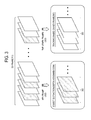
- FIG. 3 shows a selection of a key frame in a content converting apparatus according to an exemplary embodiment.
- Reference numeral 301 indicates plural frames of 2D contents to be converted.
- Reference numeral of 302 indicates a frame selected as the key frame among the plural frames 301, and reference numeral of 303 indicates the other frames.
- a frame representing contents of an image may be selected among the plural frames 301 of the 2D contents.
- the key frame 302 may include a frame where a scene is switched, a frame where a main character of a scene is closed up, etc.
- the key frame 302 may be selected on the basis of motion of an image in the corresponding frame. For example, a frame of which motion of an image is equal to or higher than a predetermined value may be selected as the key frame 302.
- an object to which a 3D effect will be reflected is extracted with regard to the selected key frame 302 (refer to 304 of FIG. 3 ).
- the object may be a main image contained in the scene of each frame and, for example, may be an image of a main character in a scene where the main character appears, an image of a vehicle in a scene where a vehicle moves, etc.
- an image of a corresponding frame is segmented so that a boundary of an object can be extracted from segmentation results.
- depth is assigned to the object extracted by the object extraction operation 202 (refer to 304 of IG. 3).
- the depth is a parameter for realizing a 3D visual effect, which is used for shifting the object leftward and rightward by an assigned parameter in generated corresponding left-eye and right-eye frames.
- a previously given standardized template may be used for depth assignment.
- a left-eye frame and a right-eye frame are generated corresponding not to the key frame 302, but to the other frames 303 (refer to 305 of FIG. 3 ).
- the tracking 204 may be performed with reference to the object extraction operation 202 and the depth assignment operation 203 performed with regard to the key frame 302.
- the main key frame 302 is selected and the object extraction operation 202 and the depth assignment operation 203 are performed with respect to the selected key frame 302. Also, the tracking 204 is applied to the other frames 303 with reference to the selected key frame 302.
- the converting process is efficient in cost and time and can be performed while keeping the quality high.
- the rendering operation 205 image processing for a completed 3D image is performed with regard to the left-eye and right-eye frames resulting from the depth assignment operation 203 and the tracking operation 204.
- the rendering operation 205 may include a process for filling a blank area generated as an object is shifted in an image of a frame (i.e., inpainting), etc.
- At least one of the 2D-3D converting process operations may be performed on the basis of information about contents and developments of a scene of a frame to be processed (hereinafter, referred to as 'storytelling information').
- the storytelling information is information to be used in realizing 3D visual effects corresponding to story development of contents in accordance with an intention of a content producer.
- the object extraction operation 202, the depth assignment operation 203, or the like operations may be performed on the basis of the storytelling information.
- the storytelling information may include information about an image of another main character to extract an object, or a vale representing an importance degree on story development to assign the depth, etc., which may be previously provided corresponding to a relevant frame and stored in the storage unit 111.
- the converter 11 may perform a conversion process operation with reference to the storytelling information stored in the storage unit 111.
- At least one operation of the 2D-3D converting process may include a manual operation implemented in accordance with a user's input, and an automatic operation implemented in accordance with preset reference information.
- a manual operation implemented in accordance with a user's input
- an automatic operation implemented in accordance with preset reference information.
- some frames may be processed by manual operations while other frames may be processed by automatic operations.
- the converting process operations may be performed in accordance with an input of a user (or a developer of performing a content converting operation).
- the content converting apparatus 1 may further include a user input unit 12 such as a keyboard, a mouse, a tablet, etc., for the input of a user.
- the content converting apparatus 1 may further include a display unit 13 such as a monitor or the like that displays an image being converted so that a user can observe a progression of the converting process.
- the content converting apparatus 1 may display a graphic user interface (GUI, not shown) containing an image of a processed frame, a predetermined input menu, etc., on the display unit 13.
- GUI graphic user interface
- a user may enter an input for the converting process through the input menu or the like of the GUI while ascertaining an image of a frame displayed on the display unit 13. For instance, a user may enter an input for extracting an object through the input menu or the like of the GUI while ascertaining the object contained in an image of a frame.
- the operations are performed on the basis of the preset reference information.
- the content converting apparatus 1 may analyze an image of a frame and select an object, of which variation in a pixel value on a boundary of a certain object within the image is equal to or higher than a predetermined threshold value, as an object to be extracted.
- the reference information may be a threshold value for the variation in the pixel value on the boundary of the object, by which the object can be selected to be extracted.
- the 2D-3D converting process operations may be performed in accordance with a quality of 3D contents.
- the quality of 3D contents may indicate how much percentage each of the manual operations and the automatic operations are.
- the manual operations and the automatic operations may each constitute half of the object extraction operation 202.
- the quality of 3D contents may be represented as a proportion (hereinafter, referred to as a 'combination proportion') of the automatic operations (or the manual operations) in the whole of a certain 2D-3D converting process operation.
- whether to perform the automatic operation or the manual operation may be determined per frame.
- the quality of 3D contents may include a plurality of quality modes.
- the 2D-2D converting process may be performed corresponding to one selected among the plurality of quality modes.
- the plurality of quality modes may include a simple mode, a basic mode, an advanced mode and an expert mode in order of higher quality.
- these quality modes may have combination proportions (e.g., the proportions of the automatic operations) of more than 85%, 85%, 70% and 50%, respectively, in the whole corresponding operation.
- the quality of 3D contents may be determined in accordance with the kinds or formats of 2D contents. For example, if the 2D contents are recently released movies, relatively high quality may be determined for the 2D contents. On the other hand, if the 2D contents are old movies, relatively low quality may be determined for the 2D contents. According to another exemplary embodiment, if the movie is a grand scale blockbuster, relatively high quality may be determined for the movie. On the other hand, the relatively low quality may be determined for a story-oriented movie. According to still another exemplary embodiment, the quality of 3D contents may be determined in accordance with genres of contents such as sports, movies, drama, etc. According to still another exemplary embodiment, the quality of 3D contents may be determined in accordance with a user's input. The user's input for determining the quality of 3D contents may be received through the user input unit 12 or received from another device via the communication unit 14.
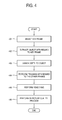
- FIG. 4 is a flowchart showing an operation of a content converting apparatus 1 according to another exemplary embodiment.
- the 2D-3D converting process operations performed by the content converting apparatus 1 of FIG. 4 may include a key frame selection operation 401, an object extraction operation 402, a depth assignment operation 403, a tracking operation 404, a rendering operation 405, and a 3D picture quality operation 406.
- a random key frame is selected among plural frames of 2D contents.
- an object is extracted with regard to the selected key frame.
- depth assignment operation 403 depth is assigned to the object extracted in the object extraction operation 402.
- tracking operation 404 a left-eye frame and a right-eye frame are generated corresponding to other frames other than the key frame.
- rendering operation 405 image processing for a completed 3D image is performed with regard to the left-eye and right-eye frames resulting from the depth assignment operation 403 and the tracking operation 404.
- the 3D picture quality operation is performed with regard to the frames resulting from the rendering operation 405.
- the 3D picture quality operation 406 may include at least one of contrast enhancement, detail enhancement, etc. Through the 3D picture quality operation 406, improvement of picture quality can be achieved when the 3D contents are actually displayed, so that the picture quality can be optimized to a display apparatus.
- an exemplary embodiment can be embodied as computer-readable code on a computer-readable recording medium.
- the computer-readable recording medium is any data storage device that can store data that can be thereafter read by a computer system. Examples of the computer-readable recording medium include read-only memory (ROM), random-access memory (RAM), CD-ROMs, magnetic tapes, floppy disks, and optical data storage devices.
- the computer-readable recording medium can also be distributed over network-coupled computer systems so that the computer-readable code is stored and executed in a distributed fashion.
- an exemplary embodiment may be written as a computer program transmitted over a computer-readable transmission medium, such as a carrier wave, and received and implemented in general-use or special-purpose digital computers that execute the programs.
- one or more units of the content converting apparatus 1 can include a processor or microprocessor executing a computer program stored in a computer-readable medium.
Landscapes
- Engineering & Computer Science (AREA)
- Multimedia (AREA)
- Signal Processing (AREA)
- Testing, Inspecting, Measuring Of Stereoscopic Televisions And Televisions (AREA)
- Image Analysis (AREA)
- Image Processing (AREA)
- Processing Or Creating Images (AREA)
Applications Claiming Priority (1)
| Application Number | Priority Date | Filing Date | Title |
|---|---|---|---|
| KR1020110045843A KR20120127992A (ko) | 2011-05-16 | 2011-05-16 | 컨텐츠변환장치, 컨텐츠변환방법 및 그 저장 매체 |
Publications (2)
| Publication Number | Publication Date |
|---|---|
| EP2525582A2 true EP2525582A2 (fr) | 2012-11-21 |
| EP2525582A3 EP2525582A3 (fr) | 2013-10-23 |
Family
ID=45002770
Family Applications (1)
| Application Number | Title | Priority Date | Filing Date |
|---|---|---|---|
| EP20110190016 Withdrawn EP2525582A3 (fr) | 2011-05-16 | 2011-11-21 | Appareil et procédé pour convertir un contenu 2D en contenu 3D et support de stockage lisible sur ordinateur correspondant |
Country Status (8)
| Country | Link |
|---|---|
| US (1) | US20120293617A1 (fr) |
| EP (1) | EP2525582A3 (fr) |
| JP (1) | JP2012244623A (fr) |
| KR (1) | KR20120127992A (fr) |
| CN (1) | CN102790897A (fr) |
| AU (1) | AU2012256626A1 (fr) |
| MX (1) | MX337087B (fr) |
| WO (1) | WO2012157833A1 (fr) |
Families Citing this family (1)
| Publication number | Priority date | Publication date | Assignee | Title |
|---|---|---|---|---|
| CN104994365B (zh) * | 2015-04-30 | 2017-09-26 | 西安电子科技大学 | 一种获取非关键帧深度图像的方法以及2d视频立体化方法 |
Family Cites Families (10)
| Publication number | Priority date | Publication date | Assignee | Title |
|---|---|---|---|---|
| MY124160A (en) * | 1997-12-05 | 2006-06-30 | Dynamic Digital Depth Res Pty | Improved image conversion and encoding techniques |
| US7116324B2 (en) * | 1998-05-27 | 2006-10-03 | In-Three, Inc. | Method for minimizing visual artifacts converting two-dimensional motion pictures into three-dimensional motion pictures |
| AU2003274951A1 (en) * | 2002-08-30 | 2004-03-19 | Orasee Corp. | Multi-dimensional image system for digital image input and output |
| KR100607072B1 (ko) * | 2004-06-21 | 2006-08-01 | 최명렬 | 2차원 영상신호를 3차원 영상신호로 변환하는 장치 및 방법 |
| KR20070095031A (ko) * | 2006-03-20 | 2007-09-28 | 정기철 | 오프라인 이차원 이미지를 3차원 이미지로 변환 |
| KR101387212B1 (ko) * | 2007-06-12 | 2014-04-21 | 삼성전자주식회사 | 2d 영상 미디어 표준을 기반으로 3d 입체영상 파일을생성 및 재생하기 위한 시스템 및 방법 |
| US9083958B2 (en) * | 2009-08-06 | 2015-07-14 | Qualcomm Incorporated | Transforming video data in accordance with three dimensional input formats |
| KR101699920B1 (ko) * | 2009-10-07 | 2017-01-25 | 삼성전자주식회사 | 깊이 조절 방법 및 장치 |
| KR101082046B1 (ko) * | 2009-10-30 | 2011-11-10 | 엘지이노텍 주식회사 | 2차원 영상의 3차원 영상으로의 변환방법 및 그 장치 |
| KR101181962B1 (ko) * | 2009-12-24 | 2012-09-11 | 동신대학교산학협력단 | 3d 입체영상 변환장치 및 변환방법 |
-
2011
- 2011-05-16 KR KR1020110045843A patent/KR20120127992A/ko not_active Withdrawn
- 2011-11-21 EP EP20110190016 patent/EP2525582A3/fr not_active Withdrawn
-
2012
- 2012-01-04 MX MX2013013321A patent/MX337087B/es active IP Right Grant
- 2012-01-04 WO PCT/KR2012/000072 patent/WO2012157833A1/fr not_active Ceased
- 2012-01-04 AU AU2012256626A patent/AU2012256626A1/en not_active Abandoned
- 2012-02-09 CN CN2012100316202A patent/CN102790897A/zh active Pending
- 2012-03-28 US US13/432,681 patent/US20120293617A1/en not_active Abandoned
- 2012-04-09 JP JP2012088785A patent/JP2012244623A/ja not_active Withdrawn
Non-Patent Citations (1)
| Title |
|---|
| XUN CAO ET AL: "Converting 2D Video to 3D: An Efficient Path to a 3D Experience", IEEE MULTIMEDIA, IEEE SERVICE CENTER, NEW YORK, NY, US, vol. 18, no. 4, 1 April 2011 (2011-04-01), pages 12 - 17, XP011378369, ISSN: 1070-986X, DOI: 10.1109/MMUL.2011.65 * |
Also Published As
| Publication number | Publication date |
|---|---|
| MX2013013321A (es) | 2014-02-10 |
| JP2012244623A (ja) | 2012-12-10 |
| CN102790897A (zh) | 2012-11-21 |
| EP2525582A3 (fr) | 2013-10-23 |
| US20120293617A1 (en) | 2012-11-22 |
| KR20120127992A (ko) | 2012-11-26 |
| WO2012157833A1 (fr) | 2012-11-22 |
| AU2012256626A1 (en) | 2013-11-07 |
| MX337087B (es) | 2016-02-11 |
Similar Documents
| Publication | Publication Date | Title |
|---|---|---|
| EP2525581A2 (fr) | Appareil et procédé pour convertir un contenu 2D en contenu 3D et support de stockage lisible sur ordinateur correspondant | |
| EP2371139B1 (fr) | Procédé de traitement d'image et appareil associé | |
| CN102549507B (zh) | 选择视点用于在3d视频中生成附加视图 | |
| US9154772B2 (en) | Method and apparatus for converting 2D content into 3D content | |
| US20100103165A1 (en) | Image decoding method, image outputting method, and image decoding and outputting apparatuses | |
| JP2010093816A (ja) | 視覚的関心に基づいた2次元映像の3次元映像変換器および変換方法 | |
| US10127714B1 (en) | Spherical three-dimensional video rendering for virtual reality | |
| US20130070052A1 (en) | Video procesing device, system, video processing method, and video processing program capable of changing depth of stereoscopic video images | |
| EP2525588A1 (fr) | Procédé et appareil pour fournir de contenu 3D | |
| US20110242099A1 (en) | Image processing apparatus, image processing method, and program | |
| EP2525582A2 (fr) | Appareil et procédé pour convertir un contenu 2D en contenu 3D et support de stockage lisible sur ordinateur correspondant | |
| EP2566168A2 (fr) | Appareil et procédé de conversion de contenu 2D dans un contenu 3D | |
| US20120170841A1 (en) | Image processing apparatus and method | |
| JP6025740B2 (ja) | エネルギー値を用いたイメージ処理装置およびそのイメージ処理方法、並びにディスプレイ方法 | |
| EP2530940A1 (fr) | Appareil et procédé de conversion d'image en 3D et support de stockage associé | |
| US9210406B2 (en) | Apparatus and method for converting 2D content into 3D content | |
| EP4319150A1 (fr) | Procédé de détection d'image de format 3d et appareil électronique utilisant ce procédé | |
| US20250225714A1 (en) | Dynamic block decimation in v-pcc decoder |
Legal Events
| Date | Code | Title | Description |
|---|---|---|---|
| PUAI | Public reference made under article 153(3) epc to a published international application that has entered the european phase |
Free format text: ORIGINAL CODE: 0009012 |
|
| AK | Designated contracting states |
Kind code of ref document: A2 Designated state(s): AL AT BE BG CH CY CZ DE DK EE ES FI FR GB GR HR HU IE IS IT LI LT LU LV MC MK MT NL NO PL PT RO RS SE SI SK SM TR |
|
| AX | Request for extension of the european patent |
Extension state: BA ME |
|
| PUAL | Search report despatched |
Free format text: ORIGINAL CODE: 0009013 |
|
| AK | Designated contracting states |
Kind code of ref document: A3 Designated state(s): AL AT BE BG CH CY CZ DE DK EE ES FI FR GB GR HR HU IE IS IT LI LT LU LV MC MK MT NL NO PL PT RO RS SE SI SK SM TR |
|
| AX | Request for extension of the european patent |
Extension state: BA ME |
|
| RIC1 | Information provided on ipc code assigned before grant |
Ipc: H04N 13/02 20060101AFI20130917BHEP |
|
| 17P | Request for examination filed |
Effective date: 20140326 |
|
| RBV | Designated contracting states (corrected) |
Designated state(s): AL AT BE BG CH CY CZ DE DK EE ES FI FR GB GR HR HU IE IS IT LI LT LU LV MC MK MT NL NO PL PT RO RS SE SI SK SM TR |
|
| 17Q | First examination report despatched |
Effective date: 20150312 |
|
| STAA | Information on the status of an ep patent application or granted ep patent |
Free format text: STATUS: EXAMINATION IS IN PROGRESS |
|
| STAA | Information on the status of an ep patent application or granted ep patent |
Free format text: STATUS: THE APPLICATION IS DEEMED TO BE WITHDRAWN |
|
| 18D | Application deemed to be withdrawn |
Effective date: 20170601 |