EP2525647B1 - Système de manipulation de plantules - Google Patents
Système de manipulation de plantules Download PDFInfo
- Publication number
- EP2525647B1 EP2525647B1 EP10805898.3A EP10805898A EP2525647B1 EP 2525647 B1 EP2525647 B1 EP 2525647B1 EP 10805898 A EP10805898 A EP 10805898A EP 2525647 B1 EP2525647 B1 EP 2525647B1
- Authority
- EP
- European Patent Office
- Prior art keywords
- plantlet
- holder
- housing
- plantlets
- closure
- Prior art date
- Legal status (The legal status is an assumption and is not a legal conclusion. Google has not performed a legal analysis and makes no representation as to the accuracy of the status listed.)
- Active
Links
Images







Classifications
-
- A—HUMAN NECESSITIES
- A01—AGRICULTURE; FORESTRY; ANIMAL HUSBANDRY; HUNTING; TRAPPING; FISHING
- A01G—HORTICULTURE; CULTIVATION OF VEGETABLES, FLOWERS, RICE, FRUIT, VINES, HOPS OR SEAWEED; FORESTRY; WATERING
- A01G31/00—Soilless cultivation, e.g. hydroponics
- A01G31/02—Special apparatus therefor
-
- A—HUMAN NECESSITIES
- A01—AGRICULTURE; FORESTRY; ANIMAL HUSBANDRY; HUNTING; TRAPPING; FISHING
- A01G—HORTICULTURE; CULTIVATION OF VEGETABLES, FLOWERS, RICE, FRUIT, VINES, HOPS OR SEAWEED; FORESTRY; WATERING
- A01G9/00—Cultivation in receptacles, forcing-frames or greenhouses; Edging for beds, lawn or the like
- A01G9/02—Receptacles, e.g. flower-pots or boxes; Glasses for cultivating flowers
- A01G9/029—Receptacles for seedlings
-
- A—HUMAN NECESSITIES
- A01—AGRICULTURE; FORESTRY; ANIMAL HUSBANDRY; HUNTING; TRAPPING; FISHING
- A01G—HORTICULTURE; CULTIVATION OF VEGETABLES, FLOWERS, RICE, FRUIT, VINES, HOPS OR SEAWEED; FORESTRY; WATERING
- A01G9/00—Cultivation in receptacles, forcing-frames or greenhouses; Edging for beds, lawn or the like
- A01G9/02—Receptacles, e.g. flower-pots or boxes; Glasses for cultivating flowers
- A01G9/029—Receptacles for seedlings
- A01G9/0293—Seed or shoot receptacles
-
- A—HUMAN NECESSITIES
- A01—AGRICULTURE; FORESTRY; ANIMAL HUSBANDRY; HUNTING; TRAPPING; FISHING
- A01G—HORTICULTURE; CULTIVATION OF VEGETABLES, FLOWERS, RICE, FRUIT, VINES, HOPS OR SEAWEED; FORESTRY; WATERING
- A01G9/00—Cultivation in receptacles, forcing-frames or greenhouses; Edging for beds, lawn or the like
- A01G9/02—Receptacles, e.g. flower-pots or boxes; Glasses for cultivating flowers
- A01G9/029—Receptacles for seedlings
- A01G9/0297—Grids for supporting several receptacles
-
- A—HUMAN NECESSITIES
- A01—AGRICULTURE; FORESTRY; ANIMAL HUSBANDRY; HUNTING; TRAPPING; FISHING
- A01G—HORTICULTURE; CULTIVATION OF VEGETABLES, FLOWERS, RICE, FRUIT, VINES, HOPS OR SEAWEED; FORESTRY; WATERING
- A01G9/00—Cultivation in receptacles, forcing-frames or greenhouses; Edging for beds, lawn or the like
- A01G9/02—Receptacles, e.g. flower-pots or boxes; Glasses for cultivating flowers
- A01G9/0302—Receptacles consisting of separable sections, e.g. for allowing easy removal of the plant
-
- Y—GENERAL TAGGING OF NEW TECHNOLOGICAL DEVELOPMENTS; GENERAL TAGGING OF CROSS-SECTIONAL TECHNOLOGIES SPANNING OVER SEVERAL SECTIONS OF THE IPC; TECHNICAL SUBJECTS COVERED BY FORMER USPC CROSS-REFERENCE ART COLLECTIONS [XRACs] AND DIGESTS
- Y02—TECHNOLOGIES OR APPLICATIONS FOR MITIGATION OR ADAPTATION AGAINST CLIMATE CHANGE
- Y02P—CLIMATE CHANGE MITIGATION TECHNOLOGIES IN THE PRODUCTION OR PROCESSING OF GOODS
- Y02P60/00—Technologies relating to agriculture, livestock or agroalimentary industries
- Y02P60/20—Reduction of greenhouse gas [GHG] emissions in agriculture, e.g. CO2
- Y02P60/21—Dinitrogen oxide [N2O], e.g. using aquaponics, hydroponics or efficiency measures
Definitions
- This invention relates to a plantlet handling system.
- This invention has particular application to a plantlet handling system for taking plantlets from rooted or non-rooted tissue culture plantlet to a transferable state, and for illustrative purposes the invention will be described with reference to this application. However we envisage that this invention may find use in other applications such as multiple stages of culture of plantlets.
- Plant tissue culture involves growth of plants (including plantlets) under usually sterile conditions in nutrient medium in glass or plastic containers. Plantlets are typically grown in groups of up to 40 individual shoots per container. Growth is generally non-uniform due to variation in biomass and physiology of the initial explant, time to root formation, and other factors that are not always readily defined.
- shoot pieces or small plantlets can be dissected from the plantlets to be placed in new medium so that these will form roots or shoot growth for ex vitro rooting, or other tissue growth and further grow. There are often more dissected pieces (shoot tips, nodal segments, or small plantlets) than in the original container. Moreover, the plantlets from which shoot pieces have been dissected will generally form new shoots that will grow and be suitable for dissection and planting. In these processes multiplication occurs.
- Dissection operations may occur in the growth container, and frequently further dissections of single shoots into multiple pieces may also occur in the growth container, whereby any overhanging leaves or shoots from neighbouring plantlets may impede the operator's efficient access to the target plant being dissected.
- the plantlets When growth has continued sufficiently, such as when rooted shoots of adequate form are available or when the plantlet is developed enough for further ex vitro development, the plantlets may be transferred to nursery potting medium, generally requiring removal of nutrient agar as the organic nutrients generally in such agar will encourage unwanted microbial growth. This process is generally labour intensive and can be damaging to plant roots. For practicality all plants in a container are removed and if not meeting root, shoot or other specifications are generally discarded. Slow-growing plantlets generally cannot be allowed more time to grow without detriment to advanced plantlets, and reduction in efficiency.
- tissue-culture In standard tissue-culture multiple plantlets sharing one container generally have their roots interwoven throughout substantial volumes of agar in the container. Typical arrangements for tissue-culture of plants do not allow removal of more (or less) advanced individuals, re-sorting of plants into uniform batches for specific treatments or release of plantlets, without discard of plants requiring further growth.
- WO 2009/021274 there is described a method including the steps of segregating plantlets from a tissue-culture propagation medium into a root-permeable container containing a phytocompatible supporting aqueous gel medium comprising a nutrient solution gelled with an effective amount of a hydrocolloid gel-forming material, acclimating the segregated plantlets in light and air until the roots extend to the bottom of the container, and planting out the acclimated plantlet in its container.
- a plant propagation container comprising a root permeable sleeve formed of a heat sealable, non-woven cellulosic tissue material having a proportion of polyolefin fibre incorporated therein.
- This provides a plant propagation transfer method where acclimated plants are more robust than direct-planted propagants and suffer less attrition accordingly.
- the described method provides advantages over the prior art of the time.
- the container requires support in a tube or the like that requires manual separation for planting out. Accordingly it would be desirable to provide a plantlet holder that can support the plantlet between culture steps or between the final stage of propagation and planting out directly in the container, and able to be handled mechanically.
- US Patent Publication No. US 2009/0151248 A1 discloses plantlet handling apparatus (countertop gardening appliance, 2).
- This apparatus includes a housing (vessel, 6) that can contain liquid and/or nutrients ([0044]) within a nutrient medium (growth medium); plantlet holders (seed cartridges, 16) which may be sold in a partially or wholly disassembled state (i.e. formed from a plurality of body portions, [0048]) and forming, in assembly, an open-topped container ( Fig.
- FIG. 1B having a tapering form from a top to a base portion ([0047]), apertures (substantially vertical slits, 303) open to the vessel (6) including a base aperture (central aperture, 304); a plantlet holder support (growing surface, 8) located within the vessel (6) and supporting the seed cartridges (16) in the growth medium.
- the present invention resides broadly in plantlet handing apparatus including:
- the housing may be formed of any material compatible for use in conjunction with plantlet raising conditions and media.
- the housing may comprise a polypropylene tub or tray.
- the housing is preferably transparent or translucent.
- the housing may be made of food grade polypropylene such as that used to produce take-away food containers.
- the housing may include integrally formed sealing means adapted to cooperate with the closure to provide the substantially airtight seal.
- the housing may include an integral supporting portion adapted to cooperate with the plantlet holder support to maintain the plurality of plantlet holders in the nutrient medium in use.
- the housing may include an integral plantlet holder portion.
- the housing may be formed with integral wells each configured to support a plantlet holder.
- the housing may comprise a substantially flat bottomed enclosure for the nutrient medium and into which the supported plantlet holders depend.
- the void volume of nutrient medium between plantlet holders may be controlled by the use of integrally moulded void filler portions.
- the housing base may be provided with re-entrants to enable close stacking of housings with the plantlet holder support and plantlet holders installed.
- the housing base may be formed with integral recesses adapted to cooperate with upper portions of the plantlet holders whereby the upper portions are located in the integral recesses in the stack.
- the housing may be any suitable shape.
- the housing may be round or rectangular in general shape. However, it is understood that any custom shape may be adopted.
- the nutrient medium is selected from aqueous liquid and aqueous gel media suitable for the selected plantlet species, its stage of growth and/or the conditions of culture to be imposed.
- the medium may be substantially sterile or at least be of a selected degree of biological inactivity before use.
- the aqueous gel nutrient medium may include inorganic nutrient and is preferably selected from phytocompatible aqueous gels comprising an inorganic nutrient solution.
- the solution may be gelled with an effective amount of a hydrocolloid gel forming material.
- the gel forming material may be selected from natural or synthetic hydrocolloid forming materials such as seaweed-derived gelling agents (including agar), modified carbohydrate gelling agents or the like.
- the material forms a self supporting gel at low concentrations.
- network gel polymers at ⁇ 0.8% solids may be used.
- the inorganic nutrients may comprise any nutrient or combination of nutrients in concentration known in the art of hydroponic cultivation and propagation media.
- the aqueous gel medium is preferably prepared under sterile conditions especially where the plantlets are segregated from sterile plant propagation stock.
- the nutrient medium may be changed or supplemented to allow for diffusion into and/or out of the plantlet holders without disrupting the plantlet roots.
- plantlets can be grown in agar-gelled medium containing organic as well as inorganic nutrients.
- the plantlet holder allows such plantlets to be prepared for transfer ex-vitro by immersing in a liquid nutrient solution or water to allow diffusion of organic components from the plantlet holder into the surrounding medium. This can be repeated if necessary with fresh surrounding medium until the organic components of the agar-gelled medium are sufficiently depleted.
- the same approach can be adopted (with or without root washing) to introduce different nutrient media, hormones and plant growth regulators and the like.
- the closure may comprise any suitable lid adapted to close off an open top of the housing by means of a substantially airtight seal.
- the closure may comprise a lid having a complementary engagement periphery adapted to mechanically and sealingly engage a corresponding peripheral lip of the housing.
- the common and well developed technology in respect of sealing mechanical closure of take-away food containers may be utilized.
- the maintenance of an isolated environment inside the housing by way of the mechanical seal between the housing and the closure is of course compromised by opening the housing.
- the closure may from time to time be opened. While the acclimation environment may be kept as clean as possible, contamination may occur. It has been surprisingly determined that contamination is reduced by providing the closure with a relatively deep peripheral flange that extends downward of the housing lip to define an annular dead space that is not subject to convection mixing with the environment. The flange appears to lower the risk of contamination by influencing the flow of condensation and airborne aerosols and particles entering the housing.
- this invention resides broadly in a plantlet handing apparatus including:
- a suitable flange may extend below the sealing rim of the housing sufficient to form an air gap which may avoid capillary entrapment of a water bridge across the seal.
- the flange may extend at least 3 mm and preferably 8 to 10 mm).
- the annular space is narrow enough to achieve the desired convection mixing control but not so narrow as to form a surface tension trap for condensation.
- there may be mechanical constraints such as the need to distort the flange by a sufficient degree to open the housing.
- the flange may be stepped whereby the selected narrow annular space is bounded at is lower edge by an outward step to a lower flange portion, whereby there is provided a lower annular space providing a degree of reduced convection mixing and of a width sufficient to permit removal of the closure from the housing and an upper annular space selected to substantially resist convection mixing.
- the closure may have a peripheral flange that is spaced inwardly of and extends downward of the housing lip to define an annular drip line for condensation away from the lip.
- the housing is adapted to receive a plurality of plantlet holders each including a plurality of body portions forming, in assembly, an open-topped container having apertures open to said nutrient medium in use, and engagement means disposed between adjacent said body portions and orienting said body portions in assembly for handling, and supported in a plantlet holder support located in the housing and supporting said plurality of plantlet holders in said nutrient medium in use, as described above.
- a plurality of plantlet holders each including a plurality of body portions forming, in assembly, an open-topped container having apertures open to said nutrient medium in use, and engagement means disposed between adjacent said body portions and orienting said body portions in assembly for handling, and supported in a plantlet holder support located in the housing and supporting said plurality of plantlet holders in said nutrient medium in use, as described above.
- the closure may have its selected permeability to metabolic gases produced or required by plantlets provided by inclusion of a gas permeable portion of the closure.
- the closure for said housing includes a gas permeable portion of either film material or fibrous material selected to allow exchange of metabolic gases produced or required by plantlets.
- the material may be hydrophobic or hydrophilic.
- film materials may be selected from hydrophobic polyolefin materials.
- Fibrous materials may comprise hydrophilic or hydrophobic fibres in a woven or non-woven mat.
- Hydrophobic permeability of the closure to metabolic gases may be provided by any suitable means.
- hydrophobic permeability to metabolic gases it is meant that metabolically relevant transfer of metabolic gases such as CO 2 and O 2 may relatively freely exchange through the closure.
- the material may be selected for its ability to control water vapour to tend water to be retained inside the housing.
- a closure including an annular body adapted to seal the housing closed and including a permeable closure portion closing over the aperture of the annulus and formed of a gas permeable hydrophobic material.
- the gas permeable hydrophobic material may be selected from axially oriented crystalline polyolefins and other suitable membranous materials, and non-woven sheet materials.
- the hydrophobically permeable material may be selected from the synthetic materials, PP (Polypropylene), LDPE (low density polyethylene film), PVC (unplasticized polyvinylchloride film) and FEPC (fluorinated ethylene propylene copolymer film):
- the gas permeable hydrophilic material may be selected from non-woven fibrous sheet materials, such as cellulose fibres with inclusion of a proportion of polyolefins to allow heat-sealing to the closure.
- the fibrous materials are selected to allow relatively free transfer of all gases, including water vapour, through the sheet material, but represent a tortuous path inhibiting the entry of particulate biological contaminants.
- the permeable portion may be mechanically engaged with a body portion of the closure, or may be adhered to the closure body by adhesive or heat sealing.
- the closure may be formed with one or more apertures which are occluded by one or more layers of permeable material bonded or heat sealed to the inner or outer surface of the closure body.
- the permeable material may for example comprise biaxially oriented polypropylene (BOPP) which is able to be autoclaved for sterilization of the assembled closure while being heat sealable to a polypropylene closure body.
- BOPP biaxially oriented polypropylene
- a suitable hydrophobic and permeable material is biaxially oriented polypropylene (BOPP) laminate comprising film co-extruded on one or both sides with polyolefinic copolymers forming a heat sealable layer.
- BOPP biaxially oriented polypropylene
- Such films find applications based on the gas permeability properties, such as improving the shelf life of fresh produce and other applications requiring a high gas transfer rate.
- Typical values are an overall thickness of about 35 ⁇ m, yielding 31.4 m 2 kg -1 and having permeabilities (24hr) of 2.7 Lm -2 (O 2 ) and 10.8 Lm -2 (CO 2 ).
- Water vapour permeability varies from 0.8 gm -2 per 24 hrs at 23°C and 85%RH to 6.0 gm -2 per 24 hrs at 38°C and 90%RH.
- the plantlet holders may take any suitable form.
- this invention resides broadly in a plantlet holder including:
- the plurality of body portions may be adapted to fit closely in assembly to form an impervious container.
- the body portions may fit together to form slots or apertures along one or both of the partition lines between adjacent body portions to permit equilibration with surrounding plant propagation medium.
- the body portions may be provided with selected apertures to allow for diffusion of nutrients and metabolites to and from the medium.
- the body portions may be provided with complementary engagement means.
- the complementary engagement means may comprise closely fitting surfaces maintained in assembly by adhesion or surface tension of the plant propagation medium.
- the complementary engagement means may include mechanical engagement means, including flexible hinges joining the components.
- the complementary engagement means may comprise integral recesses and pins to permit assembly.
- the recesses and pins may be adapted for precision location with frictional engagement of the recesses and the pins being minimal in order to provide that root growth can separate the body portions.
- the respective body portions may be relieved from the assembly slots allowing for diffusion of materials and egress of growing roots.
- the respective body portions may be relieved from the assembly slots allowing for diffusion of materials and egress of growing roots. Otherwise the body portions may be provided with apertures.
- the apertures may comprise one or more of complementary aperture shapes disposed about a partition line of the plantlet holder, and apertures through a side or bottom wall web of the plantlet holder.
- the apertures may be any selected shape.
- a round aperture of a given cross section may be used or, where a round hole of that cross section would be impractical for weakening the holder or making it dimensionally unstable to make, the aperture may be oval, oblong or any other selected shape.
- the apertures may have a form dictated by functions other than allowing the diffusion of nutrients and metabolites and the egress of roots.
- the apertures may be shaped having a transverse opening larger at the upper end than at the lower end.
- the side wall of the plantlet holder may be relieved downward of the upper edge to provide access for a scalpel to trim or excise new plantlets from the main plant, requiring access to the basal portion of the plantlets from below the agar surface.
- the relieved portion may intersect an aperture in the side wall to provide a deeper re-entrant.
- the apertures may comprise one or more vertical slots. Lugs or projections provide means for handling the plant holder by manual or mechanical means.
- the lugs or projections may be complementary between the body portions to provide a component of the engagement means.
- the engagement means may comprise the aforementioned complementary engagement means or may be or include engagement means such as a flexible hinge.
- the plantlet holders may be formed in multiples as a stock moulding wherein complementary halves of the plantlet holder are formed either side of a joiner strip, whereby the individual plantlet holders may be excised from the joiner strip as a conjoined pair of plantlet holder portions where the conjoined portion is a residual part of the joiner strip.
- the residual part may comprise a frangible join between the plantlet holder portions whereby the parts may be broken before assembly to form the plantlet holder.
- the residual part may include a self hinge crease whereby the plantlet holder portions may be assembled by folding the parts relative to the closed plantlet holder.
- the residual part may be formed with mechanical engagement portions whereby the assembled plantlet holder is adapted for use with mechanical plantlet handling means such as a computer controlled mechanical handling means.
- the computer controlled mechanical handling means may form part of an integrated plant handling apparatus including electronic control of subsystems including one or more of plantlet holder excision and assembly, sterilization of parts, mixing and dispensing of nutrient media, changeover of nutrient media, insertion of plantlets into the plantlet holder support, handling supported plantlet holders en mass or plantlet holders individually, or the like.
- the plantlet holder support may take any suitable form.
- a support system for a plurality of the above plantlet holders and including a moulded or sheet-formed body having a plurality of apertures into which the assembled plantlet holders are located, the apertures serving as engagement means maintaining the plantlet holders in assembly for handling en mass.
- the moulded or sheet formed body may comprise or be associated with the plantlet box or housing with separate cells for the plantlet holders.
- the body may comprise a support system for a plurality of plantlet holders and adapted to suspend the plantlet holders in a housing relative to a nutrient.
- the support system may include a nutrient medium bath to allow media replenishment or change by simply having desired liquid medium (or new agar-gelled medium) surrounding the plant holder, and allowing diffusion to add or remove components such as nutrients or hormones.
- the plantlet holders may be formed as a single injection or other moulding, wherein the parts are retained in relative positions by sprues or tabs.
- the plantlet holder may comprise a generally propagation-tube shaped container formed as a unitary moulding wherein the body portions are engaged in their relative positions for propagation by a connection portion located at one or both of the bottom or the top rim.
- the connection portion comprises a break-out closure at the bottom of the plantlet holder, providing the dual function of separating the parts on plant-out and opening a root aperture at the bottom of the container.
- this invention resides broadly in a plant propagation transfer method including the steps of:
- the medium may be selected from any medium suitable for growing the explants. Depending on the nature of the explants and the growing conditions selected the medium may be selected from sterile liquid and gel media.
- the explant may be selected from an excised tip, nodal segment or other propagatable tissue.
- the transfer may be to another tissue-culture propagation stage, a further acclimation stage, maybe to hydroponic or other artificial growing condition, or planting out into soil or growing medium. On planting out and subsequent growth it is intended that the roots and stem of the growing plant will push the plurality of body portions apart.
- the steps of inserting the explants into an aqueous gel medium and growing said explants to plantlets may be interposed with a further step or steps wherein plantlets may be treated and transferred to new culture conditions prior to root growth.
- the aqueous gel medium may include inorganic nutrient and is preferably selected from phytocompatible supporting gels comprising an inorganic nutrient solution.
- the solution may be gelled with an effective amount of a hydrocolloid gel forming material.
- the gel forming material may be selected from natural or synthetic hydrocolloid forming materials such as seaweed-derived gelling agents, agar, modified carbohydrate gelling agents or the like.
- the material forms a self supporting gel at low concentrations. For example, network gel polymers at ⁇ 0.8% solids are preferred.
- the inorganic nutrients may comprise any nutrient or combination of nutrients in concentration known in the art of plant tissue culture, hydroponic cultivation and plant propagation media.
- Organic nutrients are preferably avoided in the step prior to transfer ex-vitro to reduce the likelihood of proliferation of contaminating microorganisms such as fungi.
- the aqueous gel medium is preferably prepared under sterile conditions especially where the plantlets are segregated from sterile plant propagation stock. It has been surprisingly determined that acclimation in accordance with the present invention and in the substantial absence of organic nutrients in the medium such as sugars does not set the plantlets back substantially. There is zero or very low attrition attributable to the gel and a reduction in risk of fungal infections both in acclimation and ex-vitro transfer to nursery or other conditions.
- Plants can be grown in agar-gelled medium containing organic as well as inorganic nutrients.
- the plantlet holder allows such plantlets to be prepared for transfer ex-vitro by immersing in a liquid nutrient solution or water to allow diffusion of organic components from the plantlet holder into the surrounding medium; this can be repeated if necessary with fresh surrounding medium until the organic components of the agar-gelled medium are sufficiently depleted.
- the segregation of the plantlets into the aqueous gel medium may be with or without removal of the source nutrient.
- it may be appropriate to allow some pass-through of gelled medium to prevent root damage by cleaning.
- less persistent media may be removed by gently washing.
- the addition or removal of any components of the media may be done by diffusion into, or from, the surrounding medium of desired composition.
- the acclimation conditions may be selected having regard to the plant variety involved.
- the conditions are at least as rigorous for the plant as the minimum conditions for conventional hardening up.
- the acclimation process of the present invention can be done under a wide range of light conditions, including ambient nursery lighting conditions and typical plant growth-room conditions. No specialised atmosphere is required; species that are weaned off low O 2 /high CO 2 atmospheres may be acclimated under ambient atmospheric conditions.
- the invention does not preclude the use of modified atmospheres where these are preferred.
- Acclimation may occur for any suitable period of time determined principally by the survival of planted out plantlets and will vary from variety to variety. As a general rule, acclimation will continue to advantage the plant until the plant roots approach the bottom of the plantlet holder or partially egress into the surrounding space.
- the plantlet holder When the plantlet is established adequately, the plantlet holder is used to support transfer to soil of the intact column of gelled solution including the growing plantlet. Roots on the plantlet are protected within the gel that is held intact by the plantlet holder. Not only are roots protected by this system, but they are functional to the depth of the plant holder for better establishment in the soil.
- the column of gelled solution provides a water resource that buffers the plant in the event of variation in watering regime.
- the plantlets are cultivated as for normally hardened plantlets in terms of regular watering, and the like.
- this invention resides broadly in a plant cloning method including the steps of:
- a robotic platform comprising a six-axis robot that operates in a sterile laminar flow cabinet with suitably high precision such as 0.02 mm repeatability and speed such as up to 4.4 m/s.
- a batch of up to nine containers may be loaded consisting of up to three sealed containers of input plantlets (ready for subculture) that are sprayed with alcohol (surface decontamination) as they are loaded into a tray that quickly snaps into the robotic platform.
- Up to six output containers with empty plantlet holders are similarly sprayed and inserted into trays; these are filled with agar-gelled medium.
- the container lids are robotically removed (using integrated grip points) to a storage area within the sterile cabinet.
- the first two plantlet holders (with plantlets) from the first input container are, in sequence, gripped by the robotic fingers and transferred to two corresponding plantlet holder-stands where they are suspended in front of the operator, alongside two output plantlet holders similarly transferred from the first output container.
- the operator readily excises a shoot (or other tissue) from the first input plantlet and transfers this to the first output plantlet holder, and signals completion using foot or other controls.
- the robot fingers grip the finished output plantlet holder and quickly returns this to an empty position in the output container, then return with a replacement plantlet holder.
- the operator may signal this with foot or other controls, and it is removed to the input container, and replaced.
- the operator thereby may always have at least one input plantlet and one empty output plantlet holder available to continue working, with the robot removing and replacing these as signalled.
- a graphic interface may report progress in plan view.
- a screen image may be placed for dissection and may visually illustrate status.
- the system may also facilitate rapid grading without dissection, such as for quality control and consolidation before shipping.
- the cycle time for grading is typically under three seconds per plantlet.
- Image-processing for automatic grading may also be included.
- One feature of the system is the ability to change medium, and this may be performed with minimal operator input.
- Input containers and corresponding receiving containers with the new (liquid) medium are loaded and positions designated as shown in the screen image.
- Feedback on progress is also provided graphically.
- Transfer time may be approximately three seconds per plantlet, and operators can attend to other duties while a set of four pairs of containers are transferred. Speed and other variables are readily adjusted through a configuration page.
- the robotic system is very powerful allowing essentially unlimited actions such as subtle "wiggling" of plantlet holders to free from agar, angular approaches when tall plants are to be avoided, shaking or twisting actions to ensure no entanglement with neighbouring leaves, etc. These actions go further than mimicking manual methods to provide more reliable results at high speed.
- the robotic system also may provide data collection capability, allowing tracking of individual plantlets through all subcultures through to nursery transfer. Such tracking may provide clients with data for further improvement of subculture and growth regimes. It may also provide a management tool to flag time and location for collection of plantlets for dissection or other transfers, and monitoring of operator performance for positive feedback.
- the system may be used as a powerful research tool for monitoring experimental treatments.
- the robotic system may provide image capture for research purposes. For example, in large-scale transformation, the robotic system may capture photo images of each plantlet at multiple assessment stages, whereas in manual systems the cost is prohibitive.
- a camera may be attached to the robotic arm or, for better consistency, the plantlet can be taken to a defined camera position with balanced lighting or other requirements (e.g. fluorescence).
- the image record may be managed by the database for fool-proof correlation with the plantlet holder location.
- the robotic system may provide ergonomic supports. While not practical for conventional tissue culture operations, the consistent placement of the plantlet holders in front of the operator facilitates appropriate positioning of arm supports for operator comfort. It is noted that the present system is deliberately based on processing batches of up to 9 containers (216 plantlets) which avoids potential for contamination spread in continuous approach. At the end of each batch, the operator may unload processed containers, spray the cabinet, and reload with new containers (robotic tools may be cleaned during this time). Accordingly, operators have a change of activity at intervals of about 20 minutes.
- the robotic system may provide safety screens.
- the robot system may include a light screen system whereby penetration of a beam array triggers rapid freezing of the robot.
- Delivering plantlet holders to the operator may use a "shuttle" system whereby the screen is briefly opened while the robot is in defined rest positions.
- Shuttle plantlet holder stands may be moved by a magnetic drive beneath a smooth panel.
- Mechanical barriers metal bars and screens are a robust alternative, albeit not as elegant.
- the robotic system may provide lid storage. Lids may be designed to be suitable for both robotic and manual removal. In the case of robotic operation, mechanical fingers first widen the lid to unlatch and allow removal from the container; the lid is then slightly compressed for insertion into recesses in the vertical storage panel, where they latch upon release.
- the robotic system may provide tool cleaning. There may be provided a row of baths designed for immersion of robotic fingers. A series of complementary cleaning (such as detergent) and sterilising (such as ethanol or isopropanol) solutions can be used. Robotic movements can provide agitation as needed. Cleaning would normally occur during the brief reloading between batches of plantlets.
- complementary cleaning such as detergent
- sterilising such as ethanol or isopropanol
- a plantlet holder 10 comprising left 11 and right 12 precision-moulded polypropylene body portions.
- the left body portion 11 forms a half-shell of an open-topped plantlet holder and the right body portion 12 forms a complementary half shell of the open topped plantlet holder.
- the respective body portions 11, 12 are each relieved at 13 to form in assembly slots 14 allowing for diffusion of materials and egress of growing roots.
- the remaining abutting edge portions of the body portions 11, 12 are adapted to fit closely.
- the left body portion 11 has formed at the upper edge thereof a projection 15 that cooperates with a complementary projection 16 on the right body portion 12 to form a handle 17.
- the handle 17 permits the plantlet holder to be manipulated manually or by automated equipment.
- Each of the left 11 and right 12 body portions are provided with integral recesses 20 and pins 21 to permit assembly.
- the frictional engagement of the recesses 20 and the pins 21 is minimal in order to provide that root growth can separate the body portions 11, 12.
- the adjacent edges 22 of the left 11 and right 12 body portions are a precision fit (permitted by the use of dimensionally stable precision moulding) whereby there is a degree of adhesion between the left 11 and right 12 body portions by the medium.
- the combination of the precise and frictional engagement of the recesses 20 and the pins 21 and the degree of adhesion between the left 11 and right 12 body portions by the medium provides a first engagement means of the invention.
- a culture system as illustrated in Fig. 3 , wherein there is provided a moulded tray 23 and lid 24, the tray 23 having an integrally formed array of wells 25 each adapted to receive a plantlet holder 10, the well 25 serving to retain the left 11 and right 12 body portions together for medium filling.
- a plantlet holder 26 that is moulded in a single piece and comprising a plantlet holder body 27 substantially trifurcated by slots 30 extending from the upper rim 31 and meeting at the lower apex 32.
- the nascent three body portions 33 defined by the slots are retained by an integral tear-off collar 34.
- the tear-off collar 34 is formed with an integral and terminal tear tab 35.
- the tear tab 35 may be pulled to detach the tear off collar 34 and separate the body portions. During the culture stages the tear-off collar 34 and the tear tab 35 may assist in supporting a plurality of the plantlet holders in a supporting aperture board or the like, and provide means for manual or automated handling.
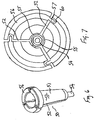
- a tapered round section plantlet holder 36 comprising left 37 and right 40 body portions having precision moulded mating surfaces 41.
- the upper rim of each of the body portions 37, 40 are provided with a flange 42 braced by integral buttressing lugs 43.
- the buttressing lugs 43 which are adjacent to mating surfaces 41 are provided with complementary pins 44 and recesses 45 which enable accurate alignment of the body portions 37, 40.
- Further complementary pins 46 stabilize the union of the body portions 37, 40 toward the lower portion thereof.
- a moulded plantlet holder 50 that is moulded in a single piece and comprising a plantlet holder body 51 substantially trifurcated by slots 52 into body portions 53 conjoined at their bases by a tear-off pin 54 connected to each body portion by a frangible sprue 55.
- the upper edges of the body portions are stiffened by respective flange and collar portions 56.
- Form stability of moulded plantlet holder 50 at its upper end is provided by cooperation of integral lugs 57 and slots 60 formed on adjacent flange and collar portions 56.
- the tear-off pin 54 may be twisted to cause failure of the frangible sprues 55 to separate the body portions 53.
- the flange and collar portions 56 assist in supporting a plurality of the plantlet holders in a supporting aperture board or the like, and provide means for manual or automated handling.
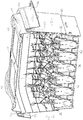
- a plantlet handling apparatus including a housing 70 formed of a light-transmitting polypropylene, a plantlet holder support 71 similarly moulded in polypropylene, a plurality of plantlet holders 72, and a closure assembly 73.
- the housing comprises side 74 and end 75 walls which are divergent up from a base wall 76 to provide for stack ability of the housings.
- the upper edges 77 of the side and end walls form a reinforced edge including a mechanical engagement for the closure assembly 73.
- the base wall 76 is formed with re-entrant portions 82 which enable the apparatus to be stacked complete with inserted holder supports 71 and plantlet holders 72 for shipping.
- the side walls 74 are provided with moulded nibs 83 which provide for positive engagement in position of the plantlet holder support 71 on the land 81.
- the plantlet holder support 71 is unitarily moulded of polypropylene and has a body portion 84 bounded by a peripheral bead 85 disposed between the body portion 84 and a downward depending peripheral flange 86.
- the flange 86 supports the plantlet holder support 71 on the land 81 and the bead 85 clips under the nibs 83.
- the body portion 84 includes a plurality of apertures 87 in array on the body portion 84.
- the apertures 87 are shaped to accept the plantlet holders 72 and include a downward depending flange adapted to conform to an outer surface of the plantlet holder 72 and a recess portion 90 providing positive orientation of the plantlet holder 72, by means that will become apparent hereunder.
- the body portion 84 also includes indexing and handling apertures.
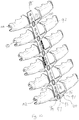
- the plantlet holder 72 is produced by injection moulding a multiple strip 91 wherein plantlet holder halves 92 are conjoined by a central spine 93.
- the central spine 93 includes a self hinge crease 94 and indexing apertures 95.
- the plantlet holder halves 92 connect to the central spine via a respective half of a handling tab 96 including a handling lug 97 and a handling peg 100, the purpose of which will become apparent hereunder.
- the indexing apertures 95 enable the multiple plantlet holder strip 91 to be positioned relative to a shearing device which accurately separates the plantlet holders 72 from the multiple strip 91, by shearing across the central spine 93 through guide apertures 101.
- the plantlet holder halves 92 have a tapering form from the top to a base portion 102.
- the base portions 102 of the respective plantlet holder halves 92 have respective engagement pins 103 and holes 104 which retain the two plantlet holder halves 92 together when the halves are closed together by bending about the self hinge crease 94.
- the plantlet holder 72 when assembled has a pair of apertures 105 in one side disposed about the partition line, and a single large aperture 106 in the opposite side again disposed symmetrically about the partition line.
- the base portions 102 are also configured to close up forming a base aperture 107.
- the handling tabs 96 in the assembled plantlet holder 72 present single handling portions having opposed respective handling lugs 97 and handling pegs 100, and are adapted to be gripped by a handling robot.
- the handling portion doubles as a means for positive orientation by engaging in use in the recess portion 90 of the plantlet holder support 71.
- the closure assembly 73 comprises a polypropylene moulded body portion 110 having formed in the upper surface a pair of windows 111 formed in a raised portion 112 which provides some stiffening of the upper surface.
- the upper surface is bounded by a peripheral stiffening ridge 113 which forms the inner boundary of a mechanical engagement portion 114 adapted to sealingly engage the complementary upper edges 77 of the side and end walls.
- the inner, downward-depending edge 115 forms a drip line inside the housing in use.
- An outer flange 116 extends down past the upper edge 77 in use to define a dead space 117 which resists convection mixing.
- the windows 111 are closed off by a biaxially oriented polypropylene (BOPP) film heat sealed to the raised portion 112 in order to provide a closure assembly that is substantially sealed to the housing to reduce the risk of biological contamination while permitting exchange of metabolic gases.
- BOPP biaxially oriented polypropylene
- the drip line inside the housing in use is provided by a formed blade edge 120.
- Apparatus in accordance with the foregoing embodiments are mechanical devices that support individual tissue culture plantlets, allowing them to be readily handled as individuals for transfers between tissue culture flasks, and transfer ex-vitro to soil or other growing medium.
- the plantlet holder provides a solid projection for mechanical gripping and movement of individual plantlets without touching the plantlet shoots or roots directly.
- plantlet holders are comprised of two (or more) parts that are held together during in vitro growth, and through all transfers and manipulations.
- the plantlet holder permits roots to grow through openings between the components.
- the partially open structure provides communication between the medium within the plantlet holder and the surrounding medium.
- the plantlet holder allows clean plantlets to be quickly removed from the presence of contamination if this is detected within part of the container.
- the plantlet holder allows transfer to a new in vitro environment for replenishment of nutrients or change of medium or other growth conditions.
- the plantlet holder allows change in spacing of plantlets if needed during different growth phases.
- the plantlet holder allows selective removal of either retarded or advanced plantlets if these need to be transferred to different conditions.
- the plantlet holder allows grading of plantlets for uniformity or designated heterogeneity during particular growth phases.
- the plantlet holder allows grading of plantlets for efficient release of plantlets or transfer to new conditions.
- the plantlet holder allows plants to be separated from other plantlets for improved accessibility for operator dissection operations without interference obscuring or confusion with aerial parts of neighbouring plantlets. There is no need to remove the plantlet holder from the plantlet on transfer to nursery pots, or to soil; roots will grow through the separation region between the components, with the solid plantlet holder components progressively displaced as roots grow.
- the plantlet holder system is applicable to many types of plant tissue culture, including organogenesis or somatic embryogenesis, and to transformation/regeneration systems.
- the plantlet holder system can be used with manual methods of handling using forceps and similar gripping tools, the system is also suitable for machine controlled tools to facilitate mechanized handling methods.
- the system of the foregoing embodiment can address the key limitations to radically change conventional tissue culture.
- the central element is the "plantlet holder”. This is a precisely moulded device that holds one plantlet within a custom container and, in essence, provides a "handle" on each plantlet to allow mechanical gripping.
- a set of plantlet holders is suspended by plantlet holder support within a custom growth container.
- a manual version may involve a set of 16 plantlet holders held in a 4x4 array in a round tub.
- a second version may have a rectangular box holding 24 plantlet holders in a 6x4 array.
- the plantlet holder system provides a number of key features as follows:
Landscapes
- Life Sciences & Earth Sciences (AREA)
- Environmental Sciences (AREA)
- Apparatus Associated With Microorganisms And Enzymes (AREA)
- Breeding Of Plants And Reproduction By Means Of Culturing (AREA)
- Cultivation Receptacles Or Flower-Pots, Or Pots For Seedlings (AREA)
- Hydroponics (AREA)
Claims (11)
- Appareil de manipulation de plantules comprenant :un contenant (70) pour un milieu nutritif à liquide aqueux ou à gel aqueux ;une pluralité de porte-plantules (72) comprenant une pluralité de parties corps (92) formant, une fois assemblées, un récipient ouvert en haut ayant une forme s'amincissant d'une partie haut à une partie base (102), des ouvertures ouvertes audit milieu nutritif utilisé comprenant une ouverture de base (107), un moyen d'engagement (103, 104) disposé entre lesdites parties corps adjacentes et s'engageant avec lesdites parties corps lors de l'assemblage pour la manipulation ;un support de porte-plantules (71) situé dans ledit contenant et supportant ladite pluralité de porte-plantules dans ledit milieu nutritif en cours d'utilisation, caractérisé en ce qu'il comprend en outre :un couvercle de fermeture (73) pour ledit contenant ayant un joint essentiellement étanche à l'air avec ledit contenant et ayant une perméabilité sélectionnée aux gaz métaboliques produits ou requis par les plantules,le porte-plantule (72) ayant des moitiés complémentaires (92), les parties base (102) des moitiés respectives du porte-plantule (92) ayant des goupilles d'engagement (103) et des trous (104) respectifs qui maintiennent ensemble les deux moitiés du porte-plantule (92) le long d'une ligne de séparation lorsque les moitiés sont fermées ensemble en les pliant autour d'une pliure formant charnière (94), le porte-plantule (72), lorsqu'il est assemblé, ayant une paire desdites ouvertures (105) sur un côté disposées de part et d'autre de la ligne de séparation, et une seule grande dite ouverture (106) sur le côté opposé, elle aussi disposée symétriquement de part et d'autre de la ligne de séparation, un ergot ou une saillie étant prévue sur chaque dit porte-plantule pour manipuler le porte-plantule par des moyens manuels ou mécaniques, le couvercle de fermeture (73) comportant une partie corps moulée en polypropylène (110) ayant, formées dans la surface supérieure, une paire de fenêtres (111) formées dans une partie surélevée (112), la surface supérieure étant délimitée par une nervure de renforcement périphérique (113), les fenêtres (111) étant fermées par un film en polypropylène à orientation biaxiale (BOPP) thermoscellé à la partie surélevée (112) de façon à fournir ladite perméabilité sélectionnée.
- Appareil de manipulation de plantules selon la revendication 1, dans lequel le contenant (70) comprend une enceinte à fond essentiellement plat (76) pour le milieu nutritif et dans laquelle les porte-plantules supportés (72) sont suspendus, le fond (76) étant pourvu de renfoncements (82) sélectionnés pour permettre l'empilage étroit des contenants respectifs avec le support de porte-plantules (71) et lesdits porte-plantules (72) installés.
- Appareil de manipulation de plantules selon la revendication 1, dans lequel le couvercle de fermeture (73) consiste en un couvercle (110 - 113) ayant une périphérie d'engagement complémentaire (114) adaptée de façon à s'engager mécaniquement et hermétiquement avec une lèvre périphérique correspondante du contenant (77).
- Appareil de manipulation de plantules selon la revendication 3, dans lequel le couvercle de fermeture (73) a une bride périphérique (116) qui s'étend vers le bas de la lèvre du contenant (77) à l'extérieur du contenant (70) afin de définir un espace mort annulaire (117) qui n'est pas soumis au mélange par convection avec l'environnement.
- Appareil de manipulation de plantules selon la revendication 4, dans lequel la bride périphérique (116) est pourvue d'un gradin, comme quoi ledit espace mort annulaire (117) est délimité, à un bord inférieur, par un gradin extérieur relié à une partie bride inférieure, créant ainsi un espace annulaire inférieur fournissant un degré de mélange par convection et d'une largeur suffisante pour permettre d'enlever le couvercle de fermeture du contenant (70), et un espace annulaire supérieur sélectionné de façon à résister sensiblement au mélange par convection.
- Appareil de manipulation de plantules selon la revendication 4, dans lequel le couvercle de fermeture (73) a une bride périphérique (115) qui est écartée vers l'intérieur de la lèvre du contenant (77) et qui s'étend vers le bas de celle-ci afin de définir une ligne annulaire d'égouttement pour éloigner la condensation de la lèvre.
- Appareil de manipulation de plantules selon la revendication 6, dans lequel la bride périphérique (115) s'étend vers le bas de la lèvre du contenant (77) afin de définir une ligne annulaire d'égouttement pour éloigner la condensation de la lèvre de façon à éviter la rétention et l'attraction de condensat liquide à travers le joint d'étanchéité.
- Appareil de manipulation de plantules selon la revendication 6, dans lequel la bride périphérique (116) est pourvue d'un gradin, comme quoi ledit espace mort annulaire (117) est délimité, à un bord inférieur, par un gradin extérieur relié à une partie bride inférieure, créant ainsi un espace annulaire inférieur fournissant un degré de mélange par convection et d'une largeur suffisante pour permettre d'enlever le couvercle de fermeture du contenant, et un espace annulaire supérieur sélectionné de façon à résister sensiblement au mélange par convection.
- Appareil de manipulation de plantules selon la revendication 1, dans lequel les ouvertures (105, 106) sont sélectionnées parmi des ouvertures rondes d'une section transversale donnée ou, lorsqu'un trou rond ayant cette section transversale serait impossible parce qu'il affaiblirait le porte-plantule (72) ou qu'il rendrait sa fabrication dimensionnellement instable, l'ouverture est sélectionnée parmi les formes ovale, oblongue ou toute autre forme sélectionnée.
- Appareil de manipulation de plantules selon la revendication 1, dans lequel une paroi latérale du porte-plantule (72) est dégagée vers le bas relativement à un bord supérieur pour fournir l'accès à la partie basale des plantules pour permettre à un scalpel de tailler ou d'exciser de nouveaux plantules de la plante principale.
- Appareil de manipulation de plantules selon la revendication 1, dans lequel les porte-plantules (72) sont formés par multiples comme un moulage multiple dans lequel lesdites moitiés complémentaires (92) du porte-plantule (10) sont formées de part et d'autre d'une bande de jonction (93), dans lequel les porte-plantules (72) sont excisés comme une paire conjointe de parties de porte-plantules (92) où la partie conjointe est une partie résiduelle de la bande de jonction (93), et dans lequel la partie résiduelle comprend ladite pliure formant charnière (94).
Applications Claiming Priority (3)
| Application Number | Priority Date | Filing Date | Title |
|---|---|---|---|
| AU2009903687A AU2009903687A0 (en) | 2009-08-07 | Plantlet holder | |
| AU2010901431A AU2010901431A0 (en) | 2010-04-06 | Plantlet handling system | |
| PCT/AU2010/001008 WO2011014933A1 (fr) | 2009-08-07 | 2010-08-06 | Système de manipulation de plantules |
Publications (3)
| Publication Number | Publication Date |
|---|---|
| EP2525647A1 EP2525647A1 (fr) | 2012-11-28 |
| EP2525647A4 EP2525647A4 (fr) | 2015-07-22 |
| EP2525647B1 true EP2525647B1 (fr) | 2018-07-11 |
Family
ID=43543832
Family Applications (1)
| Application Number | Title | Priority Date | Filing Date |
|---|---|---|---|
| EP10805898.3A Active EP2525647B1 (fr) | 2009-08-07 | 2010-08-06 | Système de manipulation de plantules |
Country Status (5)
| Country | Link |
|---|---|
| US (1) | US20120137581A1 (fr) |
| EP (1) | EP2525647B1 (fr) |
| AU (1) | AU2010281302B2 (fr) |
| NZ (1) | NZ598476A (fr) |
| WO (1) | WO2011014933A1 (fr) |
Cited By (1)
| Publication number | Priority date | Publication date | Assignee | Title |
|---|---|---|---|---|
| WO2025088036A1 (fr) * | 2023-10-26 | 2025-05-01 | Pöppelmann Holding GmbH & Co. KG | Réceptacle de culture de plantes pour la culture de plantes in vitro |
Families Citing this family (41)
| Publication number | Priority date | Publication date | Assignee | Title |
|---|---|---|---|---|
| NL2003810C2 (nl) * | 2009-11-16 | 2011-05-17 | Idea Packaging B V | Werkwijze en substraat voor het telen van een plant. |
| CA2856091C (fr) | 2011-06-08 | 2019-03-19 | Nuplant Pty Ltd | Systeme de manipulation de plantule robotise |
| US20130160360A1 (en) * | 2011-12-21 | 2013-06-27 | Dustin W. Palmer | Seed sprouter and method of use |
| US20130318871A1 (en) * | 2012-06-04 | 2013-12-05 | Eco Box Holdings, LLC | Planter having a multi-purpose lid |
| CN105208851B (zh) * | 2013-03-13 | 2019-03-12 | 戈德菲尔茨集合公司 | 用于移植植物的嵌件和装置 |
| CA154487S (en) * | 2013-06-27 | 2014-10-16 | Nelson Garden AB | Greenhouse container |
| NL2012234C2 (en) * | 2014-02-10 | 2015-08-17 | Vivi B V | Plant holder. |
| CN103923824B (zh) * | 2014-04-24 | 2015-11-18 | 山东省农业科学院玉米研究所 | 一种玉米幼苗茎尖分生组织转基因浸染专用培养皿 |
| US20160060021A1 (en) * | 2014-05-21 | 2016-03-03 | Christopher Lau | Seed vault, organizer, manipulator, and seed germinator |
| NL2012907C2 (en) * | 2014-05-28 | 2015-08-10 | Floréac N V | Systems for cultivating plants with aerial roots. |
| US20170064915A1 (en) | 2014-05-28 | 2017-03-09 | Floréac N.V. | Systems for cultivating plants with aerial roots |
| NL2013545B1 (en) * | 2014-09-29 | 2016-09-29 | Edc Horti-Services B V | Body for cultivation of a plant. |
| US20170318753A1 (en) * | 2014-11-11 | 2017-11-09 | Nuplant Pty. Ltd. | Plantlet Holder and Handling System |
| MX2017010173A (es) * | 2015-02-13 | 2018-02-21 | Univ Nagoya Nat Univ Corp | Miembro de cultivo de plantulas y conjunto de cultivo de plantulas para injerto, y metodo para producir plantulas injertadas. |
| CN105009984A (zh) * | 2015-08-08 | 2015-11-04 | 宋涛 | 一种简便花盆 |
| US11083144B2 (en) * | 2015-10-30 | 2021-08-10 | Syngenta Participations Ag | Plant container and tray system |
| US20180279567A1 (en) * | 2015-11-23 | 2018-10-04 | M. Stolze Holding B.V. | Device for the treatment of substrate bodies with plants |
| US11019764B2 (en) * | 2015-12-21 | 2021-06-01 | Volgin Llc | Compact standardized grain germinator |
| WO2017124137A1 (fr) * | 2016-01-21 | 2017-07-27 | Goldfields Collections Pty Ltd | Insert et récipient pour replanter des plantes |
| US10645886B2 (en) * | 2016-01-29 | 2020-05-12 | Board Of Trustees Of Michigan State University | Methods and apparatus for gnotobiotic plant growth |
| JP6834009B2 (ja) * | 2016-10-03 | 2021-02-24 | グッドウィン, ランディー, エム.GOODWIN, Randy, M. | 水耕栽培ユニット |
| US10736285B2 (en) * | 2017-01-27 | 2020-08-11 | Mjnn, Llc | Hydroponic plant display system |
| US20180325040A1 (en) * | 2017-05-09 | 2018-11-15 | Casa Flora, Inc. | Plant Material Containers and Methods |
| CA3007538A1 (fr) * | 2017-06-08 | 2018-12-08 | University Of Guelph | Bioreacteur |
| USD822223S1 (en) | 2017-06-08 | 2018-07-03 | University Of Guelph | Bioreactor |
| US10492390B2 (en) * | 2017-09-29 | 2019-12-03 | Bloomaker USA, Inc. | Hydroponic display container for flowering bulbs |
| US20190230869A1 (en) * | 2018-01-29 | 2019-08-01 | Gilad Krakover | System for Transporting Plant Clones |
| AU2019300940B2 (en) * | 2018-07-13 | 2025-09-18 | Lowes TC Pty Ltd | Plant propagation systems, devices and methods |
| CN109548521B (zh) * | 2018-12-29 | 2020-09-11 | 深圳春沐源控股有限公司 | 育苗装置 |
| EP3993606A4 (fr) | 2019-07-01 | 2023-07-12 | Borroughs, LLC | Kit grille de culture horticole intégré |
| CN110972876B (zh) * | 2019-12-17 | 2021-11-23 | 厦门市鼓浪屿园艺建筑有限公司 | 一种乔木全冠移植方法 |
| US11452266B2 (en) * | 2020-03-13 | 2022-09-27 | Adam Ramirez | Modular grow boxes and associated systems and methods |
| EP3903565B1 (fr) * | 2020-04-30 | 2025-08-27 | Antonio Palumbo | Dispositif de coupe et de croissance de clones et procédés associés |
| WO2022155485A1 (fr) * | 2021-01-15 | 2022-07-21 | Maui Greens, Inc. | Récipients de culture de plantes et plateaux de support |
| US12575516B2 (en) * | 2021-01-27 | 2026-03-17 | Earthwise Incorporated | In-ground aeroponic planter and system |
| GB2606048B (en) * | 2021-04-20 | 2023-04-26 | Gyroplant Ltd | A reusable growing plug and hydroponic system for a growing crop |
| DE102021111372A1 (de) * | 2021-05-03 | 2022-11-03 | Greenling UG (haftungsbeschränkt) | Pflanzanordnung und Verfahren zum Arrangieren einer Pflanzanordnung |
| AU2021221631A1 (en) | 2021-08-25 | 2023-03-16 | Nuplant Pty Ltd | Ejection transplanter |
| US20230337593A1 (en) * | 2022-04-22 | 2023-10-26 | Canopii Inc. | Autonomous greenhouse |
| USD1059208S1 (en) * | 2023-09-21 | 2025-01-28 | Shrooly LTD | Indoor cultivation apparatus |
| US20250287883A1 (en) * | 2024-03-13 | 2025-09-18 | Cedric Marcel Joseph Guigand | Biodegradable tree planting apparatus |
Family Cites Families (25)
| Publication number | Priority date | Publication date | Assignee | Title |
|---|---|---|---|---|
| US152758A (en) * | 1874-07-07 | Improvement in boxes for propagating plants | ||
| USRE29248E (en) * | 1973-03-21 | 1977-06-07 | Dolco Packaging Corporation | Container |
| US4057932A (en) * | 1975-01-06 | 1977-11-15 | Henry Anderson Spencer | Container for seedlings |
| US4236350A (en) * | 1978-08-21 | 1980-12-02 | Hasselbach Sr Arthur | Seedling tray assembly and greenhouse |
| US4216622A (en) * | 1978-09-19 | 1980-08-12 | Hackney Howard U Jr | Plant container |
| US4224765A (en) * | 1979-02-07 | 1980-09-30 | Song John S | Plant culture container |
| US4299054A (en) * | 1979-07-20 | 1981-11-10 | Ware R Louis | Hydroponic assembly and wafer for use therein |
| US4249341A (en) * | 1979-08-27 | 1981-02-10 | Huegli Ronald W | Package for sprouts |
| IL69976A (en) * | 1983-10-16 | 1987-08-31 | Mekler Dan | Automatic planting apparatus and method |
| US5225342A (en) * | 1986-05-30 | 1993-07-06 | Farrell Michael E | Systemic plant interface |
| US5215550A (en) * | 1991-07-10 | 1993-06-01 | Sylvester M. Tesch, Jr. | Seedling array transplanter |
| IL102741A (en) * | 1992-08-05 | 1997-02-18 | Freimann Daniel | Method and receptacles for growing plants particularly tissue culture plant precursors |
| FR2724812B1 (fr) * | 1994-09-23 | 1996-12-27 | Agronomique Inst Nat Rech | Conteneur pour cultures de plantes in vitro |
| ATE233043T1 (de) * | 1998-09-16 | 2003-03-15 | Daled Ab | Vorrichtung zur wachstumsförderung von saat bis zu pflanze |
| US6243987B1 (en) * | 1999-09-01 | 2001-06-12 | Organitech Ltd. | Self contained fully automated robotic crop production facility |
| JP2002186362A (ja) * | 2000-12-22 | 2002-07-02 | Oishi Sangyo Kk | パルプモウルド製育苗移植用ポット及びその連結体 |
| US7168375B2 (en) * | 2003-07-21 | 2007-01-30 | Barney Kuoyen Huang | Air-pruning tray/container matrix transfer and transplanting system and methods |
| WO2005013670A1 (fr) * | 2003-07-29 | 2005-02-17 | Ultracell Limited | Planteur automatique |
| US20080078118A1 (en) * | 2003-11-17 | 2008-04-03 | Aerogrow International, Inc. | Master gardener baskets and methods for growing plants |
| US7681357B2 (en) * | 2005-01-25 | 2010-03-23 | Dyas Drew C | Apparatuses and systems for growing nursery stock |
| US8091279B2 (en) * | 2007-05-09 | 2012-01-10 | Stewart Donald J | Multiple self watering container system |
| AU2008286685B2 (en) * | 2007-08-10 | 2013-10-03 | Nuplant Pty Ltd | Plant propagation transfer method |
| US8375628B2 (en) * | 2007-09-20 | 2013-02-19 | Kamterter Products, Llc | Seed testing method and apparatus |
| US20090151248A1 (en) * | 2007-10-30 | 2009-06-18 | Aerogrow International, Inc. | Devices and methods for growing plants |
| US8291639B2 (en) * | 2009-09-09 | 2012-10-23 | S and E Properties, Inc. | Growing system for hydroponics and/or aeroponics |
-
2010
- 2010-08-06 US US13/388,995 patent/US20120137581A1/en not_active Abandoned
- 2010-08-06 WO PCT/AU2010/001008 patent/WO2011014933A1/fr not_active Ceased
- 2010-08-06 NZ NZ598476A patent/NZ598476A/xx unknown
- 2010-08-06 EP EP10805898.3A patent/EP2525647B1/fr active Active
- 2010-08-06 AU AU2010281302A patent/AU2010281302B2/en active Active
Non-Patent Citations (1)
| Title |
|---|
| None * |
Cited By (1)
| Publication number | Priority date | Publication date | Assignee | Title |
|---|---|---|---|---|
| WO2025088036A1 (fr) * | 2023-10-26 | 2025-05-01 | Pöppelmann Holding GmbH & Co. KG | Réceptacle de culture de plantes pour la culture de plantes in vitro |
Also Published As
| Publication number | Publication date |
|---|---|
| EP2525647A4 (fr) | 2015-07-22 |
| WO2011014933A1 (fr) | 2011-02-10 |
| US20120137581A1 (en) | 2012-06-07 |
| AU2010281302B2 (en) | 2015-12-03 |
| EP2525647A1 (fr) | 2012-11-28 |
| AU2010281302A1 (en) | 2012-03-22 |
| NZ598476A (en) | 2013-09-27 |
Similar Documents
| Publication | Publication Date | Title |
|---|---|---|
| AU2010281302B2 (en) | Plantlet handling system | |
| CA2856091C (fr) | Systeme de manipulation de plantule robotise | |
| US20170318753A1 (en) | Plantlet Holder and Handling System | |
| US5119588A (en) | Method and apparatus for culturing autotrophic plants from heterotrophic plant material | |
| JP3764959B2 (ja) | 細胞培養用容器および細胞培養方法 | |
| EP2966977B1 (fr) | Procédé d'approvisionnement des plantes | |
| US20030032174A1 (en) | Apparatus and method for propagating plants | |
| US11140840B2 (en) | Plant propagation system and method | |
| CN205756178U (zh) | 一种高通量筛选化感水稻种质资源装置 | |
| CN203860262U (zh) | 一种蚜虫简易饲养装置 | |
| EP0287284A1 (fr) | Système de propagation stérile | |
| CN105900822A (zh) | 一种高通量筛选化感水稻种质资源装置及方法 | |
| US20250050344A1 (en) | Substrate trays and methods of use | |
| Fozard et al. | Novel micro-phenotyping approach to chemical genetic screening for increased plant tolerance to abiotic stress | |
| Kurata | Automated systems for organogenesis | |
| Zandvoort et al. | Mechanisation in tissue culture systems | |
| CN218232349U (zh) | 具有多组对照功能的用于无菌培养芜萍的装置 | |
| Dinesen | Technical guideline on seed potato micropropagation and multiplication | |
| HK40009603A (en) | Insert and apparatus for transplanting plants | |
| CN109874564A (zh) | 一种基于自动化生产的蔬菜培养结构 | |
| Brewer | Transplanters in Plant Propagation | |
| HK40035871B (en) | Container for growing plants and method of supplying plants | |
| JPH0257131A (ja) | 植物培養器構造および植物培養方法 | |
| JPH02154680A (ja) | 植物培養容器 | |
| JPH02238830A (ja) | 幼植物培養装置 |
Legal Events
| Date | Code | Title | Description |
|---|---|---|---|
| PUAI | Public reference made under article 153(3) epc to a published international application that has entered the european phase |
Free format text: ORIGINAL CODE: 0009012 |
|
| 17P | Request for examination filed |
Effective date: 20120227 |
|
| AK | Designated contracting states |
Kind code of ref document: A1 Designated state(s): AL AT BE BG CH CY CZ DE DK EE ES FI FR GB GR HR HU IE IS IT LI LT LU LV MC MK MT NL NO PL PT RO SE SI SK SM TR |
|
| RA4 | Supplementary search report drawn up and despatched (corrected) |
Effective date: 20150618 |
|
| RIC1 | Information provided on ipc code assigned before grant |
Ipc: A01G 9/08 20060101ALI20150612BHEP Ipc: B65D 85/52 20060101ALI20150612BHEP Ipc: A01G 9/10 20060101ALI20150612BHEP Ipc: A01G 9/02 20060101AFI20150612BHEP Ipc: A01C 11/02 20060101ALI20150612BHEP |
|
| 17Q | First examination report despatched |
Effective date: 20161123 |
|
| RAP1 | Party data changed (applicant data changed or rights of an application transferred) |
Owner name: NUPLANT PTY LTD. |
|
| REG | Reference to a national code |
Ref country code: DE Ref legal event code: R079 Ref document number: 602010051887 Country of ref document: DE Free format text: PREVIOUS MAIN CLASS: A01G0009020000 Ipc: A01G0009029000 |
|
| GRAP | Despatch of communication of intention to grant a patent |
Free format text: ORIGINAL CODE: EPIDOSNIGR1 |
|
| RIC1 | Information provided on ipc code assigned before grant |
Ipc: A01G 9/029 20180101AFI20180116BHEP |
|
| INTG | Intention to grant announced |
Effective date: 20180206 |
|
| GRAA | (expected) grant |
Free format text: ORIGINAL CODE: 0009210 |
|
| AK | Designated contracting states |
Kind code of ref document: B1 Designated state(s): AL AT BE BG CH CY CZ DE DK EE ES FI FR GB GR HR HU IE IS IT LI LT LU LV MC MK MT NL NO PL PT RO SE SI SK SM TR |
|
| REG | Reference to a national code |
Ref country code: GB Ref legal event code: FG4D |
|
| REG | Reference to a national code |
Ref country code: CH Ref legal event code: EP |
|
| REG | Reference to a national code |
Ref country code: AT Ref legal event code: REF Ref document number: 1015938 Country of ref document: AT Kind code of ref document: T Effective date: 20180715 |
|
| GRAS | Grant fee paid |
Free format text: ORIGINAL CODE: EPIDOSNIGR3 |
|
| REG | Reference to a national code |
Ref country code: IE Ref legal event code: FG4D |
|
| REG | Reference to a national code |
Ref country code: DE Ref legal event code: R096 Ref document number: 602010051887 Country of ref document: DE |
|
| REG | Reference to a national code |
Ref country code: FR Ref legal event code: PLFP Year of fee payment: 9 |
|
| REG | Reference to a national code |
Ref country code: NL Ref legal event code: FP |
|
| REG | Reference to a national code |
Ref country code: LT Ref legal event code: MG4D |
|
| REG | Reference to a national code |
Ref country code: AT Ref legal event code: MK05 Ref document number: 1015938 Country of ref document: AT Kind code of ref document: T Effective date: 20180711 |
|
| PG25 | Lapsed in a contracting state [announced via postgrant information from national office to epo] |
Ref country code: PL Free format text: LAPSE BECAUSE OF FAILURE TO SUBMIT A TRANSLATION OF THE DESCRIPTION OR TO PAY THE FEE WITHIN THE PRESCRIBED TIME-LIMIT Effective date: 20180711 Ref country code: NO Free format text: LAPSE BECAUSE OF FAILURE TO SUBMIT A TRANSLATION OF THE DESCRIPTION OR TO PAY THE FEE WITHIN THE PRESCRIBED TIME-LIMIT Effective date: 20181011 Ref country code: AT Free format text: LAPSE BECAUSE OF FAILURE TO SUBMIT A TRANSLATION OF THE DESCRIPTION OR TO PAY THE FEE WITHIN THE PRESCRIBED TIME-LIMIT Effective date: 20180711 Ref country code: GR Free format text: LAPSE BECAUSE OF FAILURE TO SUBMIT A TRANSLATION OF THE DESCRIPTION OR TO PAY THE FEE WITHIN THE PRESCRIBED TIME-LIMIT Effective date: 20181012 Ref country code: FI Free format text: LAPSE BECAUSE OF FAILURE TO SUBMIT A TRANSLATION OF THE DESCRIPTION OR TO PAY THE FEE WITHIN THE PRESCRIBED TIME-LIMIT Effective date: 20180711 Ref country code: BG Free format text: LAPSE BECAUSE OF FAILURE TO SUBMIT A TRANSLATION OF THE DESCRIPTION OR TO PAY THE FEE WITHIN THE PRESCRIBED TIME-LIMIT Effective date: 20181011 Ref country code: SE Free format text: LAPSE BECAUSE OF FAILURE TO SUBMIT A TRANSLATION OF THE DESCRIPTION OR TO PAY THE FEE WITHIN THE PRESCRIBED TIME-LIMIT Effective date: 20180711 Ref country code: LT Free format text: LAPSE BECAUSE OF FAILURE TO SUBMIT A TRANSLATION OF THE DESCRIPTION OR TO PAY THE FEE WITHIN THE PRESCRIBED TIME-LIMIT Effective date: 20180711 Ref country code: IS Free format text: LAPSE BECAUSE OF FAILURE TO SUBMIT A TRANSLATION OF THE DESCRIPTION OR TO PAY THE FEE WITHIN THE PRESCRIBED TIME-LIMIT Effective date: 20181111 |
|
| REG | Reference to a national code |
Ref country code: CH Ref legal event code: PK Free format text: BERICHTIGUNGEN |
|
| RIC2 | Information provided on ipc code assigned after grant |
Ipc: A01G 9/029 20180101AFI20180116BHEP |
|
| PG25 | Lapsed in a contracting state [announced via postgrant information from national office to epo] |
Ref country code: ES Free format text: LAPSE BECAUSE OF FAILURE TO SUBMIT A TRANSLATION OF THE DESCRIPTION OR TO PAY THE FEE WITHIN THE PRESCRIBED TIME-LIMIT Effective date: 20180711 Ref country code: AL Free format text: LAPSE BECAUSE OF FAILURE TO SUBMIT A TRANSLATION OF THE DESCRIPTION OR TO PAY THE FEE WITHIN THE PRESCRIBED TIME-LIMIT Effective date: 20180711 Ref country code: HR Free format text: LAPSE BECAUSE OF FAILURE TO SUBMIT A TRANSLATION OF THE DESCRIPTION OR TO PAY THE FEE WITHIN THE PRESCRIBED TIME-LIMIT Effective date: 20180711 Ref country code: LV Free format text: LAPSE BECAUSE OF FAILURE TO SUBMIT A TRANSLATION OF THE DESCRIPTION OR TO PAY THE FEE WITHIN THE PRESCRIBED TIME-LIMIT Effective date: 20180711 |
|
| REG | Reference to a national code |
Ref country code: DE Ref legal event code: R082 Ref document number: 602010051887 Country of ref document: DE Representative=s name: VKK PATENTANWAELTE PARTG MBB, DE |
|
| REG | Reference to a national code |
Ref country code: CH Ref legal event code: PL |
|
| REG | Reference to a national code |
Ref country code: DE Ref legal event code: R097 Ref document number: 602010051887 Country of ref document: DE |
|
| PG25 | Lapsed in a contracting state [announced via postgrant information from national office to epo] |
Ref country code: EE Free format text: LAPSE BECAUSE OF FAILURE TO SUBMIT A TRANSLATION OF THE DESCRIPTION OR TO PAY THE FEE WITHIN THE PRESCRIBED TIME-LIMIT Effective date: 20180711 Ref country code: CH Free format text: LAPSE BECAUSE OF NON-PAYMENT OF DUE FEES Effective date: 20180831 Ref country code: LI Free format text: LAPSE BECAUSE OF NON-PAYMENT OF DUE FEES Effective date: 20180831 Ref country code: LU Free format text: LAPSE BECAUSE OF NON-PAYMENT OF DUE FEES Effective date: 20180806 Ref country code: MC Free format text: LAPSE BECAUSE OF FAILURE TO SUBMIT A TRANSLATION OF THE DESCRIPTION OR TO PAY THE FEE WITHIN THE PRESCRIBED TIME-LIMIT Effective date: 20180711 Ref country code: CZ Free format text: LAPSE BECAUSE OF FAILURE TO SUBMIT A TRANSLATION OF THE DESCRIPTION OR TO PAY THE FEE WITHIN THE PRESCRIBED TIME-LIMIT Effective date: 20180711 Ref country code: RO Free format text: LAPSE BECAUSE OF FAILURE TO SUBMIT A TRANSLATION OF THE DESCRIPTION OR TO PAY THE FEE WITHIN THE PRESCRIBED TIME-LIMIT Effective date: 20180711 Ref country code: IT Free format text: LAPSE BECAUSE OF FAILURE TO SUBMIT A TRANSLATION OF THE DESCRIPTION OR TO PAY THE FEE WITHIN THE PRESCRIBED TIME-LIMIT Effective date: 20180711 |
|
| PLBE | No opposition filed within time limit |
Free format text: ORIGINAL CODE: 0009261 |
|
| STAA | Information on the status of an ep patent application or granted ep patent |
Free format text: STATUS: NO OPPOSITION FILED WITHIN TIME LIMIT |
|
| PG25 | Lapsed in a contracting state [announced via postgrant information from national office to epo] |
Ref country code: SK Free format text: LAPSE BECAUSE OF FAILURE TO SUBMIT A TRANSLATION OF THE DESCRIPTION OR TO PAY THE FEE WITHIN THE PRESCRIBED TIME-LIMIT Effective date: 20180711 Ref country code: SM Free format text: LAPSE BECAUSE OF FAILURE TO SUBMIT A TRANSLATION OF THE DESCRIPTION OR TO PAY THE FEE WITHIN THE PRESCRIBED TIME-LIMIT Effective date: 20180711 Ref country code: DK Free format text: LAPSE BECAUSE OF FAILURE TO SUBMIT A TRANSLATION OF THE DESCRIPTION OR TO PAY THE FEE WITHIN THE PRESCRIBED TIME-LIMIT Effective date: 20180711 |
|
| 26N | No opposition filed |
Effective date: 20190412 |
|
| PG25 | Lapsed in a contracting state [announced via postgrant information from national office to epo] |
Ref country code: SI Free format text: LAPSE BECAUSE OF FAILURE TO SUBMIT A TRANSLATION OF THE DESCRIPTION OR TO PAY THE FEE WITHIN THE PRESCRIBED TIME-LIMIT Effective date: 20180711 |
|
| PG25 | Lapsed in a contracting state [announced via postgrant information from national office to epo] |
Ref country code: MT Free format text: LAPSE BECAUSE OF NON-PAYMENT OF DUE FEES Effective date: 20180806 |
|
| PG25 | Lapsed in a contracting state [announced via postgrant information from national office to epo] |
Ref country code: TR Free format text: LAPSE BECAUSE OF FAILURE TO SUBMIT A TRANSLATION OF THE DESCRIPTION OR TO PAY THE FEE WITHIN THE PRESCRIBED TIME-LIMIT Effective date: 20180711 |
|
| PG25 | Lapsed in a contracting state [announced via postgrant information from national office to epo] |
Ref country code: PT Free format text: LAPSE BECAUSE OF FAILURE TO SUBMIT A TRANSLATION OF THE DESCRIPTION OR TO PAY THE FEE WITHIN THE PRESCRIBED TIME-LIMIT Effective date: 20180711 Ref country code: HU Free format text: LAPSE BECAUSE OF FAILURE TO SUBMIT A TRANSLATION OF THE DESCRIPTION OR TO PAY THE FEE WITHIN THE PRESCRIBED TIME-LIMIT; INVALID AB INITIO Effective date: 20100806 |
|
| PG25 | Lapsed in a contracting state [announced via postgrant information from national office to epo] |
Ref country code: MK Free format text: LAPSE BECAUSE OF NON-PAYMENT OF DUE FEES Effective date: 20180711 Ref country code: CY Free format text: LAPSE BECAUSE OF FAILURE TO SUBMIT A TRANSLATION OF THE DESCRIPTION OR TO PAY THE FEE WITHIN THE PRESCRIBED TIME-LIMIT Effective date: 20180711 |
|
| P01 | Opt-out of the competence of the unified patent court (upc) registered |
Effective date: 20230530 |
|
| PGFP | Annual fee paid to national office [announced via postgrant information from national office to epo] |
Ref country code: NL Payment date: 20250821 Year of fee payment: 16 |
|
| PGFP | Annual fee paid to national office [announced via postgrant information from national office to epo] |
Ref country code: DE Payment date: 20250819 Year of fee payment: 16 |
|
| PGFP | Annual fee paid to national office [announced via postgrant information from national office to epo] |
Ref country code: BE Payment date: 20250820 Year of fee payment: 16 Ref country code: GB Payment date: 20250822 Year of fee payment: 16 |
|
| PGFP | Annual fee paid to national office [announced via postgrant information from national office to epo] |
Ref country code: FR Payment date: 20250821 Year of fee payment: 16 |
|
| PGFP | Annual fee paid to national office [announced via postgrant information from national office to epo] |
Ref country code: IE Payment date: 20250821 Year of fee payment: 16 |