EP2526656B1 - Verfahren und vorrichtung zum suchen von werten eines oder mehrerer parameter und zugehörige vorrichtungen - Google Patents
Verfahren und vorrichtung zum suchen von werten eines oder mehrerer parameter und zugehörige vorrichtungen Download PDFInfo
- Publication number
- EP2526656B1 EP2526656B1 EP11703916.4A EP11703916A EP2526656B1 EP 2526656 B1 EP2526656 B1 EP 2526656B1 EP 11703916 A EP11703916 A EP 11703916A EP 2526656 B1 EP2526656 B1 EP 2526656B1
- Authority
- EP
- European Patent Office
- Prior art keywords
- devices
- value
- disclose
- request
- parameter
- Prior art date
- Legal status (The legal status is an assumption and is not a legal conclusion. Google has not performed a legal analysis and makes no representation as to the accuracy of the status listed.)
- Active
Links
Images
Classifications
-
- H—ELECTRICITY
- H04—ELECTRIC COMMUNICATION TECHNIQUE
- H04L—TRANSMISSION OF DIGITAL INFORMATION, e.g. TELEGRAPHIC COMMUNICATION
- H04L12/00—Data switching networks
- H04L12/28—Data switching networks characterised by path configuration, e.g. LAN [Local Area Networks] or WAN [Wide Area Networks]
- H04L12/2803—Home automation networks
- H04L12/2807—Exchanging configuration information on appliance services in a home automation network
- H04L12/281—Exchanging configuration information on appliance services in a home automation network indicating a format for calling an appliance service function in a home automation network
-
- H—ELECTRICITY
- H04—ELECTRIC COMMUNICATION TECHNIQUE
- H04L—TRANSMISSION OF DIGITAL INFORMATION, e.g. TELEGRAPHIC COMMUNICATION
- H04L12/00—Data switching networks
- H04L12/28—Data switching networks characterised by path configuration, e.g. LAN [Local Area Networks] or WAN [Wide Area Networks]
- H04L12/2803—Home automation networks
- H04L2012/2847—Home automation networks characterised by the type of home appliance used
- H04L2012/285—Generic home appliances, e.g. refrigerators
Definitions
- the present invention relates to a method of and apparatus for searching for values of one or more parameters held by one or more of a plurality of devices and also relates to a device capable of storing a value of a parameter and disclosing the value on request.
- serial links are used to connect devices together. Examples of such systems include those used to control and monitor the operation of a building, for example the lighting, air conditioning, fire detection or security mechanisms within a building. Devices in such a system might include actuators that turn individual lights or heaters on and off, sensors that detect ambient light or temperature levels or the presence of people within an area in the building, and computing engines that process the information from sensors to determine the desired settings of actuators.
- a serial link is a means of exchanging data between two or more devices, a single symbol at a time.
- a common embodiment of a serial link is a pair of electrical conductors, the voltage difference between which is used to encode binary symbols (commonly referred to as '1' and '0').
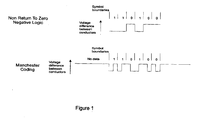
- Common methods for encoding binary symbols on a serial link include 'non return to zero' and 'Manchester code', examples of which are shown schematically in Figure 1 .
- all devices are normally aware of the signalling period, that is to say the time taken to encode a binary symbol on the serial link. This may be known a priori or one device may learn the signalling period for example by decoding a transmission by another device.
- Serial links may also operate in an asynchronous manner, in which the link is not driven all the time. Such a case is shown in Figure 1 for Manchester code.
- Serial links may operate with a "bias", that is to say that the link is normally held at one voltage level by one or more devices or some other equipment attached to the link; the biasing circuit is such that a device that requires to drive the link to one of the voltage levels indicating '1' or '0' will succeed in doing so in preference to the bias.
- the bias is one of the voltage levels indicating '1' or '0', a device that requires to drive the link to one of the voltage levels does so only when the other voltage level is required.
- serial link include wireless links, for example radio links.
- radio links For example, both of the symbol encodings shown in Figure 1 can be conveyed over the medium of radio by replacing the lower voltage difference level by emission of a radio signal and the higher voltage difference level by no such emission.
- radio modulation and signalling techniques are known; an example of a suitable technique would be for each device to emit a continuous carrier frequency as a replacement for the lower voltage difference level, the carrier frequency used by each device being slightly different in order to avoid anti-phase cancellation at any receiving device.
- a parameter value will typically be held by a device as a single value from a discrete set of possible values.
- the parameter will be a sparse parameter, that is to say a parameter that may take one of a very large number of values, and where significantly fewer instances of such values are held by the devices.
- sparse parameters are "MAC address" numbers specified in ISO 8802.1 for identification of computer communication devices. These are taken from a range of 2 48 different numbers, while a typical system may incorporate from two to a few hundred devices.
- the number space specified in ISO 16484-5 for assigning a unique identifier to a device is a range of 2 22 different numbers and ISO 16484-5 also further defines a MAC address number per device in a range of up to 2 48 different numbers.
- the number space specified in IEC 62386-102 for assigning unique numbers to lighting control devices is a range of up to 2 128 different numbers. Also under IEC 62386-102 a lighting control device may be instructed to pick and retain a random number from a range of 2 24 different numbers.
- US5968154 discloses a method of arbitrating between a number of devices which are attempting to access a serial data bus.
- US2004-0217718A1 discloses a digitally addressable electronic ballast and control unit. An address search technique according to a DALI (Digital Addressable Lighting Interface) standard is described.
- DALI Digital Addressable Lighting Interface
- a method of learning values of one or more parameters held by a plurality of devices that are capable of communication with each other via a serial communications link comprising:
- one or more devices are connected together using a serial link.
- Each device is able to transmit on the serial link at times of its own choosing; furthermore, each device is able to detect the resultant signals due to one or more devices transmitting on the serial link at times of their own choosing.
- the effect resulting in a case where more than one device transmits on the serial link at the same time is known by all devices, as is the effect resulting in a case where no device transmits on the serial link.
- at most one value is disclosed in response to each request. This can be achieved very quickly compared to corresponding prior art techniques of learning the values of parameters held,by devices.
- each device may hold zero, one or more instances of values of that parameter.
- One or more devices can learn the parameter values held by one or more devices connected using the serial link.
- each device operates a comparator rule whereby if a device learns that another of the devices is transmitting a value that is preferred to the value that is being transmitted by said device, then said device ceases transmitting its value.
- a "preferred" value may for example be one that is greater than the value held by the device concerned.
- each device operates a comparator rule whereby if a device holds plural values for a parameter, the device transmits a preferred one of said values in response to the request.
- a "preferred" value may be for example one that is the greatest of the values held by the device concerned. This enables a particularly efficient and therefore rapid transmission scheme, by which all devices disclose their relevant values, to be achieved.
- the request for said devices to disclose a parameter held by the devices includes or is accompanied by a restriction on the devices that are to respond to said request such that only a subset of the devices respond to said request.
- the values held by the devices may be represented by a number of bits that varies between the devices, and wherein the devices insert bits into the values transmitted by the devices such that the bit values that are transmitted by the devices are all of the same length.
- the values held by the devices may be represented by a number of bits that varies between the devices, and wherein the devices insert one or more bit patterns into the values transmitted by the devices to indicate the presence or length of optional sub-sequences within the overall bit pattern transmitted by the devices.
- these embodiments provide a simple way of allowing any bit sequence held by any device to be disclosed in a way that can be understood by other devices.
- the value is encoded as a binary number, the most significant bit being placed on the serial link first.
- each device is able to recognise during a symbol period when some other device has a superior bit to transmit and a device that would otherwise transmit an inferior bit does not prevent other devices from detecting the transmission of the superior bit. Again, this enables a particularly efficient and therefore rapid transmission scheme, by which all devices disclose their relevant values, to be achieved.
- the devices employ "Manchester Coding” bit encoding.
- the devices employ “non return to zero" bit encoding.
- a parameter to be disclosed is an IEC 62386-102 random number.
- a parameter to be disclosed is a compound value consisting of plural elements.
- a parameter to be disclosed is a compound value consisting of an IEC 62386-102 random number and an IEC 62386-102 short address.
- the devices are discrete devices distributed around a building. Such devices may be for example for controlling and monitoring the operation of a building, for example the lighting, air conditioning, fire detection or security mechanisms within a building. Devices in such a system might include actuators that turn individual lights or heaters on and off, sensors that detect ambient light or temperature levels or the presence of people within an area in the building, and computing engines that process the information from sensors to determine the desired settings of actuators.
- a device arranged to learn values of one or more parameters held by a plurality of devices that are capable of communication with each other via a serial communications link, the device being arranged to:
- a parameter to be disclosed is one of an IEC 62386-102 random number, a compound value consisting of plural elements, and a compound value consisting of an IEC 62386-102 random number and an IEC 62386-102 short address.
- the device is arranged such that the request for devices to disclose a parameter held by the devices includes or is accompanied by a restriction on the devices that are to respond to said request such that only a subset of the devices respond to said request.
- apparatus comprising a plurality of discrete devices that are distributed around a building and capable of communication with each other via a serial communications link, wherein the devices are arranged such that:
- plural devices communicate with each other via a serial communications link, which in general may be wired or wireless.
- the devices may be discrete devices, which may be distributed around a building for example. Examples of systems using such an arrangement include those used to control and monitor the operation of a building, for example the lighting, air conditioning, fire detection or security mechanisms within a building.
- Devices in such a system might include actuators that turn individual lights or heaters on and off, sensors that detect ambient light or temperature levels or the presence of people within an area in the building, and computing engines that process the information from sensors to determine the desired settings of actuators.
- fluorescent lights typically employ a digital ballast, which can apply quite complex logic to lamp starting and operation and enable functions such as testing for broken electrodes and missing tubes before attempting to start and auto-detection of tube replacement and tube type. They allow features such as dimming and having the ballast maintain a constant light level against changing ambient light contribution to be easily included in the embedded microcontroller software.
- one device transmits on the serial link a sequence of symbols that indicate or relate to an instruction for certain or all of the devices to disclose a value that they hold for a parameter.
- the transmission may include any or all of the following information:
- An instruction to disclose a value may incorporate other information in the list above.
- the instruction may be preceded by other information in the list, transmitted in one or more separate sequences of symbols.
- the applicability of information transmitted as separate sequences of symbols may vary. For example it may be indicated as applying to the next disclosure instruction, to all further disclosure instructions until revoked or for some defined number of following disclosure instructions.
- a device wishing to learn the IEC 62386-102 random numbers held by all other devices may transmit the following sequence of messages on the serial link:
- each directive that applies until revoked is defined to modify but not to revoke any previous conflicting directives.
- each device Upon receiving an instruction to disclose a value, each device first determines whether it has at least one value that it is entitled to disclose, taking into account any stipulations in and preceding the disclosure instruction. In one embodiment, if the device has at least one such value, it uses the following procedure to ensure that no more than one such value is disclosed on the serial link at one time.
- the device For each parameter, the device holds a comparator rule and a serial encoding rule.
- a device may hold a comparator rule which is to disclose the numerically highest value and a serial encoding rule which is to encode the value as an 8-bit binary number, the most significant bit being placed on the serial link first.
- a device may hold a serial encoding rule which is to encode the value as an 8-bit binary number, the least significant bit being placed on the serial link first, and a comparator rule which is to disclose its value only if there is no bit position at which the device would disclose a '1' and at which some other device would disclose a '0'.
- the device If the device holds more than one value that it is entitled to disclose, it first uses the comparator rule to select one such value. The device then begins to drive the line with symbols as defined by the encoding rule. As it drives the line, it also monitors for other devices driving the line and thus learns whether any other device is disclosing a value that is preferred, according to the comparator rule, to the value that it is attempting to disclose.
- the device learns that another device is disclosing a value that is preferred according to the comparator rule, the device immediately stops its own disclosure. Otherwise it continues until the value is fully disclosed.
- the disclosure sequence preferably begins with a 'start symbol'. This is a symbol that immediately precedes disclosure of the first symbol of the requested value.
- the start symbol may be the last symbol of the disclosure instruction message.
- the requesting device may transmit a set of one or more symbols some time after the disclosure instruction message, the last symbol of which serves as the start symbol.
- each device holding at least one value that it is entitled to disclose may be entitled to transmit the start symbol within a specified time window following the disclosure request message.
- one or more devices may transmit the start symbol before some others attempt to so do and all other devices that are entitled to disclose a value will detect this transmission as the start symbol.
- the start bit is not present; the devices begin their disclosures some measured time after some previous transmission on the link.
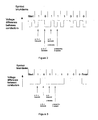
- three devices a, b and c have values to disclose: these values are 184, 168 and 136 respectively, encoded as symbol streams 10111000, 10101000 and 10001000 respectively.
- the behaviour of the devices is shown schematically in Figure 2 .
- a device that wishes to transmit a '0' will see any '1' transmission in the first half of the symbol period.
- a device that wishes to transmit a '0' and sees a ⁇ 1' transmission learns that some other device is disclosing a preferred value and therefore immediately ceases transmission.
- a , b and c all have a '1' to transmit and therefore do so.
- a , b and c all have a '0' to transmit. No other device transmits a '1' and therefore they all transmit a '0'.
- a and b have a '1' to transmit and therefore do so.
- c has a '0' to transmit, but on seeing transmission of a '1' c ceases transmission.
- a has a '1' to transmit and therefore does so.
- b has a '0' to transmit, but on seeing transmission of a '1' b ceases transmission.
- a In the fifth symbol period after the start bit, a has a '1' to transmit and therefore does so.
- a has a '0' to transmit. No other device transmits a '1' and therefore a transmits a '0'.
- This example also uses the comparator rule and the serial encoding rule for an 8-bit binary number given as examples above.
- the example uses negative logic.
- a device drives the voltage difference down during a symbol to indicate '1'; the rest of the time the voltage difference is above this level.
- the disclosure sequence preferably begins with a 1 as a start symbol, according to one of the alternatives in the previous example.
- three devices a , b and c have values to disclose: these are 184, 168 and 136 respectively, encoded as symbol streams 10111000, 10101000 and 10001000 respectively.
- the behaviour of the devices is shown schematically in Figure 3 .
- a device that wishes to transmit a '0' will see any '1' transmission throughout the symbol period.
- a device that wishes to transmit a '0' and sees a '1' transmission learns that some other device is disclosing a preferred value and therefore immediately ceases transmission.
- a , b and c all have a '1' to transmit and therefore do so.
- a , b and c all have a '0' to transmit. No other device transmits a '1' and so they remain eligible to transmit in the third symbol period.
- a and b have a '1' to transmit and therefore do so.
- c has a '0' to transmit, but on seeing transmission of a '1' c ceases transmission.
- a has a '1' to transmit and therefore does so.
- b has a '0' to transmit, but on seeing transmission of a '1' b ceases transmission.
- a In the fifth symbol period after the start bit, a has a '1' to transmit and therefore does so.
- a has a '0' to transmit. No other device transmits a '1' and therefore a remains eligible to transmit in further symbol periods.
- a Since a remains eligible to transmit after the eighth symbol period, a transmits a further '1' as a 'finish bit'.
- finish bit is to distinguish between the case where one device has a value to disclose and discloses 00000000, as against the case where no device has a value to disclose.
- each transmitter is able to recognise during a symbol period when some other transmitter has a 'superior' bit to transmit.
- a '1' is superior to a '0'.
- this invention is applicable to any arrangement of encoding on any serial line where the encoding on the line is such that each transmitter is able to recognise during a symbol period when some other transmitter has a superior bit to transmit and where a transmitter that would otherwise transmit an 'inferior' bit does not prevent other devices from detecting the transmission of the superior bit.
- search sequence for all values of IEC 62386-102 random number.
- the following example search sequence may be carried out using either of the previous encoding techniques or using any other suitable combination of symbol encoding, comparator rule and serial encoding rule. Since the IEC 62386-102 random number is an integer in the range 0 to 2 24 -1, a suitable serial encoding rule is to encode the value as a 24-bit binary number.
- a suitable comparator rule for either of the previous encoding techniques is to disclose the numerically highest value and for the encoding rule to place the most significant bit on the serial link first.
- a device wishing to learn the IEC 62386-102 random numbers held by all other devices may drive the serial link with the following sequence of messages.
- the first step may be omitted if this is the only parameter available from the devices.
- Step 4 may be omitted and Step 3 may be repeated until no device discloses a value.
- the example above is modified so that the message at Step 2 becomes 'All devices holding such a parameter shall report it no more than once, until revoked'.
- the act of disclosing a value represents an implicit instruction to the device that has disclosed the value not to disclose it again, until revoked.
- every device is able to detect and decode the symbols transmitted by all other devices.
- a device a that wishes to learn some information may detect that another device b is requesting and receiving the required information.
- device a is able to learn the information without making any disclosure requests itself.
- both device a and device b may hold one or more values of a requested parameter. In order that device b may correctly learn the complete set of values by this method, device a shall operate as a responding device with respect to the values that it holds.
- device a may have a requirement to learn up to n different values of a parameter, in a circumstance where more than n are held by the devices.
- a device b that requires to learn more than n values may observe the instructions issued by a and then issue further instructions thereafter to continue the learning sequence.
- Device b may take account of unrevoked instructions issued by a in order to minimise the instructions that it must issue.
- Device a may give an indication on the serial link that it has completed its learning sequence, thus enabling device b to continue the learning sequence, without preempting a while a is still issuing instructions.
- a device a may previously have learnt the value of a parameter held by some other device b and may wish to confirm that the value is still held.
- the parameter may be a device identifier for the device. If device a takes advantage of some functionality realised in device b , it may wish to confirm regularly whether device b is still accessible. It can do so for example by the instructions:
- a parameter may be held by different devices using a varying numbers of bits.
- the unique numbers assigned to lighting control equipment as specified in IEC 62386-102 may vary at the choice of individual manufacturer from 96 to 128 bits in length.
- Parameters held by different devices using a varying numbers of bits may be disclosed by padding the shorter representations by inserting patterns of 1 or 0 bits at defined points within the disclosure, such that all patterns are the same length.
- the difference in parameter length may be related to a substructure within the parameter. For example one device has a parameter value containing sub-fields a , b and c while another device has a parameter value containing sub-fields a and c .
- one or more bit patterns may be inserted into the messages to indicate the presence or length of optional sub-sequences within the overall bit pattern.
- the presence or length indicators are inserted before the sub-sequences to which they relate.
- a bit sequence that may vary between 1 and 256 bits in length is delivered with an 8-bit pattern placed at its head that indicates the number of bits following in the sequence. This added pattern both provides a comparator between messages of different lengths and also enables messages of any permitted length to be disclosed and interpreted correctly.
- bitwise comparator rule and the variable length encoding techniques described above allow any bit sequence held by any device to be disclosed.
- the way in which the bit sequence is used to encode a value can in general be arranged to allow for values to be disclosed in a desired order.
- "floating point" or non-integer numbers are generally represented by a sign bit, a set of bits for a mantissa and a set of bits for an exponent.
- the sign bit should be presented first, followed by the exponent and then the mantissa. Where the number is negative, the exponent and mantissa values should be presented with each bit inverted (1 in place of 0 and 0 in place of 1).
- mantissa and exponent should be encoded such that any changes in exponent are always more significant in multiplicative effect than any changes in mantissa.
- the same encoding rule should be used with a bitwise comparator rule to prefer a '0' to a ⁇ 1' at each symbol transmission.
- bit inversion can be employed in general to make a comparator function suited to the symbol encoding on a particular serial line.
- the preferred embodiments of the present invention relate to any case where one or more devices have one or more values of a parameter to disclose.
- the parameter to be disclosed may be a compound value consisting of two or more elements, for example a temperature and a pressure measured by a device. Any compound value that can be represented as a single sequence of bits can be disclosed in the same manner as a single value.
- the preferred embodiments of the present invention are applicable to cases where only the set of values of the parameter are of interest, not the identity of the devices holding them nor the number of devices holding the same value.
- a number of devices may have measured a temperature. It may be desired to determine the range of temperatures that have been measured by the devices. In such a case, all different temperatures are disclosed; two or more devices with the same value to disclose will disclose them at the same time, since none of these devices will detect a "superior" disclosure during their own disclosures.
- the preferred embodiments of the present invention are applicable to cases where the set of values of the parameter and the number of devices holding the same value are of interest, but not the identity of the devices holding them.
- a number of devices may have measured a temperature. It may be desired to determine the average temperature measured by the devices.
- each disclosure may be a compound value consisting of the temperature and some "tie breaker" such as a unique number held by exactly one disclosing device. This allows every temperature measurement to be disclosed exactly once.
- the preferred embodiments of the present invention are applicable to cases where the set of values of the parameter and the identity of the devices holding them are both of interest.
- a compound value consisting of the parameter value and a unique number held by exactly one disclosing device would be disclosed in such a case.
- the existing technique commonly used for searching for parameter values over a communications line is set out in IEC 62386-102, where it is described with reference to a search for 24-bit random numbers, each device holding one such number.
- the existing technique makes use of a "comparator register", i.e. a 24-bit value that is transmitted to all other devices by the device that requires the disclosure.
- the messages that are used are:
- the symbol encoding rate is 1200 symbols per second.
- a single disclosure using the technique and encoding rules described in IEC 62386-102 takes at least 2 seconds.
- Techniques according to the preferred embodiments of the present invention can generate a disclosure of a 24-bit value in 50ms using a symbol encoding rate of 1200 symbols per second. Since systems implemented in compliance with IEC 62386-102 may have 128 devices attached to a serial link, the time taken for a complete search is over 4 minutes according to IEC 62386-102 or around 6 seconds according to the preferred embodiments of the present invention.
- the preferred embodiments of the present invention may readily be incorporated as an enhancement to IEC 62386-102 in such a way as to provide an enhancement to those devices that incorporate this invention but so as not to affect the behaviour of a lighting device built in conformance to IEC 62386-102 but not incorporating this invention.
- One way to achieve this is to use two of the command codes designated in IEC 62386-102 as "Reserved for future needs.
- the control gear shall not react in any way" to signal Step 3 and Step 4 as defined above.
- the command code used to signal Step 4 or an additional command code may also be used to indicate to a device that it should not take part in the search procedure currently defined in IEC 62386-102.
- a start bit for the response to Step 3 may be generated by the device that signalled Step 3, for example in the form of 1 bit signalled a defined time after the signal for Step 3.
- a combination of this bit plus either no response or 24 bits in response from a disclosing device will be ignored by a lighting device built in conformance to IEC 62386-102 but not incorporating this invention.
- any transmission of between 1 and 34 bits, other than a sequence of 16 bits, will be ignored by a lighting device built in conformance to IEC 62386-102 but not incorporating this invention.
- any disclosure of between 1 and 33 bits in length can be made by the method above, using more than one start bit in the case of a 15-bit disclosure.
- the disclosure may proceed by means of the device that signalled Step 3 repeatedly generating one or more start bits, eliciting a response of up to 33 bits on each repetition of the start bit(s), until either no value or a full parameter value has been disclosed.
- the number of start bits may be adjusted on each repetition such as to ensure that each repetition will be ignored by a lighting device built in conformance to IEC 62386-102 but not incorporating this invention. It may be noted that at the present time, lighting devices built in conformance to IEC 62386-102 typically incorporate a computing device suitable to implement the processing steps shown in Figure 2 , at the IEC 62386-102 symbol encoding rate.
- a search to detect the continued presence or disappearance of previously identified IEC 62386-102 devices can be accomplished using techniques according to IEC 62386-102, but only slowly. According to the preferred embodiments of the present invention, detection of the presence of previously identified devices and/or previously unidentified devices can be carried out significantly more quickly.
- the parameter disclosed is a compound value consisting of the random number plus the short address, where the short address encoding allows a value "not assigned a short address" to be encoded in place of a short address value; this compound value can be encoded using 31 bits.
- all of the devices in the system can both interrogate other devices, by transmitting requests for other devices to disclose values of parameters held by the devices, and respond to such requests.
- Examples of use of this invention have been given relating to systems distributed around a building, in particular discrete devices distributed around a building.
- the invention may be applied to systems of greater size and to systems of smaller size.
- the devices comprising the system may be very far apart and linked using very long distance telemetry links.
- One suitable realisation of the serial link in this case would be low frequency radio transmission with symbol encoding rate long enough for all devices in the system to detect other transmissions within a symbol encoding period.
- the devices comprising the system may be located on a single electronic circuit board or within a single electronic device. Suitable realisations of the serial link in this case include electrical conductive paths or various electromagnetic means of signalling between the devices.
- inventions described herein principally comprise computer processes performed in computer apparatus and computer apparatus per se, in combination with other electrical or electronic apparatus
- the invention also extends to computer programs, particularly computer programs on or in a carrier, adapted for putting the invention into practice.
- the program may be in the form of source code, object code, a code intermediate source or object code such as in a partially compiled form, or in any other form suitable for use in implementation of the processes according to the invention.
- the carrier may be any entity or device capable of carrying the program.
- the carrier may comprise a storage medium, such as a ROM, for example a CD ROM or a semiconductor ROM, or a magnetic recording medium, for example a hard disk.
Landscapes
- Engineering & Computer Science (AREA)
- Automation & Control Theory (AREA)
- Computer Networks & Wireless Communication (AREA)
- Signal Processing (AREA)
- Selective Calling Equipment (AREA)
- Information Transfer Systems (AREA)
Claims (15)
- Verfahren zum Erlernen von Werten eines oder mehrerer Parameter, die von einer Vielzahl von Vorrichtungen, die geeignet sind, miteinander mittels einer seriellen Kommunikationsverbindung zu kommunizieren, vorgehalten werden, wobei das Verfahren aufweist:(A) Ausgeben einer Anfrage durch eine der Vorrichtungen über die serielle Kommunikationsverbindung an die Vorrichtungen, um über die serielle Kommunikationsverbindung einen Wert eines Parameters, der von den Vorrichtungen vorgehalten wird, mitzuteilen; und(B) als Antwort darauf versucht jede der Vorrichtungen, die einen solchen Wert vorhält und die angefragt wurde, den Wert mitzuteilen, den Wert, der von der Vorrichtung vorgehalten wird, mitzuteilen, während sie Versuche von anderen Vorrichtungen, die Werte, die von den anderen Vorrichtungen vorgehalten werden, mitzuteilen, beobachtet, wobei die Vorrichtungen dazu eingerichtet sind, dass höchstens ein Wert als Antwort auf jede Anfrage mitgeteilt wird; undWiederholen von (A) und (B), sodass eine Vielzahl der Vorrichtungen, die solch einen Wert vorhalten und die angefragt wurden, den Wert mitzuteilen, den Wert mitgeteilt haben, sodass die anfragende Vorrichtung die Werte der Parameter, die von der Vielzahl der Vorrichtungen vorgehalten werden, erlernt.
- Verfahren nach Anspruch 1, wobei jede Vorrichtung eine Vergleichsregel anwendet, wobei, wenn eine Vorrichtung erlernt, dass eine andere Vorrichtung einen Wert überträgt, der bevorzugt wird vor dem Wert, den die Vorrichtung überträgt, die Vorrichtung das Übertragen ihres Wertes beendet.
- Verfahren nach Anspruch 1 oder Anspruch 2, wobei jede Vorrichtung eine Vergleichsregel anwendet, wobei, wenn eine Vorrichtung mehrere Werte für einen Parameter vorhält, die Vorrichtung einen bevorzugten dieser Werte als Antwort auf die Anfrage überträgt.
- Verfahren nach einem der Ansprüche 1 bis 3, wobei die Anfrage an die Vorrichtungen einen Parameter, der von den Vorrichtungen vorgehalten wird, mitzuteilen, eine Beschränkung für die Vorrichtungen, die auf die Anfrage zu antworten haben, umfasst oder beifügt, sodass nur eine Untermenge der Vorrichtungen auf die Anfrage antwortet.
- Verfahren nach einem der Ansprüche 1 bis 4, wobei jede Vorrichtung in der Lage ist, während einer Zeichenperiode zu erkennen, wenn irgendeine andere Vorrichtung ein übergeordnetes Binärzeichen zu übertragen hat, und wobei eine Vorrichtung, die anderenfalls ein untergeordnetes Binärzeichen übertragen würde, andere Vorrichtungen nicht vom Erfassen der Übertragung des übergeordneten Binärzeichens abhält.
- Verfahren nach einem der Ansprüche 1 bis 5, wobei ein mitzuteilender Parameter ausgewählt aus einer Gruppe bestehend aus einer IEC 62386-102 Zufallszahl, einem Mischwert bestehend aus mehreren Elementen und einem Mischwert bestehend aus einer IEC 62386-102 Zufallszahl und einer IEC 62386-102 Kurzadresse ist.
- Verfahren nach einem der Ansprüche 1 bis 6, wobei die Vorrichtungen separate Vorrichtungen verteilt um ein Gebäude sind.
- Vorrichtung dazu eingerichtet, Werte eines oder mehrerer Parameter, die von einer Vielzahl von Vorrichtungen, die fähig sind, miteinander mittels einer seriellen Kommunikationsverbindung zu kommunizieren, vorgehalten werden, zu erlernen, wobei die Vorrichtung dazu eingerichtet ist:eine Anfrage über die serielle Kommunikationsverbindung an die Vielzahl von Vorrichtungen auszugeben, einen Wert eines Parameters, der von der Vielzahl der Vorrichtungen vorgehalten wird, über die serielle Kommunikationsverbindung mitzuteilen, wobei als Antwort darauf jede der Vorrichtungen, die einen solchen Wert vorhält und die angefragt wurde, diesen Wert mitzuteilen, versucht, den Wert, der von der Vorrichtung vorgehalten wird, mitzuteilen, während es Versuche von anderen Vorrichtungen, die Werte, die von anderen Vorrichtungen vorgehalten werden, mitzuteilen, beobachtet, wobei die Vielzahl der Vorrichtungen so eingerichtet ist, dass höchstens ein Wert als Antwort auf jede Anfrage mitgeteilt wird; unddie Ausgabe einer Anfrage zu wiederholen, sodass eine Vielzahl der Vielzahl der Vorrichtungen, die solch einen Wert vorhalten und bei denen angefragt wurde, diesen Wert mitzuteilen, diesen Wert mitgeteilt haben;sodass die Vorrichtung die Werte der Parameter, die von der Vielzahl der
- Vorrichtung nach Anspruch 8, wobei ein mitzuteilender Parameter ausgewählt aus einer Gruppe bestehend aus einer IEC 62386-102 Zufallszahl, einem Mischwert bestehend aus mehreren Elementen und einem Mischwert bestehend aus einer IEC 62386-102 Zufallszahl und einer IEC 62386-102 Kurzadresse ist.
- Vorrichtung nach Anspruch 8 oder Anspruch 9, wobei die Vorrichtung dazu eingerichtet ist, dass die Anfrage an die Vorrichtungen, einen Parameter mitzuteilen, der von den Vorrichtungen vorgehalten wird, eine Beschränkung für die Vorrichtungen, die auf die Anfrage zu antworten haben, umfasst oder beifügt, sodass nur eine Untermenge der Vorrichtungen auf die Anfrage antwortet.
- Gerät, das eine Vielzahl eigenständiger Vorrichtungen aufweist, die um ein Gebäude verteilt sind und die fähig sind, miteinander mittels einer seriellen Kommunikationsverbindung zu kommunizieren, wobei die Vorrichtungen so eingerichtet sind, dass:wenigstens eine der Vorrichtungen in der Lage ist, eine Anfrage über die serielle Kommunikationsverbindung an die Vorrichtungen auszugeben, einen Wert eines Parameters, der von den Vorrichtungen vorgehalten wird, über die serielle Kommunikationsverbindung mitzuteilen; undals Antwort darauf, jede der Vorrichtungen, die solch einen Wert vorhält und die angefragt wurde, diesen Wert mitzuteilen, versucht, den Wert, der von der Vorrichtung vorgehalten wird, mitzuteilen, während es Versuche von anderen Vorrichtungen, den Wert, der von den anderen Vorrichtungen vorgehalten wird, mitzuteilen, beobachtet, wobei die Vorrichtungen so eingerichtet sind, dass höchstens ein Wert als Antwort auf jede Anfrage mitgeteilt wird;wenigstens eine der Vorrichtungen eingerichtet ist, die Anfrage über die serielle Kommunikationsverbindung an die Vorrichtungen, einen Wert eines Parameters, der von den Vorrichtungen vorgehalten wird, über die serielle Kommunikationsverbindung mitzuteilen, zu wiederholen, sodass eine Vielzahl der Vorrichtungen, die einen solchen Wert vorhalten und bei denen angefragt wurde, den Wert mitzuteilen, den Wert mitgeteilt haben;wobei es einer oder mehreren Vorrichtungen ermöglicht wird, die Werte der Parameter, die von einer Vielzahl von Vorrichtungen vorgehalten werden, zu erlernen.
- Gerät nach Anspruch 11, wobei jede Vorrichtung eine Vergleichsregel anwendet, wobei, wenn eine Vorrichtung erlernt, dass eine andere der Vorrichtungen einen Wert überträgt, der bevorzugt wird vor dem Wert, den die Vorrichtung überträgt, die Vorrichtung das Übertragen ihres Wertes beendet.
- Gerät nach Anspruch 11 oder Anspruch 12, wobei jede Vorrichtung eine Vergleichsregel anwendet, wobei, wenn eine Vorrichtung mehrere Werte für einen Parameter vorhält, die Vorrichtung einen bevorzugten dieser Werte als Antwort auf die Frage überträgt.
- Gerät nach einem der Ansprüche 11 bis 13, wobei die Anfrage an die Vorrichtungen, einen Parameter, der von den Vorrichtungen vorgehalten wird, mitzuteilen, eine Beschränkung für die Vorrichtungen, die auf die Anfrage zu antworten haben, umfasst oder beifügt, so dass nur eine Untermenge der Vorrichtungen auf die Anfrage antwortet.
- Gerät nach einem der Ansprüche 11 bis 14, wobei ein mitzuteilender Parameter ausgewählt aus einer Gruppe bestehend aus einer IEC 62386-102 Zufallszahl, einem Mischwert bestehend aus mehreren Elementen und einem Mischwert bestehend aus einer IEC 62386-102 Zufallszahl und einer IEC 62386-102 Kurzadresse ist.
Applications Claiming Priority (2)
| Application Number | Priority Date | Filing Date | Title |
|---|---|---|---|
| GBGB1000996.7A GB201000996D0 (en) | 2010-01-22 | 2010-01-22 | Method and apparatus for searching for values of one or more parameters and related devices |
| PCT/GB2011/000048 WO2011089380A1 (en) | 2010-01-22 | 2011-01-17 | Method and apparatus for searching for values of one or more parameters and related devices |
Publications (3)
| Publication Number | Publication Date |
|---|---|
| EP2526656A1 EP2526656A1 (de) | 2012-11-28 |
| EP2526656B1 true EP2526656B1 (de) | 2014-05-07 |
| EP2526656B2 EP2526656B2 (de) | 2020-05-13 |
Family
ID=42045881
Family Applications (1)
| Application Number | Title | Priority Date | Filing Date |
|---|---|---|---|
| EP11703916.4A Active EP2526656B2 (de) | 2010-01-22 | 2011-01-17 | Verfahren und vorrichtung zum suchen von werten eines oder mehrerer parameter und zugehörige vorrichtungen |
Country Status (3)
| Country | Link |
|---|---|
| EP (1) | EP2526656B2 (de) |
| GB (1) | GB201000996D0 (de) |
| WO (1) | WO2011089380A1 (de) |
Family Cites Families (4)
| Publication number | Priority date | Publication date | Assignee | Title |
|---|---|---|---|---|
| DE19549815B4 (de) * | 1994-04-18 | 2008-05-21 | Kvaser Consultant Ab | Anordnung zur Beseitigung von Störungen bzw. zur Ermöglichung einer Hochgeschwindigkeitsübertragung in einer seriellen Bus-Schaltung sowie mit letzterer verbundene Sende- und Empfangsgeräte |
| US5968154A (en) | 1995-07-25 | 1999-10-19 | Cho; Jin Young | Distributed priority arbitrating method and system in multi-point serial networks with different transmission rates |
| US20040217718A1 (en) | 2003-05-02 | 2004-11-04 | Russikesh Kumar | Digital addressable electronic ballast and control unit |
| US7755505B2 (en) * | 2006-09-06 | 2010-07-13 | Lutron Electronics Co., Inc. | Procedure for addressing remotely-located radio frequency components of a control system |
-
2010
- 2010-01-22 GB GBGB1000996.7A patent/GB201000996D0/en not_active Ceased
-
2011
- 2011-01-17 WO PCT/GB2011/000048 patent/WO2011089380A1/en not_active Ceased
- 2011-01-17 EP EP11703916.4A patent/EP2526656B2/de active Active
Also Published As
| Publication number | Publication date |
|---|---|
| WO2011089380A1 (en) | 2011-07-28 |
| EP2526656B2 (de) | 2020-05-13 |
| EP2526656A1 (de) | 2012-11-28 |
| GB201000996D0 (en) | 2010-03-10 |
Similar Documents
| Publication | Publication Date | Title |
|---|---|---|
| RU2595962C2 (ru) | Способ и устройство для адаптации надежности передачи данных в последовательной шинной системе | |
| RU2620989C2 (ru) | Способ и устройство для повышения пропускной способности при передаче данных в последовательной шинной системе | |
| JP5798251B2 (ja) | メッセージの大きさがフレキシブルな直列データ伝送におけるデータ伝送信頼性を改善するための方法及び装置 | |
| RU2597502C2 (ru) | Способ и устройство для адаптируемой к размерам памяти последовательной передачи данных | |
| US8514065B2 (en) | Method and device for waking users of a bus system, and corresponding users | |
| RU2597501C2 (ru) | Способ и устройство для последовательной передачи данных с гибким размером сообщений и переменной длительностью бита | |
| US8693878B2 (en) | Illumination device and method for embedding a data signal in a luminance output using AC driven light sources | |
| EP2179521A1 (de) | Verfahren, system und vorrichtung zur sendung von daten einer beleuchtungsvorrichtung | |
| CN100385447C (zh) | 用于选择一个或多个应答器的方法 | |
| EP2526656B1 (de) | Verfahren und vorrichtung zum suchen von werten eines oder mehrerer parameter und zugehörige vorrichtungen | |
| EP3029859A1 (de) | Verfahren, vorrichtungen und systeme mit einem fehlerneuübertragungsmechanismus zum senden und empfangen sichtbarer lichtsignale | |
| EP0866401B1 (de) | Informationsidentifikationssystem zur Antwortgeberidentifizierung | |
| CN102027715B (zh) | 用于在菊链总线结构上重复照明信息的方法和设备 | |
| KR20190033041A (ko) | 리니어 모터 시스템 및 그 구동 방법 | |
| US7836224B2 (en) | Method and system for transmitting data of a data type to be transmitted cyclically and of a data type which can be transmitted acyclically via a common transmission channel | |
| US6470045B1 (en) | Communication protocol between a transceiver unit and transponders or transceivers associated with said unit | |
| US20150208365A1 (en) | Apparatus and method for controlling transmission power in can communication | |
| US7020156B2 (en) | Multiple device communications | |
| CN121079943A (zh) | 用于通信网络中的设备识别的方法和装置 | |
| EP3094018B1 (de) | Lichtregulierungsverfahren und vorrichtung zur reduzierung des zwischenrahmenflimmerns | |
| KR100417483B1 (ko) | 펄스 위치 변조 및 진폭 변조에 의한 데이터 전송 방법 | |
| CN114051702B (zh) | 运行通信网络的方法、通信网络和用于通信网络的用户装置 | |
| CN120582807A (zh) | 一种数据传输方法、系统、设备及存储介质 | |
| JP2004088391A (ja) | 鉄道システム用信号伝送システム |
Legal Events
| Date | Code | Title | Description |
|---|---|---|---|
| PUAI | Public reference made under article 153(3) epc to a published international application that has entered the european phase |
Free format text: ORIGINAL CODE: 0009012 |
|
| 17P | Request for examination filed |
Effective date: 20120822 |
|
| AK | Designated contracting states |
Kind code of ref document: A1 Designated state(s): AL AT BE BG CH CY CZ DE DK EE ES FI FR GB GR HR HU IE IS IT LI LT LU LV MC MK MT NL NO PL PT RO RS SE SI SK SM TR |
|
| DAX | Request for extension of the european patent (deleted) | ||
| GRAP | Despatch of communication of intention to grant a patent |
Free format text: ORIGINAL CODE: EPIDOSNIGR1 |
|
| INTG | Intention to grant announced |
Effective date: 20140103 |
|
| GRAS | Grant fee paid |
Free format text: ORIGINAL CODE: EPIDOSNIGR3 |
|
| GRAA | (expected) grant |
Free format text: ORIGINAL CODE: 0009210 |
|
| AK | Designated contracting states |
Kind code of ref document: B1 Designated state(s): AL AT BE BG CH CY CZ DE DK EE ES FI FR GB GR HR HU IE IS IT LI LT LU LV MC MK MT NL NO PL PT RO RS SE SI SK SM TR |
|
| REG | Reference to a national code |
Ref country code: GB Ref legal event code: FG4D |
|
| REG | Reference to a national code |
Ref country code: AT Ref legal event code: REF Ref document number: 667396 Country of ref document: AT Kind code of ref document: T Effective date: 20140515 |
|
| REG | Reference to a national code |
Ref country code: IE Ref legal event code: FG4D |
|
| REG | Reference to a national code |
Ref country code: DE Ref legal event code: R096 Ref document number: 602011006782 Country of ref document: DE Effective date: 20140703 |
|
| REG | Reference to a national code |
Ref country code: NL Ref legal event code: T3 |
|
| REG | Reference to a national code |
Ref country code: AT Ref legal event code: MK05 Ref document number: 667396 Country of ref document: AT Kind code of ref document: T Effective date: 20140507 |
|
| REG | Reference to a national code |
Ref country code: LT Ref legal event code: MG4D |
|
| PG25 | Lapsed in a contracting state [announced via postgrant information from national office to epo] |
Ref country code: IS Free format text: LAPSE BECAUSE OF FAILURE TO SUBMIT A TRANSLATION OF THE DESCRIPTION OR TO PAY THE FEE WITHIN THE PRESCRIBED TIME-LIMIT Effective date: 20140907 Ref country code: GR Free format text: LAPSE BECAUSE OF FAILURE TO SUBMIT A TRANSLATION OF THE DESCRIPTION OR TO PAY THE FEE WITHIN THE PRESCRIBED TIME-LIMIT Effective date: 20140808 Ref country code: NO Free format text: LAPSE BECAUSE OF FAILURE TO SUBMIT A TRANSLATION OF THE DESCRIPTION OR TO PAY THE FEE WITHIN THE PRESCRIBED TIME-LIMIT Effective date: 20140807 Ref country code: LT Free format text: LAPSE BECAUSE OF FAILURE TO SUBMIT A TRANSLATION OF THE DESCRIPTION OR TO PAY THE FEE WITHIN THE PRESCRIBED TIME-LIMIT Effective date: 20140507 Ref country code: CY Free format text: LAPSE BECAUSE OF FAILURE TO SUBMIT A TRANSLATION OF THE DESCRIPTION OR TO PAY THE FEE WITHIN THE PRESCRIBED TIME-LIMIT Effective date: 20140507 Ref country code: FI Free format text: LAPSE BECAUSE OF FAILURE TO SUBMIT A TRANSLATION OF THE DESCRIPTION OR TO PAY THE FEE WITHIN THE PRESCRIBED TIME-LIMIT Effective date: 20140507 |
|
| PG25 | Lapsed in a contracting state [announced via postgrant information from national office to epo] |
Ref country code: PL Free format text: LAPSE BECAUSE OF FAILURE TO SUBMIT A TRANSLATION OF THE DESCRIPTION OR TO PAY THE FEE WITHIN THE PRESCRIBED TIME-LIMIT Effective date: 20140507 Ref country code: AT Free format text: LAPSE BECAUSE OF FAILURE TO SUBMIT A TRANSLATION OF THE DESCRIPTION OR TO PAY THE FEE WITHIN THE PRESCRIBED TIME-LIMIT Effective date: 20140507 Ref country code: LV Free format text: LAPSE BECAUSE OF FAILURE TO SUBMIT A TRANSLATION OF THE DESCRIPTION OR TO PAY THE FEE WITHIN THE PRESCRIBED TIME-LIMIT Effective date: 20140507 Ref country code: HR Free format text: LAPSE BECAUSE OF FAILURE TO SUBMIT A TRANSLATION OF THE DESCRIPTION OR TO PAY THE FEE WITHIN THE PRESCRIBED TIME-LIMIT Effective date: 20140507 Ref country code: SE Free format text: LAPSE BECAUSE OF FAILURE TO SUBMIT A TRANSLATION OF THE DESCRIPTION OR TO PAY THE FEE WITHIN THE PRESCRIBED TIME-LIMIT Effective date: 20140507 Ref country code: ES Free format text: LAPSE BECAUSE OF FAILURE TO SUBMIT A TRANSLATION OF THE DESCRIPTION OR TO PAY THE FEE WITHIN THE PRESCRIBED TIME-LIMIT Effective date: 20140507 Ref country code: RS Free format text: LAPSE BECAUSE OF FAILURE TO SUBMIT A TRANSLATION OF THE DESCRIPTION OR TO PAY THE FEE WITHIN THE PRESCRIBED TIME-LIMIT Effective date: 20140507 |
|
| PG25 | Lapsed in a contracting state [announced via postgrant information from national office to epo] |
Ref country code: PT Free format text: LAPSE BECAUSE OF FAILURE TO SUBMIT A TRANSLATION OF THE DESCRIPTION OR TO PAY THE FEE WITHIN THE PRESCRIBED TIME-LIMIT Effective date: 20140908 |
|
| PG25 | Lapsed in a contracting state [announced via postgrant information from national office to epo] |
Ref country code: CZ Free format text: LAPSE BECAUSE OF FAILURE TO SUBMIT A TRANSLATION OF THE DESCRIPTION OR TO PAY THE FEE WITHIN THE PRESCRIBED TIME-LIMIT Effective date: 20140507 Ref country code: DK Free format text: LAPSE BECAUSE OF FAILURE TO SUBMIT A TRANSLATION OF THE DESCRIPTION OR TO PAY THE FEE WITHIN THE PRESCRIBED TIME-LIMIT Effective date: 20140507 Ref country code: BE Free format text: LAPSE BECAUSE OF FAILURE TO SUBMIT A TRANSLATION OF THE DESCRIPTION OR TO PAY THE FEE WITHIN THE PRESCRIBED TIME-LIMIT Effective date: 20140507 Ref country code: EE Free format text: LAPSE BECAUSE OF FAILURE TO SUBMIT A TRANSLATION OF THE DESCRIPTION OR TO PAY THE FEE WITHIN THE PRESCRIBED TIME-LIMIT Effective date: 20140507 Ref country code: SK Free format text: LAPSE BECAUSE OF FAILURE TO SUBMIT A TRANSLATION OF THE DESCRIPTION OR TO PAY THE FEE WITHIN THE PRESCRIBED TIME-LIMIT Effective date: 20140507 Ref country code: RO Free format text: LAPSE BECAUSE OF FAILURE TO SUBMIT A TRANSLATION OF THE DESCRIPTION OR TO PAY THE FEE WITHIN THE PRESCRIBED TIME-LIMIT Effective date: 20140507 |
|
| REG | Reference to a national code |
Ref country code: DE Ref legal event code: R026 Ref document number: 602011006782 Country of ref document: DE |
|
| PLBI | Opposition filed |
Free format text: ORIGINAL CODE: 0009260 |
|
| PLAX | Notice of opposition and request to file observation + time limit sent |
Free format text: ORIGINAL CODE: EPIDOSNOBS2 |
|
| 26 | Opposition filed |
Opponent name: HELVAR OY AB Effective date: 20150209 |
|
| REG | Reference to a national code |
Ref country code: DE Ref legal event code: R026 Ref document number: 602011006782 Country of ref document: DE Effective date: 20150209 |
|
| PG25 | Lapsed in a contracting state [announced via postgrant information from national office to epo] |
Ref country code: IT Free format text: LAPSE BECAUSE OF FAILURE TO SUBMIT A TRANSLATION OF THE DESCRIPTION OR TO PAY THE FEE WITHIN THE PRESCRIBED TIME-LIMIT Effective date: 20140507 |
|
| PLBB | Reply of patent proprietor to notice(s) of opposition received |
Free format text: ORIGINAL CODE: EPIDOSNOBS3 |
|
| PG25 | Lapsed in a contracting state [announced via postgrant information from national office to epo] |
Ref country code: SI Free format text: LAPSE BECAUSE OF FAILURE TO SUBMIT A TRANSLATION OF THE DESCRIPTION OR TO PAY THE FEE WITHIN THE PRESCRIBED TIME-LIMIT Effective date: 20140507 |
|
| REG | Reference to a national code |
Ref country code: CH Ref legal event code: PL |
|
| PG25 | Lapsed in a contracting state [announced via postgrant information from national office to epo] |
Ref country code: LU Free format text: LAPSE BECAUSE OF FAILURE TO SUBMIT A TRANSLATION OF THE DESCRIPTION OR TO PAY THE FEE WITHIN THE PRESCRIBED TIME-LIMIT Effective date: 20150117 |
|
| PG25 | Lapsed in a contracting state [announced via postgrant information from national office to epo] |
Ref country code: MC Free format text: LAPSE BECAUSE OF FAILURE TO SUBMIT A TRANSLATION OF THE DESCRIPTION OR TO PAY THE FEE WITHIN THE PRESCRIBED TIME-LIMIT Effective date: 20140507 |
|
| PG25 | Lapsed in a contracting state [announced via postgrant information from national office to epo] |
Ref country code: CH Free format text: LAPSE BECAUSE OF NON-PAYMENT OF DUE FEES Effective date: 20150131 Ref country code: LI Free format text: LAPSE BECAUSE OF NON-PAYMENT OF DUE FEES Effective date: 20150131 |
|
| REG | Reference to a national code |
Ref country code: IE Ref legal event code: MM4A |
|
| PLAY | Examination report in opposition despatched + time limit |
Free format text: ORIGINAL CODE: EPIDOSNORE2 |
|
| PG25 | Lapsed in a contracting state [announced via postgrant information from national office to epo] |
Ref country code: IE Free format text: LAPSE BECAUSE OF NON-PAYMENT OF DUE FEES Effective date: 20150117 |
|
| REG | Reference to a national code |
Ref country code: FR Ref legal event code: PLFP Year of fee payment: 6 |
|
| PLBC | Reply to examination report in opposition received |
Free format text: ORIGINAL CODE: EPIDOSNORE3 |
|
| PG25 | Lapsed in a contracting state [announced via postgrant information from national office to epo] |
Ref country code: MT Free format text: LAPSE BECAUSE OF FAILURE TO SUBMIT A TRANSLATION OF THE DESCRIPTION OR TO PAY THE FEE WITHIN THE PRESCRIBED TIME-LIMIT Effective date: 20140507 |
|
| REG | Reference to a national code |
Ref country code: FR Ref legal event code: PLFP Year of fee payment: 7 |
|
| PG25 | Lapsed in a contracting state [announced via postgrant information from national office to epo] |
Ref country code: SM Free format text: LAPSE BECAUSE OF FAILURE TO SUBMIT A TRANSLATION OF THE DESCRIPTION OR TO PAY THE FEE WITHIN THE PRESCRIBED TIME-LIMIT Effective date: 20140507 Ref country code: HU Free format text: LAPSE BECAUSE OF FAILURE TO SUBMIT A TRANSLATION OF THE DESCRIPTION OR TO PAY THE FEE WITHIN THE PRESCRIBED TIME-LIMIT; INVALID AB INITIO Effective date: 20110117 Ref country code: BG Free format text: LAPSE BECAUSE OF FAILURE TO SUBMIT A TRANSLATION OF THE DESCRIPTION OR TO PAY THE FEE WITHIN THE PRESCRIBED TIME-LIMIT Effective date: 20140507 |
|
| APAH | Appeal reference modified |
Free format text: ORIGINAL CODE: EPIDOSCREFNO |
|
| APBM | Appeal reference recorded |
Free format text: ORIGINAL CODE: EPIDOSNREFNO |
|
| APBP | Date of receipt of notice of appeal recorded |
Free format text: ORIGINAL CODE: EPIDOSNNOA2O |
|
| PG25 | Lapsed in a contracting state [announced via postgrant information from national office to epo] |
Ref country code: TR Free format text: LAPSE BECAUSE OF FAILURE TO SUBMIT A TRANSLATION OF THE DESCRIPTION OR TO PAY THE FEE WITHIN THE PRESCRIBED TIME-LIMIT Effective date: 20140507 |
|
| APBQ | Date of receipt of statement of grounds of appeal recorded |
Free format text: ORIGINAL CODE: EPIDOSNNOA3O |
|
| REG | Reference to a national code |
Ref country code: FR Ref legal event code: PLFP Year of fee payment: 8 |
|
| PLAB | Opposition data, opponent's data or that of the opponent's representative modified |
Free format text: ORIGINAL CODE: 0009299OPPO |
|
| PG25 | Lapsed in a contracting state [announced via postgrant information from national office to epo] |
Ref country code: MK Free format text: LAPSE BECAUSE OF FAILURE TO SUBMIT A TRANSLATION OF THE DESCRIPTION OR TO PAY THE FEE WITHIN THE PRESCRIBED TIME-LIMIT Effective date: 20140507 |
|
| R26 | Opposition filed (corrected) |
Opponent name: HELVAR OY AB Effective date: 20150209 |
|
| PG25 | Lapsed in a contracting state [announced via postgrant information from national office to epo] |
Ref country code: AL Free format text: LAPSE BECAUSE OF FAILURE TO SUBMIT A TRANSLATION OF THE DESCRIPTION OR TO PAY THE FEE WITHIN THE PRESCRIBED TIME-LIMIT Effective date: 20140507 |
|
| PLAB | Opposition data, opponent's data or that of the opponent's representative modified |
Free format text: ORIGINAL CODE: 0009299OPPO |
|
| R26 | Opposition filed (corrected) |
Opponent name: HELVAR OY AB Effective date: 20150209 |
|
| APBU | Appeal procedure closed |
Free format text: ORIGINAL CODE: EPIDOSNNOA9O |
|
| PUAH | Patent maintained in amended form |
Free format text: ORIGINAL CODE: 0009272 |
|
| STAA | Information on the status of an ep patent application or granted ep patent |
Free format text: STATUS: PATENT MAINTAINED AS AMENDED |
|
| 27A | Patent maintained in amended form |
Effective date: 20200513 |
|
| AK | Designated contracting states |
Kind code of ref document: B2 Designated state(s): AL AT BE BG CH CY CZ DE DK EE ES FI FR GB GR HR HU IE IS IT LI LT LU LV MC MK MT NL NO PL PT RO RS SE SI SK SM TR |
|
| REG | Reference to a national code |
Ref country code: DE Ref legal event code: R102 Ref document number: 602011006782 Country of ref document: DE |
|
| REG | Reference to a national code |
Ref country code: NL Ref legal event code: MP Effective date: 20140507 |
|
| REG | Reference to a national code |
Ref country code: NL Ref legal event code: NE Effective date: 20201217 |
|
| PG25 | Lapsed in a contracting state [announced via postgrant information from national office to epo] |
Ref country code: NL Free format text: LAPSE BECAUSE OF FAILURE TO SUBMIT A TRANSLATION OF THE DESCRIPTION OR TO PAY THE FEE WITHIN THE PRESCRIBED TIME-LIMIT Effective date: 20140507 |
|
| REG | Reference to a national code |
Ref country code: NL Ref legal event code: NG Ref country code: NL Ref legal event code: FP |
|
| PG25 | Lapsed in a contracting state [announced via postgrant information from national office to epo] |
Ref country code: NL Free format text: LAPSE BECAUSE OF FAILURE TO SUBMIT A TRANSLATION OF THE DESCRIPTION OR TO PAY THE FEE WITHIN THE PRESCRIBED TIME-LIMIT Effective date: 20140507 |
|
| PGRI | Patent reinstated in contracting state [announced from national office to epo] |
Ref country code: NL Effective date: 20211201 |
|
| P01 | Opt-out of the competence of the unified patent court (upc) registered |
Effective date: 20230424 |
|
| PGFP | Annual fee paid to national office [announced via postgrant information from national office to epo] |
Ref country code: NL Payment date: 20260121 Year of fee payment: 16 |
|
| PGFP | Annual fee paid to national office [announced via postgrant information from national office to epo] |
Ref country code: GB Payment date: 20260106 Year of fee payment: 16 |
|
| PGFP | Annual fee paid to national office [announced via postgrant information from national office to epo] |
Ref country code: DE Payment date: 20251231 Year of fee payment: 16 |
|
| PGFP | Annual fee paid to national office [announced via postgrant information from national office to epo] |
Ref country code: FR Payment date: 20260128 Year of fee payment: 16 |