EP2526792A1 - Dispositif de support de l'articulation du coude - Google Patents
Dispositif de support de l'articulation du coude Download PDFInfo
- Publication number
- EP2526792A1 EP2526792A1 EP11734801A EP11734801A EP2526792A1 EP 2526792 A1 EP2526792 A1 EP 2526792A1 EP 11734801 A EP11734801 A EP 11734801A EP 11734801 A EP11734801 A EP 11734801A EP 2526792 A1 EP2526792 A1 EP 2526792A1
- Authority
- EP
- European Patent Office
- Prior art keywords
- section
- knitted fabric
- elbow joint
- joint supporter
- fabric
- Prior art date
- Legal status (The legal status is an assumption and is not a legal conclusion. Google has not performed a legal analysis and makes no representation as to the accuracy of the status listed.)
- Granted
Links
Images




Classifications
-
- A—HUMAN NECESSITIES
- A41—WEARING APPAREL
- A41D—OUTERWEAR; PROTECTIVE GARMENTS; ACCESSORIES
- A41D13/00—Professional, industrial or sporting protective garments, e.g. surgeons' gowns or garments protecting against blows or punches
- A41D13/05—Professional, industrial or sporting protective garments, e.g. surgeons' gowns or garments protecting against blows or punches protecting only a particular body part
- A41D13/08—Arm or hand
-
- A—HUMAN NECESSITIES
- A61—MEDICAL OR VETERINARY SCIENCE; HYGIENE
- A61F—FILTERS IMPLANTABLE INTO BLOOD VESSELS; PROSTHESES; DEVICES PROVIDING PATENCY TO, OR PREVENTING COLLAPSING OF, TUBULAR STRUCTURES OF THE BODY, e.g. STENTS; ORTHOPAEDIC, NURSING OR CONTRACEPTIVE DEVICES; FOMENTATION; TREATMENT OR PROTECTION OF EYES OR EARS; BANDAGES, DRESSINGS OR ABSORBENT PADS; FIRST-AID KITS
- A61F13/00—Bandages or dressings; Absorbent pads
- A61F13/10—Bandages or dressings; Absorbent pads specially adapted for fingers, hands or arms; Finger-stalls; Nail-protectors
- A61F13/101—Bandages or dressings; Absorbent pads specially adapted for fingers, hands or arms; Finger-stalls; Nail-protectors for the elbow, e.g. decubitus ulcer bandages
-
- A—HUMAN NECESSITIES
- A61—MEDICAL OR VETERINARY SCIENCE; HYGIENE
- A61F—FILTERS IMPLANTABLE INTO BLOOD VESSELS; PROSTHESES; DEVICES PROVIDING PATENCY TO, OR PREVENTING COLLAPSING OF, TUBULAR STRUCTURES OF THE BODY, e.g. STENTS; ORTHOPAEDIC, NURSING OR CONTRACEPTIVE DEVICES; FOMENTATION; TREATMENT OR PROTECTION OF EYES OR EARS; BANDAGES, DRESSINGS OR ABSORBENT PADS; FIRST-AID KITS
- A61F5/00—Orthopaedic methods or devices for non-surgical treatment of bones or joints; Nursing devices ; Anti-rape devices
- A61F5/01—Orthopaedic devices, e.g. long-term immobilising or pressure directing devices for treating broken or deformed bones such as splints, casts or braces
- A61F5/0102—Orthopaedic devices, e.g. long-term immobilising or pressure directing devices for treating broken or deformed bones such as splints, casts or braces specially adapted for correcting deformities of the limbs or for supporting them; Ortheses, e.g. with articulations
- A61F5/0104—Orthopaedic devices, e.g. long-term immobilising or pressure directing devices for treating broken or deformed bones such as splints, casts or braces specially adapted for correcting deformities of the limbs or for supporting them; Ortheses, e.g. with articulations without articulation
- A61F5/0118—Orthopaedic devices, e.g. long-term immobilising or pressure directing devices for treating broken or deformed bones such as splints, casts or braces specially adapted for correcting deformities of the limbs or for supporting them; Ortheses, e.g. with articulations without articulation for the arms, hands or fingers
-
- D—TEXTILES; PAPER
- D04—BRAIDING; LACE-MAKING; KNITTING; TRIMMINGS; NON-WOVEN FABRICS
- D04B—KNITTING
- D04B1/00—Weft knitting processes for the production of fabrics or articles not dependent on the use of particular machines; Fabrics or articles defined by such processes
- D04B1/10—Patterned fabrics or articles
- D04B1/102—Patterned fabrics or articles with stitch pattern
-
- D—TEXTILES; PAPER
- D04—BRAIDING; LACE-MAKING; KNITTING; TRIMMINGS; NON-WOVEN FABRICS
- D04B—KNITTING
- D04B1/00—Weft knitting processes for the production of fabrics or articles not dependent on the use of particular machines; Fabrics or articles defined by such processes
- D04B1/22—Weft knitting processes for the production of fabrics or articles not dependent on the use of particular machines; Fabrics or articles defined by such processes specially adapted for knitting goods of particular configuration
-
- A—HUMAN NECESSITIES
- A63—SPORTS; GAMES; AMUSEMENTS
- A63B—APPARATUS FOR PHYSICAL TRAINING, GYMNASTICS, SWIMMING, CLIMBING, OR FENCING; BALL GAMES; TRAINING EQUIPMENT
- A63B71/00—Games or sports accessories not covered in groups A63B1/00 - A63B69/00
- A63B71/08—Body-protectors for players or sportsmen, i.e. body-protecting accessories affording protection of body parts against blows or collisions
- A63B71/12—Body-protectors for players or sportsmen, i.e. body-protecting accessories affording protection of body parts against blows or collisions for the body or the legs, e.g. for the shoulders
- A63B71/1225—Body-protectors for players or sportsmen, i.e. body-protecting accessories affording protection of body parts against blows or collisions for the body or the legs, e.g. for the shoulders for the legs, e.g. thighs, knees, ankles, feet
- A63B2071/125—Body-protectors for players or sportsmen, i.e. body-protecting accessories affording protection of body parts against blows or collisions for the body or the legs, e.g. for the shoulders for the legs, e.g. thighs, knees, ankles, feet for the knee
-
- A—HUMAN NECESSITIES
- A63—SPORTS; GAMES; AMUSEMENTS
- A63B—APPARATUS FOR PHYSICAL TRAINING, GYMNASTICS, SWIMMING, CLIMBING, OR FENCING; BALL GAMES; TRAINING EQUIPMENT
- A63B71/00—Games or sports accessories not covered in groups A63B1/00 - A63B69/00
- A63B71/08—Body-protectors for players or sportsmen, i.e. body-protecting accessories affording protection of body parts against blows or collisions
- A63B71/12—Body-protectors for players or sportsmen, i.e. body-protecting accessories affording protection of body parts against blows or collisions for the body or the legs, e.g. for the shoulders
-
- D—TEXTILES; PAPER
- D10—INDEXING SCHEME ASSOCIATED WITH SUBLASSES OF SECTION D, RELATING TO TEXTILES
- D10B—INDEXING SCHEME ASSOCIATED WITH SUBLASSES OF SECTION D, RELATING TO TEXTILES
- D10B2509/00—Medical; Hygiene
- D10B2509/02—Bandages, dressings or absorbent pads
- D10B2509/028—Elastic support stockings or elastic bandages
Definitions
- the present invention relates to an elbow joint supporter which can support a wearer's daily motion, and particularly, to an elbow joint supporter having a taping function of improving the stability of the elbow joint, thereby reducing a strain on the elbow joint and also reducing a load on the biceps brachii tendon.
- a pain occurs in the vicinity of the olecranon. Inflammation of the joint capsule is often regarded as a factor of the pain, and in severe cases, the formation of an osteophyte or a bone fracture occurs.
- a main motion muscle to bend the elbow joint is the biceps brachii muscle.
- inflammation occurs in the biceps brachii tendon extending in front of the shoulder joint, thereby causing a pain.
- a load in an extension direction of the elbow joint becomes an overload.
- a supporter for an elbow in the related art includes a tubular supporter main body which covers at least the upper and lower sides of the elbow joint of the arm of a wearer, first and second expansion and contraction inhibition sections each provided over an approximately half circumference at a periphery of one end of the supporter main body, and third and fourth expansion and contraction inhibition sections each provided over an approximately half circumference at the peripheral surface of the other end, wherein the first and second expansion and contraction inhibition sections and the third and fourth expansion and contraction inhibition sections are respectively disposed at about 90° torsional positions such that the first expansion and contraction inhibition section presses the biceps brachii muscle, the second expansion and contraction inhibition section presses the triceps brachii muscle, the third expansion and contraction inhibition section presses the brachioradial muscle, the extensor carpi radialis longus muscle, the extensor carpi radialis brevis muscle, and the extensor carpi ulnaris muscle, and the fourth expansion and contraction inhibition section presse
- the supporter for an elbow in the related art is a supporter activating the muscles of the arm or the wrist of a wearer and the expansion and contraction inhibition section extends in the circumferential direction of the arm of the wearer to press the muscles.
- an expansion and contraction inhibition section does not extend in the length direction of the arm of the wearer.
- the supporter for an elbow in the related art is not for controlling the full extension of the elbow joint (limiting a range of motion) and cannot reduce a strain on the elbow joint, so that there is a problem in that it is not possible to prevent inflammation of the biceps brachii tendon.
- the present invention has been made to solve the problems as described above and has an object to provide an elbow joint supporter which improves the stability of the elbow joint, thereby being able to reduce a strain on the elbow joint and also reduce a load on the biceps brachii tendon.
- An elbow joint supporter includes: a first anchor section which is knitted to go around one end of a tubular knitted fabric and makes the tubular knitted fabric be tightened on the brachium of a wearer; a second anchor section which is knitted to go around the other end of the tubular knitted fabric and makes the tubular knitted fabric be tightened on the forearm of the wearer; and a supporting section which is knitted in an approximate X-shape that crosses at the cubital fossa of the wearer, and supports the elbow joint of the wearer by connecting two end portions in the approximately X-shaped knitted fabric to the first anchor section and connecting the other two end portions in the approximately X-shaped knitted fabric to the second anchor section, wherein the stretch resistances of the first anchor section and the second anchor section in a circumferential direction of the tubular knitted fabric are larger than the stretch resistance of a base fabric section in the circumferential direction of the tubular knitted fabric, and the stretch resistance of the supporting section in a length direction of the
- the elbow joint supporter by controlling the full extension of the elbow joint, it is possible to reduce a load on the olecranon (the rear of the elbow joint) and also protect the biceps brachii tendon and reduce a pain.
- an elbow joint supporter 10 is made of a tubular knitted fabric which is knitted in circular knitting by a hosiery knitting machine (for example, a type of knitting machine (the number of needles: 256) manufactured by Lonati Co.), and is a supporter which comes into close contact with the body surface of a wearer, thereby assisting the elbow joint of the wearer.
- a hosiery knitting machine for example, a type of knitting machine (the number of needles: 256) manufactured by Lonati Co.
- the elbow joint supporter 10 has a desired functionality such as a taping function by performing different knitting with respect to a base fabric section 1 that is a knitted fabric which is knitted in a plain stitch, a rib stitch, a tuck stitch, a float stitch, a pile stitch, or the like by using an upper thread, an under thread, and a rubber thread as knitting yarn.
- the base fabric section 1 related to this embodiment is a knitted fabric which is knitted in a tuck stitch (hereinafter referred to as a tuck stitch knitted fabric).
- the tuck stitch knitted fabric is a knitted fabric in which a certain loop is not made temporarily when knitting the fabric and loops are made together when knitting the next course.
- the number of times to tuck is set to be twice. However, the number of times is not limited thereto.
- the elbow joint supporter 10 has a first anchor section 2 which is knitted to go around one end (an upper end 10a) of the tubular knitted fabric and makes the elbow joint supporter 10 be tightened on the brachium of a wearer, and a second anchor section 3 which is knitted to go around the other end (a lower end 10b) of the tubular knitted fabric and makes the elbow joint supporter 10 be tightened on the forearm of the wearer.
- the first anchor section 2 and the second anchor section 3 are knitted such that the stretch resistances thereof in a circumferential direction H of the elbow joint supporter 10 (the tubular knitted fabric) are larger than the stretch resistance of the base fabric section 1 in the circumferential direction H of the elbow joint supporter 10.
- the tension of the base fabric section 1 in the circumferential direction H of the elbow joint supporter 10 is set to be F H1
- the tension of the first anchor section 2 in the circumferential direction H of the elbow joint supporter 10 is set to be F H2
- the tension of the second anchor section 3 in the circumferential direction H of the elbow joint supporter 10 is set to be F H3
- the first anchor section 2 and the second anchor section 3 have such a magnitude relation of F H2 ⁇ F H3 >F H1 that they have strong tightening forces in the circumferential direction H of the elbow joint supporter 10, compared to the base fabric section 1.
- each of the first anchor section 2 and the second anchor section 3 be a knitted fabric knitted in a moss stitch (hereinafter referred to as a moss stitch knitted fabric), it is possible to make the stretch resistance thereof in the circumferential direction H of the elbow joint supporter 10 large with respect to the base fabric section 1 that is the tuck stitch knitted fabric.
- the moss stitch knitted fabric is a knitted fabric in which a plain stitch and a tuck (a structure in which no loop protrudes over a certain course and plural loops protrude over the subsequent course) appear alternately or for every few courses in the course direction and the wale direction.
- the plain stitch and the tuck are used in combination, whereby it is possible to make protuberances or openwork stitches on the surface of a knitted fabric and a mesh pattern such as a moss appear.
- the first anchor section 2 is knitted to surround the brachium of a wearer, and the stretch resistance of the first anchor section 2 in the circumferential direction H of the elbow joint supporter 10 is larger than the stretch resistance of the base fabric section 1 in the circumferential direction H of the elbow joint supporter 10, whereby it is possible to fix the elbow joint supporter 10 to the brachium of a wearer and suppress slipping-off of the upper end 10a of the elbow joint supporter 10 at the time of the flexion of the elbow joint.
- the first anchor section 2 is connected to a supporting section 4 (described later), thereby also functioning as an anchor of the supporting section 4.
- the second anchor section 3 is knitted to surround the forearm of a wearer, and the stretch resistance of the second anchor section 3 in the circumferential direction H of the elbow joint supporter 10 is larger than the stretch resistance of the base fabric section 1 in the circumferential direction H of the elbow joint supporter 10, whereby it is possible to fix the elbow joint supporter 10 to the forearm of a wearer and suppress slipping-off of the lower end 10b of the elbow joint supporter 10 at the time of the flexion of the elbow joint.
- the second anchor section 3 is connected to the supporting section 4 (described later), thereby also functioning as an anchor of the supporting section 4.
- the tightening forces on the brachium and the forearm of a wearer by the first anchor section 2 and the second anchor section 3 are too strong, constriction of blood flow in the brachium and the forearm occurs, thereby causing a feeling of discomfort to the wearer.
- the feeling of discomfort is marked in the brachium, compared to the forearm.
- the feeling of discomfort which is imparted to a wearer is alleviated by widening the area of the first anchor section 2 which comes into contact with the body surface of the wearer, with respect to the second anchor section 3, thereby dispersing pressure which is applied to the body surface by the first anchor section 2, and also adjusting density in a portion of the first anchor section 2 (for example, to make a tightening force thereof be reduced by about 10% with respect to the second anchor section 3). That is, it is preferable that the elbow joint supporter 10 related to this embodiment have a magnitude relation of F H3 >F H2 >F H1 so as to have a moderate tightening force in the circumferential direction H of the elbow joint supporter 10.
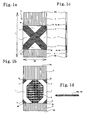
- the supporting section 4 is knitted in an approximate X-shape which crosses at the cubital fossa of a wearer, and supports the elbow joint of the wearer by connecting two end portions 4a and 4b in an approximately X-shaped knitted fabric to the first anchor section 2 and connecting the other two end portions 4c and 4d in the approximately X-shaped knitted fabric to the second anchor section 3. That is, the supporting section 4 is locked at the first anchor section 2 on the brachium side of a wearer and locked at the second anchor section 3 on the forearm side of the wearer.
- the supporting section 4 be formed such that the stretch resistance in the length direction of the supporting section 4 becomes large compared to the stretch resistance in the width direction of the supporting section 4.
- the supporting section 4 is formed in which the stretch resistance thereof in a length direction L of the elbow joint supporter 10 is large compared to the stretch resistance thereof in the circumferential direction H of the elbow joint supporter 10 so as to approximate to a knitted fabric with a difference in the stretch resistance imparted thereto.
- the supporting section 4 is knitted such that the stretch resistance thereof in the length direction L of the elbow joint supporter 10 is larger than the stretch resistance of the base fabric section 1 in the length direction L of the elbow joint supporter 10. That is, when the tension of the base fabric section 1 in the length direction L of the elbow joint supporter 10 is set to be F L1 and the tension of the supporting section 4 in the length direction L of the elbow joint supporter 10 is set to be F L4 , the supporting section 4 has such a magnitude relation of F L4 >F L1 that it has a strong tightening force in the length direction L of the elbow joint supporter 10, compared to the base fabric section 1.
- the supporting section 4 be a knitted fabric in which a tuck stitch and a plating stitch are used in combination (hereinafter referred to as a tuck stitch-plating stitch knitted fabric), it is possible to make the stretch resistance thereof in the length direction L of the elbow joint supporter 10 large with respect to the base fabric section 1 that is the tuck stitch knitted fabric.
- expansion and contraction of the supporting section 4 in the length direction L of the elbow joint supporter 10 is moderately suppressed by additionally feeding another knitting yarn (for example, woolly nylon yarn) in addition to ground knitting yarn of the tuck stitch, and another knitting yarn is cut at the boundary between the supporting section 4 and the base fabric section 1 (a cut boss).
- another knitting yarn for example, woolly nylon yarn
- the supporting section 4 is knitted in an approximate X-shape which crosses at the cubital fossa of a wearer, and the stretch resistance thereof in the length direction L of the elbow joint supporter 10 is larger than the stretch resistance of the base fabric section 1 in the length direction L of the elbow joint supporter 10, whereby it is possible to grip the elbow joint like grabbing the cubital fossa of a wearer, thereby limiting the rotation of the elbow joint and securing the stability of the elbow joint, and it is also possible to prevent damage to the ligament which is located at the elbow joint due to over-rotation of the elbow joint.
- special function knitting (the tuck stitch-plating stitch knitted fabric) in the supporting section 4 is connected to the moss stitch knitted fabrics in the first anchor section 2 and the second anchor section 3 and prevents a position shift of the supporting section 4 with respect to the cubital fossa of a wearer, so that it is possible to fix the supporting section 4 to an appropriate position.
- An olecranon contact section 5 is a section which is knitted on the rear face side of the elbow joint supporter 10 and comes into contact with the olecranon of a wearer, and in this embodiment, the olecranon contact section 5 is an approximately octagon-shaped knitted fabric.
- the olecranon contact section 5 is knitted such that the stretch resistance thereof in the length direction L of the elbow joint supporter 10 is smaller than the stretch resistance of the base fabric section 1 in the length direction L of the elbow joint supporter 10. That is, when the tension of the olecranon contact section 5 in the length direction L of the elbow joint supporter 10 is set to be F L5 , the olecranon contact section 5 has such a magnitude relation of F L1 >F L5 that it has a weak tightening force in the length direction L of the elbow joint supporter 10, compared to the base fabric section 1.
- the olecranon contact section 5 be a knitted fabric knitted in a mesh stitch that is a knitting structure having good air permeability (hereinafter referred to as a mesh stitch knitted fabric), it is possible to make the stretch resistance thereof in the length direction L of the elbow joint supporter 10 small with respect to the base fabric section 1 that is the tuck stitch knitted fabric.
- a mesh stitch knitted fabric a knitted fabric knitted in a mesh stitch that is a knitting structure having good air permeability
- the mesh stitch knitted fabric is a knitted fabric in which a certain loop is not made temporarily when knitting the fabric and loops are made together when knitting the next course and which stretches well with knitting in the form of a mesh.
- the olecranon contact section 5 is a section which comes into contact with the olecranon of a wearer, and the stretch resistance thereof in the length direction L of the elbow joint supporter 10 is smaller than the stretch resistance of the base fabric section 1 in the length direction L of the elbow joint supporter 10, whereby forces associated with expansion and contraction of the skin of a wearer in the bending and stretching motion or the rotation motion of the elbow joint can be absorbed by a high stretch function.
- the olecranon contact section 5 can grip the kneecap of a wearer at the time of the flexion of the elbow joint due to the mesh stitch knitted fabric having high stretch properties, and prevents a position shift in any direction of the elbow joint supporter 10, so that it is possible to improve the operation and effects by the supporting section 4 described above, as an anchor function of the supporting section 4.
- the olecranon contact section 5 may also be a knitted fabric in which a mesh stitch knitted fabric (a plain stitch knitted fabric composed of an under thread and a rubber thread without feeding an upper thread) and a plain stitch knitted fabric (a plain stitch knitted fabric composed of an upper thread, an under thread, and a rubber thread), which extend in the circumferential direction H of the elbow joint supporter 10, are alternately arranged in parallel (hereinafter referred to as a bellows knitted fabric).
- a mesh stitch knitted fabric a plain stitch knitted fabric composed of an under thread and a rubber thread without feeding an upper thread
- a plain stitch knitted fabric a plain stitch knitted fabric composed of an upper thread, an under thread, and a rubber thread
- the olecranon contact section 5 becomes a knitted fabric having high stretch properties, because frictional resistance between the olecranon of a wearer and the olecranon contact section 5 is small due to a narrow contact area with the body surface of the wearer and frictional resistance between adjacent threads is also small due to the large loop of the mesh stitch knitted fabric.
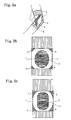
- a knitted fabric having an approximate octagon shape (refer to Fig. 1(b) ), a circular or ellipse shape (refer to Fig. 2(b) ), or an oval shape (refer to Fig. 2(c) ) to fit the shape of the olecranon of a wearer.
- the knitted fabric of a circular shape, an ellipse shape, or an oval shape improves a grip performance on the olecranon of a wearer, thereby preventing a position shift in any direction of the elbow joint supporter 10, so that it is possible to maintain the reliable mounting state of the elbow joint supporter 10.
- the stretch resistance of the base fabric section 1 in the length direction L of the elbow joint supporter 10 is larger than the stretch resistance of the second anchor section 3 in the length direction L of the elbow joint supporter 10. Further, the stretch resistance of the second anchor section 3 in the length direction L of the elbow joint supporter 10 is larger than the stretch resistance of the first anchor section 2 in the length direction L of the elbow joint supporter 10. Further, the stretch resistance of the first anchor section 2 in the length direction L of the elbow joint supporter 10 is larger than the stretch resistance of the olecranon contact section 5 in the length direction L of the elbow joint supporter 10.
- the elbow joint supporter 10 related to this embodiment satisfies a magnitude relation shown by the following expression (1) in the tension F in the length direction L of the elbow joint supporter 10.
- F L2 is the tension of the first anchor section 2 in the length direction L of the elbow joint supporter
- F L3 is the tension of the second anchor section 3 in the length direction L of the elbow joint supporter 10.
- the tensions F L1 and F L4 in the length direction L of the elbow joint supporter 10 of the base fabric section 1 and the supporting section 4 which occupy the entire area on the front face side of the elbow joint supporter 10 excluding the first anchor section 2 and the second anchor section 3 are larger than the tension F L5 in the length direction L of the elbow joint supporter 10 of the olecranon contact section 5 which occupies almost the entire area on the rear face side of the elbow joint supporter 10, whereby the elbow joint supporter 10 has the following operation and effects.
- the base fabric section 1 and the supporting section 4 which are on the front face side of the elbow joint supporter 10 suppress the extension in the length direction L of the elbow joint supporter 10 and perform a limitation such that the extended position of the elbow joint does not exceed 180 degrees (hyperextension does not occur), by a difference contraction between the sections and the olecranon contact section 5 that is a high stretchable mesh stitch knitted fabric, so that it is possible to limit the extension of the ligament which is located at the elbow joint.
- the elbow joint supporter 10 prevents damage to the ligament by an excessive extension of the ligament which is located at the elbow joint, and also protects the biceps brachii muscle that controls the extension of the elbow joint, so that it is possible to reduce a pain due to bicipital tendinitis.
- the base fabric section 1 and the supporting section 4 which are on the front face side of the elbow joint supporter 10 can act like a splint which supports the elbow joint from the front face side, thereby suppressing the shake of the bending and stretching motion of the elbow joint.
- the elbow joint supporter 10 in a case where the elbow joint supporter 10 is not worn, there is a fear that a burden may also be applied to the hand joint which compensates for an overload on the elbow joint, thereby causing tenosynovitis of the hand.
- the stability of the elbow joint is obtained by the wear of the elbow joint supporter 10, whereby it is possible to reduce an overload on other joints such as the hand joint.
- DCY double covered yarn
- the upper thread it is preferable to select a natural fiber such as cotton, wool (cashmere, lamb, Angora, or the like), silk, or hemp, a chemical fiber such as acrylic, a material having a sweat absorbing, quick-drying, or body temperature adjusting function, or the like according to the cost of the elbow joint supporter 10 or the needs of a wearer.
- a natural fiber such as cotton, wool (cashmere, lamb, Angora, or the like)
- silk or hemp
- a chemical fiber such as acrylic, a material having a sweat absorbing, quick-drying, or body temperature adjusting function, or the like according to the cost of the elbow joint supporter 10 or the needs of a wearer.
- the under thread it is preferable to select an ester, FTY (filament twisted yarn), or an antibacterial, deodorant, or odor eliminating material according to the cost of the elbow joint supporter 10 or the needs of a wearer.
- a knitted fabric of the boundary between the base fabric section 1 and the supporting section 4 related to this embodiment is knitted such that an upper thread which is used in the base fabric section 1 and an upper thread which is used in the supporting section 4 are continuous without overlapping each other, as shown in Fig. 1(a) .
- a knitted fabric 6 of the boundary between the base fabric section 1 and the supporting section 4 is knitted by overlapping an upper thread which is used in the base fabric section 1 and an upper thread which is used in the supporting section 4 and using the upper threads along with a common under thread which is used in the base fabric section 1 and the supporting section 4.
- a knitted fabric of the boundary between the base fabric section 1 and the olecranon contact section 5 is knitted such that an upper thread which is used in the base fabric section 1 and an upper thread which is used in the olecranon contact section 5 are continuous without overlapping each other, as shown in Fig. 1(b) , or as shown in Fig. 8(b) , the knitted fabric 6 of the boundary between the base fabric section 1 and the olecranon contact section 5 is knitted by overlapping an upper thread which is used in the base fabric section 1 and an upper thread which is used in the olecranon contact section 5 and using the upper threads along with a common under thread which is used in the base fabric section 1 and the olecranon contact section 5.
- the elbow joint supporter 10 in a case where the elbow joint supporter 10 is worn on the right elbow of a test subject (a 26-years-old healthy male, there is no anamnesis in four limbs) (hereinafter referred to as the time of wear) and a case where the elbow joint supporter 10 is not worn (hereinafter referred to as the time of non-wear), the elbow joint was flexed and extended three times in a state where a dumbbell (an iron dumbbell) of 4 kg is held by the right hand and the brachium of the right arm is approximately horizontal ( Fig. 4(a) ).
- a dumbbell an iron dumbbell
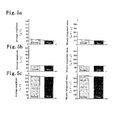
- the trajectory of an angle by the flexion and extension (bending and stretching) of the elbow joint was measured by three-dimensional motion analysis ( Fig. 4(b) ) and the myogenic potentials of the biceps brachii muscle (the muscle to bend the elbow) and the flexor carpi ulnaris muscle and the flexor carpi radialis muscle (the muscles to bend the wrist) in the third bending and stretching motion were measured by a surface electromyogram ( Fig. 5 ).
- VICON MX three-dimensional motion analysis system manufactured by VICON, Inc.
- MyoResearch manufactured by Noraxon, Inc.
- the elbow joint supporter 10 can improve the stability of the elbow joint of a wearer.
- the myogenic potential (the average amplitude and the muscle integrated value) of the biceps brachii muscle is lowered compared to the case of the time of non-wear, it can be found that a load on the biceps brachii muscle is reduced, so that a strain on the elbow joint is reduced.
- the elbow joint supporter 10 reduces a strain on the elbow joint, so that it becomes possible to prevent a bicipital tendinitis.
- Fig. 9(a) is a front view showing the schematic configuration of an elbow joint supporter related to the second embodiment
- Fig. 9(b) is a back view of the elbow joint supporter shown in Fig. 9(a)
- Fig. 9(c) is a left side view and right side view of the elbow joint supporter shown in Fig. 9(a)
- Fig. 9(d) is a plan view and bottom view of the elbow supporter shown in Fig. 9(a) .
- the same symbol as that in Fig. 1 , 2 , or 8 denotes the same or equivalent section, and explanation thereof is omitted.
- the elbow joint supporter 10 related to this embodiment is configured to have, in addition to the configuration in the first embodiment described above, reinforcing sections 7 which are knitted to extend in the length direction of the tubular knitted fabric at both side portions on the front face side of the tubular knitted fabric and connected to the first anchor section 2 and the second anchor section 3, thereby reinforcing the supporting section 4.
- expansion and contraction of the reinforcing section 7 in the length direction L of the elbow joint supporter 10 is moderately suppressed, for example, by additionally feeding another knitting yarn (for example, woolly nylon yarn) in addition to the knitting yarn of the base fabric section 1 (the tuck stitch knitted fabric) and the supporting section 4 (the tuck stitch-plating stitch knitted fabric), which constitute the reinforcing section 7, and another knitting yarn is cut at the boundary between the reinforcing section 7 and the base fabric section 1 and the supporting section 4 (a cut boss).
- another knitting yarn for example, woolly nylon yarn
- the reinforcing section 7 is constituted by knitting a knitted fabric by yarn impregnated with resin of a kind such as a polyester type, a polyamide type, a polyurethane type, a polyethylene type (high density, low density), or an ethylene vinyl acetate type.
- the reinforcing section 7 is constituted by sewing a tape made of a narrow cloth or the like for preventing elongation to the knitted fabrics of the base fabric section 1 (the tuck stitch knitted fabric) and the supporting section 4 (the tuck stitch-plating stitch knitted fabric), which constitute the reinforcing section 7, or by sticking an adhesive tape in which an adhesive is applied onto a tape made of cellophane, plastic, or the like, to the knitted fabrics of the base fabric section 1 and the supporting section 4.
- the reinforcing section 7 is constituted by applying liquid resin to the knitted fabrics of the base fabric section 1 (the tuck stitch knitted fabric) and the supporting section 4 (the tuck stitch-plating stitch knitted fabric), which constitute the reinforcing section 7, and then bringing the resin into contact with air, thereby oxidizing and fixing the resin, or by attaching a thin film-shaped resin to the knitted fabrics of the base fabric section 1 and the supporting section 4, or by spraying liquid resin onto the knitted fabrics of the base fabric section 1 and the supporting section 4 by a sprayer or the like, and then bringing the resin into contact with air, thereby oxidizing and fixing the resin.
- the reinforcing section 7 may also be an adhesive interlining cloth which is obtained by performing resin processing on the knitted fabrics of the base fabric section 1 (the tuck stitch knitted fabric) and the supporting section 4 (the tuck stitch-plating stitch knitted fabric), which constitute the reinforcing section 7, by using an adhesive.
- the resin can be fixed to the knitted fabrics by applying adhesive resin made of resin of a kind such as a polyester type, a polyamide type, a polyurethane type, a polyethylene type (high density, low density), or an ethylene vinyl acetate type to the knitted fabrics by a processing method such as dot processing, powder processing, cobweb processing, or film processing and then performing heating and pressurization treatments by a flat press, a roller-type press, or the like.
- adhesive resin made of resin of a kind such as a polyester type, a polyamide type, a polyurethane type, a polyethylene type (high density, low density), or an ethylene vinyl acetate type
- a processing method such as dot processing, powder processing, cobweb processing, or film processing and then performing heating and pressurization treatments by a flat press, a roller-type press, or the like.
- the second embodiment is different from the first embodiment only in that the reinforcing section 7 is newly disposed on the front face side of the elbow joint supporter 10, and except the operation and effects by the reinforcing section 7, which are described below, the same operation and effects as those in the first embodiment are obtained.
Landscapes
- Health & Medical Sciences (AREA)
- Engineering & Computer Science (AREA)
- General Health & Medical Sciences (AREA)
- Public Health (AREA)
- Biomedical Technology (AREA)
- Heart & Thoracic Surgery (AREA)
- Vascular Medicine (AREA)
- Life Sciences & Earth Sciences (AREA)
- Animal Behavior & Ethology (AREA)
- Veterinary Medicine (AREA)
- Textile Engineering (AREA)
- Nursing (AREA)
- Orthopedic Medicine & Surgery (AREA)
- Physical Education & Sports Medicine (AREA)
- Professional, Industrial, Or Sporting Protective Garments (AREA)
- Orthopedics, Nursing, And Contraception (AREA)
Applications Claiming Priority (2)
| Application Number | Priority Date | Filing Date | Title |
|---|---|---|---|
| JP2010012513 | 2010-01-22 | ||
| PCT/JP2011/051221 WO2011090195A1 (fr) | 2010-01-22 | 2011-01-24 | Dispositif de support de l'articulation du coude |
Publications (3)
| Publication Number | Publication Date |
|---|---|
| EP2526792A1 true EP2526792A1 (fr) | 2012-11-28 |
| EP2526792A4 EP2526792A4 (fr) | 2014-01-15 |
| EP2526792B1 EP2526792B1 (fr) | 2022-09-14 |
Family
ID=44306996
Family Applications (1)
| Application Number | Title | Priority Date | Filing Date |
|---|---|---|---|
| EP11734801.1A Active EP2526792B1 (fr) | 2010-01-22 | 2011-01-24 | Dispositif de support de l'articulation du coude |
Country Status (9)
| Country | Link |
|---|---|
| US (1) | US10206439B2 (fr) |
| EP (1) | EP2526792B1 (fr) |
| JP (1) | JP5283202B2 (fr) |
| KR (1) | KR101555002B1 (fr) |
| CN (1) | CN102548437B (fr) |
| ES (1) | ES2929938T3 (fr) |
| PL (1) | PL2526792T3 (fr) |
| TW (1) | TWI533814B (fr) |
| WO (1) | WO2011090195A1 (fr) |
Cited By (2)
| Publication number | Priority date | Publication date | Assignee | Title |
|---|---|---|---|---|
| FR3032878A1 (fr) * | 2015-02-25 | 2016-08-26 | Stephane Herald George Trichet | Dispositif de manchette de maintien et compression |
| EP4011348A4 (fr) * | 2019-08-09 | 2023-08-16 | Toray Industries, Inc. | Orthétique |
Families Citing this family (25)
| Publication number | Priority date | Publication date | Assignee | Title |
|---|---|---|---|---|
| USD332975S (en) * | 1990-11-26 | 1993-02-02 | Terminel Fernando N | Game board |
| JP2012115526A (ja) * | 2010-12-01 | 2012-06-21 | Molten Corp | 足関節サポーター |
| US10398585B2 (en) | 2013-05-30 | 2019-09-03 | Xtreme Orthopedics Llc | Shoulder and arm restraint |
| US11638656B2 (en) | 2012-12-31 | 2023-05-02 | Xtreme Orthopedics Llc | Shoulder and arm restraint |
| DE102013103914B3 (de) | 2013-04-18 | 2014-03-20 | Medi Gmbh & Co. Kg | Kompressives Rundgestrick zum Überziehen über eine ein Gelenk aufweisende Extremität |
| USD962450S1 (en) | 2013-05-30 | 2022-08-30 | Extreme Orthopedics Llc | Shoulder immobilizer pillow |
| USD728805S1 (en) * | 2013-11-01 | 2015-05-05 | Wacoal Corp. | Knee supporter |
| JP5905506B2 (ja) * | 2014-04-17 | 2016-04-20 | メディ・ゲーエムベーハー・アンド・コンパニー・カーゲーMedi Gmbh & Co. Kg | 関節で繋がった肢を固定するための圧迫丸編地 |
| USD745176S1 (en) * | 2014-05-06 | 2015-12-08 | Mueller Sports Medicine, Inc. | Knee brace |
| JP5695812B1 (ja) * | 2014-06-06 | 2015-04-08 | 諒子 水谷 | 筋肉強化装着具 |
| CN107529836A (zh) * | 2015-04-22 | 2018-01-02 | 三井化学株式会社 | 具有关节用支撑体部的衣物、及膝用支撑体 |
| USD800323S1 (en) * | 2015-09-11 | 2017-10-17 | Xtreme Orthopedics Llc | Compression sleeve |
| USD799708S1 (en) | 2015-09-11 | 2017-10-10 | Xtreme Orthopedics Llc | Shin splint with calf support brace |
| JP1554708S (fr) * | 2015-10-09 | 2016-07-25 | ||
| USD804680S1 (en) * | 2016-04-12 | 2017-12-05 | MMAR Medical Group, Inc. | Knee sleeve |
| US20180042755A1 (en) * | 2016-08-15 | 2018-02-15 | Bucknell University | Back brace |
| JP6124234B1 (ja) * | 2016-11-30 | 2017-05-10 | 株式会社Mogu | 体幹サポーターおよびそれを備えたインナーウエア |
| RU2651448C1 (ru) * | 2017-06-23 | 2018-04-19 | Федеральное государственное автономное образовательное учреждение высшего образования "Национальный исследовательский технологический университет "МИСиС" | Компрессионная одежда, выполненная с использованием синтетических искусственных мышц |
| AU2018424469A1 (en) | 2018-05-25 | 2020-11-26 | FEETNESS S.r.l. | Containing fabric, garments comprising such fabric, and related production methods |
| PT3640383T (pt) * | 2018-10-16 | 2023-01-20 | Medi Gmbh & Co Kg | Peça tricotada |
| CN114980767A (zh) * | 2020-01-09 | 2022-08-30 | 恩丽株式会社 | 套袖 |
| US12213544B2 (en) * | 2020-06-12 | 2025-02-04 | 5.11, Inc. | Protective garment system |
| US12495846B2 (en) * | 2020-10-30 | 2025-12-16 | Ansell Limited | Protective knit sleeves |
| JP7761207B2 (ja) * | 2022-02-25 | 2025-10-28 | 興和株式会社 | 肘関節用サポーター |
| JP2023160464A (ja) * | 2022-04-22 | 2023-11-02 | 興和株式会社 | 腕サポータ |
Family Cites Families (19)
| Publication number | Priority date | Publication date | Assignee | Title |
|---|---|---|---|---|
| US3000378A (en) * | 1957-11-26 | 1961-09-19 | S H Camp & Company | Limb compression sleeve |
| US3000318A (en) * | 1959-09-28 | 1961-09-19 | Cav Ltd | Liquid fuel pumps for internal combustion engines |
| US3084685A (en) | 1961-05-25 | 1963-04-09 | Surgical Appliance Ind | Knee brace |
| US3934583A (en) * | 1974-09-27 | 1976-01-27 | Danny W. Hollingshead | Therapeutic musculoskeletal support sleeve and method of manufacturing same |
| US4315504A (en) * | 1981-01-26 | 1982-02-16 | Dm Systems, Inc. | Elbow suspension device |
| CH657044A5 (de) * | 1982-05-27 | 1986-08-15 | Senn & Co Ag | Elastische kniebandage. |
| JP2894778B2 (ja) | 1990-03-05 | 1999-05-24 | アルケア株式会社 | サポーター |
| JP2702668B2 (ja) | 1993-07-28 | 1998-01-21 | 株式会社ワコール | 腰部保護用衣類 |
| JP4055099B2 (ja) | 1999-08-03 | 2008-03-05 | 吉田司株式会社 | サポータと、その製造方法 |
| JP4537601B2 (ja) | 2001-03-07 | 2010-09-01 | ピップフジモト株式会社 | 膨ら脛用サポーター |
| JP3842684B2 (ja) * | 2002-03-27 | 2006-11-08 | 美津濃株式会社 | 肘用サポーター |
| EP1860217A3 (fr) | 2003-06-23 | 2010-10-20 | Teijin Fibers Limited | Tissu tissé ou tricoté contenant deux fils différents et vêtement l'utilisant |
| US7434423B1 (en) * | 2004-04-30 | 2008-10-14 | Carolon Company | Impact protection and performance garment |
| JP4964443B2 (ja) * | 2005-08-22 | 2012-06-27 | サン エース株式会社 | 膝関節用サポータ |
| CN2855127Y (zh) * | 2005-10-12 | 2007-01-10 | 翁荣弟 | 一种护肘 |
| CN2865338Y (zh) * | 2006-01-25 | 2007-02-07 | 郑清水 | 身体护套的改进构造 |
| JP5049031B2 (ja) | 2007-02-28 | 2012-10-17 | ピップ株式会社 | 衣類用の編地 |
| JP2010100981A (ja) | 2008-10-27 | 2010-05-06 | Okamoto Kk | 靴下 |
| JP5225821B2 (ja) * | 2008-12-02 | 2013-07-03 | ピップ株式会社 | 肘用サポーター |
-
2011
- 2011-01-21 TW TW100102423A patent/TWI533814B/zh active
- 2011-01-24 WO PCT/JP2011/051221 patent/WO2011090195A1/fr not_active Ceased
- 2011-01-24 ES ES11734801T patent/ES2929938T3/es active Active
- 2011-01-24 KR KR1020127005802A patent/KR101555002B1/ko active Active
- 2011-01-24 EP EP11734801.1A patent/EP2526792B1/fr active Active
- 2011-01-24 CN CN201180003741.XA patent/CN102548437B/zh active Active
- 2011-01-24 PL PL11734801.1T patent/PL2526792T3/pl unknown
- 2011-01-24 JP JP2011550982A patent/JP5283202B2/ja active Active
- 2011-01-24 US US13/522,670 patent/US10206439B2/en active Active
Cited By (2)
| Publication number | Priority date | Publication date | Assignee | Title |
|---|---|---|---|---|
| FR3032878A1 (fr) * | 2015-02-25 | 2016-08-26 | Stephane Herald George Trichet | Dispositif de manchette de maintien et compression |
| EP4011348A4 (fr) * | 2019-08-09 | 2023-08-16 | Toray Industries, Inc. | Orthétique |
Also Published As
| Publication number | Publication date |
|---|---|
| WO2011090195A1 (fr) | 2011-07-28 |
| US20120289875A1 (en) | 2012-11-15 |
| KR101555002B1 (ko) | 2015-09-22 |
| JPWO2011090195A1 (ja) | 2013-05-23 |
| TWI533814B (zh) | 2016-05-21 |
| US10206439B2 (en) | 2019-02-19 |
| CN102548437B (zh) | 2015-09-30 |
| EP2526792B1 (fr) | 2022-09-14 |
| ES2929938T3 (es) | 2022-12-05 |
| PL2526792T3 (pl) | 2023-01-30 |
| HK1172520A1 (zh) | 2013-04-26 |
| EP2526792A4 (fr) | 2014-01-15 |
| JP5283202B2 (ja) | 2013-09-04 |
| KR20130007530A (ko) | 2013-01-18 |
| CN102548437A (zh) | 2012-07-04 |
| TW201141404A (en) | 2011-12-01 |
Similar Documents
| Publication | Publication Date | Title |
|---|---|---|
| EP2526792B1 (fr) | Dispositif de support de l'articulation du coude | |
| EP2526791B1 (fr) | Dispositif de support de l'articulation du genou | |
| JP5901022B2 (ja) | 下腿用サポーター | |
| US9579229B2 (en) | Hand joint supporter | |
| JP2012245117A (ja) | 膝関節サポーター | |
| JP5428095B2 (ja) | 膝サポーター | |
| JP5483540B2 (ja) | テーピング構造体及び被服 | |
| JP7761207B2 (ja) | 肘関節用サポーター | |
| HK1172520B (en) | Elbow joint supporter | |
| JP2013091881A (ja) | サポーター | |
| HK1172521B (en) | Hand joint supporter | |
| HK1172522B (en) | Knee joint supporter |
Legal Events
| Date | Code | Title | Description |
|---|---|---|---|
| PUAI | Public reference made under article 153(3) epc to a published international application that has entered the european phase |
Free format text: ORIGINAL CODE: 0009012 |
|
| 17P | Request for examination filed |
Effective date: 20120720 |
|
| AK | Designated contracting states |
Kind code of ref document: A1 Designated state(s): AL AT BE BG CH CY CZ DE DK EE ES FI FR GB GR HR HU IE IS IT LI LT LU LV MC MK MT NL NO PL PT RO RS SE SI SK SM TR |
|
| DAX | Request for extension of the european patent (deleted) | ||
| A4 | Supplementary search report drawn up and despatched |
Effective date: 20131212 |
|
| RIC1 | Information provided on ipc code assigned before grant |
Ipc: A41D 13/08 20060101AFI20131206BHEP Ipc: A41D 13/00 20060101ALI20131206BHEP Ipc: A61F 13/10 20060101ALI20131206BHEP |
|
| 17Q | First examination report despatched |
Effective date: 20150603 |
|
| STAA | Information on the status of an ep patent application or granted ep patent |
Free format text: STATUS: EXAMINATION IS IN PROGRESS |
|
| GRAP | Despatch of communication of intention to grant a patent |
Free format text: ORIGINAL CODE: EPIDOSNIGR1 |
|
| STAA | Information on the status of an ep patent application or granted ep patent |
Free format text: STATUS: GRANT OF PATENT IS INTENDED |
|
| INTG | Intention to grant announced |
Effective date: 20220411 |
|
| GRAS | Grant fee paid |
Free format text: ORIGINAL CODE: EPIDOSNIGR3 |
|
| GRAA | (expected) grant |
Free format text: ORIGINAL CODE: 0009210 |
|
| STAA | Information on the status of an ep patent application or granted ep patent |
Free format text: STATUS: THE PATENT HAS BEEN GRANTED |
|
| AK | Designated contracting states |
Kind code of ref document: B1 Designated state(s): AL AT BE BG CH CY CZ DE DK EE ES FI FR GB GR HR HU IE IS IT LI LT LU LV MC MK MT NL NO PL PT RO RS SE SI SK SM TR |
|
| RAP3 | Party data changed (applicant data changed or rights of an application transferred) |
Owner name: KOWA COMPANY, LTD. |
|
| REG | Reference to a national code |
Ref country code: GB Ref legal event code: FG4D |
|
| REG | Reference to a national code |
Ref country code: CH Ref legal event code: EP |
|
| REG | Reference to a national code |
Ref country code: DE Ref legal event code: R096 Ref document number: 602011073276 Country of ref document: DE |
|
| REG | Reference to a national code |
Ref country code: IE Ref legal event code: FG4D |
|
| REG | Reference to a national code |
Ref country code: AT Ref legal event code: REF Ref document number: 1518171 Country of ref document: AT Kind code of ref document: T Effective date: 20221015 |
|
| REG | Reference to a national code |
Ref country code: ES Ref legal event code: FG2A Ref document number: 2929938 Country of ref document: ES Kind code of ref document: T3 Effective date: 20221205 |
|
| REG | Reference to a national code |
Ref country code: LT Ref legal event code: MG9D |
|
| REG | Reference to a national code |
Ref country code: NL Ref legal event code: MP Effective date: 20220914 |
|
| PG25 | Lapsed in a contracting state [announced via postgrant information from national office to epo] |
Ref country code: SE Free format text: LAPSE BECAUSE OF FAILURE TO SUBMIT A TRANSLATION OF THE DESCRIPTION OR TO PAY THE FEE WITHIN THE PRESCRIBED TIME-LIMIT Effective date: 20220914 Ref country code: RS Free format text: LAPSE BECAUSE OF FAILURE TO SUBMIT A TRANSLATION OF THE DESCRIPTION OR TO PAY THE FEE WITHIN THE PRESCRIBED TIME-LIMIT Effective date: 20220914 Ref country code: NO Free format text: LAPSE BECAUSE OF FAILURE TO SUBMIT A TRANSLATION OF THE DESCRIPTION OR TO PAY THE FEE WITHIN THE PRESCRIBED TIME-LIMIT Effective date: 20221214 Ref country code: LV Free format text: LAPSE BECAUSE OF FAILURE TO SUBMIT A TRANSLATION OF THE DESCRIPTION OR TO PAY THE FEE WITHIN THE PRESCRIBED TIME-LIMIT Effective date: 20220914 Ref country code: LT Free format text: LAPSE BECAUSE OF FAILURE TO SUBMIT A TRANSLATION OF THE DESCRIPTION OR TO PAY THE FEE WITHIN THE PRESCRIBED TIME-LIMIT Effective date: 20220914 Ref country code: FI Free format text: LAPSE BECAUSE OF FAILURE TO SUBMIT A TRANSLATION OF THE DESCRIPTION OR TO PAY THE FEE WITHIN THE PRESCRIBED TIME-LIMIT Effective date: 20220914 |
|
| PG25 | Lapsed in a contracting state [announced via postgrant information from national office to epo] |
Ref country code: HR Free format text: LAPSE BECAUSE OF FAILURE TO SUBMIT A TRANSLATION OF THE DESCRIPTION OR TO PAY THE FEE WITHIN THE PRESCRIBED TIME-LIMIT Effective date: 20220914 Ref country code: GR Free format text: LAPSE BECAUSE OF FAILURE TO SUBMIT A TRANSLATION OF THE DESCRIPTION OR TO PAY THE FEE WITHIN THE PRESCRIBED TIME-LIMIT Effective date: 20221215 |
|
| PG25 | Lapsed in a contracting state [announced via postgrant information from national office to epo] |
Ref country code: SM Free format text: LAPSE BECAUSE OF FAILURE TO SUBMIT A TRANSLATION OF THE DESCRIPTION OR TO PAY THE FEE WITHIN THE PRESCRIBED TIME-LIMIT Effective date: 20220914 Ref country code: RO Free format text: LAPSE BECAUSE OF FAILURE TO SUBMIT A TRANSLATION OF THE DESCRIPTION OR TO PAY THE FEE WITHIN THE PRESCRIBED TIME-LIMIT Effective date: 20220914 Ref country code: PT Free format text: LAPSE BECAUSE OF FAILURE TO SUBMIT A TRANSLATION OF THE DESCRIPTION OR TO PAY THE FEE WITHIN THE PRESCRIBED TIME-LIMIT Effective date: 20230116 Ref country code: CZ Free format text: LAPSE BECAUSE OF FAILURE TO SUBMIT A TRANSLATION OF THE DESCRIPTION OR TO PAY THE FEE WITHIN THE PRESCRIBED TIME-LIMIT Effective date: 20220914 |
|
| PG25 | Lapsed in a contracting state [announced via postgrant information from national office to epo] |
Ref country code: SK Free format text: LAPSE BECAUSE OF FAILURE TO SUBMIT A TRANSLATION OF THE DESCRIPTION OR TO PAY THE FEE WITHIN THE PRESCRIBED TIME-LIMIT Effective date: 20220914 Ref country code: IS Free format text: LAPSE BECAUSE OF FAILURE TO SUBMIT A TRANSLATION OF THE DESCRIPTION OR TO PAY THE FEE WITHIN THE PRESCRIBED TIME-LIMIT Effective date: 20230114 Ref country code: EE Free format text: LAPSE BECAUSE OF FAILURE TO SUBMIT A TRANSLATION OF THE DESCRIPTION OR TO PAY THE FEE WITHIN THE PRESCRIBED TIME-LIMIT Effective date: 20220914 |
|
| REG | Reference to a national code |
Ref country code: DE Ref legal event code: R097 Ref document number: 602011073276 Country of ref document: DE |
|
| P01 | Opt-out of the competence of the unified patent court (upc) registered |
Effective date: 20230522 |
|
| PG25 | Lapsed in a contracting state [announced via postgrant information from national office to epo] |
Ref country code: NL Free format text: LAPSE BECAUSE OF FAILURE TO SUBMIT A TRANSLATION OF THE DESCRIPTION OR TO PAY THE FEE WITHIN THE PRESCRIBED TIME-LIMIT Effective date: 20220914 Ref country code: AL Free format text: LAPSE BECAUSE OF FAILURE TO SUBMIT A TRANSLATION OF THE DESCRIPTION OR TO PAY THE FEE WITHIN THE PRESCRIBED TIME-LIMIT Effective date: 20220914 |
|
| PLBE | No opposition filed within time limit |
Free format text: ORIGINAL CODE: 0009261 |
|
| STAA | Information on the status of an ep patent application or granted ep patent |
Free format text: STATUS: NO OPPOSITION FILED WITHIN TIME LIMIT |
|
| PG25 | Lapsed in a contracting state [announced via postgrant information from national office to epo] |
Ref country code: DK Free format text: LAPSE BECAUSE OF FAILURE TO SUBMIT A TRANSLATION OF THE DESCRIPTION OR TO PAY THE FEE WITHIN THE PRESCRIBED TIME-LIMIT Effective date: 20220914 |
|
| 26N | No opposition filed |
Effective date: 20230615 |
|
| PG25 | Lapsed in a contracting state [announced via postgrant information from national office to epo] |
Ref country code: SI Free format text: LAPSE BECAUSE OF FAILURE TO SUBMIT A TRANSLATION OF THE DESCRIPTION OR TO PAY THE FEE WITHIN THE PRESCRIBED TIME-LIMIT Effective date: 20220914 |
|
| PG25 | Lapsed in a contracting state [announced via postgrant information from national office to epo] |
Ref country code: LU Free format text: LAPSE BECAUSE OF NON-PAYMENT OF DUE FEES Effective date: 20230124 |
|
| REG | Reference to a national code |
Ref country code: BE Ref legal event code: MM Effective date: 20230131 |
|
| PG25 | Lapsed in a contracting state [announced via postgrant information from national office to epo] |
Ref country code: BE Free format text: LAPSE BECAUSE OF NON-PAYMENT OF DUE FEES Effective date: 20230131 |
|
| PG25 | Lapsed in a contracting state [announced via postgrant information from national office to epo] |
Ref country code: IE Free format text: LAPSE BECAUSE OF NON-PAYMENT OF DUE FEES Effective date: 20230124 |
|
| PGFP | Annual fee paid to national office [announced via postgrant information from national office to epo] |
Ref country code: PL Payment date: 20231129 Year of fee payment: 14 |
|
| PG25 | Lapsed in a contracting state [announced via postgrant information from national office to epo] |
Ref country code: MC Free format text: LAPSE BECAUSE OF FAILURE TO SUBMIT A TRANSLATION OF THE DESCRIPTION OR TO PAY THE FEE WITHIN THE PRESCRIBED TIME-LIMIT Effective date: 20220914 |
|
| PG25 | Lapsed in a contracting state [announced via postgrant information from national office to epo] |
Ref country code: MC Free format text: LAPSE BECAUSE OF FAILURE TO SUBMIT A TRANSLATION OF THE DESCRIPTION OR TO PAY THE FEE WITHIN THE PRESCRIBED TIME-LIMIT Effective date: 20220914 |
|
| PG25 | Lapsed in a contracting state [announced via postgrant information from national office to epo] |
Ref country code: BG Free format text: LAPSE BECAUSE OF FAILURE TO SUBMIT A TRANSLATION OF THE DESCRIPTION OR TO PAY THE FEE WITHIN THE PRESCRIBED TIME-LIMIT Effective date: 20220914 |
|
| PG25 | Lapsed in a contracting state [announced via postgrant information from national office to epo] |
Ref country code: BG Free format text: LAPSE BECAUSE OF FAILURE TO SUBMIT A TRANSLATION OF THE DESCRIPTION OR TO PAY THE FEE WITHIN THE PRESCRIBED TIME-LIMIT Effective date: 20220914 |
|
| PG25 | Lapsed in a contracting state [announced via postgrant information from national office to epo] |
Ref country code: CY Free format text: LAPSE BECAUSE OF FAILURE TO SUBMIT A TRANSLATION OF THE DESCRIPTION OR TO PAY THE FEE WITHIN THE PRESCRIBED TIME-LIMIT; INVALID AB INITIO Effective date: 20110124 |
|
| PG25 | Lapsed in a contracting state [announced via postgrant information from national office to epo] |
Ref country code: HU Free format text: LAPSE BECAUSE OF FAILURE TO SUBMIT A TRANSLATION OF THE DESCRIPTION OR TO PAY THE FEE WITHIN THE PRESCRIBED TIME-LIMIT; INVALID AB INITIO Effective date: 20110124 |
|
| PG25 | Lapsed in a contracting state [announced via postgrant information from national office to epo] |
Ref country code: TR Free format text: LAPSE BECAUSE OF FAILURE TO SUBMIT A TRANSLATION OF THE DESCRIPTION OR TO PAY THE FEE WITHIN THE PRESCRIBED TIME-LIMIT Effective date: 20220914 |
|
| PGFP | Annual fee paid to national office [announced via postgrant information from national office to epo] |
Ref country code: GB Payment date: 20251204 Year of fee payment: 16 |
|
| PGFP | Annual fee paid to national office [announced via postgrant information from national office to epo] |
Ref country code: FR Payment date: 20251128 Year of fee payment: 16 |
|
| REG | Reference to a national code |
Ref country code: AT Ref legal event code: UEP Ref document number: 1518171 Country of ref document: AT Kind code of ref document: T Effective date: 20220914 |
|
| REG | Reference to a national code |
Ref country code: CH Ref legal event code: U11 Free format text: ST27 STATUS EVENT CODE: U-0-0-U10-U11 (AS PROVIDED BY THE NATIONAL OFFICE) Effective date: 20260201 |
|
| PGFP | Annual fee paid to national office [announced via postgrant information from national office to epo] |
Ref country code: ES Payment date: 20260203 Year of fee payment: 16 |
|
| PGFP | Annual fee paid to national office [announced via postgrant information from national office to epo] |
Ref country code: DE Payment date: 20251203 Year of fee payment: 16 |
|
| PGFP | Annual fee paid to national office [announced via postgrant information from national office to epo] |
Ref country code: AT Payment date: 20251230 Year of fee payment: 16 |
|
| PGFP | Annual fee paid to national office [announced via postgrant information from national office to epo] |
Ref country code: IT Payment date: 20251219 Year of fee payment: 16 |
|
| PGFP | Annual fee paid to national office [announced via postgrant information from national office to epo] |
Ref country code: CH Payment date: 20260201 Year of fee payment: 16 |
|
| PG25 | Lapsed in a contracting state [announced via postgrant information from national office to epo] |
Ref country code: PL Free format text: LAPSE BECAUSE OF NON-PAYMENT OF DUE FEES Effective date: 20250124 |