EP2528124A1 - Générateur de puissance - Google Patents
Générateur de puissance Download PDFInfo
- Publication number
- EP2528124A1 EP2528124A1 EP11004228A EP11004228A EP2528124A1 EP 2528124 A1 EP2528124 A1 EP 2528124A1 EP 11004228 A EP11004228 A EP 11004228A EP 11004228 A EP11004228 A EP 11004228A EP 2528124 A1 EP2528124 A1 EP 2528124A1
- Authority
- EP
- European Patent Office
- Prior art keywords
- thermo electric
- heat
- power generator
- electric generators
- heat absorbing
- Prior art date
- Legal status (The legal status is an assumption and is not a legal conclusion. Google has not performed a legal analysis and makes no representation as to the accuracy of the status listed.)
- Withdrawn
Links
- 239000000758 substrate Substances 0.000 claims abstract description 42
- 238000001816 cooling Methods 0.000 claims abstract description 41
- 230000000694 effects Effects 0.000 claims description 16
- RYGMFSIKBFXOCR-UHFFFAOYSA-N Copper Chemical compound [Cu] RYGMFSIKBFXOCR-UHFFFAOYSA-N 0.000 claims description 7
- 229910052802 copper Inorganic materials 0.000 claims description 7
- 239000010949 copper Substances 0.000 claims description 7
- 229910052782 aluminium Inorganic materials 0.000 claims description 5
- XAGFODPZIPBFFR-UHFFFAOYSA-N aluminium Chemical compound [Al] XAGFODPZIPBFFR-UHFFFAOYSA-N 0.000 claims description 5
- 239000011521 glass Substances 0.000 claims description 5
- 239000004411 aluminium Substances 0.000 claims description 4
- 239000004020 conductor Substances 0.000 claims description 4
- XLYOFNOQVPJJNP-UHFFFAOYSA-N water Substances O XLYOFNOQVPJJNP-UHFFFAOYSA-N 0.000 description 7
- 230000005855 radiation Effects 0.000 description 6
- 230000005611 electricity Effects 0.000 description 4
- 238000004519 manufacturing process Methods 0.000 description 4
- 239000000463 material Substances 0.000 description 4
- 239000002826 coolant Substances 0.000 description 3
- 239000007788 liquid Substances 0.000 description 3
- 229910052751 metal Inorganic materials 0.000 description 3
- 239000002184 metal Substances 0.000 description 3
- 235000015927 pasta Nutrition 0.000 description 3
- CURLTUGMZLYLDI-UHFFFAOYSA-N Carbon dioxide Chemical compound O=C=O CURLTUGMZLYLDI-UHFFFAOYSA-N 0.000 description 2
- 239000011358 absorbing material Substances 0.000 description 2
- 238000006243 chemical reaction Methods 0.000 description 2
- 238000005516 engineering process Methods 0.000 description 2
- 239000012530 fluid Substances 0.000 description 2
- 239000003292 glue Substances 0.000 description 2
- 150000002739 metals Chemical class 0.000 description 2
- 238000010248 power generation Methods 0.000 description 2
- IJGRMHOSHXDMSA-UHFFFAOYSA-N Atomic nitrogen Chemical compound N#N IJGRMHOSHXDMSA-UHFFFAOYSA-N 0.000 description 1
- 230000005679 Peltier effect Effects 0.000 description 1
- 230000005678 Seebeck effect Effects 0.000 description 1
- 238000010521 absorption reaction Methods 0.000 description 1
- 229910002092 carbon dioxide Inorganic materials 0.000 description 1
- 239000001569 carbon dioxide Substances 0.000 description 1
- 239000000919 ceramic Substances 0.000 description 1
- 239000011248 coating agent Substances 0.000 description 1
- 238000000576 coating method Methods 0.000 description 1
- 238000010276 construction Methods 0.000 description 1
- 238000005538 encapsulation Methods 0.000 description 1
- 239000003344 environmental pollutant Substances 0.000 description 1
- 238000010438 heat treatment Methods 0.000 description 1
- 239000011810 insulating material Substances 0.000 description 1
- 238000009413 insulation Methods 0.000 description 1
- 238000000034 method Methods 0.000 description 1
- JCXJVPUVTGWSNB-UHFFFAOYSA-N nitrogen dioxide Inorganic materials O=[N]=O JCXJVPUVTGWSNB-UHFFFAOYSA-N 0.000 description 1
- 231100000719 pollutant Toxicity 0.000 description 1
- 229920000642 polymer Polymers 0.000 description 1
- 239000004065 semiconductor Substances 0.000 description 1
- 239000007787 solid Substances 0.000 description 1
Images

Classifications
-
- H—ELECTRICITY
- H10—SEMICONDUCTOR DEVICES; ELECTRIC SOLID-STATE DEVICES NOT OTHERWISE PROVIDED FOR
- H10N—ELECTRIC SOLID-STATE DEVICES NOT OTHERWISE PROVIDED FOR
- H10N10/00—Thermoelectric devices comprising a junction of dissimilar materials, i.e. devices exhibiting Seebeck or Peltier effects
- H10N10/10—Thermoelectric devices comprising a junction of dissimilar materials, i.e. devices exhibiting Seebeck or Peltier effects operating with only the Peltier or Seebeck effects
- H10N10/17—Thermoelectric devices comprising a junction of dissimilar materials, i.e. devices exhibiting Seebeck or Peltier effects operating with only the Peltier or Seebeck effects characterised by the structure or configuration of the cell or thermocouple forming the device
Definitions
- the present invention relates to a power generator comprising a heat absorbing substrate with a first heat absorbing side and a second heat releasing side and one or more thermo electric generators having a first heat receiving side and a second cooling side.
- Thermo electric generator technology is based on the well-known concept that a temperature differential may be converted into electricity and vice versa. Namely, the Seebeck effect which is the conversion of a temperature differential directly into electricity, and the Peltier effect which is the production of a temperature differential from a difference in electric potential.
- a Thermo electric generator is normally made from two different sheets of plates of semi conducting material such as e.g. semi conducting metal. The sheets are electrical separated, but thermal connected at two end points.
- thermo electric generators is also a well-known technical field.
- Thermo electric generators hold great promise for widespread use due to their solid state structure, silent operation, high reliability and long service life.
- Thermo electric generators used for power generation can produce electricity from virtually any source of heat, which could enable many energy conversion processes to increase efficiency, reduce pollutant emissions and lower costs.
- Thermo electric generators used for heating or cooling can achieve very sensitive temperature control, and thermo electric generators used for cooling do not require volatile working fluids.
- Radiation from the sun is the primary source for energy on Earth, however, depending on the location the energy contained in the radiation from the sun will vary.
- the effect from the sun may be between 600 and 1000Watt per square meter, closer to equator, e.g. in Sahara the effect may be as high as between 1200 and 1300Watt per square meter.
- thermo electric generators Although, use of radiation from sun too power thermo electric device have been attempted, these attempts have not been very successful as the efficiency of the thermo electric generators was to low to provide any effect that was of economical and industrial feasibility. Examples of the prior use of sunlight to power thermo electric generators are e.g. disclosed in German patent document DE 202008009979 and US patent document 20080142069 .
- thermo electric generators for power production in a scale that is of commercial interest as the efficiency has been to low in relation to the required investments.
- the object of the present invention is to provide a power generator with thermo electric generators that has a higher efficiency.
- the present invention provides a power generator based on thermo electric generators that has a surprising high efficiency and which power generator is easy to install and use and, moreover, can be acquired at relative low costs.
- the present invention relates to a power generator comprising a heat absorbing substrate with a first heat absorbing side and a second heat releasing side and one or more thermo electric generators having a first heat receiving side and a second cooling side, wherein the one or more thermo electric generators are in contact with the heat releasing side of the heat absorbing substrate with their first heat receiving side to allow heat to be transferred from the heat absorbing substrate to the one or more thermo electric generators and where the area of the heat releasing side in contact with and surrounding a thermo electric generator is at least four times larger than the area of the first heat receiving side of the thermo electric generator.
- the heat absorbing substrate may be any material that can absorb and transport heat and it may be a material based on metals, polymers or ceramics having good heat conductive properties.
- the heat absorbing substrate is in the form of thin plates or strips to which the thermo electric generator may be attached in heat conductive contact.
- the heat conductive attachment can be obtained by use of heat conductive and heat resistant glue such as FisherElectric, a heat conductive pasta from the company 3M, or a similar heat conductive pasta from the company Danfoss.
- the thermo electric generators are attached to the heat releasing side of the substrate, which second heat releasing side normally is opposite to the first heat absorbing side.
- the first heat absorbing side may be painted or coated with a colour or material that increases the heat absorption, e.g. a black colour.
- the substrate and the thermo electric generators may be placed in a box comprising at least one side made form glass. Such an encapsulation may significantly increase the heat input to the substrate.
- the heat absorbing side of the heat absorbing substrate may be adapted to be directly exposed to solar radiation or the heat absorbing substrate may adapted to absorb heat from a heat absorbing media, e.g. from a fluid such as water. In the latter case the power generator may be incorporated in a solar thermal collector plant.
- thermo electric generators used according with the invention are commercially available thermo electric generators referred to as e.g. HTTEM or TEG 3 or TEG 7.
- the thermo electric generators have effects in the range from about 3 to about 10Watt or even up to 15 or 20Watt.
- the reason for this is based on the unexpected finding that the heat absorbing area for providing heat to first heat receiving side of the thermal electric generator should be at least four times larger than the area or the first heat receiving side, conveniently the heat absorbing area should be four to hundred times larger than the area of the first heat receiving side, preferably the heat absorbing side is between ten to fifty times larger than the area of the first heat receiving side.
- thermo electric generators are in heat conductive contact with the heat releasing side of the heat absorbing substrate it has been found that the mutual distance between each thermo electric generator should be at least 5cm. The reason for this is that mutual distance between the two or more thermal power generators of at least 5cm allows for at very efficient and substantially sufficient heat supply to the heat receiving side of each thermal power generator.
- the cooling side of the thermo electric generator is in contact with a cooling media.
- the cooling media may be air, however, to obtain a more efficient cooling it is preferred that the cooling media is a liquid, which has a higher heat capacity.
- the liquid may be water, an oil or alternatively e.g. pressurised nitrogen or carbon dioxide.
- the preferred cooling media is water, which has an excellent heat capacity and, thereby, capacity to remove a substantial amount of heat from the cooling side of the thermo electric generator. Water can be obtained at low cost and is easy to reuse.
- a liquid cooling media is provided to the cooling side of the thermo electric generator in a tube of heat conductive material, where the exterior side of the tube is in contact with cooling side.
- the difference in temperature between the first heat receiving side and the second cooling side of the thermo electric generator is preferably in the range of 30 to 300K, more preferably in the range of 50 to 250K. This is in accordance with principle that if the difference in temperature is higher the output is higher.
- the heat absorbing substrate may comprise any material with good heat absorbing properties combined with good heat conductive properties it is, however, preferred that a part of the heat absorbing substrate comprises copper or aluminium, which metals are known to be extremely good heat absorbing and heat conductive materials.
- each thermo electric generator has a maximum effect of from 3 to 10Watt or even up to 15 or 20Watt. Higher effects are most likely to be expected in the future as the technology is maturing.
- the present invention is, however, applicable with any maximum effect of the thermo electric generators.
- the power generator comprises 5 to 40 thermo electric generators per square meter of heat absorbing substrate, and suitable 10-30 thermo electric generators per square meter of heat absorbing substrate. In this way it is possible to design a compact and efficient power generator and, moreover, if the number of thermo electric generators becomes too high the efficiency of the thermo electric generators may decrease. However, the exact number of thermo electric generator per square meter of heat absorbing substrate depends on the specific thermo electric generator and the location where the power generator is to be used.
- thermo electric generators may be connected in parallel or in series, however for most practical uses it is preferred that the thermo electric generators are electrical connected in series.
- the thermo electric generators are also connected to an inverter that inverts the electricity from the thermo electric generators into electric power with a desired voltage.
- the power generator according to the invention comprises all necessary wiring to transfer the electric power from the thermo electric generators to an inverter.
- the heat absorbing substrate is prefabricated as strips in a heat conducting material such as e.g. copper or aluminium.
- the prefabricated strips may be adapted with tracks for easy mounting of thermo electric generators.
- the prefabricated strips may be coated with a heat absorbing material.
- the prefabricated strips may facilitate production of the power generator according to the invention.
- the power generator comprises an embodiment where the heat absorbing substrate and the thermo electric generators are placed in a box having at least one side made from glass.
- the side made from glass is intended to face the sun and in this way the box serves to provide a greenhouse effect whereby more heat can be transferred to the heat absorbing substrate and the thermo electric generators.
- the power generator may also comprise a cooling module adapted to fit with the cooling side of the thermo electric generators.
- the cooling module may be a special shaped tube member adapted to fit with the cooling side of the thermo electric generators and cool the cooling side by means of a cooling medium such as water.
- the heat absorbing substrate is prefabricated strips, preferably adapted with tracks for mounting thermo electric generators and, moreover, the power generator comprises prefabricated cooling tubes for cooling the thermo electric generators.
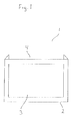
- Figure 1 shows a cooling tube 1 for a cooling medium such as water.
- the tube 2 is made from copper or aluminum and further comprises a layer of insulation 3.
- the cooling tube 2 comprises a track 4 for mounting the thermo electric generators.
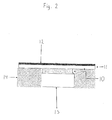
- FIG. 2 shows a cross section of a power generator according to the invention.
- the power generator comprises a thermo electric generator 10 that are attached to a copper strip 11 constituting the heat absorbing substrate.
- the thermo electric generator 10 is attached with the heat receiving side to the heat releasing side of the substrate 11.
- the heat absorbing side of the substrate 11 is applied with a heat absorbing coating 12 to improve the heat transfer properties of the substrate 11.
- the cooling side of the thermo electric generator 10 is in contact with a tube 13 in which a cooling medium, such as water, flows.
- the tube 13 is connected with a cooling system that provides for an efficient cooling of the cooling side of the thermo electric generator 10.
- the thermo electric generator 10 and the tube 13 are insulated with an insulating material 14.
- thermo electric generator 10 is attached to the substrate 11 and the tube 13 by means of heat conductive paste or glue.
- the wiring connecting the thermo electric generator 10 with other thermo electric generators and an inverter is not visible in the figure.
- FIG 3 shows the principles of a power generator comprising copper strips 11 as heat absorbing substrate to which the thermo electric generators 10 are attached. Each strip 11 carries six thermo electric generators and all together the six strips 11 carries thirty six thermo electric generators 10. Consequently, figure 3 schematically depicts a power generator with thirty six thermo electric generators.
- thermo electric generator 7Watt or 7,5Watt will, thus, require 70Watt or 75Watt, respectively, for maximum performance.
- a heat absorbing substrate with a heat absorbing area of 2,2m 2 was used as strips with a total length of 16m were the strips had a width of 0,14m.
- the strips were Custrlps delivered from the company BATEC, Denmark.
- Custrips are made from copper and have a heat absorbing side that is coated with a black heat absorbing material.
- thermo electric generators with a heat receiving areal 900mm 2 (30 x 30mm) were mounted on the heat releasing side of the strips. These thermo electric generators were intended to work with a maximum temperature of about 200°C. The maximum effect for each of the thermo electric generator was 4Watt, TEG-4 delivered from the company TEGPOWER, USA.
- thermo electric generators each having a maximum output of 4Watt was mounted on the 16m long strips by use of heat conductive pasta FisherElectric from the company 3M.
- the thermo electric generators were mounted with a mutual distance of 0,5m on the strips which was in accordance with the fact that the input effect to the strips was found to be approximately 640Watt/m 2 (measured on the test location, Karise, Denmark).
- the strips and the thermo electric generators was mounted in boxes having sides of glass facing the sun, which also increased the heat input to the thermo electric generators.
- thermo electric generators with a heat receiving areal of 1600mm 2 (40 x 40mm), which have a maximum effect of 7Watt.
- fewer thermo electric generators could have been used or a higher effect could have been achieved.
Landscapes
- Photovoltaic Devices (AREA)
- Motor Or Generator Cooling System (AREA)
- Connection Of Motors, Electrical Generators, Mechanical Devices, And The Like (AREA)
Priority Applications (2)
| Application Number | Priority Date | Filing Date | Title |
|---|---|---|---|
| EP11004228A EP2528124A1 (fr) | 2011-05-23 | 2011-05-23 | Générateur de puissance |
| PCT/DK2012/000060 WO2012159634A2 (fr) | 2011-05-23 | 2012-05-23 | Générateur de puissance |
Applications Claiming Priority (1)
| Application Number | Priority Date | Filing Date | Title |
|---|---|---|---|
| EP11004228A EP2528124A1 (fr) | 2011-05-23 | 2011-05-23 | Générateur de puissance |
Publications (1)
| Publication Number | Publication Date |
|---|---|
| EP2528124A1 true EP2528124A1 (fr) | 2012-11-28 |
Family
ID=46396956
Family Applications (1)
| Application Number | Title | Priority Date | Filing Date |
|---|---|---|---|
| EP11004228A Withdrawn EP2528124A1 (fr) | 2011-05-23 | 2011-05-23 | Générateur de puissance |
Country Status (2)
| Country | Link |
|---|---|
| EP (1) | EP2528124A1 (fr) |
| WO (1) | WO2012159634A2 (fr) |
Citations (2)
| Publication number | Priority date | Publication date | Assignee | Title |
|---|---|---|---|---|
| US20080142069A1 (en) | 2006-12-14 | 2008-06-19 | Joel Lindstrom | Thermoelectric module |
| EP2124267A2 (fr) * | 2008-05-22 | 2009-11-25 | Stichting IMEC Nederland | Générateur thermoélectrique pour implants et dispositifs intégrés |
Family Cites Families (4)
| Publication number | Priority date | Publication date | Assignee | Title |
|---|---|---|---|---|
| US4106952A (en) * | 1977-09-09 | 1978-08-15 | Kravitz Jerome H | Solar panel unit |
| US20090301541A1 (en) * | 2008-06-10 | 2009-12-10 | Watts Phillip C | Thermoelectric generator |
| BRPI0916044B1 (pt) * | 2008-11-04 | 2019-06-18 | Eaton Corporation | Gerador solar |
| US20110048489A1 (en) * | 2009-09-01 | 2011-03-03 | Gabriel Karim M | Combined thermoelectric/photovoltaic device for high heat flux applications and method of making the same |
-
2011
- 2011-05-23 EP EP11004228A patent/EP2528124A1/fr not_active Withdrawn
-
2012
- 2012-05-23 WO PCT/DK2012/000060 patent/WO2012159634A2/fr not_active Ceased
Patent Citations (2)
| Publication number | Priority date | Publication date | Assignee | Title |
|---|---|---|---|---|
| US20080142069A1 (en) | 2006-12-14 | 2008-06-19 | Joel Lindstrom | Thermoelectric module |
| EP2124267A2 (fr) * | 2008-05-22 | 2009-11-25 | Stichting IMEC Nederland | Générateur thermoélectrique pour implants et dispositifs intégrés |
Also Published As
| Publication number | Publication date |
|---|---|
| WO2012159634A2 (fr) | 2012-11-29 |
| WO2012159634A3 (fr) | 2013-04-11 |
Similar Documents
| Publication | Publication Date | Title |
|---|---|---|
| Parthiban et al. | An enhancement of the solar panel efficiency: a comprehensive review | |
| Moradgholi et al. | Application of heat pipe in an experimental investigation on a novel photovoltaic/thermal (PV/T) system | |
| Ghazy et al. | Cooling technologies for enhancing photovoltaic–thermal (PVT) performance: a state of the art | |
| EP2239787A1 (fr) | Panneau solaire thermoélectrique | |
| Fan et al. | Electric power generation from thermoelectric cells using a solar dish concentrator | |
| Eswaramoorthy et al. | Experimental study on solar parabolic dish thermoelectric generator | |
| ES2702348T3 (es) | Dispositivo solar híbrido para producción de electricidad con un aumento de la vida útil | |
| Lertsatitthanakorn et al. | Performance analysis of a double-pass thermoelectric solar air collector | |
| EP2262004A1 (fr) | Installation photovoltaïque pour la production d'énergie électrique | |
| Sachit et al. | Current progress on flat-plate water collector design in photovoltaic thermal (PV/T) systems: A Review | |
| CN202424590U (zh) | 一种温差太阳能发电墙 | |
| Tiwari et al. | Effects of active cooling techniques to improve the overall efficiency of photovoltaic module-An updated review | |
| Wang et al. | Solar-and/or radiative cooling-driven thermoelectric generators: a critical review | |
| CN109004863A (zh) | 一种热电相变围护结构系统及应用方法 | |
| Mishra et al. | A review of advanced cooling methodologies for solar photovoltaic and thermoelectric hybrid energy systems | |
| CN105332461A (zh) | 发电砖 | |
| CN105452655A (zh) | 用于近海应用的高效太阳能发电机 | |
| Daud et al. | Novel hybrid photovoltaic and thermoelectric panel | |
| Srimanickam et al. | Experimental performance assessment of single glazing flat plate solar photovoltaic thermal (PV/T) hybrid system | |
| EP2528124A1 (fr) | Générateur de puissance | |
| Ashibil et al. | Performance assessments of direct contact serpentine tube based photovoltaic thermal module: an experimental comparison | |
| CN102545715A (zh) | 一种大气温差发电装置 | |
| Khasee et al. | Energy and exergy analysis of a double–pass thermoelectric solar air collector | |
| CN104660101A (zh) | 一种温差发电机 | |
| CN101924505A (zh) | 一种太阳能温差发电装置 |
Legal Events
| Date | Code | Title | Description |
|---|---|---|---|
| PUAI | Public reference made under article 153(3) epc to a published international application that has entered the european phase |
Free format text: ORIGINAL CODE: 0009012 |
|
| AK | Designated contracting states |
Kind code of ref document: A1 Designated state(s): AL AT BE BG CH CY CZ DE DK EE ES FI FR GB GR HR HU IE IS IT LI LT LU LV MC MK MT NL NO PL PT RO RS SE SI SK SM TR |
|
| AX | Request for extension of the european patent |
Extension state: BA ME |
|
| STAA | Information on the status of an ep patent application or granted ep patent |
Free format text: STATUS: THE APPLICATION IS DEEMED TO BE WITHDRAWN |
|
| 18D | Application deemed to be withdrawn |
Effective date: 20130529 |