EP2530125A1 - Kern-Schale-Partikel mit katalytischer Aktivität - Google Patents
Kern-Schale-Partikel mit katalytischer Aktivität Download PDFInfo
- Publication number
- EP2530125A1 EP2530125A1 EP11305657A EP11305657A EP2530125A1 EP 2530125 A1 EP2530125 A1 EP 2530125A1 EP 11305657 A EP11305657 A EP 11305657A EP 11305657 A EP11305657 A EP 11305657A EP 2530125 A1 EP2530125 A1 EP 2530125A1
- Authority
- EP
- European Patent Office
- Prior art keywords
- core
- particles
- shell
- cobalt
- suspension
- Prior art date
- Legal status (The legal status is an assumption and is not a legal conclusion. Google has not performed a legal analysis and makes no representation as to the accuracy of the status listed.)
- Withdrawn
Links
Images

Classifications
-
- B—PERFORMING OPERATIONS; TRANSPORTING
- B01—PHYSICAL OR CHEMICAL PROCESSES OR APPARATUS IN GENERAL
- B01J—CHEMICAL OR PHYSICAL PROCESSES, e.g. CATALYSIS OR COLLOID CHEMISTRY; THEIR RELEVANT APPARATUS
- B01J23/00—Catalysts comprising metals or metal oxides or hydroxides, not provided for in group B01J21/00
- B01J23/70—Catalysts comprising metals or metal oxides or hydroxides, not provided for in group B01J21/00 of the iron group metals or copper
- B01J23/74—Iron group metals
- B01J23/75—Cobalt
-
- B—PERFORMING OPERATIONS; TRANSPORTING
- B01—PHYSICAL OR CHEMICAL PROCESSES OR APPARATUS IN GENERAL
- B01J—CHEMICAL OR PHYSICAL PROCESSES, e.g. CATALYSIS OR COLLOID CHEMISTRY; THEIR RELEVANT APPARATUS
- B01J23/00—Catalysts comprising metals or metal oxides or hydroxides, not provided for in group B01J21/00
- B01J23/70—Catalysts comprising metals or metal oxides or hydroxides, not provided for in group B01J21/00 of the iron group metals or copper
- B01J23/74—Iron group metals
- B01J23/745—Iron
-
- B—PERFORMING OPERATIONS; TRANSPORTING
- B01—PHYSICAL OR CHEMICAL PROCESSES OR APPARATUS IN GENERAL
- B01J—CHEMICAL OR PHYSICAL PROCESSES, e.g. CATALYSIS OR COLLOID CHEMISTRY; THEIR RELEVANT APPARATUS
- B01J35/00—Catalysts, in general, characterised by their form or physical properties
- B01J35/19—Catalysts containing parts with different compositions
-
- B—PERFORMING OPERATIONS; TRANSPORTING
- B01—PHYSICAL OR CHEMICAL PROCESSES OR APPARATUS IN GENERAL
- B01J—CHEMICAL OR PHYSICAL PROCESSES, e.g. CATALYSIS OR COLLOID CHEMISTRY; THEIR RELEVANT APPARATUS
- B01J35/00—Catalysts, in general, characterised by their form or physical properties
- B01J35/30—Catalysts, in general, characterised by their form or physical properties characterised by their physical properties
- B01J35/396—Distribution of the active metal ingredient
- B01J35/397—Egg shell like
-
- B—PERFORMING OPERATIONS; TRANSPORTING
- B01—PHYSICAL OR CHEMICAL PROCESSES OR APPARATUS IN GENERAL
- B01J—CHEMICAL OR PHYSICAL PROCESSES, e.g. CATALYSIS OR COLLOID CHEMISTRY; THEIR RELEVANT APPARATUS
- B01J35/00—Catalysts, in general, characterised by their form or physical properties
- B01J35/40—Catalysts, in general, characterised by their form or physical properties characterised by dimensions, e.g. grain size
- B01J35/45—Nanoparticles
-
- B—PERFORMING OPERATIONS; TRANSPORTING
- B01—PHYSICAL OR CHEMICAL PROCESSES OR APPARATUS IN GENERAL
- B01J—CHEMICAL OR PHYSICAL PROCESSES, e.g. CATALYSIS OR COLLOID CHEMISTRY; THEIR RELEVANT APPARATUS
- B01J35/00—Catalysts, in general, characterised by their form or physical properties
- B01J35/50—Catalysts, in general, characterised by their form or physical properties characterised by their shape or configuration
- B01J35/51—Spheres
- B01J35/53—Spheres with a core-shell structure
-
- B—PERFORMING OPERATIONS; TRANSPORTING
- B01—PHYSICAL OR CHEMICAL PROCESSES OR APPARATUS IN GENERAL
- B01J—CHEMICAL OR PHYSICAL PROCESSES, e.g. CATALYSIS OR COLLOID CHEMISTRY; THEIR RELEVANT APPARATUS
- B01J37/00—Processes, in general, for preparing catalysts; Processes, in general, for activation of catalysts
- B01J37/0072—Preparation of particles, e.g. dispersion of droplets in an oil bath
-
- B—PERFORMING OPERATIONS; TRANSPORTING
- B01—PHYSICAL OR CHEMICAL PROCESSES OR APPARATUS IN GENERAL
- B01J—CHEMICAL OR PHYSICAL PROCESSES, e.g. CATALYSIS OR COLLOID CHEMISTRY; THEIR RELEVANT APPARATUS
- B01J37/00—Processes, in general, for preparing catalysts; Processes, in general, for activation of catalysts
- B01J37/02—Impregnation, coating or precipitation
- B01J37/0215—Coating
- B01J37/0217—Pretreatment of the substrate before coating
-
- B—PERFORMING OPERATIONS; TRANSPORTING
- B01—PHYSICAL OR CHEMICAL PROCESSES OR APPARATUS IN GENERAL
- B01J—CHEMICAL OR PHYSICAL PROCESSES, e.g. CATALYSIS OR COLLOID CHEMISTRY; THEIR RELEVANT APPARATUS
- B01J37/00—Processes, in general, for preparing catalysts; Processes, in general, for activation of catalysts
- B01J37/02—Impregnation, coating or precipitation
- B01J37/0215—Coating
- B01J37/0221—Coating of particles
-
- B—PERFORMING OPERATIONS; TRANSPORTING
- B01—PHYSICAL OR CHEMICAL PROCESSES OR APPARATUS IN GENERAL
- B01J—CHEMICAL OR PHYSICAL PROCESSES, e.g. CATALYSIS OR COLLOID CHEMISTRY; THEIR RELEVANT APPARATUS
- B01J37/00—Processes, in general, for preparing catalysts; Processes, in general, for activation of catalysts
- B01J37/02—Impregnation, coating or precipitation
- B01J37/0215—Coating
- B01J37/0225—Coating of metal substrates
-
- B—PERFORMING OPERATIONS; TRANSPORTING
- B01—PHYSICAL OR CHEMICAL PROCESSES OR APPARATUS IN GENERAL
- B01J—CHEMICAL OR PHYSICAL PROCESSES, e.g. CATALYSIS OR COLLOID CHEMISTRY; THEIR RELEVANT APPARATUS
- B01J37/00—Processes, in general, for preparing catalysts; Processes, in general, for activation of catalysts
- B01J37/02—Impregnation, coating or precipitation
- B01J37/03—Precipitation; Co-precipitation
- B01J37/031—Precipitation
-
- B—PERFORMING OPERATIONS; TRANSPORTING
- B01—PHYSICAL OR CHEMICAL PROCESSES OR APPARATUS IN GENERAL
- B01J—CHEMICAL OR PHYSICAL PROCESSES, e.g. CATALYSIS OR COLLOID CHEMISTRY; THEIR RELEVANT APPARATUS
- B01J37/00—Processes, in general, for preparing catalysts; Processes, in general, for activation of catalysts
- B01J37/06—Washing
-
- B—PERFORMING OPERATIONS; TRANSPORTING
- B01—PHYSICAL OR CHEMICAL PROCESSES OR APPARATUS IN GENERAL
- B01J—CHEMICAL OR PHYSICAL PROCESSES, e.g. CATALYSIS OR COLLOID CHEMISTRY; THEIR RELEVANT APPARATUS
- B01J37/00—Processes, in general, for preparing catalysts; Processes, in general, for activation of catalysts
- B01J37/32—Freeze drying, i.e. lyophilisation
-
- C—CHEMISTRY; METALLURGY
- C10—PETROLEUM, GAS OR COKE INDUSTRIES; TECHNICAL GASES CONTAINING CARBON MONOXIDE; FUELS; LUBRICANTS; PEAT
- C10G—CRACKING HYDROCARBON OILS; PRODUCTION OF LIQUID HYDROCARBON MIXTURES, e.g. BY DESTRUCTIVE HYDROGENATION, OLIGOMERISATION, POLYMERISATION; RECOVERY OF HYDROCARBON OILS FROM OIL-SHALE, OIL-SAND, OR GASES; REFINING MIXTURES MAINLY CONSISTING OF HYDROCARBONS; REFORMING OF NAPHTHA; MINERAL WAXES
- C10G2/00—Production of liquid hydrocarbon mixtures of undefined composition from oxides of carbon
- C10G2/30—Production of liquid hydrocarbon mixtures of undefined composition from oxides of carbon from carbon monoxide with hydrogen
- C10G2/32—Production of liquid hydrocarbon mixtures of undefined composition from oxides of carbon from carbon monoxide with hydrogen with the use of catalysts
- C10G2/33—Production of liquid hydrocarbon mixtures of undefined composition from oxides of carbon from carbon monoxide with hydrogen with the use of catalysts characterised by the catalyst used
- C10G2/331—Production of liquid hydrocarbon mixtures of undefined composition from oxides of carbon from carbon monoxide with hydrogen with the use of catalysts characterised by the catalyst used containing group VIII-metals
- C10G2/332—Production of liquid hydrocarbon mixtures of undefined composition from oxides of carbon from carbon monoxide with hydrogen with the use of catalysts characterised by the catalyst used containing group VIII-metals of the iron-group
-
- B—PERFORMING OPERATIONS; TRANSPORTING
- B01—PHYSICAL OR CHEMICAL PROCESSES OR APPARATUS IN GENERAL
- B01J—CHEMICAL OR PHYSICAL PROCESSES, e.g. CATALYSIS OR COLLOID CHEMISTRY; THEIR RELEVANT APPARATUS
- B01J2235/00—Indexing scheme associated with group B01J35/00, related to the analysis techniques used to determine the catalysts form or properties
-
- B—PERFORMING OPERATIONS; TRANSPORTING
- B01—PHYSICAL OR CHEMICAL PROCESSES OR APPARATUS IN GENERAL
- B01J—CHEMICAL OR PHYSICAL PROCESSES, e.g. CATALYSIS OR COLLOID CHEMISTRY; THEIR RELEVANT APPARATUS
- B01J2235/00—Indexing scheme associated with group B01J35/00, related to the analysis techniques used to determine the catalysts form or properties
- B01J2235/30—Scanning electron microscopy; Transmission electron microscopy
-
- B—PERFORMING OPERATIONS; TRANSPORTING
- B01—PHYSICAL OR CHEMICAL PROCESSES OR APPARATUS IN GENERAL
- B01J—CHEMICAL OR PHYSICAL PROCESSES, e.g. CATALYSIS OR COLLOID CHEMISTRY; THEIR RELEVANT APPARATUS
- B01J37/00—Processes, in general, for preparing catalysts; Processes, in general, for activation of catalysts
- B01J37/0009—Use of binding agents; Moulding; Pressing; Powdering; Granulating; Addition of materials ameliorating the mechanical properties of the product catalyst
-
- B—PERFORMING OPERATIONS; TRANSPORTING
- B01—PHYSICAL OR CHEMICAL PROCESSES OR APPARATUS IN GENERAL
- B01J—CHEMICAL OR PHYSICAL PROCESSES, e.g. CATALYSIS OR COLLOID CHEMISTRY; THEIR RELEVANT APPARATUS
- B01J37/00—Processes, in general, for preparing catalysts; Processes, in general, for activation of catalysts
- B01J37/16—Reducing
- B01J37/18—Reducing with gases containing free hydrogen
Definitions
- the present invention pertains to novel core-shell particles, to the method for preparing same, and to their uses in the manufacture of a catalyst.
- a catalyst made from core-shell particles having a core of zinc oxide and a shell comprising cobalt oxide may be produced either by co-precipitation of insoluble thermally decomposable compounds of zinc and cobalt, or by precipitation of an insoluble thermally decomposable compound of cobalt in the presence of zinc oxide.
- the insoluble thermally decomposable compounds are formed from metal oxides obtained by adding a precipitant such as a base to an aqueous solution of the corresponding metal salts.
- the catalytic activity of the particles obtained according to these two methods need to be improved.
- Another method to prepare core-shell catalysts has been proposed in US-7 422 995 and is referred to as the layer-by-layer (or "LBL”) method. Again, the catalytic activity of the particles can be improved. Moreover, it involves several steps and the use of a surfactant to anchor the cobalt layer to the chemically inert core coated with a zinc oxide layer, which increases the cost of this method.
- core-shell materials have been proposed for catalytic applications ( J. BAO et al., Angewandte Chemie, International Edition in English, Vol. 47, pp. 353-356, 2008 ; J. M. BADANO et al., Applied Catalysis A., Vol. 390, pp. 166-174, 2010 ). They include an active phase, generally a transition metal, which is set as the core of the composite particle. This active core is then coated with a protective shell, such as mesoporous silica, titania or carbon nanotubes. Covering the active phase with a protective shell can prevent sintering, while allowing reactants and products to diffuse through the catalyst. However, the system is severely affected by the diffusion limitation across the shell. Examples of such core-shell catalysts have been used in Fischer-Tropsch reactions ( R. XIE et al., Catalysis Communications, Vol. 12, pp. 380-383 and pp. 589-592, 2011 ).
- core-shell particles having a core of iron oxide and a shell comprising cobalt, and other cobalt-doped iron oxide particles, have already been described in various documents such as US-6 080 233 , US-5 512 317 , US-5 484 628 , US-5 183 709 , US-4 276 183 , US-4 226 909 , US-4 420 537 and US-3 573 980 .
- These particles are intended to be used as magnetisable particles in magnetic recording tapes which require both a high coercivity and a good orientation ratio of the particles in a binder. These particles have an acicular shape, resulting from their preparation processes.
- acicular iron oxides as starting materials, which are treated in a basic aqueous solution so as to form a core of magnetite, berthollide or ⁇ -Fe 2 O 3 , having a size of more than 20 nm and most often more than 100 nm.
- a cobalt salt (and optionally other metallic salts or a silicate) is added to the iron compound either before or after the formation of the core, so as to result in a shell comprising cobalt and optionally iron or chromium (and optionally a silicate).
- Similar processes have been disclosed by A. E. Berlowitz et al in IEEE Transactions on Magnetics, Vol. 24, No. 6, November 1988 , by M.
- the present invention is thus directed to a method for the preparation of spherical core-shell particles, comprising the successive steps consisting of:
- the above method may comprise other preliminary, intermediate or subsequent steps, as long as they do not impair the structure and properties of the core-shell particles obtained.
- this invention pertains to the core-shell particles which may be obtained according to the above method.
- this invention is directed to core-shell particles comprising a core of iron oxide and a shell of cobalt oxide, characterized in that they are spherical with a number average diameter, as measured by TEM, of between 1 and 20 nm.
- the core consists in magnetite or hematite and the shell consists in cobalt oxide.
- this invention pertains to the use of these core-shell particles to manufacture a catalyst.
- this invention pertains to a catalyst comprising an inert porous carrier containing core-shell particles as defined above.
- the novel method of this invention for the preparation of core-shell particles mainly involves the precipitation of iron oxide particles from iron salts, so as to form a magnetite (Fe 3 O 4 ) or hematite (Fe 2 O 3 ) core, followed by the addition of a cobalt salt, in a hot basic medium, in order to precipitate a cobalt oxide shell (Co 3 O 4 ) around said core.
- an aqueous solution which comprises a ferric or Fe(III) salt, optionally mixed with a ferrous or Fe(II) salt in a molar ratio of Fe(III) to Fe(II) of 2:1.
- These salts may be independently chosen from, for instance, nitrate, chloride and hydroxide salts, with chloride salts being preferred.
- chloride salts being preferred.
- sulphate salts will not be used.
- the solution of these salts in water is maintained at, or brought to, a temperature of less than 50°C, preferably comprised between 15 and 40°C and more preferably comprised between 20 and 30°C. This solution generally comprises no other compound than the above salts, especially no other salt and/or no surfactant.
- This base is preferably ammonium hydroxide, although other bases such as sodium or potassium hydroxide may be used. This addition is performed until a pH of from 10 to 14 is reached, generally while stirring the solution.
- a suspension containing hematite particles Fe 2 O 3
- magnetite particles FeO.Fe 2 O 3 also designated by Fe 3 O 4
- This suspension is then washed with water, preferably at 10-40°C, for instance at 10-30°C, so as to remove the excess ions, before adding a strong acid, such as nitric acid or hydrochloric acid, to the washed suspension.
- a strong acid such as nitric acid or hydrochloric acid
- the iron oxide particles thus obtained have a spherical shape with a number average diameter, as measured by Transmission Electron Microscopy (TEM), comprised between 1 and 20 nm and preferably between 3 and 15 nm, which has been shown to be dependent on the precipitation pH.
- TEM Transmission Electron Microscopy
- a base is added to the suspension of magnetite particles, until a pH of from 10 to 14 is reached.
- This base may be chosen from those listed above, among which sodium hydroxide is preferred.
- the addition of this base is generally performed while stirring the suspension.
- This base is reacted with the suspension of iron oxide particles at a temperature of from 50 to 95°C and preferably comprised between 60 and 70°C.
- the suspension may either be heated first, then reacted with the base, or first reacted with the base and then heated.
- cobalt salt is then added slowly to this suspension, for instance at a rate of from 0.1 to 0.5 ml/min.
- This salt may be chosen from cobalt chloride, cobalt nitrate, cobalt sulphate and their hydrates and mixtures, wherein cobalt nitrate is preferred.
- the addition of this salt is also usually carried out while stirring the suspension.
- at least one other metal salt may be added, especially salts of catalytic promoters such as platinum, manganese or ruthenium and their mixtures.
- the amount of cobalt salt, and optionally other salts, used depends on the thickness of the cobalt oxide shell that is to be formed around the magnetite core particles.
- This step leads to the formation of core-shell particles having a number average diameter, as measured by TEM, comprised between 2 and 30 nm and preferably between 3 and 15 nm, and a weight ratio of cobalt to iron comprised between 1 and 70%, preferably from 10 to 65% and more preferably from 15 to 60%.
- This ratio should however be properly chosen in view of the reaction in which these particles are intended to be used, so as to provide the required catalytic activity.
- the method according to this invention is simple, with only a few steps, it need not be carried out under specific conditions, for instance under inert atmosphere. Moreover, this method does neither generate hazardous by-products, nor contaminated waters, and uses standard low-cost chemicals.
- the core-shell particles of this invention are novel. They comprise a core of iron oxide and a shell of cobalt oxide and they are spherical with a number average diameter, as measured by TEM, of between 1 and 20 nm.
- the core preferably consists in magnetite or hematite and the shell consists in cobalt oxide. Usually, these particles do not include any other metal oxide.
- They may be used to manufacture catalysts involved in Fischer Tropsch reactions or in other chemical reactions such as the hydrogenation of nitriles into primary amines or in hydroformylation processes.
- the Fischer-Tropsch process generally comprises the following process steps.
- the first step involves reacting a source of carbon (such as coal, natural gas or biomass) with a source of oxygen (such as steam, air or oxygen) to form a mixture of carbon monoxide and hydrogen, usually referred to as syngas.
- the second step involves contacting the syngas with a Fischer-Tropsch catalyst including the particles of this invention, which leads to hydrocarbons and water.
- the main products of the Fischer-Tropsch reaction are linear olefins and paraffins and water.
- the third step involves isomerisation of the hydrocarbons formed in the second step to produce more valuable products. For instance, the longer chains in the product may be cracked to form products in the diesel or gasoline range, and linear paraffins may be isomerised to improve diesel product properties such as cloud point and pour point.
- adapted hydrotreating catalysts are used for this third step.
- the core-shell particles of this invention are usually included within and/or adsorbed on an inert porous carrier so as to form a catalyst.
- This carrier may be a porous inorganic refractory oxide, more preferably alumina, silica, titania, zirconia or mixtures thereof. Alternatively, it may be chosen from aluminosilicates such as zeolithes.
- This carrier is usually beneficial to the retention of the core-shell structure under reducing conditions.
- the core-shell particles are impregnated onto the carrier, which preferably has a pore size of at least 40 nm. To this end, a particle suspension with a concentration of from 5 to 20 g/l may be used, and water may be slowly removed after impregnation.
- the optimum amount of core-shell particles present in the carrier may vary, depending on the catalytic activity required.
- the amount of cobalt present in the catalyst may range from 1 to 25% by weight of catalyst, for instance from 10 to 20% by weight of catalyst.
- Other promoters, if present, may represent from 0.5 to 5% by weight of catalyst.
- the promoters may be present as metals or as the metal oxide, depending upon the particular promoter concerned. Suitable promoters include oxides of metals from Groups IVB, VB and/or VIIB of the Periodic Table, oxides of the lanthanides and/or the actinides.
- the catalyst comprises at least one oxide of titanium, zirconium, manganese and/or vanadium.
- the catalyst may comprise a metal promoter selected from Groups VIIB and/or VIII of the Periodic Table.
- Preferred metal promoters include rhenium, platinum and palladium.
- the core-shell particles described above may be used to manufacture a catalyst comprising from 3 to 8% by weight of cobalt, from 0.2 to 1% by weight of ruthenium and from 0.5 to 1.5% by weight of platinum.
- the catalyst When fresh prepared, the catalyst may be shaped or formed by means of spray drying, pelletizing, (wheel) pressing, extrusion, or application on a metal support like a metal wire.
- the core-shell particles and/or any promoter may be added to the carrier material before or after shaping.
- the catalyst suitably has an average diameter of 0.5-15 mm.
- One form of catalyst is as an extrudate. Such extrudates suitably have a length of 2-10 mm, and a cross section suitably of 1-6 mm 2 , especially 2-3 mm 2 .
- the catalyst After shaping, the catalyst may be strengthened by calcination thereof in a manner known in the art.
- the calcination temperature depends on the carrier material used.
- Activation of a fresh prepared catalyst can be carried out in any known manner and under conventional conditions.
- the catalyst may be activated by contacting it with hydrogen or a hydrogen-containing gas, typically at temperatures of about 200°C to 350°C.
- the catalyst may then be used as a slurry catalyst or preferably as a fixed bed catalyst.
- this catalyst may be used in fixed bed reactors, especially multi-tubular fixed bed reactors, fluidised bed reactors, such as entrained fluidised bed reactors and fixed fluidised bed reactors, and slurry bed reactors such as three-phase slurry bubble columns and ebullated bed reactors.
- Magnetite particles were first synthetized via a slightly modified Massart method. To this end, 9.02 g of FeCl 3 .xH 2 O and 3.26 g of FeCl 2 .xH 2 O were mixed together in 380 ml of water. To this solution were added from 10 to 40 ml of ammonia: magnetite formation was visible as a black precipitate. The particles were washed with 300 ml water, until the pH of the supernatant was constant. The magnetite particles were then peptized with 40 ml of a 2M HNO 3 solution. The precipitate was recovered with a magnet and redispersed in water.
- Table 1 summarizes the size of the magnetite particles as a function of the ammonia amount: Table 1 NH 4 OH (ml) Particle size (nm) 10 12.2 20 7.6 40 3.5
- the precipitate was then washed with water, the supernatant was removed and the so-obtained slurry was freeze-dried.
- the particle suspensions show an extended stability in a wide range of pH values.
- Mean iron particle size calculated on the basis of the TEM image analysis, is comprised in the 3-12 nm range and inversely proportional to the amount of ammonia used in the synthesis.
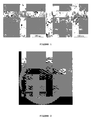
- the image analysis of the Co coated particles showed no homogeneous nucleated Co oxide particles (see Figure 1a which illustrates core-shell particles of about 7.5 nm).
- a control experiment further showed how, with no magnetite particles in the hot basic solution, Co oxide precipitates as hexagonal plates of about 20 nm (see Figure 1b ).
- TPR characterizations were also performed on freeze-dried powders by flowing a 5% H 2 in N 2 mixture at 40 ml/min, heating the samples at 5°C/min.
- the TPR characterization as well supports the presence of a core-shell structure.
- the behaviour in a reducing environment of these iron oxide particles perfectly matched magnetite TPR profile reported in the literature. From the TPR plots illustrated on Figure 3 , one could derive that the part of the Co interacted with the magnetite structure, influencing Fe reducibility, and that part of it also contributed to the formation of the cobaltrich shell. The reduction rate was so fast in any way that the presence of pure Co 3 O 4 and Fe 3 O 4 phases could not be detected.
Landscapes
- Chemical & Material Sciences (AREA)
- Engineering & Computer Science (AREA)
- Organic Chemistry (AREA)
- Chemical Kinetics & Catalysis (AREA)
- Materials Engineering (AREA)
- Oil, Petroleum & Natural Gas (AREA)
- General Chemical & Material Sciences (AREA)
- Dispersion Chemistry (AREA)
- Catalysts (AREA)
- Compounds Of Iron (AREA)
Priority Applications (10)
| Application Number | Priority Date | Filing Date | Title |
|---|---|---|---|
| EP11305657A EP2530125A1 (de) | 2011-05-30 | 2011-05-30 | Kern-Schale-Partikel mit katalytischer Aktivität |
| CA2836825A CA2836825A1 (en) | 2011-05-30 | 2012-05-30 | Core-shell particles with catalytic activity |
| US14/118,748 US9539563B2 (en) | 2011-05-30 | 2012-05-30 | Core-shell particles with catalytic activity |
| PCT/EP2012/060150 WO2012163969A1 (en) | 2011-05-30 | 2012-05-30 | Core-shell particles with catalytic activity |
| EA201301307A EA024839B1 (ru) | 2011-05-30 | 2012-05-30 | Частицы ядро-оболочка с каталитической активностью |
| CN201280034322.7A CN103649234B (zh) | 2011-05-30 | 2012-05-30 | 具有催化活性的芯-壳颗粒 |
| EP12727123.7A EP2714816A1 (de) | 2011-05-30 | 2012-05-30 | Kern-schale-partikel mit katalytischer aktivität |
| AU2012264715A AU2012264715B2 (en) | 2011-05-30 | 2012-05-30 | Core-shell particles with catalytic activity |
| ZA2013/08813A ZA201308813B (en) | 2011-05-30 | 2013-11-22 | Core-shell particles with catalytic activity |
| US15/237,233 US9956545B2 (en) | 2011-05-30 | 2016-08-15 | Core-shell particles with catalytic activity |
Applications Claiming Priority (1)
| Application Number | Priority Date | Filing Date | Title |
|---|---|---|---|
| EP11305657A EP2530125A1 (de) | 2011-05-30 | 2011-05-30 | Kern-Schale-Partikel mit katalytischer Aktivität |
Publications (1)
| Publication Number | Publication Date |
|---|---|
| EP2530125A1 true EP2530125A1 (de) | 2012-12-05 |
Family
ID=44562700
Family Applications (2)
| Application Number | Title | Priority Date | Filing Date |
|---|---|---|---|
| EP11305657A Withdrawn EP2530125A1 (de) | 2011-05-30 | 2011-05-30 | Kern-Schale-Partikel mit katalytischer Aktivität |
| EP12727123.7A Withdrawn EP2714816A1 (de) | 2011-05-30 | 2012-05-30 | Kern-schale-partikel mit katalytischer aktivität |
Family Applications After (1)
| Application Number | Title | Priority Date | Filing Date |
|---|---|---|---|
| EP12727123.7A Withdrawn EP2714816A1 (de) | 2011-05-30 | 2012-05-30 | Kern-schale-partikel mit katalytischer aktivität |
Country Status (8)
| Country | Link |
|---|---|
| US (2) | US9539563B2 (de) |
| EP (2) | EP2530125A1 (de) |
| CN (1) | CN103649234B (de) |
| AU (1) | AU2012264715B2 (de) |
| CA (1) | CA2836825A1 (de) |
| EA (1) | EA024839B1 (de) |
| WO (1) | WO2012163969A1 (de) |
| ZA (1) | ZA201308813B (de) |
Cited By (2)
| Publication number | Priority date | Publication date | Assignee | Title |
|---|---|---|---|---|
| EP2740534A1 (de) * | 2012-12-04 | 2014-06-11 | Total Raffinage Marketing | Kern-Schale-Partikel mit katalytischer Aktivität und das Verfahren zu deren Herstellung. Das Herstellverfahren eines Fischer-Tropsch Katalysators basierend auf diesen Partikel. |
| CN110565114A (zh) * | 2019-09-29 | 2019-12-13 | 济南大学 | 一种三维多孔Fe@Fe(OH)3析氧阳极的制备方法 |
Families Citing this family (8)
| Publication number | Priority date | Publication date | Assignee | Title |
|---|---|---|---|---|
| CN103920496B (zh) * | 2014-04-22 | 2015-11-18 | 武汉凯迪工程技术研究总院有限公司 | 介孔材料包覆式钴基费托合成催化剂及其制备方法 |
| EP3259598B1 (de) * | 2015-02-19 | 2020-07-29 | Actorius Innovations and Research Pvt. Ltd. | Multifunktionelle magnetopolymere nanosysteme für schnelles targeting, isolierung, nachweis und gleichzeitige bildgebung von zirkulierenden tumorzellen |
| FR3033792B1 (fr) * | 2015-03-20 | 2017-04-21 | Innov'ia 3I | Compositions pulverulentes d'un complexe entre un acide et un metal a haute teneur en composes organiques soufres et leur procede de preparation |
| CN105861024B (zh) * | 2016-04-20 | 2017-11-17 | 中国科学院山西煤炭化学研究所 | 一种钴基费托合成催化剂的应用方法 |
| EP3844109B1 (de) | 2018-08-31 | 2023-11-15 | Dow Global Technologies LLC | Verfahren zur herstellung von wasserstoffselektiven sauerstoffträgermaterialien |
| CN111530494B (zh) * | 2020-05-15 | 2023-11-10 | 洛阳市科创石化科技开发有限公司 | 一种内核为分子筛的复合载体及其制备方法 |
| US11857951B2 (en) | 2020-10-09 | 2024-01-02 | Iowa State University Research Foundation, Inc. | Pore-encapsulated catalysts for selective hydrogenolysis of plastic waste |
| US12030843B2 (en) | 2021-01-05 | 2024-07-09 | Iowa State University Research Foundation, Inc. | Catalytic upcycling of polyolefins via versatile alkylaluminums |
Citations (14)
| Publication number | Priority date | Publication date | Assignee | Title |
|---|---|---|---|---|
| US3573980A (en) | 1968-02-19 | 1971-04-06 | Minnesota Mining & Mfg | Method of making magnetic particles and recording tape |
| US4226909A (en) | 1978-08-21 | 1980-10-07 | Minnesota Mining And Manufacturing Company | Cobalt-doped acicular hyper-magnetite particles |
| US4276183A (en) | 1978-10-25 | 1981-06-30 | Pfizer Inc. | Cobalt modified magnetic iron oxide |
| US4420537A (en) | 1979-11-28 | 1983-12-13 | Tdk Electronics Co. Ltd. | Magnetic recording medium having cobalt adsorbed iron oxide layer |
| EP0261870A1 (de) | 1986-09-26 | 1988-03-30 | The British Petroleum Company p.l.c. | Katalysator für die Umwandlung von Synthesegas, seine Herstellung und seine Verwendung |
| US5183709A (en) | 1989-04-20 | 1993-02-02 | Basf Aktiengesellschaft | Acicular cobalt-modified iron oxides and their preparation |
| GB2281071A (en) * | 1993-08-18 | 1995-02-22 | Basf Magnetics Gmbh | Preparation of acicular magnetic iron oxide coated with cobalt ferrite |
| US5512317A (en) | 1993-07-06 | 1996-04-30 | Minnesota Mining And Manufacturing Company | Doped magnetic iron oxide particles and method of preparing the same |
| US6080233A (en) | 1993-06-14 | 2000-06-27 | Toda Kogyo Corporation | Cobalt-containing iron oxide pigments, process for producing the same and magnetic recording medium containing the same |
| US7422995B2 (en) | 2004-04-30 | 2008-09-09 | Basf Catalysts Llc | Process for the preparation of a supported catalyst |
| JP2008248367A (ja) * | 2007-03-30 | 2008-10-16 | Kyoto Univ | FePtコア/Coシェル構造を有する複合ナノ粒子の製造方法 |
| US20100062929A1 (en) * | 2008-07-31 | 2010-03-11 | Virkar Anil V | Core Shell Catalyst |
| WO2010060736A1 (en) * | 2008-11-03 | 2010-06-03 | Acta S.P.A. | Non-noble metals based catalysts for ammonia decomposition and their preparation |
| US20100143721A1 (en) * | 2008-12-09 | 2010-06-10 | University Of South Carolina | Porous metal oxide particles and their methods of synthesis |
Family Cites Families (1)
| Publication number | Priority date | Publication date | Assignee | Title |
|---|---|---|---|---|
| CN101786601B (zh) * | 2010-03-23 | 2013-01-09 | 济南大学 | Fe3O4/CoO核壳结构复合纳米粒子的制备方法 |
-
2011
- 2011-05-30 EP EP11305657A patent/EP2530125A1/de not_active Withdrawn
-
2012
- 2012-05-30 CA CA2836825A patent/CA2836825A1/en not_active Abandoned
- 2012-05-30 US US14/118,748 patent/US9539563B2/en not_active Expired - Fee Related
- 2012-05-30 EP EP12727123.7A patent/EP2714816A1/de not_active Withdrawn
- 2012-05-30 CN CN201280034322.7A patent/CN103649234B/zh not_active Expired - Fee Related
- 2012-05-30 EA EA201301307A patent/EA024839B1/ru not_active IP Right Cessation
- 2012-05-30 AU AU2012264715A patent/AU2012264715B2/en not_active Ceased
- 2012-05-30 WO PCT/EP2012/060150 patent/WO2012163969A1/en not_active Ceased
-
2013
- 2013-11-22 ZA ZA2013/08813A patent/ZA201308813B/en unknown
-
2016
- 2016-08-15 US US15/237,233 patent/US9956545B2/en not_active Expired - Fee Related
Patent Citations (15)
| Publication number | Priority date | Publication date | Assignee | Title |
|---|---|---|---|---|
| US3573980A (en) | 1968-02-19 | 1971-04-06 | Minnesota Mining & Mfg | Method of making magnetic particles and recording tape |
| US4226909A (en) | 1978-08-21 | 1980-10-07 | Minnesota Mining And Manufacturing Company | Cobalt-doped acicular hyper-magnetite particles |
| US4276183A (en) | 1978-10-25 | 1981-06-30 | Pfizer Inc. | Cobalt modified magnetic iron oxide |
| US4420537A (en) | 1979-11-28 | 1983-12-13 | Tdk Electronics Co. Ltd. | Magnetic recording medium having cobalt adsorbed iron oxide layer |
| EP0261870A1 (de) | 1986-09-26 | 1988-03-30 | The British Petroleum Company p.l.c. | Katalysator für die Umwandlung von Synthesegas, seine Herstellung und seine Verwendung |
| US5183709A (en) | 1989-04-20 | 1993-02-02 | Basf Aktiengesellschaft | Acicular cobalt-modified iron oxides and their preparation |
| US6080233A (en) | 1993-06-14 | 2000-06-27 | Toda Kogyo Corporation | Cobalt-containing iron oxide pigments, process for producing the same and magnetic recording medium containing the same |
| US5512317A (en) | 1993-07-06 | 1996-04-30 | Minnesota Mining And Manufacturing Company | Doped magnetic iron oxide particles and method of preparing the same |
| US5484628A (en) | 1993-08-18 | 1996-01-16 | Basf Magnetics Gmbh | Preparation of acicular cobalt-containing magnetic iron oxide |
| GB2281071A (en) * | 1993-08-18 | 1995-02-22 | Basf Magnetics Gmbh | Preparation of acicular magnetic iron oxide coated with cobalt ferrite |
| US7422995B2 (en) | 2004-04-30 | 2008-09-09 | Basf Catalysts Llc | Process for the preparation of a supported catalyst |
| JP2008248367A (ja) * | 2007-03-30 | 2008-10-16 | Kyoto Univ | FePtコア/Coシェル構造を有する複合ナノ粒子の製造方法 |
| US20100062929A1 (en) * | 2008-07-31 | 2010-03-11 | Virkar Anil V | Core Shell Catalyst |
| WO2010060736A1 (en) * | 2008-11-03 | 2010-06-03 | Acta S.P.A. | Non-noble metals based catalysts for ammonia decomposition and their preparation |
| US20100143721A1 (en) * | 2008-12-09 | 2010-06-10 | University Of South Carolina | Porous metal oxide particles and their methods of synthesis |
Non-Patent Citations (10)
| Title |
|---|
| A. E. BERLOWITZ ET AL., IEEE TRANSACTIONS ON MAGNETICS, vol. 24, no. 6, November 1988 (1988-11-01) |
| BODNARCHUK M I ET AL: "Large-area ordered superlattices from magnetic wu"stite/cobalt ferrite core/shell nanocrystals by doctor blade casting", ACS NANO 20100126 AMERICAN CHEMICAL SOCIETY USA, vol. 4, no. 1, 26 January 2010 (2010-01-26), pages 423 - 431, XP002659565, DOI: 10.1021/NN901284F * |
| H. SESIGUR ET AL., MATERIALS RESEARCH BULLETIN, vol. 31, no. 12, 1996, pages 1581 - 1586 |
| HABIB A H ET AL: "Evaluation of iron-cobalt/ferrite core-shell nanoparticles for cancer thermotherapy", JOURNAL OF APPLIED PHYSICS 2008 AMERICAN INSTITUTE OF PHYSICS US, vol. 103, no. 7, 2008, XP002659567, DOI: 10.1063/1.2830975 * |
| J. BAO ET AL., ANGEWANDTE CHEMIE, INTERNATIONAL EDITION IN ENGLISH, vol. 47, 2008, pages 353 - 356 |
| J. M. BADANO ET AL., APPLIED CATALYSIS A., vol. 390, 2010, pages 166 - 174 |
| K. SAKAI ET AL., J. APPL. CRYSTAL., vol. 34, 2001, pages 102 - 107 |
| M. KISHIMOTO ET AL., IEEE TRANSACTIONS ON MAGNETICS, vol. MAG-21, no. 6, November 1985 (1985-11-01) |
| MAAZ K ET AL: "Magnetic response of core-shell cobalt ferrite nanoparticles at low temperature", JOURNAL OF APPLIED PHYSICS 2009 AMERICAN INSTITUTE OF PHYSICS USA, vol. 105, no. 11, 2009, XP002659566, DOI: 10.1063/1.3139293 * |
| R. XIE ET AL., CATALYSIS COMMUNICATIONS, vol. 12, 2011, pages 380 - 383,589-592 |
Cited By (3)
| Publication number | Priority date | Publication date | Assignee | Title |
|---|---|---|---|---|
| EP2740534A1 (de) * | 2012-12-04 | 2014-06-11 | Total Raffinage Marketing | Kern-Schale-Partikel mit katalytischer Aktivität und das Verfahren zu deren Herstellung. Das Herstellverfahren eines Fischer-Tropsch Katalysators basierend auf diesen Partikel. |
| WO2014086812A1 (en) | 2012-12-04 | 2014-06-12 | Total Raffinage Marketing | Core-shell particles with catalytic activity |
| CN110565114A (zh) * | 2019-09-29 | 2019-12-13 | 济南大学 | 一种三维多孔Fe@Fe(OH)3析氧阳极的制备方法 |
Also Published As
| Publication number | Publication date |
|---|---|
| AU2012264715B2 (en) | 2015-07-16 |
| EA201301307A1 (ru) | 2014-03-31 |
| US20140087936A1 (en) | 2014-03-27 |
| CN103649234A (zh) | 2014-03-19 |
| US20160354762A1 (en) | 2016-12-08 |
| WO2012163969A1 (en) | 2012-12-06 |
| US9956545B2 (en) | 2018-05-01 |
| ZA201308813B (en) | 2014-08-27 |
| EP2714816A1 (de) | 2014-04-09 |
| CA2836825A1 (en) | 2012-12-06 |
| US9539563B2 (en) | 2017-01-10 |
| EA024839B1 (ru) | 2016-10-31 |
| CN103649234B (zh) | 2015-09-09 |
Similar Documents
| Publication | Publication Date | Title |
|---|---|---|
| US9956545B2 (en) | Core-shell particles with catalytic activity | |
| AU2012264715A1 (en) | Core-shell particles with catalytic activity | |
| US10005069B2 (en) | Core-shell particles with catalytic activity | |
| Keyvanloo et al. | Supported iron Fischer–Tropsch catalyst: superior activity and stability using a thermally stable silica-doped alumina support | |
| US7361626B2 (en) | Supported catalyst | |
| CA2496152C (en) | Process for preparing cobalt catalysts on titania support | |
| CN101076402B (zh) | 含钴的成形蛋壳型催化剂及其用途和制备 | |
| US7422995B2 (en) | Process for the preparation of a supported catalyst | |
| US7846977B2 (en) | Processes using a supported catalyst | |
| JP2002507055A (ja) | 強磁性粒子 | |
| Lang et al. | Preparation of magnetic γ‐Al2O3 supported palladium catalyst for hydrogenation of nitrobenzene | |
| US20030181327A1 (en) | Microencapsulated magnetite support for cobalt fischer-tropsch catalyst | |
| Mori et al. | Design of colloidal and supported metal nanoparticles: their synthesis, characterization, and catalytic application | |
| JPH03137023A (ja) | 合成粗粒状酸化鉄 | |
| CN109718783B (zh) | 一种稳定的超细ft合成催化剂及其制备方法和应用及费托合成方法 | |
| HK1035159A (en) | Titania catalysts, their preparation and use in fischer-tropsch synthesis | |
| Valechha et al. | Low Temperature CO Oxidation Over a Novel Nano-Structured, Mesoporous CeO | |
| JPS6097050A (ja) | チタニア上担持鉄触媒および炭化水素合成のためのその使用 |
Legal Events
| Date | Code | Title | Description |
|---|---|---|---|
| PUAI | Public reference made under article 153(3) epc to a published international application that has entered the european phase |
Free format text: ORIGINAL CODE: 0009012 |
|
| AK | Designated contracting states |
Kind code of ref document: A1 Designated state(s): AL AT BE BG CH CY CZ DE DK EE ES FI FR GB GR HR HU IE IS IT LI LT LU LV MC MK MT NL NO PL PT RO RS SE SI SK SM TR |
|
| AX | Request for extension of the european patent |
Extension state: BA ME |
|
| RAP1 | Party data changed (applicant data changed or rights of an application transferred) |
Owner name: TOTAL RAFFINAGE CHIMIE |
|
| STAA | Information on the status of an ep patent application or granted ep patent |
Free format text: STATUS: THE APPLICATION IS DEEMED TO BE WITHDRAWN |
|
| 18D | Application deemed to be withdrawn |
Effective date: 20130606 |