EP2532719A2 - Jeu d'encre, matière imprimée et article moulé - Google Patents
Jeu d'encre, matière imprimée et article moulé Download PDFInfo
- Publication number
- EP2532719A2 EP2532719A2 EP20120170674 EP12170674A EP2532719A2 EP 2532719 A2 EP2532719 A2 EP 2532719A2 EP 20120170674 EP20120170674 EP 20120170674 EP 12170674 A EP12170674 A EP 12170674A EP 2532719 A2 EP2532719 A2 EP 2532719A2
- Authority
- EP
- European Patent Office
- Prior art keywords
- ink
- acrylate
- polymerizable compound
- meth
- film
- Prior art date
- Legal status (The legal status is an assumption and is not a legal conclusion. Google has not performed a legal analysis and makes no representation as to the accuracy of the status listed.)
- Withdrawn
Links
Images


Classifications
-
- C—CHEMISTRY; METALLURGY
- C09—DYES; PAINTS; POLISHES; NATURAL RESINS; ADHESIVES; COMPOSITIONS NOT OTHERWISE PROVIDED FOR; APPLICATIONS OF MATERIALS NOT OTHERWISE PROVIDED FOR
- C09D—COATING COMPOSITIONS, e.g. PAINTS, VARNISHES OR LACQUERS; FILLING PASTES; CHEMICAL PAINT OR INK REMOVERS; INKS; CORRECTING FLUIDS; WOODSTAINS; PASTES OR SOLIDS FOR COLOURING OR PRINTING; USE OF MATERIALS THEREFOR
- C09D11/00—Inks
- C09D11/02—Printing inks
- C09D11/10—Printing inks based on artificial resins
- C09D11/101—Inks specially adapted for printing processes involving curing by wave energy or particle radiation, e.g. with UV-curing following the printing
-
- C—CHEMISTRY; METALLURGY
- C09—DYES; PAINTS; POLISHES; NATURAL RESINS; ADHESIVES; COMPOSITIONS NOT OTHERWISE PROVIDED FOR; APPLICATIONS OF MATERIALS NOT OTHERWISE PROVIDED FOR
- C09D—COATING COMPOSITIONS, e.g. PAINTS, VARNISHES OR LACQUERS; FILLING PASTES; CHEMICAL PAINT OR INK REMOVERS; INKS; CORRECTING FLUIDS; WOODSTAINS; PASTES OR SOLIDS FOR COLOURING OR PRINTING; USE OF MATERIALS THEREFOR
- C09D11/00—Inks
- C09D11/30—Inkjet printing inks
- C09D11/32—Inkjet printing inks characterised by colouring agents
- C09D11/322—Pigment inks
-
- C—CHEMISTRY; METALLURGY
- C09—DYES; PAINTS; POLISHES; NATURAL RESINS; ADHESIVES; COMPOSITIONS NOT OTHERWISE PROVIDED FOR; APPLICATIONS OF MATERIALS NOT OTHERWISE PROVIDED FOR
- C09D—COATING COMPOSITIONS, e.g. PAINTS, VARNISHES OR LACQUERS; FILLING PASTES; CHEMICAL PAINT OR INK REMOVERS; INKS; CORRECTING FLUIDS; WOODSTAINS; PASTES OR SOLIDS FOR COLOURING OR PRINTING; USE OF MATERIALS THEREFOR
- C09D11/00—Inks
- C09D11/30—Inkjet printing inks
- C09D11/40—Ink-sets specially adapted for multi-colour inkjet printing
-
- Y—GENERAL TAGGING OF NEW TECHNOLOGICAL DEVELOPMENTS; GENERAL TAGGING OF CROSS-SECTIONAL TECHNOLOGIES SPANNING OVER SEVERAL SECTIONS OF THE IPC; TECHNICAL SUBJECTS COVERED BY FORMER USPC CROSS-REFERENCE ART COLLECTIONS [XRACs] AND DIGESTS
- Y10—TECHNICAL SUBJECTS COVERED BY FORMER USPC
- Y10T—TECHNICAL SUBJECTS COVERED BY FORMER US CLASSIFICATION
- Y10T428/00—Stock material or miscellaneous articles
- Y10T428/24—Structurally defined web or sheet [e.g., overall dimension, etc.]
- Y10T428/24802—Discontinuous or differential coating, impregnation or bond [e.g., artwork, printing, retouched photograph, etc.]
- Y10T428/24893—Discontinuous or differential coating, impregnation or bond [e.g., artwork, printing, retouched photograph, etc.] including particulate material
- Y10T428/24901—Discontinuous or differential coating, impregnation or bond [e.g., artwork, printing, retouched photograph, etc.] including particulate material including coloring matter
Definitions
- the present invention relates to an ink set, printed matter, and a molded article.
- An ink set according to one aspect of the present invention includes a first ink containing a pigment as a colorant, and a second ink containing no pigment.
- a film of the first ink stretches at least 70% when the first ink is cured into the film with a thickness of 5 ⁇ m and the film is stretched under a 150°C environment.
- a film of the second ink has an elastic modulus of no more than 200 MPa when the second ink is cured into the film with a thickness of 50 to 200 ⁇ m.
- stretchability is excellent when a substrate in the form of a sheet, for example, is coated with the first ink and the second ink and this coating surface is subjected to processing.
- the first ink and the second ink are preferably applied at the same region on at least a part of a printing medium.
- the first ink and the second ink each preferably contain a polymerizable compound, and in the region of the printing medium coated with the first ink and the second ink, a total weight of the polymerizable compound contained by the first ink is preferably the same as or greater than a total weight of the polymerizable compound contained by the second ink.
- the first ink preferably contains a polymerization initiator and a polymerizable compound, and a monofunctional polymerizable compound accounts for at least 65 wt% of a total weight of the polymerizable compound.
- the cured coating surface will have excellent stretchability, and processability will be even better.
- the second ink preferably contains a polymerization initiator and a polymerizable compound, and a polyfunctional polymerizable compound accounts for at least 50 wt% of a total weight of the polymerizable compound.
- the cured coating surface will have excellent impact resistance, wear resistance (rubbing resistance), scratch resistance, and solvent resistance, for example, and processability will be even better.
- the first ink and the second ink are preferably cured by being irradiated with ultraviolet rays of the same wavelength.
- first ink and second ink can be cured together.
- the first ink and the second ink are preferably each cured by being irradiated with ultraviolet rays, and the wavelength of the ultraviolet rays is at least 350 nm and no more than 450 nm.
- the first ink and second ink can be easily and reliably cured together.
- the first ink and the second ink each preferably have a viscosity at 40°C of at least 1 mPa•s and no more than 1000 mPa•s.
- the first ink and the second ink each preferably have a surface tension at 40°C of at least 5 mN/m and no more than 200 mN/m.
- the inks when the same region is coated with both the first ink and the second ink, the inks will exhibit the same wetting and spreading behavior in that region, the inks will spread out uniformly, and color unevenness can be prevented.
- an equation ((f 1 - f 2 )/f 1 ) ⁇ 100 ⁇ 10 (%) is preferably satisfied, where f 1 represents a surface tension of the first ink at 40°C, and f 2 represents a surface tension of the second ink at 40°C.
- the inks when the same region is coated with both the first ink and the second ink, the inks will exhibit the same wetting and spreading behavior in that region, the inks will spread out uniformly, and color unevenness can be effectively prevented.
- the second ink is preferably substantially colorless.
- Printed matter according to another aspect of the present invention includes a printing medium, and a printing layer formed on the printing medium by printing and curing a first ink containing a pigment as a colorant, and a second ink containing no pigment.
- a film of the first ink stretches at least 70% when the first ink is cured into the film with a thickness of 5 ⁇ m and the film is stretched under a 150°C environment.
- a film of the second ink has an elastic modulus of no more than 200 MPa when the second ink is cured into the film with a thickness of 50 to 200 ⁇ m.
- a molded article includes printed matter processed by performing mechanical processing, the printed matter having a printing medium and a printing layer formed on the printing medium by printing and curing a first ink containing a pigment as a colorant, and a second ink containing no pigment.
- a film of the first ink stretches at least 70% when the first ink is cured into the film with a thickness of 5 ⁇ m and the film is stretched under a 150°C environment.
- a film of the second ink has an elastic modulus of no more than 200 MPa when the second ink is cured into the film with a thickness of 50 to 200 ⁇ m.
- a molded article is obtained with which mechanical processing can be carried out favorably on a printing layer formed by the first ink and the second ink.
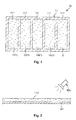
- FIG. 1 is a cross section of an embodiment of the ink set of the present invention
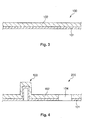
- FIG. 2 is a cross section showing the state when a substrate is coated with a first ink and a second ink and the coating is cured;
- FIG. 3 is a cross section of an embodiment of the printed matter of the present invention.
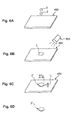
- FIG. 4 is a cross section of an embodiment of the molded article of the present invention.
- FIGS. 5A to 5D are oblique views illustrating the characteristics of the first ink
- FIGS. 6A to 6D are oblique views illustrating the characteristics of the second ink.
- FIG. 7 is a graph of the recovery ratio (displacement recovery/maximum displacement) of a film composed of the first ink, a film composed of the second ink, and a film composed of a mixture of the first ink and the second ink.
- FIG. 1 is a cross section of an embodiment of the ink set of the present invention.
- FIG. 2 is a cross section showing the state when a substrate is coated with a first ink and a second ink and the coating is cured.
- FIG. 3 is a cross section of an embodiment of the printed matter of the present invention.
- FIG. 4 is a cross section of an embodiment of the molded article of the present invention.
- FIGS. 5A to 5D are oblique views illustrating the characteristics of the first ink.
- FIGS. 6A to 6D are oblique views illustrating the characteristics of the second ink.
- FIG. 5A to 5D are oblique views illustrating the characteristics of the first ink.
- FIGS. 1 to 6 are graphs of the recovery ratio (displacement recovery/maximum displacement) of a film composed of the first ink, a film composed of the second ink, and a film composed of a mixture of the first ink and the second ink.
- the upper side in FIGS. 1 to 6 will be referred to as "upper,” and the lower side as “lower.”
- the ink set 10 shown in FIG. 1 comprises a yellow (Y) first ink 1Y, a cyan (C) first ink 1C, a magenta (M) first ink 1M, a black (K) first ink 1K, and a colorless, transparent second ink 2.
- the first inks 1Y, 1C, 1M, and 1K and the second ink 2 are held in an ink tank 11 segmented into five spaces 111, and are discharged as droplets by inkjet method.
- first ink 1 when no distinction is made between the first inks 1Y, 1C, 1M, and 1K, they will sometimes be referred to simply as the "first ink 1.” When no distinction is made between the first ink 1 and the second ink 2, they will sometimes be referred to simply as "ink.”
- This ink set 10 is used in the manufacture of the printed matter 100 shown in FIG. 3 .
- the printed matter 100 serves as the matrix for the molded article 200 shown in FIG. 4 .
- this molded article 200 There are no particular restrictions on this molded article 200, but examples include interior automotive parts, such as a speedometer, exterior parts for electrical products, masks, and signs.
- the printed matter 100 shown in FIG. 3 is made up of a substrate 101 (serving as a printing medium) and a printing layer 102 provided over the substrate 101.
- the printing layer 102 is produced by printing with the first ink 1 (that is, an ink of at least one color from among the first inks 1 Y, 1C, 1M, and 1K) and the second ink 2 (see FIG. 2 ).
- the supply of the first ink 1 and the second ink 2 onto the substrate 101 is accomplished by discharging the inks as droplets by inkjet onto the substrate 101.
- the ink on the substrate 101 is then irradiated with ultraviolet rays to cure it and produce the printing layer 102.
- the molded article 200 shown in FIG. 4 is produced by subjecting the printed matter 100 to mechanical processing.
- mechanical processing There are no particular restrictions on the mechanical processing, but examples include drawing, bending, and other types of deformation processing, as well as punching, cutting, and other types of shear processing.
- a portion 103 in the form of a bottomed cylinder is formed by drawing a portion of the printed matter 100 where the printing layer 102 is formed.
- an opening 104 is formed by punching out a portion of the printed matter 100 where the printing layer 102 is formed, at a different location from that of the bottomed cylinder portion 103.
- the ink set 10 will be described first.
- the ink set 10 comprises the first ink 1, which is a UV-curing ink containing a pigment as a colorant, and the second ink 2, which is a radiation-curing ink containing no pigment.
- a radiation-curing ink needs to cure at high sensitivity in order to form an image of high quality.
- Increasing the sensitivity of an ink affords better curing by irradiation with active radiation, and therefore offers a variety of advantages, such as a reduction in power consumption and a longer service life due to reduced load on the active radiation generation apparatus, as well as less volatilization of uncured low-molecular weight substances, less decrease in the strength of the formed image, and so forth.
- the first ink 1 preferably contains a polymerization initiator (a-1) and a polymerizable compound (b-1) (first polymerizable compound), and a monofunctional polymerizable compound (hereinafter also referred to as monofunctional monomer) preferably accounts for at least 65 wt% of the total weight of the polymerizable compound (b-1).
- the second ink 2 preferably contains a polymerization initiator (a-2) and a polymerizable compound (b-2) (second polymerizable compound), and a polyfunctional polymerizable compound (hereinafter also referred to as polyfunctional monomer) preferably accounts for at least 50 wt% of the total weight of the polymerizable compound (b-2).
- the weight ratio of the monofunctional polymerizable compound to the total weight of the polymerizable compound in the ink is also called the "monofunctional monomer ratio,” and the weight ratio of the polyfunctional polymerizable compound to the total weight of the polymerizable compound in the ink is also called the “polyfunctional monomer ratio.”
- the monofunctional monomer ratio (%) and the polyfunctional monomer ratio (%) are rounded off at the decimal point.
- the ink is a radiation-curing ink that can be cured by irradiation with active radiation.
- active radiation there are no particular restrictions on the term "active radiation” here, so long as it is active radiation capable of imparting enough energy by its irradiation to generate initiation seeds in the ink, and the term broadly encompasses alpha rays, gamma rays, X rays, ultraviolet rays (UV), visible light rays, electron beams, and the like, but of these, ultraviolet rays and electron beams are preferable in terms of curing sensitivity and ready availability of the apparatus, and ultraviolet rays are particularly favorable. Therefore, it is preferable if the ink can be cured by being irradiated with radiation.
- a known radical polymerization initiator or a known cationic polymerization initiator can be used as the polymerization initiator here.
- a single type of polymerization initiator may be used, or two or more types may be used together.
- a radical polymerization initiator and a cationic polymerization initiator may be used together.
- a polymerization initiator is a compound that generates polymerization initiation seeds by absorbing external energy.
- the external energy used to initiate polymerization is broadly broken down into heat and active radiation, and a thermal polymerization initiator and an optical polymerization initiator are used for each.
- active radiation include gamma rays, beta rays, electron beams, ultraviolet rays, visible light rays, and infrared rays.
- a radical polymerizable compound is used as the polymerization initiator in the ink, a radical polymerization initiator is preferably contained, and if a cationic polymerizable compound is used as the polymerizable compound, a cationic polymerization initiator is preferably contained.
- radical polymerization initiators examples include aromatic ketones, acylphosphine compounds, aromatic onium salt compounds, organic peroxides, thio compounds, hexa-arylbiimidazole compounds, ketooxime ester compounds, borate compounds, azinium compounds, metallocene compounds, active ester compounds, compounds containing carbon-halogen bonds, and alkylamine compounds.
- aromatic ketones acylphosphine compounds
- aromatic onium salt compounds organic peroxides
- thio compounds hexa-arylbiimidazole compounds
- ketooxime ester compounds e.g., hexa-arylbiimidazole compounds
- ketooxime ester compounds hexa-arylbiimidazole compounds
- borate compounds azinium compounds
- metallocene compounds active ester compounds
- compounds containing carbon-halogen bonds examples of alkylamine compounds.
- alkylamine compounds examples include aromatic ketones, acylphosphine compounds, aromatic
- the compounds used in chemical amplification photoresists and optical cationic polymerization can be used as a cationic polymerization initiator (optical acid generator) (see “ Imaging-Use Organic Materials,” Organic Electronics Materials Conference edition, published by Bunshin (1993), pp. 187-192 ).
- examples include B(C 6 F 5 ) 4 - , PF 6 - , AsF 6 - , SbF 6 - , and CF 3 SO 3 - salts of diazonium, ammonium, iodonium, sulfonium, phosphonium, and other such aromatic onium compounds.
- examples include sulfonation compounds which generate sulfonic acid.
- examples include halides which generate hydrogen halides.
- examples include iron arene complexes.
- the total amount in which the polymerization initiator is used is 0.01 to 35 wt% with respect to the total amount in which the polymerizable compounds are used, with a range of 0.5 to 20 wt% being more preferable, and 1.0 to 20 wt% being even better. If the amount is at least 0.01 wt%, the ink can be sufficiently cured, and if the amount is no more than 35 wt%, a cured film with a uniform degree of curing can be obtained.
- the total amount in which the polymerizable compounds are used is preferably such that the weight ratio between the polymerization initiator and the sensitizer is from 200:1 to 1:200, and more preferably 50:1 to 1:50, and even more preferably 20:1 to 1:5.
- the ink contains a polymerizable compound.
- the polymerizable compound preferably has a molecular weight of 1000 or less, with 50 to 800 being more preferable, and 60 to 500 being even better.
- polymerizable compound there are no particular restrictions on the polymerizable compound as long as imparting some kind of energy brings about a polymerization reaction, such as a radical polymerization reaction, cationic polymerization reaction, or anionic polymerization reaction, and cures the compound.
- a polymerization reaction such as a radical polymerization reaction, cationic polymerization reaction, or anionic polymerization reaction
- Monomers, oligomers, and polymers can be used irrespectively, but in particular, various kinds of polymerizable compound known as photo-polymerizable compounds can be used that induce a polymerization reaction by means of an initiation seed generated by the above-mentioned polymerization initiator.
- Radical polymerizable compounds and cationic polymerizable compound are favorable examples of polymerizable compounds.
- radical polymerizable compound there are no particular restrictions on the radical polymerizable compound, and any known radical polymerizable compound can be used, but it is preferably an ethylenic unsaturated compound, and more preferably is a (meth)acrylate compound, a (meth)acrylamide compound, an N-vinyl compound, and/or a vinyl ether compound, and even more preferably a (meth)acrylate compound and/or an N-vinyl compound.
- (meth)acrylic here means both acrylic and methacrylic.
- the first ink 1 is preferably such that a monofunctional radical polymerizable compound accounts for 67 to 100 wt% of the total weight of the polymerizable compound (b-1), with 70 to 100 wt% being more preferable, and 85 to 95 wt% being even more preferable. Within the above range, the printing layer 102 will have good stretchability.
- the second ink 2 is preferably such that a polyfunctional radical polymerizable compound accounts for 55 to 100 wt% of the total weight of the polymerizable compound (b-2), with 60 to 100 wt% being more preferable, 80 to 100 wt% being even more preferable, and 100 wt% (that is, all of the polymerizable compound (b-2) being a polyfunctional radical polymerizable compound) being particularly favorable.
- the printing layer 102 will have excellent impact resistance, wear resistance (rubbing resistance), scratch resistance, and solvent resistance. In this Specification, impact resistance, wear resistance (rubbing resistance), scratch resistance, and solvent resistance will sometimes be collectively referred to as "durability.”
- radical polymerizable compound may be either monofunctional or polyfunctional.
- a monofunctional radical polymerizable compound is preferably an N-vinyl compound (discussed below), and more preferably an N-vinyl lactam.
- the first ink preferably includes an N-vinyl compound (discussed below), and more preferably includes an N-vinyl lactam.
- a polyfunctional (meth)acrylate compound (discussed below) is favorable as a polyfunctional radial polymerizable compound.
- (meth)acrylate here means both acrylate and methacrylate.
- the second ink 2 is preferably such that a bifunctional radical polymerizable compound accounts for 30 to 100 wt% of the total weight of the polymerizable compound (b-2), with a range of 50 to 95 wt% being more preferable, and 70 to 90 wt% being even better. Also, the second ink 2 is preferably such that a trifunctional or higher radical polymerizable compound accounts for 5 to 50 wt% of the total weight of the polymerizable compound (b-2), with a range of 10 to 30 wt% being more preferable. Furthermore, the second ink 2 is preferably such that a trifunctional radical polymerizable compound accounts for 5 to 50 wt% of the total weight of the polymerizable compound (b-2), with a range of 10 to 30 wt% being more preferable.
- the first ink 1 is preferably such that a monofunctional radical polymerizable compound accounts for 50 to 95 wt% of the total weight of the first ink 1, with a range of 55 to 90 wt% being more preferable, and 60 to 85 wt% being even better. Within the above range, the printing layer 102 will have good stretchability (flexibility).
- the second ink 2 is preferably such that a polyfunctional radical polymerizable compound accounts for 50 to 98 wt% of the total weight of the second ink 2, with a range of 55 to 95 wt% being more preferable, and 60 to 90 wt% being even better. Within the above range, the printing layer 102 will have excellent durability.
- a monofunctional radical polymerizable monomer can be used as a radical polymerizable compound.
- monofunctional radical polymerizable compounds include monofunctional acrylate compounds, monofunctional methacrylate compounds, monofunctional N-vinyl compounds, monofunctional acrylamide compounds, and monofunctional methacrylamide compounds, with monofunctional acrylate compounds, monofunctional methacrylate compounds, and monofunctional N-vinyl compounds being more preferable.
- the monofunctional radical polymerizable compound is preferably a combination of a monofunctional acrylate compound and a monofunctional N-vinyl compound, or of a monofunctional methacrylate compound and a monofunctional N-vinyl compound, and a combination of a monofunctional acrylate compound and a monofunctional N-vinyl compound is particularly favorable.
- a monomer having a cyclic structure and having one ethylenic unsaturated double bond group selected from the group consisting of an acryloxy group, a methacryloxy group, an acrylamide group, a methacrylamide group, and an N-vinyl group is preferably used as the monofunctional radical polymerizable compound.
- An ethylenic unsaturated compound is an example of a radical polymerizable monomer that can be used favorably.
- monofunctional acrylates, monofunctional methacrylates, monofunctional vinyloxy compounds, monofunctional acrylamides, and monofunctional methacrylamides include monofunctional radical polymerizable monomers having a cyclic structure such as a phenyl group, a naphthyl group, an anthracenyl group, a pyridinyl group, a tetrahydrofurfuryl group, a piperidinyl group, a cyclohexyl group, a cyclopentyl group, a cycloheptyl group, an isoboronyl group, or a tricyclodecanyl group.
- a cyclic structure such as a phenyl group, a naphthyl group, an anthracenyl group, a pyridinyl group, a tetrahydrofurfuryl group, a piperidinyl group, a cyclohexyl group, a cyclopentyl group
- monofunctional radical polymerizable monomers include norbornyl (meth)acrylate, isoboronyl (meth)acrylate, cyclohexyl (meth)acrylate, cyclopentyl (meth)acrylate, cycloheptyl (meth)acrylate, cyclooctyl (meth)acrylate, cyclodecyl (meth)acrylate, dicyclodecylyl (meth)acrylate, trimethylcyclohexylyl (meth)acrylate, 4-6-butylcyclohexylyl (meth)acrylate, acryloyl morpholine, 2-benzyl (meth)acrylate, phenoxyethyl (meth)acrylate, phenoxydiethylene glycol (meth)acrylate, phenoxytriethylene glycol (meth)acrylate, EO-modified cresol (meth)acrylate, tetrahydrofurfuryl (meth)acrylate, cap
- a radical polymerizable monomer having an N-vinyl group and having a group with a cyclic structure is used as the monofunctional radical polymerizable monomer.
- N-vinylcarbaszole, 1-vinylimidazole, or an N-vinyl lactam is preferable to use an N-vinyl lactam.
- the first ink 1 preferably contains a monofunctional cyclic polymerizable monomer having an N-vinyl group, in an amount of up to 40 wt% of the entire first ink 1, and more preferably in an amount of 10 to 35 wt%, and even more preferably 12 to 30 wt%. Within the above range, good copolymerizability with other polymerizable compounds will be exhibited, and an ink with excellent curability and blocking resistance will be obtained.
- the first ink 1 also preferably contains a monofunctional N-vinyl lactam in an amount of 1 to 40 wt% of the entire first ink 1, and more preferably in an amount of 10 to 35 wt%, and even more preferably 12 to 30 wt%.
- an N-vinyl lactam is a compound with a relatively high melting point. It is preferable for the N-vinyl lactam content to be 40 wt% or less because the ink will exhibit good solubility even at low temperatures of 0°C or lower, and the ink can be handled over a wider range of temperatures.
- a acyclic monofunctional monomer has a relatively low viscosity, and can also be used favorably for the purpose of lowering the viscosity of the ink, for example.
- the proportion of the entire ink accounted for by the following acyclic monofunctional monomers it is preferable for the proportion of the entire ink accounted for by the following acyclic monofunctional monomers to be no more than 20 wt%. 15 wt% or less is even better.
- Specific examples include octyl (meth)acrylate, 2-ethylhexyl (meth)acrylate, decyl (meth)acrylate, dodecyl (meth)acrylate, tridecyl (meth)acrylate, tetradecyl (meth)acrylate, hexadecyl (meth)acrylate, 2-hydroxyethyl (meth)acrylate, butoxyethyl (meth)acrylate, carbitol (meth)acrylate, 2-ethylhexyl diglycol (meth)acrylate, polyethylene glycol (meth)acrylate monomethyl ether, polypropylene glycol (meth)acrylate monomethyl ether, and polytetraethylene glycol (meth)acrylate monomethyl ether.
- Further examples include (poly)ethylene glycol mono(meth)acrylate, (poly)ethylene glycol (meth)acrylate methyl ester, (poly)ethylene glycol (meth)acrylate ethyl ester, (poly)ethylene glycol (meth)acrylate phenyl ester, (poly)propylene glycol mono(meth)acrylate, (poly)propylene glycol mono(meth)acrylate phenyl ester, (poly)propylene glycol (meth)acrylate methyl ester, (poly)propylene glycol (meth)acrylate ethyl ester, 2-ethylhexyl acrylate, n-octyl acrylate, n-nonyl acrylate, n-decyl acrylate, isooctyl acrylate, n-lauryl acrylate, n-tridecyl acrylate, n-cetyl acrylate, n-ste
- Further examples include 2-ethylhexyl-glycol acrylate, 2-hydroxy-3-phenoxypropyl acrylate, 2-hydroxybutyl acrylate, 2-acryloyloxyethylphthalic acid, 2-acryloyloxyethyl-2-hydroxyethylphthalic acid, ethoxylated phenyl acrylate, 2-acryloyloxyethylsuccinic acid, 2-acryloyloxyethylhexahydrophthalic acid, lactone-modified flexible acrylate, butoxyethyl acrylate, 2-hydroxyethyl acrylate, and methoxydipropylene glycol acrylate.
- a polyfunctional radical polymerizable monomer can be used as the radical polymerizable compound.
- polyfunctional radical polymerizable monomers include polyfunctional polymerizable monomers having two or more ethylenic unsaturated double bonds selected from the group consisting of an acryloyloxy group, a methacryloyloxy group, an acrylamide group, a methacrylamide group, a vinyloxy group, and an N-vinyl group.
- An ink that gives high cured film strength will be obtained if a polyfunctional polymerizable monomer is contained.
- polyfunctional radical polymerizable monomers having ethylenic unsaturated bonds that can undergo radical polymerization include acrylic acid, methacrylic acid, itaconic acid, crotonic acid, isocrotonic acid, maleic acid, and other such unsaturated carboxylic acids and salts thereof, anhydrides having an ethylenic unsaturated group, acrylonitrile, styrene, and, furthermore, compounds that are (meth)acrylic acid esters and have two or more ethylenic unsaturated groups, such as various types of unsaturated polyesters, unsaturated polyethers, unsaturated polyamides, unsaturated urethane (meth)acrylic monomers or prepolymers, epoxy monomers or prepolymers, and urethane monomers or prepolymers.
- neopentyl glycol di(meth)acrylate examples include neopentyl glycol di(meth)acrylate, (poly)ethylene glycol di(meth)acrylate, diethylene glycol di(meth)acrylate, triethylene glycol di(meth)acrylate, tetraethylene glycol di(meth)acrylate, polypropylene glycol di(meth)acrylate, (poly)tetramethylene glycol di(meth)acrylate, bisphenol A propylene oxide (PO) adduct di(meth)acrylate, ethoxylated neopentyl glycol di(meth)acrylate, propoxylated neopentyl glycol di(meth)acrylate, bisphenol A ethylene oxide (EO) adduct di(meth)acrylate, EO-modified pentaerythritol tri(meth)acrylate, PO-modified pentaerythritol tri(meth)acrylate, EO
- difunctional radical polymerizable monomers include ethylene glycol di(meth)acrylate, diethylene glycol di(meth)acrylate, triethylene glycol di(meth)acrylate, tetraethylene glycol di(meth)acrylate, polyethylene glycol di(meth)acrylate, propylene glycol di(meth)acrylate, dipropylene glycol di(meth)acrylate, tripropylene glycol di(meth)acrylate, tetrapropylene glycol di(meth)acrylate, polypropylene glycol di(meth)acrylate, ethoxylated neopentyl glycol diacrylate, and propoxylated neopentyl glycol diacrylate.
- a vinyl ether compound can also be used favorably as a radical polymerizable compound.
- radical polymerizable compounds have high reactivity, low viscosity, and excellent adhesion to a support.
- an oxetane ring-containing compound and an oxirane ring-containing compound are suitable as the cationic polymerizable compound, and a mode in which both an oxetane ring-containing compound and an oxirane ring-containing compound are contained is more preferable.
- oxirane ring-containing compound (hereinafter also called an “oxirane compound”) here is a compound containing at least one oxirane ring (oxiranyl group, epoxy group) in its molecule, and specifically, it may be selected as appropriate from those usually used as epoxy resins, examples of which include conventionally known aromatic epoxy resins, alicyclic epoxy resins, and aliphatic epoxy resins. It may be either a monomer, an oligomer, or a polymer.
- oxetane ring-containing compound (hereinafter also called an “oxetane compound”) is a compound containing at least one oxetane ring (oxetanyl group) in its molecule.
- the first ink 1 is preferably such that 65 to 95 wt % of the total weight of the polymerizable compound (b-1) is accounted for by a monofunctional cationic polymerizable compound, with a range of 65 to 85 wt% being more preferable, and 65 to 75 wt% being even better. Within the above range, the printing layer 102 will have excellent flexibility.
- the second ink 2 is preferably such that 50 to 90 wt% of the total weight of the polymerizable compound (b-2) is accounted for by a polyfunctional cationic polymerizable compound, with a range of 52 to 75 wt% being more preferable, and 55 to 65 wt% being even better. Within the above range, the printing layer 102 will have excellent durability.
- the cationic polymerizable compound may be either monofunctional or polyfunctional.
- a monofunctional oxirane compound and/or a monofunctional oxetane compound is preferable as the monofunctional cationic polymerizable compound.
- a difunctional cationic polymerizable compound is preferable as the polyfunctional cationic polymerizable compound.
- a polyfunctional oxirane compound and/or a polyfunctional oxetane compound is preferable as the polyfunctional cationic polymerizable compound, and it is more preferable to use a polyfunctional oxirane compound and a polyfunctional oxetane compound together.
- the first ink 1 is preferably such that 40 to 95 wt% of the total weight of the first ink 1 is accounted for by a monofunctional cationic polymerizable compound, with a range of 45 to 80 wt% being more preferable, and 45 to 65 wt% being even better. Within the above range, the printing layer 102 will have excellent flexibility.
- the second ink 2 is preferably such that 35 to 90 wt% of the total weight of the second ink 2 is accounted for by a polyfunctional cationic polymerizable compound, with a range of 38 to 75 wt% being more preferable, and 40 to 60 wt% being even better. Within the above range, the printing layer 102 will have excellent durability.
- cationic polymerizable compounds examples include the epoxy compounds, vinyl ether compounds, oxetane compounds, and so forth discussed in Japanese Laid-Open Patent Applications H6-9714 , 2001-31892 , 2001-40068 , 2001-55507 , 2001-310938 , 2001-310937 , 2001-220526 , etc.
- Examples of monofunctional epoxy compounds include phenyl glycidyl ether, p-tert-butylphenyl glycidyl ether, butyl glycidyl ether, 2-ethylhexyl glycidyl ether, allyl glycidyl ether, 1,2-butylene oxide, 1,3-butadiene monoxide, 1,2-epoxydodecane, epichlorohydrin, 1,2-epoxydecane, styrene oxide, cyclohexene oxide, 3-methacryloyloxymethylcyclohexene oxide, 3-acryloyloxymethylcyclohexene oxide, and 3-vinylcyclohexene oxide.
- polyfunctional epoxy compounds include bisphenol A diglycidyl ether, bisphenol F diglycidyl ether, bisphenol S diglycidyl ether, brominated bisphenol A diglycidyl ether, brominated bisphenol F diglycidyl ether, brominated bisphenol S diglycidyl ether, epoxy novolac resins, hydrogenated bisphenol A diglycidyl ether, hydrogenated bisphenol F diglycidyl ether, hydrogenated bisphenol S diglycidyl ether, 3,4-epoxycyclohexylmethyl-3',4'-epoxycyclohexanecarboxylate, 2-(3,4-epoxycyclohexyl)-7,8-epoxy-1,3-dioxaspiro [5.5]undecane, bis(3,4-epoxycyclohexylmethyl) adipate, vinylcyclohexene oxide, 4-vinylepoxycyclohexane, bis(3,4-epoxy-6
- aromatic epoxides and alicyclic epoxides are preferable from the standpoint of excellent curing speed, and alicyclic epoxides are particularly preferable.
- Examples of monofunctional oxetane compounds include 3-ethyl-3-hydroxymethyloxetane, 3-(meth)allyloxymethyl-3-ethyloxetane, (3-ethyl-3-oxetanylmethoxy)methylbenzene, 4-fluoro-[1-(3-ethyl-3-oxetanylmethoxy)methyl]benzene, 4-methoxy-[1-(3-ethyl-3-oxetanylmethoxy)methyl]benzene, [1-(3-ethyl-3-oxetanylmethoxy)ethyl]phenyl ether, isobutoxymethyl (3-ethyl-3-oxetanylmethyl) ether, isobornyloxyethyl (3-ethyl-3-oxetanylmethyl) ether, isobornyl (3-ethyl-3-oxetanylmethyl) ether, 2-ethylhe
- polyfunctional oxetane compounds include polyfunctional 3,7-bis(3-oxetanyl)-5-oxanonane, 3,3'-(1,3-(2-methylenyl)propanediylbis(oxymethylene))bis(3-ethyloxetane), 1,4-bis[(3-ethyl-3-oxetanylmethoxy)methyl]benzene, 1,2-bis[(3-ethyl-3-oxetanylmethoxy)methyl] ethane, 1,3-bis[(3-ethyl-3-oxetanylmethoxy)methyl]propane, ethylene glycol bis(3-ethyl-3-oxetanylmethyl) ether, dicyclopentenylbis(3-ethyl-3-oxetanylmethyl) ether, triethylene glycol bis(3-ethyl-3-oxetanylmethyl) ether, tetraethylene glycol bis(
- cationic polymerizable compounds may be used alone, or two or more types may be used in combination.
- the total weight of polymerizable compound in the ink is preferably 55 to 95 wt%, and more preferably 60 to 90 wt%, with respect to the total weight of the ink. Within the above range, curability will be excellent and the viscosity will be appropriate.
- the method for manufacturing the polymerizable compound there are no particular restrictions on the method for manufacturing the polymerizable compound, and this compound can be synthesized by any known method. If available, a commercial product may be used.
- the first ink 1 contains a pigment as a colorant. Pigments have excellent weather resistance and good color reproducibility. Also, from the standpoint of no lower the sensitivity of the curing reaction by active radiation, a pigment (colorant) that can be used favorably in the ink is preferably selected from among those compounds that do not function as a polymerization inhibitor in the polymerization reaction (the curing reaction).
- the following pigments can be used according to the intended object, for example.
- Red 3 As a red or magenta pigment: Pigment Red 3, 5, 19, 22, 31, 38, 42, 43, 48:1, 48:2, 48:3, 48:4, 48:5, 49:1, 53:1, 57:1, 57:2, 58:4, 63:1, 81, 81:1, 81:2, 81:3, 81:4, 88, 104, 108, 112, 122, 123, 144, 146, 149, 166, 168, 169, 170, 177, 178, 179, 184, 185, 208, 216, 226, or 257, Pigment Violet 3, 19, 23, 29, 30, 37, 50, or 88, and Pigment Orange 13, 16, 20, or 36;
- Pigment Blue 1 15, 15:1, 15:2, 15:3, 15:4, 15:6, 16, 17-1, 22, 27, 28, 29, 36, or 60;
- Pigment Green 7, 26, 36, or 50 As a green pigment: Pigment Green 7, 26, 36, or 50;
- Pigment Yellow 1 3, 12, 13, 14, 17, 34, 35, 37, 55, 74, 81, 83, 93, 94, 95, 97, 108, 109, 110, 120, 137, 138, 139, 153, 154, 155, 157, 166, 167, 168, 180, 185, or 193;
- Pigment Black 7, 28, or 26 As a black pigment: Pigment Black 7, 28, or 26;
- Pigment White 6, 18, or 21 As a white pigment: Pigment White 6, 18, or 21.
- the colorant is preferably added to the ink or the inkjet recording ink and then suitably dispersed in the ink.
- any of various dispersing machines such as a ball mill, a sand mill, an attritor, a roll mill, an agitator, a Henschel mixer, a colloidal mill, an ultrasonic homogenizer, a pearl mill, a wet jet mill, or a paint shaker, can be used, for example.
- the colorant may be added directly along with the other components in the preparation of the ink, but in order to improve dispersibility it may be added in advance to a solvent or to a dispersing medium such as a radical polymerizable compound, uniformly dispersed or dissolved, and then blended.
- a dispersing medium such as a radical polymerizable compound
- the ink preferably contains a dispersant in order to disperse the pigment stably in the ink.
- a macromolecular dispersant is preferable as the dispersant.
- the term "macromolecular dispersant” means a dispersant having a weight-average molecular weight of 1000 or higher.
- Examples of macromolecular dispersants include DisperBYK-101, DisperBYK-102, DisperBYK-103, DisperBYK-106, DisperBYK-111, DisperBYK-161, DisperBYK-162, DisperBYK-163, DisperBYK-164, DisperBYK-166, DisperBYK-167, DisperBYK-168, DisperBYK-170, DisperBYK-171, DisperBYK-174, and DisperBYK-182 (all made by BYK Chemie), EFKA4010, EFKA4046, EFKA4080, EFKA5010, EFKA5207, EFKA5244, EFKA6745, EFKA6750, EFKA7414, EFKA745, EFKA7462, EFKA7500, EFKA7570, EFKA7575, and EFKA7580 (all made by EFKA Additives), Disperse Aid 6, Disperse Aid 8, Dis
- the amount in which the dispersant is contained in the ink is suitably selected according to the intended use, but is preferably 0.05 to 15 wt% with respect to the total weight of the ink.
- Examples of other components include sensitizers, cosensitizers, surfactants, UV absorbents, antioxidants, antifading agents, conductive salts, solvents, macromolecular compounds, and basic compounds.
- the ink may contain as necessary, for example, a leveling additive, a matting agent, a wax for adjusting film properties, or a tackifier (one that does not inhibit polymerization) to improve the adhesion to a support made of polyolefin, PET, or the like.
- a leveling additive for example, a matting agent, a wax for adjusting film properties, or a tackifier (one that does not inhibit polymerization) to improve the adhesion to a support made of polyolefin, PET, or the like.
- the tackifier include the high-molecular weight adhesive polymers mentioned on pp. 5 and 6 of Japanese Laid-Open Patent Application 2001-49200 (such as a copolymer composed of an ester of (meth)acrylic acid and an alcohol having an alkyl group with 1 to 20 carbons, an ester of (meth)acrylic acid and an alicyclic alcohol having 3 to 14 carbons, or an ester of (meth)acrylic acid and an aromatic alcohol having 6 to 14 carbons), and a low-molecular weight tackifying resin having a polymerizable unsaturated bond.
- the high-molecular weight adhesive polymers mentioned on pp. 5 and 6 of Japanese Laid-Open Patent Application 2001-49200 (such as a copolymer composed of an ester of (meth)acrylic acid and an alcohol having an alkyl group with 1 to 20 carbons, an ester of (meth)acrylic acid and an alicyclic alcohol having 3 to 14 carbons, or an ester of (meth)
- the first ink 1 and the second ink 2 containing the above components have mutually different characteristics after curing.
- a characteristic of the first ink 1 is that it stretches at least 70% when the first ink 1 is cured into a film 1' with a thickness t 1 of 5 ⁇ m, and the film 1' is stretched at a temperature of 150°C (see FIGS. 5A to 5D ).
- This characteristic will hereinafter be called the "first characteristic.”
- a characteristic of the second ink 2 is that when the second ink 2 is cured into a film 2' with a thickness t 2 of 50 to 200 ⁇ m, the film 2' has an elastic modulus of no more than 200 MPa (see FIGS. 6A to 6D ).
- This characteristic will hereinafter be called the "second characteristic.”
- a comparison of the film 1' and the film 2' reveals that the film 1' has better stretchability and higher elasticity than the film 2', and that the film 2' has low elasticity.
- the stretching ratio (stretchability) of the film 1' is defined as follows.
- a resin substrate 300 was readied that was in the form of a board having a length L 3 , a thickness t 3 , and a width w 3 .
- the resin material that make up the substrate 300 include polyethylene terephthalate (PET), polycarbonate, and various other kinds of thermoplastic elastomer.
- the first ink 1 is then applied by inkjet onto the substrate 300.
- the first ink 1 on the substrate 300 is irradiated with ultraviolet rays from an ultraviolet ray irradiation apparatus 500.
- the peak wavelength of the ultraviolet rays here is approximately 390 nm, and the duration of ultraviolet ray irradiation is 0.05 to 5 seconds.
- this forms a film 1' by curing the first ink 1 on the substrate 300.
- This film 1' is substantially circular in plan view, having a diameter ⁇ d 1 .
- the thickness t 1 of the film 1' is 5 ⁇ m.
- the substrate 300 on which the film 1' has been formed is placed in a chamber (not shown), for example, the inside of this chamber is heated to 150°C with an electric heater, and this heated state is maintained.
- the substrate 300 is then pulled until its entire length is 2L.
- the pulling rate here is 1.0 mm/sec.
- the stretching ratio is defined by ( ⁇ d/d) ⁇ 100, and the value thereof is at least 70%.
- the stretching ratio of the film 2' is defined as follows.
- a resin substrate 400 is readied.
- the resin material that makes up the substrate 400 can be the same as that used for the substrate 300, for example.
- a second ink 2 is then applied by inkjet on the substrate 400.
- the second ink 2 on the substrate 400 is irradiated with ultraviolet rays from the ultraviolet ray irradiation apparatus 500.
- the peak wavelength of the ultraviolet rays here is approximately 390 nm, and the duration of ultraviolet ray irradiation is 0.1 to 10 seconds.
- a film thickness that allows easy measurement of the elastic modulus cannot be reached in a single printing, so this printing is repeated a number of times to form a film of the desired thickness.
- the film 2' is formed on the substrate 400 by curing the second ink 2.
- This film 2' is substantially circular in plan view, having a diameter ⁇ d 2 .
- the thickness t 2 of the film 2' is 50 to 200 ⁇ m.
- the film 2' is peeled off of the substrate 400.
- the elastic modulus of the peeled film 2' is then measured using an elastic modulus measurement apparatus (such as the "CC Series" made by Nihon Techno-Plus), and this measurement value is 200 MPa or less.
- the substrate 101 is coated with the first ink 1 having the first characteristic and the second ink 2 having the second characteristic.
- the first ink 1 and the second ink 2 are applied so that they are superimposed at the same place on the substrate 101, that is, they are mixed.
- the ink on the substrate 101 (the mixed first ink 1 and second ink 2) is cured by being irradiated with ultraviolet rays from the ultraviolet ray irradiation apparatus 500. This forms the printing layer 102.
- the second ink 2 is substantially colorless and transparent as mentioned above, even though the first ink 1 and the second ink 2 are mixed, any change in the original color of the first ink 1 can be minimized or prevented.
- the first ink 1 and the second ink 2 can be cured all at once with ultraviolet rays having the same peak wavelength.
- the peak wavelength of these ultraviolet rays there are no particular restrictions on the peak wavelength of these ultraviolet rays, but at least 350 nm and more than 450 nm is preferable, and at least 380 nm and no more than 420 nm is more preferable, for example.
- the inks will have to be irradiated with ultraviolet rays of their own peak wavelength.
- ultraviolet rays of the same peak wavelength can be used, then the step of curing the first ink 1 and the second ink 2 and forming the printing layer 102 can be carried out more easily and quickly in the manufacture of the printed matter 100.
- An example of a method for curing the first ink 1 and the second ink 2 with ultraviolet rays having the same peak wavelength is to add the same type (a common) polymerization initiator to each of the inks.
- first ink 1 and the second ink 2 each have a viscosity of at least 1 mPa ⁇ s and no more than 1000 mPa ⁇ s near 25 degrees (normal temperature), with a range of at least 1 mPa ⁇ s and no more than 50 mPa ⁇ s being even better.
- ⁇ 1 represents the viscosity of the first ink 1 at 40 degrees
- ⁇ 2 represents the viscosity of the second ink 2 at 40 degrees
- it is preferable if the equation (( ⁇ 1 - ⁇ 2 )/ ⁇ 1 ) ⁇ 100 ⁇ 10 (%) is satisfied.
- the surface tension of the first ink 1 and the second ink 2 near 25 degrees (normal temperature) is at least 5 mN/m and no more than 200 mN/m, with a range of at least 10 mN/m and no more than 40 mN/m being even better.
- f 1 represents the surface tension of the first ink 1 at 40 degrees
- f 2 represents the surface tension of the second ink 2 at 40 degrees
- first ink 1 and the second ink 2 are each discharged by inkjet method, this discharge will be carried out stably. Also, the first ink 1 and the second ink 2 will exhibit the same wetting and spreading behavior on the substrate 101, the inks will spread out uniformly, and color unevenness on a single printing layer 102 can be effectively prevented.
- Adjustment of the ink viscosity or surface tension can be accomplished by adjusting the amount in which surfactants and other such additives are contained.
- the printed matter 100 is the product of coating the sheet-form substrate 101 with the first ink 1 and the second ink 2 constituted as above, and curing the inks.
- the printed matter 100 has the substrate 101 and the printing layer 102 that is formed directly or indirectly on the substrate 101.
- the resin material examples include polyethylene, polypropylene, an ethylene-propylene copolymer, an ethylene-vinyl acetate copolymer (EVA), and other such polyolefins, cyclic polyolefins, modified polyolefins, polyvinyl chloride, polyvinylidene chloride, polystyrene, polyamide, polyimide, polyamideimide, polycarbonate, poly-(4-methylpentene-1), ionomers, acrylic resins, polymethyl methacrylate, acrylonitrile-butadiene-styrene copolymer (ABS resin), acrylonitrile-styrene copolymer (AS resin), butadiene-styrene copolymer, polyoxymethylene, polyvinyl alcohol (PVA), ethylene-vinyl alcohol copolymer (EVOH), polyethylene terephthalate (PET), polybutylene terephthalate (PEA), and other such poly
- the substrate 101 When the printed matter 100 is to be viewed from the top side (the substrate 101 side), the substrate 101 shall be transparent. On the other hand, when the printed matter 100 is to be viewed from the bottom side (the printing layer 102 side), the substrate 101 may be either opaque or transparent.
- the printing layer 102 is formed by printing. In this embodiment, this formation is performed as follows, for example.
- a printing apparatus (not shown) is used to apply (coat) the first ink 1 and the second ink 2 superimposed over the substrate 101 by inkjet method. After this, the inks are irradiated with radiation from the ultraviolet ray irradiation apparatus 500 to cure the inks. This forms the printing layer 102.
- the thickness of the substrate 101 and the thickness of the printing layer 102 will depend on what the molded article 200 is, that is, on what the molded article 200 is used for, but if the molded article 200 is a panel for an automotive speedometer, for instance, the thickness of the substrate 101 is preferably 0.1 to 2 mm, and more preferably 0.3 to 0.8 mm.
- the thickness of the printing layer 102 is preferably 5 to 200 ⁇ m, and more preferably 5 to 100 ⁇ m.
- the molded article 200 is obtained by subjecting the printed matter 100 to mechanical processing.
- This molded article 200 will now be described.
- the molded article 200 has a bottomed cylindrical portion 103 and an opening 104.
- the bottomed cylindrical portion 103 is formed by drawing.
- the opening 104 is formed by punching. An NC machine or other such machine tool can be used as the apparatus for this processing.
- the printing layer 102 is a layer composed of the first ink 1 containing a pigment as a colorant, and the second ink 2 that is colorless and transparent.
- the first ink 1 has the first characteristic
- the second ink 2 has the second characteristic.
- a TMA apparatus was used to apply a constant pressure to the printing layer 102 at a temperature of 30°C, and the maximum amount of displacement at this point (the amount of depression) and the amount of displacement recovery (restoration amount) when the pressure was released were both measured a plurality of times.
- the recovery ratio was calculated by dividing the amount of displacement recovery by the maximum amount of displacement. As a result, it was found that the recovery ratio averages 30% (margin of error of ⁇ 5%), although this depends on the amount of pressure and other such test conditions (see FIG. 7 ). This tells us that the printing layer 102 is a layer that readily undergoes plastic deformation in the first case, and when subjected to mechanical processing, cracking, peeling, and other such problems occur.
- the recovery ratio averages 80% (margin of error of ⁇ 10%) (see FIG. 7 ).
- the printing layer 102 is composed of the first ink 1 and the second ink 2, and it was found that the recovery ratio averages 55% (margin of error of ⁇ 3%), although this varies with the mixing ratio (see FIG. 7 ).
- the printing layer 102 can be said to be a layer having properties somewhere in between the first case and the second case. Cracking, peeling, and other such problems are effectively prevented from occurring in the printing layer 102, even when the printing layer 102 is subjected to mechanical processing, by a combination of the effect of the first characteristic (excellent stretchability) and the effect of the second characteristic (excellent elasticity).
- the durability of the printing layer 102 is enhanced by the simple act of mixing (superimposing) the colorless and transparent second ink 2, which has the second characteristic and with which the loss of color of the first ink 1 is prevented or suppressed, with the colored first ink 1, which has the first characteristic. Consequently, processability is excellent in the manufacture of the molded article 200 by performing mechanical processing on the printed matter 100 having the printing layer 102 (coated surface). Also, if the molded article 200 is an automotive speedometer, for example, the printing layer 102 can be stored with its high quality preserved over an extended period of time, under a variety of environments, such as when the vehicle interior temperature rises to over 50°C on a hot summer day.
- the total weight of the polymerizable compound (b-1) contained by the first ink 1 is preferably the same as or greater than (such as at least 1.1 times) the total weight of the polymerizable compound (b-2) contained by the second ink 2. Consequently, cracking, peeling, and the like are effectively prevented from occurring in the printing layer 102 when the printed matter 100 is mechanically processed (when the molded article 200 is manufactured), and the printing layer 102 has even better durability.
- the substrate 101 is coated with a previously prepared mixture of the first ink 1 and the second ink 2 before the substrate 101 is coated with the first ink 1 and the second ink 2, and when the colored first ink 1 has the second characteristic and the colorless and transparent second ink 2 has the first characteristic.
- the printing layer 102 undergoes cracking, peeling, and other such problems due to the lack of a combined effect from the effect produced by the first characteristic and the effect produced by the second characteristic.
- the cause of the former is assumed to be that if the inks are mixed ahead of time, the pigment loses its dispersion stability in the inks.
- the cause of the latter is assumed to be that there is a pronounced decrease in the elasticity of the pigment.
- the first ink 1 and the second ink 2 must be mixed for the first time on the substrate 101, and the first ink 1 must have the first characteristic and the second ink 2 the second characteristic.
- ink set, printed matter, and molded article of the present invention were described above through the embodiments shown in the drawings, but the present invention is not limited to these, and the various components that make up the ink set, printed matter, and molded article can be substituted with any other components that will give the same function. Also, other components may be added as desired.
- the ink set was one that had a first ink of four colors in the above embodiment, but this is not the only option, and may instead be one having a first ink of one color, two colors, three colors, or five colors.
- the printed matter when subjected to mechanical processing, it may be heated while undergoing this processing.
Landscapes
- Chemical & Material Sciences (AREA)
- Life Sciences & Earth Sciences (AREA)
- Engineering & Computer Science (AREA)
- Materials Engineering (AREA)
- Wood Science & Technology (AREA)
- Organic Chemistry (AREA)
- Ink Jet Recording Methods And Recording Media Thereof (AREA)
- Inks, Pencil-Leads, Or Crayons (AREA)
Applications Claiming Priority (1)
| Application Number | Priority Date | Filing Date | Title |
|---|---|---|---|
| JP2011126159A JP2012250493A (ja) | 2011-06-06 | 2011-06-06 | インクセット、印刷物および成形体 |
Publications (1)
| Publication Number | Publication Date |
|---|---|
| EP2532719A2 true EP2532719A2 (fr) | 2012-12-12 |
Family
ID=46331025
Family Applications (1)
| Application Number | Title | Priority Date | Filing Date |
|---|---|---|---|
| EP20120170674 Withdrawn EP2532719A2 (fr) | 2011-06-06 | 2012-06-04 | Jeu d'encre, matière imprimée et article moulé |
Country Status (4)
| Country | Link |
|---|---|
| US (1) | US20120308791A1 (fr) |
| EP (1) | EP2532719A2 (fr) |
| JP (1) | JP2012250493A (fr) |
| KR (1) | KR20120135483A (fr) |
Cited By (3)
| Publication number | Priority date | Publication date | Assignee | Title |
|---|---|---|---|---|
| EP3351366A4 (fr) * | 2015-09-15 | 2019-06-12 | Maxell Holdings, Ltd. | Assortiment d'encre de façonnage optique, et procédé de fabrication d'article optiquement façonné |
| US11485067B2 (en) | 2015-07-29 | 2022-11-01 | Maxell, Ltd. | Resin composition for modeling material, resin composition for supporting material, photofabrication product, and process for producing photofabrication product |
| US11795335B2 (en) | 2015-09-15 | 2023-10-24 | Maxell, Ltd. | Resin composition for modeling material, light curing molding ink set, and method for manufacturing optically shaped article |
Families Citing this family (1)
| Publication number | Priority date | Publication date | Assignee | Title |
|---|---|---|---|---|
| CN112898824B (zh) * | 2019-12-04 | 2022-08-02 | 中山大学 | 一种用于玻璃基材的uv-led光固化喷墨墨水及其制备方法 |
Citations (9)
| Publication number | Priority date | Publication date | Assignee | Title |
|---|---|---|---|---|
| JPH069714A (ja) | 1992-06-29 | 1994-01-18 | Sumitomo Chem Co Ltd | 光重合性組成物及び光制御板の製造方法 |
| JP2001031892A (ja) | 1999-07-23 | 2001-02-06 | Toyo Ink Mfg Co Ltd | 紫外線硬化型塗料組成物及びその利用 |
| JP2001040068A (ja) | 1999-07-27 | 2001-02-13 | Asahi Denka Kogyo Kk | 光重合性組成物 |
| JP2001049200A (ja) | 1999-08-11 | 2001-02-20 | Soken Chem & Eng Co Ltd | アクリル系粘着剤組成物、該組成物を用いた粘着テープの製造方法および粘着テープ |
| JP2001055507A (ja) | 1999-08-19 | 2001-02-27 | Kansai Paint Co Ltd | 活性エネルギー線硬化性組成物およびその被膜形成方法 |
| JP2001220526A (ja) | 2000-02-09 | 2001-08-14 | Brother Ind Ltd | インクジェット記録方式用エネルギー線硬化型組成物 |
| JP2001310937A (ja) | 2000-04-27 | 2001-11-06 | Hitachi Chem Co Ltd | 硬化性オキセタン組成物およびその硬化方法ならびにその方法により得られる硬化物 |
| JP2001310938A (ja) | 2000-04-28 | 2001-11-06 | Showa Denko Kk | 重合性組成物、その硬化物と製造方法 |
| JP2001343260A (ja) | 2000-05-31 | 2001-12-14 | Nippon Seiki Co Ltd | 計器装置及び計器装置用表示板の製造方法 |
Family Cites Families (3)
| Publication number | Priority date | Publication date | Assignee | Title |
|---|---|---|---|---|
| US4003868A (en) * | 1971-12-08 | 1977-01-18 | Union Carbide Corporation | Ink or coating compositions of low volatility |
| JP2006326929A (ja) * | 2005-05-24 | 2006-12-07 | Fujifilm Holdings Corp | 活性エネルギー硬化型インクカートリッジ及びインクジェット記録装置 |
| US20090099277A1 (en) * | 2007-10-11 | 2009-04-16 | Nagvekar Devdatt S | Radiation curable and jettable ink compositions |
-
2011
- 2011-06-06 JP JP2011126159A patent/JP2012250493A/ja not_active Withdrawn
-
2012
- 2012-06-04 KR KR20120059828A patent/KR20120135483A/ko not_active Withdrawn
- 2012-06-04 US US13/487,362 patent/US20120308791A1/en not_active Abandoned
- 2012-06-04 EP EP20120170674 patent/EP2532719A2/fr not_active Withdrawn
Patent Citations (9)
| Publication number | Priority date | Publication date | Assignee | Title |
|---|---|---|---|---|
| JPH069714A (ja) | 1992-06-29 | 1994-01-18 | Sumitomo Chem Co Ltd | 光重合性組成物及び光制御板の製造方法 |
| JP2001031892A (ja) | 1999-07-23 | 2001-02-06 | Toyo Ink Mfg Co Ltd | 紫外線硬化型塗料組成物及びその利用 |
| JP2001040068A (ja) | 1999-07-27 | 2001-02-13 | Asahi Denka Kogyo Kk | 光重合性組成物 |
| JP2001049200A (ja) | 1999-08-11 | 2001-02-20 | Soken Chem & Eng Co Ltd | アクリル系粘着剤組成物、該組成物を用いた粘着テープの製造方法および粘着テープ |
| JP2001055507A (ja) | 1999-08-19 | 2001-02-27 | Kansai Paint Co Ltd | 活性エネルギー線硬化性組成物およびその被膜形成方法 |
| JP2001220526A (ja) | 2000-02-09 | 2001-08-14 | Brother Ind Ltd | インクジェット記録方式用エネルギー線硬化型組成物 |
| JP2001310937A (ja) | 2000-04-27 | 2001-11-06 | Hitachi Chem Co Ltd | 硬化性オキセタン組成物およびその硬化方法ならびにその方法により得られる硬化物 |
| JP2001310938A (ja) | 2000-04-28 | 2001-11-06 | Showa Denko Kk | 重合性組成物、その硬化物と製造方法 |
| JP2001343260A (ja) | 2000-05-31 | 2001-12-14 | Nippon Seiki Co Ltd | 計器装置及び計器装置用表示板の製造方法 |
Non-Patent Citations (5)
| Title |
|---|
| "Kalzyozai Handobuk7iu", 1981, TAISEISHA |
| "Organic Electronics Materials Conference edition", 1993, BUNSHIN, article "Imaging-Use Organic Materials", pages: 187 - 192 |
| "UV.EB Koka Gijutsu no Oyo to Shijo", 1989, CMC, pages: 79 |
| "UV.EB Koka Handobukku (Genryo Hen", 1985, KOBUNSHI KANKOUKAI |
| E. TAKIYAMA: "Poriesuteru Jushi Handobukku", 1988, THE NIKKAN KOGYO SHIMBUN LTD. |
Cited By (4)
| Publication number | Priority date | Publication date | Assignee | Title |
|---|---|---|---|---|
| US11485067B2 (en) | 2015-07-29 | 2022-11-01 | Maxell, Ltd. | Resin composition for modeling material, resin composition for supporting material, photofabrication product, and process for producing photofabrication product |
| EP3351366A4 (fr) * | 2015-09-15 | 2019-06-12 | Maxell Holdings, Ltd. | Assortiment d'encre de façonnage optique, et procédé de fabrication d'article optiquement façonné |
| US11111401B2 (en) | 2015-09-15 | 2021-09-07 | Maxell Holdings, Ltd. | Light curing molding ink set, and method for manufacturing light cured article |
| US11795335B2 (en) | 2015-09-15 | 2023-10-24 | Maxell, Ltd. | Resin composition for modeling material, light curing molding ink set, and method for manufacturing optically shaped article |
Also Published As
| Publication number | Publication date |
|---|---|
| US20120308791A1 (en) | 2012-12-06 |
| JP2012250493A (ja) | 2012-12-20 |
| KR20120135483A (ko) | 2012-12-14 |
Similar Documents
| Publication | Publication Date | Title |
|---|---|---|
| EP2653509B1 (fr) | Apprêt pour enregistrement à jet d'encre | |
| US20130135384A1 (en) | Photocurable ink composition for ink jet recording | |
| JP6132876B2 (ja) | インクジェット記録用プライマー | |
| EP2551123B1 (fr) | Procédé d'impression, matériau imprimé et article moulé | |
| EP2511101B1 (fr) | Matériau imprimé et procédé de fabrication d'un matériau imprimé | |
| JP6068793B2 (ja) | エネルギー線硬化型プライマーインク | |
| JP2013022932A (ja) | 印刷方法、印刷装置、印刷物および成形体 | |
| JP2014177551A (ja) | インクジェットインク組成物及びそれを用いた画像形成方法 | |
| EP2532719A2 (fr) | Jeu d'encre, matière imprimée et article moulé | |
| JP6392941B2 (ja) | エネルギー線硬化型プライマーインク | |
| US8927094B2 (en) | Printed article and method of manufacturing printed article | |
| JP5776236B2 (ja) | 印刷物および印刷物の製造方法 | |
| JP6652622B2 (ja) | エネルギー線硬化型インクジェットインク組成物 | |
| US20120237735A1 (en) | Printed article and method of manufacturing printed article | |
| JP5803177B2 (ja) | 印刷装置 | |
| JP2016196658A (ja) | エネルギー線硬化型プライマーインク | |
| JP6035703B2 (ja) | 印刷物および印刷物の製造方法 | |
| JP2013022933A (ja) | 印刷方法、印刷物および成形体 |
Legal Events
| Date | Code | Title | Description |
|---|---|---|---|
| PUAI | Public reference made under article 153(3) epc to a published international application that has entered the european phase |
Free format text: ORIGINAL CODE: 0009012 |
|
| AK | Designated contracting states |
Kind code of ref document: A2 Designated state(s): AL AT BE BG CH CY CZ DE DK EE ES FI FR GB GR HR HU IE IS IT LI LT LU LV MC MK MT NL NO PL PT RO RS SE SI SK SM TR |
|
| AX | Request for extension of the european patent |
Extension state: BA ME |
|
| STAA | Information on the status of an ep patent application or granted ep patent |
Free format text: STATUS: THE APPLICATION IS DEEMED TO BE WITHDRAWN |
|
| 18D | Application deemed to be withdrawn |
Effective date: 20160105 |