EP2535009A2 - Tastenauslösegriff - Google Patents
Tastenauslösegriff Download PDFInfo
- Publication number
- EP2535009A2 EP2535009A2 EP20120172077 EP12172077A EP2535009A2 EP 2535009 A2 EP2535009 A2 EP 2535009A2 EP 20120172077 EP20120172077 EP 20120172077 EP 12172077 A EP12172077 A EP 12172077A EP 2535009 A2 EP2535009 A2 EP 2535009A2
- Authority
- EP
- European Patent Office
- Prior art keywords
- core
- housing
- handle
- button
- lumen
- Prior art date
- Legal status (The legal status is an assumption and is not a legal conclusion. Google has not performed a legal analysis and makes no representation as to the accuracy of the status listed.)
- Granted
Links
Images


Classifications
-
- A—HUMAN NECESSITIES
- A61—MEDICAL OR VETERINARY SCIENCE; HYGIENE
- A61B—DIAGNOSIS; SURGERY; IDENTIFICATION
- A61B17/00—Surgical instruments, devices or methods
- A61B17/28—Surgical forceps
- A61B17/29—Forceps for use in minimally invasive surgery
- A61B17/2909—Handles
-
- A—HUMAN NECESSITIES
- A61—MEDICAL OR VETERINARY SCIENCE; HYGIENE
- A61B—DIAGNOSIS; SURGERY; IDENTIFICATION
- A61B17/00—Surgical instruments, devices or methods
- A61B17/00234—Surgical instruments, devices or methods for minimally invasive surgery
-
- A—HUMAN NECESSITIES
- A61—MEDICAL OR VETERINARY SCIENCE; HYGIENE
- A61B—DIAGNOSIS; SURGERY; IDENTIFICATION
- A61B17/00—Surgical instruments, devices or methods
- A61B17/32—Surgical cutting instruments
- A61B17/3205—Excision instruments
- A61B17/32056—Surgical snare instruments
-
- A—HUMAN NECESSITIES
- A61—MEDICAL OR VETERINARY SCIENCE; HYGIENE
- A61B—DIAGNOSIS; SURGERY; IDENTIFICATION
- A61B17/00—Surgical instruments, devices or methods
- A61B2017/0046—Surgical instruments, devices or methods with a releasable handle; with handle and operating part separable
-
- A—HUMAN NECESSITIES
- A61—MEDICAL OR VETERINARY SCIENCE; HYGIENE
- A61B—DIAGNOSIS; SURGERY; IDENTIFICATION
- A61B17/00—Surgical instruments, devices or methods
- A61B2017/00831—Material properties
- A61B2017/00858—Material properties high friction or non-slip
-
- A—HUMAN NECESSITIES
- A61—MEDICAL OR VETERINARY SCIENCE; HYGIENE
- A61B—DIAGNOSIS; SURGERY; IDENTIFICATION
- A61B17/00—Surgical instruments, devices or methods
- A61B17/28—Surgical forceps
- A61B17/29—Forceps for use in minimally invasive surgery
- A61B17/2909—Handles
- A61B2017/2912—Handles transmission of forces to actuating rod or piston
- A61B2017/2919—Handles transmission of forces to actuating rod or piston details of linkages or pivot points
- A61B2017/292—Handles transmission of forces to actuating rod or piston details of linkages or pivot points connection of actuating rod to handle, e.g. ball end in recess
Definitions
- the field of the disclosure is that of medical and surgical instruments, and in particular, medical and surgical instruments intended primarily for minimally-invasive procedures. These instruments typically have a small diameter for entering body spaces or orifices of limited size and often are sold with or are usable with handles to assist with the manipulation of the device.
- the embodiment includes a handle for receiving an elongate medical device, such as a basket, a snare, forceps and the like.
- the handle includes a housing defining an elongate hollow interior portion that allows communication through an open distal end and through an aperture disposed upon a side surface of the housing.
- the hollow portion defines a first portion proximate the distal end and the aperture, a second portion that is disposed proximally of the first portion with an inner diameter less than an inner diameter of the first portion, and a third portion that is disposed proximally of the second portion with an inner diameter larger than the inner diameter of the second portion.
- a core is slidably disposed within the interior portion and includes a central lumen disposed therethrough along a longitudinal axis between a distal opening and a proximal opening.
- the core includes a ramp portion extending from an outer surface of the core at an oblique angle to the longitudinal axis, and two or more arms extending outwardly from a proximal end of the core and biased toward an extended configuration where a proximal end of each arm extends radially outside of an outer surface of the core.
- the two or more arms combine to define the proximal opening.
- a button is movably disposed within the aperture and substantially blocks communication with the hollow portion through the aperture.
- the button includes an inclined surface that slidably engages the ramp surface, wherein engagement of the ramp and inclined surfaces establishes a normal position of the core within the housing, such that the arms are aligned with the second portion of the hollow portion to urge the arms inwardly away from their extended configuration and minimize the size of the proximal opening.
- the embodiment includes a handle for removably receiving an elongate medical device, such as a basket, a snare, forceps and the like.
- the handle includes an elongate rigid housing enclosing a central hollow portion disposed along at least a substantial portion of the housing and an aperture disposed upon a side surface of the housing communicating with the hollow portion.
- the hollow portion maintains a first inner diameter for a majority of a length of the hollow portion.
- the hollow portion additionally includes a thin smaller inner diameter portion at a proximal portion of the hollow portion.
- a slidable core is disposed within the hollow portion of the housing, and includes an elongate core lumen disposed therethrough.
- the core lumen is sized to receive a shaft of an elongate medical device, the core further includes a ramp surface disposed thereon.
- a collet is disposed within the hollow portion and movable with movement of the core within the housing.
- the collet comprises a collet lumen in registration with the core lumen, and two or more arms attached to a proximal end of the collet at a first portion thereon and each with a second portion that is biased radially outward outside of an outer surface of the collet.
- the slidable core and the collet are each biased distally such that the second portion of each arm contacts the smaller diameter portion to urge each arm radially inward from its biased configuration toward a restrained configuration.
- the embodiment includes a handle for removably receiving an elongate medical device, such as a basket, a snare, forceps and the like.
- the handle includes a housing that is configured to receive the proximal portion of the elongate medical device within a lumen provided along the longitudinal axis of the housing.
- the housing includes a void that extends from a side surface of the housing and into the lumen. The void receives a button therethrough that is movably mounted within the housing and operable by a user holding the handle.
- the button includes a button lumen that is normally at least partially offset from the housing lumen, but may be placed in coaxial registration with the housing lumen by depressing the button toward the lumen of the housing.
- a button lumen that is normally at least partially offset from the housing lumen, but may be placed in coaxial registration with the housing lumen by depressing the button toward the lumen of the housing.
- the embodiment includes a handle for removably receiving an elongate medical device, such as a basket, a snare, forceps and the like.
- the handle includes an elongate rigid housing enclosing a central hollow portion disposed along at least a substantial portion of the housing and an aperture disposed upon a side surface of the housing communicating with the hollow portion.
- the hollow portion maintains a first inner diameter for a majority of a length of the hollow portion.
- the hollow portion additionally includes a thin smaller inner diameter portion at a proximal portion of the hollow portion.
- a slidable core is disposed within the hollow portion of the housing, and includes an elongate core lumen disposed therethrough.
- the core lumen is sized to receive a shaft of an elongate medical device, the core further includes a ramp surface disposed thereon.
- a collet is disposed within the hollow portion and movable with movement of the core within the housing.
- the collet includes two or more arms that contribute to a rear opening into the collet lumen, wherein the motion of the arms radially outward increases a diameter of the rear opening.
- the core lumen and the collet lumen are configured to slidably receive the shaft of an elongate medical device, such that a proximal end of the shaft extends through the rear opening.
- An elongate portion of a medical device is provided as a kit with the handle, the elongate portion comprises a proximal tip, and a transition portion connected distally of the proximal tip and formed with a smaller diameter than a diameter of the proximal tip, wherein the transition portion is configured to be received within the collet lumen, and the proximal tip extends through the rear opening.
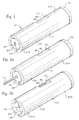
- FIG. 1 is a perspective view of a representative handle of the disclosure.
- FIG. 1 a is the view of FIG. 1 with a medical device received within the handle.
- FIG. 1b is the view of FIG. 1 with the button depressed.
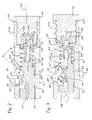
- FIG. 2 is a cross-sectional view of the handle of FIG. 1 showing the handle in the normal configuration.
- FIG. 3 is the view of FIG. 2 showing the button depressed.
- FIG. 4 is the view of FIG. 2 showing a medical received within the handle with the handle in the normal configuration.
- FIG. 5 is the view of FIG. 3 showing a medical device inserted within the handle with the button depressed.
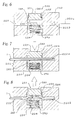
- FIG. 6 is a cross-sectional view of an alternate embodiment of a handle showing the handle in a normal configuration without receipt of an elongate device therewithin.
- FIG. 7 is the view of FIG. 6 with the button fully depressed receiving an elongate device therewithin.
- FIG. 8 is the view of FIG. 7 with the button released to retain the elongate device therewithin.
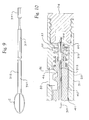
- FIG. 9 is a side view of an alternate elongate portion of a medical device.
- FIG. 10 is a cross-sectional view of the FIG. 2 showing receipt and engagement with the elongate portion depicted in FIG. 9 .
- FIG. 11 is a cross-sectional view of an alternate handle that is configured to further manipulate a medical device, showing the medical device in a closed configuration.
- FIG. 12 is the handle of FIG. 11 showing the device in an open configuration.
- a handle 10 is provided that is configured to releasably receive a proximal portion 1 of an elongate medical device, such as a basket, a snare, or the like.
- the handle 10 includes a housing 20 and a core 40 slidably disposed within an internal, hollow portion 23 of the housing 20.
- the hollow portion 23 may extend from an open distal end 21 a of the housing 20 to an open proximal end 21 b of the housing 20, while in other embodiments, the hollow portion 23 may extend from an open distal end 21a to a closed proximal end.
- the proximal end 21 b may be ultimately closed with a cap 74 that is removably mounted to the proximal end of the housing 20, with a threaded connection, a snap fit or press fit connection, or by another attachment structure known in the art.
- the distal end of the housing 20 may be substantially closed, with only a central opening configured to receive the proximal end 1 of a medical device therethrough. As shown in FIG.
- the proximal end 1 of a medical device may be threaded directly into a lumen 41 of the core 40, which extends along the entire length of the core 40, and in some embodiments along the longitudinal axis 100 ( FIG. 2 ) of the core 40 (which may or may not be co-linear with the longitudinal axis of the housing 20, or the handle 10).
- the core 40 is slidable longitudinally within the housing 20 as urged by movement of a button 80 that extends through an aperture 27 in the housing 20 and is operable by a user that is holding the housing 20 with a single hand, and in some embodiments, is operable by simply pressing the thumb of the user's hand on the button 80 to compress it further into the aperture 27.
- depressing the button 80 urges the core 40 proximally within the hollow portion 23 of the housing 20 to a removal configuration ( FIG. 3 ), and releasing the depressed button 80 cases the core 40 to return to its normal position ( FIG. 2 ).
- the housing 20 is an elongate, substantially rigid member that may be configured to be held and manipulated with a single hand of a user and is configured to allow the user to insert and remove a proximal elongate portion 1 of a flexible medical device therein.
- the housing 20 may be a single molded piece, or may be assembled from two or more clam-shell halves that are fixed together after the housing 20 is assembled.
- the housing 20 has an outer surface 31 that may be ergonomically and geometrically adapted for the comfortable receipt and manipulation by the user's hand.
- the housing 20 may be formed with a smooth or rough outer surface 31, may have a plurality of projections for comfortable receipt of a user's fingers, or other design features known in the art.
- the housing 20 may be made from a rigid plastic material, such as ABS or may be made from a metal, or may be made from a composite material.
- a rigid plastic material such as ABS
- a metal such as aluminum, copper, or magnesium, or magnesium, or magnesium, or magnesium.
- material selection will be based upon various factors such as cost, weight, strength, availability, manufacturability and the like.
- the housing 20 is configured to define an inner hollow portion 23, which is an open internal volume within an inner surface 32 of the housing 20.
- the hollow portion 23 includes a distal, first portion 22 that extends from an open distal end 21 a (in embodiments including this structure) or at least a distal portion of the housing 20 and extends along a majority of the length of the housing 20.
- the first portion 22 is defined at a first inner diameter and is in communication with an aperture 27 defined through a portion of the side wall of the housing 20.
- the aperture 27 may be of a constant shape and size through the thickness of the side wall of the housing 20, while in other embodiments the aperture may have a first cross-section at the outer surface 32 of the housing 20 and form a larger cross section inwardly from the outer surface 32 of the housing 20.
- the area of the housing side wall distinguishing the larger and smaller cross-section of the housing is defined as the step 34 ( FIG. 2 ).
- the hollow portion 23 includes a second portion 24 proximal of the first portion 22, which has a smaller inner diameter than the inner diameter of the first portion 22.
- the second portion 24 may be defined from a wall 33 that extends radially inward into the hollow portion 23 from the inner surface 32 of the housing 20 along the entire inner circumference of the hollow portion 23, the majority of the inner circumference, or at predetermined positions within the inner circumference, to substantially reduce the inner diameter of the hollow portion 23.
- the wall 33 of the housing 20, and the second portion 24 of the hollow portion 23 defined therefrom is configured to urge the arms 64 of a collet 60 (in conjunction with the core 40) together to minimize the size of the rear opening 61 a into the collet lumen 61.
- the collet 60 and core 40 may be formed as a monolithic piece, such that the arms 64 are a part of the core 40, although operation of the device with a monolithic core 40 and collet 60 is substantially the same as the embodiment where the core 40 and collet 60 are different elements joined together.
- embodiments with separate collet 60 and core 40 fixed together will be discussed, but one of ordinary skill in the art will understand that the structure disclosed herein can be freely substituted with a monolithic core 40 and collet 60.
- the hollow portion 23 may further include a third portion 26 proximal of the second portion 24, which has a larger inner diameter than the inner diameter of the second portion 24.
- the inner diameter of the third portion 26 may be substantially the same as the inner diameter of the first portion 22, while in other embodiments, the inner diameter of the third portion 26 may be different.
- the third portion 26 of the hollow portion 23 is configured to allow space for the second ends 66 of each of the plurality of arms 64 of the collet 60 to extend radially away from each other and radially away from the outer surface of the collet 60, with the radial outward motion of the second ends 66 of the arms 64 increasing the size of the proximal opening 61 a into the collet lumen 61.
- the housing 20 may include a proximal opening 29, which is normally closed by a cap 74 that is fixably retained upon the housing 20 to close the proximal opening, but is removable to allow for assembly of the handle 10.
- the cap 74 may be friction fit within the housing, threaded upon the housing, or in some embodiments where the housing is a single molded piece (or formed from two clamshell halves) the cap 74 may be formed integrally with the remainder of the housing 20.
- the core 40 is an elongate member that is slidably received within the hollow portion 23 of the housing 20.
- the core 40 has a lumen 41 that extends therethrough, which may extend collinearly with the longitudinal axis 100 through the core 40, while in other embodiments, the core lumen 41 extends in an offset manner from the longitudinal axis. In some embodiments, the core lumen 41 extends through the core 40 in parallel to the direction of sliding motion of the core 40 through the hollow portion 23.
- the core lumen 41 is configured to receive the proximal end 1 of an elongate medical device therethrough and is either accessible to the user through the open distal end 28 of the housing 20, or through a hole in the distal end 21a of the housing 20 and in registration with the core lumen 41.
- the core lumen 41 is configured to receive the proximal portion 1 of a medical device therethrough, to allow free, limited friction, sliding of the proximal portion 1 therealong, including an enlarged proximal tip 1a ( FIGs. 4-5 ) that may be present upon the elongate medical device.
- the core 40 may include an upstanding surface 44 at or near the proximal end of the core 40, that is configured to engage one end of a spring 70, such as a compression spring, that may be disposed within the hollow portion 23 and between the upstanding surface 44 and the wall 33 of the housing 20.
- the spring 70 may be installed in a compressed manner (with the handle 10 in the normal configuration) such that the core 40 constantly feels a force urging the core 40 distally within the hollow portion 23.
- the core 40 includes one or more ramp surfaces 46 (46a) that extend from the core 40 at an oblique angle ⁇ with respect to the longitudinal axis 100 of the core 40.
- the one or more ramp surfaces 46 (46a) are configured to make sliding contact with inclined surfaces 86 (86a) of the button 80 as discussed below.
- a portion of the core 40 defining a ramp surface 46 (or 46a when provided) may also define the upstanding member 44.
- the spring 70 biases the core 40 in the distal direction to urge continuous contact between the ramp surface(s) 46 (46a) of the core 40 and the inclined surface(s) 86 (86a) of the button 80.
- the contact between the ramp and inclined surfaces 46, 86 establishes the avenue for transfer of force from the button 80 to the core 40 (and ultimately to the arms 64 of the collet 60), but also prevents further distal motion of the core 40 within the hollow portion 23, which allows for embodiments of the handle 10 with an open front portion 28 on the housing 20 without the core 40 sliding distally out of the housing 20.
- the button 80 is a member that is received within the aperture 27 in the side surface of the housing 20 and is configured to engage the core 40, as discussed above.
- the button 80 includes one or more inclined surfaces 86 (86a) that extend radially into the hollow portion 23 of the housing 20 to engage the opposed ramp surfaces 46 (46a) of the core 40.
- the inclined surface(s) may be disposed at substantially the same angle ⁇ with respect to the longitudinal axis 100 of the core 40, such that the opposed ramp and inclined surfaces 46, 86 make sliding contact with respect to each other.
- the angle ⁇ is configured to impart a proximally directed force upon the core 40 for moving the core 40 proximally within the hollow portion 23 of the housing 20 as the button 80 is urged into the hollow portion 23 of the housing.
- the angle ⁇ is determined by an optimization of at least two competing factors, i.e. the amount of available horizontal motion of the core 40 with a set vertical displacement of the button 80 (e.g. smaller angles ⁇ provide for greater horizontal displacement with respect to a set amount of vertical displacement), competing with the larger frictional forces observed with smaller angles ⁇ (due to a larger vertical component of the force vector acting as a normal force upon the surface contact). Angles around 45 degrees are believed to be suitable for this design, as well as angles within the range of about 30 degrees to about 60 degrees, inclusive thereof.
- the specific angle ⁇ chosen will be optimized based upon the required horizontal movement of the core 40 needed and the vertical movement of the button 80 available, and those of ordinary skill in the art will be able to choose an optimal angle ⁇ based upon the specific geometric (size, shape), and physical design of the handle 10 with reference to this specification.
- the proximal end 1 of the medical device includes an enlarged tip 1a ( FIGS.
- the proximal opening 61 a of the collet 60 needs to be large enough to allow the tip 1 a to pass when the button 80 is fully pressed, but still retain the proximal end 1 of the medical device when the handle 10 is in the normal configuration, thereby requiring a larger range of motion of the arms 64 of the collet 60 and potentially a larger range of horizontal motion of the core 40 than embodiments where the proximal end 1 of the medical device does not have an enlarged tip (1a).
- the button 80 defines a ledge 84 that surrounds all or a portion of an extended central portion of the button 80.
- the ledge 84 is a cross-sectional portion of the button that includes a larger cross-sectional area than the top surface 82 of the button 80, and may be formed along a plane 83 ( FIG. 2 ) formed below and in parallel (or at a constant offset distance in embodiments where the top surface 82 is not planer) to the top surface 82 of the button.
- the ledge 82 of the button engages a step 34 formed in the housing 20 to prevent the button 80 from falling through or being removable from the aperture 27 in the housing.
- the combined geometry of the ledge 84, the button 80, and the step 34 define the range of upward motion of the button 80 within the housing 20, and also, based upon engagement between the opposed ramp and inclined surfaces 46, 86, defines the limit of core 40 motion in the distal direction.
- the top surface 82 of the button 80 may be recessed below the outer surface 31 of the housing 20 to prevent spurious and unintended motion of the button 80 (and therefore unintended release of the device from the handle 10). Specifically, the recessed positioning of the button 80 below the outer surface 31 of the housing 20 minimizes the chance of the button 80 being engaged and depressed if the handle 10 is inadvertently dropped or mishandled.
- the collet 60 is disposed proximal of the core 40 and is configured to translate within the housing 20 with motion of the core 40.
- the collet 60 may be removably fixed to the core 40 (such as with a threaded connection as shown in FIGS. 2 and 3 , or alternatively, the collet 60 may be inserted molded to the core, press fit, or fixed thereto with adhesive or fasteners), while in other embodiments, the collet 60 may be monolithically formed with the core 40.
- the collet 60 includes a collet lumen 61 that extends through the collet 60 and in registry with the core lumen 41 to receive the elongate proximal end 1 of a medical device disposed therethrough.
- the collet lumen 61 extends to a proximal end through a rear opening 61 a that is defined by the second ends 66 of a plurality of arms 64 that extend from the collet 60.
- Each of the plurality of arms 64 include a first portion fixed to the collet 60 and a second portion 66 that extend from the collet 60.
- the second ends 66 of each arm 64 are biased away from the outer surface of the collet 60 and from the second ends 66 of the other arms 64, such that the second ends 66 are urged to establish a relatively large rear opening 61 a into the collet lumen 61 when the arms 64 are free to move to a biased outward configuration ( FIG. 3 ), i.e. when the arms 64 are within the third portion 26 of the hollow portion 23.
- the collet arms 64 are normally maintained in a narrowed configuration within the second portion 24 of the hollow portion 23, due to the biasing force of the spring 70 upon the core 40.
- the wall 33 of the housing 20 urges the plurality of arms 64 toward the outer surface of the remainder of the collet 60 and toward each other, such that the size of the rear portion 61 a of the collet lumen 61 is minimized to retain the proximal end 1 of a medical device within the collet lumen 61.
- the combined second ends 66 of the arms 64 define a rear opening 61 a that is smaller than the cross-section of the proximal tip 1a to prevent distal movement of the medical device when the handle is in the normal configuration.
- the diameter of the remainder of the core lumen 41 and the collet lumen 61 is larger than the largest anticipated proximal tip 1a of the medical device to allow the proximal tip 1a to be threaded through the lumens 41, 61.
- the collet 60 and the collet arms 64 may be made from metal or plastic and contain enough elasticity to deform into a compressed state and return into an expanded state (normal bias position), without suffering permanent disfiguration.
- the inner surface of the second end 66 of one, some, or all of the collet arms 64 may have a retention structure 67 ( FIGs. 4 and 5 ) that assists with maintaining the second end 1 of a medical device inserted within the handle 10 in addition to the normal inward force imparted upon the proximal end 1 of the device from the compressed arms.
- the inner surface may be coated with a high friction material to enlarge the frictional force felt upon the proximal end 1 of the device disposed within the collet lumen 61.
- the inner surface may have a thicker material to cause the plurality of arms 64 to collectively press upon the proximal end 1 of the device.
- the inner surface may include a plurality of teeth that collectively dig or bite into the proximal end of the device.
- the core 40 and collet 60 are movable proximally within the hollow portion 23 of the housing when the button 80 is depressed by the user.
- the proximal movement of the collet 60 causes the extended second ends 66 of the plurality of arms 64 to move radially outward away from each other as they slide proximally past the wall 33 in the housing 20 and into the third portion 26 of the hollow portion 23, due to the outward biasing force imparted upon the arms 64 during manufacture.
- the proximal motion of the arms 64 and radially outward motion of the second ends 66 of the arms 64 causes the size of the rear opening 61 a of the collet lumen 61 to increase to a size where the proximal end 1 of the medical device is no longer engaged by the arms 64 and is freely removed from the collet lumen 61 and the handle 10 (and also allows the proximal portion 1 of the medical device to be slid between the arms and through the rear opening 61 a in the collet lumen 61 when the device is initially being loaded into the handle 10).
- the handle includes a housing 220 that defines a central lumen 222 extending from a distal surface of the housing 220 blindly along the either the entire length or a significant portion of the length of the housing 220.
- the lumen 222 and the distal opening into the lumen 222 is configured to receive an elongated proximal portion 1 of a medical device, such as a basket, snare, or the like to allow for a medical professional to ergonomically hold and manipulate the device within the patient.
- the housing 220 and lumen 222 are configured to receive the elongate portion 1 in a back loading manner, i.e. the proximal tip of the elongate portion 1 is threaded through the opening and lumen 222 and into the desired position within the housing 220.
- the housing 220 further includes a movable button 280 that is disposed within a side opening in the housing 220 and is translatable within the housing 220 in both directions substantially perpendicular to the longitudinal axis 220a of the housing 220.
- the button 280 is received within a void 224 defined from the side opening 221 of the housing 220 and extending through the lumen 222 and to an opposite side of the housing 220 from the side opening 221.
- the void 224 may include a stepped portion 225 where the cross-sectional area of the void 224 that extends through the lumen 222 (and for some desired distance on the opposite side of the lumen 222 from the side opening 221) is greater than the cross-sectional area of the side opening 221.
- the radius of the portion of the void 224 crossing the lumen is larger than the radius of the concentric portion of the void 224 that defines the side hole 221.
- the step change in the size of the void 224 creates a step 225 that limits the outward motion of the button 280, in embodiments where the button 280 includes a ledge 284 that has a larger cross-sectional area than the area of the void at the side hole 221. Accordingly, in embodiments where the housing 220 and the button 280 are constructed with this geometry, the button 280 is free to partially move within the void 224, but prevented from leaving the handle through the side hole 221.
- the height of the button 280 (and more specifically the height of the button above the ledge 284) is smaller than the distance between the step 225 and the side hole 221, such that the button 280 is recessed within the void 224 to minimize or avoid inadvertent operation of the button 280 when holding or manipulating the handle 200.
- the void 224 and button 280 may be formed from other profiles, such as squares, rectangles, and the like, as well as arcuate versions of these profiles to provide an ergonomic and high strength device.
- the button 280 may be biased radially (i.e. in a direction toward the side hole 221) with a spring 290 or the like positioned within the void 224 and between a lower surface of the button 280 and an inner wall of the housing 220 within the void 224.
- the spring 290 may be constructed to urge the button 280 toward the side opening 221 as limited by contact between the step 225 and the ledge 284.
- the spring 290 is configured to be inwardly compressible (i.e. to allow the button to travel radially inward within the housing 220) when the top surface of the button 280 is pressed by the user through the side hole 221.
- the button 280 further includes a button lumen 282 that extends through the width of the button 280, which is sized to accept and allow the proximal portion of a medical device configured to be used with the handle 200 to slide therethrough.
- the button lumen 282 is positioned upon the button 280 such that the button lumen 282 is not in registry (either complete registry or partial registry) with the lumen 222 of the housing 220 when the button 280 is in its normal position (i.e. the ledge 284 contacting the step 225 as urged by the spring 290).
- the button lumen 282 is configured such that the button lumen 282 is in substantially complete (or at least sufficient) registry with the handle lumen 222 when the button 280 is fully depressed by the user, which allows the proximal portion of the medical device to be completely threaded through the housing lumen 222, including the button lumen 282, and in some embodiments, a proximal lumen 222b disposed proximally in the housing 220 (i.e. the portion of the housing lumen 222 that the elongate medical device enters after being threaded through the button lumen 282).
- the button 280 and button lumen 282 are configured such that there is some play for the button 280 to move slightly toward the side opening 221 of the housing 220 when the button 280 is released (due to the biasing force of the spring 290), such that the elongate portion 1 of the medical device exiting through the button lumen 282 (and in embodiments where the housing lumen 222 includes a proximal lumen 222b, both sides of the button lumen 282) is urged into contact with the upper edge of the housing lumen 222 and a portion of the upper surface of the button 280 that defines the button lumen 282, establishing a large normal force therebetween and therefore a high frictional connection between the two.
- the proximal-most portion of the elongate portion 1 of the medical device may be sized such that it may be threaded from the housing lumen 222 into the button lumen 282 when the button 280 is fully depressed ( FIG.
- the elongate portion of the medical device may be released from the housing 220 by fully pressing the button 280 against the biasing force of the spring 290, which established at least sufficient registry between the housing lumen 222 and the button lumen 282 to minimize the frictional forces upon the medical device to allow it to be removed from the lumens by pulling the medical device from the lumens.
- the button 280 may be released, and the medical device may be fully withdrawn if warranted.
- the button 280 moves radially within the void 224 (as urged by the spring 290) until the ledge 284 of the button 280 engages the step 225 on the housing 220.
- the proximal portion an alternate elongate portion 301 of the medical device may be formed with a varying cross section, as shown in FIG. 9 .
- the proximal portion of the elongate portion 301 may include a proximal tip 310, a transition portion 311 just distal of the proximal tip 310, and a distal portion 312 that is distal of the transition portion 311.
- the transition portion 311 is configured to have a lower diameter along its length than both the distal portion 312 or the proximal tip 310.
- the distal portion 312 and the proximal tip 310 will have the same diameter as each other and of the remainder of the elongate portion 301 of the medical device, while in other embodiments when needed or warranted, the distal portion 312 and the proximal tip 310 may include different diameters (both normally larger than the diameter of the transition portion 311).
- the elongate portion 301 of the medical device and the housing 20 are configured such that the transition portion 311 is disposed within the collet 60 when the medical device is fully inserted into the handle 10, with the proximal tip 310 extending from the collet 60 and into the third portion 26 of the housing 20 (or proximally of the button 280 in those embodiments).
- the formation of the elongate portion 301 of the medical device in this manner provides for a step change in diameter that outside of the collett 60, which provides for additional strength to maintain the elongate portion 1 disposed within the housing in the normal configuration (i.e. the nominal configuration shown in FIG.
- the housing 20 and alternate elongate portion 301 can be released from the housing by depressing the button 80 which translates the collet 60 and releases connection with the transition portion 311/proximal tip 310 in the same manner as depicted in FIG. 3 for the embodiment discussed above, which allows the elongate portion 301 to be removed from the handle 10.
- an alternate handle 410 may be provided that is fixably connected to an outer sheath 490 that is coaxially received about the portion of the elongate portion 301 (or 1, as discussed elsewhere herein) that extends from the handle 410.
- the outer sheath 490 is configured such that it may slide over all or a portion of the device 2 (such as a basket, snare, forceps, or the like) that is provided upon the distal end of the elongate portion 301 of the medical device to close the device, or minimize the diameter of the device for insertion, removal, or manipulation within the patient.
- the outer sheath 490 may be withdrawn proximally from the device such that the device is allowed to expand towards its normal configuration for operation within the patient.
- the outer sheath 490 is fixed to a cap 492 that is movably fixed with respect to the housing 420 with a movable shaft 493 that extends into the distal portion of the housing 420.
- the movable shaft 493 receives a slider 494 that extends through a slot 495 defined in the housing 420 to allow the slider 494 to move proximally and distally with respect to the housing 420.
- the cap 492 and the slider 493 may be removably connectable to each other with a threaded connection, or the like, or they may fixably connectable, or monolithically formed together.
- the outer sheath 490 moves distally toward the device, thereby compressing the device and covering at least a portion thereof ( FIG. 11 ).
- the outer sheath 490 moves proximally with respect to the device, allowing the device to fully deploy to its normal biased configuration ( FIG. 12 ).
- the remaining portions of the housing 420 may be constructed with structure described in the embodiments above, for example, such as with a button 80 and ramp surfaces 46, such that the collet 60 moves with respect to the elongate portion 301 to allow the elongate portion 301 to be released from the handle 10 when the button 80 is depressed.
- a handle for receiving an elongate medical device includes a housing defining an elongate hollow interior portion, the hollow portion defining a first portion proximate the distal end and the aperture, a second portion.
- a core is slidably disposed within the interior portion and includes a ramp portion extending from an outer surface of the core at an oblique angle to the longitudinal axis, and two or more arms extending outwardly from a proximal end of the core and biased toward an extended configuration where a proximal end of each arm extends radially outside of an outer surface of the core, wherein the two or more arms combine to define the proximal opening.
- a button is movably disposed within the aperture substantially blocking communication with the hollow portion through the aperture, comprising an inclined surface that slidably engages the ramp surface.
Landscapes
- Health & Medical Sciences (AREA)
- Life Sciences & Earth Sciences (AREA)
- Surgery (AREA)
- Heart & Thoracic Surgery (AREA)
- Engineering & Computer Science (AREA)
- Biomedical Technology (AREA)
- Nuclear Medicine, Radiotherapy & Molecular Imaging (AREA)
- Medical Informatics (AREA)
- Molecular Biology (AREA)
- Animal Behavior & Ethology (AREA)
- General Health & Medical Sciences (AREA)
- Public Health (AREA)
- Veterinary Medicine (AREA)
- Ophthalmology & Optometry (AREA)
- Surgical Instruments (AREA)
Priority Applications (1)
| Application Number | Priority Date | Filing Date | Title |
|---|---|---|---|
| EP16169696.8A EP3090694B1 (de) | 2011-06-15 | 2012-06-14 | Tastenauslösegriff |
Applications Claiming Priority (1)
| Application Number | Priority Date | Filing Date | Title |
|---|---|---|---|
| US201161497358P | 2011-06-15 | 2011-06-15 |
Related Child Applications (2)
| Application Number | Title | Priority Date | Filing Date |
|---|---|---|---|
| EP16169696.8A Division EP3090694B1 (de) | 2011-06-15 | 2012-06-14 | Tastenauslösegriff |
| EP16169696.8A Division-Into EP3090694B1 (de) | 2011-06-15 | 2012-06-14 | Tastenauslösegriff |
Publications (3)
| Publication Number | Publication Date |
|---|---|
| EP2535009A2 true EP2535009A2 (de) | 2012-12-19 |
| EP2535009A3 EP2535009A3 (de) | 2013-05-29 |
| EP2535009B1 EP2535009B1 (de) | 2016-08-10 |
Family
ID=46354017
Family Applications (2)
| Application Number | Title | Priority Date | Filing Date |
|---|---|---|---|
| EP16169696.8A Active EP3090694B1 (de) | 2011-06-15 | 2012-06-14 | Tastenauslösegriff |
| EP12172077.5A Active EP2535009B1 (de) | 2011-06-15 | 2012-06-14 | Tastenauslösegriff |
Family Applications Before (1)
| Application Number | Title | Priority Date | Filing Date |
|---|---|---|---|
| EP16169696.8A Active EP3090694B1 (de) | 2011-06-15 | 2012-06-14 | Tastenauslösegriff |
Country Status (2)
| Country | Link |
|---|---|
| US (2) | US8840630B2 (de) |
| EP (2) | EP3090694B1 (de) |
Cited By (4)
| Publication number | Priority date | Publication date | Assignee | Title |
|---|---|---|---|---|
| EP2904977A1 (de) * | 2014-02-10 | 2015-08-12 | Karl Storz GmbH & Co. KG | Chirurgisches instrument und handhabe für selbiges |
| WO2016115043A3 (en) * | 2015-01-16 | 2016-10-13 | Boston Scientific Neuromodulation Corporation | Electrical stimulation system with intraoperative cable and methods of making and using |
| US10130806B2 (en) | 2015-06-26 | 2018-11-20 | Boston Scientific Neuromodulation Corporation | Systems and methods for making and using a temporary lead |
| CN111225623A (zh) * | 2017-06-22 | 2020-06-02 | 柯惠有限合伙公司 | 用于重新入鞘血管内装置的紧固元件以及相关联的系统和方法 |
Families Citing this family (5)
| Publication number | Priority date | Publication date | Assignee | Title |
|---|---|---|---|---|
| US20140135820A1 (en) * | 2012-11-13 | 2014-05-15 | Alcon Research, Ltd. | Disposable capsulorhexis forceps |
| US9827141B2 (en) | 2013-06-21 | 2017-11-28 | Novartis Ag | Systems and techniques for tissue manipulation during ocular surgery |
| US10421766B2 (en) * | 2015-02-13 | 2019-09-24 | Versum Materials Us, Llc | Bisaminoalkoxysilane compounds and methods for using same to deposit silicon-containing films |
| DE102017106714A1 (de) * | 2017-03-29 | 2018-10-04 | Karl Storz Se & Co. Kg | Beobachtungsinstrument mit optischer Anordnung |
| WO2021127618A1 (en) * | 2019-12-19 | 2021-06-24 | Fibertex & Supply Inc. | Slide lock assembly and snaring tool |
Family Cites Families (29)
| Publication number | Priority date | Publication date | Assignee | Title |
|---|---|---|---|---|
| DE4323584A1 (de) | 1993-07-14 | 1995-01-19 | Delma Elektro Med App | Zerlegbares medizinisches Instrument |
| DE4421584C2 (de) | 1994-06-21 | 1996-05-23 | Aesculap Ag | Chirurgisches Rohrschaftinstrument |
| US5601560A (en) | 1994-10-07 | 1997-02-11 | The Anspach Effort, Inc. | Tool bit for a motor driven surgical instrument |
| US6348056B1 (en) * | 1999-08-06 | 2002-02-19 | Scimed Life Systems, Inc. | Medical retrieval device with releasable retrieval basket |
| US6197001B1 (en) | 1996-09-27 | 2001-03-06 | Becton Dickinson And Company | Vascular access device |
| US5964717A (en) | 1997-01-06 | 1999-10-12 | Symbiosis Corporation | Biopsy forceps having detachable handle and distal jaws |
| AU727277B2 (en) * | 1997-06-02 | 2000-12-07 | Cook Urological Inc. | Replaceable, medical device handle |
| US5976143A (en) | 1997-12-23 | 1999-11-02 | Johnson & Johnson Professional, Inc. | Orthopedic reaming instrument |
| US6299624B1 (en) * | 1999-05-27 | 2001-10-09 | Karl Storz Gmbh & Co. Kg | Handle for a medical instrument |
| US6764499B2 (en) | 2000-05-18 | 2004-07-20 | Cook Urological Incorporated | Medical device handle |
| US6527780B1 (en) | 2000-10-31 | 2003-03-04 | Odyssey Medical, Inc. | Medical implant insertion system |
| IL139802A0 (en) | 2000-11-21 | 2002-02-10 | Serpomed Ltd | Catheter insertion apparatus |
| US6537295B2 (en) * | 2001-03-06 | 2003-03-25 | Scimed Life Systems, Inc. | Wire and lock mechanism |
| US6984213B2 (en) * | 2001-03-15 | 2006-01-10 | Specialized Health Products, Inc. | Biopsy needle device |
| US6676668B2 (en) * | 2001-12-12 | 2004-01-13 | C.R. Baed | Articulating stone basket |
| US6652537B2 (en) * | 2001-12-12 | 2003-11-25 | C. R. Bard, Inc. | Articulating stone basket |
| US7105016B2 (en) * | 2002-04-23 | 2006-09-12 | Medtronic Vascular, Inc. | Integrated mechanical handle with quick slide mechanism |
| US6862776B2 (en) * | 2003-04-23 | 2005-03-08 | Chia-Yu Chen | Positioning structure of a retractable handle |
| DE10351013A1 (de) * | 2003-10-31 | 2005-06-02 | Polydiagnost Gmbh | Endoskop mit einer flexiblen Sonde |
| JP2007514465A (ja) * | 2003-11-13 | 2007-06-07 | シナージエテイクス・インコーポレイテツド | アクチュエータ位置を調節可能な手術装置ハンドル |
| JP4624718B2 (ja) | 2004-05-14 | 2011-02-02 | オリンパス株式会社 | 医療器具用挿入補助装置、及び、医療器具挿入システム |
| IL162415A0 (en) | 2004-06-09 | 2005-11-20 | Noam Shamay | A micro-catheter for crossing totalocclusions in blood vessels |
| US8608703B2 (en) * | 2007-06-12 | 2013-12-17 | Medrad, Inc. | Infusion flow guidewire system |
| US7959162B2 (en) | 2007-07-26 | 2011-06-14 | Syntheon, Llc | Releasing instrument holder and method of operating the instrument holder |
| US8945160B2 (en) * | 2008-07-03 | 2015-02-03 | Hotspur Technologies, Inc. | Apparatus and methods for treating obstructions within body lumens |
| JP5555242B2 (ja) * | 2008-10-13 | 2014-07-23 | コヴィディエン リミテッド パートナーシップ | カテーテルシャフトを操作するデバイスおよび方法 |
| EP2588012B1 (de) * | 2010-07-01 | 2016-08-17 | Avinger, Inc. | Atherektomiekatheter mit länglich verschiebbaren antriebswellen |
| AU2011296277B2 (en) * | 2010-09-01 | 2014-10-23 | Medtronic Inc. | Single handed deployment handle |
| US9351757B2 (en) * | 2012-01-17 | 2016-05-31 | Covidien Lp | Material removal device and method of use |
-
2012
- 2012-05-31 US US13/484,953 patent/US8840630B2/en active Active
- 2012-06-14 EP EP16169696.8A patent/EP3090694B1/de active Active
- 2012-06-14 EP EP12172077.5A patent/EP2535009B1/de active Active
-
2014
- 2014-09-19 US US14/490,860 patent/US9532795B2/en active Active
Non-Patent Citations (1)
| Title |
|---|
| None |
Cited By (9)
| Publication number | Priority date | Publication date | Assignee | Title |
|---|---|---|---|---|
| EP2904977A1 (de) * | 2014-02-10 | 2015-08-12 | Karl Storz GmbH & Co. KG | Chirurgisches instrument und handhabe für selbiges |
| US10251632B2 (en) | 2014-02-10 | 2019-04-09 | Karl Storz Se & Co. Kg | Surgical instrument, handle, operating method, and method for dismantling same |
| WO2016115043A3 (en) * | 2015-01-16 | 2016-10-13 | Boston Scientific Neuromodulation Corporation | Electrical stimulation system with intraoperative cable and methods of making and using |
| US10195446B2 (en) | 2015-01-16 | 2019-02-05 | Boston Scientific Neuromodulation Corporation | Electrical stimulation system with intraoperative cable and methods of making and using |
| US10981011B2 (en) | 2015-01-16 | 2021-04-20 | Boston Scientific Neuromodulation Corporation | Electrical stimulation system with intraoperative cable and methods of making and using |
| US11786742B2 (en) | 2015-01-16 | 2023-10-17 | Boston Scientific Neuromodulation Corporation | Electrical stimulation system with intraoperative cable and methods of making and using |
| US10130806B2 (en) | 2015-06-26 | 2018-11-20 | Boston Scientific Neuromodulation Corporation | Systems and methods for making and using a temporary lead |
| CN111225623A (zh) * | 2017-06-22 | 2020-06-02 | 柯惠有限合伙公司 | 用于重新入鞘血管内装置的紧固元件以及相关联的系统和方法 |
| CN111225623B (zh) * | 2017-06-22 | 2023-05-26 | 柯惠有限合伙公司 | 用于重新入鞘血管内装置的紧固元件以及相关联的系统和方法 |
Also Published As
| Publication number | Publication date |
|---|---|
| EP3090694B1 (de) | 2020-01-08 |
| EP2535009B1 (de) | 2016-08-10 |
| EP3090694A1 (de) | 2016-11-09 |
| US9532795B2 (en) | 2017-01-03 |
| US20120318110A1 (en) | 2012-12-20 |
| US20150000480A1 (en) | 2015-01-01 |
| EP2535009A3 (de) | 2013-05-29 |
| US8840630B2 (en) | 2014-09-23 |
Similar Documents
| Publication | Publication Date | Title |
|---|---|---|
| US9532795B2 (en) | Button release handle | |
| US8100838B2 (en) | Variable stiffness guidewire systems | |
| US11684501B2 (en) | Multipurpose handle | |
| JP4236010B2 (ja) | ワイヤガイド制御ハンドル | |
| EP1885429B1 (de) | Führungsdraht-Drehmomentvorrichtung | |
| WO2009001309A1 (en) | Device for controlling a catheter | |
| EP2682070B1 (de) | Transporttablett für chirurgische Instrumente | |
| JP7203922B2 (ja) | 格納式ブレードまたはフック付き軟組織切断機器 | |
| CN104902830A (zh) | 安全切割设备 | |
| US8376963B2 (en) | Variable stiffness guidewire systems | |
| JP2017532133A (ja) | トルク装置及び固定機構 | |
| US12575853B2 (en) | Multipurpose handles and medical snare or other devices incorporating them | |
| US7748124B1 (en) | Scalpel assembly | |
| US20090254001A1 (en) | Variable Stiffness Guidewire Systems |
Legal Events
| Date | Code | Title | Description |
|---|---|---|---|
| PUAI | Public reference made under article 153(3) epc to a published international application that has entered the european phase |
Free format text: ORIGINAL CODE: 0009012 |
|
| AK | Designated contracting states |
Kind code of ref document: A2 Designated state(s): AL AT BE BG CH CY CZ DE DK EE ES FI FR GB GR HR HU IE IS IT LI LT LU LV MC MK MT NL NO PL PT RO RS SE SI SK SM TR |
|
| AX | Request for extension of the european patent |
Extension state: BA ME |
|
| PUAL | Search report despatched |
Free format text: ORIGINAL CODE: 0009013 |
|
| AK | Designated contracting states |
Kind code of ref document: A3 Designated state(s): AL AT BE BG CH CY CZ DE DK EE ES FI FR GB GR HR HU IE IS IT LI LT LU LV MC MK MT NL NO PL PT RO RS SE SI SK SM TR |
|
| AX | Request for extension of the european patent |
Extension state: BA ME |
|
| RIC1 | Information provided on ipc code assigned before grant |
Ipc: A61B 17/3205 20060101ALI20130419BHEP Ipc: A61B 17/00 20060101ALN20130419BHEP Ipc: A61B 17/29 20060101AFI20130419BHEP |
|
| 17P | Request for examination filed |
Effective date: 20131128 |
|
| RBV | Designated contracting states (corrected) |
Designated state(s): AL AT BE BG CH CY CZ DE DK EE ES FI FR GB GR HR HU IE IS IT LI LT LU LV MC MK MT NL NO PL PT RO RS SE SI SK SM TR |
|
| 17Q | First examination report despatched |
Effective date: 20140514 |
|
| GRAP | Despatch of communication of intention to grant a patent |
Free format text: ORIGINAL CODE: EPIDOSNIGR1 |
|
| RIC1 | Information provided on ipc code assigned before grant |
Ipc: A61B 17/3205 20060101ALI20160324BHEP Ipc: A61B 17/29 20060101AFI20160324BHEP Ipc: A61B 17/00 20060101ALN20160324BHEP |
|
| RIN1 | Information on inventor provided before grant (corrected) |
Inventor name: GILTINAN, JAMES Inventor name: LAVELLE, SHAY |
|
| INTG | Intention to grant announced |
Effective date: 20160419 |
|
| RAP1 | Party data changed (applicant data changed or rights of an application transferred) |
Owner name: COOK MEDICAL TECHNOLOGIES LLC |
|
| GRAS | Grant fee paid |
Free format text: ORIGINAL CODE: EPIDOSNIGR3 |
|
| GRAA | (expected) grant |
Free format text: ORIGINAL CODE: 0009210 |
|
| AK | Designated contracting states |
Kind code of ref document: B1 Designated state(s): AL AT BE BG CH CY CZ DE DK EE ES FI FR GB GR HR HU IE IS IT LI LT LU LV MC MK MT NL NO PL PT RO RS SE SI SK SM TR |
|
| REG | Reference to a national code |
Ref country code: GB Ref legal event code: FG4D |
|
| REG | Reference to a national code |
Ref country code: CH Ref legal event code: EP Ref country code: AT Ref legal event code: REF Ref document number: 818227 Country of ref document: AT Kind code of ref document: T Effective date: 20160815 |
|
| REG | Reference to a national code |
Ref country code: IE Ref legal event code: FG4D |
|
| REG | Reference to a national code |
Ref country code: DE Ref legal event code: R096 Ref document number: 602012021387 Country of ref document: DE |
|
| REG | Reference to a national code |
Ref country code: LT Ref legal event code: MG4D |
|
| REG | Reference to a national code |
Ref country code: NL Ref legal event code: MP Effective date: 20160810 |
|
| REG | Reference to a national code |
Ref country code: AT Ref legal event code: MK05 Ref document number: 818227 Country of ref document: AT Kind code of ref document: T Effective date: 20160810 |
|
| PG25 | Lapsed in a contracting state [announced via postgrant information from national office to epo] |
Ref country code: RS Free format text: LAPSE BECAUSE OF FAILURE TO SUBMIT A TRANSLATION OF THE DESCRIPTION OR TO PAY THE FEE WITHIN THE PRESCRIBED TIME-LIMIT Effective date: 20160810 Ref country code: FI Free format text: LAPSE BECAUSE OF FAILURE TO SUBMIT A TRANSLATION OF THE DESCRIPTION OR TO PAY THE FEE WITHIN THE PRESCRIBED TIME-LIMIT Effective date: 20160810 Ref country code: HR Free format text: LAPSE BECAUSE OF FAILURE TO SUBMIT A TRANSLATION OF THE DESCRIPTION OR TO PAY THE FEE WITHIN THE PRESCRIBED TIME-LIMIT Effective date: 20160810 Ref country code: NO Free format text: LAPSE BECAUSE OF FAILURE TO SUBMIT A TRANSLATION OF THE DESCRIPTION OR TO PAY THE FEE WITHIN THE PRESCRIBED TIME-LIMIT Effective date: 20161110 Ref country code: IT Free format text: LAPSE BECAUSE OF FAILURE TO SUBMIT A TRANSLATION OF THE DESCRIPTION OR TO PAY THE FEE WITHIN THE PRESCRIBED TIME-LIMIT Effective date: 20160810 Ref country code: IS Free format text: LAPSE BECAUSE OF FAILURE TO SUBMIT A TRANSLATION OF THE DESCRIPTION OR TO PAY THE FEE WITHIN THE PRESCRIBED TIME-LIMIT Effective date: 20161210 Ref country code: LT Free format text: LAPSE BECAUSE OF FAILURE TO SUBMIT A TRANSLATION OF THE DESCRIPTION OR TO PAY THE FEE WITHIN THE PRESCRIBED TIME-LIMIT Effective date: 20160810 Ref country code: NL Free format text: LAPSE BECAUSE OF FAILURE TO SUBMIT A TRANSLATION OF THE DESCRIPTION OR TO PAY THE FEE WITHIN THE PRESCRIBED TIME-LIMIT Effective date: 20160810 |
|
| PG25 | Lapsed in a contracting state [announced via postgrant information from national office to epo] |
Ref country code: PT Free format text: LAPSE BECAUSE OF FAILURE TO SUBMIT A TRANSLATION OF THE DESCRIPTION OR TO PAY THE FEE WITHIN THE PRESCRIBED TIME-LIMIT Effective date: 20161212 Ref country code: AT Free format text: LAPSE BECAUSE OF FAILURE TO SUBMIT A TRANSLATION OF THE DESCRIPTION OR TO PAY THE FEE WITHIN THE PRESCRIBED TIME-LIMIT Effective date: 20160810 Ref country code: SE Free format text: LAPSE BECAUSE OF FAILURE TO SUBMIT A TRANSLATION OF THE DESCRIPTION OR TO PAY THE FEE WITHIN THE PRESCRIBED TIME-LIMIT Effective date: 20160810 Ref country code: LV Free format text: LAPSE BECAUSE OF FAILURE TO SUBMIT A TRANSLATION OF THE DESCRIPTION OR TO PAY THE FEE WITHIN THE PRESCRIBED TIME-LIMIT Effective date: 20160810 Ref country code: PL Free format text: LAPSE BECAUSE OF FAILURE TO SUBMIT A TRANSLATION OF THE DESCRIPTION OR TO PAY THE FEE WITHIN THE PRESCRIBED TIME-LIMIT Effective date: 20160810 Ref country code: GR Free format text: LAPSE BECAUSE OF FAILURE TO SUBMIT A TRANSLATION OF THE DESCRIPTION OR TO PAY THE FEE WITHIN THE PRESCRIBED TIME-LIMIT Effective date: 20161111 Ref country code: ES Free format text: LAPSE BECAUSE OF FAILURE TO SUBMIT A TRANSLATION OF THE DESCRIPTION OR TO PAY THE FEE WITHIN THE PRESCRIBED TIME-LIMIT Effective date: 20160810 |
|
| PG25 | Lapsed in a contracting state [announced via postgrant information from national office to epo] |
Ref country code: EE Free format text: LAPSE BECAUSE OF FAILURE TO SUBMIT A TRANSLATION OF THE DESCRIPTION OR TO PAY THE FEE WITHIN THE PRESCRIBED TIME-LIMIT Effective date: 20160810 Ref country code: RO Free format text: LAPSE BECAUSE OF FAILURE TO SUBMIT A TRANSLATION OF THE DESCRIPTION OR TO PAY THE FEE WITHIN THE PRESCRIBED TIME-LIMIT Effective date: 20160810 |
|
| REG | Reference to a national code |
Ref country code: DE Ref legal event code: R097 Ref document number: 602012021387 Country of ref document: DE |
|
| PG25 | Lapsed in a contracting state [announced via postgrant information from national office to epo] |
Ref country code: SK Free format text: LAPSE BECAUSE OF FAILURE TO SUBMIT A TRANSLATION OF THE DESCRIPTION OR TO PAY THE FEE WITHIN THE PRESCRIBED TIME-LIMIT Effective date: 20160810 Ref country code: DK Free format text: LAPSE BECAUSE OF FAILURE TO SUBMIT A TRANSLATION OF THE DESCRIPTION OR TO PAY THE FEE WITHIN THE PRESCRIBED TIME-LIMIT Effective date: 20160810 Ref country code: BE Free format text: LAPSE BECAUSE OF FAILURE TO SUBMIT A TRANSLATION OF THE DESCRIPTION OR TO PAY THE FEE WITHIN THE PRESCRIBED TIME-LIMIT Effective date: 20160810 Ref country code: SM Free format text: LAPSE BECAUSE OF FAILURE TO SUBMIT A TRANSLATION OF THE DESCRIPTION OR TO PAY THE FEE WITHIN THE PRESCRIBED TIME-LIMIT Effective date: 20160810 Ref country code: BG Free format text: LAPSE BECAUSE OF FAILURE TO SUBMIT A TRANSLATION OF THE DESCRIPTION OR TO PAY THE FEE WITHIN THE PRESCRIBED TIME-LIMIT Effective date: 20161110 Ref country code: CZ Free format text: LAPSE BECAUSE OF FAILURE TO SUBMIT A TRANSLATION OF THE DESCRIPTION OR TO PAY THE FEE WITHIN THE PRESCRIBED TIME-LIMIT Effective date: 20160810 |
|
| PLBE | No opposition filed within time limit |
Free format text: ORIGINAL CODE: 0009261 |
|
| STAA | Information on the status of an ep patent application or granted ep patent |
Free format text: STATUS: NO OPPOSITION FILED WITHIN TIME LIMIT |
|
| 26N | No opposition filed |
Effective date: 20170511 |
|
| PG25 | Lapsed in a contracting state [announced via postgrant information from national office to epo] |
Ref country code: SI Free format text: LAPSE BECAUSE OF FAILURE TO SUBMIT A TRANSLATION OF THE DESCRIPTION OR TO PAY THE FEE WITHIN THE PRESCRIBED TIME-LIMIT Effective date: 20160810 |
|
| PG25 | Lapsed in a contracting state [announced via postgrant information from national office to epo] |
Ref country code: MC Free format text: LAPSE BECAUSE OF FAILURE TO SUBMIT A TRANSLATION OF THE DESCRIPTION OR TO PAY THE FEE WITHIN THE PRESCRIBED TIME-LIMIT Effective date: 20160810 |
|
| REG | Reference to a national code |
Ref country code: CH Ref legal event code: PL |
|
| REG | Reference to a national code |
Ref country code: FR Ref legal event code: ST Effective date: 20180228 |
|
| PG25 | Lapsed in a contracting state [announced via postgrant information from national office to epo] |
Ref country code: LI Free format text: LAPSE BECAUSE OF NON-PAYMENT OF DUE FEES Effective date: 20170630 Ref country code: CH Free format text: LAPSE BECAUSE OF NON-PAYMENT OF DUE FEES Effective date: 20170630 Ref country code: LU Free format text: LAPSE BECAUSE OF NON-PAYMENT OF DUE FEES Effective date: 20170614 |
|
| PG25 | Lapsed in a contracting state [announced via postgrant information from national office to epo] |
Ref country code: FR Free format text: LAPSE BECAUSE OF NON-PAYMENT OF DUE FEES Effective date: 20170630 |
|
| PG25 | Lapsed in a contracting state [announced via postgrant information from national office to epo] |
Ref country code: MT Free format text: LAPSE BECAUSE OF NON-PAYMENT OF DUE FEES Effective date: 20170614 |
|
| PG25 | Lapsed in a contracting state [announced via postgrant information from national office to epo] |
Ref country code: AL Free format text: LAPSE BECAUSE OF FAILURE TO SUBMIT A TRANSLATION OF THE DESCRIPTION OR TO PAY THE FEE WITHIN THE PRESCRIBED TIME-LIMIT Effective date: 20160810 |
|
| PG25 | Lapsed in a contracting state [announced via postgrant information from national office to epo] |
Ref country code: HU Free format text: LAPSE BECAUSE OF FAILURE TO SUBMIT A TRANSLATION OF THE DESCRIPTION OR TO PAY THE FEE WITHIN THE PRESCRIBED TIME-LIMIT; INVALID AB INITIO Effective date: 20120614 |
|
| PG25 | Lapsed in a contracting state [announced via postgrant information from national office to epo] |
Ref country code: CY Free format text: LAPSE BECAUSE OF NON-PAYMENT OF DUE FEES Effective date: 20160810 |
|
| PG25 | Lapsed in a contracting state [announced via postgrant information from national office to epo] |
Ref country code: MK Free format text: LAPSE BECAUSE OF FAILURE TO SUBMIT A TRANSLATION OF THE DESCRIPTION OR TO PAY THE FEE WITHIN THE PRESCRIBED TIME-LIMIT Effective date: 20160810 |
|
| PG25 | Lapsed in a contracting state [announced via postgrant information from national office to epo] |
Ref country code: TR Free format text: LAPSE BECAUSE OF FAILURE TO SUBMIT A TRANSLATION OF THE DESCRIPTION OR TO PAY THE FEE WITHIN THE PRESCRIBED TIME-LIMIT Effective date: 20160810 |
|
| P01 | Opt-out of the competence of the unified patent court (upc) registered |
Effective date: 20230602 |
|
| PGFP | Annual fee paid to national office [announced via postgrant information from national office to epo] |
Ref country code: DE Payment date: 20250626 Year of fee payment: 14 |
|
| PGFP | Annual fee paid to national office [announced via postgrant information from national office to epo] |
Ref country code: GB Payment date: 20250618 Year of fee payment: 14 |
|
| PGFP | Annual fee paid to national office [announced via postgrant information from national office to epo] |
Ref country code: IE Payment date: 20250617 Year of fee payment: 14 |