EP2540275A2 - Support d'occupant avec profil variable cyclique - Google Patents
Support d'occupant avec profil variable cyclique Download PDFInfo
- Publication number
- EP2540275A2 EP2540275A2 EP12174015A EP12174015A EP2540275A2 EP 2540275 A2 EP2540275 A2 EP 2540275A2 EP 12174015 A EP12174015 A EP 12174015A EP 12174015 A EP12174015 A EP 12174015A EP 2540275 A2 EP2540275 A2 EP 2540275A2
- Authority
- EP
- European Patent Office
- Prior art keywords
- support
- occupant
- mattress
- profile
- occupant support
- Prior art date
- Legal status (The legal status is an assumption and is not a legal conclusion. Google has not performed a legal analysis and makes no representation as to the accuracy of the status listed.)
- Withdrawn
Links
- 125000004122 cyclic group Chemical group 0.000 claims abstract description 17
- 230000000694 effects Effects 0.000 claims abstract description 8
- 210000000689 upper leg Anatomy 0.000 claims description 32
- 244000309466 calf Species 0.000 claims description 29
- 125000006850 spacer group Chemical group 0.000 claims description 13
- 239000012636 effector Substances 0.000 claims description 7
- 210000002414 leg Anatomy 0.000 description 9
- 210000000629 knee joint Anatomy 0.000 description 8
- 210000003127 knee Anatomy 0.000 description 7
- 239000006260 foam Substances 0.000 description 6
- 230000007935 neutral effect Effects 0.000 description 5
- 238000002560 therapeutic procedure Methods 0.000 description 5
- 210000001217 buttock Anatomy 0.000 description 4
- 238000006073 displacement reaction Methods 0.000 description 3
- 210000005010 torso Anatomy 0.000 description 3
- 238000005452 bending Methods 0.000 description 2
- 238000001356 surgical procedure Methods 0.000 description 2
- 230000001154 acute effect Effects 0.000 description 1
- 230000003247 decreasing effect Effects 0.000 description 1
- 230000001419 dependent effect Effects 0.000 description 1
- 238000010586 diagram Methods 0.000 description 1
- 229940025016 jointflex Drugs 0.000 description 1
- 238000000034 method Methods 0.000 description 1
- 230000002980 postoperative effect Effects 0.000 description 1
- 230000002685 pulmonary effect Effects 0.000 description 1
- 238000010200 validation analysis Methods 0.000 description 1
Images




Classifications
-
- A—HUMAN NECESSITIES
- A61—MEDICAL OR VETERINARY SCIENCE; HYGIENE
- A61G—TRANSPORT, PERSONAL CONVEYANCES, OR ACCOMMODATION SPECIALLY ADAPTED FOR PATIENTS OR DISABLED PERSONS; OPERATING TABLES OR CHAIRS; CHAIRS FOR DENTISTRY; FUNERAL DEVICES
- A61G7/00—Beds specially adapted for nursing; Devices for lifting patients or disabled persons
- A61G7/002—Beds specially adapted for nursing; Devices for lifting patients or disabled persons having adjustable mattress frame
- A61G7/015—Beds specially adapted for nursing; Devices for lifting patients or disabled persons having adjustable mattress frame divided into different adjustable sections, e.g. for Gatch position
-
- A—HUMAN NECESSITIES
- A61—MEDICAL OR VETERINARY SCIENCE; HYGIENE
- A61G—TRANSPORT, PERSONAL CONVEYANCES, OR ACCOMMODATION SPECIALLY ADAPTED FOR PATIENTS OR DISABLED PERSONS; OPERATING TABLES OR CHAIRS; CHAIRS FOR DENTISTRY; FUNERAL DEVICES
- A61G7/00—Beds specially adapted for nursing; Devices for lifting patients or disabled persons
- A61G7/05—Parts, details or accessories of beds
- A61G7/057—Arrangements for preventing bed-sores or for supporting patients with burns, e.g. mattresses specially adapted therefor
- A61G7/0573—Arrangements for preventing bed-sores or for supporting patients with burns, e.g. mattresses specially adapted therefor with mattress frames having alternately movable parts
-
- A—HUMAN NECESSITIES
- A61—MEDICAL OR VETERINARY SCIENCE; HYGIENE
- A61G—TRANSPORT, PERSONAL CONVEYANCES, OR ACCOMMODATION SPECIALLY ADAPTED FOR PATIENTS OR DISABLED PERSONS; OPERATING TABLES OR CHAIRS; CHAIRS FOR DENTISTRY; FUNERAL DEVICES
- A61G2203/00—General characteristics of devices
- A61G2203/30—General characteristics of devices characterised by sensor means
- A61G2203/42—General characteristics of devices characterised by sensor means for inclination
-
- A—HUMAN NECESSITIES
- A61—MEDICAL OR VETERINARY SCIENCE; HYGIENE
- A61G—TRANSPORT, PERSONAL CONVEYANCES, OR ACCOMMODATION SPECIALLY ADAPTED FOR PATIENTS OR DISABLED PERSONS; OPERATING TABLES OR CHAIRS; CHAIRS FOR DENTISTRY; FUNERAL DEVICES
- A61G7/00—Beds specially adapted for nursing; Devices for lifting patients or disabled persons
- A61G7/002—Beds specially adapted for nursing; Devices for lifting patients or disabled persons having adjustable mattress frame
- A61G7/018—Control or drive mechanisms
-
- A—HUMAN NECESSITIES
- A61—MEDICAL OR VETERINARY SCIENCE; HYGIENE
- A61G—TRANSPORT, PERSONAL CONVEYANCES, OR ACCOMMODATION SPECIALLY ADAPTED FOR PATIENTS OR DISABLED PERSONS; OPERATING TABLES OR CHAIRS; CHAIRS FOR DENTISTRY; FUNERAL DEVICES
- A61G7/00—Beds specially adapted for nursing; Devices for lifting patients or disabled persons
- A61G7/05—Parts, details or accessories of beds
- A61G7/057—Arrangements for preventing bed-sores or for supporting patients with burns, e.g. mattresses specially adapted therefor
- A61G7/05769—Arrangements for preventing bed-sores or for supporting patients with burns, e.g. mattresses specially adapted therefor with inflatable chambers
-
- A—HUMAN NECESSITIES
- A61—MEDICAL OR VETERINARY SCIENCE; HYGIENE
- A61H—PHYSICAL THERAPY APPARATUS, e.g. DEVICES FOR LOCATING OR STIMULATING REFLEX POINTS IN THE BODY; ARTIFICIAL RESPIRATION; MASSAGE; BATHING DEVICES FOR SPECIAL THERAPEUTIC OR HYGIENIC PURPOSES OR SPECIFIC PARTS OF THE BODY
- A61H1/00—Apparatus for passive exercising; Vibrating apparatus; Chiropractic devices, e.g. body impacting devices, external devices for briefly extending or aligning unbroken bones
- A61H1/02—Stretching or bending or torsioning apparatus for exercising
- A61H1/0237—Stretching or bending or torsioning apparatus for exercising for the lower limbs
- A61H1/024—Knee
-
- A—HUMAN NECESSITIES
- A61—MEDICAL OR VETERINARY SCIENCE; HYGIENE
- A61H—PHYSICAL THERAPY APPARATUS, e.g. DEVICES FOR LOCATING OR STIMULATING REFLEX POINTS IN THE BODY; ARTIFICIAL RESPIRATION; MASSAGE; BATHING DEVICES FOR SPECIAL THERAPEUTIC OR HYGIENIC PURPOSES OR SPECIFIC PARTS OF THE BODY
- A61H2201/00—Characteristics of apparatus not provided for in the preceding codes
- A61H2201/01—Constructive details
- A61H2201/0103—Constructive details inflatable
-
- A—HUMAN NECESSITIES
- A61—MEDICAL OR VETERINARY SCIENCE; HYGIENE
- A61H—PHYSICAL THERAPY APPARATUS, e.g. DEVICES FOR LOCATING OR STIMULATING REFLEX POINTS IN THE BODY; ARTIFICIAL RESPIRATION; MASSAGE; BATHING DEVICES FOR SPECIAL THERAPEUTIC OR HYGIENIC PURPOSES OR SPECIFIC PARTS OF THE BODY
- A61H2201/00—Characteristics of apparatus not provided for in the preceding codes
- A61H2201/12—Driving means
- A61H2201/1207—Driving means with electric or magnetic drive
- A61H2201/1215—Rotary drive
-
- A—HUMAN NECESSITIES
- A61—MEDICAL OR VETERINARY SCIENCE; HYGIENE
- A61H—PHYSICAL THERAPY APPARATUS, e.g. DEVICES FOR LOCATING OR STIMULATING REFLEX POINTS IN THE BODY; ARTIFICIAL RESPIRATION; MASSAGE; BATHING DEVICES FOR SPECIAL THERAPEUTIC OR HYGIENIC PURPOSES OR SPECIFIC PARTS OF THE BODY
- A61H2201/00—Characteristics of apparatus not provided for in the preceding codes
- A61H2201/12—Driving means
- A61H2201/1238—Driving means with hydraulic or pneumatic drive
-
- A—HUMAN NECESSITIES
- A61—MEDICAL OR VETERINARY SCIENCE; HYGIENE
- A61H—PHYSICAL THERAPY APPARATUS, e.g. DEVICES FOR LOCATING OR STIMULATING REFLEX POINTS IN THE BODY; ARTIFICIAL RESPIRATION; MASSAGE; BATHING DEVICES FOR SPECIAL THERAPEUTIC OR HYGIENIC PURPOSES OR SPECIFIC PARTS OF THE BODY
- A61H2201/00—Characteristics of apparatus not provided for in the preceding codes
- A61H2201/16—Physical interface with patient
- A61H2201/1657—Movement of interface, i.e. force application means
- A61H2201/1664—Movement of interface, i.e. force application means linear
- A61H2201/1669—Movement of interface, i.e. force application means linear moving along the body in a reciprocating manner
-
- A—HUMAN NECESSITIES
- A61—MEDICAL OR VETERINARY SCIENCE; HYGIENE
- A61H—PHYSICAL THERAPY APPARATUS, e.g. DEVICES FOR LOCATING OR STIMULATING REFLEX POINTS IN THE BODY; ARTIFICIAL RESPIRATION; MASSAGE; BATHING DEVICES FOR SPECIAL THERAPEUTIC OR HYGIENIC PURPOSES OR SPECIFIC PARTS OF THE BODY
- A61H2201/00—Characteristics of apparatus not provided for in the preceding codes
- A61H2201/16—Physical interface with patient
- A61H2201/1657—Movement of interface, i.e. force application means
- A61H2201/1676—Pivoting
-
- A—HUMAN NECESSITIES
- A61—MEDICAL OR VETERINARY SCIENCE; HYGIENE
- A61H—PHYSICAL THERAPY APPARATUS, e.g. DEVICES FOR LOCATING OR STIMULATING REFLEX POINTS IN THE BODY; ARTIFICIAL RESPIRATION; MASSAGE; BATHING DEVICES FOR SPECIAL THERAPEUTIC OR HYGIENIC PURPOSES OR SPECIFIC PARTS OF THE BODY
- A61H2201/00—Characteristics of apparatus not provided for in the preceding codes
- A61H2201/50—Control means thereof
- A61H2201/5058—Sensors or detectors
- A61H2201/5064—Position sensors
-
- A—HUMAN NECESSITIES
- A61—MEDICAL OR VETERINARY SCIENCE; HYGIENE
- A61H—PHYSICAL THERAPY APPARATUS, e.g. DEVICES FOR LOCATING OR STIMULATING REFLEX POINTS IN THE BODY; ARTIFICIAL RESPIRATION; MASSAGE; BATHING DEVICES FOR SPECIAL THERAPEUTIC OR HYGIENIC PURPOSES OR SPECIFIC PARTS OF THE BODY
- A61H2201/00—Characteristics of apparatus not provided for in the preceding codes
- A61H2201/50—Control means thereof
- A61H2201/5058—Sensors or detectors
- A61H2201/5069—Angle sensors
-
- A—HUMAN NECESSITIES
- A61—MEDICAL OR VETERINARY SCIENCE; HYGIENE
- A61H—PHYSICAL THERAPY APPARATUS, e.g. DEVICES FOR LOCATING OR STIMULATING REFLEX POINTS IN THE BODY; ARTIFICIAL RESPIRATION; MASSAGE; BATHING DEVICES FOR SPECIAL THERAPEUTIC OR HYGIENIC PURPOSES OR SPECIFIC PARTS OF THE BODY
- A61H2203/00—Additional characteristics concerning the patient
- A61H2203/04—Position of the patient
- A61H2203/0425—Sitting on the buttocks
- A61H2203/0437—Sitting on the buttocks with stretched legs, like in a bed
-
- A—HUMAN NECESSITIES
- A61—MEDICAL OR VETERINARY SCIENCE; HYGIENE
- A61H—PHYSICAL THERAPY APPARATUS, e.g. DEVICES FOR LOCATING OR STIMULATING REFLEX POINTS IN THE BODY; ARTIFICIAL RESPIRATION; MASSAGE; BATHING DEVICES FOR SPECIAL THERAPEUTIC OR HYGIENIC PURPOSES OR SPECIFIC PARTS OF THE BODY
- A61H2203/00—Additional characteristics concerning the patient
- A61H2203/04—Position of the patient
- A61H2203/0443—Position of the patient substantially horizontal
- A61H2203/0456—Supine
Definitions
- the subject matter described herein relates to a variable profile occupant support and a controller responsive to user input for commanding an actuation system to execute one or more cycles of profile variation.
- One example embodiment of the occupant support is a hospital bed in which the cyclic profile variation can be used for passive flexion and extension of an occupant's knee joint.
- FIG. 7 of US Patent 5,781,949 shows a bed whose deck segments describe a longitudinally undulating profile as seen in side elevation. A supine occupant of the bed as illustrated in FIG. 7 would experience a small amount of knee flexion.
- FIG. 8 shows the same bed with the deck segments defining a longitudinal profile similar to that of a chair. A supine occupant of the bed as illustrated in FIG. 8 would experience a larger amount of knee flexion.
- FIGS. 5 and 6 show that the bed can also be inclined in a head-down or foot-down orientation without affecting its side profile, i.e.
- FIGS. 7 and 8 of the patent shows configurations corresponding to knee flexion, the patent does not appear to describe any capability to cyclically vary the profile in response to a user input. The patent also does not appear to describe any adjustability of the lateral profile (the profile seen in end elevation) however FIGS. 18-20 show the use of pulmonary bladders to affect the lateral orientation of a foundation base so that the occupant can be placed in a left side up or a right side up lateral orientation.
- the patient's hospital bed may include features that enable the bed to apply a prescribed flexion/extension therapy in accordance with an initial caregiver input, but without further caregiver intervention.
- a mattress in another aspect, comprises a primary support, and an elevator above the primary support.
- the elevator has a deflated state in which it cooperates with the primary support to provide popliteal support to a supine occupant of the mattress.
- the elevator also has an inflated state in which it withholds popliteal support.
- a mattress comprises individual bladders, some of which are cyclically inflatable and deflatable. When inflated, the bladders cooperate with the other bladders to provide popliteal support for a supine occupant. When deflated, the bladders cooperate with the other bladders to define an effective concavity that withholds popliteal support.
- an occupant support 30 such as a hospital bed extends longitudinally from a head end 32 to a foot end 34 and laterally from a right side (seen in the plane of the illustration) to a left side.
- the bed includes a base frame 38 and an elevatable frame 40. Casters 44 extend from the base frame to floor 46.
- a lift system represented by canister lifts 50, 52, extends between the base frame and elevatable frame and renders the elevatable frame height adjustable relative to the base frame.
- the bed also includes a support structure 56, for example a deck 58, supported by the elevatable frame.
- a pump 60 satisfies the demands of bed components that require pressurized air.
- the illustrated deck is a four segment deck comprising an upper body or torso segment 70, a seat segment 72, a thigh segment 74, and a calf segment 76 corresponding approximately to an occupant's torso, buttocks, thighs, and calves respectively.
- the seat, thigh and calf segments comprise a lower body segment 82.
- the thigh and calf segments comprise a leg segment 84.
- the deck segments are rotatable about hinges or joints 88, 90, 92.
- the upper body, thigh and calf segments are orientation adjustable between a substantially 0° orientation relative to the elevatable frame ( FIG. 1 ) and a less horizontal orientation as indicated by angles ⁇ D , ⁇ D , ⁇ D ( FIG. 2 ).
- the angular orientations of the thigh and calf segments define an intersegment angle ⁇ .
- Some bed architectures employ a three segment deck.
- a three segment deck (not illustrated) is similar to a four segment deck but does not include a dedicated seat segment 72.
- the thigh segment corresponds to the occupant's thighs and buttocks.
- the bed also includes a support structure actuation system 100.
- the actuation system comprises a torso segment actuator 102 extending between the elevatable frame 40 and the torso deck segment 70, a thigh segment actuator 104 extending between the elevatable frame and the thigh deck segment 74, and a calf segment actuator 106 extending between the elevatable frame and the calf deck segment 76.
- suitable actuators include motors, hydraulic cylinders and pneumatic cylinders. Operation of the deck segment actuators varies the angular orientations of the deck segments relative to the elevatable frame. As a result, at least a portion of support structure 56, specifically the deck component in the embodiment of FIG.
- FIG. 1 has a longitudinally variable profile or contour.
- FIG. 1 shows all the adjustable deck segments at a 0° orientation, thereby defining a flat profile.
- FIG. 2 shows a profile in which the thigh and calf segments are at a nonzero orientation as a result of the actuation system having varied the angular orientation of those segments.
- FIG. 5 which illustrates an embodiment different than that of FIGS. 1 - 2, shows a profile in which the torso and thigh segments are at a nonzero orientation as a result of the actuation system having varied the angular orientation of those segments.
- FIG. 6 shows the embodiment of FIG. 5 with a profile in which the torso, thigh and calf segments are at a nonzero orientation as a result of the actuation system having varied the angular orientation of those segments.
- the lift system may be operated to change the elevation of the elevatable frame relative to the base frame without changing the profile.
- canister lifts 50, 52 may be operated in unison to raise or lower the elevatable frame, and therefore the deck, without affecting the flat profile of FIG. 1 or the non-flat profile of FIG. 2 .
- the canister lifts may also be operated differentially (at different speeds and/or in opposite directions) to place the elevatable frame in an inclined orientation relative to the base frame without affecting the deck profile.
- a mattress 110 is placed on the deck to support an occupant.
- the illustrated mattress is an air mattress 112 comprising a longitudinally distributed array of individual bladders 114, each of which extends laterally across the bed.
- a different type of mattress such as a foam mattress, could be employed.
- the mattress includes a torso or upper body section 120, a seat section 122, a thigh section 124 and a calf section 126, each corresponding approximately to an occupant's torso, buttocks, thighs and calves and to the torso, buttocks, thigh and calf deck segments.
- the mattress is affixed to the deck in any suitable manner such that the angular orientations ⁇ M , ⁇ M , ⁇ M of the various mattress sections remain equal to or approximately equal to the angular orientations ⁇ D , ⁇ D , ⁇ D of the corresponding deck segments.
- the profile of the mattress is a longitudinally variable profile that mimics the profile of the deck.
- angular orientation sensors 130, 132 are affixed to the thigh deck segment, the calf deck segment or both. Each sensor is responsive to the angular orientation of the deck segment to which it is affixed. The sensors acquire at least some of the information necessary to characterize one or more selected aspects of the variable profile.
- angular orientation sensors 134, 136 are affixed to the thigh mattress section, the calf mattress section or both. At least some of the acquired information could have an origin external to the occupant support. For example, as shown in FIG. 1 , an angular orientation sensor 140, 142 could be strapped to the occupant's thigh and/or calf.
- the acquired information is information representative of whichever aspect or aspects of the profile are desired to be known.
- the representative information may be electrical signals whose magnitude is correlatable to an angular orientation or a linear or angular displacement rather than the actual orientation and displacement.
- references to the actual parameter values e.g.
- the illustrated bed also includes a controller 150 and a user interface 152 enabling the user to issue commands or specifications to the controller and to which the controller will respond.
- the user interface allows the user to prescribe profile cycle parameters to define properties of a profile variation cycle, for example a cycle that begins with the profile of FIG. 1 , attains the profile of FIG. 2 and then returns to the profile of FIG. 1 .
- the user provided cyclic parameters can include the initial value of ⁇ ( ⁇ i ), the final value of ⁇ ( ⁇ f ), increasing and decreasing rates of change of ⁇ ( ⁇ dot n ) intracycle pause intervals P n , break point times t n or angles ⁇ n , cycle period P (or frequency), and intercycle delay interval D.
- the cyclic parameters may also include the quantity of cycles to be performed in a given therapy session, the quantity of sessions to be performed (where a session is one or more cycles) and the duration of intersession rest intervals.
- FIG. 4 is intended to illustrate a wide variety of cycle parameters. An actual cycle is likely to be less complex.
- the controller is capable of commanding multiple cycles, but is also capable of commanding a single cycle if a caregiver selects only a single cycle.
- a user uses user interface 152 to prescribe the cycle parameters.
- the controller responds to the user prescription by commanding the actuation system to effect the specified cyclic variation in the variable profile.
- the controller also receives feedback 160, 162, i.e. the previously described information representative of an aspect of the variable profile, and responds to the feedback to correctly perform the requested cyclic variation of the variable profile.
- the controller may respond to the received information without further processing of the information or may process the information and respond to the results of the processing. In the example of FIGS.
- the processor commands actuators 104, 106 to change deck angles ⁇ and ⁇ from their prescribed initial values ⁇ i and ⁇ i of zero to prescribed nonzero final values ⁇ f and ⁇ f and then back to zero.
- the commands issued by the controller will also conform to any other cyclic parameters prescribed by the user and will use feedback from whichever sensors are provided (e.g. pair 130, 132, pair 134, 136 or pair 140, 142 ) to regulate the cyclic variation.
- deck 58 is in a first position in which it is approximately longitudinally coextensive with elevatable frame 40 and is not longitudinally translatable relative to the elevatable frame.
- the achievable value of at least some of the orientation angles and/or of inter-segment angle ⁇ may be limited to values insufficient to provide fully effective therapy.
- the intersegment angle ⁇ of the nontranslatable embodiment of FIGS. 1-2 is limited to a range whose maximum is about 180° ( FIG. 1 ) and whose minimum is about 125° ( FIG. 2 ).
- additional angular range may be obtained by employing a longitudinally translatable deck.
- the minimum achievable intersegment angle ⁇ is about 70°, which is considerably less than the minimum intersegment angle of 125° achievable with the deck in its first longitudinal position.
- FIGS. 7-12 illustrate three embodiments in which support structure 56 comprises mattress 110 which is shown as either a base air mattress 112 ( FIGS. 7-10 ) or foam mattress 116 ( FIGS. 11-12 ) in combination with an orientation adjustment effector 170.
- the orientation adjustment effector 170 is a pressurizable component whose internal volume changes as a function of pressure.
- An actuation system for varying the variable profile of the support structure includes pump 60, which serves as an source of pressurized air to be supplied to the pressurizable component.
- the base mattress is an air mattress 112 similar to that of FIG. 1
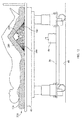
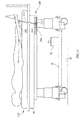
- the pressurizable component is a pair of bellows 180 positioned above the base mattress.
- Pressure sensors 200 monitor bladder pressure to enable bellow spread angle ⁇ to be estimated.
- FIG. 7 shows the bellows in a deflated or collapsed state in which the occupant's legs are in a neutral position.
- FIG. 8 shows the bellows in an inflated or expanded state as a result of pressurized air from pump 60 having been introduced into the bellows. Inflation of the bellows, causes the occupant's legs to be flexed by an amount ⁇ related to bellows spread angle ⁇ .
- the base mattress is an air mattress 112 similar to that of FIG. 1
- the pressurizable component 170 is a triplet of laterally extending orientation adjustment non-bellows bladders 184, 186, 188 positioned above the base mattress.
- Pressure sensors 200 monitor bladder pressure to enable knee joint flex angle ⁇ to be estimated.
- FIG. 9 shows the bladders in a deflated or collapsed state in which the occupant's legs are in a neutral position.
- FIG. 10 shows the bladders in an inflated or expanded state as a result of pressurized air from pump 60 having been introduced into the bladders.
- the bladders of the illustrated embodiment are constructed and/or pressurized so that longitudinally interior bladder 186 expands to a height greater than that of longitudinally exterior bladders 184, 188. Inflation of the orientation adjustment bladders causes the occupant's legs to be flexed by an angle ⁇ related to the heights of the bladders relative to the base mattress.
- the base mattress is a foam mattress 116
- the pressurizable component is a pair of bellows 180 positioned below the base mattress.
- FIG. 11 shows the bellows in a deflated or collapsed state in which the occupant's legs are in a neutral position.
- FIG. 12 shows the bellows in an inflated or expanded state as a result of pressurized air from pump 60 having been introduced into the bellows. Inflation of the bellows causes the occupant's legs to be flexed by an amount ⁇ related to bellows spread angle ⁇ to be estimated.
- pressure sensors 200 enable the magnitude of spread angle to be estimated.
- the bellows of FIGS. 11-12 is a component of the mattress it could instead be a component of deck 58.
- the foam base mattress could be substituted for the base air mattress and vice versa.
- the pressurizable component e.g& bellows and triplet of orientation adjustment bladders
- a segmented deck could be substituted for the non-segmented deck of FIGS. 7-12 .
- pressure sensor 200 which is responsive to pressure in the pressurizable component could be used instead of an angular orientation sensor.
- a pressure sensor could also be used in addition to an angular orientation sensor, for example to provide a benchmark for parameter validation and/or to serve as a backup sensor to accommodate failure of a primary sensor.
- FIGS. 13-14 show a hybrid embodiment in which the occupant support comprises base frame 38, elevatable frame 40 and a support structure 56.
- the support structure includes segmented deck 58 and mattress 110.
- Mattress 110 includes a foam base mattress 116 and an orientation adjustment effector in the form of a pair of bellows 180 positioned below the base mattress.
- the deck segments are all oriented at approximately 0° relative to the elevatable frame, and the bellows is deflated.
- FIG. 13 the deck segments are all oriented at approximately 0° relative to the elevatable frame, and the bellows is deflated.
- actuators 104, 106 have rotated thigh segment 74 and calf segment 76 to non-zero orientations, and pump/actuator 60 has inflated the bellows to a spread angle ⁇ to achieve a knee flexure angle ⁇ more acute than that which could be obtained with either the deck segments or the bellows alone.
- FIGS. 15-21 show embodiments including components operable to provide or withhold popliteal support for a supine occupant of the occupant support.
- the embodiments of FIGS. 15-21 withdraw popliteal support to place the occupant's knee joint in a condition of extension. That is, the occupant's calf and thigh tend to rotate in directions E and F ( FIG. 16 ), which is opposite the normal flex direction shown in the previous illustrations.
- the occupant support includes base frame 38, an elevatable frame 40, an actuator system including pump 60, and a support structure 56.
- the support structure includes a mattress 110, at least a portion of which is operable to provide or withhold popliteal support for a supine occupant of the bed.
- mattress 110 is an air mattress 112 comprising multiple individual bladders 114, five of which (114A, 114B, 114C, 114D, 114E) are inflatable so that they cooperate with the other bladders, as seen in FIG. 15 , to define a substantially continuous and approximately planar profile corresponding to a flat profile that provides popliteal support.
- FIG. 15 As seen in FIG.
- the five popliteal bladders are also deflatable to define an effective concavity 204 or discontinuity corresponding to a non-flat profile.
- deflation of the popliteal bladders allows the occupant's calf and thigh to rotate slightly in directions E and F.
- Factors such as the actual longitudinal position of the occupant relative to the poplitial bladders and the amount of bending moment desired to be applied to the occupants knee joint will determine which of the politeal bladders are selected for deflation.
- FIGS. 17-19 illustrate another embodiment in which the support structure includes a mattress 110, at least a portion of which is operable to define an effective concavity 204 corresponding to a non-flat profile.
- the mattress includes a primary support in the form of a layer of primary support bladders 114.
- the mattress also includes an elevator in the form of longitudinally distributed, selectively inflatable elevation bladders 208 positioned above the primary support.
- An actuation system includes pump 60.
- the elevator bladders are deflatable so that they cooperate with the primary support to define a substantially continuous and planar profile corresponding to a flat profile that provides popliteal support. In the deflated state the elevator bladders may be completely deflated so that the air pressure inside the bladders is negligible.
- the deflated bladders cannot react any loads and therefore are dedicated to providing or withholding popliteal support.
- the elevator bladders may be deflated to a state in which they are still slightly pressurized so that they are load bearing even when deflated. In this state the slightly pressurized elevator bladders contribute to the load bearing capacity of the primary support.
- selected bladders are inflatable to define an effective concavity 204 or discontinuity corresponding to a non-flat profile.
- inflation of the selected elevator bladders withdraws popliteal support and allows the occupant's calf and thigh to rotate slightly in directions E and F.
- Factors such as the longitudinal position of the occupant relative to the elevation bladders and the amount of bending moment desired to be applied to the occupant's knee joint will determine which of the elevation bladders are selected for inflation.
- FIGS. 20-21 another embodiment of the occupant support includes a base frame 38, an elevatable frame 40 and a support structure comprising deck 58 or mattress 110, and a spacer assembly 210.
- the spacer assembly includes a base 212, a link 214 rotatable relative to the base about axis 216 and a roller 220 rotatably mounted on the opposite end of the link.
- the roller extends laterally from the right side of the bed to the left side where it may be connected to a second link similar to the one visible in the illustration.
- FIG. 20 shows the spacer in a neutral position in which it provides popliteal support by enabling mattress 110 to support the entire length of the occupant's leg.
- FIG. 21 is a view of the bed of FIG.
- the spacer can also be adjusted vertically by rotating link 214 about axis 216.
- the actuation system for the spacer can include one or more actuators such as a linear actuator a ballscrew or a motor to translate the assembly longitudinally and rotate the link about its axis.
- the spacer and the mattress which reflects the flat profile of the deck, cooperate to define concavity 204.
Landscapes
- Health & Medical Sciences (AREA)
- Nursing (AREA)
- Life Sciences & Earth Sciences (AREA)
- Animal Behavior & Ethology (AREA)
- General Health & Medical Sciences (AREA)
- Public Health (AREA)
- Veterinary Medicine (AREA)
- Invalid Beds And Related Equipment (AREA)
Applications Claiming Priority (1)
| Application Number | Priority Date | Filing Date | Title |
|---|---|---|---|
| US13/173,521 US20130000041A1 (en) | 2011-06-30 | 2011-06-30 | Occupant Support with a Cyclically Variable Profile |
Publications (2)
| Publication Number | Publication Date |
|---|---|
| EP2540275A2 true EP2540275A2 (fr) | 2013-01-02 |
| EP2540275A3 EP2540275A3 (fr) | 2014-01-08 |
Family
ID=46506179
Family Applications (1)
| Application Number | Title | Priority Date | Filing Date |
|---|---|---|---|
| EP12174015.3A Withdrawn EP2540275A3 (fr) | 2011-06-30 | 2012-06-28 | Support d'occupant avec profil variable cyclique |
Country Status (2)
| Country | Link |
|---|---|
| US (1) | US20130000041A1 (fr) |
| EP (1) | EP2540275A3 (fr) |
Cited By (3)
| Publication number | Priority date | Publication date | Assignee | Title |
|---|---|---|---|---|
| CN103445925A (zh) * | 2013-08-26 | 2013-12-18 | 王玉朝 | 一种多功能抗褥疮康复床 |
| EP2664315B1 (fr) * | 2012-05-14 | 2016-04-27 | Askle Sante | Matelas gonflable à gyroscope intégré |
| CN114569397A (zh) * | 2020-11-30 | 2022-06-03 | 丰田自动车株式会社 | 睡眠用器具 |
Families Citing this family (12)
| Publication number | Priority date | Publication date | Assignee | Title |
|---|---|---|---|---|
| JP6329945B2 (ja) * | 2013-05-15 | 2018-05-23 | パラマウントベッド株式会社 | ベッド装置 |
| US9259098B2 (en) * | 2013-12-06 | 2016-02-16 | Hill-Rom Services, Inc. | Inflatable patient positioning unit |
| JP6089253B2 (ja) * | 2014-01-21 | 2017-03-08 | 株式会社ケーイーアール | 下腿関節運動支援用ティルト台 |
| US10576003B2 (en) | 2014-07-14 | 2020-03-03 | Elaine L. Britton | Personal support sling, a mattress system including such support sling, optionally with a waste elimination system |
| US9545348B2 (en) * | 2014-07-14 | 2017-01-17 | Elaine L. Britton | Mattress with a rotating and waste elimination system |
| KR101662766B1 (ko) * | 2014-12-24 | 2016-10-06 | 주식회사 세라젬 | 에어포켓 타입의 마사지장치 |
| CN104739629A (zh) * | 2015-04-21 | 2015-07-01 | 李安 | 腰腿痛按摩器 |
| AU2015249155B2 (en) * | 2015-10-29 | 2017-08-10 | Winter, Paul Nicholas MR | An air-bed that allows the bariatric patient to be turned from side to side with tilting sets of arms attached to jointed shafts electro-mechanically operated, ensuring patient safety through the use of bedside rails that can double as positioning devices and comfort by being padded. The bed would eliminate physical effort in turning bariatric patients by nursing staff and allow clear areas for treatment |
| KR102513942B1 (ko) * | 2020-08-28 | 2023-03-27 | 경북보건대학교 산학협력단 | 가변 구조를 지닌 매트리스 장치 |
| JP7393101B2 (ja) * | 2020-11-30 | 2023-12-06 | トヨタ自動車株式会社 | 睡眠用器具 |
| CN115039989A (zh) * | 2022-06-17 | 2022-09-13 | 慕思健康睡眠股份有限公司 | 床垫变形调整方法、装置、床垫及存储介质 |
| EP4633571A1 (fr) * | 2022-12-13 | 2025-10-22 | Afifi, Ahmed M. | Systèmes, dispositifs et procédés de support chirurgical |
Citations (1)
| Publication number | Priority date | Publication date | Assignee | Title |
|---|---|---|---|---|
| US5781949A (en) | 1995-08-04 | 1998-07-21 | Hill-Rom, Inc. | Rotational therapy apparatus for a bed |
Family Cites Families (8)
| Publication number | Priority date | Publication date | Assignee | Title |
|---|---|---|---|---|
| EP0323460A1 (fr) * | 1986-08-15 | 1989-07-12 | Butcher, Ian Donald | Appareil de support du corps |
| US5940911A (en) * | 1997-11-10 | 1999-08-24 | Wang; Yi-Lung | Multi-functional bed structure |
| GB9808675D0 (en) * | 1998-04-24 | 1998-06-24 | Comfort & Care Limited | Smart bed |
| US5966762A (en) * | 1998-07-01 | 1999-10-19 | Wu; Shan-Chieh | Air mattress for modulating ridden positions |
| JP2001095858A (ja) * | 1999-03-25 | 2001-04-10 | Matsushita Seiko Co Ltd | 身体を動作させる装置 |
| US7346951B1 (en) * | 2006-11-09 | 2008-03-25 | Heaton Steven C | Bedsore reduction system for beds |
| US8037559B2 (en) * | 2007-09-20 | 2011-10-18 | Toshihiro Niwa | Variable posture bed |
| WO2011155769A2 (fr) * | 2010-06-09 | 2011-12-15 | 한국생산기술연구원 | Plateforme pour lit vibratoire pour empêcher l'escarre de décubitus, possédant un axe de rotation variable pour des types corporels différents et procédé pour commander un cycle de changement de position associé |
-
2011
- 2011-06-30 US US13/173,521 patent/US20130000041A1/en not_active Abandoned
-
2012
- 2012-06-28 EP EP12174015.3A patent/EP2540275A3/fr not_active Withdrawn
Patent Citations (1)
| Publication number | Priority date | Publication date | Assignee | Title |
|---|---|---|---|---|
| US5781949A (en) | 1995-08-04 | 1998-07-21 | Hill-Rom, Inc. | Rotational therapy apparatus for a bed |
Cited By (4)
| Publication number | Priority date | Publication date | Assignee | Title |
|---|---|---|---|---|
| EP2664315B1 (fr) * | 2012-05-14 | 2016-04-27 | Askle Sante | Matelas gonflable à gyroscope intégré |
| CN103445925A (zh) * | 2013-08-26 | 2013-12-18 | 王玉朝 | 一种多功能抗褥疮康复床 |
| CN103445925B (zh) * | 2013-08-26 | 2016-04-27 | 王玉朝 | 一种多功能抗褥疮康复床 |
| CN114569397A (zh) * | 2020-11-30 | 2022-06-03 | 丰田自动车株式会社 | 睡眠用器具 |
Also Published As
| Publication number | Publication date |
|---|---|
| US20130000041A1 (en) | 2013-01-03 |
| EP2540275A3 (fr) | 2014-01-08 |
Similar Documents
| Publication | Publication Date | Title |
|---|---|---|
| EP2540275A2 (fr) | Support d'occupant avec profil variable cyclique | |
| EP2462912B1 (fr) | Augmentation de la vessie de matelas pendant la sortie de chaise | |
| US20250248874A1 (en) | Person support apparatus having exercise therapy features | |
| EP2649908B1 (fr) | Support d'occupant avec vessie sensible à la migration et procédé de détection de migration | |
| US4989283A (en) | Inflation control for air supports | |
| EP3653271B1 (fr) | Appareils de soutien des personnes dotés d'éléments de rééducation par l'exercice | |
| US12310905B2 (en) | Bed apparatus and patient detection method | |
| EP3384890B1 (fr) | Lit d'hôpital à largeur variable | |
| US10413464B2 (en) | Multi-mode sacral unloading pressure relief in a patient support surface | |
| JP2012183312A (ja) | 使用者保持装置および使用者保持装置上の使用者のポジショニングのための方法 | |
| CN109922771A (zh) | 病床 | |
| Mansouri et al. | Review of assistive devices for the prevention of pressure ulcers: an engineering perspective | |
| EP3603598B1 (fr) | Structure de support d'occupant résistant aux lésions de la peau | |
| EP2874591B1 (fr) | Table d'auscultation posturale munie de capteurs pour thérapie physique | |
| US11998497B2 (en) | Device for supporting a body part | |
| JP7250812B2 (ja) | 人を扱うためのサポート構造の加圧 | |
| CN107928925A (zh) | 防褥疮的气动枕桥 | |
| KR20210135214A (ko) | 접촉 압력을 완화하기 위한 팽창가능한 관류 개선 장치를 제어 및 모니터링하는 시스템 및 방법 |
Legal Events
| Date | Code | Title | Description |
|---|---|---|---|
| PUAI | Public reference made under article 153(3) epc to a published international application that has entered the european phase |
Free format text: ORIGINAL CODE: 0009012 |
|
| AK | Designated contracting states |
Kind code of ref document: A2 Designated state(s): AL AT BE BG CH CY CZ DE DK EE ES FI FR GB GR HR HU IE IS IT LI LT LU LV MC MK MT NL NO PL PT RO RS SE SI SK SM TR |
|
| AX | Request for extension of the european patent |
Extension state: BA ME |
|
| PUAL | Search report despatched |
Free format text: ORIGINAL CODE: 0009013 |
|
| AK | Designated contracting states |
Kind code of ref document: A3 Designated state(s): AL AT BE BG CH CY CZ DE DK EE ES FI FR GB GR HR HU IE IS IT LI LT LU LV MC MK MT NL NO PL PT RO RS SE SI SK SM TR |
|
| AX | Request for extension of the european patent |
Extension state: BA ME |
|
| RIC1 | Information provided on ipc code assigned before grant |
Ipc: A61G 7/057 20060101AFI20131129BHEP |
|
| STAA | Information on the status of an ep patent application or granted ep patent |
Free format text: STATUS: THE APPLICATION IS DEEMED TO BE WITHDRAWN |
|
| 18D | Application deemed to be withdrawn |
Effective date: 20140709 |