EP2543220B1 - Verfahren zur funkressourcenzuweisung in einem funkkommunikationssystem - Google Patents
Verfahren zur funkressourcenzuweisung in einem funkkommunikationssystem Download PDFInfo
- Publication number
- EP2543220B1 EP2543220B1 EP11707829.5A EP11707829A EP2543220B1 EP 2543220 B1 EP2543220 B1 EP 2543220B1 EP 11707829 A EP11707829 A EP 11707829A EP 2543220 B1 EP2543220 B1 EP 2543220B1
- Authority
- EP
- European Patent Office
- Prior art keywords
- radio
- block
- radio block
- allocated
- blocks
- Prior art date
- Legal status (The legal status is an assumption and is not a legal conclusion. Google has not performed a legal analysis and makes no representation as to the accuracy of the status listed.)
- Active
Links
- 238000004891 communication Methods 0.000 title claims description 44
- 238000000034 method Methods 0.000 title claims description 35
- 238000013468 resource allocation Methods 0.000 title description 10
- 230000004044 response Effects 0.000 claims description 17
- 230000005540 biological transmission Effects 0.000 claims description 12
- 230000000737 periodic effect Effects 0.000 claims description 8
- 238000004590 computer program Methods 0.000 claims description 7
- 230000007480 spreading Effects 0.000 claims description 6
- 230000004075 alteration Effects 0.000 claims description 3
- 230000001955 cumulated effect Effects 0.000 claims description 2
- 238000003199 nucleic acid amplification method Methods 0.000 description 12
- 230000006870 function Effects 0.000 description 8
- 101100172132 Mus musculus Eif3a gene Proteins 0.000 description 4
- 238000010586 diagram Methods 0.000 description 4
- 238000005516 engineering process Methods 0.000 description 4
- 230000011664 signaling Effects 0.000 description 4
- 230000003466 anti-cipated effect Effects 0.000 description 2
- 238000001514 detection method Methods 0.000 description 2
- 238000012545 processing Methods 0.000 description 2
- 230000001629 suppression Effects 0.000 description 2
- LHASLBSEALHFGO-ASZAQJJISA-N 1-[(4s,5r)-4-hydroxy-5-(hydroxymethyl)oxolan-2-yl]-5-[[(2r,3r,4s,5s,6r)-3,4,5-trihydroxy-6-(hydroxymethyl)oxan-2-yl]oxymethyl]pyrimidine-2,4-dione Chemical compound C1[C@H](O)[C@@H](CO)OC1N1C(=O)NC(=O)C(CO[C@H]2[C@@H]([C@@H](O)[C@H](O)[C@@H](CO)O2)O)=C1 LHASLBSEALHFGO-ASZAQJJISA-N 0.000 description 1
- PRKWNRUVAZZHPH-UHFFFAOYSA-N 2-(4-chlorophenyl)sulfonyl-6-methoxy-3-nitropyridine Chemical compound COC1=CC=C([N+]([O-])=O)C(S(=O)(=O)C=2C=CC(Cl)=CC=2)=N1 PRKWNRUVAZZHPH-UHFFFAOYSA-N 0.000 description 1
- 239000000969 carrier Substances 0.000 description 1
- 230000003247 decreasing effect Effects 0.000 description 1
- 239000000284 extract Substances 0.000 description 1
- 238000009499 grossing Methods 0.000 description 1
- 230000007774 longterm Effects 0.000 description 1
- 238000007726 management method Methods 0.000 description 1
- 238000013507 mapping Methods 0.000 description 1
- 238000005259 measurement Methods 0.000 description 1
- 238000004377 microelectronic Methods 0.000 description 1
- 238000010295 mobile communication Methods 0.000 description 1
- 230000004048 modification Effects 0.000 description 1
- 238000012986 modification Methods 0.000 description 1
- 230000010363 phase shift Effects 0.000 description 1
- 230000008569 process Effects 0.000 description 1
- 230000007704 transition Effects 0.000 description 1
Images


Classifications
-
- H—ELECTRICITY
- H04—ELECTRIC COMMUNICATION TECHNIQUE
- H04W—WIRELESS COMMUNICATION NETWORKS
- H04W72/00—Local resource management
- H04W72/50—Allocation or scheduling criteria for wireless resources
- H04W72/54—Allocation or scheduling criteria for wireless resources based on quality criteria
- H04W72/543—Allocation or scheduling criteria for wireless resources based on quality criteria based on requested quality, e.g. QoS
-
- H—ELECTRICITY
- H04—ELECTRIC COMMUNICATION TECHNIQUE
- H04W—WIRELESS COMMUNICATION NETWORKS
- H04W16/00—Network planning, e.g. coverage or traffic planning tools; Network deployment, e.g. resource partitioning or cells structures
- H04W16/14—Spectrum sharing arrangements between different networks
-
- H—ELECTRICITY
- H04—ELECTRIC COMMUNICATION TECHNIQUE
- H04W—WIRELESS COMMUNICATION NETWORKS
- H04W72/00—Local resource management
- H04W72/04—Wireless resource allocation
- H04W72/044—Wireless resource allocation based on the type of the allocated resource
- H04W72/0446—Resources in time domain, e.g. slots or frames
-
- H—ELECTRICITY
- H04—ELECTRIC COMMUNICATION TECHNIQUE
- H04W—WIRELESS COMMUNICATION NETWORKS
- H04W72/00—Local resource management
- H04W72/12—Wireless traffic scheduling
- H04W72/1263—Mapping of traffic onto schedule, e.g. scheduled allocation or multiplexing of flows
-
- H—ELECTRICITY
- H04—ELECTRIC COMMUNICATION TECHNIQUE
- H04W—WIRELESS COMMUNICATION NETWORKS
- H04W88/00—Devices specially adapted for wireless communication networks, e.g. terminals, base stations or access point devices
- H04W88/08—Access point devices
-
- H—ELECTRICITY
- H04—ELECTRIC COMMUNICATION TECHNIQUE
- H04W—WIRELESS COMMUNICATION NETWORKS
- H04W72/00—Local resource management
- H04W72/04—Wireless resource allocation
Definitions
- the present invention relates to a radio communication system including base stations and mobile stations that communicate with the base stations through radio resources shared in a predetermined wide frequency band and during radio frames.
- the invention finds applications more specifically in Professional Mobile Radio (PMR) systems having their implementation depending on communication needs and radio coverage varying in time.
- PMR Professional Mobile Radio
- each base station has only available a frequency channel consisting in a sub-band of the predetermined frequency band and accordingly, only limited radio resources allocated to it.
- the base station According to requests of applications in the base station or a mobile station, the base station locally allocates uplink and/or downlink radio resources to each application.
- the predetermined frequency band is wide, only a few base stations can establish links with mobile stations.
- the number of radio resources can not dynamically progress as a function of the application needs of the base stations, two base stations being unable to dialog remaining without any progress of their initially limited numbers of radio resources.
- the dialog between two base stations makes the associated network infrastructure more complex and slows down the implementation of the radio communication system whose mobility then is restricted.
- a node such as a station
- CSMA/CD Carrier Sense Multiple Access with Collision Detection
- the collision detection improves the performance of the CSMA access by stopping the transmission for a random period of time as soon as a transmission collision is detected and reduces the probability of a second collision upon another transmission attempt.
- a protocol is implemented in narrow band systems according to the standard IEEE 802.1 1 , or meeting the WiFi (Wireless Fidelity) label.
- This invention has in common with the CSMA CD access, sensing shared radio resources, signalling a data transmission and managing a collision.
- US2009/219810 discloses a point-to-multipoint or multipoint-to-multipoint communication network comprises at least one management center and remote traffic stations, between which radio links sharing resources allocated dynamically by the management center have been established.
- Each traffic station is tasked, whenever it needs additional resources to increase the useful traffic that it must transmit to the management center, with adding to the current useful traffic a first traffic, known as smoothing traffic and representative of a selected margin, and a second traffic, known as anticipated traffic and representative of an anticipated need for additional resources, in order to implicitly solicit the management center, then with determining whether additional resources were allocated by the management center, and, if additional resources were allocated, to increase the useful traffic by an amount corresponding as much as possible to the sum of the resources corresponding to the first traffic and allocated additional resources.
- US2007/086474 discloses a method for estimating the size of a MAP region according to data burst allocation in a wireless mobile communication system.
- a data burst region is divided into at least one sub-region.
- a downlink frame is constructed with at least one sub-region such that a power boosting process is performed according to a predefined power level.
- the data burst is allocated to a specific sub-region of the sub-region according to a carrier to interference and noise ratio (CINR) of the data burst.
- CINR carrier to interference and noise ratio
- a concatenation or non-concatenation of the data bursts is set according to a predetermined criterion when the slot occupancy rate is less than a predefined slot occupancy rate.
- a size of the MAP region to be occupied by allocation information of the data bursts to be concatenated or unconcatenated is set.
- the object of the invention is to have shared in frequency and in time the wide frequency band of a radio communication system by base stations each managing itself autonomously the allocation of radio resources for its own application needs without having such a share of radio resources requiring communications between the base stations.
- a method for allocating to an application radio resources amongst radio blocks wherein the radio blocks are shared in a predetermined frequency band during a periodic radio frame between base stations, each radio block spreading on frequencies of said band during a time slot of the radio frame, and each the radio block and being able to be associated with a communication link between a base station and a mobile station, wherein it includes in a base station in response to quality-of-service parameters required by the application:
- the quality-of-service parameters can be conventionally a flow rate and a maximal allocation duration required to transmit data on an uplink or downlink, or other equivalent parameters.
- the allocation periodicity for a radio block to be allocated derived from the quality-of-service parameters by the base station is expressed in number of frame period.
- Each base station estimates occupation rates of all the radio blocks independently from the other base stations, for the quality-of-service needs of its own applications able to be implemented in the base station and /or in mobile stations attached to the base station.
- the base stations are autonomous in terms of allocation of radio blocks.
- each base station or each mobile station can over-amplify predefined radio elements in a radio block allocated to an application included in said each station, each radio block being made of radio elements spread on frequencies of the radio block and equi-distributed in the time slot of the radio block.
- Over-amplifying predefined radio elements in an allocated radio block can depend on the allocation periodicity of the allocated radio block, or over-amplifying predefined radio elements in any radio block allocated to a station can be constant.
- Estimating the occupation rate of a radio block can then include measuring a received mean power associated with the over-amplified predefined radio elements of the radio block and a received mean power associated with the other radio elements of the radio block, determining the difference of the measured received mean powers for the radio block in each one of the consecutive radio frames, and determining the average of the mean power differences during the consecutive radio frames constituting the occupation rates.
- the base stations can sense the close end of the allocation of a radio block by another station thanks to a suppression of the over-amplification of the predefined radio elements in a radio block for a data emission from said other station in at least one radio frame preceding the expiration of an allocation duration. The suppression of the over-amplification results in a decrease of the difference of the received mean powers measured for the radio block that can be detected in the base stations.
- allocating a radio block to the requesting application can include selecting iteratively one or several scarcely occupied radio blocks until of radio resource quantities associated with the selected radio blocks and cumulated for a required allocation duration according to the required quality-of-service parameters are at least equal to a required radio resource quantity derived from the required quality-of-service parameters, and for each allocated selected radio block, selecting a first radio frame wherein the allocated selected radio block is a priori unoccupied.
- the iterative selection of one or several scarcely occupied radio blocks can iteratively include selecting a scarcely occupied radio block in the frames, determining an allocation periodicity to be associated with the selected radio block depending on the occupation rate of the selected radio block and on the required quality-of-service parameters, and determining a quantity of radio resources associated with the selected radio block for the required allocation duration, as long as the sum of the radio resource quantities associated with the selected radio blocks for the required allocation duration is not at least equal to the required radio resource quantity.
- Selecting a first radio frame for each allocated selected radio block can include selecting any first frame if the allocated selected radio block is unoccupied, and if the allocated selected radio block is partially occupied in consecutive frames, determining a difference of a mean power associated with predefined radio elements of the allocated selected radio block and a mean power associated with the other radio elements of the allocated selected radio block for each one of previous consecutive frames in number equal to the periodicity of the allocated selected radio block, and selecting amongst the previous consecutive frames a first frame for which the difference of mean powers is nil.
- the allocation of a radio block can also be based on estimated parameters other than the occupation rates of the radio blocks. For example, in each base station, an average of the received mean powers associated with determined radio elements in each radio block, as so-called "un-predefined" radio elements in the remainder of the description, can be estimated. Such parameters are compared to thresholds able to vary according to the allocation rules. Some of such comparisons can be relative to an estimation of distances between stations.
- a radio block is allocatable to the application if the average of mean powers associated with radio elements in the radio block and measured during consecutive radio frames is less than a threshold, whatever the occupation rate of the radio block.
- a radio block able to be allocated has been, a priori, allocated to a base station or a mobile station remote from the base station being to meet the application.
- the method of this invention can still include modifying one of the required quality-of-service parameters as a result of an at least partial alteration of the transmission of data of the application within the allocated radio block. Such a lack of response can result from a radio block allocation collision between two stations.
- This invention also relates to a radio communication system including base stations and mobile stations for allocating radio resources amongst radio blocks to applications in the stations, the radio blocks being shared in a predetermined frequency band during a periodic radio frame between the base stations, and each radio block spreading on frequencies of said band during a time slot of the radio frame and being able to be associated with a communication link between a base station and a mobile station.
- the radio communication system is characterized in that, to meet quality-of-service parameters required by an application in a base station, the base station includes:
- the invention further relates to a base station for allocating to an application radio resources amongst shared radio blocks in a predetermined frequency band during a periodic radio frame between base stations.
- the base station includes estimating means and allocating means so as to meet quality-of-service parameters required by the application in the base station.
- the invention is relative to a computer program able to be implemented in a base station, said programme comprising instructions that, when the programme is executed in said base station, carry out estimating occupation rates and allocating at least one radio block according to the method of the invention.
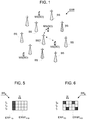
- a broadband radio communication system SYR includes base stations BS and mobile stations MS that communicates with the base stations through shared radio resources in a predetermined wide frequency band ⁇ f[f 11 , f JN ].
- the band ⁇ f is of a few MHz for a carrier of a few hundred of MHz.
- the radio communication system is based on some prerogatives of the WiMAX known technology, of the standard 802.16e/j and of the LTE technology, a radio interface of the OFDMA (Orthogonal Frequency Division Multiple Access) type and some concepts of the CSMA/CD access.
- OFDMA Orthogonal Frequency Division Multiple Access
- the system SYR does not comprise any centralized management infrastructure of radio resources.
- the base stations are autonomous and do not contain any means for communicating directly therebetween.
- Managing associations of mobile stations with a base station is independent from those relating to the other base stations. This allows the radio communication system to be implemented, more particularly, for urgent or temporary communication needs, such as in an "ad hoc" network, by adding, or subtracting, fixed or mobile stations as the mobility of mobile stations extends and as the radio coverage ensured by the system optionally extends.
- the frequency band ⁇ f to be shared between base stations is fixed. This means that the available frequency bands and the radio resources associated with each base station are limited for a radio frame. Only base stations whose number is variable can establish communications with mobile stations as a function of the availability of the radio resources in the frequency band ⁇ f during a radio frame.
- Each base station BS is able to estimate the partial or total occupation of radio resources by the other base stations, to thereby allocating available radio resources in the frequency band ⁇ f for its own communications with one or more mobile stations thanks to radio resources shared between the base stations.
- a base station cannot take radio resources another base station has allocated to itself, when those two stations are relatively close. All the base stations have a predetermined maximum emission power and all the mobile stations have a predetermined maximum emission power.
- the distribution of frequencies of the predetermined frequency band ⁇ f[f 11 , f JN ] in the frequency and time plane (f, t) between active downlinks and uplinks between the stations is based on OFDMA orthogonal frequency division multiple access transmissions.
- the predetermined frequency band ⁇ f[f 11 , f JN ] is divided into J frequency channels C 1 to C J .
- J radio blocks BR 1p to BR Jp associated with J channels C 1 to C J and each having N strings of radio elements ER 1njp to ER Mnjp of a duration ⁇ t, associated with N respective consecutive frequencies f j1 to f jN can be allocated respectively to at the most J base stations for links with mobile stations, with 1 ⁇ m ⁇ M.
- An radio element ER mnjp associated with a respective frequency f jn defines the smallest allocation unit during which a base station can exchange data at the respective frequency with a mobile station on an uplink according to the direction from the mobile station to the base station or on a downlink according to the direction from the base station to the mobile station.
- a data symbol for a communication link with characteristics depending on the flow rate and on the type of modulation used for the communication can be transmitted.
- the modulation is a PSK phase shift keying modulation or a quadrature amplitude modulation QAM16 or QAM64 with several amplitude levels. Different types of modulation can be used for a single radio block for signalling, traffic data and pilots.
- An APR application in a base station can require a radio block to be allocated for communicating data through a downlink from the base station to a mobile station, and another radio block to be allocated for communicating data through an uplink from the mobile station to the base station.
- an application APR in a mobile station can require a radio block to be allocated for communicating data through an uplink from the mobile station to a base station, and another radio block to be allocated for communicating data through a downlink from the base station to the mobile station.
- an application is a software module for processing user data whose communication is required by the application and that are relative to voice, or to video, or that are specific to any interactivity between a base station and a mobile station, as a station location on a map.
- the applications in the stations thus have different quality-of-service needs, more specifically, in terms of quantity and periodicity of radio resources and communication duration.
- the association of a radio block to an uplink or a downlink is decided by each base station BS. If the system SYR operates in a FDD (Frequency Division Duplex) mode, the base station BS simultaneously emits and receives in at least two blocks of two different frequency channels respectively associated with the uplink and the downlink of a communication with a mobile station MS. If the system SYR operates in a TDD (Time Division Duplex) mode, the base station BS emits and receives during different time slots M ⁇ t in at least two radio blocks belonging to a common frequency channel and respectively associated with the downlink and the uplink of a communication with a mobile station MS.
- FDD Frequency Division Duplex
- TDD Time Division Duplex
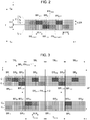
- Each frame TR i comprises a predetermined number JxP of radio blocks BR 11 to BR JP distributed into P columns.
- Each column has a duration M ⁇ t and contains J radio blocks.
- a base station for transmitting data to a mobile station or receiving data from the mobile station can periodically allocate at least one available radio block BR jp having the same position marked by indicia j and p in frames offering an allocation periodicity PA block expressed in a number of consecutive frame periods T frame .
- the base station BSD includes functional blocks most of which provide functions having a relationship with this invention and can correspond to software modules implemented in at least one processor and/or to dedicated or programmable hardware modules.
- the functional blocks are, more particularly, a radio block detector DBR, a radio block occupation estimator EOB, a radio block scheduler ABR, an over-amplification module MSA and a booster BO.
- the scheduler ABR includes a radio block selector SBR and a radio frame selector STR.
- Each mobile station MS further includes a booster BO for uplink.
- the allocation periodicity and duration for a radio block depend on radio resource needs of a requesting application APR implemented in the base station BSD, or in a mobile station MS having to communicate with the base station BSD, and are defined as a function of known quality-of-service parameters QoS for data to be communicated, such as a flow rate DB and an allocation duration DAR required for an uplink or a downlink and optionally the distance between stations.
- the application APR in the station BSD or MS transmits to the radio block scheduler ABR in the station BSD a radio resource allocation request RQA including the quality-of-service parameters QoS(DB, DAR) for a communication link.
- the station BSD derives therefrom an allocation periodicity PA block for each block to be allocated expressed in a number of frame periods T frame that is at least equal to 1.
- the allocation request also includes the identifier IMS of the mobile station MS that has to communicate with the base station BSD by the communication link.
- the radio modulation type for the communication link is determined by the base station BSD.
- the allocations of the radio blocks are independent.
- plural radio blocks able to have different periodicities for meeting the required parameters for an uplink or a downlink, such as for example for the first link set forth above, can be allocated to a single allocation request.
- the booster BO in a base station BS or a mobile station MS is adapted for over-amplifying (boosting) the emission power of predefined radio elements ERP mnjp comparatively to the other radio elements, referred to as un-predefined radio elements ERNP mnjp , in an allocated radio block BR jp so that each one of the base stations is able to detect radio blocks allocated to other base stations and other mobile stations in the frames, as will be seen hereinafter.
- the over-amplified predefined radio elements ERP mnjp can be for example:
- the booster BO in the station including the requesting application APR having received an accepted allocation response RPA increases by ⁇ P the emission power of the predefined radio elements ERP mnjp of all the radio blocks to be emitted in the frames, allocated to this application.
- the over-amplified power of the predefined radio elements is determined by the over-amplification module MSA in the base station.
- the module MSA determines an over-amplifying parameter BOOST according to one of first and second next over-amplifying methods and introduces it in the allocation response RPA to the application APR.
- the module MSA distributes an mean excess EXP of available emission power in the station having transmitted the allocation request RQA proportionally to the allocation periodicities of allocated radio blocks.
- the power excess EXP depends on the difference between the predetermined maximum emission power of the station and the sum of the emission powers for all the radio blocks allocated to the station in average per frame, based on a constant emission power for all the radio elements of the allocated blocks. For example, if an allocated block BRS jp is allocated with an allocation periodicity PA block , i.e.
- the over-amplification parameter BOOST is 1/PA block of the power excess EXP for the predefined radio elements ERP mnjp in the allocated and not allocated blocks of all the frames having the same location as that of the allocated block BRS jp .
- the over-amplification parameters BOOST are 1/2 and 1/3 fractions of the power excess EXP for the predefined radio elements ERP mnjp in the allocated and not allocated blocks of all the frames having the same locations as those of the first and second allocated blocks.
- the module MSA imposes a constant over-amplification gain parameter BOOST identical for all the predefined radio elements ERP mnjp in each allocated block BRS jp to the station having transmitted the allocation request RQA, whatever the allocation periodicity of the block.
- the parameter BOOST is proportional to the ratio of the available power minimum excess EXP in the station on the maximum number of blocks able to be allocated to the station for a predetermined duration.
- the over-amplification module MSA in the station including the requesting application APR suppresses the over-amplification of the predefined radio elements ERP mnjp of the block allocated in one or more last frames at the expiration of the allocation duration indicated in the allocation request RQA.
- the number of last frames with the allocated block having non over-amplified predefined radio elements can be proportional to the allocation duration.
- the base station BSD checks the occupation of radio blocks in the frames with the predetermined frequency band ⁇ f[f 11 , f JN ] by means of the received radio block detector DBR.
- the powers PNP jpi and ⁇ P jpi in association with the block indicia j and p and the index i for each frame TR i are written in memory in the radio block occupation estimator EOB of the base station BSD.
- the base station BS When the radio communication system SYR operates in the FDD frequency division duplex mode, the base station BS emits and receives in different frequency channels during the same time slot M ⁇ t on the downlink and uplink of a communication with a mobile station; the detector DBR in the base station is not able to detect the power emitted by the other stations of the system during this time slot.
- the radio communication system operates in a TDD time division duplex mode, the downlink and uplink of a communication with the base station BSD share the same frequency channel for different time slots separated by transition time intervals; the detector DBR in the base station is able to detect the power emitted by the other stations of the system except during the time slots allocated to the emission on the downlink. In these two modes, the detector DBR in the base station BS measures the received powers associated with radio blocks when the detector DBR is able to detect itself the power emitted by the other stations.
- the radio block detector DBR For the radio block detector DBR to acquire measured received powers associated with all the radio blocks of each frame even when the base station BS is unable to detect the power emitted by other stations, one of the two following power measurement solutions is implemented.
- the base station BSD postpones some emissions of data so that the detector DBR measures received mean powers associated with the radio elements ERP and ERNP in the radio blocks emitted by other stations.
- the over-amplification module MSA within the latter removes the over-amplification of predefined radio elements ERP mnjp of the allocated block or the allocated blocks in one or more frames for preliminarily signalling the postponement of the emission to other neighbouring base stations located under the radio coverage of the base station BSD. This preliminary emission postponement signalling reduces the number of base stations deciding to postpone at the same time their emissions.
- the base station BSD controls one or more mobile stations communicating with the base station, to measure received powers associated with radio elements in radio blocks emitted by other stations and to transmit the measured powers to the base station BS, whether the detector DBR is able or unable to detect the power emitted by the other stations.
- the radio block occupation estimator EOB in the base station BSD stores them for using them in a periodic estimation of the mean occupation of radio blocks by the other stations in the I frames in active links.
- the integer I is more than 1 and can be at least equal to the highest acceptable block periodicity PA block .
- each base station BS is able to establish a mapping in the form of an occupation rate table of dimensions JxP reflecting the occupation, the partial occupation and the inoccupation of the radio blocks in average per period of frame in I consecutive frames for the share frequency band ⁇ f[f 1 , f N ].
- the period of the estimation can be that T frame of the radio frames or a few periods of radio frame.
- the average M ⁇ P jp is compared for example to two thresholds of power difference average S ⁇ P1 and S ⁇ P2 such that S ⁇ P1 ⁇ S ⁇ P2 by the estimator EOB for deriving therefrom the occupation rate of the radio block BR jp that is classified into one of the three following occupation classes:
- the thresholds S ⁇ P1 and S ⁇ P2 are equal and the occupation rates are estimated as low or high in two occupation classes.
- the average MPNP jp is compared for example to two mean power thresholds SPNP1 and SPNP2 such that SPNP1 > SPNP2 by the estimator EOB for approximately deriving therefrom the mean distance D jp between the given base station BSD and the station or the stations having introduced data in the radio block BR jp during the I consecutive radio frames.
- the mean distance D jp is classified in one of the three following distance classes:
- the thresholds SPNP1 and SPNP2 are equal and the distance is estimated small or high in two distance classes.
- the estimator EOB compares the average MPNP jp to a lot of thresholds for more accurately estimating the distance D jp of the stations having emitted the radio block BR jp so as to locate them on a map.
- the estimator EOB delivers the indicia of the radio blocks j and p of the radio blocks BR jp with the occupation rate and distance class parameters CO jp and CD jp for the frames TR 1 to TR I to the radio block scheduler ABR.
- the radio block scheduler ABR thus periodically stores a radio block mean-occupation table TBR in time and frequency for the frames TR 1 to TR I .
- the scheduler ABR in the given base station BSD can accept or refuse the radio resource allocation request RQA provided by the application APR. For example, if unoccupied and scarcely occupied radio blocks in the class C01 meet the required quality-of-service parameters QoS(DB, DAR) included in the request RQA, the scheduler ABR selects one or more radio blocks in the frames as a function of quality-of-service parameters, accepts the request and transmits to the application an allocation response RPA including for each allocated radio block the indicia p and j, the allocation periodicity of the allocated radio block and the number of a first selected frame whose the allocated radio block will contain user data, and the identifier IMS of the mobile station MS that has to communicate with the base station BSD.
- the scheduler ABR allocates each radio block independently from the others. This means that radio blocks in plural consecutive frames allocated to an application can be distributed into said plural consecutive frames according to different respective allocation periodicities, such as for the examples of allocated block distribution shown on figure 3 .
- the estimator EOB periodically updates the radio block occupation table and extracts from this table selectable radio blocks BRS that are able to be allocated, according to predetermined allocation rules relating to classes C01 to C03 and CD1 to CD3, and that make up a list LBRS.
- the list LBRS is supplied to the radio block scheduler ABR to allocate one or more radio blocks to the request RQA as a function of quality-of-service parameters QoS(DB, DAR) of the latter.
- the estimator establishes a list LBRS containing the radio blocks having relatively low occupation rates belonging to the class C01 or to the classes C01 and C02, and adds to this list the radio blocks emitted by stations relatively remote from the base station BSD and for which the distances belong to the class CD3 or to the classes CD2 and CD3, whatever their occupation rates.
- the added radio blocks have relatively low interferences with such radio blocks to be allocated by the base station BSD.
- the occupation rate thresholds S ⁇ P1 and S ⁇ P2 and/or the distance thresholds SPNP1 and SPNP2 are varying every I consecutive frames TR 1 to TR I . For example, if the number of radio blocks in the selectable radio block list LBRS based on the class C01 is insufficient for a selection of blocks in response to one or more refused requests RQA, the scheduler ABR controls the estimator EOB to increase progressively the threshold S ⁇ P1 until threshold S ⁇ P2.
- the scheduler ABR refuses the allocation request RQA if the list LBRS is empty, or if one or several blocks in the list LBRS can not meet the quantity of radio resources QR derived from the quality-of-service parameters QoS(DB, DAR) in the request.
- the estimators in the base stations BS establish radio block occupation tables and selectable radio block lists that are different and independent one from each other as the tables and the lists depend on different reception powers and different distances between the stations.
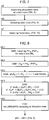
- the radio resource allocation method embodying the invention in the given base station BSD includes a selection SB of radio block to be allocated and a selection ST of radio frames in response to an allocation request RQA transmitted by a requesting application APR, after an estimation SE of the occupation rates of the radio blocks and an establishment of selectable radio block list LBRS by the base station BSD, as shown on figure 7 .
- the estimation of the occupation rates of all the radio blocks BR 11 to BR jp includes at least the following steps SE1 to SE4 shown on figure 8 for each radio block BR jp :
- the estimator EOB establishes a table of the occupation rates of the radio blocks BR 11 to BR JP and a list LBRS of unoccupied or scarcely occupied selectable radio blocks BRS chosen in the table according to predetermined allocation rules relating to the classes C01 to C03.
- the blocks are classified into the distance classes CD1 to CD3 in step SE4 and the allocation rules are also based on the distance classes in step SE5.
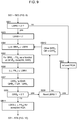
- the radio block selection includes steps SB1 to SB11 shown on figure 9 .
- step SB1 the radio block selector SBR examines the content of the selectable radio block list LBRS. If the list LBRS is empty, the scheduler ABR refuses the allocation request in step SB2. Otherwise, the scheduler ABR establishes an empty list LBRA of radio block to be allocated to the request RQA, in step SB3.
- the selector SBR actives a random number generator in the scheduler in step SB4 for randomly obtaining the indicia j and p of a selected radio block BRS jp amongst those of the list LBRS comprising unoccupied and scarcely occupied selectable radio blocks.
- the selector SBR points to the block BRS jp in the list LBRS as a function of the randomly selected indicia j and p.
- the selector SBR reads the occupation rate M ⁇ P jp of the selected radio block BRS jp and the quality-of-service parameters QoS(DB, DAR) extracted from the request RQA for deriving therefrom a minimum allocation periodicity PS jp to be associated to the selected radio block BRS jp , in step SB5.
- the indicia of the block BRS jp and the periodicity PS jp are stored in association in the list LBRA to be established for the request RQA, in step SB6.
- step SB8 If the remaining quantity QRR jp is strictly positive in step SB8, i.e. if the required quantity of radio resources QR is not completely allocated, and if there is at least one block left to be processed in the list LBRS in step SB9, the quantity QR is put equal to QRR jp in step SB10 and the radio block selection goes back to step SB4 for trying to allocate another radio block.
- the steps SB4 to SB9 are repeated for selecting in the list LBRS one or more other blocks BRS jp to be added to the list LBRA so as to meet the remaining quantity of radio resources QRR.
- step SB9 If in step SB9, the list LBRS has been completely read, the remaining quantity QRR jp being positive, the block or the blocks read in the list LBRS are insufficient for meeting the required parameters QoS(DB, DAR); the request RQA is refused in step SB2.
- the scheduler ABR controls the estimator EOB to increase progressively the threshold S ⁇ P1 and thus the number of selectable radio blocks in the list LBRS.
- the selector SBR associates the allocated blocks BRA jp of the list LBRA with the request RQA, in step SB11, which means that the scheduler accepts the request RQA.
- the radio frame selection includes steps ST1 to ST6 and follows step SB11 for introducing each allocated radio block BRA jp in the previously established list LBRA.
- the radio frame selector STR of the given base station BSD is adapted to select a first radio frame wherein the radio block BRA jp allocated to the requesting application APR is a priori unoccupied.
- PS jp is the periodicity of the allocated block BRA jp that has been determined by the selector SBR.
- step ST4 the selector SBR looks for, amongst the previous frames TR i to TR i+PSip-1 , the frame TR k for which the difference ⁇ P jpk for the selected block BRS jp is nil, with i ⁇ k ⁇ i + PS ip - 1, and consequently, in which the allocated block BRA jp is unoccupied.
- the selector SBR adds its indicia k to the periodicity PS jp in step ST5 and the selector STR ends the allocation of the selected block by introducing the index k + PS jp in the allocation response RPA, in step ST6.
- the station BSD or a mobile station MS where the requesting application APR is implemented can then insert data in the allocated block BRA jp of a first frame having the index k + PS jp that follows the frame TR k and wherein the block BRA jp is a priori unoccupied.
- Sets of steps ST1 to ST6 are executed independently one from the other by the selector STR respectively for the allocated blocks BRA jp of the list LBRA so as to allocate them individually in the frames with a requesting application APR as a function of their periodicities PS jp . If at least one of the allocated blocks is occupied, an allocation collision occurs and a hereinafter described procedure for repeating an allocation request is executed.
- the given base station BSD transmits to the station containing the requesting application APR an allocation response RPA including triplets (j, p, k + PS jp ) associating with indicia j and p of the allocated radio blocks BRA jp the indicia k + PS jp of the first frames that are to contain data in these blocks.
- the over-amplification parameter BOOST determined according to one of first and second previously described methods by the module MSA is also introduced in the response RPA.
- the booster BO in the station containing the requesting application APR over-amplifies the power of predefined radio elements ERP mnjp of all the radio blocks that have been allocated to the application APR and that are to be emitted according to their periodicities in the frames, in a step SR2.
- the radio resource allocation method of the invention makes use of an allocation request repeating procedure HARQ (Hybrid Automatic Repeat reQuest) also shown on figure 10 , to overcome an allocation collision between at least two stations.
- HARQ Hybrid Automatic Repeat reQuest
- Such a procedure takes place in each one of the two stations wherein applications have transmitted user data mixed in a common allocated radio block of a radio frame. If the application in a station in collision has not received an acknowledgement of the transmitted user data, the application in this station controls a retransmission of the user data for a predetermined number of time at least equal to 1.
- a partial or total alteration of the transmission of data results in the application modifying at least one of its quality-of-service parameters QoS(DB, DAR) in its allocation request RQA.
- the modification of the allocation request allows the application to request the allocation of one or several radio blocks different from that or those previously allocated to the application to the base station BS associated with the application, in a step SC2.
- the associated base station BS decides to impose another type of radio modulation corresponding for example to the modulation QAM16 in response to a decreased required flow rate DB included in the modified request RQA.
- Such changes of required flow rate and modulation type lead to another required quantity of radio resources QR and a selection of one or several other radio blocks allocated with different allocation periodicities and selected amongst the radio blocks of a selectable radio block list established in response to the received modified request by the scheduler ABR of the associated base station BS.
- the response to the modified request contains for an allocated radio block the index of a first radio frame that is determined according to the allocation method according to this invention and to which there is added a random number of some periodicities of the allocated radio block, for example less than 10. If the failure of the retransmitted user data is a result of a conflict of radio block allocation between the two stations, the probability of another conflict of radio block allocation according to the parameters of said other request is then low.
- the invention described here relates to a method and a base station for allocating radio resources.
- the steps of the method of the invention are determined by the instructions of a computer program incorporated in the base station.
- the program adapted to be implemented in the base station according to the invention includes program instructions, which when said program is executed in the base station whose operation is then controlled by the execution of the program, carry out the steps of the method according to the invention.
- the invention also applies to a computer program, in particular a computer program stored on or in a storage medium readable by a computer and by any data processing device adapted to implement the invention.
- This program can use any programming language and take the form of source code, object code, or an intermediate code between source code and object code, such as a partially compiled form, or any other form desirable for implementing the method according to the invention.
- the program can be downloaded in the base station via a telecommunication network, as internet.
- the storage medium can be any entity or device capable of storing the program.
- the medium can include storage means in which the computer program according to the invention is stored, such as a ROM, for example a CD ROM or a microelectronic circuit ROM, a USB key, or magnetic storage means, for example a hard disk.
Landscapes
- Engineering & Computer Science (AREA)
- Computer Networks & Wireless Communication (AREA)
- Signal Processing (AREA)
- Quality & Reliability (AREA)
- Mobile Radio Communication Systems (AREA)
Claims (14)
- Verfahren zur Zuordnung von Funkressourcen aus Funkblöcken (BRjp) zu einer Anwendung (APR), wobei die Funkblöcke in einem vorbestimmten Frequenzband während eines periodischen Funk-Frames (TRi) zwischen Basisstationen (BS) geteilt sind, wobei jeder Funkblock sich über Frequenzen des genannten Bandes während eines Zeitfensters des Funkrahmens erstreckt und jeder Funkblock geeignet ist, einem Kommunikationslink zwischen einer Basisstation und einer mobilen Station (MS) zugeordnet zu sein, wobei er in einer Basisstation (BSD) als Antwort auf einen von der Anwendung geforderten Qualität-des-Dienstes-Parameter (QoS) einschließt:- Schätzen (SE) von Belegungsraten der Funkblöcke während konsekutiver Funk-Frames und- Zuordnen (SB, ST) wenigstens eines Funkblocks (BRS) mit einer Belegungsrate von weniger als einem Schwellenwert und einer als Frame-Periode exprimierten und von den erforderlichen Qualitäten-der-Dienstparametern abhängigen Periodizität zu der Anwendung.
- Verfahren gemäß Anspruch 1, das weiterhin in jeder Station (BS; MS) das Übersteuern (ST7) von vordefinierten Funkelementen (ERPnmjp) in einem Funkblock einschließt, der einer Anwendung zugeordnet ist, die in der genannten jeden Station eingeschlossen ist, wobei jeder Funkblock (BRjp) aus Funkelementen besteht, die über Frequenzen des Funkblocks verstreut und gleichmäßig in dem Zeitfenster des Funkblocks verteilt sind, und wobei ein Schätzen der Belegungsrate eines Funkblocks (BRjp) die Messung (SE1) einer empfangenen mittleren Leistung einschließt, die den übersteuerten vordefinierten Funkelementen (ERPmnjp) des Funkblocks zugeordnet ist, und einer empfangenen mittleren Leistung, die den anderen Funkelementen (ERNPmnjp) des Funkblocks zugeordnet ist, Bestimmen (SE2) der Differenz der gemessenen empfangenen mittleren Leistungen für den Funkblock (BRjp) in jedem der konsekutiven Funk-Frames und Bestimmen (SE3) des Durchschnitts der mittleren Leistungsdifferenzen während der konsekutiven Funk-Frames, die die Belegungsraten bilden.
- Verfahren gemäß Anspruch 2, wobei übersteuernde (SR2), vordefinierte Funkelemente (ERPnmj) in zugeordneten und nicht zugeordneten Blöcken aller Frames mit demselben Standort wie dem eines zugeordneten Funkblocks von der Zuordnungsperiodizität des zugeordneten Funkblocks abhängt.
- Verfahren gemäß Anspruch 2, wobei übersteuernde (SR2) vordefinierte Funkelemente (ERPnmjp) in irgendeinem, einer Station zugeordneten Funkblock konstant sind.
- Verfahren gemäß einem der Ansprüche 2 bis 4, das die Unterdrückung der Übersteuerung der vordefinierten Funkelemente (ERPmnjp) in einem Funkblock (BRjpi) für eine Datenausgabe von einer Station in wenigstens einem Funk-Frame (TRi) vor dem Ablauf einer Zuordnungsdauer einschließt.
- Verfahren gemäß einem der Ansprüche 1 bis 5, wobei die Zuordnung eines Funkblocks zu der anfragenden Anwendung die iterative Auswahl (SB) eines oder mehrerer kaum belegter Funkblöcke (BRSjp) einschließt, bis Funkressourcenmengen, die den ausgewählten Funkblöcken zugeordnet und für eine erforderliche Zuordnungsdauer (DARF) gemäß den erforderlichen Qualität-des-Dienstes-Parametern kumuliert sind, wenigstens gleich einer erforderlichen Funkressourcenqualität (QR) sind, die aus den erforderlichen Qualität-des-Dienstes-Parametern abgeleitet sind, und für jeden zugeordneten ausgewählten Funkblock, Auswählen (ST) eines ersten Funk-Frames, wobei der zugeordnete ausgewählte Funkblock a priori unbelegt ist.
- Verfahren gemäß Anspruch 6, wobei die iterative Auswahl (SB) eines oder mehrerer kaum belegter Funkblöcke iterativ die Auswahl (SB4, SB5) eines kaum belegten Funkblocks (BRSjp) in den Frames, die Bestimmung (SB6, SB7) einer Zuordnungsperiodizität, die dem ausgewählten Funkblock in Abhängigkeit von der Belegungsrate des ausgewählten Funkblocks und von den erforderlichen Qualität-des-Dienstes-Parametern zuzuordnen ist, und die Bestimmung (SB7) einer Menge von Funkressourcen, die dem ausgewählten Funkblock für die erforderliche Zuordnungsdauer zugeordnet ist, solange wie (SB8) die Summe der Funkressourcenmengen, die den ausgewählten Funkblöcken für die erforderliche Zuordnungsdauer zugeordnet sind, nicht wenigstens gleich der erforderlichen Funkressourcenmenge ist, einschließt.
- Verfahren gemäß Anspruch 6 oder 7, wobei die Auswahl (ST) eines ersten Funk-Frames für jeden zugeordneten ausgewählten Funkblock (BRAjp) die Auswahl (ST2) jedes ersten Frames einschließt, wenn der zugeteilte ausgewählte Funkblock unbelegt ist, und wenn der zugeordnete ausgewählte Funkblock (BRAjp) teilweise in konsekutiven Frames belegt ist, Bestimmen (ST3) einer Differenz zwischen einer mittleren Leistung, die vordefinierten Funkelementen (ERPmnjp) des zugeordneten ausgewählten Funkblocks zugeordnet ist, und einer mittlere Leistung, die den anderen Funkelementen (ERNPmnjp) des zugeordneten ausgewählten Funkblock für jeden der vorherigen konsekutiven Frames in einer gleichen Anzahl wie der Periodizität des zugeordneten ausgewählten Funkblocks zugeordnet ist, und Auswahl (ST4) eines ersten Frames aus den vorherigen konsekutiven Frames, für den die Differenz aus mittleren Leistungen Null ist.
- Verfahren gemäß einem der Ansprüche 1 bis 8, wobei ein Funkblock (BRjp) zu der Anwendung (APR)zuordenbar ist, wenn der Durchschnitt von mittleren Leistungen, die Funkelementen (ERNPnmjp) in den Funkblöcken zugeordnet sind und während der konsekutiven Funk-Frames gemessen werden, unabhängig von der Belegungsrate des Funkblocks geringer ist als ein Schwellenwert (SPNP2).
- Verfahren gemäß einem der Ansprüche 1 bis 9, das die Modifizierung (SC2) eines der erforderlichen Qualität-des-Dienstes-Parameter (QoS) als Ergebnis einer wenigstens teilweisen Änderung (SC1) der Übertragung von Daten der Anwendung innerhalb des zugeordneten Funkblocks einschließt.
- Funkkommunikationssystem (SYR), das Basisstationen (BS) und mobile Stationen (MS) zur Zuordnung von Funkressourcen (BRjp) aus Funkblöcken zu Anwendungen (APR) in den Stationen einschließt, wobei die Funkblöcke in einem vorbestimmten Frequenzband während eines periodischen Funk-Frames (TRi) zwischen Basisstationen (BS) geteilt sind und jeder Funkblock sich über Frequenzen des genannten Bandes während eines Zeitfensters des Funk-Frames erstreckt und jeder Funkblock geeignet ist, um einem Kommunikationslink zwischen einer Basisstation und einer mobilen Station zugeordnet zu werden, wobei die Basisstation, um den Qualität-des-Dienstes-Parametern, die von einer Anwendung in einer Basisstation gefordert ist, zu genügen, einschließt:- Mittel (EOB) zum Schätzen von Belegungsraten der Funkblöcke während konsekutiver Funk-Frames und- Mittel (ABR) zum Zuordnen von wenigstens einem Funkblock mit einer Belegungsrate von weniger als einem Schwellenwert und einer Periodizität, die als Frame-Periode exprimiert wird und von den erforderlichen Qualität-des-Dienstes-Parametern abhängt, zu der Anwendung.
- Funkkommunikationssystem gemäß Anspruch 11, wobei jede Station (BS; MS) Mittel (BO) zum Übersteuern von vordefinierten Funkelementen (ERPnmj) in einem Funkblock, die einer Anwendung zugeordnet sind, die in der genannten jeden Station eingeschlossen ist, wobei jeder Funkblock (BRjp) aus Funkelementen besteht, die über Frequenzen des Funkblocks verstreut sind und in dem Zeitfenster des Funkblocks gleichmäßig verteilt sind, Mittel (DBR) zur Messung einer empfangenen mittleren Leistung, die den übersteuerten vordefinierten Funkelementen (ERPnmjp) eines Funkblocks zugeordnet ist, und eine empfangene mittlere Leistung, die den anderen Funkelementen (ERNPmnjp) des Funkblocks zugeordnet ist, und Mittel (DBR) zur Bestimmung der Differenz der gemessenen empfangenen mittleren Leistungen für den Funkblock (BRjp) in jedem der konsekutiven Funkrahmen einschließt, wobei die schätzenden Mittel (EOB) angepasst sind, um den Durchschnitt der mittleren Leistungsdifferenzen während der konsekutiven Funk-Frames zu bestimmen, die die Belegungsraten bilden.
- Basisstation (BS) zur Zuordnung von Funkressourcen aus Funkblöcken (BRjp) zu einer Anwendung (APR), wobei die Funkblöcke in einem vorbestimmten Frequenzband während eines periodischen Funk-Frames (TRi) zischen Basisstationen (BS) geteilt sind, wobei jeder Funkblock sich über Frequenzen des genannten Bandes während eines Zeitfensters des Funk-Frames erstreckt und jeder Funkblock geeignet ist, einem Kommunikationslink zwischen einer Basisstation und einer mobilen Station (MS) zugeordnet zu werden, wobei sie, um den von der Anwendung geforderten Qualität-des-Dienstes Parametern zu genügen, einschließt:- Mittel (EOB) zum Schätzen von Belegungsraten der Funkblöcke während konsekutiver Funk-Frames und- Mittel (ABR) zum Zuordnen von wenigstens einem Funkblock (BRS) mit einer Belegungsrate von weniger als einem Schwellenwert und einer Periodizität, die als Frame-Periode exprimiert wird und von den erforderlichen Qualität-des-Dienstes-Parametern abhängt, zu der Anwendung.
- Computerprogrammprodukt, das geeignet ist, um in einer Basisstation implementiert zu werden, wobei das Computerprogrammprodukt Codemittel umfasst, die geeignet sind, um Funkressourcen aus Funkblöcken (BRjp) zu einer Anwendung (APR) zuzuordnen, wobei die Funkblöcke in einem vorbestimmten Frequenzband während eines periodischen Funkrahmens (TRi) zwischen Basisstationen (BS) geteilt sind, wobei jeder Funkblock sich über Frequenzen des genannten Bandes während eines Zeitfensters des Funk-Frames erstreckt und jeder Funkblock geeignet ist, einem Kommunikationslink zwischen einer Basisstation und einer mobilen Station (MS) zugeordnet zu sein, wobei das genannte Programm weiterhin Programmanweisungen einschließt, die die folgenden Schritte ausführen, um Qualität-des-Dienstes-Parameter zu erfüllen, die von der Anwendung gefordert werden, wenn das genannte Programm in der genannten Basisstation ausgeführt ist- Schätzen (SE) von Belegungsraten der Funkblöcke während konsekutiver Funk-Frames und- Zuordnen (SB, ST) wenigstens eines Funkblocks (BRS) mit einer Belegungsrate von weniger als einem Schwellenwert und einer als Frame-Periode exprimierten und von den erforderlichen Qualitäten-der-Dienstparametern abhängigen Periodizität zu der Anwendung.
Applications Claiming Priority (2)
| Application Number | Priority Date | Filing Date | Title |
|---|---|---|---|
| FR1051559A FR2957218B1 (fr) | 2010-03-04 | 2010-03-04 | Procede d'allocation de ressources radio dans un systeme de radiocommunication |
| PCT/EP2011/053316 WO2011107596A1 (en) | 2010-03-04 | 2011-03-04 | Radio resource allocation method in a radio communication system |
Publications (2)
| Publication Number | Publication Date |
|---|---|
| EP2543220A1 EP2543220A1 (de) | 2013-01-09 |
| EP2543220B1 true EP2543220B1 (de) | 2016-12-28 |
Family
ID=42710543
Family Applications (1)
| Application Number | Title | Priority Date | Filing Date |
|---|---|---|---|
| EP11707829.5A Active EP2543220B1 (de) | 2010-03-04 | 2011-03-04 | Verfahren zur funkressourcenzuweisung in einem funkkommunikationssystem |
Country Status (6)
| Country | Link |
|---|---|
| US (1) | US9253790B2 (de) |
| EP (1) | EP2543220B1 (de) |
| KR (1) | KR20130001232A (de) |
| CN (1) | CN102860104B (de) |
| FR (1) | FR2957218B1 (de) |
| WO (1) | WO2011107596A1 (de) |
Families Citing this family (4)
| Publication number | Priority date | Publication date | Assignee | Title |
|---|---|---|---|---|
| JP5581975B2 (ja) * | 2010-07-07 | 2014-09-03 | ソニー株式会社 | 通信制御装置、通信制御方法、通信システム及び通信装置 |
| IL218047A (en) | 2012-02-12 | 2017-09-28 | Elta Systems Ltd | Devices and methods are added, for spatial suppression of interference in wireless networks |
| US10228927B2 (en) * | 2014-05-02 | 2019-03-12 | Neo Sastech Co., Ltd. | Method for distributing, installing, and executing software-defined radio application |
| US10375592B2 (en) * | 2014-07-25 | 2019-08-06 | Sony Corporation | Method, mobile communications device, system and circuitry for estimating an occupancy level of a shared channel |
Citations (2)
| Publication number | Priority date | Publication date | Assignee | Title |
|---|---|---|---|---|
| US20060101168A1 (en) * | 2004-10-21 | 2006-05-11 | Samsung Electronics, Co., Ltd. | Apparatus and method for allocating data bursts in a broadband wireless communication system |
| US20090219810A1 (en) * | 2006-01-03 | 2009-09-03 | Alcatel Lucent | Implicit reservation of resources in a point-to-multipoint or multi-point-to-multipoint network |
Family Cites Families (5)
| Publication number | Priority date | Publication date | Assignee | Title |
|---|---|---|---|---|
| FR2774536B1 (fr) * | 1998-02-02 | 2000-03-10 | Alsthom Cge Alcatel | Procede de detection d'un ou plusieurs canaux libres dans un multiplex temporel optique, un dispositif de mise en oeuvre et une application du dispositif |
| CN100471097C (zh) * | 2000-02-02 | 2009-03-18 | 株式会社Ntt都科摩 | 单载波/ds-cdma分组传送方法与系统 |
| MXPA06000344A (es) * | 2003-07-09 | 2006-03-28 | Interdigital Tech Corp | Metodo y sistema para gestionar recursos de radio en un sistema de comunicacion de tiempo ranurado. |
| KR20070040995A (ko) * | 2005-10-13 | 2007-04-18 | 삼성전자주식회사 | 광대역 무선 접속 통신 시스템에서 map 크기 추정 방법 |
| KR101152460B1 (ko) * | 2005-11-04 | 2012-07-03 | 인하대학교 산학협력단 | 무선 통신 시스템의 자원 관리 방법 및 시스템 |
-
2010
- 2010-03-04 FR FR1051559A patent/FR2957218B1/fr not_active Expired - Fee Related
-
2011
- 2011-03-04 CN CN201180012053.XA patent/CN102860104B/zh not_active Expired - Fee Related
- 2011-03-04 WO PCT/EP2011/053316 patent/WO2011107596A1/en not_active Ceased
- 2011-03-04 KR KR1020127023185A patent/KR20130001232A/ko not_active Ceased
- 2011-03-04 EP EP11707829.5A patent/EP2543220B1/de active Active
- 2011-03-04 US US13/582,080 patent/US9253790B2/en active Active
Patent Citations (2)
| Publication number | Priority date | Publication date | Assignee | Title |
|---|---|---|---|---|
| US20060101168A1 (en) * | 2004-10-21 | 2006-05-11 | Samsung Electronics, Co., Ltd. | Apparatus and method for allocating data bursts in a broadband wireless communication system |
| US20090219810A1 (en) * | 2006-01-03 | 2009-09-03 | Alcatel Lucent | Implicit reservation of resources in a point-to-multipoint or multi-point-to-multipoint network |
Also Published As
| Publication number | Publication date |
|---|---|
| WO2011107596A1 (en) | 2011-09-09 |
| US9253790B2 (en) | 2016-02-02 |
| FR2957218B1 (fr) | 2012-05-11 |
| FR2957218A1 (fr) | 2011-09-09 |
| CN102860104B (zh) | 2016-06-01 |
| KR20130001232A (ko) | 2013-01-03 |
| US20130003581A1 (en) | 2013-01-03 |
| EP2543220A1 (de) | 2013-01-09 |
| CN102860104A (zh) | 2013-01-02 |
Similar Documents
| Publication | Publication Date | Title |
|---|---|---|
| EP4038785B1 (de) | Gleichzeitige physikalische sidelink-rückkopplungskanalübertragung | |
| KR102503604B1 (ko) | 공유 통신 매체 상에서의 업링크 절차들 | |
| US11737142B2 (en) | Effective contention windows for new radio sidelink over unlicensed bands | |
| US11863996B2 (en) | Centralized coordination for shared spectrum systems | |
| US20190268939A1 (en) | Signal transmission method, communication device and communication system | |
| KR101048227B1 (ko) | Tdd 무선 통신 시스템에 있어서의 스케쥴링되지 않은주파수 도메인 전송 | |
| Kang et al. | Sensing-based power adaptation for cellular V2X mode 4 | |
| EP2104391B1 (de) | Sende-/Empfangsvorrichtung und Verfahren zum Senden und Empfangen von Datenpaketen in einem mobilen Kommunikationsnetzwerk | |
| US20250185035A1 (en) | Method and apparatus for performing sidelink communication in wireless communication system | |
| US8175045B2 (en) | Apparatus and method for transmitting uplink feedback data in a broadband wireless mobile communication system | |
| EP2543220B1 (de) | Verfahren zur funkressourcenzuweisung in einem funkkommunikationssystem | |
| US20250185046A1 (en) | Method and apparatus for performing sidelink communication in wireless communication system | |
| KR101397112B1 (ko) | 무선통신 시스템에서 피드백 영역을 구성하는 방법 | |
| CN116235582A (zh) | 用于多发射机-接收机点用户设备的侧行链路接收机侧保护 | |
| US8693443B2 (en) | Method for allocating wireless resource, base station, and mobile station | |
| Soleymani et al. | Dedicated sub-granting radio resource in overlay d2d communication | |
| WO2024014184A1 (en) | Resolving resource contention between different periodic data transmissions | |
| CN113330807A (zh) | 无线系统中的干扰抑制 | |
| WO2023176254A1 (en) | Scheduling positioning reference signal transmissions across different subcarrier spacings | |
| JP2025526098A (ja) | 非免許帯域上でサイドリンク通信を実行する方法及び装置 |
Legal Events
| Date | Code | Title | Description |
|---|---|---|---|
| PUAI | Public reference made under article 153(3) epc to a published international application that has entered the european phase |
Free format text: ORIGINAL CODE: 0009012 |
|
| 17P | Request for examination filed |
Effective date: 20120814 |
|
| AK | Designated contracting states |
Kind code of ref document: A1 Designated state(s): AL AT BE BG CH CY CZ DE DK EE ES FI FR GB GR HR HU IE IS IT LI LT LU LV MC MK MT NL NO PL PT RO RS SE SI SK SM TR |
|
| DAX | Request for extension of the european patent (deleted) | ||
| RAP1 | Party data changed (applicant data changed or rights of an application transferred) |
Owner name: AIRBUS DS SAS |
|
| 17Q | First examination report despatched |
Effective date: 20150316 |
|
| GRAP | Despatch of communication of intention to grant a patent |
Free format text: ORIGINAL CODE: EPIDOSNIGR1 |
|
| RIC1 | Information provided on ipc code assigned before grant |
Ipc: H04W 72/04 20090101AFI20160729BHEP Ipc: H04W 72/08 20090101ALN20160729BHEP Ipc: H04W 16/14 20090101ALI20160729BHEP |
|
| INTG | Intention to grant announced |
Effective date: 20160901 |
|
| GRAS | Grant fee paid |
Free format text: ORIGINAL CODE: EPIDOSNIGR3 |
|
| GRAA | (expected) grant |
Free format text: ORIGINAL CODE: 0009210 |
|
| AK | Designated contracting states |
Kind code of ref document: B1 Designated state(s): AL AT BE BG CH CY CZ DE DK EE ES FI FR GB GR HR HU IE IS IT LI LT LU LV MC MK MT NL NO PL PT RO RS SE SI SK SM TR |
|
| REG | Reference to a national code |
Ref country code: GB Ref legal event code: FG4D |
|
| REG | Reference to a national code |
Ref country code: CH Ref legal event code: EP |
|
| REG | Reference to a national code |
Ref country code: AT Ref legal event code: REF Ref document number: 858245 Country of ref document: AT Kind code of ref document: T Effective date: 20170115 |
|
| REG | Reference to a national code |
Ref country code: IE Ref legal event code: FG4D |
|
| REG | Reference to a national code |
Ref country code: DE Ref legal event code: R096 Ref document number: 602011033809 Country of ref document: DE |
|
| REG | Reference to a national code |
Ref country code: FR Ref legal event code: PLFP Year of fee payment: 7 |
|
| PG25 | Lapsed in a contracting state [announced via postgrant information from national office to epo] |
Ref country code: LV Free format text: LAPSE BECAUSE OF FAILURE TO SUBMIT A TRANSLATION OF THE DESCRIPTION OR TO PAY THE FEE WITHIN THE PRESCRIBED TIME-LIMIT Effective date: 20161228 |
|
| REG | Reference to a national code |
Ref country code: LT Ref legal event code: MG4D |
|
| PG25 | Lapsed in a contracting state [announced via postgrant information from national office to epo] |
Ref country code: SE Free format text: LAPSE BECAUSE OF FAILURE TO SUBMIT A TRANSLATION OF THE DESCRIPTION OR TO PAY THE FEE WITHIN THE PRESCRIBED TIME-LIMIT Effective date: 20161228 Ref country code: LT Free format text: LAPSE BECAUSE OF FAILURE TO SUBMIT A TRANSLATION OF THE DESCRIPTION OR TO PAY THE FEE WITHIN THE PRESCRIBED TIME-LIMIT Effective date: 20161228 Ref country code: NO Free format text: LAPSE BECAUSE OF FAILURE TO SUBMIT A TRANSLATION OF THE DESCRIPTION OR TO PAY THE FEE WITHIN THE PRESCRIBED TIME-LIMIT Effective date: 20170328 Ref country code: GR Free format text: LAPSE BECAUSE OF FAILURE TO SUBMIT A TRANSLATION OF THE DESCRIPTION OR TO PAY THE FEE WITHIN THE PRESCRIBED TIME-LIMIT Effective date: 20170329 |
|
| REG | Reference to a national code |
Ref country code: NL Ref legal event code: MP Effective date: 20161228 |
|
| REG | Reference to a national code |
Ref country code: AT Ref legal event code: MK05 Ref document number: 858245 Country of ref document: AT Kind code of ref document: T Effective date: 20161228 |
|
| PG25 | Lapsed in a contracting state [announced via postgrant information from national office to epo] |
Ref country code: RS Free format text: LAPSE BECAUSE OF FAILURE TO SUBMIT A TRANSLATION OF THE DESCRIPTION OR TO PAY THE FEE WITHIN THE PRESCRIBED TIME-LIMIT Effective date: 20161228 Ref country code: HR Free format text: LAPSE BECAUSE OF FAILURE TO SUBMIT A TRANSLATION OF THE DESCRIPTION OR TO PAY THE FEE WITHIN THE PRESCRIBED TIME-LIMIT Effective date: 20161228 Ref country code: FI Free format text: LAPSE BECAUSE OF FAILURE TO SUBMIT A TRANSLATION OF THE DESCRIPTION OR TO PAY THE FEE WITHIN THE PRESCRIBED TIME-LIMIT Effective date: 20161228 |
|
| PG25 | Lapsed in a contracting state [announced via postgrant information from national office to epo] |
Ref country code: NL Free format text: LAPSE BECAUSE OF FAILURE TO SUBMIT A TRANSLATION OF THE DESCRIPTION OR TO PAY THE FEE WITHIN THE PRESCRIBED TIME-LIMIT Effective date: 20161228 |
|
| PG25 | Lapsed in a contracting state [announced via postgrant information from national office to epo] |
Ref country code: CZ Free format text: LAPSE BECAUSE OF FAILURE TO SUBMIT A TRANSLATION OF THE DESCRIPTION OR TO PAY THE FEE WITHIN THE PRESCRIBED TIME-LIMIT Effective date: 20161228 Ref country code: EE Free format text: LAPSE BECAUSE OF FAILURE TO SUBMIT A TRANSLATION OF THE DESCRIPTION OR TO PAY THE FEE WITHIN THE PRESCRIBED TIME-LIMIT Effective date: 20161228 Ref country code: RO Free format text: LAPSE BECAUSE OF FAILURE TO SUBMIT A TRANSLATION OF THE DESCRIPTION OR TO PAY THE FEE WITHIN THE PRESCRIBED TIME-LIMIT Effective date: 20161228 Ref country code: SK Free format text: LAPSE BECAUSE OF FAILURE TO SUBMIT A TRANSLATION OF THE DESCRIPTION OR TO PAY THE FEE WITHIN THE PRESCRIBED TIME-LIMIT Effective date: 20161228 Ref country code: IS Free format text: LAPSE BECAUSE OF FAILURE TO SUBMIT A TRANSLATION OF THE DESCRIPTION OR TO PAY THE FEE WITHIN THE PRESCRIBED TIME-LIMIT Effective date: 20170428 |
|
| PG25 | Lapsed in a contracting state [announced via postgrant information from national office to epo] |
Ref country code: IT Free format text: LAPSE BECAUSE OF FAILURE TO SUBMIT A TRANSLATION OF THE DESCRIPTION OR TO PAY THE FEE WITHIN THE PRESCRIBED TIME-LIMIT Effective date: 20161228 Ref country code: SM Free format text: LAPSE BECAUSE OF FAILURE TO SUBMIT A TRANSLATION OF THE DESCRIPTION OR TO PAY THE FEE WITHIN THE PRESCRIBED TIME-LIMIT Effective date: 20161228 Ref country code: ES Free format text: LAPSE BECAUSE OF FAILURE TO SUBMIT A TRANSLATION OF THE DESCRIPTION OR TO PAY THE FEE WITHIN THE PRESCRIBED TIME-LIMIT Effective date: 20161228 Ref country code: BE Free format text: LAPSE BECAUSE OF FAILURE TO SUBMIT A TRANSLATION OF THE DESCRIPTION OR TO PAY THE FEE WITHIN THE PRESCRIBED TIME-LIMIT Effective date: 20161228 Ref country code: PL Free format text: LAPSE BECAUSE OF FAILURE TO SUBMIT A TRANSLATION OF THE DESCRIPTION OR TO PAY THE FEE WITHIN THE PRESCRIBED TIME-LIMIT Effective date: 20161228 Ref country code: BG Free format text: LAPSE BECAUSE OF FAILURE TO SUBMIT A TRANSLATION OF THE DESCRIPTION OR TO PAY THE FEE WITHIN THE PRESCRIBED TIME-LIMIT Effective date: 20170328 Ref country code: AT Free format text: LAPSE BECAUSE OF FAILURE TO SUBMIT A TRANSLATION OF THE DESCRIPTION OR TO PAY THE FEE WITHIN THE PRESCRIBED TIME-LIMIT Effective date: 20161228 Ref country code: PT Free format text: LAPSE BECAUSE OF FAILURE TO SUBMIT A TRANSLATION OF THE DESCRIPTION OR TO PAY THE FEE WITHIN THE PRESCRIBED TIME-LIMIT Effective date: 20170428 |
|
| REG | Reference to a national code |
Ref country code: DE Ref legal event code: R097 Ref document number: 602011033809 Country of ref document: DE |
|
| REG | Reference to a national code |
Ref country code: CH Ref legal event code: PL |
|
| PLBE | No opposition filed within time limit |
Free format text: ORIGINAL CODE: 0009261 |
|
| STAA | Information on the status of an ep patent application or granted ep patent |
Free format text: STATUS: NO OPPOSITION FILED WITHIN TIME LIMIT |
|
| GBPC | Gb: european patent ceased through non-payment of renewal fee |
Effective date: 20170328 |
|
| PG25 | Lapsed in a contracting state [announced via postgrant information from national office to epo] |
Ref country code: DK Free format text: LAPSE BECAUSE OF FAILURE TO SUBMIT A TRANSLATION OF THE DESCRIPTION OR TO PAY THE FEE WITHIN THE PRESCRIBED TIME-LIMIT Effective date: 20161228 Ref country code: MC Free format text: LAPSE BECAUSE OF FAILURE TO SUBMIT A TRANSLATION OF THE DESCRIPTION OR TO PAY THE FEE WITHIN THE PRESCRIBED TIME-LIMIT Effective date: 20161228 |
|
| 26N | No opposition filed |
Effective date: 20170929 |
|
| REG | Reference to a national code |
Ref country code: IE Ref legal event code: MM4A |
|
| PG25 | Lapsed in a contracting state [announced via postgrant information from national office to epo] |
Ref country code: LU Free format text: LAPSE BECAUSE OF NON-PAYMENT OF DUE FEES Effective date: 20170304 |
|
| REG | Reference to a national code |
Ref country code: FR Ref legal event code: PLFP Year of fee payment: 8 |
|
| PG25 | Lapsed in a contracting state [announced via postgrant information from national office to epo] |
Ref country code: SI Free format text: LAPSE BECAUSE OF FAILURE TO SUBMIT A TRANSLATION OF THE DESCRIPTION OR TO PAY THE FEE WITHIN THE PRESCRIBED TIME-LIMIT Effective date: 20161228 Ref country code: LI Free format text: LAPSE BECAUSE OF NON-PAYMENT OF DUE FEES Effective date: 20170331 Ref country code: GB Free format text: LAPSE BECAUSE OF NON-PAYMENT OF DUE FEES Effective date: 20170328 Ref country code: CH Free format text: LAPSE BECAUSE OF NON-PAYMENT OF DUE FEES Effective date: 20170331 Ref country code: IE Free format text: LAPSE BECAUSE OF NON-PAYMENT OF DUE FEES Effective date: 20170304 |
|
| PG25 | Lapsed in a contracting state [announced via postgrant information from national office to epo] |
Ref country code: MT Free format text: LAPSE BECAUSE OF NON-PAYMENT OF DUE FEES Effective date: 20170304 |
|
| PG25 | Lapsed in a contracting state [announced via postgrant information from national office to epo] |
Ref country code: HU Free format text: LAPSE BECAUSE OF FAILURE TO SUBMIT A TRANSLATION OF THE DESCRIPTION OR TO PAY THE FEE WITHIN THE PRESCRIBED TIME-LIMIT; INVALID AB INITIO Effective date: 20110304 |
|
| PG25 | Lapsed in a contracting state [announced via postgrant information from national office to epo] |
Ref country code: CY Free format text: LAPSE BECAUSE OF NON-PAYMENT OF DUE FEES Effective date: 20161228 |
|
| PG25 | Lapsed in a contracting state [announced via postgrant information from national office to epo] |
Ref country code: MK Free format text: LAPSE BECAUSE OF FAILURE TO SUBMIT A TRANSLATION OF THE DESCRIPTION OR TO PAY THE FEE WITHIN THE PRESCRIBED TIME-LIMIT Effective date: 20161228 |
|
| PG25 | Lapsed in a contracting state [announced via postgrant information from national office to epo] |
Ref country code: TR Free format text: LAPSE BECAUSE OF FAILURE TO SUBMIT A TRANSLATION OF THE DESCRIPTION OR TO PAY THE FEE WITHIN THE PRESCRIBED TIME-LIMIT Effective date: 20161228 |
|
| PG25 | Lapsed in a contracting state [announced via postgrant information from national office to epo] |
Ref country code: AL Free format text: LAPSE BECAUSE OF FAILURE TO SUBMIT A TRANSLATION OF THE DESCRIPTION OR TO PAY THE FEE WITHIN THE PRESCRIBED TIME-LIMIT Effective date: 20161228 |
|
| PGFP | Annual fee paid to national office [announced via postgrant information from national office to epo] |
Ref country code: DE Payment date: 20230221 Year of fee payment: 13 |
|
| REG | Reference to a national code |
Ref country code: DE Ref legal event code: R119 Ref document number: 602011033809 Country of ref document: DE |
|
| PG25 | Lapsed in a contracting state [announced via postgrant information from national office to epo] |
Ref country code: DE Free format text: LAPSE BECAUSE OF NON-PAYMENT OF DUE FEES Effective date: 20241001 |
|
| PG25 | Lapsed in a contracting state [announced via postgrant information from national office to epo] |
Ref country code: DE Free format text: LAPSE BECAUSE OF NON-PAYMENT OF DUE FEES Effective date: 20241001 |
|
| PGFP | Annual fee paid to national office [announced via postgrant information from national office to epo] |
Ref country code: FR Payment date: 20250219 Year of fee payment: 15 |