EP2543685A1 - Verfahren zur kovalenten Bindung eines Metallkomplexes an ein Polymer - Google Patents
Verfahren zur kovalenten Bindung eines Metallkomplexes an ein Polymer Download PDFInfo
- Publication number
- EP2543685A1 EP2543685A1 EP11175125A EP11175125A EP2543685A1 EP 2543685 A1 EP2543685 A1 EP 2543685A1 EP 11175125 A EP11175125 A EP 11175125A EP 11175125 A EP11175125 A EP 11175125A EP 2543685 A1 EP2543685 A1 EP 2543685A1
- Authority
- EP
- European Patent Office
- Prior art keywords
- metal complex
- reactant
- anchor group
- reaction
- polymer
- Prior art date
- Legal status (The legal status is an assumption and is not a legal conclusion. Google has not performed a legal analysis and makes no representation as to the accuracy of the status listed.)
- Withdrawn
Links
- JRXXLCKWQFKACW-UHFFFAOYSA-N c(cc1)ccc1C#Cc1ccccc1 Chemical compound c(cc1)ccc1C#Cc1ccccc1 JRXXLCKWQFKACW-UHFFFAOYSA-N 0.000 description 1
Images

Classifications
-
- C—CHEMISTRY; METALLURGY
- C08—ORGANIC MACROMOLECULAR COMPOUNDS; THEIR PREPARATION OR CHEMICAL WORKING-UP; COMPOSITIONS BASED THEREON
- C08F—MACROMOLECULAR COMPOUNDS OBTAINED BY REACTIONS ONLY INVOLVING CARBON-TO-CARBON UNSATURATED BONDS
- C08F212/00—Copolymers of compounds having one or more unsaturated aliphatic radicals, each having only one carbon-to-carbon double bond, and at least one being terminated by an aromatic carbocyclic ring
- C08F212/02—Monomers containing only one unsaturated aliphatic radical
- C08F212/04—Monomers containing only one unsaturated aliphatic radical containing one ring
- C08F212/14—Monomers containing only one unsaturated aliphatic radical containing one ring substituted by heteroatoms or groups containing heteroatoms
- C08F212/26—Nitrogen
-
- C—CHEMISTRY; METALLURGY
- C07—ORGANIC CHEMISTRY
- C07F—ACYCLIC, CARBOCYCLIC OR HETEROCYCLIC COMPOUNDS CONTAINING ELEMENTS OTHER THAN CARBON, HYDROGEN, HALOGEN, OXYGEN, NITROGEN, SULFUR, SELENIUM OR TELLURIUM
- C07F1/00—Compounds containing elements of Groups 1 or 11 of the Periodic Table
- C07F1/08—Copper compounds
-
- C—CHEMISTRY; METALLURGY
- C07—ORGANIC CHEMISTRY
- C07F—ACYCLIC, CARBOCYCLIC OR HETEROCYCLIC COMPOUNDS CONTAINING ELEMENTS OTHER THAN CARBON, HYDROGEN, HALOGEN, OXYGEN, NITROGEN, SULFUR, SELENIUM OR TELLURIUM
- C07F9/00—Compounds containing elements of Groups 5 or 15 of the Periodic Table
- C07F9/02—Phosphorus compounds
- C07F9/547—Heterocyclic compounds, e.g. containing phosphorus as a ring hetero atom
- C07F9/553—Heterocyclic compounds, e.g. containing phosphorus as a ring hetero atom having one nitrogen atom as the only ring hetero atom
- C07F9/576—Six-membered rings
- C07F9/58—Pyridine rings
-
- C—CHEMISTRY; METALLURGY
- C08—ORGANIC MACROMOLECULAR COMPOUNDS; THEIR PREPARATION OR CHEMICAL WORKING-UP; COMPOSITIONS BASED THEREON
- C08F—MACROMOLECULAR COMPOUNDS OBTAINED BY REACTIONS ONLY INVOLVING CARBON-TO-CARBON UNSATURATED BONDS
- C08F12/00—Homopolymers and copolymers of compounds having one or more unsaturated aliphatic radicals, each having only one carbon-to-carbon double bond, and at least one being terminated by an aromatic carbocyclic ring
- C08F12/02—Monomers containing only one unsaturated aliphatic radical
- C08F12/04—Monomers containing only one unsaturated aliphatic radical containing one ring
- C08F12/14—Monomers containing only one unsaturated aliphatic radical containing one ring substituted by hetero atoms or groups containing heteroatoms
- C08F12/26—Nitrogen
-
- C—CHEMISTRY; METALLURGY
- C08—ORGANIC MACROMOLECULAR COMPOUNDS; THEIR PREPARATION OR CHEMICAL WORKING-UP; COMPOSITIONS BASED THEREON
- C08F—MACROMOLECULAR COMPOUNDS OBTAINED BY REACTIONS ONLY INVOLVING CARBON-TO-CARBON UNSATURATED BONDS
- C08F212/00—Copolymers of compounds having one or more unsaturated aliphatic radicals, each having only one carbon-to-carbon double bond, and at least one being terminated by an aromatic carbocyclic ring
- C08F212/02—Monomers containing only one unsaturated aliphatic radical
- C08F212/04—Monomers containing only one unsaturated aliphatic radical containing one ring
- C08F212/06—Hydrocarbons
- C08F212/08—Styrene
-
- C—CHEMISTRY; METALLURGY
- C08—ORGANIC MACROMOLECULAR COMPOUNDS; THEIR PREPARATION OR CHEMICAL WORKING-UP; COMPOSITIONS BASED THEREON
- C08F—MACROMOLECULAR COMPOUNDS OBTAINED BY REACTIONS ONLY INVOLVING CARBON-TO-CARBON UNSATURATED BONDS
- C08F8/00—Chemical modification by after-treatment
- C08F8/30—Introducing nitrogen atoms or nitrogen-containing groups
-
- C—CHEMISTRY; METALLURGY
- C08—ORGANIC MACROMOLECULAR COMPOUNDS; THEIR PREPARATION OR CHEMICAL WORKING-UP; COMPOSITIONS BASED THEREON
- C08F—MACROMOLECULAR COMPOUNDS OBTAINED BY REACTIONS ONLY INVOLVING CARBON-TO-CARBON UNSATURATED BONDS
- C08F8/00—Chemical modification by after-treatment
- C08F8/40—Introducing phosphorus atoms or phosphorus-containing groups
-
- C—CHEMISTRY; METALLURGY
- C08—ORGANIC MACROMOLECULAR COMPOUNDS; THEIR PREPARATION OR CHEMICAL WORKING-UP; COMPOSITIONS BASED THEREON
- C08F—MACROMOLECULAR COMPOUNDS OBTAINED BY REACTIONS ONLY INVOLVING CARBON-TO-CARBON UNSATURATED BONDS
- C08F8/00—Chemical modification by after-treatment
- C08F8/42—Introducing metal atoms or metal-containing groups
-
- C—CHEMISTRY; METALLURGY
- C08—ORGANIC MACROMOLECULAR COMPOUNDS; THEIR PREPARATION OR CHEMICAL WORKING-UP; COMPOSITIONS BASED THEREON
- C08G—MACROMOLECULAR COMPOUNDS OBTAINED OTHERWISE THAN BY REACTIONS ONLY INVOLVING UNSATURATED CARBON-TO-CARBON BONDS
- C08G79/00—Macromolecular compounds obtained by reactions forming a linkage containing atoms other than silicon, sulfur, nitrogen, oxygen, and carbon with or without the latter elements in the main chain of the macromolecule
- C08G79/14—Macromolecular compounds obtained by reactions forming a linkage containing atoms other than silicon, sulfur, nitrogen, oxygen, and carbon with or without the latter elements in the main chain of the macromolecule a linkage containing two or more elements other than carbon, oxygen, nitrogen, sulfur and silicon
-
- C—CHEMISTRY; METALLURGY
- C09—DYES; PAINTS; POLISHES; NATURAL RESINS; ADHESIVES; COMPOSITIONS NOT OTHERWISE PROVIDED FOR; APPLICATIONS OF MATERIALS NOT OTHERWISE PROVIDED FOR
- C09K—MATERIALS FOR MISCELLANEOUS APPLICATIONS, NOT PROVIDED FOR ELSEWHERE
- C09K11/00—Luminescent materials, e.g. electroluminescent or chemiluminescent
- C09K11/06—Luminescent materials, e.g. electroluminescent or chemiluminescent containing organic luminescent materials
-
- H—ELECTRICITY
- H05—ELECTRIC TECHNIQUES NOT OTHERWISE PROVIDED FOR
- H05B—ELECTRIC HEATING; ELECTRIC LIGHT SOURCES NOT OTHERWISE PROVIDED FOR; CIRCUIT ARRANGEMENTS FOR ELECTRIC LIGHT SOURCES, IN GENERAL
- H05B33/00—Electroluminescent light sources
- H05B33/12—Light sources with substantially two-dimensional [2D] radiating surfaces
- H05B33/14—Light sources with substantially two-dimensional [2D] radiating surfaces characterised by the chemical or physical composition or the arrangement of the electroluminescent material, or by the simultaneous addition of the electroluminescent material in or onto the light source
-
- H—ELECTRICITY
- H10—SEMICONDUCTOR DEVICES; ELECTRIC SOLID-STATE DEVICES NOT OTHERWISE PROVIDED FOR
- H10K—ORGANIC ELECTRIC SOLID-STATE DEVICES
- H10K85/00—Organic materials used in the body or electrodes of devices covered by this subclass
- H10K85/10—Organic polymers or oligomers
- H10K85/141—Organic polymers or oligomers comprising aliphatic or olefinic chains, e.g. poly N-vinylcarbazol, PVC or PTFE
-
- H—ELECTRICITY
- H10—SEMICONDUCTOR DEVICES; ELECTRIC SOLID-STATE DEVICES NOT OTHERWISE PROVIDED FOR
- H10K—ORGANIC ELECTRIC SOLID-STATE DEVICES
- H10K85/00—Organic materials used in the body or electrodes of devices covered by this subclass
- H10K85/30—Coordination compounds
- H10K85/361—Polynuclear complexes, i.e. complexes comprising two or more metal centers
-
- H—ELECTRICITY
- H10—SEMICONDUCTOR DEVICES; ELECTRIC SOLID-STATE DEVICES NOT OTHERWISE PROVIDED FOR
- H10K—ORGANIC ELECTRIC SOLID-STATE DEVICES
- H10K85/00—Organic materials used in the body or electrodes of devices covered by this subclass
- H10K85/30—Coordination compounds
- H10K85/371—Metal complexes comprising a group IB metal element, e.g. comprising copper, gold or silver
-
- H—ELECTRICITY
- H10—SEMICONDUCTOR DEVICES; ELECTRIC SOLID-STATE DEVICES NOT OTHERWISE PROVIDED FOR
- H10W—GENERIC PACKAGES, INTERCONNECTIONS, CONNECTORS OR OTHER CONSTRUCTIONAL DETAILS OF DEVICES COVERED BY CLASS H10
- H10W74/00—Encapsulations, e.g. protective coatings
- H10W74/10—Encapsulations, e.g. protective coatings characterised by their shape or disposition
-
- H—ELECTRICITY
- H10—SEMICONDUCTOR DEVICES; ELECTRIC SOLID-STATE DEVICES NOT OTHERWISE PROVIDED FOR
- H10W—GENERIC PACKAGES, INTERCONNECTIONS, CONNECTORS OR OTHER CONSTRUCTIONAL DETAILS OF DEVICES COVERED BY CLASS H10
- H10W74/00—Encapsulations, e.g. protective coatings
- H10W74/40—Encapsulations, e.g. protective coatings characterised by their materials
-
- C—CHEMISTRY; METALLURGY
- C09—DYES; PAINTS; POLISHES; NATURAL RESINS; ADHESIVES; COMPOSITIONS NOT OTHERWISE PROVIDED FOR; APPLICATIONS OF MATERIALS NOT OTHERWISE PROVIDED FOR
- C09K—MATERIALS FOR MISCELLANEOUS APPLICATIONS, NOT PROVIDED FOR ELSEWHERE
- C09K2211/00—Chemical nature of organic luminescent or tenebrescent compounds
- C09K2211/18—Metal complexes
- C09K2211/188—Metal complexes of other metals not provided for in one of the previous groups
-
- H—ELECTRICITY
- H10—SEMICONDUCTOR DEVICES; ELECTRIC SOLID-STATE DEVICES NOT OTHERWISE PROVIDED FOR
- H10K—ORGANIC ELECTRIC SOLID-STATE DEVICES
- H10K2101/00—Properties of the organic materials covered by group H10K85/00
- H10K2101/10—Triplet emission
-
- H—ELECTRICITY
- H10—SEMICONDUCTOR DEVICES; ELECTRIC SOLID-STATE DEVICES NOT OTHERWISE PROVIDED FOR
- H10K—ORGANIC ELECTRIC SOLID-STATE DEVICES
- H10K50/00—Organic light-emitting devices
- H10K50/10—OLEDs or polymer light-emitting diodes [PLED]
- H10K50/11—OLEDs or polymer light-emitting diodes [PLED] characterised by the electroluminescent [EL] layers
-
- H—ELECTRICITY
- H10—SEMICONDUCTOR DEVICES; ELECTRIC SOLID-STATE DEVICES NOT OTHERWISE PROVIDED FOR
- H10K—ORGANIC ELECTRIC SOLID-STATE DEVICES
- H10K85/00—Organic materials used in the body or electrodes of devices covered by this subclass
- H10K85/10—Organic polymers or oligomers
- H10K85/151—Copolymers
-
- Y—GENERAL TAGGING OF NEW TECHNOLOGICAL DEVELOPMENTS; GENERAL TAGGING OF CROSS-SECTIONAL TECHNOLOGIES SPANNING OVER SEVERAL SECTIONS OF THE IPC; TECHNICAL SUBJECTS COVERED BY FORMER USPC CROSS-REFERENCE ART COLLECTIONS [XRACs] AND DIGESTS
- Y02—TECHNOLOGIES OR APPLICATIONS FOR MITIGATION OR ADAPTATION AGAINST CLIMATE CHANGE
- Y02E—REDUCTION OF GREENHOUSE GAS [GHG] EMISSIONS, RELATED TO ENERGY GENERATION, TRANSMISSION OR DISTRIBUTION
- Y02E10/00—Energy generation through renewable energy sources
- Y02E10/50—Photovoltaic [PV] energy
- Y02E10/549—Organic PV cells
Definitions
- the invention relates to a process for the covalent bonding of an organic metal complex to a polymer (a polymeric matrix).
- the organic metal complex has at least one metal center and at least one organic ligand.
- the method comprises conducting a first reaction comprising a first reactant in the form of an organic metal complex and a second reactant in the form of a polymer, wherein during the reaction the metal complex is covalently bonded to the polymer.
- Phosphorescent transition-metal complexes are becoming increasingly important because of their properties as highly efficient emitters in optoelectronic components such as OLEDs.
- the spin-orbit coupling induced by the transition-metal atom results in an increased singlet-to-triplet excited-state intersystem crossing rate, thus allowing both the singlet and triplet excitons to be used for emission a theoretically achievable internal quantum efficiency of 100%.
- These phosphorescent dyes are usually incorporated into corresponding energetically adapted host materials. Due to the easier processability by liquid processing from the solution, in particular polymeric structures are suitable for this purpose. Ideally, these should perform additional tasks such as spatial separation of the dye molecules to avoid unwanted concentration quenching processes and triplet triplet annihilation under emission abatement, improved charge carrier injection and transport, and increased recombination probability directly on the emitter molecules.
- the combination of suitable polymeric host structures with corresponding randomly mixed emitter compounds and additionally introduced charge transport molecules is a widely used method for the production of polymeric light-emitting diodes (PLEDs).
- PLEDs polymeric light-emitting diodes
- the OLED components shown in this way usually have high efficiencies, however, these mixing systems can unwanted phase separations , Aggregates or crystallization processes that adversely affect the performance and life of the components.
- the preparation of adapted (co) polymers which perform different functions such as charge transport and emission while exploiting the advantages of liquid processing is of ever-increasing interest.
- the invention relates in a first aspect to a process for the covalent bonding of an organic metal complex to a polymer.
- the organic metal complex has at least one metal center and at least one organic ligand, whereby the binding of the metal complex to the matrix takes place via the at least one ligand.
- the method comprises conducting a first reaction comprising a first reactant in the form of an organic metal complex and a second reactant in the form of a polymer.
- the metal complex is covalently bonded to the polymer via at least one ligand. This first reaction is catalyzed by the metal complex bound to the polymer according to the invention.
- the metal center of the metal complex thus constitutes the catalyzing agent of the reaction.
- the metal center can be Re, Fe, Ru, Os, Co, Rh, Ir, Ni, Pd, Pt, Cu, Ag, Au, Zn, Cd, Hg, Sn and / or Pb, in atomic or ionic form, that is, as a cationic central ion of the metal complex.
- the metal center is Cu.
- the metal center is preferably Pd, Pt, or Ni.
- the metal complex is bound to the polymer, which bond may be one-sided or at least two-sided , ie it may be a connection of the metal complex to only one polymer molecule or it may be a simultaneous attachment of the metal complex to at least two different polymer molecules, so that it leads to a cross-linking of the metal complex in the polymer, forming a multi-dimensional network.
- a multidimensional network is formed in one embodiment of the method (cross-linking), this may be in its simplest form a ladder-like (two-dimensional) structure in which two polymer molecules are linked by at least one metal complex having at least one covalent bond with one of the polymer molecules formed. Furthermore, complicated three-dimensional networks are possible as a product of the first reaction comprising cross-linked metal complexes by means of a variable number of polymer molecules. The cross-linked metal complex is thus immobilized in the multidimensional network.
- the metal complex has an anchor group of a first anchor group species which serves to covalently attach the metal complex to the polymer.
- the second reactant has at least one anchor group of a second anchor group species suitable for attaching the second reactant to the anchor group of the metal complex.
- the bonding of the metal complex to the polymer takes place by reaction of the anchor groups of the metal complex with a second anchor group of a second reactant.
- a third reactant participates in the first reaction, which may also be termed a "spacer" molecule.
- the metal complex has an anchor group of a first anchor group species, which is suitable for covalent integration of the metal complex in the matrix over a second anchor group.
- the second reactant has an anchor group of a first anchor group species which serves to bind the second reactant to a second anchor group so that the metal complex can not bind directly to the second reactant.
- a third reactant having two anchor groups of a second anchor group species is added, each of these anchor groups of the third reactant having a first anchor group (namely, the metal complex and the second reactant) being capable of covalent bonding ,
- the binding of the metal complex to the polymer occurs by reaction of the anchor group of the metal complex and by reaction of the anchor group of the second reactant with a same third reactant, so that it comes to a binding of the metal complex to the polymer.
- the metal complex has at least two anchor groups of a first anchor group species which serve to covalently attach the metal complex to the polymer.
- the second reactant has at least one anchor group of a second anchor group species suitable for attaching the second reactant to a first anchor group of the metal complex.
- the binding of the metal complex to the polymer takes place by reaction of the at least two anchor groups of the metal complex with a respective second anchor group of a second reactant.
- a third reactant participates as a "spacer" molecule in the first reaction.
- the metal complex has at least two anchor groups of a first anchor group species, which is suitable for covalent integration of the metal complex in the matrix over a second anchor group.
- the second reactant has an anchor group of a first anchor group species which serves to bind the second reactant to a second anchor group so that the metal complex can not bind directly to the second reactant.
- a third reactant having two anchor groups of a second anchor group species is added, wherein each of these anchor groups of the third reactant is capable of covalent bonding with each of a first anchor group (namely, the metal complex and the second reactant).
- the bonding of the metal complex into the multidimensional network occurs by reaction of the anchor group of the metal complex and by reaction of the anchor group of the second reactant with the same third reactant so that there is a cross-linking of the metal complex.
- the third reactant ("spacer" molecule), z. Example, be an alkyl chain of a desired chain length, at two spaced apart molecular parts, for. B. opposite ends, each having an anchor group, which mediates the connection to metal complex or second reactants.
- alkyl chains are also aryl, heteroaryl, alkenyl, alkynyl, trialkylsilyl and triarylsilyl groups or substituted alkyl, aryl, heteroaryl and alkenyl groups, optionally with substituents such as halogens, lower alkyl groups and / or electron-donating and - pulling groups, as well as common charge transport units such as aryl amines, carbazoles, benzimidazoles, oxadiazoles etc. possible.
- the substituents can also lead to fused ring systems.
- the metal complex and the second reactant are preferably soluble in a common organic solvent (in particular for OLED component production).
- Common organic solvents include, in addition to alcohols, ethers, alkanes and halogenated aliphatic and aromatic hydrocarbons and alkylated aromatic hydrocarbons, especially toluene, chlorobenzene, dichlorobenzene, mesitylene, xylene and tetrahydrofuran.
- the formed multidimensional network is insoluble with cross-linked organic metal complexes, which in particular makes possible the formation of a structure of several superimposed layers of such a multi-dimensional network in a simple manner.
- the first and second anchor groups may in particular be selected from the in FIG. 2 shown group of chemical residues. If the metal complex is an emitter, the anchor group is preferably not conjugated to the emitter system so as not to affect the emission of the complex.
- any organic transition metal complex can be used in the process bearing a first anchor group on at least one of its organic ligands.
- the metal complex has, in addition to the first anchor group, at least one metal center and at least one ligand.
- the metal complex can be mononuclear or polynuclear (bi-, tri-, tetranuclear, etc.) and can carry one or more ligands.
- the ligands may be mono- or polydentate. If a mononuclear complex carries only one ligand, this ligand is multidentate. If the complex is not neutral, a corresponding counterion must be provided, but preferably does not participate in the first reaction as described herein.
- Preferred organic metal complexes are, for example, light emitters which can be used in optoelectronic components, such as OLEDs.
- Another group of preferred metal complexes are semiconductors. Such emitting and semiconducting metal complexes are known in the art.
- the number of anchor groups on a metal complex depends on whether the metal complex is to be covalently bound to a polymer on one side or at least two sides.
- the metal complex For a one-sided attachment of a metal complex to a polymer, the metal complex has an anchor group.
- At least one ligand of the metal complex has a first anchor group.
- a metal complex for an at least two-sided bond has at least two anchor groups, preferably an anchor group species, which may be distributed on one or preferably on two ligands of the metal complex. It is thus also possible for several ligands of a metal complex to have one or more anchor groups, the number of anchor groups on the metal complex and on the second ligand determining the degree of cross-linking.
- the multidimensional network formed in a preferred embodiment of the method when a metal complex is bonded to more than one polymer (at least two-sided bond) is a two-dimensional or three-dimensional network. Preferred is a three-dimensional network.
- the second reactant used in the process is a polymer.
- Polymers are molecules composed of at least 10, preferably at least 15, more preferably at least 20 and most preferably at least 30 structurally identical or similar units. Examples of polymers are polystyrene, polyethylene, polypropylene, polyvinyl chloride, polytetrafluoroethylene, polyacrylic acid methyl ester, polymethyl methacrylate, polycarbonates, polyethylene glycol, polyethylene terephthalate and poly (organo) siloxanes.
- the invention relates to materials, in particular liquid-processable optoelectronic materials which, by virtue of their special structure, simultaneously covalently attach a metal complex, for example a highly efficient emitter metal complex, to a correspondingly functionalized second reactant in the form of a polymer also optionally ensures its cross-linking and thus insolubility.
- a metal complex for example a highly efficient emitter metal complex
- a fourth reactant is employed in the first reaction of the process, which is a hole or electron conducting chemical group and / or a charge blocking chemical group which can also be crosslinked as a charge transport or charge blocking unit.
- hole- or electron-conducting chemical groups are arylamines such as N, N'-bis (naphthalen-1-yl) -N, N'-bis (phenyl) benzidine, N, N'-bis (naphthalen-1-yl) -N, N'-bis (phenyl) -2,2'-dimethylbenzidine, carbazoles such as 4,4-bis (carbazol-9-yl) biphenyl, 1,3-bis (carbazol-9-yl) benzene, benzimidazoles as 1,3,5-tris (1-phenyl-1H-benzo [d] imidazol-2-yl) benzene, oxadiazoles such as 2- (4-biphenyl) -5- (4-tert-butylphenyl) -1,3, 4-oxadiazole, triazoles such as 3- (4-biphenyl) -4-phenyl-5-tert-butylphenyl-1,2,4-
- the fourth reactant also has at least one anchor group of the first and / or second anchor group species, depending on whether the fourth reactant is to be bound to the metal complex or the second reactant.
- the "click chemistry” thus includes reactions that are feasible in high yields, have a wide range of applications, (stereo) specific, have simple reaction conditions (as insensitive to water and oxygen), easily removable, harmless by-products and reagents (if have at all), in environmentally friendly and / or easily removable solvents such as water or solvent-free run and / or simple purification (extraction, phase separation, distillation or crystallization - if possible no chromatography) or no purification need.
- click reactions are strongly thermodynamically favored, often exceeding 20 kcal mol -1 , which results in fast conversion with high selectivity into a single product. With click reactions mostly carbon-heteroatom bonds are formed.
- nucleophilic substitutions especially ring-opening of strained, electrophilic heterocycles such as epoxides and aziridines, non-aldol type carbonyl chemistry such as the formation of aromatic heterocycles or hydrazones, additions to carbon-carbon double bonds such as the oxidative formation of epoxides and aziridines, dihydroxylation and Michael additions, as well as cycloaddition to unsaturated CC bonds, especially 1,3-dipolar cycloadditions and Diels-Alder reactions according to the invention.
- Further examples of such reactions are cross-coupling reactions for the formation of C-C bonds such as the Ullmann reaction, the Sonogashira reaction and the Glaser coupling. All of these reactions are known to the person skilled in the art.
- reactions are preferred which do not require the addition of a further reactant (ie beyond the first, second and possibly third and possibly fourth addition), that is to say at most by a catalyst which does not further disturb the further application.
- a further reactant ie beyond the first, second and possibly third and possibly fourth addition
- Examples of such reactions are nitrone-alkyne, nitrile-alkyne-alkyne, thiol-ene, thiol-in, thiol-isocyanate, tetrazole-alkene and other methods known in the chemical literature as click reactions.
- the first reaction of the process takes place in the presence of a catalyst to catalyze the reaction.
- the metal complex on the catalyst ie the metal center contained in the organic metal complex also serves as a catalyst, so that an autocatalytic bond of the metal complex takes place on the polymer.
- the copper-catalyzed click reaction between a terminal or activated alkyne as the first anchor group of a first anchor group species of a metal complex and an azide as the anchor group of a second anchor group species of a polymer.
- the metal complex is a Cu (I) or Cu (II) complex, so that the reaction takes place autocatalytically.
- Other possible catalysts as part of the metal complex are Re, Fe, Ru, Os, Co, Rh, Ir, Ni, Pd, Pt, Ag, Au, Zn, Cd, Hg, Sn and / or Pb.
- the reaction between metal complex and second reactant preferably proceeds at a temperature greater than room temperature. At least 50.degree. C. are preferred, and temperatures of from 80.degree. C. to 120.degree. C. are particularly preferred.
- the reaction time required for the particular reaction temperature can easily be determined by a person skilled in the art. In general, a reaction time of 1 minute to 60 minutes, preferably from 10 minutes to 30 minutes, is to be expected, so that the metal complex is immobilized and thus stabilized and insoluble.
- the thermal activation can also be carried out by irradiation with microwaves, whereby the reaction times can be significantly shortened to less than 1 minute.
- an alkyne linker in conjugation to an organic ligand of the metal complex and an aromatic azide is used as a complementary anchor group, the emission colors of such emitting complexes, which are based on charge transfer transitions between the metal ions and the ligands influence.
- Preferred in this context are metal complexes having three or more ligands (eg, four, five, or six ligands) since there are three attachment sites or more (eg, four, five, or six attachment sites).
- the complexes can be attached in this way both to the polymers, as well as with hole or electron conductors (fourth reactants) connect.
- the optical, mechanical and electrical properties of the substances thus obtained can thus be influenced by the particular composition of the azide mixture.
- a second reaction is carried out after the first reaction described above.
- This second reaction comprises a fifth reactant in the form of an organic metal complex and a sixth reactant to form a preferably insoluble multidimensional network, wherein the metal complex is cross-linked during the second reaction in the forming multidimensional network.
- a fifth reactant in the form of an organic metal complex
- a sixth reactant to form a preferably insoluble multidimensional network, wherein the metal complex is cross-linked during the second reaction in the forming multidimensional network.
- the fifth reactant of the second reaction may be identical or different to the first reactant of the first reaction.
- the sixth reactant of the second reaction may be the same or different than the second reactant of the first reaction.
- the cross-linking which takes place according to a preferred embodiment of the method, permits a fast and simple arrangement of any number of photoactive layers whose solubility does not have to be exactly matched to one another, as in previous systems. This results in a significant simplification in processing, since the selection of the individual active layers no longer has to be orthogonal with respect to the solubility to one another, but can be combined almost independently of one another. This thus allows the sequential application of any number of different layers and thus leads to a significant improvement in efficiency and durability.
- the anchor groups of the first and second anchor group species are present in equimolar amounts, so that all anchor groups can form covalent bonds with complementary anchor groups.
- the invention relates to the use of the polymer obtained by the method described here, in particular as an emitter or absorber in an optoelectronic component.
- the metal complex is an emitter metal complex that can and should be used in optoelectronic devices, it is an advantage of the invention to stabilize the geometry of the emitter metal complex by immobilizing the crosslink.
- the invention further improves the efficiency of optoelectronic components:
- the steric hindrance of the metal complexes makes the overlap integrals between states not used for emission smaller and the occupation of rotational and vibrational states less likely ,
- the stability of the complexes increases by preventing bond breaking and non-radiative relaxation by free mobility of the ligands of a metal-emitter system. Immobilization makes it possible to shift the emission of a given free, ie non-crosslinked, emitting metal complex in the direction of or into the blue spectral range.
- the invention relates to the use of a covalently bonded metal complex polymer prepared according to the method described herein as an emitter or absorber in an optoelectronic device, provided that the metal complex is a light emitter or absorber.
- the invention also relates to an optoelectronic component comprising an organic metal complex covalently bonded to a polymer, as described herein.
- the optoelectronic component can relate to an organic light emitting diode (OLED), light emitting electrochemical cell (LEECs or LECs), OLED sensors, optical temperature sensors, organic solar cells (OSCs), organic field effect transistors, organic diodes, organic photodiodes and "down conversion" systems , Such components are known in the art.
- OLED organic light emitting diode
- LEECs or LECs light emitting electrochemical cell
- OLED sensors optical temperature sensors
- organic solar cells (OSCs) organic solar cells
- organic field effect transistors organic diodes
- organic photodiodes organic photodiodes and "down conversion" systems
- the invention relates to a method for producing a layer of an organic metal complex bonded to a polymer, in particular a thin layer having a thickness of 75 nm to 300 nm, in particular from 100 nm to 250 nm, in particular for producing an optoelectronic component.
- the process depends on whether the metal complex is bound to the polymer on one side or at least two sides.
- a liquid processing of the reaction product takes place, since the solubility of the metal complex is increased by the binding to the polymer.
- the application of a mixture of both reactants to a solid support can be carried out by any means known in the art, in particular by means of inkjet printing, dipping, spin coating, slot casting or knife coating.
- the reaction product is insoluble.
- the further liquid processing of the thus obtained composite material can be carried out by means of all known in the art coating and printing processes, in particular by means of inkjet printing, dipping, spin coating, slot casting or knife coating (knife coating).
- the process comprises at least the following steps: First, a mixture of a first reactant in the form of an organic metal complex and a second reactant in the form of a polymer in solution is prepared.
- Common organic solvents used herein include, in addition to alcohols, ethers, alkanes and halogenated aliphatic and aromatic hydrocarbons and alkylated aromatic hydrocarbons, especially toluene, chlorobenzene, dichlorobenzene, mesitylene, xylene and tetrahydrofuran.
- the metal complex is unilaterally bound to the polymer during the first reaction then carried out, or in a preferred embodiment, as described above, bound on several sides (cross-linked). In this case, the reaction between the first reactant and the second reactant is catalyzed by the metal complex.
- the formation of the unilateral or at least multi-sided attachment is preferably carried out at elevated temperature, preferably between 80 ° C to 120 ° C.
- the invention relates to the use of a metal complex bound to a polymer as emitter material for an optoelectronic component, in particular as an optoelectronic ink.
- the invention in a seventh aspect, relates to an organic metal complex having at least one metal center and at least one organic ligand.
- the metal complex has one, preferably two, three, four, or more anchor groups of a first anchor group species for reaction with an anchor group of a second anchor group species for unilateral or multilateral attachment, wherein the anchor group of the metal complex during a first reaction to the anchor group of a second reactant, can form a covalent bond.
- the invention relates to the use of such a metal complex for attachment and optionally cross-linking and thus immobilization of the metal complex with a second reactant, especially in the form of a polymer having an anchor group of a second anchor group species.
- the invention relates to the use of a polymer for improving the solubility of a metal complex in the one-sided attachment described here.
- the invention relates to a process for the functionalization of an organic metal complex having one, two or more anchor groups, via which the metal complex can be bonded by binding to a second reactant bearing a second anchor group and optionally immobilized (with at least two-way bonding), since the anchor group (s) of a first anchor cluster species of the metal complex (each) react with the anchor group of a second anchor group species of the second reactant to form a covalent bond.
- the invention consists in a stabilization, attachment and optionally crosslinking process of metal complexes by polymers consisting of one or more metals and an at least bidentate, or more mono- or polydentate ligand.
- the organic metal complex and the second reactant carry complementary chemical anchors of a (first or second) anchor group species which are covalently bonded together in a reaction which proceeds as rapidly and completely as possible.
- luminescent or semiconductive metal complexes z. B. be immobilized for applications in organic electronics to increase the life and long-term stability of the corresponding components.
- Example 1.1 Cu complex catalyzed click reaction between terminal alkynes and azides:
- Phenylacetylene (103 mg, 1.0 mmol, 1.0 equiv.) And benzyl azide (133 mg, 1.0 mmol, 1.0 equiv.)
- the Cu complex (catalytic or stoichiometric amounts) was added, the vial sealed, and the reaction stirred for 2 days at room temperature.
- the reaction mixture was added to 50 mL of methanol and stirred for 20 minutes. The complex was filtered off and the filtrate was concentrated.
- Example 1.2 Cu-complex catalyzed click reaction between Cu-alkyne complex and azides:
- the Cu complex (1.341 g, 1.0 mmol, 1.0 equiv.) was dissolved in a septum airtight vial in 10 mL of dry dichloromethane and benzyl azide (466 mg, 3.5 mmol, 3.5 equiv.) was added , The reaction was stirred for 12 hours at room temperature, filtered through a syringe filter and precipitated by dropwise addition to diethyl ether.
- Example 1.3 Cu complex catalyzed click reaction between Cu-alkyne complex and polyazides for cross-linking:
- the Cu complex (440 mg, 0.33 mmol, 1.0 equiv.) was the first reactant to be dissolved in a septum-tight vial in 10 mL dry dichloromethane and treated with poly (vinylbenzyl azide-old-styrene) (370 mg, 1, 0 mmol, 3.0 equiv.).
- the reaction was stirred for 12 hours at room temperature, whereupon the product precipitated out of the reaction solution as an insoluble greenish solid.
- the precipitate was filtered off with suction, washed with 20 ml of dichloromethane, 20 ml of diethyl ether and 20 ml of methanol and dried under high vacuum.
- the product poly (4- (2- (1- (4-vinylbenzyl-1H-1,2,3-triazol-4-yl) ethyl) -2- (diphenylphosphino) pyridine) -alt-styrene @ CuI was reported as bright green solid in 66% yield (540 mg, 0.21 mmol) and represents the cross-linked metal complex. The identity of the product was clearly evidenced by infrared spectroscopy and elemental analysis.
- the invention relates to the production of novel optoelectronic inks as emitter material for organic light-emitting diodes as an optoelectronic component.
- the ink is based on electroluminescent copper (I) complexes in which diphenylphosphinepyridines, diphenylphosphinequinolines and related heterocycles are used as ligands. These bidentate ligands form with copper (I) iodide polynuclear complexes with a ligand-metal iodide ratio of 3: 2.
- these ligand systems can be substituted with alkyne chains such as 4-butyne and coupled as a copper complex (first reactant with first anchor group) in a click reaction with azides.
- alkyne chains such as 4-butyne
- both low molecular weight and polymeric azides can be reacted as a second reactant, so that, for example, crosslinked, copper-containing polymers can be synthesized which combine the electroluminescent properties of the metal complexes with the advantages of simple liquid processability of the polymers and robust after an annealing step , insoluble layers result.
- the advantages of a liquid processing of the resulting soluble metal complex polymer composite materials in short composite materials
- multiple-sided binding results cross-linked insoluble layers for the realization of multi-layer structures.
- this reaction can also be carried out with further ligand classes.
- additional material functions can be implemented in the ink.
- click reactions can be used to link functional semiconductors (as third reactants), which have hole-conducting or electron-conducting properties, to the complexes. If the anchor group, z.
- the alkyne linker linked in conjugation to the organic ligands and aromatic azides used, so can the emission color of the complexes, which is based on charge transfer transitions between the metal ions and the ligands influence.
- the dimeric complexes each contain three ligands and thus three attachment sites, the complexes can be attached in this way both to the polymers, as well as connect with hole or electron conductors.
- the optical, mechanical and electrical properties of the substances thus obtained can thus be influenced by the particular composition of the azide mixture.
- Robot-assisted high-throughput screening can be used to optimize these parameters of the ink.
- the emitters can be combined with an optimal mixture of hole conductors, electron conductors and a polymer to form an optoelectronic ink.
- the sphere shown in Figure 27 is polystyrene, but may represent any other polymer as the second reactant.
- PyrPHOS PyrPHOS
- PyrPHOS PyrPHOS
- polymeric azides with a backbone of polystyrene or polyethylene glycol occurs by reaction over only one anchor group of the metal complex on one side binding.
- the yellow emission color of the copper PyrPHOS complexes is not affected by variation of the charge transport or blocking moieties nor by the attachment to the polymers.
- the emission maximum of the PyrPHOS systems is 550 nm.
- the fact that the emission color observed by photoluminescence can also be reproduced in the OLED was demonstrated in a single-layer arrangement by mixing the composite material with the hole conductor CBP.
- thin layers can be produced with the aid of a wedge-shaped coating knife.
- the substance is applied in solution to the substrate and evenly distributed by a carriage, which can be controlled with a defined gap width and pulling speed.
- a carriage which can be controlled with a defined gap width and pulling speed.
- the films thus produced are dried, so that extremely smooth, defined layers can be produced.
- the polymer dissolved in xylene was mixed with the metal complex dissolved in dichloromethane in a vial and after a short time after combining, applied as a slightly cloudy solution to an indium tin oxide (ITO) and PEDOT: PSS coated substrate. An equimolar stoichiometry was chosen.
- the reaction, coating and drying were carried out at different temperatures. Since the entire process was completed after a very short time, the samples were then annealed for one hour on a hot plate at 100 ° C in order to achieve the highest possible conversion of the Huisgen reaction. The samples were examined under a UV lamp and by atomic force microscopy. In addition, for the reaction control, the films were subjected to before and after drying Immersed in xylene rinsed. While the cross-linked product is insoluble, the starting materials dissolve in this solvent, so that the consistency of the layers makes it possible to conclude a successful cross-linking.
- the rinse resistance also increased.
- all the layers tested were resistant to xylene.
- the various samples were measured by AFM (Atomic Force Microscope) to study the morphology of the layers at the nanoscale.
- Atomic force microscopy confirmed the impression obtained by optical comparison that the properties of the cross-linked samples can no longer be changed by rinsing.
- the roughness R q standard deviation of the height distribution curve
- the entire scan area or, in the case of impurities, a section of it was selected. The results are shown in Table 1 below.
- the roughness is very low for the measured samples with values between 0.53 and 1.64 nm, which speaks for an excellent morphology of the measured samples.
- Table 1 Roughness of the AFM samples. The first four samples showed pinholes, so the determination was not made over the entire measurement range but over a hole-free region to obtain representative results.
- FIG. 4 Histograms are shown for comparison. Accordingly, there are quite sharp, almost Gaussian height distributions. The standard deviation of these distribution curves is given in table as R q .
- the catalytic potential of the PyrPHOS systems should be evaluated beyond the Cu (I) -Huisgen reaction.
- the insoluble, cross-linked PyrPHOS polymers could thus be a solid-phase catalyst with immobilized Cu (I).
- the product shown on the right luminesces like the educt shown on the left.
- the typical odor of a free thiol was no longer present after the reaction.
Landscapes
- Chemical & Material Sciences (AREA)
- Organic Chemistry (AREA)
- Health & Medical Sciences (AREA)
- Chemical Kinetics & Catalysis (AREA)
- Medicinal Chemistry (AREA)
- Polymers & Plastics (AREA)
- Engineering & Computer Science (AREA)
- Materials Engineering (AREA)
- General Chemical & Material Sciences (AREA)
- Inorganic Chemistry (AREA)
- Biochemistry (AREA)
- General Health & Medical Sciences (AREA)
- Molecular Biology (AREA)
- Life Sciences & Earth Sciences (AREA)
- Physics & Mathematics (AREA)
- High Energy & Nuclear Physics (AREA)
- Electroluminescent Light Sources (AREA)
- Processes Of Treating Macromolecular Substances (AREA)
- Addition Polymer Or Copolymer, Post-Treatments, Or Chemical Modifications (AREA)
Abstract
Die Erfindung betrifft ein Verfahren zur kovalenten Bindung eines organischen Metallkomplexes an eine polymere Matrix. Das Verfahren umfasst die Durchführung einer ersten Reaktion, die einen ersten Reaktanden in Form eines organischen Metallkomplexes und einen zweiten Reaktanden in Form eines Polymers aufweist, wobei während der Reaktion der Metallkomplex an das Polymer kovalent gebunden wird. Erfindungsgemäß wird die Reaktion durch den Metallkomplex katalysiert.
Description
- Die Erfindung betrifft insbesondere ein Verfahren zur kovalenten Bindung eines organischen Metallkomplexes an ein Polymer (eine polymere Matrix). Der organische Metallkomplex weist mindestens ein Metallzentrum und mindestens einen organischen Liganden auf. Das Verfahren umfasst die Durchführung einer ersten Reaktion, die einen ersten Reaktanden in Form eines organischen Metallkomplexes und einen zweiten Reaktanden in Form eines Polymers aufweist, wobei während der Reaktion der Metallkomplex kovalent an das Polymer gebunden wird.
- Phosphoreszierende Übergangsmetallkomplexe gewinnen aufgrund ihrer Eigenschaften als hocheffiziente Emitter in optoelektronischen Bauteilen wie OLEDs zunehmend stärker an Bedeutung. Die vom Übergangsmetallatom (Schwermetallatom) induzierte Spin-Bahn-Kopplung resultiert in einer erhöhten Intersystem-Crossing-Rate vom angeregten Singulett- zum Triplett-Zustand und somit zu einer Nutzung sowohl der Singulett- als auch der Triplett-Exzitonen für die Emission und ermöglicht dadurch eine theoretisch erreichbare innere Quantenausbeute von 100 %.
- Diese phosphoreszierenden Farbstoffe werden üblicherweise in entsprechende energetisch angepasste Hostmaterialien eingebracht. Aufgrund der leichteren Verarbeitbarkeit durch flüssige Prozessierung aus der Lösung eignen sich hierfür insbesondere polymere Strukturen. Diese sollten im Idealfall weitere Aufgaben wie eine räumliche Trennung der Farbstoffmoleküle zur Vermeidung unerwünschter Konzentrations-Quenchprozesse und Triplett-Triplett-Annihilierung unter Emissionsminderung, verbesserte Ladungsträgerinjektion und -transport und eine erhöhte Rekombinationswahrscheinlicheit direkt auf den Emittermolekülen übernehmen.
- Demnach stellt die Kombination geeigneter polymerer Hoststrukturen mit entsprechenden statistisch eingemischten Emitterverbindungen und zusätzlich eingebrachten Ladungstransportmolekülen eine vielfältig angewandete Methode zur Herstellung polymerer lichtemittierender Dioden (PLEDs) dar. Obwohl die auf diese Art dargestellten OLED-Bauteile meist hohe Effizienzen aufweisen, können diese Mischsysteme jedoch unerwünschten Phasenseparierungen, Aggregierungen oder Kristallisationsprozessen unterliegen, die sich nachteilig auf die Leistungsfähigkeit und Lebensdauer der Bauteile auswirken. Somit ist die Herstellung angepasster (Co)polymere, die unterschiedliche Funktionen wie Ladungstransport und Emission übernehmen, bei gleichzeitiger Nutzung der Vorteile der flüssigen Verarbeitung von stetig zunehmendem Interesse.
- Zur Synthese phosphoreszierender Polymere mit kovalent angebundenen Übergangsmetallkomplexen ist im Stand der Technik die nachträgliche Anbindung der Metallkomplexe an die vorher dargestellten, mit funktionellen Gruppen versehenen Polymere ("Komplexierung am Polymer") bekannt. Es ist wünschenswert, derartige Anbindungsreaktionen zu optimieren.
- Die Erfindung betrifft in einem ersten Aspekt ein Verfahren zur kovalenten Bindung eines organischen Metallkomplexes an ein Polymer. Der organische Metallkomplex weist mindestens ein Metallzentrum und mindestens einen organischen Liganden auf, wobei die Bindung des Metallkomplexes an die Matrix über den mindestens einen Liganden erfolgt.
- Das Verfahren umfasst das Durchführen einer ersten Reaktion, die einen ersten Reaktanden in Form eines organischen Metallkomplexes und einen zweiten Reaktanden in Form eines Polymers aufweist. Während der ersten Reaktion wird der Metallkomplex über mindestens einen Liganden kovalent an das Polymer gebunden. Diese erste Reaktion wird erfindungsgemäß durch den an das Polymer gebundenen Metallkomplex katalysiert.
- Das Metallzentrum des Metallkomplexes stellt somit das katalysierende Agens der Reaktion dar. Demgemäß kann das Metallzentrum Re, Fe, Ru, Os, Co, Rh, Ir, Ni, Pd, Pt, Cu, Ag, Au, Zn, Cd, Hg, Sn und/oder Pb sein, und zwar in atomarer oder ionischer Form, also als kationisches Zentralion des Metallkomplexes. Bevorzugter Weise ist das Metallzentrum Cu. Wenn die erste Reaktion als Kreuzkupplungsreaktion wie beispielsweise Suzuki-, Stille- Negishi-, Kumada-, Hiyama-, und Sonogashira-Reaktion durchgeführt wird, ist das Metallzentrum bevorzugt Pd, Pt, oder Ni.
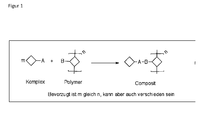
- Während dieser ersten Reaktion wird der Metallkomplex an das Polymer gebunden, wobei diese Bindung einseitig oder mindestens zweiseitig sein kann, d. h. es kann eine Anbindung des Metallkomplexes an nur ein Polymermolekül oder es kann eine gleichzeitige Anbindung des Metallkomplexes an mindestens zwei verschiedene Polymermoleküle erfolgen, so dass es zu einer Querverknüpfung des Metallkomplexes im Polymer kommt, wodurch sich ein mehrdimensionales Netzwerk bildet.
- Sofern in einer Ausführungsform des Verfahrens ein mehrdimensionales Netzwerk gebildet wird (Querverknüpfung), kann dies in seiner einfachsten Ausprägung einer leiterähnliche (zweidimensionale) Struktur sein, bei der zwei Polymermoleküle durch mindestens einen Metallkomplex verknüpft sind, der mit je einem der Polymermoleküle mindestens eine kovalente Bindung ausbildet. Weiterhin sind komplizierte dreidimensionale Netzwerke als Produkt der ersten Reaktion möglich, die mittels einer variablen Zahl von Polymermolekülen querverknüpfte Metallkomplexe umfassen. Der querverknüpfte Metallkomplex ist somit im mehrdimensionalen Netzwerk immobilisiert.
- Zur kovalenten Verknüpfung des organischen Metallkomplexes an den zweiten Reaktanden stehen unterschiedliche Strategien zur Verfügung. Dabei werden allgemein Paare miteinander korrespondierender chemischer Gruppen verwendet, die miteinander eine kovalente chemische Bindung ausbilden können. Diese chemischen Gruppen, die hier auch als Ankergruppen bezeichnet werden, gehören einer ersten Ankergruppenspezies oder einer zweiten Ankergruppenspezies an, wobei Ankergruppen der ersten Ankergruppenspezies mit Ankergruppen der zweiten Ankergruppenspezies eine kovalente Bindung ausbilden können, nicht aber Ankergruppen einer ersten Ankergruppenspezies untereinander oder Ankergruppen einer zweiten Ankergruppenspezies untereinander.
- Nachfolgend wird zunächst die einseitigen Verknüpfung (A), dann die zweiseitige Verknüpfung (Querverknüpfung) (B) erläutert.
- A. Bei einer ersten Strategie der einseitigen kovalenten Verknüpfung des organischen Metallkomplexes an den zweiten Reaktanden weist der Metallkomplex eine Ankergruppe einer ersten Ankergruppenspezies auf, die der kovalenten Bindung des Metallkomplexes an das Polymer dient. Der zweite Reaktand weist mindestens eine Ankergruppe einer zweiten Ankergruppenspezies auf, die zur Bindung des zweiten Reaktanden an die Ankergruppe des Metallkomplexes geeignet ist. Die Bindung des Metallkomplexes an das Polymer erfolgt durch Reaktion der Ankergruppen des Metallkomplexes mit einer zweiten Ankergruppe eines zweiten Reaktanden.
- Bei einer zweiten Strategie der einseitigen kovalenten Verknüpfung des organischen Metallkomplexes an den zweiten Reaktanden nimmt ein dritter Reaktand an der ersten Reaktion teil, der auch als "Spacer"-Molekül bezeichnet werden kann.
- Dabei weist der Metallkomplex eine Ankergruppe einer ersten Ankergruppenspezies auf, die zur kovalenten Einbindung des Metallkomplexes in die Matrix über einer zweiten Ankergruppe geeignet ist. Der zweite Reaktand weist eine Ankergruppe einer ersten Ankergruppenspezies auf, die der Bindung des zweiten Reaktanden an eine zweite Ankergruppe dient, so dass der Metallkomplex nicht unmittelbar an den zweiten Reaktanden binden kann. Zur Ausbildung einer kovalenten Bindung zwischen Metallkomplex und zweitem Reaktanden wird ein dritter Reaktand zugegeben, der zwei Ankergruppen einer zweiten Ankergruppenspezies aufweist, wobei jede dieser Ankergruppen des dritten Reaktanden mit je einer ersten Ankergruppe (nämlich des Metallkomplexes und des zweiten Reaktanden) eine kovalente Bindung eingehen kann. Somit erfolgt die Bindung des Metallkomplexes an das Polymer durch Reaktion der Ankergruppe des Metallkomplexes und durch Reaktion der Ankergruppe des zweiten Reaktanden mit einem dem selben dritten Reaktanden, so dass es zu einer Anbindung des Metallkomplexes an das Polymer kommt.
- B. Bei einer ersten Strategie der zweiseitigen kovalenten Verknüpfung des organischen Metallkomplexes an den zweiten Reaktanden weist der Metallkomplex mindestens zwei Ankergruppen einer ersten Ankergruppenspezies auf, die der kovalenten Bindung des Metallkomplexes an das Polymer dienen. Der zweite Reaktand weist mindestens eine Ankergruppe einer zweiten Ankergruppenspezies auf, die zur Bindung des zweiten Reaktanden an eine erste Ankergruppe des Metallkomplexes geeignet ist. Die Bindung des Metallkomplexes an das Polymer erfolgt durch Reaktion der mindestens zwei Ankergruppen des Metallkomplexes mit je einer zweiten Ankergruppe eines zweiten Reaktanden.
- Bei einer zweiten Strategie der kovalenten Verknüpfung des organischen Metallkomplexes an den zweiten Reaktanden nimmt ein dritter Reaktand als "Spacer"-Molekül an der ersten Reaktion teil.
- Dabei weist der Metallkomplex mindestens zwei Ankergruppen einer ersten Ankergruppenspezies auf, der zur kovalenten Einbindung des Metallkomplexes in die Matrix über einer zweiten Ankergruppe geeignet ist. Der zweite Reaktand weist eine Ankergruppe einer ersten Ankergruppenspezies auf, die der Bindung des zweiten Reaktanden an eine zweite Ankergruppe dient, so dass der Metallkomplex nicht unmittelbar an den zweiten Reaktanden binden kann. Zur Ausbildung einer kovalenten Bindung zwischen Metallkomplex und zweitem Reaktanden wird ein dritter Reaktand zugegeben, der zwei Ankergruppen einer zweiten Ankergruppenspezies aufweist, wobei jede dieser Ankergruppen des dritten Reaktanden mit je einer ersten Ankergruppe (nämlich des Metallkomplexes und des zweiten Reaktanden) eine kovalente Bindung eingehen kann. Somit erfolgt die Bindung des Metallkomplexes in das mehrdimensionale Netzwerk durch Reaktion der Ankergruppe des Metallkomplexes und durch Reaktion der Ankergruppe des zweiten Reaktanden mit demselben dritten Reaktanden, so dass es zu einer Querverknüpfung des Metallkomplexes kommt. Der dritte Reaktand ("Spacer"-Molekül), kann z. B. eine Alkylkette einer gewünschten Kettenlänge sein, das an zwei voneinander beabstandeten Molekülteilen, z. B. einander gegenüberliegenden Enden, je eine Ankergruppe aufweist, der die Anbindung an Metallkomplex bzw. zweiten Reaktanden vermittelt. Neben Alkylketten sind auch Aryl-, Heteroaryl-, Alkenyl-, Alkinyl-, Trialkylsilyl- und Triarylsilyl-Gruppen bzw. substituierte Alkyl-, Aryl-, Heteroaryl- und Alkenyl-Gruppen, optional mit Substituenten wie Halogenen, niedrigen Alkylgruppen und/oder elektronenschiebenden und - ziehenden Gruppen, sowie gängigen Ladungstransporteinheiten wie beispielsweise Arylamine, Carbazole, Benzimidazole, Oxadiazole etc. möglich. Die Substituenten können auch zu anellierten Ringsystemen führen.
- Bevorzugter Weise sind der Metallkomplex und der zweite Reaktand in einem (insbesondere zur OLED-Bauteilherstellung) gängigen organischen Lösemittel löslich. Gängige organische Lösungsmittel umfassen, neben Alkoholen, Ethern, Alkanen sowie halogenierten aliphatischen und aromatischen Kohlenwasserstoffen und alkylierten aromatischen Kohlenwasserstoffen, insbesondere Toluol, Chlorbenzol, Dichlorbenzol, Mesitylen, Xylol und Tetrahydrofuran. In einer bevorzugten Ausgestaltung der Erfindung ist das gebildete mehrdimensionale Netzwerk mit querverknüpften organischen Metallkomplexen unlöslich, was insbesondere die Ausbildung einer Struktur mehrerer übereinanderliegender Schichten eines derartigen mehrdimensionalen Netzwerks in einfacher Weise möglich macht.
- Die erste und zweite Ankergruppe können insbesondere ausgewählt sein aus der in
Figur 2 gezeigten Gruppe chemischer Reste. Sofern es sich bei dem Metallkomplex um einen Emitter handelt, steht die Ankergruppe bevorzugter weise nicht in Konjugation zum Emittersystem, um die Emission des Komplexes nicht zu beeinflussen. - Grundsätzlich kann jedweder organischer Übergangsmetallkomplex in dem Verfahren verwendet werden, der an mindestens einem seiner organischen Liganden eine erste Ankergruppe trägt. Insbesondere weist der Metallkomplex neben der ersten Ankergruppe mindestens ein Metallzentrum und mindestens einen Liganden auf. Der Metallkomplex kann ein- oder mehrkernig (zwei-, drei-, vierkernig, etc.) sein und kann einen oder mehrere Liganden tragen. Die Liganden können ein- oder mehrzähnig sein. Sofern ein einkerniger Komplex nur einen Liganden trägt, ist dieser Ligand mehrzähnig. Wenn der Komplex nicht neutral ist, ist ein entsprechendes Gegenion bereitzustellen, das aber bevorzugt nicht an der ersten Reaktion wie hier beschrieben teilnimmt.
- Bevorzugte organische Metallkomplexe sind beispielsweise Lichtemitter, die in optoelektronischen Bauteilen, wie OLEDs eingesetzt werden können. Eine weitere Gruppe bevorzugte Metallkomplexe sind Halbleiter. Derartige emittierende und halbleitende Metallkomplexe sind im Stand der Technik bekannt.
- Die Anzahl der Ankergruppen an einem Metallkomplex ist abhängig davon, ob der Metallkomplex einseitig oder mindestens zweiseitig kovalent an ein Polymer gebunden werden soll.
- Für eine einseitige Bindung eines Metallkomplexes an ein Polymer weist der Metallkomplex eine Ankergruppe auf.
- Mindestens ein Ligand des Metallkomplexes weist eine erste Ankergruppe auf. Insgesamt weist ein Metallkomplex für eine mindestens zweiseitige Bindung mindestens zwei Ankergruppen bevorzugt einer Ankergruppenspezies auf, die an einem oder bevorzugt auf zwei Liganden des Metallkomplexes verteilt angeordnet sein können. Es ist somit auch möglich, dass mehrere Liganden eines Metallkomplexes eine oder mehrere Ankergruppen aufweisen, wobei die Anzahl der Ankergruppen an dem Metallkomplex und an dem zweiten Liganden den Querverknüpfungsgrad bestimmt.
- Das in einer bevorzugten Ausgestaltung des Verfahrens bei Bindung eines Metallkomplexes an mehr als ein Polymer (mindestens zweiseitige Bindung) gebildete mehrdimensionale Netzwerk ist ein zweidimensionales oder dreidimensionales Netzwerk. Bevorzugt ist ein dreidimensionales Netzwerk.
- Der in dem Verfahren verwendete zweite Reaktand ist ein Polymer. Polymere sind Moleküle, die aus mindestens 10, bevorzugt mindestens 15, stärker bevorzugt aus mindestens 20 und am meisten bevorzugt aus mindestens 30 strukturell gleichen oder ähnlichen Einheiten aufgebaut sind. Beispiele für Polymere sind Polystyrol, Polyethylen, Polypropylen, Polyvinylchlorid, Polytetrafluorethylen, Polyacrylsäuremethylester, Polymethacrylsäuremethylester, Polycarbonate, Polyethylenglykol, Polyethylenterephthalat und Poly(organo)siloxane.
- Bisher ist eine Querverknüpfung nur zwischen nicht metall-angebundenen Polymeren bekannt, wobei immer nur Polymere mit sich selbst eine Querverknüpfungsreaktion eingehen, also nur homoquerverknüpft werden. Demgegenüber wird erfindungsgemäß nur durch die Ausbildung einer Bindung an den Metallkomplex eine Querverknüpfung ausgelöst, wodurch die entsprechenden Polymere mit dem Metallkomplex hetero-querverknüpft werden.
- Die Erfindung betrifft mit anderen Worten in einer Ausführungsform Materialien, insbesondere flüssig-prozessierbare optoelektronische Materialien, die durch ihren speziellen Aufbau gleichzeitig sowohl die kovalente Anbindung eines Metallkomplexes, beispielsweise eines hocheffizienten Emitter-Metallkomplexes, an einen entsprechend funktionalisierten zweiten Reaktanden in Form eines Polymers, als auch optional dessen Quervernetzung und somit Unlöslichkeitsmachung gewährleistet.
- In einer bevorzugten Ausführungsform der Erfindung wird neben dem Metallkomplex, dem zweiten Reaktanden und optional dem dritten Reaktanden, ein vierter Reaktand in der ersten Reaktion des Verfahrens eingesetzt, wobei es sich um eine loch- oder elektronenleitende chemische Gruppe und/oder um eine ladungsblockierende chemische Gruppe handelt, die als Ladungstransport- bzw. Ladungsblockiereinheit ebenfalls quervernetzt werden kann. Beispiele für loch- oder elektronenleitende chemische Gruppen sind Arylamine wie N,N'-bis(naphthalen-1-yl)-N,N'-bis(phenyl)-benzidin, N,N'-bis(naphthalen-1-yl)-N,N'-bis(phenyl)-2,2'-dimethylbenzidin, Carbazole wie 4,4-Bis(carbazol-9-yl)biphenyl, 1,3-Bis(carbazol-9-yl)benzol, Benzimidazole wie 1,3,5-Tris(1-phenyl-1H-benzo[d]imidazol-2-yl)benzol, Oxadiazole wie 2-(4-Biphenyl)-5-(4-tert-butylphenyl)-1,3,4-oxadiazol, Triazole wie 3-(4-Biphenyl)-4-phenyl-5-tert-butylphenyl-1,2,4-triazol, 4-(Naphthalen-1-yl)-3,5-diphenyl-4H-1,2,4-triazol.
- Zum Zwecke der Anbindung in an das Polymer und/oder den Metallkomplex weist der vierte Reaktand ebenfalls mindestens eine Ankergruppe der ersten und/oder zweiten Ankergruppenspezies auf, abhängig davon, ob der vierte Reaktand an den Metallkomplex oder den zweiten Reaktanden gebunden werden soll.
- Für die erste Reaktion können dabei insbesondere solche im Stand der Technik als "Click-Chemie" bezeichnete, energetisch begünstigte Reaktionen verwendet werden, die spezifisch verlaufen und ein einzelnes Produkt ergeben (H. C. Kolb, M. G. Finn, K. B. Sharpless, Angew. Chem. Int. Ed. 2001, 40, 2004 -2021). Die "Click-Chemie" umfasst somit Reaktionen, die mit hohen Ausbeuten durchführbar sind, ein breites Anwendungsspektrum aufweisen, (stereo)spezifisch ablaufen, einfache Reaktionsbedingungen (möglichst unempfindlich gegen Wasser und Sauerstoff) aufweisen, einfach entfernbare, möglichst ungefährliche Nebenprodukte und Reagenzien (falls überhaupt) aufweisen, in umweltfreundlichen und/oder leichtentfernbaren Lösungsmitteln wie Wasser oder lösungsmittelfrei ablaufen und/oder eine einfache Aufreinigung (Extraktion, Phasentrennung, Destillation oder Kristallisation - möglichst keine Chromatographie) oder gar keine Aufreinigung benötigen.
- "Click"-Reaktionen sind zumeist stark thermodynamisch begünstigt, mit oft mehr als 20 kcal mol-1, was in schnellem Umsatz mit hoher Selektivität zu einem einzelnen Produkt resultiert. Mit Click-Reaktionen werden meist Kohlenstoff-Heteroatom Bindungen gebildet.
- Insbesondere können nucleophile Substitutionen, besonders Ringöffnung von gespannten, elektrophilen Heterozyklen wie Epoxide und Aziridine, Carbonyl-Chemie des "Non-Aldol"-Typs wie die Bildung von aromatischen Heterocyclen oder Hydrazonen, Additionen an Kohlenstoff-Kohlenstoff-Doppelbindungen wie die oxidative Bildung von Epoxiden und Aziridinen, Dihydroxylierung und Michael-Additionen, sowie Cycloaddition an ungesättigte C-C-Bindungen, besonders 1,3-dipolare Cycloadditionen und Diels-Alder-Reaktionen gemäß der Erfindung verwendet werden. Weitere Beispiele für solche Reaktionen sind Kreuzkupplungsreaktionen zur Knüpfung von C-C-Bindungen wie die Ullmann-Reaktion, die Sonogashira-Reaktion und die Glaser-Kupplung. Alle diese Reaktionen sind dem Fachmann bekannt.
- Für die Erfindung sind insbesondere solche Reaktionen bevorzugt, die ohne den Zusatz eines weiteren Reaktanden (also über den ersten, zweiten und ggf. dritten und ggf. vierten hinaus), dass heißt höchstens durch einen die weiter Anwendung nicht weiter störenden Katalysator auskommen. Beispiele für solche Reaktionen sind neben den oben erwähnten 1,3-dipolaren Cycloadditionen und Diels-Alder-Reaktionen Nitron-Alkin-, Nitriloxid-Alkin-, Thiol-En-, Thiol-In-, Thiol-Isocyanat, Tetrazol-Alken- und andere in der chemischen Literatur als Click-Reaktionen bekannte Verfahren.
- Wie eingangs beschrieben findet die erste Reaktion des Verfahrens in Gegenwart eines Katalysators zur Katalyse der Reaktion statt. Dabei weist der Metallkomplex den Katalysator auf, d. h. das im organischen Metallkomplex enthaltene Metallzentrum dient gleichzeitig als Katalysator, so dass eine autokatalysierte Bindung des Metallkomplexes an das Polymer stattfindet. Als Beispiel hierfür ist in
Figur 3 die Kupfer-katalysierte Clickreaktion zwischen einem terminalen oder aktivierten Alkin als erster Ankergruppe einer ersten Ankergruppenspezies eines Metallkomplexes und einem Azid als Ankergruppe einer zweiten Ankergruppenspezies eines Polymers dargestellt. - Mittels eines Cu(I) Katalysators verläuft z. B. die klassische 1,3-dipolare Cycloaddition (Huisgen-Cyclisierung), die ansonsten recht hohe Temperaturen erfordert, regiounspezifisch verläuft und sich daher grundsätzlich nicht als "Click"-Reaktion eignet (V. V. Rostovtsev, et al., Angew. Chem. Int. Ed. 2002, 41, 2596-2599; C. W. Tornøe, et al., J. Org. Chem. 2002, 67, 3057) gegenüber der klassischen Cyclisierung bis zu 107 mal schneller, regioselektiv (nur das 1,4-Regioisomer wird gebildet), auch in Wasser, bei Raumtemperatur und ist dabei unempfindlich gegenüber den meisten anderen funktionellen Gruppen, wie beispielsweise Alkoholen, Säuren und Säurederivaten, Carbonylverbindungen, Halogenen etc.
- In einer bevorzugten Ausführungsform ist der Metallkomplex ein Cu(I) oder Cu(II)-Komplex, so dass die Reaktion autokatalytisch erfolgt. Andere mögliche Katalysatoren als Teil des Metallkomplexes sind Re, Fe, Ru, Os, Co, Rh, Ir, Ni, Pd, Pt, Ag, Au, Zn, Cd, Hg, Sn und/oder Pb.
- Die Reaktion zwischen Metallkomplex und zweitem Reaktanden verläuft bevorzugt bei einer Temperatur, die größer ist als Raumtemperatur. Bevorzugt sind mindestens 50 °C, besonders bevorzugt sind Temperaturen von 80 °C bis 120 °C. Die für die jeweilige Reaktionstemperatur benötigte Reaktionszeit kann von einem Fachmann leicht bestimmt werden. Im Allgemeinen ist mit einer Reaktionszeit von 1 Minute bis 60 Minuten, bevorzugt von 10 Minuten bis 30 Minuten zu rechnen, so dass der Metallkomplex immobilisiert und damit stabilisiert und unlöslich ist. Die thermische Aktivierung kann dabei auch durch Bestrahlung mit Mikrowellen erfolgen, wodurch die Reaktionszeiten meist deutlich verkürzt auf kleiner als 1 Minute werden können.
- Ist eine Ankergruppe, z. B. ein Alkin-Linker, in Konjugation zu einem organischen Liganden des Metallkomplexes vorhanden und wird ein aromatisches Azid als komplementäre Ankergruppe verwendet, so lassen sich die Emissionsfarben solcher emittierender Komplexe, die auf Charge-Transferübergängen zwischen den Metallionen und den Liganden beruhen, beeinflussen. Bevorzugt sind in diesem Zusammenhang Metallkomplexe mit drei Liganden oder mehr (z. B. vier, fünf oder sechs Liganden), da damit drei Anknüpfstellen oder mehr (z. B. vier, fünf oder sechs Anknüpfungsstellen) vorhanden sind. Somit lassen sich die Komplexe auf diese Weise sowohl an die Polymere anknüpfen, als auch mit Loch- oder Elektronenleitern (vierten Reaktanden) verbinden. Die optischen, mechanischen und elektrischen Eigenschaften der so erhaltenen Substanzen lassen sich damit über die jeweilige Zusammensetzung des Azid-Gemisches beeinflussen.
- Sofern das hier beschriebenen Verfahren gemäß einer bevorzugten Ausführungsform der Erfindung zu einem unlöslichen Produkt führt ist es möglich, mehrere Schichten immobilisierter Metallkomplexe in einfacher Weise übereinander anzuordnen, ohne dass z. B. orthogonale Lösungsmittel verwendet werden müssen.
- Zur Herstellung einer Mehrschichtanordnung wird nach der oben beschriebenen ersten Reaktion eine zweite Reaktion durchgeführt. Diese zweite Reaktion umfasst einen fünften Reaktanden in Form eines organischen Metallkomplexes und einen sechsten Reaktanden zur Ausbildung eines bevorzugt unlöslichen mehrdimensionalen Netzwerkes, wobei der Metallkomplex während der zweiten Reaktion in dem sich bildenden mehrdimensionalen Netzwerk querverknüpft wird. Hinsichtlich spezieller Ausgestaltungen der zweiten Reaktion gilt das für die erste Reaktion gesagte entsprechend.
- Dabei kann der fünfte Reaktand der zweiten Reaktion zu dem ersten Reaktanden der ersten Reaktion identisch oder verschieden sein. Ebenso kann der sechste Reaktand der zweiten Reaktion zu dem zweiten Reaktanden der ersten Reaktion identisch oder verschieden sein.
- Die gemäß einer bevorzugten Ausgestaltung des Verfahrens erfolgende Quervernetzung erlaubt eine schnelle und einfache Anordnung beliebig vieler photoaktiver Schichten, deren Löslichkeit nicht wie in bisherigen Systemen exakt aufeinander abgestimmt werden müssen. Dies hat eine deutliche Vereinfachung in der Verarbeitung zur Folge, da die Auswahl der einzelnen aktiven Schichten nicht mehr bezüglich der Löslichkeit zueinander orthogonal sein muss, sondern nahezu unabhängig voneinander kombiniert werden kann. Dies erlaubt somit die sequentielle Auftragung beliebig vieler unterschiedlicher Schichten und führt dadurch zu einer signifikanten Verbesserung der Effizient und Haltbarkeit.
- In einer bevorzugten Ausgestaltung des Verfahrens sind die Ankergruppen der ersten und zweiten Ankergruppenspezies in jeweils äquimolaren Mengen vorhanden, so dass alle Ankergruppen kovalente Bindungen mit komplementären Ankergruppen eingehen können.
- In einem zweiten Aspekt betrifft die Erfindung die Verwendung des mittels des hier beschriebenen Verfahrens erhaltenen Polymers, insbesondere als Emitter oder Absorber in einem optoelektronischen Bauelement.
- Insbesondere in Fällen, in denen der Metallkomplex ein Emitter-Metallkomplex ist, der in optoelektronischen Bauelementen eingesetzt werden kann und soll, besteht ein Vorteil der Erfindung in der Stabilisierung der Geometrie des Emitter-Metallkomplexes durch die Immobilisierung der Quervernetzung.
- Es ist bekannt, dass eine Änderung der Geometrie eines Emitterkomplexes bei der Anregung aus dem Grundzustand in den ersten angeregten Zustand zu größeren Verschiebungen der Energiepotentiale und zu größeren Wahrscheinlichkeiten für nicht-strahlende Relaxationsprozesse führt. Die Geometrie des angeregten Zustands sollte sich daher nicht von derjenigen des Grundzustands unterscheiden. Die mit der Erfindung erreichte räumliche/sterische Stabilisierung von Emittern führt somit zu einer Effizienzsteigerung von Emittern als Metallkomplexe.
- Mittels der in der Peripherie der Liganden der als Metallkomplexe, z. B. als Emitterkomplexe, angebundenen Ankergruppen für die verknüpfenden Click-Reaktionen wird die mögliche Bewegung der Liganden des Metallkomplexes zueinander eingeschränkt. Die Komplexe werden somit fixiert und stabilisiert. Die Übergangswahrscheinlichkeiten für nicht strahlende Prozesse werden im Gegensatz zu "freien" Komplexen durch Rotation und Verdrillung reduziert: Die Emissions-Quantenausbeute der Emitter werden erhöht. Gleichzeitig führt die Fixierung zu einer maximalen Ausnutzung des energetischen Abstandes zwischen Grund- und erstem angeregten Zustand. Hierdurch kann im Vergleich zum "freien", d. h. nicht quervernetzten Komplex eine Blauverschiebung des Emissionsspektrums stattfinden, da die Besetzung von Rotations- und Schwingungszuständen weniger wahrscheinlich und der Energieunterschied zwischen Grund- und erstem angeregten Zustand (direkte vertikale Anordnung der Potentialkurven, vgl. Franck-Condon-Prinzip, das dem Fachmann bekannt ist) maximiert wird.
- Neben der Schichtstabilisierung und dem möglichen Einbau von definierten Loch- und Elektronenleitern verbessert die Erfindung darüber hinaus die Effizienz von optoelektronischen Bauteilen: Durch die sterische Hinderung der Metallkomplexe werden die Überlappintegrale zwischen nicht zur Emission genutzten Zuständen kleiner, die Besetzung von Rotations- und Schwingungszuständen weniger wahrscheinlich. Die Stabilität der Komplexe steigt durch die Verhinderung von Bindungsbrüchen und nicht-strahlenden Relaxationen durch freie Beweglichkeit der Liganden eines Metall-Emittersystems. Durch die Immobilisierung ist es möglich, die Emission eines gegebenen freien, also nichtvernetzten emittierenden Metallkomplexes in Richtung des oder in den blauen Spektralbereich zu verschieben.
- In einem dritten Aspekt betrifft die Erfindung die Verwendung eines gemäß dem hier beschriebenen Verfahrens hergestellten Polymers mit kovalent angebundenem Metallkomplex als Emitter oder Absorber in einem optoelektronischen Bauelement, sofern der Metallkomplex ein Licht-Emitter oder -Absorber ist.
- Entsprechend betrifft die Erfindung in einem vierten Aspekt auch ein optoelektronisches Bauelement, aufweisend einen an ein Polymer kovalent gebundenen organischen Metallkomplex, wie hier beschrieben.
- Das optoelektronische Bauelement kann eine organischen Leuchtdiode (OLEDs), lichtemittierenden elektrochemischen Zelle (LEECs oder LECs), OLED-Sensoren, optischen Temperatur-Sensoren, organischen Solarzellen (OSCs), organischen Feldeffekttransistoren, organischen Dioden, organischen Photodioden und "down conversion" Systeme betreffen. Derartige Bauelemente sind dem Fachmann bekannt.
- In einem fünften Aspekt betrifft die Erfindung ein Verfahren zur Herstellung einer Schicht eines an ein Polymer gebundenen organischen Metallkomplexes, insbesondere einer dünnen Schicht mit einer Dicke von 75 nm bis 300 nm, insbesondere von 100 nm bis 250 nm, insbesondere zur Herstellung eines optoelektronischen Bauelements.
- Das Verfahren ist abhängig davon, ob der Metallkomplex einseitig oder mindestens zweiseitig an das Polymer gebunden wird. Im ersten Fall erfolgt eine Flüssigprozessierung des Reaktionsproduktes, da die Löslichkeit des Metallkomplexes durch die Bindung an das Polymer erhöht wird. Im zweiten Fall kann das Auftragen eines Gemisches beider Reaktanden auf einen festen Träger mittels aller im Stand der Technik bekannter Methoden erfolgen, insbesondere mittels Inkjet-Printing, Dipping, Spincoating, Schlitzgießen oder Rakeln (Knife Coating). Das Reaktionsprodukt ist unlöslich.
- Im ersten Fall kann die weitere Flüssigprozessierung des somit erhaltenen Kompositmaterials mittels aller im Stand der Technik bekannter Beschichtungs- und Druckverfahren erfolgen, insbesondere mittels Inkjet-Printing, Dipping, Spincoating, Schlitzgießen oder Rakeln (Knife Coating).
- Im ersten Fall weist das Verfahren mindestens die folgenden Schritte auf: Zunächst wird ein Gemisch aus einem ersten Reaktanden in Form eines organischen Metallkomplexes und einem zweiten Reaktanden in Form eines Polymers in Lösung hergestellt. Gängige dabei verwendete organische Lösungsmittel umfassen, neben Alkoholen, Ethern, Alkanen sowie halogenierten aliphatischen und aromatischen Kohlenwasserstoffen und alkylierten aromatischen Kohlenwasserstoffen, insbesondere Toluol, Chlorbenzol, Dichlorbenzol, Mesitylen, Xylol und Tetrahydrofuran.
- Der Metallkomplex wird während der dann durchgeführten ersten Reaktion an das Polymer einseitig gebunden, bzw. in einer bevorzugten Ausgestaltung, wie oben beschrieben, mehrseitig gebunden (quervernetzt). Dabei wird die Reaktion zwischen dem ersten Reaktanden und dem zweiten Reaktanden durch den Metallkomplex katalysiert.
- Wie hierin beschrieben erfolgt die Ausbildung der einseitigen oder mindestens mehrseitigen Anbindung bevorzugt bei erhöhter Temperatur, bevorzugt zwischen 80 °C bis 120 °C.
- In einem sechsten Aspekt betrifft die Erfindung die Verwendung eines an ein Polymer gebundenen Metallkomplexes als Emittermaterial für ein optoelektronisches Bauelement, insbesondere als optoelektronische Tinte.
- In einem siebenten Aspekt betrifft die Erfindung einen organischen Metallkomplex mit mindestens einem Metallzentrum und mindestens einem organischen Liganden. Erfindungsgemäß weist der Metallkomplex eine, bevorzugt zwei, drei, vier, oder mehr Ankergruppen einer ersten Ankergruppenspezies zur Reaktion mit einer Ankergruppe einer zweiten Ankergruppenspezies zur einseitigen oder mehrseitigen Anbindung auf, wobei die Ankergruppe des Metallkomplexes während einer ersten Reaktion zu der Ankergruppe eines zweiten Reaktanden, eine kovalente Bindung ausbilden kann.
- In einem achten Aspekt betrifft die Erfindung die Verwendung eines derartigen Metallkomplexes zur Anbindung und optional Quervernetzung und somit Immobilisierung des Metallkomplexes mit einem zweiten Reaktanden, insbesondere in Form eines Polymers, der eine Ankergruppe einer zweiten Ankergruppenspezies aufweist. Gleichzeitig betrifft die Erfindung die Verwendung eines Polymers zur Verbesserung der Löslichkeit eines Metallkomplexes bei der hier beschriebenen einseitigen Anbindung.
- In einem neunten Aspekt betrifft die Erfindung ein Verfahren zur Funktionalisierung eines organischen Metallkomplexes mit ein, zwei, oder mehr Ankergruppen, über die der Metallkomplex durch Bindung an einen eine zweite Ankergruppe tragenden zweiten Reaktanden gebunden und optional (bei mindestens zweiseitger Bindung) immobilisiert werden kann, da die Ankergruppe(n) einer ersten Ankerguppenspezies des Metallkomplexes (jeweils) mit der Ankergruppe einer zweiten Ankergruppenspezies des zweiten Reaktanden reagieren und so eine kovalente Bindung ausbilden kann.
-
- Figur 1:
- Allgemeines Schema für die Verknüpfung von organischen Metallkomplexen (erster Reaktand) mit einem Polymeren (zweiter Reaktand), die jeweils eine entsprechende Ankergruppen tragen, die die Bindung bzw. optional Quervernetzung des Metallkomplexes ermöglichen.
- Figur 2:
- Ausgewählte Beispiele für Ankergruppen einer ersten und zweiten Ankergruppenspezies (jeweils in Zeilen angeordnet). Jeweils gegenüberliegend gezeigte Ankergruppen können, gebunden einerseits an den Metallkomplex und andererseits an den zweiten Reaktanden, eine kovalente Bindung zwischen den Reaktanden ausbilden und den Metallkomplex so anbinden und ihn ggf. immobilisieren. Erste und zweite Ankergruppenspezies werden hier als Anker A bzw. Anker B angesprochen. Dabei kann je nach Verwendung der hier dargestellte Anker A die erste oder zweite Ankergruppenspezies, und der Anker B entsprechend die zweite oder erste Ankergruppenspezies darstellen.
- Figur 3:
- Reaktion für die Vernetzung eines Alkin-substituierten Kupferkomplexes mit einem polymeren Azid als zweitem Reaktanden, wobei die Reaktion autokatalysiert abläuft. Die gezeigte Kugel steht für Polystyrol als Beispiel für einen zweiten Reaktanden.
- Figur 4:
- Histogramm des AFM-Bildes vor und nach dem Spülen mit Xylol (s. Beispiel 3). Die Höhen sind auf 1 normiert, die Lage der Histogramme auf der X-Achse willkürlich, aber maßstabsgetreu. Zur besseren Übersicht wurden die Histogramme nicht über einander, sondern nebeneinander angeordnet. Die Prozessierung erfolgte bei 40 °C, die Scan-Größe der zugrundeliegenden Aufnahmen beträgt 1 µm2.
- Die Erfindung besteht in einem Stabilisierungs-, Anbindungs- und optional Vernetzungsverfahren von Metallkomplexen durch Polymere, die aus einem oder mehreren Metallen und einem mindestens zweizähnigen, oder mehreren ein- oder mehrzähnigen Liganden bestehen. Erfindungsgemäß tragen der organische Metallkomplex und der zweite Reaktand komplementäre chemische Anker einer (ersten bzw. zweiten) Ankergruppenspezies, die in einer möglichst schnell und vollständig ablaufenden Reaktion kovalent miteinander verbunden werden. So können beispielsweise lumineszierende oder halbleitende Metallkomplexe z. B. für Anwendungen in der organischen Elektronik immobilisiert werden, um die Lebensdauer und Langzeitstabilität der entsprechenden Bauteile zu erhöhen.
- Für die beschriebene Erfindung sind solche Reaktionen bevorzugt, die neben dem Metallkomplex und dem zweiten Reaktanden ohne den Zusatz eines weiteren Reaktanden, dass heißt höchstens durch einen die Anwendung nicht weiter störenden Katalysator, auskommen. Beispiele für solche Reaktionen sind 1,3-dipolaren Cycloadditionen, Diels-Alder-Reaktionen, Nitron-Alkin-, Nitriloxid-Alkin-, Thiol-En-, Thiol-In-, Thiol-Isocyanat, Tetrazol-Alken- und andere in der chemischen Literatur als Click-Reaktionen bekannte Verfahren.
- Es handelt sich um Reaktionen, die von dem im Metallkomplex enthaltenen Metall selbst katalysiert werden, was einer autokatalysierten Anbindung oder Quervernetzung entspricht. Ein Beispiel hierfür ist die Kupfer-katalysierte Clickreaktion zwischen einem terminalen oder aktivierten Alkin und einem Azid. Diese Reaktion liefert regioselektiv und in hohen Ausbeuten und Umsätzen 1,4-Triazole (s.
Figur 2 ). - Phenylacetylen (103 mg, 1.0 mmol, 1.0 Äquiv.) und Benzylazid (133 mg, 1.0 mmol, 1.0 Äquiv.) wurden in einem mit einem Septum luftdicht verschließbaren Vial in 10 mL trockenem Dichlormethan gelöst. Der Cu-Komplex (katalytische oder stöchiometrische Mengen) wurde zugegeben, das Vial versiegelt und die Reaktion 2 Tage bei Raumtemperatur gerührt. Zum Entfernen des Katalysator-Komplexes wurde die Reaktionsmischung in 50 mL Methanol gegeben und 20 min gerührt. Der Komplex wurde abfiltriert und das Filtrat eingeengt. Entfernen des Lösungsmittels und Trocknen des Produkts im Hochvakuum ergab die Verbindung 1-Benzyl-4-phenyl-1H-1,2,3-triazol als hellgelben Feststoff in 95 % Ausbeute (245 mg, 0.95 mmol). Die Identität des Produkts wurde eindeutig durch NMR-Spektroskopie, Infrarotspektroskopie und hochauflösende Massenspektrometrie belegt.

- Der Cu-Komplex (1,341 g, 1.0 mmol, 1,0 Äquiv.) wurde in einem mit einem Septum luftdicht verschließbaren Vial in 10 mL trockenem Dichlormethan gelöst und Benzylazid (466 mg, 3,5 mmol, 3,5 Äquiv.) zugegeben. Die Reaktion wurde 12 Stunden lang bei Raumtemperatur gerührt, über einen Spritzenfilter filtriert und durch Eintropfen in Diethylether ausgefällt. Waschen des ausgefällten Feststoffs mit Diethylether und Trocknen des Produkts im Hochvakuum ergab die Verbindung Tris-(4-(2-(1-benzyl-1H-1,2,3-triazol-4-yl)ethyl)-2-(diphenylphosphino)pyridin)-di-kupfer-diiodid als hellgrünen Feststoff in 61 % Ausbeute (1,052 g, 0,61 mmol). Die Identität des Produkts wurde eindeutig durch NMR-Spektroskopie, Infrarotspektroskopie, Massenspektrometrie und Elementaranalyse belegt.

- Der Cu-Komplex (440 mg, 0.33 mmol, 1.0 Äquiv.) wurde als erster Reaktand in einem mit einem Septum luftdicht verschließbaren Vial in 10 mL trockenem Dichlormethan gelöst und mit Poly-(vinylbenzylazid-alt-styrol) (370 mg, 1,0 mmol, 3,0 Aquiv.) umgesetzt. Die Reaktion wurde 12 Stunden lang bei Raumtemperatur gerührt, wobei das Produkt als unlöslicher grünlicher Feststoff aus der Reaktionslösung ausfiel. Der Niederschlag wurde abgesaugt, mit 20 mL Dichlormethan, 20 mL Diethylether und 20 mL Methanol gewaschen und im Hochvakuum getrocknet. Das Produkt Poly-(4-(2-(1-(4-vinylbenzyl-1H-1,2,3-triazol-4-yl)ethyl)-2-(diphenylphosphino)pyridin)-alt-styrol @ CuI fiel als hellgrüner Feststoff in 66 % Ausbeute an (540 mg, 0,21 mmol) und stellt den quervernetzten Metallkomplex dar. Die Identität des Produkts wurde eindeutig durch Infrarotspektroskopie und Elementaranalyse belegt.

- Es wurde gezeigt, dass eine solche Reaktion unlösliche, quervernetzte Metallkomplexe (KompositMaterialien) liefert. Sowohl der Ausgangskomplex 25 als auch das Produkt 26 (s.
Figur 2 ). verfügen dabei über eine gelbe Lumineszenz, deren Spektrum durch die Reaktion nicht weiter beeinflusst oder gestört wird, da die Ankergruppen nicht in Konjugation zum Emittersystem stehen. - Nach dem Auftragen auf einen Objektträger mit einer Rakel-Apparatur (alle weiteren bekannten Druck- oder Beschichtungsverfahren wie bspw. Spincoating, Schlitzgießen oder Ink-Jet sind ebenfalls möglich) zu einer dünnen Schicht und einem Aushärten durch 30-minütiges Erhitzen auf 100 °C wurde diese Schicht stabilisiert und unlöslich. Mit einem derartigen Verfahren lassen sich auf einfachem Wege Mehrschichtanordnungen realisieren, für deren Umsetzung ansonsten orthogonale Lösungsmittel oder photochemische Aushärtungsschritte benötigt werden. Zusätzlich sorgt diese Quervernetzung für eine Stabilisierung und Fixierung der geometrischen Struktur der Metallkomplexe, wodurch eine Bewegung der Liganden und somit eine Strukturänderung der angeregten Moleküle verhindert und eine Effizienzminderung durch strahlungslose Relaxationspfade wirkungsvoll unterbunden wird.
- Die Erfindung betrifft in einer bevorzugten Ausführungsform die Herstellung von neuartigen optoelektronischen Tinten als Emittermaterial für organische Leuchtdioden als optoelektronisches Bauelement. Die Tinte beruht dabei in einer Ausführungsform auf elektrolumineszierenden Kupfer(I)-Komplexen, bei denen Diphenylphosphinpyridine, Diphenylphosphinchinoline und verwandte Heterozyklen als Liganden verwendet werden. Diese zweizähnigen Liganden bilden mit Kupfer(I)-iodid mehrkernige Komplexe mit einem Ligand-Metalliodid-Verhältnis von 3:2.

- Struktur von Tris-(4-Butinyl-2-diphenylphosphinopyridin)-bis-(kupferiodid)
- Wie in Versuchen gezeigt wurde, lassen sich diese Ligandensysteme mit Alkin-Ketten wie 4-Butin substituieren und als Kupferkomplex (erster Reaktand mit erster Ankergruppe) in einer Click-Reaktion mit Aziden kuppeln. Mit dieser Reaktion lassen sich sowohl niedermolekulare als auch polymere Azide als zweiter Reaktand umsetzen, so dass beispielsweise vernetzte, Kupfer-haltige Polymere synthetisiert werden können, die die elektrolumineszierenden Eigenschaften der Metallkomplexe mit den Vorteilen der einfachen flüssigen Verarbeitbarkeit der Polymere verbinden und nach einem Temperschritt robuste, unlösliche Schichten ergeben. Im Falle der einseitigen Anbindung können die Vorteile einer flüssigen Prozessierung der hierdurch entstehenden löslichen Metallkomplex-Polymer-Kompositmaterialien (kurz Kompositmaterialien) genutzt werden, bei mehrseitiger Anbindung ergeben sich quervernetzte unlösliche Schichten zur Realisierung von Mehrschichtaufbauten.
- Weiterhin kann diese Reaktion auch mit weiteren Ligandenklassen durchgeführt werden. Gleichzeitig können neben der Anbindung oder Quervernetzung weitere Materialfunktionen in die Tinte implementiert werden. Dafür können Click-Reaktionen genutzt werden, um funktionelle Halbleiter (als dritter Reaktand), die lochleitende beziehungsweise elektronenleitende Eigenschaften haben, an die Komplexe zu knüpfen. Wird die Ankergruppe, z. B. der Alkin-Linker, in Konjugation zu den organischen Liganden angeknüpft und aromatische Azide verwendet, so lassen sich die Emissionsfarbe der Komplexe, die auf Charge-Transferübergängen zwischen den Metallionen und den Liganden beruht, beeinflussen. Da die dimeren Komplexe jeweils drei Liganden und damit drei Anknüpfstellen enthalten, lassen sich die Komplexe auf diese Weise sowohl an die Polymere anknüpfen, als auch mit Loch- oder Elektronenleitern verbinden. Die optischen, mechanischen und elektrischen Eigenschaften der so erhaltenen Substanzen lassen sich damit über die jeweilige Zusammensetzung des Azid-Gemisches beeinflussen. Über Roboter-gestützte High-Throughput-Screening-Verfahren lassen sich diese Parameter der Tinte optimieren. Bei der Verwendung verschiedener mit Alkin substituierter Metallkomplexe lassen sich so organische Leuchtdioden in verschiedenen Farben realisieren, durch geeignete Farbmischung der entsprechenden Metallkomplexe können so Weißlicht-OLEDs erzeugt werden.
- So lassen sich die Emitter mit einer optimalen Mischung aus Lochleitern, Elektronenleitern und einem Polymer zu einer optoelektronischen Tinte verknüpfen.

- Die in 27 gezeigte Kugel steht für Polystyrol, kann aber jedes andere Polymer als zweiten Reaktanden repräsentieren.
- Dabei dient der PyrPHOS-Komplex (Pyridyldiphenylphosphin = PyrPHOS) selbst als Katalysator für die Click-Reaktion. Bei Verwendung von polymeren Aziden mit einem Rückgrat aus Polystyrol oder Polyethylenglykol tritt durch Reaktion über nur eine Ankergruppe des Metallkomplexes eine einseitige Anbindung auf.
- Wie durch Photolumineszenz-Spektroskopie gezeigt werden konnte, wird die gelbe Emissionsfarbe der Kupfer-PyrPHOS-Komplexe weder durch Variation der Ladungstransport- oder Blockiereinheiten, noch durch die Anknüpfung an die Polymere beeinflusst. Das Emissionsmaximum der PyrPHOS-Systeme liegt bei 550 nm. Dass sich die per Photolumineszenz beobachtete Emissionsfarbe auch im OLED reproduzieren lässt, wurde in einer Einschichtanordnung durch Mischen des Kompositmaterials mit dem Lochleiter CBP gezeigt.
- Mit dem Rakel-Verfahren lassen sich dünne Schichten mithilfe eines keilförmigen Beschichtungsmessers herstellen. Dazu wird die Substanz in Lösung auf das Substrat aufgetragen und durch einen Schlitten, der mit einer definierten Spaltbreite und Zuggeschwindigkeit gesteuert werden kann, gleichmäßig verteilt. Durch Beheizen und einen Stickstoffstrom werden die so erzeugten Filme getrocknet, so dass extrem glatte, definierte Schichten erzeugt werden können.
- Zur Herstellung der dünnen Schichten wurde das in Xylol gelöste Polymer mit dem in Dichlormethan gelösten Metallkomplex in einem Vial gemischt und nach einer kurzen Zeit nach dem Zusammengeben als leicht getrübte Lösung auf ein mit Indiumzinnoxid (ITO) und PEDOT:PSS beschichtetes Substrat aufgetragen. Es wurde eine äquimolare Stöchiometrie gewählt.
- Die Reaktion, Beschichtung und Trocknung wurden bei verschiedenen Temperaturen durchgeführt. Da der gesamte Prozess nach sehr kurzer Zeit beendet war, wurden die Proben anschließend für eine Stunde auf einer Heizplatte bei 100 °C getempert, um einen möglichst hohen Umsatz der Huisgen-Reaktion zu erreichen. Die Proben wurden unter einer UV-Lampe sowie per Rasterkraftmikroskopie untersucht. Außerdem wurden zur Reaktionskontrolle die Filme vor und nach dem Trocknen durch Eintauchen in Xylol gespült. Während das vernetzte Produkt unlöslich ist, lösen sich die Edukte in diesem Lösemittel, sodass durch die Beständigkeit der Schichten eine Aussage über eine erfolgreiche Quervernetzung möglich ist.
- Mit zunehmender Prozesstemperatur stieg auch die Spülbeständigkeit. Nach dem Temperschritt waren alle getesteten Schichten beständig gegen Xylol. Die verschiedenen Proben wurden per AFM (Rasterkraftmikroskop) vermessen, um die Morphologie der Schichten auf nanoskaliger Ebene zu untersuchen.
- Durch Rasterkraftmikroskopie konnte der durch optischen Vergleich gewonnene Eindruck, dass sich die Eigenschaften der quervernetzten Proben durch das Spülen nicht mehr verändern lässt, bestätigt werden. Zusätzlich wurde die Rauigkeit Rq(Standardabweichung der Höhenverteilungskurve) bestimmt (gemäß E. P. Degarmo, J. T. Black, R. A. Kohser, Materials and Processes in Manufacturing, 2003, 9. Auflage, Wiley, 223). Dazu wurden die gesamte Scanfläche oder bei Verunreinigungen ein Ausschnitt davon ausgewählt. Die Ergebnisse sind in der nachstehendenTabelle 1 aufgeführt.
- Die Rauigkeit ist für die gemessenen Proben mit Werten zwischen 0,53 und 1,64 nm sehr niedrig, was für eine exzellente Morphologie der gemessenen Proben spricht.
Tabelle 1: Rauigkeit der AFM-Proben. In den ersten vier Proben zeigten sich Pinholes, die Bestimmung erfolgte daher nicht über den gesamten Messbereich, sondern über einen loch-freien Bereich, um repräsentative Ergebnisse zu erhalten. Probe Rauigkeit Rq Bezogen auf eine Fläche von 80 11 °C 0.66 nm 0.478 µm2 80 11 °C gespült 0.99 nm 0.397 µm2 81 25 °C 0.53 nm 0.485 µm2 81 25 °C gespült 0.70 nm 0.495 µm2 82 40 °C 1.64 nm 1.000 µm2 82 40 °C gespült 0.91 nm 1.000 µm2 - In
Figur 4 sind zum Vergleich Histogramme gezeigt. Demnach ergeben sich recht scharfe, nahezu Gauß-förmige Höhenverteilungen. Die Standardabweichung dieser Verteilungskurven ist in Tabelle als Rq angegeben. -

- Um auf einfache, modulare Weise sowohl Kupferkomplexe (als erster Reaktand) als Emitter, als auch Ladungstransport-Einheiten (als dritter Reaktand) in ein Polymer (als zweiter Reaktand) zu bringen, wurde der Metallkomplex, ein Überschuss Azid und Phenylacetylen umgesetzt. Es wurden beide Alkine ans Polymer geknüpft. Außerdem luminesziert das Produkt wie erwartet, der Komplex bleibt also intakt.
-
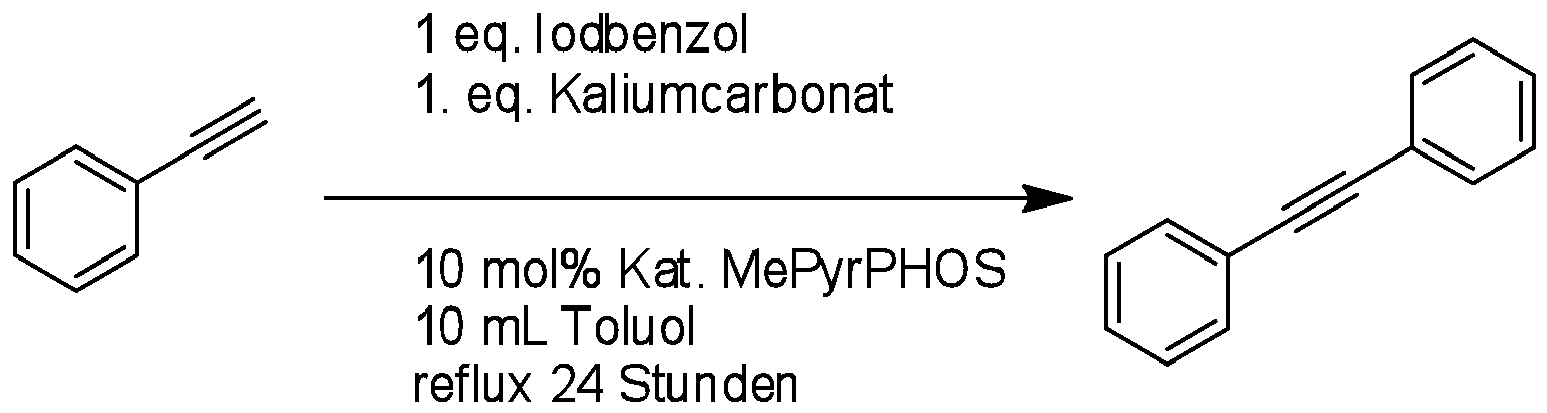
- Einerseits soll das katalytische Potential der PyrPHOS-Systeme über die Cu(I)-Huisgen-Reaktion hinaus evaluiert werden. Mit den unlöslichen, quervernetzen PyrPHOS-Polymeren könnte somit ein Festphasen-Katalysator mit immobilisiertem Cu(I) vorliegen.
- Andererseits können mit derartigen Reaktionen die Eigenschaften der Metallkomplexe modifiziert werden, z. B.:

- Die oben gezeigte Reaktion lief mit vollständigem Umsatz (mittels IGC-MS bestimmt) ab, außerdem konnte der in Toluol unlöslich Katalysator mit dem Kaliumcarbonat abfiltriert werden und blieb intakt (Erhalt der gelben Photolumineszenz).
-

- Das rechts gezeigte Produkt luminesziert wie das links gezeigte Edukt. Der typische Geruch eines freien Thiols war nach der Reaktion nicht mehr vorhanden.
Claims (14)
- Verfahren zur kovalenten Bindung eines organischen Metallkomplexes mit mindestens einem Metallzentrum und mindestens einem organischen Liganden an ein Polymer,
umfassend das Durchführen einer ersten Reaktion, die aufweist- einen ersten Reaktanden in Form eines organischen Metallkomplexes und- einen zweiten Reaktanden in Form eines Polymers,wobei während der Reaktion der Metallkomplex kovalent an das Polymer gebunden wird,
dadurch gekennzeichnet, dass
die Reaktion durch den Metallkomplex katalysiert wird. - Verfahren nach Anspruch 1, wobei das Metallzentrum des Metallkomplexes ausgewählt ist aus der Gruppe bestehend aus Re, Fe, Ru, Os, Co, Rh, Ir, Ni, Pd, Pt, Cu, Ag, Au, Zn, Cd, Hg, Sn und Pb.
- Verfahren nach Anspruch 1 oder 2, wobei- der Metallkomplex eine Ankergruppe einer ersten Ankergruppenspezies zur kovalenten Bindung des Metallkomplexes an das Polymer aufweist und- der zweite Reaktand eine Ankergruppe einer zweiten Ankergruppenspezies zur kovalenten Bindung an den Metallkomplex aufweist, und wobeidie kovalente Bindung des Metallkomplexes an das Polymer durch Reaktion der Ankergruppe des Metallkomplexes mit der Ankergruppe des zweiten Reaktanden erfolgt.
- Verfahren nach Anspruch 1 oder 2, wobei- der Metallkomplex eine Ankergruppe einer ersten Ankergruppenspezies zur kovalenten Bindung des Metallkomplexes an das Polymer mittels einer Ankergruppe einer zweiten Ankergruppenspezies aufweist und- der zweite Reaktand eine erste Ankergruppe einer ersten Ankergruppenspezies zur kovalenten Bindung des zweiten Reaktanden an eine Ankergruppe einer zweiten Ankergruppenspezies aufweist, und wobeidie kovalente Einbindung des Metallkomplexes an das Polymer durch Reaktion der Ankergruppe des Metallkomplexes mit einem dritten Reaktanden erfolgt, der zwei Ankergruppen einer zweiten Ankergruppenspezies aufweist.
- Verfahren nach Anspruch 4, wobei das Reaktionsprodukt ein mehrdimensionales Netzwerk mit querverknüpften organischen Metallkomplexen darstellt, das unlöslich ist.
- Verfahren nach Anspruch 1 bis 5, wobei die erste und zweite Ankergruppenspezies ausgewählt ist aus der in Figur 2 gezeigten Gruppe.
- Verfahren nach Anspruch 1 bis 6, wobei ein vierter Reaktand zum Transport oder zur Blockierung elektrischer Ladungen an der Reaktion teilnimmt, der eine Ankergruppe der ersten oder zweiten Ankergruppenspezies aufweist.
- Verfahren nach Anspruch 1 bis 7, wobei neben dem ersten Reaktanden, dem zweiten Reaktanden, optional dem dritten Reaktanden und optional dem vierten Reaktanden kein weiterer Reaktand an der Reaktion teilnimmt.
- Polymer mit einem kovalent gebundenen organischen Metallkomplex, herstellbar durch ein Verfahren nach Anspruch 1 bis 8.
- Verwendung eines Polymers nach Anspruch 9 als Emitter oder Absorber in einem optoelektronischen Bauelement.
- Optoelektronisches Bauelement, aufweisend ein Polymer nach Anspruch 9, wobei das optoelektronische Bauelement ausgewählt ist aus der Gruppe bestehend aus organischen Leuchtidioden (OLEDs), lichtemittierenden elektrochemischen Zellen (LEECs oder LECs), OLED-Sensoren, insbesondere nicht hermetisch nach außen abgeschirmten Gas- und Dampf-Sensoren, optischen Temperatur-Sensoren, organischen Solarzellen (OSCs), organischen Feldeffekttransistoren, organischen Dioden, organischen Photodioden und "down conversion" Systemen.
- Verfahren zur Herstellung einer Schicht eines an ein Polymer gebundenen organischen Metallkomplexes, aufweisend die Schritte des- Auftragen eines Reaktionsproduktes aus einer ersten Reaktion aufweisend- einem ersten Reaktanden in Form eines organischen Metallkomplexes und- einem zweiten Reaktanden in Form eines Polymers, insbesondere zur Ausbildung eines mehrdimensionalen Netzwerkes
auf einen festen Träger, und- Durchführen einer Reaktion zwischen dem ersten Reaktanden und dem zweiten Reaktandendadurch gekennzeichnet, dass
die Reaktion zwischen dem ersten Reaktanden und dem zweiten Reaktanden durch den Metallkomplex katalysiert wird. - Organischer Metallkomplex mit mindestens einem Metallzentrum und mindestens einem organischen Liganden,
gekennzeichnet durch
eine Ankergruppe einer ersten Ankergruppenspezies zur Reaktion mit einer Ankergruppe einer zweiten Ankergruppenspezies zur Querverknüpfung,
wobei jeweils eine der zwei Ankergruppe des Metallkomplexes während einer Querverknüpfungsreaktion zu einer Ankergruppe eines zweiten Reaktanden zur Ausbildung eines mehrdimensionalen Netzwerkes eine kovalente Bindung ausbilden kann. - Verwendung eines organischen Metallkomplexes nach Anspruch 13 zur Anbindung oder Querverknüpfung des Metallkomplexes mit einem zweiten Reaktanden zur Ausbildung eines mehrdimensionalen Netzwerkes.
Priority Applications (7)
| Application Number | Priority Date | Filing Date | Title |
|---|---|---|---|
| EP11175125A EP2543685A1 (de) | 2011-07-08 | 2011-07-22 | Verfahren zur kovalenten Bindung eines Metallkomplexes an ein Polymer |
| KR1020147003330A KR102014224B1 (ko) | 2011-07-08 | 2012-07-09 | 유기 금속 착화합물을 중합체에 공유 결합시키는 방법 |
| EP12743102.1A EP2729506B1 (de) | 2011-07-08 | 2012-07-09 | Verfahren zur kovalenten bindung eines organischen metallkomplexes an ein polymer |
| PCT/EP2012/063447 WO2013007710A1 (de) | 2011-07-08 | 2012-07-09 | Verfahren zur kovalenten bindung eines organischen metallkomplexes an ein polymer |
| CN201280033791.7A CN103649133B (zh) | 2011-07-08 | 2012-07-09 | 一种将金属有机络合物与聚合物共价结合的方法 |
| US14/131,622 US9447246B2 (en) | 2011-07-08 | 2012-07-09 | Method of covalently bonding an organic metal complex to a polymer |
| JP2014517847A JP6072026B2 (ja) | 2011-07-08 | 2012-07-09 | 有機金属錯体のポリマーへの共有結合方法 |
Applications Claiming Priority (2)
| Application Number | Priority Date | Filing Date | Title |
|---|---|---|---|
| EP11173374 | 2011-07-08 | ||
| EP11175125A EP2543685A1 (de) | 2011-07-08 | 2011-07-22 | Verfahren zur kovalenten Bindung eines Metallkomplexes an ein Polymer |
Publications (1)
| Publication Number | Publication Date |
|---|---|
| EP2543685A1 true EP2543685A1 (de) | 2013-01-09 |
Family
ID=44582278
Family Applications (4)
| Application Number | Title | Priority Date | Filing Date |
|---|---|---|---|
| EP11175125A Withdrawn EP2543685A1 (de) | 2011-07-08 | 2011-07-22 | Verfahren zur kovalenten Bindung eines Metallkomplexes an ein Polymer |
| EP11175122A Withdrawn EP2543671A1 (de) | 2011-07-08 | 2011-07-22 | Querverknüpfung und Stabilisierung von organischen Metallkomplexen in Netzwerken |
| EP12743102.1A Active EP2729506B1 (de) | 2011-07-08 | 2012-07-09 | Verfahren zur kovalenten bindung eines organischen metallkomplexes an ein polymer |
| EP12740922.5A Active EP2729505B1 (de) | 2011-07-08 | 2012-07-09 | Querverknüpfung und stabilisierung von organischen metallkomplexen in netzwerken |
Family Applications After (3)
| Application Number | Title | Priority Date | Filing Date |
|---|---|---|---|
| EP11175122A Withdrawn EP2543671A1 (de) | 2011-07-08 | 2011-07-22 | Querverknüpfung und Stabilisierung von organischen Metallkomplexen in Netzwerken |
| EP12743102.1A Active EP2729506B1 (de) | 2011-07-08 | 2012-07-09 | Verfahren zur kovalenten bindung eines organischen metallkomplexes an ein polymer |
| EP12740922.5A Active EP2729505B1 (de) | 2011-07-08 | 2012-07-09 | Querverknüpfung und stabilisierung von organischen metallkomplexen in netzwerken |
Country Status (6)
| Country | Link |
|---|---|
| US (2) | US9447246B2 (de) |
| EP (4) | EP2543685A1 (de) |
| JP (2) | JP6253577B2 (de) |
| KR (2) | KR102014224B1 (de) |
| CN (2) | CN103649133B (de) |
| WO (2) | WO2013007709A2 (de) |
Cited By (1)
| Publication number | Priority date | Publication date | Assignee | Title |
|---|---|---|---|---|
| WO2026131611A1 (de) * | 2024-12-17 | 2026-06-25 | Merck Patent Gmbh | Siliciumverbindungen für organische elektrolumineszenzvorrichtungen |
Families Citing this family (16)
| Publication number | Priority date | Publication date | Assignee | Title |
|---|---|---|---|---|
| EP2543685A1 (de) | 2011-07-08 | 2013-01-09 | cynora GmbH | Verfahren zur kovalenten Bindung eines Metallkomplexes an ein Polymer |
| DE102013106949A1 (de) | 2013-07-02 | 2015-01-08 | Osram Opto Semiconductors Gmbh | Optoelektronisches Bauelement, organische funktionelle Schicht und Verfahren zur Herstellung eines optoelektronischen Bauelements |
| WO2015162026A1 (de) * | 2014-04-24 | 2015-10-29 | Cynora Gmbh | Material zur markierung von gegenständen, stoffen oder stoffgemischen |
| EP2937354A1 (de) * | 2014-04-27 | 2015-10-28 | Studiengesellschaft Kohle mbH | N-substituierte Pyridiniophosphine, Verfahren zu ihrer Herstellung und ihrer Verwendung |
| DE102014210412A1 (de) * | 2014-06-03 | 2015-12-03 | Siemens Aktiengesellschaft | p-Dotierende Vernetzung organischer Lochleiter |
| DE102015216658A1 (de) | 2014-09-02 | 2016-03-03 | Cynora Gmbh | Strukturell Stabilisierte Kupfer(I)-Komplexe |
| EP2993176A1 (de) | 2014-09-02 | 2016-03-09 | cynora GmbH | Metall(i)-komplexe für verbesserte leitfähigkeit |
| WO2016037963A1 (de) | 2014-09-08 | 2016-03-17 | Cynora Gmbh | Stabilisierte optisch aktive schicht und verfahren zur herstellung |
| WO2016037964A1 (de) | 2014-09-08 | 2016-03-17 | Cynora Gmbh | Verbesserte optisch aktive schicht und verfahren zur herstellung |
| WO2016041802A1 (en) | 2014-09-16 | 2016-03-24 | Cynora Gmbh | Light-emitting layer suitable for bright luminescence |
| CN110152739B (zh) * | 2019-06-06 | 2022-04-15 | 山东师范大学 | 原位负载钯纳米颗粒的多孔有机复合物、合成方法及应用 |
| JP7392482B2 (ja) * | 2019-09-24 | 2023-12-06 | 株式会社豊田中央研究所 | 二酸化炭素還元触媒 |
| WO2021075879A2 (ko) * | 2019-10-15 | 2021-04-22 | 고려대학교 산학협력단 | 단백질 응집체 검출용 형광 프로브 화합물 및 이를 포함하는 단백질 응집체 검출용 형광 센서 |
| CN110776532B (zh) * | 2019-11-05 | 2022-05-17 | 江西理工大学 | 一种3-甲基吡啶四氮唑四核铜[i]配合物在刺激响应发光变色材料的应用 |
| US12102992B2 (en) * | 2020-06-10 | 2024-10-01 | Chevron Phillips Chemical Company Lp | Machine learning and statistical analysis for catalyst structure prediction and design |
| US11286269B1 (en) * | 2020-08-27 | 2022-03-29 | The United States Of America As Represented By The Secretary Of The Navy | Synthesis of copper azido-based energetic compounds |
Citations (4)
| Publication number | Priority date | Publication date | Assignee | Title |
|---|---|---|---|---|
| WO2003072584A1 (de) * | 2002-02-26 | 2003-09-04 | Celanese Ventures Gmbh | Kovalent fixierte non-metallocene, verfahren zur herstellung von diesen und deren verwendung zur polymerisation von olefinen |
| WO2005042550A1 (de) * | 2003-10-30 | 2005-05-12 | Merck Patent Gmbh | Metallkomplexe mit bipodalen liganden |
| US20060269779A1 (en) * | 2003-04-30 | 2006-11-30 | Yoshiaki Takahashi | Organic polymer light-emitting element material having gold complex structure and organic polymer light-emitting element |
| WO2010149748A1 (de) * | 2009-06-24 | 2010-12-29 | Hartmut Yersin | Kupfer-komplexe für optoelektronische anwendungen |
Family Cites Families (25)
| Publication number | Priority date | Publication date | Assignee | Title |
|---|---|---|---|---|
| DE3039720A1 (de) * | 1980-10-21 | 1982-05-27 | Wacker-Chemie GmbH, 8000 München | Umsetzungsprodukte von kieselsaeureester mit organischer zinnverbindung und ihre verwendung |
| DE3337100C2 (de) * | 1983-10-12 | 1986-01-09 | Dynamit Nobel Ag, 5210 Troisdorf | Wasserlösliche Titan(IV)-bis-acetylacetonate |
| EP0190998B1 (de) * | 1985-02-05 | 1988-10-26 | Ciba-Geigy Ag | Copolymerisierbare Dibenzalaceton-Palladiumkomplexe und deren Verwendung |
| FR2656618B1 (fr) * | 1989-12-28 | 1992-05-07 | Centre Nat Rech Scient | Procede de reticulation de (co)polymeres chlores, compositions reticulables et objets conformes. |
| JP3969152B2 (ja) * | 2001-06-21 | 2007-09-05 | 昭和電工株式会社 | 有機発光素子および発光材料 |
| US7396598B2 (en) * | 2001-06-20 | 2008-07-08 | Showa Denko K.K. | Light emitting material and organic light-emitting device |
| JP3890242B2 (ja) * | 2002-03-26 | 2007-03-07 | キヤノン株式会社 | 高分子化合物及び電界発光素子 |
| JP2004027088A (ja) * | 2002-06-27 | 2004-01-29 | Jsr Corp | 燐光発光剤およびその製造方法並びに発光性組成物 |
| GB0219987D0 (en) * | 2002-08-28 | 2002-10-09 | Isis Innovation | Intramolecular interactions in organometallics |
| JP4666338B2 (ja) * | 2003-04-30 | 2011-04-06 | 昭和電工株式会社 | 金錯体構造を有する有機高分子発光素子材料および有機高分子発光素子 |
| US7198730B2 (en) | 2003-08-28 | 2007-04-03 | E. I. Du Pont De Nemours And Company | Phosphorescent material |
| JP4226432B2 (ja) * | 2003-10-16 | 2009-02-18 | 富士通株式会社 | 金属錯体含有高分子、有機el素子及び有機elディスプレイ |
| DE10361385B4 (de) * | 2003-12-29 | 2011-07-28 | OSRAM Opto Semiconductors GmbH, 93055 | Polymere, phosphoreszierende, organisch halbleitende Emittermaterialien auf Basis perarylierter Borane, Verfahren zu deren Herstellung und Verwendungen davon |
| KR101288729B1 (ko) * | 2005-04-01 | 2013-07-23 | 인터자인 테크놀로지스, 인코포레이티드 | 약물 전달용 중합체성 마이셀 |
| US20070020620A1 (en) * | 2005-07-14 | 2007-01-25 | Finn M G | Compositions and methods for coupling a plurality of compounds to a scaffold |
| KR20070105080A (ko) * | 2006-04-25 | 2007-10-30 | 엘지전자 주식회사 | 적색 인광 화합물 및 이를 사용한 유기전계발광소자 |
| EP1996938A4 (de) * | 2006-03-22 | 2009-12-09 | Univ Utah Res Found | Immobilisierte proteine und verwendungsverfahren dafür |
| US8236284B1 (en) * | 2008-04-02 | 2012-08-07 | University Of Central Florida Research Foundation, Inc. | Multimodal, multifunctional polymer coated nanoparticles |
| EP2291872A1 (de) * | 2008-06-27 | 2011-03-09 | Universal Display Corporation | Vernetzbare ionische dotierungsstoffe |
| DE102008040886A1 (de) * | 2008-07-31 | 2010-02-04 | Wacker Chemie Ag | Durch Click-Reaktion vernetzbare mehrkomponentige Siliconzusammensetzungen |
| US20120267612A1 (en) * | 2009-01-14 | 2012-10-25 | Universal Display Corporation | Cross-linkable copper phthalocyanine complexes |
| GB0921201D0 (en) * | 2009-12-03 | 2010-01-20 | Univ Muenster Wilhelms | IR(III) and RU(II) complexes containing pyridine-triazole ligands and the luminescence enhancement upon substitution with cyclodextrin |
| US20130299744A1 (en) * | 2011-01-23 | 2013-11-14 | Cynora Gmbh | Metal complexes having adaptable emission colors for optoelectronic devices |
| WO2012156378A1 (de) | 2011-05-13 | 2012-11-22 | Cynora Gmbh | Kupfer(i)komplexe, insbesondere für optoelektronische bauelemente |
| EP2543685A1 (de) | 2011-07-08 | 2013-01-09 | cynora GmbH | Verfahren zur kovalenten Bindung eines Metallkomplexes an ein Polymer |
-
2011
- 2011-07-22 EP EP11175125A patent/EP2543685A1/de not_active Withdrawn
- 2011-07-22 EP EP11175122A patent/EP2543671A1/de not_active Withdrawn
-
2012
- 2012-07-09 KR KR1020147003330A patent/KR102014224B1/ko active Active
- 2012-07-09 EP EP12743102.1A patent/EP2729506B1/de active Active
- 2012-07-09 WO PCT/EP2012/063446 patent/WO2013007709A2/de not_active Ceased
- 2012-07-09 CN CN201280033791.7A patent/CN103649133B/zh active Active
- 2012-07-09 CN CN201280034048.3A patent/CN103649134B/zh active Active
- 2012-07-09 JP JP2014517846A patent/JP6253577B2/ja active Active
- 2012-07-09 JP JP2014517847A patent/JP6072026B2/ja active Active
- 2012-07-09 KR KR1020147003326A patent/KR102014223B1/ko active Active
- 2012-07-09 WO PCT/EP2012/063447 patent/WO2013007710A1/de not_active Ceased
- 2012-07-09 US US14/131,622 patent/US9447246B2/en active Active
- 2012-07-09 US US14/131,594 patent/US9447245B2/en active Active
- 2012-07-09 EP EP12740922.5A patent/EP2729505B1/de active Active
Patent Citations (4)
| Publication number | Priority date | Publication date | Assignee | Title |
|---|---|---|---|---|
| WO2003072584A1 (de) * | 2002-02-26 | 2003-09-04 | Celanese Ventures Gmbh | Kovalent fixierte non-metallocene, verfahren zur herstellung von diesen und deren verwendung zur polymerisation von olefinen |
| US20060269779A1 (en) * | 2003-04-30 | 2006-11-30 | Yoshiaki Takahashi | Organic polymer light-emitting element material having gold complex structure and organic polymer light-emitting element |
| WO2005042550A1 (de) * | 2003-10-30 | 2005-05-12 | Merck Patent Gmbh | Metallkomplexe mit bipodalen liganden |
| WO2010149748A1 (de) * | 2009-06-24 | 2010-12-29 | Hartmut Yersin | Kupfer-komplexe für optoelektronische anwendungen |
Non-Patent Citations (8)
| Title |
|---|
| BIWU MA ET AL: "Multifunctional crosslinkable iridium complexes as hole transporting/electron blocking and emitting materials for solution-processed multilayer organic light-emitting diodes", ADVANCED FUNCTIONAL MATERIALS, WILEY - V C H VERLAG GMBH & CO. KGAA, DE, vol. 19, no. 7, 9 April 2009 (2009-04-09), pages 1024 - 1031, XP001521551, ISSN: 1616-301X, DOI: 10.1002/ADFM.200801071 * |
| C. W. TORNOE ET AL., J. ORG. CHEM., vol. 67, 2002, pages 3057 |
| E. P. DEGARMO, J. T. BLACK, R. A. KOHSER: "Materials and Processes in Manufacturing", 2003, WILEY, pages: 223 |
| GARCIA ARMADA M P ET AL: "Electrochemical and bioelectrocatalytical properties of novel block-copolymers containing interacting ferrocenyl units", JOURNAL OF ORGANOMETALLIC CHEMISTRY, ELSEVIER-SEQUOIA S.A. LAUSANNE, CH, vol. 693, no. 16, 1 August 2008 (2008-08-01), pages 2803 - 2811, XP022854180, ISSN: 0022-328X, [retrieved on 20080604], DOI: 10.1016/J.JORGANCHEM.2008.05.038 * |
| H. C. KOLB, M. G. FINN, K. B. SHARPLESS, ANGEW. CHEM. INT. ED., vol. 40, 2001, pages 2004 - 2021 |
| N. HOLTEN-ANDERSEN ET AL: "pH-induced metal-ligand cross-links inspired by mussel yield self-healing polymer networks with near-covalent elastic moduli", PROCEEDINGS OF THE NATIONAL ACADEMY OF SCIENCES, vol. 108, no. 7, 15 February 2011 (2011-02-15), pages 2651 - 2655, XP055015324, ISSN: 0027-8424, DOI: 10.1073/pnas.1015862108 * |
| RIEDL/JANIAK: "Anorganische Chemie", 2007, 7. AUFL, WALTER DE GRUYTER, pages: 306, XP002666355 * |
| V. V. ROSTOVTSEV ET AL., ANGEW. CHEM. INT. ED., vol. 41, 2002, pages 2596 - 2599 |
Cited By (1)
| Publication number | Priority date | Publication date | Assignee | Title |
|---|---|---|---|---|
| WO2026131611A1 (de) * | 2024-12-17 | 2026-06-25 | Merck Patent Gmbh | Siliciumverbindungen für organische elektrolumineszenzvorrichtungen |
Also Published As
| Publication number | Publication date |
|---|---|
| WO2013007709A3 (de) | 2013-04-04 |
| WO2013007709A2 (de) | 2013-01-17 |
| JP2014529577A (ja) | 2014-11-13 |
| EP2729505A2 (de) | 2014-05-14 |
| KR20140061389A (ko) | 2014-05-21 |
| JP6072026B2 (ja) | 2017-02-01 |
| EP2729506B1 (de) | 2016-08-10 |
| WO2013007710A1 (de) | 2013-01-17 |
| US9447246B2 (en) | 2016-09-20 |
| US20140142258A1 (en) | 2014-05-22 |
| EP2543671A1 (de) | 2013-01-09 |
| CN103649134A (zh) | 2014-03-19 |
| CN103649133B (zh) | 2016-07-06 |
| JP6253577B2 (ja) | 2017-12-27 |
| EP2729506A1 (de) | 2014-05-14 |
| KR20140061390A (ko) | 2014-05-21 |
| US9447245B2 (en) | 2016-09-20 |
| JP2014531472A (ja) | 2014-11-27 |
| US20140142259A1 (en) | 2014-05-22 |
| EP2729505B1 (de) | 2016-03-23 |
| CN103649134B (zh) | 2016-07-06 |
| KR102014223B1 (ko) | 2019-08-26 |
| CN103649133A (zh) | 2014-03-19 |
| KR102014224B1 (ko) | 2019-08-26 |
Similar Documents
| Publication | Publication Date | Title |
|---|---|---|
| EP2729506B1 (de) | Verfahren zur kovalenten bindung eines organischen metallkomplexes an ein polymer | |
| EP3299437B1 (de) | Übergangsmetallkomplexe mit carbenliganden als emitter für organische licht-emittierende dioden (oleds) | |
| EP1837926B1 (de) | Heterocyclisches Radikal oder Diradikal, deren Dimere, Oligomere, Polymere, Dispiroverbindungen und Polycyclen, deren Verwendung, organisches halbleitendes Material sowie elektronisches Bauelement | |
| EP2002492B1 (de) | Verwendung von heterocyclischen radikalen zur dotierung von organischen halbeitern | |
| EP2007779B1 (de) | Heteroleptische übergangsmetall-carben-komplexe und deren verwendung in organischen leuchtdioden (oleds) | |
| EP1990847B1 (de) | Verwendung von chinoiden Bisimidazolen und deren Derivaten als Dotand zur Dotierung eines organischen halbleitenden Matrixmaterials | |
| EP2307430B1 (de) | Phosphoreszente metallkomplexverbindung, verfahren zur herstellung dazu und strahlungsemittierendes bauelement | |
| DE102007002420A1 (de) | Polymere Anionen/Kationen | |
| WO2005111172A2 (de) | Neue materialmischungen für die elektrolumineszenz | |
| EP3642258A1 (de) | Materialien für elektronische vorrichtungen | |
| DE112006000604T5 (de) | Hochverzweigte Dendrimere | |
| EP3235020B1 (de) | Ambipolare hostmaterialien für optoelektronische bauelemente | |
| WO2012171609A1 (de) | Materialien für organische elektrolumineszenzvorrichtungen | |
| DE102015200699A1 (de) | Aminophosphazen-Basen als n-Dotierstoffe in der organischen Elektronik | |
| EP1745086B1 (de) | Elektrolumineszierende polymere | |
| EP1904507B1 (de) | Metallkomplexe | |
| DE102016111062A1 (de) | Vernetzende p-Dotanden zur p-Dotierung organischer Lochleiter | |
| DE102009021881B4 (de) | Organisches halbleitendes Bauelement | |
| DE112017002037T5 (de) | Ladungstransportmaterial, tintenzusammensetzung, die das material verwendet, organisches elektronisches element, organisches elektrolumineszentes element, display-element, beleuchtungsvorrichtung und display-vorrichtung | |
| WO2016034556A2 (de) | Opto-elektronische vorrichtung enthaltend emitterverbindung mit hoher quantenausbeute und löslichkeit | |
| EP3192107B1 (de) | Stabilisierte optisch aktive schicht und verfahren zur herstellung | |
| WO2016037964A1 (de) | Verbesserte optisch aktive schicht und verfahren zur herstellung | |
| DE60105130T2 (de) | Elektrolumineszenzpolymere, deren herstellung und verwendung | |
| DE102015216658A1 (de) | Strukturell Stabilisierte Kupfer(I)-Komplexe |
Legal Events
| Date | Code | Title | Description |
|---|---|---|---|
| PUAI | Public reference made under article 153(3) epc to a published international application that has entered the european phase |
Free format text: ORIGINAL CODE: 0009012 |
|
| AK | Designated contracting states |
Kind code of ref document: A1 Designated state(s): AL AT BE BG CH CY CZ DE DK EE ES FI FR GB GR HR HU IE IS IT LI LT LU LV MC MK MT NL NO PL PT RO RS SE SI SK SM TR |
|
| AX | Request for extension of the european patent |
Extension state: BA ME |
|
| STAA | Information on the status of an ep patent application or granted ep patent |
Free format text: STATUS: THE APPLICATION IS DEEMED TO BE WITHDRAWN |
|
| 18D | Application deemed to be withdrawn |
Effective date: 20130710 |