EP2544052A1 - Rouleau conducteur et procédé de fabrication pour celui-ci - Google Patents
Rouleau conducteur et procédé de fabrication pour celui-ci Download PDFInfo
- Publication number
- EP2544052A1 EP2544052A1 EP11750657A EP11750657A EP2544052A1 EP 2544052 A1 EP2544052 A1 EP 2544052A1 EP 11750657 A EP11750657 A EP 11750657A EP 11750657 A EP11750657 A EP 11750657A EP 2544052 A1 EP2544052 A1 EP 2544052A1
- Authority
- EP
- European Patent Office
- Prior art keywords
- elastic layer
- roller
- conductive roller
- layer
- shaft
- Prior art date
- Legal status (The legal status is an assumption and is not a legal conclusion. Google has not performed a legal analysis and makes no representation as to the accuracy of the status listed.)
- Granted
Links
- 238000004519 manufacturing process Methods 0.000 title claims abstract description 12
- 239000010410 layer Substances 0.000 claims abstract description 107
- 238000000576 coating method Methods 0.000 claims abstract description 36
- 239000003795 chemical substances by application Substances 0.000 claims abstract description 33
- 239000011248 coating agent Substances 0.000 claims abstract description 33
- 238000004078 waterproofing Methods 0.000 claims abstract description 26
- 239000002344 surface layer Substances 0.000 claims abstract description 20
- 229920005749 polyurethane resin Polymers 0.000 claims abstract description 17
- 229920005830 Polyurethane Foam Polymers 0.000 claims abstract description 13
- 239000011496 polyurethane foam Substances 0.000 claims abstract description 13
- 239000000463 material Substances 0.000 claims abstract description 12
- 238000007598 dipping method Methods 0.000 claims abstract description 9
- 238000005187 foaming Methods 0.000 claims abstract description 8
- WRAGBEWQGHCDDU-UHFFFAOYSA-M C([O-])([O-])=O.[NH4+].[Zr+] Chemical group C([O-])([O-])=O.[NH4+].[Zr+] WRAGBEWQGHCDDU-UHFFFAOYSA-M 0.000 claims description 5
- 239000011148 porous material Substances 0.000 abstract description 24
- XLYOFNOQVPJJNP-UHFFFAOYSA-N water Substances O XLYOFNOQVPJJNP-UHFFFAOYSA-N 0.000 description 23
- 229920005989 resin Polymers 0.000 description 17
- 239000011347 resin Substances 0.000 description 17
- 239000006258 conductive agent Substances 0.000 description 14
- -1 fluoroborates Chemical class 0.000 description 11
- 239000006260 foam Substances 0.000 description 11
- 239000004925 Acrylic resin Substances 0.000 description 10
- 229920000178 Acrylic resin Polymers 0.000 description 10
- 238000000034 method Methods 0.000 description 10
- NIXOWILDQLNWCW-UHFFFAOYSA-N acrylic acid group Chemical group C(C=C)(=O)O NIXOWILDQLNWCW-UHFFFAOYSA-N 0.000 description 9
- 239000000203 mixture Substances 0.000 description 9
- 230000000694 effects Effects 0.000 description 8
- 239000000178 monomer Substances 0.000 description 8
- 239000000080 wetting agent Substances 0.000 description 8
- 239000000654 additive Substances 0.000 description 6
- 229910052751 metal Inorganic materials 0.000 description 6
- 239000002184 metal Substances 0.000 description 6
- 229920002803 thermoplastic polyurethane Polymers 0.000 description 6
- 239000006185 dispersion Substances 0.000 description 5
- 229910052739 hydrogen Inorganic materials 0.000 description 5
- 239000001257 hydrogen Substances 0.000 description 5
- 229920001296 polysiloxane Polymers 0.000 description 5
- NLHHRLWOUZZQLW-UHFFFAOYSA-N Acrylonitrile Chemical compound C=CC#N NLHHRLWOUZZQLW-UHFFFAOYSA-N 0.000 description 4
- UFHFLCQGNIYNRP-UHFFFAOYSA-N Hydrogen Chemical compound [H][H] UFHFLCQGNIYNRP-UHFFFAOYSA-N 0.000 description 4
- VYPSYNLAJGMNEJ-UHFFFAOYSA-N Silicium dioxide Chemical compound O=[Si]=O VYPSYNLAJGMNEJ-UHFFFAOYSA-N 0.000 description 4
- 230000015572 biosynthetic process Effects 0.000 description 4
- CQEYYJKEWSMYFG-UHFFFAOYSA-N butyl acrylate Chemical compound CCCCOC(=O)C=C CQEYYJKEWSMYFG-UHFFFAOYSA-N 0.000 description 4
- 229920001577 copolymer Polymers 0.000 description 4
- 229920001971 elastomer Polymers 0.000 description 4
- 239000000839 emulsion Substances 0.000 description 4
- 238000009472 formulation Methods 0.000 description 4
- 239000002562 thickening agent Substances 0.000 description 4
- 125000003178 carboxy group Chemical group [H]OC(*)=O 0.000 description 3
- 230000000052 comparative effect Effects 0.000 description 3
- 239000013530 defoamer Substances 0.000 description 3
- NBVXSUQYWXRMNV-UHFFFAOYSA-N fluoromethane Chemical compound FC NBVXSUQYWXRMNV-UHFFFAOYSA-N 0.000 description 3
- 108091008695 photoreceptors Proteins 0.000 description 3
- 239000005060 rubber Substances 0.000 description 3
- 239000013008 thixotropic agent Substances 0.000 description 3
- OKTJSMMVPCPJKN-UHFFFAOYSA-N Carbon Chemical compound [C] OKTJSMMVPCPJKN-UHFFFAOYSA-N 0.000 description 2
- 239000004971 Cross linker Substances 0.000 description 2
- RTZKZFJDLAIYFH-UHFFFAOYSA-N Diethyl ether Chemical compound CCOCC RTZKZFJDLAIYFH-UHFFFAOYSA-N 0.000 description 2
- LFQSCWFLJHTTHZ-UHFFFAOYSA-N Ethanol Chemical compound CCO LFQSCWFLJHTTHZ-UHFFFAOYSA-N 0.000 description 2
- JOYRKODLDBILNP-UHFFFAOYSA-N Ethyl urethane Chemical compound CCOC(N)=O JOYRKODLDBILNP-UHFFFAOYSA-N 0.000 description 2
- IAYPIBMASNFSPL-UHFFFAOYSA-N Ethylene oxide Chemical compound C1CO1 IAYPIBMASNFSPL-UHFFFAOYSA-N 0.000 description 2
- 244000043261 Hevea brasiliensis Species 0.000 description 2
- PXHVJJICTQNCMI-UHFFFAOYSA-N Nickel Chemical compound [Ni] PXHVJJICTQNCMI-UHFFFAOYSA-N 0.000 description 2
- 229920000459 Nitrile rubber Polymers 0.000 description 2
- 239000004677 Nylon Substances 0.000 description 2
- 229910019142 PO4 Inorganic materials 0.000 description 2
- FAPWRFPIFSIZLT-UHFFFAOYSA-M Sodium chloride Chemical compound [Na+].[Cl-] FAPWRFPIFSIZLT-UHFFFAOYSA-M 0.000 description 2
- PPBRXRYQALVLMV-UHFFFAOYSA-N Styrene Chemical compound C=CC1=CC=CC=C1 PPBRXRYQALVLMV-UHFFFAOYSA-N 0.000 description 2
- 230000000996 additive effect Effects 0.000 description 2
- 239000002216 antistatic agent Substances 0.000 description 2
- 238000006243 chemical reaction Methods 0.000 description 2
- 235000014113 dietary fatty acids Nutrition 0.000 description 2
- 239000004205 dimethyl polysiloxane Substances 0.000 description 2
- 235000013870 dimethyl polysiloxane Nutrition 0.000 description 2
- 239000002270 dispersing agent Substances 0.000 description 2
- 238000001035 drying Methods 0.000 description 2
- 150000002148 esters Chemical class 0.000 description 2
- 239000000194 fatty acid Substances 0.000 description 2
- 229930195729 fatty acid Natural products 0.000 description 2
- 125000002887 hydroxy group Chemical group [H]O* 0.000 description 2
- 238000005259 measurement Methods 0.000 description 2
- 150000002739 metals Chemical class 0.000 description 2
- 229920003052 natural elastomer Polymers 0.000 description 2
- 229920001194 natural rubber Polymers 0.000 description 2
- 229920001778 nylon Polymers 0.000 description 2
- 239000002245 particle Substances 0.000 description 2
- 239000010452 phosphate Substances 0.000 description 2
- 229920001084 poly(chloroprene) Polymers 0.000 description 2
- 229920000435 poly(dimethylsiloxane) Polymers 0.000 description 2
- 229920006122 polyamide resin Polymers 0.000 description 2
- 239000011342 resin composition Substances 0.000 description 2
- 150000003839 salts Chemical class 0.000 description 2
- 239000000377 silicon dioxide Substances 0.000 description 2
- 229920002050 silicone resin Polymers 0.000 description 2
- 239000007787 solid Substances 0.000 description 2
- VZXTWGWHSMCWGA-UHFFFAOYSA-N 1,3,5-triazine-2,4-diamine Chemical compound NC1=NC=NC(N)=N1 VZXTWGWHSMCWGA-UHFFFAOYSA-N 0.000 description 1
- SMZOUWXMTYCWNB-UHFFFAOYSA-N 2-(2-methoxy-5-methylphenyl)ethanamine Chemical compound COC1=CC=C(C)C=C1CCN SMZOUWXMTYCWNB-UHFFFAOYSA-N 0.000 description 1
- GOXQRTZXKQZDDN-UHFFFAOYSA-N 2-Ethylhexyl acrylate Chemical group CCCCC(CC)COC(=O)C=C GOXQRTZXKQZDDN-UHFFFAOYSA-N 0.000 description 1
- IMSODMZESSGVBE-UHFFFAOYSA-N 2-Oxazoline Chemical compound C1CN=CO1 IMSODMZESSGVBE-UHFFFAOYSA-N 0.000 description 1
- KXGFMDJXCMQABM-UHFFFAOYSA-N 2-methoxy-6-methylphenol Chemical compound [CH]OC1=CC=CC([CH])=C1O KXGFMDJXCMQABM-UHFFFAOYSA-N 0.000 description 1
- DLTXRGFRPZKYNS-UHFFFAOYSA-N 2-methylpropan-1-ol;2,2,4-trimethylpentane-1,3-diol Chemical compound CC(C)CO.CC(C)C(O)C(C)(C)CO DLTXRGFRPZKYNS-UHFFFAOYSA-N 0.000 description 1
- 125000003504 2-oxazolinyl group Chemical group O1C(=NCC1)* 0.000 description 1
- XTEGARKTQYYJKE-UHFFFAOYSA-M Chlorate Chemical class [O-]Cl(=O)=O XTEGARKTQYYJKE-UHFFFAOYSA-M 0.000 description 1
- RYGMFSIKBFXOCR-UHFFFAOYSA-N Copper Chemical compound [Cu] RYGMFSIKBFXOCR-UHFFFAOYSA-N 0.000 description 1
- 239000004593 Epoxy Substances 0.000 description 1
- JIGUQPWFLRLWPJ-UHFFFAOYSA-N Ethyl acrylate Chemical compound CCOC(=O)C=C JIGUQPWFLRLWPJ-UHFFFAOYSA-N 0.000 description 1
- YCKRFDGAMUMZLT-UHFFFAOYSA-N Fluorine atom Chemical compound [F] YCKRFDGAMUMZLT-UHFFFAOYSA-N 0.000 description 1
- 239000006237 Intermediate SAF Substances 0.000 description 1
- 229920000877 Melamine resin Polymers 0.000 description 1
- CERQOIWHTDAKMF-UHFFFAOYSA-N Methacrylic acid Chemical compound CC(=C)C(O)=O CERQOIWHTDAKMF-UHFFFAOYSA-N 0.000 description 1
- 239000002033 PVDF binder Substances 0.000 description 1
- ISWSIDIOOBJBQZ-UHFFFAOYSA-N Phenol Chemical compound OC1=CC=CC=C1 ISWSIDIOOBJBQZ-UHFFFAOYSA-N 0.000 description 1
- 239000002202 Polyethylene glycol Substances 0.000 description 1
- 239000004721 Polyphenylene oxide Substances 0.000 description 1
- XUIMIQQOPSSXEZ-UHFFFAOYSA-N Silicon Chemical compound [Si] XUIMIQQOPSSXEZ-UHFFFAOYSA-N 0.000 description 1
- BQCADISMDOOEFD-UHFFFAOYSA-N Silver Chemical compound [Ag] BQCADISMDOOEFD-UHFFFAOYSA-N 0.000 description 1
- 239000006230 acetylene black Substances 0.000 description 1
- 239000002253 acid Substances 0.000 description 1
- 125000000217 alkyl group Chemical group 0.000 description 1
- HSFWRNGVRCDJHI-UHFFFAOYSA-N alpha-acetylene Natural products C#C HSFWRNGVRCDJHI-UHFFFAOYSA-N 0.000 description 1
- 125000003277 amino group Chemical group 0.000 description 1
- 239000003945 anionic surfactant Substances 0.000 description 1
- 229910021383 artificial graphite Inorganic materials 0.000 description 1
- AGEZXYOZHKGVCM-UHFFFAOYSA-N benzyl bromide Chemical class BrCC1=CC=CC=C1 AGEZXYOZHKGVCM-UHFFFAOYSA-N 0.000 description 1
- 150000005524 benzylchlorides Chemical class 0.000 description 1
- 229910052799 carbon Inorganic materials 0.000 description 1
- 239000003093 cationic surfactant Substances 0.000 description 1
- RLGQACBPNDBWTB-UHFFFAOYSA-N cetyltrimethylammonium ion Chemical compound CCCCCCCCCCCCCCCC[N+](C)(C)C RLGQACBPNDBWTB-UHFFFAOYSA-N 0.000 description 1
- 238000004140 cleaning Methods 0.000 description 1
- 238000010073 coating (rubber) Methods 0.000 description 1
- 239000011247 coating layer Substances 0.000 description 1
- 229910052802 copper Inorganic materials 0.000 description 1
- 239000010949 copper Substances 0.000 description 1
- 238000004132 cross linking Methods 0.000 description 1
- 239000003431 cross linking reagent Substances 0.000 description 1
- 238000007607 die coating method Methods 0.000 description 1
- VICYBMUVWHJEFT-UHFFFAOYSA-N dodecyltrimethylammonium ion Chemical compound CCCCCCCCCCCC[N+](C)(C)C VICYBMUVWHJEFT-UHFFFAOYSA-N 0.000 description 1
- 239000000806 elastomer Substances 0.000 description 1
- 239000003792 electrolyte Substances 0.000 description 1
- 230000007613 environmental effect Effects 0.000 description 1
- 239000003822 epoxy resin Substances 0.000 description 1
- 229920000840 ethylene tetrafluoroethylene copolymer Polymers 0.000 description 1
- 229910052731 fluorine Inorganic materials 0.000 description 1
- 239000011737 fluorine Substances 0.000 description 1
- 239000004088 foaming agent Substances 0.000 description 1
- 238000001879 gelation Methods 0.000 description 1
- 229910052732 germanium Inorganic materials 0.000 description 1
- GNPVGFCGXDBREM-UHFFFAOYSA-N germanium atom Chemical compound [Ge] GNPVGFCGXDBREM-UHFFFAOYSA-N 0.000 description 1
- 239000004615 ingredient Substances 0.000 description 1
- 239000012948 isocyanate Substances 0.000 description 1
- 150000002513 isocyanates Chemical class 0.000 description 1
- 239000003273 ketjen black Substances 0.000 description 1
- 239000004816 latex Substances 0.000 description 1
- 229920000126 latex Polymers 0.000 description 1
- 229910001540 lithium hexafluoroarsenate(V) Inorganic materials 0.000 description 1
- 229910001496 lithium tetrafluoroborate Inorganic materials 0.000 description 1
- JDSHMPZPIAZGSV-UHFFFAOYSA-N melamine Chemical compound NC1=NC(N)=NC(N)=N1 JDSHMPZPIAZGSV-UHFFFAOYSA-N 0.000 description 1
- 229910044991 metal oxide Inorganic materials 0.000 description 1
- 150000004706 metal oxides Chemical class 0.000 description 1
- 238000002156 mixing Methods 0.000 description 1
- 229910021382 natural graphite Inorganic materials 0.000 description 1
- 229910052759 nickel Inorganic materials 0.000 description 1
- INAMEDPXUAWNKL-UHFFFAOYSA-N nonadecan-1-amine Chemical compound CCCCCCCCCCCCCCCCCCCN INAMEDPXUAWNKL-UHFFFAOYSA-N 0.000 description 1
- 239000002736 nonionic surfactant Substances 0.000 description 1
- 239000012860 organic pigment Substances 0.000 description 1
- 230000003647 oxidation Effects 0.000 description 1
- 238000007254 oxidation reaction Methods 0.000 description 1
- SOQBVABWOPYFQZ-UHFFFAOYSA-N oxygen(2-);titanium(4+) Chemical class [O-2].[O-2].[Ti+4] SOQBVABWOPYFQZ-UHFFFAOYSA-N 0.000 description 1
- PNJWIWWMYCMZRO-UHFFFAOYSA-N pent‐4‐en‐2‐one Natural products CC(=O)CC=C PNJWIWWMYCMZRO-UHFFFAOYSA-N 0.000 description 1
- VLTRZXGMWDSKGL-UHFFFAOYSA-N perchloric acid Chemical class OCl(=O)(=O)=O VLTRZXGMWDSKGL-UHFFFAOYSA-N 0.000 description 1
- 230000000737 periodic effect Effects 0.000 description 1
- 229920001568 phenolic resin Polymers 0.000 description 1
- 239000005011 phenolic resin Substances 0.000 description 1
- 229920003023 plastic Polymers 0.000 description 1
- 239000004033 plastic Substances 0.000 description 1
- 238000007747 plating Methods 0.000 description 1
- 229920001197 polyacetylene Polymers 0.000 description 1
- 229920000058 polyacrylate Polymers 0.000 description 1
- 229920000767 polyaniline Polymers 0.000 description 1
- 229920000647 polyepoxide Polymers 0.000 description 1
- 239000004645 polyester resin Substances 0.000 description 1
- 229920001225 polyester resin Polymers 0.000 description 1
- 229920000570 polyether Polymers 0.000 description 1
- 229920001223 polyethylene glycol Polymers 0.000 description 1
- 229920000642 polymer Polymers 0.000 description 1
- 229920000128 polypyrrole Polymers 0.000 description 1
- 229920001343 polytetrafluoroethylene Polymers 0.000 description 1
- 239000004810 polytetrafluoroethylene Substances 0.000 description 1
- 229920002620 polyvinyl fluoride Polymers 0.000 description 1
- 229920002981 polyvinylidene fluoride Polymers 0.000 description 1
- ZNNZYHKDIALBAK-UHFFFAOYSA-M potassium thiocyanate Chemical compound [K+].[S-]C#N ZNNZYHKDIALBAK-UHFFFAOYSA-M 0.000 description 1
- 239000002296 pyrolytic carbon Substances 0.000 description 1
- 150000003242 quaternary ammonium salts Chemical class 0.000 description 1
- 229910052710 silicon Inorganic materials 0.000 description 1
- 239000010703 silicon Substances 0.000 description 1
- 229910052709 silver Inorganic materials 0.000 description 1
- 239000004332 silver Substances 0.000 description 1
- 239000011780 sodium chloride Substances 0.000 description 1
- BAZAXWOYCMUHIX-UHFFFAOYSA-M sodium perchlorate Chemical compound [Na+].[O-]Cl(=O)(=O)=O BAZAXWOYCMUHIX-UHFFFAOYSA-M 0.000 description 1
- 229910001488 sodium perchlorate Inorganic materials 0.000 description 1
- VGTPCRGMBIAPIM-UHFFFAOYSA-M sodium thiocyanate Chemical compound [Na+].[S-]C#N VGTPCRGMBIAPIM-UHFFFAOYSA-M 0.000 description 1
- 239000007921 spray Substances 0.000 description 1
- 239000003381 stabilizer Substances 0.000 description 1
- 238000003756 stirring Methods 0.000 description 1
- 229920003048 styrene butadiene rubber Polymers 0.000 description 1
- 229920001909 styrene-acrylic polymer Polymers 0.000 description 1
- 239000000126 substance Substances 0.000 description 1
- 150000005846 sugar alcohols Polymers 0.000 description 1
- 150000003460 sulfonic acids Chemical class 0.000 description 1
- 150000003467 sulfuric acid derivatives Chemical class 0.000 description 1
- 230000003746 surface roughness Effects 0.000 description 1
- 239000004094 surface-active agent Substances 0.000 description 1
- 229910001887 tin oxide Inorganic materials 0.000 description 1
- QHGNHLZPVBIIPX-UHFFFAOYSA-N tin(ii) oxide Chemical class [Sn]=O QHGNHLZPVBIIPX-UHFFFAOYSA-N 0.000 description 1
- OGIDPMRJRNCKJF-UHFFFAOYSA-N titanium oxide Inorganic materials [Ti]=O OGIDPMRJRNCKJF-UHFFFAOYSA-N 0.000 description 1
- GETQZCLCWQTVFV-UHFFFAOYSA-N trimethylamine Chemical compound CN(C)C GETQZCLCWQTVFV-UHFFFAOYSA-N 0.000 description 1
- 230000037303 wrinkles Effects 0.000 description 1
- 235000014692 zinc oxide Nutrition 0.000 description 1
- RNWHGQJWIACOKP-UHFFFAOYSA-N zinc;oxygen(2-) Chemical class [O-2].[Zn+2] RNWHGQJWIACOKP-UHFFFAOYSA-N 0.000 description 1
Images


Classifications
-
- G—PHYSICS
- G03—PHOTOGRAPHY; CINEMATOGRAPHY; ANALOGOUS TECHNIQUES USING WAVES OTHER THAN OPTICAL WAVES; ELECTROGRAPHY; HOLOGRAPHY
- G03G—ELECTROGRAPHY; ELECTROPHOTOGRAPHY; MAGNETOGRAPHY
- G03G15/00—Apparatus for electrographic processes using a charge pattern
- G03G15/02—Apparatus for electrographic processes using a charge pattern for laying down a uniform charge, e.g. for sensitising; Corona discharge devices
- G03G15/0208—Apparatus for electrographic processes using a charge pattern for laying down a uniform charge, e.g. for sensitising; Corona discharge devices by contact, friction or induction, e.g. liquid charging apparatus
- G03G15/0216—Apparatus for electrographic processes using a charge pattern for laying down a uniform charge, e.g. for sensitising; Corona discharge devices by contact, friction or induction, e.g. liquid charging apparatus by bringing a charging member into contact with the member to be charged, e.g. roller, brush chargers
- G03G15/0233—Structure, details of the charging member, e.g. chemical composition, surface properties
-
- C—CHEMISTRY; METALLURGY
- C08—ORGANIC MACROMOLECULAR COMPOUNDS; THEIR PREPARATION OR CHEMICAL WORKING-UP; COMPOSITIONS BASED THEREON
- C08J—WORKING-UP; GENERAL PROCESSES OF COMPOUNDING; AFTER-TREATMENT NOT COVERED BY SUBCLASSES C08B, C08C, C08F, C08G or C08H
- C08J9/00—Working-up of macromolecular substances to porous or cellular articles or materials; After-treatment thereof
- C08J9/0014—Use of organic additives
- C08J9/0052—Organo-metallic compounds
-
- C—CHEMISTRY; METALLURGY
- C08—ORGANIC MACROMOLECULAR COMPOUNDS; THEIR PREPARATION OR CHEMICAL WORKING-UP; COMPOSITIONS BASED THEREON
- C08J—WORKING-UP; GENERAL PROCESSES OF COMPOUNDING; AFTER-TREATMENT NOT COVERED BY SUBCLASSES C08B, C08C, C08F, C08G or C08H
- C08J9/00—Working-up of macromolecular substances to porous or cellular articles or materials; After-treatment thereof
- C08J9/0066—Use of inorganic compounding ingredients
-
- C—CHEMISTRY; METALLURGY
- C08—ORGANIC MACROMOLECULAR COMPOUNDS; THEIR PREPARATION OR CHEMICAL WORKING-UP; COMPOSITIONS BASED THEREON
- C08J—WORKING-UP; GENERAL PROCESSES OF COMPOUNDING; AFTER-TREATMENT NOT COVERED BY SUBCLASSES C08B, C08C, C08F, C08G or C08H
- C08J9/00—Working-up of macromolecular substances to porous or cellular articles or materials; After-treatment thereof
- C08J9/30—Working-up of macromolecular substances to porous or cellular articles or materials; After-treatment thereof by mixing gases into liquid compositions or plastisols, e.g. frothing with air
-
- C—CHEMISTRY; METALLURGY
- C08—ORGANIC MACROMOLECULAR COMPOUNDS; THEIR PREPARATION OR CHEMICAL WORKING-UP; COMPOSITIONS BASED THEREON
- C08L—COMPOSITIONS OF MACROMOLECULAR COMPOUNDS
- C08L75/00—Compositions of polyureas or polyurethanes; Compositions of derivatives of such polymers
- C08L75/04—Polyurethanes
-
- G—PHYSICS
- G03—PHOTOGRAPHY; CINEMATOGRAPHY; ANALOGOUS TECHNIQUES USING WAVES OTHER THAN OPTICAL WAVES; ELECTROGRAPHY; HOLOGRAPHY
- G03G—ELECTROGRAPHY; ELECTROPHOTOGRAPHY; MAGNETOGRAPHY
- G03G15/00—Apparatus for electrographic processes using a charge pattern
- G03G15/06—Apparatus for electrographic processes using a charge pattern for developing
- G03G15/08—Apparatus for electrographic processes using a charge pattern for developing using a solid developer, e.g. powder developer
- G03G15/0806—Apparatus for electrographic processes using a charge pattern for developing using a solid developer, e.g. powder developer on a donor element, e.g. belt, roller
- G03G15/0818—Apparatus for electrographic processes using a charge pattern for developing using a solid developer, e.g. powder developer on a donor element, e.g. belt, roller characterised by the structure of the donor member, e.g. surface properties
-
- G—PHYSICS
- G03—PHOTOGRAPHY; CINEMATOGRAPHY; ANALOGOUS TECHNIQUES USING WAVES OTHER THAN OPTICAL WAVES; ELECTROGRAPHY; HOLOGRAPHY
- G03G—ELECTROGRAPHY; ELECTROPHOTOGRAPHY; MAGNETOGRAPHY
- G03G15/00—Apparatus for electrographic processes using a charge pattern
- G03G15/14—Apparatus for electrographic processes using a charge pattern for transferring a pattern to a second base
- G03G15/16—Apparatus for electrographic processes using a charge pattern for transferring a pattern to a second base of a toner pattern, e.g. a powder pattern, e.g. magnetic transfer
- G03G15/1665—Apparatus for electrographic processes using a charge pattern for transferring a pattern to a second base of a toner pattern, e.g. a powder pattern, e.g. magnetic transfer by introducing the second base in the nip formed by the recording member and at least one transfer member, e.g. in combination with bias or heat
- G03G15/167—Apparatus for electrographic processes using a charge pattern for transferring a pattern to a second base of a toner pattern, e.g. a powder pattern, e.g. magnetic transfer by introducing the second base in the nip formed by the recording member and at least one transfer member, e.g. in combination with bias or heat at least one of the recording member or the transfer member being rotatable during the transfer
- G03G15/1685—Structure, details of the transfer member, e.g. chemical composition
-
- G—PHYSICS
- G03—PHOTOGRAPHY; CINEMATOGRAPHY; ANALOGOUS TECHNIQUES USING WAVES OTHER THAN OPTICAL WAVES; ELECTROGRAPHY; HOLOGRAPHY
- G03G—ELECTROGRAPHY; ELECTROPHOTOGRAPHY; MAGNETOGRAPHY
- G03G21/00—Arrangements not provided for by groups G03G13/00 - G03G19/00, e.g. cleaning, elimination of residual charge
- G03G21/0005—Arrangements not provided for by groups G03G13/00 - G03G19/00, e.g. cleaning, elimination of residual charge for removing solid developer or debris from the electrographic recording medium
- G03G21/0058—Arrangements not provided for by groups G03G13/00 - G03G19/00, e.g. cleaning, elimination of residual charge for removing solid developer or debris from the electrographic recording medium using a roller or a polygonal rotating cleaning member; Details thereof, e.g. surface structure
-
- C—CHEMISTRY; METALLURGY
- C08—ORGANIC MACROMOLECULAR COMPOUNDS; THEIR PREPARATION OR CHEMICAL WORKING-UP; COMPOSITIONS BASED THEREON
- C08J—WORKING-UP; GENERAL PROCESSES OF COMPOUNDING; AFTER-TREATMENT NOT COVERED BY SUBCLASSES C08B, C08C, C08F, C08G or C08H
- C08J2205/00—Foams characterised by their properties
- C08J2205/06—Flexible foams
-
- C—CHEMISTRY; METALLURGY
- C08—ORGANIC MACROMOLECULAR COMPOUNDS; THEIR PREPARATION OR CHEMICAL WORKING-UP; COMPOSITIONS BASED THEREON
- C08J—WORKING-UP; GENERAL PROCESSES OF COMPOUNDING; AFTER-TREATMENT NOT COVERED BY SUBCLASSES C08B, C08C, C08F, C08G or C08H
- C08J2375/00—Characterised by the use of polyureas or polyurethanes; Derivatives of such polymers
- C08J2375/04—Polyurethanes
-
- Y—GENERAL TAGGING OF NEW TECHNOLOGICAL DEVELOPMENTS; GENERAL TAGGING OF CROSS-SECTIONAL TECHNOLOGIES SPANNING OVER SEVERAL SECTIONS OF THE IPC; TECHNICAL SUBJECTS COVERED BY FORMER USPC CROSS-REFERENCE ART COLLECTIONS [XRACs] AND DIGESTS
- Y10—TECHNICAL SUBJECTS COVERED BY FORMER USPC
- Y10T—TECHNICAL SUBJECTS COVERED BY FORMER US CLASSIFICATION
- Y10T29/00—Metal working
- Y10T29/49—Method of mechanical manufacture
- Y10T29/49544—Roller making
- Y10T29/4956—Fabricating and shaping roller work contacting surface element
-
- Y—GENERAL TAGGING OF NEW TECHNOLOGICAL DEVELOPMENTS; GENERAL TAGGING OF CROSS-SECTIONAL TECHNOLOGIES SPANNING OVER SEVERAL SECTIONS OF THE IPC; TECHNICAL SUBJECTS COVERED BY FORMER USPC CROSS-REFERENCE ART COLLECTIONS [XRACs] AND DIGESTS
- Y10—TECHNICAL SUBJECTS COVERED BY FORMER USPC
- Y10T—TECHNICAL SUBJECTS COVERED BY FORMER US CLASSIFICATION
- Y10T29/00—Metal working
- Y10T29/49—Method of mechanical manufacture
- Y10T29/49544—Roller making
- Y10T29/4956—Fabricating and shaping roller work contacting surface element
- Y10T29/49563—Fabricating and shaping roller work contacting surface element with coating or casting about a core
-
- Y—GENERAL TAGGING OF NEW TECHNOLOGICAL DEVELOPMENTS; GENERAL TAGGING OF CROSS-SECTIONAL TECHNOLOGIES SPANNING OVER SEVERAL SECTIONS OF THE IPC; TECHNICAL SUBJECTS COVERED BY FORMER USPC CROSS-REFERENCE ART COLLECTIONS [XRACs] AND DIGESTS
- Y10—TECHNICAL SUBJECTS COVERED BY FORMER USPC
- Y10T—TECHNICAL SUBJECTS COVERED BY FORMER US CLASSIFICATION
- Y10T29/00—Metal working
- Y10T29/49—Method of mechanical manufacture
- Y10T29/4998—Combined manufacture including applying or shaping of fluent material
- Y10T29/49982—Coating
Definitions
- the present invention relates to a conductive roller and a manufacturing method therefor (hereinafter, also simply referred to as “roller” and “ manufacturing method”, respectively), and more particularly, to a conductive roller used in an image forming apparatus using a xerography, and a manufacturing method therefor.
- a roller to which a conductivity is imparted such as a transfer roller, a developing roller, a toner supply roller, a charging roller, a cleaning roller, an intermediate transfer roller or a belt driving roller is used.
- roller members ones provided with a basic structure having an elastic layer comprising rubber, polymeric elastomer, polymeric foam or the like to which an electric conductivity is imparted by blending a conductive agent therein, which elastic layer is formed on the outer periphery of the shaft; and further with a single or multiple coating layers on the outer periphery of the layer to attain a desired surface roughness, conductivity, hardness and the like; have been conventionally used.
- Patent Document 1 discloses a technique in which a metal plating layer is provided on the outer surface and the inner surface of an elastic resin roller portion in a conductive roller provided with a shaft and a continuously foamed elastic resin roller portion which is bonded to the periphery surface of the shaft excepting at least one of the exposed ends of the shaft via an adhesion layer, for the purpose of obtaining a conductive roller having an elasticity and provided with an intermediate resistance of about 10 3 ⁇ to 10 6 ⁇ with small resistance variability.
- Patent Document 1 Japanese Unexamined Patent Application Publication No. 11-294446
- the resistance variation under a high temperature and a high humidity environment is wide and the resistance value under a normal temperature environment and a normal humidity is widely different from the resistance value under a high temperature and a high humidity environment.
- an elastic layer composed of a foam body is manufactured by free foaming, pores are formed on the surface of the elastic layer.
- the pore size is large, in the case of forming another layer on the elastic layer by coating, a coating soaks into the pores and there may arise unevenness on the surface of the finally obtained roller.
- the pore size on the surface of the elastic layer be fine, it has thus been difficult to adjust the pore size as desired by a free foaming method.
- an object of the present invention is to overcome the above-mentioned problem and to provide a conductive roller whose resistance has a small environment-dependence, on the surface of the elastic layer of which the pore size is fine and the surface properties are excellent, and a manufacturing method therefor.
- the present inventor intensively studied to discover that the above-mentioned problem can be resolved by adding a waterproofing agent to the composition of a foam body constituting an elastic layer, thereby completing the present invention.
- the conductive roller of the present invention is a conductive roller comprising a shaft, and an elastic layer and a surface layer formed on the periphery of the shaft in the order mentioned, wherein
- the elastic layer is composed of a polyurethane foam containing a polyurethane resin and a waterproofing agent.
- ammonium zirconium carbonate is preferably used as the waterproofing agent.
- the polyurethane foam preferably contains 0.5 to 20 parts by mass of the waterproofing agent with respect to 100 parts by mass of the polyurethane resin.
- the conductive roller of the present invention is preferably used as a conductive roller is a charging roller.
- the manufacturing method of a conductive roller of the present invention is a manufacturing method of the conductive roller of the present invention, wherein, after foaming materials to be added containing the polyurethane resin and waterproofing agent, the foamed materials to be added is applied to the shaft by dipping coating and the elastic layer is formed on the periphery of the shaft.
- the present invention by containing a waterproofing agent in the formulation of the polyurethane foam constituting an elastic layer, it becomes possible to attain a conductive roller whose resistance has a small environment-dependence, on the surface of the elastic layer of which the pore size is fine and the surface properties are excellent, and a manufacturing method therefor.
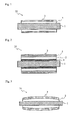
- Fig. 1 is a cross-sectional view illustrating one example of a conductive roller of the present invention in the length direction.
- a conductive roller 10 of the present invention comprises a shaft 1, and an elastic layer 2 and a surface layer 3 formed on the periphery of the shaft in the order mentioned.
- the present invention is characterized in that an elastic layer 2 is composed of a polyurethane foam containing a polyurethane resin and a waterproofing agent.
- an elastic layer 2 is composed of a polyurethane foam containing a polyurethane resin and a waterproofing agent.
- the waterproofing agent for example, ammonium zirconium carbonate can be preferably used.
- the reason why the above-mentioned effect is obtained by adding such a waterproofing agent into the elastic layer 2 is thought to be that a new charge path is formed in the foam by forming a hydrogen bond between an OH group in the polyurethane resin and a carboxyl group in the waterproofing agent such as zirconium ammonium carbonate.
- a roller in which the electric resistance of the foam can be reduced, the resistance variation with respect to change in the environment is inhibited and the environment-dependence of the resistance is small can be obtained.
- a waterproofing agent composed of ammonium zirconium carbonate for example, AZ Coat 5800MT manufactured by SAN NOPCO LIMITED can be preferably used.
- the amount of the waterproofing agent to be added is preferably 0.5 to 20 parts by mass, particularly 0.5 to 5 parts by mass with respect to 100 parts by mass of the polyurethane resin.
- the amount of the waterproofing agent to be added is too large, the viscosity becomes too high and the pot life tends to be reduced; on the other hand, when the amount of the waterproofing agent to be added is too small, a desired effect of the present invention may not be sufficiently obtained, both of which are not preferred.
- the roller can be constituted according to an usual method as appropriate, and the method is not particularly restricted.
- the polyurethane resin used for the above-mentioned polyurethane foam a conventionally known material can be appropriately selected and used, and is not particularly restricted.
- the expansion ratio of the polyurethane foam is not particularly restricted and preferably 1.2 to 50 times, particularly 1.5 to 10 times, and the foam density is preferably 0.1 to 0.7 g/cm 3 .
- a conductive agent can be added. By this, the conductivity is imparted to the layer, or the conductivity is adjusted to obtain a predetermined resistance value.
- a conductive agent is not particularly restricted, and examples thereof include cationic surfactants such as quaternary ammonium salts such as perchlorates, chlorates, fluoroborates, sulphates, ethosulfates and benzyl halides such as benzyl bromides, benzyl chlorides of lauryltrimethyl ammonium, stearylmethyl ammonium, octadodecyl trimethyl ammonium, hexadecyl trimethyl ammonium, trans fatty acid-dimethyl ethyl ammonium; anionic surfactants such as fatty series sulfonic acid salts, higher alcohol sulfate ester salts, higher alcohol ethylene oxide adduct sulfate ester salts, higher alcohol phosphate ester salts, higher alcohol phosphate este
- conductive agents may be used alone or two or more of these may be mixed and used.
- the amount of such conductive agents to be added is appropriately selected depending on the type of the composition, and usually adjusted such that the volume resistivity of the elastic layer 2 is 10 0 to 10 8 ⁇ cm, preferably 10 2 to 10 6 ⁇ cm.
- a known additive such as a wetting agent, a foaming agent, a foam stabilizer, a curing agent, a thickener, a defoamer, a leveling agent, a dispersing agent, a thixotropic agent, an antiblocking agent, a crosslinker or a film formation aid can be added in an appropriate amount, as required.
- a wetting agent for example, a silicone surfactant such as a polyether-modified silicone can be favorably used.
- the polyether-modified silicone has a structure in which a part of alkyl group in poly(dialkylsiloxane) is replaced by a substitute having a polyoxyalkylene group.
- examples of such a polyether-modified silicone include dimethylpolysiloxane polyoxyalkylene copolymer.
- the amount of such a wetting agent to be added is preferably 0.1 to 2 parts by mass with respect to 100 parts by mass of polyurethane resin.
- amount of the wetting agent to be added is too large, gelation of the coating tends to occur; on the other hand, when the amount of the wetting agent to be added is too small, a desired effect may not be sufficiently obtained, both of which are not preferred.
- the thickness of the elastic layer 2 is preferably 0.6 to 5.0 mm, and more preferably 1.0 to 3.0 mm. By making the thickness of the elastic layer 2 in the above range, a spark discharge can be prevented.
- a hollow cylinder or solid cylinder made of metal or plastics can be used, and preferably a hollow cylinder or solid cylinder made of metal, and more preferably a hollow cylinder made of metal can be used. By using this, the cost can be reduced.
- the surface layer 3 provided on the elastic layer 2 is preferably formed by using a water-based coating.
- a water-based coating used for such a surface layer 3 rubber or a resin which is known as a material for a roller or the like can be employed.
- the resin include a urethane-modified acrylic resin, polyurethane resin, acrylic resin, acrylic silicone resin, polyamide resin and fluorocarbon resin, and one or more of these can be mixed to be used.
- latex such as natural rubber (NR), chloroprene rubber (CR), nitrile rubber (NBR), styrene butadiene rubber (SBR) can be preferably used;
- water-based polyurethane resin coating an ether or ester emulsion or dispersion can be preferably used;
- the water-based acrylic resin coating emulsion such as acrylic, acrylic styrene can be preferably used;
- water-based fluorocarbon resin coating polytetrafluoroethylene, tetrafluoroethylene-perfluoroalkylvinylether copolymer, tetrafluoroethylene-ethylene copolymer, polychlorotrifluoroethylene, chlorotrifluoroethylene-ethylene copolymer, tetrafluoroethylene-vinylidenefluoride copolymer, polyvinylidene fluoride, polyvinyl fluoride can be preferably used.
- a water-based acrylic resin can be preferably used as the water-based coating.
- a resin having as an essential component acrylonitrile and n-butyl acrylate and optionally containing other monomers is preferred.
- the other monomer include ethyl acrylate, acrylic acid 2-ethyl hexyl, acrylic acid and methacrylic acid.
- the resin contains as the essential component acrylonitrile and n-butyl acrylate because these serve as the improvement of the elasticity (setting properties).
- the amount of n-butyl acrylate is increased as much as possible and the amount of the other components is reduced, as well as the monomer ratio of monomer components other than the essential components is preferably reduced.
- the ratio of acrylonitrile is increased, the formed layer becomes hard, which is not preferable.
- the monomer ratio of acrylonitrile and n-butyl acrylate which are essential components is therefore 1 to 25 : 99 to 75 based on the molar ratio, and particularly preferably in a range of 5 to 20 : 95 to 80.
- the above-mentioned water-based acrylic resin preferably contains a group having an active hydrogen in the molecule.
- the group having an active hydrogen includes a carboxyl group, a hydroxy group and an amino group, and are preferably a carboxyl group.
- the ratio of monomers containing a group having such an active hydrogen is preferably in a range of 3 to 6% of the whole amount of the monomers.
- a water-based acrylic resin whose surface acid value is adjusted to 10mg/g or higher, for example, 10 to 20 mg/g can be favorably used.
- a conductive agent is added, which is not restrictive, whereby the conductivity (electric resistance) is imparted to the surface layer 3 or the conductivity can be adjusted.
- the conductive agent used in this case is not particularly restricted, and the same agents used for the elastic layer 2 can be appropriately used alone or two or more of these can be used in mixture.
- the amount of these conductive agents added is appropriately selected depending on the types of the composition, and usually, the volume resistivity of the surface layer 2 is adjusted to 1 ⁇ 10 4 to 1 ⁇ 10 12 ⁇ cm, preferably 1 ⁇ 10 6 to 1 ⁇ 10 8 ⁇ cm.
- an additive such as a cross linking agent, a thickener, a thixotropic agent or a structural viscosity agent may be added as required.
- the thickness of the surface layer 3 is not particularly restricted thereto, and may be set to usually 1 to 30 ⁇ m, particularly 1 to 20 ⁇ m. If the thickness is smaller than 1 ⁇ m, the durability of the roller is sometimes poor, and on the other hand, if the thickness is larger than 30 ⁇ m, there are cases where a good surface quality may not be obtained such as a case where electrification characteristics or the like is negatively affected and a case where wrinkle occurs on the surface.
- a conductive roller 10 of the present invention at least comprises the surface layer 3 on the above-mentioned elastic layer 2.
- a resistance adjusting layer 5 can be provided as an intermediate layer; and further, between the elastic layer 2 and the resistance adjusting layer 5, an adhesion layer 4 can be placed. Further, by providing an adhesion layer 4 on the periphery of a shaft 1 prior to the formation of the elastic layer 2, the adhesiveness between the shaft 1 and the elastic layer 2 can be improved.
- Fig. 2 is a cross-sectional view illustrating another configuration example of a conductive roller of the present invention.
- a conductive roller 20 as illustrated comprises the shaft 1, and the adhesion layer 4, the elastic layer 2, the resistance adjusting layer 5 and the surface layer 3 which are formed on the periphery of the shaft 1 in the order mentioned.
- the above-mentioned resistance adjusting layer 5 can be formed by a resin composition in which a conductive agent is added to the resin.
- the resin which constitutes this resin composition is not particularly restricted, and examples thereof include urethane resin, acrylic urethane resin, acrylic resin, ester resin, nylon resin, phenolic resin, epoxy resin, fluorocarbon resin and silicone resin. One of these may be used, or two or more of these may be used in mixture. Among these, a water-based coating such as urethane resin, acrylic urethane resin, acrylic resin is preferably used.
- the conductive agent which is added to this water-based coating the same conductive agent as used in the above-mentioned elastic layer 2 can be used.
- the resistance adjusting layer 5 is optionally provided in order to adjust the electric resistance value of the conductive roller.
- the resistance value of the resistance adjusting layer 5 is appropriately set depending on the resistance value of the above-mentioned elastic layer 2 or the resistance value needed for the roller, and may be usually in a range of 1 ⁇ 10 3 to 1 ⁇ 10 8 ⁇ cm, and particularly 1 ⁇ 10 5 to 1 ⁇ 10 7 ⁇ cm.
- the amount of the above-mentioned conductive agent to be added may be an amount in which this resistance value is attained, and is usually 0.1 to 20 parts by mass, particularly 1 to 10 parts by mass with respect to 100 parts by mass of the base resin of the above-mentioned water-based coating.
- a variety of additives other than the conductive agents can be added without departing from an object of the present invention.
- a crosslinker such as one based on oxazoline, epoxy, melamine, guanamine, isocyanate or phenol can be added in an appropriate amount depending on the base resin to be used.
- Other known additives such as a film formation aid, a dispersing agent, a thickener, a leveling agent, a thixotropic agent and a structural viscosity agent may be added in an appropriate amount.
- the thickness of the resistance adjusting layer 5 is appropriately selected depending on the thickness of the elastic layer 2 or the shape of the conductive roller or the like, and not particularly restricted.
- the thickness is preferably usually 10 to 500 ⁇ m, and particularly 50 to 300 ⁇ m.
- the thickness of the resistance adjusting layer 5 is smaller than 50 ⁇ m, it sometimes becomes difficult to sufficiently adjust the resistance value.
- the thickness of the resistance adjusting layer 5 is larger than 300 ⁇ m, the thickness of the elastic layer becomes relatively small, whereby the hardness of the roller (hardness of a member) sometimes becomes high or the cost sometimes becomes higher than necessary.
- the adhesion layer 4 can be optionally provided in order to strongly bond between the shaft 1 and the elastic layer 2, or between the elastic layer 2 and the resistance adjusting layer 5, and the thickness thereof may be about 1 to 100 ⁇ m.
- the adhesion layer 4 can by formed, for example, by using a resin material such as acrylic resin, urethane resin, acrylic urethane resin, polyester resin or polyamide resin.
- Fig. 3 is a cross-sectional view in the length direction illustrating still another example of a conductive roller of the present invention.
- the illustrated conductive roller 30 of the preferred embodiment has a crown shape whose diameter at the center portion is larger than those at the end portions.
- the conductive roller is made into a crown shape
- a crown amount which represents the degree of the protrusion when the portion at the center is more protruded than the portions at the ends in the roller length direction in the cross section of the roller length direction
- 50 to 300 ⁇ m is preferably employed. By employing this amount, normal images may be made more preferable. If the crown amount is smaller than 50 ⁇ m, the contact pressure at the center of the roller in the roller length direction becomes low, while if the crown amount is larger than 300 ⁇ m, the portion at the center of the roller in the roller length direction makes too strong contact. Both cases possibly cause a failure such as ununiformity of the charge amount.
- the measurement of the crown amount of the conductive roller of the present invention can be performed by using High Precision Laser Measuring Machine LSM-430v manufactured by Mitutoyo Corporation. External diameters at the center portion and at 90 mm from the center portion in the direction from the center portion to the end portion were measured by this measuring machine, and a roller crown amount is defined as the difference between the external diameter at the center portion and the average of the external diameters at 90 mm from the center portion in the directions from the center portion to the end portions. For example, for a conductive roller having a roller length of 250 mm, external diameters are measured at three point, at 35 mm, 125 mm and 215 mm from one end of the roller.
- the conductive rollers of the present invention preferably have a deviation (precision of film thickness) of not larger than 70 ⁇ m in the whole range in the roller length direction.
- a deviation precision of film thickness
- the conductive rollers are used as an electrifying roller and allowed to be revolved while being in contact with the photoreceptor, when the deviation of the conductive rollers is large, a gap between the conductive roller and the photoreceptor is generated and further, the gap distance varies.
- toner particles and external additives which remain on the photoreceptor are likely to intrude into the gap and then attached irregularly on the conductive rollers. As a result, the surface of the roller becomes mottled with the remain, which produces an image with a low quality.
- the measurement of the deviation of the conductive rollers of the present invention can be performed by using High Precision Laser Measuring Machine LSM-430v manufactured by Mitutoyo Corporation.
- the external diameters for five points in the roller length direction are measured by this measuring machine, and a deviation is defined as the average of the differences between the maximum value and the minimum value of the measured external diameter for individual points.
- the conductive roller of the present invention can be favorably used particularly as a charging roller.
- the conductive roller of the present invention can be manufactured as described in the following. First, to polyurethane resin constituting the elastic layer 2, a waterproofing agent and other optional additives are added, and the obtained materials to be added are allowed to be foamed by stirring with a stirrer such as a hand-mixer. Thereafter, the foamed materials to be added are applied to the shaft 1 by dipping coating to form the elastic layer 2 on the periphery of the shaft 1. By forming the elastic layer 2 by applying a coating directly to the shaft 1, the manufacturing steps can be simplified and the cost can be reduced.
- the adhesion layer 4 is optionally formed by applying a coating in which the above-mentioned components are dispersed or dissolved.
- a coating method known methods such as a dipping method, a spray method, a roll coater method, a die coating method and a ring coating method can be appropriately used. After a coating is applied, the coating is solidified by drying to form the adhesion layer 4.
- a dipping method is preferably used. Also in cases where the adhesion layer 4 is provided between the shaft 1 and the elastic layer 2, the same method as described above can be used.
- the resistance adjusting layer 5 also can be optionally formed in the same manner as used for the adhesion layer 4.
- the conductive roller of the present invention can be obtained.
- the pore size on the surface of the elastic layer 2 is made fine, a coating will not intrude into the pores when the surface layer 3 or the like is formed by applying on the elastic layer 2, and an effect is obtained which does not compromise the surface properties of the finally obtained conductive roller.
- a conductive roller having a structure as illustrated in Fig. 1 in which an elastic layer 2 and a surface layer 3 were formed on the periphery of a shaft 1 in the order mentioned was manufactured in the manner as described in the following according to the formulation given in the Table below.
- water-based coating a water emulsion of acrylonitrile-acrylic acid alkyl ester-methacrylic acid-methacrylic acid glycidyl copolymer
- EPOCROS emulsion of oxazoline group containing styrene-acrylic copolymer
- 10 parts by mass of water dispersion carbon 7.5 parts by mass of Fineseal X-12 (hydrophilic silica), 1 parts by mass of SN Defoamer 777 (defoamer), 1 parts by mass of SN Wet 970 (wetting agent), 1.6% by mass of UH420 (thickener) were added to be stirred by a stirrer.
- the water-based coating to which all of the ingredients were added was filtrated by a mesh to remove aggregate.
- the shaft 1 was subjected to a dipping coating with this water-based coating and to heat drying, thereby forming an adhesion layer 4 having a thickness of 100 ⁇ m on the periphery of the shaft 1.
- the materials to be added of the elastic layer each given in the Table below were injected in a container to be stirred for 30 minutes by using a blade. Then, the resultant was stirred for six minutes by using a commercially available hand-mixer to be foamed, thereby obtaining an aqueous urethane foam dispersion.
- aqueous urethane foam dispersion was applied by dipping coating on the periphery of the shaft 1 on which the adhesion layer 4 was formed, dried and hardened in a heat oven, whereby the elastic layers 2 composed of polyurethane foams individually having the thicknesses given in the Table below.
- a water-based coating (acrylic silicon resin, EX102SI, manufactured by NIPPON SHOKUBAI CO., LTD.), 70 parts by mass of 2,2,4-trimethyl-1,3-pentanediol monoisobutylate (manufactured by Chisso Corporation, CS-12), 8 parts by mass of aqueous silicone graft acrylic polymer (manufactured by Toagosei Co., Ltd., Symac US-450), 27 parts by mass of polyether modified polydimethyl siloxane (manufactured by BYK Japan KK, BYK-333), 2 parts by mass of a fluorine containing nonionic surfactant (manufactured by Neos COMPANY LIMITED, Ftergent 215M) and 10 parts by mass of SILICA (manufactured by TOKUYAMA corporation, FINE SEAL X-12), 15 parts by mass of Nylon particles (manufactured by GANZ CHEM
- the obtained water-based coating was applied on the above-mentioned elastic layer 2 by dipping coating and dried for 30 minutes at room temperature and for 20 minutes at 110°C to form the surface layer 3 having a thickness of 5 ⁇ m, thereby obtaining each conductive roller.
- each roller was left to stand in a controlled space for 24 hours under the normal temperature and the normal humidity at a room temperature of 23°C and a humidity of 55%, under the low temperature and the low humidity of 10°C and a humidity of 15% or under the high temperature and the high humidity at a room temperature of 30°C and a humidity of 85%, then the resistances were measured.
- the vicinity of the surface of the elastic layer before the formation of the surface layer 3 was cut in a thickness of about 3 mm.
- the diameters of the pores were measured by using DIGITAL MICROSCOPE (VHX-100, manufactured by KEYENCE CORPORATION) at ten points in descending order to be averaged. The measured results of these resistance values and the averaged pore sizes are given in the Table below.
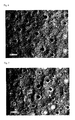
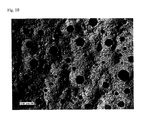
- the photographs of the pores on the surface of the elastic layers are illustrated in Figs. 4 to 10 .
- the rollers of the Examples in which the polyurethane resin and the waterproofing agent were contained in the elastic layer formulation had a controlled environment-dependence of the resistance and had a small variation of the resistance accompanied by environmental change as compared to the roller of the Comparative Example 1 in which the waterproofing agent was not contained.
- the rollers in the Examples had a fine pore size at the surface of the elastic layer as compared to the roller of the Comparative Example 1.
Landscapes
- Chemical & Material Sciences (AREA)
- Physics & Mathematics (AREA)
- Engineering & Computer Science (AREA)
- General Physics & Mathematics (AREA)
- Materials Engineering (AREA)
- Organic Chemistry (AREA)
- Health & Medical Sciences (AREA)
- Chemical Kinetics & Catalysis (AREA)
- Medicinal Chemistry (AREA)
- Polymers & Plastics (AREA)
- Inorganic Chemistry (AREA)
- Plasma & Fusion (AREA)
- Electrostatic Charge, Transfer And Separation In Electrography (AREA)
- Electrophotography Configuration And Component (AREA)
- Manufacture Of Porous Articles, And Recovery And Treatment Of Waste Products (AREA)
- Compositions Of Macromolecular Compounds (AREA)
- Dry Development In Electrophotography (AREA)
- Cleaning In Electrography (AREA)
- Rolls And Other Rotary Bodies (AREA)
Applications Claiming Priority (2)
| Application Number | Priority Date | Filing Date | Title |
|---|---|---|---|
| JP2010044654A JP5642401B2 (ja) | 2010-03-01 | 2010-03-01 | 導電性ローラおよびその製造方法 |
| PCT/JP2011/054649 WO2011108547A1 (fr) | 2010-03-01 | 2011-03-01 | Rouleau conducteur et procédé de fabrication pour celui-ci |
Publications (3)
| Publication Number | Publication Date |
|---|---|
| EP2544052A1 true EP2544052A1 (fr) | 2013-01-09 |
| EP2544052A4 EP2544052A4 (fr) | 2015-07-22 |
| EP2544052B1 EP2544052B1 (fr) | 2018-05-23 |
Family
ID=44542197
Family Applications (1)
| Application Number | Title | Priority Date | Filing Date |
|---|---|---|---|
| EP11750657.6A Not-in-force EP2544052B1 (fr) | 2010-03-01 | 2011-03-01 | Rouleau conducteur et procédé de fabrication pour celui-ci |
Country Status (4)
| Country | Link |
|---|---|
| US (1) | US8943692B2 (fr) |
| EP (1) | EP2544052B1 (fr) |
| JP (1) | JP5642401B2 (fr) |
| WO (1) | WO2011108547A1 (fr) |
Cited By (1)
| Publication number | Priority date | Publication date | Assignee | Title |
|---|---|---|---|---|
| CN110205007A (zh) * | 2019-04-30 | 2019-09-06 | 清远市绚淳环保新材料有限公司 | 一种发泡材质充电辊的表面处理涂料及其制备方法 |
Families Citing this family (8)
| Publication number | Priority date | Publication date | Assignee | Title |
|---|---|---|---|---|
| WO2011074610A1 (fr) * | 2009-12-15 | 2011-06-23 | 株式会社ブリヂストン | Rouleau électroconducteur et procédé de fabrication associé |
| CN106795910A (zh) * | 2014-09-04 | 2017-05-31 | 株式会社普利司通 | 辊和使用其的图像形成装置 |
| JP6051365B2 (ja) * | 2014-09-25 | 2016-12-27 | 住友理工株式会社 | 帯電部材 |
| JP6520550B2 (ja) * | 2015-08-14 | 2019-05-29 | 富士ゼロックス株式会社 | 転写ロール、プロセスカートリッジ、及び画像形成装置 |
| JP2017181599A (ja) * | 2016-03-28 | 2017-10-05 | 富士ゼロックス株式会社 | 転写ロール、プロセスカートリッジ、及び画像形成装置 |
| JP7083440B2 (ja) * | 2018-03-05 | 2022-06-13 | 株式会社ブリヂストン | 導電性ローラ |
| JP7623135B2 (ja) * | 2020-12-24 | 2025-01-28 | 住友理工株式会社 | 電子写真機器用帯電ロール |
| JP2024118791A (ja) * | 2023-02-21 | 2024-09-02 | 住友ゴム工業株式会社 | 現像ローラ |
Family Cites Families (9)
| Publication number | Priority date | Publication date | Assignee | Title |
|---|---|---|---|---|
| JPS5843267A (ja) * | 1981-09-08 | 1983-03-12 | Matsushita Electric Ind Co Ltd | 円盤の塗装方法 |
| JP3400054B2 (ja) * | 1993-05-31 | 2003-04-28 | 株式会社リコー | 画像形成装置 |
| JPH10513581A (ja) * | 1995-11-29 | 1998-12-22 | ロジャーズ コーポレーション | 導電性熱収縮性筒表面を備えた導電ローラー |
| JPH10159834A (ja) * | 1996-11-25 | 1998-06-16 | Sumitomo Rubber Ind Ltd | 導電性ゴムローラおよびその製造方法 |
| JP4252125B2 (ja) | 1998-04-08 | 2009-04-08 | 株式会社イノアックコーポレーション | 導電ロ一ラ及びその製造方法 |
| JP2001049194A (ja) * | 1999-08-13 | 2001-02-20 | Daikin Ind Ltd | 耐汚染性塗料 |
| JP4953520B2 (ja) * | 2001-06-07 | 2012-06-13 | 株式会社ブリヂストン | ディッピング制御方法とその装置、及びロール部材の製造方法 |
| JP3980958B2 (ja) * | 2002-07-25 | 2007-09-26 | 株式会社日本触媒 | ウレタン樹脂組成物 |
| JP2009045759A (ja) * | 2007-08-14 | 2009-03-05 | Oji Paper Co Ltd | 感熱記録体 |
-
2010
- 2010-03-01 JP JP2010044654A patent/JP5642401B2/ja not_active Expired - Fee Related
-
2011
- 2011-03-01 EP EP11750657.6A patent/EP2544052B1/fr not_active Not-in-force
- 2011-03-01 US US13/582,191 patent/US8943692B2/en active Active
- 2011-03-01 WO PCT/JP2011/054649 patent/WO2011108547A1/fr not_active Ceased
Non-Patent Citations (1)
| Title |
|---|
| See references of WO2011108547A1 * |
Cited By (2)
| Publication number | Priority date | Publication date | Assignee | Title |
|---|---|---|---|---|
| CN110205007A (zh) * | 2019-04-30 | 2019-09-06 | 清远市绚淳环保新材料有限公司 | 一种发泡材质充电辊的表面处理涂料及其制备方法 |
| CN110205007B (zh) * | 2019-04-30 | 2022-07-12 | 清远市绚淳环保新材料有限公司 | 一种发泡材质充电辊的表面处理涂料及其制备方法 |
Also Published As
| Publication number | Publication date |
|---|---|
| WO2011108547A1 (fr) | 2011-09-09 |
| EP2544052A4 (fr) | 2015-07-22 |
| EP2544052B1 (fr) | 2018-05-23 |
| JP2011180386A (ja) | 2011-09-15 |
| JP5642401B2 (ja) | 2014-12-17 |
| US20120322637A1 (en) | 2012-12-20 |
| US8943692B2 (en) | 2015-02-03 |
Similar Documents
| Publication | Publication Date | Title |
|---|---|---|
| EP2544052B1 (fr) | Rouleau conducteur et procédé de fabrication pour celui-ci | |
| JP4799706B1 (ja) | 帯電部材、プロセスカートリッジ及び電子写真装置 | |
| CN101051202B (zh) | 显影辊及其制造方法、以及显影辊的产品检查方法 | |
| US9964890B2 (en) | Rubber member for developing roll, and method for manufacturing same | |
| JP5767034B2 (ja) | ウレタン樹脂組成物およびそれを用いた導電性ローラ | |
| US8090295B2 (en) | Conductive rubber member | |
| JP2010015143A (ja) | 多層ベルト | |
| EP3088962B1 (fr) | Organe en caoutchouc visant à recouvrir un rouleau de développement et procédé de production d'un rouleau de développement pour un dispositif de formation d'image | |
| EP1288729A2 (fr) | Elément élastique de polymère semiconducteur et équipement bureautique avec celui-ci | |
| JP4922801B2 (ja) | 電子写真機器用現像ロールおよび電子写真機器用現像ロールの製造方法 | |
| CN1983053B (zh) | 导电性橡胶部件 | |
| JP5334092B2 (ja) | 導電性ゴム部材及びその製造方法 | |
| EP2515180B1 (fr) | Rouleau électroconducteur et procédé de fabrication associé | |
| JP5238335B2 (ja) | トナー供給ローラ及びその製造方法 | |
| JP4533692B2 (ja) | 導電性部材を有する現像装置及び画像形成装置 | |
| JPH11249384A (ja) | 帯電部材及び帯電装置 | |
| JP6133617B2 (ja) | 導電性ローラ | |
| CN112540520B (zh) | 显影辊 | |
| JP2008209668A (ja) | 現像ロール | |
| JP2016114791A (ja) | 帯電ローラ | |
| JP2011248224A (ja) | 導電性ローラの製造方法およびそれにより得られる導電性ローラ | |
| JP2012181227A (ja) | 帯電部材、プロセスカートリッジ及び電子写真装置 | |
| JPH10161391A (ja) | 帯電部材及び帯電装置 | |
| JP2001066850A (ja) | 帯電部材及び帯電装置 | |
| JP2014169756A (ja) | 導電性ローラ |
Legal Events
| Date | Code | Title | Description |
|---|---|---|---|
| PUAI | Public reference made under article 153(3) epc to a published international application that has entered the european phase |
Free format text: ORIGINAL CODE: 0009012 |
|
| 17P | Request for examination filed |
Effective date: 20121001 |
|
| AK | Designated contracting states |
Kind code of ref document: A1 Designated state(s): AL AT BE BG CH CY CZ DE DK EE ES FI FR GB GR HR HU IE IS IT LI LT LU LV MC MK MT NL NO PL PT RO RS SE SI SK SM TR |
|
| DAX | Request for extension of the european patent (deleted) | ||
| RA4 | Supplementary search report drawn up and despatched (corrected) |
Effective date: 20150624 |
|
| RIC1 | Information provided on ipc code assigned before grant |
Ipc: F16C 13/00 20060101ALI20150618BHEP Ipc: C08J 9/06 20060101ALI20150618BHEP Ipc: G03G 21/10 20060101ALI20150618BHEP Ipc: G03G 15/02 20060101AFI20150618BHEP Ipc: G03G 15/00 20060101ALI20150618BHEP Ipc: G03G 15/16 20060101ALI20150618BHEP Ipc: C08L 75/04 20060101ALI20150618BHEP Ipc: C08J 9/00 20060101ALI20150618BHEP Ipc: G03G 15/08 20060101ALI20150618BHEP |
|
| REG | Reference to a national code |
Ref country code: DE Ref legal event code: R079 Ref document number: 602011048583 Country of ref document: DE Free format text: PREVIOUS MAIN CLASS: G03G0015020000 Ipc: G03G0021000000 |
|
| GRAP | Despatch of communication of intention to grant a patent |
Free format text: ORIGINAL CODE: EPIDOSNIGR1 |
|
| STAA | Information on the status of an ep patent application or granted ep patent |
Free format text: STATUS: GRANT OF PATENT IS INTENDED |
|
| RIC1 | Information provided on ipc code assigned before grant |
Ipc: C08J 9/30 20060101ALI20171013BHEP Ipc: G03G 15/02 20060101ALI20171013BHEP Ipc: G03G 15/16 20060101ALI20171013BHEP Ipc: C08L 75/04 20060101ALI20171013BHEP Ipc: C08J 9/00 20060101ALI20171013BHEP Ipc: G03G 21/00 20060101AFI20171013BHEP Ipc: G03G 15/08 20060101ALI20171013BHEP |
|
| GRAJ | Information related to disapproval of communication of intention to grant by the applicant or resumption of examination proceedings by the epo deleted |
Free format text: ORIGINAL CODE: EPIDOSDIGR1 |
|
| GRAP | Despatch of communication of intention to grant a patent |
Free format text: ORIGINAL CODE: EPIDOSNIGR1 |
|
| INTG | Intention to grant announced |
Effective date: 20171120 |
|
| INTG | Intention to grant announced |
Effective date: 20171204 |
|
| GRAS | Grant fee paid |
Free format text: ORIGINAL CODE: EPIDOSNIGR3 |
|
| GRAA | (expected) grant |
Free format text: ORIGINAL CODE: 0009210 |
|
| STAA | Information on the status of an ep patent application or granted ep patent |
Free format text: STATUS: THE PATENT HAS BEEN GRANTED |
|
| AK | Designated contracting states |
Kind code of ref document: B1 Designated state(s): AL AT BE BG CH CY CZ DE DK EE ES FI FR GB GR HR HU IE IS IT LI LT LU LV MC MK MT NL NO PL PT RO RS SE SI SK SM TR |
|
| REG | Reference to a national code |
Ref country code: GB Ref legal event code: FG4D |
|
| REG | Reference to a national code |
Ref country code: CH Ref legal event code: EP |
|
| REG | Reference to a national code |
Ref country code: IE Ref legal event code: FG4D |
|
| REG | Reference to a national code |
Ref country code: AT Ref legal event code: REF Ref document number: 1001996 Country of ref document: AT Kind code of ref document: T Effective date: 20180615 |
|
| REG | Reference to a national code |
Ref country code: DE Ref legal event code: R096 Ref document number: 602011048583 Country of ref document: DE |
|
| REG | Reference to a national code |
Ref country code: NL Ref legal event code: MP Effective date: 20180523 |
|
| REG | Reference to a national code |
Ref country code: LT Ref legal event code: MG4D |
|
| PG25 | Lapsed in a contracting state [announced via postgrant information from national office to epo] |
Ref country code: ES Free format text: LAPSE BECAUSE OF FAILURE TO SUBMIT A TRANSLATION OF THE DESCRIPTION OR TO PAY THE FEE WITHIN THE PRESCRIBED TIME-LIMIT Effective date: 20180523 Ref country code: LT Free format text: LAPSE BECAUSE OF FAILURE TO SUBMIT A TRANSLATION OF THE DESCRIPTION OR TO PAY THE FEE WITHIN THE PRESCRIBED TIME-LIMIT Effective date: 20180523 Ref country code: NO Free format text: LAPSE BECAUSE OF FAILURE TO SUBMIT A TRANSLATION OF THE DESCRIPTION OR TO PAY THE FEE WITHIN THE PRESCRIBED TIME-LIMIT Effective date: 20180823 Ref country code: SE Free format text: LAPSE BECAUSE OF FAILURE TO SUBMIT A TRANSLATION OF THE DESCRIPTION OR TO PAY THE FEE WITHIN THE PRESCRIBED TIME-LIMIT Effective date: 20180523 Ref country code: FI Free format text: LAPSE BECAUSE OF FAILURE TO SUBMIT A TRANSLATION OF THE DESCRIPTION OR TO PAY THE FEE WITHIN THE PRESCRIBED TIME-LIMIT Effective date: 20180523 Ref country code: BG Free format text: LAPSE BECAUSE OF FAILURE TO SUBMIT A TRANSLATION OF THE DESCRIPTION OR TO PAY THE FEE WITHIN THE PRESCRIBED TIME-LIMIT Effective date: 20180823 |
|
| PG25 | Lapsed in a contracting state [announced via postgrant information from national office to epo] |
Ref country code: GR Free format text: LAPSE BECAUSE OF FAILURE TO SUBMIT A TRANSLATION OF THE DESCRIPTION OR TO PAY THE FEE WITHIN THE PRESCRIBED TIME-LIMIT Effective date: 20180824 Ref country code: NL Free format text: LAPSE BECAUSE OF FAILURE TO SUBMIT A TRANSLATION OF THE DESCRIPTION OR TO PAY THE FEE WITHIN THE PRESCRIBED TIME-LIMIT Effective date: 20180523 Ref country code: RS Free format text: LAPSE BECAUSE OF FAILURE TO SUBMIT A TRANSLATION OF THE DESCRIPTION OR TO PAY THE FEE WITHIN THE PRESCRIBED TIME-LIMIT Effective date: 20180523 Ref country code: LV Free format text: LAPSE BECAUSE OF FAILURE TO SUBMIT A TRANSLATION OF THE DESCRIPTION OR TO PAY THE FEE WITHIN THE PRESCRIBED TIME-LIMIT Effective date: 20180523 Ref country code: HR Free format text: LAPSE BECAUSE OF FAILURE TO SUBMIT A TRANSLATION OF THE DESCRIPTION OR TO PAY THE FEE WITHIN THE PRESCRIBED TIME-LIMIT Effective date: 20180523 |
|
| REG | Reference to a national code |
Ref country code: AT Ref legal event code: MK05 Ref document number: 1001996 Country of ref document: AT Kind code of ref document: T Effective date: 20180523 |
|
| PG25 | Lapsed in a contracting state [announced via postgrant information from national office to epo] |
Ref country code: RO Free format text: LAPSE BECAUSE OF FAILURE TO SUBMIT A TRANSLATION OF THE DESCRIPTION OR TO PAY THE FEE WITHIN THE PRESCRIBED TIME-LIMIT Effective date: 20180523 Ref country code: SK Free format text: LAPSE BECAUSE OF FAILURE TO SUBMIT A TRANSLATION OF THE DESCRIPTION OR TO PAY THE FEE WITHIN THE PRESCRIBED TIME-LIMIT Effective date: 20180523 Ref country code: DK Free format text: LAPSE BECAUSE OF FAILURE TO SUBMIT A TRANSLATION OF THE DESCRIPTION OR TO PAY THE FEE WITHIN THE PRESCRIBED TIME-LIMIT Effective date: 20180523 Ref country code: PL Free format text: LAPSE BECAUSE OF FAILURE TO SUBMIT A TRANSLATION OF THE DESCRIPTION OR TO PAY THE FEE WITHIN THE PRESCRIBED TIME-LIMIT Effective date: 20180523 Ref country code: AT Free format text: LAPSE BECAUSE OF FAILURE TO SUBMIT A TRANSLATION OF THE DESCRIPTION OR TO PAY THE FEE WITHIN THE PRESCRIBED TIME-LIMIT Effective date: 20180523 Ref country code: EE Free format text: LAPSE BECAUSE OF FAILURE TO SUBMIT A TRANSLATION OF THE DESCRIPTION OR TO PAY THE FEE WITHIN THE PRESCRIBED TIME-LIMIT Effective date: 20180523 Ref country code: CZ Free format text: LAPSE BECAUSE OF FAILURE TO SUBMIT A TRANSLATION OF THE DESCRIPTION OR TO PAY THE FEE WITHIN THE PRESCRIBED TIME-LIMIT Effective date: 20180523 |
|
| REG | Reference to a national code |
Ref country code: DE Ref legal event code: R097 Ref document number: 602011048583 Country of ref document: DE |
|
| PG25 | Lapsed in a contracting state [announced via postgrant information from national office to epo] |
Ref country code: IT Free format text: LAPSE BECAUSE OF FAILURE TO SUBMIT A TRANSLATION OF THE DESCRIPTION OR TO PAY THE FEE WITHIN THE PRESCRIBED TIME-LIMIT Effective date: 20180523 Ref country code: SM Free format text: LAPSE BECAUSE OF FAILURE TO SUBMIT A TRANSLATION OF THE DESCRIPTION OR TO PAY THE FEE WITHIN THE PRESCRIBED TIME-LIMIT Effective date: 20180523 |
|
| PLBE | No opposition filed within time limit |
Free format text: ORIGINAL CODE: 0009261 |
|
| STAA | Information on the status of an ep patent application or granted ep patent |
Free format text: STATUS: NO OPPOSITION FILED WITHIN TIME LIMIT |
|
| 26N | No opposition filed |
Effective date: 20190226 |
|
| PG25 | Lapsed in a contracting state [announced via postgrant information from national office to epo] |
Ref country code: SI Free format text: LAPSE BECAUSE OF FAILURE TO SUBMIT A TRANSLATION OF THE DESCRIPTION OR TO PAY THE FEE WITHIN THE PRESCRIBED TIME-LIMIT Effective date: 20180523 |
|
| PG25 | Lapsed in a contracting state [announced via postgrant information from national office to epo] |
Ref country code: MC Free format text: LAPSE BECAUSE OF FAILURE TO SUBMIT A TRANSLATION OF THE DESCRIPTION OR TO PAY THE FEE WITHIN THE PRESCRIBED TIME-LIMIT Effective date: 20180523 |
|
| REG | Reference to a national code |
Ref country code: CH Ref legal event code: PL |
|
| PG25 | Lapsed in a contracting state [announced via postgrant information from national office to epo] |
Ref country code: AL Free format text: LAPSE BECAUSE OF FAILURE TO SUBMIT A TRANSLATION OF THE DESCRIPTION OR TO PAY THE FEE WITHIN THE PRESCRIBED TIME-LIMIT Effective date: 20180523 Ref country code: LU Free format text: LAPSE BECAUSE OF NON-PAYMENT OF DUE FEES Effective date: 20190301 |
|
| REG | Reference to a national code |
Ref country code: BE Ref legal event code: MM Effective date: 20190331 |
|
| PG25 | Lapsed in a contracting state [announced via postgrant information from national office to epo] |
Ref country code: CH Free format text: LAPSE BECAUSE OF NON-PAYMENT OF DUE FEES Effective date: 20190331 Ref country code: IE Free format text: LAPSE BECAUSE OF NON-PAYMENT OF DUE FEES Effective date: 20190301 Ref country code: LI Free format text: LAPSE BECAUSE OF NON-PAYMENT OF DUE FEES Effective date: 20190331 |
|
| PG25 | Lapsed in a contracting state [announced via postgrant information from national office to epo] |
Ref country code: BE Free format text: LAPSE BECAUSE OF NON-PAYMENT OF DUE FEES Effective date: 20190331 |
|
| PG25 | Lapsed in a contracting state [announced via postgrant information from national office to epo] |
Ref country code: TR Free format text: LAPSE BECAUSE OF FAILURE TO SUBMIT A TRANSLATION OF THE DESCRIPTION OR TO PAY THE FEE WITHIN THE PRESCRIBED TIME-LIMIT Effective date: 20180523 |
|
| PGFP | Annual fee paid to national office [announced via postgrant information from national office to epo] |
Ref country code: DE Payment date: 20200320 Year of fee payment: 10 Ref country code: GB Payment date: 20200323 Year of fee payment: 10 |
|
| PG25 | Lapsed in a contracting state [announced via postgrant information from national office to epo] |
Ref country code: PT Free format text: LAPSE BECAUSE OF FAILURE TO SUBMIT A TRANSLATION OF THE DESCRIPTION OR TO PAY THE FEE WITHIN THE PRESCRIBED TIME-LIMIT Effective date: 20180924 Ref country code: MT Free format text: LAPSE BECAUSE OF NON-PAYMENT OF DUE FEES Effective date: 20190301 |
|
| PGFP | Annual fee paid to national office [announced via postgrant information from national office to epo] |
Ref country code: FR Payment date: 20200320 Year of fee payment: 10 |
|
| PG25 | Lapsed in a contracting state [announced via postgrant information from national office to epo] |
Ref country code: CY Free format text: LAPSE BECAUSE OF FAILURE TO SUBMIT A TRANSLATION OF THE DESCRIPTION OR TO PAY THE FEE WITHIN THE PRESCRIBED TIME-LIMIT Effective date: 20180523 |
|
| PG25 | Lapsed in a contracting state [announced via postgrant information from national office to epo] |
Ref country code: IS Free format text: LAPSE BECAUSE OF FAILURE TO SUBMIT A TRANSLATION OF THE DESCRIPTION OR TO PAY THE FEE WITHIN THE PRESCRIBED TIME-LIMIT Effective date: 20180923 |
|
| PG25 | Lapsed in a contracting state [announced via postgrant information from national office to epo] |
Ref country code: HU Free format text: LAPSE BECAUSE OF FAILURE TO SUBMIT A TRANSLATION OF THE DESCRIPTION OR TO PAY THE FEE WITHIN THE PRESCRIBED TIME-LIMIT; INVALID AB INITIO Effective date: 20110301 |
|
| REG | Reference to a national code |
Ref country code: DE Ref legal event code: R119 Ref document number: 602011048583 Country of ref document: DE |
|
| GBPC | Gb: european patent ceased through non-payment of renewal fee |
Effective date: 20210301 |
|
| PG25 | Lapsed in a contracting state [announced via postgrant information from national office to epo] |
Ref country code: DE Free format text: LAPSE BECAUSE OF NON-PAYMENT OF DUE FEES Effective date: 20211001 Ref country code: GB Free format text: LAPSE BECAUSE OF NON-PAYMENT OF DUE FEES Effective date: 20210301 Ref country code: FR Free format text: LAPSE BECAUSE OF NON-PAYMENT OF DUE FEES Effective date: 20210331 |
|
| PG25 | Lapsed in a contracting state [announced via postgrant information from national office to epo] |
Ref country code: MK Free format text: LAPSE BECAUSE OF FAILURE TO SUBMIT A TRANSLATION OF THE DESCRIPTION OR TO PAY THE FEE WITHIN THE PRESCRIBED TIME-LIMIT Effective date: 20180523 |