EP2544103A1 - Verfahren und System zum Interagieren mit Objekten - Google Patents
Verfahren und System zum Interagieren mit Objekten Download PDFInfo
- Publication number
- EP2544103A1 EP2544103A1 EP11290310A EP11290310A EP2544103A1 EP 2544103 A1 EP2544103 A1 EP 2544103A1 EP 11290310 A EP11290310 A EP 11290310A EP 11290310 A EP11290310 A EP 11290310A EP 2544103 A1 EP2544103 A1 EP 2544103A1
- Authority
- EP
- European Patent Office
- Prior art keywords
- object class
- class
- association
- identifying
- objects
- Prior art date
- Legal status (The legal status is an assumption and is not a legal conclusion. Google has not performed a legal analysis and makes no representation as to the accuracy of the status listed.)
- Withdrawn
Links
Images

Classifications
-
- G—PHYSICS
- G06—COMPUTING OR CALCULATING; COUNTING
- G06Q—INFORMATION AND COMMUNICATION TECHNOLOGY [ICT] SPECIALLY ADAPTED FOR ADMINISTRATIVE, COMMERCIAL, FINANCIAL, MANAGERIAL OR SUPERVISORY PURPOSES; SYSTEMS OR METHODS SPECIALLY ADAPTED FOR ADMINISTRATIVE, COMMERCIAL, FINANCIAL, MANAGERIAL OR SUPERVISORY PURPOSES, NOT OTHERWISE PROVIDED FOR
- G06Q10/00—Administration; Management
-
- G—PHYSICS
- G06—COMPUTING OR CALCULATING; COUNTING
- G06F—ELECTRIC DIGITAL DATA PROCESSING
- G06F16/00—Information retrieval; Database structures therefor; File system structures therefor
- G06F16/90—Details of database functions independent of the retrieved data types
- G06F16/95—Retrieval from the web
- G06F16/953—Querying, e.g. by the use of web search engines
- G06F16/9535—Search customisation based on user profiles and personalisation
Definitions
- the present invention generally relates to complex interactions with objects like for instance reparation of a tire, maintenance of a garden park, etc.
- the invention in particular concerns automated, fast and smart guidance on how to interact with objects.
- a first category of existing solutions for guidance on interaction with objects consists of CAD tools that provide a context driven overview of possible actions on certain classes of objects.
- a second category of solutions for guidance on interaction with objects consists of online interest groups that provide information on how to interact with certain objects.
- the invention consists in establishing an interactive user experience wherein the user is intelligently guided on possible associations between identified object classes in a context, presented as an ordered, random or pseudo-random list, that he/she can select and instantiate.
- the method can be implemented on any simple mobile device with network connectivity and a camera, tag reader, barcode scanner or the like for identification of the object classes, e.g. a mobile phone, smart phone, tablet PC, etc.
- identifying the first object class may comprise visual recognition or tag reading.
- one way to identify an object class may involve taking a picture of the first object and identifying the first object class through visual recognition.
- the visual recognition may be located in the mobile device that is used for taking the picture, or in the network where the mobile device connects to.
- the first object class may be identified through reading and interpreting a tag, e.g. an RFID tag, fixed on or integrated in the first object.
- a tag e.g. an RFID tag
- identifying the second object class may comprise visual recognition or tag reading or selection out of an option list.
- the second object class may be identified by taking a picture of the second object and visually recognizing the first object, or by reading a product tag that is fixed onto or integrated into the second object.
- the system may suggest object classes for the second object out of an option list of object classes that are interrelated with the first object class. For instance the class of wheels or tires could be suggested if the first object class is the bike class.
- the possible associations may be ordered according to popularity in an ordered overview.
- the list of candidate associations for interaction and how to instantiate these associations for reasons of convenience may be presented in a certain order of priority.
- the order could be based on popularity of the following triplet: first object class, second object class, association.
- the possible associations may be ordered according to user profile in an ordered overview.
- the user's profile of interest may help in establishing the order wherein the associations are presented to him/her.
- the possible associations may be ordered according to social network status in an ordered overview.
- first object class the order wherein the triplets of first object class, second object class and association is presented, may depend on usage of the associations by friends.
- the above examples for ordering the list of possible associations are not exhaustive. Alternative parameters or criteria may be considered to set the priority order of the associations, e.g. the context, and plural parameters or criteria may be combined to determine the priority order for presenting the associations to the user. Instead of an ordered list, the possible associations may be presented to the user through a random or pseudo-random list. If the first object is for instance supposed to be a particular Lego building block, the application according to the present invention may suggest second object classes and associations in a pseudo-random order related to the shape, colour, etc. of the Lego building block.
- the method according to the current invention further comprises instructing the first object or the second object to elaborate the association.
- an object of the identified classes could be instructed to elaborate the association autonomously.
- the user could interactively monitor the progress of instantiation.
- the implementation of the instantiation procedure is beyond the scope of the present invention.
- the present invention also concerns a corresponding system to interact with objects as defined by claim 8, the system comprising:
- system may further comprise- means for instructing the first object or the second object to elaborate the association selected.
- the system shall consists of a mobile device with camera or tag reader for photographing or scanning objects and/or with a 3D scanner based on laser, sound, radar or a variant 3D scan technology, network connectivity towards a database of associations between object classes, intelligence in the mobile device or network for identifying object classes, a display in the mobile device to visualize a list of associations, and a user interface like buttons or a touch screen in the mobile device for selecting and instantiating an association.
- the instantiation procedure could then interactively guide the user step by step.
- the objects are intelligent, the first and/or second object could even be instructed to elaborate the selected association autonomously. In the latter case, the user could interactively monitor progress of the instantiation.
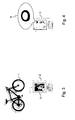
- Fig. 1 and Fig. 2 illustrate the step of identifying a first object class in an embodiment of the method according to the present invention
- Fig. 3 and Fig. 4 illustrate the step of identifying a second object class in an embodiment of the method according to the present invention.
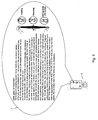
- Fig. 5 illustrates the step of selecting and instantiating an association in an embodiment of the method according to the present invention.
- the current invention concerns a concept for easy, intuitive, visual user experience in smart guided interactions, which is applicable in many physical environments, and on top of a wide range of infrastructure types.
- the user is intelligently guided on possible associations between identified object classes in a context which he/she can instantiate.
- an instantiation procedure could interactively guide the user step by step.
- the intelligent guidance may be realized through an instruction set that interactively guides the user to carry out a sequence of actions.
- the application may automatically sense the abilities and skill level of the user and adapt the instruction set and/or the way of interacting with the user to the user's abilities, e.g. in case only auditive or only visual interaction is possible, and to the user's skill level, e.g. by switching between beginner, custom and expert levels.
- the implementation of the instantiation procedure however is beyond the scope of the present invention.
- an object of the identified classes could be instructed to elaborate the association autonomously.
- the user could interactively monitor the progress of instantiation.
- a first object class is identified via visual recognition, tag reading, etc.
- a second object class is identified similarly or could also be suggested by the system and selected out of an option list.
- the douplet of object classes is then used as key to consult a local or networked database, to consult the Internet, e.g. via Google search, or any other networked knowledge source.
- the candidate associations may be presented in a certain order or priority. This order could be based on popularity, on personal profile, social network status, context, etc. Instructions and guidelines found can then be consulted online.
- Fig. 1 the user takes a picture 3 of his bike 1 with the camera in his smart phone 2.
- An application running on the smart phone 2 identifies the bike class 4 as the first object class. This is illustrated by Fig. 2 .
- Fig. 3 the user takes a picture 5 of the front wheel of his bike 1 with his smart phone 2.
- the application running on smart phone 2 identifies the wheel class as the second object class. This is illustrated by Fig. 4 .
- the sytems responds by questioning the user for product codes printed on the side of the tire. The user thereupon inserts the codes he can read.
- the system explores several knowledge sources and lists potential activities associated with the two classes, e.g.
- the user selects an activity thereby instantiating an associtaion between the two classes.
- the user shall then be guided step by step through the instantiated activity as is illustrated by 7 in Fig. 5 .
- top, bottom, over, under, and the like are introduced for descriptive purposes and not necessarily to denote relative positions. It is to be understood that the terms so used are interchangeable under appropriate circumstances and embodiments of the invention are capable of operating according to the present invention in other sequences, or in orientations different from the one(s) described or illustrated above.
Landscapes
- Engineering & Computer Science (AREA)
- Databases & Information Systems (AREA)
- Theoretical Computer Science (AREA)
- Physics & Mathematics (AREA)
- General Physics & Mathematics (AREA)
- General Engineering & Computer Science (AREA)
- Data Mining & Analysis (AREA)
- Business, Economics & Management (AREA)
- Human Resources & Organizations (AREA)
- Tourism & Hospitality (AREA)
- Strategic Management (AREA)
- General Business, Economics & Management (AREA)
- Quality & Reliability (AREA)
- Operations Research (AREA)
- Marketing (AREA)
- Entrepreneurship & Innovation (AREA)
- Economics (AREA)
- Management, Administration, Business Operations System, And Electronic Commerce (AREA)
Priority Applications (1)
| Application Number | Priority Date | Filing Date | Title |
|---|---|---|---|
| EP11290310A EP2544103A1 (de) | 2011-07-04 | 2011-07-04 | Verfahren und System zum Interagieren mit Objekten |
Applications Claiming Priority (1)
| Application Number | Priority Date | Filing Date | Title |
|---|---|---|---|
| EP11290310A EP2544103A1 (de) | 2011-07-04 | 2011-07-04 | Verfahren und System zum Interagieren mit Objekten |
Publications (1)
| Publication Number | Publication Date |
|---|---|
| EP2544103A1 true EP2544103A1 (de) | 2013-01-09 |
Family
ID=44503648
Family Applications (1)
| Application Number | Title | Priority Date | Filing Date |
|---|---|---|---|
| EP11290310A Withdrawn EP2544103A1 (de) | 2011-07-04 | 2011-07-04 | Verfahren und System zum Interagieren mit Objekten |
Country Status (1)
| Country | Link |
|---|---|
| EP (1) | EP2544103A1 (de) |
Cited By (1)
| Publication number | Priority date | Publication date | Assignee | Title |
|---|---|---|---|---|
| WO2016160680A1 (en) * | 2015-03-27 | 2016-10-06 | The Parari Group, Llc | Apparatus, systems, and methods for providing three-dimensional instruction manuals in a simplified manner |
Citations (2)
| Publication number | Priority date | Publication date | Assignee | Title |
|---|---|---|---|---|
| US20060031148A1 (en) * | 2004-07-02 | 2006-02-09 | O'dell Gregory S | Handheld scanner device with display location database |
| US20070290030A1 (en) * | 2006-06-15 | 2007-12-20 | Cerner Innovation, Inc. | Updating supply inventory data to reflect the use of a medical supply item for a patient |
-
2011
- 2011-07-04 EP EP11290310A patent/EP2544103A1/de not_active Withdrawn
Patent Citations (2)
| Publication number | Priority date | Publication date | Assignee | Title |
|---|---|---|---|---|
| US20060031148A1 (en) * | 2004-07-02 | 2006-02-09 | O'dell Gregory S | Handheld scanner device with display location database |
| US20070290030A1 (en) * | 2006-06-15 | 2007-12-20 | Cerner Innovation, Inc. | Updating supply inventory data to reflect the use of a medical supply item for a patient |
Non-Patent Citations (1)
| Title |
|---|
| "Human Computer Interaction with Mobile Devices", vol. 2411, 1 January 2002, SPRINGER BERLIN HEIDELBERG, Berlin, Heidelberg, ISBN: 978-3-54-044189-2, article SIMON HOLLAND ET AL: "Direct Combination: A New User Interaction Principle for Mobile and Ubiquitous HCI", pages: 108 - 122, XP055012869 * |
Cited By (4)
| Publication number | Priority date | Publication date | Assignee | Title |
|---|---|---|---|---|
| WO2016160680A1 (en) * | 2015-03-27 | 2016-10-06 | The Parari Group, Llc | Apparatus, systems, and methods for providing three-dimensional instruction manuals in a simplified manner |
| US10585949B2 (en) | 2015-03-27 | 2020-03-10 | The Parari Group, Llc | Apparatus, systems, and methods for providing three-dimensional instruction manuals in a simplified manner |
| US10885123B2 (en) | 2015-03-27 | 2021-01-05 | The Parari Group, Llc | Apparatus, systems, and methods for providing three-dimensional instruction manuals in a simplified manner |
| US11487828B2 (en) | 2015-03-27 | 2022-11-01 | The Parari Group, Llc | Apparatus, systems and methods for providing three-dimensional instruction manuals in a simplified manner |
Similar Documents
| Publication | Publication Date | Title |
|---|---|---|
| Rejeb et al. | Potentials and challenges of augmented reality smart glasses in logistics and supply chain management: a systematic literature review | |
| Delfanti et al. | Humanly extended automation or the future of work seen through Amazon patents | |
| US10417878B2 (en) | Method, computer program product, and system for providing a sensor-based environment | |
| Batran et al. | Procurement 4.0: A survival guide in a digital, disruptive world | |
| US20210128979A1 (en) | System and method for managing and tracking activity of a person | |
| US20230342677A1 (en) | Task optimization in an extended reality environment | |
| US20180082349A1 (en) | Device for providing health information and advice to shoppers | |
| JP2016095837A (ja) | 次世代デジタルサイネージシステム | |
| US20240420431A1 (en) | Navigation paths for directing users to food items based on meal plans | |
| US20150169834A1 (en) | Fatigue level estimation method, program, and method for providing program | |
| Theodorou et al. | An extended usability and UX evaluation of a mobile application for the navigation of individuals with blindness and visual impairments indoors: An evaluation approach combined with training sessions | |
| JP6820038B1 (ja) | 情報処理装置、情報処理方法及び情報処理プログラム | |
| CN109558004A (zh) | 一种人体辅助机器人的控制方法及装置 | |
| Das et al. | A context-sensitive conceptual framework for activity modeling | |
| EP2544103A1 (de) | Verfahren und System zum Interagieren mit Objekten | |
| Kumar et al. | Internet of things (IoT) applications and Challenges: A Study | |
| CN112906513A (zh) | 就餐资源信息的处理方法、装置及设备 | |
| Ortiz et al. | Using activity recognition for building planning action models | |
| US12100275B2 (en) | DMS—interactive product identification for a call center | |
| RU2831096C1 (ru) | Dms - интерактивная идентификация изделия для центра обработки вызовов | |
| Rokhsaritalemi et al. | Smart Interfaces for Wellbeing Powered by Biosensors, AI, XR, and Geospatial Data | |
| JP2021076930A (ja) | 課題解決発想支援方法、課題解決発想支援システム、制御装置、課題解決発想支援ツール、および課題解決発想支援装置 | |
| Sharf | Towards an innovative service digitalization in smart spaces: a user-oriented approach | |
| Heinin et al. | Challenges and opportunities with manual order picking | |
| Bajones | Enabling long-term human-robot interaction: On the need for behavior coordination systems |
Legal Events
| Date | Code | Title | Description |
|---|---|---|---|
| PUAI | Public reference made under article 153(3) epc to a published international application that has entered the european phase |
Free format text: ORIGINAL CODE: 0009012 |
|
| AK | Designated contracting states |
Kind code of ref document: A1 Designated state(s): AL AT BE BG CH CY CZ DE DK EE ES FI FR GB GR HR HU IE IS IT LI LT LU LV MC MK MT NL NO PL PT RO RS SE SI SK SM TR |
|
| AX | Request for extension of the european patent |
Extension state: BA ME |
|
| 111Z | Information provided on other rights and legal means of execution |
Free format text: AL AT BE BG CH CY CZ DE DK EE ES FI FR GB GR HR HU IE IS IT LI LT LU LV MC MK MT NL NO PL PT RO RS SE SI SK SM TR Effective date: 20130410 |
|
| STAA | Information on the status of an ep patent application or granted ep patent |
Free format text: STATUS: THE APPLICATION IS DEEMED TO BE WITHDRAWN |
|
| 18D | Application deemed to be withdrawn |
Effective date: 20130710 |