EP2544470A1 - Déclenchement avec paramètres QoS - Google Patents
Déclenchement avec paramètres QoS Download PDFInfo
- Publication number
- EP2544470A1 EP2544470A1 EP12174697A EP12174697A EP2544470A1 EP 2544470 A1 EP2544470 A1 EP 2544470A1 EP 12174697 A EP12174697 A EP 12174697A EP 12174697 A EP12174697 A EP 12174697A EP 2544470 A1 EP2544470 A1 EP 2544470A1
- Authority
- EP
- European Patent Office
- Prior art keywords
- terminal
- server
- trigger message
- communication path
- data connection
- Prior art date
- Legal status (The legal status is an assumption and is not a legal conclusion. Google has not performed a legal analysis and makes no representation as to the accuracy of the status listed.)
- Withdrawn
Links
- 238000004891 communication Methods 0.000 claims abstract description 83
- 238000000034 method Methods 0.000 claims abstract description 38
- 238000004590 computer program Methods 0.000 claims description 3
- 230000007246 mechanism Effects 0.000 description 9
- 238000012545 processing Methods 0.000 description 8
- 230000011664 signaling Effects 0.000 description 8
- 230000009286 beneficial effect Effects 0.000 description 5
- 230000005611 electricity Effects 0.000 description 4
- 230000006870 function Effects 0.000 description 4
- 230000004044 response Effects 0.000 description 4
- 230000005540 biological transmission Effects 0.000 description 3
- 230000000977 initiatory effect Effects 0.000 description 3
- 239000002699 waste material Substances 0.000 description 3
- 230000004913 activation Effects 0.000 description 2
- 238000005516 engineering process Methods 0.000 description 2
- 230000008569 process Effects 0.000 description 2
- 239000004065 semiconductor Substances 0.000 description 2
- 230000001960 triggered effect Effects 0.000 description 2
- 241001071864 Lethrinus laticaudis Species 0.000 description 1
- 230000008901 benefit Effects 0.000 description 1
- 230000008859 change Effects 0.000 description 1
- 230000003247 decreasing effect Effects 0.000 description 1
- 230000001934 delay Effects 0.000 description 1
- 230000000694 effects Effects 0.000 description 1
- 230000007774 longterm Effects 0.000 description 1
- 230000000116 mitigating effect Effects 0.000 description 1
- 230000000737 periodic effect Effects 0.000 description 1
- 230000007480 spreading Effects 0.000 description 1
- 238000010561 standard procedure Methods 0.000 description 1
- 238000012546 transfer Methods 0.000 description 1
Images






Classifications
-
- H—ELECTRICITY
- H04—ELECTRIC COMMUNICATION TECHNIQUE
- H04W—WIRELESS COMMUNICATION NETWORKS
- H04W4/00—Services specially adapted for wireless communication networks; Facilities therefor
- H04W4/70—Services for machine-to-machine communication [M2M] or machine type communication [MTC]
-
- H—ELECTRICITY
- H04—ELECTRIC COMMUNICATION TECHNIQUE
- H04W—WIRELESS COMMUNICATION NETWORKS
- H04W4/00—Services specially adapted for wireless communication networks; Facilities therefor
- H04W4/02—Services making use of location information
-
- H—ELECTRICITY
- H04—ELECTRIC COMMUNICATION TECHNIQUE
- H04W—WIRELESS COMMUNICATION NETWORKS
- H04W76/00—Connection management
- H04W76/10—Connection setup
Definitions
- the invention relates to the field of data communication. More specifically, the invention relates to the field of data communication between a terminal and an application server, for example for machine-to-machine (M2M) communication.
- M2M machine-to-machine
- PDP Packet Data Protocol
- GSM Global System for Mobile communications
- UMTS Universal Mobile Broadband
- IP middle boxes like firewalls and Network Address Translators, rely on initiation of a data session by the device.
- Such devices may be applied in the field of machine-to-machine (M2M) communication as currently being standardized in 3GPP (see e.g. TS 22.368). While in many M2M applications it is sufficient that the M2M device initiates establishment of a communication path between the M2M device and the M2M server, there are also applications where the M2M server is required to be able to initiate the data connection.
- M2M machine-to-machine
- An example of an M2M server initiating communication with the device is a smart electricity metering application. Normally, the meter may report meter readings at the end of every month. But when e.g. a customer changes to a different electricity provider, the M2M server needs to be able to trigger the meter to request the meter readings at the specific end-of-contract date.
- the server needs to inform the device that the device should set up a connection. This process is called triggering.
- triggering There are different methods of triggering which all have in common the fact that the trigger merely provides a request to the device to set up a connection to a server, possibly indicating an address of the server (e.g. APN, IP address or FQDN), if the address of the server for the communication path that the device has to set up was not pre-configured in the terminal.
- the device When the device receives a trigger, it will set up a best effort data connection or whichever data connection the device is preconfigured to set up. If the server needs another type of connection (e.g. a video connection for a camera surveillance system), then the server will communicate to the device, over the already set up data connection, that the device needs to establish a data connection of a different type. After that the device will establish the type of the data connection that the server requested.
- another type of connection e.g. a video connection for a camera surveillance system
- a method for triggering at least one terminal to establish a communication path between the terminal and a server includes transmitting a trigger message to the terminal, the trigger message including connection information indicating a first type of the data connection for establishing the communication path between the terminal and the server.
- protocols such as e.g. PDP context or UMTS bearer described in 3GPP TS 23.060 or EPS bearer described in 3GPP TS 23.401.
- network gateway refers to an intermediate network node adapted to function as a gateway between a mobile network and an external packet data network such as e.g. internet or corporate packet data network.
- the Gateway GPRS Support Node acts as the network gateway
- the PDN Gateway (P-GW) node is the network gateway.
- QoS parameters include parameters such as e.g. maximum bitrate, guaranteed bitrate, allocation set up, time out limit, and queue configuration.
- QoS profile includes parameters such as e.g. maximum bitrate, guaranteed bitrate, allocation set up, time out limit, and queue configuration.
- Some examples of the types of data connections include a best effort connection, a conversational connection, or a streaming connection.
- QoS parameters are required.
- a conversational data connection may have strict requirements as to the delay and jitter in order to enable voice communication, while in a streaming connection the delay may be not so important.
- the data connection between the terminal and the network gateway may be viewed as a "tunnel" set up between the terminal and the gateway.
- the server or some other entity outside of the tunnel, i.e. in the external data packet network
- the server would use an IP address that is routed to the network gateway. From there, the IP packet is "tunnelled” through the data connection, to the terminal.
- the IP packets are "tunnelled” through the data connection from the terminal to the network gateway without the need to know IP addresses of intermediate nodes in the tunnel.
- the overall communication path between the terminal and the server may include one or more of such "tunnels.”
- a conventional IP routing of the Packet Data Network may be used.
- the entire communication path between the terminal and the server may be a "tunnel" in that the entire communication path may need to be set up according to some set of parameters defining the type of data connection (i.e., the "at least one data connection" recited in claim 1 is actually the entire communication path between the terminal and the server).
- there is a concatenation of tunnels e.g. one tunnel from the terminal to the network gateway and another tunnel from the gateway to the server.
- QoS parameters in both tunnels may either be derived from same QoS indication or there may be different QoS indications.
- the tunnel between the network gateway and the server would not necessarily be set up by providing indication of the type of this tunnel in a trigger message. All of such embodiments are also included within the scope of the present invention and it is understood that a person skilled in the art would recognize what set of parameters (i.e., not necessarily the QoS parameters described above) would be the most appropriate in specifying the type(s) of such data connection(s).
- trigger messages do not require a "data connection" between the terminal and the server set up according to a particular set of QoS parameters in the manner defined above.
- Embodiments of the present invention are intended to mitigate or prevent this situation by providing information to the terminal as to what type of connection the terminal should establish early on, in the trigger message, before the terminal sets up a communication path including that data connection. Doing so avoids the terminal setting up a wrong type of data connection and allows significantly decreasing the number of messages exchanged between the server and the terminal, thereby preserving processing resources of the system and reducing inefficient bandwidth usage.
- the connection information could include e.g. part or all of a QoS profile or a QoS Class Identifier (QCI).
- the QCI could be in the form of a number that indicates which set of QoS parameters should be used for setting up a data connection. For example, a QCI equal to 1 may imply all QoS parameters needed for a conversational type of data connection.
- An advantage of using QCI is that it is much smaller than the QoS profile and, therefore, is much easier to transport in a trigger message.
- the QCI is particularly advantageous for applications where the trigger message is sent over a broadcast channel.
- other examples of information which could be indicative of the type of connection (i.e. of the range of QoS parameters of the requested data connection or whether a Circuit Switched or Packet Switched connection is used) could be envisioned and are within the scope of the present invention.
- the disclosed solution is, although not being limited to this field, especially advantageous for M2M communications because M2M communications typically involves hundreds, thousands or millions of terminals.
- An example involves collecting information by a server from e.g. smart electricity meters at the homes of a large customer base.
- Other examples include surveillance systems, sensors, etc. that can be equipped with communication modules that may support various types of advanced data connections to a server.
- mobile navigation terminals and payment terminals are examples of M2M applications.
- the presented solution provides for efficient server-based initiation of establishing a communication path between the terminal and the server for such applications.
- the trigger message may further include timing information indicating when the communication path between the at least one terminal and the server is to be established.
- timing information indicating when the communication path between the at least one terminal and the server is to be established.
- the timing information could include one or more of a time delay, a time window, and an instruction to randomly select time for establishing the communication path between the terminal and the server.
- a server and a terminal for use in the above methods are also disclosed.
- an intermediate network node configured for use in the above methods and/or with the above terminal.
- Such an intermediate network node could be communicatively connected to the terminal and the server, either directly or via other intermediate nodes, and the trigger message generated at the server could be sent to the intermediate network node before being transmitted by the node to the terminal.
- Such an intermediate network node could be a network gateway for communicating user data between the terminal and the server, such as e.g. GGSN or P-GW nodes described above, or it could be a network gateway for communicating control data, such as e.g. a machine-type communication gateway (MTC GW), described in greater detail below.
- MTC GW machine-type communication gateway
- the intermediate network node may be configured to determine whether the first type of data connection is supported by the terminal and/or allowed for the terminal. Upon positive determination, the intermediate network node may be configured to transmit the trigger message further, to the terminal. Upon negative determination, the intermediate network node may be configured to update the trigger message by replacing the information indicating the first type of data connection with information indicating a second type of data connection. Alternatively, upon negative determination, the intermediate network node may be configured to stop the transmission of the trigger message to the terminal, possibly informing the server to that effect. Such functionality could ensure that trigger messages provided to the terminal include requests for only the type of data connection that is actually supported by and/or allowed for the terminal, according e.g. to terminal's subscription.
- the intermediate network node may be configured to implement the methods described herein by adding the connection information and, optionally, the timing information to the trigger message received from the server. This could be beneficial because the intermediate network node could be the entity that has information as to what types of data connections are supported by and allowed for the terminal, according e.g. to terminal's subscription.
- a trigger message may first be transmitted from a server to a first intermediate network node, such as e.g. a control plane gateway, and then transmitted from the first intermediate network node to a second intermediate network note, such as e.g. a user plane gateway, before being transmitted to the terminal.
- a first intermediate network node such as e.g. a control plane gateway
- a second intermediate network note such as e.g. a user plane gateway
- the present disclosure relates to a computer program with portions (possibly distributed) for performing the various functions described herein, to a data carrier for such software portions and to a telecommunications system comprising at least a server and a terminal as described above.
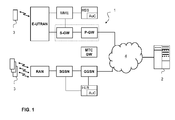
- FIG. 1 shows a schematic illustration of a telecommunications network 1.
- the telecommunications network 1 allows data sessions between a server 2 and a terminal 3 over a data network 4, wherein access of the terminal to the telecommunications network 1 is wireless.
- the lower branch of FIG. 1 represents a GPRS or UMTS telecommunications network comprising a GGSN, a Serving GPRS Support Node (SGSN) and a Radio Access Network (RAN).
- the RAN comprises a Base Station Controller (BSC) connected to a plurality of Base Station Transceivers (BTSs), both not shown.
- BSC Base Station Controller
- BTS Base Station Transceivers
- UTRAN UMTS radio access network
- the RAN comprises a Radio Network Controller (RNC) connected to a plurality of NodeBs), also not shown.
- the GGSN and the SGSN are conventionally connected to a Home Location Register (HLR) that contains subscription information of the terminals 3.
- the HLR is combined with an authentication centre (AuC) for authenticating terminals 3 in the network.
- AuC authentication centre
- the upper branch in FIG. 1 represents a next generation telecommunications network, commonly indicated as Long Term Evolution (LTE) or Evolved Packet System (EPS).
- LTE Long Term Evolution
- EPS Evolved Packet System
- Such a network comprises a P-GW and a Serving Gateway (S-GW).
- the E-UTRAN of the LTE network comprises evolved NodeBs (eNodeBs or eNBs) providing wireless access for a terminal 3 that is connected to the S-GW via a packet network.
- the S-GW is connected to a Home Subscriber Server HSS and a Mobility Management Entity MME for signalling purposes.
- the HSS includes a subscription profile repository and an authentication centre (AuC). Further information of the general architecture of an LTE network can be found in 3GPP TS 23.401.
- the GGSN node of the GPRS and UMTS networks and the P-GW node of the LTE network act as user plane gateways between a mobile network and the external data network 4, providing functions such as e.g. QoS policy enforcing, usage metering, and IP address allocation.
- All of the networks illustrated in FIG. 1 may also, optionally, include a control plane gateway, such as e.g. a MTC GW currently being standardized.
- a control plane gateway is intended to act as an entry point in the mobile network for control messages from the servers. The purpose of the control plane gateway is, typically, to protect the network from unauthorised control messages, or control messages sent by unauthorised servers.
- the control plane gateway may be pre-provisioned in the server, in case the server only communicates with one network operator. Otherwise, the server first needs to determine to which operator a control message such as the trigger message described in the present invention needs to be sent to. Based on the Device ID, Group ID or IMSI, the server should be able to find the correct mobile operator network.
- functionality of a user plane gateway and a control plane gateway could be combined in a single node or distributed among a larger number of nodes than illustrated in FIG. 1 .
- FIG. 2 is a schematic illustration of establishing a server-initiated communication path between a server and a terminal, the communication path comprising a data connection of a specific type, according to prior art.
- the server 2 initiates the set up of a connection between the terminal 3 and the server 2 by triggering the terminal 3.
- a single server 2 normally is used for communication with a large number of terminals 3.
- Individual terminals 3 can be identified by individual identifiers, such as an IP address, an International Mobile Subscriber Identity (IMSI) or another terminal identifier.
- IMSI International Mobile Subscriber Identity
- the terminal 3 is represented as comprising an M2M device and (U)SIM.
- a particular type of data connection between the terminal and the network gateway such as e.g. PDP context, may be set-up, and, in step 3, a communication path between the terminal 3 and the server 2 may be established, the communication path including the data connection between the terminal and the network gateway.
- the terminal 3 and the server 2 may then exchange data via the established communication path.
- the server 2 will then use the established communication path to inform the terminal 3, in step 4, that a different type of data connection is required in the communication path between the terminal 3 and the server 2.
- the terminal 3 will establish a communication path comprising the data connection requested by the server 2 (provided the terminal 3 supports the type of data connection and is allowed to set up the type of data connection requested by the server).
- the correct communication path is established by modifying the existing data connection with the correct type of the data connection requested by the server or by generating a new data connection of the correct type.
- FIG. 2 illustrates that a data connection of a particular type is set up between the terminal and the network gateway
- a data connection may be set up between the terminal and the server (i.e., the entire communication path between the terminal and the server may be a data connection of a particular type specified by certain parameters).
- the present invention is developed from the insight that providing the information indicating the required type of data connection within the communication path before the data connection/communication path has been set up by including that information in the trigger message would avoid the waste of system resources by setting up a wrong type of connection and then having to correct it.
- M2M terminals typically include devices like parking meters and vending machines for which there is no need to establish some special type of data connection in the communication between the terminal and the server. In such cases there has been no need for the server to influence the type of the data connection that the device would set up.
- the problem underlying the present invention is therefore mainly unnoticed.
- the present invention is based on the recognition that, as the technology develops, more and more different types of data connections will have to be used and that the burden of spending system's resources on setting up wrong type of data connection will start to outweigh an increase in the size of the trigger message.
- FIGS. 3A-3F are schematic illustrations of providing a trigger message for establishing a communication path comprising at least one data connection of a specific type, according to various embodiments of the present invention. For clarity reasons only the relevant steps of transmitting a trigger message are depicted in FIGS. 3A-3F . Other procedures, e.g. the ones associated with the actual set up of the data connection and exchange of user data, are not included. Thus, FIGS. 3A-3F illustrate how step 1 of FIG.2 is performed differently according to the embodiments of the present invention, which, in turn, allows performing steps 2 and 3 illustrated in FIG. 2 more efficiently and allows eliminating steps 4 and 5 of FIG. 2 .
- the server 2 may be configured to generate a trigger message TM1 and transmit it directly to the terminal 3.
- the server 2 may include a processing unit for generating trigger messages and a communications module for transmitting trigger messages.
- the term "directly” is used only to differentiate the embodiment illustrated in FIG. 3A from the embodiments illustrated in FIGS. 3B-3F where the trigger message generated by the server 2 is transmitted through and, possibly, further processed by one or more intermediate network nodes.
- the trigger message may be transmitted to the terminal 3 via entities other than the intermediate nodes described in FIGS. 3B-3F , such as e.g. a Cell Broadcast Centre (CBC), or SMS Service Centre (SMS-SC).
- CBC Cell Broadcast Centre
- SMS-SC SMS Service Centre
- the trigger message TM1 is formed by including at least connection information specifying the type of at least one data connection that the server 2 needs the terminal 3 to set up as a part of the terminal 3 establishing a communication path between the server 2 and the terminal 3.
- the connection information could include e.g. a complete or partial QoS profile, a QCI, or some other information that can adequately identify a particular type of data connection.
- the trigger message TM1 could also include information that is typically included in conventional trigger messages, such as the identity of the terminal 3, the identity of the application, and/or a request counter associated to this request allowing to detect duplicated requests, to correlate requests with their acknowledgement and to allow the application to cancel a request.
- the trigger message TM1 may also, optionally, include the IP address (or Fully Qualified Domain Name) and/or port numbers of the application server 2 with which the terminal 3 is triggered to establish a data connection, an urgency request indication, a validity timer allowing to remove triggers that are stored in the network when the terminal 3 cannot be reached (e.g. with SMS), the area where triggering needs to be sent, and/or a limited amount of application specific information (e.g. to instruct the terminal 3 to do something before establishing a data connection with the server 2).
- the terminal 3 Upon receiving the trigger message TM1, the terminal 3 is configured to obtain the connection information from the message and establish a communication path to the server 2, the communication path comprising the data connection of the type specified in the message.
- the terminal 3 may include a processing unit capable of extracting the connection information from the trigger message and a communications module for establishing the requested type of data connection. At least part of the functionality of the processing unit and/or the communications module of the terminal 3 may be included within a (U)SIM within the terminal 3.
- FIG. 3B illustrates that an intermediate network node 5, such as e.g. GGSN, P-GW or MTC GW, may be included in the communication path between the server 2 and the terminal 3.
- the intermediate node 5 is communicatively connected to the server 2, either directly or via other intermediate nodes, in that the intermediate node 5 can receive the trigger message TM1 from the server 2 (over the external network 4).
- the intermediate node 5 is also communicatively connected to the terminal 3, either directly or via other intermediate nodes, in that the intermediate node 5 can transmit the trigger message further to the terminal 3, over the mobile network.
- the trigger message TM1 transmitted by the server 2, the server 2, and the terminal 3 illustrated in FIG. 3B are analogous to those illustrated in FIG. 3A and, therefore, their discussion is not repeated here.
- the intermediate node 5 could be configured to obtain the connection information from the received trigger message TM1 and check whether the particular QoS profile identified by the connection information is supported by the terminal 3 and/or allowed by the subscription of the terminal 3. This may be done by e.g. checking with HSS containing subscriber's information.
- the intermediate node 5 may transmit the trigger message TM1 further, to the terminal 3. Otherwise, the intermediate node 5 may either stop the transmission of the trigger message to the terminal 3 (possibly communicate to the server 2 that the transmission of the trigger message TM1 has been interrupted) or overwrite the connection information in TM1 specifying the type of data connection requested by the server 2 with the most appropriate connection information specifying the type of data connection that would be supported by and allowed for the terminal 3. In the latter case, the intermediate node 5 would then transmit an updated trigger message TM1' to the terminal 3, the updated message including updated connection information.
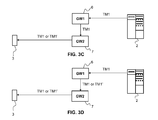
- FIG. 3C illustrates that more than one intermediate network nodes may be included in the communication path between the server 2 and the terminal 3.
- FIG. 3C illustrates a first intermediate node 6 and a second intermediate node 7.
- the first intermediate node 6 is communicatively connected to the server 2, either directly or via other intermediate nodes, in that the intermediate node 6 can receive the trigger message TM1 from the server 2.
- the first intermediate node 6 is also communicatively connected to the intermediate node 7, either directly or via other intermediate nodes, in that the intermediate node 6 can transmit the trigger message further to the node 7.
- the intermediate node 7 is communicatively connected to the terminal 3, also either directly or via other intermediate nodes, in that it may, in turn, transmit the trigger message further to the terminal 3.
- FIG. 3C differs from FIG. 3B in that two intermediate network nodes are used instead of one, where the first intermediate network node 6 transmits the trigger message TM1 to the second intermediate network node 7 which then is configured to check whether the type of data connection requested by the server 2 is supported and/or allowed by the terminal 3. That functionality of the intermediate node 7 is then analogous to that of the intermediate node 5 illustrated in FIG. 3B and, in the interests of brevity, is not repeated here.
- a configuration illustrated in FIG. 3C could be advantageous where the first intermediate node 6 is configured to check whether the server 2 is authorised to send messages to the network and to check whether the server 2 is only sending messages it is authorised to send.
- the first intermediate node 6 could include a control plane gateway, such as e.g. MTC GW, while the second intermediate node 7 could include a user plane gateway, such as e.g. P-GW.
- a control plane gateway such as e.g. MTC GW
- a user plane gateway such as e.g. P-GW
- FIG. 3D differs from FIG. 3C in that it is already the first intermediate network node 6 that performs the checking of the connection information included by the server 2 in the trigger message TM1, similar to that of the intermediate node 5 illustrated in FIG. 3B .
- the intermediate node 6 may comprise HSS, which then may modify QoS information in the received trigger message TM1 based on the subscription information for the terminal 3 and forward the updated trigger message TM1' to the intermediate node 7 which then sends it to the terminal 3. This could be particularly beneficial for triggering via HSS and NAS signalling.
- FIGS. 3E and 3F illustrate embodiments where the server 2 does not include the connection information in the trigger message, but where it is some intermediate network node that includes the connection information into the trigger message transmitted to the terminal 3.
- the server 2 transmits a trigger message TM0 to the intermediate node 5, such as e.g. GGSN, P-GW, or MTC-GW described above.
- the trigger message TM0 could be e.g. a conventional trigger message (i.e. TM0 does not include the connection information).
- the intermediate node 5 is then configured to add the connection information to the trigger message, thus generating a new trigger message TM1, and transmit the trigger message TM1 with the connection information to the terminal 3.
- the discussions provided above with respect to the trigger message TM1 are also applicable here and, therefore, are not repeated.
- the intermediate node 5 illustrated in FIG. 3E may be configured to first determine which type of connection is supported by and allowed for the terminal 3 and, possibly, the server 2, before inserting appropriate connection information into the trigger message TM1.
- the intermediate node 5 may comprise a MTC GW configured to check with HSS to see what the default QoS profile for the subscription of the terminal 3 is and insert the appropriate QoS identification in the subsequent trigger signalling.
- FIG. 3F differs from FIG. 3E in that two intermediate nodes are used, similar to the intermediate nodes described in FIGS. 3C and 3D .
- either the first intermediate node 6 or the second intermediate node 7 can include the connection information into the trigger message, similar to how it is done by the intermediate node 5 illustrated in FIG. 3E .
- the intermediate node 6 may comprise HSS, which then adds QoS information based on the subscription information for the terminal 3. HSS then forwards the trigger message TM1 to the intermediate node 7 which then sends it to the terminal 3. This could be particularly beneficial for triggering via HSS and NAS signalling.
- the trigger message may further include timing information specifying the time at which the terminal 3 should start establishing the communication path with the server 2. Since the communication path includes the data connection, the timing information specifies when the terminal 3 should start setting up the data connection of the particular type specified in the trigger message. In response to receiving the trigger message with the timing information, the terminal 3 would delay establishing the communication path/data connection until a time that the terminal 3 determines on basis of the timing information.
- the timing information could be included in the trigger message in the form of a delay time, e.g. instructing the terminal 3 to delay establishing of the communication path/data connection by one hour (measured e.g. from the time of receipt of the trigger message or from the time stamp indicating when the trigger message was sent by the server 2).
- the timing information may instruct the terminal 3 to establish the communication path after a delay of 75 seconds or after a delay of 13 min 15 seconds (i.e., the timing information would specify the delay exactly, up to the couple of seconds).
- the timing information could also instruct the terminal 3 to establish the communication path at 07:35:35 (i.e. at some specific time).
- the timing information could be in the form of a time window, e.g. instructing the terminal 3 to establish the communication path/data connection between 16:00 and 17:00 or in a smaller time window, between 03:45:15 and 03:45:45.
- the timing information could instruct the terminal 3 to select the time at which to establish a communication path/data connection at random.
- This embodiment may be particularly beneficial in situations when the trigger message is sent to a group of terminals, e.g. using group addressing, where each terminal would randomise the time of response to the trigger message.
- timing information instructing the terminal 3 to select the time at which to establish a communication path/data connection at random could be combined with providing delay time or window time so that e.g. the timing information may instruct the terminal 3 to select some random time in a particular time window (e.g. random time between 02:00 and 04:00) for establishing a communication path/data connection.
- the timing information may instruct the terminal 3 to randomize time for establishing the communication path between now and one hour.
- the timing information providing both a time delay and a time window is possible where the timing information would indicate the delay together with the duration, instructing the terminal 3 to establish the communication path after a delay of e.g. 15 minutes during the time window of 1 hour.
- a delay e.g. 15 minutes during the time window of 1 hour.
- the timing information may include two delays, e.g. instructing the terminal to establish the communication path from 15 minutes from now until from 30 minutes from now.
- the timing information may be used to spread network load when a trigger is sent to a group of terminals (i.e., the terminals may randomize their load) and/or to spread network load when triggers are sent to individual devices (i.e., the server may randomize the loads of the terminals).
- timing information in the trigger message may instruct the terminal 3 to do something before the terminal 3 would start sending its data to the server 2, e.g. to start recording data and send data after 4 days or to record data between July 1st 13:00 and July 4th 15:00 and then send data.
- timing information could relate to times from a few seconds to multiple days.
- Other types of timing information indicating at what time the terminal 3 should or should not establish the communication path/data connection may be envisioned and are intended to be within the scope of the present invention.
- the timing information may or may not be included in the trigger message by the same entity that includes the connection information.
- the server 2 that includes the connection information into the trigger message, but it could be the intermediate node 5 that adds the timing information to that trigger message.
- the timing information may be included into the trigger message by the server 2 while the connection information may be added later, by either the intermediate node 6 or the intermediate node 7.
- each of the intermediate network nodes 5, 6, and 7 illustrated in FIGS. 3B-3F may include a processing unit for generating and processing trigger messages and other data and a communications module for communicating with the terminal, the server, or other nodes and entities.
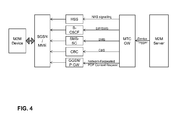
- FIG. 4 provides an exemplary illustration of how various trigger messages may be transmitted to a terminal via the control plane gateway, such as e.g. MTC GW, according to various M2M embodiments of the present invention.
- the term "M2M device" is used to identify the terminal 3 described in the remainder of the present description, to point out that these illustrative embodiments are particularly suitable for M2M applications.
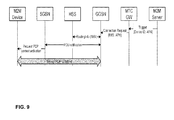
- FIG. 4 from the MTC GW onwards, a number of potential trigger mechanisms exist that could be used in the embodiments of FIGS. 3A-3F . These mechanisms include triggering using mobile terminated SMS, triggering using IMS Message, triggering using cell broadcast, triggering via HSS and NAS signalling, and triggering via Network Requested PDP context establishment, illustrated in greater detail in FIGS. 5-9 , respectively.
- the MTC GW may be configured to decide which triggering mechanism to choose, e.g. based on status information from the network.
- the M2M server may be the decision point on which trigger method to use. That may be advantageous because the M2M server typically has most knowledge about the particular application, the M2M devices associated with that application, and the kind of triggering mechanisms these devices would support.
- connection information and, optionally, the timing information may be added to the trigger message as described in various embodiments of FIGS. 3A-3F .
- the various triggering mechanisms are now briefly described in association with FIGS. 5-9 , where it is understood that a person skilled in the art would be able to implement one or more of these triggering mechanisms in context of the embodiments of FIGS. 3A-3F .
- FIG. 5 illustrates how the trigger message sent by the M2M server is forwarded by the MTC GW to the SMS Service Centre (SMS SC). From there on, the procedure is almost the standard mobile terminated SMS procedure, as described in 3GPP TS 23.040. The main difference is that in normal SMS procedures, a MSISDN is used as the Device Identifier. With M2M communications, either the IMSI or an MSISDN replacement could be used, which implies a change to the SendRoutingInfoforSMS procedure.
- SMS SC SMS Service Centre
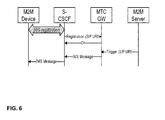
- FIG. 6 illustrates how IMS message can be used to trigger a M2M device.
- the M2M device would need to register in IMS, in order to be able to receive IMS Messages.
- the MTC GW is seen as an IMS Application Server and the registration of M2M devices in the S-CSCSF is forwarded to the MTC GW.
- the MTC GW transmits a SIP Message towards the M2M device via the ISC interface with the S-CSCF.
- FIG. 7 illustrates triggering using cell broadcast.
- the assumption behind this solution is that the M2M server has the information as to the area where the M2M device is located.
- a trigger request with the area is sent to the MTC GW, which forwards it to the Cell Broadcast Centre (CBC).
- CBC Cell Broadcast Centre
- standard procedures of cell broadcast as described in 3GPP TS 23.041 may be used to broadcast the trigger message within the indicated area.
- the M2M device listens to the broadcast messages. First the M2M device will determine which broadcast messages are trigger messages. Trigger messages may be identified for example by the broadcast channel identifier or through a specific formatting of the broadcast message.
- the M2M device may interpret the receipt of any trigger message as a trigger and set up a connection to the M2M server. Alternatively, the M2M device first determines if there is a match between the identification sent in the trigger message and the identification of the M2M device, and, upon a positive match, set up a connection to the M2M server.
- the identification used in the trigger message may be any application level identifier and may be completely transparent to the mobile network. For example, a smart metering application could use serial numbers of the electricity meters.
- the identification in the trigger message may also identify a group of M2M devices. This allows for an efficient way to trigger a batch of M2M devices to do e.g. a software upgrade. In such a case, including also the timing information within the trigger message, as described in the present invention, could allow spreading the response to the trigger message out in time and mitigating or preventing that a too large group of M2M devices will try to connect to the M2M server simultaneously.
- FIG. 8 illustrates a message sequence for triggering using existing Non Access Stratum (NAS) signalling.
- the idea behind this concept is that the trigger message can be "piggy-backed" by attaching it to the existing signalling messages exchanged between the M2M device and the network.
- the trigger message is sent via the MTC GW to the HSS.
- the HSS stores the request and, when the M2M device is attached, sends it in an Insert Subscriber message to the SGSN or MME where the M2M is registered.
- the M2M device next signals to the SGSN/MME, e.g. for a periodic routing area update, the SGSN/MME piggy backs the trigger message in the response to the M2M device.
- the trigger request may be deleted from the SGSN/MME and the HSS.
- the HSS may store the trigger message until the next time the M2M device attaches to the network again.
- the network requested PDP context activation procedure has been specified in 3GPP TS 23.060.
- the new aspect in this procedure would be the Connection Request from the MTC GW to the GGSN.
- the existing network requested PDP context activation procedure is not initiated by a signalling message but by the receipt of an IP packet for the device.
- the RoutingInfo for determination to which SGSN the trigger message should be sent may be found in the HSS on the basis of the IMSI. It may also be an option to use a new Device ID replacement of the MSISDN to query the HSS.
- One embodiment of the invention may be implemented as a program product for use with a computer system.
- the program(s) of the program product define functions of the embodiments (including the methods described herein) and can be contained on a variety of, preferably non-transitory, computer-readable storage media.
- Illustrative computer-readable storage media include, but are not limited to: (i) non-writable storage media (e.g., read-only memory devices within a computer such as CD-ROM disks readable by a CD-ROM drive, ROM chips or any type of solid-state non-volatile semiconductor memory) on which information is permanently stored; and (ii) writable storage media (e.g., floppy disks within a diskette drive or hard-disk drive or any type of solid-state random-access semiconductor memory, flash memory) on which alterable information is stored.
- the computer program may be run on the processing units described herein.
Landscapes
- Engineering & Computer Science (AREA)
- Computer Networks & Wireless Communication (AREA)
- Signal Processing (AREA)
- Mobile Radio Communication Systems (AREA)
- Data Exchanges In Wide-Area Networks (AREA)
- Communication Control (AREA)
Priority Applications (1)
| Application Number | Priority Date | Filing Date | Title |
|---|---|---|---|
| EP12174697A EP2544470A1 (fr) | 2011-07-04 | 2012-07-03 | Déclenchement avec paramètres QoS |
Applications Claiming Priority (2)
| Application Number | Priority Date | Filing Date | Title |
|---|---|---|---|
| EP11172510 | 2011-07-04 | ||
| EP12174697A EP2544470A1 (fr) | 2011-07-04 | 2012-07-03 | Déclenchement avec paramètres QoS |
Publications (1)
| Publication Number | Publication Date |
|---|---|
| EP2544470A1 true EP2544470A1 (fr) | 2013-01-09 |
Family
ID=46331153
Family Applications (1)
| Application Number | Title | Priority Date | Filing Date |
|---|---|---|---|
| EP12174697A Withdrawn EP2544470A1 (fr) | 2011-07-04 | 2012-07-03 | Déclenchement avec paramètres QoS |
Country Status (3)
| Country | Link |
|---|---|
| US (1) | US20130013792A1 (fr) |
| EP (1) | EP2544470A1 (fr) |
| JP (1) | JP2013017179A (fr) |
Families Citing this family (11)
| Publication number | Priority date | Publication date | Assignee | Title |
|---|---|---|---|---|
| BR112014003030B1 (pt) * | 2011-08-11 | 2021-09-08 | Apple Inc | Método para comutar de um download de mbms para um fornecimento com base em http de conteúdo formatado dash, método para comutar de um fornecimento com base em http de conteúdo formatado dash para um download de mbms e dispositivo móvel |
| US20130155954A1 (en) * | 2011-12-14 | 2013-06-20 | Interdigital Patent Holdings, Inc. | Method and apparatus for triggering machine type communications applications |
| KR101761702B1 (ko) * | 2012-03-30 | 2017-08-04 | 노키아 솔루션스 앤드 네트웍스 오와이 | 분산된 게이트웨이들을 위한 중앙집중화된 ip 어드레스 관리 방법 및 장치 |
| US9215549B2 (en) | 2013-02-13 | 2015-12-15 | Aeris Communications, Inc. | Method for delivering machine to machine (M2M) application control data over control plane in LTE/EPS utilizing standard bearer management procedures |
| US10834557B2 (en) | 2013-02-13 | 2020-11-10 | Aeris Communications, Inc. | Layered machine to machine (M2M) service methodology using class-based access point names (APNs) for the internet of things |
| US9800621B2 (en) | 2013-05-06 | 2017-10-24 | Convida Wireless, Llc | Registration for device triggering |
| JP6599317B2 (ja) * | 2013-06-05 | 2019-10-30 | ザ アリゾナ ボード オブ リージェンツ オン ビハーフ オブ ザ ユニバーシティー オブ アリゾナ | 画像化プローブ |
| WO2015187068A1 (fr) * | 2014-06-02 | 2015-12-10 | Telefonaktiebolaget L M Ericsson (Publ) | Mandataire de fusion |
| WO2017016615A1 (fr) * | 2015-07-30 | 2017-02-02 | Sony Mobile Communications Inc. | Point d'accès sans fil mobile |
| WO2017070958A1 (fr) * | 2015-10-30 | 2017-05-04 | 华为技术有限公司 | Procédé de configuration de passerelle et dispositif de passerelle |
| US11133923B2 (en) * | 2018-10-24 | 2021-09-28 | Landis+Gyr Innovations, Inc. | Cryptographic operations using internet of things device pool |
Family Cites Families (15)
| Publication number | Priority date | Publication date | Assignee | Title |
|---|---|---|---|---|
| EP3291595B1 (fr) * | 2007-12-21 | 2022-10-26 | Telefonaktiebolaget LM Ericsson (publ) | Procédé et appareil pour limiter l'envoi de rapport cqi |
| KR101637584B1 (ko) * | 2009-04-21 | 2016-07-07 | 엘지전자 주식회사 | 무선 통신 시스템상에서 서비스의 품질(QoS)을 보장하는 방법 |
| JP5514305B2 (ja) * | 2009-06-10 | 2014-06-04 | テレフオンアクチーボラゲット エル エム エリクソン(パブル) | 通信ネットワークにおける性能測定 |
| CN101932040B (zh) * | 2009-06-26 | 2014-01-01 | 华为技术有限公司 | 寻呼处理方法、通信装置及通信系统 |
| CN101959133A (zh) * | 2009-07-15 | 2011-01-26 | 华为技术有限公司 | M2m用户设备的操作控制方法、系统和m2m用户设备 |
| JP5783640B2 (ja) * | 2009-09-02 | 2015-09-24 | テレフオンアクチーボラゲット エル エム エリクソン(パブル) | 通信ネットワーク内でのページングの区別のためのソリューション |
| JP4648479B1 (ja) * | 2009-10-16 | 2011-03-09 | 株式会社エヌ・ティ・ティ・ドコモ | 移動通信方法、移動管理用ノード及びパケット交換機 |
| EP2680619A3 (fr) * | 2009-10-30 | 2015-07-22 | Panasonic Intellectual Property Corporation of America | Système de communication et appareil pour services de mobile dépendant de l'état |
| US9167517B2 (en) * | 2010-01-29 | 2015-10-20 | Interdigital Patent Holdings, Inc. | Group-based machine to machine communication |
| WO2011162667A1 (fr) * | 2010-06-21 | 2011-12-29 | Telefonaktiebolaget L M Ericsson (Publ) | Procédé et agencement pour une radiomessagerie dans un système de communication sans fil |
| US8711721B2 (en) * | 2010-07-15 | 2014-04-29 | Rivada Networks Llc | Methods and systems for dynamic spectrum arbitrage |
| KR101854000B1 (ko) * | 2011-04-01 | 2018-05-02 | 인터디지탈 패튼 홀딩스, 인크 | 기계 타입 통신 디바이스들을 트리거링 및 동기화하기 위한 방법 및 장치 |
| WO2012135582A1 (fr) * | 2011-04-01 | 2012-10-04 | Interdigital Patent Holdings, Inc. | Déclenchement demandé par réseau d'un dispositif hors ligne |
| US8929335B2 (en) * | 2011-04-29 | 2015-01-06 | Telefonaktiebolaget L M Ericsson (Publ) | Mobile terminated call improvements |
| US8879667B2 (en) * | 2011-07-01 | 2014-11-04 | Intel Corporation | Layer shifting in open loop multiple-input, multiple-output communications |
-
2012
- 2012-07-03 JP JP2012150013A patent/JP2013017179A/ja active Pending
- 2012-07-03 EP EP12174697A patent/EP2544470A1/fr not_active Withdrawn
- 2012-07-03 US US13/541,461 patent/US20130013792A1/en not_active Abandoned
Non-Patent Citations (5)
| Title |
|---|
| "3rd Generation Partnership Project; Technical Specification Group Services and System Aspects; Service requirements for Machine-Type Communications (MTC); Stage 1 (Release 11)", 3GPP STANDARD; 3GPP TS 22.368, 3RD GENERATION PARTNERSHIP PROJECT (3GPP), MOBILE COMPETENCE CENTRE ; 650, ROUTE DES LUCIOLES ; F-06921 SOPHIA-ANTIPOLIS CEDEX ; FRANCE, no. V11.1.0, 1 April 2011 (2011-04-01), pages 1 - 23, XP050476757 * |
| "3rd Generation Partnership Project; Technical Specification Group Services and System Aspects; System Improvements for Machine-Type Communications; (Release 11)", 3GPP STANDARD; 3GPP TR 23.888, 3RD GENERATION PARTNERSHIP PROJECT (3GPP), MOBILE COMPETENCE CENTRE ; 650, ROUTE DES LUCIOLES ; F-06921 SOPHIA-ANTIPOLIS CEDEX ; FRANCE, no. V1.2.0, 27 April 2011 (2011-04-27), pages 1 - 111, XP050477581 * |
| CATT: "Access Time Period Update for Time Controlled MTC Feature", 3GPP DRAFT; S2-110717, 3RD GENERATION PARTNERSHIP PROJECT (3GPP), MOBILE COMPETENCE CENTRE ; 650, ROUTE DES LUCIOLES ; F-06921 SOPHIA-ANTIPOLIS CEDEX ; FRANCE, vol. SA WG2, no. Salt Lake City; 20110221, 15 February 2011 (2011-02-15), XP050523900 * |
| ETRI: "Impact and Evaluation of Randomized Triggering of Time-controlled Operations (6.21)", 3GPP DRAFT; S2-103571 IMPACT AND EVALUATION OF RANDOMIZED TRIGGERING OF TIME-CONTROLLED OPERATIONS, 3RD GENERATION PARTNERSHIP PROJECT (3GPP), MOBILE COMPETENCE CENTRE ; 650, ROUTE DES LUCIOLES ; F-06921 SOPHIA-ANTIPOLIS CEDEX ; FRANCE, vol. SA WG2, no. Brunstad; 20100903, 24 August 2010 (2010-08-24), XP050458601 * |
| KPN: "Discussion on SIMTC Prioritisation", 3GPP DRAFT; S1-110131, 3RD GENERATION PARTNERSHIP PROJECT (3GPP), MOBILE COMPETENCE CENTRE ; 650, ROUTE DES LUCIOLES ; F-06921 SOPHIA-ANTIPOLIS CEDEX ; FRANCE, vol. SA WG1, no. Nashville, Tennessee, USA; 20110214, 7 February 2011 (2011-02-07), XP050514501 * |
Also Published As
| Publication number | Publication date |
|---|---|
| US20130013792A1 (en) | 2013-01-10 |
| JP2013017179A (ja) | 2013-01-24 |
Similar Documents
| Publication | Publication Date | Title |
|---|---|---|
| EP2544470A1 (fr) | Déclenchement avec paramètres QoS | |
| CN108370506B (zh) | 无线通信系统中的服务节点重新定位方法及其设备 | |
| EP2544467B1 (fr) | Déclenchement avec indicateur temporel | |
| EP2843992B1 (fr) | Dispositif de communication sans fil, noeud de réseau, noeud d'utilisateur, coeur de réseau et procédé associé | |
| US9439073B2 (en) | Server and communication terminal | |
| EP2709291B1 (fr) | Procédé et appareil pour des communications mtc dans un système de communication sans fil | |
| CN108141719B (zh) | 优化的短消息传输 | |
| US11910292B2 (en) | Support of user plane transactions over a mobile network | |
| US9730056B2 (en) | System, method, and apparatus for facilitating selection of a serving node | |
| CN104871603A (zh) | 用于连接基于ims的服务的方法 | |
| CN102340754A (zh) | 数据发送和接收方法及设备 | |
| EP2731365A1 (fr) | Procédé et système d'implémentation de service de messages courts de domaine à commutation par paquets, et équipement d'utilisateur | |
| EP2613589B1 (fr) | Procédé et appareil de commande d'accès au réseau d'un terminal de machine | |
| CN107852669A (zh) | 利用nfv的mtc服务管理 | |
| EP3058774B1 (fr) | Transmission de données à partir d'un dispositif de radiocommunications mobiles | |
| US10873669B2 (en) | Service differentiation for devices connected to a UE as a router | |
| EP3841831B1 (fr) | Procédé mise en oeuvre dans un noeud d'exposition au réseau pour la communication de données ip et non-ip | |
| EP3994851B1 (fr) | Procédés et appareils de distribution de données non ip | |
| CN102469550A (zh) | 信令拥塞的处理方法和设备 | |
| HK1253884B (zh) | 优化的短消息传输 |
Legal Events
| Date | Code | Title | Description |
|---|---|---|---|
| PUAI | Public reference made under article 153(3) epc to a published international application that has entered the european phase |
Free format text: ORIGINAL CODE: 0009012 |
|
| AK | Designated contracting states |
Kind code of ref document: A1 Designated state(s): AL AT BE BG CH CY CZ DE DK EE ES FI FR GB GR HR HU IE IS IT LI LT LU LV MC MK MT NL NO PL PT RO RS SE SI SK SM TR |
|
| AX | Request for extension of the european patent |
Extension state: BA ME |
|
| 17P | Request for examination filed |
Effective date: 20130709 |
|
| RBV | Designated contracting states (corrected) |
Designated state(s): AL AT BE BG CH CY CZ DE DK EE ES FI FR GB GR HR HU IE IS IT LI LT LU LV MC MK MT NL NO PL PT RO RS SE SI SK SM TR |
|
| STAA | Information on the status of an ep patent application or granted ep patent |
Free format text: STATUS: THE APPLICATION HAS BEEN WITHDRAWN |
|
| 18W | Application withdrawn |
Effective date: 20160125 |