EP2545889A1 - Bandage fixe pour la fixation dýun patient - Google Patents
Bandage fixe pour la fixation dýun patient Download PDFInfo
- Publication number
- EP2545889A1 EP2545889A1 EP12005078A EP12005078A EP2545889A1 EP 2545889 A1 EP2545889 A1 EP 2545889A1 EP 12005078 A EP12005078 A EP 12005078A EP 12005078 A EP12005078 A EP 12005078A EP 2545889 A1 EP2545889 A1 EP 2545889A1
- Authority
- EP
- European Patent Office
- Prior art keywords
- belt
- strap
- bed
- portions
- patient
- Prior art date
- Legal status (The legal status is an assumption and is not a legal conclusion. Google has not performed a legal analysis and makes no representation as to the accuracy of the status listed.)
- Withdrawn
Links
- 238000009958 sewing Methods 0.000 description 3
- 210000000689 upper leg Anatomy 0.000 description 3
- 210000002414 leg Anatomy 0.000 description 2
- 230000002787 reinforcement Effects 0.000 description 2
- 206010011985 Decubitus ulcer Diseases 0.000 description 1
- 208000027418 Wounds and injury Diseases 0.000 description 1
- 230000003187 abdominal effect Effects 0.000 description 1
- 230000006378 damage Effects 0.000 description 1
- 230000000694 effects Effects 0.000 description 1
- 230000001771 impaired effect Effects 0.000 description 1
- 208000014674 injury Diseases 0.000 description 1
- 238000004519 manufacturing process Methods 0.000 description 1
- 230000003340 mental effect Effects 0.000 description 1
- 238000011321 prophylaxis Methods 0.000 description 1
- 230000003014 reinforcing effect Effects 0.000 description 1
- 230000029058 respiratory gaseous exchange Effects 0.000 description 1
- 238000005096 rolling process Methods 0.000 description 1
Images


Classifications
-
- A—HUMAN NECESSITIES
- A61—MEDICAL OR VETERINARY SCIENCE; HYGIENE
- A61F—FILTERS IMPLANTABLE INTO BLOOD VESSELS; PROSTHESES; DEVICES PROVIDING PATENCY TO, OR PREVENTING COLLAPSING OF, TUBULAR STRUCTURES OF THE BODY, e.g. STENTS; ORTHOPAEDIC, NURSING OR CONTRACEPTIVE DEVICES; FOMENTATION; TREATMENT OR PROTECTION OF EYES OR EARS; BANDAGES, DRESSINGS OR ABSORBENT PADS; FIRST-AID KITS
- A61F5/00—Orthopaedic methods or devices for non-surgical treatment of bones or joints; Nursing devices ; Anti-rape devices
- A61F5/37—Restraining devices for the body or for body parts; Restraining shirts
- A61F5/3769—Restraining devices for the body or for body parts; Restraining shirts for attaching the body to beds, wheel-chairs or the like
- A61F5/3776—Restraining devices for the body or for body parts; Restraining shirts for attaching the body to beds, wheel-chairs or the like by means of a blanket or belts
- A61F5/3784—Restraining devices for the body or for body parts; Restraining shirts for attaching the body to beds, wheel-chairs or the like by means of a blanket or belts directly connected to the trunk, e.g. with jacket
Definitions
- the invention relates to a fixation bandage for fixing a patient on a bed or other warehouse.
- a fixation bandage having a bed strap to be laid flat on the bed, which has a bed rest for attachment to a bed frame of the bed at each of its two ends.
- the bed supports are each looped around a spar of the bed frame and closed with a suitable lock, such as a magnetic lock.
- a suitable lock such as a magnetic lock.
- the bed strap is attached to the bed.
- Attached to the bed belt is a waist belt that can be wrapped around the waist of the patient and closed with another lock. This fixes the patient at the waist on the bed. This protects him from falling out of bed, without unnecessarily restricting his freedom of movement, especially on the hands and feet.
- the patient receives additional freedom of movement characterized in that the waist belt is not sewn directly to the bed belt, but with the help of crossing bands.
- This is basically in the published patent application DE 1 953 842 described. Due to the crossing ribbons, the annularly closed body belt can roll in a certain area on the bed belt and thus allow the patient to turn to the side.
- this additional range of motion may also be disadvantageous, in particular if, as a result of a lateral rotation, the patient leans his legs sideways over a bed edge, slips too deeply into the body belt and is then impaired by the body belt in his breathing.
- additional lateral fixation is in the already mentioned document DE 20 317 701 U1 described.
- additional side fastenings are attached to both sides of the harness, which are connected to the bed supports.
- fixation bandages with such additional side fasteners they must always be applied conscientiously and correctly.
- the fixation bandage is used to fix a patient on a bed or other warehouse. Fixation is, on the one hand, meant to immobilize confused, uncooperative or unreasonable patients. In addition, a storage of patients in a preferred attitude for other reasons, for example, for decubitus prophylaxis is included.
- the other camp may be, for example, a stretcher or a couch, such as a patient transport. As far as the claim features reference to elements of the bed as the bed frame or a bed surface, this is done for the sake of simplicity representative of corresponding components of other camps.
- the bed frame may be a frame of the stretcher and the bed surface of the bed may be a stretcher surface of the stretcher, etc.
- the bed supports may be straps that are passed around a bed column (or, for example, for attachment to a stretcher around a wearer of a frame of the stretcher) for attachment to a bed frame.
- the loop formed by each bed holder in this manner is closed with a suitable lock.
- This is for example a magnetic lock, which has a base with a plate and a shaft and a closing button.
- the shaft is inserted through two eyelets in the bed holder and provided with the closing button.
- the plate of the base can be located below the eyelets in a pocket of the bed holder.
- the first, second and third strap sections are each paired and are referred to as left and right sections.
- the respective sections are located substantially on a right or left side of the Patients are located.
- they may be arranged substantially mirror-symmetrically on both sides of a sagittal plane of the patient.
- the respective belt portions may also partially extend to the respective opposite side of the patient, which applies in particular to the overlapping free ends of the third belt portions.
- connection can be fixed, for example by sewing the two belt sections, in particular in a longitudinal section, in which the respective belt sections overlap.
- the sections can in particular be large-area, that is, sewn by a plurality of spaced apart seams.
- connection can be designed to be detachable, for example by loops or eyes, passed through the ends of the belt sections or to which they are attached in any other way.
- belt portions connected to one another in the claimed manner may also be formed by a single-piece belt. In this case, the subdivision into different sections mental type or is only defined by a connection area to another belt section.
- the two third belt portions are releasably connected to each other in the region of their free ends, for example via a magnetic lock, which by eyelets in the free ends of the third belt sections is passed.
- the two third belt sections and the fifth belt section, which connects the two third belt sections with each other, encircle the patient in a ring shape and therefore correspond functionally to a harness.
- the two second belt sections make a connection between the first and fourth belt sections forming a bed belt in this sense and the third and fifth belt sections forming a waist belt in this sense.
- the length of the second strap portions and the exact arrangement of the connecting portions of the remaining strap sections determine how much freedom of movement remains for the patient.
- the second strap portions may have a length in the range, for example, 10 cm to 25 cm, in particular in the range of 15 cm to 20 cm.
- the second belt sections do not intersect, but when the waist belt forming sections are arranged at a maximum possible distance from the Bettgurt forming sections, two opposite sides of a parallelogram.
- the other two sides of this parallelogram, in particular its sides arranged in parallel, are formed by the fourth belt portion and the fifth belt portion.
- This arrangement of the individual belt sections on the one hand enables a rolling movement of the waist belt forming sections on the Bettgurt forming sections, approximately comparable to the patient's possible movement when using crossing bands.
- the patient additionally receives the possibility, regardless of a rotational movement in a certain range slide back and forth sideways. This can make it much easier for the patient even with little lateral movement, to find a comfortable reclining position and thereby considerably increase the wearing comfort of the fixation bandage.
- the fifth belt section and the two third belt sections have the same width.
- the width may be, for example, in the range of 14 cm to 22 cm, preferably in the range of 16 cm to 20 cm.
- the first belt sections and / or the second belt sections and / or the third belt sections have a first width and the fourth belt section has a second width which is smaller than the first width.
- the first width may be, for example, in the aforementioned range of the width of the third belt portions and the fifth belt portion.
- the fourth strap portion has a second, smaller width, which is for example in the range of 4 cm to 8 cm, in particular in the range of 3 cm to 6 cm.
- This embodiment is material-saving and does not affect the wearing comfort, because the narrower executed fourth strap portion does not come into direct contact with the patient. In addition, it is less heavily loaded even with powerful movements of the patient as the preferably wider running belt sections, so that a sufficient strength is ensured.
- the first, second and third belt portions may have the first width.
- two main straps are provided, each forming one of the first strap portions, one of the second of the strap portions and one of the third strap portions and each having at least a first strip of material, which runs continuously from the first end of the first strap section to the free end of the third strap section.
- a left and a right main belt are provided, which form said left and right belt portions.
- the main straps can be designed continuously from the first end of the first strap section to the free one of the third strap section, optionally consisting of several different layers and / or materials. They have at least one first strip of material, which runs continuously in said area.
- the continuous design of the main straps leads in comparison to otherwise interconnected, in particular sewn together belt sections to a particularly high strength.
- the use of the main straps also allows a particularly simple and material-saving production, because the number of connections of the different belt sections is reduced and there are correspondingly fewer overlapping areas.
- At least one second strip of material is present, which runs continuously from a free end of one of the third strap sections to a free end of one of the bed supports.
- a continuous course up to a free end of one of the bed supports in particular a continuous course from the free end of a left bed support to the free end of a right bed support, improves the strength and resilience of Fixierbandage additionally.
- a separate connection between bed supports and first strap sections or main straps can be omitted or restricted to a connection of additional material layers.
- the first material strip and the second material strip are sewn together and the second material strip has a smaller width than the first material strip.
- the first and second strips of material can abut each other directly. It can also be arranged more layers of material between the two strips of material.
- the two strips of material are sewn together at least along a longitudinal section, for example substantially along the entire length of the left and right first belt sections.
- the first strip of material and the second strip of material may have the same width, for example the aforementioned second width.
- a crotch strap is attached to the fifth strap portion.
- the crotch strap can in particular be sewn directly to the fifth belt section, for example over a large area and / or on the basis of a plurality of adjacent seams.
- the crotch strap can also be mounted indirectly, ie, for example via a reinforcing or intermediate piece, on the fifth belt section. It can also be a releasable attachment, for example by means of a loop or eyelet, can be provided.
- the crotch strap may have a free end with a fastening device, for example with a plurality of spaced-apart eyelets, which allows attachment of the free end of the crotch strap on the waist belt, in particular in the region of the two releasably interconnected free ends of the third belt sections.
- the crotch strap may have a pad which is located between the legs of the patient and improves comfort and protects against injury. The crotch strap has the effect of reliably preventing the patient from slipping too deeply into the fixation bandage.
- thigh straps or cuffs can also be used, which are ring-shaped around each thigh of the patient be applied around and also prevent too deep slipping of the patient into the fixation bandage.
- the thigh straps or cuffs may be attached to the fifth strap portion in the same manner as described for the crotch strap.
- a fastening device for attaching a chest or shoulder belt is formed on the third belt sections or on the fifth belt section.
- the fastening device can be formed, for example, by two loops arranged at a distance from one another, through which further straps can be passed.
- a chest or shoulder belt attached in this manner can prevent the patient from escaping upwardly from the fixation bandage.
- the chest or shoulder belt can also be permanently attached to the third belt sections or to the fifth belt section, in particular by sewing.
- the chest or shoulder belt can be attached directly or optionally via an additional reinforcement or intermediate piece to said belt sections.
- a connection region between two of the belt sections is reinforced with a piece of material that is sewn to the two belt sections.
- the piece of material may for example be rectangular or oval and consist for example of a belt material.
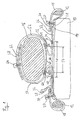
- Fig. 1 shows in cross-section a bed with mattress 10 and two bars of a bed frame 12.
- the top of the mattress 10 forms a bed surface 14, on which a lying on the back patient 16 rests.
- the distance between the patient 16 and lying surface 14 is shown enlarged in order to better represent the interposed elements of the fixation bandage can.
- the section shown runs through the body of the patient in the abdominal area and the view is directed from below, that is from the patient's feet, to this cut surface. Therefore, the elements located on the right side of the patient are shown on the left in the figure and vice versa.
- the Fixierbandage has two bed supports 18, each wrapped around a spar of the bed frame 12 and with a magnetic lock 20, which is passed through two eyelets of the bed supports 18, are attached.
- the fixation bandage further comprises a left first strap portion 22 and a right first strap portion 24.
- the left first belt portion 22 has a first one End 26, which is connected to the left bed holder 18. More specifically, the first end 26 of the left first strap portion 22 is connected to a first end 28 of the left-side bed holder 18.
- the left bed holder 18 also has a free end 30.
- This bed holder 18 also has a free end 30.
- the connections between the bed supports 18 and left and right first belt sections 22, 24 are not shown in detail in the figure. They can be produced in different ways, for example by sewing on overlapping belt sections or by using continuous strips of material.
- the left first belt portion 22 has a second end 34 which is connected to a first end 38 of a left second belt portion 36.
- the left second belt portion 36 also has a second end 41.
- the right first belt portion 24 has a second end 40 that is connected to a first end 42 of a right second belt portion 44.
- the right second belt portion 44 also has a second end 46.
- the second end 34 of the left first strap section 22 and the second end 40 of the right first strap section 24 are arranged at a first distance 48 from each other on the lying surface 14.
- This first distance 48 is for example in the range of 20 cm to 30 cm.
- the second end 41 of the left second belt section 36 and the second end 46 of the right second belt section 44 are arranged at a second distance 50 from each other in the back of the patient.
- the second distance 50 is for example in the range of 15 cm to 25 cm.
- the fixing bandage has a left third belt portion 52 and a right third belt portion 54.
- the left third strap portion 52 has a first end 56 and a free end 58.
- the right third strap portion 54 has a first end 60 and a free end 62.
- the free ends 58, 62 of the two third belt sections 52, 54 overlap and are detachably connected to one another by means of a further magnetic lock 64.
- a fourth belt section 66 connects the two second ends 34, 40 of the first belt sections 22, 24 with each other.
- the second belt sections 36, 44 together with the fourth belt section 66 and the fifth belt section 68 form a quadrilateral, in particular a parallelogram, in particular when the second belt sections 36, 44 are stretched.
- the left first belt section 22, the left second belt section 36 and the left third belt section 52 are formed by a left main belt running continuously from the first end 26 of the left first belt section 22 to the free end 58 of the left third belt section 52.
- the right first belt portion 24, the right second belt portion 44 and the right third belt portion 54 are formed by a right main belt extending continuously from the first end 32 of the right first belt portion 24 to the free end 62 of the right third belt portion 54.
- the fourth belt portion 66 is sewn to the two main straps, as indicated in the figure by five small parallel lines.
- the area in which the fourth belt section 66 is sewn to the two main belts, is located in the region of the second end 34 of the left first belt section 22 and in the region of the second end 40 of the right first belt section 24.
- the fifth strap portion 68 is also sewn to the two main straps, in the region of the first end 60 of the right third strap portion 54 and in the region of the first end 56 of the left third strap portion 52nd
- the fourth strap portion 66 consists essentially of a second strip of material extending continuously from a free end 30 of the right-side bed holder 18 to a free end 30 of the left-hand bed holder 18.
- the second strip of material is further sewn in the region of the first strap sections 22, 24 along its longitudinal direction with the two main straps, that is, with the first strap sections 22, 24.
- the already explained elements of the fixation bandage are provided with the same reference numerals.
- the left first, second and third strap portions 22, 36, 52 form a continuous left main belt
- the right first, second and third strap portions 24, 44 and 54 respectively form a right, continuous main belt.
- the aforementioned belt sections or main belts formed by these have a uniform first width which corresponds to the width of the fifth belt section 68.
- a crotch strap 70 secured to the fifth strap portion 68 and having a free end 72 and a pad 74.
- the free end 72 has a plurality of eyelets, so that the crotch strap 70 can be connected to the magnetic lock 64 with the third strap sections 52, 54.
- Fig. 3 shows a section of the fixation bandage from the FIGS. 1 and 2 from a different angle, namely approximately from the lying surface 14 of.
- the fourth belt portion 66 can be seen and that this has a second width which is smaller than the first width, for example, the left and right first belt portions 22, 24.
- the connecting portions of the fourth belt portions 66 with the two main straps defines the position of second ends 34 and 40 of the first two belt sections 22 and 24, respectively.
- Fig. 4 shows a section of the fixation bandage from the FIGS. 1 to 3 in a perspective view and in another arrangement, which corresponds approximately to a patient turned to his right side.
- the left second belt portion 36 is stretched, so that the pulling forces exerted on the left third belt portion 52 are discharged to the left-side bed holder 18 via the left main belt or the first material strip 76 sewn thereto.
- the patient in the fixation bandage according to the invention irrespective of additional side attachments, a certain freedom of movement remains and a lateral movement of the patient is still limited to extremely robust manner.
Landscapes
- Health & Medical Sciences (AREA)
- Nursing (AREA)
- Orthopedic Medicine & Surgery (AREA)
- Engineering & Computer Science (AREA)
- Biomedical Technology (AREA)
- Heart & Thoracic Surgery (AREA)
- Vascular Medicine (AREA)
- Life Sciences & Earth Sciences (AREA)
- Animal Behavior & Ethology (AREA)
- General Health & Medical Sciences (AREA)
- Public Health (AREA)
- Veterinary Medicine (AREA)
- Professional, Industrial, Or Sporting Protective Garments (AREA)
Applications Claiming Priority (1)
| Application Number | Priority Date | Filing Date | Title |
|---|---|---|---|
| DE201120103318 DE202011103318U1 (de) | 2011-07-12 | 2011-07-12 | Fixierbandage zur Fixierung eines Patienten |
Publications (1)
| Publication Number | Publication Date |
|---|---|
| EP2545889A1 true EP2545889A1 (fr) | 2013-01-16 |
Family
ID=45116242
Family Applications (1)
| Application Number | Title | Priority Date | Filing Date |
|---|---|---|---|
| EP12005078A Withdrawn EP2545889A1 (fr) | 2011-07-12 | 2012-07-09 | Bandage fixe pour la fixation dýun patient |
Country Status (2)
| Country | Link |
|---|---|
| EP (1) | EP2545889A1 (fr) |
| DE (1) | DE202011103318U1 (fr) |
Cited By (2)
| Publication number | Priority date | Publication date | Assignee | Title |
|---|---|---|---|---|
| ES2620985A1 (es) * | 2017-03-31 | 2017-06-30 | Corporació Sanitària Parc Taulí | Dispositivo de seguridad y retención torácica para pacientes y elemento tensor asociado al mismo |
| ES2712326A1 (es) * | 2017-11-10 | 2019-05-10 | Ofidex Imp Export S L | Sistema de seguridad para pacientes en cama |
Citations (7)
| Publication number | Priority date | Publication date | Assignee | Title |
|---|---|---|---|---|
| US2437585A (en) * | 1946-07-24 | 1948-03-09 | Zimmern Benno | Child's swivel harness |
| DE1953842A1 (de) | 1969-10-25 | 1971-05-06 | Giraldez Jose H Sanchez | Vorrichtung zum Festhalten eines menschlichen Koerpers auf einem Lager |
| DE20317701U1 (de) | 2003-11-14 | 2004-01-22 | Soetebeer, Roxana | Sicherheitsbandage |
| DE202006009390U1 (de) | 2006-06-14 | 2006-08-17 | Wysozki, Roman | Gurtsystem mit einem Fixiergurt |
| DE202006009392U1 (de) | 2006-06-14 | 2006-08-31 | Sánchez, Alexander | Sicherheitsbandage |
| WO2007144171A1 (fr) * | 2006-06-14 | 2007-12-21 | Alexander Sanchez | Bandage d'immobilisation avec sangle de maintien et sangle ventrale reliée fixement à cette dernière |
| EP2452656A1 (fr) * | 2010-11-16 | 2012-05-16 | Roman Wysozki | Bandage fixe pour la fixation d'un patient |
-
2011
- 2011-07-12 DE DE201120103318 patent/DE202011103318U1/de not_active Expired - Lifetime
-
2012
- 2012-07-09 EP EP12005078A patent/EP2545889A1/fr not_active Withdrawn
Patent Citations (7)
| Publication number | Priority date | Publication date | Assignee | Title |
|---|---|---|---|---|
| US2437585A (en) * | 1946-07-24 | 1948-03-09 | Zimmern Benno | Child's swivel harness |
| DE1953842A1 (de) | 1969-10-25 | 1971-05-06 | Giraldez Jose H Sanchez | Vorrichtung zum Festhalten eines menschlichen Koerpers auf einem Lager |
| DE20317701U1 (de) | 2003-11-14 | 2004-01-22 | Soetebeer, Roxana | Sicherheitsbandage |
| DE202006009390U1 (de) | 2006-06-14 | 2006-08-17 | Wysozki, Roman | Gurtsystem mit einem Fixiergurt |
| DE202006009392U1 (de) | 2006-06-14 | 2006-08-31 | Sánchez, Alexander | Sicherheitsbandage |
| WO2007144171A1 (fr) * | 2006-06-14 | 2007-12-21 | Alexander Sanchez | Bandage d'immobilisation avec sangle de maintien et sangle ventrale reliée fixement à cette dernière |
| EP2452656A1 (fr) * | 2010-11-16 | 2012-05-16 | Roman Wysozki | Bandage fixe pour la fixation d'un patient |
Cited By (2)
| Publication number | Priority date | Publication date | Assignee | Title |
|---|---|---|---|---|
| ES2620985A1 (es) * | 2017-03-31 | 2017-06-30 | Corporació Sanitària Parc Taulí | Dispositivo de seguridad y retención torácica para pacientes y elemento tensor asociado al mismo |
| ES2712326A1 (es) * | 2017-11-10 | 2019-05-10 | Ofidex Imp Export S L | Sistema de seguridad para pacientes en cama |
Also Published As
| Publication number | Publication date |
|---|---|
| DE202011103318U1 (de) | 2011-11-09 |
Similar Documents
| Publication | Publication Date | Title |
|---|---|---|
| EP2810587A1 (fr) | Porte-bébé | |
| DE2708801A1 (de) | Gesundheitsgeschirr | |
| DE29717429U1 (de) | Bandagen-System | |
| DE102008035752A1 (de) | Babytragetuch | |
| EP2452656B1 (fr) | Bandage fixe pour la fixation d'un patient | |
| EP2452655B1 (fr) | Bandage fixe pour la fixation d'un patient | |
| EP2545889A1 (fr) | Bandage fixe pour la fixation dýun patient | |
| DE102007022443B4 (de) | Tragevorrichtung | |
| DE102004063444C5 (de) | Fixiergurt | |
| EP2545888A1 (fr) | Bandage de fixation avec deux ceintures principales | |
| DE102006017567B4 (de) | Thoraxbandage | |
| EP3127513A1 (fr) | Systeme de traitement orthopedique de lesions et/ou de deformations de la jambe et/ou de la cheville | |
| WO2010139084A1 (fr) | Orthèse | |
| DE202006009390U1 (de) | Gurtsystem mit einem Fixiergurt | |
| DE102017115688B4 (de) | Tragesystem für Babys und Kinder | |
| DE20204936U1 (de) | Dynamisierte Reklinationsorthese mit Sternal- und Symphysenpelotte | |
| AT502986B1 (de) | Stützbandage | |
| EP2068788B1 (fr) | Bandage de sécurité doté d'une boucle de sécurité | |
| WO2007144171A1 (fr) | Bandage d'immobilisation avec sangle de maintien et sangle ventrale reliée fixement à cette dernière | |
| DE202006009389U1 (de) | Antidekubitusbandage | |
| AT521819B1 (de) | Tragevorrichtung | |
| DE202006009398U1 (de) | Sicherheitsbandage mit einer Seitenbefestigung | |
| DE202006009392U1 (de) | Sicherheitsbandage | |
| DE202006009397U1 (de) | Sicherheitsbandage mit Oberschenkelmanschetten | |
| DE102022121620A1 (de) | Hebegeschirr sowie Verfahren zum bedarfsgerechten Aufrichten, Sichern und Entlasten von Großtieren |
Legal Events
| Date | Code | Title | Description |
|---|---|---|---|
| PUAI | Public reference made under article 153(3) epc to a published international application that has entered the european phase |
Free format text: ORIGINAL CODE: 0009012 |
|
| AK | Designated contracting states |
Kind code of ref document: A1 Designated state(s): AL AT BE BG CH CY CZ DE DK EE ES FI FR GB GR HR HU IE IS IT LI LT LU LV MC MK MT NL NO PL PT RO RS SE SI SK SM TR |
|
| AX | Request for extension of the european patent |
Extension state: BA ME |
|
| STAA | Information on the status of an ep patent application or granted ep patent |
Free format text: STATUS: THE APPLICATION IS DEEMED TO BE WITHDRAWN |
|
| 18D | Application deemed to be withdrawn |
Effective date: 20130717 |