EP2546653B1 - Électrode de mesure de glycoprotéine et son procédé de préparation - Google Patents
Électrode de mesure de glycoprotéine et son procédé de préparation Download PDFInfo
- Publication number
- EP2546653B1 EP2546653B1 EP12176052.4A EP12176052A EP2546653B1 EP 2546653 B1 EP2546653 B1 EP 2546653B1 EP 12176052 A EP12176052 A EP 12176052A EP 2546653 B1 EP2546653 B1 EP 2546653B1
- Authority
- EP
- European Patent Office
- Prior art keywords
- electrode
- cystamine
- boronic acid
- hba1c
- fpba
- Prior art date
- Legal status (The legal status is an assumption and is not a legal conclusion. Google has not performed a legal analysis and makes no representation as to the accuracy of the status listed.)
- Not-in-force
Links
- 0 C[C@](B(*)[N+]([O-])=O)C* Chemical compound C[C@](B(*)[N+]([O-])=O)C* 0.000 description 1
Images



Classifications
-
- G—PHYSICS
- G01—MEASURING; TESTING
- G01N—INVESTIGATING OR ANALYSING MATERIALS BY DETERMINING THEIR CHEMICAL OR PHYSICAL PROPERTIES
- G01N27/00—Investigating or analysing materials by the use of electric, electrochemical, or magnetic means
- G01N27/26—Investigating or analysing materials by the use of electric, electrochemical, or magnetic means by investigating electrochemical variables; by using electrolysis or electrophoresis
- G01N27/28—Electrolytic cell components
- G01N27/30—Electrodes, e.g. test electrodes; Half-cells
-
- C—CHEMISTRY; METALLURGY
- C12—BIOCHEMISTRY; BEER; SPIRITS; WINE; VINEGAR; MICROBIOLOGY; ENZYMOLOGY; MUTATION OR GENETIC ENGINEERING
- C12Q—MEASURING OR TESTING PROCESSES INVOLVING ENZYMES, NUCLEIC ACIDS OR MICROORGANISMS; COMPOSITIONS OR TEST PAPERS THEREFOR; PROCESSES OF PREPARING SUCH COMPOSITIONS; CONDITION-RESPONSIVE CONTROL IN MICROBIOLOGICAL OR ENZYMOLOGICAL PROCESSES
- C12Q1/00—Measuring or testing processes involving enzymes, nucleic acids or microorganisms; Compositions therefor; Processes of preparing such compositions
- C12Q1/001—Enzyme electrodes
- C12Q1/002—Electrode membranes
- C12Q1/003—Functionalisation
-
- C—CHEMISTRY; METALLURGY
- C07—ORGANIC CHEMISTRY
- C07F—ACYCLIC, CARBOCYCLIC OR HETEROCYCLIC COMPOUNDS CONTAINING ELEMENTS OTHER THAN CARBON, HYDROGEN, HALOGEN, OXYGEN, NITROGEN, SULFUR, SELENIUM OR TELLURIUM
- C07F5/00—Compounds containing elements of Groups 3 or 13 of the Periodic Table
- C07F5/02—Boron compounds
-
- G—PHYSICS
- G01—MEASURING; TESTING
- G01N—INVESTIGATING OR ANALYSING MATERIALS BY DETERMINING THEIR CHEMICAL OR PHYSICAL PROPERTIES
- G01N27/00—Investigating or analysing materials by the use of electric, electrochemical, or magnetic means
- G01N27/26—Investigating or analysing materials by the use of electric, electrochemical, or magnetic means by investigating electrochemical variables; by using electrolysis or electrophoresis
- G01N27/28—Electrolytic cell components
- G01N27/30—Electrodes, e.g. test electrodes; Half-cells
- G01N27/327—Biochemical electrodes, e.g. electrical or mechanical details for in vitro measurements
-
- G—PHYSICS
- G01—MEASURING; TESTING
- G01N—INVESTIGATING OR ANALYSING MATERIALS BY DETERMINING THEIR CHEMICAL OR PHYSICAL PROPERTIES
- G01N27/00—Investigating or analysing materials by the use of electric, electrochemical, or magnetic means
- G01N27/26—Investigating or analysing materials by the use of electric, electrochemical, or magnetic means by investigating electrochemical variables; by using electrolysis or electrophoresis
- G01N27/416—Systems
-
- G—PHYSICS
- G01—MEASURING; TESTING
- G01N—INVESTIGATING OR ANALYSING MATERIALS BY DETERMINING THEIR CHEMICAL OR PHYSICAL PROPERTIES
- G01N33/00—Investigating or analysing materials by specific methods not covered by groups G01N1/00 - G01N31/00
- G01N33/48—Biological material, e.g. blood, urine; Haemocytometers
- G01N33/50—Chemical analysis of biological material, e.g. blood, urine; Testing involving biospecific ligand binding methods; Immunological testing
- G01N33/68—Chemical analysis of biological material, e.g. blood, urine; Testing involving biospecific ligand binding methods; Immunological testing involving proteins, peptides or amino acids
-
- G—PHYSICS
- G01—MEASURING; TESTING
- G01N—INVESTIGATING OR ANALYSING MATERIALS BY DETERMINING THEIR CHEMICAL OR PHYSICAL PROPERTIES
- G01N33/00—Investigating or analysing materials by specific methods not covered by groups G01N1/00 - G01N31/00
- G01N33/48—Biological material, e.g. blood, urine; Haemocytometers
- G01N33/50—Chemical analysis of biological material, e.g. blood, urine; Testing involving biospecific ligand binding methods; Immunological testing
- G01N33/72—Chemical analysis of biological material, e.g. blood, urine; Testing involving biospecific ligand binding methods; Immunological testing involving blood pigments, e.g. haemoglobin, bilirubin or other porphyrins; involving occult blood
- G01N33/721—Haemoglobin
- G01N33/723—Glycosylated haemoglobin
-
- H—ELECTRICITY
- H01—ELECTRIC ELEMENTS
- H01R—ELECTRICALLY-CONDUCTIVE CONNECTIONS; STRUCTURAL ASSOCIATIONS OF A PLURALITY OF MUTUALLY-INSULATED ELECTRICAL CONNECTING ELEMENTS; COUPLING DEVICES; CURRENT COLLECTORS
- H01R43/00—Apparatus or processes specially adapted for manufacturing, assembling, maintaining, or repairing of line connectors or current collectors or for joining electric conductors
- H01R43/16—Apparatus or processes specially adapted for manufacturing, assembling, maintaining, or repairing of line connectors or current collectors or for joining electric conductors for manufacturing contact members, e.g. by punching and by bending
-
- Y—GENERAL TAGGING OF NEW TECHNOLOGICAL DEVELOPMENTS; GENERAL TAGGING OF CROSS-SECTIONAL TECHNOLOGIES SPANNING OVER SEVERAL SECTIONS OF THE IPC; TECHNICAL SUBJECTS COVERED BY FORMER USPC CROSS-REFERENCE ART COLLECTIONS [XRACs] AND DIGESTS
- Y10—TECHNICAL SUBJECTS COVERED BY FORMER USPC
- Y10T—TECHNICAL SUBJECTS COVERED BY FORMER US CLASSIFICATION
- Y10T29/00—Metal working
- Y10T29/49—Method of mechanical manufacture
- Y10T29/49002—Electrical device making
- Y10T29/49117—Conductor or circuit manufacturing
- Y10T29/49204—Contact or terminal manufacturing
Definitions
- the present invention relates to an electrode for measuring glycoprotein, and more particularly, to an electrode for measuring glycoprotein, the surface of which can bind an increased amount of boronic acid capable of binding to glycoprotein and which can more accurately measure the amount of glycoprotein, and to a preparation method thereof.
- Blood glucose and glycated hemoglobin are most frequently used as important indexes that reflect the current status of diabetes.
- glycated hemoglobin a test error caused by an empty stomach and a drug is low and it is possible to predict long-term changes in the blood glucose levels of diabetic patients before blood collection.
- the measurement of glycated hemoglobin is useful for assessment of the long-term regulation of plasma glucose.
- glycated hemoglobin has good specificity, and thus is considered as a good index for diabetes and related complications.
- the electrode surface was modified with boronic acid (BA) capable of binding specifically to glycated hemoglobin.
- BA boronic acid
- Boronic acid is frequently used in sensors for measuring glycoprotein or glucose, because it has the property of binding specifically to sugars and glycoprotein by interaction with the cis-diol.
- a boronic acid group is exposed to the electrode surface to which glycated hemoglobin is then immobilized, and the concentration of the glycated hemoglobin is measured in the resulting change in electrochemical signals.
- Korean Patent Laid-Open Publication No. 2011-0002293 discloses preparing an electrode by binding a dendrimer to the electrode surface and then binding 4-formyl-phenylboronic acid thereto, and also discloses reacting glycated hemoglobin with the 4-formyl-phenylboronic acid and then electrochemically measuring the amount of the glycated hemoglobin.
- the 4-formyl-phenylboronic acid is used, there are shortcomings in that the reaction of glycated hemoglobin is insufficient and the density of 4-formyl-phenylboronic acid that is bound to the electrode surface by the dendrimer is low.
- the present invention has been made in view of the above-described problems occurring in the prior art, and it is an object of the present invention to increase the amount of boronic acid that is bound to the electrode surface and to more accurately measure the amount of glycoprotein.
- Another object of the present invention is to prepare an electrode having a boronic acid bound thereto in a simple and easy manner.
- the present invention provides an electrode for measuring glycoprotein as defined in claim 1.
- Cystamine (Cys) is bound to the surface of the electrode, and boronic acid (BA) is conjugated to the cystamine.
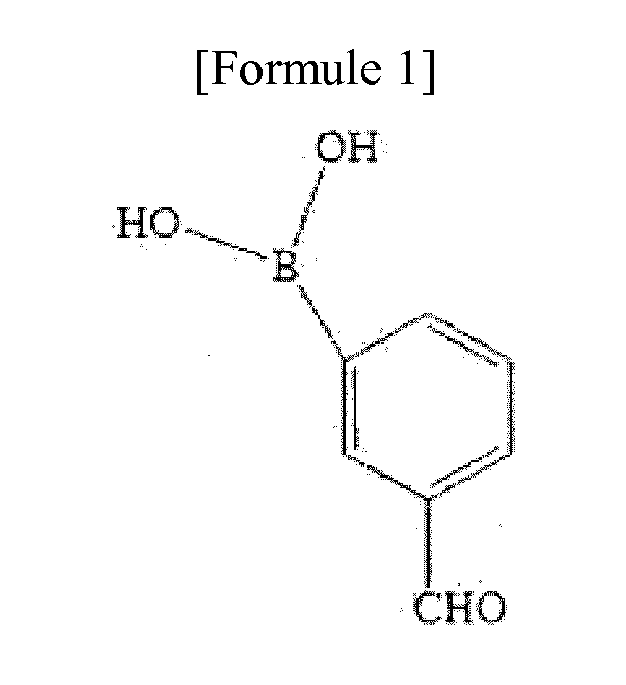
- the boronic acid is preferably formylphenyl boronic acid (FPBA), and more preferably a 3-formylphenyl boronic acid (3-FPBA) represented by the following formula 1:
- two 3-formylphenyl boronic acids may be conjugated to one cystamine.
- cystamine may be bound to the electrode surface by the disulfide group of the cystamine.
- the present invention provides an electrode for measuring glycoprotein, wherein a cystamine-boronic acid conjugate prepared by conjugating cystamine to boronic acid is bound to the electrode surface.
- the conjugate may be bound to the electrode surface by the disulfide group of the cystamine.
- conjugate may be Cys-FPBA 2 represented by the following formula 2:
- the electrode surface may be made of gold (Au).
- the present invention provides a method for preparing an electrode for measuring glycoprotein as defined in claim 10.
- the method includes the steps of: preparing a cystamine-boronic acid conjugate by conjugating cystamine to boronic acid; and binding the prepared conjugate to the surface of an electrode.
- the step of preparing the conjugate may include a step of reacting the cystamine with the boronic acid for 3-5 hours.
- the step of preparing the conjugate may also include a step of reacting the cystamine with the boronic acid in the presence of triethylamine (TEA).
- TAA triethylamine
- the step of preparing the conjugate preferably includes a step of reacting the cystamine with the boronic acid at a temperature of 40 ⁇ 60 °C.
- the present invention is directed to an electrode for measuring glycoprotein, and more particularly to an electrode capable of detecting the presence or measuring the amount of a glycoprotein having the cis-diol group of the carbohydrate chain, for example, glycated hemoglobin (HbA1c) or glycated albumin.
- a glycoprotein having the cis-diol group of the carbohydrate chain for example, glycated hemoglobin (HbA1c) or glycated albumin.
- the electrode that is used in the present invention may have a conductive electrode body, for example made of gold (Au) or platinum (Pt) electrode, or consisting of a semiconductor electrode such as a carbon electrode.
- a conductive electrode body for example made of gold (Au) or platinum (Pt) electrode, or consisting of a semiconductor electrode such as a carbon electrode.
- Au gold
- Pt platinum
- the gold electrode is used.
- the electrode body preferably has on its surface a boronic acid (BA) capable of binding the cis-diol group by interaction with the cis-diol.
- a cystamine Cys
- the boronic acid is not specifically limited and may be any boronic acid which is widely known in the art.
- the boronic acid may be formylphenyl boronic acid (FPBA), preferably 3-formylphenyl boronic acid (3-FPBA), and more preferably a 3-formylphenyl boronic acid (3-FPBA) represented by formula 1.
- FPBA formylphenyl boronic acid
- 3-FPBA 3-formylphenyl boronic acid
- 3-FPBA 3-formylphenyl boronic acid
- the cystamine is bound to the electrode surface, and the boronic acid is conjugated to the cystamine.
- the cystamine includes a disulfide group which can bind to the electrode surface made of, for example, a metal, and it has an amine group at both ends, and thus can also bind to a boronic acid having an aldehyde group.
- one cystamine can be conjugated to two 3-formylphenyl boronic acids by amino groups at both ends.
- the electrode of the present invention may further comprise a surface modification layer which is known to those skilled in the art.
- DTSP 3,3'-dithio-bis-propionic acid N-hydroxysuccinimide ester
- a dendrimer such as poly(amidoamine) or poly(alkyleneimine) was bound thereto, and then boronic acid was bound to the dendrimer.
- a structure such as BA/dendrimer/DTSP/electrode was prepared.
- cystamine is bound to the electrode surface, and boronic acid is bound directly thereto.
- a structure of BA/cystamine/electrode which is simpler than the prior art structure is provided, and the preparation method is simpler and easier than the prior art.
- This electrode of the present invention may be prepared by binding a cystamine to the electrode surface and conjugating a boronic acid to the cystamine.
- this electrode structure is preferably prepared by a conjugation method in which a cystamine is conjugated with a boronic acid to prepare a Cys-FPBA 2 conjugate which is then bound to the electrode surface by dipping the electrode once in a solution containing the conjugate.
- the electrode structure may also be prepared by a bottom-up method in which a cystamine is bound to the electrode surface and then a boronic acid is bound to the cystamine.
- the inventive electrode structure consisting of boronic acid/cystamine/electrode surface could not be conceived of from the prior art. The reason is as follows. First, the disulfide group of cystamine is not located at the end of the cystamine, but is located at the middle of the cystamine. Second, the electrode having the boronic acid bound thereto is preferably prepared by the conjugation method compared to the bottom-up method which is a general method.
- the present invention provides an electrode for measuring glycoprotein, in which a cystamine-boronic acid conjugate is bound to the electrode surface.
- the conjugate may be a Cys-FPBA 2 synthesized by reacting cystamine with 3-formylphenyl boronic acid (3-FPBA) according to the following reaction scheme:
- the conjugate is preferably bound to the electrode surface such that the diol group of the boronic acid faces outward so as to bind to glycoprotein.
- the conjugate is preferably bound to the electrode surface by the disulfide of the cystamine.
- the present invention is characterized in that cystamine is bound to the electrode surface and boronic acid is conjugated to the cystamine.
- cystamine is bound to the electrode surface and boronic acid is conjugated to the cystamine.
- an increased amount of boronic acid can be bound to the electrode surface, so that the amount of glycoprotein can be more accurately measured.
- Another aspect of the present invention is directed to a method for preparing an electrode for measuring glycoprotein, the method comprising the steps of: preparing a cystamine-boronic acid conjugate by conjugating a cystamine with a boronic acid; and binding the prepared conjugate to an electrode surface.
- the electrode for measuring glycoprotein is prepared in a simple and easy manner by a conjugation method in which cystamine and boronic acid are conjugated with each other to prepare a Cys-FPBA 2 conjugate, and then an electrode body is then dipped once in a solution containing the conjugate.
- the electrode prepared by this method has significantly excellent effects compared to an electrode prepared by a conventional bottom-up method.
- the cystamine can be prepared by reacting cystamine with 3-FPBA in a solvent at room temperature for several hours.
- the solvent is preferably DMSO (dimethyl sulfoxide).
- the method of binding the conjugate is also not specifically limited.
- the binding can be performed by washing a gold-deposited electrode surface and then dipping the electrode body in a solution of Cys-FPBA 2 in DMSO for several hours.
- the electrode is washed with Piranha solution to remove contaminants, and after the dipping process, the electrode is washed with DMSO and ethanol.
- the present inventors carried out tests under various conditions in order to find optimal conditions for synthesizing Cys-FPBA 2 with high yield.
- the reaction for preparing the conjugate is preferably carried out for 3-5 hours, and more preferably 3-4. This is because if the reaction time is shorter than 3 hours, the synthesis of Cys-FPBA 2 will be insufficient so that the signal of glucose oxidase (GOX) will be weak, and if the reaction time is longer than 5, the reaction signal decreases, rather than increases.
- the reaction is carried out in the presence of triethylamine (TEA) as a catalyst.
- TAA triethylamine
- the reaction temperature is preferably 40-60 °C, and more preferably 45-55 °C. This is because, if the reaction temperature is lower than 40 °C, the synthesis of Cys-FPBA 2 will be insufficient (the signal of glucose oxidase (GOX) will be weak), and if the reaction temperature is higher than 60 °C, the conjugate can be decomposed.
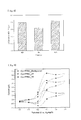
- FIG. 1 is a schematic diagram showing one example of a competition assay for electrochemically measuring glycated hemoglobin (HbA1c) using an electrode for measuring glycoprotein according to one embodiment of the present invention.
- boronic acid self-assembled monolayer (BA SAM)
- SAM self-assembled monolayer
- BA synthesized cystamine/boronic acid conjugate
- bottom-up method in which cystamine and BA are sequentially reacted with the electrode surface.
- Cystamine (5 mM) and 3-FPBA (20 mM) were allowed to react with each other in a DMSO (dimethyl sulfoxide) solvent at room temperature for 4 hours, thereby synthesizing a Cys-FPBA 2 conjugate.
- the amino group of the cystamine was mixed and bound to the aldehyde group of FPBA by the Schiff's base.
- triethylamine (TEA) was added to the mixed solution before a basic atmosphere was formed.
- the deposited gold surface was immersed in Piranha solution for 5 minutes and washed with distilled water. Then, in order to form a boronate-modified self-assembled monolayer (SAM), the electrode body was dipped in a solution of the Cys-FPBA 2 in DMSO for 2 hours. Then, the electrode was washed with DMSO and ethanol, followed by rinse with distilled water (DDW). Finally, the electrode was stored in phosphate buffered saline (PBS).
- PBS phosphate buffered saline
- Example 2 glycoprotein measurement electrode by bottom-up method
- An electrode body was prepared in the same manner as Example 1, and 5 mM cystamine, 20 mM 3-FPBA and a DMSO solvent were used as in Example 1.
- cystamine was reacted with the gold electrode such that the amino group was exposed to the electrode surface.
- 3-FPBA having an aldehyde group capable of reacting with the amino group was reacted with the electrode surface so as to be bound to the electrode surface by a Schiff's base.
- Test Example 1 Measurement of electrochemical signals on the electrodes prepared by conjugation method and bottom-up method
- FIG. 2 shows the values of electrochemical signals on the electrodes prepared by the bottom-up method ( ⁇ , red line) and the conjugation method ( ⁇ , blue line) according to the examples of the present invention.
- the signal increased by about 2 ⁇ A compared to the background signal having no substrate. This is attributable to GOX immobilized on the gold electrode surface by the interaction between BA and the cis-diol of GOX, suggesting that the gold electrode surface was modified with BA.
- the signal increased by about 0.3 ⁇ A, suggesting that the degree of modification of the electrode surface with BA was not substantially lower than that in the conjugation method.
- Example 3 Preparation of electrodes using Cys-FPBA 2 synthesized by reacting Cys with FPBA 2 for various times, and measurement of electrochemical signals
- the reaction for synthesis of Cys-FPBA 2 was carried out for various times between 2 hours and 8 hours, and the degree of synthesis of Cys-FPBA 2 was analyzed as a function of reaction time.
- the synthesis of Cys-FPBA 2 was performed by reacting 5 mM cystamine with 20 mM 3FPBA in DMSO.
- the degree of modification with BA SAM as a function of the synthesis yield and reaction time was examined using a GOX immobilization test in the same manner as Example 1 (BA SAM modification test). The results of the electrochemical test as a function of synthesis time are shown in FIG. 3 .
- Example 4 Preparation of electrodes using Cys-FPBA 2 synthesized in the presence of various catalysts, and measurement of electrochemical signals
- FIG. 4 shows electrochemical signals as a function of the kind of catalyst and shows the current values obtained by subtracting the background signal from the current values at 400 mV on the CV (cyclic voltammogram).
- the signal of GOX was higher in the presence of TEA than in the absence of TEA and in the presence of HCl.
- the presence of TEA in the synthesis reaction facilitates the synthesis of Cys-FPBA 2 .
- the synthesis of Cys-FPBA 2 was carried out in the presence of 1.1 ⁇ l of TEA.
- Example 5 Preparation of electrodes using Cys-FPBA 2 synthesized at various temperatures, and measurement of electrochemical signals
- FIG. 5 shows the electrochemical signals of GOX immobilized on the Cys-FPBA 2 SAM conjugates synthesized at various temperatures.
- the signal of GOX immobilized on the BA SAM synthesized at 50 °C was about two times (about 1 ⁇ A) than that on the BA SAM synthesized at 25 °C. This indicates that the amount of GOX immobilized on the Cys-FPBA 2 synthesized at 50 °C was much larger, suggesting that the Cys-FPBA 2 synthesized at 50 °C is significantly efficient.
- the synthesis of Cys-FPBA 2 was carried out at 50 °C.
- Cys-FPBA 2 according to the present invention was correctly synthesized so that the electrode surface is modified with the BA group.
- a BA SAM was formed on the gold electrode surface, and a competition assay for measurement of HbA1c was performed.
- the competition assay was performed using each of a buffer sample consisting of HbA1c alone (Test Example 3-1), an HbA1c containing BSA (Test Example 3-2), and a reference sample (Test Example 3-3).
- Test Example 3-1 Measurement of HbA1c% in HbA1c sample (in PBS buffer)
- a electrochemical signal was detected as a function of the concentration of HbA1c. Specifically, 20 ⁇ g/ml of an HbA1c sample (corresponding to a 7500-fold dilution of 150 mg/ml which is the average total hemoglobin concentration of normal persons) was diluted to a concentration ranging from 0% to 15% (0.5 ⁇ g/ml to 3 ⁇ g/ml), and a signal was measured as function of the concentration of HbA1c.
- FIG. 7 shows the values of electrochemical signals and COV as a function of the concentration of HbA1c, measured using the electrode according to the example of the present invention.
- the electrochemical signal decreased.
- the concentration of HbA1c increases, the amount of HbA1c that is immobilized on the electrode surface increases, and thus the binding of GOX capable of generating a signal is spatially limited, and the amount of GOX that binds decreases.
- the electrochemical signal of GOX decreases.
- the signal decreased gradually in the HbA1c concentration range of 2.5-15%, suggesting that the concentration of HbA1c can be electrochemically measured using Cys-FPBA 2 SAM.
- Test Example 3-2 Measurement of HbA1c% in HkaA1c sample (with BSA in PBS buffer)
- HbA1c samples in Test Example 3-1 consist of HbA1c alone, the total concentration proteins of the samples which are allowed to react with the electrode modified with GOX differ from each other.
- the measurement of HbA1c% is carried out to measure HbA1c in a total Hb sample which comprises HbA1c (glycated hemoglobin (Hb)) and HbA0 (non-glycated hemoglobin).
- HbA1c% comprising HbA1c and BSA in place of HbA0 was measured.
- 20 ⁇ g/ml of total protein (assumed as 100% Hb) was diluted to a concentration ranging from 2.5% to 15% to prepare HbA1c samples, and a competition assay of each sample with GOX was carried out.
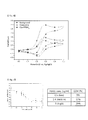
- FIG. 8 shows electrochemical signals (current) and COV values as a function of the concentration of HbA1c%, measured using the electrode according to the example of the present invention.
- the right table in FIG. 8 shows COV values obtained by performing three repeated tests in the same manner as the above tests performed using the HbA1c standard solution sample.
- the COV values were generally lower than those in Test Example 3-1 performed using HbA1c alone. The reason is as follows. In the case of the sample comprising HbA1c alone, the amount of total protein is not constant, but when the amount of total amount is controlled to a constant level using BSA, the general conditions of the protein sample become uniform, and thus reproducibility is increased.
- the competition assay can be applied in a test based on total Hb and that the ratio for the Hb sample and the GOX sample for the competition assay is suitable.
- the ratio of concentration between the two samples is very important in carrying out the competition assay. This is because when the ratio of GOX is too high or low, the electrochemical signal is too large or small to accurately detect the signal of HbA1c.
- Test Example 3-3 Measurement of HbA1c% in HbA1c% sample (reference sample)
- HbA1c reference samples (Lyphochek Hemoglobin Linearity set) purchased from Bio-Rad, Inc.
- the samples used were reference samples close to whole blood, which were lyophilized according to their HbA1c levels. Because no total hemoglobin level was indicated on the four samples included in the linearity set, the total hemoglobin and glucose levels of each sample were using Reflotron (Roche), before the competition assay was carried out. As a result, it could be seen that the amount of total Hb was different between the samples, and each of the samples contained a significant amount of glucose.
- HbA1c glucose in blood can react with BA, like HbA1c, it interferes with the measurement of the concentration of HbA1c%.
- glucose was removed from each sample, and then the total Hb of each sample was adjusted to 20 ⁇ g/ml and used in the test.
- FIG. 9 shows electrochemical signals (current) and COV values as a function of the concentration of %HbA1c in the reference samples, measured using the electrode according to the example of the present invention. Specifically, it shows the results of competition assays carried out using the four reference samples having different HbA1c levels, from which glucose was removed and which were suitably diluted.
- the sample data sheet show the concentration of HbA1c% in each sample, measured using commercial HbA1c measurement systems.
- HbA1c% IFCC value
- samples 1, 2 and 3 had HbA1c concentrations of 1.7%, 4.4% and 17%, respectively.
- cystamine is bound to the electrode surface, and boronic acid is conjugated to the cystamine.
- boronic acid is conjugated to the cystamine.
- the electrode having boronic acid bound thereto can be prepared in a simple and easy manner by preparing a cystamine-boronic acid conjugate and dipping an electrode once in a solution containing the conjugate.
Landscapes
- Life Sciences & Earth Sciences (AREA)
- Health & Medical Sciences (AREA)
- Chemical & Material Sciences (AREA)
- Engineering & Computer Science (AREA)
- Molecular Biology (AREA)
- Immunology (AREA)
- Hematology (AREA)
- Organic Chemistry (AREA)
- General Health & Medical Sciences (AREA)
- Physics & Mathematics (AREA)
- Analytical Chemistry (AREA)
- Biochemistry (AREA)
- Biomedical Technology (AREA)
- Urology & Nephrology (AREA)
- Proteomics, Peptides & Aminoacids (AREA)
- Pathology (AREA)
- Microbiology (AREA)
- Biotechnology (AREA)
- General Physics & Mathematics (AREA)
- Wood Science & Technology (AREA)
- Zoology (AREA)
- Medicinal Chemistry (AREA)
- Food Science & Technology (AREA)
- Cell Biology (AREA)
- Chemical Kinetics & Catalysis (AREA)
- Electrochemistry (AREA)
- Biophysics (AREA)
- Bioinformatics & Cheminformatics (AREA)
- General Engineering & Computer Science (AREA)
- Genetics & Genomics (AREA)
- Manufacturing & Machinery (AREA)
- Peptides Or Proteins (AREA)
- Investigating Or Analysing Biological Materials (AREA)
- Measuring Or Testing Involving Enzymes Or Micro-Organisms (AREA)
Claims (14)
- Electrode de mesure de glycoprotéine, l'électrode comprenant :un corps d'électrode ayant une surface d'électrode ;de la cystamine liée à la surface d'électrode ; etde l'acide boronique (BA) conjugué à la cystamine ;dans laquelle ledit acide boronique est lié directement à la cystamine.
- Electrode selon la revendication 1, dans laquelle l'acide boronique est un acide formylphényl boronique (FPBA).
- Electrode selon la revendication 1, dans laquelle l'acide boronique est un acide 3-formylphényl boronique (3FPBA) représenté par la formule 1 suivante :
- Electrode selon la revendication 3, dans laquelle deux acides 3-formylphényl-boroniques sont conjugués à une cystamine.
- Electrode selon l'une quelconque des revendications 1 à 4, dans laquelle la cystamine est liée à la surface d'électrode par le groupe disulfure de la cystamine.
- Electrode selon la revendication 1, dans laquelle un conjugué cystamine-acide boronique préparé par la conjugaison de la cystamine à l'acide boronique est lié à la surface d'électrode.
- Electrode selon la revendication 6, dans laquelle le conjugué est lié à la surface d'électrode par le groupe disulfure de la cystamine.
- Electrode selon la revendication 6 ou 7, dans laquelle le conjugué est un Cys-FPBA2 représenté par la formule 2 suivante :

- Electrode selon l'une quelconque des revendications 1 à 8, dans laquelle la surface d'électrode est faite d'or (Au).
- Procédé de préparation d'une électrode de mesure de glycoprotéine, le procédé comprenant les étapes suivantes :la préparation d'un conjugué cystamine-acide boronique par la conjugaison de la cystamine à un acide boronique ; etla liaison du conjugué préparé à une surface d'électrode,dans lequel ledit acide boronique est lié directement à la cystamine.
- Procédé selon la revendication 10, dans lequel l'étape de préparation du conjugué comprend une étape de réaction de la cystamine avec l'acide boronique pendant 3 à 5 heures.
- Procédé selon la revendication 10 ou 11, dans lequel l'étape de préparation du conjugué comprend une étape de réaction de la cystamine avec l'acide boronique en présence de triéthylamine (TEA).
- Procédé selon l'une quelconque des revendications 10 à 12, dans lequel l'étape de préparation du conjugué comprend une étape de réaction de la cystamine avec l'acide boronique à une température de 40 °C à 60 °C.
- Procédé selon la revendication 10, dans lequel le conjugué est un Cys-FPBA2 représenté par la formule 2 suivante :

Applications Claiming Priority (1)
| Application Number | Priority Date | Filing Date | Title |
|---|---|---|---|
| KR1020110070646A KR101728920B1 (ko) | 2011-07-15 | 2011-07-15 | 당화당백질 측정용 전극 및 이것의 제조방법 |
Publications (2)
| Publication Number | Publication Date |
|---|---|
| EP2546653A1 EP2546653A1 (fr) | 2013-01-16 |
| EP2546653B1 true EP2546653B1 (fr) | 2015-04-15 |
Family
ID=47010170
Family Applications (1)
| Application Number | Title | Priority Date | Filing Date |
|---|---|---|---|
| EP12176052.4A Not-in-force EP2546653B1 (fr) | 2011-07-15 | 2012-07-12 | Électrode de mesure de glycoprotéine et son procédé de préparation |
Country Status (5)
| Country | Link |
|---|---|
| US (1) | US20130015062A1 (fr) |
| EP (1) | EP2546653B1 (fr) |
| JP (1) | JP5281179B2 (fr) |
| KR (1) | KR101728920B1 (fr) |
| CN (1) | CN102879446A (fr) |
Families Citing this family (9)
| Publication number | Priority date | Publication date | Assignee | Title |
|---|---|---|---|---|
| CN104024841B (zh) * | 2011-09-15 | 2017-03-08 | 株式会社Ndd | 糖化蛋白质检测传感器以及具备该传感器的便携式糖化蛋白质检测装置 |
| CN104614417B (zh) * | 2014-02-17 | 2016-10-19 | 安阳师范学院 | 一种用于糖蛋白检测的电化学方法 |
| JP7068822B2 (ja) * | 2014-09-08 | 2022-05-17 | インディアン インスティテゥート オブ サイエンス | 電気化学的バイオセンサ及びアルブミンとその複合体の検出方法 |
| CN109206614B (zh) * | 2017-07-05 | 2020-10-16 | 大连医科大学 | 一种检测含有糖链生物分子的试剂及其制备方法和应用 |
| CN109884149A (zh) * | 2019-02-02 | 2019-06-14 | 常州市第二人民医院 | 糖化血红蛋白电化学发光酶传感器制备方法 |
| CN110215740B (zh) * | 2019-07-15 | 2021-05-04 | 大连医科大学 | 一种两性离子亲水前处理硅胶材料的制备方法 |
| WO2023085617A1 (fr) * | 2021-11-15 | 2023-05-19 | 재단법인 대구경북첨단의료산업진흥재단 | Structure comprenant un composé à base d'acide anthracènediboronique pour la détection du glucose, procédé de préparation pour celle-ci et utilisation de celle-ci |
| CN114720527A (zh) * | 2022-04-07 | 2022-07-08 | 广州大学 | 一种糖蛋白的电化学适体检测方法 |
| CN116908252B (zh) * | 2023-05-26 | 2026-03-03 | 安阳师范学院 | 一种用于重组糖蛋白检测的电化学检测方法 |
Family Cites Families (4)
| Publication number | Priority date | Publication date | Assignee | Title |
|---|---|---|---|---|
| GB8504521D0 (en) * | 1985-02-21 | 1985-03-27 | Genetics Int Inc | Electrochemical assay |
| US7018518B2 (en) * | 2002-02-04 | 2006-03-28 | Yissum Research Development Company Of The Hebrew University Of Jerusalem | Biosensor carrying redox enzymes |
| US20050130248A1 (en) | 2002-02-04 | 2005-06-16 | Yissum Research And Development Company Of The Hebrew University Of Jerusalem | Biosensor carrying redox enzymes |
| KR101061601B1 (ko) | 2009-07-01 | 2011-09-02 | 주식회사 올메디쿠스 | 보론산이 수식된 전극을 이용한 당화단백질의 전기화학적 측정방법 |
-
2011
- 2011-07-15 KR KR1020110070646A patent/KR101728920B1/ko active Active
-
2012
- 2012-07-05 US US13/542,398 patent/US20130015062A1/en not_active Abandoned
- 2012-07-12 EP EP12176052.4A patent/EP2546653B1/fr not_active Not-in-force
- 2012-07-12 JP JP2012156685A patent/JP5281179B2/ja not_active Expired - Fee Related
- 2012-07-16 CN CN2012102465574A patent/CN102879446A/zh active Pending
Also Published As
| Publication number | Publication date |
|---|---|
| EP2546653A1 (fr) | 2013-01-16 |
| KR20130009488A (ko) | 2013-01-23 |
| KR101728920B1 (ko) | 2017-04-20 |
| JP2013024870A (ja) | 2013-02-04 |
| CN102879446A (zh) | 2013-01-16 |
| US20130015062A1 (en) | 2013-01-17 |
| JP5281179B2 (ja) | 2013-09-04 |
Similar Documents
| Publication | Publication Date | Title |
|---|---|---|
| EP2546653A1 (fr) | Électrode de mesure de glycoprotéine et son procédé de préparation | |
| Crapnell et al. | Electroanalytical point-of-care detection of gold standard and emerging cardiac biomarkers for stratification and monitoring in intensive care medicine-a review | |
| EP2809769B1 (fr) | Procédés et dispositifs pour la détection et la mesure d'analytes | |
| US8198039B2 (en) | Biosensors and related methods | |
| Sánchez-Tirado et al. | Carbon nanotubes functionalized by click chemistry as scaffolds for the preparation of electrochemical immunosensors. Application to the determination of TGF-beta 1 cytokine | |
| Kumbhat et al. | Surface plasmon resonance biosensor for dopamine using D3 dopamine receptor as a biorecognition molecule | |
| Chawla et al. | An amperometric hemoglobin A1c biosensor based on immobilization of fructosyl amino acid oxidase onto zinc oxide nanoparticles–polypyrrole film | |
| Song et al. | Boronic acid-modified thin film interface for specific binding of glycated hemoglobin (HbA1c) and electrochemical biosensing | |
| Yazdanpanah et al. | Glycated hemoglobin-detection methods based on electrochemical biosensors | |
| Zuaznabar-Gardona et al. | Development of highly sensitive IgA immunosensors based on co-electropolymerized L-DOPA/dopamine carbon nano-onion modified electrodes | |
| CN113155930B (zh) | 一种多重信号放大技术检测白血病干细胞肿瘤标志物cd123的电化学免疫传感方法 | |
| Ortiz et al. | Detection of antigliadin autoantibodies in celiac patient samples using a cyclodextrin-based supramolecular biosensor | |
| US8679772B2 (en) | Immunoassay | |
| Sakata et al. | Aptamer-based glycated albumin sensor for capacitive spectroscopy | |
| Madhurantakam et al. | Advancements in electrochemical immunosensors towards point-of-care detection of cardiac biomarkers | |
| KR101061601B1 (ko) | 보론산이 수식된 전극을 이용한 당화단백질의 전기화학적 측정방법 | |
| WO2011078800A1 (fr) | Procédé de détection d'un analyte | |
| AU2012304199B2 (en) | Electrochemical affinity sensor | |
| da Silva et al. | An electrochemical biosensor to detect anti-asparaginase antibodies using immobilized ASNase on carbon-printed electrodes | |
| CN113340864A (zh) | 基于mef效应二次放大ins信号的适体传感器及其制备方法和应用 | |
| CN115963274B (zh) | 一种心肌肌钙蛋白i的检测试剂及方法 | |
| US20200110080A1 (en) | Direct Electron Transfer-Type Oxidoreductase-Modified Molecular Recognition Element | |
| KR102777917B1 (ko) | 디보론산 안트라센계 화합물을 포함하는 포도당 검출용 구조체, 이의 제조방법 및 용도 | |
| CN120522250A (zh) | 导电防污材料的制备方法及在电化学生物传感器中的应用 | |
| CN120009358A (zh) | 一种基于探针链置换反应的电化学生物传感器 |
Legal Events
| Date | Code | Title | Description |
|---|---|---|---|
| PUAI | Public reference made under article 153(3) epc to a published international application that has entered the european phase |
Free format text: ORIGINAL CODE: 0009012 |
|
| 17P | Request for examination filed |
Effective date: 20120712 |
|
| AK | Designated contracting states |
Kind code of ref document: A1 Designated state(s): AL AT BE BG CH CY CZ DE DK EE ES FI FR GB GR HR HU IE IS IT LI LT LU LV MC MK MT NL NO PL PT RO RS SE SI SK SM TR |
|
| AX | Request for extension of the european patent |
Extension state: BA ME |
|
| RBV | Designated contracting states (corrected) |
Designated state(s): AL AT BE BG CH CY CZ DE DK EE ES FI FR GB GR HR HU IE IS IT LI LT LU LV MC MK MT NL NO PL PT RO RS SE SI SK SM TR |
|
| RIC1 | Information provided on ipc code assigned before grant |
Ipc: C12Q 1/00 20060101ALI20140930BHEP Ipc: G01N 33/72 20060101ALI20140930BHEP Ipc: G01N 33/543 20060101AFI20140930BHEP |
|
| GRAP | Despatch of communication of intention to grant a patent |
Free format text: ORIGINAL CODE: EPIDOSNIGR1 |
|
| INTG | Intention to grant announced |
Effective date: 20141110 |
|
| GRAS | Grant fee paid |
Free format text: ORIGINAL CODE: EPIDOSNIGR3 |
|
| GRAA | (expected) grant |
Free format text: ORIGINAL CODE: 0009210 |
|
| AK | Designated contracting states |
Kind code of ref document: B1 Designated state(s): AL AT BE BG CH CY CZ DE DK EE ES FI FR GB GR HR HU IE IS IT LI LT LU LV MC MK MT NL NO PL PT RO RS SE SI SK SM TR |
|
| REG | Reference to a national code |
Ref country code: GB Ref legal event code: FG4D Ref country code: CH Ref legal event code: EP |
|
| REG | Reference to a national code |
Ref country code: IE Ref legal event code: FG4D |
|
| REG | Reference to a national code |
Ref country code: AT Ref legal event code: REF Ref document number: 722278 Country of ref document: AT Kind code of ref document: T Effective date: 20150515 |
|
| REG | Reference to a national code |
Ref country code: DE Ref legal event code: R096 Ref document number: 602012006651 Country of ref document: DE Effective date: 20150528 |
|
| REG | Reference to a national code |
Ref country code: FR Ref legal event code: PLFP Year of fee payment: 4 |
|
| REG | Reference to a national code |
Ref country code: NL Ref legal event code: VDEP Effective date: 20150415 |
|
| REG | Reference to a national code |
Ref country code: AT Ref legal event code: MK05 Ref document number: 722278 Country of ref document: AT Kind code of ref document: T Effective date: 20150415 |
|
| REG | Reference to a national code |
Ref country code: LT Ref legal event code: MG4D |
|
| PG25 | Lapsed in a contracting state [announced via postgrant information from national office to epo] |
Ref country code: NL Free format text: LAPSE BECAUSE OF FAILURE TO SUBMIT A TRANSLATION OF THE DESCRIPTION OR TO PAY THE FEE WITHIN THE PRESCRIBED TIME-LIMIT Effective date: 20150415 |
|
| PG25 | Lapsed in a contracting state [announced via postgrant information from national office to epo] |
Ref country code: LT Free format text: LAPSE BECAUSE OF FAILURE TO SUBMIT A TRANSLATION OF THE DESCRIPTION OR TO PAY THE FEE WITHIN THE PRESCRIBED TIME-LIMIT Effective date: 20150415 Ref country code: PT Free format text: LAPSE BECAUSE OF FAILURE TO SUBMIT A TRANSLATION OF THE DESCRIPTION OR TO PAY THE FEE WITHIN THE PRESCRIBED TIME-LIMIT Effective date: 20150817 Ref country code: ES Free format text: LAPSE BECAUSE OF FAILURE TO SUBMIT A TRANSLATION OF THE DESCRIPTION OR TO PAY THE FEE WITHIN THE PRESCRIBED TIME-LIMIT Effective date: 20150415 Ref country code: NO Free format text: LAPSE BECAUSE OF FAILURE TO SUBMIT A TRANSLATION OF THE DESCRIPTION OR TO PAY THE FEE WITHIN THE PRESCRIBED TIME-LIMIT Effective date: 20150715 Ref country code: FI Free format text: LAPSE BECAUSE OF FAILURE TO SUBMIT A TRANSLATION OF THE DESCRIPTION OR TO PAY THE FEE WITHIN THE PRESCRIBED TIME-LIMIT Effective date: 20150415 Ref country code: HR Free format text: LAPSE BECAUSE OF FAILURE TO SUBMIT A TRANSLATION OF THE DESCRIPTION OR TO PAY THE FEE WITHIN THE PRESCRIBED TIME-LIMIT Effective date: 20150415 |
|
| PG25 | Lapsed in a contracting state [announced via postgrant information from national office to epo] |
Ref country code: LV Free format text: LAPSE BECAUSE OF FAILURE TO SUBMIT A TRANSLATION OF THE DESCRIPTION OR TO PAY THE FEE WITHIN THE PRESCRIBED TIME-LIMIT Effective date: 20150415 Ref country code: GR Free format text: LAPSE BECAUSE OF FAILURE TO SUBMIT A TRANSLATION OF THE DESCRIPTION OR TO PAY THE FEE WITHIN THE PRESCRIBED TIME-LIMIT Effective date: 20150716 Ref country code: RS Free format text: LAPSE BECAUSE OF FAILURE TO SUBMIT A TRANSLATION OF THE DESCRIPTION OR TO PAY THE FEE WITHIN THE PRESCRIBED TIME-LIMIT Effective date: 20150415 Ref country code: AT Free format text: LAPSE BECAUSE OF FAILURE TO SUBMIT A TRANSLATION OF THE DESCRIPTION OR TO PAY THE FEE WITHIN THE PRESCRIBED TIME-LIMIT Effective date: 20150415 Ref country code: IS Free format text: LAPSE BECAUSE OF FAILURE TO SUBMIT A TRANSLATION OF THE DESCRIPTION OR TO PAY THE FEE WITHIN THE PRESCRIBED TIME-LIMIT Effective date: 20150815 |
|
| REG | Reference to a national code |
Ref country code: DE Ref legal event code: R097 Ref document number: 602012006651 Country of ref document: DE |
|
| PG25 | Lapsed in a contracting state [announced via postgrant information from national office to epo] |
Ref country code: DK Free format text: LAPSE BECAUSE OF FAILURE TO SUBMIT A TRANSLATION OF THE DESCRIPTION OR TO PAY THE FEE WITHIN THE PRESCRIBED TIME-LIMIT Effective date: 20150415 Ref country code: EE Free format text: LAPSE BECAUSE OF FAILURE TO SUBMIT A TRANSLATION OF THE DESCRIPTION OR TO PAY THE FEE WITHIN THE PRESCRIBED TIME-LIMIT Effective date: 20150415 |
|
| PLBE | No opposition filed within time limit |
Free format text: ORIGINAL CODE: 0009261 |
|
| STAA | Information on the status of an ep patent application or granted ep patent |
Free format text: STATUS: NO OPPOSITION FILED WITHIN TIME LIMIT |
|
| PG25 | Lapsed in a contracting state [announced via postgrant information from national office to epo] |
Ref country code: CZ Free format text: LAPSE BECAUSE OF FAILURE TO SUBMIT A TRANSLATION OF THE DESCRIPTION OR TO PAY THE FEE WITHIN THE PRESCRIBED TIME-LIMIT Effective date: 20150415 Ref country code: MC Free format text: LAPSE BECAUSE OF FAILURE TO SUBMIT A TRANSLATION OF THE DESCRIPTION OR TO PAY THE FEE WITHIN THE PRESCRIBED TIME-LIMIT Effective date: 20150415 Ref country code: SK Free format text: LAPSE BECAUSE OF FAILURE TO SUBMIT A TRANSLATION OF THE DESCRIPTION OR TO PAY THE FEE WITHIN THE PRESCRIBED TIME-LIMIT Effective date: 20150415 Ref country code: PL Free format text: LAPSE BECAUSE OF FAILURE TO SUBMIT A TRANSLATION OF THE DESCRIPTION OR TO PAY THE FEE WITHIN THE PRESCRIBED TIME-LIMIT Effective date: 20150415 Ref country code: RO Free format text: LAPSE BECAUSE OF NON-PAYMENT OF DUE FEES Effective date: 20150415 |
|
| REG | Reference to a national code |
Ref country code: CH Ref legal event code: PL |
|
| 26N | No opposition filed |
Effective date: 20160118 |
|
| PG25 | Lapsed in a contracting state [announced via postgrant information from national office to epo] |
Ref country code: LU Free format text: LAPSE BECAUSE OF FAILURE TO SUBMIT A TRANSLATION OF THE DESCRIPTION OR TO PAY THE FEE WITHIN THE PRESCRIBED TIME-LIMIT Effective date: 20150712 |
|
| REG | Reference to a national code |
Ref country code: IE Ref legal event code: MM4A |
|
| PG25 | Lapsed in a contracting state [announced via postgrant information from national office to epo] |
Ref country code: CH Free format text: LAPSE BECAUSE OF NON-PAYMENT OF DUE FEES Effective date: 20150731 Ref country code: IT Free format text: LAPSE BECAUSE OF FAILURE TO SUBMIT A TRANSLATION OF THE DESCRIPTION OR TO PAY THE FEE WITHIN THE PRESCRIBED TIME-LIMIT Effective date: 20150415 Ref country code: LI Free format text: LAPSE BECAUSE OF NON-PAYMENT OF DUE FEES Effective date: 20150731 |
|
| PG25 | Lapsed in a contracting state [announced via postgrant information from national office to epo] |
Ref country code: SI Free format text: LAPSE BECAUSE OF FAILURE TO SUBMIT A TRANSLATION OF THE DESCRIPTION OR TO PAY THE FEE WITHIN THE PRESCRIBED TIME-LIMIT Effective date: 20150415 |
|
| REG | Reference to a national code |
Ref country code: FR Ref legal event code: PLFP Year of fee payment: 5 |
|
| PG25 | Lapsed in a contracting state [announced via postgrant information from national office to epo] |
Ref country code: IE Free format text: LAPSE BECAUSE OF NON-PAYMENT OF DUE FEES Effective date: 20150712 |
|
| PG25 | Lapsed in a contracting state [announced via postgrant information from national office to epo] |
Ref country code: BE Free format text: LAPSE BECAUSE OF FAILURE TO SUBMIT A TRANSLATION OF THE DESCRIPTION OR TO PAY THE FEE WITHIN THE PRESCRIBED TIME-LIMIT Effective date: 20150415 |
|
| PG25 | Lapsed in a contracting state [announced via postgrant information from national office to epo] |
Ref country code: MT Free format text: LAPSE BECAUSE OF FAILURE TO SUBMIT A TRANSLATION OF THE DESCRIPTION OR TO PAY THE FEE WITHIN THE PRESCRIBED TIME-LIMIT Effective date: 20150415 |
|
| PG25 | Lapsed in a contracting state [announced via postgrant information from national office to epo] |
Ref country code: SM Free format text: LAPSE BECAUSE OF FAILURE TO SUBMIT A TRANSLATION OF THE DESCRIPTION OR TO PAY THE FEE WITHIN THE PRESCRIBED TIME-LIMIT Effective date: 20150415 Ref country code: BG Free format text: LAPSE BECAUSE OF FAILURE TO SUBMIT A TRANSLATION OF THE DESCRIPTION OR TO PAY THE FEE WITHIN THE PRESCRIBED TIME-LIMIT Effective date: 20150415 Ref country code: HU Free format text: LAPSE BECAUSE OF FAILURE TO SUBMIT A TRANSLATION OF THE DESCRIPTION OR TO PAY THE FEE WITHIN THE PRESCRIBED TIME-LIMIT; INVALID AB INITIO Effective date: 20120712 |
|
| REG | Reference to a national code |
Ref country code: FR Ref legal event code: PLFP Year of fee payment: 6 |
|
| PG25 | Lapsed in a contracting state [announced via postgrant information from national office to epo] |
Ref country code: SE Free format text: LAPSE BECAUSE OF FAILURE TO SUBMIT A TRANSLATION OF THE DESCRIPTION OR TO PAY THE FEE WITHIN THE PRESCRIBED TIME-LIMIT Effective date: 20150415 Ref country code: CY Free format text: LAPSE BECAUSE OF FAILURE TO SUBMIT A TRANSLATION OF THE DESCRIPTION OR TO PAY THE FEE WITHIN THE PRESCRIBED TIME-LIMIT Effective date: 20150415 |
|
| PG25 | Lapsed in a contracting state [announced via postgrant information from national office to epo] |
Ref country code: TR Free format text: LAPSE BECAUSE OF FAILURE TO SUBMIT A TRANSLATION OF THE DESCRIPTION OR TO PAY THE FEE WITHIN THE PRESCRIBED TIME-LIMIT Effective date: 20150415 |
|
| REG | Reference to a national code |
Ref country code: FR Ref legal event code: PLFP Year of fee payment: 7 |
|
| PG25 | Lapsed in a contracting state [announced via postgrant information from national office to epo] |
Ref country code: MK Free format text: LAPSE BECAUSE OF FAILURE TO SUBMIT A TRANSLATION OF THE DESCRIPTION OR TO PAY THE FEE WITHIN THE PRESCRIBED TIME-LIMIT Effective date: 20150415 |
|
| PG25 | Lapsed in a contracting state [announced via postgrant information from national office to epo] |
Ref country code: AL Free format text: LAPSE BECAUSE OF FAILURE TO SUBMIT A TRANSLATION OF THE DESCRIPTION OR TO PAY THE FEE WITHIN THE PRESCRIBED TIME-LIMIT Effective date: 20150415 |
|
| PGFP | Annual fee paid to national office [announced via postgrant information from national office to epo] |
Ref country code: GB Payment date: 20240604 Year of fee payment: 13 |
|
| PGFP | Annual fee paid to national office [announced via postgrant information from national office to epo] |
Ref country code: FR Payment date: 20240605 Year of fee payment: 13 |
|
| PGFP | Annual fee paid to national office [announced via postgrant information from national office to epo] |
Ref country code: DE Payment date: 20240604 Year of fee payment: 13 |
|
| REG | Reference to a national code |
Ref country code: DE Ref legal event code: R119 Ref document number: 602012006651 Country of ref document: DE |
|
| GBPC | Gb: european patent ceased through non-payment of renewal fee |
Effective date: 20250712 |
|
| PG25 | Lapsed in a contracting state [announced via postgrant information from national office to epo] |
Ref country code: GB Free format text: LAPSE BECAUSE OF NON-PAYMENT OF DUE FEES Effective date: 20250712 |
|
| PG25 | Lapsed in a contracting state [announced via postgrant information from national office to epo] |
Ref country code: DE Free format text: LAPSE BECAUSE OF NON-PAYMENT OF DUE FEES Effective date: 20260203 |
|
| PG25 | Lapsed in a contracting state [announced via postgrant information from national office to epo] |
Ref country code: FR Free format text: LAPSE BECAUSE OF NON-PAYMENT OF DUE FEES Effective date: 20250731 |