EP2546806A2 - Rendu à base d'image pour AR - permettant à l'utilisateur la génération d'un contenu en 3D - Google Patents
Rendu à base d'image pour AR - permettant à l'utilisateur la génération d'un contenu en 3D Download PDFInfo
- Publication number
- EP2546806A2 EP2546806A2 EP12175950A EP12175950A EP2546806A2 EP 2546806 A2 EP2546806 A2 EP 2546806A2 EP 12175950 A EP12175950 A EP 12175950A EP 12175950 A EP12175950 A EP 12175950A EP 2546806 A2 EP2546806 A2 EP 2546806A2
- Authority
- EP
- European Patent Office
- Prior art keywords
- marker
- real
- sector
- face
- texture
- Prior art date
- Legal status (The legal status is an assumption and is not a legal conclusion. Google has not performed a legal analysis and makes no representation as to the accuracy of the status listed.)
- Granted
Links
Images









Classifications
-
- G—PHYSICS
- G06—COMPUTING OR CALCULATING; COUNTING
- G06T—IMAGE DATA PROCESSING OR GENERATION, IN GENERAL
- G06T19/00—Manipulating three-dimensional [3D] models or images for computer graphics
- G06T19/006—Mixed reality
-
- G—PHYSICS
- G06—COMPUTING OR CALCULATING; COUNTING
- G06T—IMAGE DATA PROCESSING OR GENERATION, IN GENERAL
- G06T15/00—Three-dimensional [3D] image rendering
- G06T15/10—Geometric effects
- G06T15/20—Perspective computation
- G06T15/205—Image-based rendering
-
- G—PHYSICS
- G06—COMPUTING OR CALCULATING; COUNTING
- G06T—IMAGE DATA PROCESSING OR GENERATION, IN GENERAL
- G06T17/00—Three-dimensional [3D] modelling for computer graphics
Definitions
- the present invention relates to an augmented reality system and a method of augmented reality, and in particular to an augmented reality system and a method of augmented reality allowing for measurement, 3D modeling and visualization of real world objects.
- AR augmented reality
- the field of augmented reality is all about imaging a real scene and augmenting it with objects that do not really exist in that scene.
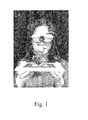
- the camera observes the scene consisting of a person holding up a visual 2D marker.
- the AR system then automatically places on this marker a 3D graphical model virtually in the scene.
- the marker in AR applications is used to determine the perspective at which the camera views the scene.
- perspective we refer to the camera's pose (location and orientation, referred to as “pose”) with respect to the marker as well as the camera lens and resolution properties (such as focal length, principle point, etc., together referred to as “camera intrinsics”) that determine how it scales and forms an image from that pose.
- pose location and orientation
- camera lens and resolution properties such as focal length, principle point, etc., together referred to as “camera intrinsics”
- a field of application of AR with real-word objects is, for example, the following: While manually measuring objects such as furniture would provide very accurate results, it does not always provide the sense of space occupied by an object. The look and sheer size of an object cannot be captured by a few numbers denoting the dimensions alone. Moreover, the problem is further complicated if the object in question is heavy and cannot be moved around easily or, even worse, is still not at hand (for example at a shop). It is with these circumstances in mind that the present invention was developed.
- the objective of the present invention is thus to provide an augmented reality system and a method of augmented reality allowing for measurement, 3D modeling and visualization of real world objects.
- the novel system allows the user to photograph furniture or other objects using their mobile camera and directly measure their sizes from the image alone. Furthermore, once measured, the system allows the user to walk around the object and take more photographs and automatically compute image based textures for the 3D models. Finally, using a marker to determine the user's perspective, the furniture is rendered in real-time in a new position/environment.
- a standard smartphone equipped with a camera is then capable of providing the user with a live view of the world.
- Our invention then allows the user to enjoy a live walk about the modeled objects, e.g. furniture, in real-time.
- the invention provides a simple way to use minimal geometric shapes as primitives to model real-world objects together with IBR (image based rendering) techniques to determine accurate textures of real-world objects for purposes of augmented reality and other applications.
- IBR image based rendering
- the approach according to the invention directly computes the colour textures for the object and creates a virtual model with texture for AR applications.
- the method according to the invention allows anyone to build a textured 3D model of an object.
- the method enables the user to measure precisely the furniture or object in question as well as to collect samples of images as textures which are automatically extracted.
- the user can share this model and textures with anyone either via the web or directly via messaging or other means of sharing.
- the AR system according to the invention allows the user to measure an object reliably (within acceptable margins of error) and capture images from which a texture mapped 3D model is computed as well as to use the textured models to virtually place and manipulate the object in a new location.
- an object reliably (within acceptable margins of error) and capture images from which a texture mapped 3D model is computed as well as to use the textured models to virtually place and manipulate the object in a new location.
- the object can be viewed in real-time in another location.
- the method described in this document contains the following components that together enable the easy creation of 3D models and "Image based Textures" of real world objects as shown by way of example in Fig. 2 .
- the method enables any user (without specialized training or skills) to be able to interactively measure accurately any 3D object. Furthermore, the method completely automatically computes a real Image based Texture model from a few images of the object.
- the user can then easily share these with anyone using multiple possibilities.
- the method allows the user to share models just like one shares images.
- Other users can then visualize the 3D object virtually with the same real image textures in remote locations virtually.
- the remote users simply download the models and then can see the object, e.g. the furniture, in a different environment, e.g. their own homes, from any perspective (viewing angle etc.) in real-time.
- 3D models and IBR textures enable many applications including e-commerce of objects over the internet.
- the technology does not only apply for corporations (big or small), but also to individually trading objects online. Instead of simply having images of the object (furniture) being sold, one can now also include these 3D models and textures.
- the remote buyer can then download the models to his/her mobile device or computer and then visualize the object in their own home or office or other environment.
- the marker is used to determine the scale and pose of the camera with respect to the piece of furniture (cupboard, chair, table etc.) being measured.
- the measurement itself is carried out semi-interactively by the user visually changing the size of a virtual bounding box in the viewfinder of his device so as to enclose the furniture as shown by way of example in Fig. 3 .
- the user not only determines the exact dimensions of the object, but also provides a primitive 3D model of the object.
- the user can automatically acquire multiple views of the object for which the camera's pose is determined using the marker, which together with the 3D bounding box provides ample information to compute a visual model for the object. From the multiple images and the 3D model, both view independent (for Lambertian objects) as well as view dependant representations can be determined, that can be used for real-time rendering of the same object, e.g. piece of furniture, in another scene virtually.
- the user can later virtually place this object in any other real scene (augment a remote scene) so as to visualize not only its size there but also its appearance and how it blends with the other objects in that scene.
- the camera's pose (rotation R and translation t) with respect to the scene need to be determine.
- the scale of objects in the image needs to be determined; perspective images have no notion of depth and scale such that from an image alone it is in fact impossible to make Euclidean measurements without some knowledge of scale and geometry. Therefore, the standard approach of 2D markers similar to [4] is employed.
- calibration is done automatically using a few images of the marker (see [8]).
- the markers not only provide a scale of objects in the scene, but also allow determining the camera pose.
- the bounding box already provides a good yet primitive 3D model of the object being measured. While being able to compute the size of an object is interesting, it alone does not convey the full extent of how that object would feel in another environment. In order to get a better and more complete sense of the space occupied by the object, it is necessary to be able to capture the object and place it virtually in another location. The user should be able to virtually walk around it and "feel" its presence. This is only possible if the virtual placed furniture not only has the size of the original object but also the appearance.
- the key step to the augmented reality application for real-world objects is the ability to virtually place, move and manipulate an object in an environment. To do so, again the marker to determine the camera's pose is employed. Then, a realistic view of the furniture in true size depending on the position of the user is rendered.
- the user is enabled to move (translate on the ground) the object and rotate it about its axis.
- the interaction metaphors are in line with those used in visual metrology.
- Image based rendering is employed to compute textures for the object model.
- the user is then capable of capturing multiple still-shots of the furniture.
- the system automatically processes it to extract relevant texture information.
- the marker already in place one can acquire multiple images from different positions so as to "image" the various sides of the furniture.
- the bounding box represents the object rendered in real-time exactly where the object lies in the scene.
- the bounding box also relatively is shown to match the position and size of the object. The user then simply clicks to take snapshots of the object from different positions to reveal the different sides/faces of the object.
- the user can thus take as many snapshots of the object from different positions as he or she wishes.
- we automatically extract the textures for the visible faces of the object from the current image. These current face textures are used together with past face textures previously extracted to compute a final texture of every face.
- the method automatically extracts textures from this image for the visible faces of the object. Each extracted face texture is then used together with previously extracted face textures to compute a final texture representation as will be described below.
- the system For every image taken by the user, the system first determines the marker and the pose of the camera relative to it and the user defined bounding-box (in 3D). Using this information, it is determined which of the 6 faces of the bounding box are actually visible in the camera's view. Next, the image projection of the 8 vertices of the wire-frame box in the view of the camera is computed. In doing so, essentially the regions within the image corresponding to every face (side) of the bounding box are determined.
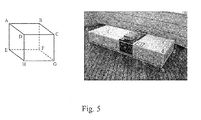
- our goal is to create a 3D texture model of an object, for example the furniture from Fig. 5 , based on textures that are extracted from images taken by the user of the real-world object.
- the 3D model of the box is represented by its 3D vertices A, B, C , D, E, F G , H.
- the corresponding 2D image coordinates in the captured image are ( a, b, c , d, e, f, g , h ).
- the visible faces of the white couch include faces defined by the vertices ABCD, ADHE and DCGH in the image.
- the faces ABFE, BCGF and EFGH are not visible to the user in the given image.
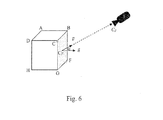
- Visibility of a face can be tested for using the camera position (given by the vector v ) and the corresponding surface normal n of a face as shown below by way of example in Fig. 6 .
- the surface normals of the object's faces and the camera position are defined simply in terms of the face's corner vertices.
- n is obtained from the cross product of two adjacent edges of the face.
- Texture extraction is only performed on faces that are visible. Thus, at any given instance (image), at most 3 textures are extracted, corresponding to any 3 visible faces.
- every pixel Q i in texture ABCD should map to a pixel within the quadrilateral abcd .
- the homography is calculated finding the linear solution of the equation above using the following constrains relating the four 2D corners of the face and the four corners of the output texture with width W and height H as:
- the homography is obtained, it is used to find and map every pixel in the texture, the corresponding pixel in the source image.
- the homography relates a point in a first plane to its corresponding position in a second under perspective projection.
- the computed 3D box model along with the computed rotation and translation matrices and the camera intrinsic K are used to predict the corners of the box in the image.
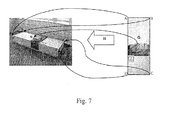
- the texture is defined as a rectangular image of redefined size as shown by way of example in Fig. 7 .
- the homography relates these two rectangular faces as given by: q i ⁇ H * Q i
- This value represents the quality of the texture: the higher the weight, the better the texture estimated.
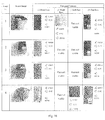
- Fig. 10 shows an example of how textures are extracted from the source subsequent images captured by the user. In the following, it is shown how these various textures can be merged together successfully to compute one final texture per face of the object efficiently.
- Faces from which no information is available remain with a default texture or colour (e.g. transparency, black or chessboard). Furthermore, we allow the object to be symmetric; thus the left side face can be denoted to be similar to the right, thereby unifying the textures.
- a default texture or colour e.g. transparency, black or chessboard.
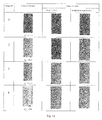
- the method always stores only the best extracted face texture from any one image. It does not merge multiple textures into one. For every image acquired, one computes the visible faces and first determines their weights. Then, at every point only the best texture and the corresponding weight is saved. "Best" is defined in terms of the computed weight. We replace face textures with a new texture only if the new texture has a higher weight. In other words, if the currently extracted face weight is better than what was previously computed, one replaces the previous texture with that extracted from the current image:
- the method combines the pixel values of all extracted textures of a face, giving priority to those textures with higher weights.
- N the number images acquired by the user.
- p i the value of the pixel in the i 'th image (extracted texture) taken by the user with corresponding weight w i
- N the number images captured by the user. Notice that N is the number of extracted textures for a certain face and not the total number of source images. For cases where the face is not visible, the corresponding weight is zero and the image is ignored.
- Fig. 11 shows by way of example how both heuristics work for the same set of extracted textures. Face 2 of Fig. 10 is used as an example.
- the embodiment as described as follows is even more generic and allows for greater flexibility in measuring objects even when the camera is uncalibrated.
- the marker is used the same way as described before and a single image is employed to compute both the size of the object and as a side effect the appropriate calibration matrix K of the used camera.
- One aspect of the invention relates to a method for generating a 3D model representation of a real-world object, comprising the steps of:
- the marker is a 2D marker, the layout and the real dimensions of the 2D marker being stored in a storing means, wherein the layout comprises: a polygon of pre-defined dimensions, preferably a rectangle or square, for example having a length of 16 cm and a width of 16 cm; a pre-defined identification pattern, for example three dots or squares arranged at the corners of an imaginary triangle, the identification pattern being arranged inside the polygon; wherein preferably the polygon and the identification pattern are printed or painted on a sheet of paper.
- the method comprises the further steps of:
- the method comprises the further steps of:
- At least four, preferably five, corner points of the virtual bounding box are selectable; and the method comprises the further step of:
- the method comprises the further step of:
- first plane being defined as the plane wherein the 2D marker is located and a second plane being defined as an arbitrary plane parallel to and different from the first plane:
- step (8d) the joint estimation of the height of the sector and the intrinsic matrix K is performed using the step:
- the estimation of the intrinsic matrix K in step (8d) relies on two assumptions:
- step (9a) of performing a line-search comprises the steps of:
- the method comprises the further steps of:
- step (12b) of analysing each of the snapshot(s) and extracting information from it comprises the steps of:
- step (13b) of computing textures comprises the following steps, wherein each of the following steps is to be applied to each of the faces of the selected sector:
- step (1d) of creating a 3D model representation of the real-world object comprises the step of:
- step (15a) is performed by taking only the best available texture of the textures obtained from one or more snapshot(s) taken in step (12a).
- step (15a) is performed by evaluating the weighted sum of each textures available from the snapshot(s), wherein preferably, for each of the faces and each of the snapshot(s), the weights are given by the dot product or scalar product of unit vector v pointing from the mean value of the vertices or the geometrical center of gravity of the face to the position of the camera and the normal unit vector n of the face.
- the user is enabled to store the 3D model representation or share the 3D model representation, for example online using one of various modalities such as e-mail, MMS, online-portals, etc.
- Another aspect of the invention relates to a method for visualising an object in a displayed scene, the method comprising the steps of:
- One embodiment of the invention relates to a method for visualising an object in a displayed scene, wherein the scene displayed in step (19a) is static, for example a pre-captured photograph.
- a further embodiment of the invention relates to a method for visualising an object in a displayed scene, wherein:
- a preferred embodiment of the invention relates to a method for visualising an object in a displayed scene, wherein a marker, for example a 2D marker, is embedded in the real scene, the method comprising the further steps of:
- the user is enabled to manipulate, for example, to translate and/or to rotate, the visualised object within the displayed scene.
- a further aspect of the invention relates to a method for virtually augmenting a scene with a real-world object, comprising the steps of:
- the size of the object can be defined in terms of its bounding box in 3D as shown in Fig. 12 .
- the user has to indicate from a single image the visual extents of the bounding box in order to compute the object's size.
- the user places the marker on or next to the object so that it is aligned with the edges of the object.
- aligning the marker with the edges is an intuitive subconscious act.
- discarding the rotation interaction reduces the number of interactions needed and therefore reduces complexity to the measuring task.
- the user first takes a snapshot image that allows for defining the bounding box. Thus, the three extents of the object that define its length, width and height should be visible.
- the system then processes the image to detect the presence of the marker as well as establishes point correspondences between the marker and its image. These correspondences define a homography H between the plane of the marker and the image.
- t ) is then derived (see [7] chapter 5). Having the camera pose and camera intrinsics makes it possible to render 3D objects in the world from the perspective of the user.
- the system then displays a control-cube of known size on the marker along with a control-pane allowing the user to select specific faces of the box to move and extrude the box thereby moving and resizing it.
- the user can select one face at a time, and swipe left or right to extrude that face of the box inwards (making the box smaller) or outwards (making it bigger). These operations allow the user to resize as well as translate the box in the plane of the marker.
- the system provides real-time feedback to the user by augmenting the acquired image with the correct perspective view of the manipulated control-cube.
- This perspective feedback is sufficient to reliably align the cubes edges with the bounding edges of the furniture.
- the size of the extruded control-cube then is exactly the size of the furniture.
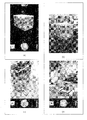
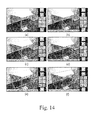
- results of using the model manipulation with feedback on small android based smartphone will be presented.
- the user points the smartphone camera at the table with the marker placed below it, aligned with its front edge.
- the system detects the marker and computes the pose of the camera (user's perspective) with respect to the marker on the floor, and accordingly augments the view with a virtual control-cube.
- the control-pane allows the user to select various faces of the control-cube.
- the user first aligns the rear-face of the cube with the back of the table (b).
- the user extrudes out and in as required the various faces to visually determine the bounding box in the real world.
- Fig. 15 shows the object to measure ( l ⁇ h ⁇ b ) 138 ⁇ 73 ⁇ 59 cm 3 .
- the table's true dimensions are ( l ⁇ h ⁇ b ) 140 ⁇ 72 ⁇ 60 cm 3 .
- the experiments revealed measurements to be within a couple of centimeters of their true sizes.
- model manipulation approach as described above was suitable for small screens but required considerable number of interaction steps to align the control-cube with the extent of the object. Typically the user would need to iterate over the faces by adjusting and readjusting the faces (depending on the perspective) to eventually obtain the 3D size of the object.
- the user again takes a snap-shot of the object with the marker.
- the camera intrinsic matrix K is used together with the marker based homography H , to estimate the pose of the camera with regard to the marker. These parameters are then used to virtually place the control-cube upon the marker as before.
- the corners indicated by the user provide a correspondence between the control-cube corners and those of the object.
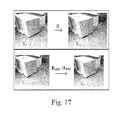
- the problem of determining the size of the object is then posed as that of determining the parameters needed to reshape the control-cube and move it in 3D so that resulting (resized) corners of the cube align with the image points indicated by the user.
- the reshaping comprises two transformations: scaling and then rotation and translation.
- the next step is to appropriately rotate and translate the resized cube (see Fig. 17 (bottom)) so as to match the furniture's real 3D location. Only then will the reshaped cube corners align with the points provided by the user.
- M m 11 m 12 0 m 14 m 21 m 22 0 m 24 0 0 m 32 0 0 0 0 1
- K is the intrinsic camera matrix
- R C and t C denote the pose.
- P K ⁇ R c
- the system can take advantage of larger screen devices by providing a more intuitive user interaction to obtain the box measurements and position.
- the idea is to obtain the box 3D coordinates in the world using only the information of the 2D markers.
- the system is also capable of automatically extracting textures from the object's images. The textures are then used for image based rendering of furniture virtually placed in the scene.
- the homography is calculated knowing that the four vertices of the textures correspond to the four vertices of the face in the source image.
Landscapes
- Engineering & Computer Science (AREA)
- Physics & Mathematics (AREA)
- Theoretical Computer Science (AREA)
- Computer Graphics (AREA)
- General Physics & Mathematics (AREA)
- Geometry (AREA)
- Software Systems (AREA)
- Computing Systems (AREA)
- Computer Hardware Design (AREA)
- General Engineering & Computer Science (AREA)
- Processing Or Creating Images (AREA)
Priority Applications (1)
| Application Number | Priority Date | Filing Date | Title |
|---|---|---|---|
| EP12175950.0A EP2546806B1 (fr) | 2011-07-11 | 2012-07-11 | Rendu à base d'image pour ar - permettant à l'utilisateur la génération d'un contenu en 3d |
Applications Claiming Priority (2)
| Application Number | Priority Date | Filing Date | Title |
|---|---|---|---|
| EP11173488 | 2011-07-11 | ||
| EP12175950.0A EP2546806B1 (fr) | 2011-07-11 | 2012-07-11 | Rendu à base d'image pour ar - permettant à l'utilisateur la génération d'un contenu en 3d |
Publications (3)
| Publication Number | Publication Date |
|---|---|
| EP2546806A2 true EP2546806A2 (fr) | 2013-01-16 |
| EP2546806A3 EP2546806A3 (fr) | 2017-06-28 |
| EP2546806B1 EP2546806B1 (fr) | 2019-05-08 |
Family
ID=46458385
Family Applications (1)
| Application Number | Title | Priority Date | Filing Date |
|---|---|---|---|
| EP12175950.0A Active EP2546806B1 (fr) | 2011-07-11 | 2012-07-11 | Rendu à base d'image pour ar - permettant à l'utilisateur la génération d'un contenu en 3d |
Country Status (1)
| Country | Link |
|---|---|
| EP (1) | EP2546806B1 (fr) |
Cited By (19)
| Publication number | Priority date | Publication date | Assignee | Title |
|---|---|---|---|---|
| WO2014182545A1 (fr) * | 2013-05-04 | 2014-11-13 | Vupad Partners, Llc | Mise à l'échelle d'un objet virtuel dans un environnement de réalité augmentée |
| WO2016109121A1 (fr) * | 2014-12-30 | 2016-07-07 | Microsoft Technology Licensing, Llc | Représentations virtuelles d'objets du monde réel |
| JP2016197342A (ja) * | 2015-04-03 | 2016-11-24 | 株式会社サイバーウォーカー | 拡張現実プログラム、拡張現実提供方法、拡張現実提供装置、及び情報配信方法 |
| WO2017134886A1 (fr) * | 2016-02-02 | 2017-08-10 | ソニー株式会社 | Dispositif de traitement d'informations, procédé de traitement d'informations et support d'enregistrement |
| EP3220098A1 (fr) * | 2016-03-16 | 2017-09-20 | Fujitsu Limited | Mesure dimensionelle dans la realite virtuelle |
| EP3246880A1 (fr) * | 2016-05-20 | 2017-11-22 | Thomson Licensing | Procédé et dispositif de rendu d'image d'une scène comprenant un objet réel et réplique virtuelle de l'objet réel |
| CN109345614A (zh) * | 2018-09-20 | 2019-02-15 | 山东师范大学 | 基于深度强化学习的ar增强现实大屏互动的动画仿真方法 |
| CN109949400A (zh) * | 2019-03-22 | 2019-06-28 | 南京可居网络科技有限公司 | 适于ar虚拟软装合成的光影估计和重构方法 |
| US10339721B1 (en) | 2018-01-24 | 2019-07-02 | Apple Inc. | Devices, methods, and graphical user interfaces for system-wide behavior for 3D models |
| CN109960872A (zh) * | 2019-03-22 | 2019-07-02 | 南京可居网络科技有限公司 | Ar虚拟软装搭配管理系统及其工作方法 |
| CN110647301A (zh) * | 2018-06-27 | 2020-01-03 | 光宝电子(广州)有限公司 | 增强现实系统及其影像显示方法 |
| EP3706076A1 (fr) * | 2019-03-07 | 2020-09-09 | Siemens Healthcare GmbH | Procédé et dispositif pour déterminer les dimensions et la distance d'un certain nombre d'objets dans un environnement |
| CN113538452A (zh) * | 2021-05-27 | 2021-10-22 | 华中科技大学 | 家具布局及三维可视化方法、装置和设备 |
| US11163417B2 (en) | 2017-08-31 | 2021-11-02 | Apple Inc. | Systems, methods, and graphical user interfaces for interacting with augmented and virtual reality environments |
| JP2021177162A (ja) * | 2020-05-08 | 2021-11-11 | アイタックソリューションズ株式会社 | 測定装置、測定プログラム及び測定方法 |
| JP2021177161A (ja) * | 2020-05-08 | 2021-11-11 | アイタックソリューションズ株式会社 | 測定装置、測定プログラム及び測定方法 |
| JP2021177147A (ja) * | 2020-05-08 | 2021-11-11 | アイタックソリューションズ株式会社 | 測定装置、測定プログラム及び測定方法 |
| CN115191006A (zh) * | 2020-02-28 | 2022-10-14 | 奇跃公司 | 用于所显示的2d元素的3d模型 |
| US11551369B2 (en) * | 2018-09-25 | 2023-01-10 | Ebay Inc. | Augmented reality digital content search and sizing techniques |
Families Citing this family (1)
| Publication number | Priority date | Publication date | Assignee | Title |
|---|---|---|---|---|
| US12169902B2 (en) | 2021-09-21 | 2024-12-17 | Apple Inc. | Methods and systems for composing and executing a scene |
Family Cites Families (2)
| Publication number | Priority date | Publication date | Assignee | Title |
|---|---|---|---|---|
| JP2004537082A (ja) * | 2001-01-26 | 2004-12-09 | ザクセル システムズ インコーポレイテッド | 仮想現実環境における実時間バーチャル・ビューポイント |
| US7391424B2 (en) * | 2003-08-15 | 2008-06-24 | Werner Gerhard Lonsing | Method and apparatus for producing composite images which contain virtual objects |
-
2012
- 2012-07-11 EP EP12175950.0A patent/EP2546806B1/fr active Active
Non-Patent Citations (8)
| Title |
|---|
| CHANG, Y.-N.; KOH, R.K.C.; BEEN-LIM DUH; H. HANDHELD: "AR games - A triarchic conceptual design framework", IEEE INTERNATIONAL SYMPOSIUM ON MIXED AND AUGMENTED REALITY - ARTS, MEDIA, AND HUMANITIES, IEEE, 2011, pages 29 - 36, XP032028779, DOI: doi:10.1109/ISMAR-AMH.2011.6093653 |
| DE SA, M.; CHURCHILL, E.F.; ISBISTER, K.: "Mobile augmented reality. Proceedings of the 13th International Conference on Human Computer Interaction with Mobile Devices and Services - MobileHCI '11", 2011, ACM PRESS, pages: 749 |
| FEINER, S.; MACLNTYRE, B.; HOLLERER, T.; WEBSTER, A.: "A Touring Machine: Prototyping 3D Mobile Augmented Reality Systems for Exploring the Urban Environment", 97 PROCEEDINGS OF THE 1ST IEEE INTERNATIONAL SYMPOSIUM ON WEARABLE COMPUTERS, 1997 |
| KATO, H.; BILLINGHURST, M.: "Proceedings 2nd IEEE and ACM International Workshop on Augmented Reality (IWAR'99", IEEE COMPUT. SOC, article "Marker tracking and HMD calibration for a video- based augmented reality conferencing system", pages: 85 - 94 |
| KATO, H.; BILLINGHURST, M.; POUPYREV, I.; IMAMOTO, K.; TACHIBANA, K.: "Virtual object manipulation on a table-top AR environment", PROCEEDINGS IEEE AND ACM INTERNATIONAL SYMPOSIUM ON AUGMENTED REALITY (ISAR 2000), IEEE, 2000, pages 111 - 119, XP055336195, DOI: doi:10.1109/ISAR.2000.880934 |
| OLSSON, T.; SALO, M.: "Online user survey on current mobile augmented reality applications", 2011 10TH IEEE INTERNATIONAL SYMPOSIUM ON MIXED AND AUGMENTED REALITY, IEEE, 2011, pages 75 - 84 |
| YI MA; STEFANO SOATTO; JANA KOSECKA, S.S.S.: "An Invitation to 3-D Vision", 2004, SPRINGER |
| ZHENGYOU ZHANG: "Flexible camera calibration by viewing a plane from unknown orientations", PROCEEDINGS OF THE SEVENTH IEEE INTERNATIONAL CONFERENCE ON COMPUTER VISION, IEEE, vol. 1, 1999, pages 666 - 673, XP010350391 |
Cited By (46)
| Publication number | Priority date | Publication date | Assignee | Title |
|---|---|---|---|---|
| WO2014182545A1 (fr) * | 2013-05-04 | 2014-11-13 | Vupad Partners, Llc | Mise à l'échelle d'un objet virtuel dans un environnement de réalité augmentée |
| US9728010B2 (en) | 2014-12-30 | 2017-08-08 | Microsoft Technology Licensing, Llc | Virtual representations of real-world objects |
| CN107111370B (zh) * | 2014-12-30 | 2020-06-19 | 微软技术许可有限责任公司 | 现实世界对象的虚拟表示 |
| CN107111370A (zh) * | 2014-12-30 | 2017-08-29 | 微软技术许可有限责任公司 | 现实世界对象的虚拟表示 |
| KR20170100641A (ko) * | 2014-12-30 | 2017-09-04 | 마이크로소프트 테크놀로지 라이센싱, 엘엘씨 | 실세계 객체들의 가상 표현들 |
| WO2016109121A1 (fr) * | 2014-12-30 | 2016-07-07 | Microsoft Technology Licensing, Llc | Représentations virtuelles d'objets du monde réel |
| JP2016197342A (ja) * | 2015-04-03 | 2016-11-24 | 株式会社サイバーウォーカー | 拡張現実プログラム、拡張現実提供方法、拡張現実提供装置、及び情報配信方法 |
| WO2017134886A1 (fr) * | 2016-02-02 | 2017-08-10 | ソニー株式会社 | Dispositif de traitement d'informations, procédé de traitement d'informations et support d'enregistrement |
| JP2022000640A (ja) * | 2016-02-02 | 2022-01-04 | ソニーグループ株式会社 | 情報処理装置、情報処理方法、及び情報処理プログラム |
| JP7283506B2 (ja) | 2016-02-02 | 2023-05-30 | ソニーグループ株式会社 | 情報処理装置、情報処理方法、及び情報処理プログラム |
| US10942024B2 (en) | 2016-02-02 | 2021-03-09 | Sony Corporation | Information processing apparatus, information processing method, and recording medium |
| JPWO2017134886A1 (ja) * | 2016-02-02 | 2018-11-22 | ソニー株式会社 | 情報処理装置、情報処理方法、及び記録媒体 |
| US11796309B2 (en) | 2016-02-02 | 2023-10-24 | Sony Corporation | Information processing apparatus, information processing method, and recording medium |
| EP3220098A1 (fr) * | 2016-03-16 | 2017-09-20 | Fujitsu Limited | Mesure dimensionelle dans la realite virtuelle |
| EP3246880A1 (fr) * | 2016-05-20 | 2017-11-22 | Thomson Licensing | Procédé et dispositif de rendu d'image d'une scène comprenant un objet réel et réplique virtuelle de l'objet réel |
| US10055893B2 (en) | 2016-05-20 | 2018-08-21 | Thomson Licensing | Method and device for rendering an image of a scene comprising a real object and a virtual replica of the real object |
| EP3246879A1 (fr) * | 2016-05-20 | 2017-11-22 | Thomson Licensing | Procédé et dispositif pour rendre une image d'une scène comprenant un objet réel et une réplique virtuelle de l'objet réel |
| US11163417B2 (en) | 2017-08-31 | 2021-11-02 | Apple Inc. | Systems, methods, and graphical user interfaces for interacting with augmented and virtual reality environments |
| US12443324B2 (en) | 2017-08-31 | 2025-10-14 | Apple Inc. | Systems, methods, and graphical user interfaces for interacting with augmented and virtual reality environments |
| US11740755B2 (en) | 2017-08-31 | 2023-08-29 | Apple Inc. | Systems, methods, and graphical user interfaces for interacting with augmented and virtual reality environments |
| US12099692B2 (en) | 2018-01-24 | 2024-09-24 | Apple Inc. | Devices, methods, and graphical user interfaces for system-wide behavior for 3D models |
| US10460529B2 (en) | 2018-01-24 | 2019-10-29 | Apple Inc. | Devices, methods, and graphical user interfaces for system-wide behavior for 3D models |
| US10475253B2 (en) | 2018-01-24 | 2019-11-12 | Apple Inc. | Devices, methods, and graphical user interfaces for system-wide behavior for 3D models |
| US10339721B1 (en) | 2018-01-24 | 2019-07-02 | Apple Inc. | Devices, methods, and graphical user interfaces for system-wide behavior for 3D models |
| US11099707B2 (en) | 2018-01-24 | 2021-08-24 | Apple Inc. | Devices, methods, and graphical user interfaces for system-wide behavior for 3D models |
| CN110647301A (zh) * | 2018-06-27 | 2020-01-03 | 光宝电子(广州)有限公司 | 增强现实系统及其影像显示方法 |
| CN110647301B (zh) * | 2018-06-27 | 2023-08-08 | 光宝电子(广州)有限公司 | 增强现实系统及其影像显示方法 |
| CN109345614A (zh) * | 2018-09-20 | 2019-02-15 | 山东师范大学 | 基于深度强化学习的ar增强现实大屏互动的动画仿真方法 |
| CN109345614B (zh) * | 2018-09-20 | 2023-04-07 | 山东师范大学 | 基于深度强化学习的ar增强现实大屏互动的动画仿真方法 |
| US11551369B2 (en) * | 2018-09-25 | 2023-01-10 | Ebay Inc. | Augmented reality digital content search and sizing techniques |
| US11043037B2 (en) | 2019-03-07 | 2021-06-22 | Siemens Healthcare Gmbh | Method and device to determine the dimensions and distance of a number of objects in an environment |
| EP3706076A1 (fr) * | 2019-03-07 | 2020-09-09 | Siemens Healthcare GmbH | Procédé et dispositif pour déterminer les dimensions et la distance d'un certain nombre d'objets dans un environnement |
| CN109960872B (zh) * | 2019-03-22 | 2023-02-03 | 南京可居网络科技有限公司 | Ar虚拟软装搭配管理系统及其工作方法 |
| CN109949400B (zh) * | 2019-03-22 | 2023-02-03 | 南京可居网络科技有限公司 | 适于ar虚拟软装合成的光影估计和重构方法 |
| CN109949400A (zh) * | 2019-03-22 | 2019-06-28 | 南京可居网络科技有限公司 | 适于ar虚拟软装合成的光影估计和重构方法 |
| CN109960872A (zh) * | 2019-03-22 | 2019-07-02 | 南京可居网络科技有限公司 | Ar虚拟软装搭配管理系统及其工作方法 |
| US12026351B2 (en) | 2020-02-28 | 2024-07-02 | Magic Leap, Inc. | 3D models for displayed 2D elements |
| CN115191006A (zh) * | 2020-02-28 | 2022-10-14 | 奇跃公司 | 用于所显示的2d元素的3d模型 |
| JP2023515578A (ja) * | 2020-02-28 | 2023-04-13 | マジック リープ, インコーポレイテッド | 表示される2d要素のための3dモデル |
| US11650709B2 (en) | 2020-02-28 | 2023-05-16 | Magic Leap, Inc. | 3D models for displayed 2D elements |
| CN118379428A (zh) * | 2020-02-28 | 2024-07-23 | 奇跃公司 | 用于所显示的2d元素的3d模型 |
| CN115191006B (zh) * | 2020-02-28 | 2024-05-24 | 奇跃公司 | 用于所显示的2d元素的3d模型 |
| JP2021177147A (ja) * | 2020-05-08 | 2021-11-11 | アイタックソリューションズ株式会社 | 測定装置、測定プログラム及び測定方法 |
| JP2021177162A (ja) * | 2020-05-08 | 2021-11-11 | アイタックソリューションズ株式会社 | 測定装置、測定プログラム及び測定方法 |
| JP2021177161A (ja) * | 2020-05-08 | 2021-11-11 | アイタックソリューションズ株式会社 | 測定装置、測定プログラム及び測定方法 |
| CN113538452A (zh) * | 2021-05-27 | 2021-10-22 | 华中科技大学 | 家具布局及三维可视化方法、装置和设备 |
Also Published As
| Publication number | Publication date |
|---|---|
| EP2546806A3 (fr) | 2017-06-28 |
| EP2546806B1 (fr) | 2019-05-08 |
Similar Documents
| Publication | Publication Date | Title |
|---|---|---|
| EP2546806B1 (fr) | Rendu à base d'image pour ar - permettant à l'utilisateur la génération d'un contenu en 3d | |
| Sinha et al. | Interactive 3D architectural modeling from unordered photo collections | |
| Guillou et al. | Using vanishing points for camera calibration and coarse 3D reconstruction from a single image | |
| US5990900A (en) | Two-dimensional to three-dimensional image converting system | |
| Tian et al. | Handling occlusions in augmented reality based on 3D reconstruction method | |
| US9282321B2 (en) | 3D model multi-reviewer system | |
| Neumann et al. | Augmented virtual environments (ave): Dynamic fusion of imagery and 3d models | |
| US9171405B1 (en) | Identifying and filling holes across multiple aligned three-dimensional scenes | |
| CN104995666B (zh) | 用于在真实环境中表示虚拟信息的方法 | |
| KR100443552B1 (ko) | 가상 현실 구현 시스템 및 방법 | |
| Pulli et al. | Acquisition and visualization of colored 3D objects | |
| CN110926334B (zh) | 测量方法、装置、电子设备及存储介质 | |
| Goesele et al. | Ambient point clouds for view interpolation | |
| KR20130094015A (ko) | 입체 모델 생성 장치 및 방법 | |
| Kolivand et al. | Cultural heritage in marker-less augmented reality: a survey | |
| Brosz et al. | Single camera flexible projection | |
| US9881419B1 (en) | Technique for providing an initial pose for a 3-D model | |
| JP2001067463A (ja) | 異なる視点からの複数のフェイシャル画像に基づき新たな視点からのフェイシャル画像を生成するフェイシャル画像生成装置及び方法並びにその応用装置及び記録媒体 | |
| Deepu et al. | 3D Reconstruction from Single 2D Image | |
| Boulanger et al. | ATIP: A Tool for 3D Navigation inside a Single Image with Automatic Camera Calibration. | |
| Ishikawa et al. | In-situ 3d indoor modeler with a camera and self-contained sensors | |
| US8294814B2 (en) | System for accurately repositioning imaging devices | |
| Al-Zahrani et al. | Applications of a direct algorithm for the rectification of uncalibrated images | |
| Glueck et al. | Multiscale 3D reference visualization | |
| JPH03138784A (ja) | 3次元モデルの再構成方法および表示方法 |
Legal Events
| Date | Code | Title | Description |
|---|---|---|---|
| PUAI | Public reference made under article 153(3) epc to a published international application that has entered the european phase |
Free format text: ORIGINAL CODE: 0009012 |
|
| AK | Designated contracting states |
Kind code of ref document: A2 Designated state(s): AL AT BE BG CH CY CZ DE DK EE ES FI FR GB GR HR HU IE IS IT LI LT LU LV MC MK MT NL NO PL PT RO RS SE SI SK SM TR |
|
| AX | Request for extension of the european patent |
Extension state: BA ME |
|
| PUAL | Search report despatched |
Free format text: ORIGINAL CODE: 0009013 |
|
| AK | Designated contracting states |
Kind code of ref document: A3 Designated state(s): AL AT BE BG CH CY CZ DE DK EE ES FI FR GB GR HR HU IE IS IT LI LT LU LV MC MK MT NL NO PL PT RO RS SE SI SK SM TR |
|
| AX | Request for extension of the european patent |
Extension state: BA ME |
|
| RIC1 | Information provided on ipc code assigned before grant |
Ipc: G06T 17/00 20060101AFI20170522BHEP Ipc: G06T 19/00 20110101ALI20170522BHEP Ipc: G06T 15/20 20110101ALI20170522BHEP |
|
| STAA | Information on the status of an ep patent application or granted ep patent |
Free format text: STATUS: REQUEST FOR EXAMINATION WAS MADE |
|
| 17P | Request for examination filed |
Effective date: 20171206 |
|
| RBV | Designated contracting states (corrected) |
Designated state(s): AL AT BE BG CH CY CZ DE DK EE ES FI FR GB GR HR HU IE IS IT LI LT LU LV MC MK MT NL NO PL PT RO RS SE SI SK SM TR |
|
| RIC1 | Information provided on ipc code assigned before grant |
Ipc: G06T 15/20 20110101ALI20180802BHEP Ipc: G06T 19/00 20110101ALI20180802BHEP Ipc: G06T 17/00 20060101AFI20180802BHEP |
|
| GRAP | Despatch of communication of intention to grant a patent |
Free format text: ORIGINAL CODE: EPIDOSNIGR1 |
|
| STAA | Information on the status of an ep patent application or granted ep patent |
Free format text: STATUS: GRANT OF PATENT IS INTENDED |
|
| INTG | Intention to grant announced |
Effective date: 20180921 |
|
| RIN1 | Information on inventor provided before grant (corrected) |
Inventor name: AGURTO, RENATO Inventor name: SWAMINATHAN, RAHUL Inventor name: WOLF, INGO Inventor name: GROTHE, ANDREAS Inventor name: BURKARD, SIMON |
|
| GRAS | Grant fee paid |
Free format text: ORIGINAL CODE: EPIDOSNIGR3 |
|
| GRAA | (expected) grant |
Free format text: ORIGINAL CODE: 0009210 |
|
| STAA | Information on the status of an ep patent application or granted ep patent |
Free format text: STATUS: THE PATENT HAS BEEN GRANTED |
|
| RAP1 | Party data changed (applicant data changed or rights of an application transferred) |
Owner name: DEUTSCHE TELEKOM AG |
|
| AK | Designated contracting states |
Kind code of ref document: B1 Designated state(s): AL AT BE BG CH CY CZ DE DK EE ES FI FR GB GR HR HU IE IS IT LI LT LU LV MC MK MT NL NO PL PT RO RS SE SI SK SM TR |
|
| REG | Reference to a national code |
Ref country code: GB Ref legal event code: FG4D |
|
| REG | Reference to a national code |
Ref country code: CH Ref legal event code: EP Ref country code: AT Ref legal event code: REF Ref document number: 1131397 Country of ref document: AT Kind code of ref document: T Effective date: 20190515 |
|
| REG | Reference to a national code |
Ref country code: DE Ref legal event code: R096 Ref document number: 602012059784 Country of ref document: DE Ref country code: IE Ref legal event code: FG4D |
|
| REG | Reference to a national code |
Ref country code: NL Ref legal event code: MP Effective date: 20190508 |
|
| REG | Reference to a national code |
Ref country code: LT Ref legal event code: MG4D |
|
| PG25 | Lapsed in a contracting state [announced via postgrant information from national office to epo] |
Ref country code: NO Free format text: LAPSE BECAUSE OF FAILURE TO SUBMIT A TRANSLATION OF THE DESCRIPTION OR TO PAY THE FEE WITHIN THE PRESCRIBED TIME-LIMIT Effective date: 20190808 Ref country code: FI Free format text: LAPSE BECAUSE OF FAILURE TO SUBMIT A TRANSLATION OF THE DESCRIPTION OR TO PAY THE FEE WITHIN THE PRESCRIBED TIME-LIMIT Effective date: 20190508 Ref country code: HR Free format text: LAPSE BECAUSE OF FAILURE TO SUBMIT A TRANSLATION OF THE DESCRIPTION OR TO PAY THE FEE WITHIN THE PRESCRIBED TIME-LIMIT Effective date: 20190508 Ref country code: LT Free format text: LAPSE BECAUSE OF FAILURE TO SUBMIT A TRANSLATION OF THE DESCRIPTION OR TO PAY THE FEE WITHIN THE PRESCRIBED TIME-LIMIT Effective date: 20190508 Ref country code: NL Free format text: LAPSE BECAUSE OF FAILURE TO SUBMIT A TRANSLATION OF THE DESCRIPTION OR TO PAY THE FEE WITHIN THE PRESCRIBED TIME-LIMIT Effective date: 20190508 Ref country code: PT Free format text: LAPSE BECAUSE OF FAILURE TO SUBMIT A TRANSLATION OF THE DESCRIPTION OR TO PAY THE FEE WITHIN THE PRESCRIBED TIME-LIMIT Effective date: 20190908 Ref country code: ES Free format text: LAPSE BECAUSE OF FAILURE TO SUBMIT A TRANSLATION OF THE DESCRIPTION OR TO PAY THE FEE WITHIN THE PRESCRIBED TIME-LIMIT Effective date: 20190508 Ref country code: SE Free format text: LAPSE BECAUSE OF FAILURE TO SUBMIT A TRANSLATION OF THE DESCRIPTION OR TO PAY THE FEE WITHIN THE PRESCRIBED TIME-LIMIT Effective date: 20190508 Ref country code: AL Free format text: LAPSE BECAUSE OF FAILURE TO SUBMIT A TRANSLATION OF THE DESCRIPTION OR TO PAY THE FEE WITHIN THE PRESCRIBED TIME-LIMIT Effective date: 20190508 |
|
| PG25 | Lapsed in a contracting state [announced via postgrant information from national office to epo] |
Ref country code: GR Free format text: LAPSE BECAUSE OF FAILURE TO SUBMIT A TRANSLATION OF THE DESCRIPTION OR TO PAY THE FEE WITHIN THE PRESCRIBED TIME-LIMIT Effective date: 20190809 Ref country code: LV Free format text: LAPSE BECAUSE OF FAILURE TO SUBMIT A TRANSLATION OF THE DESCRIPTION OR TO PAY THE FEE WITHIN THE PRESCRIBED TIME-LIMIT Effective date: 20190508 Ref country code: RS Free format text: LAPSE BECAUSE OF FAILURE TO SUBMIT A TRANSLATION OF THE DESCRIPTION OR TO PAY THE FEE WITHIN THE PRESCRIBED TIME-LIMIT Effective date: 20190508 Ref country code: BG Free format text: LAPSE BECAUSE OF FAILURE TO SUBMIT A TRANSLATION OF THE DESCRIPTION OR TO PAY THE FEE WITHIN THE PRESCRIBED TIME-LIMIT Effective date: 20190808 |
|
| REG | Reference to a national code |
Ref country code: AT Ref legal event code: MK05 Ref document number: 1131397 Country of ref document: AT Kind code of ref document: T Effective date: 20190508 |
|
| PG25 | Lapsed in a contracting state [announced via postgrant information from national office to epo] |
Ref country code: RO Free format text: LAPSE BECAUSE OF FAILURE TO SUBMIT A TRANSLATION OF THE DESCRIPTION OR TO PAY THE FEE WITHIN THE PRESCRIBED TIME-LIMIT Effective date: 20190508 Ref country code: SK Free format text: LAPSE BECAUSE OF FAILURE TO SUBMIT A TRANSLATION OF THE DESCRIPTION OR TO PAY THE FEE WITHIN THE PRESCRIBED TIME-LIMIT Effective date: 20190508 Ref country code: CZ Free format text: LAPSE BECAUSE OF FAILURE TO SUBMIT A TRANSLATION OF THE DESCRIPTION OR TO PAY THE FEE WITHIN THE PRESCRIBED TIME-LIMIT Effective date: 20190508 Ref country code: EE Free format text: LAPSE BECAUSE OF FAILURE TO SUBMIT A TRANSLATION OF THE DESCRIPTION OR TO PAY THE FEE WITHIN THE PRESCRIBED TIME-LIMIT Effective date: 20190508 Ref country code: AT Free format text: LAPSE BECAUSE OF FAILURE TO SUBMIT A TRANSLATION OF THE DESCRIPTION OR TO PAY THE FEE WITHIN THE PRESCRIBED TIME-LIMIT Effective date: 20190508 Ref country code: DK Free format text: LAPSE BECAUSE OF FAILURE TO SUBMIT A TRANSLATION OF THE DESCRIPTION OR TO PAY THE FEE WITHIN THE PRESCRIBED TIME-LIMIT Effective date: 20190508 |
|
| REG | Reference to a national code |
Ref country code: DE Ref legal event code: R097 Ref document number: 602012059784 Country of ref document: DE |
|
| PG25 | Lapsed in a contracting state [announced via postgrant information from national office to epo] |
Ref country code: SM Free format text: LAPSE BECAUSE OF FAILURE TO SUBMIT A TRANSLATION OF THE DESCRIPTION OR TO PAY THE FEE WITHIN THE PRESCRIBED TIME-LIMIT Effective date: 20190508 Ref country code: IT Free format text: LAPSE BECAUSE OF FAILURE TO SUBMIT A TRANSLATION OF THE DESCRIPTION OR TO PAY THE FEE WITHIN THE PRESCRIBED TIME-LIMIT Effective date: 20190508 Ref country code: MC Free format text: LAPSE BECAUSE OF FAILURE TO SUBMIT A TRANSLATION OF THE DESCRIPTION OR TO PAY THE FEE WITHIN THE PRESCRIBED TIME-LIMIT Effective date: 20190508 |
|
| REG | Reference to a national code |
Ref country code: CH Ref legal event code: PL |
|
| PLBE | No opposition filed within time limit |
Free format text: ORIGINAL CODE: 0009261 |
|
| STAA | Information on the status of an ep patent application or granted ep patent |
Free format text: STATUS: NO OPPOSITION FILED WITHIN TIME LIMIT |
|
| PG25 | Lapsed in a contracting state [announced via postgrant information from national office to epo] |
Ref country code: TR Free format text: LAPSE BECAUSE OF FAILURE TO SUBMIT A TRANSLATION OF THE DESCRIPTION OR TO PAY THE FEE WITHIN THE PRESCRIBED TIME-LIMIT Effective date: 20190508 |
|
| 26N | No opposition filed |
Effective date: 20200211 |
|
| REG | Reference to a national code |
Ref country code: BE Ref legal event code: MM Effective date: 20190731 |
|
| PG25 | Lapsed in a contracting state [announced via postgrant information from national office to epo] |
Ref country code: PL Free format text: LAPSE BECAUSE OF FAILURE TO SUBMIT A TRANSLATION OF THE DESCRIPTION OR TO PAY THE FEE WITHIN THE PRESCRIBED TIME-LIMIT Effective date: 20190508 |
|
| PG25 | Lapsed in a contracting state [announced via postgrant information from national office to epo] |
Ref country code: CH Free format text: LAPSE BECAUSE OF NON-PAYMENT OF DUE FEES Effective date: 20190731 Ref country code: BE Free format text: LAPSE BECAUSE OF NON-PAYMENT OF DUE FEES Effective date: 20190731 Ref country code: LI Free format text: LAPSE BECAUSE OF NON-PAYMENT OF DUE FEES Effective date: 20190731 Ref country code: LU Free format text: LAPSE BECAUSE OF NON-PAYMENT OF DUE FEES Effective date: 20190711 Ref country code: SI Free format text: LAPSE BECAUSE OF FAILURE TO SUBMIT A TRANSLATION OF THE DESCRIPTION OR TO PAY THE FEE WITHIN THE PRESCRIBED TIME-LIMIT Effective date: 20190508 |
|
| PG25 | Lapsed in a contracting state [announced via postgrant information from national office to epo] |
Ref country code: IE Free format text: LAPSE BECAUSE OF NON-PAYMENT OF DUE FEES Effective date: 20190711 |
|
| PG25 | Lapsed in a contracting state [announced via postgrant information from national office to epo] |
Ref country code: CY Free format text: LAPSE BECAUSE OF FAILURE TO SUBMIT A TRANSLATION OF THE DESCRIPTION OR TO PAY THE FEE WITHIN THE PRESCRIBED TIME-LIMIT Effective date: 20190508 |
|
| PG25 | Lapsed in a contracting state [announced via postgrant information from national office to epo] |
Ref country code: IS Free format text: LAPSE BECAUSE OF FAILURE TO SUBMIT A TRANSLATION OF THE DESCRIPTION OR TO PAY THE FEE WITHIN THE PRESCRIBED TIME-LIMIT Effective date: 20190908 |
|
| PG25 | Lapsed in a contracting state [announced via postgrant information from national office to epo] |
Ref country code: HU Free format text: LAPSE BECAUSE OF FAILURE TO SUBMIT A TRANSLATION OF THE DESCRIPTION OR TO PAY THE FEE WITHIN THE PRESCRIBED TIME-LIMIT; INVALID AB INITIO Effective date: 20120711 Ref country code: MT Free format text: LAPSE BECAUSE OF FAILURE TO SUBMIT A TRANSLATION OF THE DESCRIPTION OR TO PAY THE FEE WITHIN THE PRESCRIBED TIME-LIMIT Effective date: 20190508 |
|
| PG25 | Lapsed in a contracting state [announced via postgrant information from national office to epo] |
Ref country code: MK Free format text: LAPSE BECAUSE OF FAILURE TO SUBMIT A TRANSLATION OF THE DESCRIPTION OR TO PAY THE FEE WITHIN THE PRESCRIBED TIME-LIMIT Effective date: 20190508 |
|
| PGFP | Annual fee paid to national office [announced via postgrant information from national office to epo] |
Ref country code: DE Payment date: 20250722 Year of fee payment: 14 |
|
| PGFP | Annual fee paid to national office [announced via postgrant information from national office to epo] |
Ref country code: GB Payment date: 20250724 Year of fee payment: 14 |
|
| PGFP | Annual fee paid to national office [announced via postgrant information from national office to epo] |
Ref country code: FR Payment date: 20250723 Year of fee payment: 14 |