EP2547152A1 - Système de communication mobile, procédé de sélection de cellule, appareil formant station de base et appareil formant station mobile - Google Patents
Système de communication mobile, procédé de sélection de cellule, appareil formant station de base et appareil formant station mobile Download PDFInfo
- Publication number
- EP2547152A1 EP2547152A1 EP10847437A EP10847437A EP2547152A1 EP 2547152 A1 EP2547152 A1 EP 2547152A1 EP 10847437 A EP10847437 A EP 10847437A EP 10847437 A EP10847437 A EP 10847437A EP 2547152 A1 EP2547152 A1 EP 2547152A1
- Authority
- EP
- European Patent Office
- Prior art keywords
- cell
- plural
- mobile station
- cells
- base stations
- Prior art date
- Legal status (The legal status is an assumption and is not a legal conclusion. Google has not performed a legal analysis and makes no representation as to the accuracy of the status listed.)
- Withdrawn
Links
Images





Classifications
-
- H—ELECTRICITY
- H04—ELECTRIC COMMUNICATION TECHNIQUE
- H04W—WIRELESS COMMUNICATION NETWORKS
- H04W48/00—Access restriction; Network selection; Access point selection
- H04W48/20—Selecting an access point
-
- H—ELECTRICITY
- H04—ELECTRIC COMMUNICATION TECHNIQUE
- H04W—WIRELESS COMMUNICATION NETWORKS
- H04W48/00—Access restriction; Network selection; Access point selection
- H04W48/16—Discovering, processing access restriction or access information
Definitions
- the present invention relates to a mobile communication system, a cell selection method, a base station apparatus, and a mobile station apparatus.
- a cellular method is generally used in which a base station covers a large area formed by combining plural areas where the base station may transmit and receive (i.e., cells), and a mobile station changes (switches) from a base station to another base station with the movement of the mobile station.
- a mobile station performs a cell selection and a cell reselection based on a received level or a communication quality while waiting (in a standby state).
- a cell when a cell is included in (regarded as) a re-selection target (a cell to be re-selected), the cell using a frequency band (Inter-frequency) which is different from another frequency band (Intra-frequency) used in the standby state, a different selection criterion may be used.
- priority levels may be set (assigned) to the respective frequency bands. Then, a mobile station first performs a cell search within a frequency band having a higher priority level. Then, the mobile station selects a cell having the received level satisfying a predetermined value and the highest receiving level, the cell being formed by a base station, as a new standby cell. In this case, when no cell satisfying the predetermined value is found, the cell search is performed within a frequency band having the next highest priority level. When no cell satisfying the predetermined value is found in all the frequency bands, it is determined that the mobiles station is in an out-of-service area.
- the cell in a case where there is a cell providing a higher received level but practically has a lower priority level, if there is a cell having the received level satisfying the predetermined value within a frequency band having a higher priority level, the cell may be selected. As a result, the mobile station may not always select an appropriate cell.
- a cell reselection process may be as follows:
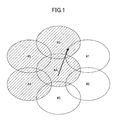
- FIGS. 1 and 2 illustrate cases of a cell reselection method in related art.
- a mobile station is located within a cell #A.
- the cells #0 through #5 are neighboring cells of the cell #A.
- the cells #A, #4, #5, and #0 hatched in the figures use a frequency band F1
- the cells #1, #2, and #3 without hatching use a frequency band F2.
- the priority level of the frequency band F2 is higher than that of the frequency band F1.
- the mobile station moves in the arrow direction from the cell #A and exits from the cell #A, the received level of the cell #A is reduced. Accordingly, the mobile station performs a cell search process to select a new standby cell. To that end, the mobile station first searches the cells #1, #2, and #3 of the frequency band F2 having a higher priority level. Among the cells, the cell #1 is located nearest to the moving direction (path) of the mobile station. As a result, the received level of the cell #1 becomes the highest.
- the received level of the cell #1 satisfies a predetermined level
- the cell #1 is selected as the new standby cell.
- the cell that may have the highest received level for the mobile station is the cell #0. Therefore, it is the cell #0 that is to be selected as the new standby cell.
- the priority level of the frequency band F1 is higher than that of the frequency band F2.
- the mobile station moves in the arrow direction from the cell #A and exits from the cell #A, the received level of the cell #A is reduced. Accordingly, the mobile station performs the cell search process to select a new standby cell. To that end, the mobile station first searches the cells #4, #5, and #0 of the frequency band F1 having a higher priority level. Among the cells, the cell #0 is located nearest to the moving direction (path) of the mobile station. As a result, the received level of the cell #0 becomes the highest.
- the received level of the cell #0 satisfies the predetermined level
- the cell #0 is selected as the new standby cell.
- the cell that may have the highest received level for the mobile station is the cell #1. Therefore, it is the cell #1 that is to be selected as the new standby cell.
- a cell which is not appropriate may be selected by the mobile station.
- the introduction of the spectrum aggregation is being considered. If the spectrum aggregation is introduced, the mobile station may have to perform the cell selection process based on plural frequency bands whenever the mobile station moves from one cell to another. As a result, an inappropriate cell may be more likely to be selected.
- the present invention is made in light of the above circumstances, and may provide a mobile communication system that may select an appropriate cell as a standby cell.
- a mobile communication system includes plural base stations forming cells and a mobile station being disposed in one of the cells and wirelessly communicating with one of the plural base stations.
- One of the plural base stations includes a cell group information broadcast unit broadcasting plural cell group information items which are information indicating a relationship between moving directions and cell groups.
- the mobile station includes a cell group information selection unit, when receiving quality is reduced in a standby operation, selecting a cell group information item corresponding to an estimated moving direction of the mobile station out of the plural cell group information items broadcast by the one of the plural base station, and a standby cell selection unit selecting, as a new standby cell, a cell having a receiving state satisfying a desired condition from among cells included in the selected cell group information item.
- a mobile station estimates the moving direction of the mobile station based on a move history of the mobile station or the like. Further, the mobile station selects a cell group to be searched based on information indicating a relationship between the moving direction reported from the base station and cell groups. Then, the mobile station selects a cell as a new standby cell from among the cells included in the selected cell group based on a received state such as a receiving level or a receiving quality.
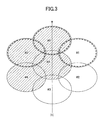
- FIG. 3 illustrates an example cell selection method according to a first embodiment.
- the cells are described as ellipses, the cell numbers are described as alphanumeric characters in the ellipses.
- the mobile station is located in the cell #A, and the cells #0 through #5 are neighboring cells of the cell #A.
- the cells #A, #4, #5, and #0 are hatched in the figure and use a frequency band F1, and the cells #1, #2, and #3 without hatching use a frequency band F2.
- the cells periodically report a cell group information for each of the moving directions of the mobile station.
- the cell group information includes plural cell groups with respect to the moving directions, each of the cell groups including neighboring cells of the cell where the mobile station is located. More specifically, each of the cell groups includes cell numbers of plural cells and the frequency band information corresponding to the plural cells.
- the mobile station located in the cell #A detects the reduction of the received level (or the received quality)
- the mobile station performs the cell reselection process to determine a new standby cell.
- the mobile station first estimates the moving direction of the mobile station.
- a Global Positioning System (GPS) or the like may be used to determine the moving direction.
- the moving direction may also be estimated based on the move history of the mobile station.
- the moving direction may be estimated to be the direction parallel in the arrow (1) direction.
- the mobile station selects a cell group where the mobile station moving in the arrow (1) direction may have to search.
- the cell group to be selected includes the cells #5, #0, and #1 which are surrounded by the dotted lines, respectively.
- the mobile station measures the received levels (or the received qualities) of the respective cells #5, #0, and #1, and selects an appropriate cell (the cell #0 in this case) as the new standby cell.
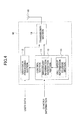
- FIG. 4 illustrates an example configuration of the base station apparatus forming cells. Here, a part is illustrated where a process relevant to downlink user data and control data is performed.
- a base station apparatus 10 includes a control section 11, a user data processing section 12, and a transmission section 13.
- the base station apparatus 10 already knows the arranged state of the base stations of the neighboring cells and the frequency bands used in the cells. Based on that, in a cell group information storage section 14 of the control section 11, a cell group table information where the cell groups are associated with the moving directions is registered in advance.
- FIG. 5 illustrates an example of a cell group table according to an embodiment.
- the cell group table of FIG. 5 exemplarily illustrates the contents of the cell group information storage section 14 of the base station apparatus 10 forming the cell #A of FIG. 3 .
- the degrees of the moving directions are determined by assuming that the north direction (cell#0 direction) from the base station apparatus of the cell #A is 0 degrees, and increases in the clockwise direction.
- the cell groups the cell numbers of plural cells and the frequency bands (in parentheses after cell number) of the cells are registered.
- the number of the moving directions in the cell group table is six.
- the number of the moving directions in the cell group table may be more than or less than six.
- a broadcast information generation section 15 in the control section 11 receives control information from an upper apparatus (e.g., a base station control apparatus), and also receives the cell group table information from the cell group information storage section 14.
- the broadcast information generation section 15 generates a broadcast information based on the control information and the cell group table information. Further, the broadcast information generation section 15 generates an error correction code with respect to the broadcast information, performs data modulation based on a designated modulation method to output a downlink control signal to the transmission section 13.
- the user data processing section 12 receives downlink user data from the upper apparatus (e.g., the base station control apparatus).
- the user data processing section 12 generates an error correction code with respect to the user data and performs data modulation based on the designated modulation method to output a downlink data signal to the transmission section 13.
- the transmission section 13 multiplexes the downlink control signal from the control section 11 with the downlink data signal from the user data processing section 12 to generate a signal based on a predetermined radio access method (Orthogonal Frequency Division Multiplexing Access (OFDMA)). After that, the signal is converted from a base baseband signal to a radio-frequency signal by performing a D/A conversion, so that the radio frequency signal is transmitted via an antenna 16.
- a predetermined radio access method Orthogonal Frequency Division Multiplexing Access (OFDMA)
- SIB3 to SIB8 of Non-Patent Document 4 describes the broadcast information with respect to the neighboring cells.
- SIB5 describes the configurations of the Intra-frequency cell reselection information for each frequency. The configuration may be changed to the configurations for each moving directions. By doing this, the cell group table information may be broadcast (reported).
- Mobile station apparatus
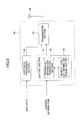
- FIG. 6 illustrates an example configuration of a mobile station apparatus according to the first embodiment. Here, a part is illustrated where a process relevant to downlink user data and control data is performed.
- a mobile station apparatus 20 includes a receiving section 21, a control section 22, and a user data processing section 23.
- the receiving section 21 converts the radio frequency signal received by an antenna 24 into a baseband signal, and performs A/D conversion. Further, the receiving section 21 performs a receiving process based on the predetermined radio access method (OFDMA), the receiving process including Fast Fourier Transform (FFT) timing detection, removal of Guard Interval (GI), a FFT process and the like, so that the received signal is separated into the data signal and the control signal.
- the separated control signal is output to the control section 22, and the separated data signal is output to the user data processing section 23.
- a broadcast information processing section 26 in the control section 22 extracts the cell group table information illustrated in FIG. 5 from the control signal received from the receiving section 21, and outputs the cell group table information to a cell group selection section 27.
- the cell group selection section 27 stores the cell group table information.
- a move history management section 28 stores the information of the cells where the mobile station had been located before.
- a moving direction estimation section 29 receives the information of the cells where the mobile station had been previously located from the move history management section 28, and estimates the moving direction of the mobile station based on the information. Then, the moving direction estimation section 29 reports the estimated moving direction to the cell group selection section 27.
- the move history management section 28 may store past GPS information, so that the moving direction estimation section 29 may estimate the moving direction based on the GPS information.
- the cell group selection section 27 selects the cell group corresponding to the moving direction of the mobile station based on the cell group table information of FIG. 5 , and sequentially reads and outputs the cell numbers of the plural cells and the frequency bands included in the selected cell group to the receiving section 21. Upon receiving the cell numbers of the plural cells and the frequency bands included in the selected cell group, the receiving section 21 searches the frequency bands corresponding to the plural cells.
- the measurement section 30 in the control section 22 measures the received level (or the received quality) at the receiving section 21, and reports the measured value to a cell selection section 31. Further, the measurement section 30 reports information indicating whether the (measured) received level (or the received quality) is greater than or less than a predetermined value or less than the predetermined value to the cell selection section 31 and the moving direction estimation section 29.
- the cell selection section 31 selects the cell having the received level (or the received quality) greater than or equal to the predetermined threshold value and having the maximum receiving level (or the receiving quality) as the standby cell (reselection cell).
- the cell selection section 31 stores and outputs the information of the selected cell to the receiving section 21.
- FIG. 7 is an example flowchart of the cell reselection process executed by the mobile station apparatus according to the first embodiment.
- the measurement section 30 determines whether the receive level (or the received quality) is lower than a predetermined value.
- the process goes to step S2. Otherwise (i.e., NO in step S1), the process ends.
- step S2 the moving direction estimation section 29 estimates the moving direction of the mobile station based on the information indicating the cells where the mobile stations had been previously located, the information being received from the move history management section 28.
- step S3 the cell group selection section 27 selects the cell group corresponding to the moving direction of the mobile station based on the cell group table information.
- step S4 the measurement section 30 searches the plural cells included in the selected cell group, and measures the received level (or the received quality) of the cells included in the cell group.
- step S5 the cell selection section 31 determines whether the maximum received level (or the received quality) of the cell satisfies a required value, that is, whether the received level (or the received quality) is greater than or equal to a threshold value.
- step S5 the condition in step S5 is satisfied
- step S6 the cell (i.e., the cell having the maximum received quality) is selected as the new standby cell.
- step S7 it is determined that the mobile station is located in an out-of-service area. After step S6 or S7, the process ends.
- broadcast information generation section 15 is used as the examples of a cell group information broadcast unit, a cell group information selection unit, and a standby cell selection unit, respectively.
- a mobile station estimates the moving direction of the mobile station based on the move history of the mobile station or the like. Further, the mobile station selects a frequency band having a higher priority level based on information indicating the relationship between the moving directions and the priority levels, the information being broadcast (reported) from the base station. Then, the mobile station selects a new standby cell in accordance with the received level (or the received quality) based on the frequency band.
- FIG. 8 illustrates an example cell selection method according to a second embodiment.
- the cells are described as ellipses, the cell numbers are described as alphanumeric characters in the ellipses.
- the mobile station is located in the cell #A, and the cells #0 through #5 are neighboring cells of the cell #A.
- a frequency band F1 is used in the cells #A, #4, #5, and #0 hatched in the figure, and a frequency band F2 is used in the cells #1, #2, and #3 without hatching in the figure.
- the cells periodically report a priority level set information for each of the moving directions of the mobile station.
- the priority level set information herein refers to a priority level set corresponding to the moving direction. More specifically, the priority level set information includes, for example, the frequency band having the first priority level, the frequency band having the second priority level and the like for each of the moving directions.
- the mobile station located in the cell #A detects the reduction of the received level (or the received quality)
- the mobile station performs the cell reselection process to determine a new standby cell.
- the mobile station first estimates the moving direction of the mobile station. To that end, a GPS or the like may be used to determine the moving direction. However, the moving direction may also be estimated based on the move history of the mobile station.
- the moving direction may be estimated to be the direction parallel to the arrow (2) direction.
- the mobile station selects the priority level set of the frequency bands based on the broadcast information broadcast from the base station of the cell #A. According to the priority level set where the moving direction corresponds to the arrow (2) direction, the priority level of the frequency band F2 is set higher (as the first priority level).
- the mobile station measures the received levels (or the received qualities) of the frequency band F2 (i.e., the cells #1, #2, and #3), and selects an appropriate cell (the cell #1 in this case) as a new standby cell.
- the mobile station may search plural frequency bands to select an appropriate cell (base station).
- FIG. 9 illustrates an example configuration of the base station apparatus forming cells. Here, a part is illustrated where a process relevant to the downlink user data and the control data is performed.
- a base station apparatus 40 includes a control section 41, a user data processing section 42, and a transmission section 43.
- a priority level set information storage section 44 of the control section 41 a priority level set table information where the priority level sets of the frequency bands are associated with the moving directions is registered in advance.
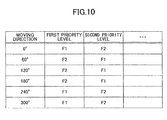
- FIG. 10 illustrates an example of a priority level table according to an embodiment.
- the priority level table of FIG. 10 exemplarily illustrates the contents of the priority level set information storage section 44 of the base station apparatus 40 forming the cell #A of FIG. 8 .
- the degrees of the moving directions are determined by assuming that the north direction (cell#0 direction) from the base station apparatus of the cell #A is 0 degrees, and increase in the clockwise direction.
- the frequency band having the first priority level, the frequency band having the second priority level, the frequency band having the third priority level, the frequency band having the fourth priority level and the like are registered.
- the number of the moving directions in the priority level table is six.
- the number of the moving directions in the priority level table may be more than or less than six.
- a broadcast information generation section 45 in the control section 41 receives the control information from the upper apparatus (e.g., the base station control apparatus), and further receives the priority level set table information from the priority level set information storage section 44.
- the broadcast information generation section 45 generates a broadcast information based on the control information and the priority level set table information. Further, the broadcast information generation section 45 generates an error correction code with respect to the broadcast information, performs data modulation based on a designated modulation method to output a downlink control signal to the transmission section 43.
- the user data processing section 42 receives downlink user data from the upper apparatus (e.g., the base station control apparatus).
- the user data processing section 42 generates an error correction code with respect to the user data and performs data modulation based on the designated modulation method to output a downlink data signal to the transmission section 43.
- the transmission section 43 multiplexes the downlink control signal from the control section 41 with the downlink data signal from the user data processing section 42 to generate a signal based on a predetermined radio access method (OFDMA). After that, the signal is converted from a base baseband signal to a radio-frequency signal by performing a D/A conversion and a quadrature modulation, so that the radio frequency signal is transmitted via an antenna 46.
- OFDMA radio access method
- the configurations of the Intra-frequency cell reselection information for each frequency described in SIB5 may be changed to the configurations for each moving direction.
- the priority level set table information may be broadcast (reported) .
- FIG. 11 illustrates an example configuration of a mobile station apparatus according to the second embodiment. Here, a part is illustrated where a process relevant to downlink user data and control data is performed.
- a mobile station apparatus 50 includes a receiving section 51, a control section 52, and a user data processing section 53.
- the receiving section 51 converts the radio frequency signal received by an antenna 54 into a baseband signal, and performs a quadrature demodulation and the A/D conversion. Further, the receiving section 51 performs a receiving process based on the predetermined radio access method (OFDMA), the receiving process including FFT timing detection, removal of GI, a FFT process and the like, so that the received signal is separated into the data signal and the control signal.
- the separated control signal is output to the control section 52, and the separated data signal is output to the user data processing section 53.
- a broadcast information processing section 56 in the control section 52 extracts the priority level set table information illustrated in FIG. 10 from the control signal received from the receiving section 51, and outputs the priority level set table information to a priority level set selection section 57.
- the priority level set selection section 57 stores the priority level set table information.
- a move history management section 58 stores the information of the cells where the mobile station had been located before.
- a moving direction estimation section 59 receives the information of the cells where the mobile station had been located before from the move history management section 58, and estimates the moving direction of the mobile station based on the information. Then, the moving direction estimation section 59 reports the estimated moving direction to the priority level set selection section 57.
- the move history management section 58 may store past GPS information, so that the moving direction estimation section 59 may estimate the moving direction based on the GPS information.
- the priority level set selection section 57 selects the priority level set corresponding to the moving direction of the mobile station based on the priority level set table information of FIG. 10 , and outputs the frequency bands included in the selected priority level set to a frequency selection section 62.
- the frequency selection section 62 sequentially selects the priority levels included in the priority level set in the increasing order of the priority levels (i.e., in the order of the first priority level, the second priority level, and so forth), and reads and outputs the frequency band corresponding to the selected priority level to the receiving section 51.
- the receiving section 51 searches the frequency band.
- the measurement section 60 in the control section 52 measures the received level (or the received quality) at the receiving section 51, and reports the measured value to a cell selection section 61. Further, the measurement section 30 reports information indicating whether the (measured) received level (or the received quality) is greater than or less than a predetermined value or less than the predetermined value to the cell selection section 61 and the moving direction estimation section 59.
- the cell selection section 61 selects the cell having the received level (or the received quality) greater than or equal to the predetermined threshold value and having the maximum receiving level (or the receiving quality) as the standby cell (reselection cell).
- the cell selection section 31 stores and outputs the information of the selected cell to the receiving section 51.
- FIG. 12 is an example flowchart of the cell reselection process executed by the mobile station apparatus according to the second embodiment.
- the measurement section 60 determines whether the receive level (or the received quality) is lower than a predetermined value.
- the process goes to step S12. Otherwise (i.e., NO in step S11), the process ends.
- step S12 the moving direction estimation section 59 estimates the moving direction of the mobile station based on the information indicating the cells where the mobile stations had been located before, the information being received from the move history management section 58.
- step S13 the priority level set selection section 57 selects the priority level set corresponding to the moving direction of the mobile station based on the priority level set table information.
- step S14 the frequency selection section 62 sequentially selects the frequency bands included in the priority level set in the increasing order of the priority levels. Then, in step S15, the frequency selection section 62 reads and outputs the frequency band corresponding to the selected priority level to the receiving section 51.
- the reason why two separated steps S14 and S15 are provided is that there may be a case where plural frequency bands are set in a single (the same) priority level.
- step S16 the measurement section 60 searches the selected frequency band and measures the received level (or the received quality).
- step S17 the cell selection section 61 determines whether the maximum received level (or the received quality) of the cell satisfies a required value, that is, whether the received level (or the received quality) is greater than or equal to a threshold value.
- a required value that is, whether the received level (or the received quality) is greater than or equal to a threshold value.
- step S18 the cell (i.e., the cell having the maximum received quality) is selected as the new standby cell. Then, the process ends.
- step S17 when determining that the condition in step S17 is not satisfied (NO in step S17), the process goes to step S19.
- step S19 it is determined whether there is the next frequency (the same priority level) or there is the next priority level remaining.
- the process goes to step S20, where the next frequency or the priority level is set and the process goes back to step S15.
- step S19 When determining that there is no next frequency and next priority left (NO in step S19), the process goes to step S21.
- step S21 it is determined that the mobile station is located in an out-of-service area, and the process ends.
- broadcast information generation section 45 “priority level set selection section 57”, and “cell selection section 61" are used as the examples of a priority level information broadcast unit, a priority level information selection unit, and a standby cell selection unit, respectively.
Landscapes
- Engineering & Computer Science (AREA)
- Computer Security & Cryptography (AREA)
- Computer Networks & Wireless Communication (AREA)
- Signal Processing (AREA)
- Mobile Radio Communication Systems (AREA)
Applications Claiming Priority (1)
| Application Number | Priority Date | Filing Date | Title |
|---|---|---|---|
| PCT/JP2010/054128 WO2011111207A1 (fr) | 2010-03-11 | 2010-03-11 | Système de communication mobile, procédé de sélection de cellule, appareil formant station de base et appareil formant station mobile |
Publications (2)
| Publication Number | Publication Date |
|---|---|
| EP2547152A1 true EP2547152A1 (fr) | 2013-01-16 |
| EP2547152A4 EP2547152A4 (fr) | 2015-11-25 |
Family
ID=44563049
Family Applications (1)
| Application Number | Title | Priority Date | Filing Date |
|---|---|---|---|
| EP10847437.0A Withdrawn EP2547152A4 (fr) | 2010-03-11 | 2010-03-11 | Système de communication mobile, procédé de sélection de cellule, appareil formant station de base et appareil formant station mobile |
Country Status (4)
| Country | Link |
|---|---|
| US (1) | US8606278B2 (fr) |
| EP (1) | EP2547152A4 (fr) |
| JP (1) | JP5457545B2 (fr) |
| WO (1) | WO2011111207A1 (fr) |
Families Citing this family (4)
| Publication number | Priority date | Publication date | Assignee | Title |
|---|---|---|---|---|
| US9137728B2 (en) | 2013-02-05 | 2015-09-15 | Qualcomm Incorporated | Method of predicting suitable candidates for user equipment cell reselection in mobile networks based on the direction of movement |
| US20150326998A1 (en) * | 2014-01-30 | 2015-11-12 | Telefonaktiebolaget L M Ericsson (Publ) | Pre-Configuration of Devices Supporting National Security and Public Safety Communications |
| WO2016125311A1 (fr) * | 2015-02-06 | 2016-08-11 | 富士通株式会社 | Système de communication sans fil, dispositif sans fil et procédé de traitement |
| JP6903450B2 (ja) * | 2017-02-23 | 2021-07-14 | 株式会社Nttドコモ | ユーザ端末およびセル選択方法 |
Family Cites Families (10)
| Publication number | Priority date | Publication date | Assignee | Title |
|---|---|---|---|---|
| US5465389A (en) * | 1994-02-25 | 1995-11-07 | At&T Corp. | Method of prioritizing handoff procedures in a cellular system |
| DE19831569A1 (de) | 1998-07-14 | 2000-01-20 | Siemens Ag | Verfahren zur Informationsübertragung und Funkstation |
| US6970708B1 (en) * | 2000-02-05 | 2005-11-29 | Ericsson Inc. | System and method for improving channel monitoring in a cellular system |
| JP2002027519A (ja) * | 2000-06-30 | 2002-01-25 | Toshiba Corp | 移動通信端末とその接続先基地局選択方法及び接続先基地局選択制御プログラムを記憶した記憶媒体 |
| JP3911495B2 (ja) * | 2003-08-28 | 2007-05-09 | 株式会社エヌ・ティ・ティ・ドコモ | 移動端末、位置管理装置、位置登録システム、及び、位置登録方法 |
| JP4367284B2 (ja) * | 2004-08-06 | 2009-11-18 | 三菱電機株式会社 | ハンドオーバ方法、移動通信システムおよびアクセスポイント |
| KR100677604B1 (ko) * | 2005-07-27 | 2007-02-02 | 삼성전자주식회사 | Gps 위치정보를 이용한 무선 랜에서의 빠른 핸드오버방법 및 그 방법을 수행하는 모바일 기기, 그리고 gps위치정보를 이용한 서비스 전환 방법 |
| JP2008016991A (ja) * | 2006-07-04 | 2008-01-24 | Matsushita Electric Ind Co Ltd | 無線ip電話システム |
| JP2008236727A (ja) * | 2007-02-23 | 2008-10-02 | Matsushita Electric Ind Co Ltd | 無線通信端末装置及び隣接セル測定方法 |
| US20100130212A1 (en) * | 2008-10-23 | 2010-05-27 | Zte (Usa) Inc. | Femto Cell Handover In Wireless Communications |
-
2010
- 2010-03-11 EP EP10847437.0A patent/EP2547152A4/fr not_active Withdrawn
- 2010-03-11 JP JP2012504233A patent/JP5457545B2/ja not_active Expired - Fee Related
- 2010-03-11 WO PCT/JP2010/054128 patent/WO2011111207A1/fr not_active Ceased
-
2012
- 2012-09-07 US US13/607,139 patent/US8606278B2/en not_active Expired - Fee Related
Non-Patent Citations (1)
| Title |
|---|
| See references of WO2011111207A1 * |
Also Published As
| Publication number | Publication date |
|---|---|
| US20120329463A1 (en) | 2012-12-27 |
| JP5457545B2 (ja) | 2014-04-02 |
| WO2011111207A1 (fr) | 2011-09-15 |
| EP2547152A4 (fr) | 2015-11-25 |
| JPWO2011111207A1 (ja) | 2013-06-27 |
| US8606278B2 (en) | 2013-12-10 |
Similar Documents
| Publication | Publication Date | Title |
|---|---|---|
| EP2856674B1 (fr) | Procédés pour la gestion de types de porteuses hétérogènes | |
| WO2020140830A1 (fr) | Procédé et appareil de sélection de plmn et de (re)sélection de cellule | |
| EP3414951B1 (fr) | Dispositif de communication et procédé associé, pour sélectionner une cellule et une technologie d'accès radio dans un réseau de communications sans fil | |
| EP2330849B1 (fr) | Resélection de cellule dans un système de communication sans fil | |
| US8700039B2 (en) | Method and apparatus for coordinated multiple point transmission and reception | |
| KR101161067B1 (ko) | 무선 통신 시스템에서 셀 선택을 위한 방법들, 장치들 및 시스템 | |
| CN106664171B (zh) | 用于管理小区参考符号的传输的网络节点和方法 | |
| CN107211332B (zh) | 一种小区选择方法及装置 | |
| US20130267221A1 (en) | Measurement of cells arranged in groups of different priorities | |
| US11122577B2 (en) | Initial acquisition | |
| JP7205582B2 (ja) | 5gにおける同期信号 | |
| US20110039551A1 (en) | Mobile communication system, mobile station device, base station device, and mobile communication method | |
| JP2009542061A (ja) | Ofdm通信システムにおける隣接セル測定値を取得するために同期チャネルを使用する方法及び装置 | |
| KR20110057464A (ko) | 무선통신 시스템에서 협력통신을 수행하기 위한 방법 및 장치 | |
| US8275380B2 (en) | Cell information transmission method and user apparatus in mobile communications system | |
| EP3391691B1 (fr) | Dispositif de communication et procédé associé, pour sélectionner une cellule et une technologie d'accès radio dans un réseau de communications sans fil | |
| CN110178408A (zh) | 无线通信系统中的小区历史使用 | |
| EP3542576B1 (fr) | Hiérarchisation de fréquences de canal de synchronisation dans des communications sans fil | |
| CN101536575A (zh) | 用于蜂窝通信中改进捕获和切换的辅助信道上的导频发送 | |
| EP2965452B1 (fr) | Estimation de canal pour la suppression d'interférences | |
| US8606278B2 (en) | Mobile communication system, cell selection method, base station apparatus, and mobile station apparatus | |
| JP2021121107A (ja) | 信号伝送方法、ネットワーク設備及び端末設備 | |
| US9736743B2 (en) | Method of user equipment selecting cell in wireless communication system and user equipment using the method | |
| EP3108712B1 (fr) | Sélection de canal prach dans des déploiements des cellules radio combinées | |
| US20180063744A1 (en) | Methods and devices for interference cancellation in cell search |
Legal Events
| Date | Code | Title | Description |
|---|---|---|---|
| PUAI | Public reference made under article 153(3) epc to a published international application that has entered the european phase |
Free format text: ORIGINAL CODE: 0009012 |
|
| 17P | Request for examination filed |
Effective date: 20121004 |
|
| AK | Designated contracting states |
Kind code of ref document: A1 Designated state(s): AT BE BG CH CY CZ DE DK EE ES FI FR GB GR HR HU IE IS IT LI LT LU LV MC MK MT NL NO PL PT RO SE SI SK SM TR |
|
| DAX | Request for extension of the european patent (deleted) | ||
| RIC1 | Information provided on ipc code assigned before grant |
Ipc: H04W 36/00 20090101ALI20150706BHEP Ipc: H04W 48/16 20090101AFI20150706BHEP |
|
| RA4 | Supplementary search report drawn up and despatched (corrected) |
Effective date: 20151027 |
|
| RIC1 | Information provided on ipc code assigned before grant |
Ipc: H04W 36/00 20090101ALI20151021BHEP Ipc: H04W 48/16 20090101AFI20151021BHEP |
|
| STAA | Information on the status of an ep patent application or granted ep patent |
Free format text: STATUS: EXAMINATION IS IN PROGRESS |
|
| 17Q | First examination report despatched |
Effective date: 20161114 |
|
| GRAP | Despatch of communication of intention to grant a patent |
Free format text: ORIGINAL CODE: EPIDOSNIGR1 |
|
| STAA | Information on the status of an ep patent application or granted ep patent |
Free format text: STATUS: GRANT OF PATENT IS INTENDED |
|
| STAA | Information on the status of an ep patent application or granted ep patent |
Free format text: STATUS: THE APPLICATION HAS BEEN WITHDRAWN |
|
| RIC1 | Information provided on ipc code assigned before grant |
Ipc: H04W 48/16 20090101ALI20190215BHEP Ipc: H04W 48/20 20090101AFI20190215BHEP |
|
| INTG | Intention to grant announced |
Effective date: 20190307 |
|
| 18W | Application withdrawn |
Effective date: 20190311 |