EP2548147B1 - Procédé de reconnaissance et de classification d'une plante à racine nue - Google Patents
Procédé de reconnaissance et de classification d'une plante à racine nue Download PDFInfo
- Publication number
- EP2548147B1 EP2548147B1 EP11756656.2A EP11756656A EP2548147B1 EP 2548147 B1 EP2548147 B1 EP 2548147B1 EP 11756656 A EP11756656 A EP 11756656A EP 2548147 B1 EP2548147 B1 EP 2548147B1
- Authority
- EP
- European Patent Office
- Prior art keywords
- plant
- bare
- image
- color
- root
- Prior art date
- Legal status (The legal status is an assumption and is not a legal conclusion. Google has not performed a legal analysis and makes no representation as to the accuracy of the status listed.)
- Active
Links
Images


Classifications
-
- B—PERFORMING OPERATIONS; TRANSPORTING
- B07—SEPARATING SOLIDS FROM SOLIDS; SORTING
- B07C—POSTAL SORTING; SORTING INDIVIDUAL ARTICLES, OR BULK MATERIAL FIT TO BE SORTED PIECE-MEAL, e.g. BY PICKING
- B07C5/00—Sorting according to a characteristic or feature of the articles or material being sorted, e.g. by control effected by devices which detect or measure such characteristic or feature; Sorting by manually actuated devices, e.g. switches
- B07C5/34—Sorting according to other particular properties
- B07C5/342—Sorting according to other particular properties according to optical properties, e.g. colour
Definitions
- the strawberry industry presently uses manual labor to sort several hundred million plants every year into good and bad categories, a tedious and costly step in the process of bringing fruit to market.
- Plants raised by nursery farms are cultivated in large fields grown like grass. The plants are harvested at night in the fall and winter when they are dormant and can be moved to their final locations for berry production.
- the quality of the plants coming from the field is highly variable. Only about half of the harvested plants are of sufficient quality to be sold to the berry farms. It is these plants that ultimately yield the berries seen in supermarkets and roadside fruit stands.
- the present invention provides new sorting technologies that will fill a valuable role by standardizing plant quality and reducing the amount of time that plants are out of the ground between the nursery farms and berry farms.
- Present operations to sort plants are done completely manually with hundreds of migrant workers.
- a typical farm employs 500- 1000 laborers for a 6-8 week period each year during the plant harvest.
- the present invention is novel both in its application of advanced computer vision to the automated plant-sorting task, and in the specific design of the computer vision algorithms.
- One embodiment of the present invention applies to strawberry nursery farms.
- the software engine being for many different types of plants that require sophisticated quality sorting. Sorting of plants according to sub-parts identified by pixel-based evaluation is for example known from US-A-5,253,302 .
- the method described in the present invention is a core component for a system outside of the scope of the present invention, that can take plants from a transport bin, separate them into single streams, inspect, and move them into segregated bins that relate to sale quality.
- automated sorting systems exist in other applications, this is the first application to strawberry nursery sorting, and the first such system to involve extensive processing and computer vision for bare-root crops.
- Plants in the ground are harvested from the ground, roots trimmed and dirt removed for improved classification, plants are separated by a singulation process, each plant is optically scanned by a vision system for classification, and the plants are sorted based on classification grades, such as Grade A, Grade B, good, bad, premium, marginal, problem X, problem Y, and directed along a predetermined path for disposition into bins by configured categories or a downstream conveyor for: (i) shipment to customers, (ii) separated for manual sorting, or (iii) rejected.
- Optically scanned raw images are classified using a bare-root plant machine learning classifier to generate classified images based on crop specific training parameters.
- the classified images undergo a crop specific plant evaluation and sorting process 36 that determines the grade of the plant and the disposition of each plant configured categories.
- an exemplary system having a conveyor system with a top surface, a vision system, and a sorting device.
- An example of the sorting device is air jets in communication with the vision system for selective direction of the individual plants along the predetermined path.
- This invention is a novel combination and sequence of computer vision and machine learning algorithms to perform a highly complex plant evaluation and sorting task.
- the described software performs with accuracy matching or exceeding human operations with speeds exceeding 100 times that of human sorters.
- the software is adaptable to changing crop conditions and until now, there have been no automated sorting systems that can compare to human quality and speed for bare-root plant sorting.
- Figure 4 illustrates the software flow logic of the present invention broken into the following primary components: (i) camera imaging and continuous input stream of raw data, e.g., individual plants on a high speed conveyor belt or any surface, (ii) detection and extraction of foreground objects (or sub-images) from the raw imagery, (Hi) masking of disconnected components in the foreground image, (iv) feature calculation for use in pixel classification, (v) pixel classification of plant sub-parts (roots, stems, leaves, etc.), (vi) feature calculation for use in plant classification, (vii) feature calculation for use in multiple plant detection, (viii) determination of single or multiple objects within the image, and (ix) plant classification into categories (good, bad, premium, marginal, problem X, problem Y, etc).
- Step i produces a real-time 2 dimensional digital image containing conveyor background and plants.
- Step ii processes the image stream of step i to produce properly cropped images containing only plants and minimal background.
- Step iii utilizes connected-component information from step ii to detect foreground pixels that are not part of the primary item of interest in the foreground image, resulting in a masked image to remove portions of other nearby plants that may be observed in this image.
- Step iv processes, the plant images of step iii using many sub-algorithms and creates 'feature' images representing how each pixel responded to a particular computer vision algorithm or filter.
- Step v exercises a machine learning classifier applied to the feature images of step iv to predict type of each pixel (roots, stems, leaves, etc.).
- Step vi uses the pixel classification image from step v to calculate features of the plant.
- Step vii uses information from step v and step vi to calculate features used to discern whether an image contains a single or multiple plants.
- Step viii exercises a machine learning classifier applied to plant features from step vii to detect the presence of multiple, possibly overlapping, plants within the image. If the result is the presence of a single plant, step ix exercises a machine learning classifier applied to the plant features from step vi to calculate plant disposition (good, bad, marginal, etc).
- Figure 4 also illustrates the operational routines of bare-root plant machine learning classifier 32 and crop specific plant evaluation and sorting process 36.
- Bare-root plant machine learning classifier 32 can include step ii detecting and extracting foreground objects to identify a plurality of sub-parts of the bare-root plant to form a first cropped image; step iv calculating features for use in pixel classification based on the cropped image to classify each pixel of the cropped image as one sub-part of the plurality of sub-parts of the bare-root plant; and step v classifying pixels of the plurality of sub-parts of the bare-root plant to generate a vector of scores for each plant image.
- bare-root plant machine learning classifier 32 can also include step iii masking disconnected components of the first cropped image to form a second cropped image.
- Crop specific plant evaluation and sorting process 36 can include step vi calculating features for use in plant classification; and step ix classifying the bare-root plant based on the calculated features into a configured category.
- crop specific plant evaluation and sorting process 36 can also include step vii calculating features for use in multiple plant detection; and step viii detecting a single plant or multiple plants.
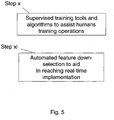
- Figure 5 illustrates additional processing steps of the present invention that include (x) supervised training tools and algorithms to assist human training operations and (xi) automated feature down-selection to aid in reaching real-time implementations.
- One embodiment of system of the present invention includes 2 dimensional camera images for classification.
- the imagery can be grayscale or color but color images add extra information to assist in higher accuracy pixel classification. No specific resolution is required for operation, and system performance degrades gracefully with decreasing image resolution.
- the image resolution that provides most effective classification of individual pixels and overall plants depends on the application.
- One embodiment of the present invention that generates the 2 dimensional camera images can include two types of cameras: area cameras (cameras that image rectangular regions), and line scan cameras (cameras that image a single line only, commonly used with conveyor belts and other industrial applications).
- the camera imaging software must maintain continuous capture of the stream of plants (typically a conveyor belt or waterfall).
- the images must be evenly illuminated and must not distort the subject material, for example plants.
- the camera For real-time requirements, the camera must keep up with application speed (for example, the conveyor belt speed).
- Exemplary system 10 requires capturing pictures of plants at rates of 15-20 images per second or more.
- One embodiment of the software can use a color masking algorithm to identify the foreground objects (plants).
- the belt color will be the background color in the image.
- a belt color is selected that is maximally different from the colors detected in the plants that are being inspected.
- the color space in which this foreground /background segmentation is performed is chosen to maximize segmentation accuracy.
- the maximally color differential method can be implemented with any background surface being either a stationary or moving surface.
- Figure 6F illustrates that converting incoming color imagery to hue space and selecting a background color that is out of phase with the foreground color, a simple foreground/ background mask (known as hue threshold or color segmentation) can be applied to extract region of interest images for evaluation.
- hue threshold or color segmentation
- An example segregates the foreground and background based on a hue threshold , and creates a mask. The mask applied to the original image, with only the color information of the foreground (i.e., the plant) displayed and the background is ignored.
- the present invention can include two operational algorithms for determining region of interest for extraction:
- a first algorithm can count foreground pixels for a 1st axis per row.
- the algorithm is tracking a plant. This threshold is pre-determined based on the size of the smallest plant to be detected for a given application. As the pixel count falls below the threshold, a plant is captured along one axis. For the 2nd axis, the foreground pixels are summed per column starting at the column with the most foreground pixels and walking left and right until it falls below threshold (marking the edges of the plant).
- This algorithm is fast enough to keep up with real-time data and is good at chopping off extraneous runners and debris at the edges of the plant due to the pixel count thresholding.
- the result of this processing are images cropped around the region of interest with the background masked, that can use used directly as input to step iv or can be further processed by step iii to remove "blobs" or other images that are not part of the subject plant.
- Step iii is a second algorithm that can use a modified connected components algorithm to track 'blobs' and count foreground pixel volume per blob during processing.
- the connected components algorithm is run joining foreground pixels with their adjacent neighbors into blobs with unique indices.
- This threshold is pre-determined based on the size of the smallest plant to be detected for a given application. If the completed blob is below this threshold it is ignored, making this algorithm able to ignore dirt and small debris without requiring them to be fully processed by later stages of the system.
- the result of this processing are images cropped around the region of interest that encompasses each blob with the background masked, which can be used as input into step iv..
- the cropped image containing the region of interest may contain foreground pixels that are not part of the item of interest, possibly due to debris, dirt, or nearby plants that partially lie within this region. Pixels that are not part of this plant are masked and thus ignored by later processing, reducing the overall number of pixels that require processing and reducing errors that might otherwise be introduced by these pixels. Disclosed is an example of a foreground mask in which extraneous components that were not part of the plant have been removed. Note that portions of the image, such as the leaf in the top right corner, are now ignored and marked as background for this image.
- the result of this stage is an isolated image containing an item of interest (i.e. a plant), with all other pixels masked. This stage is optional and helps to increase the accuracy of plant quality assessment.
- One embodiment of the present invention includes an algorithm for feature calculation for use in pixel classification (step iv of Figure 4 ) in order to classify each pixel of the image as root, stem, leaf, etc. This utilizes either the output of step ii or step iii.
- the algorithm is capable of calculating several hundred features for each pixel. Though the invention is not to be limited to any particular set of features, the following features are examples of what can be utilized:
- the neighborhood mean is then calculated and variance for each pixel executed over many different neighborhood sizes as it was found that the accuracy of classifying a particular pixel can be improved by using information from the surrounding pixels.
- the neighborhood sizes used are dependent upon the parameters of the application, typically a function of plant size, plant characteristics, and camera parameters.
- each pixel has a vector of scores, with each score providing a value representing each feature.
- the system is designed to be capable of generating several hundred scores per pixel to use for classification, but the configuration of features is dependent upon computational constraints and desired accuracy.
- the exemplary system utilizes a set of 37 features that were a subset of the 308 tested features (element vectors). This subset was determined through a down- select process, explained in a later section, which determined the optimal and minimum combination of features to achieve desired minimum accuracy. This process can be performed for each plant variety as well as plant species.
- Machine learning techniques are used to classify pixels into high level groups (step v of Figure 4 ) such as roots, stems, leaves, or other plant parts using calculated feature score vectors.
- a SVM support vector machine
- This implementation is generic and configurable so the software may be used to classify roots, stems, and leaves for one plant variety and flowers, fruits, stems, and roots for another variety.
- This step of the software requires training examples prior to classification when a new variety is used with the system. The training procedures allow the learning system to associate particular combinations of feature scores with particular classes. Details of this training process are explained later in this document. Once training is complete, the software is then able to automatically label pixels of new images. Disclosed are background, roots, stems, live leaves, and dead leaves being correctly identified.
- Another aspect of the present invention uses the classified pixel image step v) discussed above for further feature calculation for use in plant classification (step vi of Figure 4 ).
- the algorithm can calculate plant characteristics such as: overall plant size and size of each subcategory (root, stem, leaves, other), ratio of different subcategories (i.e. root vs. stem), mean and variance of each category pixel color (looking for defects), spatial distributions of each category or subcategory (physical layout of the plant), lengths of roots and stems, histogram of texture of roots (to help evaluate root health), location and size of crown, number of roots or overall root linear distance, and number of stems.
- plant characteristics such as: overall plant size and size of each subcategory (root, stem, leaves, other), ratio of different subcategories (i.e. root vs. stem), mean and variance of each category pixel color (looking for defects), spatial distributions of each category or subcategory (physical layout of the plant), lengths of roots and stems, histogram of texture of roots (
- One particular algorithm that helps to standardize the plant classification application is the concept of virtual cropping. Even though different farmers chop their plants, such as strawberries, using different machinery, the plant evaluation of the present invention can be standardized by measuring attributes only within a fixed distance from the crown. This allows for some farmers to crop short while others crop longer, and makes the plant classification methods above more robust to these variations. This step is optional and can improve the consistency of classification between different farm products.
- step vi of Figure 4 it may be required for the system to determine if only a single plant is present in the image. This step is optional if singulation is reliable (i.e. if plants are adequately separated to create images of only single plants).
- Some applications of this plant evaluation software may involve mechanical devices that distribute plants onto the inspection surface for the camera, and may not achieve 100% separation of the plants.
- a sorting system may place clumps of plants into a special bin for evaluation by some other means.
- the vector of plant scores calculated above are used for this purpose (step vi of Figure 4 ), providing cues based on overall size, root mass, etc.
- step vii of Figure 4 Additionally statistics regarding the crown pixel distribution are used as features for classification (step vii of Figure 4 ) to generate a vector of scores for multiple plant detection.
- An image with multiple crowns typically exhibits a multimodal distribution of pixel locations, thus statistics including kurtosis and variance of these pixel locations are calculated and used as additional features. These measures combine to give a strong indication of multiple crowns in the image without the need for an absolute crown position detector.
- Machine learning is applied to these score vectors so that the system is able to associate particular combinations of scores with the presence of single or multiple plants (step viii of Figure 4 ).
- the breadth of features used is designed such that the system is capable of detecting multiple plants within images where some of the crowns are not visible, due to cues from other features. If multiple plants are detected, the plants are dispositioned in a predefined manner. Otherwise the vector of plant scores from step vi are used for final plant classification (step ix of Figure 4 ).
- step ix of Figure 4 Another aspect of the present invention mentioned above is plant classification (step ix of Figure 4 ) into categories (good, bad, premium, marginal, problem X, problem Y, etc.).
- This algorithm of the software package uses machine learning to use the vector of plant scores from step vi to classify plant images into high level groups such as good and bad.
- Various embodiments of the present invention use SVM (support vector machine), clustering, and knn classifiers, but other classifiers are able to be used within the scope of the invention.
- the algorithm can be used to classify good vs. bad (2 categories) for one plant variety and no-roots, no-crown, too small, premium, marginal large, marginal small (6 categories) for another variety and is configured based on the present application.
- This step of the software requires training examples prior to classification, allowing the learning system to associate particular combinations of plant score vectors with particular classes. Details of this training process are explained later in this document.
- the result of this stage of the software during runtime operation is an overall classification for the plant based on the configured categories. The plant will be dispositioned based on the classification and the configuration of the application. Exemplary system ultimately classifies a plant as one that can or cannot be sold based on various health characteristics and dispositions the plant into an appropriate bin.
- Another aspect of the present invention involves training procedures and tools for the system software (step x in Figure 5 ).
- the first training stage 32 involves creating a mathematical model for classifying pixels can be utilized by step v of Figure 4 . Examples of two operational algorithms that perform that task are presented below.
- the first algorithm shown in Figure 9A , includes the step to manually cut plants apart into their various sub-components (roots, leaves, stems, etc.) and capture images of each example.
- the foreground pixels from these images are then used as training examples with each image giving a set of examples for one specific class.
- the results from this method are good but sometimes overlapping regions of roots, stems, or leaves in full plant images are misclassified because they are not represented properly in the training.
- a second algorithm uses a selection of images containing full plants rather than specific plant parts. For example, 50 plant images can be collected and used for this purpose. These images are input to a custom training utility in order to label the foreground pixels with appropriate categories.
- This utility processes each image with a super-pixel algorithm customized for this application using intensity and hue space for segmentation.
- the image is then displayed in a utility for the operator to label pixels. This is labeling is accomplished by selecting a desired category then clicking on specific points of the image to associate with this label. Using the super-pixel results, nearby similar pixels are also assigned this label to expedite the process. Thus the operator only needs to label a subset of the foreground pixels to fully label an image.
- the second algorithm is a more manually intensive method, but is able to achieve higher accuracy in some situations. When there are cases of overlapping regions of different classes, this method is better able to assess them correctly.
- This first training stage produces a model containing parameters used to classify each pixel into a configurable category, such as root, stem, leaf, etc.
- the second training stage involves creating a model for classifying plants 36 can be utilized by step ix of Figure 4 .
- a collection of isolated plant images are acquired for training. The number of images required is dependent upon the machine learning method being applied for an application. Once these images are acquired they must be assigned a label based on the desired categories that are to be used for classification. Two methods have been utilized to acquire these labels.
- the first method involves sorting plants manually. Once the plants are separated into the various categories, each plant from each category is captured and given a label. This is a time intensive task as the plants must be sorted manually, but allows careful visual inspection of each plant.
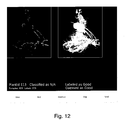
- the second method uses unsorted plants that are provided to the system, capturing an image of each plant. These images are transmitted to a custom user interface that displays the image as well as the pixel classified image. This allows an operator to evaluate how to categorize a plant using the same information that the system will be using during training, which has the benefit of greater consistency. The operator then selects a category from the interface and the next image is displayed.
- An example interface is shown in Figure 12 .
- machine learning software e.g., a SVM algorithm
- SVM algorithm a model of parameters containing parameters used to determine the category of a pixel classified image.
- Both of these training operations 32, 36 share some common algorithms to analyze, configure, and enhance accuracy. Randomization, class training distributions, penalty matrices, and exit criteria are all configurable with our implementation of the learning engine. These settings are independent of the actual machine learning engine software and enabled the software to attain accuracy equivalent to or beyond human levels. Additional features have been added to the training system to allow the user to predict expected accuracy and control error rates by using margins. These margins are computed by looking at the classifier confidence level, representing how certain it is that the item is of a certain category relative to the other categories. If the machine learning software is unsure about an answer for a pixel or a plant, the user can configure a specific margin (to ensure certainty). If the answer does not have enough margin, the answer will be marked ambiguous instead.
- Another concept is to make realtime adjustments to plant classification during system operation. While the system is operating, image and classification data is transmitted to a user interface such as the example in Figure 12 . A human operator is able to observe the classification results from the system, and if the result was not correct assign the image the correct category. The system automatically applies the corresponding machine learning algorithm used for the application to this new data, updating the model. This model can then be transmitted to the running system and new parameters loaded without requiring interruption of the system.
- Another aspect is Automated Feature Down-selection to Aid in Reaching Real-time Implementations (steps iv and vi of Figure 4 ).
- the goal is to reduce the workload for step iv and step vi in Figure 4 .
- An application of this software may include a time constraint to classify an image, thereby restricting the number of features that can be calculated for the pixel and plant classification stages. Often a large number of features are designed and computed to maximize accuracy; however some features used for the machine learning system have redundant information. It is desired to find the minimum set of features needed to achieve the application specified accuracy and meet computational constraints during real-time operation.
- the present invention includes software that automatically down-selects which set of features are most important for sorting accuracy to satisfy this constraint. Two examples of operational algorithms are described below.
- the first algorithm begins by utilizing all of the feature calculations that have been implemented and calculating a model of training parameters using the machine learning software. One feature calculation is then ignored and the training process is repeated, creating a new model for this feature combination. This process is repeated, each time ignoring a different feature calculation, until a model has been created for each combination. Once this step is complete the combination with the highest accuracy is chosen for the next cycle. Each cycle repeats these steps using the final combination from the previous cycle, with each cycle providing the optimal combination of that number of features. The overall accuracy can be graphed and examined to determine when the accuracy of this sort falls below acceptable levels.
- the model with the least number of features above required accuracy is chosen to be the real-time implementation.
- the second algorithm has similar functionality as the first algorithm but the second algorithm starts with using only one feature at a time and increasing the number of features each cycle. The feature that results in highest accuracy is accepted permanently and the next cycle is started (looking for a second, third, fourth, etc. feature to use). This algorithm is much faster and is also successful at identifying which features to use for real-time implementation .
Landscapes
- Image Analysis (AREA)
- Apparatuses For Bulk Treatment Of Fruits And Vegetables And Apparatuses For Preparing Feeds (AREA)
- Sorting Of Articles (AREA)
Claims (12)
- Procédé permettant de reconnaître et de classer une plante à racines nues sur une surface de convoyeur, comprenant les étapes consistant à :classifier une plante à racines nues à partir d'une image brute pour former une image à racines nues classifiée sur la base de paramètres formésévaluer la plante à racines nues classée sur la base de caractéristiques formées pour affecter la plante à racines nues évaluée à une catégorie configurée, dans laquelle la classification (32) de la plante à racines nues comprend :la réception d'un flux continu bidimensionnel en temps réel de données d'images brutes provenant de l'imagerie d'une caméra ;la détection et l'extraction des objets d'avant-plan dans l'image pour identifier une pluralité de sous-parties de la plante à racines nues afin de former une image recadrée contenant uniquement des plantes et un arrière-plan minimal de convoyeur ;le masquage des éléments déconnectés de l'image d'avant-plan pour éliminer des parties d'autres plantes voisines afin de former une deuxième image recadrée ;le calcul des caractéristiques à utiliser dans la classification des pixels basée sur la deuxième image recadrée ; etoù l'évaluation (36) de la racine nue classifiée comprend :la classification de chaque pixel de la deuxième image recadrée en utilisant les paramètres formés en tant que constituant une sous-partie de la pluralité des sous-parties de la plante à racines nues, afin d'identifier les sous-parties de la plante à racines nues ;le calcul des caractéristiques de la plante à racines nues à partir des pixels classés pour les utiliser dans la classification de la plante sur la base des caractéristiques formées ;la classification de la plante à racines nues dans une catégorie parmi une pluralité de catégories ; et le suivi de la plante sur la base de la catégorie.
- Procédé selon la revendication 1, dans lequel la détection et l'extraction des objets d'avant plan comprennent le masquage des couleurs.
- Procédé selon la revendication 2, dans lequel le masquage des couleurs comprend la sélection d'une couleur de la surface pour former une couleur d'arrière-plan qui est au maximum différente des couleurs de la pluralité de sous-parties de la plante à racines nues requises pour former la couleur d'avant-plan.
- Procédé selon la revendication 3, dans lequel la sélection de la couleur de la surface pour former la couleur d'arrière-plan comprend la sélection de la couleur d'arrière-plan qui est déphasée par rapport à la couleur d'avant-plan.
- Procédé selon la revendication 4, dans lequel la sélection de la couleur d'avant-plan et de la couleur d'arrière-plan est basée sur un seuil des teintes requises pour créer un masque.
- Procédé selon la revendication 5, dans lequel le masquage des couleurs comprend en outre l'application du masque à l'image brute pour former l'image classifiée à racines nues, si bien que seule la couleur d'avant-plan est affichée.
- Procédé selon toute revendication précédente, comprenant en outre le calcul de la moyenne de voisinage et de la variance pour chaque pixel sur la base des caractéristiques calculées pour former un vecteur de scores.
- Procédé selon toute revendication précédente comprenant en outre l'association de scores de vecteurs de caractéristiques à des sous-parties particulières de la plante à racines nues.
- Procédé selon toute revendication précédente, dans lequel le calcul des caractéristiques de la plante à racines nues pour générer un vecteur de scores pour chaque image de plante comprend le recadrage virtuel.
- Procédé selon toute revendication précédente, comprenant en outre la détection d'une seule ou de plusieurs plantes.
- Procédé selon la revendication 8, dans lequel l'association comprend :la collecte d'exemples d'images de plantes à racines nues complètes ;le traitement de chaque image avec un algorithme de super-pixels utilisant la segmentation de l'espace d'intensité et de teintes ;l'étiquetage des pixels d'avant-plan de chaque image pour chaque sous-partie des plantes à racines nues complètes afin de constituer un exemple de formationla création d'un modèle de classificateur basé sur l'exemple de formation pour construire des associations du vecteur de scores à la pluralité des sous-parties de la plante à racines nues.
- Procédé selon toute revendication précédente, dans lequel les caractéristiques utilisées comprennent une ou plusieurs des caractéristiques suivantes
intensité des niveaux de gris ;
information sur les couleurs rouge, verte, bleue (RVB) ;
Informations sur les couleurs à type de teinte, saturation, valeur (TSV) ;
informations sur les couleurs selon le procédé YIQ ;
informations sur les bords ;
un filtre personnalisé identifiant les pixels ayant des motifs adjacents de haute et basse intensité
Informations sur les FFT.
Applications Claiming Priority (2)
| Application Number | Priority Date | Filing Date | Title |
|---|---|---|---|
| US34009110P | 2010-03-13 | 2010-03-13 | |
| PCT/US2011/000465 WO2011115666A2 (fr) | 2010-03-13 | 2011-03-14 | Logiciel assurant la vision par ordinateur et l'apprentissage automatique afin de classer et de trier des plantes |
Publications (3)
| Publication Number | Publication Date |
|---|---|
| EP2548147A2 EP2548147A2 (fr) | 2013-01-23 |
| EP2548147A4 EP2548147A4 (fr) | 2014-04-16 |
| EP2548147B1 true EP2548147B1 (fr) | 2020-09-16 |
Family
ID=44649754
Family Applications (1)
| Application Number | Title | Priority Date | Filing Date |
|---|---|---|---|
| EP11756656.2A Active EP2548147B1 (fr) | 2010-03-13 | 2011-03-14 | Procédé de reconnaissance et de classification d'une plante à racine nue |
Country Status (4)
| Country | Link |
|---|---|
| US (1) | US9527115B2 (fr) |
| EP (1) | EP2548147B1 (fr) |
| ES (1) | ES2837552T3 (fr) |
| WO (1) | WO2011115666A2 (fr) |
Families Citing this family (77)
| Publication number | Priority date | Publication date | Assignee | Title |
|---|---|---|---|---|
| US8938116B2 (en) * | 2011-12-08 | 2015-01-20 | Yahoo! Inc. | Image cropping using supervised learning |
| DE102012200930A1 (de) * | 2012-01-23 | 2015-08-20 | Fraunhofer-Gesellschaft zur Förderung der angewandten Forschung e.V. | Vorrichtung und Verfahren zum Erfassen einer Pflanze vor einem Hintergrund |
| WO2013134480A1 (fr) | 2012-03-07 | 2013-09-12 | Blue River Technology, Inc. | Procédé et appareil pour nécrose de plante automatisée |
| IE20120388A1 (en) * | 2012-09-07 | 2014-03-12 | Odenberg Engineering Ltd | Method and apparatus for handling harvested root crops |
| WO2014126576A2 (fr) * | 2013-02-14 | 2014-08-21 | Adaptive Spectrum And Signal Alignment, Inc. | Prévision du roulement dans un réseau à large bande |
| EP2839735B1 (fr) | 2013-08-22 | 2016-04-13 | Agricultural Robotics LLC | Appareil et procédé de séparation de plantes |
| US9688953B2 (en) * | 2014-04-02 | 2017-06-27 | Weyerhaeuser Nr Company | Systems and methods of separating and singulating embryos |
| CN104636716B (zh) * | 2014-12-08 | 2018-04-13 | 宁波工程学院 | 绿色果实识别方法 |
| US12246355B2 (en) | 2015-07-16 | 2025-03-11 | Sortera Technologies, Inc. | Sorting of Zorba |
| US11964304B2 (en) | 2015-07-16 | 2024-04-23 | Sortera Technologies, Inc. | Sorting between metal alloys |
| US12017255B2 (en) | 2015-07-16 | 2024-06-25 | Sortera Technologies, Inc. | Sorting based on chemical composition |
| US12103045B2 (en) | 2015-07-16 | 2024-10-01 | Sortera Technologies, Inc. | Removing airbag modules from automotive scrap |
| US11969764B2 (en) | 2016-07-18 | 2024-04-30 | Sortera Technologies, Inc. | Sorting of plastics |
| US10625304B2 (en) | 2017-04-26 | 2020-04-21 | UHV Technologies, Inc. | Recycling coins from scrap |
| US11278937B2 (en) | 2015-07-16 | 2022-03-22 | Sortera Alloys, Inc. | Multiple stage sorting |
| US12194506B2 (en) | 2015-07-16 | 2025-01-14 | Sortera Technologies, Inc. | Sorting of contaminants |
| US12551931B2 (en) | 2015-07-16 | 2026-02-17 | Sortera Technologies, Inc. | Classifying of materials with contaminants |
| US12403505B2 (en) | 2015-07-16 | 2025-09-02 | Sortera Technologies, Inc. | Sorting of aluminum alloys |
| US10710119B2 (en) | 2016-07-18 | 2020-07-14 | UHV Technologies, Inc. | Material sorting using a vision system |
| US12280403B2 (en) | 2015-07-16 | 2025-04-22 | Sortera Technologies, Inc. | Sorting based on chemical composition |
| US12290842B2 (en) | 2015-07-16 | 2025-05-06 | Sortera Technologies, Inc. | Sorting of dark colored and black plastics |
| US12508628B2 (en) | 2015-07-16 | 2025-12-30 | Sortera Technologies, Inc. | Sorting between metal alloys |
| US10722922B2 (en) | 2015-07-16 | 2020-07-28 | UHV Technologies, Inc. | Sorting cast and wrought aluminum |
| US12109593B2 (en) | 2015-07-16 | 2024-10-08 | Sortera Technologies, Inc. | Classification and sorting with single-board computers |
| US12208421B2 (en) | 2015-07-16 | 2025-01-28 | Sortera Technologies, Inc. | Metal separation in a scrap yard |
| US9684967B2 (en) | 2015-10-23 | 2017-06-20 | International Business Machines Corporation | Imaging segmentation using multi-scale machine learning approach |
| CN106372635A (zh) * | 2016-08-24 | 2017-02-01 | 滁州学院 | 一种基于机器视觉的草莓外形品质判别方法 |
| US11538099B2 (en) | 2016-09-21 | 2022-12-27 | Iunu, Inc. | Online data market for automated plant growth input curve scripts |
| US10791037B2 (en) | 2016-09-21 | 2020-09-29 | Iunu, Inc. | Reliable transfer of numerous geographically distributed large files to a centralized store |
| US10339380B2 (en) * | 2016-09-21 | 2019-07-02 | Iunu, Inc. | Hi-fidelity computer object recognition based horticultural feedback loop |
| US11244398B2 (en) | 2016-09-21 | 2022-02-08 | Iunu, Inc. | Plant provenance and data products from computer object recognition driven tracking |
| US10635274B2 (en) | 2016-09-21 | 2020-04-28 | Iunu, Inc. | Horticultural care tracking, validation and verification |
| CN106650822A (zh) * | 2016-12-30 | 2017-05-10 | 深圳前海弘稼科技有限公司 | 病虫害识别方法及装置 |
| US20180197287A1 (en) * | 2017-01-08 | 2018-07-12 | Adrian Ronaldo Macias | Process of using machine learning for cannabis plant health diagnostics |
| JP7126065B2 (ja) | 2017-06-30 | 2022-08-26 | パナソニックIpマネジメント株式会社 | 荷物認識装置、荷物仕分けシステムおよび荷物認識方法 |
| US10997620B2 (en) * | 2017-09-18 | 2021-05-04 | Vertigo Studios, Llc | Blockchain-enabled system for controlling advertiser access to personal user data |
| US10747999B2 (en) * | 2017-10-18 | 2020-08-18 | The Trustees Of Columbia University In The City Of New York | Methods and systems for pattern characteristic detection |
| TWI649659B (zh) | 2017-10-27 | 2019-02-01 | 財團法人工業技術研究院 | 自動光學檢測影像分類方法、系統及含有該方法之電腦可讀取媒體 |
| EP3704626A1 (fr) * | 2017-11-02 | 2020-09-09 | Amp Robotics Corporation | Systèmes et procédés pour caractérisation matérielle optique de déchets par apprentissage automatique |
| US11134221B1 (en) | 2017-11-21 | 2021-09-28 | Daniel Brown | Automated system and method for detecting, identifying and tracking wildlife |
| US10492374B2 (en) * | 2017-12-28 | 2019-12-03 | X Development Llc | Capture of ground truthed labels of plant traits method and system |
| US11288712B2 (en) * | 2018-01-03 | 2022-03-29 | Hrb Innovations, Inc. | Visual item identification and valuation |
| US11062516B2 (en) | 2018-02-07 | 2021-07-13 | Iunu, Inc. | Augmented reality based horticultural care tracking |
| CN110309933A (zh) * | 2018-03-23 | 2019-10-08 | 广州极飞科技有限公司 | 植株种植数据测量方法、作业路线规划方法及装置、系统 |
| CN108647652B (zh) * | 2018-05-14 | 2022-07-01 | 北京工业大学 | 一种基于图像分类和目标检测的棉花发育期自动识别方法 |
| CN110547092A (zh) * | 2018-06-04 | 2019-12-10 | 田林睿 | 一种基于Kmeans算法的自动化草莓采摘方法 |
| US11315231B2 (en) | 2018-06-08 | 2022-04-26 | Industrial Technology Research Institute | Industrial image inspection method and system and computer readable recording medium |
| US20210245201A1 (en) * | 2018-06-12 | 2021-08-12 | H.T.B Agri Ltd. | A system, method and computer product for real time sorting of plants |
| US11550951B2 (en) | 2018-09-18 | 2023-01-10 | Inspired Patents, Llc | Interoperable digital social recorder of multi-threaded smart routed media |
| US11462037B2 (en) | 2019-01-11 | 2022-10-04 | Walmart Apollo, Llc | System and method for automated analysis of electronic travel data |
| US11120552B2 (en) | 2019-02-27 | 2021-09-14 | International Business Machines Corporation | Crop grading via deep learning |
| US10930065B2 (en) * | 2019-03-08 | 2021-02-23 | X Development Llc | Three-dimensional modeling with two dimensional data |
| WO2020210557A1 (fr) * | 2019-04-10 | 2020-10-15 | The Climate Corporation | Exploitation de la création de variables explicatives pour augmenter la prédictibilité de placement pour la sélection et la recommandation de produit semencier par champ |
| CN110321868B (zh) | 2019-07-10 | 2024-09-24 | 杭州睿琪软件有限公司 | 对象识别及显示的方法及系统 |
| CN110554040B (zh) * | 2019-09-09 | 2024-10-29 | 云南农业大学 | 一种三七种苗机器视觉采集装置及其检测方法 |
| EP3809366A1 (fr) | 2019-10-15 | 2021-04-21 | Aisapack Holding SA | Procédé de fabrication |
| US11720980B2 (en) | 2020-03-25 | 2023-08-08 | Iunu, Inc. | Crowdsourced informatics for horticultural workflow and exchange |
| US11593712B2 (en) * | 2020-05-04 | 2023-02-28 | Google Llc | Node-based interface for machine learning classification modeling |
| US12423659B2 (en) | 2020-05-05 | 2025-09-23 | Planttagg, Inc. | System and method for horticulture viability prediction and display |
| US11748984B2 (en) * | 2020-05-05 | 2023-09-05 | Planttagg, Inc. | System and method for horticulture viability prediction and display |
| US11687858B2 (en) * | 2020-08-04 | 2023-06-27 | Florida Power & Light Company | Prioritizing trim requests of vegetation using machine learning |
| US20240104947A1 (en) * | 2020-12-14 | 2024-03-28 | Mars, Incorporated | Systems and methods for classifying food products |
| IT202100009185A1 (it) * | 2021-04-13 | 2022-10-13 | Unitec Spa | Impianto di trattamento di prodotti ortofrutticoli. |
| US12073554B2 (en) | 2021-07-08 | 2024-08-27 | The United States Of America, As Represented By The Secretary Of Agriculture | Charcoal identification system |
| US11856898B2 (en) | 2021-08-03 | 2024-01-02 | 4Ag Robotics Inc. | Automated mushroom harvesting system |
| US12541836B2 (en) | 2021-09-13 | 2026-02-03 | Borde, Inc. | Optical inspection systems and methods for moving objects |
| US11480529B1 (en) | 2021-09-13 | 2022-10-25 | Borde, Inc. | Optical inspection systems and methods for moving objects |
| GB202118033D0 (en) * | 2021-12-13 | 2022-01-26 | Mars Inc | A computer-implemented method of predicting quality of a food product sample |
| JP2023094434A (ja) * | 2021-12-23 | 2023-07-05 | 日清紡ホールディングス株式会社 | 分類装置、分類方法、及び分類システム |
| US20250176478A1 (en) * | 2021-12-29 | 2025-06-05 | Yang Fang | Apparatus and method for agricultural mechanization |
| US12469118B2 (en) * | 2022-07-11 | 2025-11-11 | Deere & Company | System and method for measuring leaf-to-stem ratio |
| KR20250073486A (ko) | 2022-10-21 | 2025-05-27 | 솔테라 테크노롤지스 인코포레이티드 | 재료 분류를 위한 보정 기법들 |
| EP4698336A1 (fr) * | 2023-06-02 | 2026-02-25 | Keirton Inc. | Systèmes et procédés de tri ou de classement pour fleurs de cannabis |
| US20250072327A1 (en) * | 2023-08-30 | 2025-03-06 | Deere & Company | System and method for controlling windrower using crop constituents |
| WO2025091105A1 (fr) | 2023-10-30 | 2025-05-08 | 4Ag Robotics Inc. | Récolte activée par virtualisation par apprentissage automatique |
| WO2025166444A1 (fr) | 2024-02-08 | 2025-08-14 | 4Ag Robotics Inc. | Changeur d'outil activé par apprentissage automatique pour système de gestion de culture de champignons |
| US12377567B1 (en) | 2024-11-22 | 2025-08-05 | 4Ag Robotics Inc. | Mushroom trimming and sorting system |
Family Cites Families (22)
| Publication number | Priority date | Publication date | Assignee | Title |
|---|---|---|---|---|
| NL8900227A (nl) | 1988-07-07 | 1990-02-01 | Adrianus Franciscus Maria Flat | Werkwijze en inrichting voor het behandelen van planten. |
| US5253302A (en) * | 1989-02-28 | 1993-10-12 | Robert Massen | Method and arrangement for automatic optical classification of plants |
| US5659626A (en) * | 1994-10-20 | 1997-08-19 | Calspan Corporation | Fingerprint identification system |
| JPH08190573A (ja) * | 1995-01-12 | 1996-07-23 | Hitachi Ltd | 電子図鑑 |
| US5864984A (en) | 1995-06-19 | 1999-02-02 | Paradigm Research Corporation | System and method for measuring seedlot vigor |
| US6882740B1 (en) | 2000-06-09 | 2005-04-19 | The Ohio State University Research Foundation | System and method for determining a seed vigor index from germinated seedlings by automatic separation of overlapped seedlings |
| US7367155B2 (en) | 2000-12-20 | 2008-05-06 | Monsanto Technology Llc | Apparatus and methods for analyzing and improving agricultural products |
| EP1430438A2 (fr) | 2001-09-17 | 2004-06-23 | Her Majesty the Queen in Right of Canada, representend by the Department of Agriculture and Agri-Food Canada | Procede et appareil d'identification et de quantification des caracteristiques des graines et autres objets de petites dimensions |
| US7123750B2 (en) | 2002-01-29 | 2006-10-17 | Pioneer Hi-Bred International, Inc. | Automated plant analysis method, apparatus, and system using imaging technologies |
| NL1021800C2 (nl) | 2002-10-31 | 2004-05-06 | Plant Res Int Bv | Werkwijze en inrichting voor het maken van beelden van de kwantumefficientie van het fotosynthesesysteem met tot doel het bepalen van de kwaliteit van plantaardig materiaal en werkwijze en inrichting voor het meten, classificeren en sorteren van plantaardig materiaal. |
| US7406190B2 (en) * | 2003-07-24 | 2008-07-29 | Lucidyne Technologies, Inc. | Wood tracking by identification of surface characteristics |
| US8577616B2 (en) * | 2003-12-16 | 2013-11-05 | Aerulean Plant Identification Systems, Inc. | System and method for plant identification |
| US7536048B2 (en) * | 2004-01-15 | 2009-05-19 | Xerox Corporation | Method and apparatus for automatically determining image foreground color |
| US7430315B2 (en) * | 2004-02-13 | 2008-09-30 | Honda Motor Co. | Face recognition system |
| JP3885058B2 (ja) * | 2004-02-17 | 2007-02-21 | 株式会社日立製作所 | 植物成育解析システム及び解析方法 |
| EP1777486B1 (fr) * | 2005-08-01 | 2013-07-17 | Pioneer-Hi-Bred International, Inc. | Système capteur, méthode et produit logiciel pour mesurer le phenotype de plantes dans des environnements agricoles |
| US8045060B2 (en) * | 2006-10-04 | 2011-10-25 | Hewlett-Packard Development Company, L.P. | Asynchronous camera/projector system for video segmentation |
| CA2674830A1 (fr) * | 2007-01-05 | 2008-07-17 | Nestor, Inc. | Systeme de detection de vitesse video |
| WO2009009779A2 (fr) * | 2007-07-11 | 2009-01-15 | Cualing Hernani D | Détermination automatisée de la cellularité de la moelle osseuse |
| US7899248B2 (en) * | 2007-08-30 | 2011-03-01 | Seiko Epson Corporation | Fast segmentation of images |
| US8798374B2 (en) * | 2008-08-26 | 2014-08-05 | The Regents Of The University Of California | Automated facial action coding system |
| RU2426172C1 (ru) * | 2010-01-21 | 2011-08-10 | Корпорация "САМСУНГ ЭЛЕКТРОНИКС Ко., Лтд." | Способ и система выделения данных об изображении объекта переднего плана на основе данных о цвете и глубине |
-
2011
- 2011-03-14 EP EP11756656.2A patent/EP2548147B1/fr active Active
- 2011-03-14 ES ES11756656T patent/ES2837552T3/es active Active
- 2011-03-14 WO PCT/US2011/000465 patent/WO2011115666A2/fr not_active Ceased
- 2011-03-14 US US13/634,086 patent/US9527115B2/en active Active
Non-Patent Citations (1)
| Title |
|---|
| None * |
Also Published As
| Publication number | Publication date |
|---|---|
| WO2011115666A2 (fr) | 2011-09-22 |
| WO2011115666A3 (fr) | 2011-12-29 |
| ES2837552T3 (es) | 2021-06-30 |
| EP2548147A4 (fr) | 2014-04-16 |
| US20130028487A1 (en) | 2013-01-31 |
| US9527115B2 (en) | 2016-12-27 |
| EP2548147A2 (fr) | 2013-01-23 |
Similar Documents
| Publication | Publication Date | Title |
|---|---|---|
| EP2548147B1 (fr) | Procédé de reconnaissance et de classification d'une plante à racine nue | |
| Jaisakthi et al. | Grape leaf disease identification using machine learning techniques | |
| Fu et al. | A novel image processing algorithm to separate linearly clustered kiwifruits | |
| Rodríguez et al. | A computer vision system for automatic cherry beans detection on coffee trees | |
| Sahu et al. | Defect identification and maturity detection of mango fruits using image analysis | |
| Dandawate et al. | An automated approach for classification of plant diseases towards development of futuristic Decision Support System in Indian perspective | |
| Puttemans et al. | Automated visual fruit detection for harvest estimation and robotic harvesting | |
| Barnes et al. | Visual detection of blemishes in potatoes using minimalist boosted classifiers | |
| Abbas et al. | Automated sorting and grading of agricultural products based on image processing | |
| Ronald et al. | Classification of selected apple fruit varieties using Naive Bayes | |
| Sahu et al. | Identification and classification of mango fruits using image processing | |
| Bosilj et al. | Analysis of morphology-based features for classification of crop and weeds in precision agriculture | |
| Thakur et al. | An innovative approach for fruit ripeness classification | |
| De Luna et al. | Tomato fruit image dataset for deep transfer learning-based defect detection | |
| Rahamathunnisa et al. | Vegetable disease detection using k-means clustering and svm | |
| Dang-Ngoc et al. | Citrus leaf disease detection and classification using hierarchical support vector machine | |
| Ignacio et al. | A YOLOv5-based deep learning model for in-situ detection and maturity grading of mango | |
| Deulkar et al. | An automated tomato quality grading using clustering based support vector machine | |
| Gaikwad et al. | Fruit disease detection and classification | |
| Akter et al. | Development of a computer vision based Eggplant grading system | |
| Behera et al. | Image processing based detection & size estimation of fruit on mango tree canopies | |
| Gómez-Zamanillo et al. | Deep learning-based instance segmentation for improved pepper phenotyping | |
| Kalia et al. | Fruit quality evaluation using Machine Learning: A review | |
| Bini et al. | Intelligent agrobots for crop yield estimation using computer vision | |
| Tan et al. | A framework for measuring infection level on cacao pods |
Legal Events
| Date | Code | Title | Description |
|---|---|---|---|
| PUAI | Public reference made under article 153(3) epc to a published international application that has entered the european phase |
Free format text: ORIGINAL CODE: 0009012 |
|
| 17P | Request for examination filed |
Effective date: 20121002 |
|
| AK | Designated contracting states |
Kind code of ref document: A2 Designated state(s): AL AT BE BG CH CY CZ DE DK EE ES FI FR GB GR HR HU IE IS IT LI LT LU LV MC MK MT NL NO PL PT RO RS SE SI SK SM TR |
|
| DAX | Request for extension of the european patent (deleted) | ||
| A4 | Supplementary search report drawn up and despatched |
Effective date: 20140318 |
|
| RIC1 | Information provided on ipc code assigned before grant |
Ipc: B07C 5/342 20060101ALI20140312BHEP Ipc: G06F 19/00 20110101AFI20140312BHEP |
|
| 17Q | First examination report despatched |
Effective date: 20150820 |
|
| STAA | Information on the status of an ep patent application or granted ep patent |
Free format text: STATUS: EXAMINATION IS IN PROGRESS |
|
| REG | Reference to a national code |
Ref country code: DE Ref legal event code: R079 Ref document number: 602011068627 Country of ref document: DE Free format text: PREVIOUS MAIN CLASS: G06F0019000000 Ipc: B07C0005342000 |
|
| RIC1 | Information provided on ipc code assigned before grant |
Ipc: B07C 5/342 20060101AFI20200312BHEP |
|
| GRAP | Despatch of communication of intention to grant a patent |
Free format text: ORIGINAL CODE: EPIDOSNIGR1 |
|
| STAA | Information on the status of an ep patent application or granted ep patent |
Free format text: STATUS: GRANT OF PATENT IS INTENDED |
|
| INTG | Intention to grant announced |
Effective date: 20200511 |
|
| GRAS | Grant fee paid |
Free format text: ORIGINAL CODE: EPIDOSNIGR3 |
|
| GRAA | (expected) grant |
Free format text: ORIGINAL CODE: 0009210 |
|
| STAA | Information on the status of an ep patent application or granted ep patent |
Free format text: STATUS: THE PATENT HAS BEEN GRANTED |
|
| AK | Designated contracting states |
Kind code of ref document: B1 Designated state(s): AL AT BE BG CH CY CZ DE DK EE ES FI FR GB GR HR HU IE IS IT LI LT LU LV MC MK MT NL NO PL PT RO RS SE SI SK SM TR |
|
| REG | Reference to a national code |
Ref country code: GB Ref legal event code: FG4D |
|
| REG | Reference to a national code |
Ref country code: CH Ref legal event code: EP |
|
| REG | Reference to a national code |
Ref country code: DE Ref legal event code: R096 Ref document number: 602011068627 Country of ref document: DE |
|
| REG | Reference to a national code |
Ref country code: IE Ref legal event code: FG4D |
|
| REG | Reference to a national code |
Ref country code: AT Ref legal event code: REF Ref document number: 1313677 Country of ref document: AT Kind code of ref document: T Effective date: 20201015 |
|
| REG | Reference to a national code |
Ref country code: NL Ref legal event code: FP |
|
| PG25 | Lapsed in a contracting state [announced via postgrant information from national office to epo] |
Ref country code: FI Free format text: LAPSE BECAUSE OF FAILURE TO SUBMIT A TRANSLATION OF THE DESCRIPTION OR TO PAY THE FEE WITHIN THE PRESCRIBED TIME-LIMIT Effective date: 20200916 Ref country code: HR Free format text: LAPSE BECAUSE OF FAILURE TO SUBMIT A TRANSLATION OF THE DESCRIPTION OR TO PAY THE FEE WITHIN THE PRESCRIBED TIME-LIMIT Effective date: 20200916 Ref country code: SE Free format text: LAPSE BECAUSE OF FAILURE TO SUBMIT A TRANSLATION OF THE DESCRIPTION OR TO PAY THE FEE WITHIN THE PRESCRIBED TIME-LIMIT Effective date: 20200916 Ref country code: NO Free format text: LAPSE BECAUSE OF FAILURE TO SUBMIT A TRANSLATION OF THE DESCRIPTION OR TO PAY THE FEE WITHIN THE PRESCRIBED TIME-LIMIT Effective date: 20201216 Ref country code: GR Free format text: LAPSE BECAUSE OF FAILURE TO SUBMIT A TRANSLATION OF THE DESCRIPTION OR TO PAY THE FEE WITHIN THE PRESCRIBED TIME-LIMIT Effective date: 20201217 Ref country code: BG Free format text: LAPSE BECAUSE OF FAILURE TO SUBMIT A TRANSLATION OF THE DESCRIPTION OR TO PAY THE FEE WITHIN THE PRESCRIBED TIME-LIMIT Effective date: 20201216 |
|
| REG | Reference to a national code |
Ref country code: AT Ref legal event code: MK05 Ref document number: 1313677 Country of ref document: AT Kind code of ref document: T Effective date: 20200916 |
|
| PG25 | Lapsed in a contracting state [announced via postgrant information from national office to epo] |
Ref country code: LV Free format text: LAPSE BECAUSE OF FAILURE TO SUBMIT A TRANSLATION OF THE DESCRIPTION OR TO PAY THE FEE WITHIN THE PRESCRIBED TIME-LIMIT Effective date: 20200916 Ref country code: RS Free format text: LAPSE BECAUSE OF FAILURE TO SUBMIT A TRANSLATION OF THE DESCRIPTION OR TO PAY THE FEE WITHIN THE PRESCRIBED TIME-LIMIT Effective date: 20200916 |
|
| REG | Reference to a national code |
Ref country code: LT Ref legal event code: MG4D |
|
| PG25 | Lapsed in a contracting state [announced via postgrant information from national office to epo] |
Ref country code: CZ Free format text: LAPSE BECAUSE OF FAILURE TO SUBMIT A TRANSLATION OF THE DESCRIPTION OR TO PAY THE FEE WITHIN THE PRESCRIBED TIME-LIMIT Effective date: 20200916 Ref country code: EE Free format text: LAPSE BECAUSE OF FAILURE TO SUBMIT A TRANSLATION OF THE DESCRIPTION OR TO PAY THE FEE WITHIN THE PRESCRIBED TIME-LIMIT Effective date: 20200916 Ref country code: LT Free format text: LAPSE BECAUSE OF FAILURE TO SUBMIT A TRANSLATION OF THE DESCRIPTION OR TO PAY THE FEE WITHIN THE PRESCRIBED TIME-LIMIT Effective date: 20200916 Ref country code: PT Free format text: LAPSE BECAUSE OF FAILURE TO SUBMIT A TRANSLATION OF THE DESCRIPTION OR TO PAY THE FEE WITHIN THE PRESCRIBED TIME-LIMIT Effective date: 20210118 Ref country code: RO Free format text: LAPSE BECAUSE OF FAILURE TO SUBMIT A TRANSLATION OF THE DESCRIPTION OR TO PAY THE FEE WITHIN THE PRESCRIBED TIME-LIMIT Effective date: 20200916 Ref country code: SM Free format text: LAPSE BECAUSE OF FAILURE TO SUBMIT A TRANSLATION OF THE DESCRIPTION OR TO PAY THE FEE WITHIN THE PRESCRIBED TIME-LIMIT Effective date: 20200916 |
|
| PG25 | Lapsed in a contracting state [announced via postgrant information from national office to epo] |
Ref country code: IS Free format text: LAPSE BECAUSE OF FAILURE TO SUBMIT A TRANSLATION OF THE DESCRIPTION OR TO PAY THE FEE WITHIN THE PRESCRIBED TIME-LIMIT Effective date: 20210116 Ref country code: AL Free format text: LAPSE BECAUSE OF FAILURE TO SUBMIT A TRANSLATION OF THE DESCRIPTION OR TO PAY THE FEE WITHIN THE PRESCRIBED TIME-LIMIT Effective date: 20200916 Ref country code: AT Free format text: LAPSE BECAUSE OF FAILURE TO SUBMIT A TRANSLATION OF THE DESCRIPTION OR TO PAY THE FEE WITHIN THE PRESCRIBED TIME-LIMIT Effective date: 20200916 Ref country code: PL Free format text: LAPSE BECAUSE OF FAILURE TO SUBMIT A TRANSLATION OF THE DESCRIPTION OR TO PAY THE FEE WITHIN THE PRESCRIBED TIME-LIMIT Effective date: 20200916 |
|
| REG | Reference to a national code |
Ref country code: DE Ref legal event code: R097 Ref document number: 602011068627 Country of ref document: DE |
|
| PG25 | Lapsed in a contracting state [announced via postgrant information from national office to epo] |
Ref country code: SK Free format text: LAPSE BECAUSE OF FAILURE TO SUBMIT A TRANSLATION OF THE DESCRIPTION OR TO PAY THE FEE WITHIN THE PRESCRIBED TIME-LIMIT Effective date: 20200916 |
|
| REG | Reference to a national code |
Ref country code: ES Ref legal event code: FG2A Ref document number: 2837552 Country of ref document: ES Kind code of ref document: T3 Effective date: 20210630 |
|
| PLBE | No opposition filed within time limit |
Free format text: ORIGINAL CODE: 0009261 |
|
| STAA | Information on the status of an ep patent application or granted ep patent |
Free format text: STATUS: NO OPPOSITION FILED WITHIN TIME LIMIT |
|
| 26N | No opposition filed |
Effective date: 20210617 |
|
| PG25 | Lapsed in a contracting state [announced via postgrant information from national office to epo] |
Ref country code: SI Free format text: LAPSE BECAUSE OF FAILURE TO SUBMIT A TRANSLATION OF THE DESCRIPTION OR TO PAY THE FEE WITHIN THE PRESCRIBED TIME-LIMIT Effective date: 20200916 Ref country code: DK Free format text: LAPSE BECAUSE OF FAILURE TO SUBMIT A TRANSLATION OF THE DESCRIPTION OR TO PAY THE FEE WITHIN THE PRESCRIBED TIME-LIMIT Effective date: 20200916 |
|
| PG25 | Lapsed in a contracting state [announced via postgrant information from national office to epo] |
Ref country code: MC Free format text: LAPSE BECAUSE OF FAILURE TO SUBMIT A TRANSLATION OF THE DESCRIPTION OR TO PAY THE FEE WITHIN THE PRESCRIBED TIME-LIMIT Effective date: 20200916 Ref country code: IT Free format text: LAPSE BECAUSE OF FAILURE TO SUBMIT A TRANSLATION OF THE DESCRIPTION OR TO PAY THE FEE WITHIN THE PRESCRIBED TIME-LIMIT Effective date: 20200916 |
|
| REG | Reference to a national code |
Ref country code: CH Ref legal event code: PL |
|
| GBPC | Gb: european patent ceased through non-payment of renewal fee |
Effective date: 20210314 |
|
| PG25 | Lapsed in a contracting state [announced via postgrant information from national office to epo] |
Ref country code: LU Free format text: LAPSE BECAUSE OF NON-PAYMENT OF DUE FEES Effective date: 20210314 Ref country code: LI Free format text: LAPSE BECAUSE OF NON-PAYMENT OF DUE FEES Effective date: 20210331 Ref country code: CH Free format text: LAPSE BECAUSE OF NON-PAYMENT OF DUE FEES Effective date: 20210331 Ref country code: GB Free format text: LAPSE BECAUSE OF NON-PAYMENT OF DUE FEES Effective date: 20210314 Ref country code: IE Free format text: LAPSE BECAUSE OF NON-PAYMENT OF DUE FEES Effective date: 20210314 |
|
| PG25 | Lapsed in a contracting state [announced via postgrant information from national office to epo] |
Ref country code: HU Free format text: LAPSE BECAUSE OF FAILURE TO SUBMIT A TRANSLATION OF THE DESCRIPTION OR TO PAY THE FEE WITHIN THE PRESCRIBED TIME-LIMIT; INVALID AB INITIO Effective date: 20110314 Ref country code: CY Free format text: LAPSE BECAUSE OF FAILURE TO SUBMIT A TRANSLATION OF THE DESCRIPTION OR TO PAY THE FEE WITHIN THE PRESCRIBED TIME-LIMIT Effective date: 20200916 |
|
| P01 | Opt-out of the competence of the unified patent court (upc) registered |
Effective date: 20230602 |
|
| P02 | Opt-out of the competence of the unified patent court (upc) changed |
Effective date: 20230619 |
|
| PGFP | Annual fee paid to national office [announced via postgrant information from national office to epo] |
Ref country code: NL Payment date: 20240108 Year of fee payment: 14 |
|
| PG25 | Lapsed in a contracting state [announced via postgrant information from national office to epo] |
Ref country code: MK Free format text: LAPSE BECAUSE OF FAILURE TO SUBMIT A TRANSLATION OF THE DESCRIPTION OR TO PAY THE FEE WITHIN THE PRESCRIBED TIME-LIMIT Effective date: 20200916 |
|
| PGFP | Annual fee paid to national office [announced via postgrant information from national office to epo] |
Ref country code: DE Payment date: 20231229 Year of fee payment: 14 |
|
| PGFP | Annual fee paid to national office [announced via postgrant information from national office to epo] |
Ref country code: FR Payment date: 20240103 Year of fee payment: 14 Ref country code: BE Payment date: 20240105 Year of fee payment: 14 |
|
| PGFP | Annual fee paid to national office [announced via postgrant information from national office to epo] |
Ref country code: ES Payment date: 20240408 Year of fee payment: 14 |
|
| PG25 | Lapsed in a contracting state [announced via postgrant information from national office to epo] |
Ref country code: MT Free format text: LAPSE BECAUSE OF FAILURE TO SUBMIT A TRANSLATION OF THE DESCRIPTION OR TO PAY THE FEE WITHIN THE PRESCRIBED TIME-LIMIT Effective date: 20200916 |
|
| REG | Reference to a national code |
Ref country code: DE Ref legal event code: R119 Ref document number: 602011068627 Country of ref document: DE |
|
| REG | Reference to a national code |
Ref country code: NL Ref legal event code: MM Effective date: 20250401 |
|
| PG25 | Lapsed in a contracting state [announced via postgrant information from national office to epo] |
Ref country code: TR Free format text: LAPSE BECAUSE OF FAILURE TO SUBMIT A TRANSLATION OF THE DESCRIPTION OR TO PAY THE FEE WITHIN THE PRESCRIBED TIME-LIMIT Effective date: 20200916 |
|
| REG | Reference to a national code |
Ref country code: BE Ref legal event code: MM Effective date: 20250331 |
|
| PG25 | Lapsed in a contracting state [announced via postgrant information from national office to epo] |
Ref country code: NL Free format text: LAPSE BECAUSE OF NON-PAYMENT OF DUE FEES Effective date: 20250401 |
|
| PG25 | Lapsed in a contracting state [announced via postgrant information from national office to epo] |
Ref country code: DE Free format text: LAPSE BECAUSE OF NON-PAYMENT OF DUE FEES Effective date: 20251001 |
|
| PG25 | Lapsed in a contracting state [announced via postgrant information from national office to epo] |
Ref country code: FR Free format text: LAPSE BECAUSE OF NON-PAYMENT OF DUE FEES Effective date: 20250331 |
|
| PG25 | Lapsed in a contracting state [announced via postgrant information from national office to epo] |
Ref country code: BE Free format text: LAPSE BECAUSE OF NON-PAYMENT OF DUE FEES Effective date: 20250331 |