EP2548372B1 - Procédés et dispositif de sélection implicite de prédicteur de vecteur de mouvement adaptatif pour codage et décodage vidéo - Google Patents
Procédés et dispositif de sélection implicite de prédicteur de vecteur de mouvement adaptatif pour codage et décodage vidéo Download PDFInfo
- Publication number
- EP2548372B1 EP2548372B1 EP11708948.2A EP11708948A EP2548372B1 EP 2548372 B1 EP2548372 B1 EP 2548372B1 EP 11708948 A EP11708948 A EP 11708948A EP 2548372 B1 EP2548372 B1 EP 2548372B1
- Authority
- EP
- European Patent Office
- Prior art keywords
- motion vector
- current block
- motion
- vector predictor
- block
- Prior art date
- Legal status (The legal status is an assumption and is not a legal conclusion. Google has not performed a legal analysis and makes no representation as to the accuracy of the status listed.)
- Active
Links
Images




Classifications
-
- H—ELECTRICITY
- H04—ELECTRIC COMMUNICATION TECHNIQUE
- H04N—PICTORIAL COMMUNICATION, e.g. TELEVISION
- H04N19/00—Methods or arrangements for coding, decoding, compressing or decompressing digital video signals
- H04N19/50—Methods or arrangements for coding, decoding, compressing or decompressing digital video signals using predictive coding
- H04N19/503—Methods or arrangements for coding, decoding, compressing or decompressing digital video signals using predictive coding involving temporal prediction
- H04N19/51—Motion estimation or motion compensation
- H04N19/56—Motion estimation with initialisation of the vector search, e.g. estimating a good candidate to initiate a search
-
- H—ELECTRICITY
- H04—ELECTRIC COMMUNICATION TECHNIQUE
- H04N—PICTORIAL COMMUNICATION, e.g. TELEVISION
- H04N19/00—Methods or arrangements for coding, decoding, compressing or decompressing digital video signals
- H04N19/10—Methods or arrangements for coding, decoding, compressing or decompressing digital video signals using adaptive coding
- H04N19/134—Methods or arrangements for coding, decoding, compressing or decompressing digital video signals using adaptive coding characterised by the element, parameter or criterion affecting or controlling the adaptive coding
- H04N19/136—Incoming video signal characteristics or properties
- H04N19/137—Motion inside a coding unit, e.g. average field, frame or block difference
- H04N19/139—Analysis of motion vectors, e.g. their magnitude, direction, variance or reliability
-
- H—ELECTRICITY
- H04—ELECTRIC COMMUNICATION TECHNIQUE
- H04N—PICTORIAL COMMUNICATION, e.g. TELEVISION
- H04N19/00—Methods or arrangements for coding, decoding, compressing or decompressing digital video signals
- H04N19/10—Methods or arrangements for coding, decoding, compressing or decompressing digital video signals using adaptive coding
- H04N19/102—Methods or arrangements for coding, decoding, compressing or decompressing digital video signals using adaptive coding characterised by the element, parameter or selection affected or controlled by the adaptive coding
- H04N19/103—Selection of coding mode or of prediction mode
- H04N19/109—Selection of coding mode or of prediction mode among a plurality of temporal predictive coding modes
-
- H—ELECTRICITY
- H04—ELECTRIC COMMUNICATION TECHNIQUE
- H04N—PICTORIAL COMMUNICATION, e.g. TELEVISION
- H04N19/00—Methods or arrangements for coding, decoding, compressing or decompressing digital video signals
- H04N19/10—Methods or arrangements for coding, decoding, compressing or decompressing digital video signals using adaptive coding
- H04N19/102—Methods or arrangements for coding, decoding, compressing or decompressing digital video signals using adaptive coding characterised by the element, parameter or selection affected or controlled by the adaptive coding
- H04N19/103—Selection of coding mode or of prediction mode
- H04N19/105—Selection of the reference unit for prediction within a chosen coding or prediction mode, e.g. adaptive choice of position and number of pixels used for prediction
-
- H—ELECTRICITY
- H04—ELECTRIC COMMUNICATION TECHNIQUE
- H04N—PICTORIAL COMMUNICATION, e.g. TELEVISION
- H04N19/00—Methods or arrangements for coding, decoding, compressing or decompressing digital video signals
- H04N19/10—Methods or arrangements for coding, decoding, compressing or decompressing digital video signals using adaptive coding
- H04N19/102—Methods or arrangements for coding, decoding, compressing or decompressing digital video signals using adaptive coding characterised by the element, parameter or selection affected or controlled by the adaptive coding
- H04N19/103—Selection of coding mode or of prediction mode
- H04N19/11—Selection of coding mode or of prediction mode among a plurality of spatial predictive coding modes
-
- H—ELECTRICITY
- H04—ELECTRIC COMMUNICATION TECHNIQUE
- H04N—PICTORIAL COMMUNICATION, e.g. TELEVISION
- H04N19/00—Methods or arrangements for coding, decoding, compressing or decompressing digital video signals
- H04N19/10—Methods or arrangements for coding, decoding, compressing or decompressing digital video signals using adaptive coding
- H04N19/102—Methods or arrangements for coding, decoding, compressing or decompressing digital video signals using adaptive coding characterised by the element, parameter or selection affected or controlled by the adaptive coding
- H04N19/13—Adaptive entropy coding, e.g. adaptive variable length coding [AVLC] or context adaptive binary arithmetic coding [CABAC]
-
- H—ELECTRICITY
- H04—ELECTRIC COMMUNICATION TECHNIQUE
- H04N—PICTORIAL COMMUNICATION, e.g. TELEVISION
- H04N19/00—Methods or arrangements for coding, decoding, compressing or decompressing digital video signals
- H04N19/10—Methods or arrangements for coding, decoding, compressing or decompressing digital video signals using adaptive coding
- H04N19/169—Methods or arrangements for coding, decoding, compressing or decompressing digital video signals using adaptive coding characterised by the coding unit, i.e. the structural portion or semantic portion of the video signal being the object or the subject of the adaptive coding
- H04N19/17—Methods or arrangements for coding, decoding, compressing or decompressing digital video signals using adaptive coding characterised by the coding unit, i.e. the structural portion or semantic portion of the video signal being the object or the subject of the adaptive coding the unit being an image region, e.g. an object
- H04N19/176—Methods or arrangements for coding, decoding, compressing or decompressing digital video signals using adaptive coding characterised by the coding unit, i.e. the structural portion or semantic portion of the video signal being the object or the subject of the adaptive coding the unit being an image region, e.g. an object the region being a block, e.g. a macroblock
-
- H—ELECTRICITY
- H04—ELECTRIC COMMUNICATION TECHNIQUE
- H04N—PICTORIAL COMMUNICATION, e.g. TELEVISION
- H04N19/00—Methods or arrangements for coding, decoding, compressing or decompressing digital video signals
- H04N19/46—Embedding additional information in the video signal during the compression process
-
- H—ELECTRICITY
- H04—ELECTRIC COMMUNICATION TECHNIQUE
- H04N—PICTORIAL COMMUNICATION, e.g. TELEVISION
- H04N19/00—Methods or arrangements for coding, decoding, compressing or decompressing digital video signals
- H04N19/50—Methods or arrangements for coding, decoding, compressing or decompressing digital video signals using predictive coding
- H04N19/503—Methods or arrangements for coding, decoding, compressing or decompressing digital video signals using predictive coding involving temporal prediction
- H04N19/51—Motion estimation or motion compensation
- H04N19/513—Processing of motion vectors
-
- H—ELECTRICITY
- H04—ELECTRIC COMMUNICATION TECHNIQUE
- H04N—PICTORIAL COMMUNICATION, e.g. TELEVISION
- H04N19/00—Methods or arrangements for coding, decoding, compressing or decompressing digital video signals
- H04N19/50—Methods or arrangements for coding, decoding, compressing or decompressing digital video signals using predictive coding
- H04N19/503—Methods or arrangements for coding, decoding, compressing or decompressing digital video signals using predictive coding involving temporal prediction
- H04N19/51—Motion estimation or motion compensation
- H04N19/513—Processing of motion vectors
- H04N19/517—Processing of motion vectors by encoding
- H04N19/52—Processing of motion vectors by encoding by predictive encoding
-
- H—ELECTRICITY
- H04—ELECTRIC COMMUNICATION TECHNIQUE
- H04N—PICTORIAL COMMUNICATION, e.g. TELEVISION
- H04N19/00—Methods or arrangements for coding, decoding, compressing or decompressing digital video signals
- H04N19/50—Methods or arrangements for coding, decoding, compressing or decompressing digital video signals using predictive coding
- H04N19/503—Methods or arrangements for coding, decoding, compressing or decompressing digital video signals using predictive coding involving temporal prediction
- H04N19/51—Motion estimation or motion compensation
- H04N19/513—Processing of motion vectors
- H04N19/521—Processing of motion vectors for estimating the reliability of the determined motion vectors or motion vector field, e.g. for smoothing the motion vector field or for correcting motion vectors
-
- H—ELECTRICITY
- H04—ELECTRIC COMMUNICATION TECHNIQUE
- H04N—PICTORIAL COMMUNICATION, e.g. TELEVISION
- H04N19/00—Methods or arrangements for coding, decoding, compressing or decompressing digital video signals
- H04N19/50—Methods or arrangements for coding, decoding, compressing or decompressing digital video signals using predictive coding
- H04N19/503—Methods or arrangements for coding, decoding, compressing or decompressing digital video signals using predictive coding involving temporal prediction
- H04N19/51—Motion estimation or motion compensation
- H04N19/567—Motion estimation based on rate distortion criteria
-
- H—ELECTRICITY
- H04—ELECTRIC COMMUNICATION TECHNIQUE
- H04N—PICTORIAL COMMUNICATION, e.g. TELEVISION
- H04N19/00—Methods or arrangements for coding, decoding, compressing or decompressing digital video signals
- H04N19/50—Methods or arrangements for coding, decoding, compressing or decompressing digital video signals using predictive coding
- H04N19/503—Methods or arrangements for coding, decoding, compressing or decompressing digital video signals using predictive coding involving temporal prediction
- H04N19/51—Motion estimation or motion compensation
- H04N19/57—Motion estimation characterised by a search window with variable size or shape
-
- H—ELECTRICITY
- H04—ELECTRIC COMMUNICATION TECHNIQUE
- H04N—PICTORIAL COMMUNICATION, e.g. TELEVISION
- H04N19/00—Methods or arrangements for coding, decoding, compressing or decompressing digital video signals
- H04N19/60—Methods or arrangements for coding, decoding, compressing or decompressing digital video signals using transform coding
- H04N19/61—Methods or arrangements for coding, decoding, compressing or decompressing digital video signals using transform coding in combination with predictive coding
-
- H—ELECTRICITY
- H04—ELECTRIC COMMUNICATION TECHNIQUE
- H04N—PICTORIAL COMMUNICATION, e.g. TELEVISION
- H04N19/00—Methods or arrangements for coding, decoding, compressing or decompressing digital video signals
- H04N19/70—Methods or arrangements for coding, decoding, compressing or decompressing digital video signals characterised by syntax aspects related to video coding, e.g. related to compression standards
Definitions
- the present principles relate generally to video encoding and decoding and, more particularly, to methods and apparatus for implicit adaptive motion vector predictor selection for video encoding and decoding.
- Motion estimation and compensation are widely used in video compression to leverage and make use of the temporal redundancy inherent between images of a video sequence.
- Motion information is usually represented by a displacement format with a motion vector and corresponding reference frame index to indicate the correspondence of a current coding block in the reference frame buffer.
- Such motion information is transmitted or otherwise conveyed to a decoder as overhead.
- the goal in compression is to convey information for as little cost as possible, while still maintaining a desired objective and subjective quality of images.
- a motion vector is predicted by the median of its spatial causal neighboring motion vectors.
- This approach is very simple and effective when the motion field is relatively smooth and the neighboring motion vectors have high fidelities.
- this approach may not work well by only selecting the median value of the neighboring motion vectors.
- MVComp motion vector competition
- the process is highly optimized because each of the motion vector predictors will be checked and compared with other motion vector predictors.
- the set can include motion vectors which come from both spatial and temporal causal neighboring blocks. Given a motion vector predictor set, this approach can also find the best predictor in the set in the rate-distortion sense. However, the complexity is very high at the encoder as it will take each predictor into the mode decision loop for each coding block.
- US2005/053136 A1 discloses a motion vector predictor selecting from a set of candidate motion vector predictors, and that respectively the encoder uses the motion estimator to obtain an estimated motion vector with respect to a current frame/macroblock and a reference frame/macroblock, wherein current and reference macroblocks are close/neighboring in space and time.
- an apparatus includes a video encoder for encoding at least a block in a picture using implicit adaptive motion vector predictor selection.
- a motion vector for encoding the block is predicted by defining a set of motion vector predictor candidates for the block based on a plurality of spatio-temporal neighboring motion vectors, and selecting from the set a particular motion vector predictor candidate as the motion vector for encoding the block responsive to respective values for a fidelity of the spatio-temporal neighboring motion vectors.
- a method in a video encoder includes encoding at least a block in a picture using implicit adaptive motion vector predictor selection.
- a motion vector for encoding the block is predicted by defining a set of motion vector predictor candidates for the block based on a plurality of spatio-temporal neighboring motion vectors, and selecting from the set a particular motion vector predictor candidate as the motion vector for encoding the block responsive to respective values for a fidelity of the spatio-temporal neighboring motion vectors.
- an apparatus includes a video decoder for decoding at least a block in a picture using implicit adaptive motion vector predictor selection.
- a motion vector for decoding the block is predicted by defining a set of motion vector predictor candidates for the block based on a plurality of spatio-temporal neighboring motion vectors, and selecting from the set a particular motion vector predictor candidate as the motion vector for decoding the block responsive to respective values for a fidelity of the spatio-temporal neighboring motion vectors.
- a method in a video decoder includes decoding at least a block in a picture using implicit adaptive motion vector predictor selection.
- a motion vector for decoding the block is predicted by defining a set of motion vector predictor candidates for the block based on a plurality of spatio-temporal neighboring motion vectors, and selecting from the set a particular motion vector predictor candidate as the motion vector for decoding the block responsive to respective values for a fidelity of the spatio-temporal neighboring motion vectors.
- the present principles are directed to methods and apparatus for implicit adaptive motion vector predictor selection for video encoding and decoding.
- processor or “controller” should not be construed to refer exclusively to hardware capable of executing software, and may implicitly include, without limitation, digital signal processor (“DSP”) hardware, read-only memory (“ROM”) for storing software, random access memory (“RAM”), and non-volatile storage.
- DSP digital signal processor
- ROM read-only memory
- RAM random access memory
- any switches shown in the figures are conceptual only. Their function may be carried out through the operation of program logic, through dedicated logic, through the interaction of program control and dedicated logic, or even manually, the particular technique being selectable by the implementer as more specifically understood from the context.
- any element expressed as a means for performing a specified function is intended to encompass any way of performing that function including, for example, a) a combination of circuit elements that performs that function or b) software in any form, including, therefore, firmware, microcode or the like, combined with appropriate circuitry for executing that software to perform the function.
- the present principles as defined by such claims reside in the fact that the functionalities provided by the various recited means are combined and brought together in the manner which the claims call for. It is thus regarded that any means that can provide those functionalities are equivalent to those shown herein.
- such phrasing is intended to encompass the selection of the first listed option (A) only, or the selection of the second listed option (B) only, or the selection of the third listed option (C) only, or the selection of the first and the second listed options (A and B) only, or the selection of the first and third listed options (A and C) only, or the selection of the second and third listed options (B and C) only, or the selection of all three options (A and B and C).
- This may be extended, as readily apparent by one of ordinary skill in this and related arts, for as many items listed.
- a picture and “image” are used interchangeably and refer to a still image or a picture from a video sequence.
- a picture may be a frame or a field.
- the video encoder 100 includes a frame ordering buffer 110 having an output in signal communication with a non-inverting input of a combiner 185.
- An output of the combiner 185 is connected in signal communication with a first input of a transformer and quantizer 125.
- An output of the transformer and quantizer 125 is connected in signal communication with a first input of an entropy coder 145 and a first input of an inverse transformer and inverse quantizer 150.
- An output of the entropy coder 145 is connected in signal communication with a first non-inverting input of a combiner 190.
- An output of the combiner 190 is connected in signal communication with a first input of an output buffer 135.
- a first output of an encoder controller 105 is connected in signal communication with a second input of the frame ordering buffer 110, a second input of the inverse transformer and inverse quantizer 150, an input of a picture-type decision module 115, a first input of a macroblock-type (MB-type) decision module 120, a second input of an intra prediction module 160, a second input of a deblocking filter 165, a first input of a motion compensator 170, a first input of a motion estimator 175, and a second input of a reference picture buffer 180.
- MB-type macroblock-type
- a second output of the encoder controller 105 is connected in signal communication with a first input of a Supplemental Enhancement Information (SEI) inserter 130, a second input of the transformer and quantizer 125, a second input of the entropy coder 145, a second input of the output buffer 135, and an input of the Sequence Parameter Set (SPS) and Picture Parameter Set (PPS) inserter 140.
- SEI Supplemental Enhancement Information
- An output of the SEI inserter 130 is connected in signal communication with a second non-inverting input of the combiner 190.
- a first output of the picture-type decision module 115 is connected in signal communication with a third input of the frame ordering buffer 110.
- a second output of the picture-type decision module 115 is connected in signal communication with a second input of a macroblock-type decision module 120.
- SPS Sequence Parameter Set
- PPS Picture Parameter Set
- An output of the inverse quantizer and inverse transformer 150 is connected in signal communication with a first non-inverting input of a combiner 119.
- An output of the combiner 119 is connected in signal communication with a first input of the intra prediction module 160 and a first input of the deblocking filter 165.
- An output of the deblocking filter 165 is connected in signal communication with a first input of a reference picture buffer 180.
- An output of the reference picture buffer 180 is connected in signal communication with a second input of the motion estimator 175 and a third input of the motion compensator 170.
- a first output of the motion estimator 175 is connected in signal communication with a second input of the motion compensator 170.
- a second output of the motion estimator 175 is connected in signal communication with a third input of the entropy coder 145.
- An output of the motion compensator 170 is connected in signal communication with a first input of a switch 197.
- An output of the intra prediction module 160 is connected in signal communication with a second input of the switch 197.
- An output of the macroblock-type decision module 120 is connected in signal communication with a third input of the switch 197.
- the third input of the switch 197 determines whether or not the "data" input of the switch (as compared to the control input, i.e., the third input) is to be provided by the motion compensator 170 or the intra prediction module 160.
- the output of the switch 197 is connected in signal communication with a second non-inverting input of the combiner 119 and an inverting input of the combiner 185.
- a first input of the frame ordering buffer 110 and an input of the encoder controller 105 are available as inputs of the encoder 100, for receiving an input picture.
- a second input of the Supplemental Enhancement Information (SEI) inserter 130 is available as an input of the encoder 100, for receiving metadata.
- An output of the output buffer 135 is available as an output of the encoder 100, for outputting a bitstream.
- SEI Supplemental Enhancement Information
- the video decoder 200 includes an input buffer 210 having an output connected in signal communication with a first input of an entropy decoder 245.
- a first output of the entropy decoder 245 is connected in signal communication with a first input of an inverse transformer and inverse quantizer 250.
- An output of the inverse transformer and inverse quantizer 250 is connected in signal communication with a second non-inverting input of a combiner 225.
- An output of the combiner 225 is connected in signal communication with a second input of a deblocking filter 265 and a first input of an intra prediction module 260.
- a second output of the deblocking filter 265 is connected in signal communication with a first input of a reference picture buffer 280.
- An output of the reference picture buffer 280 is connected in signal communication with a second input of a motion compensator 270.
- a second output of the entropy decoder 245 is connected in signal communication with a third input of the motion compensator 270, a first input of the deblocking filter 265, and a third input of the intra predictor 260.
- a third output of the entropy decoder 245 is connected in signal communication with an input of a decoder controller 205.
- a first output of the decoder controller 205 is connected in signal communication with a second input of the entropy decoder 245.
- a second output of the decoder controller 205 is connected in signal communication with a second input of the inverse transformer and inverse quantizer 250.
- a third output of the decoder controller 205 is connected in signal communication with a third input of the deblocking filter 265.
- a fourth output of the decoder controller 205 is connected in signal communication with a second input of the intra prediction module 260, a first input of the motion compensator 270, and a second input of the reference picture buffer 280.
- An output of the motion compensator 270 is connected in signal communication with a first input of a switch 297.
- An output of the intra prediction module 260 is connected in signal communication with a second input of the switch 297.
- An output of the switch 297 is connected in signal communication with a first non-inverting input of the combiner 225.
- An input of the input buffer 210 is available as an input of the decoder 200, for receiving an input bitstream.
- a first output of the deblocking filter 265 is available as an output of the decoder 200, for outputting an output picture.
- the present principles are directed to methods and apparatus for implicit adaptive motion vector predictor selection for video encoding and decoding.
- a motion vector is predicted by one of its spatio-temporal neighboring motion vector.
- the selection is based on the motion compensation error of the corresponding motion vector candidate, which is available at both the encoder and decoder. Therefore, the selection is based on implicit (derived) data already available at the encoder and decoder without the need for side or additional information being sent from the encoder to the decoder. Therefore, using the present principles, there is no additional cost or overhead for motion vector predictor selection and, yet, the present principles still achieve very accurate prediction performance.
- a motion vector is derived at the decoder by exploiting the correlation among its spatio-temporal neighboring motion vectors and their prediction confidence.
- the prediction confidence can be a function of an estimated motion compensation error, motion vector magnitude, reference index, or other parameter available and related to motion information.
- the neighborhood includes causal spatio-temporal neighboring blocks that are coded as inter-coded blocks. Since these blocks are already decoded, the motion vectors are known at both the encoder and decoder. These motion vectors form the motion vector candidate set. The next question is how to select motion vector predictors for the coding block within the candidate set.
- the fidelity is defined as the motion compensation error caused by using the motion vector to compensate the corresponding block.
- the motion compensation error E i of B i caused by using MV i can be estimated by the residual information of B i .
- the function should be a decreasing function of E i , which means that a large motion compensation error results in a low fidelity.
- Each motion vector in the candidate set has a fidelity value, which implicitly provides side information for our motion vector predictor selection.
- the selection process is made.
- the actual parameter or parameters used to make the selection can be from a variety of parameters. For example, in an embodiment, we can select the motion vector in the set which has the highest fidelity as the motion vector predictor. In another embodiment, we can use the weighted median value of the motion vectors in the set as the motion vector predictor. In an embodiment, the weights can be a function of the fidelity value. In an embodiment, we can also use weighted averaging or other functions that take into account the fidelity information in order to derive the motion vector predictor. Embodiments are presented which illustrate these varieties.
- the present principles take into account the fidelity of the neighboring motion vectors, which may be suitable for the relatively complicated motion field cases with only a very minor increase in complexity.
- the motion vector predictor selection is based on the prior information provided by the fidelity values of the neighboring candidates.
- the motion vector predictor of the current coding block is the motion vector in the set which has the highest fidelity.
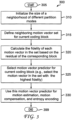
- an exemplary method for implicit adaptive motion vector prediction selection in a video encoder is indicated generally by the reference numeral 300.
- the method 300 includes a start block 305 that passes control to a function block 310.
- the function block 310 initializes the size of a neighborhood of different partition modes, and passes control to a function block 315.
- the function block 315 defines the neighboring motion vector set for the current coding block, and passes control to a function block 320.
- the function block 320 calculates the fidelity of each motion vector in the set based on the residual of the corresponding block, and passes control to a function block 325.
- the function block 325 selects the motion vector predictor for the current coding block (e.g., selecting the motion vector in the set with the highest fidelity), and passes control to a function block 330.
- the function block 330 uses this motion vector predictor for motion estimation, motion compensation, and entropy encoding, and passes control to an end block 399.
- the method 400 includes a start block 405 that passes control to a function block 410.
- the function block 410 parses an input bitstream, and passes control to a function block 415.
- the function block 415 initializes the size of a neighborhood of different partition modes, and passes control to a function block 420.
- the function block 420 defines the neighboring motion vector set for the current coding block, and passes control to a function block 425.
- the function block 425 calculates the fidelity of each motion vector in the set based on the residual of the corresponding block, and passes control to a function block 430.
- the function block 430 selects the motion vector predictor for the current coding block (e.g., selecting the motion vector in the set with the highest fidelity), and passes control to a function block 435.
- the function block 435 decodes the motion vector difference, calculates the motion vector by using the motion vector predictor, and passes control to an end block 499.
- the fidelity values of the motion vector candidates are used for a weighted median filter to derive the motion vector predictor.
- the weights in the weighted median filter indicate the number of repetitions of a value within the filter support.
- the filter support here is the neighborhood that includes all the motion vector candidates of a block. If the weight of a motion vector is n, then the motion vector will be duplicated n times when being filtered by a median filter.
- the weights are linked with the fidelity by a mapping function, which maps the fidelity to the number of repetitions of a motion vector. Then the output of the weighted median filter is taken as the motion vector predictor of the current coding block.
- the method 500 includes a start block 505 that passes control to a function block 510.
- the function block 510 initializes the size of a neighborhood of different partition modes, and passes control to a function block 515.
- the function block 515 defines the neighboring motion vector set for the current coding block, and passes control to a function block 520.
- the function block 520 calculates the fidelity of each motion vector in the set based on the residual of the corresponding block, and passes control to a function block 525.
- the function block 525 maps the fidelity to the weight of the median filter, and passes control to a function block 530.
- the function block 530 applies the weighted median filter to the motion vector predictor candidate set to obtain the motion vector predictor of the current coding block, and passes control to a function block 535.
- the function block 535 uses the motion vector predictor for motion estimation, motion compensation, and entropy encoding, and passes control to an end block 599.
- the method 600 includes a start block 605 that passes control to a function block 610.
- the function block 610 parses an input bitstream, and passes control to a function block 615.
- the function block 615 initializes the size of a neighborhood of different partition modes, and passes control to a function block 620.
- the function block 620 defines the neighboring motion vector set for the current coding block, and passes control to a function block 625.
- the function block 625 calculates the fidelity of each motion vector in the set based on the residual of the corresponding block, and passes control to a function block 630.
- the function block 630 maps the fidelity to the weight of the median filter, and passes control to a function block 635.
- the function block 635 applies the weighted median filter to the motion vector predictor candidate set to obtain the motion vector predictor of the current coding block, and passes control to a function block 640.
- the function block 640 decodes the motion vector difference, calculates the motion vector by using the motion vector predictor, and passes control to an end block 699.
- the implicit motion vector predictor selection can be combined with the explicit approach.
- the fidelities of neighboring motion vectors are generated and compared with a pre-defined threshold. If all fidelities are lower than the threshold, the explicit signaling approach is used for selecting the motion vector predictors based on the rate distortion optimization. Otherwise, the implicit signaling approach is used.
- the method 700 includes a start block 705 that passes control to a function block 710.
- the function block 710 initializes the size of a neighborhood of different partition modes, and passes control to a function block 715.
- the function block 715 defines the neighboring motion vector set for the current coding block, and passes control to a function block 720.
- the function block 720 calculates the fidelity of each motion vector in the set based on the residual of the corresponding block, and passes control to a decision block 725.
- the decision block 725 determines whether or not all fidelities are smaller than a threshold. If so, then control is passed to a function block 730.
- control is passed to a function block 740.
- the function block 730 uses the explicit motion vector predictor signaling approach based on rate distortion optimization, and passes control to a function block 735.
- the function block 740 uses the implicit motion vector predictor selection approach based on fidelity, and passes control to the function block 735.
- the function block 735 uses this motion vector predictor for motion estimation, motion compensation, and entropy encoding, and passes control to an end block 799.
- the method 800 includes a start block 805 that passes control to a function block 810.
- the function block 810 parses an input bitstream, and passes control to a function block 815.
- the function block 815 initializes the size of a neighborhood of different partition modes, and passes control to a function block 820.
- the function block 820 defines the neighboring motion vector set for the current coding block, and passes control to a function block 825.
- the function block 825 calculates the fidelity of each motion vector in the set based on the residual of the corresponding block, and passes control to a decision block 830.
- the decision block 830 determines whether or not all fidelities are smaller than a threshold. If so, then control is passed to a function block 835. Otherwise, control is passed to a function block 840.
- the function block 835 decodes the motion vector index, and passes control to a function block 840.
- the function block 845 uses the implicit motion vector predictor selection approach based on fidelity, and passes control to the function block 840.
- the function block 840 decodes the motion vector difference, calculates the motion vector by using the motion vector predictor, and passes control to an end block 899.
- TABLE 1 shows exemplary slice header syntax, in accordance with an embodiment of the present principles.
- slice_header( ) Descriptor ... use_implicit_mvp_signaling u(1) ... ⁇ macroblock() ⁇ if ( use_implicit_mvp_signaling ) ⁇ ... if ( all fidelities ⁇ threshold ) ⁇ mvp_index u(v) ⁇ ... ⁇ ... ⁇
- one advantage/feature is an apparatus having a video encoder for encoding at least a block in a picture using implicit adaptive motion vector predictor selection, wherein a motion vector for encoding the block is predicted by defining a set of motion vector predictor candidates for the block based on a plurality of spatio-temporal neighboring motion vectors, and selecting from the set a particular motion vector predictor candidate as the motion vector for encoding the block responsive to respective values for a fidelity of the spatio-temporal neighboring motion vectors.
- Another advantage/feature is the apparatus having the video encoder as described above, wherein the fidelity is a function of at least one of the motion compensation error, a motion vector magnitude, a reference index, and other motion related information which is available at both the encoder and the corresponding decoder.
- Yet another advantage/feature is the apparatus having the video encoder as described above, wherein the particular motion vector predictor candidate selected as the motion vector for encoding the block has a highest fidelity from the motion vector predictor candidates in the set.
- Still another advantage/feature is the apparatus having the video encoder as described above, wherein the respective values for the fidelity of the spatio-temporal neighboring motion vectors are used for a weighted median filter to derive the particular motion vector predictor candidate selected as the motion vector for encoding the block.
- Another advantage/feature is the apparatus having the video encoder as described above, wherein the implicit adaptive motion vector predictor selection is combined with explicit signaling of motion vector predictors in a hybrid scenario.
- another advantage/feature is the apparatus having the video encoder wherein the implicit adaptive motion vector predictor selection is combined with explicit signaling of motion vector predictors in a hybrid scenario as described above, wherein a decision of whether to use the implicit adaptive motion vector predictor selection or the explicit signaling of motion vector predictors for the block is determined responsive to an evaluation of fidelity values.
- another advantage/feature is the apparatus having the video encoder wherein the implicit adaptive motion vector predictor selection is combined with explicit signaling of motion vector predictors in a hybrid scenario as described above, wherein the explicit signaling of motion vector predictors is used at a slice level, and the decision of whether to use the implicit adaptive motion vector predictor selection or the explicit signaling of motion vector predictors for the block is made at a block level.
- the teachings of the present principles are implemented as a combination of hardware and software.
- the software may be implemented as an application program tangibly embodied on a program storage unit.
- the application program may be uploaded to, and executed by, a machine comprising any suitable architecture.
- the machine is implemented on a computer platform having hardware such as one or more central processing units (“CPU"), a random access memory (“RAM”), and input/output ("I/O") interfaces.
- CPU central processing units
- RAM random access memory
- I/O input/output
- the computer platform may also include an operating system and microinstruction code.
- the various processes and functions described herein may be either part of the microinstruction code or part of the application program, or any combination thereof, which may be executed by a CPU.
- various other peripheral units may be connected to the computer platform such as an additional data storage unit and a printing unit.
Landscapes
- Engineering & Computer Science (AREA)
- Multimedia (AREA)
- Signal Processing (AREA)
- Compression Or Coding Systems Of Tv Signals (AREA)
Claims (10)
- Appareil comprenant :un codeur vidéo (100) pour coder un bloc courant d'une image à l'aide d'un procédé de prédiction de vecteur de mouvement, dans lequelle codeur vidéo comprend :un moyen pour prédire un vecteur de mouvement du bloc courant, le vecteur de mouvement du bloc courant étant obtenu par estimation de mouvement, en définissant un ensemble de candidats prédicteurs de vecteur de mouvement pour le bloc courant en fonction des vecteurs de mouvement d'une pluralité de blocs voisins spatio-temporels du bloc courant,un moyen pour sélectionner dans l'ensemble un candidat prédicteur de vecteur de mouvement particulier comme candidat prédicteur de vecteur de mouvement sélectionné pour prédire le vecteur de mouvement du bloc courant en fonction des valeurs de confiance de prédiction respectives des vecteurs de mouvement de l'ensemble, la valeur de confiance de prédiction du vecteur de mouvement d'un bloc voisin spatio-temporel de la pluralité étant déterminée en fonction d'un ou de plusieurs paramètres relatifs aux informations de mouvement dudit bloc voisin spatio-temporel ; etun moyen pour coder le vecteur de mouvement du bloc courant sous la forme d'une différence entre le candidat prédicteur de vecteur de mouvement sélectionné et le vecteur de mouvement du bloc courant ; et dans lequel la valeur de confiance de prédiction du vecteur de mouvement d'un bloc voisin spatio-temporel de la pluralité est fonction d'au moins une erreur de compensation de mouvement, une amplitude de vecteur de mouvement ou un indice de référence.
- Procédé comprenant :le codage d'un bloc courant d'une image à l'aide d'un procédé de prédiction de vecteur de mouvement,dans lequel un vecteur de mouvement pour le codage du bloc courant est prédit par :la définition (315, 515, 715) d'un ensemble de candidats prédicteurs de vecteur de mouvement pour prédire le vecteur de mouvement du bloc courant, le vecteur de mouvement du bloc courant étant obtenu par estimation de mouvement, en fonction des vecteurs de mouvement d'une pluralité de blocs voisins spatio-temporels du bloc courant ; etla sélection (325, 530, 740) dans l'ensemble d'un candidat prédicteur de vecteur de mouvement particulier comme candidat prédicteur de vecteur de mouvement sélectionné pour prédire le vecteur de mouvement du bloc courant en fonction des valeurs de confiance de prédiction respectives des vecteurs de mouvement de l'ensemble (320, 520, 720), la valeur de confiance de prédiction du vecteur de mouvement d'un bloc voisin spatio-temporel de la pluralité étant déterminée en fonction d'un ou de plusieurs paramètres relatifs aux informations de mouvement dudit bloc voisin spatio-temporel ; etle codage du vecteur de mouvement du bloc courant sous la forme d'une différence entre le candidat prédicteur de vecteur de mouvement sélectionné et le vecteur de mouvement du bloc courant ; et dans lequel la valeur de confiance de prédiction du vecteur de mouvement d'un bloc voisin spatio-temporel de la pluralité est fonction d'au moins une erreur de compensation de mouvement, une amplitude de vecteur de mouvement ou un indice de référence.
- Procédé selon la revendication 2 ou appareil selon la revendication 1, dans lequel le candidat prédicteur de vecteur de mouvement particulier sélectionné comme prédicteur de vecteur de mouvement pour prédire le vecteur de mouvement du bloc courant présente la valeur de confiance de prédiction la plus élevée parmi les candidats prédicteurs de vecteur de mouvement de l'ensemble (325).
- Procédé selon la revendication 2 ou appareil selon la revendication 1, dans lequel les valeurs de confiance de prédiction respectives du vecteur de mouvement de l'ensemble sont utilisées pour un filtre médian pondéré pour dériver le candidat prédicteur de vecteur de mouvement particulier sélectionné comme prédicteur de vecteur de mouvement pour prédire le vecteur de mouvement du bloc courant (525, 530).
- Appareil comprenant :un décodeur vidéo (200) pour décoder un bloc courant d'une image à partir d'un flux binaire à l'aide d'un procédé de prédiction de vecteur de mouvement, dans lequel le décodeur vidéo comprendun moyen pour définir un ensemble de candidats prédicteurs de vecteur de mouvement pour le bloc courant en fonction des vecteurs de mouvement d'une pluralité de blocs voisins spatio-temporels du bloc courant,un moyen pour sélectionner dans l'ensemble un candidat prédicteur de vecteur de mouvement particulier comme candidat prédicteur de vecteur de mouvement sélectionné pour prédire le vecteur de mouvement du bloc courant en fonction des valeurs de confiance de prédiction respectives des vecteurs de mouvement de l'ensemble, la valeur de confiance de prédiction du vecteur de mouvement d'un bloc voisin spatio-temporel de la pluralité étant déterminée en fonction d'un ou de plusieurs paramètres relatifs aux informations de mouvement dudit bloc voisin spatio-temporel ;un moyen pour décoder une différence de vecteur de mouvement à partir du flux binaire ; etun moyen pour obtenir le vecteur de mouvement du bloc courant en ajoutant la différence de vecteur de mouvement au candidat prédicteur de vecteur de mouvement sélectionné ; et dans lequel la valeur de confiance de prédiction respective du vecteur de mouvement d'un bloc voisin spatio-temporel de la pluralité est fonction d'au moins une erreur de compensation de mouvement, une amplitude de vecteur de mouvement ou un indice de référence.
- Procédé comprenant :
le décodage d'un bloc courant d'une image à partir d'un flux binaire à l'aide d'un procédé de prédiction de vecteur de mouvement, dans lequel un vecteur de mouvement pour décoder le bloc courant est prédit par :la définition (420, 620, 820) d'un ensemble de candidats prédicteurs de vecteurs de mouvement pour le bloc courant en fonction des vecteurs de mouvement d'une pluralité de blocs voisins spatio-temporels du bloc courant ; etla sélection (430, 635, 845) dans l'ensemble d'un candidat prédicteur de vecteur de mouvement particulier comme candidat prédicteur de vecteur de mouvement sélectionné pour prédire le vecteur de mouvement du bloc courant en fonction des valeurs de confiance de prédiction respectives des vecteurs de mouvement de l'ensemble (425, 625, 825), la valeur de confiance de prédiction d'un vecteur de mouvement d'un bloc voisin étant déterminée en fonction d'un ou de plusieurs paramètres relatifs aux informations de mouvement dudit bloc voisin spatio-temporel ;le décodage d'une différence de vecteur de mouvement à partir du flux binaire ; etl'obtention du vecteur de mouvement du bloc courant en ajoutant la différence de vecteur de mouvement au candidat prédicteur de vecteur de mouvement sélectionné ; et dans lequel la valeur de confiance de prédiction respective du vecteur de mouvement d'un bloc voisin spatio-temporel de la pluralité est fonction d'au moins une erreur de compensation de mouvement, une amplitude de vecteur de mouvement ou un indice de référence. - Procédé selon la revendication 6 ou appareil selon la revendication 5, dans lequel le candidat prédicteur de vecteur de mouvement particulier sélectionné comme prédicteur de vecteur de mouvement pour prédire le vecteur de mouvement du bloc courant est celui qui présente la valeur de confiance de prédiction la plus élevée parmi les candidats prédicteurs de vecteur de mouvement de l'ensemble (430).
- Procédé selon la revendication 6 ou appareil selon la revendication 5, dans lequel les valeurs de confiance de prédiction respectives des vecteurs de mouvement de l'ensemble sont utilisées pour un filtre médian pondéré pour dériver le candidat prédicteur de vecteur de mouvement particulier sélectionné comme prédicteur de vecteur de mouvement pour prédire le vecteur de mouvement du bloc courant (630, 635).
- Programme informatique comprenant des instructions de code de programme qui, lorsqu'elles sont exécutées par un processeur de l'appareil selon la revendication 1, mettent en oeuvre le procédé selon l'une quelconque des revendications 2 à 4, ou, lorsqu'elles sont exécutées par un processeur de l'appareil selon la revendication 5, mettent en oeuvre le procédé selon l'une quelconque des revendications 6 à 8.
- Support de stockage d'informations sur lequel sont stockées des instructions de code de programme qui, lorsqu'elles sont exécutées par un processeur de l'appareil de la revendication 1, mettent en oeuvre le procédé selon l'une quelconque des revendications 2 à 4, ou, lorsqu'elles sont exécutées par un processeur de l'appareil selon la revendication 5, mettent en oeuvre le procédé selon l'une quelconque des revendications 6 à 8.
Applications Claiming Priority (2)
| Application Number | Priority Date | Filing Date | Title |
|---|---|---|---|
| US31450610P | 2010-03-16 | 2010-03-16 | |
| PCT/US2011/000421 WO2011115659A1 (fr) | 2010-03-16 | 2011-03-03 | Procédés et dispositif de sélection implicite de prédicteur de vecteur de mouvement adaptatif pour codage et décodage vidéo |
Publications (2)
| Publication Number | Publication Date |
|---|---|
| EP2548372A1 EP2548372A1 (fr) | 2013-01-23 |
| EP2548372B1 true EP2548372B1 (fr) | 2023-02-15 |
Family
ID=44231283
Family Applications (1)
| Application Number | Title | Priority Date | Filing Date |
|---|---|---|---|
| EP11708948.2A Active EP2548372B1 (fr) | 2010-03-16 | 2011-03-03 | Procédés et dispositif de sélection implicite de prédicteur de vecteur de mouvement adaptatif pour codage et décodage vidéo |
Country Status (7)
| Country | Link |
|---|---|
| US (1) | US9628788B2 (fr) |
| EP (1) | EP2548372B1 (fr) |
| JP (1) | JP5882984B2 (fr) |
| KR (1) | KR101952606B1 (fr) |
| CN (1) | CN102812706B (fr) |
| BR (1) | BR112012023319A2 (fr) |
| WO (1) | WO2011115659A1 (fr) |
Families Citing this family (33)
| Publication number | Priority date | Publication date | Assignee | Title |
|---|---|---|---|---|
| ES2883353T3 (es) * | 2011-06-28 | 2021-12-07 | Lg Electronics Inc | Método para obtener un predictor de vector de movimiento |
| TWI552577B (zh) * | 2011-10-31 | 2016-10-01 | Jvc Kenwood Corp | Motion picture decoding device, dynamic image decoding method, and dynamic image decoding program product |
| US9571833B2 (en) * | 2011-11-04 | 2017-02-14 | Nokia Technologies Oy | Method for coding and an apparatus |
| KR20130050405A (ko) * | 2011-11-07 | 2013-05-16 | 오수미 | 인터 모드에서의 시간 후보자 결정방법 |
| JP5485969B2 (ja) * | 2011-11-07 | 2014-05-07 | 株式会社Nttドコモ | 動画像予測符号化装置、動画像予測符号化方法、動画像予測符号化プログラム、動画像予測復号装置、動画像予測復号方法及び動画像予測復号プログラム |
| CN107493474B (zh) | 2011-11-08 | 2021-01-12 | 株式会社Kt | 利用解码装置对视频信号进行解码的方法 |
| TWI580264B (zh) * | 2011-11-10 | 2017-04-21 | Sony Corp | Image processing apparatus and method |
| CN103108178B (zh) | 2011-11-11 | 2016-03-30 | 华为技术有限公司 | 视频图像编解码的方法及装置 |
| BR112014013969B1 (pt) * | 2011-12-28 | 2022-05-10 | JVC Kenwood Corporation | Dispositivo de codificação de vídeo, método de codificação de vídeo, programa de codificação de vídeo, dispositivo de decodificação de vídeo, método de decodificação de vídeo, programa de decodificação de vídeo |
| US20150085932A1 (en) | 2012-04-24 | 2015-03-26 | Mediatek Inc. | Method and apparatus of motion vector derivation for 3d video coding |
| PL400344A1 (pl) * | 2012-08-13 | 2014-02-17 | Politechnika Poznanska | Sposób wyznaczania predyktora wektora ruchu |
| US10812829B2 (en) * | 2012-10-03 | 2020-10-20 | Avago Technologies International Sales Pte. Limited | 2D block image encoding |
| US9978156B2 (en) * | 2012-10-03 | 2018-05-22 | Avago Technologies General Ip (Singapore) Pte. Ltd. | High-throughput image and video compression |
| US9883180B2 (en) | 2012-10-03 | 2018-01-30 | Avago Technologies General Ip (Singapore) Pte. Ltd. | Bounded rate near-lossless and lossless image compression |
| EP2904806B1 (fr) * | 2012-10-03 | 2020-09-02 | Avago Technologies International Sales Pte. Limited | Codage d'image par blocs bidimensionnels |
| US10609405B2 (en) | 2013-03-18 | 2020-03-31 | Ecole De Technologie Superieure | Optimal signal encoding based on experimental data |
| US9338450B2 (en) * | 2013-03-18 | 2016-05-10 | Ecole De Technologie Superieure | Method and apparatus for signal encoding producing encoded signals of high fidelity at minimal sizes |
| US9661331B2 (en) | 2013-03-18 | 2017-05-23 | Vantrix Corporation | Method and apparatus for signal encoding realizing optimal fidelity |
| KR101649120B1 (ko) | 2015-01-23 | 2016-08-18 | 오스템임플란트 주식회사 | 흡수성 치주조직 재생막 및 이를 보관하는 앰플 |
| US10390033B2 (en) | 2016-06-06 | 2019-08-20 | Google Llc | Adaptive overlapped block prediction in variable block size video coding |
| US20170359575A1 (en) * | 2016-06-09 | 2017-12-14 | Apple Inc. | Non-Uniform Digital Image Fidelity and Video Coding |
| CN109565595B (zh) * | 2016-06-24 | 2021-06-22 | 华为技术有限公司 | 一种使用基于分割的视频编码块划分的视频编码设备和方法 |
| US10999602B2 (en) | 2016-12-23 | 2021-05-04 | Apple Inc. | Sphere projected motion estimation/compensation and mode decision |
| US11259046B2 (en) | 2017-02-15 | 2022-02-22 | Apple Inc. | Processing of equirectangular object data to compensate for distortion by spherical projections |
| US10924747B2 (en) | 2017-02-27 | 2021-02-16 | Apple Inc. | Video coding techniques for multi-view video |
| US10491917B2 (en) * | 2017-03-22 | 2019-11-26 | Qualcomm Incorporated | Decoder-side motion vector derivation |
| CN107094251B (zh) * | 2017-03-31 | 2021-07-23 | 浙江大学 | 一种基于空间位置自适应质量调整的视频、图像编解码方法及装置 |
| US11093752B2 (en) | 2017-06-02 | 2021-08-17 | Apple Inc. | Object tracking in multi-view video |
| US10754242B2 (en) | 2017-06-30 | 2020-08-25 | Apple Inc. | Adaptive resolution and projection format in multi-direction video |
| CH714289A2 (de) | 2017-10-31 | 2019-05-15 | Tecpharma Licensing Ag | Stromversorgung Zusatzmodul. |
| US10623746B2 (en) * | 2017-12-07 | 2020-04-14 | Tencent America LLC | Method and apparatus for video coding |
| EP3550834A1 (fr) * | 2018-04-06 | 2019-10-09 | Comcast Cable Communications LLC | Codage de fondus enchaînés de vidéo par inter-prédiction pondérée |
| KR102214669B1 (ko) | 2020-04-09 | 2021-02-10 | 동아대학교 산학협력단 | 수정 하이브리드 메디안 필터로 최적화한 하드웨어 구조 추론 방법 |
Citations (1)
| Publication number | Priority date | Publication date | Assignee | Title |
|---|---|---|---|---|
| US20050053136A1 (en) * | 2003-09-09 | 2005-03-10 | Keman Yu | Low complexity real-time video coding |
Family Cites Families (14)
| Publication number | Priority date | Publication date | Assignee | Title |
|---|---|---|---|---|
| US5546130A (en) * | 1993-10-11 | 1996-08-13 | Thomson Consumer Electronics S.A. | Method and apparatus for forming a video signal using motion estimation and signal paths with different interpolation processing |
| KR100739281B1 (ko) * | 2000-02-21 | 2007-07-12 | 주식회사 팬택앤큐리텔 | 움직임 추정 방법 및 장치 |
| EP1294194B8 (fr) * | 2001-09-10 | 2010-08-04 | Texas Instruments Incorporated | Procédé et appareil pour l'estimation des vecteurs de mouvement |
| US20030123738A1 (en) * | 2001-11-30 | 2003-07-03 | Per Frojdh | Global motion compensation for video pictures |
| BR0316963A (pt) * | 2002-12-04 | 2005-10-25 | Thomson Licensing Sa | Codificação de fusões de vìdeo usando predição ponderada |
| KR100579493B1 (ko) | 2003-06-16 | 2006-05-15 | 삼성전자주식회사 | 움직임 벡터 생성 장치 및 방법 |
| US20060012719A1 (en) * | 2004-07-12 | 2006-01-19 | Nokia Corporation | System and method for motion prediction in scalable video coding |
| US20070131269A1 (en) | 2005-12-09 | 2007-06-14 | Biprodas Dutta | High density nanowire arrays in glassy matrix |
| WO2007078800A1 (fr) * | 2005-12-15 | 2007-07-12 | Analog Devices, Inc. | Estimation de mouvement utilisant une recherche decimee guidee par une prediction |
| KR101383540B1 (ko) | 2007-01-03 | 2014-04-09 | 삼성전자주식회사 | 복수의 움직임 벡터 프리딕터들을 사용하여 움직임 벡터를추정하는 방법, 장치, 인코더, 디코더 및 복호화 방법 |
| US20080247465A1 (en) * | 2007-04-05 | 2008-10-09 | Jun Xin | Method and System for Mapping Motion Vectors between Different Size Blocks |
| WO2009115901A2 (fr) * | 2008-03-19 | 2009-09-24 | Nokia Corporation | Vecteur de mouvement combiné et prédiction d'indice de référence pour codage vidéo |
| JP2010016453A (ja) | 2008-07-01 | 2010-01-21 | Sony Corp | 画像符号化装置および方法、画像復号装置および方法、並びにプログラム |
| KR101768207B1 (ko) * | 2010-01-19 | 2017-08-16 | 삼성전자주식회사 | 축소된 예측 움직임 벡터의 후보들에 기초해 움직임 벡터를 부호화, 복호화하는 방법 및 장치 |
-
2011
- 2011-03-03 CN CN201180014338.7A patent/CN102812706B/zh active Active
- 2011-03-03 BR BR112012023319A patent/BR112012023319A2/pt active Search and Examination
- 2011-03-03 EP EP11708948.2A patent/EP2548372B1/fr active Active
- 2011-03-03 KR KR1020127023953A patent/KR101952606B1/ko active Active
- 2011-03-03 US US13/634,663 patent/US9628788B2/en active Active
- 2011-03-03 WO PCT/US2011/000421 patent/WO2011115659A1/fr not_active Ceased
- 2011-03-03 JP JP2013500043A patent/JP5882984B2/ja active Active
Patent Citations (1)
| Publication number | Priority date | Publication date | Assignee | Title |
|---|---|---|---|---|
| US20050053136A1 (en) * | 2003-09-09 | 2005-03-10 | Keman Yu | Low complexity real-time video coding |
Also Published As
| Publication number | Publication date |
|---|---|
| CN102812706A (zh) | 2012-12-05 |
| US9628788B2 (en) | 2017-04-18 |
| EP2548372A1 (fr) | 2013-01-23 |
| BR112012023319A2 (pt) | 2016-05-24 |
| KR101952606B1 (ko) | 2019-02-27 |
| JP2013523010A (ja) | 2013-06-13 |
| JP5882984B2 (ja) | 2016-03-09 |
| WO2011115659A1 (fr) | 2011-09-22 |
| KR20130006616A (ko) | 2013-01-17 |
| CN102812706B (zh) | 2016-11-02 |
| US20130208787A1 (en) | 2013-08-15 |
Similar Documents
| Publication | Publication Date | Title |
|---|---|---|
| EP2548372B1 (fr) | Procédés et dispositif de sélection implicite de prédicteur de vecteur de mouvement adaptatif pour codage et décodage vidéo | |
| US12425637B2 (en) | Methods and apparatus for adaptive motion vector candidate ordering for video encoding and decoding | |
| US11722669B2 (en) | Methods and apparatus for determining quantization parameter predictors from a plurality of neighboring quantization parameters | |
| US9288494B2 (en) | Methods and apparatus for implicit and semi-implicit intra mode signaling for video encoders and decoders | |
| US8750377B2 (en) | Method and apparatus for context dependent merging for skip-direct modes for video encoding and decoding | |
| US9277227B2 (en) | Methods and apparatus for DC intra prediction mode for video encoding and decoding | |
| EP3633996A1 (fr) | Procédés et appareil de codage adaptatif d'informations de mouvement | |
| US20110261882A1 (en) | Methods and apparatus for template matching prediction (tmp) in video encoding and decoding | |
| EP2621174A2 (fr) | Procédés et appareil pour la prédiction adaptative par mise en correspondence de modèles dans le codage et le décodage de vidéos | |
| US10291930B2 (en) | Methods and apparatus for uni-prediction of self-derivation of motion estimation |
Legal Events
| Date | Code | Title | Description |
|---|---|---|---|
| PUAI | Public reference made under article 153(3) epc to a published international application that has entered the european phase |
Free format text: ORIGINAL CODE: 0009012 |
|
| 17P | Request for examination filed |
Effective date: 20120927 |
|
| AK | Designated contracting states |
Kind code of ref document: A1 Designated state(s): AL AT BE BG CH CY CZ DE DK EE ES FI FR GB GR HR HU IE IS IT LI LT LU LV MC MK MT NL NO PL PT RO RS SE SI SK SM TR |
|
| DAX | Request for extension of the european patent (deleted) | ||
| RAP1 | Party data changed (applicant data changed or rights of an application transferred) |
Owner name: THOMSON LICENSING DTV |
|
| RAP1 | Party data changed (applicant data changed or rights of an application transferred) |
Owner name: INTERDIGITAL MADISON PATENT HOLDINGS |
|
| STAA | Information on the status of an ep patent application or granted ep patent |
Free format text: STATUS: EXAMINATION IS IN PROGRESS |
|
| 17Q | First examination report despatched |
Effective date: 20190401 |
|
| REG | Reference to a national code |
Ref country code: DE Ref legal event code: R079 Ref document number: 602011073661 Country of ref document: DE Free format text: PREVIOUS MAIN CLASS: H04N0007260000 Ipc: H04N0019460000 |
|
| GRAJ | Information related to disapproval of communication of intention to grant by the applicant or resumption of examination proceedings by the epo deleted |
Free format text: ORIGINAL CODE: EPIDOSDIGR1 |
|
| STAA | Information on the status of an ep patent application or granted ep patent |
Free format text: STATUS: GRANT OF PATENT IS INTENDED |
|
| GRAP | Despatch of communication of intention to grant a patent |
Free format text: ORIGINAL CODE: EPIDOSNIGR1 |
|
| RIC1 | Information provided on ipc code assigned before grant |
Ipc: H04N 19/109 20140101ALI20210916BHEP Ipc: H04N 19/70 20140101ALI20210916BHEP Ipc: H04N 19/61 20140101ALI20210916BHEP Ipc: H04N 19/567 20140101ALI20210916BHEP Ipc: H04N 19/56 20140101ALI20210916BHEP Ipc: H04N 19/52 20140101ALI20210916BHEP Ipc: H04N 19/513 20140101ALI20210916BHEP Ipc: H04N 19/46 20140101AFI20210916BHEP |
|
| INTG | Intention to grant announced |
Effective date: 20211006 |
|
| RIN1 | Information on inventor provided before grant (corrected) |
Inventor name: XU, QIAN Inventor name: LU, XIAOAN Inventor name: SOLE, JOEL Inventor name: YIN, PENG Inventor name: ZHENG, YUNFEI |
|
| GRAJ | Information related to disapproval of communication of intention to grant by the applicant or resumption of examination proceedings by the epo deleted |
Free format text: ORIGINAL CODE: EPIDOSDIGR1 |
|
| STAA | Information on the status of an ep patent application or granted ep patent |
Free format text: STATUS: EXAMINATION IS IN PROGRESS |
|
| INTC | Intention to grant announced (deleted) | ||
| GRAP | Despatch of communication of intention to grant a patent |
Free format text: ORIGINAL CODE: EPIDOSNIGR1 |
|
| STAA | Information on the status of an ep patent application or granted ep patent |
Free format text: STATUS: GRANT OF PATENT IS INTENDED |
|
| INTG | Intention to grant announced |
Effective date: 20220401 |
|
| GRAJ | Information related to disapproval of communication of intention to grant by the applicant or resumption of examination proceedings by the epo deleted |
Free format text: ORIGINAL CODE: EPIDOSDIGR1 |
|
| STAA | Information on the status of an ep patent application or granted ep patent |
Free format text: STATUS: EXAMINATION IS IN PROGRESS |
|
| INTC | Intention to grant announced (deleted) | ||
| GRAP | Despatch of communication of intention to grant a patent |
Free format text: ORIGINAL CODE: EPIDOSNIGR1 |
|
| STAA | Information on the status of an ep patent application or granted ep patent |
Free format text: STATUS: GRANT OF PATENT IS INTENDED |
|
| INTG | Intention to grant announced |
Effective date: 20220901 |
|
| RAP3 | Party data changed (applicant data changed or rights of an application transferred) |
Owner name: INTERDIGITAL MADISON PATENT HOLDINGS, SAS |
|
| GRAS | Grant fee paid |
Free format text: ORIGINAL CODE: EPIDOSNIGR3 |
|
| GRAA | (expected) grant |
Free format text: ORIGINAL CODE: 0009210 |
|
| STAA | Information on the status of an ep patent application or granted ep patent |
Free format text: STATUS: THE PATENT HAS BEEN GRANTED |
|
| AK | Designated contracting states |
Kind code of ref document: B1 Designated state(s): AL AT BE BG CH CY CZ DE DK EE ES FI FR GB GR HR HU IE IS IT LI LT LU LV MC MK MT NL NO PL PT RO RS SE SI SK SM TR |
|
| REG | Reference to a national code |
Ref country code: CH Ref legal event code: EP Ref country code: GB Ref legal event code: FG4D |
|
| REG | Reference to a national code |
Ref country code: DE Ref legal event code: R096 Ref document number: 602011073661 Country of ref document: DE |
|
| REG | Reference to a national code |
Ref country code: AT Ref legal event code: REF Ref document number: 1548867 Country of ref document: AT Kind code of ref document: T Effective date: 20230315 Ref country code: IE Ref legal event code: FG4D |
|
| REG | Reference to a national code |
Ref country code: NL Ref legal event code: FP |
|
| REG | Reference to a national code |
Ref country code: LT Ref legal event code: MG9D |
|
| P01 | Opt-out of the competence of the unified patent court (upc) registered |
Effective date: 20230514 |
|
| REG | Reference to a national code |
Ref country code: AT Ref legal event code: MK05 Ref document number: 1548867 Country of ref document: AT Kind code of ref document: T Effective date: 20230215 |
|
| PG25 | Lapsed in a contracting state [announced via postgrant information from national office to epo] |
Ref country code: RS Free format text: LAPSE BECAUSE OF FAILURE TO SUBMIT A TRANSLATION OF THE DESCRIPTION OR TO PAY THE FEE WITHIN THE PRESCRIBED TIME-LIMIT Effective date: 20230215 Ref country code: PT Free format text: LAPSE BECAUSE OF FAILURE TO SUBMIT A TRANSLATION OF THE DESCRIPTION OR TO PAY THE FEE WITHIN THE PRESCRIBED TIME-LIMIT Effective date: 20230615 Ref country code: NO Free format text: LAPSE BECAUSE OF FAILURE TO SUBMIT A TRANSLATION OF THE DESCRIPTION OR TO PAY THE FEE WITHIN THE PRESCRIBED TIME-LIMIT Effective date: 20230515 Ref country code: LV Free format text: LAPSE BECAUSE OF FAILURE TO SUBMIT A TRANSLATION OF THE DESCRIPTION OR TO PAY THE FEE WITHIN THE PRESCRIBED TIME-LIMIT Effective date: 20230215 Ref country code: LT Free format text: LAPSE BECAUSE OF FAILURE TO SUBMIT A TRANSLATION OF THE DESCRIPTION OR TO PAY THE FEE WITHIN THE PRESCRIBED TIME-LIMIT Effective date: 20230215 Ref country code: HR Free format text: LAPSE BECAUSE OF FAILURE TO SUBMIT A TRANSLATION OF THE DESCRIPTION OR TO PAY THE FEE WITHIN THE PRESCRIBED TIME-LIMIT Effective date: 20230215 Ref country code: ES Free format text: LAPSE BECAUSE OF FAILURE TO SUBMIT A TRANSLATION OF THE DESCRIPTION OR TO PAY THE FEE WITHIN THE PRESCRIBED TIME-LIMIT Effective date: 20230215 Ref country code: AT Free format text: LAPSE BECAUSE OF FAILURE TO SUBMIT A TRANSLATION OF THE DESCRIPTION OR TO PAY THE FEE WITHIN THE PRESCRIBED TIME-LIMIT Effective date: 20230215 |
|
| PG25 | Lapsed in a contracting state [announced via postgrant information from national office to epo] |
Ref country code: SE Free format text: LAPSE BECAUSE OF FAILURE TO SUBMIT A TRANSLATION OF THE DESCRIPTION OR TO PAY THE FEE WITHIN THE PRESCRIBED TIME-LIMIT Effective date: 20230215 Ref country code: PL Free format text: LAPSE BECAUSE OF FAILURE TO SUBMIT A TRANSLATION OF THE DESCRIPTION OR TO PAY THE FEE WITHIN THE PRESCRIBED TIME-LIMIT Effective date: 20230215 Ref country code: IS Free format text: LAPSE BECAUSE OF FAILURE TO SUBMIT A TRANSLATION OF THE DESCRIPTION OR TO PAY THE FEE WITHIN THE PRESCRIBED TIME-LIMIT Effective date: 20230615 Ref country code: GR Free format text: LAPSE BECAUSE OF FAILURE TO SUBMIT A TRANSLATION OF THE DESCRIPTION OR TO PAY THE FEE WITHIN THE PRESCRIBED TIME-LIMIT Effective date: 20230516 Ref country code: FI Free format text: LAPSE BECAUSE OF FAILURE TO SUBMIT A TRANSLATION OF THE DESCRIPTION OR TO PAY THE FEE WITHIN THE PRESCRIBED TIME-LIMIT Effective date: 20230215 |
|
| PG25 | Lapsed in a contracting state [announced via postgrant information from national office to epo] |
Ref country code: SM Free format text: LAPSE BECAUSE OF FAILURE TO SUBMIT A TRANSLATION OF THE DESCRIPTION OR TO PAY THE FEE WITHIN THE PRESCRIBED TIME-LIMIT Effective date: 20230215 Ref country code: RO Free format text: LAPSE BECAUSE OF FAILURE TO SUBMIT A TRANSLATION OF THE DESCRIPTION OR TO PAY THE FEE WITHIN THE PRESCRIBED TIME-LIMIT Effective date: 20230215 Ref country code: EE Free format text: LAPSE BECAUSE OF FAILURE TO SUBMIT A TRANSLATION OF THE DESCRIPTION OR TO PAY THE FEE WITHIN THE PRESCRIBED TIME-LIMIT Effective date: 20230215 Ref country code: DK Free format text: LAPSE BECAUSE OF FAILURE TO SUBMIT A TRANSLATION OF THE DESCRIPTION OR TO PAY THE FEE WITHIN THE PRESCRIBED TIME-LIMIT Effective date: 20230215 Ref country code: CZ Free format text: LAPSE BECAUSE OF FAILURE TO SUBMIT A TRANSLATION OF THE DESCRIPTION OR TO PAY THE FEE WITHIN THE PRESCRIBED TIME-LIMIT Effective date: 20230215 |
|
| REG | Reference to a national code |
Ref country code: CH Ref legal event code: PL |
|
| REG | Reference to a national code |
Ref country code: DE Ref legal event code: R097 Ref document number: 602011073661 Country of ref document: DE |
|
| PG25 | Lapsed in a contracting state [announced via postgrant information from national office to epo] |
Ref country code: SK Free format text: LAPSE BECAUSE OF FAILURE TO SUBMIT A TRANSLATION OF THE DESCRIPTION OR TO PAY THE FEE WITHIN THE PRESCRIBED TIME-LIMIT Effective date: 20230215 |
|
| REG | Reference to a national code |
Ref country code: BE Ref legal event code: MM Effective date: 20230331 |
|
| PLBE | No opposition filed within time limit |
Free format text: ORIGINAL CODE: 0009261 |
|
| STAA | Information on the status of an ep patent application or granted ep patent |
Free format text: STATUS: NO OPPOSITION FILED WITHIN TIME LIMIT |
|
| PG25 | Lapsed in a contracting state [announced via postgrant information from national office to epo] |
Ref country code: LU Free format text: LAPSE BECAUSE OF NON-PAYMENT OF DUE FEES Effective date: 20230303 |
|
| PG25 | Lapsed in a contracting state [announced via postgrant information from national office to epo] |
Ref country code: MC Free format text: LAPSE BECAUSE OF FAILURE TO SUBMIT A TRANSLATION OF THE DESCRIPTION OR TO PAY THE FEE WITHIN THE PRESCRIBED TIME-LIMIT Effective date: 20230215 |
|
| REG | Reference to a national code |
Ref country code: IE Ref legal event code: MM4A |
|
| 26N | No opposition filed |
Effective date: 20231116 |
|
| PG25 | Lapsed in a contracting state [announced via postgrant information from national office to epo] |
Ref country code: SI Free format text: LAPSE BECAUSE OF FAILURE TO SUBMIT A TRANSLATION OF THE DESCRIPTION OR TO PAY THE FEE WITHIN THE PRESCRIBED TIME-LIMIT Effective date: 20230215 Ref country code: MC Free format text: LAPSE BECAUSE OF FAILURE TO SUBMIT A TRANSLATION OF THE DESCRIPTION OR TO PAY THE FEE WITHIN THE PRESCRIBED TIME-LIMIT Effective date: 20230215 Ref country code: LI Free format text: LAPSE BECAUSE OF NON-PAYMENT OF DUE FEES Effective date: 20230331 Ref country code: IE Free format text: LAPSE BECAUSE OF NON-PAYMENT OF DUE FEES Effective date: 20230303 Ref country code: CH Free format text: LAPSE BECAUSE OF NON-PAYMENT OF DUE FEES Effective date: 20230331 |
|
| PG25 | Lapsed in a contracting state [announced via postgrant information from national office to epo] |
Ref country code: BE Free format text: LAPSE BECAUSE OF NON-PAYMENT OF DUE FEES Effective date: 20230331 |
|
| PG25 | Lapsed in a contracting state [announced via postgrant information from national office to epo] |
Ref country code: IT Free format text: LAPSE BECAUSE OF FAILURE TO SUBMIT A TRANSLATION OF THE DESCRIPTION OR TO PAY THE FEE WITHIN THE PRESCRIBED TIME-LIMIT Effective date: 20230215 |
|
| PG25 | Lapsed in a contracting state [announced via postgrant information from national office to epo] |
Ref country code: BG Free format text: LAPSE BECAUSE OF FAILURE TO SUBMIT A TRANSLATION OF THE DESCRIPTION OR TO PAY THE FEE WITHIN THE PRESCRIBED TIME-LIMIT Effective date: 20230215 |
|
| PG25 | Lapsed in a contracting state [announced via postgrant information from national office to epo] |
Ref country code: BG Free format text: LAPSE BECAUSE OF FAILURE TO SUBMIT A TRANSLATION OF THE DESCRIPTION OR TO PAY THE FEE WITHIN THE PRESCRIBED TIME-LIMIT Effective date: 20230215 |
|
| PG25 | Lapsed in a contracting state [announced via postgrant information from national office to epo] |
Ref country code: CY Free format text: LAPSE BECAUSE OF FAILURE TO SUBMIT A TRANSLATION OF THE DESCRIPTION OR TO PAY THE FEE WITHIN THE PRESCRIBED TIME-LIMIT; INVALID AB INITIO Effective date: 20110303 |
|
| PG25 | Lapsed in a contracting state [announced via postgrant information from national office to epo] |
Ref country code: HU Free format text: LAPSE BECAUSE OF FAILURE TO SUBMIT A TRANSLATION OF THE DESCRIPTION OR TO PAY THE FEE WITHIN THE PRESCRIBED TIME-LIMIT; INVALID AB INITIO Effective date: 20110303 |
|
| PG25 | Lapsed in a contracting state [announced via postgrant information from national office to epo] |
Ref country code: TR Free format text: LAPSE BECAUSE OF FAILURE TO SUBMIT A TRANSLATION OF THE DESCRIPTION OR TO PAY THE FEE WITHIN THE PRESCRIBED TIME-LIMIT Effective date: 20230215 |
|
| PGFP | Annual fee paid to national office [announced via postgrant information from national office to epo] |
Ref country code: GB Payment date: 20260319 Year of fee payment: 16 |
|
| PGFP | Annual fee paid to national office [announced via postgrant information from national office to epo] |
Ref country code: DE Payment date: 20260320 Year of fee payment: 16 |
|
| PGFP | Annual fee paid to national office [announced via postgrant information from national office to epo] |
Ref country code: NL Payment date: 20260323 Year of fee payment: 16 |
|
| PGFP | Annual fee paid to national office [announced via postgrant information from national office to epo] |
Ref country code: FR Payment date: 20260323 Year of fee payment: 16 |