EP2549205A2 - Dampfabsorptionskühlsystem mit Dreifachwirkung - Google Patents
Dampfabsorptionskühlsystem mit Dreifachwirkung Download PDFInfo
- Publication number
- EP2549205A2 EP2549205A2 EP12173027.9A EP12173027A EP2549205A2 EP 2549205 A2 EP2549205 A2 EP 2549205A2 EP 12173027 A EP12173027 A EP 12173027A EP 2549205 A2 EP2549205 A2 EP 2549205A2
- Authority
- EP
- European Patent Office
- Prior art keywords
- solution
- temperature
- range
- heat exchanger
- dilute
- Prior art date
- Legal status (The legal status is an assumption and is not a legal conclusion. Google has not performed a legal analysis and makes no representation as to the accuracy of the status listed.)
- Withdrawn
Links
- 238000005057 refrigeration Methods 0.000 title claims abstract description 66
- 238000010521 absorption reaction Methods 0.000 title claims abstract description 64
- 239000006096 absorbing agent Substances 0.000 claims abstract description 45
- 239000007789 gas Substances 0.000 claims abstract description 13
- 230000007797 corrosion Effects 0.000 claims abstract description 10
- 238000005260 corrosion Methods 0.000 claims abstract description 10
- 239000000243 solution Substances 0.000 claims description 209
- XLYOFNOQVPJJNP-UHFFFAOYSA-N water Substances O XLYOFNOQVPJJNP-UHFFFAOYSA-N 0.000 claims description 89
- 238000000034 method Methods 0.000 claims description 43
- 238000010438 heat treatment Methods 0.000 claims description 19
- 230000008016 vaporization Effects 0.000 claims description 16
- 230000000694 effects Effects 0.000 claims description 15
- 238000004891 communication Methods 0.000 claims description 12
- 239000000498 cooling water Substances 0.000 claims description 11
- 239000012141 concentrate Substances 0.000 claims description 7
- 238000010790 dilution Methods 0.000 claims description 7
- 239000012895 dilution Substances 0.000 claims description 7
- 230000005484 gravity Effects 0.000 claims description 6
- 238000001704 evaporation Methods 0.000 claims description 3
- AMXOYNBUYSYVKV-UHFFFAOYSA-M lithium bromide Chemical compound [Li+].[Br-] AMXOYNBUYSYVKV-UHFFFAOYSA-M 0.000 description 305
- 239000003507 refrigerant Substances 0.000 description 16
- 239000007788 liquid Substances 0.000 description 11
- 239000002250 absorbent Substances 0.000 description 10
- 239000000284 extract Substances 0.000 description 10
- 230000002745 absorbent Effects 0.000 description 8
- 238000012546 transfer Methods 0.000 description 6
- 230000006835 compression Effects 0.000 description 5
- 238000007906 compression Methods 0.000 description 5
- 238000002425 crystallisation Methods 0.000 description 5
- 230000008025 crystallization Effects 0.000 description 5
- 238000001816 cooling Methods 0.000 description 4
- 239000002274 desiccant Substances 0.000 description 4
- 238000005086 pumping Methods 0.000 description 4
- HEMHJVSKTPXQMS-UHFFFAOYSA-M Sodium hydroxide Chemical compound [OH-].[Na+] HEMHJVSKTPXQMS-UHFFFAOYSA-M 0.000 description 3
- 239000000567 combustion gas Substances 0.000 description 3
- 239000000446 fuel Substances 0.000 description 3
- 229940059936 lithium bromide Drugs 0.000 description 3
- 230000001172 regenerating effect Effects 0.000 description 3
- 238000002485 combustion reaction Methods 0.000 description 2
- 238000004134 energy conservation Methods 0.000 description 2
- 238000012986 modification Methods 0.000 description 2
- 230000004048 modification Effects 0.000 description 2
- 238000009834 vaporization Methods 0.000 description 2
- 239000002918 waste heat Substances 0.000 description 2
- CBENFWSGALASAD-UHFFFAOYSA-N Ozone Chemical compound [O-][O+]=O CBENFWSGALASAD-UHFFFAOYSA-N 0.000 description 1
- 238000004378 air conditioning Methods 0.000 description 1
- WYTGDNHDOZPMIW-RCBQFDQVSA-N alstonine Natural products C1=CC2=C3C=CC=CC3=NC2=C2N1C[C@H]1[C@H](C)OC=C(C(=O)OC)[C@H]1C2 WYTGDNHDOZPMIW-RCBQFDQVSA-N 0.000 description 1
- 238000005267 amalgamation Methods 0.000 description 1
- 230000006378 damage Effects 0.000 description 1
- 230000000779 depleting effect Effects 0.000 description 1
- 238000011161 development Methods 0.000 description 1
- 230000018109 developmental process Effects 0.000 description 1
- 238000007599 discharging Methods 0.000 description 1
- 230000005611 electricity Effects 0.000 description 1
- 230000007613 environmental effect Effects 0.000 description 1
- 230000007717 exclusion Effects 0.000 description 1
- 238000010304 firing Methods 0.000 description 1
- 239000003546 flue gas Substances 0.000 description 1
- 239000012530 fluid Substances 0.000 description 1
- 239000002803 fossil fuel Substances 0.000 description 1
- 239000004615 ingredient Substances 0.000 description 1
- IPLONMMJNGTUAI-UHFFFAOYSA-M lithium;bromide;hydrate Chemical compound [Li+].O.[Br-] IPLONMMJNGTUAI-UHFFFAOYSA-M 0.000 description 1
- 239000000463 material Substances 0.000 description 1
- 238000012544 monitoring process Methods 0.000 description 1
- 230000003449 preventive effect Effects 0.000 description 1
- 230000008929 regeneration Effects 0.000 description 1
- 238000011069 regeneration method Methods 0.000 description 1
Images


Classifications
-
- F—MECHANICAL ENGINEERING; LIGHTING; HEATING; WEAPONS; BLASTING
- F25—REFRIGERATION OR COOLING; COMBINED HEATING AND REFRIGERATION SYSTEMS; HEAT PUMP SYSTEMS; MANUFACTURE OR STORAGE OF ICE; LIQUEFACTION SOLIDIFICATION OF GASES
- F25B—REFRIGERATION MACHINES, PLANTS OR SYSTEMS; COMBINED HEATING AND REFRIGERATION SYSTEMS; HEAT PUMP SYSTEMS
- F25B15/00—Sorption machines, plants or systems, operating continuously, e.g. absorption type
- F25B15/008—Sorption machines, plants or systems, operating continuously, e.g. absorption type with multi-stage operation
-
- Y—GENERAL TAGGING OF NEW TECHNOLOGICAL DEVELOPMENTS; GENERAL TAGGING OF CROSS-SECTIONAL TECHNOLOGIES SPANNING OVER SEVERAL SECTIONS OF THE IPC; TECHNICAL SUBJECTS COVERED BY FORMER USPC CROSS-REFERENCE ART COLLECTIONS [XRACs] AND DIGESTS
- Y02—TECHNOLOGIES OR APPLICATIONS FOR MITIGATION OR ADAPTATION AGAINST CLIMATE CHANGE
- Y02A—TECHNOLOGIES FOR ADAPTATION TO CLIMATE CHANGE
- Y02A30/00—Adapting or protecting infrastructure or their operation
- Y02A30/27—Relating to heating, ventilation or air conditioning [HVAC] technologies
-
- Y—GENERAL TAGGING OF NEW TECHNOLOGICAL DEVELOPMENTS; GENERAL TAGGING OF CROSS-SECTIONAL TECHNOLOGIES SPANNING OVER SEVERAL SECTIONS OF THE IPC; TECHNICAL SUBJECTS COVERED BY FORMER USPC CROSS-REFERENCE ART COLLECTIONS [XRACs] AND DIGESTS
- Y02—TECHNOLOGIES OR APPLICATIONS FOR MITIGATION OR ADAPTATION AGAINST CLIMATE CHANGE
- Y02B—CLIMATE CHANGE MITIGATION TECHNOLOGIES RELATED TO BUILDINGS, e.g. HOUSING, HOUSE APPLIANCES OR RELATED END-USER APPLICATIONS
- Y02B30/00—Energy efficient heating, ventilation or air conditioning [HVAC]
- Y02B30/62—Absorption based systems
Definitions
- the present invention relates to absorption refrigeration systems. Particularly, the present invention relates to a triple-effect vapor absorption refrigeration system.
- low temperature generator used in the specification means a generator operated over a temperature range of 70 - 100 °C being adapted to generate vapors.
- intermediate temperature generator used in the specification means a generator operated over a temperature range of 100 - 150 °C being adapted to generate vapors.
- high temperature generator used in the specification means a generator operated over a temperature range of 150 - 200 °C being adapted to generate vapors.
- low temperature heat exchanger used in the specification means the heat exchanger operated over a temperature range of 35 - 100 °C being adapted to transfer heat between two liquids.
- medium temperature heat exchanger used in the specification means the heat exchanger operated over a temperature range of 75 - 150 °C being adapted to transfer heat between two liquids.
- high temperature heat exchanger used in the specification means the heat exchanger operated over a temperature range of 125 - 200 °C being adapted to transfer heat between two liquids.
- low temperature drain heat exchanger used in the specification means the heat exchanger operated over a temperature range of 35 - 100 °C being adapted to transfer heat between two liquids.
- high temperature drain heat exchanger used in the specification means the heat exchanger operated over a temperature range of 75 - 150 °C being adapted to transfer heat between two liquids.
- Refrigeration can be achieved either by vapor compression or by vapor absorption.
- the vapor compression cycle uses high grade energy from mechanical inputs while the vapor absorption cycle uses energy input from waste heat or heat derived from solar collectors.
- vapor absorption systems are preferred over vapor compression as they substantially reduce the operating costs by using low-grade waste heat.
- the vapor absorption systems use non-ozone depleting refrigerants (water) and require much lesser electricity compared to the vapor compression systems. As a result, the vapor absorption systems are gaining favor over conventional vapor compression systems in industrial applications.
- the basic vapor absorption cycle employs two fluids, the refrigerant and the absorbent. Most commonly, lithium bromide (Li-Br) - water are used as the absorbent-refrigerant pair.
- the low-pressure refrigerant vapor is absorbed into the absorbent releasing a large amount of heat of dilution.
- the refrigerant-absorbent solution is pumped to a high-operating pressure generator, where heat is provided from a source selected from gas burner, steam, hot water and hot gases. The heat causes the refrigerant to desorb from the absorbent and vaporize. These vapors flow to a condenser, where the heat is rejected and the refrigerant is condensed to a high-pressure liquid.
- This liquid refrigerant is then sent to a low-pressure evaporator, where it evaporates by absorbing heat and thereby providing the cooling effect.
- the concentrated absorbent in the generator is then sent to the absorber, where it is absorbs the low-pressure refrigerant vapors from the evaporator, thus, completing the refrigeration cycle.
- the absorption refrigeration systems are either single-effect or double-effect.
- the process above discloses the working of a single-effect vapor absorption system.
- heat released during the process of desorbing refrigerant vapors from absorbent stream is rejected to the environment.
- some of this energy is utilized as the driving force to generate more refrigerant vapors.
- the more vapor generated per unit of heat input greater the cooling capacity and higher the overall operating efficiency.
- a double-effect absorption system uses two generators including a high temperature and a low temperature generator, paired with a single condenser, absorber, and evaporator. The vapors released in the first generator are used as driving force for the second generator.
- the double-effect systems have a higher coefficient of performance (COP) than single-effect systems, i.e. if a single effect system has a COP in the range of 0.6 to 0.7 then a double-effect system has a COP in the range of 1.3 to 1.4.
- COP coefficient of performance
- the single-effect refrigeration systems operate at generator temperatures of about 95°C and the double-effect refrigeration systems operate at generator temperatures of about 155°C, therefore, theoretically, the triple-effect refrigeration systems have to operate at a generator temperature of above 200°C; at such high solution temperatures Lithium-Bromide solution is highly corrosive and controlling the corrosion rate at such high temperatures is very difficult;
- triple-effect refrigeration systems are much more complicated than double-effect refrigeration systems and also because they operate at a much higher pressure, operating such a system is complex;
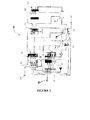
- the typical triple-effect vapor absorption system illustrated in FIGURES 1 & 2 , comprises: a high temperature generator 12, a medium temperature generator 14, a low temperature generator 16, a condenser 18, an evaporator 20, an absorber 22, a low temperature heat exchanger 24, a medium temperature heat exchanger 26, a high temperature heat exchanger 28, a low temperature drain heat exchanger 30 and a high temperature drain heat exchanger 32.
- a dilute Li-Br solution from the absorber 22 is fed in parallel streams to all the generators - viz., 12, 14, and 16.
- the dilute Li-Br solution gets concentrated; the resultant stream is combined to obtain a concentrated Li-Br solution having a maximum concentration of 63.5 %.
- the concentrated Li-Br solution is then sprayed in the absorber 22, where the solution absorbs refrigerant vapors coming from the evaporator 20 and becomes diluted, thereby, completing the cycle.
- the heat exchangers 24, 26, 28, 30 & 32 are provided to heat the dilute Li-Br solution leaving the absorber 22 by extracting heat from the concentrated Li-Br solutions leaving the generator 12, 14 & 16, and the refrigerant condensate leaving the generators 14 & 16, respectively.
- the refrigerant condensate after cooling in the drain heat exchangers 30 & 32 is further condensed in the condenser 18 by means of cooling water supplied through line 36, the high pressure condensate from the condenser 18 is subsequently sprayed in the evaporator 20, where the condensate takes heat from cold water supplied through line 38 to form vapors and thereby producing the refrigeration effect.
- the temperature of the Li-Br solution in the high temperature generator 12 is higher than 200 °C, therefore, maximum Li-Br solution temperature and maximum Li-Br concentration occurs simultaneously in the high temperature generator 12; at this point, Li-Br corrosion rate increases exponentially due to the high temperature and the high concentration, also resulting in the generation of non-condensable gases;
- the operating pressure is also higher.
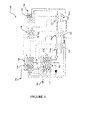
- the dilute Li-Br solution leaving absorber 22 is first fed to low temperature generator 16 where it is concentrated to an intermediate concentration. This solution is then fed to the medium temperature generator 14 for further concentration. Finally, the concentrated Li-Br solution from the medium temperature generator 14 is fed to the high temperature generator 12 where it reaches the maximum concentration. As the Li-Br solution concentration in the low temperature generator 16 is less (only intermediate concentration), the temperature of the generator 16 is less as compared to that in the cycle disclosed in FIGURE 1 . Although, this cycle provides operation at a lower temperature and pressure than that disclosed in FIGURE 1 , there are some disadvantages to this cycle as listed below:
- Li-Br corrosion rate increases exponentially due to the high temperature and the high concentration, also resulting in the generation of non-condensable gases;
- US5205137 discloses an absorption air conditioner having an evaporator, an absorber for discharging a dilute solution, a regenerator, a condenser, and a first conduit, and comprising a regenerating chamber for heating and condensing a portion of the dilute solution generated in the absorber and an absorption chamber for causing the refrigerant vapors generated in the regenerating chamber to be absorbed into the dilute solution at an intermediate position prior to the absorber so that the size of the absorber is reduced.
- the system as disclosed in US5205137 comprises a high temperature regenerator and a low temperature regenerator arranged parallel to each other, wherein the dilute solution is simultaneously supplied to both the regenerators. This system is complex to operate and there is a high possibility of corrosion due to high temperature and high Li-Br concentration.
- US5653116 discloses a triple-effect cycle comprises two hermetic loops - one a conventional LiBr double-effect loop, and other a single-effect loop which overlaps the high pressure portion of the double-effect loop, and exchanges heat with it at three locations.
- the system as disclosed in US5653116 uses Li-Br as an absorbent in the double-effect loop and NaOH and KOH as an absorbent in the high temperature loop. This system is complex and difficult to operate due to the multiple flow streams involved.
- US2005262720 discloses a multi-stage regeneration system for regenerating a liquid desiccant comprising the liquid desiccant, a vapor/gas stream, and a high temperature regenerator and a low temperature regenerator comprising a rotating contacting device assembly that provides contact between the liquid desiccant and the vapor/gas stream for heat and/or mass transfer so as to effect carryover of the liquid desiccant into the vapor/gas stream.
- the system as disclosed in US2005262720 operates under high pressure conditions and provides a COP of only up to 0.9.
- W09112472 discloses a refrigeration and/or heating system including a plurality of generators and a plurality of heat exchanging recuperators in which improved efficiencies are obtained by placing helical concentric coils of at least two generators and recuperators on a common axis with a heating unit at the center and allowing hot combustion gases to circulate in serpentine fashion through separate concentric chambers containing the coils.
- This system is complex and operates at a high pressure.
- JP04562323 discloses an absorption machine for air conditioning which comprises a controller that operates shut-off valves to open and close when temperature of cooling water increases beyond 25 °C. This system is complex and involves high operating costs.
- An object of the present invention is to provide a triple-effect vapor absorption refrigeration system which substantially reduces corrosion due to high Li-Br concentration and high temperature during the operation.
- Another object of the present invention is to provide a triple-effect vapor absorption refrigeration system having an increased co-efficient of performance (COP).
- COP co-efficient of performance
- Still another object of the present invention is to provide a triple-effect absorption refrigeration system which is energy-efficient.
- Yet another object of the present invention is to provide a triple-effect absorption refrigeration system which has an in-built mechanism to detect and prevent Li-Br crystallization.
- One more object of the present invention is to provide a triple-effect absorption refrigeration system which is simple and easy to operate.
- Yet one more object of the present invention is to provide a triple-effect absorption refrigeration system which minimizes heat losses.
- An additional object of the present invention is to provide a triple-effect absorption refrigeration system which does not operate at super-atmospheric pressures.
- a triple-effect vapor absorption refrigeration system comprising: a high temperature generator, a medium temperature generator, a low temperature generator, a condenser, an absorber, and an evaporator; characterized in that :
- said high temperature generator is in operative communication with said absorber to receive a dilute Li-Br solution, said high temperature generator being adapted to concentrate the dilute Li-Br solution by means of a heat source having temperature in the range of 200 - 250 °C to provide a concentrated Li-Br solution and generate water vapors having temperature in the range of 130 - 150 °C;
- said medium temperature generator is in operative communication with said high temperature generator to receive the concentrated Li-Br solution and the water vapors having temperature in the range of 130 - 150 °C, said medium temperature generator being adapted to further concentrate the concentrated Li-Br solution by means of the water vapors to provide a further concentrated Li-Br solution and generate water vapors having temperature in the range of 80 - 100 °C and a first condensate;
- said low temperature generator is in operative communication with said medium temperature generator to receive the further concentrated Li-Br solution and the water vapors having temperature in the range of 80 - 100 °C, said low temperature generator being adapted to still further concentrate the further concentrated Li-Br solution by means of the water vapors to provide a still further concentrated Li-Br solution and generate water vapors and a second condensate;
- said condenser is in operative communication with said medium temperature generator to receive the first condensate and said low temperature generator to receive the second condensate and the water vapors generated in the low temperature generator, said condenser being adapted to further condense the condensate and the water vapors by means of cooling water, to provide a further condensed condensate, and to generate heated water having temperature in the range 30 - 40 °C;
- said evaporator housed together with said absorber is in operative communication with said condenser to receive the further condensed condensate, said evaporator being adapted to evaporate the further condensed condensate by extracting heat from cold water circulated there through, to provide chilled water having temperature in the range of 0 - 10 °C and to generate water vapors;
- said absorber housed together with said evaporator is in operative communication with said low temperature generator to receive the still further concentrated Li-Br solution and said condenser to receive the heated water, said absorber being adapted to absorb the vapors generated in said evaporator in the still further concentrated Li-Br solution to provide the dilute Li-Br solution, thereby completing the refrigeration cycle, wherein, heat of dilution generated during the absorption process is absorbed by the heated water circulated there through to provide further heated water having temperature in the range of 35 - 45 °C.
- said system comprises a low temperature heat exchanger, a medium temperature heat exchanger, a high temperature heat exchanger, a low temperature drain heat exchanger and a high temperature drain heat exchanger, being adapted to heat the dilute Li-Br solution leaving the absorber, to a temperature in the range of 150 - 180 °C, prior to being concentrated in said high temperature generator.
- said system further comprises a heat reclaimer for heating the dilute Li-Br solution leaving the absorber by extracting left-over heat from said heat input.
- said low temperature heat exchanger, said medium temperature heat exchanger, and said high temperature heat exchanger are operatively connected in a consecutive manner.
- said low temperature drain heat exchanger and said high temperature drain heat exchanger are operatively connected in a consecutive manner and in series with said high temperature heat exchanger.
- said low temperature drain heat exchanger and said high temperature drain heat exchanger are connected in parallel to said low temperature heat exchanger and said medium temperature heat exchanger.
- said low temperature drain heat exchanger, said high temperature drain heat exchanger and said heat reclaimer are operatively connected in a consecutive manner and in parallel with said low temperature heat exchanger, said medium temperature heat exchanger and said high temperature heat exchanger.
- said low temperature heat exchanger is operatively positioned between said low temperature generator and said absorber, said low temperature heat exchanger being adapted to extract heat from the still further concentrated Li-Br solution.
- said medium temperature heat exchanger is operatively positioned between said medium temperature generator and said low temperature generator, said medium temperature heat exchanger being adapted to extract heat from the further concentrated Li-Br solution.
- said high temperature heat exchanger is operatively positioned between said high temperature generator and said medium temperature generator, said high temperature heat exchanger being adapted to extract heat from the concentrated Li-Br solution.
- said low temperature drain heat exchanger is operatively positioned between said low temperature generator and said condenser, said low temperature drain heat exchanger being adapted to extract heat from the second condensate.
- said high temperature drain heat exchanger is operatively positioned between said medium temperature generator and said condenser, said high temperature drain heat exchanger being adapted to extract heat from the first condensate.
- a method for operating a triple-effect vapor absorption refrigeration system to generate refrigeration effect comprising the steps of:
- said method for operating a triple-effect vapor absorption refrigeration system includes the step of bifurcating the dilute Li-Br solution from the absorber, wherein a first portion is received in a low temperature heat exchanger and a second portion is received in a low temperature drain heat exchanger.
- said method for operating a triple-effect vapor absorption refrigeration system includes the step of heating the first portion of the dilute Li-Br solution in a low temperature heat exchanger by extracting heat from the still further concentrated Li-Br solution to obtain a first portion of heated dilute Li-Br solution having temperature in the range of 65 - 75 °C.
- said method for operating a triple-effect vapor absorption refrigeration system includes the step of further heating the first portion of the heated dilute Li-Br solution in a medium temperature heat exchanger by extracting heat from the further concentrated Li-Br solution to obtain a first portion of further heated dilute Li-Br solution having temperature in the range of 120 - 130 °C.
- said method for operating a triple-effect vapor absorption refrigeration system includes the step of heating the second portion of the dilute Li-Br solution in a low temperature drain heat exchanger by extracting heat from the second condensate to obtain a second portion of heated dilute Li-Br solution having temperature in the range of 65 - 75 °C.
- said method for operating a triple-effect vapor absorption refrigeration system includes the step of further heating the second portion of the heated dilute Li-Br solution in a high temperature drain heat exchanger by extracting heat from the first condensate to obtain a second portion of further heated dilute Li-Br solution having temperature in the range of 120 - 130 °C.
- said method for operating a triple-effect vapor absorption refrigeration system includes the step of combining the first portion of the further heated dilute Li-Br solution and the second portion of the further heated dilute Li-Br solution to obtain a combined stream of the further heated dilute Li-Br solution having temperature in the range of 120 - 130 °C.
- said method for operating a triple-effect vapor absorption refrigeration system includes the step of still further heating the combined stream of the further heated dilute Li-Br solution in a high temperature heat exchanger by extracting heat from the concentrated Li-Br solution to obtain a still further heated dilute Li-Br solution having temperature in the range of 170 - 190 °C.
- said method comprises still further heating the first portion of further heated dilute Li-Br solution in a high temperature heat exchanger by extracting heat from the concentrated Li-Br solution to obtain a first portion of still further heated dilute Li-Br solution having temperature in the range of 170 - 190 °C.
- said method comprises still further heating the second portion of further heated dilute Li-Br solution in a heat reclaimer by extracting left-over heat from the heat input to obtain a second portion of still further heated dilute Li-Br solution having temperature in the range of 170 - 190 °C.
- said method comprises combining the first portion of still further heated dilute Li-Br solution and second portion of still further heated dilute Li-Br solution.
- said method for operating a triple-effect vapor absorption refrigeration system includes the step of vaporizing the still further heated dilute Li-Br solution in the high temperature generator.
- the maximum Li-Br solution temperature and maximum Li-Br solution concentration does not occur simultaneously, hence, Li-Br corrosion rate is reduced and minimum non-condensable gases are generated, this helps in maintaining vacuum during operation thus providing a smoother operation.
- said method for operating a triple effect vapor absorption refrigeration system includes the step of allowing the Li-Br solution to flow in series from the high temperature generator via the medium temperature generator to the low temperature generator, by gravity, by using a single solution pump between the absorber and the high temperature generator.
- said method for operating a triple effect vapor absorption refrigeration system includes the step of allowing the concentrated Li-Br solution to flow by gravity, wherein, only the flow of the dilute Li-Br solution from the absorber to the high temperature generator is controlled.
- said method for operating a triple effect vapor absorption refrigeration system includes the step of feeding the cooling water primarily at the condenser so as to lower the overall operating pressure, temperature and effect an increase in the COP.
- FIGURE 1 illustrates a schematic of an embodiment of a conventional triple-effect vapor absorption refrigeration system
- FIGURE 2 illustrates a schematic of another embodiment of a conventional triple-effect vapor absorption refrigeration system
- FIGURE 3 illustrates a schematic of a preferred embodiment of the triple-effect vapor absorption refrigeration system in accordance with the present invention.
- FIGURE 4 illustrates a schematic of another preferred embodiment of the triple-effect vapor absorption refrigeration system in accordance with the present invention.
- the present invention envisages a triple-effect vapor absorption refrigeration system which minimizes the corrosion problems due to high Li-Br concentrations and high temperature and also combats problems of Li-Br crystallization by continuously monitoring the working parameters during operation of the refrigeration cycle. Further, the system provides a COP of greater than 1.7 by minimizing heat losses and conserves energy by reducing the pumping costs.
- FIGURES 3 & 4 The preferred embodiments of the triple-effect vapor absorption refrigeration system of the present invention are illustrated in FIGURES 3 & 4 , generally referenced by numerals 100 & 200, respectively.
- the systems (100, 200) comprise: a high temperature generator 102, a medium temperature generator 104, a low temperature generator 106, a condenser 108, an evaporator 112, an absorber 110, a low temperature heat exchanger 114, a medium temperature heat exchanger 116, a high temperature heat exchanger 118, a low temperature drain heat exchanger 120, a high temperature drain heat exchanger 122, and a heat reclaimer 130.
- the preferred embodiment 100 illustrates a refrigeration cycle under conditions when superheated water is used as the heat input and the preferred embodiment 200 illustrates a refrigeration cycle under conditions when the heat input is obtained from superheated steam or direct fuel firing (high temperature heat input).
- the refrigerant-absorbent pair is typically water-lithium bromide (LiBr).
- FIGURE 3 & 4 disclose the refrigeration cycle in accordance with the present invention.
- the high temperature generator 102 is adapted to receive a heat input 124 having temperature in the range of 200 - 250 °C; the heat input 124 boils the dilute Li-Br solution to provide a concentrated Li-Br solution having concentration in the range of 55 - 60 % and generate water vapors having temperature in the range of 130 - 150 °C.
- the heat input 124 is selected from steam, superheated water, combustion gases from combustion of a fuel or exhaust gases.
- the heat reclaimer 130 is provided for extracting left-over heat from the heat input leaving the high temperature generator 102.
- the dilute Li-Br solution is heated in the heat exchangers, viz., 114, 116, 118, 120, & 122 prior to concentration in the high temperature generator 102.
- the dilute Li-Br solution can be further heated in the heat exclaimer 130 (refer FIGURE 4 ) by heat from the heat input 124.
- the medium temperature generator 104 and the high temperature generator 102 are operatively connected to convey the concentrated Li-Br solution and the water vapors having temperature in the range of 130 - 150 °C from the high temperature generator 102 to the medium temperature generator 104.
- the concentrated Li-Br solution is first passed through the high temperature heat exchanger 118 where it losses heat to the dilute Li-Br solution.
- the water vapors from the high temperature generator 102 act as a heat source for vaporizing the concentrated Li-Br solution in the medium temperature generator 104.
- the water vapors further concentrate the concentrated Li-Br solution, thus providing a further concentrated Li-Br solution having concentration in the range of 57 - 62 % and thereby consequently generating water vapors having temperature in the range of 80 - 100°C.
- the water vapors passed through the generator tubes as the heat source condense to produce a first condensate.
- the first condensate is passed through the high temperature drain heat exchanger 122 where it losses heat to the dilute Li-Br solution.
- the low temperature generator 106 is operatively connected to the medium temperature generator 104 to receive the further concentrated Li-Br solution and the water vapors having temperature in the range of 80 - 100 °C. Prior to vaporization in the low temperature generator 106 the further concentrated Li-Br solution is passed through the medium temperature heat exchanger 116 so as to extract heat therefrom to the dilute Li-Br solution.
- the water vapors generated in the medium temperature generator 104 due to vaporization of the Li-Br solution act as a heat source in the low temperature generator 106 for concentrating the further concentrated Li-Br solution, thereby providing a still further concentrated Li-Br solution having concentration in the range of 59 - 64 %.
- the still further concentrated Li-Br solution, thus obtained in the low temperature generator 106 is the most concentrated absorbent solution achieved using the process cycle of the present invention.
- the still further concentrated Li-Br solution, leaving the low temperature generator 106, is sprayed in the absorber 110 after passing through the low temperature heat exchanger 114 where the solution loses heat to the dilute Li-Br solution.
- the second condensate after passing through the low temperature drain heat exchanger 120, the first condensate after passing through the high temperature drain heat exchanger 122, and water vapors having temperature generated in the low temperature generator 106 are fed to the condenser 108, where the condensate is further condensed and the vapors are condensed, by means of cooling water having temperature in the range of 25 - 35 °C circulated there through via supply line 126, to provide a further condensed condensate and generate heated water having temperature in the range of 30 - 40 °C.
- the step of primary condensing the vapors before passing through the condenser 108 helps in reducing the condenser duty.
- the further condensed condensate leaves at a high pressure from the condenser 108, are sprayed in the evaporator 112.
- the evaporator 112 and the absorber 110 are housed together in a single shell.
- the further condensed high pressure condensate, sprayed in the evaporator 112 is vaporized at a low temperature by extracting heat from cold water circulated through the evaporator 112 tubes via supply line 128; thus chilling the water to a temperature between 0 - 10 °C.
- the vapors thus produced in the evaporator 112 are absorbed by the still further concentrated Li-Br solution sprayed in the absorber 110.
- the still further concentrated Li-Br solution after absorbing the refrigerant vapors, becomes dilute and leaves the absorber 110 as the dilute Li-Br solution.
- the process of vapor absorption produces heat of dilution which is rejected to the heated water circulated there through from the condenser 108 via supply line 126, thereby producing further heated water having temperature in the range of 35 - 45 °C.
- the refrigerant stream leaving the evaporator 112 is sprayed back on to the evaporator 112 tubes via pumping means.
- the dilute Li-Br solution leaving the absorber 110 is passed via pumping means through the series of heat exchangers 114, 116, 118, 120, and 122, and the heat reclaimer 130.
- the dilute Li-Br solution is bifurcated, wherein a first portion is received in the low temperature heat exchanger 114 and a second portion is received in the low temperature drain heat exchanger 120.
- the low temperature heat exchanger 114, the medium temperature heat exchanger 116, and the high temperature heat exchanger 118 are operatively connected in a consecutive manner.
- the low temperature drain heat exchanger 120, the high temperature drain heat exchanger 122, and the heat reclaimer 130 are operatively connected in a consecutive manner and in parallel with the low temperature heat exchanger 114, the medium temperature heat exchanger 116 and the high temperature heat exchanger 118.
- the low temperature heat exchanger 114 and the medium temperature heat exchanger 116 are arranged parallel to the low temperature drain heat exchanger 120 and the high temperature drain heat exchanger 122.
- the first portion of the dilute Li-Br solution extracts heat from the still further concentrated Li-Br solution in the low temperature heat exchanger 114 to become a first portion of heated dilute Li-Br solution.
- the first portion of the heated dilute Li-Br solution extracts heat from the further concentrated Li-Br solution in the medium temperature heat exchanger 116 to become a first portion of further heated dilute Li-Br solution.
- the second portion of the dilute Li-Br solution extracts heat from the second condensate in the low temperature drain heat exchanger 120 to become a second portion of heated dilute Li-Br solution.
- the second portion of the heated dilute Li-Br solution extracts heat from the first condensate in the high temperature drain heat exchanger 122 to become a second portion of further heated dilute Li-Br solution.
- the first portion of the further heated dilute Li-Br solution and the second portion of the further heated dilute Li-Br solution are combined and passed through the high temperature heat exchanger 118, where the solution extracts heat from the concentrated Li-Br solution to become a still further heated dilute Li-Br solution.
- the still further heated dilute Li-Br solution is conveyed to the high temperature generator 102 for vaporizing.
- the system 100 is provided with a programmable logic control (PLC) (not shown in the figure) to provide an automated control over the refrigeration cycle.
- PLC programmable logic control
- the first portion of the dilute Li-Br solution extracts heat from the still further concentrated Li-Br solution in the low temperature heat exchanger 114 to become a first portion of heated dilute Li-Br solution.
- the first portion of the heated dilute Li-Br solution extracts heat from the further concentrated Li-Br solution in the medium temperature heat exchanger 116 to become a first portion of further heated dilute Li-Br solution.
- the first portion of the further heated dilute Li-Br solution is passed through the high temperature heat exchanger 118 where the solution extracts heat from the concentrated Li-Br solution to become a first portion of still further heated dilute Li-Br solution.
- the second portion of the dilute Li-Br solution extracts heat from the second condensate in the low temperature drain heat exchanger 120 to become a second portion of heated dilute Li-Br solution.
- the second portion of the heated dilute Li-Br solution extracts heat from the first condensate in the high temperature drain heat exchanger 122 to become a second portion of further heated dilute Li-Br solution.
- the second portion of further heated dilute Li-Br solution is still further heated in the heat reclaimer 130 by extracting left-over heat from the high temperature heat input 124 (steam condensate or exhaust/flue gases) leaving the high temperature generator 102, to obtain a second portion of still further heated dilute Li-Br solution.
- the heat input 124 is suitably cooled before it is let off.
- the first and second portion of still further heated dilute Li-Br solution are combined and conveyed to the high temperature generator 102 for vaporizing.
- the system 200 is provided with a programmable logic control (PLC) (not shown in the figure) to provide an automated control over the refrigeration cycle.
- PLC programmable logic control
- a triple-effect vapor absorption refrigeration system and method thereof; as disclosed in the present invention has several technical advantages including but not limited to the realization of:
- the system has an in-built programmable logic control for automated operation which detects the probability of Li-Br crystallization and take preventive measures to avoid the same;
Landscapes
- Engineering & Computer Science (AREA)
- Physics & Mathematics (AREA)
- Mechanical Engineering (AREA)
- Thermal Sciences (AREA)
- General Engineering & Computer Science (AREA)
- Sorption Type Refrigeration Machines (AREA)
Applications Claiming Priority (1)
| Application Number | Priority Date | Filing Date | Title |
|---|---|---|---|
| IN1828MU2011 | 2011-06-24 |
Publications (2)
| Publication Number | Publication Date |
|---|---|
| EP2549205A2 true EP2549205A2 (de) | 2013-01-23 |
| EP2549205A3 EP2549205A3 (de) | 2015-08-05 |
Family
ID=46419906
Family Applications (1)
| Application Number | Title | Priority Date | Filing Date |
|---|---|---|---|
| EP12173027.9A Withdrawn EP2549205A3 (de) | 2011-06-24 | 2012-06-21 | Dampfabsorptionskühlsystem mit Dreifachwirkung |
Country Status (3)
| Country | Link |
|---|---|
| US (1) | US20120324925A1 (de) |
| EP (1) | EP2549205A3 (de) |
| CN (1) | CN102901264A (de) |
Cited By (1)
| Publication number | Priority date | Publication date | Assignee | Title |
|---|---|---|---|---|
| WO2017001708A1 (es) * | 2014-05-30 | 2017-01-05 | Consejo Superior De Investigaciones Científicas (Csic) | Máquina frigorífica de absorción de pequeña potencia |
Families Citing this family (3)
| Publication number | Priority date | Publication date | Assignee | Title |
|---|---|---|---|---|
| US9835361B2 (en) | 2015-11-09 | 2017-12-05 | King Fahd University Of Petroleum And Minerals | Solar-powered LiBr-water absorption air conditioning system using hybrid storage |
| CN107144043A (zh) * | 2017-06-28 | 2017-09-08 | 远大空调有限公司 | 一种三段式热水机组系统及其工作方法 |
| CN113137783A (zh) * | 2021-05-17 | 2021-07-20 | 中国华能集团清洁能源技术研究院有限公司 | 一种利用热泵回收电解水制氢余热的系统及方法 |
Citations (5)
| Publication number | Priority date | Publication date | Assignee | Title |
|---|---|---|---|---|
| WO1991012472A1 (en) | 1990-02-09 | 1991-08-22 | Columbia Gas System Service Corporation | Heat transfer apparatus for heat pumps |
| US5205137A (en) | 1990-09-05 | 1993-04-27 | Hitachi, Ltd. | Absorption air conditioner |
| US5653116A (en) | 1996-01-11 | 1997-08-05 | Erickson; Donald C. | Triple-effect absorption cycle with condensate-to-solution sensible heat exchanger |
| US20050262720A1 (en) | 2002-02-19 | 2005-12-01 | Indian Institute Of Technology | Energy efficient sorption processes and systems |
| JP4562323B2 (ja) | 2001-07-02 | 2010-10-13 | 三洋電機株式会社 | 吸収冷凍機 |
Family Cites Families (9)
| Publication number | Priority date | Publication date | Assignee | Title |
|---|---|---|---|---|
| US3279207A (en) * | 1964-12-08 | 1966-10-18 | Carrier Corp | Absorption refrigeration systems |
| US4484456A (en) * | 1983-10-21 | 1984-11-27 | The United States Of America As Represented By The United States Department Of Energy | Triple loop heat exchanger for an absorption refrigeration system |
| US6536229B1 (en) * | 2000-08-29 | 2003-03-25 | Kawasaki Thermal Engineering Co., Ltd. | Absorption refrigerator |
| EP1321728A1 (de) * | 2000-08-29 | 2003-06-25 | Kawajureinetsukougyo K.K. | Absorptionskältemaschine |
| EP1205718B1 (de) * | 2000-11-08 | 2006-09-27 | Kawasaki Thermal Engineering Co., Ltd. | Sicherheitsvorrichtung für Absorptionskühler oder Absorptionskühl- und Heizgerät |
| US6550272B2 (en) * | 2000-11-08 | 2003-04-22 | Kawasaki Thermal Engineering Co., Ltd. | Absorption chiller/absorption chiller-heater having safety device |
| JP3791832B2 (ja) * | 2001-03-28 | 2006-06-28 | 東京瓦斯株式会社 | 蒸気焚き吸収冷温水機 |
| US8978397B2 (en) * | 2009-04-24 | 2015-03-17 | Thermax Limited | Absorption heat pump employing a high/low pressure evaporator/absorber unit a heat recovery unit |
| CN201429267Y (zh) * | 2009-06-09 | 2010-03-24 | 江苏双良空调设备股份有限公司 | 溶液并联流程的三效机 |
-
2012
- 2012-06-21 EP EP12173027.9A patent/EP2549205A3/de not_active Withdrawn
- 2012-06-22 US US13/530,508 patent/US20120324925A1/en not_active Abandoned
- 2012-06-25 CN CN2012102120102A patent/CN102901264A/zh active Pending
Patent Citations (5)
| Publication number | Priority date | Publication date | Assignee | Title |
|---|---|---|---|---|
| WO1991012472A1 (en) | 1990-02-09 | 1991-08-22 | Columbia Gas System Service Corporation | Heat transfer apparatus for heat pumps |
| US5205137A (en) | 1990-09-05 | 1993-04-27 | Hitachi, Ltd. | Absorption air conditioner |
| US5653116A (en) | 1996-01-11 | 1997-08-05 | Erickson; Donald C. | Triple-effect absorption cycle with condensate-to-solution sensible heat exchanger |
| JP4562323B2 (ja) | 2001-07-02 | 2010-10-13 | 三洋電機株式会社 | 吸収冷凍機 |
| US20050262720A1 (en) | 2002-02-19 | 2005-12-01 | Indian Institute Of Technology | Energy efficient sorption processes and systems |
Cited By (2)
| Publication number | Priority date | Publication date | Assignee | Title |
|---|---|---|---|---|
| WO2017001708A1 (es) * | 2014-05-30 | 2017-01-05 | Consejo Superior De Investigaciones Científicas (Csic) | Máquina frigorífica de absorción de pequeña potencia |
| US10845100B2 (en) | 2014-05-30 | 2020-11-24 | Consejo Superior De Investigaciones Cientificas | Low-power absorption refrigeration machine |
Also Published As
| Publication number | Publication date |
|---|---|
| US20120324925A1 (en) | 2012-12-27 |
| CN102901264A (zh) | 2013-01-30 |
| EP2549205A3 (de) | 2015-08-05 |
Similar Documents
| Publication | Publication Date | Title |
|---|---|---|
| EP2244039B1 (de) | Kühler-Wärmepumpe | |
| CN103090593B (zh) | 热泵循环系统及热泵循环方法及蒸发系统 | |
| EP2366966B1 (de) | Hocheffiziente Doppeleffekt-Vorrichtung mit Kühlung und Heizung | |
| EP2659201B1 (de) | Hybrider absorptions- und kompressionskühler und ein entsprechendes verfahren zur bereitstellung von kühlung | |
| US11940187B2 (en) | Water treatment system of coupling heat pump with multi-effect evaporation and operating method thereof | |
| CN108148555B (zh) | 一种制冷吸收剂及余热驱动吸收式深度制冷方法 | |
| EP2549205A2 (de) | Dampfabsorptionskühlsystem mit Dreifachwirkung | |
| CN100570241C (zh) | 烟气余热利用的双效溴化锂吸收式制冷装置 | |
| CN101344342A (zh) | 膜蒸馏回热吸收式制冷装置 | |
| CN108507219A (zh) | 一种复合型两级式溴化锂吸收式热泵及工作方法 | |
| CN103175332B (zh) | 基于双工质对的两级吸收式制冷循环系统及其制冷方法 | |
| CN104807249A (zh) | 一种热能冷冻方法及使用该方法的冷冻机 | |
| CN219656366U (zh) | 一种低温热源制冷系统 | |
| CN205867609U (zh) | 以电驱动的冷热双效热泵型药液浓缩装置 | |
| CN116481205A (zh) | 一种低温热源制冷系统及方法 | |
| CN104807237A (zh) | 一种应用溴化锂的节能装置 | |
| CN105402932B (zh) | 一种带涡流管的低温吸收制冷系统及工作方法 | |
| CN110567189B (zh) | 一种蒸汽压缩型吸收式热泵 | |
| CN101603747A (zh) | 一种吸收式制冷循环方法 | |
| CN116398927B (zh) | 一种冷热两用的开式吸收式热泵及运行方法 | |
| CN201141712Y (zh) | 三效吸收式制冷装置 | |
| CN113587491B (zh) | 一种双级发生吸收式热泵空调装置 | |
| JPS6222059B2 (de) | ||
| CN102798247A (zh) | 低品位能驱动co2吸收式制冷系统 | |
| CN110986423B (zh) | 一种冷水机组 |
Legal Events
| Date | Code | Title | Description |
|---|---|---|---|
| PUAI | Public reference made under article 153(3) epc to a published international application that has entered the european phase |
Free format text: ORIGINAL CODE: 0009012 |
|
| AK | Designated contracting states |
Kind code of ref document: A2 Designated state(s): AL AT BE BG CH CY CZ DE DK EE ES FI FR GB GR HR HU IE IS IT LI LT LU LV MC MK MT NL NO PL PT RO RS SE SI SK SM TR |
|
| AX | Request for extension of the european patent |
Extension state: BA ME |
|
| PUAL | Search report despatched |
Free format text: ORIGINAL CODE: 0009013 |
|
| AK | Designated contracting states |
Kind code of ref document: A3 Designated state(s): AL AT BE BG CH CY CZ DE DK EE ES FI FR GB GR HR HU IE IS IT LI LT LU LV MC MK MT NL NO PL PT RO RS SE SI SK SM TR |
|
| AX | Request for extension of the european patent |
Extension state: BA ME |
|
| RIC1 | Information provided on ipc code assigned before grant |
Ipc: F25B 15/00 20060101AFI20150701BHEP |
|
| STAA | Information on the status of an ep patent application or granted ep patent |
Free format text: STATUS: THE APPLICATION IS DEEMED TO BE WITHDRAWN |
|
| 18D | Application deemed to be withdrawn |
Effective date: 20160206 |