EP2551175A2 - Anhänger zur Verkehrsüberwachung - Google Patents
Anhänger zur Verkehrsüberwachung Download PDFInfo
- Publication number
- EP2551175A2 EP2551175A2 EP12177954A EP12177954A EP2551175A2 EP 2551175 A2 EP2551175 A2 EP 2551175A2 EP 12177954 A EP12177954 A EP 12177954A EP 12177954 A EP12177954 A EP 12177954A EP 2551175 A2 EP2551175 A2 EP 2551175A2
- Authority
- EP
- European Patent Office
- Prior art keywords
- trailer
- wheels
- slot
- trailer according
- radar
- Prior art date
- Legal status (The legal status is an assumption and is not a legal conclusion. Google has not performed a legal analysis and makes no representation as to the accuracy of the status listed.)
- Granted
Links
Images





Classifications
-
- G—PHYSICS
- G08—SIGNALLING
- G08G—TRAFFIC CONTROL SYSTEMS
- G08G1/00—Traffic control systems for road vehicles
- G08G1/01—Detecting movement of traffic to be counted or controlled
- G08G1/017—Detecting movement of traffic to be counted or controlled identifying vehicles
- G08G1/0175—Detecting movement of traffic to be counted or controlled identifying vehicles by photographing vehicles, e.g. when violating traffic rules
-
- B—PERFORMING OPERATIONS; TRANSPORTING
- B62—LAND VEHICLES FOR TRAVELLING OTHERWISE THAN ON RAILS
- B62D—MOTOR VEHICLES; TRAILERS
- B62D61/00—Motor vehicles or trailers, characterised by the arrangement or number of wheels, not otherwise provided for, e.g. four wheels in diamond pattern
- B62D61/12—Motor vehicles or trailers, characterised by the arrangement or number of wheels, not otherwise provided for, e.g. four wheels in diamond pattern with variable number of ground engaging wheels, e.g. with some wheels arranged higher than others, or with retractable wheels
-
- B—PERFORMING OPERATIONS; TRANSPORTING
- B62—LAND VEHICLES FOR TRAVELLING OTHERWISE THAN ON RAILS
- B62D—MOTOR VEHICLES; TRAILERS
- B62D63/00—Motor vehicles or trailers not otherwise provided for
- B62D63/06—Trailers
- B62D63/061—Foldable, extensible or yielding trailers
-
- G—PHYSICS
- G01—MEASURING; TESTING
- G01S—RADIO DIRECTION-FINDING; RADIO NAVIGATION; DETERMINING DISTANCE OR VELOCITY BY USE OF RADIO WAVES; LOCATING OR PRESENCE-DETECTING BY USE OF THE REFLECTION OR RERADIATION OF RADIO WAVES; ANALOGOUS ARRANGEMENTS USING OTHER WAVES
- G01S13/00—Systems using the reflection or reradiation of radio waves, e.g. radar systems; Analogous systems using reflection or reradiation of waves whose nature or wavelength is irrelevant or unspecified
- G01S13/88—Radar or analogous systems specially adapted for specific applications
- G01S13/91—Radar or analogous systems specially adapted for specific applications for traffic control
- G01S13/92—Radar or analogous systems specially adapted for specific applications for traffic control for velocity measurement
-
- G—PHYSICS
- G08—SIGNALLING
- G08G—TRAFFIC CONTROL SYSTEMS
- G08G1/00—Traffic control systems for road vehicles
- G08G1/01—Detecting movement of traffic to be counted or controlled
- G08G1/052—Detecting movement of traffic to be counted or controlled with provision for determining speed or overspeed
- G08G1/054—Detecting movement of traffic to be counted or controlled with provision for determining speed or overspeed photographing overspeeding vehicles
Definitions
- the invention relates to a trailer for traffic surveillance, with the method for detecting and documenting red light and / or speed violations are feasible, as generically from the DE 10 2007 022 373 A1 and EP 2 048 515 A1 are known.
- the mobile traffic monitoring systems are in use. Compared to the stationary facilities, the mobile devices have the advantage that they can be used at arbitrary locations at any time to monitor a traffic area. Most new surveillance systems have grown in volume so that they are hardly more to accommodate in a car. Another disadvantage is that always a car is blocked with this technique.
- the invention has for its object to provide an arrangement that can be easily constructed at any location, so that detection and documentation of red light and / or speed violations can be performed, the arrangement should not be placed in a car.
- the object with a trailer for traffic surveillance containing a structure and a chassis with drawbar and axle with wheels, achieved in that means are provided with which the wheels can be raised and lowered, so that in the lowered state, the trailer is ready to drive and in the raised state, the wheels have no contact with the ground and thus the trailer is on the ground, that the drawbar after uncoupling of the car at the site is designed collapsible, and that in the structure at least one system for recording and documentation of red light and / or speed violations is arranged integrated.
- a particularly advantageous embodiment of the trailer is that a housing attachment is arranged on the structure, which has at least one slot, wherein the slot for receiving a radar with radar antenna and at least one recording unit is designed. It may be advantageous if only the radar antenna and the recording unit are placed in the slot and the further components associated with the detection and documentation of red light and / or speed violations are accommodated in the setup.
- the housing attachment is designed with two inserts, wherein the inserts with respect to the trailer to the front or to the rear and against the drawbar each an angle of less than 45 ° are arranged, so that when the trailer off the side
- the radar radiation is also parallel to the road at an angle ⁇ of the radar axis to the roadway direction of also less than 45 °.
- an angle of 30 ° is selected.
- a further advantageous variation results if only one camera is installed in one slot and only one camera is installed in the other slot.
- the speed can be determined with the measuring system of an oncoming vehicle and in case of exceeding a front photo or a sequence of images is created with the camera to the measuring system in the same slot.
- All recording systems can each be coupled with an IR flash device, which are then placed in the same slot.
- telescopic support feet can be used to put the trailer on this.
- the disadvantage then, however, again that so that the trailer is lifted unnecessarily.
- the better variant is to arrange one or more pneumatic or hydraulic cylinders such that the axle can be raised and thus the attachment is lowered and the trailer is on this then.
- a further advantageous variant is obtained by arranging the cylinders acting on the axle in such a way that thereby the axle can be rotated and, in turn, the trailer is parked on its superstructure. Since there are often bumps at the place of installation, it is particularly advantageous to combine the lowering mechanism with the telescopic support feet. This can be done a simple leveling of the entire trailer and also can be spared the structure. It is particularly advantageous if the telescoping support feet can be controlled individually via a remote control, or even automatically align themselves with a leveling element in connection.
- An approximately parallel orientation of the trailer on the roadside is completely sufficient, for example, in the writings DE 10 2007 022 373 A1 and EP 2 048 515 A1 published procedures when such radars and associated cameras are housed in the slots.
- the intended angular position of the inserts guarantees a required installation angle (radar axis to the roadway) of less than 45 °.
- the system also opposes the fact that the radar radiation is operated with a relatively large opening angle (20 ° to 40 °).
- Fig. 1 the trailer 1 with its essential components, the structure 2, the drawbar 3, a wheel 4 and the housing attachment 5 can be seen. Also shown are the slots 6 with the corresponding windows 7 for radar antenna or sensor, recording unit and IR flash device.
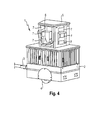
- Fig. 2 to 4 you can find the same elements again, just from a different perspective.
- Fig. 5 is the detached state to recognize. This is the so-called working position.
- the movably arranged drawbar 3 is here indicated schematically folded up, so that it is easier to get to all located in the front part of the trailer 1 units.
- the trailer 1 is deposited on the structure 2, so that logically no more wheels 4 can be seen.
- Out Fig. 7, 8 and 9 is the mechanism by which the wheels 4 can be pulled up.
- Fig. 10 shows the remote control installed on the trailer, with the telescopic support legs, not shown, can be individually driven off or retracted. This is particularly advantageous in two ways. On the one hand, the lower border of the body 2 is relieved, on the other hand, the trailer 1 can thus be leveled out particularly easily. Possible bumps are compensated and thus also increase the stability.
- Fig. 11 shows the trailer 1 in running condition and attached to a pickup truck.
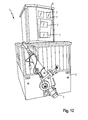
- Fig. 12 shows the state of use with correspondingly folded drawbar 3 and 2 stepped structure.
- Fig. 13 shows another view in the detached state.
- the inserts 6 of the housing attachment 5 are based on the Direction of the trailer 1 and the direction of the drawbar axis arranged at an angle.
- a camera is installed next to the radar in the same slot 6 as the master creates front photos.
- the second slot 6 is not occupied, so that no rear view can be created. Monitoring only one direction of travel in this configuration is possible.
- the second slot 6 is equipped with a further camera. This can then deliver as a slave rear photos. Furthermore, only one direction of travel can be monitored, whereby the cameras can always be combined with an IR flash. If the second module 6 is also equipped with a complete measuring system, it is possible to monitor both directions of travel.
Landscapes
- Engineering & Computer Science (AREA)
- Physics & Mathematics (AREA)
- General Physics & Mathematics (AREA)
- Radar, Positioning & Navigation (AREA)
- Remote Sensing (AREA)
- Transportation (AREA)
- Mechanical Engineering (AREA)
- Chemical & Material Sciences (AREA)
- Combustion & Propulsion (AREA)
- Electromagnetism (AREA)
- Computer Networks & Wireless Communication (AREA)
- Traffic Control Systems (AREA)
- Radar Systems Or Details Thereof (AREA)
Abstract
Description
- Die Erfindung betrifft einen Anhänger zur Verkehrsüberwachung, mit dem Verfahren zur Erfassung und Dokumentation von Rotlicht- und/oder Geschwindigkeitsverstößen durchführbar sind, wie sie gattungsgemäß aus der
DE 10 2007 022 373 A1 undEP 2 048 515 A1 bekannt sind. - Neben den stationär aufgestellten Verkehrsüberwachungssystemen sind die mobilen Verkehrsüberwachungseinrichtungen im Einsatz. Gegenüber den stationären Einrichtungen haben die mobilen Einrichtungen den Vorteil, dass sie an beliebigen Orten zu beliebigen Zeiten zur Überwachung eines Verkehrsraumes eingesetzt werden können. Die meisten neuen Überwachungssysteme sind volumenmäßig derart angewachsen, dass sie in einen PKW schon kaum mehr unterzubringen sind. Nachteilig ist auch, dass stets ein PKW mit dieser Technik blockiert wird.
- Für die Anzeige von gemessenen Geschwindigkeiten werden mobile Anhängersysteme, wie mit der
US 5,231,393 A offengelegt, an den unterschiedlichsten Orten zum Einsatz gebracht. Um Rotlicht- und/oder Geschwindigkeitsverstöße zu registrieren, sind derartige Einrichtungen nicht geeignet. - Der Erfindung liegt die Aufgabe zugrunde, eine Anordnung zu schaffen, die einfach an beliebigen Orten aufgebaut werden kann, so dass eine Erfassung und Dokumentation von Rotlicht- und/oder Geschwindigkeitsverstößen durchgeführt werden kann, wobei die Anordnung nicht in einem PKW platziert sein soll.
- Erfindungsgemäß wird die Aufgabe mit einem Anhänger zur Verkehrsüberwachung enthaltend einen Aufbau und ein Fahrgestell mit Deichsel und Achse mit Rädern, dadurch gelöst, dass Mittel vorhanden sind, mit denen die Räder anheb- und absenkbar sind, so dass im abgesenkten Zustand der Anhänger fahrbereit ist und im angehobenen Zustand die Räder keinen Bodenkontakt aufweisen und somit der Anhänger auf der Erde steht, dass die Deichsel nach dem Abkoppeln vom PKW am Einsatzort einklappbar ausgestaltet ist, und dass in dem Aufbau mindestens eine Anlage zur Erfassung und Dokumentation von Rotlicht- und/oder Geschwindigkeitsverstößen integrierbar angeordnet ist.
- Eine besonders vorteilhafte Ausgestaltung des Anhängers besteht darin, dass ein Gehäuseaufsatz am Aufbau angeordnet ist, der mindestens einen Einschub aufweist, wobei der Einschub zur Aufnahme eines Radargerätes mit Radarantenne und mindestens einer Aufzeichnungseinheit konzipiert ist. Von Vorteil kann es sein, wenn im Einschub nur die Radarantenne und die Aufzeichnungseinheit platziert werden und die zur Erfassung und Dokumentation von Rotlicht- und/oder Geschwindigkeitsverstößen zugehörigen weiteren Bestandteile im Aufbau untergebracht werden.
- Von besonderem Vorteil erweist es sich, wenn der Gehäuseaufsatz mit zwei Einschüben ausgestaltet wird, wobei die Einschübe bezüglich des Anhängers nach vorn bzw. nach hinten und gegenüber der Deichsel jeweils einen Winkel von kleiner 45° einschließend angeordnet sind, so dass bei Abstellung des Anhängers seitlich parallel zur Straße die Radarstrahlung unter einem Winkel α der Radarachse zur Fahrbahnrichtung von ebenfalls kleiner 45° erfolgt. Vorzugsweise wird ein Winkel von 30° gewählt.
- Wenn in jedem Einschub ein Messsystem vorgesehen wird, dann können Messungen in beide Fahrtrichtungen gleichzeitig von dem einen Standort aus durchführt werden.
- Eine weitere vorteilhafte Variation ergibt sich, wenn in einem Einschub ein komplettes Messsystem und in dem anderen Einschub nur eine Kamera installiert wird. Somit kann die Geschwindigkeit mit dem Messsystem von einem entgegenkommenden Fahrzeug ermittelt werden und bei Überschreitung wird mit der zum Messsystem im selben Einschub befindlichen Kamera ein Frontfoto bzw. eine Sequenz von Bildern erstellt. Zur Aufnahme der Heckansicht des Fahrzeugs wird dann die im anderen Einschub befindliche Kamera aktiviert.
- Sämtliche Aufnahmesysteme können jeweils mit einer IR-Blitzeinrichtung gekoppelt werden, die dann im selben Einschub platziert werden.
- Damit der Anhänger während des Einsatzes nicht ständig auf seinen Rädern steht, ist von Vorteil, diese zu entlasten. Dabei können teleskopierbare Stützfüße zum Einsatz gebracht werden, um den Anhänger auf diese zu stellen. Nachteilig ist dann allerdings wieder, dass damit der Anhänger unnötig hochgehoben wird. Die bessere Variante ist es, einen oder mehrere Pneumatik- oder Hydraulikzylinder derart anzuordnen, dass die Achse angehoben werden kann und somit der Aufsatz abgesenkt wird und der Anhänger auf diesem dann steht. Eine weitere vorteilhafte Variante ergibt sich, indem die Zylinder an die Achse angreifend derart angeordnet werden, dass dadurch die Achse gedreht werden kann und somit wiederum der Anhänger auf seinem Aufbau abgestellt wird. Da oftmals am Aufstellort Unebenheiten zu verzeichnen sind, ist es besonders vorteilhaft, den Absenkmechanismus mit den teleskopierbaren Stützfüßen zu kombinieren. Dadurch kann eine einfache Nivellierung des gesamten Anhängers erfolgen und außerdem kann dadurch der Aufbau geschont werden. Besonders vorteilhaft ist es, wenn die teleskopierbaren Stützfüße einzeln über eine Fernbedienung ansteuerbar sind, oder auch sich automatisch mit einem in Verbindung stehenden Nivellierelement selbst ausrichten.
- Eine annähernd parallele Ausrichtung des Anhängers am Straßenrand genügt vollkommen um beispielsweise die in den Schriften
DE 10 2007 022 373 A1 undEP 2 048 515 A1 veröffentlichten Verfahren durchzuführen, wenn derartige Radargeräte und zugehörige Kameras in den Einschüben untergebracht sind. Die vorgesehene Winkelstellung der Einschübe garantiert einen geforderten Aufstellwinkel (Radarachse zur Fahrbahn) von kleiner 45°. Ebenfalls kommt dem System entgegen, dass die Radarstrahlung mit einem relativ großen Öffnungswinkel (20 ° bis 40 °) betrieben wird. - Die Erfindung soll nachfolgend anhand von Ausführungsbeispielen an Zeichnungen näher erläutert werden.
- Hierzu zeigen:
- Fig. 1
- eine schematische Darstellung des Anhängers von der Seite
- Fig. 2
- eine schematische Darstellung des Anhängers von vorn
- Fig. 3
- eine perspektivische Darstellung des Anhängers
- Fig. 4
- eine weitere perspektivische Darstellung des Anhängers
- Fig. 5
- eine schematische Darstellung des Anhängers von der Seite im abgesenkten Zustand
- Fig. 6
- eine schematische Darstellung des Anhängers von vorn im abgesenkten Zustand
- Fig. 7
- Draufsicht auf Achse
- Fig. 8
- weitere Draufsicht auf Achse
- Fig. 9
- weitere Draufsicht auf Achse
- Fig. 10
- Fernbedienung für teleskopische Stützfüße
- Fig. 11
- Anhänger im fahrbereiten Zustand
- Fig. 12
- Anhänger im abgesetzten Zustand
- Fig. 13
- weitere Ansicht auf Anhänger im abgesetzten Zustand
- In
Fig. 1 ist der Anhänger 1 mit seinen wesentlichen Bestandteilen, dem Aufbau 2, der Deichsel 3 , ein Rad 4 sowie dem Gehäuseaufsatz 5 zu erkennen. Ebenfalls dargestellt sind die Einschübe 6 mit den entsprechenden Fenstern 7 für Radarantenne bzw. Sensor, Aufnahmeeinheit und IR-Blitzeinrichtung. In denFig. 2 bis 4 finden sich die selben Elemente wieder, nur aus einer anderen Perspektive.Fig. 5 ist der abgesetzte Zustand zu erkennen. Dies ist die sogenannte Arbeitsstellung. Die beweglich angeordnete Deichsel 3 ist hier schematisch angedeutet hochgeklappt, so dass man einfacher an sämtliche im vorderen Teil des Anhängers 1 befindlichen Einheiten herankommt. Der Anhänger 1 ist auf den Aufbau 2 abgesetzt, so dass folgerichtig keine Räder 4 mehr zu erkennen sind. AusFig. 7, 8 und9 ist der Mechanismus zu erkennen, mit dem die Räder 4 hochgezogen werden können. Dazu sind zwei Arbeitszylinder 8, welche pneumatisch oder aber auch hydraulisch betrieben werden können, mit der Achse 9 derart verbunden, dass beim Einfahren der Arbeitszylinder 8 die Achse 9 gedreht wird und somit die daran befindlichen Radstellungen nach oben bewegt werden können.Fig. 10 zeigt die am Hänger installierte Fernbedienung, mit der die nicht dargestellten teleskopischen Stützfüße einzeln ansteuerbar aus- bzw. eingefahren werden können. Dies ist in zweierlei Sicht von besonderem Vorteil. Zum einen wird dabei die untere Umrandung des Aufbaus 2 entlastet, zum anderen kann damit besonders einfach der Anhänger 1 ausnivelliert werden. Mögliche Unebenheiten werden ausgeglichen und erhöhen somit ebenfalls die Standsicherheit.Fig. 11 zeigt den Anhänger 1 im fahrbereiten und an einen Kleintransporter angehängten Zustand. Auf diese Weise kann der Anhänger 1 mit seinen fest Installierten Messsystemen an jeden beliebigen Ort zur Verkehrsüberwachung gefahren werden.Fig. 12 zeigt den Einsatzzustand mit entsprechend hochgeklappter Deichsel 3 und abgesetzten Aufbau 2.Fig. 13 zeigt eine weitere Ansicht im abgesetzten Zustand. Wie insbesondereFig. 5 deutlich zu entnehmen, sind die Einschübe 6 des Gehäuseaufsatzes 5 bezogen auf die Laufrichtung des Anhängers 1 bzw. der Richtung der Deichselachse unter einem Winkel stehend angeordnet. Somit ist eine einfache Ausrichtung der Radarantenne bzw. des Sensors gewährleistet, da der Anhänger 1 nur parallel zur überwachenden Straße aufgestellt werden muss, wobei eine ungefähre Parallelität vollkommen ausreichend ist, da die ausgesendete Radarstrahlung einen weiten Öffnungswinkel aufweist. Ein weit höherer Aufwand muss bezüglich der Aufstellung dann betrieben werden, wenn sich in den Einschüben 6 ein anderes Messsystem z. B. auf Basis eines Lasers befinden, da derartige Messsysteme im Allgemeinen keinen derartigen Öffnungswinkel aufweisen. Der Anhänger 1 ist jedoch nicht einschränkend auf die Verwendung eines Radargerätes beschränkt. Die Kombination verbindet jedoch sämtliche Vorteile der beiden Systeme. - Die Ausgestaltung des Anhängers 1 mit zwei Einschüben 6 erlaubt besonders vorteilhaft die folgenden Variationen:
- Für die Geschwindigkeitsmessung wird neben dem Radargerät im selben Einschub 6 eine Kamera installiert die als Master Frontfotos erstellt. Der zweite Einschub 6 ist nicht besetzt, so dass keine Heckaufnahme erstellt werden kann. Die Überwachung nur einer Fahrtrichtung in dieser Konfiguration ist möglich. Eine weitere Ausgestaltung besteht darin, dass der zweite Einschub 6 mit einer weiteren Kamera ausgestattet ist. Diese kann dann als Slave Heckfotos liefern. Es ist weiterhin nur eine Fahrtrichtung überwachbar, wobei stets die Kameras mit einem IR-Blitz kombinierbar sind. Wird der zweite Einschub 6 ebenfalls mit ein komplettes Messsystem bestückt, ist eine Überwachung beider Fahrtrichtungen möglich.
- Für die Rotlicht- und Geschwindigkeitsüberwachung ist die Bestückung eines Einschubs 6 mit einem kompletten Messsystem und die Bestückung des anderen Einschubs 6 mit einer Kamera nur sinnvoll.
-
- 1
- Anhänger
- 2
- Aufbau
- 3
- Deichsel
- 4
- Rad
- 5
- Gehäuseaufsatz
- 6
- Einschübe
- 7
- Fenster für Radarantenne bzw. Sensor
- 8
- Arbeitszylinder
- 9
- Achse
Claims (9)
- Anhänger zur Verkehrsüberwachung enthaltend einen Aufbau und ein Fahrgestell mit Deichsel und Achse mit Rädern, dadurch gekennzeichnet, dass- Mittel vorhanden sind, mit denen die Räder anheb- und absenkbar sind, so dass im abgesenkten Zustand der Anhänger fahrbereit ist und im angehobenen Zustand die Räder keinen Bodenkontakt aufweisen und somit der Anhänger über seinen Aufbau auf der Erde steht und- in dem Aufbau mindestens eine Anlage zur Erfassung und Dokumentation von Rotlicht- und/oder Geschwindigkeitsverstößen integrierbar angeordnet ist.
- Anhänger nach Anspruch 1, dadurch gekennzeichnet, dass die Deichsel (3) einklappbar angeordnet ist.
- Anhänger nach Anspruch 1 oder 2, dadurch gekennzeichnet, dass ein Gehäuseaufsatz (5) am Aufbau (2) angeordnet ist, der mindestens einen Einschub (6) aufweist, wobei der Einschub (6) zur Aufnahme eines Radargerätes mit Radarantenne und mindestens einer Aufzeichnungseinheit konzipiert ist.
- Anhänger nach Anspruch 3, dadurch gekennzeichnet, dass im Einschub (6) die Radarantenne und die Aufzeichnungseinheit und die zur Erfassung und Dokumentation von Rotlicht- und/oder Geschwindigkeitsverstößen zugehörigen weiteren Bestandteile im Gehäuseaufsatz (5) angeordnet sind.
- Anhänger nach Anspruch 3, dadurch gekennzeichnet, dass der Gehäuseaufsatz zwei Einschübe (6) aufweist, wobei die Einschübe (6) bezüglich des Anhängers (1) nach vorn bzw. nach hinten und gegenüber der Deichsel (3) jeweils einen Winkel von kleiner 45° einschließend angeordnet sind, so dass bei Abstellung des Anhängers (1) seitlich parallel zur Straße die Radarstrahlung unter einem Winkel α der Radarachse zur Fahrbahnrichtung von ebenfalls kleiner 45° erfolgt.
- Anhänger nach Anspruch 5, dadurch gekennzeichnet, dass in jedem Einschub (6) ein Messsystem vorhanden ist, so dass Messungen von beiden Fahrtrichtungen durchgeführt werden können.
- Anhänger nach Anspruch 5, dadurch gekennzeichnet, dass in einem Einschub (6) ein komplettes Messsystem und in dem anderen Einschub (6) eine Kamera zur Aufnahme der Heckansicht eines Fahrzeugs, von dem bereits eine Frontansicht durch das komplette Messsystem generiert wurde, vorhanden sind.
- Anhänger nach einem der vorgenannten Ansprüche, dadurch gekennzeichnet, dass mindestens ein Pneumatik- oder Hydraulikzylinder vorhanden ist, mittels derer die Räder (4) durch Drehung der Achse (9) anheb- und absenkbar sind.
- Anhänger nach einem der vorgenannten Ansprüche, dadurch gekennzeichnet, dass teleskopierbare Stützfüße vorhanden sind, die im angehobenen Zustand der Räder (4) zur Justierung des Anhängers (1) und Entlastung des Aufbaus (2) verstellbar angeordnet sind.
Applications Claiming Priority (1)
| Application Number | Priority Date | Filing Date | Title |
|---|---|---|---|
| DE102011052218A DE102011052218A1 (de) | 2011-07-27 | 2011-07-27 | Anhänger zur Verkehrsüberwachung |
Publications (3)
| Publication Number | Publication Date |
|---|---|
| EP2551175A2 true EP2551175A2 (de) | 2013-01-30 |
| EP2551175A3 EP2551175A3 (de) | 2014-03-26 |
| EP2551175B1 EP2551175B1 (de) | 2017-10-04 |
Family
ID=46603622
Family Applications (1)
| Application Number | Title | Priority Date | Filing Date |
|---|---|---|---|
| EP12177954.0A Active EP2551175B1 (de) | 2011-07-27 | 2012-07-26 | Anhänger zur Verkehrsüberwachung |
Country Status (4)
| Country | Link |
|---|---|
| US (1) | US8757640B2 (de) |
| EP (1) | EP2551175B1 (de) |
| CN (1) | CN102903252A (de) |
| DE (1) | DE102011052218A1 (de) |
Cited By (1)
| Publication number | Priority date | Publication date | Assignee | Title |
|---|---|---|---|---|
| EP4722092A1 (de) * | 2024-08-27 | 2026-04-08 | Jenoptik Robot GmbH | Transportbox, transportfahrrad und verfahren |
Families Citing this family (9)
| Publication number | Priority date | Publication date | Assignee | Title |
|---|---|---|---|---|
| AU2013100165B4 (en) * | 2013-02-12 | 2014-02-13 | David Kurrle | Safety trailer |
| US10285153B2 (en) * | 2014-11-12 | 2019-05-07 | Industry-University Cooperation Foundation Hanyang University | Method and apparatus for transmitting positioning reference signal |
| CN104699103B (zh) * | 2015-02-28 | 2018-09-28 | 厦门大学 | 用于狭窄空间的四车分载智能拖车系统 |
| US10319227B2 (en) | 2015-06-29 | 2019-06-11 | Royal Truck & Equipment, Inc. | Roadway work area safety truck |
| US11008717B2 (en) | 2015-06-29 | 2021-05-18 | Royal Truck & Equipment, Inc. | Safety truck attachments, and methods of safety truck use |
| JP6029129B1 (ja) * | 2016-05-23 | 2016-11-24 | 株式会社カンバーランド・ジャパン | トレーラーハウス |
| DE102016113367A1 (de) * | 2016-07-20 | 2018-01-25 | Jenoptik Robot Gmbh | Gehäuse für ein mobiles Verkehrsüberwachungsgerät und Verkehrsüberwachungssystem |
| US20220104479A1 (en) * | 2017-07-13 | 2022-04-07 | Daryn Yoder | Portable blind system and method thereof |
| CN107566698A (zh) * | 2017-09-06 | 2018-01-09 | 合肥庆响网络科技有限公司 | 图像生成装置及生成方法 |
Citations (3)
| Publication number | Priority date | Publication date | Assignee | Title |
|---|---|---|---|---|
| US5231393A (en) | 1988-10-18 | 1993-07-27 | P.A.T., Co. | Mobile speed awareness device |
| DE102007022373A1 (de) | 2007-05-07 | 2008-11-13 | Robot Visual Systems Gmbh | Verfahren zur beweiskräftigen Erfassung der Geschwindigkeit eines Fahrzeuges |
| EP2048515A1 (de) | 2007-10-11 | 2009-04-15 | ROBOT Visual Systems GmbH | Verfahren zur Erfassung und Dokumentation von Verkehrsverstössen an einer Verkehrsampel |
Family Cites Families (11)
| Publication number | Priority date | Publication date | Assignee | Title |
|---|---|---|---|---|
| US4547856A (en) * | 1982-07-01 | 1985-10-15 | Pitney Bowes Inc. | Universal multi-station document inserter |
| US5137297A (en) * | 1990-08-09 | 1992-08-11 | Walker Douglas W | Trailerable structure with retractable towing hardware |
| US6317058B1 (en) * | 1999-09-15 | 2001-11-13 | Jerome H. Lemelson | Intelligent traffic control and warning system and method |
| US6556916B2 (en) * | 2001-09-27 | 2003-04-29 | Wavetronix Llc | System and method for identification of traffic lane positions |
| WO2003052715A1 (de) * | 2001-12-19 | 2003-06-26 | Logobject Ag | Verfahren und vorrichtung zur verfolgung von objekten, insbesondere zur verkehrsüberwachung |
| US6970102B2 (en) * | 2003-05-05 | 2005-11-29 | Transol Pty Ltd | Traffic violation detection, recording and evidence processing system |
| US7243979B1 (en) * | 2003-12-03 | 2007-07-17 | Aurora Borealis Sales & Distributing, Inc. | Recreational and utility trailer |
| US7210888B2 (en) * | 2004-11-30 | 2007-05-01 | Frank Bearden | Bale hauling system |
| CA2585677A1 (en) * | 2007-04-10 | 2008-10-10 | Kenneth L. Macdougall | Highway and display security trailer |
| US8310377B2 (en) * | 2009-08-24 | 2012-11-13 | Optotraffic, Llc | Mobile automated system for traffic monitoring |
| AT509049B1 (de) | 2010-03-25 | 2011-06-15 | Mezgolits Stefan Jun | Land- und forstwirtschaftlicher zugmaschinen-anhänger |
-
2011
- 2011-07-27 DE DE102011052218A patent/DE102011052218A1/de not_active Withdrawn
-
2012
- 2012-07-19 CN CN2012102515287A patent/CN102903252A/zh active Pending
- 2012-07-25 US US13/557,647 patent/US8757640B2/en active Active
- 2012-07-26 EP EP12177954.0A patent/EP2551175B1/de active Active
Patent Citations (3)
| Publication number | Priority date | Publication date | Assignee | Title |
|---|---|---|---|---|
| US5231393A (en) | 1988-10-18 | 1993-07-27 | P.A.T., Co. | Mobile speed awareness device |
| DE102007022373A1 (de) | 2007-05-07 | 2008-11-13 | Robot Visual Systems Gmbh | Verfahren zur beweiskräftigen Erfassung der Geschwindigkeit eines Fahrzeuges |
| EP2048515A1 (de) | 2007-10-11 | 2009-04-15 | ROBOT Visual Systems GmbH | Verfahren zur Erfassung und Dokumentation von Verkehrsverstössen an einer Verkehrsampel |
Cited By (1)
| Publication number | Priority date | Publication date | Assignee | Title |
|---|---|---|---|---|
| EP4722092A1 (de) * | 2024-08-27 | 2026-04-08 | Jenoptik Robot GmbH | Transportbox, transportfahrrad und verfahren |
Also Published As
| Publication number | Publication date |
|---|---|
| EP2551175A3 (de) | 2014-03-26 |
| DE102011052218A1 (de) | 2013-01-31 |
| CN102903252A (zh) | 2013-01-30 |
| US8757640B2 (en) | 2014-06-24 |
| EP2551175B1 (de) | 2017-10-04 |
| US20130026724A1 (en) | 2013-01-31 |
Similar Documents
| Publication | Publication Date | Title |
|---|---|---|
| EP2551175B1 (de) | Anhänger zur Verkehrsüberwachung | |
| EP3510463B1 (de) | Sensoranordnung für ein autonom betriebenes nutzfahrzeug und ein verfahren zur rundumbilderfassung | |
| DE102016111618B4 (de) | Fahrzeug mit Rangiersystem | |
| EP3124698B1 (de) | Strassenfertiger mit walzhinweisanzeigeeinrichtung | |
| EP2987663B1 (de) | Fahrerassistenzsystem für ein nutzfahrzeuggespann sowie verfahren zur durchführung eines ankuppelvorgangs | |
| DE102012024931A1 (de) | Heckklappenssystem mit Öffnungswinkelbeschränkung | |
| WO2016004947A2 (de) | Vorrichtung zur entfernungsmessung, fahrzeug und verfahren | |
| DE202013012627U1 (de) | Ladestellenanfahrhilfsvorrichtung | |
| AT509870B1 (de) | Anordnung zum fahrtrichtungsorientierten ausrichten von mehrspurigen kraftfahrzeugen auf parkplätzen bzw. in garagen | |
| DE102013221879A1 (de) | Fahrerassistenzsystem mit einer Kamera mit Verstellmechanismus | |
| DE102013012314B4 (de) | Verwendung einer fahrzeugfesten Bilderfassungs- und Analysevorrichtung zur Erfassung einer Beladungshöhe einer Beladung des Fahrzeugs | |
| DE102012010500A1 (de) | Reduzierung einer Fahrzeugbreite bei Benutzung einer verengten Fahrbahn | |
| EP3752375A1 (de) | Mobile sensorvorrichtung für einen sattelzug, anordnung von mobilen sensorvorrichtungen an einem sattelauflieger, verfahren zum erfassen von informationen für einen sattelzug, zentraleinrichtung und sattelzugmaschine | |
| EP3487717B1 (de) | Gehäuse für ein mobiles verkehrsüberwachungsgerät und verkehrsüberwachungssystem | |
| DE102006027852B4 (de) | Gleismeßfahrzeug | |
| EP4630260A1 (de) | Kamerasystem für ein treffsicheres ankuppeln eines anhängerfahrzeugs an ein zugfahrzeug | |
| DE102009028606A1 (de) | Verfahren zum Kalibrieren einer Fahrerassistenzsystem-Kamera eines Kraftfahrzeugs sowie Kalibriereinrichtung für eine solche Fahrerassistenzsystem-Kamera | |
| DE102005041493B3 (de) | Vorrichtung zum Ablegen eines Heckauslegers insbesondere eines Brückenverlegers | |
| DE102018131220A1 (de) | Arbeitsmaschine | |
| WO2019096543A1 (de) | Kalibriereinrichtung und verfahren zum kalibrieren eines referenztargets | |
| DE602004001442T2 (de) | Mobiles Informationssystem zur Geschwindigkeitsvorwarnung | |
| DE10319881B4 (de) | Außenspiegelvorrichtung | |
| DE102024125678A1 (de) | Vorrichtung zur Positionierung mindestens eines Sensors an einem Fahrzeug | |
| DE102024001840A1 (de) | Sicherheitssystem für ein treffsicheres Ankuppeln eines Anhängerfahrzeugs an ein Zugfahrzeug | |
| DE202017105233U1 (de) | In eine platzsparende Anordnung bringbarer Rotorantriebsstrang |
Legal Events
| Date | Code | Title | Description |
|---|---|---|---|
| PUAI | Public reference made under article 153(3) epc to a published international application that has entered the european phase |
Free format text: ORIGINAL CODE: 0009012 |
|
| AK | Designated contracting states |
Kind code of ref document: A2 Designated state(s): AL AT BE BG CH CY CZ DE DK EE ES FI FR GB GR HR HU IE IS IT LI LT LU LV MC MK MT NL NO PL PT RO RS SE SI SK SM TR |
|
| AX | Request for extension of the european patent |
Extension state: BA ME |
|
| PUAL | Search report despatched |
Free format text: ORIGINAL CODE: 0009013 |
|
| AK | Designated contracting states |
Kind code of ref document: A3 Designated state(s): AL AT BE BG CH CY CZ DE DK EE ES FI FR GB GR HR HU IE IS IT LI LT LU LV MC MK MT NL NO PL PT RO RS SE SI SK SM TR |
|
| AX | Request for extension of the european patent |
Extension state: BA ME |
|
| RIC1 | Information provided on ipc code assigned before grant |
Ipc: G08G 1/017 20060101ALI20140217BHEP Ipc: G08G 1/054 20060101ALI20140217BHEP Ipc: B62D 61/12 20060101AFI20140217BHEP Ipc: B62D 63/06 20060101ALI20140217BHEP Ipc: G01S 13/92 20060101ALI20140217BHEP |
|
| 17P | Request for examination filed |
Effective date: 20140908 |
|
| RBV | Designated contracting states (corrected) |
Designated state(s): AL AT BE BG CH CY CZ DE DK EE ES FI FR GB GR HR HU IE IS IT LI LT LU LV MC MK MT NL NO PL PT RO RS SE SI SK SM TR |
|
| 17Q | First examination report despatched |
Effective date: 20160707 |
|
| GRAP | Despatch of communication of intention to grant a patent |
Free format text: ORIGINAL CODE: EPIDOSNIGR1 |
|
| INTG | Intention to grant announced |
Effective date: 20170418 |
|
| GRAS | Grant fee paid |
Free format text: ORIGINAL CODE: EPIDOSNIGR3 |
|
| GRAA | (expected) grant |
Free format text: ORIGINAL CODE: 0009210 |
|
| AK | Designated contracting states |
Kind code of ref document: B1 Designated state(s): AL AT BE BG CH CY CZ DE DK EE ES FI FR GB GR HR HU IE IS IT LI LT LU LV MC MK MT NL NO PL PT RO RS SE SI SK SM TR |
|
| REG | Reference to a national code |
Ref country code: GB Ref legal event code: FG4D Free format text: NOT ENGLISH |
|
| REG | Reference to a national code |
Ref country code: CH Ref legal event code: EP |
|
| REG | Reference to a national code |
Ref country code: AT Ref legal event code: REF Ref document number: 933722 Country of ref document: AT Kind code of ref document: T Effective date: 20171015 |
|
| REG | Reference to a national code |
Ref country code: IE Ref legal event code: FG4D Free format text: LANGUAGE OF EP DOCUMENT: GERMAN |
|
| REG | Reference to a national code |
Ref country code: DE Ref legal event code: R096 Ref document number: 502012011372 Country of ref document: DE |
|
| REG | Reference to a national code |
Ref country code: NL Ref legal event code: FP |
|
| REG | Reference to a national code |
Ref country code: LT Ref legal event code: MG4D |
|
| PG25 | Lapsed in a contracting state [announced via postgrant information from national office to epo] |
Ref country code: ES Free format text: LAPSE BECAUSE OF FAILURE TO SUBMIT A TRANSLATION OF THE DESCRIPTION OR TO PAY THE FEE WITHIN THE PRESCRIBED TIME-LIMIT Effective date: 20171004 Ref country code: SE Free format text: LAPSE BECAUSE OF FAILURE TO SUBMIT A TRANSLATION OF THE DESCRIPTION OR TO PAY THE FEE WITHIN THE PRESCRIBED TIME-LIMIT Effective date: 20171004 Ref country code: FI Free format text: LAPSE BECAUSE OF FAILURE TO SUBMIT A TRANSLATION OF THE DESCRIPTION OR TO PAY THE FEE WITHIN THE PRESCRIBED TIME-LIMIT Effective date: 20171004 Ref country code: LT Free format text: LAPSE BECAUSE OF FAILURE TO SUBMIT A TRANSLATION OF THE DESCRIPTION OR TO PAY THE FEE WITHIN THE PRESCRIBED TIME-LIMIT Effective date: 20171004 Ref country code: NO Free format text: LAPSE BECAUSE OF FAILURE TO SUBMIT A TRANSLATION OF THE DESCRIPTION OR TO PAY THE FEE WITHIN THE PRESCRIBED TIME-LIMIT Effective date: 20180104 |
|
| PG25 | Lapsed in a contracting state [announced via postgrant information from national office to epo] |
Ref country code: GR Free format text: LAPSE BECAUSE OF FAILURE TO SUBMIT A TRANSLATION OF THE DESCRIPTION OR TO PAY THE FEE WITHIN THE PRESCRIBED TIME-LIMIT Effective date: 20180105 Ref country code: LV Free format text: LAPSE BECAUSE OF FAILURE TO SUBMIT A TRANSLATION OF THE DESCRIPTION OR TO PAY THE FEE WITHIN THE PRESCRIBED TIME-LIMIT Effective date: 20171004 Ref country code: IS Free format text: LAPSE BECAUSE OF FAILURE TO SUBMIT A TRANSLATION OF THE DESCRIPTION OR TO PAY THE FEE WITHIN THE PRESCRIBED TIME-LIMIT Effective date: 20180204 Ref country code: HR Free format text: LAPSE BECAUSE OF FAILURE TO SUBMIT A TRANSLATION OF THE DESCRIPTION OR TO PAY THE FEE WITHIN THE PRESCRIBED TIME-LIMIT Effective date: 20171004 Ref country code: RS Free format text: LAPSE BECAUSE OF FAILURE TO SUBMIT A TRANSLATION OF THE DESCRIPTION OR TO PAY THE FEE WITHIN THE PRESCRIBED TIME-LIMIT Effective date: 20171004 Ref country code: BG Free format text: LAPSE BECAUSE OF FAILURE TO SUBMIT A TRANSLATION OF THE DESCRIPTION OR TO PAY THE FEE WITHIN THE PRESCRIBED TIME-LIMIT Effective date: 20180104 |
|
| REG | Reference to a national code |
Ref country code: DE Ref legal event code: R097 Ref document number: 502012011372 Country of ref document: DE |
|
| REG | Reference to a national code |
Ref country code: FR Ref legal event code: PLFP Year of fee payment: 7 |
|
| PG25 | Lapsed in a contracting state [announced via postgrant information from national office to epo] |
Ref country code: SK Free format text: LAPSE BECAUSE OF FAILURE TO SUBMIT A TRANSLATION OF THE DESCRIPTION OR TO PAY THE FEE WITHIN THE PRESCRIBED TIME-LIMIT Effective date: 20171004 Ref country code: DK Free format text: LAPSE BECAUSE OF FAILURE TO SUBMIT A TRANSLATION OF THE DESCRIPTION OR TO PAY THE FEE WITHIN THE PRESCRIBED TIME-LIMIT Effective date: 20171004 Ref country code: EE Free format text: LAPSE BECAUSE OF FAILURE TO SUBMIT A TRANSLATION OF THE DESCRIPTION OR TO PAY THE FEE WITHIN THE PRESCRIBED TIME-LIMIT Effective date: 20171004 Ref country code: CZ Free format text: LAPSE BECAUSE OF FAILURE TO SUBMIT A TRANSLATION OF THE DESCRIPTION OR TO PAY THE FEE WITHIN THE PRESCRIBED TIME-LIMIT Effective date: 20171004 |
|
| PLBE | No opposition filed within time limit |
Free format text: ORIGINAL CODE: 0009261 |
|
| STAA | Information on the status of an ep patent application or granted ep patent |
Free format text: STATUS: NO OPPOSITION FILED WITHIN TIME LIMIT |
|
| PG25 | Lapsed in a contracting state [announced via postgrant information from national office to epo] |
Ref country code: PL Free format text: LAPSE BECAUSE OF FAILURE TO SUBMIT A TRANSLATION OF THE DESCRIPTION OR TO PAY THE FEE WITHIN THE PRESCRIBED TIME-LIMIT Effective date: 20171004 Ref country code: SM Free format text: LAPSE BECAUSE OF FAILURE TO SUBMIT A TRANSLATION OF THE DESCRIPTION OR TO PAY THE FEE WITHIN THE PRESCRIBED TIME-LIMIT Effective date: 20171004 Ref country code: IT Free format text: LAPSE BECAUSE OF FAILURE TO SUBMIT A TRANSLATION OF THE DESCRIPTION OR TO PAY THE FEE WITHIN THE PRESCRIBED TIME-LIMIT Effective date: 20171004 Ref country code: RO Free format text: LAPSE BECAUSE OF FAILURE TO SUBMIT A TRANSLATION OF THE DESCRIPTION OR TO PAY THE FEE WITHIN THE PRESCRIBED TIME-LIMIT Effective date: 20171004 |
|
| 26N | No opposition filed |
Effective date: 20180705 |
|
| PG25 | Lapsed in a contracting state [announced via postgrant information from national office to epo] |
Ref country code: MT Free format text: LAPSE BECAUSE OF FAILURE TO SUBMIT A TRANSLATION OF THE DESCRIPTION OR TO PAY THE FEE WITHIN THE PRESCRIBED TIME-LIMIT Effective date: 20171004 |
|
| PG25 | Lapsed in a contracting state [announced via postgrant information from national office to epo] |
Ref country code: SI Free format text: LAPSE BECAUSE OF FAILURE TO SUBMIT A TRANSLATION OF THE DESCRIPTION OR TO PAY THE FEE WITHIN THE PRESCRIBED TIME-LIMIT Effective date: 20171004 |
|
| PG25 | Lapsed in a contracting state [announced via postgrant information from national office to epo] |
Ref country code: MC Free format text: LAPSE BECAUSE OF FAILURE TO SUBMIT A TRANSLATION OF THE DESCRIPTION OR TO PAY THE FEE WITHIN THE PRESCRIBED TIME-LIMIT Effective date: 20171004 |
|
| REG | Reference to a national code |
Ref country code: IE Ref legal event code: MM4A |
|
| PG25 | Lapsed in a contracting state [announced via postgrant information from national office to epo] |
Ref country code: IE Free format text: LAPSE BECAUSE OF NON-PAYMENT OF DUE FEES Effective date: 20180726 |
|
| PG25 | Lapsed in a contracting state [announced via postgrant information from national office to epo] |
Ref country code: HU Free format text: LAPSE BECAUSE OF FAILURE TO SUBMIT A TRANSLATION OF THE DESCRIPTION OR TO PAY THE FEE WITHIN THE PRESCRIBED TIME-LIMIT; INVALID AB INITIO Effective date: 20120726 Ref country code: PT Free format text: LAPSE BECAUSE OF FAILURE TO SUBMIT A TRANSLATION OF THE DESCRIPTION OR TO PAY THE FEE WITHIN THE PRESCRIBED TIME-LIMIT Effective date: 20171004 |
|
| PG25 | Lapsed in a contracting state [announced via postgrant information from national office to epo] |
Ref country code: CY Free format text: LAPSE BECAUSE OF FAILURE TO SUBMIT A TRANSLATION OF THE DESCRIPTION OR TO PAY THE FEE WITHIN THE PRESCRIBED TIME-LIMIT Effective date: 20171004 Ref country code: MK Free format text: LAPSE BECAUSE OF NON-PAYMENT OF DUE FEES Effective date: 20171004 |
|
| PG25 | Lapsed in a contracting state [announced via postgrant information from national office to epo] |
Ref country code: AL Free format text: LAPSE BECAUSE OF FAILURE TO SUBMIT A TRANSLATION OF THE DESCRIPTION OR TO PAY THE FEE WITHIN THE PRESCRIBED TIME-LIMIT Effective date: 20171004 |
|
| PGFP | Annual fee paid to national office [announced via postgrant information from national office to epo] |
Ref country code: NL Payment date: 20250723 Year of fee payment: 14 Ref country code: LU Payment date: 20250722 Year of fee payment: 14 |
|
| PGFP | Annual fee paid to national office [announced via postgrant information from national office to epo] |
Ref country code: DE Payment date: 20250722 Year of fee payment: 14 |
|
| PGFP | Annual fee paid to national office [announced via postgrant information from national office to epo] |
Ref country code: TR Payment date: 20250722 Year of fee payment: 14 |
|
| PGFP | Annual fee paid to national office [announced via postgrant information from national office to epo] |
Ref country code: BE Payment date: 20250722 Year of fee payment: 14 Ref country code: GB Payment date: 20250724 Year of fee payment: 14 |
|
| PGFP | Annual fee paid to national office [announced via postgrant information from national office to epo] |
Ref country code: FR Payment date: 20250723 Year of fee payment: 14 Ref country code: AT Payment date: 20250721 Year of fee payment: 14 |
|
| PGFP | Annual fee paid to national office [announced via postgrant information from national office to epo] |
Ref country code: CH Payment date: 20250724 Year of fee payment: 14 |