EP2551443A2 - Optimiertes Verfahren zur Behandlung von einem Bohrloch gegen Versandung - Google Patents
Optimiertes Verfahren zur Behandlung von einem Bohrloch gegen Versandung Download PDFInfo
- Publication number
- EP2551443A2 EP2551443A2 EP12290197A EP12290197A EP2551443A2 EP 2551443 A2 EP2551443 A2 EP 2551443A2 EP 12290197 A EP12290197 A EP 12290197A EP 12290197 A EP12290197 A EP 12290197A EP 2551443 A2 EP2551443 A2 EP 2551443A2
- Authority
- EP
- European Patent Office
- Prior art keywords
- gas
- well
- water
- formation
- polymer
- Prior art date
- Legal status (The legal status is an assumption and is not a legal conclusion. Google has not performed a legal analysis and makes no representation as to the accuracy of the status listed.)
- Withdrawn
Links
- 238000000034 method Methods 0.000 title claims abstract description 26
- 239000004576 sand Substances 0.000 title description 5
- XLYOFNOQVPJJNP-UHFFFAOYSA-N water Substances O XLYOFNOQVPJJNP-UHFFFAOYSA-N 0.000 claims abstract description 71
- 238000011282 treatment Methods 0.000 claims abstract description 59
- 238000002347 injection Methods 0.000 claims abstract description 54
- 239000007924 injection Substances 0.000 claims abstract description 54
- 230000015572 biosynthetic process Effects 0.000 claims abstract description 46
- 229920000642 polymer Polymers 0.000 claims abstract description 45
- 238000004519 manufacturing process Methods 0.000 claims abstract description 18
- 239000000853 adhesive Substances 0.000 claims abstract description 12
- 230000001070 adhesive effect Effects 0.000 claims abstract description 12
- 239000012530 fluid Substances 0.000 claims abstract description 10
- 230000008569 process Effects 0.000 claims abstract description 9
- 230000009466 transformation Effects 0.000 claims abstract description 4
- 229920002401 polyacrylamide Polymers 0.000 claims description 22
- 238000002386 leaching Methods 0.000 claims description 13
- 101100216185 Oryza sativa subsp. japonica AP25 gene Proteins 0.000 claims 1
- 239000007789 gas Substances 0.000 description 66
- 238000007596 consolidation process Methods 0.000 description 37
- 238000005755 formation reaction Methods 0.000 description 37
- FAPWRFPIFSIZLT-UHFFFAOYSA-M Sodium chloride Chemical compound [Na+].[Cl-] FAPWRFPIFSIZLT-UHFFFAOYSA-M 0.000 description 30
- 239000011780 sodium chloride Substances 0.000 description 15
- 239000011324 bead Substances 0.000 description 14
- 230000000694 effects Effects 0.000 description 14
- 239000000243 solution Substances 0.000 description 13
- 238000005243 fluidization Methods 0.000 description 12
- 239000012153 distilled water Substances 0.000 description 10
- 239000012267 brine Substances 0.000 description 9
- HPALAKNZSZLMCH-UHFFFAOYSA-M sodium;chloride;hydrate Chemical compound O.[Na+].[Cl-] HPALAKNZSZLMCH-UHFFFAOYSA-M 0.000 description 9
- 238000001035 drying Methods 0.000 description 6
- 239000002245 particle Substances 0.000 description 5
- 230000035699 permeability Effects 0.000 description 5
- 239000007787 solid Substances 0.000 description 5
- 238000003860 storage Methods 0.000 description 5
- 230000008901 benefit Effects 0.000 description 4
- 230000001186 cumulative effect Effects 0.000 description 4
- VNWKTOKETHGBQD-UHFFFAOYSA-N methane Chemical compound C VNWKTOKETHGBQD-UHFFFAOYSA-N 0.000 description 4
- 239000011148 porous material Substances 0.000 description 4
- 241001511493 Matthiola fruticulosa Species 0.000 description 3
- 240000008042 Zea mays Species 0.000 description 3
- 239000004927 clay Substances 0.000 description 3
- 238000004132 cross linking Methods 0.000 description 3
- 238000002474 experimental method Methods 0.000 description 3
- 239000000843 powder Substances 0.000 description 3
- 230000003449 preventive effect Effects 0.000 description 3
- 230000001737 promoting effect Effects 0.000 description 3
- 238000012360 testing method Methods 0.000 description 3
- 238000013459 approach Methods 0.000 description 2
- 239000007864 aqueous solution Substances 0.000 description 2
- 239000004568 cement Substances 0.000 description 2
- 238000009833 condensation Methods 0.000 description 2
- 230000005494 condensation Effects 0.000 description 2
- 229920006037 cross link polymer Polymers 0.000 description 2
- 230000007423 decrease Effects 0.000 description 2
- 238000009826 distribution Methods 0.000 description 2
- 239000013505 freshwater Substances 0.000 description 2
- 239000011521 glass Substances 0.000 description 2
- 239000011159 matrix material Substances 0.000 description 2
- 230000007246 mechanism Effects 0.000 description 2
- 239000003345 natural gas Substances 0.000 description 2
- 238000012545 processing Methods 0.000 description 2
- 239000011435 rock Substances 0.000 description 2
- 238000004088 simulation Methods 0.000 description 2
- 239000000126 substance Substances 0.000 description 2
- 238000005406 washing Methods 0.000 description 2
- 239000004215 Carbon black (E152) Substances 0.000 description 1
- 230000001174 ascending effect Effects 0.000 description 1
- 238000012550 audit Methods 0.000 description 1
- 230000004888 barrier function Effects 0.000 description 1
- 230000033228 biological regulation Effects 0.000 description 1
- 230000002301 combined effect Effects 0.000 description 1
- 238000007796 conventional method Methods 0.000 description 1
- 239000013256 coordination polymer Substances 0.000 description 1
- 229920001577 copolymer Polymers 0.000 description 1
- 238000009109 curative therapy Methods 0.000 description 1
- 238000010586 diagram Methods 0.000 description 1
- 230000003628 erosive effect Effects 0.000 description 1
- 238000011156 evaluation Methods 0.000 description 1
- 230000002349 favourable effect Effects 0.000 description 1
- 229930195733 hydrocarbon Natural products 0.000 description 1
- 150000002430 hydrocarbons Chemical class 0.000 description 1
- 238000009434 installation Methods 0.000 description 1
- 230000003993 interaction Effects 0.000 description 1
- 238000009533 lab test Methods 0.000 description 1
- 230000000670 limiting effect Effects 0.000 description 1
- 231100000252 nontoxic Toxicity 0.000 description 1
- 230000003000 nontoxic effect Effects 0.000 description 1
- 230000002035 prolonged effect Effects 0.000 description 1
- 230000009467 reduction Effects 0.000 description 1
- 230000002829 reductive effect Effects 0.000 description 1
- 239000011347 resin Substances 0.000 description 1
- 229920005989 resin Polymers 0.000 description 1
- 230000000717 retained effect Effects 0.000 description 1
- 238000000518 rheometry Methods 0.000 description 1
- 229920006395 saturated elastomer Polymers 0.000 description 1
- 238000004513 sizing Methods 0.000 description 1
- 238000001179 sorption measurement Methods 0.000 description 1
- 229920001897 terpolymer Polymers 0.000 description 1
- 230000007704 transition Effects 0.000 description 1
Images

Classifications
-
- E—FIXED CONSTRUCTIONS
- E21—EARTH OR ROCK DRILLING; MINING
- E21B—EARTH OR ROCK DRILLING; OBTAINING OIL, GAS, WATER, SOLUBLE OR MELTABLE MATERIALS OR A SLURRY OF MINERALS FROM WELLS
- E21B43/00—Methods or apparatus for obtaining oil, gas, water, soluble or meltable materials or a slurry of minerals from wells
- E21B43/02—Subsoil filtering
- E21B43/025—Consolidation of loose sand or the like round the wells without excessively decreasing the permeability thereof
Definitions
- the present invention relates to the field of the exploitation of gas deposits or the storage of gas in formations of the subsoil.
- Sandstorms are sometimes observed during the production of natural gas from sandstone reservoirs (exploitation of gas deposits or natural gas storage activity, deep aquifer context or converted depleted reservoir).
- the rock deconsolidates in places generating a production of sand grains in the gas flow with consequences that are harmful for the operator.
- These upswings are related mainly to the geological nature of the rocks and their mechanical properties around the well but also to the operating conditions that modify the pressure distributions and therefore the distribution of mechanical stresses. Indeed, the production leads to the increase of the speeds to the right of the well by the combined effect of the depressurization and the global rise of the water body which gradually limits the passing section.
- the object of the invention relates to an optimized method for treating an underground formation against sandstorms, during the production of gas from this formation.
- the invention makes it possible to recreate a cohesion of the deconsolidated formations by promoting the formation of inter-grain adhesive bridges and by minimizing the leaching of these adhesive junctions, by means of an adequate placement the product including i) sequential placement of different products selected and optimized by a precise methodology in the laboratory; ii) a reduction in gas flows (injection and production) during the gas breakthrough at the end of treatment.
- the invention it is possible to carry out injection cycles by alternating a gas injection step with a treatment fluid injection step.
- the polymer can be chosen so as to limit leaching of the capillary bridges.
- This polymer may be chosen from the following polymers: SBP500 microgels, AP25 microgels, PAM FA920 polyacrylamide.
- the flow rate can be chosen by means of a flow simulator, from which residual saturations for different flow rates are determined.
- polymers includes polyacrylamide-based linear chain polymers and microgels.
- microgel is designated a non-linear polymer, crosslinked, thus presenting itself in the state of three-dimensional network, inflatable in the presence of water.
- the molecular mass is high (> 5.10 8 daltons) and depends on the degree of crosslinking.
- the low degree of crosslinking (0.05% to 0.5%, and preferably 0.1% to 0.25%) makes it possible to impart elasticity and therefore a high capacity for deformation to these microgels, which are known of "deformables"("softmicrogels”) as opposed to microgels with a high degree of crosslinking that would approach hard spheres.
- the invention includes a choice of certain polymers better resistant to this leaching.
- the implementation of the invention makes it possible to significantly increase the durability of the treatment.
- the proposed methodology provides flexibility of use to achieve a consolidating effect. Indeed, it is preferable to limit the flow of gas to obtain optimal saturation, however, one can also play on the number of cycles of treatment. Thus, even if the flow rates are such that the residual saturation is low, several successive treatment cycles are recommended to significantly increase the consolidation.
- the production of the gas contained in an underground formation is carried out by means of at least one well drilled through this formation. During the treatment phase against the arrival of sand, we stop the production of gas.
- this well is used to inject a volume V FT of a treatment fluid comprising at least one polymer and water.
- This method corresponds to the conventional method of treatment of formations against the arrival of sand during the subsequent production of the gas of the underground formation.
- the chemicals used for the treatment are based on polymers, copolymers or terpolymers (preferably a non-hydrolyzed polyacrylamide type polymer), combined with a crosslinked polymer in the state of three-dimensional network, inflatable in the presence of water, preferably microgels (see chapter detailed description).
- An advantage of the process employing the preferentially recommended treatment fluids of the present invention is that they can be applied to formations without having to isolate or protect the hydrocarbon producing zone (s) during the injection phase. , unlike gelling solutions or resins.
- a further advantage is that the microgels which are deformable in nature can be compressed to the wall of the pore restrictions thus allowing the gas to flow to the producing well without altering its relative permeability.
- the microgels are also non-toxic, with no harmful residues, thus making it possible to meet the evolution of the European regulation on dangerous substances and the norms concerning discharges.
- the volume of treatment V FT corresponds to a product saturation in a radius around the well of the first five meters. For a layer 15 m thick and 20% porosity, a volume of 60 m 3 is typically obtained.
- the formation near the well is found saturated with water and product (polymer) treatment.
- High water saturation significantly decreases gas permeability.
- V g of gas In order to restore the gas permeability, a volume V g of gas is reinjected into the formation through the same well, in order to reconnect the gas bubble to the producing well: the gas pushes the water around the well. Once the water is removed, the injection can be stopped.
- the injection rate of the gas in this phase must be uncontrolled. It must be low enough to leave a significant water saturation and thus help to strengthen the degree of consolidation of the formation in which the gas is injected leaving a significant water saturation.
- capillary bridges are formed between grains containing active product (polymer). It is necessary to have a residual water saturation as high as possible in order to increase the amount of polymer product per bridge. However, the residual water saturation is even lower than the gas flow is important. As the experiments clearly show, consolidation is weaker in the presence of low water saturation.
- the re-piercing phase of the gas is thus controlled in the formation after treatment with a lower flow rate compared with the usual procedures (an accurate evaluation of the flow can be carried out by means of flow simulation), in order to achieve on the other hand, to leave a strong residual saturation of the order of 10 to 15%, above the saturation irreducible in water, and on the other hand, to dry the capillary bridges.
- the gas is injected to best flush the water around the well
- the gas is injected so as to leave a saturation in large water. In this way, it promotes the formation of capillary bridges during reconnection (or breakthrough).
- the beginning of the reconnection is typically marked by a sudden increase in the injection rate at imposed pressure.
- there is still water in the stems so at the beginning the gas just pushes the water (thus still monophasic at the bottom) and it is only when the stems are empty that the gas begins to invade the formation.
- Residual saturation is the amount of average water remaining in the aquifer around the well once the treatment solution has been injected and the reconnection of the gas bubble by gas breakthrough.
- the invention there is left around the well a residual saturation with water as much as possible by controlling the flow of gas at the moment of breakthrough and / or the production of gas after injection of the treatment.
- the injected gas volume must also be sufficient to dry the capillary bridges formed between the grains of the porous matrix.
- the residual saturation is a function of the relative permeability curves of the medium in which the gas is injected, and of the capillary pressure curve. Depending on the gas flow that is injected, the residual saturation changes. This can be calculated with a tank simulator such as PUMAFlow TM software (IFP Energys Company, France). For this purpose, such a simulator uses the following input data: relative permeability - capillary pressure (Krs-Pc), treatment volume, product rheology, formation characteristic and storage status to more accurately anticipate the required volume and the time of the operation.
- Krs-Pc relative permeability - capillary pressure
- the volume of injected gas must also be sufficient to sufficiently dry the capillary bridges formed.
- steps 2) and 3) are repeated in order to obtain a cumulative effect on the consolidation.
- the type of product (polymer) used in the treatment solution is alternated in order to optimize the degree of consolidation / durability of the treatment.
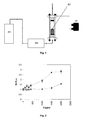
- the solid particles used are homogeneous glass beads (BV) with a diameter of 1 mm.
- the beads are introduced into a glass cell to form a bed of beads as defined on the figure 1 .
- the consolidation tests are based on the resistance of the solid to fluidization. Indeed, by circulating the dry air (AS) through the layer of balls in the ascending direction, and gradually increasing the gas flow (measured by a flow meter DM), at a given flow rate, a threshold speed is reached from which the particles are suspended. The beads are then called fluidized. Before fluidization the pressure differential, measured by a sensor CP, increases continuously with the speed of the gas (Darcy regime), after fluidization, the pressure is maintained at a constant value. The transition between these two regimes defines our criterion of rupture.
- the fluidization rate is our reference value in the absence of any treatment. It is noted Qc_ini.
- the polymer treatment is then applied by injecting the product in solution from top to bottom through the solid mass. The gas flow is then restored and leads to residual saturation with the water combined with the polymer. This water is dried by gas flow in an oven at 60 ° C. The new dry mass is fluidized again.
- the observed fluidization rate, noted Qc is much greater than the initial flow rate. This flow rate report is defined as the consolidation criterion.
- the tests consist of three steps:
- This step consists of injecting the air into the bed of dry beads in order to define the fluidization rate of the unconsolidated medium (Qc_ini).
- This step consists of treating the bed of beads and carrying out a fluidization test.
- step 2 directly follows step 2 by injecting into the treated solid 10 Pore Volumes (VP) of distilled water from the top of the cell.
- VP Pore Volumes
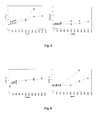
- the figure 2 illustrates the analysis of the effect of microgel type 2 (AP25).
- the treatment consists of injecting 500 ppm NaCl brine and a microgel at different concentrations.
- the figure 2 shows the consolidation (Qc / Qc_ini ratio) of the bed of beads after injection of AP25 microgels at different concentrations C in ppm.
- the results before flush with distilled water are represented by triangles, and the results after flush with distilled water are represented by squares.
- the figure 3 illustrates the analysis of the effect of microgel type 1 (SBP500).
- the treatment consists in injecting 500 ppm NaCl brine and a microgel at different concentrations C in ppm.
- the figure 3 shows the consolidation (Qc / Qc_ini ratio) of the bed of beads after injection of SBP500 microgels at different concentrations.
- the results before flush with distilled water are represented by triangles, and the results after flush with distilled water are represented by squares.
- the figure 4 illustrates the analysis of the effect of WFP.
- the treatment consists in injecting brine 500 ppm NaCl and PAM 920SH at different concentrations.
- the figure 4 shows the consolidation (Qc / Qc_ini ratio) of the bed of beads after injection of PAM at different concentrations C in ppm.
- the results before flush with distilled water are represented by triangles, and the results after flush with distilled water are represented by squares.
- This microgel has the effect of consolidating the medium more and more depending on the concentration.
- Residual efficacy after washing with fresh water is obtained from microgel concentrations of at least 2000 ppm.
- PAM 920SH has the effect of strongly consolidating the environment.
- the consolidation is greater than that obtained with the microgels for concentrations exceeding 300 ppm.
- the effectiveness disappears completely after a gentle wash with water, regardless of the polymer concentration.
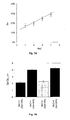
- the mass of microgels retained increases with each cycle as shown by the Figures 7A and 7B .
- the Figure 7A illustrates the evolution of the residual water saturation (Sw) as a function of the number of injection / gas breakthrough cycles (NbC).
- the injection cycle is performed with the AP25 microgel.
- the presence of microgels is favorable for the residual saturation. Indeed, it increases with the number of cycles, the others parameters remaining constant.
- the Figure 7B illustrates the results of consolidation (report Qc / Qc_ini) of the bed of balls after injection as a function of the number of cycles (NbC).
- the method according to the invention has preventive efficacy, but it can also be used for curative treatment. Thus, even wells with strong sandstorms can be treated.
- the invention makes it possible to recreate a cohesion of deconsolidated formations by promoting the formation of inter-grain adhesive bridges and by minimizing the leaching of these adhesive junctions.
Landscapes
- Geology (AREA)
- Life Sciences & Earth Sciences (AREA)
- Engineering & Computer Science (AREA)
- Mining & Mineral Resources (AREA)
- Environmental & Geological Engineering (AREA)
- Fluid Mechanics (AREA)
- Physics & Mathematics (AREA)
- General Life Sciences & Earth Sciences (AREA)
- Geochemistry & Mineralogy (AREA)
- Addition Polymer Or Copolymer, Post-Treatments, Or Chemical Modifications (AREA)
- Consolidation Of Soil By Introduction Of Solidifying Substances Into Soil (AREA)
- Gas Separation By Absorption (AREA)
- Physical Or Chemical Processes And Apparatus (AREA)
Applications Claiming Priority (1)
| Application Number | Priority Date | Filing Date | Title |
|---|---|---|---|
| FR1102375A FR2978488B1 (fr) | 2011-07-28 | 2011-07-28 | Procede optimise de traitement de puits contre les venues de sable |
Publications (2)
| Publication Number | Publication Date |
|---|---|
| EP2551443A2 true EP2551443A2 (de) | 2013-01-30 |
| EP2551443A3 EP2551443A3 (de) | 2017-07-19 |
Family
ID=46320844
Family Applications (1)
| Application Number | Title | Priority Date | Filing Date |
|---|---|---|---|
| EP12290197.8A Withdrawn EP2551443A3 (de) | 2011-07-28 | 2012-06-14 | Optimiertes Verfahren zur Behandlung von einem Bohrloch gegen Versandung |
Country Status (2)
| Country | Link |
|---|---|
| EP (1) | EP2551443A3 (de) |
| FR (1) | FR2978488B1 (de) |
Cited By (2)
| Publication number | Priority date | Publication date | Assignee | Title |
|---|---|---|---|---|
| CN104121017B (zh) * | 2013-04-27 | 2018-08-14 | 中国石油化工股份有限公司 | 一种三维模拟油藏剩余油饱和度测量方法及装置 |
| FR3069011A1 (fr) * | 2017-07-17 | 2019-01-18 | Storengy | Procede de traitement d'une formation rocheuse contre les venues de sable utilisant un coulis de ciment geopolymerique |
Family Cites Families (6)
| Publication number | Priority date | Publication date | Assignee | Title |
|---|---|---|---|---|
| US5201612A (en) * | 1990-06-21 | 1993-04-13 | Institut Francais Du Petrole | Process for the consolidation of a geological formation by a substance polymerizable at the temperature and pressure of the formation |
| US5082057A (en) * | 1990-12-14 | 1992-01-21 | Marathon Oil Company | Sand consolidation treatment for a hydrocarbon production well bore using an overdisplacement fluid |
| US6152234A (en) * | 1998-06-10 | 2000-11-28 | Atlantic Richfield Company | Method for strengthening a subterranean formation |
| US6431280B2 (en) * | 1998-12-21 | 2002-08-13 | Geoffrey Stanley Bayliss | Method for placement of blocking gels or polymers at specific depths of penetration into oil and gas, and water producing formations |
| US7757768B2 (en) * | 2004-10-08 | 2010-07-20 | Halliburton Energy Services, Inc. | Method and composition for enhancing coverage and displacement of treatment fluids into subterranean formations |
| FR2932183B1 (fr) * | 2008-06-10 | 2013-03-29 | Seppic Sa | Nouveau polyampholyte, et son utilisation dans le traitement des formations rocheuses |
-
2011
- 2011-07-28 FR FR1102375A patent/FR2978488B1/fr not_active Expired - Fee Related
-
2012
- 2012-06-14 EP EP12290197.8A patent/EP2551443A3/de not_active Withdrawn
Non-Patent Citations (1)
| Title |
|---|
| None |
Cited By (4)
| Publication number | Priority date | Publication date | Assignee | Title |
|---|---|---|---|---|
| CN104121017B (zh) * | 2013-04-27 | 2018-08-14 | 中国石油化工股份有限公司 | 一种三维模拟油藏剩余油饱和度测量方法及装置 |
| FR3069011A1 (fr) * | 2017-07-17 | 2019-01-18 | Storengy | Procede de traitement d'une formation rocheuse contre les venues de sable utilisant un coulis de ciment geopolymerique |
| WO2019016469A1 (fr) | 2017-07-17 | 2019-01-24 | Storengy | Procede de traitement d'une formation rocheuse contre les venues de sable utilisant un coulis de ciment geopolymerique |
| US11186761B2 (en) | 2017-07-17 | 2021-11-30 | Storengy | Method for treating a rock formation against the inflitration of sand using a geopolymer cement grout |
Also Published As
| Publication number | Publication date |
|---|---|
| FR2978488A1 (fr) | 2013-02-01 |
| EP2551443A3 (de) | 2017-07-19 |
| FR2978488B1 (fr) | 2013-07-12 |
Similar Documents
| Publication | Publication Date | Title |
|---|---|---|
| Zhang et al. | Effect of concentration on HPAM retention in porous media | |
| Li et al. | Static adsorption and dynamic retention of an anti‐salinity polymer in low permeability sandstone core | |
| US8936087B2 (en) | Methods and compositions for sand control in injection wells | |
| CN107109916A (zh) | 包含化学处理剂的经注入的和涂布的支撑剂及其使用方法 | |
| CN105670593B (zh) | 一种新的Cr3+聚合物凝胶及其与水交替注入调驱方法 | |
| Brattekås et al. | A review of polymer gel utilization in carbon dioxide flow control at the core and field scale | |
| Kudaibergenov et al. | Plugging behavior of gellan in porous saline media | |
| FR3068964A1 (fr) | Coulis de ciment geopolymerique et procede de traitement d'une formation rocheuse contre les venues de sable utilisant un tel coulis de ciment geopolymerique | |
| CN103080472A (zh) | 控制井下产水量的水敏性多孔介质及控制井下产水量的方法 | |
| Al-Shajalee et al. | Low-salinity-assisted cationic polyacrylamide water shutoff in low-permeability sandstone gas reservoirs | |
| EP2551443A2 (de) | Optimiertes Verfahren zur Behandlung von einem Bohrloch gegen Versandung | |
| FR3069011B1 (fr) | Procede de traitement d'une formation rocheuse contre les venues de sable utilisant un coulis de ciment geopolymerique | |
| US8875786B2 (en) | Methods and compositions for sand control in injection wells | |
| Ayari et al. | An environmentally friendly and low-cost alginate-based gel for water management in petroleum reservoirs: Characterization and efficacy investigation | |
| CA2076641C (fr) | Une suspension stabilisee et son utilisation pour la recuperation d'hydrocarbures | |
| CN113250663B (zh) | 中低渗储层乳液-聚合物复合体系注入参数的优化设计方法 | |
| CN106279526A (zh) | 一种冻胶微球体系及其制备方法,冻胶微球分散体系,冻胶微球强化聚合物驱体系 | |
| KR20190031926A (ko) | 나노 입자를 이용한 지중 가스 저장층의 주입성 향상방법 | |
| Brattekås et al. | The effect of Cr (III) acetate-HPAM gel maturity on washout from open fractures | |
| Fenglan et al. | The applicable limits of the high strength gel system to the tight sandstone fractured reservoir in CO2 flooding | |
| KR101235914B1 (ko) | 폴리머의 순차적 주입을 통한 지층수 생산 제어 방법 | |
| Zaitoun et al. | Gas production enhancement by polymer treatment | |
| US20130312967A1 (en) | Method for limiting the water or gas coning in an extraction well of a hydrocarbon fluid | |
| CN114508331B (zh) | 一种基于霍尔曲线导数确定聚合物注入能力新方法 | |
| Park et al. | Experimental investigation of polymer adsorption-induced permeability reduction in low permeability reservoirs |
Legal Events
| Date | Code | Title | Description |
|---|---|---|---|
| PUAI | Public reference made under article 153(3) epc to a published international application that has entered the european phase |
Free format text: ORIGINAL CODE: 0009012 |
|
| AK | Designated contracting states |
Kind code of ref document: A2 Designated state(s): AL AT BE BG CH CY CZ DE DK EE ES FI FR GB GR HR HU IE IS IT LI LT LU LV MC MK MT NL NO PL PT RO RS SE SI SK SM TR |
|
| AX | Request for extension of the european patent |
Extension state: BA ME |
|
| PUAL | Search report despatched |
Free format text: ORIGINAL CODE: 0009013 |
|
| AK | Designated contracting states |
Kind code of ref document: A3 Designated state(s): AL AT BE BG CH CY CZ DE DK EE ES FI FR GB GR HR HU IE IS IT LI LT LU LV MC MK MT NL NO PL PT RO RS SE SI SK SM TR |
|
| AX | Request for extension of the european patent |
Extension state: BA ME |
|
| RIC1 | Information provided on ipc code assigned before grant |
Ipc: E21B 43/02 20060101AFI20170613BHEP Ipc: E21B 33/138 20060101ALI20170613BHEP |
|
| RAP1 | Party data changed (applicant data changed or rights of an application transferred) |
Owner name: IFP ENERGIES NOUVELLES |
|
| 17P | Request for examination filed |
Effective date: 20180119 |
|
| RBV | Designated contracting states (corrected) |
Designated state(s): AL AT BE BG CH CY CZ DE DK EE ES FI FR GB GR HR HU IE IS IT LI LT LU LV MC MK MT NL NO PL PT RO RS SE SI SK SM TR |
|
| 17Q | First examination report despatched |
Effective date: 20180926 |
|
| GRAP | Despatch of communication of intention to grant a patent |
Free format text: ORIGINAL CODE: EPIDOSNIGR1 |
|
| INTG | Intention to grant announced |
Effective date: 20191011 |
|
| GRAJ | Information related to disapproval of communication of intention to grant by the applicant or resumption of examination proceedings by the epo deleted |
Free format text: ORIGINAL CODE: EPIDOSDIGR1 |
|
| GRAP | Despatch of communication of intention to grant a patent |
Free format text: ORIGINAL CODE: EPIDOSNIGR1 |
|
| INTC | Intention to grant announced (deleted) | ||
| INTG | Intention to grant announced |
Effective date: 20200224 |
|
| STAA | Information on the status of an ep patent application or granted ep patent |
Free format text: STATUS: THE APPLICATION IS DEEMED TO BE WITHDRAWN |
|
| 18D | Application deemed to be withdrawn |
Effective date: 20200707 |