EP2551783A1 - System und Verfahren zur Informationslebenszyklusverwaltung von Ermittlungsfällen - Google Patents
System und Verfahren zur Informationslebenszyklusverwaltung von Ermittlungsfällen Download PDFInfo
- Publication number
- EP2551783A1 EP2551783A1 EP12177976A EP12177976A EP2551783A1 EP 2551783 A1 EP2551783 A1 EP 2551783A1 EP 12177976 A EP12177976 A EP 12177976A EP 12177976 A EP12177976 A EP 12177976A EP 2551783 A1 EP2551783 A1 EP 2551783A1
- Authority
- EP
- European Patent Office
- Prior art keywords
- items
- content
- storage
- ilm
- case
- Prior art date
- Legal status (The legal status is an assumption and is not a legal conclusion. Google has not performed a legal analysis and makes no representation as to the accuracy of the status listed.)
- Ceased
Links
Images


Classifications
-
- G—PHYSICS
- G06—COMPUTING OR CALCULATING; COUNTING
- G06F—ELECTRIC DIGITAL DATA PROCESSING
- G06F16/00—Information retrieval; Database structures therefor; File system structures therefor
- G06F16/20—Information retrieval; Database structures therefor; File system structures therefor of structured data, e.g. relational data
- G06F16/21—Design, administration or maintenance of databases
-
- G—PHYSICS
- G06—COMPUTING OR CALCULATING; COUNTING
- G06F—ELECTRIC DIGITAL DATA PROCESSING
- G06F16/00—Information retrieval; Database structures therefor; File system structures therefor
- G06F16/10—File systems; File servers
- G06F16/18—File system types
- G06F16/185—Hierarchical storage management [HSM] systems, e.g. file migration or policies thereof
Definitions
- the present disclosure relates generally to data management, and particularly to methods and systems for information lifecycle management.
- ILM Information Lifecycle Management
- An embodiment that is described herein provides a method for Information Lifecycle Management (ILM).
- the method includes analyzing a state of an investigation case and selecting, based on the analyzed state, an ILM policy for applying to items of data associated with the investigation case.
- the items of data are stored in a storage system having multiple storage tiers having different, respective performance levels, in accordance with the ILM policy.
- selecting the ILM policy includes choosing a respective storage tier for storing each item of data. In an embodiment, selecting the ILM policy includes identifying an activity status of the investigation case, and choosing the storage tier depending on the activity status. In a disclosed embodiment, the performance levels of the multiple storage tiers include different, respective access times.
- the items include content that is derived from communication sessions conducted over a communication network and metadata associated with the content.
- the metadata includes references to a current storage location of the associated content in the storage system.
- the items include additional items of data from an external source separate from the communication network.
- storing the items in accordance with the ILM policy includes storing the items in a first storage tier having a first performance level when the investigation case is active, and storing the items in a second storage tier having a second performance level, lower than the first performance level, when the investigation case is inactive.
- storing the items in accordance with the ILM policy includes detecting a change in the state of the investigation case, and moving the items from a first storage tier to a second storage tier in response to the change.
- the items include content and metadata associated with the content, and moving the items includes moving only the content and not the metadata of the items, and updating the metadata of the items to reflect a current storage location of the items in the second storage tier.
- the investigation case is one of multiple investigation cases that are assigned respective priorities
- storing the items in accordance with the ILM policy includes choosing a storage tier for storing the items depending on a priority assigned to the investigation case.
- selecting the ILM policy includes choosing a storage tier for storing the items depending on a parent case or on a sub-case of the investigation case.
- selecting the ILM policy includes selecting a storage tier for storing the items based on timing profiles according to which the data items associated with the investigation case were accessed.
- storing the items in accordance with the ILM policy includes copying content of all the items associated with the investigation case from a first storage location to a second storage location in a single transaction, updating metadata associated with the items following the transaction to indicate the second storage location, and, after updating the metadata, deleting the content from the first storage location.
- the method includes rolling back the transaction upon failing to successfully complete the transaction or to update the metadata.
- apparatus for Information Lifecycle Management including a storage system and a processor.
- the storage system includes multiple storage tiers having different, respective performance levels.
- the processor is configured to analyze a state of an investigation case, to select, based on the analyzed state, an ILM policy for applying to items of data that are associated with the investigation case, and to store the items of data in the storage tiers of the storage system in accordance with the ILM policy.
- a monitoring center typically comprises a large storage system, which stores raw content of intercepted communication sessions as well as analysis products. In many practical applications, a large volume of content has to be stored for long periods of time - An example monitoring center may be required to store several Terabytes of content for several years. The cost of storage devices that meet such requirements may be prohibitive.
- an ILM scheme may store some content on lower-cost but slower storage devices, and other content on faster but higher-cost storage devices.
- Each type of storage device which is characterized by a certain cost/access-time trade-off, is referred to herein as a storage tier.
- the storage system comprises three storage tiers: An on-line tier comprising Fibre-Channel (FC) disks, a mid-term storage tier comprising Serial Advanced Technology Attachment (SATA) disks, and an archive tier comprising detachable storage media.
- FC Fibre-Channel
- SATA Serial Advanced Technology Attachment
- the monitoring center processes the various items of content in the context of investigation cases.
- each item of content is associated with one or more investigation cases.
- a given investigation case may be assigned a certain status, e.g., active or closed.
- the monitoring center comprises an ILM server that assigns content items to storage tiers based on the investigation cases with which the content items are associated.
- content that is associated with active investigation cases will be stored on faster storage devices, and content that is associated with closed investigation cases will be stored on slower storage devices.
- the ILM server analyzes the state of a given investigation case, and selects an ILM policy based on the state of the case.
- the ILM policy specifies the storage tier (or tiers) to be used for storing items of data associated with the case.
- the ILM server stores the items in accordance with the selected ILM policy.
- the items comprise content and associated metadata.
- the metadata comprises references to the current storage locations of the content in the storage system, and is updated whenever content is moved between storage tiers.
- a naive ILM solution would be to select a storage tier for a given content item based on the last time this item was accessed, such that only recently-accessed items are stored on fast but expensive storage media. Such a na ⁇ ve solution, however, does not perform well in the context of investigation cases.
- an active investigation case often relates to multiple content items, some of which are old and accessed rarely, while others are new and accessed recently.
- a closed investigation case may relate to a mixture of new and old content items.
- the disclosed techniques can make all the content items related to an active case readily accessible, regardless of their individual access history. As a result, access time to content items of active cases is reduced.
- an investigation case is closed, its content items can be moved to slow, low-cost storage, even though some of the items may be new and recently-accessed. Thus, fast memory storage is used only when actually needed, and system cost is reduced.
- Fig. 1 is a block diagram that schematically illustrates a monitoring center 20, in accordance with an embodiment of the present disclosure.
- Monitoring center 20 is connected to a communication network 22 and monitors communication of users 24 who operate communication terminals 28 over the network.
- Monitoring centers of this sort may be used, for example, for tracking suspect users, for intelligence gathering or for any other suitable application.
- the system may be deployed, for example, by intelligence or government agencies, by law enforcement or public safety bodies, or by any other suitable party.
- Network 22 may comprise, for example, a wireless (e.g., cellular) network such as a Global System for Mobile communications (GSM) network, a Universal Mobile Telecommunications System (UMTS) network, a Wireless Local Area Network (WLAN - also referred to as Wi-Fi) or any other suitable type of wireless communication network.
- GSM Global System for Mobile communications
- UMTS Universal Mobile Telecommunications System
- WLAN Wireless Local Area Network
- network 22 may comprise a wireline network such as a Public Switched Telephone Network (PSTN), an Internet Protocol (IP) network such as the Internet or any other suitable type of wireleine network.
- PSTN Public Switched Telephone Network
- IP Internet Protocol
- Terminals 28 may comprise, for example, fixed or mobile phones, communication-enabled mobile computers or Personal Digital Assistants (PDAs), or any other suitable type of device having communication capabilities. Terminals 28 may communicate over network 22 in various ways. The embodiments described below refer mainly to telephone calls, but the disclosed techniques are applicable to various other kinds of communication interaction, such as e-mail, chat, instant messaging and Short Message Service (SMS).
- SMS Short Message Service
- probes 32 intercept the communication from network 22.
- the type of probe may vary, for example, depending on the type of network and the means for connecting to the network.
- probe 32 comprises a passive IP or telephony probe.
- probes 32 may intercept the communication using active methods, e.g., using commands in the network elements of network 22 to duplicate the communication of certain terminals 28 and send it to the monitoring center.
- a mediation device 36 separates each intercepted communication session into content and metadata.
- the content may comprise, for example, recorded voice, text, images, IP traffic or any other type of content exchanged between users 24.
- the metadata of a given communication session may comprise any suitable parameters that are descriptive of the session.
- the communication sessions comprise telephone calls and the metadata comprises Call Data Records (CDRs).
- CDRs Call Data Records
- the content of the intercepted communication is stored in a storage system 40.
- content is used to cover both raw content that is extracted from the intercepted communication, as well as analysis products that are produced based on the extracted content. Both types of content are typically stored in system 40, and both types can be stored using the disclosed techniques.
- storage system 40 stores additional information relating to the intercepted content, such as transcriptions of voice content and/or annotations written by analysts. Information of this sort may change along the life-cycle of the case. For example, a month after a call was recorded and transcribed, an analyst may discover the meaning of a certain code word used in that call and add this information to the annotations stored in system 40.
- the monitoring center may receive additional information from other sources other than network 22, and relate this information to one or more investigation cases.
- information may comprise, for example, historical CDRs from service providers, financial transactions from banks or credit card companies, or any other suitable information type.
- Information from external sources may comprise content - e.g., e-mail messages from mail server archives.
- information of this sort is also regarded herein as content and/or metadata as appropriate, and the ILM techniques described herein are applied to them based on their association with investigation cases.
- System 40 comprises multiple storage tiers, such that each tier comprises storage devices that are characterized by a certain access time. Typically, faster storage devices have higher cost, and vice versa.
- the multi-tier configuration enables the system to select the appropriate cost/access-time trade-off for each content item, while maintaining a manageable system cost. As will be explained below, each item of content is associated with one or more investigation cases, and the selection of storage tier depends on this association.
- storage system 40 comprises an on-line storage tier 44, a mid-term storage tier 48, and an archive storage tier 52.
- On-line storage tier 44 has the fastest but most expensive storage devices among the storage tiers.
- tier 44 comprises Fibre-Channel (FC) disks.
- Mid-term storage tier 48 may comprise slower and lower-cost storage devices, such as Serial Advanced Technology Attachment (SATA) disks.
- FC Fibre-Channel
- SATA Serial Advanced Technology Attachment
- Archive storage tier 52 comprises even slower storage devices.
- the archive storage tier comprises detachable storage devices, such as detachable disk or tape drives, which are not permanently connected to the monitoring center.
- archive storage tier 52 comprises storage media that can be written once but read multiple times, sometimes referred to as Write Once Read Many (WORM) media
- WORM Write Once Read Many
- archive storage tier 52 may comprise optical storage devices such as CD-ROM or DVD.
- the archive storage tier may comprise storage media that can be written and read multiple times, sometimes referred to as Write Many Read Many (WMRM) media.
- WMRM Write Many Read Many
- system 40 may comprise any suitable number of storage tiers, each having any suitable type of storage devices. Any suitable storage media can be used for implementing the storage devices, such as solid-state memory, or magnetic disk or tape.
- Monitoring center 20 comprises a metadata database (DB) 64, which holds the metadata of the intercepted communication sessions.
- the metadata stored in DB 64 may comprise, for example, transcriptions and annotations relating to the intercepted content and Call Data Records (CDRs).
- CDRs Call Data Records
- DB 64 holds references (e.g., pointers or paths) that indicate the current storage locations of the raw content in storage system 40. The references to the raw content storage locations are typically maintained transparently of the actual physical locations of the content in system 40.
- Monitoring center 20 comprises an Information Lifecycle Management (ILM) server 68, which controls the storage of content in system 40.
- ILM Information Lifecycle Management
- the ILM server decides in which storage tier to store each content item. As conditions change, the ILM server may move content items from one storage tier to another.
- ILM server 68 selects the storage tier for a given content item based on the investigation case (or cases) with which this item is associated. The structure and operation of ILM server 68 is explained in greater detail below.
- the definitions or rules that specify which storage tier or tiers are to be used for storing the various content items are referred to as an ILM policy.
- the content items are associated with investigation cases, and the ILM policy depends on this association.
- the ILM server analyzes the state of a given investigation case, and then selects and applies a suitable ILM policy for the items associated with this case based on the state of the case.
- selecting a storage tier and “selecting an ILM policy” are sometimes used interchangeably herein.
- Monitoring center 20 comprises an operator terminal 56, using which an operator 60 is able to retrieve and analyze the content stored in storage system 40.
- the operator terminal comprises suitable input and output devices for presenting the content to the operator and for controlling the monitoring center by the operator.
- the operator is able to view and analyze the metadata, as well.
- DB 64 holds a list of investigation cases. For each investigation case, DB 64 holds references to the current storage locations (in system 40) of all raw data elements that are associated with the case stored, as well as the metadata relating to the case. Typically, a raw content element may belong to only one case. Thus, for example, if a certain intercepted call belongs to multiple cases, the call is duplicated and its content associated separately with the different cases.
- This technique enables each case to be analyzed separately and allow applying case-based access rights.
- an investigator working on one case is usually not permitted to have access to information gathered and analyzed in another case. If a call belongs to two cases, the call will typically be handled totally separately within the context of each case, e.g., with separate transcriptions, annotations and analysis results.
- DB 64 typically holds, for each case, a list of references to the metadata records associated with the case.
- a given metadata record typically holds a list of references to the current storage locations (in system 40) of the raw content elements.
- the ILM server moves content items from one storage tier to another, the metadata associated with these content items is not moved.
- the ILM server updates the metadata to reflect the new storage locations of the content items in the new storage tier.
- all content items of a given case are moved in a single transaction. The transaction can be rolled back in case of failure.
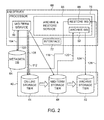
- FIG. 2 is a block diagram that schematically illustrates ILM server 68 and its interaction with other elements of monitoring center 20, in accordance with an embodiment of the present disclosure.
- ILM server 68 comprises an interface 72 for communicating with other elements of monitoring center 20, e.g., with DB 64 and with storage system 40.
- the ILM server further comprises a processor 76 that carries out the methods described herein.
- processor 76 runs several software modules, namely a mid-term service 80 and an archive/restore service 84.
- Service 84 comprises a restore Work Station (WS) 88 and an archive WS 92 that are operated by operator 60.
- WS restore Work Station
- Mid-term service 80 is responsible for moving content items between on-line storage tier 44 and mid-term storage tier 58.
- the mid-term service queries the metadata of the calls related to this case in DB 64, as illustrated by an arrow 100.
- the mid-term service may decide to move the content of the call from on-line storage tier 44 to mid-term storage tier 48.
- the mid-term service After copying the content item from tier 44 to tier 48 (illustrated by an arrow 112), the mid-term service deletes the content item from tier 44 (illustrated by an arrow 108), and updates the path of in the metadata stored in DB 64 (illustrated by an arrow 104) to reflect the new storage location.
- the entire process of moving content items between storage tiers is transparent to operator 60.
- a content item is typically deleted from a given storage tier only after it is safely copied to its new location, to ensure data integrity.
- these procedures sometimes referred to as "make before break"
- the duplicated content is first verified to be stored successfully in the new location. Only afterwards, as a complete transaction (meaning that all the content items were copied successfully), the old information is deleted. If, for any reason, the copy process is interrupted or the metadata update fails, then the process is rolled-back: All the copied information is deleted and the content is left in the original storage location.
- the process above can be used to move content items from the mid-term storage tier to the on-line storage tier. This decision may be based, for example, on the investigation case or cases with which the content is associated.
- Archive/restore service 84 is responsible for moving content items between archive storage tier 52 and the other storage tiers.
- the example of Fig. 2 shows data flow from the mid-term storage tier to the archive storage tier.
- service 84 may move data from on-line storage tier to the archive storage tier, as well as from the archive storage tier to any of the other storage tiers.
- archive WS 92 queries the metadata of a certain call in DB 64. Based on the metadata (e.g., based on the investigation case with which the call is associated), the ILM server may decide to move the content of the call from mid-term storage tier 48 to archive storage tier 52. After copying the content item from tier 48 to tier 52 (illustrated by arrows 120 and 124), the ILM server deletes the content item from tier 48 and updates the path of in the metadata stored in DB 64.
- WS 92 archives a content item in tier 52 by copying the content item to a local memory in server 68, producing an image to be written to archive tier 52, and then writing the image from server 68 to tier 52.
- operator 60 may control this process, for example by returning data from WORM storage (e.g., CD, DVD or external storage).
- WORM storage e.g., CD, DVD or external storage
- restore WS 88 restores content items from tier 52 to tiers 44 and/or 48.
- restore WS 88 queries the metadata of a certain call in DB 64. Based on the metadata (e.g., based on the investigation case with which the call is associated), the ILM server may decide to restore the content of the call from archive storage tier 52 to on-line storage tier 44. After copying the content item from tier 52 to tier 44 (illustrated by arrows 128 and 116), the ILM server deletes the content item from tier 52 (if applicable) and updates the path of in the metadata stored in DB 64.
- WS 88 restores a content item from tier 52 by copying the image of the content item to a local memory in the ILM server, and restoring the content from server 68 to tier 44.
- the monitoring center and ILM server configurations of Figs. 1 and 2 are example configurations, which are chosen purely for the sake of conceptual clarity. In alternative embodiments, any other suitable configurations can be used.
- the monitoring center and ILM server elements may be implemented using hardware, software or using a combination of hardware and software elements.
- ILM server 68 (and in particular processor 84) comprises a general-purpose computer, which is programmed in software to carry out the functions described herein.
- the software may be downloaded to the computer in electronic form, over a network, for example, or it may, alternatively or additionally, be provided and/or stored on non-transitory tangible media, such as magnetic, optical, or electronic memory.
- the information in monitoring center 20 is organized and managed in the context of investigation cases.
- a given investigation case may relate to a certain individual or group of individuals, to an event or group of events, to a certain geographical location, for example.
- an investigation case may be defined in any other suitable manner.
- a given investigation case is typically associated with multiple calls, and therefore with multiple content items in storage system 40.
- an investigation case that concerns a certain suspect individual may be associated, for example, with the telephone calls conducted by this individual, the telephone calls conducted from the individual's phone, the telephone calls in which the individual's name was mentioned.
- any other suitable association criteria can be defined and used.
- the association between a given call (and thus given content) and a given investigation case may be defined manually by operator 60 or automatically.
- a given call (and therefore given content) may be associated with one or more investigation cases.
- ILM server 68 decides in which storage tier to store given content (i.e., to select an ILM policy for the content) based on the investigation case (or cases) with which the content is associated.
- the associations between content and investigation cases are stored in DB 64, and the ILM server queries this information and moves content items from one storage tier to another based on the queried associations.
- Newly-intercepted content will typically be stored in on-line storage tier 44, and later moved to other storage tiers as necessary.
- the selection of storage tier may depend on the timing profiles according to which the content items were accessed.
- ILM server 68 may apply any suitable criteria for selecting a storage tier for a given content item based on the investigation cases with which the item is associated. For example, a given investigation case typically has a given activity status at a given time. For example, an investigation case may be defined as active or inactive (closed). In some embodiments, ILM server 68 selects the storage tier for a given content item based on the activity statuses of the investigation cases with which the item is associated.
- server 68 stores all the content items that are associated with an active investigation case in on-line storage tier 44 or in mid-term storage tier 48.
- the content items that are associated with inactive investigation cases are stored in the archive storage tier 52.
- ILM server 68 typically moves the content items of this case between the storage tiers to match the new activity status. For example, when operator 60 closes a case, ILM server 68 typically moves the content associated with this case to the archive storage tier.
- the ILM server typically restores the content items associated with this case from the archive tier to the mid-term or on-line tier.
- this sort of policy is distinctly different from selecting the storage tier based on the activity status of the content items themselves (e.g., based on when the content was most recently accessed). For example, old or rarely-accessed content may be associated with an active investigation case, and therefore stored in the mid-term or even on-line tier. A new or frequently-accessed content item may not be associated with any active cases, and therefore be archived in the archive tier.
- ILM server 68 is able to optimize the usage of storage system 40 to the actual relevance of the content. As a result, both access time and system cost are optimized.
- the ILM server may apply any suitable criteria for resolving possible contradictions. For example, if at least one of the cases associated with a given content item is active, the ILM server may treat this item as associated with an active case. If all the cases associated with a given content item are inactive, the ILM server will treat this item as associated with an inactive case. Alternatively, any other suitable policy can be used.
- a given investigation case may have one or more sub-cases.
- the given investigation case is referred to as a parent case in this context.
- Each sub-case, as well as the parent case, may be associated with a certain respective set of content items.
- the ILM server may select the storage tier for a given content item based on the associated case, and/or based on parent and sub-cases of this case.
- the investigation cases are assigned respective priorities.
- the priorities can be used, for example, for allocating monitoring center resources to the various cases.
- ILM server 68 may select a storage tier for a given content item based on the priority (or priorities) of the investigation case (or cases) associated with this item. Typically, content associated with high-priority cases will be given precedence over content associated with low-priority cases in access to resources.
- on-line storage tier 44 When competing for storage space in on-line tier 44, content that is associated with a high-priority case may be given precedence over content that is associated with a low-priority case.
- the ILM server may use the priorities of the investigation cases in any other way to select storage tiers for content items.
- ILM server 68 applies the investigation-related criteria described above in combination with other criteria.
- the on-line storage tier may be used for storing content items associated with active cases as well as content items intercepted in the last N days.
- any other suitable criteria can be used.
- the storage locations of the different content items are transparent to operator 60, and are managed automatically by ILM server 68.
- Fig. 3 is a flow chart that schematically illustrates a method for ILM, in accordance with an embodiment of the present disclosure.
- the method begins with ILM server 68 querying DB 64 for the metadata of a certain call, at a database querying step 130.
- the ILM server obtains the investigation case with which the call content is associated.
- the ILM server checks whether the activity status of the investigation case has changed, at a change checking step 134. In other words, the ILM server checks whether the storage tier used for storing the content of the call matches the status of the investigation case. If the storage location matches the status, the method loops back to step 130 above.
- the ILM server re-selects the storage tier for storing the content in question, at a reselection step 138.
- the ILM server moves the content items to the re-selected storage tier, at a content moving step 142.
- the method then loops back to step 130 above.
- the disclosed techniques can be used in any application that involves investigation cases, such as like Anti-Money Laundering (AML) systems at Financial Investigation (FI) units, fraud investigation systems (e.g., systems used also by telecom operators, insurance companies and other organizations), or any other suitable application.
- investigation cases such as like Anti-Money Laundering (AML) systems at Financial Investigation (FI) units, fraud investigation systems (e.g., systems used also by telecom operators, insurance companies and other organizations), or any other suitable application.
- the data is organized by investigation cases, including both well-structured data such as CDRs and metadata, and non-structured content such as phone calls, e-mail messages, transcriptions and call summaries.
- ILM is applied to all of these data types according to their association with investigation cases, e.g., based on the case activity status.
Landscapes
- Engineering & Computer Science (AREA)
- Theoretical Computer Science (AREA)
- Databases & Information Systems (AREA)
- Data Mining & Analysis (AREA)
- Physics & Mathematics (AREA)
- General Engineering & Computer Science (AREA)
- General Physics & Mathematics (AREA)
- Information Retrieval, Db Structures And Fs Structures Therefor (AREA)
Applications Claiming Priority (1)
| Application Number | Priority Date | Filing Date | Title |
|---|---|---|---|
| IL214312A IL214312A (en) | 2011-07-27 | 2011-07-27 | A system and method for managing information lifecycle in investigation files |
Publications (1)
| Publication Number | Publication Date |
|---|---|
| EP2551783A1 true EP2551783A1 (de) | 2013-01-30 |
Family
ID=45773715
Family Applications (1)
| Application Number | Title | Priority Date | Filing Date |
|---|---|---|---|
| EP12177976A Ceased EP2551783A1 (de) | 2011-07-27 | 2012-07-26 | System und Verfahren zur Informationslebenszyklusverwaltung von Ermittlungsfällen |
Country Status (3)
| Country | Link |
|---|---|
| US (1) | US20130191354A1 (de) |
| EP (1) | EP2551783A1 (de) |
| IL (1) | IL214312A (de) |
Cited By (2)
| Publication number | Priority date | Publication date | Assignee | Title |
|---|---|---|---|---|
| GB2512856A (en) * | 2013-04-09 | 2014-10-15 | Ibm | Method for file handling in a hierarchical storage environment and corresponding hierarchical storage environment |
| US10116735B2 (en) | 2013-01-09 | 2018-10-30 | Microsoft Technology Licensing, Llc | Service migration across cluster boundaries |
Families Citing this family (5)
| Publication number | Priority date | Publication date | Assignee | Title |
|---|---|---|---|---|
| US9558208B1 (en) * | 2013-12-19 | 2017-01-31 | EMC IP Holding Company LLC | Cluster file system comprising virtual file system having corresponding metadata server |
| US10630728B2 (en) * | 2017-03-31 | 2020-04-21 | Wipro Limited | Systems and methods for minimizing privacy intrusion during internet of things lawful interception |
| US10691367B2 (en) | 2018-10-30 | 2020-06-23 | International Business Machines Corporation | Dynamic policy prioritization and translation of business rules into actions against storage volumes |
| US11593137B2 (en) | 2019-08-30 | 2023-02-28 | Nutanix, Inc. | Hypervisor hibernation |
| US11972266B2 (en) * | 2020-10-02 | 2024-04-30 | Nutanix, Inc. | Hibernating and resuming nodes of a computing cluster |
Citations (4)
| Publication number | Priority date | Publication date | Assignee | Title |
|---|---|---|---|---|
| US20030046270A1 (en) * | 2001-08-31 | 2003-03-06 | Arkivio, Inc. | Techniques for storing data based upon storage policies |
| US20060004847A1 (en) | 2004-07-01 | 2006-01-05 | Claudatos Christopher H | Content-driven information lifecycle management |
| WO2007088084A2 (en) * | 2006-02-03 | 2007-08-09 | International Business Machines Corporation | Restoring a file to its proper storage tier in an information lifecycle management environment |
| US7293133B1 (en) * | 2003-12-31 | 2007-11-06 | Veritas Operating Corporation | Performing operations without requiring split mirrors in a multi-class file system |
Family Cites Families (3)
| Publication number | Priority date | Publication date | Assignee | Title |
|---|---|---|---|---|
| JP4292331B2 (ja) * | 1998-04-27 | 2009-07-08 | ソニー株式会社 | データ記録再生装置及びその方法 |
| US7136883B2 (en) * | 2001-09-08 | 2006-11-14 | Siemens Medial Solutions Health Services Corporation | System for managing object storage and retrieval in partitioned storage media |
| US20050015409A1 (en) * | 2003-05-30 | 2005-01-20 | Arkivio, Inc. | Techniques for performing operations on migrated files without recalling data |
-
2011
- 2011-07-27 IL IL214312A patent/IL214312A/en active IP Right Grant
-
2012
- 2012-07-25 US US13/557,365 patent/US20130191354A1/en not_active Abandoned
- 2012-07-26 EP EP12177976A patent/EP2551783A1/de not_active Ceased
Patent Citations (4)
| Publication number | Priority date | Publication date | Assignee | Title |
|---|---|---|---|---|
| US20030046270A1 (en) * | 2001-08-31 | 2003-03-06 | Arkivio, Inc. | Techniques for storing data based upon storage policies |
| US7293133B1 (en) * | 2003-12-31 | 2007-11-06 | Veritas Operating Corporation | Performing operations without requiring split mirrors in a multi-class file system |
| US20060004847A1 (en) | 2004-07-01 | 2006-01-05 | Claudatos Christopher H | Content-driven information lifecycle management |
| WO2007088084A2 (en) * | 2006-02-03 | 2007-08-09 | International Business Machines Corporation | Restoring a file to its proper storage tier in an information lifecycle management environment |
Cited By (5)
| Publication number | Priority date | Publication date | Assignee | Title |
|---|---|---|---|---|
| US10116735B2 (en) | 2013-01-09 | 2018-10-30 | Microsoft Technology Licensing, Llc | Service migration across cluster boundaries |
| GB2512856A (en) * | 2013-04-09 | 2014-10-15 | Ibm | Method for file handling in a hierarchical storage environment and corresponding hierarchical storage environment |
| US9575989B2 (en) | 2013-04-09 | 2017-02-21 | International Business Machines Corporation | Method for file handling in a hierarchical storage environment and corresponding hierarchical storage environment |
| US10055416B2 (en) | 2013-04-09 | 2018-08-21 | International Business Machines Corporation | Method for file handling in a hierarchical storage environment and corresponding hierarchical storage environment |
| US11556495B2 (en) | 2013-04-09 | 2023-01-17 | International Business Machines Corporation | Method for file handling in a hierarchical storage environment and corresponding hierarchical storage environment |
Also Published As
| Publication number | Publication date |
|---|---|
| IL214312A0 (en) | 2011-09-27 |
| IL214312A (en) | 2016-06-30 |
| US20130191354A1 (en) | 2013-07-25 |
Similar Documents
| Publication | Publication Date | Title |
|---|---|---|
| EP2551783A1 (de) | System und Verfahren zur Informationslebenszyklusverwaltung von Ermittlungsfällen | |
| US11409900B2 (en) | Processing event messages for data objects in a message queue to determine data to redact | |
| US20180336210A1 (en) | Methods and systems relating to network based storage | |
| US20200311029A1 (en) | Key value store using generation markers | |
| JP2015153428A (ja) | 行動変化および一貫性をモデル化して悪意ある内部者を検出するシステムおよび方法 | |
| US11314732B2 (en) | Database migration technique | |
| US20120290545A1 (en) | Collection of intranet activity data | |
| US20070136397A1 (en) | Information life-cycle management architecture for a device with infinite storage capacity | |
| US20220405535A1 (en) | Data log content assessment using machine learning | |
| US20200159771A1 (en) | Processing event messages for data objects to determine data to redact from a database | |
| US12298958B2 (en) | System and method for capturing data sent by a mobile device | |
| CN113098715B (zh) | 一种信息处理方法、装置、系统、介质和计算设备 | |
| CN119396973A (zh) | 基于长短期记忆的会话处理方法、装置、设备及介质 | |
| US11334623B2 (en) | Key value store using change values for data properties | |
| US20210383008A1 (en) | Methods and systems for altering access rights set on digital documents based on temporal events | |
| US20250348582A1 (en) | Virtual Machine Image Management System | |
| CN113296699B (zh) | 数据处理方法及装置 | |
| US11210212B2 (en) | Conflict resolution and garbage collection in distributed databases | |
| US20220365860A1 (en) | Access management | |
| US11095587B2 (en) | Techniques for handling messages in laboratory informatics | |
| CN112187898A (zh) | 一种基于公安网的数据接入系统、方法及装置 | |
| US12229166B2 (en) | Self-organization of data storage | |
| CN121070698B (zh) | 一种提高数据库物理备份效率的方法 | |
| US12333048B1 (en) | Active data disposal | |
| US20080059538A1 (en) | Method and system for synchronizing offline records |
Legal Events
| Date | Code | Title | Description |
|---|---|---|---|
| PUAI | Public reference made under article 153(3) epc to a published international application that has entered the european phase |
Free format text: ORIGINAL CODE: 0009012 |
|
| AK | Designated contracting states |
Kind code of ref document: A1 Designated state(s): AL AT BE BG CH CY CZ DE DK EE ES FI FR GB GR HR HU IE IS IT LI LT LU LV MC MK MT NL NO PL PT RO RS SE SI SK SM TR |
|
| AX | Request for extension of the european patent |
Extension state: BA ME |
|
| 17P | Request for examination filed |
Effective date: 20130729 |
|
| RBV | Designated contracting states (corrected) |
Designated state(s): AL AT BE BG CH CY CZ DE DK EE ES FI FR GB GR HR HU IE IS IT LI LT LU LV MC MK MT NL NO PL PT RO RS SE SI SK SM TR |
|
| STAA | Information on the status of an ep patent application or granted ep patent |
Free format text: STATUS: EXAMINATION IS IN PROGRESS |
|
| 17Q | First examination report despatched |
Effective date: 20170116 |
|
| STAA | Information on the status of an ep patent application or granted ep patent |
Free format text: STATUS: THE APPLICATION HAS BEEN REFUSED |
|
| 18R | Application refused |
Effective date: 20180524 |