EP2552045A2 - Verfahren und vorrichtung zur übertragung von ack-/nack-signalen - Google Patents
Verfahren und vorrichtung zur übertragung von ack-/nack-signalen Download PDFInfo
- Publication number
- EP2552045A2 EP2552045A2 EP20110759755 EP11759755A EP2552045A2 EP 2552045 A2 EP2552045 A2 EP 2552045A2 EP 20110759755 EP20110759755 EP 20110759755 EP 11759755 A EP11759755 A EP 11759755A EP 2552045 A2 EP2552045 A2 EP 2552045A2
- Authority
- EP
- European Patent Office
- Prior art keywords
- harq
- codeword
- indicators
- phich
- bit
- Prior art date
- Legal status (The legal status is an assumption and is not a legal conclusion. Google has not performed a legal analysis and makes no representation as to the accuracy of the status listed.)
- Granted
Links
- 238000000034 method Methods 0.000 title claims abstract description 44
- 101100465000 Mus musculus Prag1 gene Proteins 0.000 title 1
- 238000004891 communication Methods 0.000 claims abstract description 21
- 239000011159 matrix material Substances 0.000 claims description 20
- 238000012545 processing Methods 0.000 claims description 15
- 230000008569 process Effects 0.000 claims description 13
- 238000010397 one-hybrid screening Methods 0.000 claims description 4
- 238000013507 mapping Methods 0.000 description 27
- 102100036409 Activated CDC42 kinase 1 Human genes 0.000 description 21
- 101000741965 Homo sapiens Inactive tyrosine-protein kinase PRAG1 Proteins 0.000 description 21
- 102100038659 Inactive tyrosine-protein kinase PRAG1 Human genes 0.000 description 21
- 230000005540 biological transmission Effects 0.000 description 18
- 125000004122 cyclic group Chemical group 0.000 description 13
- 239000000470 constituent Substances 0.000 description 5
- 238000005516 engineering process Methods 0.000 description 5
- 238000010586 diagram Methods 0.000 description 4
- 230000007480 spreading Effects 0.000 description 4
- 238000012986 modification Methods 0.000 description 3
- 230000004048 modification Effects 0.000 description 3
- 230000010363 phase shift Effects 0.000 description 3
- 230000002776 aggregation Effects 0.000 description 2
- 238000004220 aggregation Methods 0.000 description 2
- 238000010276 construction Methods 0.000 description 2
- 230000003247 decreasing effect Effects 0.000 description 2
- 230000000694 effects Effects 0.000 description 2
- 230000006870 function Effects 0.000 description 2
- 230000004044 response Effects 0.000 description 2
- 241000760358 Enodes Species 0.000 description 1
- 101001018494 Homo sapiens Pro-MCH Proteins 0.000 description 1
- 108010003272 Hyaluronate lyase Proteins 0.000 description 1
- 102100033721 Pro-MCH Human genes 0.000 description 1
- 238000003491 array Methods 0.000 description 1
- 239000000969 carrier Substances 0.000 description 1
- 238000006243 chemical reaction Methods 0.000 description 1
- 238000001514 detection method Methods 0.000 description 1
- 230000007774 longterm Effects 0.000 description 1
- 238000010295 mobile communication Methods 0.000 description 1
- 230000003252 repetitive effect Effects 0.000 description 1
- 238000005070 sampling Methods 0.000 description 1
- 235000015096 spirit Nutrition 0.000 description 1
Images



Classifications
-
- H—ELECTRICITY
- H04—ELECTRIC COMMUNICATION TECHNIQUE
- H04L—TRANSMISSION OF DIGITAL INFORMATION, e.g. TELEGRAPHIC COMMUNICATION
- H04L1/00—Arrangements for detecting or preventing errors in the information received
- H04L1/12—Arrangements for detecting or preventing errors in the information received by using return channel
- H04L1/16—Arrangements for detecting or preventing errors in the information received by using return channel in which the return channel carries supervisory signals, e.g. repetition request signals
- H04L1/18—Automatic repetition systems, e.g. Van Duuren systems
-
- H—ELECTRICITY
- H04—ELECTRIC COMMUNICATION TECHNIQUE
- H04L—TRANSMISSION OF DIGITAL INFORMATION, e.g. TELEGRAPHIC COMMUNICATION
- H04L1/00—Arrangements for detecting or preventing errors in the information received
- H04L1/12—Arrangements for detecting or preventing errors in the information received by using return channel
- H04L1/16—Arrangements for detecting or preventing errors in the information received by using return channel in which the return channel carries supervisory signals, e.g. repetition request signals
- H04L1/18—Automatic repetition systems, e.g. Van Duuren systems
- H04L1/1812—Hybrid protocols; Hybrid automatic repeat request [HARQ]
-
- H—ELECTRICITY
- H04—ELECTRIC COMMUNICATION TECHNIQUE
- H04L—TRANSMISSION OF DIGITAL INFORMATION, e.g. TELEGRAPHIC COMMUNICATION
- H04L1/00—Arrangements for detecting or preventing errors in the information received
- H04L1/0001—Systems modifying transmission characteristics according to link quality, e.g. power backoff
- H04L1/0023—Systems modifying transmission characteristics according to link quality, e.g. power backoff characterised by the signalling
- H04L1/0028—Formatting
- H04L1/0029—Reduction of the amount of signalling, e.g. retention of useful signalling or differential signalling
-
- H—ELECTRICITY
- H04—ELECTRIC COMMUNICATION TECHNIQUE
- H04L—TRANSMISSION OF DIGITAL INFORMATION, e.g. TELEGRAPHIC COMMUNICATION
- H04L1/00—Arrangements for detecting or preventing errors in the information received
- H04L1/004—Arrangements for detecting or preventing errors in the information received by using forward error control
- H04L1/0072—Error control for data other than payload data, e.g. control data
- H04L1/0073—Special arrangements for feedback channel
-
- H—ELECTRICITY
- H04—ELECTRIC COMMUNICATION TECHNIQUE
- H04L—TRANSMISSION OF DIGITAL INFORMATION, e.g. TELEGRAPHIC COMMUNICATION
- H04L1/00—Arrangements for detecting or preventing errors in the information received
- H04L1/12—Arrangements for detecting or preventing errors in the information received by using return channel
- H04L1/16—Arrangements for detecting or preventing errors in the information received by using return channel in which the return channel carries supervisory signals, e.g. repetition request signals
- H04L1/1607—Details of the supervisory signal
- H04L1/1621—Group acknowledgement, i.e. the acknowledgement message defining a range of identifiers, e.g. of sequence numbers
-
- H—ELECTRICITY
- H04—ELECTRIC COMMUNICATION TECHNIQUE
- H04L—TRANSMISSION OF DIGITAL INFORMATION, e.g. TELEGRAPHIC COMMUNICATION
- H04L1/00—Arrangements for detecting or preventing errors in the information received
- H04L1/12—Arrangements for detecting or preventing errors in the information received by using return channel
- H04L1/16—Arrangements for detecting or preventing errors in the information received by using return channel in which the return channel carries supervisory signals, e.g. repetition request signals
- H04L1/18—Automatic repetition systems, e.g. Van Duuren systems
- H04L1/1829—Arrangements specially adapted for the receiver end
-
- H—ELECTRICITY
- H04—ELECTRIC COMMUNICATION TECHNIQUE
- H04L—TRANSMISSION OF DIGITAL INFORMATION, e.g. TELEGRAPHIC COMMUNICATION
- H04L1/00—Arrangements for detecting or preventing errors in the information received
- H04L1/12—Arrangements for detecting or preventing errors in the information received by using return channel
- H04L2001/125—Arrangements for preventing errors in the return channel
Definitions
- the present invention relates to wireless communication, and more particularly, to a method and apparatus for transmitting a downlink Acknowledgement/Negative Acknowledgement (ACK/NACK) signal.
- ACK/NACK downlink Acknowledgement/Negative Acknowledgement
- a wireless communication system is a multiple access system capable of supporting communication with multiple users by sharing available system resources (bandwidth, transmission power, etc.).
- the multiple access system includes, for example, a Code Division Multiple Access (CDMA) system, a Frequency Division Multiple Access (FDMA) system, a Time Division Multiple Access (TDMA) system, an Orthogonal Frequency Division Multiple Access (OFDMA) system, a Single Carrier Frequency Division Multiple Access (SC-FDMA) system, and the like.
- CDMA Code Division Multiple Access
- FDMA Frequency Division Multiple Access
- TDMA Time Division Multiple Access
- OFDMA Orthogonal Frequency Division Multiple Access
- SC-FDMA Single Carrier Frequency Division Multiple Access
- a method for transmitting, at a base station, a Physical Hybrid ARQ Indicator Channel (PHICH) in a wireless communication system includes generating a plurality of Hybrid ARQ (HARQ) indicators; channel-coding the plurality of HARQ indicators to one HARQ codeword; and transmitting the HARQ codeword through the PHICH, wherein some values of the HARQ codeword indicate individual values for the respective HARQ indicators and the other values thereof indicate joint operation values for the plurality of HARQ indicators.
- HARQ Hybrid ARQ
- a base station configured to transmit a Physical Hybrid ARQ Indicator Channel (PHICH) in a wireless communication system includes a Radio Frequency (RF) unit; and a processor, wherein the processor is configured to generate a plurality of Hybrid ARQ (HARQ) indicators, channel-code the plurality of HARQ indicators to one HARQ codeword, and transmit the HARQ codeword through the PHICH, and wherein some values of the HARQ codeword indicate individual values of the respective HARQ indicators and the other values thereof indicate joint operation values for the plurality of HARQ indicators.
- HARQ Hybrid ARQ
- the plurality of HARQ indicators may be two 1-bit HARQ indicators and the HARQ codeword may be 3 bits.
- the channel-coding of the plurality of HARQ indicators may satisfy a characteristic in which, when a 4*2 matrix is generated by arbitrarily extracting two columns from a 4*3 matrix corresponding to an HARQ codeword set, rows of the 4*2 matrix indicate different states.
- a first bit and a second bit of the HARQ codeword may have the same values as the two HARQ indicators and a third bit of the HARQ codeword may indicate a combined value of the two HARQ indicators.
- the third bit may indicate an exclusive OR (XOR) or exclusive NOR (XNOR) operation value of the two HARQ indicators.
- a method for processing, at a user equipment, a Physical Hybrid ARQ Indicator Channel (PHICH) in a wireless communication system includes receiving one Hybrid ARQ (HARQ) codeword through the PHICH; channel-coding the HARQ codeword; and confirming a plurality of HARQ indicators from the HARQ codeword, wherein some values of the HARQ codeword indicate individual values for the respective HARQ indicators and the other values thereof indicate joint operation values for the plurality of HARQ indicators.
- HARQ Hybrid ARQ
- a user equipment configured to process a Physical Hybrid ARQ Indicator Channel (PHICH) in a wireless communication system includes a Radio Frequency (RF) unit; and a processor, wherein the processor is configured to receive one Hybrid ARQ (HARQ) codeword through the PHICH, channel-code the HARQ codeword, and confirm a plurality of HARQ indicators from the HARQ codeword, and wherein some values of the HARQ codeword indicate individual values for the respective HARQ indicators and the other values thereof indicate joint operation values for the plurality of HARQ indicators.
- HARQ Hybrid ARQ
- the plurality of HARQ indicators may be two 1-bit HARQ indicators and the HARQ codeword may be 3 bits.
- the channel-coding of the plurality of HARQ indicators may satisfy a characteristic in which, when a 4*2 matrix is generated by arbitrarily extracting two columns from a 4*3 matrix corresponding to an HARQ codeword set, rows of the 4*2 matrix indicate different states.
- a first bit and a second bit of the HARQ codeword may have the same values as the two HARQ indicators and a third bit of the HARQ codeword may indicate a combined value of the two HARQ indicators.
- the third bit may indicate an exclusive OR (XOR) or exclusive NOR (XNOR) operation value of the two HARQ indicators.
- a downlink ACK/NACK signal can be efficiently transmitted in a wireless communication system.
- a plurality of PHICHs can be transmitted using a single PHICH resource in a wireless communication system.
- CDMA may be implemented with wireless technology such as Universal Terrestrial Radio Access (UTRA) or CDMA2000.
- TDMA may be implemented with wireless technology such as Global System for Mobile communications (GSM)/General Packet Radio Service (GPRS)/Enhanced Data Rates for GSM Evolution (EDGE).
- OFDMA may be implemented with wireless technology such as IEEE 802.11 (Wi-Fi), IEEE 802.16 (WiMAX), IEEE 802.20, and Evolved UTRA (E-UTRA).
- UTRA is part of a Universal Mobile Telecommunications System (UMTS).
- LTE Long Term Evolution
- E-UMTS Evolved UMTS
- LTE-A LTE-Advanced
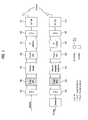
- FIG. 1 is a block diagram illustrating a transmitter and a receiver for OFDMA and SC-FDMA.
- a transmitter may be a part of a User Equipment (UE) and a receiver may be a part of a Base Station (BS).
- BS Base Station
- the transmitter may be a part of the BS and the receiver may be a part of the UE.
- an OFDMA transmitter includes a serial-to-parallel converter 202, a subcarrier mapping module 206, an M-point Inverse Discrete Fourier Transform (IDFT) module 208, a Cyclic Prefix (CP) attachment module 210 ( 212 ), a parallel-to-serial converter 212 ( 210 ), and a Radio Frequency (RF)/Digital-to-Analog Converter (DAC) module 214.
- IDFT Inverse Discrete Fourier Transform
- Signal processing in the OFDMA transmitter is as follows. First, a bitstream is modulated into a data symbol sequence.
- the bitstream may be obtained by performing various types of signal processing including channel encoding, interleaving, and scrambling of a data block delivered from a Medium Access Control (MAC) layer.
- the bitstream is also referred to as a codeword and is equivalent to a data block received from the MAC layer.
- the data block received from the MAC layer is referred to as a transport block as well.
- a modulation scheme may include, but is not limited to, Binary Phase Shift Keying (BPSK), Quadrature Phase Shift Keying (QPSK), and n-Quadrature Amplitude Modulation (n-QAM).
- BPSK Binary Phase Shift Keying
- QPSK Quadrature Phase Shift Keying
- n-QAM n-Quadrature Amplitude Modulation
- a serial data symbol sequence is converted into data symbols N by N in parallel (202).
- the N data symbols are mapped to N subcarriers allocated among a total of M subcarriers and the (M-N) remaining subcarriers are padded with 0s (206).
- the data symbol mapped in a frequency domain is converted to a time-domain sequence through M-point IDFT processing (208).
- an OFDMA symbol is generated by attaching a CP to the time-domain sequence (210) ( 212 ).
- the generated parallel OFDMA symbol is converted into a serial OFDMA symbol (212) ( 212 ).
- an OFDMA receiver includes an RF/Analog-to-Digital Converter (ADC) module 216, a serial-to-parallel converter 218, a CP removal module 220 ( 222 ), an M-point Discrete Fourier Transform (DFT) module 224, a subcarrier demapping/equalization module 226, a parallel-to-serial converter 228 ( 230 ), and a detection module 230 ( ).
- a signal processing process of the OFDMA receiver has a configuration opposite to that of the OFDMA transmitter.
- an SC-FDMA transmitter further includes an N-point DFT module 204 before the subcarrier mapping module 206.
- the SC-FDMA transmitter spreads a plurality of data in a frequency domain through DFT prior to IDFT processing, thereby considerably decreasing a Peak-to-Average Power Ratio (PAPR) of a transmission signal in comparison with an OFDMA scheme.
- an SC-FDMA receiver further includes an N-point IDFT module 226 after the subcarrier demapping module 226.
- a signal processing process of the SC-FDMA receiver has configuration opposite to that of the SC-FDMA transmitter.
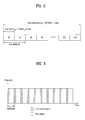
- FIG. 2 illustrates the structure of a radio frame.
- a radio frame has a length of 10 ms and includes 10 subframes.
- Each of the subframes has a length of 1 ms and includes two slots.
- Each of the slots has a length of 0.5 ms.
- Each slot includes a plurality of OFDM symbols in a time domain and includes a plurality of Resource Blocks (RBs) in a frequency domain.
- RBs Resource Blocks
- FIGs. 3 and 4 illustrate the structures of a DL frame and physical channels.
- a subframe includes a control region for transmitting scheduling information and control information and a data region for transmitting DL data.
- the control region is started from the first OFDMA symbol of the subframe and includes one or more OFDMA symbols.
- the size of the control region may be independently configured with respect to each subframe.
- R1 to R4 denote Cell Specific RSs (CRSs) for antennas 0 to 3.
- the control region includes a Physical Control Format Indicator Channel (PCFICH), a Physical Hybrid ARQ Indicator Channel (PHICH), and a Physical Downlink Control Channel (PDCCH).
- the data region includes a Physical Shared Channel (PDSCH).
- a basic resource unit constituting the control channel is a Resource Element Group (REG).
- the REG consists of four Resource Elements (REs) adjacent to one another while excluding Reference Signals (RSs).
- An RE is a minimum unit of a time-frequency resource and is defined as one subcarrier and one OFDMA symbol.
- the RE is indicated by an index pair of (k,1) wherein k denotes a subcarrier index and 1 denotes an OFDMA symbol index.
- the PCFICH physical control format indicator channel, informs a UE of the number of OFDMA symbols used for a PDCCH in each subframe.
- the PHICH carries HARQ ACK/NACK for UL data and includes three REGs.
- the PHICH will be described later in detail with reference to the drawings.
- the PDCCH physical downlink control channel, is assigned to the first n number of OFDM symbols of a subframe.
- n is an integer equal to or greater than 1, which is indicated by the PCFICH.
- the PDCCH is assigned in units of Control Channel Element (CCEs).
- One CCE includes 9 REGs.
- the PDCCH indicates information on resource assignment of a Paging Channel (PCH) and Downlink-Shared Channel (DL-SCH) which are transport channels, uplink scheduling grant, HARQ information, etc.
- the PCH and DL-SCH are transmitted through the PDSCH.
- a BS and a UE generally transmit and receive data through the PDSCH except for a specific control signal or specific service data.
- a specific PDCCH is CRC-masked with a Radio Network Temporary Identity (RNTI) "A", and information about data transmitted using a radio resource (e.g., frequency location) "B” and transmission format information (e.g., transmission block size, modulation scheme, coding information, etc.) "C" is transmitted via a specific subframe.
- RNTI Radio Network Temporary Identity
- one or more UEs located within a cell monitor the PDCCH using RNTI information thereof, and one or more UEs having "A" RNTI receive the PDCCH and receive the PDSCH indicated by "B” and "C” through the information about the received PDCCH.
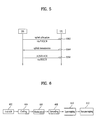
- FIG. 5 illustrates a method for transmitting an ACK/NACK signal for UL data in an LTE system.
- a network node e.g. BS transmits UL allocation information to a UE via a PDCCH (S502).
- Control information for UL allocation is referred to as a UL grant and includes resource block allocation information for PUSCH transmission and cyclic shift information for a Data Demodulation Reference Signal (DMRS).
- DMRS Data Demodulation Reference Signal
- the UE transmits UL data (e.g. a PUSCH) to the BS according to UL allocation information (S504).
- the BS receives the UL data from the UE and transmits a reception response signal to the UL data to the UE via a PHICH (S506).
- a plurality of PHICHs may be mapped to the same resource elements and constitutes a PHICH group.
- the PHICHs within the same PHICH group are distinguished through orthogonal sequences.
- a PHICH resource is identified by an index pair n PHICH group n PHICH seq , where n PHICH group is a PHICH group number and n PHICH seq is an orthogonal sequence index within the PHICH group.
- n PHICH group and n PHICH seq are identified using the lowest Physical Resource Block (PRB) index among PRB indexes allocated for PUSCH transmission and using cyclic shift of a DMRS transmitted as a UL grant.
- PRB Physical Resource Block
- Equation 1 shows an example for acquiring n PHICH group and n PHICH seq .
- N PHICH group I PRB_RA lowest_index + n DMRS ⁇ mod N PHICH group + I PHICH ⁇ N PHICH group
- n PHICH seq ⁇ I PRB_RA lowest_index / N PHICH group ⁇ + n DMRS ⁇ mod 2 N SF PHICH where n DMRS is mapped from a cyclic shift value for a DMRS.
- N SF PHICH denotes a spreading factor size used for PHICH modulation
- I PRB_RA lowest_index denotes the lowest PRB index for PUSCH transmission
- N PHICH group denotes the number of PHICH groups
- I PHICH has a value of 0 or 1 according to a type of a frame or a subframe.
- Table 1 shows exemplary mapping between n DMRS and a cyclic shift value in a DMRS field.
- N PHICH group the number of PHICH groups, N PHICH group , is the same in all subframes and the number of PHICH groups in one subframe is given by Equation 2.
- N PHICH group ⁇ ⁇ N g N RB DL / 8 ⁇ for normal cyclic prefix 2 ⁇ ⁇ N g N RB DL / 8 ⁇ for extended cyclic prefix where N g ⁇ 1/6,1/2,1,2 ⁇ is provided from a higher layer and N DL RB denotes the number of RBs of a DL band.
- the number of PHICH groups may differ according to a DL subframe and is given by m i ⁇ N PHICH group .
- Table 2 shows m i .
- Uplink-downlink configuration Subframe number i 0 1 2 3 4 5 6 7 8 9 0 2 1 - - - 2 1 - - - 1 0 1 - - 1 0 1 - - 1 2 0 0 - 1 0 0 - 1 0 3 1 0 - - - 0 0 0 1 1 4 0 0 - - 0 0 - 0 0 0 1 1 5 0 0 - 0 0 0 0 0 1 0 6 1 1 - - - 1 1 - - - 1
- FIG. 6 illustrates a PHICH signal processing process/block.
- a PHICH signal processing process includes ACK/NACK (A/N) generation 602, (channel) coding 604, modulation 606, spreading 608, layer mapping 610, and resource mapping 612.
- the ACK/NACK generation block 602 generates a 1-bit ACK/NACK according to a decoding result of a PUSCH (corresponding to a data stream, codeword, or transport block) received from a UE. Since an LTE system does not use Single User Multiple Input Multiple Output (SU-MIMO) in UL, only a 1-bit ACK/NACK for PUSCH transmission of one UE, i.e. for a single data stream, is transmitted through a PHICH.
- HARQ Indicator HI
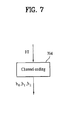
- FIG. 7 illustrates a channel coding block for an HI.
- coding blocks 604 and 704 of legacy LTE generate a 3-bit HI codeword (b 0 ,b 1 ,b 2 ) using repetition coding at a code rate 1/3 from a 1-bit HI.
- An HI of 1 indicates positive acknowledgement and an HI of 0 indicates negative acknowledgement, or vice versa.
- Table 3 shows the relationship between an HI and an HI codeword in legacy LTE. [Table 3] HI codeword HI ⁇ b 0 , b 1 , b 2 > 0 ⁇ 0, 0, 0 > 1 ⁇ 1, 1, 1 >
- the modulation block 606 modulates a bit block b (0) ,...,b ( M bit -1) (i.e. HI codeword) transmitted over one PHICH into a modulation symbol block z (0),...,z( M s -1) having a complex value.
- the PHICH is modulated using Binary Phase Shift Keying (BPSK).
- the spreading block 608 spreads the modulation symbol block z (0),..., z ( M s -1) symbol-wise by multiplying the modulation symbol by an orthogonal sequence and applies scrambling, thereby generating a modulation symbol sequence d (0),..., d ( M symb -1). Equation 3 indicates a processing process of the spreading block 608.
- d i w i mod ⁇ N SF PHICH ⁇ 1 - 2 ⁇ c i ⁇ z ⁇ i / N SF PHICH ⁇
- i 0,..., M symb -1
- M symb N SF PHICH ⁇ M s
- N SF PHICH ⁇ 4 normal cyclic prefix 2 extended cyclic prefix
- c ( i ) denotes a cell-specific scrambling sequence.
- the sequence w 0 ⁇ w ⁇ N SF PHICH - 1 denotes an orthogonal sequence for a PHICH and the sequence index n PHICH seq corresponds to a PHICH number within a PHICH group.
- Table 4 indicates the spreading sequence w 0 ⁇ w ⁇ N SF PHICH - 1 .
- the layer mapping block 610 performs resource group arrangement, layer mapping, and precoding.
- Resource group arrangement indicates arrangement of the spread modulation symbol sequence d (0),..., d ( M symb -1) in the unit of an REG to provide a symbol block d (0) (0) ,..., d (0) ( c ⁇ M symb - 1).
- CP Cyclic Prefix
- Equation 4 shows a method for performing resource group arrangement. [Equation 4]
- the number of antenna ports for a cell-specific reference signal is P ⁇ 1,2,4 ⁇ .
- Layer mapping and precoding depend on the length of a CP and the number of antenna ports used for PHICH transmission.
- p denotes the number of antenna ports.
- Equation 9 is used and, in the other cases, Equation 10 is used.
- the resource mapping block 612 performs various operations for mapping the spread symbol sequence received from the layer mapping block 610 to a physical resource.
- a sequence y ⁇ p 0 , ... , y ⁇ p ⁇ M symb 0 - 1 for each PHICH group is defined as indicated by Equation 11.
- y ⁇ p n ⁇ y i p n where sum is performed with respect to all PHICHs within a PHICH group, y i ( p ) ( n ) denotes a symbol sequence of an i-th PHICH within a PHICH group, and p is an antenna port.
- Equation 12 corresponds to a normal CP case
- Equation 13 corresponds to an extended CP case.
- y ⁇ m ⁇ p n y ⁇ m p n
- y ⁇ m ⁇ p n y ⁇ m p n + y ⁇ m + 1 p n
- m ⁇ 0 , 2 , ... , N PHICH group - 2 for frame structure type 1 0 , 2 , ... , m i ⁇ N PHICH group - 2 for frame structure type 2 and m i is shown in Table 2.
- two PHICH groups m and m+1 correspond to one PHICH mapping unit m '.
- Mapping of a PHICH mapping unit to resource elements is performed in units of a symbol quadruplet.
- Table 5 shows mapping of a PHICH mapping unit to resource elements.
- Table 5 1) For each value of l ' 2) Let n l' denote the number of resource element groups not assigned to PCFICH in OFDM symbol l ' 3) Number the resource-element groups not assigned to PCFICH in OFDM symbol l ' from 0 to n l' -1, starting from the resource-element group with the lowest frequency-domain index.
- Table 6 shows a PHICH duration defined in LTE.
- the PHICH duration is configured by a higher layer.
- Non-MBSFN subframes MBSFN subframes PHICH duration Subframes 1 and 6 in case of frame structure type 2 All other cases on a carrier supporting both PDSCH and PMCH Normal 1 1 1 Extended 2 3 2
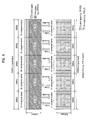
- FIG. 8 illustrates exemplary PHICH allocation in a control region according to Table 5.
- a PHICH is mapped to the remaining REGs except for PCFICHs and RSs within an OFDMA symbol.
- a PHICH group is transmitted using three REGs which are as far distant from each other as possible in a frequency domain. Consequently, each bit of an HI codeword is transmitted through each REG.
- PHICH groups are successively allocated in the frequency domain.
- the same numbers represent REGs belonging to the same PHICH group.
- the PHICH duration is restricted by the size of a control region and corresponds to first to third OFDMA symbols. If a plurality of OFDMA symbols is used for PHICH transmission, REGs belonging to the same PHICH group are transmitted using different OFDM symbols for transmit diversity.
- FIG. 9 illustrates a Carrier Aggregation (CA) communication system.
- CA Carrier Aggregation
- a plurality of UL/DL Component Carriers (CCs) is aggregated to support wider UL/DL bandwidth.
- the CCs may be contiguous or non-contiguous in the frequency domain.
- FIG. 9 shows the case in which the bandwidth of each UL CC is the same as the bandwidth of each DL CC, and UL CCs are symmetrical to DL CCs. However, the bandwidth of each CC may be independently determined.
- Asymmetric CA in which the number of UL CCs is different from the number of DL CCs may be configured.
- Asymmetric CA may be generated by restriction of an available frequency band or may be intentionally generated by network configuration.
- a frequency band which can be received by a UE may be restricted to M CCs (where M ⁇ N).
- a UE may be configured such that it receives control information only through a specific DL CC.
- a specific DL CC is referred to as a primary DL CC (or a primary cell) and the other DL CCs may be referred to as secondary DL CCs (or secondary cells).
- a 1-bit HI can be transmitted in one PHICH resource (i.e. one index pair n PHICH group n PHICH seq ).
- a situation e.g. UL MIMO
- two PHICH resources may be allocated so that each of DL ACKs/NACKs is transmitted using a different PHICH resource per UL codeword (or transport block).
- the number of PHICH resources may be insufficient.
- a BS should transmit an independent HI per UL CC to a UE and a transmission method based on multiple PHICH resources may seriously worsen the problem.
- the present invention is devised to solve the above problem and proposes a method for a plurality of HIs using one PHICH resource and an apparatus therefor.
- legacy LTE guarantees transmission reliability by transmitting an HI three times through one PHICH resource. Accordingly, when a plurality of HIs is transmitted through one PHICH resource under the premise that a PHICH structure of legacy LTE is maintained, the number of repetitive transmissions per HI is reduced and thus transmission reliability may be decreased.
- the present invention proposes an improved PHICH channel coding scheme.
- N1 elements of the HI codeword may directly indicate values for the respective HIs and the other (N2-N1) elements may indicate joint coding (or operation) values for the N1 HIs.
- each HI can commonly obtain diversity gain or coding gain by the (N2-N1) elements of the HI codeword.
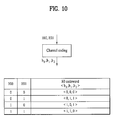
- FIGs. 10 to 13 illustrate examples of channel coding of HIs according to an exemplary embodiment of the present invention. Processing processes before and after channel coding are the same as the processes described with reference to FIG. 6 . Although the following description is described based on a BS, the process performed by the BS may be reversely performed by a UE.
- a BS generates HIs HI0 and HI1 with respect to two PUSCHs received from a UE.
- a channel coding block generates a 3-bit HI codeword (b 0 ,b 1 ,b 2 ) from the HIs HI0 and HI1.
- b 0 and b 1 are generated by HI0 and HI1, respectively, and b 2 is generated through an exclusive OR (XOR) operation of b 0 and b 1 .
- first and second HI codeword elements among three HI codeword elements are generated by HI0 and HI1, and a third HI codeword element is generated through an XOR operation of the first HI codeword element and the second HI codeword element.
- an XOR operation of a bit level has been described by way of example to aid in understanding, other schemes for producing the same result are also within the scope of the present invention.
- the present invention can be generalized as follows. It is assumed that an HI is N1 bits (i.e. N1 1-bit HIs) and an HI codeword is N2 bits (where N2>N1).
- a channel coding scheme of the present invention is characterized in that N1 columns indicate different 2 N1 states when arbitrarily selecting N1 columns from a matrix of a 2 N1 *N2 size corresponding to an HI codeword set. Accordingly, in PHICH channel coding, any scheme indicating such a channel coding characteristic is within the scope of the present invention.
- Table 7 shows a channel coding scheme of FIG. 10 and Table 8 indicates that the channel coding scheme of FIG. 10 satisfies the above-described channel coding characteristic.
- Table 7 HI0 HI1 HI codeword ⁇ b0, b1, b2 > 0 0 ⁇ 0, 0, 0> 0 1 ⁇ 0, 1, 1> 1 0 ⁇ 1, 0, 1> 1 1 ⁇ 1, 1, 0>
- HI0 denotes a HARQ indicator for a UL codeword 0 (or UL transport block 0) and HI1 denotes an HARQ indicator for a UL codeword 1 (or UL transport block 1).
- FIG. 11 is the same as FIG. 10 except that an HI of 0 is assumed to indicate ACK and an HI of 1 is assumed to indicate NACK.
- FIG. 12 is the same as FIG. 10 except that an HI of 0 is assumed to indicate ACK, an HI of 1 is assumed to indicate NACK, and b 2 is obtained from NXOR (b 0 ,b 1 ) or XNOR (b 0 , b 1 ) .
- NXOR indicates a not XOR operation and XNOR indicates an exclusive NOR operation.
- FIG. 13 is the same as FIG. 10 except that b 2 is obtained from NXOR (b 0 ,b 1 ) or XNOR (b 0 ,b 1 ).
- An HI codeword generated by the present invention has the following advantages.
- PHICH resources can be effectively used while perfect backward compatibility is maintained by reusing a PHICH format/processing process of legacy LTE. Therefore, multiple HIs can be efficiently used in a UL MIMO CA situation.
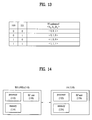
- FIG. 14 is a block diagram illustrating a BS and a UE which are applicable to an exemplary embodiment of the present invention.
- a radio communication system includes a BS 110 and a UE 120.
- the BS 110 includes a processor 112, a memory 114, and a Radio Frequency (RF) unit 116.
- the processor 112 may be configured to implement the procedures and/or methods proposed in the present invention.
- the memory 114 is connected to the processor 112 and stores information related to operation of the processor 112.
- the RF unit 116 is connected to the processor 112 and transmits and/or receives radio signals.
- the UE 120 includes a processor 122, a memory 124, and an RF unit 126.
- the processor 122 may be configured to implement the procedures and/or methods proposed in the present invention.
- the memory 124 is connected to the processor 122 and stores information related to operation of the processor 122.
- the RF unit 126 is connected to the processor 122 and transmits and/or receives radio signals.
- the BS 110 and/or the UE 120 may have a single antenna or multiple antennas.
- a specific operation described as performed by the BS may be performed by an upper node of the BS.
- various operations performed for communication with the UE may be performed by the BS, or network nodes other than the BS.
- the term BS may be replaced with the term fixed station, Node B, eNode B (eNB), access point, etc.
- UE may be replaced with the term Mobile Station (MS), Mobile Subscriber Station (MSS), etc.
- the embodiments of the present invention may be achieved by various means, for example, hardware, firmware, software, or a combination thereof.
- the exemplary embodiments of the present invention may be achieved by one or more Application Specific Integrated Circuits (ASICs), Digital Signal Processors (DSPs), Digital Signal Processing Devices (DSPDs), Programmable Logic Devices (PLDs), Field Programmable Gate Arrays (FPGAs), processors, controllers, microcontrollers, microprocessors, etc.
- ASICs Application Specific Integrated Circuits
- DSPs Digital Signal Processors
- DSPDs Digital Signal Processing Devices
- PLDs Programmable Logic Devices
- FPGAs Field Programmable Gate Arrays
- processors controllers, microcontrollers, microprocessors, etc.
- the exemplary embodiments of the present invention may be achieved by a module, a procedure, a function, etc. performing the above-described functions or operations.
- Software code may be stored in a memory unit and executed by a processor.
- the memory unit may be located at the interior or exterior of the processor and may transmit and receive data to and from the processor via various known means.
- the present invention may be applied to a wireless communication system. Specifically, the present invention is applicable to a method for transmitting a DL ACK/NACK and an apparatus therefor.
Landscapes
- Engineering & Computer Science (AREA)
- Computer Networks & Wireless Communication (AREA)
- Signal Processing (AREA)
- Quality & Reliability (AREA)
- Mobile Radio Communication Systems (AREA)
- Detection And Prevention Of Errors In Transmission (AREA)
Applications Claiming Priority (4)
| Application Number | Priority Date | Filing Date | Title |
|---|---|---|---|
| US31729010P | 2010-03-25 | 2010-03-25 | |
| US31836610P | 2010-03-28 | 2010-03-28 | |
| KR1020100105936A KR101785656B1 (ko) | 2010-03-04 | 2010-10-28 | Ack/nack 신호를 전송하는 방법 및 이를 위한 장치 |
| PCT/KR2011/002075 WO2011119006A2 (ko) | 2010-03-25 | 2011-03-25 | Ack/nack 신호를 전송하는 방법 및 이를 위한 장치 |
Publications (3)
| Publication Number | Publication Date |
|---|---|
| EP2552045A2 true EP2552045A2 (de) | 2013-01-30 |
| EP2552045A4 EP2552045A4 (de) | 2015-06-17 |
| EP2552045B1 EP2552045B1 (de) | 2016-06-15 |
Family
ID=47305346
Family Applications (1)
| Application Number | Title | Priority Date | Filing Date |
|---|---|---|---|
| EP11759755.9A Not-in-force EP2552045B1 (de) | 2010-03-25 | 2011-03-25 | Verfahren und vorrichtung zur übertragung von ack-/nack-signalen |
Country Status (5)
| Country | Link |
|---|---|
| US (1) | US9178663B2 (de) |
| EP (1) | EP2552045B1 (de) |
| KR (1) | KR101785656B1 (de) |
| CN (1) | CN102823182B (de) |
| WO (1) | WO2011119006A2 (de) |
Families Citing this family (9)
| Publication number | Priority date | Publication date | Assignee | Title |
|---|---|---|---|---|
| KR20130106223A (ko) * | 2012-03-19 | 2013-09-27 | 주식회사 팬택 | ePHICH 또는 PHICH의 동적 자원 사용을 지시하는 방법 및 장치 |
| JP6087450B2 (ja) | 2013-03-15 | 2017-03-01 | エルジー エレクトロニクス インコーポレイティド | 無線通信システムにおけるack/nack受信方法及び装置 |
| CN104349472B (zh) * | 2013-08-09 | 2018-03-30 | 普天信息技术研究院有限公司 | 一种无线通信系统的下行资源分配方法 |
| JP2016536915A (ja) * | 2013-09-18 | 2016-11-24 | エヌイーシー(チャイナ)カンパニー, リミテッドNEC(China)Co.,Ltd. | 無線通信システムにおける有効範囲向上のための方法及び装置 |
| EP3309987B1 (de) * | 2015-07-14 | 2021-11-24 | Huawei Technologies Co., Ltd. | Datenübertragungsverfahren, benutzergerät und basisstation |
| US10470001B2 (en) * | 2016-03-17 | 2019-11-05 | Lg Electronics Inc. | Method and apparatus for scheduling data common to both MBSFN and SC-PTM in wireless communication system |
| US11360808B2 (en) * | 2017-04-09 | 2022-06-14 | Intel Corporation | Efficient thread group scheduling |
| CN111181706B (zh) * | 2019-01-09 | 2021-12-24 | 维沃移动通信有限公司 | 混合自动重传请求确认的发送方法和终端 |
| KR20220076108A (ko) | 2020-11-30 | 2022-06-08 | 삼성전자주식회사 | 다중안테나 무선 통신 시스템의 저복잡도 광의 선형 수신 처리를 위한 장치 및 그 동작 방법 |
Family Cites Families (14)
| Publication number | Priority date | Publication date | Assignee | Title |
|---|---|---|---|---|
| KR20010057145A (ko) * | 1999-12-18 | 2001-07-04 | 윤종용 | Xor 코드, 이를 이용한 직렬 연접 부호기 및 복호기 |
| KR100975696B1 (ko) | 2007-04-05 | 2010-08-12 | 삼성전자주식회사 | 통신 시스템에서 부호화 장치 및 방법 |
| EP2158714B1 (de) * | 2007-05-04 | 2019-08-21 | Nokia Solutions and Networks Oy | Aggregierter harq-bericht |
| CN101325474B (zh) * | 2007-06-12 | 2012-05-09 | 中兴通讯股份有限公司 | Ldpc码的混合自动请求重传的信道编码及调制映射方法 |
| US20090024518A1 (en) | 2007-07-18 | 2009-01-22 | Alena Pavlisova | Automated system of supply and demand pairing |
| KR101410120B1 (ko) | 2007-08-21 | 2014-06-25 | 삼성전자주식회사 | 이동통신시스템에서 복합 자동 재전송을 지원하는 응답 신호를 송수신하는 장치 및 방법 |
| US8265021B2 (en) * | 2008-03-25 | 2012-09-11 | Samsung Electronics Co., Ltd. | Downlink phich mapping and channelization |
| KR101591086B1 (ko) | 2008-05-21 | 2016-02-03 | 엘지전자 주식회사 | 다중 안테나 시스템에서 harq 수행 방법 |
| KR100925444B1 (ko) | 2008-05-27 | 2009-11-06 | 엘지전자 주식회사 | 상향링크 채널을 통해 데이터와 제어 정보를 포함하는 상향링크 신호를 전송하는 방법 |
| WO2010002319A2 (en) * | 2008-07-03 | 2010-01-07 | Telefonaktiebolaget L M Ericsson (Publ) | Methods and arrangements in a wireless communication system |
| US20100172308A1 (en) * | 2009-01-07 | 2010-07-08 | Samsung Electronics Co., Ltd. | System and method for downlink physical indicator channel mapping with asymmetric carrier aggregation |
| KR101893460B1 (ko) * | 2009-09-28 | 2018-08-31 | 삼성전자주식회사 | 물리 하향링크 제어 채널의 확장 |
| WO2011099926A2 (en) * | 2010-02-15 | 2011-08-18 | Telefonaktiebolaget L M Ericsson (Publ) | Harq ack/nack signaling for multi-carrier hsdpa |
| JP5073770B2 (ja) * | 2010-02-19 | 2012-11-14 | 株式会社エヌ・ティ・ティ・ドコモ | 移動端末装置、無線基地局装置及び無線通信方法 |
-
2010
- 2010-10-28 KR KR1020100105936A patent/KR101785656B1/ko not_active Expired - Fee Related
-
2011
- 2011-03-25 EP EP11759755.9A patent/EP2552045B1/de not_active Not-in-force
- 2011-03-25 US US13/637,339 patent/US9178663B2/en not_active Expired - Fee Related
- 2011-03-25 CN CN201180015766.1A patent/CN102823182B/zh not_active Expired - Fee Related
- 2011-03-25 WO PCT/KR2011/002075 patent/WO2011119006A2/ko not_active Ceased
Also Published As
| Publication number | Publication date |
|---|---|
| EP2552045A4 (de) | 2015-06-17 |
| KR20110100572A (ko) | 2011-09-14 |
| KR101785656B1 (ko) | 2017-10-16 |
| US20130016688A1 (en) | 2013-01-17 |
| WO2011119006A2 (ko) | 2011-09-29 |
| CN102823182B (zh) | 2015-11-25 |
| CN102823182A (zh) | 2012-12-12 |
| US9178663B2 (en) | 2015-11-03 |
| EP2552045B1 (de) | 2016-06-15 |
| WO2011119006A3 (ko) | 2012-01-26 |
Similar Documents
| Publication | Publication Date | Title |
|---|---|---|
| US9722755B2 (en) | Method and apparatus for transmitting channel quality control information in wireless access system | |
| US9065619B2 (en) | Method and apparatus for transmitting control information in a wireless communication system | |
| EP4113878B1 (de) | Verfahren und vorrichtung zum senden/empfangen von uplink-steuerinformationen in einem drahtloskommunikationssystem | |
| US8767661B2 (en) | Method and apparatus for transmitting control information in wireless communication system | |
| US8867496B2 (en) | Method and apparatus for transmitting control information in a wireless communication system | |
| CN103210604B (zh) | 在时分双工系统中传送多个接收确认的方法和装置 | |
| EP2552045B1 (de) | Verfahren und vorrichtung zur übertragung von ack-/nack-signalen | |
| US8971248B2 (en) | Method and apparatus for transmitting control information in a wireless communication system | |
| EP2639984A2 (de) | Verfahren und vorrichtung zum senden und empfangen von uplink-steuerungsinformationen in einem drahtlosen kommunikationssystem | |
| US20140254520A1 (en) | Method and apparatus of transmitting uplink signal | |
| EP3462665A1 (de) | Phich-übertragung in zeitteilungs-duplexsystemen | |
| CN105580289A (zh) | 用于在无线通信系统中由终端对下行链路控制信息进行解码的方法和设备 | |
| CN102474325B (zh) | 在支持mimo天线的无线移动通信系统中发送上行链路数据和控制信息的方法和装置 | |
| WO2012074273A2 (ko) | 무선 통신 시스템에서 상향링크 제어정보를 위한 자원 할당 방법 및 이를 위한 단말 | |
| US8730898B2 (en) | Method and apparatus for transmitting an uplink control signal in a wireless communication system | |
| US9100954B2 (en) | Method for transmitting response information in a wireless communication system, and apparatus for same |
Legal Events
| Date | Code | Title | Description |
|---|---|---|---|
| PUAI | Public reference made under article 153(3) epc to a published international application that has entered the european phase |
Free format text: ORIGINAL CODE: 0009012 |
|
| 17P | Request for examination filed |
Effective date: 20121018 |
|
| AK | Designated contracting states |
Kind code of ref document: A2 Designated state(s): AL AT BE BG CH CY CZ DE DK EE ES FI FR GB GR HR HU IE IS IT LI LT LU LV MC MK MT NL NO PL PT RO RS SE SI SK SM TR |
|
| DAX | Request for extension of the european patent (deleted) | ||
| A4 | Supplementary search report drawn up and despatched |
Effective date: 20150520 |
|
| RIC1 | Information provided on ipc code assigned before grant |
Ipc: H04L 1/16 20060101ALI20150513BHEP Ipc: H04L 1/18 20060101AFI20150513BHEP Ipc: H04L 1/12 20060101ALI20150513BHEP Ipc: H04L 27/26 20060101ALI20150513BHEP |
|
| GRAP | Despatch of communication of intention to grant a patent |
Free format text: ORIGINAL CODE: EPIDOSNIGR1 |
|
| INTG | Intention to grant announced |
Effective date: 20160112 |
|
| GRAS | Grant fee paid |
Free format text: ORIGINAL CODE: EPIDOSNIGR3 |
|
| GRAA | (expected) grant |
Free format text: ORIGINAL CODE: 0009210 |
|
| AK | Designated contracting states |
Kind code of ref document: B1 Designated state(s): AL AT BE BG CH CY CZ DE DK EE ES FI FR GB GR HR HU IE IS IT LI LT LU LV MC MK MT NL NO PL PT RO RS SE SI SK SM TR |
|
| REG | Reference to a national code |
Ref country code: CH Ref legal event code: EP Ref country code: GB Ref legal event code: FG4D |
|
| REG | Reference to a national code |
Ref country code: IE Ref legal event code: FG4D |
|
| REG | Reference to a national code |
Ref country code: AT Ref legal event code: REF Ref document number: 806986 Country of ref document: AT Kind code of ref document: T Effective date: 20160715 |
|
| REG | Reference to a national code |
Ref country code: DE Ref legal event code: R096 Ref document number: 602011027454 Country of ref document: DE |
|
| REG | Reference to a national code |
Ref country code: LT Ref legal event code: MG4D |
|
| REG | Reference to a national code |
Ref country code: NL Ref legal event code: MP Effective date: 20160615 |
|
| PG25 | Lapsed in a contracting state [announced via postgrant information from national office to epo] |
Ref country code: LT Free format text: LAPSE BECAUSE OF FAILURE TO SUBMIT A TRANSLATION OF THE DESCRIPTION OR TO PAY THE FEE WITHIN THE PRESCRIBED TIME-LIMIT Effective date: 20160615 Ref country code: NO Free format text: LAPSE BECAUSE OF FAILURE TO SUBMIT A TRANSLATION OF THE DESCRIPTION OR TO PAY THE FEE WITHIN THE PRESCRIBED TIME-LIMIT Effective date: 20160915 Ref country code: FI Free format text: LAPSE BECAUSE OF FAILURE TO SUBMIT A TRANSLATION OF THE DESCRIPTION OR TO PAY THE FEE WITHIN THE PRESCRIBED TIME-LIMIT Effective date: 20160615 |
|
| REG | Reference to a national code |
Ref country code: AT Ref legal event code: MK05 Ref document number: 806986 Country of ref document: AT Kind code of ref document: T Effective date: 20160615 |
|
| PG25 | Lapsed in a contracting state [announced via postgrant information from national office to epo] |
Ref country code: LV Free format text: LAPSE BECAUSE OF FAILURE TO SUBMIT A TRANSLATION OF THE DESCRIPTION OR TO PAY THE FEE WITHIN THE PRESCRIBED TIME-LIMIT Effective date: 20160615 Ref country code: RS Free format text: LAPSE BECAUSE OF FAILURE TO SUBMIT A TRANSLATION OF THE DESCRIPTION OR TO PAY THE FEE WITHIN THE PRESCRIBED TIME-LIMIT Effective date: 20160615 Ref country code: HR Free format text: LAPSE BECAUSE OF FAILURE TO SUBMIT A TRANSLATION OF THE DESCRIPTION OR TO PAY THE FEE WITHIN THE PRESCRIBED TIME-LIMIT Effective date: 20160615 Ref country code: SE Free format text: LAPSE BECAUSE OF FAILURE TO SUBMIT A TRANSLATION OF THE DESCRIPTION OR TO PAY THE FEE WITHIN THE PRESCRIBED TIME-LIMIT Effective date: 20160615 Ref country code: NL Free format text: LAPSE BECAUSE OF FAILURE TO SUBMIT A TRANSLATION OF THE DESCRIPTION OR TO PAY THE FEE WITHIN THE PRESCRIBED TIME-LIMIT Effective date: 20160615 Ref country code: GR Free format text: LAPSE BECAUSE OF FAILURE TO SUBMIT A TRANSLATION OF THE DESCRIPTION OR TO PAY THE FEE WITHIN THE PRESCRIBED TIME-LIMIT Effective date: 20160916 |
|
| PG25 | Lapsed in a contracting state [announced via postgrant information from national office to epo] |
Ref country code: CZ Free format text: LAPSE BECAUSE OF FAILURE TO SUBMIT A TRANSLATION OF THE DESCRIPTION OR TO PAY THE FEE WITHIN THE PRESCRIBED TIME-LIMIT Effective date: 20160615 Ref country code: IT Free format text: LAPSE BECAUSE OF FAILURE TO SUBMIT A TRANSLATION OF THE DESCRIPTION OR TO PAY THE FEE WITHIN THE PRESCRIBED TIME-LIMIT Effective date: 20160615 Ref country code: EE Free format text: LAPSE BECAUSE OF FAILURE TO SUBMIT A TRANSLATION OF THE DESCRIPTION OR TO PAY THE FEE WITHIN THE PRESCRIBED TIME-LIMIT Effective date: 20160615 Ref country code: RO Free format text: LAPSE BECAUSE OF FAILURE TO SUBMIT A TRANSLATION OF THE DESCRIPTION OR TO PAY THE FEE WITHIN THE PRESCRIBED TIME-LIMIT Effective date: 20160615 Ref country code: SK Free format text: LAPSE BECAUSE OF FAILURE TO SUBMIT A TRANSLATION OF THE DESCRIPTION OR TO PAY THE FEE WITHIN THE PRESCRIBED TIME-LIMIT Effective date: 20160615 Ref country code: IS Free format text: LAPSE BECAUSE OF FAILURE TO SUBMIT A TRANSLATION OF THE DESCRIPTION OR TO PAY THE FEE WITHIN THE PRESCRIBED TIME-LIMIT Effective date: 20161015 |
|
| PG25 | Lapsed in a contracting state [announced via postgrant information from national office to epo] |
Ref country code: SM Free format text: LAPSE BECAUSE OF FAILURE TO SUBMIT A TRANSLATION OF THE DESCRIPTION OR TO PAY THE FEE WITHIN THE PRESCRIBED TIME-LIMIT Effective date: 20160615 Ref country code: BE Free format text: LAPSE BECAUSE OF FAILURE TO SUBMIT A TRANSLATION OF THE DESCRIPTION OR TO PAY THE FEE WITHIN THE PRESCRIBED TIME-LIMIT Effective date: 20160615 Ref country code: ES Free format text: LAPSE BECAUSE OF FAILURE TO SUBMIT A TRANSLATION OF THE DESCRIPTION OR TO PAY THE FEE WITHIN THE PRESCRIBED TIME-LIMIT Effective date: 20160615 Ref country code: AT Free format text: LAPSE BECAUSE OF FAILURE TO SUBMIT A TRANSLATION OF THE DESCRIPTION OR TO PAY THE FEE WITHIN THE PRESCRIBED TIME-LIMIT Effective date: 20160615 Ref country code: PT Free format text: LAPSE BECAUSE OF FAILURE TO SUBMIT A TRANSLATION OF THE DESCRIPTION OR TO PAY THE FEE WITHIN THE PRESCRIBED TIME-LIMIT Effective date: 20161017 Ref country code: PL Free format text: LAPSE BECAUSE OF FAILURE TO SUBMIT A TRANSLATION OF THE DESCRIPTION OR TO PAY THE FEE WITHIN THE PRESCRIBED TIME-LIMIT Effective date: 20160615 |
|
| REG | Reference to a national code |
Ref country code: DE Ref legal event code: R097 Ref document number: 602011027454 Country of ref document: DE |
|
| PLBE | No opposition filed within time limit |
Free format text: ORIGINAL CODE: 0009261 |
|
| STAA | Information on the status of an ep patent application or granted ep patent |
Free format text: STATUS: NO OPPOSITION FILED WITHIN TIME LIMIT |
|
| 26N | No opposition filed |
Effective date: 20170316 |
|
| PG25 | Lapsed in a contracting state [announced via postgrant information from national office to epo] |
Ref country code: DK Free format text: LAPSE BECAUSE OF FAILURE TO SUBMIT A TRANSLATION OF THE DESCRIPTION OR TO PAY THE FEE WITHIN THE PRESCRIBED TIME-LIMIT Effective date: 20160615 |
|
| PG25 | Lapsed in a contracting state [announced via postgrant information from national office to epo] |
Ref country code: SI Free format text: LAPSE BECAUSE OF FAILURE TO SUBMIT A TRANSLATION OF THE DESCRIPTION OR TO PAY THE FEE WITHIN THE PRESCRIBED TIME-LIMIT Effective date: 20160615 |
|
| REG | Reference to a national code |
Ref country code: CH Ref legal event code: PL |
|
| PG25 | Lapsed in a contracting state [announced via postgrant information from national office to epo] |
Ref country code: MC Free format text: LAPSE BECAUSE OF FAILURE TO SUBMIT A TRANSLATION OF THE DESCRIPTION OR TO PAY THE FEE WITHIN THE PRESCRIBED TIME-LIMIT Effective date: 20160615 |
|
| REG | Reference to a national code |
Ref country code: IE Ref legal event code: MM4A |
|
| REG | Reference to a national code |
Ref country code: FR Ref legal event code: ST Effective date: 20171130 |
|
| PG25 | Lapsed in a contracting state [announced via postgrant information from national office to epo] |
Ref country code: FR Free format text: LAPSE BECAUSE OF NON-PAYMENT OF DUE FEES Effective date: 20170331 Ref country code: LU Free format text: LAPSE BECAUSE OF NON-PAYMENT OF DUE FEES Effective date: 20170325 |
|
| PG25 | Lapsed in a contracting state [announced via postgrant information from national office to epo] |
Ref country code: LI Free format text: LAPSE BECAUSE OF NON-PAYMENT OF DUE FEES Effective date: 20170331 Ref country code: IE Free format text: LAPSE BECAUSE OF NON-PAYMENT OF DUE FEES Effective date: 20170325 Ref country code: CH Free format text: LAPSE BECAUSE OF NON-PAYMENT OF DUE FEES Effective date: 20170331 |
|
| PG25 | Lapsed in a contracting state [announced via postgrant information from national office to epo] |
Ref country code: MT Free format text: LAPSE BECAUSE OF NON-PAYMENT OF DUE FEES Effective date: 20170325 |
|
| PG25 | Lapsed in a contracting state [announced via postgrant information from national office to epo] |
Ref country code: AL Free format text: LAPSE BECAUSE OF FAILURE TO SUBMIT A TRANSLATION OF THE DESCRIPTION OR TO PAY THE FEE WITHIN THE PRESCRIBED TIME-LIMIT Effective date: 20160615 |
|
| PG25 | Lapsed in a contracting state [announced via postgrant information from national office to epo] |
Ref country code: HU Free format text: LAPSE BECAUSE OF FAILURE TO SUBMIT A TRANSLATION OF THE DESCRIPTION OR TO PAY THE FEE WITHIN THE PRESCRIBED TIME-LIMIT; INVALID AB INITIO Effective date: 20110325 |
|
| PG25 | Lapsed in a contracting state [announced via postgrant information from national office to epo] |
Ref country code: BG Free format text: LAPSE BECAUSE OF FAILURE TO SUBMIT A TRANSLATION OF THE DESCRIPTION OR TO PAY THE FEE WITHIN THE PRESCRIBED TIME-LIMIT Effective date: 20160615 |
|
| PG25 | Lapsed in a contracting state [announced via postgrant information from national office to epo] |
Ref country code: CY Free format text: LAPSE BECAUSE OF NON-PAYMENT OF DUE FEES Effective date: 20160615 |
|
| PG25 | Lapsed in a contracting state [announced via postgrant information from national office to epo] |
Ref country code: MK Free format text: LAPSE BECAUSE OF FAILURE TO SUBMIT A TRANSLATION OF THE DESCRIPTION OR TO PAY THE FEE WITHIN THE PRESCRIBED TIME-LIMIT Effective date: 20160615 |
|
| PG25 | Lapsed in a contracting state [announced via postgrant information from national office to epo] |
Ref country code: TR Free format text: LAPSE BECAUSE OF FAILURE TO SUBMIT A TRANSLATION OF THE DESCRIPTION OR TO PAY THE FEE WITHIN THE PRESCRIBED TIME-LIMIT Effective date: 20160615 |
|
| PGFP | Annual fee paid to national office [announced via postgrant information from national office to epo] |
Ref country code: DE Payment date: 20200211 Year of fee payment: 10 Ref country code: GB Payment date: 20200213 Year of fee payment: 10 |
|
| REG | Reference to a national code |
Ref country code: DE Ref legal event code: R119 Ref document number: 602011027454 Country of ref document: DE |
|
| GBPC | Gb: european patent ceased through non-payment of renewal fee |
Effective date: 20210325 |
|
| PG25 | Lapsed in a contracting state [announced via postgrant information from national office to epo] |
Ref country code: DE Free format text: LAPSE BECAUSE OF NON-PAYMENT OF DUE FEES Effective date: 20211001 Ref country code: GB Free format text: LAPSE BECAUSE OF NON-PAYMENT OF DUE FEES Effective date: 20210325 |