EP2552322B1 - Dispositif d'excision de tissu - Google Patents
Dispositif d'excision de tissu Download PDFInfo
- Publication number
- EP2552322B1 EP2552322B1 EP11713575.6A EP11713575A EP2552322B1 EP 2552322 B1 EP2552322 B1 EP 2552322B1 EP 11713575 A EP11713575 A EP 11713575A EP 2552322 B1 EP2552322 B1 EP 2552322B1
- Authority
- EP
- European Patent Office
- Prior art keywords
- blade
- cannula
- coring cannula
- stylet
- coring
- Prior art date
- Legal status (The legal status is an assumption and is not a legal conclusion. Google has not performed a legal analysis and makes no representation as to the accuracy of the status listed.)
- Not-in-force
Links
- 230000004807 localization Effects 0.000 claims description 58
- 238000001574 biopsy Methods 0.000 claims description 47
- 230000033001 locomotion Effects 0.000 claims description 21
- 238000000034 method Methods 0.000 claims description 14
- 230000008569 process Effects 0.000 claims description 11
- 230000004044 response Effects 0.000 claims description 6
- 229910001092 metal group alloy Inorganic materials 0.000 claims description 5
- PXHVJJICTQNCMI-UHFFFAOYSA-N Nickel Chemical compound [Ni] PXHVJJICTQNCMI-UHFFFAOYSA-N 0.000 claims description 4
- 229910001000 nickel titanium Inorganic materials 0.000 claims description 3
- HLXZNVUGXRDIFK-UHFFFAOYSA-N nickel titanium Chemical group [Ti].[Ti].[Ti].[Ti].[Ti].[Ti].[Ti].[Ti].[Ti].[Ti].[Ti].[Ni].[Ni].[Ni].[Ni].[Ni].[Ni].[Ni].[Ni].[Ni].[Ni].[Ni].[Ni].[Ni].[Ni] HLXZNVUGXRDIFK-UHFFFAOYSA-N 0.000 claims description 3
- RTAQQCXQSZGOHL-UHFFFAOYSA-N Titanium Chemical compound [Ti] RTAQQCXQSZGOHL-UHFFFAOYSA-N 0.000 claims description 2
- 229910052759 nickel Inorganic materials 0.000 claims description 2
- 239000010936 titanium Substances 0.000 claims description 2
- 229910001069 Ti alloy Inorganic materials 0.000 claims 1
- 210000001519 tissue Anatomy 0.000 description 101
- 210000000481 breast Anatomy 0.000 description 50
- 230000007246 mechanism Effects 0.000 description 50
- 230000005540 biological transmission Effects 0.000 description 14
- 238000013461 design Methods 0.000 description 7
- 230000006835 compression Effects 0.000 description 4
- 238000007906 compression Methods 0.000 description 4
- 230000004913 activation Effects 0.000 description 2
- 230000008901 benefit Effects 0.000 description 2
- 230000001419 dependent effect Effects 0.000 description 2
- 210000005036 nerve Anatomy 0.000 description 2
- 238000012546 transfer Methods 0.000 description 2
- HBBGRARXTFLTSG-UHFFFAOYSA-N Lithium ion Chemical compound [Li+] HBBGRARXTFLTSG-UHFFFAOYSA-N 0.000 description 1
- 229910000639 Spring steel Inorganic materials 0.000 description 1
- 230000002411 adverse Effects 0.000 description 1
- 238000013459 approach Methods 0.000 description 1
- 239000011324 bead Substances 0.000 description 1
- 230000000881 depressing effect Effects 0.000 description 1
- 229910003460 diamond Inorganic materials 0.000 description 1
- 239000010432 diamond Substances 0.000 description 1
- 230000008570 general process Effects 0.000 description 1
- 238000003384 imaging method Methods 0.000 description 1
- 230000006872 improvement Effects 0.000 description 1
- 230000001788 irregular Effects 0.000 description 1
- 229910001416 lithium ion Inorganic materials 0.000 description 1
- 230000014759 maintenance of location Effects 0.000 description 1
- 239000003550 marker Substances 0.000 description 1
- 239000000463 material Substances 0.000 description 1
- 229910052751 metal Inorganic materials 0.000 description 1
- 239000002184 metal Substances 0.000 description 1
- 230000004048 modification Effects 0.000 description 1
- 238000012986 modification Methods 0.000 description 1
- 230000007170 pathology Effects 0.000 description 1
- 230000009467 reduction Effects 0.000 description 1
- 210000004872 soft tissue Anatomy 0.000 description 1
- 238000012360 testing method Methods 0.000 description 1
- 229910052719 titanium Inorganic materials 0.000 description 1
- 238000002604 ultrasonography Methods 0.000 description 1
Images










Classifications
-
- A—HUMAN NECESSITIES
- A61—MEDICAL OR VETERINARY SCIENCE; HYGIENE
- A61B—DIAGNOSIS; SURGERY; IDENTIFICATION
- A61B10/00—Instruments for taking body samples for diagnostic purposes; Other methods or instruments for diagnosis, e.g. for vaccination diagnosis, sex determination or ovulation-period determination; Throat striking implements
- A61B10/02—Instruments for taking cell samples or for biopsy
- A61B10/0233—Pointed or sharp biopsy instruments
- A61B10/0266—Pointed or sharp biopsy instruments means for severing sample
-
- A—HUMAN NECESSITIES
- A61—MEDICAL OR VETERINARY SCIENCE; HYGIENE
- A61B—DIAGNOSIS; SURGERY; IDENTIFICATION
- A61B10/00—Instruments for taking body samples for diagnostic purposes; Other methods or instruments for diagnosis, e.g. for vaccination diagnosis, sex determination or ovulation-period determination; Throat striking implements
- A61B10/02—Instruments for taking cell samples or for biopsy
- A61B2010/0225—Instruments for taking cell samples or for biopsy for taking multiple samples
-
- A—HUMAN NECESSITIES
- A61—MEDICAL OR VETERINARY SCIENCE; HYGIENE
- A61B—DIAGNOSIS; SURGERY; IDENTIFICATION
- A61B90/00—Instruments, implements or accessories specially adapted for surgery or diagnosis and not covered by any of the groups A61B1/00 - A61B50/00, e.g. for luxation treatment or for protecting wound edges
- A61B90/06—Measuring instruments not otherwise provided for
- A61B2090/062—Measuring instruments not otherwise provided for penetration depth
Definitions
- the present invention relates generally to surgical instruments, and more particularly, to a device for percutaneous excision of tissue, percutaneous excisional breast biopsy or percutaneous incisional breast biopsy.
- the biopsy device includes a localization needle with a guide wire preloaded into the device.
- the localization needle and guide wire are used to locate and localize the target area.
- the methodology of their usage can be summarized as follows:
- the device can either by a handheld device or may be a fixed device.
- the below more detailed description of the method of using a prior art device is described with respect to a handheld device.
- a localization needle is placed at the center of the target tissue.
- a localization wire is used to fix the handheld device to the tissue.
- a stylet is manually advanced to a point just proximal of the target.
- the cannula is manually advanced over the target tissue. With the cannula advanced over the target tissue, a mechanism, such as a garrote wire is activated to sever the target tissue from the breast. With the target tissue severed from the breast, the device, along with the target tissue with the cannula, may be removed.
- a mechanism such as a garrote wire is activated to sever the target tissue from the breast.
- these prior art devices are purely mechanical devices, i.e., in other words, the coring cannula is advanced by hand.
- the surgeon or user rotates a knob that activates a gear system to rotate and advances the coring cannula.
- the start/stop motion can increase patient discomfort, as well as produce an undesirable irregular specimen shape.
- a garrote wire may be used to cut the sample tissue (which is inside the cannula) from the breast so that it may be removed.
- the garrote wire has several limitations. Typically, the garrote wire traverse (at least partially) along the length of the device, then is bent at a 90 degree angle, after which it encircles an inner surface of the coring cannula. The right angle in the garrote wire results in requiring a large amount of force to pull on the garrote wire to transect the tissue sample. Additionally, the garrote wire is generally located a distance behind the cutting edge of the coring cannula.
- the garrote wire may tear the tissue rather than cutting the tissue. Additionally, dense tissue can be pushed aside rather than cut.
- Another issue related to prior art designs is the size of the cutting edge of the cannula with respect to the stylet.
- a skin incision is made using a scalpel. This incision is generally just slightly wider than the diameter of the cannula.
- the stylet is advanced in the breast, up to the point where the coring blade is ready to enter the incision.
- the surgeon will use nerve hooks to grab the skin and open the incision to allow the cutting edge of the cannula to enter the breast.
- the process of using the nerve hooks to grab the skin to make the incision wider can be cumbersome and inefficient and can cause patient discomfort.
- the current devices use a stylet with integral cutting blades.
- the flat stylet blades are fixed to the stylet which may result in several adverse conditions.
- the close proximity of the cutting edge of the stylet blades to the ramp or stylet tip results in the pushing or compression or other inadvertent movement of the tissue by the stylet.
- the prior designs also results in a fixed minimal proximal margin equal to the length of the stylet system.
- the present invention is aimed at one or more of the problems identified above.
- the invention is defined in claim 1.
- Preferred embodiments are defined in dependent claims 2-12.
- a biopsy device according to the preamble of claim 1 is disclosed in US-A-4 461 305 .
- a biopsy device includes a housing, a coring cannula, and a flexible transection blade.
- the coring cannula has a longitudinal axis and is coupled to the housing.
- the coring cannula is rotatable about the axis.
- These flexible transection blade has a first end and a second end and is coupled to the coring cannula at the first end, the second end forming a cutting edge, the flexible transection blade having a first blade position and a second blade position, wherein rotation of the coring cannula in a first direction moves the flexible transection blade from the first blade position to the second blade position.
- the biopsy device includes a housing, a coring cannula, and a flexible transection blade.
- the coring cannula has a longitudinal axis and is centered on the axis and is coupled to the housing.
- the coring cannula is rotatable about the axis.
- the flexible transection blade has a first end and a second end and is coupled to the coring cannula, the second end forming a cutting edge, the flexible transection blade having a first blade position and a second blade position.
- the invention is characterized in that the coring cannula is movable along the axis from an initial cannula location towards a final cannula location in response to rotation of the coring cannula about the axis in a first direction, the flexible transection blade is in the first blade position while the coring cannula is between the initial and final cannula locations, wherein rotation of the coring cannula in the first direction while the coring cannula is at the final cannula location rotates the flexible transection blade about the axis, moving the flexible transection blade from the first blade position to the second blade position, where the flexible transection blade is at least partly contained within the coring cannula when the coring cannula is between the initial position and the final position, wherein motion of the flexible transection blade from the first blade position to the second blade position advances the transection blade past the coring cannula.
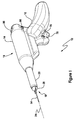
- the present invention provides a breast biopsy device 10 and a method of operating the breast biopsy device 10.
- the breast biopsy device 10 is embodied in a handheld device 12. It should be noted that the present invention may be embodied in a fixed device (not shown).
- the handheld device 12 may include a housing 14 (see Figure 10 ) and a handle 16.
- the housing 14 is removable from the handle 16.
- the handle 16 is reusable.
- the housing 14 (and all parts contained therein) are disposable and generally provided sterile.
- the device 10 may include an integrated needle assembly 18 (described below).
- the device 10 may include an independent needle assembly 18' (described below).
- the housing 14 may include an inner passage 22 (see Figure 10 ).
- a coring cannula 20 is slidably mounted within the inner passage 22 of the housing 14.
- the coring cannula 20 has a longitudinal axis 24 and may include a shaft 26 centered on the axis 24.
- the coring cannula 20 is coupled to the housing such that rotational movement of the coring cannula 20 about the axis 24 results in linear movement of the coring cannula 20 along the axis 24.
- the coring cannula 20 has a cutting edge allowing it to cut through tissue as it is rotated and advanced.
- the coring cannula 20 may simply rotate within the housing 14 .
- Linear movement of the coring cannula 20 may be provided by external mechanical means or by the user.
- the breast biopsy device 10 includes a stylet 28 , which includes a stylet housing 38.
- the stylet includes a tip 30 .
- the tip 30 includes at least one blade 32 and a central passage 34 .
- the tip 30 may also include a slot 31 for the at least one blade 32 .
- the stylet 28 is mounted within the coring cannula 20 .
- the stylet 28 includes first and second blades 32A, 32B integrated between two half portions 38A, 38B of a stylet housing 38 .
- the stylet 28 transects, dilates, and separates tissue as the device 10 is inserted or advanced towards the biopsy site.
- a drive assembly 40 mounted within the housing 14 and the handle 16 rotates the cannula 20 and controllably rotates the cannula 20 .
- the drive assembly 40 also moves the cannula 20 in a direction parallel to (and along) the axis 24 .
- the coring cannula 20 has a predetermined linear advancement per revolution of the coring cannula 20 .
- the predetermined linear advancement is 1.27 cm (0.50 inches) per revolution.
- the predetermined linear advancement is 2.13 cm (0.84) inches per revolution.
- the drive assembly 40 may include a motor assembly comprised of a DC motor and step down transmission 42 and a drivetrain 44 .
- the DC motor and step down transmission 42 is coupled to the drivetrain 44 ( Figure 9 ).
- the drive assembly 40 and the drivetrain 44 are explained more fully below.
- the drive assembly 40 rotates the coring cannula 20 as a single speed, for example, at or around 80 revolutions per minute.
- the drive assembly 40 rotates the coring cannula 20 at a variable speed (see below).
- the needle assembly 18, 18' may include a localization needle 54.
- the localization needle 54 has an inner channel 56 and is slidably removable from the central passage of the stylet 28 .
- the needle assembly 18, 18' further includes a guide element 52 (see Figures 4 and 5A ).
- the guide element 52 is used to secure the tissue while the coring cannula 20 is advanced.
- the guide element 52 has a first end 58 and a second end 60 .
- the first end 58 of the guide element 52 is slidably disposed within the channel 56 of the localization needle 54 .
- the guide element 52 is composed, at least in part, of a metal alloy.
- the metal alloy is composed of nickel and titanium.
- the metal alloy is nitinol.
- a locking member 62 may be formed at the second end 60 of the guide element 52.
- the locking member 62 has an unlocking configuration and a locking configuration.
- the locking member 62 is in the unlocking configuration when the guide element 52 is in the first position, i.e., fully contained within the localization needle 54 (see Figure 13B ).
- the locking member 62 is in the locking configuration when the guide element 52 is in the second position, i.e., then the locking member 62 is outside of the localization needle 54 (see Figure 13C ).
- the locking wire 62 is formed of multiple wires 64 , e.g., two, which are predisposed toward the locking configuration.
- the inner channel 56 of the localization needle 54 constrains and confines the wires 64 in the unlocking configuration. Once the guide element 52 is slid towards and into the second position, the wires 64 are freed from the constraints on the localization needle 54 and allowed to move toward and into the locking configuration.
- the locking configuration is defined by a predefined shape of the wires 64.
- the predefined shape is a hook shape.
- wires may be wrapped around the wires 64 to provide rigidity to allow the guide element 52 to be moved within the localization needle 54 .
- the number of wires 64 , as well as the diameter of the wires 64 (and wires used to provide rigidity) is optimized to provide maximize holding and as a function of the type of targeted tissue, e.g., hard or soft tissue.
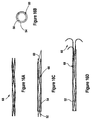
- the locking member 62 may include a twisted pair of wires 66 .
- the guide element 52 is shown in the first position in Figure 14 with the twisted pair of wires 66 in the unlocking configuration.
- the guide element 52 is shown in the second position in Figure 15 with the twisted pair of wires 66 in the locking configuration.
- the locking member 62 is formed from braided wire or cable 68 .
- the distal ends of the cables may be straightened and then formed into a predetermined shape, such as a hook shape.
- the number of wires or cables may vary, e.g., the braided wire or cable may include 4, 7 or any number of individual wires or cables.
- the guide element 52 is shown in the first position in Figure 16C with the braided cable 68 in the unlocking configuration.
- the guide element 52 is shown in the second position in Figure 16D with the braided cable 68 in the locking configuration.
- the guide element 52 may include a pushrod 70 and at least two flexible fingers 72A, 72B.
- the pushrod 70 and flexible fingers 72A, 72B are unitarily formed ( Figure 17 ).
- the flexible fingers 72A, 72B are affixed to the pushrod 70 ( Figure 18 ).
- the flexible fingers 72A, 72B may be predisposed towards the locking configuration through a heat treat process.
- the drive assembly 40 may include a variable speed circuit 74 electrically coupled to the motor assembly 42 , 44 .
- a forward/reverse switch 76 is electrically coupled to the variable speed circuit 74 .
- a speed control trigger 78 is electrically coupled to the variable speed circuit 74 .
- the forward/reverse switch 76 controls the direction of the DC motor 42 , and thus, the direction of movement (forward/reverse) of the cannula 20 along the axis 24 .
- variable speed circuit 74 controls the speed and rotation of the cannula 20 as a function of the forward/reverse switch 76 and actuation of the speed control trigger 78 .
- the variable speed circuit 74 has a predetermined speed range, for example 0-100 revolutions per minute.
- the DC motor and transmission 42 is powered by a rechargeable battery 46 , which may be charged via an external power source (not shown) through recharging port 48 .
- the rechargeable battery 46 is a lithium ion battery.
- the DC motor and transmission 42 is used to provide low speed and high torque to the drivetrain 44 .
- a drive gear 50 is directly coupled between the motor 42 and the drivetrain 44 .
- the drivetrain 44 may include a spline gear 80 , a spline gear support 82 , a lead screw 84 , a shaft 86 , and a ring gear transmission 88 .
- the spline gear 80 is contained with the housing 14 and is supported by the spline gear support 82 .
- the drive gear 50 engages the spline gear 82 to transfer power to the drivetrain 44 , and thus, the coring cannula 20 .
- the speed of the DC motor 42 is controlled by user actuation of the speed control trigger 78 .
- the variable speed circuit 74 enables variable speed ramp up and slow down. In one embodiment, a speed range of approximately 0 -100 rpm at the cannula may be provided.
- the drivetrain 44 is contained within the housing 14 , which is removable coupled to the handle 16 .
- the spline gear 80 engages the drive gear 50 within the handle 16 .
- Power transferred through the drive gear 50 causes rotation of the spline gear 80 .
- the spline gear 80 is attached to the spline gear support 82 .
- the spline gear support 82 is keyed to the shaft 86 .
- the spline gear support key 82 provides rotation to the shaft 86 while allowing it to move axially (along axis 24 ).
- the lead screw 84 which is fixed to the housing 14 , is engaged with threads at the proximal end of the shaft 86 .
- the coring cannula 20 is attached to the shaft 86 . As the shaft 86 is rotated, the threaded engagement with the lead screw 84 creates axial movement of the coring cannula 20 .
- the cannula 20 As the cannula 20 rotates, it continues to move forward for a distance determined by the thread length on the lead screw 84. As the shaft 86 reaches the end of the threads, it will continue to rotate, but will no longer move forward.
- the timing is designed such that when the shaft 86 reaches the end of the threaded section of the lead screw 84, the transmission lockout (lock out button 90 ) engages. With the lock out button 90 engaged, the ring gear assembly 88 is activated and begins to advance a drive dog 92 forward along the drive screw 50.
- the drive dog 92 is coupled to a severing mechanism 94 which is used to sever the tissue contained within the coring cannula 20, which is described more fully below.
- the localization needle 54 is advanced into the breast under ultrasound guidance. In one embodiment of the present invention, this is performed manually. For instance, with the handheld device 10, the user manually inserts the needle 54 by positioning and manually moving the device 10. When the needle 54 reaches the target area, the tissue anchor or locking member 62 is advanced to secure the tissue prior to advancement of the device 10. Next, the localization needle 54 is released allowing the device 10 to move independently of the needle 54. The device 10 is now advanced into the breast, with the stylet blades 32 separating the tissue up to the target area. When the device 10 has reached the target area, the coring cannula 20 is advanced.
- the cannula 20 is advanced by depressing the speed control trigger 78 on the handle 16, with the forward/reverse switch 76 in a forward position.
- the severing mechanism 94 is actuated, separating the tissue core from surrounding tissue.
- the severing mechanism 94 may include a flexible blade (see below) will automatically advance from the distal end of the coring cannula 20.
- the device 10 is removed from the breast. With the device out of the breast, the forward/reverse switch 76 is placed in a reverse position and the flexible blade is retracted using the speed control trigger 78 allowing the tissue sample to be retrieved from the coring cannula.
- an integrated needle assembly 18 may be provided.
- the needle assembly 18 and the coring cannula are integrated into a single unit 18 , 20 (see Figure 2A ).
- the needle assembly 18 is inserted within the central passage 34 of the stylet housing 38 when the localization needle 54 is inserted into the breast ( Figure 2B ).
- a locking member actuation button 96 located on the top of the housing 14 is slid forward. The actuation button 96 is linked to the locking member 62 resulting in the locking member 62 being slid out of the localization needle 54 securing the target tissue.
- the localization needle 54 and locking member 82 are released from the housing 14 by actuation of one of the localization needle release button(s) 98 located thereon. This allows the device 10 to be slid up localization needle 54 (the stylet blades 32 separating the tissue allowing the stylet 28 and coring cannula 20 to pass. Once the coring cannula 20 is adjacent the target tissue, the process proceeds as above.
- the device 10 would be fed down the guide rod 104 and the process would proceed as above (see Figure 5A ).
- the central passage 34 is formed by the stylet tube 36 .
- the stylet tube 36 includes an opening 106 which allows the needle assembly 18 , 18B ' to pass into the central passage 34 .
- the stylet tube 36 also may include a guide portion 108 which extends past the opening 106 to assist in the placement of the guide rod into the central passage 34 .
- an independent needle assembly 18 ' may be provided (see Figures 3 , 4A , 4B , 5A, 5B ).
- the independent needle assembly 18 ' is separate from the coring cannula 20 .
- the independent needle assembly 18 ' includes a localization needle 54 ', an independent needle handle 100 , and a plunger 102 .
- the localization needle 54 ' is inserted into the breast tissue using the handle 100 . Once the target tissue is reached, the plunger 102 is pushed forward.
- the locking member 62 is pushed forward by the plunger 102 , pushing the wires 64 into the target tissue, thereby securing the target tissue.
- the localization needle 54 ' (and handle 100 ) may thereafter be removed, leaving the locking member 62 within the breast with a guide rod 104 extending out of the breast (see Figure 4B ).
- the localization needle 54 ' has a first end 54A ' and a second end 54 '.
- the localization needle includes an internal channel or bore 56 .
- the handle 100 has first and second ends 100A, 100B and an internal bore 268 .
- the first end 54A of the needle 54 ' is fixed to the second end of the handle 100B.
- the internal bore 56 of the needle 54 ' and the internal bore 268 of the handle 100 form an assembly bore 270 therethrough.
- the guide element 52 has a guide rod 104 and a locking member 62 .
- the guide element 104 has first and second ends 58 , 60 and is removably contained within the assembly bore 270 .
- the locking member 62 is fixed to the second end 60 of the guide rod 104 .
- the plunger 102 includes a pushrod 102B and an actuation element 102A coupled to the pushrod 102B.
- the plunger 102A is movable from a first state ( Figure 4A ) to a second state ( Figure 4B )
- One end of the pushrod 102B acts on the first end 58 of the guide rod 104 , forcing the locking member 62 out of the needle 18 ' as the pushrod 102 is moved from the first state to the second state.
- one of the wires 64 ' from the locking member 62 is detachable from the pushrod 70 . It should be noted that although Figures 19A-19D illustrated this feature with respect to the integrated needle assembly 18 , the detachable wire 64 ' concept may also be used with the independent needle assembly 18 '.
- the locking member 62 is contained within the localization needle 54 when the localization needle is initially inserted into the breast tissue.
- the locking member 62 is deployed as discussed above ( Figure 19B ) to secure the target tissue.
- the cannula 20 is advanced over the target tissue and severed using the severing mechanism 94 (see above).
- the localization needle 18 may be used to push the severed tissue from the cannula 20.
- the tissue anchors or wires 64 may then be retracted.
- the third hook 64 ' may either not be attached to the pushrod 70 or may be detachable therefore.
- the third hook or wire 64' remains attached or secured to the tissue to provide an orientation marker for the sample during pathology (see Figure 19D ).
- the guide rod 104 may include scale markings 110 to provide an indication to the user the depth of the anchor/guide element 52 within the breast, as shown in Figures 13A and 19B .
- the biopsy device 12 includes a flexible transection blade 112.
- the flexible transection blade 112 is a flat metal blade with one end sharpened is formatted to the required radius (see below).
- the blade thickness and material properties as such that the formed flexible transection blade 112 can be flattened out will "spring" back to its formed shape.
- the blade 112 will be held in a flat position along the side of the coring cannula.
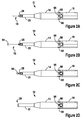
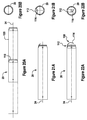
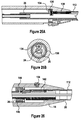
- the coring cannula 20 will use an angled or non-continuous cutting ring (see below) at the completion of the coring process. As shown in Figures 20A and 20B , the coring cannula 20 is movable along the axis 24 from an initial cannula location 118 (shown in dotted lines) to a final cannula location 120 in response to rotation of the coring cannula 20 about the axis 24 in a first direction.
- the coring cannula 20 once the coring cannula 20 reaches the final cannula location 120, it will continue to rotate but will not advance axially forward.
- a mechanism 122 will be engaged to drive the flexible transection blade 112 forward.
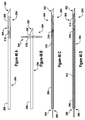
- the flexible transection blade 112 exits the coring cannula 20 at a point slightly distal to the cutting edge of the coring cannula 20 (see Figures 21A and 21B ).
- the flexible blade 112 As the flexible blade 112 is driven out of the cannula 20, it will begin to return to its pre-formed curvature. Since this advancement is taking place while the coring cannula 20 is rotating, the result will be a curved, complete cut through the tissue.
- the path of the blade 112 is designed to intersect with the distal end of the cutting path from the coring cannula 20, resulting in complete transection and release of the tissue specimen.
- the flexible transection blade 112 consists of a thin strip 124 of spring steel or nitinol.
- the flexible transection blade 112 has a first end 126 and a second or distal end 128.
- the flexible transection blade 112 is coupled to the coring cannula 20 at the first end 126 .
- the distal end 128 of the flexible transection blade 112 is cut to an optimized angle and sharpened to a cutting edge 114 (see Figure 23C ).
- a hole mount 130 may be provided for mounting the blade 112 to the drive assembly 40 .
- the flexible transection blade 112 is stored in a channel 116 built into the coring cannula 20 .
- the flexible transection blade 112 is held flat in this stored position.
- the coring cannula 20 will cease axial advancement, but will continue to rotate.
- the flexible blade 112 is driven forward, advancing past the coring cannula 20 .
- the flexible blade 112 advances, it will assume its pre-formed, curved position. Rotation causes the flexible blade 112 to create a semi-circular cut in the tissue.
- a complete cut results, releasing the tissue core.
- the curved blade 112 holds the tissue core inside the cannula 20 until removed from the breast.
- the flexible transection blade 112 has a first blade position and a second blade position.
- the flexible transection blade 112 is in the first blade position while the coring cannula 20 is between the initial and final cannula locations 118, 120.
- Figure 20A in one embodiment, when the flexible transection blade 112 is in the first blade position it is contained within the coring cannula 20, and thus, not visible.
- Rotation of the coring cannula 20 in the first direction while the coring cannula 20 is at the final cannula location 120 rotates the flexible transection blade 112 about the axis 24, moving the flexible transection blade 112 from the first blade position to the second blade position (shown in Figure 22B ).
- the most efficient cutting of tissue is accomplished by creating relative motion between cutting surface, i.e., the cutting edge 114, and tissue.
- the relationship between the cutting edge 114 and the rate of advancement of the length and angle of the cutting edge 114 must result in a cutting surface that is greater in length than the linear advancement per revolution. Further, the rate of advancement per revolution should be optimized to minimize cutting forces. This approach will ensure that a thin, flexible blade 112 will follow the desired cutting path.
- the mechanism 122 may include a friction wheel transmission 132 .
- the friction wheel transmission 132 includes friction wheel 134 which is force fit over the shaft 26 .
- the shaft 26 is directly coupled to the cannula 20 through a drive ring 20 which is fixed to the housing 14 .
- a drive screw 136 is fixed to the friction wheel 134 , which is coupled to the flexible transection blade 112 .
- the friction wheel 134 is force fit over the shaft 26 such that the transmission force may be controlled.
- the relationship between the friction wheel 134 and the drive ring 136 and/or the relationship between the friction wheel 134 and the shaft 26 can be adjusted so that if the force encountered by the flexible transection blade 112 increases to a certain point, the friction wheel 134 will slip on the shaft 26 preventing further advancement of the blade 112 . The blade 112 will continue to rotate until the sample tissue has been cut and the forces reduced. Blade advancement will then automatically resume.
- the mechanism 122 may include a gear drive transmission 140 .
- the gear drive transmission 140 provides continuous drive with maximum power transfer.
- the gears within the gear drive transmission 140 remain meshed but do not rotate during axial advancement of the coring cannula 20 .
- the gear drive transmission 140 automatically engages and begins to drive the flexible transection blade 112 .
- the gear drive transmission 140 may include a gear housing 146 , a ring gear 150 , and a drive gear 152 .
- a plunger 144 is slidably coupled to the gear housing 146 and is spring biased in an outward direction. While the coring cannula 20 is between the initial cannula location 118 and the final cannula location 120 , plunger 144 is pressed inwardly by the inner wall of the housing 20 such that one end is inserted a receiving slot 148 on the shaft 26 . Thus, the gear housing 146 is locked relative to the shaft 26 . The shaft gear housing 146 thereby rotates with the shaft 26 , and there is no relative motion between the gears 140, 152.
- a lead screw 156 is used to enable the shaft 26 to advance and rotate, stop advancing but continue rotating and then retract to its original position.
- the shaft 24 includes an opening 158 leading to a shaft threaded section 160 .
- the lead screw 156 is rotatably fixed to the housing 14 and includes a first end portion 162 , a second end portion 164 , and a lead screw threaded section 166 , which meshes with the shaft threaded section 160 .
- the shaft 26 is driven forward (to the right in Figure 29 ) until the back edge of shaft 174 reaches the front edge of lead screw threads 178 . At this position, the shaft 26 will continue to rotate but no longer advances.
- the shaft threaded portion 160 is supported by shoulder 180 .
- a first spring 168 makes contact with surface 172 exerting a slight backward force on the shaft 26 .
- This configuration may also be adopted to drive the flexible transection blade 112 .
- a drive screw 184 may be used to drive motion of the flexible transection blade 112 .
- a drive gear 182 is fixed to the drive screw 184 which is threadably coupled to the drive dog 186 .
- the drive dog 186 is allowed to slip relative to the drive screw 184 .
- the drive gear 182 and thus, the drive screw 184 rotate.
- the drive dog 186 has an internal threaded bore (not shown) which is mated with the drive screw 184.
- the drive dog 186 advances (or retracts) along the screw 184, thereby advancing the flexible transection blade 112.
- the drive dog 186' is fixed to an end of the drive screw 184'.
- the drive gear 182' has in internal threaded bore (not shown) which is mated with the drive screw 184'. As the drive gear 182' rotates, the drive screw 184' and the drive dog 186' advances or retracts.
- the cutting edge 114 of the cutting cannula 20 may be formed by a cannula insert 188 and may have different configurations.
- the cannula insert 188 forms a circular coring blade 190.
- the flexible transection blade 112 advances past the circular coring blade 190.
- the flexible blade 112 transects tissue distal to the front edge of cutting ring 190.
- the cannula insert 188 forms a partial cutting ring 192.
- the partial cutting ring 192 forms a partial cutting face 194 with an angled edge 196.
- the angled edge 196 cuts through the tissue.
- the flexible transection blade 112 does not extend past the furthermost edge of the partial cutting rung 192.
- the tissue sample is confined within the cutting ring 192.
- the cutting edge 114 of the flexible transection blade 112 is used to core the sample tissue ( Figure 34A ).
- the flexible transection blade 112 is then advanced to transect tissue ( Figure 34B ).
- a prior art cutting ring 200 is shown.
- the prior art cutting ring 200 is nestled within a bore 202 of the distal end of the cutting cannula 20.
- the coring cannula 20 has an inner diameter of d 1 and the cutting ring 200 has an inner diameter of d 2 .
- d 1 is substantially equally to d 2 .
- the outer surface of the coring cannula 205 has a ramping surface 206 from the outer dimension of the coring cannula 205 to the distal end of the coring cannula 205 .
- the outer diameter of the coring cannula d 4 is greater than the outer dimension, d 3 , of the prior art cutting ring 200 .
- the mechanism for transecting the tissue sample is a garrote wire 204 which transverses the outer wall of the coring cannula 20 .
- the garrote wire 204 forms a right angle and encircles the inner diameter of the coring cannula 20 . As shown, this occurs at a substantial distance, d 5 , from the distal end of the cutting ring 200 .
- This arrangement presents two problems. First, the 90 degree bend in the garrote wire 204 significantly increases the force required to pull the garrote wire and transect the tissue.
- the large distance, d 5 , between the garrote wire 204 and the cutting edge of the cutting ring 200 results in a core of tissue, or tissue plug, which is cored by the coring cannula 205 , but not transected by the garrote wire. This cored tissue thus remains in the breast.
- a partial cutting ring 208 may be provided.
- the illustrated partial cutting ring 208 may include a face cutting surface 208A , which has a cutting edge perpendicular to the axis 24 , and a side cutting surface 208B.
- the use of the side cutting surface 208B introduces side cutting. Side cutting is less likely to result in unwanted pushing or movement of tissue.
- the blade angle allows the garrote wire 210 to be installed outside of the coring blade and then clear of the cutting ring when retracting. This also limits the tissue plug problem identified above.
- the angle in the garrote wire 210 may be increased (as shown), reducing the required transection forces (see Figures 37A, 37B, 37C ).
- the coring cannula 20 may include an external cutting ring 198 .
- the external cutting ring 198 has an interior bore 212 within an interior diameter, d 2 .
- the coring cannula 20 has a reduced diameter portion 214 at its distal end.
- the external cutting ring 198 is fitted over the reduced diameter portion of the coring cannula 214.
- the outer diameter ( d 4 ) of the coring cannula 20 is substantially equal to the outer diameter of the external cutting ring, d 3 .
- the transecting mechanism 122 may include a garrote wire 210 .
- the garrote wire 210 is removably coupled to the coring cannula 20 by one or more bent tabs 216 formed integrally with the coring cannula 20 .
- the one or more bent tabs 216 may be integrally formed with the coring cannula 20 .
- the mechanism 122 is located at the distal end of the coring cannula 20 .
- the distal end of the coring cannula 20 is within a minimal distance of the distal end of the external cutting ring 198 . This minimizes the tissue plug problem discussed above.
- the minimal distance is ⁇ 0.64 cm ( ⁇ 0.25 inches).
- the distal end of the external cutting ring 198 is spaced from the distal end of the coring cannula 20 .
- the mechanism 122 is located at the distal end of the external cutting ring 198 .
- the mechanism 122 is within the minimal distance of the distal end of the external cutting ring 198 .
- the garrote wire may be removably held in place by one or more tabs 218 which may be formed integrally with the cutting ring 198 .
- the coring cannula 20 may be provided with a cutting ring in which the inner diameter of the coring cannula 20 has an inner diameter which is smaller than the inner diameter of the cutting ring.
- Tissue is flexible, malleable and compressible. With the inner diameter of the coring cannula 20 being smaller than the inner diameter of the cutting ring, the tissue sample is compressed as it enters the coring cannula 20 (behind the cutting ring). Compression of the tissue sample results in better retention of the tissue sample in the cannula 20 .
- the outer diameter of the cannula 20 may also be reduced, until it is the equal to or nearly equal to the outer diameter of the cutting ring. This results in (1) a smaller entry incision and (2) reduction of the required coring cutting force.
- a prior art cannula 222 is shown.
- the prior art cannula 222 has a cutting ring 224 .
- the prior art coring cannula 222 has an inner diameter ( d 1 ) which is equal to the inner diameter ( d 2 ) of the cutting ring 224 .
- the outer diameter ( d 4 ) of the prior art coring cannula 222 is greater than the outer diameter ( d 3 ) of the cutting ring 224 .
- a coring cannula 226 according to an arrangement is shown.
- the coring cannula 226 has a distal end 228 and is centered on the axis 24 and is coupled to the housing 14 .
- the coring cannula 226 having an inner surface 230 forming a cannula bore 232 .
- the cannula bore 232 has an inner diameter ( d 1 ) and is rotatable about the axis.
- a cutting ring 234 has an inner surface 236 which forms a cutting ring bore 238 and is located at the distal end of the coring cannula 226 .
- the cutting ring bore 238 has an interior diameter ( d 2 ).
- a tapered wall 240 is coupled between the coring cannula 226 and the cutting ring 234 .
- the tapered wall 240 provides a ramped surface between the inner surface 236 of the cutting ring 234 and the inner surface 236 of the coring cannula 226 .
- the inner diameter, d 1 , of the cannula bore 232 is less than the inner diameter, d 2 , of the cutting ring 234 .
- the outer diameter, d 4 , of the coring cannula 226 is equal to, or only slightly larger than, the outer diameter, d 3 , of the cutting ring 234 .
- the coring cannula 226 and the cutting ring 234 are unitarily formed. In another arrangement, the coring cannula 226 and the cutting ring 234 are formed separately. In one arrangement (as described above), the coring cannula 226 may have a reduced diameter portion formed at the distal end 228 .
- the cutting ring 234 is an external cutting ring which is fitted over the reduced diameter portion of the coring cannula. The distal end of the cutting ring 234 forms a coring cannula cutting edge 238 .
- a collapsible stylet may be provided (see below).
- a prior art stylet 242 is shown.
- the prior art stylet 242 is contained within the coring cannula 244 .
- the prior art stylet 242 has a slot 243 for the stylet blades 246 .
- the diameter, d 1 , of the prior art stylet 242 is fixed, and smaller than the diameter, d 2 , of the cutting edge 248 of the coring cannula 244 .
- the skin may need to be opened further to allow the coring cannula 244 to enter the tissue.
- a collapsible stylet 250 according to one arrangement is illustrated.
- the coring cannula 20 has a distal end 252 , a longitudinal axis 24 and is centered on the axis 24 (see above).
- the collapsible stylet 250 has a tip 254 , which contains at least one blade 256 , and a central passage 258 and is coupled to the coring cannula 20 .
- the tip 254 has a recess 260 located near a proximal end 262 thereof.
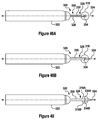
- the tip 254 is movable between an initial configuration (shown in Figures 43A and 43B ) and a contracted configuration (shown in Figures 43C and 43D ).
- the cutting edge 264 of the coring cannula 20 is within the recess 260 . This allows the coring cannula 20 to enter the incision with the stylet 250 , prior to the coring process, without the need to widen or open the incision any further.
- the tip 250 remains in the initial configuration as the coring cannula 20 is moved from the initial cannula location towards the final cannula location. Once the coring cannula 20 reaches the final cannula location, the tip may be moved into the contracted configuration ( Figure 43C ). In the contract configuration, the cutting edge 264 of the coring cannula 20 is exposed when the tip 254 is in the contracted configuration.
- the tip 254 has a first half portion 254A and a second half portion 254B.
- the first and second half portions 254A, 254B have a semi-circular cross-section (see Figures 43B and 43C ) and an inner surface 268A, 268B.
- the inner surface 266A of the first portion 254A faces the inner surface 266B of the second portion 254B .
- the first and second half portions 254A, 254B have a first part 268A, 268B and a second part 270A, 270B .
- the second parts 270A, 270B are sloped and curved forming an entry segment 272.
- the first and second parts 268A, 268B form a linear segment 274 .
- the linear segment 274 has an associated first diameter, ( d 1 ), when the tip is in the initial configuration ( Figure 43B ).
- the first diameter associated with the linear segment 274 is greater than or equal to a diameter associated with the cutting edge 248 of the coring cannula 20 .
- the cutting edge 248 can sit within the recess 260 prior to the coring process (see above).
- the linear segment 274 has a second diameter, ( d 2 ).
- the second diameter is less than diameter associated with the cutting edge 248 of the coring cannula 20 . This allows the coring cannula 20 to be rotated and moved forward (over the stylet) to perform the coring process.
- the first and second half portions 254A, 254B are biased towards the initial configuration.
- the collapsible stylet 250 includes a collet tube 251 and a collet closer 253.
- the tube 251 includes a ramping portion 251A and a distal end 251B .
- the distal end 251B is fitted between the first and second half portions 254A , 254B and bias the first and second half portions 254A , 254B into the initial configuration.
- a collet closer 253 is provided which is movable between a first position (shown in Figure 43A ) and a second position (shown in Figure 43C ).
- the collet closer 253 acts on the ramping portion 251A of the collet tube 251 to compress the distal end 251B. This allows the first and second half portions 254A, 254B of the collapsible stylet 250 to collapse to the contract position.
- the collet closer 253 may be movable from the first position to the second position by the user through actuation of a button provided on the housing 14 (not shown).
- an independent stylet mechanism 276 is provided.
- a prior art stylet 278 is shown.
- the prior art stylet 278 includes integral cutting blades 280. Since the integral cutting blades 280 are fixed relating to the stylet tip, the distance between the blades 280 and the stylet 278 is fixed at a minimal distance. This increases the chances of inadvertent movement or compression of the tissue, i.e., "snowplowing".
- the independent/retractable stylet mechanism 276 includes a tube 282 and at least one stylet blade 284 affixed to the tube 282 .
- a stylet 286 includes a stylet tip 288 with a central passage 290 .
- the tube 282 is slidably disposed within the central passage 290 of the stylet 286.
- the stylet mechanism 276 includes first and second blades 284A, 284B.
- the tube 282 may include an internal bore 292 for receiving the guide element 52 (see above).
- the independent/retractable stylet mechanism 276 is adjustable within/along the central passage 290 of the stylet 286 .
- the user can adjust the distance between the blades 284 and the stylet tip 288 to reduce the chance of snowplowing occurring.
- a localization needle with an integral locking member 294 is provided.
- the localization needle 294 includes a needle portion 296 and a locking member 304 .
- the needle portion 296 having a proximal end 298 , a distal end 300 and a channel 302 formed therein.
- the locking member 304 is formed integrally with the needle portion 296 . As shown, the locking member 304 may be formed at the distal end 300 of the needle portion 296 and has an unlocking configuration (shown in Figure 46A ) and a locking configuration (shown in Figure 46B ).
- the localization needle 294 in the unlocking configuration, is straight, i.e., without bends or kinks.
- bends, or barbs as shown in Figure 46B have been introduced into the localization needle 294 .
- bends, barbs are introduced into the localization needle 294 after the localization needle 294 has been inserted into the breast, thereby locking the localization needle 294 relative to the target tissue (see above).
- the localization needle 294 includes an actuation device 306 .
- the actuation device 306 is coupled to the distal end 300 and is used to apply a force thereto (see Figure 46B ). The force acts to bring the distal end 300 closer to the proximal end 298 .
- the localization needle 294 collapses at the locking member 304 creating the barbs, or extensions, as shown, thereby controllably moving the locking member from the unlocking configuration to the locking configuration.
- the actuation device 306 includes a member 308 coupled to an inner surface of the distal end 300 of the needle portion 296.
- the member 308 may include a wire 310 fixed to the inner diameter of the localization needle 294.
- the wire 310 may be attached to a lever (not shown) on the housing, or some other suitable mechanism, which pulls the wire 310 back toward the proximal end 298.
- the member 308 is a threaded rod 312 which is received by a threaded receiving member 314 which is coupled to the inner surface of the distal end 300 of the needle portion 296. This arrangement allows the localization needle 294 to be moved back into the unlocking configuration if the placement needs to be corrected.
- the locking member 304 is formed by at least one pair of opposed slots 316 within the needle portion 296.
- the slots 316 may be laser cut from the needle portion 296.
- the slots 316 may have a general rectangular shape with rounded ends.
- the slots 316 may include one or may directional cutouts 317 which assist in forming the extensions or barbs.
- the directional cutouts 317 may be triangular shaped.
- the slots 316 may have a general diamond shape, as shown in Figures 47A-47C .
- one or more rotating circular blades 318, 318A, 318B may be used.
- the use of the rotating circular blades 318, 318A, 318B improves the efficiency of the stylet and reduces the risk of compression and/or tearing of the tissue as the stylet in pushed into the breast.
- the rotating circular blade(s) 318, 318A, 318B may be powered (see below) or may rotating freely.
- the rotation of the blade (s) 318, 318A, 318B whether from an external source or as a result of friction between the blade 318, 318A, 318B and the tissue, creates relative motion therebetween.
- a stylet 320 is provided with a single rotating circular blade 318.
- the stylet 320 is coupled to a coring cannula 322.
- the coring cannula 322 has a longitudinal axis 324 and is centered on the axis 324.
- the stylet 320 is coupled to the coring cannula 322.
- the stylet 320 includes a stylet tube 326.
- the rotating circular blade 318 is rotatably coupled to a distal end 328 of the stylet tube 326.
- the rotating circular blade 318 is not mechanically driven, but is allowed to freely rotate. As the device 10 is advanced into the tissue, force exerted by the tissue will tend to rotate the circular blade 318, eliminating the tendency to push/tear tissue and improving cutting efficiency.
- the singular rotating circular blade 318 is mounted on its center point 334. As shown, the center point 334 is centered over the stylet tube 326.
- the rotating circular blade 318 defines a first plane which is parallel to the axis 324.
- the axis defines a second plane.
- the first and second planes intersect at a right angle.
- the center point 334 of the rotating circular blade 318 is located on both the first and second planes.
- a blade drive mechanism 330 is coupled to the rotating circular blade 318 for controllably rotating the circular blade 318.
- the blade drive mechanism 330 may include a motor (not shown) and drive cable 332.
- the blade drive mechanism 330 may include a rod and gearing system (not shown).
- the stylet 320 may include a pair of offset blades 318A, 318B.
- the second blade 318B defines a third plane which is parallel to the first plane.
- the center 334A, 334B of the blades 318A, 318B are offset a predetermined distance.
- the first and second blades 318A, 318B may be mechanically driven or may be allowed to rotate freely.
- the biopsy device 10 includes at least one retractable stylet blade 336.
- the at least one retractable stylet blade 336 is part of a stylet blade mechanism 338.
- the stylet blade mechanism 338 may include first and second retractable blades 336A, 336B, as shown.
- the stylet blade mechanism 338 is coupled to the coring cannula 20 via the stylet tip 30.
- the stylet blade mechanism 338 includes the stylet tube 36.
- the at least one retractable stylet blade 336 is fixed to the stylet tube 36.
- the stylet tube 36 is slidably disposed within the stylet housing 38.
- the central passage 34 is formed by the stylet tube 36.
- the stylet blade mechanism 338 is movable between a cutting position and a retracted position. In the cutting position, the at least one stylet blade is located a distance in front of the stylet tip 30 (as shown). In the retracted position, the at least one stylet blade 336 is located within the stylet tip 30.
- the stylet blade mechanism 338 may be manually moved from the retracted position to the cutting position. In one embodiment, the stylet blade mechanism 338 is spring biased towards the cutting position.
- the biopsy device 10 may further comprise a guide portion 108 formed at the end of the stylet tube 30.
- the guide portion 108 extends past an opening of the stylet tube 30.
- the guide portion 108 having an interior curved surface 340.
- the interior curved surface 340 assists in guiding the end of the guide element 52 into the central passageway 108.
- the stylet blade mechanism 338 and the retractable stylet blades 336 may be used with either integrated localization needle or the independent needle (see above).
- the stylet blade mechanism 338 is used with the independent needle handle assembly 18'. As discussed above, the independent needle handle assembly 18' is inserted into the breast, the guide element 52 is extended outside of the needle 54 and the locking member 62 is affixed to the target tissue. Once the locking member 62 is locked into the target tissue, the guide element 52 is removed from the needle 54. The guide element 52 is then inserted into central passageway 108.
- the biopsy device 10 With the guide element 52 within the central passageway 108 and the stylet blade mechanism 338 in the cutting position, the biopsy device 10 is slid up the guide element 52, the stylet blades 336 cutting the tissue and allowing the device 10 to reach the target tissue. Once the target tissue is reached, the stylet blade mechanism 338 can be retracted such that the blade(s) 336 are contained within the tip 30. The coring cannula 20 can then be advanced over the target tissue.
- a garrote wire 210 is used to transect the tissue sample.
- the prior art devices which employ a garrote wire, use a linear pull "trigger" system to activate the garrote wire.
- a limitation of the design is the travel required to fully pull the garrote wire. This limitation becomes an issue for larger cannula sizes. As the cannula diameter increases, the length of garrote wire required to transect tissue increases resulting in an increase in required travel. The travel length is limited by the overall length of the device. Continuing to increase the device length is not a viable option.
- the breast biopsy device 10 may include a trigger mechanism 342 which includes a trigger 344 (shown diagrammatically in Figures 50A-51B ).
- the trigger 344 is generally pulled backward to pull garrote wire 210 backward, thereby transecting the tissue sample within the coring cannula 20.
- the breast biopsy device 10 may include a pair of rotatable cleats 346 which are coupled to the housing 14 (through a trigger body 350 ) and are rotatable between a first cleat position (shown in Figure 50A ) and a second cleat position (shown in Figure 50B ).
- the rotatable cleats 346 include a plurality of teeth 348 which grip the garrote wire 210.
- the cleats 346 are coupled to the trigger mechanism 342 and when the trigger mechanism 342 is actuated, i.e., pulled backward relative to the housing 14. Friction causes the cleats 346 to rotate, thereby engaging the teeth 348 into the garrote wire 210. Then, as the trigger mechanism 342 is pulled backward, the cleats 346 move therewith, pulling the garrote wire 210 as well.
- the wire 210 when the garrote wire 210 is in a first position, the wire 210 forms a loop 352 which is external to the coring cannula 20. After the coring cannula 20 is extended and surrounds the sample tissue, the trigger mechanism 342 is used to complete separate the sample tissue from the breast.
- a single actuation of the trigger mechanism 342, e.g., a single pull of the trigger 342, moves the garrote wire 210 from the first wire position to a second wire position in which the garrote wire 210 is within the coring cannula 20 (and the sample completely separated from the breast).
- multiple actuations of the trigger mechanism 342, or multiple pulls of the trigger 344 are required.
- two pulls of the trigger 344 are required.
- Figure 50A shows the garrote wire 210 in an initial position with the loop 352 in its largest configuration.
- Figure 50B shows the garrote wire 210 in an intermediate location, after the first pull of the trigger 344 (the trigger 344 and trigger body 350 are shown at full travel).
- Figure 50C shows the garrote wire 210 at the intermediate location, with the trigger body 350 returned to the initial position.
- the trigger body 350 is spring biased back to the initial position.
- the trigger body 350 may be manually moved back to the initial position.
- Figure 50D shows the garrote wire 210 at the final location, fully actuated and within the coring cannula 20. At this point, the sample is completely severed from the breast.
- This improvement to the linear pull system will enable the use of larger cannula sizes to provide for multiple pulls of the trigger 344 on the garrote wire 210.
- Multiple pulls can be accomplished using the breakaway cleat system.
- the cleat system works as follows: When the trigger 348 is pulled, cleats 346 with separated edges or teeth 348 grip the garrote wire 210, allow the trigger 344 to pull the wire 219 the full length of travel. At the end of travel, the trigger 344 is pushed forward back to the start position. When the trigger 344 is moved in this direction, the cleat 346 (cam) disengages the wire so that the trigger 344 slides forward without affecting the wire 210. As the trigger 344 is pulled back, the cleats 346 re-engage the wire 210, pulling it to further transect tissue. This process is repeated until transection is completed.
- a second pair rotatable cleats 354 may be fixed directly to the device 10, e.g., directly to the housing 14.
- the second pair of rotatable cleats 354 are not fixed to the trigger body 350.
- the second pair of cleats 354 prevented undesirable forward motion of the garrote wire 210.
- the garrote wire 210 may have a number of beads 356 fixed thereto (crimped or welded thereon) to assist in grabbing of the wire by the cleats 346, 354.
- the prior art utilizes a linear pull trigger system, in which the trigger is pulled straight back to actuate the garrote wire.
- the trigger rides in a track and is supported by guide rods to maintain the desired linear pull.
- This support ring moves backward with the trigger, pulling the garrote wire across the cannula, transecting the core of tissue at the distal end.
- transection force increases significantly, at times resulting in incomplete transection. The user cannot provide enough input force to fully actuate the trigger system. Occurrences of this problem increases as cannula diameter increases.
- Phase 1 includes 0% to 70-95% constriction of the tissue by the garrote wire.
- the 70-95% range is dependent on cannula size and tissue density.
- the requirements of Phase 1 are long travel and low/medium input force.
- the current linear pull system works well during Phase 1.
- Phase 2 covers up to the final 30% of tissue constriction and eventual transection.
- the requirements of Phase 2 are limited travel with potentially high input forces required.
- the linear pull system does not always meet these requirements.
- the garrote wire 210 actuation by a trigger mechanism 358.
- the trigger mechanism 358 is coupled to the housing 14 and the garrote wire 210 (via support ring 370 ).
- the trigger mechanism 358 includes a trigger 360 slidably mounted in a trigger channel 362 in the housing 14.
- the trigger channel 362 is formed by a linear support track 368 within the housing 14.
- the trigger 360 is movable from a first trigger position (shown in Figure 52A and 52B ) to an intermediate trigger position (shown in Figure 52C ) within the trigger channel 362.
- the garrote wire 210 is coupled directly to the trigger 360.
- the garrote wire is moved from the first wire position to an intermediate wire position.
- the triggers 360 drops into a cam channel 366 once it reaches the intermediate trigger position.
- the trigger 360 is further rotatably movable about a trigger axis 364 from the intermediate trigger position to a second trigger position (shown dotted lines in Figures 52D ).
- the garrote wire 210 is moved from the intermediate wire position to the second wire position in response thereto.
- a rotational cam mechanism i.e., the rotatable trigger 360
- the rotational cam provides a mechanical advantage to the user allowing greater input force with limited travel.
- the concept described here is a "hybrid" system, using the linear pull system for the first 70-95% wire travel and then switching to the rotational cam system for the final phase of transection.
- the user will pull the trigger 360 along the linear track.
- the trigger 360 will reach the end of the trigger channel and engage the cam activation system. In this position the trigger will no longer translate, but will now rotate so that the input force is transferred through the cam to the support ring 370.
Landscapes
- Health & Medical Sciences (AREA)
- Life Sciences & Earth Sciences (AREA)
- Medical Informatics (AREA)
- Engineering & Computer Science (AREA)
- Biomedical Technology (AREA)
- Heart & Thoracic Surgery (AREA)
- Pathology (AREA)
- Molecular Biology (AREA)
- Surgery (AREA)
- Animal Behavior & Ethology (AREA)
- General Health & Medical Sciences (AREA)
- Public Health (AREA)
- Veterinary Medicine (AREA)
- Surgical Instruments (AREA)
Claims (12)
- Dispositif de biopsie (10), comprenant :un logement (14) ;une canule de carottage (20) ayant un axe longitudinal (24) et étant centrée sur l'axe (24) et couplée au logement (14), la canule de carottage (20) pouvant tourner autour de l'axe (24) ; etune lame souple de transsection (112) ayant une première extrémité (126) et une seconde extrémité (128) et étant couplée à la canule de carottage (20), la seconde extrémité (128) formant un bord tranchant (114), la lame souple de transsection (112) ayant une première position de lame et une seconde position de lame,caractérisé en ce que la canule de carottage (20) est mobile le long de l'axe (24) d'un emplacement de canule initial (118) vers un emplacement de canule final (120) en réponse à une rotation de la canule de carottage (20) autour de l'axe (24) dans une première direction, la lame souple de transsection (112) étant dans la première position de lame pendant que la canule de carottage (20) est entre les emplacements de canule initial et final (118, 120), une rotation de la canule de carottage (20) dans la première direction pendant que la canule de carottage (20) est à l'emplacement de canule final (120) faisant tourner la lame souple de transsection (112) autour de l'axe (24), déplaçant la lame souple de transsection (112) de la première position de lame à la seconde position de lame, où la lame souple de transsection (112) est au moins en partie contenue au sein de la canule de carottage (20) lorsque la canule de carottage (20) est entre la position initiale (118) et la position finale (120), un mouvement de la lame souple de transsection (112) de la première position de lame à la seconde position de lame faisant avancer la lame de transsection (112) au-delà de la canule de carottage (20).
- Dispositif de biopsie (10) selon la revendication 1, comprenant en outre :un stylet (28) ayant un embout (30) contenant au moins une lame (32) et un passage central (34) ;un ensemble moteur couplé à la canule de carottage (20) permettant de faire tourner sur commande la canule (20) ;un circuit (74) couplé électriquement à l'ensemble moteur ; et,une gâchette de commande (78) couplée électriquement au circuit (74), le circuit (74) étant destiné à commander en réponse une rotation de la canule (20) en fonction d'un actionnement de la gâchette de commande (78).
- Dispositif de biopsie (10) selon la revendication 2, dans lequel le circuit (74) est un circuit à vitesse variable (74) qui commande une vitesse de rotation de la canule (20) en fonction d'un niveau d'actionnement de la gâchette de commande de vitesse (78).
- Dispositif de biopsie (10) selon la revendication 2, comprenant en outre une aiguille de localisation (54) ayant un canal (56) et étant disposée avec faculté de coulissement au sein du passage central (34) du stylet (28).
- Dispositif de biopsie (10) selon la revendication 1, la lame souple de transsection (112) ayant une configuration initiale et une configuration de coupe et étant prédisposée vers la configuration de coupe, la lame souple de transsection (112) étant dans la configuration initiale à la première position de lame et dans la configuration de coupe à la seconde position de lame.
- Dispositif de biopsie (10) selon la revendication 1, comprenant en outre :un stylet (28) ayant un embout (30) contenant au moins une lame (32) et un passage central (34) ;une aiguille de localisation (54) ayant un canal (56) et étant disposée avec faculté de coulissement au sein du passage central (34) ;un ensemble moteur couplé à la canule de carottage (20) pour tourner sur commande ;un circuit à vitesse variable (74) couplé électriquement à l'ensemble moteur ;un commutateur de marche avant/arrière (76) couplé électriquement au circuit à vitesse variable (74) pour commander la direction de mouvement de la canule (20) ;une gâchette de commande de vitesse (78) couplée électriquement au circuit à vitesse variable (74), le circuit à vitesse variable (74) étant destiné à commander en réponse la vitesse de rotation de la canule (20) en fonction du commutateur de marche avant/arrière (76) et d'un actionnement de la gâchette de commande de vitesse (78) ; etun élément guide (52) ayant une première extrémité (58) et une seconde extrémité (60) et étant disposé avec faculté de coulissement au sein du canal (56) de l'aiguille de localisation (54), l'élément guide (52) étant mobile d'une première position à une seconde position au sein de l'aiguille de localisation (54).
- Dispositif de biopsie (10) selon la revendication 1, comprenant en outre ;
un stylet (28) ayant un embout (30) contenant au moins une lame (32) et un passage central (34) ;
un ensemble moteur couplé à la canule de carottage (20) pour faire tourner sur commande la canule (20) ;
un circuit à vitesse variable (74) couplé électriquement à l'ensemble moteur ;
un commutateur de marche avant/arrière (76) couplé électriquement au circuit à vitesse variable (74) pour commander la direction de mouvement de la canule (20) ; et
une gâchette de commande de vitesse (78) couplée électriquement au circuit à vitesse variable (74), le circuit à vitesse variable (74) étant destiné à commander en réponse la vitesse de rotation de la canule (20) en fonction du commutateur de marche avant/arrière (76) et d'un actionnement de la gâchette de commande de vitesse (78) ;
comprenant en outre un ensemble aiguille (18) comprenant :une aiguille de localisation (54) ayant un canal (56) et étant disposée avec faculté de coulissement au sein du passage central (34) ; etun élément guide (52) ayant une première extrémité (58) et une seconde extrémité (60) et étant disposé avec faculté de coulissement au sein du canal (56) de l'aiguille de localisation (54) et pouvant en être enlevé ;dans lequel, en utilisation, le stylet (28) est adapté pour recevoir l'élément guide (52) au sein du passage central (34) lorsqu'il est enlevé de l'aiguille de localisation (54), et le dispositif de biopsie (10) étant avancé par rapport à l'élément guide (52) pour que l'élément guide (52) se déplace d'une première position à une seconde position au sein du passage central (34). - Dispositif de biopsie (10) selon l'une quelconque des revendications 1, 5 ou 6, dans lequel la lame souple de transsection (112) a une configuration initiale et une configuration de coupe, la lame souple de transsection (112) étant prédisposée vers la configuration de coupe ; et de préférence la configuration initiale est généralement plate et la configuration de coupe est généralement incurvée.
- Dispositif de biopsie (10) selon la revendication 8, dans lequel la lame souple de transsection (112) est dans la configuration initiale à la première position de lame et dans la configuration de coupe à la seconde position de lame.
- Dispositif de biopsie (10) selon l'une quelconque des revendications 1, 5 ou 6, dans lequel l'élément souple de lame est composé d'un alliage de métal de nickel et de titane.
- Dispositif de biopsie (10) selon la revendication 10, dans lequel l'alliage de métal est du nitinol.
- Dispositif de biopsie (10) selon l'une quelconque des revendications 1, 5 ou 6, dans lequel l'élément souple de lame est prédisposé à la seconde position par l'intermédiaire d'un procédé de traitement à la chaleur.
Applications Claiming Priority (14)
| Application Number | Priority Date | Filing Date | Title |
|---|---|---|---|
| US31916010P | 2010-03-30 | 2010-03-30 | |
| US31920910P | 2010-03-30 | 2010-03-30 | |
| US31922310P | 2010-03-30 | 2010-03-30 | |
| US31915710P | 2010-03-30 | 2010-03-30 | |
| US31915910P | 2010-03-30 | 2010-03-30 | |
| US31916210P | 2010-03-30 | 2010-03-30 | |
| US31914810P | 2010-03-30 | 2010-03-30 | |
| US31915510P | 2010-03-30 | 2010-03-30 | |
| US31921810P | 2010-03-30 | 2010-03-30 | |
| US31921010P | 2010-03-30 | 2010-03-30 | |
| US31921710P | 2010-03-30 | 2010-03-30 | |
| US31952810P | 2010-03-31 | 2010-03-31 | |
| US32417210P | 2010-04-14 | 2010-04-14 | |
| PCT/US2011/030334 WO2011123446A1 (fr) | 2010-03-30 | 2011-03-29 | Dispositif d'excision de tissu |
Publications (2)
| Publication Number | Publication Date |
|---|---|
| EP2552322A1 EP2552322A1 (fr) | 2013-02-06 |
| EP2552322B1 true EP2552322B1 (fr) | 2016-11-16 |
Family
ID=44710484
Family Applications (1)
| Application Number | Title | Priority Date | Filing Date |
|---|---|---|---|
| EP11713575.6A Not-in-force EP2552322B1 (fr) | 2010-03-30 | 2011-03-29 | Dispositif d'excision de tissu |
Country Status (3)
| Country | Link |
|---|---|
| US (13) | US8597200B2 (fr) |
| EP (1) | EP2552322B1 (fr) |
| WO (1) | WO2011123446A1 (fr) |
Families Citing this family (47)
| Publication number | Priority date | Publication date | Assignee | Title |
|---|---|---|---|---|
| EP2552322B1 (fr) * | 2010-03-30 | 2016-11-16 | Martin L. Flatland | Dispositif d'excision de tissu |
| JP5984068B2 (ja) | 2010-11-21 | 2016-09-06 | ペリクス,ロバート | 組織取り出し装置及び使用方法 |
| US8801742B2 (en) | 2011-06-01 | 2014-08-12 | Devicor Medical Products, Inc. | Needle assembly and blade assembly for biopsy device |
| US9161759B2 (en) * | 2011-06-24 | 2015-10-20 | Covidien Lp | Method and apparatus for storage and/or introduction of anatomical implant |
| US9747287B1 (en) * | 2011-08-10 | 2017-08-29 | Nutanix, Inc. | Method and system for managing metadata for a virtualization environment |
| US8863124B1 (en) | 2011-08-10 | 2014-10-14 | Nutanix, Inc. | Architecture for managing I/O and storage for a virtualization environment |
| US8601473B1 (en) | 2011-08-10 | 2013-12-03 | Nutanix, Inc. | Architecture for managing I/O and storage for a virtualization environment |
| US9009106B1 (en) | 2011-08-10 | 2015-04-14 | Nutanix, Inc. | Method and system for implementing writable snapshots in a virtualized storage environment |
| US8850130B1 (en) | 2011-08-10 | 2014-09-30 | Nutanix, Inc. | Metadata for managing I/O and storage for a virtualization |
| US9652265B1 (en) | 2011-08-10 | 2017-05-16 | Nutanix, Inc. | Architecture for managing I/O and storage for a virtualization environment with multiple hypervisor types |
| US8549518B1 (en) | 2011-08-10 | 2013-10-01 | Nutanix, Inc. | Method and system for implementing a maintenanece service for managing I/O and storage for virtualization environment |
| WO2013056190A1 (fr) | 2011-10-15 | 2013-04-18 | Transmed7, Llc | Dispositifs et procédés de biopsie par extraction d'échantillon de tissu mou |
| US9772866B1 (en) | 2012-07-17 | 2017-09-26 | Nutanix, Inc. | Architecture for implementing a virtualization environment and appliance |
| US10117663B2 (en) | 2012-08-23 | 2018-11-06 | Heartware, Inc. | Coring tool |
| CN104797200B (zh) | 2012-11-21 | 2018-04-27 | C·R·巴德公司 | 芯针活检装置 |
| US9039633B2 (en) * | 2012-12-24 | 2015-05-26 | Transmed7, Llc | Automated, selectable, soft tissue excision biopsy devices and methods |
| EP2958533B8 (fr) * | 2013-02-20 | 2022-02-16 | Cytrellis Biosystems, Inc. | Procédés et dispositifs pour le resserrement de la peau |
| US9463001B2 (en) | 2013-05-28 | 2016-10-11 | Transmed7, Llc | Soft tissue coring biopsy devices and methods |
| EP3030175B1 (fr) | 2013-08-09 | 2023-10-04 | Cytrellis Biosystems, Inc. | Appareils pour le traitement de la peau à l'aide d'une ablation de tissu non thermique |
| US9155527B2 (en) | 2013-08-22 | 2015-10-13 | Transmed7, Llc | Soft tissue coring biopsy devices and methods |
| US9204867B2 (en) | 2013-08-31 | 2015-12-08 | Robert Bilgor Peliks | Tissue removal device and method of use |
| WO2015038770A2 (fr) | 2013-09-12 | 2015-03-19 | Transmed7, Llc | Dispositifs et procédés de biopsie par prélèvement de tissu |
| EP3038549B1 (fr) | 2013-09-27 | 2019-08-07 | Release Medical, Inc. | Dispositif d'incision de tissu |
| US10028762B1 (en) | 2013-10-14 | 2018-07-24 | Percutaneous Cosmetic Devices LLC | Method of cutting soft tissue under facial skin |
| US10076315B2 (en) | 2014-09-18 | 2018-09-18 | Transmed7, Llc | Soft tissue biopsy or excisional devices and methods |
| US9999758B2 (en) | 2014-09-19 | 2018-06-19 | Transmed7, Llc | In-situ material delivery devices and methods |
| US10231750B2 (en) | 2014-09-29 | 2019-03-19 | Transmed7, Llc | Excisional device distal working end actuation mechanism and method |
| KR102670286B1 (ko) | 2014-11-14 | 2024-05-30 | 사이트렐리스 바이오시스템즈, 인크. | 피부 절제를 위한 디바이스 및 방법 |
| US20160151054A1 (en) | 2014-12-02 | 2016-06-02 | Byungesol An | Disposable biopsy devices and methods of obtaining tissue biopsy samples using same |
| CN107205750B (zh) | 2015-01-08 | 2020-08-21 | 西纳塞弗医疗有限公司 | 鼻旁窦医疗装置及其用途 |
| US10251630B2 (en) | 2015-08-28 | 2019-04-09 | SiteSelect Inc. | Tissue excision device with anchor stability rod and anchor stability rod |
| US20170055963A1 (en) * | 2015-08-28 | 2017-03-02 | SiteSelect Inc. | Tissue excision device with expanding cannula and expanding cannula |
| CA2997004A1 (fr) * | 2015-08-28 | 2017-03-09 | SiteSelect Inc. | Dispositif d'excision de tissu avec tige de stabilite d'ancrage et tige de stabilite d'ancrage |
| US10467103B1 (en) | 2016-03-25 | 2019-11-05 | Nutanix, Inc. | Efficient change block training |
| WO2017180761A1 (fr) * | 2016-04-12 | 2017-10-19 | The Administrators Of The Tulane Educational Fund | Dispositif de coupe pour biopsie et méthodes d'utilisation |
| EP3478356B1 (fr) | 2016-07-03 | 2023-09-06 | Sinusafe Medical Ltd | Dispositif médical pour le traitement des sinus et/ou des oreilles |
| US10285723B2 (en) * | 2016-08-09 | 2019-05-14 | Ethicon Llc | Ultrasonic surgical blade with improved heel portion |
| CN109922740B (zh) | 2016-09-21 | 2022-08-23 | 希特利斯生物系统有限公司 | 用于美容皮肤重建的装置和方法 |
| US11457909B2 (en) * | 2017-11-14 | 2022-10-04 | Min Ho Jung | Sheath device for biportal endoscopic spinal surgery |
| FR3073729A1 (fr) * | 2017-11-22 | 2019-05-24 | Laurent Fumex | Dispositif d'ancrage et de reperage de lesions suspectes a multiples organes d'ancrage |
| IL314098A (en) | 2018-02-08 | 2024-09-01 | Limaca Medical Ltd | Biopsy device |
| EP3946087B1 (fr) | 2019-04-04 | 2024-04-24 | Transmed7, LLC | Dispositifs d'excision |
| WO2021062192A1 (fr) | 2019-09-27 | 2021-04-01 | Merit Medical Systems, Inc. | Système et poignée de biopsie par rotation |
| US12150627B2 (en) | 2019-12-11 | 2024-11-26 | Merit Medical Systems, Inc. | Bone biopsy device and related methods |
| US12582434B1 (en) | 2020-04-06 | 2026-03-24 | Transmed7 Llc | Excisional devices and methods |
| CN111616750B (zh) * | 2020-06-28 | 2024-06-21 | 北京大学深圳医院 | 多功能活检穿刺针 |
| WO2025151902A1 (fr) * | 2024-01-11 | 2025-07-17 | Transmed7, Llc | Dispositif et procédés d'excision |
Family Cites Families (149)
| Publication number | Priority date | Publication date | Assignee | Title |
|---|---|---|---|---|
| US4461305A (en) | 1981-09-04 | 1984-07-24 | Cibley Leonard J | Automated biopsy device |
| US4616656A (en) | 1985-03-19 | 1986-10-14 | Nicholson James E | Self-actuating breast lesion probe and method of using |
| US4790329A (en) | 1987-06-12 | 1988-12-13 | Trustees Of Beth Israel Hospital | Adjustable biopsy localization device |
| US5115175A (en) * | 1988-02-03 | 1992-05-19 | Hall Surgical | Drill having alternate mode control |
| US5060658A (en) | 1988-02-23 | 1991-10-29 | Vance Products Incorporated | Fine-needle aspiration cell sampling apparatus |
| WO1989009029A1 (fr) | 1989-02-16 | 1989-10-05 | Taheri Syde A | Procede et appareil d'elimination de valvules veineuses |
| US4986279A (en) | 1989-03-01 | 1991-01-22 | National-Standard Company | Localization needle assembly with reinforced needle assembly |
| US5197482A (en) | 1989-06-15 | 1993-03-30 | Research Corporation Technologies, Inc. | Helical-tipped lesion localization needle device and method of using the same |
| US5415169A (en) | 1989-11-21 | 1995-05-16 | Fischer Imaging Corporation | Motorized mammographic biopsy apparatus |
| US5030201A (en) | 1989-11-24 | 1991-07-09 | Aubrey Palestrant | Expandable atherectomy catheter device |
| US5114401A (en) * | 1990-02-23 | 1992-05-19 | New England Deaconess Hospital Corporation | Method for central venous catheterization |
| US5454365A (en) | 1990-11-05 | 1995-10-03 | Bonutti; Peter M. | Mechanically expandable arthroscopic retractors |
| US5111828A (en) | 1990-09-18 | 1992-05-12 | Peb Biopsy Corporation | Device for percutaneous excisional breast biopsy |
| US5353804A (en) | 1990-09-18 | 1994-10-11 | Peb Biopsy Corporation | Method and device for percutaneous exisional breast biopsy |
| DE69133618D1 (de) | 1990-10-09 | 2009-07-30 | Medtronic Inc | Chirurgische Vorrichtung zur Manipulation von Gewebe |
| DE9016810U1 (de) | 1990-12-12 | 1991-02-28 | Siemens AG, 8000 München | Mammographie-Röntgengerät |
| US5591186A (en) * | 1991-05-22 | 1997-01-07 | Wurster; Helmut | Self-cutting trocar |
| US5199441A (en) | 1991-08-20 | 1993-04-06 | Hogle Hugh H | Fine needle aspiration biopsy apparatus and method |
| US7549424B2 (en) | 1991-10-18 | 2009-06-23 | Pro Surg, Inc. | Method and apparatus for tissue treatment with laser and electromagnetic radiation |
| US5289520A (en) | 1991-11-27 | 1994-02-22 | Lorad Corporation | Stereotactic mammography imaging system with prone position examination table and CCD camera |
| CA2153993A1 (fr) | 1992-01-16 | 1993-08-05 | Rakesh K. Jain | Methode et appareillage de localisation de tumeurs |
| US5386447A (en) | 1992-09-23 | 1995-01-31 | Fischer Imaging Corporation | Mammographic screening and biopsy apparatus |
| US5794626A (en) | 1994-08-18 | 1998-08-18 | Kieturakis; Maciej J. | Excisional stereotactic apparatus |
| US5954670A (en) | 1994-10-05 | 1999-09-21 | Baker; Gary H. | Mandrel-guided tandem multiple channel biopsy guide device and method of use |
| US5499989A (en) | 1994-12-22 | 1996-03-19 | Labash; Stephen S. | Breast biopsy apparatus and method of use |
| US5647374A (en) | 1994-12-30 | 1997-07-15 | North American Scientific | Needle for imaging and sampling |
| US5795308A (en) | 1995-03-09 | 1998-08-18 | Russin; Lincoln D. | Apparatus for coaxial breast biopsy |
| US5868673A (en) | 1995-03-28 | 1999-02-09 | Sonometrics Corporation | System for carrying out surgery, biopsy and ablation of a tumor or other physical anomaly |
| US5817034A (en) | 1995-09-08 | 1998-10-06 | United States Surgical Corporation | Apparatus and method for removing tissue |
| US5857982A (en) | 1995-09-08 | 1999-01-12 | United States Surgical Corporation | Apparatus and method for removing tissue |
| US5709671A (en) * | 1995-10-16 | 1998-01-20 | Ethicon Endo-Surgery, Inc. | Trocar having an improved tip configuration |
| US5782775A (en) | 1995-10-20 | 1998-07-21 | United States Surgical Corporation | Apparatus and method for localizing and removing tissue |
| US5848978A (en) | 1995-11-14 | 1998-12-15 | Genx International, Inc. | Surgical biopsy device |
| US5687739A (en) * | 1995-12-06 | 1997-11-18 | Interventional Concepts, Inc. | Biopsy specimen cutter |
| US5961457A (en) | 1996-05-03 | 1999-10-05 | The Regents Of The University Of Michigan | Method and apparatus for radiopharmaceutical-guided biopsy |
| US5882316A (en) * | 1996-08-29 | 1999-03-16 | City Of Hope | Minimally invasive biopsy device |
| US5913857A (en) | 1996-08-29 | 1999-06-22 | Ethicon End0-Surgery, Inc. | Methods and devices for collection of soft tissue |
| US6152936A (en) * | 1996-09-23 | 2000-11-28 | Esd Medical, Llc | Surgical loop delivery device |
| CA2214873A1 (fr) | 1996-10-04 | 1998-04-04 | United States Surgical Corporation | Instrument chirurgical pour l'ablation de tissus |
| US5800457A (en) | 1997-03-05 | 1998-09-01 | Gelbfish; Gary A. | Intravascular filter and associated methodology |
| IL128261A0 (en) | 1999-01-27 | 1999-11-30 | Disc O Tech Medical Tech Ltd | Expandable element |
| AU8247598A (en) | 1997-06-27 | 1999-01-19 | Pachal, Jan | Biopsy method and device |
| US6280450B1 (en) | 1997-07-24 | 2001-08-28 | Rex Medical, Lp | Breast surgery method and apparatus |
| US6551253B2 (en) | 1997-09-12 | 2003-04-22 | Imagyn Medical Technologies | Incisional breast biopsy device |
| EP1011455B1 (fr) | 1997-09-12 | 2007-01-10 | SiteSelect Medical Technologies, Ltd. | Dispositif pour biopsie par incision mammaire |
| US6080113A (en) | 1998-09-11 | 2000-06-27 | Imagyn Medical Technologies California, Inc. | Incisional breast biopsy device |
| US6383145B1 (en) | 1997-09-12 | 2002-05-07 | Imagyn Medical Technologies California, Inc. | Incisional breast biopsy device |
| US6142955A (en) | 1997-09-19 | 2000-11-07 | United States Surgical Corporation | Biopsy apparatus and method |
| US6019733A (en) | 1997-09-19 | 2000-02-01 | United States Surgical Corporation | Biopsy apparatus and method |
| US6050955A (en) | 1997-09-19 | 2000-04-18 | United States Surgical Corporation | Biopsy apparatus and method |
| WO1999016499A1 (fr) * | 1997-10-01 | 1999-04-08 | Boston Scientific Corporation | Systemes de dilatation et procedes associes |
| US6303323B1 (en) | 1997-10-21 | 2001-10-16 | Cancer Research Campaign Technology Limited | Detection of dysplastic or neoplastic cells using anti-MCM5 antibodies |
| US6007495A (en) | 1998-01-22 | 1999-12-28 | United States Surgical Corporation | Biopsy apparatus and method |
| US6193673B1 (en) | 1998-02-20 | 2001-02-27 | United States Surgical Corporation | Biopsy instrument driver apparatus |
| US6540693B2 (en) | 1998-03-03 | 2003-04-01 | Senorx, Inc. | Methods and apparatus for securing medical instruments to desired locations in a patients body |
| US6053925A (en) | 1998-02-27 | 2000-04-25 | Barnhart; William H. | Lesion localization device and method |
| US6093154A (en) | 1998-04-29 | 2000-07-25 | Denver Biomaterials, Inc. | Biopsy needle |
| US6179860B1 (en) | 1998-08-19 | 2001-01-30 | Artemis Medical, Inc. | Target tissue localization device and method |
| US6136014A (en) | 1998-09-01 | 2000-10-24 | Vivant Medical, Inc. | Percutaneous tissue removal device |
| US6036698A (en) | 1998-10-30 | 2000-03-14 | Vivant Medical, Inc. | Expandable ring percutaneous tissue removal device |
| CA2351331C (fr) | 1998-11-25 | 2010-07-20 | United States Surgical Corporation | Systeme de biopsie |
| AU2706500A (en) | 1998-11-25 | 2000-09-21 | Fischer Imaging Corporation | User interface system for mammographic imager |
| US6402701B1 (en) | 1999-03-23 | 2002-06-11 | Fna Concepts, Llc | Biopsy needle instrument |
| US6607528B1 (en) | 1999-06-22 | 2003-08-19 | Senorx, Inc. | Shapeable electrosurgical scalpel |
| ES2312350T3 (es) * | 1999-06-22 | 2009-03-01 | Ernesto E. Blanco | Trocar de seguridad dotado de protectores progresivos para la punta de corte y de un deflector de tejidos con chorro de gas. |
| AU7828800A (en) | 1999-09-14 | 2001-04-17 | Papillon Surgical | Over the wire breast biopsy system |
| EP1225833A4 (fr) | 1999-09-14 | 2003-11-26 | Papillon Surgical | Stabilisateur mammaire |
| US6675037B1 (en) | 1999-09-29 | 2004-01-06 | Regents Of The University Of Minnesota | MRI-guided interventional mammary procedures |
| US6280398B1 (en) | 1999-10-18 | 2001-08-28 | Ethicon Endo-Surgery | Methods and devices for collection of soft tissue |
| GB0009927D0 (en) * | 2000-04-20 | 2000-06-07 | Cervi Paul L | Biopsy device |
| US6889073B2 (en) | 2000-05-08 | 2005-05-03 | David A. Lampman | Breast biopsy and therapy system for magnetic resonance imagers |
| US6512943B1 (en) | 2000-05-22 | 2003-01-28 | Wisconsin Alumni Research Foundation | Combined ultrasound-radionuclide device for percutaneous ultrasound-guided biopsy and method of use |
| US6494844B1 (en) | 2000-06-21 | 2002-12-17 | Sanarus Medical, Inc. | Device for biopsy and treatment of breast tumors |
| EP1299034B1 (fr) | 2000-07-07 | 2007-02-14 | Medical Positioning, Inc. | Appareil de support d'un patiente et procede de realisation d'une biopsie mammaire de decubitus |
| US6485436B1 (en) | 2000-08-10 | 2002-11-26 | Csaba Truckai | Pressure-assisted biopsy needle apparatus and technique |
| US6712773B1 (en) | 2000-09-11 | 2004-03-30 | Tyco Healthcare Group Lp | Biopsy system |
| US6610020B2 (en) | 2000-10-13 | 2003-08-26 | Ethicon Endo-Surgery, Inc. | Fork assembly for a surgical biopsy device |
| US6730044B2 (en) | 2000-10-13 | 2004-05-04 | Ethicon Endo-Surgery, Inc. | Firing mechanism for use in a surgical biopsy device |
| US6602203B2 (en) | 2000-10-13 | 2003-08-05 | Ethicon Endo-Surgery, Inc. | Remote thumbwheel for a surgical biopsy device |
| EP1333759B1 (fr) | 2000-10-16 | 2010-04-07 | Sanarus Medical, Inc. | Dispositif pour biopsie de tumeurs |
| US6758824B1 (en) | 2000-11-06 | 2004-07-06 | Suros Surgical Systems, Inc. | Biopsy apparatus |
| WO2002051300A2 (fr) | 2000-11-06 | 2002-07-04 | Krause William R | Dispositif de biopsie distribuant un agent coagulant |
| AU2907002A (en) | 2000-11-27 | 2002-06-03 | Tyco Healthcare | Tissue sampling and removal apparatus and method |
| US20020138021A1 (en) | 2001-03-23 | 2002-09-26 | Devonrex, Inc. | Micro-invasive tissue removal device |
| US6432064B1 (en) | 2001-04-09 | 2002-08-13 | Ethicon Endo-Surgery, Inc. | Biopsy instrument with tissue marking element |
| US6558337B2 (en) | 2001-04-17 | 2003-05-06 | Wisconsin Alumni Research Foundation | Positioner for medical devices such as biopsy needles |
| US6743207B2 (en) | 2001-04-19 | 2004-06-01 | Scimed Life Systems, Inc. | Apparatus and method for the insertion of a medical device |
| FI117317B (fi) | 2001-04-20 | 2006-09-15 | Instrumentarium Corp | Kuvainformaation muodostaminen, mammografialaite ja biopsian suorittaminen |
| US7473224B2 (en) | 2001-05-29 | 2009-01-06 | Ethicon Endo-Surgery, Inc. | Deployable ultrasound medical transducers |
| US7077842B1 (en) | 2001-08-03 | 2006-07-18 | Cosman Jr Eric R | Over-the-wire high frequency electrode |
| US6709408B2 (en) | 2001-08-09 | 2004-03-23 | Biopsy Sciences, Llc | Dual action aspiration biopsy needle |
| US6623437B2 (en) | 2001-08-28 | 2003-09-23 | Rex Medical, L.P. | Tissue biopsy apparatus |
| US6589240B2 (en) * | 2001-08-28 | 2003-07-08 | Rex Medical, L.P. | Tissue biopsy apparatus with collapsible cutter |
| JP2005503227A (ja) | 2001-09-27 | 2005-02-03 | ガリル メディカル リミテッド | 乳房の腫瘍の冷凍外科治療のための装置および方法 |
| US6626849B2 (en) | 2001-11-01 | 2003-09-30 | Ethicon Endo-Surgery, Inc. | MRI compatible surgical biopsy device |
| US20070219459A1 (en) | 2005-10-14 | 2007-09-20 | Microfabrica Inc. | Biopsy Devices, Methods for Using, and Methods for Making |
| US6736822B2 (en) | 2002-02-20 | 2004-05-18 | Mcclellan Scott B. | Device and method for internal ligation of tubular structures |
| CA2992643C (fr) | 2002-03-13 | 2019-06-18 | Genomic Health, Inc. | Profilage d'expression genique dans des tissus tumoraux ponctionnes |
| US7826883B2 (en) | 2002-04-23 | 2010-11-02 | Devicor Medical Products, Inc. | Localization mechanism for an MRI compatible biopsy device |
| US6918880B2 (en) | 2002-06-28 | 2005-07-19 | Ethicon, Inc. | Bipolar RF excision and aspiration device and method for endometriosis removal |
| WO2004012600A2 (fr) | 2002-08-01 | 2004-02-12 | Selis James E | Dispositifs et procedes de biopsie |
| US7438692B2 (en) | 2002-10-18 | 2008-10-21 | Mark Tsonton | Localization mechanism for an MRI compatible biopsy device |
| US7149566B2 (en) | 2002-10-31 | 2006-12-12 | Manoa Medical, Inc. | Soft tissue orientation and imaging guide systems and methods |
| EP2110094B1 (fr) * | 2002-11-18 | 2012-06-27 | Bard Peripheral Vascular, Inc. | Appareil pour implanter un fil de localisation préchargé |
| US20040171933A1 (en) | 2002-11-25 | 2004-09-02 | Milton Stoller | Mammography needle biopsy system and method |
| DE10258483B3 (de) | 2002-12-10 | 2004-06-17 | Universitätsklinikum Charité, Medizinische Fakultät der Humboldt-Universität zu Berlin | Optisches Biopsieinstrument |
| US20040186349A1 (en) | 2002-12-24 | 2004-09-23 | Usgi Medical Corp. | Apparatus and methods for achieving endoluminal access |
| US20040147917A1 (en) | 2003-01-23 | 2004-07-29 | Mueller Richard L. | Device and method for treatment of breast tissue with electromagnetic radiation |
| AU2004206998B2 (en) | 2003-01-24 | 2009-12-17 | The General Hospital Corporation | System and method for identifying tissue using low-coherence interferometry |
| BRPI0407847A (pt) * | 2003-02-25 | 2006-02-14 | Ethicon Endo Surgery Inc | dispositivo de biópsia com avanço de cortador de velocidade variável |
| US7169114B2 (en) | 2003-06-04 | 2007-01-30 | Krause William R | Biopsy and delivery device |
| US20040267121A1 (en) | 2003-06-12 | 2004-12-30 | Sarvazyan Armen P. | Device and method for biopsy guidance using a tactile breast imager |
| US7379769B2 (en) | 2003-09-30 | 2008-05-27 | Sunnybrook Health Sciences Center | Hybrid imaging method to monitor medical device delivery and patient support for use in the method |
| US7309316B1 (en) | 2004-03-01 | 2007-12-18 | Flynn Edward R | Magnetic needle biopsy |
| US7465279B2 (en) | 2004-03-31 | 2008-12-16 | Ethicon Endo-Surgery, Inc. | Marker device and method of deploying a cavity marker using a surgical biopsy device |
| US8568334B2 (en) | 2004-05-11 | 2013-10-29 | Inrad, Inc. | Core biopsy device |
| US7708751B2 (en) | 2004-05-21 | 2010-05-04 | Ethicon Endo-Surgery, Inc. | MRI biopsy device |
| DE102004030391A1 (de) * | 2004-06-23 | 2006-01-26 | Somatex Medical Technologies Gmbh | Marker |
| EP1634543B1 (fr) | 2004-09-09 | 2008-03-19 | SOMATEX Medical Technologies GmbH | Instrument de chirurgie |
| EP1800316A4 (fr) | 2004-09-15 | 2009-03-18 | Scient Biospy Ltd | Detection du cancer du sein et biopsie |
| US20060074345A1 (en) | 2004-09-29 | 2006-04-06 | Hibner John A | Biopsy apparatus and method |
| US7276032B2 (en) | 2004-09-29 | 2007-10-02 | Ethicon Endo-Surgery, Inc. | Biopsy apparatus and method |
| US20060074344A1 (en) | 2004-09-29 | 2006-04-06 | Hibner John A | Fluid control for biopsy device |
| US7611474B2 (en) | 2004-12-29 | 2009-11-03 | Ethicon Endo-Surgery, Inc. | Core sampling biopsy device with short coupled MRI-compatible driver |
| US20060184063A1 (en) | 2005-02-15 | 2006-08-17 | Miller Michael E | Single motor handheld biopsy device |
| US7517322B2 (en) | 2005-03-04 | 2009-04-14 | Ethicon Endo-Surgery, Inc. | Biopsy device with variable side aperture |
| US7635340B2 (en) * | 2005-04-05 | 2009-12-22 | Rubicor Medical, Inc. | Methods and devices for removing tissue from a patient |
| WO2006119426A2 (fr) | 2005-05-03 | 2006-11-09 | Regents Of The University Of California | Systemes de biopsie pour tomographie par ordinateur (ct) |
| US7828748B2 (en) * | 2005-08-05 | 2010-11-09 | Devicor Medical Products, Inc. | Vacuum syringe assisted biopsy device |
| US7854707B2 (en) | 2005-08-05 | 2010-12-21 | Devicor Medical Products, Inc. | Tissue sample revolver drum biopsy device |
| US7662109B2 (en) | 2006-02-01 | 2010-02-16 | Ethicon Endo-Surgery, Inc. | Biopsy device with replaceable probe incorporating static vacuum source dual valve sample stacking retrieval and saline flush |
| WO2007095330A2 (fr) | 2006-02-15 | 2007-08-23 | Hologic Inc | Biopsie mammaire et localisation a l'aiguille a l'aide de systemes de tomosynthese |
| US7473232B2 (en) | 2006-02-24 | 2009-01-06 | Boston Scientific Scimed, Inc. | Obtaining a tissue sample |
| US20070232953A1 (en) | 2006-03-31 | 2007-10-04 | Ethicon Endo-Surgery, Inc. | MRI biopsy device |
| US7507210B2 (en) | 2006-05-01 | 2009-03-24 | Ethicon Endo-Surgery, Inc. | Biopsy cannula adjustable depth stop |
| US20070282221A1 (en) | 2006-06-02 | 2007-12-06 | U-Systems, Inc. | Ultrasound assisted and x-ray assisted biopsy devices |
| WO2008027375A2 (fr) | 2006-08-31 | 2008-03-06 | Cook Incorporated | mécanisme de fixation à commande rotative |
| US7711409B2 (en) | 2006-10-04 | 2010-05-04 | Hampton University | Opposed view and dual head detector apparatus for diagnosis and biopsy with image processing methods |
| GB0620063D0 (en) | 2006-10-10 | 2006-11-22 | Medical Device Innovations Ltd | Needle structure and method of performing needle biopsies |
| US7979109B2 (en) | 2006-10-12 | 2011-07-12 | Lawrence Group Medical Device Trust | Needle driver for magnetic resonance elastography |
| US20080221479A1 (en) | 2007-03-07 | 2008-09-11 | Ritchie Paul G | Integrated Imaging and Biopsy System with Integrated Utilities |
| US8066644B2 (en) | 2007-05-17 | 2011-11-29 | Vanderbilt University | System, method and device for positioning a target located within soft tissue in a path of an instrument |
| US8343072B2 (en) * | 2007-07-16 | 2013-01-01 | Inrad, Inc. | Coaxial needle assembly |
| GB2465726A (en) | 2007-08-23 | 2010-06-02 | Fischer Medical Technologies Inc | Improved computed tomography breast imaging and biopsy system |
| US20090076412A1 (en) | 2007-09-13 | 2009-03-19 | Boston Scientific Scimed, Inc. | Apparatus and Methods for Obtaining a Sample of Tissue |
| US20090112085A1 (en) | 2007-10-30 | 2009-04-30 | University Of Washington | Preoperative localization wire |
| US8532748B2 (en) | 2008-04-23 | 2013-09-10 | Devicor Medical Products, Inc. | Devices useful in imaging |
| US8206315B2 (en) | 2008-09-30 | 2012-06-26 | Suros Surgical Systems, Inc. | Real-time pathology |
| EP2552322B1 (fr) * | 2010-03-30 | 2016-11-16 | Martin L. Flatland | Dispositif d'excision de tissu |
-
2011
- 2011-03-29 EP EP11713575.6A patent/EP2552322B1/fr not_active Not-in-force
- 2011-03-29 US US13/074,726 patent/US8597200B2/en not_active Expired - Fee Related
- 2011-03-29 US US13/074,501 patent/US20110245717A1/en not_active Abandoned
- 2011-03-29 US US13/074,716 patent/US8740809B2/en not_active Expired - Fee Related
- 2011-03-29 US US13/074,746 patent/US8529467B2/en not_active Expired - Fee Related
- 2011-03-29 US US13/074,728 patent/US8597201B2/en not_active Expired - Fee Related
- 2011-03-29 WO PCT/US2011/030334 patent/WO2011123446A1/fr not_active Ceased
- 2011-03-29 US US13/074,754 patent/US8597204B2/en not_active Expired - Fee Related
- 2011-03-29 US US13/074,511 patent/US8485988B2/en not_active Expired - Fee Related
- 2011-03-29 US US13/074,738 patent/US8597203B2/en not_active Expired - Fee Related
- 2011-03-29 US US13/074,495 patent/US8444573B2/en not_active Expired - Fee Related
- 2011-03-29 US US13/074,505 patent/US8529466B2/en not_active Expired - Fee Related
- 2011-03-29 US US13/074,732 patent/US8597202B2/en not_active Expired - Fee Related
- 2011-03-29 US US13/074,758 patent/US8535240B2/en not_active Expired - Fee Related
-
2013
- 2013-10-24 US US14/062,519 patent/US9226733B2/en not_active Expired - Fee Related
Also Published As
| Publication number | Publication date |
|---|---|
| US20110245719A1 (en) | 2011-10-06 |
| US20110245721A1 (en) | 2011-10-06 |
| US8444573B2 (en) | 2013-05-21 |
| US8597201B2 (en) | 2013-12-03 |
| WO2011123446A1 (fr) | 2011-10-06 |
| US20140128772A1 (en) | 2014-05-08 |
| US8597203B2 (en) | 2013-12-03 |
| US20110245724A1 (en) | 2011-10-06 |
| US8597202B2 (en) | 2013-12-03 |
| US20110245726A1 (en) | 2011-10-06 |
| US20110245727A1 (en) | 2011-10-06 |
| US20110245725A1 (en) | 2011-10-06 |
| US20110245717A1 (en) | 2011-10-06 |
| US20110245723A1 (en) | 2011-10-06 |
| US8740809B2 (en) | 2014-06-03 |
| US8597200B2 (en) | 2013-12-03 |
| US8597204B2 (en) | 2013-12-03 |
| US20110245722A1 (en) | 2011-10-06 |
| US8535240B2 (en) | 2013-09-17 |
| US8485988B2 (en) | 2013-07-16 |
| US9226733B2 (en) | 2016-01-05 |
| US20110245720A1 (en) | 2011-10-06 |
| US8529466B2 (en) | 2013-09-10 |
| US20110245716A1 (en) | 2011-10-06 |
| US20110245718A1 (en) | 2011-10-06 |
| US8529467B2 (en) | 2013-09-10 |
| EP2552322A1 (fr) | 2013-02-06 |
Similar Documents
| Publication | Publication Date | Title |
|---|---|---|
| EP2552322B1 (fr) | Dispositif d'excision de tissu | |
| US7335216B2 (en) | Tool for creating an opening in tissue | |
| WO2009137288A2 (fr) | Dispositifs de biopsie | |
| US20070142743A1 (en) | Tissue sample needle actuator system and apparatus and method of using same | |
| US20170055965A1 (en) | Breast compression device | |
| CA2997004A1 (fr) | Dispositif d'excision de tissu avec tige de stabilite d'ancrage et tige de stabilite d'ancrage | |
| EP3193732A2 (fr) | Recueil de tissu rotatif à entraînement hélicoïdal | |
| US20190388070A1 (en) | Tissue excision device with anchor stability rod and anchor stability rod | |
| US20170055963A1 (en) | Tissue excision device with expanding cannula and expanding cannula | |
| US20170055964A1 (en) | Incision expansion introducer | |
| EP2785255B1 (fr) | Dispositif de micro-biopsie au trocart | |
| JPH0515543A (ja) | 細胞採取具 |
Legal Events
| Date | Code | Title | Description |
|---|---|---|---|
| PUAI | Public reference made under article 153(3) epc to a published international application that has entered the european phase |
Free format text: ORIGINAL CODE: 0009012 |
|
| 17P | Request for examination filed |
Effective date: 20121026 |
|
| AK | Designated contracting states |
Kind code of ref document: A1 Designated state(s): AL AT BE BG CH CY CZ DE DK EE ES FI FR GB GR HR HU IE IS IT LI LT LU LV MC MK MT NL NO PL PT RO RS SE SI SK SM TR |
|
| DAX | Request for extension of the european patent (deleted) | ||
| 17Q | First examination report despatched |
Effective date: 20150821 |
|
| GRAP | Despatch of communication of intention to grant a patent |
Free format text: ORIGINAL CODE: EPIDOSNIGR1 |
|
| INTG | Intention to grant announced |
Effective date: 20160601 |
|
| GRAS | Grant fee paid |
Free format text: ORIGINAL CODE: EPIDOSNIGR3 |
|
| GRAA | (expected) grant |
Free format text: ORIGINAL CODE: 0009210 |
|
| AK | Designated contracting states |
Kind code of ref document: B1 Designated state(s): AL AT BE BG CH CY CZ DE DK EE ES FI FR GB GR HR HU IE IS IT LI LT LU LV MC MK MT NL NO PL PT RO RS SE SI SK SM TR |
|
| REG | Reference to a national code |
Ref country code: GB Ref legal event code: FG4D |
|
| REG | Reference to a national code |
Ref country code: CH Ref legal event code: EP |
|
| REG | Reference to a national code |
Ref country code: IE Ref legal event code: FG4D |
|
| REG | Reference to a national code |
Ref country code: AT Ref legal event code: REF Ref document number: 845117 Country of ref document: AT Kind code of ref document: T Effective date: 20161215 |
|
| REG | Reference to a national code |
Ref country code: DE Ref legal event code: R096 Ref document number: 602011032430 Country of ref document: DE |
|
| PG25 | Lapsed in a contracting state [announced via postgrant information from national office to epo] |
Ref country code: LV Free format text: LAPSE BECAUSE OF FAILURE TO SUBMIT A TRANSLATION OF THE DESCRIPTION OR TO PAY THE FEE WITHIN THE PRESCRIBED TIME-LIMIT Effective date: 20161116 |
|
| REG | Reference to a national code |
Ref country code: NL Ref legal event code: MP Effective date: 20161116 |
|
| REG | Reference to a national code |
Ref country code: LT Ref legal event code: MG4D |
|
| REG | Reference to a national code |
Ref country code: AT Ref legal event code: MK05 Ref document number: 845117 Country of ref document: AT Kind code of ref document: T Effective date: 20161116 |
|
| PG25 | Lapsed in a contracting state [announced via postgrant information from national office to epo] |
Ref country code: NO Free format text: LAPSE BECAUSE OF FAILURE TO SUBMIT A TRANSLATION OF THE DESCRIPTION OR TO PAY THE FEE WITHIN THE PRESCRIBED TIME-LIMIT Effective date: 20170216 Ref country code: GR Free format text: LAPSE BECAUSE OF FAILURE TO SUBMIT A TRANSLATION OF THE DESCRIPTION OR TO PAY THE FEE WITHIN THE PRESCRIBED TIME-LIMIT Effective date: 20170217 Ref country code: LT Free format text: LAPSE BECAUSE OF FAILURE TO SUBMIT A TRANSLATION OF THE DESCRIPTION OR TO PAY THE FEE WITHIN THE PRESCRIBED TIME-LIMIT Effective date: 20161116 Ref country code: NL Free format text: LAPSE BECAUSE OF FAILURE TO SUBMIT A TRANSLATION OF THE DESCRIPTION OR TO PAY THE FEE WITHIN THE PRESCRIBED TIME-LIMIT Effective date: 20161116 Ref country code: SE Free format text: LAPSE BECAUSE OF FAILURE TO SUBMIT A TRANSLATION OF THE DESCRIPTION OR TO PAY THE FEE WITHIN THE PRESCRIBED TIME-LIMIT Effective date: 20161116 |
|
| PG25 | Lapsed in a contracting state [announced via postgrant information from national office to epo] |
Ref country code: AT Free format text: LAPSE BECAUSE OF FAILURE TO SUBMIT A TRANSLATION OF THE DESCRIPTION OR TO PAY THE FEE WITHIN THE PRESCRIBED TIME-LIMIT Effective date: 20161116 Ref country code: HR Free format text: LAPSE BECAUSE OF FAILURE TO SUBMIT A TRANSLATION OF THE DESCRIPTION OR TO PAY THE FEE WITHIN THE PRESCRIBED TIME-LIMIT Effective date: 20161116 Ref country code: ES Free format text: LAPSE BECAUSE OF FAILURE TO SUBMIT A TRANSLATION OF THE DESCRIPTION OR TO PAY THE FEE WITHIN THE PRESCRIBED TIME-LIMIT Effective date: 20161116 Ref country code: PT Free format text: LAPSE BECAUSE OF FAILURE TO SUBMIT A TRANSLATION OF THE DESCRIPTION OR TO PAY THE FEE WITHIN THE PRESCRIBED TIME-LIMIT Effective date: 20170316 Ref country code: RS Free format text: LAPSE BECAUSE OF FAILURE TO SUBMIT A TRANSLATION OF THE DESCRIPTION OR TO PAY THE FEE WITHIN THE PRESCRIBED TIME-LIMIT Effective date: 20161116 Ref country code: PL Free format text: LAPSE BECAUSE OF FAILURE TO SUBMIT A TRANSLATION OF THE DESCRIPTION OR TO PAY THE FEE WITHIN THE PRESCRIBED TIME-LIMIT Effective date: 20161116 Ref country code: FI Free format text: LAPSE BECAUSE OF FAILURE TO SUBMIT A TRANSLATION OF THE DESCRIPTION OR TO PAY THE FEE WITHIN THE PRESCRIBED TIME-LIMIT Effective date: 20161116 |
|
| PG25 | Lapsed in a contracting state [announced via postgrant information from national office to epo] |
Ref country code: DK Free format text: LAPSE BECAUSE OF FAILURE TO SUBMIT A TRANSLATION OF THE DESCRIPTION OR TO PAY THE FEE WITHIN THE PRESCRIBED TIME-LIMIT Effective date: 20161116 Ref country code: CZ Free format text: LAPSE BECAUSE OF FAILURE TO SUBMIT A TRANSLATION OF THE DESCRIPTION OR TO PAY THE FEE WITHIN THE PRESCRIBED TIME-LIMIT Effective date: 20161116 Ref country code: SK Free format text: LAPSE BECAUSE OF FAILURE TO SUBMIT A TRANSLATION OF THE DESCRIPTION OR TO PAY THE FEE WITHIN THE PRESCRIBED TIME-LIMIT Effective date: 20161116 Ref country code: RO Free format text: LAPSE BECAUSE OF FAILURE TO SUBMIT A TRANSLATION OF THE DESCRIPTION OR TO PAY THE FEE WITHIN THE PRESCRIBED TIME-LIMIT Effective date: 20161116 Ref country code: EE Free format text: LAPSE BECAUSE OF FAILURE TO SUBMIT A TRANSLATION OF THE DESCRIPTION OR TO PAY THE FEE WITHIN THE PRESCRIBED TIME-LIMIT Effective date: 20161116 |
|
| REG | Reference to a national code |
Ref country code: DE Ref legal event code: R097 Ref document number: 602011032430 Country of ref document: DE |
|
| PG25 | Lapsed in a contracting state [announced via postgrant information from national office to epo] |
Ref country code: BE Free format text: LAPSE BECAUSE OF FAILURE TO SUBMIT A TRANSLATION OF THE DESCRIPTION OR TO PAY THE FEE WITHIN THE PRESCRIBED TIME-LIMIT Effective date: 20161116 Ref country code: SM Free format text: LAPSE BECAUSE OF FAILURE TO SUBMIT A TRANSLATION OF THE DESCRIPTION OR TO PAY THE FEE WITHIN THE PRESCRIBED TIME-LIMIT Effective date: 20161116 Ref country code: BG Free format text: LAPSE BECAUSE OF FAILURE TO SUBMIT A TRANSLATION OF THE DESCRIPTION OR TO PAY THE FEE WITHIN THE PRESCRIBED TIME-LIMIT Effective date: 20170216 Ref country code: IT Free format text: LAPSE BECAUSE OF FAILURE TO SUBMIT A TRANSLATION OF THE DESCRIPTION OR TO PAY THE FEE WITHIN THE PRESCRIBED TIME-LIMIT Effective date: 20161116 |
|
| PLBE | No opposition filed within time limit |
Free format text: ORIGINAL CODE: 0009261 |
|
| STAA | Information on the status of an ep patent application or granted ep patent |
Free format text: STATUS: NO OPPOSITION FILED WITHIN TIME LIMIT |
|
| REG | Reference to a national code |
Ref country code: DE Ref legal event code: R119 Ref document number: 602011032430 Country of ref document: DE |
|
| 26N | No opposition filed |
Effective date: 20170817 |
|
| REG | Reference to a national code |
Ref country code: CH Ref legal event code: PL |
|
| PG25 | Lapsed in a contracting state [announced via postgrant information from national office to epo] |
Ref country code: MC Free format text: LAPSE BECAUSE OF FAILURE TO SUBMIT A TRANSLATION OF THE DESCRIPTION OR TO PAY THE FEE WITHIN THE PRESCRIBED TIME-LIMIT Effective date: 20161116 Ref country code: SI Free format text: LAPSE BECAUSE OF FAILURE TO SUBMIT A TRANSLATION OF THE DESCRIPTION OR TO PAY THE FEE WITHIN THE PRESCRIBED TIME-LIMIT Effective date: 20161116 |
|
| REG | Reference to a national code |
Ref country code: IE Ref legal event code: MM4A |
|
| REG | Reference to a national code |
Ref country code: FR Ref legal event code: ST Effective date: 20171130 |
|
| PG25 | Lapsed in a contracting state [announced via postgrant information from national office to epo] |
Ref country code: DE Free format text: LAPSE BECAUSE OF NON-PAYMENT OF DUE FEES Effective date: 20171003 Ref country code: LU Free format text: LAPSE BECAUSE OF NON-PAYMENT OF DUE FEES Effective date: 20170329 Ref country code: FR Free format text: LAPSE BECAUSE OF NON-PAYMENT OF DUE FEES Effective date: 20170331 |
|
| PG25 | Lapsed in a contracting state [announced via postgrant information from national office to epo] |
Ref country code: LI Free format text: LAPSE BECAUSE OF NON-PAYMENT OF DUE FEES Effective date: 20170331 Ref country code: CH Free format text: LAPSE BECAUSE OF NON-PAYMENT OF DUE FEES Effective date: 20170331 Ref country code: IE Free format text: LAPSE BECAUSE OF NON-PAYMENT OF DUE FEES Effective date: 20170329 |
|
| PG25 | Lapsed in a contracting state [announced via postgrant information from national office to epo] |
Ref country code: MT Free format text: LAPSE BECAUSE OF NON-PAYMENT OF DUE FEES Effective date: 20170329 |
|
| PG25 | Lapsed in a contracting state [announced via postgrant information from national office to epo] |
Ref country code: HU Free format text: LAPSE BECAUSE OF FAILURE TO SUBMIT A TRANSLATION OF THE DESCRIPTION OR TO PAY THE FEE WITHIN THE PRESCRIBED TIME-LIMIT; INVALID AB INITIO Effective date: 20110329 |
|
| PG25 | Lapsed in a contracting state [announced via postgrant information from national office to epo] |
Ref country code: CY Free format text: LAPSE BECAUSE OF NON-PAYMENT OF DUE FEES Effective date: 20161116 |
|
| PGFP | Annual fee paid to national office [announced via postgrant information from national office to epo] |
Ref country code: GB Payment date: 20190404 Year of fee payment: 9 |
|
| PG25 | Lapsed in a contracting state [announced via postgrant information from national office to epo] |
Ref country code: MK Free format text: LAPSE BECAUSE OF FAILURE TO SUBMIT A TRANSLATION OF THE DESCRIPTION OR TO PAY THE FEE WITHIN THE PRESCRIBED TIME-LIMIT Effective date: 20161116 |
|
| PG25 | Lapsed in a contracting state [announced via postgrant information from national office to epo] |
Ref country code: TR Free format text: LAPSE BECAUSE OF FAILURE TO SUBMIT A TRANSLATION OF THE DESCRIPTION OR TO PAY THE FEE WITHIN THE PRESCRIBED TIME-LIMIT Effective date: 20161116 |
|
| PG25 | Lapsed in a contracting state [announced via postgrant information from national office to epo] |
Ref country code: AL Free format text: LAPSE BECAUSE OF FAILURE TO SUBMIT A TRANSLATION OF THE DESCRIPTION OR TO PAY THE FEE WITHIN THE PRESCRIBED TIME-LIMIT Effective date: 20161116 Ref country code: IS Free format text: LAPSE BECAUSE OF FAILURE TO SUBMIT A TRANSLATION OF THE DESCRIPTION OR TO PAY THE FEE WITHIN THE PRESCRIBED TIME-LIMIT Effective date: 20170316 |
|
| GBPC | Gb: european patent ceased through non-payment of renewal fee |
Effective date: 20200329 |
|
| PG25 | Lapsed in a contracting state [announced via postgrant information from national office to epo] |
Ref country code: GB Free format text: LAPSE BECAUSE OF NON-PAYMENT OF DUE FEES Effective date: 20200329 |