EP2554213A1 - Intelligenter subkutaner Venenport und Verfahren zur Erkennung eines Biolayers - Google Patents
Intelligenter subkutaner Venenport und Verfahren zur Erkennung eines Biolayers Download PDFInfo
- Publication number
- EP2554213A1 EP2554213A1 EP11380064A EP11380064A EP2554213A1 EP 2554213 A1 EP2554213 A1 EP 2554213A1 EP 11380064 A EP11380064 A EP 11380064A EP 11380064 A EP11380064 A EP 11380064A EP 2554213 A1 EP2554213 A1 EP 2554213A1
- Authority
- EP
- European Patent Office
- Prior art keywords
- intelligent
- access port
- casing
- biosensor
- venous access
- Prior art date
- Legal status (The legal status is an assumption and is not a legal conclusion. Google has not performed a legal analysis and makes no representation as to the accuracy of the status listed.)
- Withdrawn
Links
- 238000007920 subcutaneous administration Methods 0.000 title claims abstract description 32
- 238000000034 method Methods 0.000 title claims abstract description 9
- 230000001580 bacterial effect Effects 0.000 claims abstract description 31
- 239000012530 fluid Substances 0.000 claims abstract description 25
- 239000000126 substance Substances 0.000 claims abstract description 15
- 229940126601 medicinal product Drugs 0.000 claims abstract description 14
- 239000012528 membrane Substances 0.000 claims abstract description 7
- 239000002184 metal Substances 0.000 claims description 13
- 229910052751 metal Inorganic materials 0.000 claims description 13
- 239000010409 thin film Substances 0.000 claims description 3
- 238000012545 processing Methods 0.000 claims description 2
- 208000015181 infectious disease Diseases 0.000 description 13
- 230000015572 biosynthetic process Effects 0.000 description 8
- 229920001296 polysiloxane Polymers 0.000 description 6
- 238000011282 treatment Methods 0.000 description 6
- 244000005700 microbiome Species 0.000 description 4
- 230000001717 pathogenic effect Effects 0.000 description 4
- 208000024891 symptom Diseases 0.000 description 4
- 239000003242 anti bacterial agent Substances 0.000 description 3
- 239000003795 chemical substances by application Substances 0.000 description 3
- 210000003491 skin Anatomy 0.000 description 3
- 210000003462 vein Anatomy 0.000 description 3
- 241000894006 Bacteria Species 0.000 description 2
- CURLTUGMZLYLDI-UHFFFAOYSA-N Carbon dioxide Chemical compound O=C=O CURLTUGMZLYLDI-UHFFFAOYSA-N 0.000 description 2
- 229940088710 antibiotic agent Drugs 0.000 description 2
- 239000008280 blood Substances 0.000 description 2
- 210000004369 blood Anatomy 0.000 description 2
- 230000008859 change Effects 0.000 description 2
- 210000004207 dermis Anatomy 0.000 description 2
- 238000001514 detection method Methods 0.000 description 2
- 238000005259 measurement Methods 0.000 description 2
- 238000012544 monitoring process Methods 0.000 description 2
- 238000007789 sealing Methods 0.000 description 2
- RTAQQCXQSZGOHL-UHFFFAOYSA-N Titanium Chemical compound [Ti] RTAQQCXQSZGOHL-UHFFFAOYSA-N 0.000 description 1
- 230000009471 action Effects 0.000 description 1
- 230000004872 arterial blood pressure Effects 0.000 description 1
- QVGXLLKOCUKJST-UHFFFAOYSA-N atomic oxygen Chemical compound [O] QVGXLLKOCUKJST-UHFFFAOYSA-N 0.000 description 1
- 230000003115 biocidal effect Effects 0.000 description 1
- 239000000560 biocompatible material Substances 0.000 description 1
- 230000005540 biological transmission Effects 0.000 description 1
- 230000017531 blood circulation Effects 0.000 description 1
- 230000036772 blood pressure Effects 0.000 description 1
- 229910002092 carbon dioxide Inorganic materials 0.000 description 1
- 239000001569 carbon dioxide Substances 0.000 description 1
- UBAZGMLMVVQSCD-UHFFFAOYSA-N carbon dioxide;molecular oxygen Chemical compound O=O.O=C=O UBAZGMLMVVQSCD-UHFFFAOYSA-N 0.000 description 1
- 238000002512 chemotherapy Methods 0.000 description 1
- 230000008878 coupling Effects 0.000 description 1
- 238000010168 coupling process Methods 0.000 description 1
- 238000005859 coupling reaction Methods 0.000 description 1
- 238000012258 culturing Methods 0.000 description 1
- 230000014670 detection of bacterium Effects 0.000 description 1
- 239000003814 drug Substances 0.000 description 1
- 229940079593 drug Drugs 0.000 description 1
- 230000000694 effects Effects 0.000 description 1
- 239000007789 gas Substances 0.000 description 1
- 150000004676 glycans Chemical class 0.000 description 1
- 230000036541 health Effects 0.000 description 1
- 230000001506 immunosuppresive effect Effects 0.000 description 1
- 230000002458 infectious effect Effects 0.000 description 1
- 238000003780 insertion Methods 0.000 description 1
- 230000037431 insertion Effects 0.000 description 1
- 239000000463 material Substances 0.000 description 1
- 239000007769 metal material Substances 0.000 description 1
- 229910052755 nonmetal Inorganic materials 0.000 description 1
- 229910052760 oxygen Inorganic materials 0.000 description 1
- 239000001301 oxygen Substances 0.000 description 1
- 244000052769 pathogen Species 0.000 description 1
- 230000007170 pathology Effects 0.000 description 1
- 229920001282 polysaccharide Polymers 0.000 description 1
- 239000005017 polysaccharide Substances 0.000 description 1
- 230000008569 process Effects 0.000 description 1
- 102000004169 proteins and genes Human genes 0.000 description 1
- 108090000623 proteins and genes Proteins 0.000 description 1
- 230000005855 radiation Effects 0.000 description 1
- 210000001321 subclavian vein Anatomy 0.000 description 1
- 239000010936 titanium Substances 0.000 description 1
- 229910052719 titanium Inorganic materials 0.000 description 1
Images




Classifications
-
- A—HUMAN NECESSITIES
- A61—MEDICAL OR VETERINARY SCIENCE; HYGIENE
- A61M—DEVICES FOR INTRODUCING MEDIA INTO, OR ONTO, THE BODY; DEVICES FOR TRANSDUCING BODY MEDIA OR FOR TAKING MEDIA FROM THE BODY; DEVICES FOR PRODUCING OR ENDING SLEEP OR STUPOR
- A61M39/00—Tubes, tube connectors, tube couplings, valves, access sites or the like, specially adapted for medical use
- A61M39/02—Access sites
- A61M39/0208—Subcutaneous access sites for injecting or removing fluids
-
- A—HUMAN NECESSITIES
- A61—MEDICAL OR VETERINARY SCIENCE; HYGIENE
- A61M—DEVICES FOR INTRODUCING MEDIA INTO, OR ONTO, THE BODY; DEVICES FOR TRANSDUCING BODY MEDIA OR FOR TAKING MEDIA FROM THE BODY; DEVICES FOR PRODUCING OR ENDING SLEEP OR STUPOR
- A61M39/00—Tubes, tube connectors, tube couplings, valves, access sites or the like, specially adapted for medical use
- A61M39/02—Access sites
- A61M39/0208—Subcutaneous access sites for injecting or removing fluids
- A61M2039/0238—Subcutaneous access sites for injecting or removing fluids having means for locating the implanted device to insure proper injection, e.g. radio-emitter, protuberances, radio-opaque markers
-
- A—HUMAN NECESSITIES
- A61—MEDICAL OR VETERINARY SCIENCE; HYGIENE
- A61M—DEVICES FOR INTRODUCING MEDIA INTO, OR ONTO, THE BODY; DEVICES FOR TRANSDUCING BODY MEDIA OR FOR TAKING MEDIA FROM THE BODY; DEVICES FOR PRODUCING OR ENDING SLEEP OR STUPOR
- A61M2205/00—General characteristics of the apparatus
- A61M2205/33—Controlling, regulating or measuring
- A61M2205/3303—Using a biosensor
-
- A—HUMAN NECESSITIES
- A61—MEDICAL OR VETERINARY SCIENCE; HYGIENE
- A61M—DEVICES FOR INTRODUCING MEDIA INTO, OR ONTO, THE BODY; DEVICES FOR TRANSDUCING BODY MEDIA OR FOR TAKING MEDIA FROM THE BODY; DEVICES FOR PRODUCING OR ENDING SLEEP OR STUPOR
- A61M2205/00—General characteristics of the apparatus
- A61M2205/35—Communication
- A61M2205/3507—Communication with implanted devices, e.g. external control
Definitions
- the present invention relates to the medical devices used for the predictive detections of infections, providing an intelligent subcutaneous venous access port which allows the early detection of bacteria growth which are being formed therein before they can affect the physical integrity of the patient.
- Subcutaneous ports are formed by a reservoir which is introduced under the patient skin and which is connected to a central vein of the organism by means of a catheter. These ports are usually used mainly in chemotherapy or oncology treatments for administrating medicinal products to different remote parts of the body, or for drawing blood samples. Solutions of ports of this type are described in the US patents 4,802,885 , US 5,558,641 , US 5,562,618 , US 5,613,945 , or US 5,743,873 .
- the medicinal product to be administered to the patient is introduced in the reservoir of the port by means of a syringe whereby the needle of the syringe traverses a silicone membrane sealing the reservoir.
- pathogenic agents can be introduced into the reservoir through the effect of driving in the supply needle transversing the dermis. This can cause infections which have serious consequences for the patient.
- infections are produced by live or inert microorganisms which grow adhered to surfaces forming extracellular structures (formed by polysaccharides, proteins and DNA) in which they are embedded. These biological microsystems is known as bacterial biolayers.
- the diagnostic of the infectious process associated to the port is currently performed by means of culturing the silicone membrane removed from the reservoir since it is the most profitable and reliable method. To identify and confirm the caused pathogen, it is necessary to culture the sample removed from 18 to 24 hours in different specific media. Once this is done, the most effective acting drug is selected and the patient, who has had to stop the treatment that he was receiving, is treated. However, this method continues being performed after the patient presents the symptoms despite the fact that follow-up samples are taken from the content of the reservoir.
- US patent 7,070,591 discloses a subcutaneous venous access port which is provided with a unit for monitoring physiological parameters of the patient, such as blood pressure, arterial pressure, blood flow, temperature, or level of gas in blood, among others.
- This port has the same problem as the previous solutions since physical variables of the human body are monitored and the treatment against the possible infection is only carried out once a symptom has been detected in the patient.
- an intelligent subcutaneous venous access port capable of detecting the formation of bacterial biolayers therein which are the cause of possible infections that can affect the physical integrity of the patients is proposed.
- the subcutaneous venous access port is formed by a casing which is sealed in its upper part by a membrane and which houses therein a reservoir where a fluid with the medicinal product for treating patient is introduced therein.
- the medicinal product is directed to the areas of the body to be treated by means of a catheter which is implanted in a main vein of the patient.
- the reservoir of the port has therein, in direct contact with the inner fluid, a biosensor for measuring physico-chemical parameters of a bacterial biolayer formed on the biosensor and for measuring physico-chemical parameters of the fluid inside the reservoir.
- the biosensor used for the early detection of bacterial biolayers is an electric impedance sensor based on thin-film interdigitated microelectrodes on which the bacterial biolayers are directly formed. Nevertheless, to enable obtaining more information about the microorganisms forming the bacterial biolayer, it has been provided that the biosensor is a multiparameter sensor capable of measuring electric impedance, for detecting the bacterial biolayer formed thereon, as well as measuring the PH, the temperature, the amount of oxygen, the amount of carbon dioxide, the electric charge, or other physico-chemical parameters of the fluid inside the reservoir wherein the bacterial biolayers are formed.
- an envelope Internalizing an electronic and communications plate which is responsible for processing the information measured by the biosensor.
- This electronic and communications plate is linked to the biosensor through a connection plate which in turn performs the isolating functions, preventing the fluid inside the reservoir from being able to penetrate inside the envelope housing the electronic and communications plate.
- the subcutaneous venous access port of the present invention has wireless communications means for sending the information of physico-chemical parameters measured by the biosensor to the outside.
- said communications means are a communications antenna.
- This antenna is adapted to the shape of the casing of the port, whereby providing a compact device with good technical performances and low cost is assured.
- the antenna can be coupled to the outside or the inside of the casing, or even embedded in the casing itself.
- the communications antenna is made up of at least one interconnection path adapted to the casing and covers it partially, as well as of an upper metal ring arranged continuously to the interconnection path and adapted to the upper part of the casing.
- the possibility that the antenna is only made up of the interconnection path or that it is only made up of the upper metal ring has been provided.
- the possibility that the communications antenna has a metal base by way of ground plane in the lower part of the casing of the port has also been provided.
- the interconnection path adapted to the shape of the casing of the port can have different shapes, such as for example a straight, semilunar, sinusoidal, or meandering section.
- the interconnection path of the communications antenna has a width between 100 microns and 10 millimeters for all the cases with the exception of the of semilunar shape.
- the invention also proposes a method for detecting bacterial biolayers by means of the intelligent subcutaneous venous access port.
- the method comprises the steps of:
- the measurement of other physico-chemical parameters of the fluid which is inside the reservoir can be carried out, wherein that fluid relates to the biosystem wherein the bacterial biolayer can be formed. Subsequently these physico-chemical parameters of the fluid together with the electric impedance measured are sent to the external device which analyzes them and detects if a biolayer is forming inside the reservoir, as well as what are the characteristics of that bacterial biolayer which is being formed.
- FIG 1 schematically shows a conventional subcutaneous venous access port introduced under the skin of the body (1) of the patient to be treated.
- the port is made up of a reservoir (2), generally from titanium with silicone, and a catheter (3) which is introduced directly in a central vein (4) of the human body, mainly the subclavian vein.
- the health representative palpates the skin of the patient and by means of a syringe introduce the medicinal product in the reservoir (2) so that it is distributed towards the area of the body to be treated therefrom.
- a silicone membrane (6) sealing the inside of the reservoir (2) where the medicinal product is introduced therein is traversed by means of a needle (5) of the syringe.
- the needle (5) traverses the dermis (7) pathogenic agents are driven in such that they are introduced inside the reservoir (2), this can give rise to the formation of bacterial biolayers inside the reservoir (2) which can be the cause of an infection.
- the intelligent subcutaneous venous access port of the invention By means of the intelligent subcutaneous venous access port of the invention the conditions of the fluid which is inside the reservoir (2) are monitored.
- the physiological parameters of the patient are monitored, whereby any treatment is performed after an infection has been produced.
- the invention aims to monitor the conditions inside the reservoir (2), and, mainly the bacterial biolayer growth inside the same such that the formation of the bacterial biolayer can be fought when the latter is vulnerable to the antibiotics, thus foreseeing a possible infection before it affects the patient.
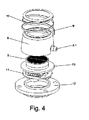
- the intelligent subcutaneous venous access port object of the present invention and shown in detail in Figures 3 , 4 and 5 is made up of a casing (8) of biocompatible material, with body of revolution shape, generally frustoconical shaped, and the inside of which is arranged a reservoir (2) where a solution with the medicinal product to be administered to the patient is introduced therein.
- the casing (8) also has an outlet (3.1) for coupling the catheter (3).
- the reservoir (2) is isolated from the rest of the body by its upper part by means of a silicone membrane (6) or the like, the silicone is a material which allows the reservoir (2) to remain perfectly sealed once removing the needle (5).
- a biosensor (9) which is in direct contact with the fluid therein and which measures the physico-chemical parameters of said fluid.
- the intelligent subcutaneous port has wireless communications means for sending the parameters measured by the biosensor (9) to an external device.
- the wireless communications means are made up of a communications antenna (10) which is directly adapted in the casing (8) itself, this antenna (10) transmits the physico-chemical parameters of the fluid inside the reservoir (2) measured by the biosensor (9) towards an exterior receiver (not depicted).
- This solution is in no case limiting, another type of wireless communications means being able to exist; they can be bluetooth, infrared, etc.
- the intelligent subcutaneous venous access port has in its lower part an electronic and communications plate (11) which is isolated from the outside of the body (1) by means of a envelope (12), said electronic and communications plate (11) being linked to the biosensor (9) by means of a connection plate (13) which in turn isolates the plate (11) and from the fluid inside the reservoir (2).
- the casing (8) is coupled above the envelope (12), the biosensor (9) being completely isolated inside the reservoir (2), to thus enable analyzing the conditions of the inner fluid and to enable predicting the formation of bacterial biolayers.
- the biosensor (9) is an electric impedance sensor based on thin-film microelectrodes which are in direct contact with the fluid inside the reservoir (2).
- a bacterial biolayer starts to form, this biolayer is formed on the inner surfaces of the reservoir (2) and therefore directly on the interdigitated microelectrodes of the biosensor (9), such that a change in the electric impedance which the biosensor (9) is monitoring, is sign that a bacterial biolayer is being formed inside the reservoir (2).
- a variable electric power is introduced at different frequencies and the electric current circulating through the interdigitated microelectrodes is measured.
- the opposition to the passage of current is very sensitive to the variations of the matter adhered to the surface of the biosensor (9), therefore, as soon as a small amount of matter is deposited on the interdigitated electrodes, a change in the electric impedance is produced which is sign of the formation of a bacterial biolayer.
- the formation of the biolayer can be treated before an infection is produced in the patient.
- the biosensor (9) is a multiparameter sensor which besides measuring the electric impedance for detecting the bacterial biolayer, monitors other physico-chemical parameters of the fluid inside the reservoir (2) wherein that bacterial biolayer is being formed, the parameters can be, such as the PH, the temperature, the amount of oxygen, carbon dioxide, electric charge, among others.
- the parameters can be, such as the PH, the temperature, the amount of oxygen, carbon dioxide, electric charge, among others.
- the communications antenna (10) is adapted to the shape of the casing (8) of the port and is devised for establishing the communications of the latter with a transmitter/receiver having a reading interface outside the human body.
- the communications antenna (10) can function in several frequency bands at the same time, it preferably functions in the 400.150-406.000 MHz bands ("MedRadio Service”) of the active medical ports, and the 2.4 GHz band (ISM "Industrial, Scientific and Medical"), however with the same typology of antenna it can communicate in other frequency bands.
- both the casing (8) and the reservoir (2) are manufactured with non-metal materials such that they do not affect the transmission efficiency of the antenna (10).
- the communications antenna (10) is made up of at least one interconnection path (10.1) adapted to the casing (8) of the port partially covering its surface. Additionally, in order to improve the radiation, the communications antenna (10) can have an upper metal ring (10.2) contiguous to the upper end of the interconnection path (10.1).
- the upper metal ring (10.2) coincides with the upper opening defined in the casing (8) and it must have a width sufficient for leaving a free space in its center and thus enabling the insertion of the needle (5) administrating the medicinal product.
- the case of which the communications antenna (10) is only formed by the upper metal ring (10.2) can also be a possibility.
- the communications antenna (10) has the possibility of having a metal base (10.3) by way of ground plane in the lower part of the casing (8).
- the communications antenna (10) is adapted to the outer surface of the casing (8) of the port, but nevertheless it can also go through the inside of the casing (8), or be embedded in the casing (8) itself without significantly altering the characteristics of the communications. It is evident that the casing (8) and the reservoir (2) can be made up of a single piece without it altering the concept of the invention. In this case the communications antenna (10) can be adapted to the outside of that single piece, or embedded therein, but it could not be adapted to the inside of that piece, since in that case the antenna (10) would be in contact with the inner fluid.
- the communications antenna (10) can adopt different configurations.
- the interconnection paths (10.1) which are adapted to the shape of the casing (8) can be straight sections ( Figures 6.1, 6.2, 6.5 and 6.6 ), semilunar sections ( Figure 6.2 and 6.5 ), sinusoidal section ( Figure 6.3 ), or meandering section ( figure 6.4 ). It has also been provided that, to assure a good communications of the port within the pre-established frequency bands, the interconnection path (10.1) of the communications antenna (10) has a width between 100 microns and 10 millimeters, this is achieved in all the cases with the exception of the semilunar shape.
- the upper metal ring (10.2) can have different configurations, being able to be continuous, discontinuous, of constant width or variable width.
- the interconnection path (10.1) can end in an open circuit or it can end in a short circuit with the metal base (10.3).
- the possibility of having a wide variety of interconnection paths (10.1) adapted to casing (8) of the port can be observed.
- a single power point on the interconnection paths (10.1) or the upper metal ring (10.2), or several strategically distributed power points can be used.
Landscapes
- Health & Medical Sciences (AREA)
- Heart & Thoracic Surgery (AREA)
- Pulmonology (AREA)
- Engineering & Computer Science (AREA)
- Anesthesiology (AREA)
- Biomedical Technology (AREA)
- Hematology (AREA)
- Life Sciences & Earth Sciences (AREA)
- Animal Behavior & Ethology (AREA)
- General Health & Medical Sciences (AREA)
- Public Health (AREA)
- Veterinary Medicine (AREA)
- Measurement Of The Respiration, Hearing Ability, Form, And Blood Characteristics Of Living Organisms (AREA)
Priority Applications (1)
| Application Number | Priority Date | Filing Date | Title |
|---|---|---|---|
| EP11380064A EP2554213A1 (de) | 2011-08-01 | 2011-08-01 | Intelligenter subkutaner Venenport und Verfahren zur Erkennung eines Biolayers |
Applications Claiming Priority (1)
| Application Number | Priority Date | Filing Date | Title |
|---|---|---|---|
| EP11380064A EP2554213A1 (de) | 2011-08-01 | 2011-08-01 | Intelligenter subkutaner Venenport und Verfahren zur Erkennung eines Biolayers |
Publications (1)
| Publication Number | Publication Date |
|---|---|
| EP2554213A1 true EP2554213A1 (de) | 2013-02-06 |
Family
ID=44947004
Family Applications (1)
| Application Number | Title | Priority Date | Filing Date |
|---|---|---|---|
| EP11380064A Withdrawn EP2554213A1 (de) | 2011-08-01 | 2011-08-01 | Intelligenter subkutaner Venenport und Verfahren zur Erkennung eines Biolayers |
Country Status (1)
| Country | Link |
|---|---|
| EP (1) | EP2554213A1 (de) |
Cited By (7)
| Publication number | Priority date | Publication date | Assignee | Title |
|---|---|---|---|---|
| WO2015097255A3 (en) * | 2013-12-23 | 2015-08-27 | Eric Chevalier | A versatile vascular access device |
| WO2016113440A1 (es) * | 2015-01-12 | 2016-07-21 | Centro De Estudios E Investigaciones Tecnicas (Ceit) | Prótesis ortopédica para reemplazo de cadera o rodilla |
| EP3727558A4 (de) * | 2017-12-21 | 2022-01-19 | Versago Vascular Access, Inc. | Medizinische zugangsports, transfervorrichtungen und verfahren zur verwendung davon |
| US11628261B2 (en) | 2014-04-03 | 2023-04-18 | Primo Medical Group, Inc. | Devices and methods for installation and removal of a needle tip of a needle |
| US11724081B2 (en) | 2014-12-18 | 2023-08-15 | Versago Vascular Access, Inc. | Devices, systems and methods for removal and replacement of a catheter for an implanted access port |
| US11771880B2 (en) | 2019-07-17 | 2023-10-03 | Nxgenport, Llc | Implantable venous access port with remote physiological monitoring capabilities |
| US11918755B2 (en) | 2014-12-18 | 2024-03-05 | Versago Vascular Access, Inc. | Catheter patency systems and methods |
Citations (9)
| Publication number | Priority date | Publication date | Assignee | Title |
|---|---|---|---|---|
| US4802885A (en) | 1986-06-17 | 1989-02-07 | Medical Engineering Corporation | Self sealing subcutaneous infusion and withdrawal device |
| US5558641A (en) | 1994-01-24 | 1996-09-24 | Sims Deltec, Inc. | Hybrid portal and method |
| US5562618A (en) | 1994-01-21 | 1996-10-08 | Sims Deltec, Inc. | Portal assembly and catheter connector |
| US20010053535A1 (en) * | 2000-04-17 | 2001-12-20 | Purdue Research Foundation | Biosensor and related method |
| US7070591B2 (en) | 2002-09-17 | 2006-07-04 | Transoma Medical, Inc. | Vascular access port with physiological sensor |
| US20070078391A1 (en) * | 2005-09-30 | 2007-04-05 | Angiodynamics Inc. | Implantable medical device |
| WO2008008845A2 (en) * | 2006-07-11 | 2008-01-17 | Microchips, Inc. | Multi-reservoir pump device for dialysis, biosensing, or delivery of substances |
| US20080262374A1 (en) * | 2007-04-19 | 2008-10-23 | Medtronic, Inc. | Event triggered infection monitoring |
| US20080306454A1 (en) * | 2007-06-06 | 2008-12-11 | Sikora Christopher F | Apparatus And Method For Sterilization Of An Intravenous Catheter |
-
2011
- 2011-08-01 EP EP11380064A patent/EP2554213A1/de not_active Withdrawn
Patent Citations (12)
| Publication number | Priority date | Publication date | Assignee | Title |
|---|---|---|---|---|
| US4802885A (en) | 1986-06-17 | 1989-02-07 | Medical Engineering Corporation | Self sealing subcutaneous infusion and withdrawal device |
| US5562618A (en) | 1994-01-21 | 1996-10-08 | Sims Deltec, Inc. | Portal assembly and catheter connector |
| US5613945A (en) | 1994-01-21 | 1997-03-25 | Sims Deltec, Inc. | Portal assembly |
| US5743873A (en) | 1994-01-21 | 1998-04-28 | Sims Deltec, Inc. | Methods for using catheter connectors and portals, and methods of assembly |
| US5558641A (en) | 1994-01-24 | 1996-09-24 | Sims Deltec, Inc. | Hybrid portal and method |
| US20010053535A1 (en) * | 2000-04-17 | 2001-12-20 | Purdue Research Foundation | Biosensor and related method |
| US7070591B2 (en) | 2002-09-17 | 2006-07-04 | Transoma Medical, Inc. | Vascular access port with physiological sensor |
| US20070049806A1 (en) * | 2002-09-17 | 2007-03-01 | Transoma Medical, Inc. | Vascular access port with physiological sensor |
| US20070078391A1 (en) * | 2005-09-30 | 2007-04-05 | Angiodynamics Inc. | Implantable medical device |
| WO2008008845A2 (en) * | 2006-07-11 | 2008-01-17 | Microchips, Inc. | Multi-reservoir pump device for dialysis, biosensing, or delivery of substances |
| US20080262374A1 (en) * | 2007-04-19 | 2008-10-23 | Medtronic, Inc. | Event triggered infection monitoring |
| US20080306454A1 (en) * | 2007-06-06 | 2008-12-11 | Sikora Christopher F | Apparatus And Method For Sterilization Of An Intravenous Catheter |
Cited By (7)
| Publication number | Priority date | Publication date | Assignee | Title |
|---|---|---|---|---|
| WO2015097255A3 (en) * | 2013-12-23 | 2015-08-27 | Eric Chevalier | A versatile vascular access device |
| US11628261B2 (en) | 2014-04-03 | 2023-04-18 | Primo Medical Group, Inc. | Devices and methods for installation and removal of a needle tip of a needle |
| US11724081B2 (en) | 2014-12-18 | 2023-08-15 | Versago Vascular Access, Inc. | Devices, systems and methods for removal and replacement of a catheter for an implanted access port |
| US11918755B2 (en) | 2014-12-18 | 2024-03-05 | Versago Vascular Access, Inc. | Catheter patency systems and methods |
| WO2016113440A1 (es) * | 2015-01-12 | 2016-07-21 | Centro De Estudios E Investigaciones Tecnicas (Ceit) | Prótesis ortopédica para reemplazo de cadera o rodilla |
| EP3727558A4 (de) * | 2017-12-21 | 2022-01-19 | Versago Vascular Access, Inc. | Medizinische zugangsports, transfervorrichtungen und verfahren zur verwendung davon |
| US11771880B2 (en) | 2019-07-17 | 2023-10-03 | Nxgenport, Llc | Implantable venous access port with remote physiological monitoring capabilities |
Similar Documents
| Publication | Publication Date | Title |
|---|---|---|
| EP2554213A1 (de) | Intelligenter subkutaner Venenport und Verfahren zur Erkennung eines Biolayers | |
| EP3723608B1 (de) | Sensorüberwachungssystem für verweilkatheterbasierte behandlungen | |
| EP1229825B1 (de) | Gewebekontaktvorrichtung | |
| US20250170380A1 (en) | Wireless charging, localization, and data communication for implantable vascular access devices | |
| US9314631B2 (en) | Tongue sensors for monitoring multiple physiological parameters and tongue stimulation | |
| JP4383879B2 (ja) | 生体監視及び治療化合物供給用のゲートウェイプラットフォーム | |
| CA2498351C (en) | Implantable sensor method and system | |
| CN102307517B (zh) | 紧凑型在体生理监测装置及其方法 | |
| WO2015097255A2 (en) | A versatile vascular access device | |
| WO2019238180A1 (en) | Moisture assessment system and method for wound care | |
| CN106061378B (zh) | 健康监测系统 | |
| WO2018148487A1 (en) | Surgical drain system and container | |
| US20140303455A1 (en) | Multipurpose cerebrospinal fluid sensor assembly and method of operation of the same | |
| RU2753720C2 (ru) | Устройство для наблюдения, зонд для исследования и система наблюдения | |
| CN113939222A (zh) | 用于监测患者健康的血管接入设备 | |
| KR102173496B1 (ko) | 제조공정이 단순화된 최소 침습형 니들 기반 바이오센서 및 그 제조방법 | |
| TW201526867A (zh) | 植入式生物感測器 | |
| US20230355118A1 (en) | System and method for monitoring physiological parameters based on cerebrospinal fluid pressures taken at two or more locations | |
| CN223438870U (zh) | 一种带传感器的多功能胃肠营养管 | |
| CN106667437B (zh) | 一种预测植入式医疗设备手术后并发症的系统 | |
| EP1765063A1 (de) | Bolus, verfahren und system zur verfolgung des gesundheitszustands von wiederkäuern | |
| AU2012203630A1 (en) | Gateway platform for biological monitoring and delivery of therapeutic compounds | |
| Lymberis | Converging Micro-Nano-Bio-Information & Communication Technologies Towards Integrated Systems: the Contribution of the EU Information Society Technologies Program |
Legal Events
| Date | Code | Title | Description |
|---|---|---|---|
| PUAI | Public reference made under article 153(3) epc to a published international application that has entered the european phase |
Free format text: ORIGINAL CODE: 0009012 |
|
| AK | Designated contracting states |
Kind code of ref document: A1 Designated state(s): AL AT BE BG CH CY CZ DE DK EE ES FI FR GB GR HR HU IE IS IT LI LT LU LV MC MK MT NL NO PL PT RO RS SE SI SK SM TR |
|
| AX | Request for extension of the european patent |
Extension state: BA ME |
|
| STAA | Information on the status of an ep patent application or granted ep patent |
Free format text: STATUS: THE APPLICATION IS DEEMED TO BE WITHDRAWN |
|
| 18D | Application deemed to be withdrawn |
Effective date: 20130807 |