EP2554254A2 - Verfahren zur herstellung eines mischkatalysator mit einem metalloxid-nanodraht sowie elektrode und brennstoffzelle mit einem auf diese weise hergestellten mischkatalysator - Google Patents
Verfahren zur herstellung eines mischkatalysator mit einem metalloxid-nanodraht sowie elektrode und brennstoffzelle mit einem auf diese weise hergestellten mischkatalysator Download PDFInfo
- Publication number
- EP2554254A2 EP2554254A2 EP10849079A EP10849079A EP2554254A2 EP 2554254 A2 EP2554254 A2 EP 2554254A2 EP 10849079 A EP10849079 A EP 10849079A EP 10849079 A EP10849079 A EP 10849079A EP 2554254 A2 EP2554254 A2 EP 2554254A2
- Authority
- EP
- European Patent Office
- Prior art keywords
- metal
- electrode
- nanowire
- oxide nanowire
- metal oxide
- Prior art date
- Legal status (The legal status is an assumption and is not a legal conclusion. Google has not performed a legal analysis and makes no representation as to the accuracy of the status listed.)
- Withdrawn
Links
Images






Classifications
-
- H—ELECTRICITY
- H01—ELECTRIC ELEMENTS
- H01M—PROCESSES OR MEANS, e.g. BATTERIES, FOR THE DIRECT CONVERSION OF CHEMICAL ENERGY INTO ELECTRICAL ENERGY
- H01M4/00—Electrodes
- H01M4/86—Inert electrodes with catalytic activity, e.g. for fuel cells
- H01M4/8647—Inert electrodes with catalytic activity, e.g. for fuel cells consisting of more than one material, e.g. consisting of composites
- H01M4/8652—Inert electrodes with catalytic activity, e.g. for fuel cells consisting of more than one material, e.g. consisting of composites as mixture
-
- H—ELECTRICITY
- H01—ELECTRIC ELEMENTS
- H01M—PROCESSES OR MEANS, e.g. BATTERIES, FOR THE DIRECT CONVERSION OF CHEMICAL ENERGY INTO ELECTRICAL ENERGY
- H01M4/00—Electrodes
- H01M4/86—Inert electrodes with catalytic activity, e.g. for fuel cells
- H01M4/90—Selection of catalytic material
-
- H—ELECTRICITY
- H01—ELECTRIC ELEMENTS
- H01M—PROCESSES OR MEANS, e.g. BATTERIES, FOR THE DIRECT CONVERSION OF CHEMICAL ENERGY INTO ELECTRICAL ENERGY
- H01M4/00—Electrodes
- H01M4/86—Inert electrodes with catalytic activity, e.g. for fuel cells
- H01M4/90—Selection of catalytic material
- H01M4/92—Metals of platinum group
-
- H—ELECTRICITY
- H01—ELECTRIC ELEMENTS
- H01M—PROCESSES OR MEANS, e.g. BATTERIES, FOR THE DIRECT CONVERSION OF CHEMICAL ENERGY INTO ELECTRICAL ENERGY
- H01M8/00—Fuel cells; Manufacture thereof
- H01M8/10—Fuel cells with solid electrolytes
- H01M2008/1095—Fuel cells with polymeric electrolytes
-
- H—ELECTRICITY
- H01—ELECTRIC ELEMENTS
- H01M—PROCESSES OR MEANS, e.g. BATTERIES, FOR THE DIRECT CONVERSION OF CHEMICAL ENERGY INTO ELECTRICAL ENERGY
- H01M4/00—Electrodes
- H01M4/86—Inert electrodes with catalytic activity, e.g. for fuel cells
- H01M4/90—Selection of catalytic material
- H01M4/92—Metals of platinum group
- H01M4/921—Alloys or mixtures with metallic elements
-
- Y—GENERAL TAGGING OF NEW TECHNOLOGICAL DEVELOPMENTS; GENERAL TAGGING OF CROSS-SECTIONAL TECHNOLOGIES SPANNING OVER SEVERAL SECTIONS OF THE IPC; TECHNICAL SUBJECTS COVERED BY FORMER USPC CROSS-REFERENCE ART COLLECTIONS [XRACs] AND DIGESTS
- Y02—TECHNOLOGIES OR APPLICATIONS FOR MITIGATION OR ADAPTATION AGAINST CLIMATE CHANGE
- Y02E—REDUCTION OF GREENHOUSE GAS [GHG] EMISSIONS, RELATED TO ENERGY GENERATION, TRANSMISSION OR DISTRIBUTION
- Y02E60/00—Enabling technologies; Technologies with a potential or indirect contribution to GHG emissions mitigation
- Y02E60/30—Hydrogen technology
- Y02E60/50—Fuel cells
Definitions
- the present invention relates a catalyst preparation method and application of the prepared catalyst, and more particularly, to a method for manufacturing a mixed catalyst containing metal oxide nanowire and applications of the prepared catalyst to fuel cell electrodes and fuel cell systems.
- a fuel cell is an electrochemical cell that converts chemical energy produced by oxidation of fuel into electrical energy through electrochemical reaction. With merits of high energy density and environmental friendliness, fuel cells have attracted attention as a future energy storage medium.
- a fuel cell generally employs a supported catalyst, in which an active metal for the catalyst is supported on a porous carbon supporter, to increase an active area of the catalyst in a catalyst layer.
- a conventional supported catalyst is prepared in the form of particles and is connected via point contact, thereby causing increase in electrode resistance.
- the thickness of the catalyst layer increases, thereby causing resistance increase.
- the present invention is aimed at providing a method for manufacturing a mixed catalyst, which can enhance charge transport capabilities, activity and stability of the catalyst.
- the present invention is aimed at providing a fuel cell electrode and a fuel cell, which include a mixed catalyst exhibiting excellent properties.
- One aspect of the present invention provides a method for manufacturing a mixed catalyst containing a metal oxide nanowire.
- the method includes: preparing a polymer solution containing a first metal precursor and a second metal precursor; electrospinning the polymer solution to form a metal-polymer nanowire; heat treating the metal-polymer nanowire to form a metal oxide nanowire; and mixing the metal oxide nanowire with active metal nanoparticles.
- the metal of the second metal precursor is used as a dopant for the metal oxide nanowire.
- the first metal precursor may include at least one metal selected from Sn, Ti, Zn, Ni, Co, Mn, Nb, Mo, V, Cr, Fe, Ru, In, Al, Sb, Ta, and Eu.
- the second metal precursor may include at least one metal selected from Pt, Pd, Au, Ag, Rh, Os, Ir, Sn, Ti, Zn, Ni, Co, Mn, Nb, Mo, V, Cr, Fe, Ru, In, Al, Sb, Ta, and Eu.
- the active metal nanoparticles may include any one component selected from Pt, Au, Ag, Fe, Co, Ni, Ru, Os, Rh, Pd, Ir, W, Sn, Pd, Bi, and alloys thereof, and may be porous carbon nanoparticles supporting an active metal.
- a polymer of the polymer solution may be any one selected from polyvinyl pyrrolidone, polyvinyl butyral, polyvinyl acetate, polyacrylonitrile, polycarbonate, and mixtures thereof.
- the first metal precursor may be a tin (Sn) salt and the second metal precursor may be an antimony (Sb) salt.
- the electrode for fuel cells includes an electrode matrix and a catalyst layer formed on the electrode matrix, wherein the catalyst layer includes an active metal nanoparticle layer and a metal oxide nanowires inserted into the active metal nanoparticle layer.
- the metal oxide nanowire is prepared by doping with a heterogeneous metal.
- the electrode matrix may be any one selected from carbon paper, carbon cloth, and carbon felt.
- the metal oxide nanowire may include at least one selected from Sn, Ti, Zn, Ni, Co, Mn, Nb, Mo, V, Cr, Fe, Ru, In, Al, Sb, Ta, and Eu.
- the heterogeneous metal may include at least one selected from Pt, Pd, Au, Ag, Rh, Os, Ir, Sn, Ti, Zn, Ni, Co, Mn, Nb, Mo, V, Cr, Fe, Ru, In, Al, Sb, Ta, and Eu.
- the active metal nanoparticles may include any one component selected from Pt, Au, Ag, Fe, Co, Ni, Ru, Os, Rh, Pd, Ir, W, Sn, Pd, Bi, and alloys thereof, and may be porous carbon nanoparticles supporting an active metal.
- the metal oxide nanowire may be a tin oxide nanowire and the heterogeneous metal may be antimony.
- a further aspect of the present invention provides a fuel cell.
- the fuel cell includes an anode and a cathode facing each other, and an electrolyte interposed between the anode and the cathode.
- at least one of the anode and the cathode is the electrode for fuel cells as described above.
- a metal oxide nanowire may be prepared by a simple process based on electrospinning, and a mixed catalyst exhibiting excellent properties may be prepared simply by mixing the metal oxide nanowire with active metal nanoparticles.
- the metal oxide nanowire of the mixed catalyst has high charge transport capabilities and may increase catalyst activity while improving catalyst stability.
- Fig.1 is a flowchart of a method for manufacturing a mixed catalyst in accordance with one embodiment of the present invention.
- a polymer solution containing a first metal precursor and a second metal precursor is prepared (S10).
- the first metal precursor may include at least one metal selected from Sn, Ti, Zn, Ni, Co, Mn, Nb, Mo, V, Cr, Fe, Ru, In, Al, Sb, Ta, and Eu, without being limited thereto.
- the second metal precursor may include at least one metal selected from Pt, Pd, Au, Ag, Rh, Os, Ir, Sn, Ti, Zn, Ni, Co, Mn, Nb, Mo, V, Cr, Fe, Ru, In, Al, Sb, Ta, and Eu, without being limited thereto.
- each of the first metal precursor and the second metal precursor may be prepared in the form of a metal salt.
- the first metal precursor may be prepared in the form of a tin salt (for example, tin chloride such as SnCl 2 or SnCl 4 )
- the second metal precursor may be prepared in the form of an antimony salt (for example, antimony chloride such as SbCl 3 ).
- the polymer for the polymer solution may be any one selected from polyvinylpyrrolidone (PVP), polyvinyl butyral (PVB), polyvinyl acetate (PVA), polyacrylonitrile (PAN), polycarbonate (PC), and mixtures thereof, without being limited thereto.
- the solvent for the polymer solution may be a polar solvent selected from water, methanol, ethanol, acetone, N,N' -dimethylformamide (DMF), dimethylsulfoxide (DMSO), N-methylpyrrolidone(NMP), methylene chloride (CH 2 Cl 2 ), chloroform (CH 3 Cl), tetrahydrofuran (THF), or mixtures thereof.
- the polymer solution containing the first and second metal precursors may be prepared by mixing a methanol solution containing a tin salt as the first metal precursor and an antimony salt as the second metal precursor with a methanol solution containing PVP.
- a metal-polymer nanowire is prepared by electrospinning the polymer solution (S 12).
- an electrospinner 200 may include a syringe 210, a syringe pump 220, a high voltage generator 230, and a collector 240. Electrospinning may be carried out by ejecting the polymer solution (spinning solution) through the syringe 210 at a predetermined speed using the pump 220 while applying a predetermined voltage via the high voltage generator 230. As a result, metal-polymer nanowires having a diameter of a few to several hundred nanometers may be formed on the collector 240 of the electrospinner 200.
- the metal-polymer nanowires may be prepared to have various characteristics through combination of various conditions, such as the kinds of metal precursors and polymers used, the ratio of substances constituting the spinning solution, density and viscosity of the spinning solution, spinning conditions, and the like.
- the metal-polymer nanowires are subjected to heat treatment to form a metal oxide nanowire (S14).
- Heat treatment may be carried out under an air atmosphere, and temperature and time for heat treatment may be suitably selected in consideration of the melting points of the metals and the dissociation points of the polymers contained in the nanowire.
- the suitable temperature for heat treatment may be measured through, for example, differential scanning calorimetry (DSC). Since the polymer and impurities are removed from the metal-polymer nanowire through heat treatment, homogeneous metal oxide nanowires may be formed.
- the metal oxide nanowires are mixed with active metal nanoparticles (S16).
- the active metal nanoparticles may include any one component selected from Pt, Au, Ag, Fe, Co, Ni, Ru, Os, Rh, Pd, Ir, W, Sn, Pd, Bi, and mixtures thereof.
- the active metal nanoparticles may be comprised of porous carbon nanoparticles supporting an active metal.
- the active metal nanoparticles may be comprised of porous carbon nanoparticles supporting platinum. Mixing may be carried out by dispersing the metal oxide nanowires and the active metal nanoparticles in a solvent using a vortex mixer or sonication and stirring.
- Fig. 3 is a schematic view of an electrode for fuel cells in accordance with one embodiment of the present invention.
- an electrode for fuel cells 300 includes an electrode matrix 310 and a catalyst layer 320, which is placed on the electrode matrix 310 and includes an active metal nanoparticle layer 322 and metal oxide nanowires 324 inserted into the active metal nanoparticle layer 322.
- the metal oxide nanowires 324 are prepared by doping with a heterogeneous metal.
- the electrode matrix 310 serves not only as a supporter of the catalyst layer 320, but also as a current collector and a passage of reactants and products. Accordingly, the electrode matrix 310 is a porous supporter.
- the electrode matrix 310 may be carbon paper, carbon cloth, or carbon felt.
- the active metal nanoparticles of the active metal nanoparticle layer 322 may be comprised any one component selected from Pt, Au, Ag, Fe, Co, Ni, Ru, Os, Rh, Pd, Ir, W, Sn, Pd, Bi, and mixtures thereof.
- the active metal nanoparticles may be comprised of porous carbon nanoparticles supporting an active metal.
- the active metal nanoparticles may be comprised of porous carbon nanoparticles supporting platinum.
- the metal oxide nanowires 324 may be comprised of at least one metal selected from Sn, Ti, Zn, Ni, Co, Mn, Nb, Mo, V, Cr, Fe, Ru, In, Al, Sb, Ta, and Eu.
- the heterogeneous metal used as a dopant for the metal oxide nanowire may include at least one metal selected from Pt, Pd, Au, Ag, Rh, Os, Ir, Sn, Ti, Zn, Ni, Co, Mn, Nb, Mo, V, Cr, Fe, Ru, In, Al, Sb, Ta, and Eu.
- the metal oxide nanowires may be comprised of tin (Sn) oxide, and the heterogeneous metal may be antimony (Sb).
- the catalyst layer 320 may be formed using the mixed catalyst prepared by the method described with reference to Fig. 1 (and Fig. 2 ).
- the catalyst layer 320 may be formed by mixing the mixed catalyst prepared by the method according to the invention with an ionomer binder solution, followed by depositing and drying the mixture on the electrode matrix 310.
- the metal oxide nanowires 324 doped with a heterogeneous metal and having a high charge transport capability is dispersed in the active metal nanoparticle layer 322.
- the electrode 300 when used as an anode or a cathode of a fuel cell, it is possible to enhance transport capabilities of electrons generated by fuel oxidation or introduced through an external circuit.
- Fig. 4 is a schematic view of a fuel cell in accordance with one embodiment of the present invention.
- a fuel cell 400 includes an anode 410 and a cathode 420 facing each other, and an electrolyte 430 interposed between and the anode 410 and the cathode 420.
- at least one of the anode 410 and the cathode 420 is constituted by the electrode for fuel cells 300 described with reference to Fig. 3 .
- the electrolyte 430 may be an acid or alkali electrolyte, and the fuel cell 400 may employ hydrogen, methanol or ethanol as fuel.
- Formula 1 represents an electrochemical reaction when using an acid electrolyte and ethanol as fuel
- Formula 2 represents an electrochemical reaction when using an alkali electrolyte and hydrogen as fuel.
- a high voltage of about 9.5 kV was applied to the ejected fluid, whereby metal-polymer nanowires containing a mixture of antimony, tin and PVP were collected by a collector.
- the collected metal-polymer nanowires having a diameter of about 300 nm were heat treated (burnt) at 600 °C for 5 hours in an air atmosphere, thereby preparing ATO nanowires, from which the polymer was removed.
- the prepared ATO nanowires and Pt/C (20 wt%) each were suitably dispersed in 1 ml of deionized water (DI water).
- DI water deionized water
- the dispersing solutions was mixed with each other such that the weight ratio of ATO nanowires to Pt became 0.5:1, followed by mixing for 6 hours or more using a vortex mixer, thereby preparing a catalyst ink.
- the catalyst ink was mixed with a National solution as a binder such that the weight ratio of Pt to Nafion became 9:1, followed by stirring for 3 hours or more and sonication.
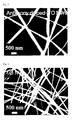
- Figs. 5 and 6 are SEM images of nanowires prepared in Preparative Example 1 and Comparative Example 1.
- the ATO nanowires had a diameter of about 100 nm and the TO nanowires (Comparative Example 1) had a diameter of about 50 nm.
- the diameter of the nanowires after burning was decreased below the diameter of the nanowires (not shown) before burning, and this phenomenon means that the polymer (PVP) was removed from the nanowires through burning.
- Figs. 7 and 8 are TEM images of the nanowires prepared in Preparative Example 1 and Comparative Example 1.
- the TO nanowires (Comparative Example 1) have a morphology with poor porosity, whereas the ATO nanowires (Preparative Example 1) have a good morphology with higher density and packing state by doping with antimony (Sb). Such improvement of the morphology may contribute to enhancement of charge transport capabilities.
- Fig. 9 is an XRD patter of the nanowires prepared in Preparative Example 1 and Comparative Example 1.
- the ATO nanowires (Preparative Example 1) and the TO nanowires (Comparative Example 1) exhibited similar X-ray diffraction patterns, and thus it could be seen that the ATP nanowires prepared in Preparative Example 1 contain antimony in a stably doped state into the tin oxide without phase separation.
- Fig. 10 is a current-voltage curve of the nanowires prepared in Preparative Example 1 and Comparative Example 1.
- Figs. 11 and 12 are SEM images of an electrode catalyst layer prepared with the ATO nanowire-Pt/C mixed catalyst ink.
- the ATO nanowires and the Pt/C were very uniformly mixed.
- the length of the ATO nanowires can be shortened below the length of the initially prepared ATO nanowires.
- the catalyst ink was prepared by the same method as in Preparative Example 1 except that the dispersing solutions of the ATO nanowires and Pt/C were mixed with each other such that the weight ratio of ATO nanowire:Pt became 1:1.
- the catalyst ink was prepared by the same method as in Preparative Example 1 except that the dispersing solutions of the ATO nanowires and Pt/C were mixed with each other such that the weight ratio of ATO nanowire:Pt became 2:1.
- the catalyst ink was prepared by the same method as in Preparative Example I except that the dispersing solutions of the ATO nanowires and Pt/C was mixed with each other such that the weight ratio of ATO nanowire:Pt became 4:1.
- Pt/C (20 wt%) was suitably dispersed in 2 ml of deionized water, thereby preparing a Pt/C catalyst ink.
- the catalyst ink was mixed with a Nafion solution as a binder such that the weight ratio of Pt to Nation became 9:1, followed by stirring and sonication.
- the ATO nanowires prepared in Preparative Example 1 were suitably dispersed in 2 ml of deionized water, thereby preparing an ATO nanowire catalyst ink.
- the catalyst ink was mixed with a Nafion solution as a binder such that the weight ratio of ATO nanowire to Nafion became 9:1, followed by stirring and sonication.
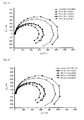
- Impedance analysis was carried out using a three-electrode cell, and one of the catalyst inks prepared in Preparative Examples 1 to 4 and Comparative Example 2 was deposited and dried on a working electrode, followed by analysis. Drying was carried out at 70°C for 1 hour.
- the electrolyte was prepared by mixing potassium hydroxide (alkali atmosphere) or sulfuric acid (acid atmosphere) with ethanol or methanol in deionized water, and impedance was measured in a constant potential of -0.3V vs. SCE (alkali atmosphere) or 0.4V vs. Ag/AgCl (acid atmosphere).
- the three-electrode cell employed a saturated calomel electrode (SCE) or an Ag/AgCl electrode as a reference electrode, a platinum wire as a counter electrode, and a glassy carbon having an area of 0.07 cm 2 as a working electrode.
- the working electrode was treated to contain platinum (Pt) in an amount of 25 ⁇ g/cm 2 to minimize influence of the Pt catalyst.
- Cyclic voltammetry analysis was carried out using a three-electrode cell, and one of the catalyst inks prepared in Preparative Examples 1 to 4 and Comparative Examples 2 and 3 was deposited and dried on a working electrode, followed by analysis. Drying was carried out at 70 °C for 1 hour.
- the electrolyte was prepared by mixing potassium hydroxide (alkali atmosphere) or sulfuric acid (acid atmosphere) with ethanol or methanol in deionized water, and scanning was carried out in a potential range of -0.8 ⁇ 0.2V vs. SCE at a constant rate of 50 mV/s.
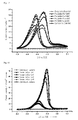
- Figs. 17 and 18 are cyclic voltammetry graphs according to oxidation of ethanol ( Fig. 17 ) and methanol ( Fig. 18 ) of an ATO nanowire-Pt/C mixed catalyst in an alkali atmosphere.
- the ATO nanowire-Pt/C mixed catalysts (Preparative Examples 1 to 4) had a maximum current density about 80% higher upon ethanol oxidation, and a maximum current density 50% higher upon methanol oxidation than those of the mono Pt/C catalyst (Comparative Example 2).
- the ATO nanowire-Pt/C mixed catalysts had superior alcohol oxidation activity to the mono Pt/C catalyst.
- activity increase of the ATO nanowire-Pt/C mixed catalysts resulted from high charge transport capabilities of the ATO nanowires.
- the current density increase in the sequence from Preparative Example 1 to 4 and this phenomenon means that activity of the electrode catalyst also increased with increasing amount of the ATO nanowires, which resulted in improved charge transport capabilities.
- cyclic voltammetry was measured by the same method without containing alcohol (ethanol or methanol) in the electrolyte.
- Fig. 19 is a cyclic voltammetry graph for measuring hydrogen adsorption/desorption capability of an ATO nanowire-Pt/C mixed catalyst in an alkali atmosphere.
- Table 1 shows the quantity of electric charges calculated from the cyclic voltammetry graph of Fig. 11 .
- Table 1 Catalyst Q hydrogen desorption (mC/cm 2 ) Q hydrogen adsorption (mC/cm 2 ) Q Average (mC/cm 2 ) Q average for Comparative Example 2 (%) Comparative Example 2 0.342 0.265 0.304 100 Preparative Example 1 0.984 0.337 0.366 120.4 Preparative Example 2 0.433 0.475 0.454 149.3 Preparative Example 3 0.422 0.479 0.451 148.4 Preparative Example 4 0.479 0.541 0.510 167.7 Comparative Example 3 - 0.04 - -
- Electrostatic analysis was carried out using a three-electrode cell, and one of the catalyst inks prepared in Preparative Examples 3 and 4 and Comparative Example 2 was deposited and dried on a working electrode, followed by analysis. Drying was carried out at 70°C for 1 hour.
- the electrolyte was prepared by mixing potassium hydroxide (alkali atmosphere) or sulfuric acid (acid atmosphere) with ethanol or methanol in deionized water, and scanning was carried out at a constant potential of -0.3V vs. SCE for 3600 seconds.
- Figs. 20 and 21 are electrostatic graphs according to oxidation of ethanol ( Fig. 20 ) and methanol ( Fig. 21 ) of an ATO nanowire-Pt/C mixed catalyst in an alkali atmosphere.
- electrospinning device 210 syringe 220: syringe pump 230: high voltage generator 240: collector 300: fuel cell electrode 310: electrode matrix 320: catalyst layer 322: active metal nanoparticle layer 324: metal oxide nanowire 400: fuel cell 410: anode 420: cathode 430: electrolyte 440: external circuit
Landscapes
- Chemical & Material Sciences (AREA)
- Chemical Kinetics & Catalysis (AREA)
- Electrochemistry (AREA)
- General Chemical & Material Sciences (AREA)
- Engineering & Computer Science (AREA)
- Materials Engineering (AREA)
- Composite Materials (AREA)
- Catalysts (AREA)
- Inert Electrodes (AREA)
Applications Claiming Priority (2)
| Application Number | Priority Date | Filing Date | Title |
|---|---|---|---|
| KR1020100029038A KR101113311B1 (ko) | 2010-03-31 | 2010-03-31 | 금속 산화물 나노선을 함유하는 혼합 촉매 제조방법, 이에 의해 제조된 혼합 촉매를 포함하는 전극 및 연료전지 |
| PCT/KR2010/008923 WO2011122757A2 (ko) | 2010-03-31 | 2010-12-14 | 금속 산화물 나노선을 함유하는 혼합 촉매 제조방법, 이에 의해 제조된 혼합 촉매를 포함하는 전극 및 연료전지 |
Publications (2)
| Publication Number | Publication Date |
|---|---|
| EP2554254A2 true EP2554254A2 (de) | 2013-02-06 |
| EP2554254A4 EP2554254A4 (de) | 2015-06-24 |
Family
ID=44720402
Family Applications (1)
| Application Number | Title | Priority Date | Filing Date |
|---|---|---|---|
| EP10849079.8A Withdrawn EP2554254A4 (de) | 2010-03-31 | 2010-12-14 | Verfahren zur herstellung eines mischkatalysator mit einem metalloxid-nanodraht sowie elektrode und brennstoffzelle mit einem auf diese weise hergestellten mischkatalysator |
Country Status (5)
| Country | Link |
|---|---|
| US (1) | US20130017473A1 (de) |
| EP (1) | EP2554254A4 (de) |
| JP (1) | JP5624207B2 (de) |
| KR (1) | KR101113311B1 (de) |
| WO (1) | WO2011122757A2 (de) |
Cited By (1)
| Publication number | Priority date | Publication date | Assignee | Title |
|---|---|---|---|---|
| CN104617314A (zh) * | 2013-11-04 | 2015-05-13 | 中国科学院大连化学物理研究所 | 一种燃料电池催化剂Pt/ATO及其制备和应用 |
Families Citing this family (16)
| Publication number | Priority date | Publication date | Assignee | Title |
|---|---|---|---|---|
| EP2850129A1 (de) | 2012-05-16 | 2015-03-25 | SABIC Innovative Plastics IP B.V. | Zusammensetzungen und artikel mit verzweigtem polycarbonat |
| CA2962426A1 (en) * | 2014-09-24 | 2016-03-31 | Vanderbilt Universtiy | Polymer solution, fiber mat, and nanofiber membrane-electrode-assembly therewith, and method of fabricating same |
| JP2016067964A (ja) * | 2014-09-26 | 2016-05-09 | 国立大学法人京都大学 | 酸化触媒組成物、およびこれを用いた燃料電池 |
| US9871256B2 (en) | 2015-02-04 | 2018-01-16 | Nissan North America, Inc. | Fuel cell electrode having non-ionomer proton-conducting material |
| US9698428B2 (en) | 2015-02-04 | 2017-07-04 | Nissan North America, Inc. | Catalyst support particle structures |
| US10829605B2 (en) | 2015-07-02 | 2020-11-10 | Sabic Global Technologies B.V. | Process and material for growth of adsorbed compound via nanoscale-controlled resistive heating and uses thereof |
| US10683404B2 (en) | 2015-11-17 | 2020-06-16 | Sabic Global Technologies B.V. | Porous polymer nanocomposites with ordered and tunable crystalline and amorphous phase domains |
| KR101899540B1 (ko) | 2017-03-06 | 2018-09-17 | 한국과학기술연구원 | 식물체를 이용한 다공성 탄소 지지체에 담지된 금속촉매의 제조방법 |
| US11515552B2 (en) * | 2018-03-22 | 2022-11-29 | Kabushiki Kaisha Toshiba | Catalyst laminate, membrane electrode assembly, electrochemical cell, stack, water electrolyzer, and hydrogen utilizing system |
| WO2020111710A1 (ko) * | 2018-11-26 | 2020-06-04 | 고려대학교 산학협력단 | 전기화학적 수처리용 전극소재 및 그 제조방법 |
| KR20200134021A (ko) | 2019-05-21 | 2020-12-01 | 한국과학기술원 | 정렬된 안티몬이 도핑된 산화주석 나노선의 제조방법 및 안티몬이 도핑된 산화주석 3차원 나노 구조체의 제조방법 |
| CN110433804B (zh) * | 2019-08-14 | 2022-01-25 | 哈尔滨工业大学 | 一种基于静电纺丝制备掺杂氧化银的氧化锰纳米线网络的方法及其在催化分解甲醛中的应用 |
| CN113707895B (zh) * | 2021-08-26 | 2022-09-16 | 浙江大学 | 具有丰富界面活性位点的异质结构催化剂的制备方法和应用 |
| CN116037954B (zh) * | 2023-03-30 | 2023-07-14 | 中国科学技术大学 | 一种金铱核壳纳米线及其制备方法 |
| KR20240170101A (ko) | 2023-05-26 | 2024-12-03 | 현대자동차주식회사 | 연료전지 촉매 전극 제조방법 및 이로부터 제조된 연료전지 촉매 전극 |
| CN118888765B (zh) * | 2024-07-08 | 2025-09-09 | 南通大学 | 一种稀土金属氧化物耦合的钌基催化剂及其制备方法与应用 |
Family Cites Families (18)
| Publication number | Priority date | Publication date | Assignee | Title |
|---|---|---|---|---|
| AU2005314211B2 (en) * | 2004-12-09 | 2010-07-08 | Oned Material, Inc. | Nanowire-based membrane electrode assemblies for fuel cells |
| JP4940421B2 (ja) * | 2005-01-17 | 2012-05-30 | 国立大学法人東京工業大学 | 酸化物複合材料、その製造方法、電気化学デバイス、および酸化物複合材料を含む触媒 |
| JP2007073291A (ja) * | 2005-09-06 | 2007-03-22 | Toyota Motor Corp | 燃料電池用電極触媒粒子及びこれを用いた燃料電池 |
| JP2007319839A (ja) * | 2006-06-05 | 2007-12-13 | Mitsubishi Chemicals Corp | 繊維状金属酸化物触媒 |
| JP2008038314A (ja) * | 2006-08-10 | 2008-02-21 | Teijin Ltd | チタニア繊維およびチタニア繊維の製造方法 |
| JP2008057072A (ja) * | 2006-08-31 | 2008-03-13 | Teijin Ltd | 希土類金属元素含有結晶性金属酸化物繊維およびその製造方法 |
| KR20090049094A (ko) * | 2006-09-06 | 2009-05-15 | 코닝 인코포레이티드 | 나노섬유, 나노필름, 및 이들의 제조/사용 방법 |
| KR100868290B1 (ko) * | 2007-05-04 | 2008-11-12 | 한국과학기술연구원 | 나노파이버 네트워크 구조의 음극 활물질을 구비한이차전지용 음극 및 이를 이용한 이차전지와, 이차전지용음극 활물질의 제조방법 |
| JP2009099486A (ja) * | 2007-10-19 | 2009-05-07 | Mitsubishi Electric Corp | 燃料電池用触媒担持粉体、その製造方法及びそれを含有する燃料電池用触媒層 |
| KR101363797B1 (ko) * | 2007-11-09 | 2014-02-14 | 고쿠리쓰다이가쿠호진 규슈다이가쿠 | 연료전지용 전극재료의 제조방법, 연료전지용 전극재료 및 이 연료전지 전극재료를 이용한 연료전지 |
| JP5360793B2 (ja) * | 2008-02-19 | 2013-12-04 | 独立行政法人産業技術総合研究所 | 機能性セラミックス繊維 |
| JP5105075B2 (ja) * | 2008-03-27 | 2012-12-19 | 国立大学法人広島大学 | 無機繊維シートの製造方法 |
| CZ2008277A3 (cs) * | 2008-05-06 | 2009-11-18 | Elmarco S.R.O. | Zpusob výroby anorganických nanovláken elektrostatickým zvláknováním |
| WO2009137110A1 (en) * | 2008-05-09 | 2009-11-12 | Gary Lee Carson | Treatment of internal combustion engine exhaust using immobilized ceramic fiber materials |
| KR20100005507A (ko) * | 2008-07-07 | 2010-01-15 | 광주과학기술원 | 전극촉매, 막-전극 접합체 및 이의 제조방법 |
| KR20100011644A (ko) * | 2008-07-25 | 2010-02-03 | 주식회사 아모메디 | 탄소나노섬유웹을 이용하여 촉매층과 가스확산층을일체화시킨 연료전지 전극, 그의 제조방법, 및 그를 사용한연료전지 |
| US20100028674A1 (en) * | 2008-07-31 | 2010-02-04 | Fredrick O Ochanda | Nanofibers And Methods For Making The Same |
| KR101144980B1 (ko) * | 2008-08-07 | 2012-05-11 | 인하대학교 산학협력단 | 금속나노입자함유 1차원 나노구조물의 제조방법, 그제조방법으로 제조된 금속나노입자함유 1차원 나노구조물,상기 1차원나노구조물을 포함하는 광촉매 |
-
2010
- 2010-03-31 KR KR1020100029038A patent/KR101113311B1/ko not_active Expired - Fee Related
- 2010-12-14 US US13/638,373 patent/US20130017473A1/en not_active Abandoned
- 2010-12-14 EP EP10849079.8A patent/EP2554254A4/de not_active Withdrawn
- 2010-12-14 JP JP2013502445A patent/JP5624207B2/ja not_active Expired - Fee Related
- 2010-12-14 WO PCT/KR2010/008923 patent/WO2011122757A2/ko not_active Ceased
Non-Patent Citations (1)
| Title |
|---|
| See references of WO2011122757A2 * |
Cited By (1)
| Publication number | Priority date | Publication date | Assignee | Title |
|---|---|---|---|---|
| CN104617314A (zh) * | 2013-11-04 | 2015-05-13 | 中国科学院大连化学物理研究所 | 一种燃料电池催化剂Pt/ATO及其制备和应用 |
Also Published As
| Publication number | Publication date |
|---|---|
| KR20110109350A (ko) | 2011-10-06 |
| WO2011122757A2 (ko) | 2011-10-06 |
| EP2554254A4 (de) | 2015-06-24 |
| JP2013525090A (ja) | 2013-06-20 |
| US20130017473A1 (en) | 2013-01-17 |
| KR101113311B1 (ko) | 2012-03-13 |
| JP5624207B2 (ja) | 2014-11-12 |
| WO2011122757A3 (ko) | 2011-11-24 |
Similar Documents
| Publication | Publication Date | Title |
|---|---|---|
| EP2554254A2 (de) | Verfahren zur herstellung eines mischkatalysator mit einem metalloxid-nanodraht sowie elektrode und brennstoffzelle mit einem auf diese weise hergestellten mischkatalysator | |
| US12005040B2 (en) | Metal and ceramic nanofibers | |
| EP2608298B1 (de) | Elektrokatalysator für Brennstoffzellen sowie Verfahren zu seiner Herstellung | |
| US8243420B2 (en) | Conductive electrode using conducting metal oxide film with network structure of nanograins and nanoparticles, preparation method thereof and supercapacitor using the same | |
| CN102820475B (zh) | 三元铂合金催化剂 | |
| KR101100693B1 (ko) | 금속 담지 탄소 나노섬유 및 그 제조 방법과, 이를 이용한 연료전지 및 필터 | |
| JP6048467B2 (ja) | 纎維状ペロブスカイト型酸化物触媒の製造方法 | |
| CN107195916B (zh) | 电池正极催化剂及其制备方法和应用 | |
| EP3855542B1 (de) | Anodenkatalysatorschicht für brennstoffzelle und brennstoffzelle damit | |
| DE102016105766B4 (de) | Verfahren zum Herstellen einer Brennstoffzellenelektrode | |
| JP6566413B2 (ja) | 電気化学的酸素還元及び/又は酸素発生用触媒 | |
| WO2020059504A1 (ja) | 燃料電池用アノード触媒層及びそれを用いた燃料電池 | |
| Guo et al. | Palladium dispersed in three-dimensional polyaniline networks as the catalyst for hydrogen peroxide electro-reduction in an acidic medium | |
| JP6727265B2 (ja) | 燃料電池用アノード触媒層及びそれを用いた燃料電池 | |
| JP3824487B2 (ja) | 触媒の製造方法 | |
| KR20230091951A (ko) | 연료 전지 전극 촉매 | |
| KR102262168B1 (ko) | 다공성 섬유상 전기화학 소자용 전극 | |
| KR20200105001A (ko) | 연료전지용 전극 촉매 및 그 제조방법 | |
| CN109930227A (zh) | 一种具有纤维结构的电极材料及制备和应用 | |
| WO2020059502A1 (ja) | 燃料電池用アノード触媒層及びそれを用いた燃料電池 | |
| CN101811062B (zh) | 基于非贵金属的催化剂及其制法、含其的电极及燃料电池 | |
| JP2024162336A (ja) | 水電解セル用アノード触媒層、膜電極接合体及び固体高分子形水電解セル、並びにIr/IrOxファイバー触媒及びその製造方法 | |
| KR101167990B1 (ko) | 전도성 고분자 나노화이버를 이용한 전기 활성 물질, 이의제조방법 및 이를 포함하는 연료전지용 전극 | |
| US9159503B2 (en) | Supercapacitor and method for manufacturing electrode thereof | |
| JP2017168240A (ja) | 燃料電池用電極、膜・電極接合体及び燃料電池 |
Legal Events
| Date | Code | Title | Description |
|---|---|---|---|
| PUAI | Public reference made under article 153(3) epc to a published international application that has entered the european phase |
Free format text: ORIGINAL CODE: 0009012 |
|
| 17P | Request for examination filed |
Effective date: 20121004 |
|
| AK | Designated contracting states |
Kind code of ref document: A2 Designated state(s): AL AT BE BG CH CY CZ DE DK EE ES FI FR GB GR HR HU IE IS IT LI LT LU LV MC MK MT NL NO PL PT RO RS SE SI SK SM TR |
|
| DAX | Request for extension of the european patent (deleted) | ||
| RIC1 | Information provided on ipc code assigned before grant |
Ipc: H01M 4/90 20060101AFI20150227BHEP Ipc: H01M 4/92 20060101ALI20150227BHEP Ipc: H01M 4/86 20060101ALI20150227BHEP Ipc: H01M 8/10 20060101ALI20150227BHEP |
|
| A4 | Supplementary search report drawn up and despatched |
Effective date: 20150521 |
|
| RIC1 | Information provided on ipc code assigned before grant |
Ipc: H01M 4/92 20060101ALI20150515BHEP Ipc: H01M 4/86 20060101ALI20150515BHEP Ipc: H01M 8/10 20060101ALI20150515BHEP Ipc: H01M 4/90 20060101AFI20150515BHEP |
|
| 17Q | First examination report despatched |
Effective date: 20161221 |
|
| STAA | Information on the status of an ep patent application or granted ep patent |
Free format text: STATUS: THE APPLICATION IS DEEMED TO BE WITHDRAWN |
|
| 18D | Application deemed to be withdrawn |
Effective date: 20180703 |