EP2554632B1 - Eisenkoks-herstellungsanlage enthaltend einen vertikalen ofen und verfahren zur eisenkoksherstellung - Google Patents
Eisenkoks-herstellungsanlage enthaltend einen vertikalen ofen und verfahren zur eisenkoksherstellung Download PDFInfo
- Publication number
- EP2554632B1 EP2554632B1 EP11762759.6A EP11762759A EP2554632B1 EP 2554632 B1 EP2554632 B1 EP 2554632B1 EP 11762759 A EP11762759 A EP 11762759A EP 2554632 B1 EP2554632 B1 EP 2554632B1
- Authority
- EP
- European Patent Office
- Prior art keywords
- temperature
- furnace
- gas
- ferrocoke
- gas injection
- Prior art date
- Legal status (The legal status is an assumption and is not a legal conclusion. Google has not performed a legal analysis and makes no representation as to the accuracy of the status listed.)
- Active
Links
Images


Classifications
-
- C—CHEMISTRY; METALLURGY
- C10—PETROLEUM, GAS OR COKE INDUSTRIES; TECHNICAL GASES CONTAINING CARBON MONOXIDE; FUELS; LUBRICANTS; PEAT
- C10B—DESTRUCTIVE DISTILLATION OF CARBONACEOUS MATERIALS FOR PRODUCTION OF GAS, COKE, TAR, OR SIMILAR MATERIALS
- C10B49/00—Destructive distillation of solid carbonaceous materials by direct heating with heat-carrying agents including the partial combustion of the solid material to be treated
- C10B49/02—Destructive distillation of solid carbonaceous materials by direct heating with heat-carrying agents including the partial combustion of the solid material to be treated with hot gases or vapours, e.g. hot gases obtained by partial combustion of the charge
- C10B49/04—Destructive distillation of solid carbonaceous materials by direct heating with heat-carrying agents including the partial combustion of the solid material to be treated with hot gases or vapours, e.g. hot gases obtained by partial combustion of the charge while moving the solid material to be treated
-
- C—CHEMISTRY; METALLURGY
- C10—PETROLEUM, GAS OR COKE INDUSTRIES; TECHNICAL GASES CONTAINING CARBON MONOXIDE; FUELS; LUBRICANTS; PEAT
- C10B—DESTRUCTIVE DISTILLATION OF CARBONACEOUS MATERIALS FOR PRODUCTION OF GAS, COKE, TAR, OR SIMILAR MATERIALS
- C10B3/00—Coke ovens with vertical chambers
-
- C—CHEMISTRY; METALLURGY
- C10—PETROLEUM, GAS OR COKE INDUSTRIES; TECHNICAL GASES CONTAINING CARBON MONOXIDE; FUELS; LUBRICANTS; PEAT
- C10B—DESTRUCTIVE DISTILLATION OF CARBONACEOUS MATERIALS FOR PRODUCTION OF GAS, COKE, TAR, OR SIMILAR MATERIALS
- C10B53/00—Destructive distillation, specially adapted for particular solid raw materials or solid raw materials in special form
- C10B53/08—Destructive distillation, specially adapted for particular solid raw materials or solid raw materials in special form in the form of briquettes, lumps and the like
-
- C—CHEMISTRY; METALLURGY
- C10—PETROLEUM, GAS OR COKE INDUSTRIES; TECHNICAL GASES CONTAINING CARBON MONOXIDE; FUELS; LUBRICANTS; PEAT
- C10B—DESTRUCTIVE DISTILLATION OF CARBONACEOUS MATERIALS FOR PRODUCTION OF GAS, COKE, TAR, OR SIMILAR MATERIALS
- C10B57/00—Other carbonising or coking processes; Features of destructive distillation processes in general
- C10B57/04—Other carbonising or coking processes; Features of destructive distillation processes in general using charges of special composition
-
- C—CHEMISTRY; METALLURGY
- C10—PETROLEUM, GAS OR COKE INDUSTRIES; TECHNICAL GASES CONTAINING CARBON MONOXIDE; FUELS; LUBRICANTS; PEAT
- C10B—DESTRUCTIVE DISTILLATION OF CARBONACEOUS MATERIALS FOR PRODUCTION OF GAS, COKE, TAR, OR SIMILAR MATERIALS
- C10B57/00—Other carbonising or coking processes; Features of destructive distillation processes in general
- C10B57/04—Other carbonising or coking processes; Features of destructive distillation processes in general using charges of special composition
- C10B57/06—Other carbonising or coking processes; Features of destructive distillation processes in general using charges of special composition containing additives
-
- C—CHEMISTRY; METALLURGY
- C21—METALLURGY OF IRON
- C21B—MANUFACTURE OF IRON OR STEEL
- C21B11/00—Making pig-iron other than in blast furnaces
- C21B11/02—Making pig-iron other than in blast furnaces in low shaft furnaces or shaft furnaces
-
- C—CHEMISTRY; METALLURGY
- C21—METALLURGY OF IRON
- C21B—MANUFACTURE OF IRON OR STEEL
- C21B15/00—Other processes for the manufacture of iron from iron compounds
-
- F—MECHANICAL ENGINEERING; LIGHTING; HEATING; WEAPONS; BLASTING
- F27—FURNACES; KILNS; OVENS; RETORTS
- F27B—FURNACES, KILNS, OVENS OR RETORTS IN GENERAL; OPEN SINTERING OR LIKE APPARATUS
- F27B1/00—Shaft or like vertical or substantially vertical furnaces
- F27B1/10—Details, accessories or equipment specially adapted for furnaces of these types
- F27B1/16—Arrangements of tuyeres
-
- Y—GENERAL TAGGING OF NEW TECHNOLOGICAL DEVELOPMENTS; GENERAL TAGGING OF CROSS-SECTIONAL TECHNOLOGIES SPANNING OVER SEVERAL SECTIONS OF THE IPC; TECHNICAL SUBJECTS COVERED BY FORMER USPC CROSS-REFERENCE ART COLLECTIONS [XRACs] AND DIGESTS
- Y02—TECHNOLOGIES OR APPLICATIONS FOR MITIGATION OR ADAPTATION AGAINST CLIMATE CHANGE
- Y02P—CLIMATE CHANGE MITIGATION TECHNOLOGIES IN THE PRODUCTION OR PROCESSING OF GOODS
- Y02P10/00—Technologies related to metal processing
- Y02P10/10—Reduction of greenhouse gas [GHG] emissions
- Y02P10/134—Reduction of greenhouse gas [GHG] emissions by avoiding CO2, e.g. using hydrogen
Definitions
- the present invention relates to a ferrocoke production facility comprising a vertical shaft furnace that subjects a burden material fed from a furnace top to combustion, gasification, carbonization, or reduction to continuously produce ferrocoke, and a ferrocoke production method using the facility.
- metallurgical coke produced by carbonization of coal in a coke furnace.
- the metallurgical coke plays the roles of a spacer for providing adequate gas permeability in the blast furnace, a reducing agent, a heat source, and the like.
- a coke production method in relation to a chamber furnace coke production method there has been developed a continuous formed coke production method.
- a vertical shaft furnace made of chamotte bricks, not silica bricks is used as a carbonization furnace, and coal is briquetted with a predetermined size by cold forming, and the briquetted coal is fed into the vertical shaft furnace to carbonize the briquetted coal by heating with a circulating heat carrier gas, thereby producing formed coke.
- the vertical shaft furnace has proven to be capable of producing coke with a strength equivalent to that of coke from a general chamber-type coke furnace, even if a large amount of non- or slightly-caking coal is used, which is abundant in resource reserve and less expensive.
- the coal used is high in caking property, the formed coal is softened and fused in the shaft furnace, which makes the shaft furnace difficult to operate and results in deteriorated quality of coke products with deformation, breakage, and the like.
- Patent Literature 1 As an example of a continuous formed coke production method, there is a known method disclosed in Patent Literature 1.
- a cooling chamber is provided so as to be directly connected to a carbonization chamber in a carbonization furnace, a top gas in a carbonization furnace is introduced as a cooling gas to the lower part of the cooling chamber, most part of the gas having passed through the cooling chamber is discharged from the upper part of the cooling chamber, and the discharged gas is supplied as a heating medium gas to an inlet at the intermediate part of the carbonization furnace.
- Patent Literature 1 In the method disclosed in Patent Literature 1, it is needed that the gas having passed through a red-hot coke layer in the cooling chamber is sucked by some means from the cooling chamber in the carbonization furnace, and the gas is adjusted in flow rate and temperature and is increased in pressure to meet a pressure necessary for blowing the gas into a low-temperature carbonization chamber tuyere. Accordingly, to conduct the pressure increase in an economical facility, there has been suggested a method by which part of furnace top gas is increased in pressure by a blower, the pressure-increased gas is used as a driver gas to suck a cooling chamber outlet gas, and an ejector is utilized to supply the discharged gas to a lower-temperature carbonization chamber tuyere (see Patent Literature 2).
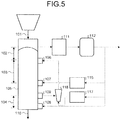
- FIG. 5 is a simplified diagram of FIG. 1 in Patent Literature 2.
- the continuous formed coke production method disclosed in Patent Literature 2 will be described with reference to FIG. 5 .
- An agglomerated coal 101 is fed into a vertical shaft furnace 105, which is formed with a low-temperature carbonization chamber 102, a high-temperature carbonization chamber 103, and a cooling chamber 104, from a furnace top into a furnace inside, and is carbonized by a heating thermal medium gas introduced from tuyeres 106 and 107 in the course of descending in the furnace. Further, the carbonized agglomerated coal 101 is cooled by a cooling gas introduced from a cooling gas introduction port 108 and discharged from a discharge port 109, and then is discharged as formed coke 110 from the lower part of the carbonization furnace.
- the gas extracted from the furnace top is cooled by a direct cooler 111 and an indirect cooler 112, and is increased in pressure by a blower not illustrated, and then a part of the gas is guided as a recovery gas to outside the system and the remaining part of the gas is circulated as a circulating gas in the system.
- a part of the circulating gas is introduced as a cooling gas from the cooling gas introduction port 108 into the cooling chamber 104.
- Another part of the circulating gas is increased in pressure by a blower not illustrated, and is introduced as a high-temperature carbonization thermal medium gas heated by a heater 115, from the tuyere 107 into the carbonization furnace.
- the remaining part of the circulating gas is adjusted in pressure, flow rate, and temperature, by a blower not illustrated and a heater 117, and is guided to an ejector 118 as a drive gas for the ejector 118.
- the ejector 118 sucks a cooling zone outlet gas from the discharge port 109, and mixes the sucked gas with the drive gas, and increases the mixed gas in pressure, and introduces the gas as a low-temperature carbonization thermal medium gas from the tuyere 106 into the carbonization furnace.
- Non Patent Literature 1 there has been examined a ferrocoke production method including a forming step of agglomerating coal and a carbonization step of, after the forming step, carbonizing the agglomerated coal in a general chamber-type coke furnace, thereby obtaining ferrocoke products.
- the general chamber-type coke furnace is made of silica bricks, and thus if iron ore is fed into the furnace, the iron ore reacts with silica as a main ingredient of the silica bricks to generate lower-melting-point firelight, which leads to damage of the silica bricks. Therefore, the technique of producing ferrocoke in a chamber-type coke furnace is industrially not utilized under actual circumstances.
- a vertical shaft furnace is used for continuous production of formed coke, not for production of ferrocoke.
- the vertical shaft furnace as disclosed in Patent Literature 2 is made of chamotte bricks, not silica bricks, as described above, it is therefore considered that, if the vertical shaft furnace is used for production of ferrocoke, the problem with the general chamber-type coke furnace using silica bricks will not arise in the vertical shaft furnace. Accordingly, it is conceived that the vertical shaft furnace made of chamotte bricks disclosed in Patent Literature 2, for example, is used at the carbonization step of ferrocoke production.
- the vertical shaft furnace disclosed in Patent Literature 2 is applied to production of ferrocoke, the following various problems remain unsolved.
- Patent Literature 2 the high-temperature gas is introduced for reuse from the tuyere 106 into the low-temperature carbonization chamber 102, and therefore, thermal loss may be generated in the course of the introduction.
- energy saving will be unavoidable and a design concept for lowering energy necessary for production of ferrocoke as much as possible will be required. Therefore, the generation of thermal loss is not considered to be expedient.
- the present invention is devised in light of the foregoing problems, and an object of the present invention is to provide a vertical shaft furnace that allows a simplified facility and uncomplicated operational conditions.
- another object of the present invention is to provide a ferrocoke production facility and a ferrocoke production method that, when a vertical shaft furnace is used as a carbonization furnace for metallurgical ferrocoke, achieves simplification of a facility and operation and reduction of energy usage.
- a ferrocoke production facility includes a vertical shaft furnace that subjects an object fed from a furnace top to combustion, gasification, carbonization, or reduction, thereby to continuously produce a target product, wherein high-temperature gas injection tuyeres configured to inject high-temperature gases of the same temperature are provided in a plurality of stages along furnace length to form a high-temperature soaking zone with a predetermined length below an intermediate position of the furnace along furnace length, wherein the predetermined length of the high-temperature soaking zone is set to 8 to 33% of the furnace length, and wherein a briquetted material of a coal-containing substance and an iron-containing substance is fed from the furnace top part of the vertical shaft furnace to continuously produce ferrocoke as a product.
- a ferrocoke production method for producing ferrocoke uses a ferrocoke production facility comprising a vertical shaft furnace that subjects a burden material fed from a furnace top to combustion, gasification, carbonization, or reduction, thereby to continuously produce a target product, provided with a briquetted material feeder for feeding a briquetted material of a coal-containing substance and an iron-containing substance from the furnace top part of the vertical shaft furnace to continuously produce ferrocoke as a product, further comprising: a plurality of high-temperature gas injection tuyeres, from which high-temperature gases of the same temperature are injected, that is provided along furnace length and injects a high-temperature gas to form a high-temperature soaking zone with a predetermined length below an intermediate position of the furnace along furnace length; a low-temperature gas injection tuyere that is provided above a central position of the furnace along furnace length to inject a low-temperature gas; a cooling
- the ferrocoke production facility comprising a vertical shaft furnace of the present invention
- a vertical shaft furnace that allows a simplified facility and uncomplicated operational conditions.
- the inventors investigated reduction behavior of iron ore in the course of carbonization of a briquetted material, as basic characteristics. Reduction of iron oxide in the process of ferrocoke production can be roughly classified into direct reduction by solid carbon (see Equation (1) below) and gas reduction by an H 2 gas and a CO gas resulting from coal (see Equations (2) and (3) below).
- Equation (1) The direct reduction in Equation (1) involves large endothermic reaction.
- a briquetted material of coal and iron ore was carbonized by increasing a temperature with distribution of N 2 , and the foregoing reduction mode was analyzed from a composition of an exhaust gas.
- the ratio of direct reduction by C (Equation (1)) rose sharply, and the amount of heat absorbed at reduction increased. Therefore, production of ferrocoke requires an operational design in which endothermic reaction with the briquetted material at a temperature of 800°C or more is compensated for.
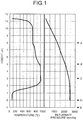
- FIG. 1 illustrates results of calculation in the case of using a ferrocoke production facility of the invention without a cooling gas extraction tuyere and with high-temperature gas injection tuyeres in two stages.
- FIG. 2 illustrates results of calculation in the case of using a ferrocoke production facility without a cooling gas extraction tuyere and with a high-temperature gas injection tuyere in one stage.
- FIGS. 1 and 2 illustrate results of calculation of gas conditions meeting target temperature distribution with a region in which the briquetted material is at a temperature of 900°C for one to two hours.
- code A denotes the position of a low-temperature gas injection tuyere through which a 600°C gas of 800 Nm 3 /t is injected;
- B the position of a high-temperature gas injection tuyere through which a 990°C gas of 950 Nm 3 /t is injected;
- C the position of a high-temperature gas injection tuyere through which a 990°C gas of 950 Nm 3 /t is injected, as with B;
- D the position of a cooling gas injection tuyere through which a 35°C gas of 1987 Nm 3 /t is injected;
- E the position of a ferrocoke discharge port.
- code A denotes the position of a low-temperature gas injection tuyere through which a 500°C gas of 1200 Nm 3 /t is injected; B the position of a high-temperature gas injection tuyere through which a 980°C gas of 2400 Nm 3 /t is injected; D the position of a cooling gas injection tuyere through which a 35°C gas of 1983 Nm 3 /t is injected; and E the position of a ferrocoke discharge port.
- the invention is devised based on the foregoing knowledge obtained by the results of experiments, and specifically, the invention is configured as described below.
- a vertical shaft furnace is used to continuously carbonize a briquetted material of a carbon-containing substance and an iron-containing substance, thereby to produce ferrocoke in which metallic iron is generated in coke.
- the ferrocoke production facility is configured such that a vertical shaft furnace has an area under a stockline level (material charging reference level), which is below a process gas discharge port, is divided into a low-temperature carbonization zone, a high-temperature carbonization zone, and a cooling zone.
- the low-temperature carbonization zone covers from the stockline level (material insertion reference level) to a low-temperature gas injection tuyere, and the high-temperature carbonization zone covers from the low-temperature gas injection tuyere to a high-temperature gas injection tuyere, which is in the lower stage along furnace length, and the cooling zone covers from the high-temperature gas injection tuyere in the lower stage to a cooling gas injection tuyere.
- the ferrocoke production facility is structured so as to supply a heat medium gas from four parts: a lower part of the low-temperature carbonization zone, an intermediate part and lower part of the high-temperature carbonization zone, and a lower part of the cooling zone, and discharges a process gas only from the furnace top part.
- the ferrocoke production facility can be simplified by eliminating a cooling gas extraction tuyere provided at a conventional formed coke production facility.
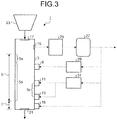
- FIG. 3 is a configuration example of the ferrocoke production facility according to the embodiment.
- a vertical shaft furnace 1 used in the ferrocoke production facility according to the embodiment subjects a briquetted material to carbonization and reduction in a carbonization zone 5 formed by a low-temperature carbonization zone 5a and a high-temperature carbonization zone 5b in a shaft furnace main body 3, and cools ferrocoke in a cooling zone 7 at a lower part.
- the vertical shaft furnace 1 has a low-temperature gas injection tuyere 9 on a side of the shaft furnace main body 3 at a position corresponding to a lower part of the low-temperature carbonization zone 5a.
- the vertical shaft furnace 1 has high-temperature gas injection tuyeres 11 and 13 on the side of the shaft furnace main body 3 at positions corresponding to an intermediate part and lower part of the high-temperature carbonization zone 5b.
- the vertical shaft furnace 1 has a cooling gas injection tuyere 15 on the side of the shaft furnace main body 3 at a position corresponding to a lower part of the cooling zone 7.
- the vertical shaft furnace 1 has a briquetted material feeding hole 17 and a process gas discharge port 19 for discharging a process gas at a top furnace part of the shaft furnace main body 3.
- the vertical shaft furnace 1 has a ferrocoke discharge port 21 for discharging ferrocoke at the lower part of the shaft furnace main body 3.
- a briquetted material feeder 23 for feeding an object into a feeding hole 17.
- a first circulating gas cooler 25 and a second circulating gas cooler 27 are connected to a discharge gas pipe connected to the process gas discharge port 19.
- a low-temperature gas heater 29 is provided to heat a circulating gas, which is cooled at the second circulating gas cooler 27, at a low temperature for use as a low-temperature gas
- a high-temperature gas heater 31 is provided to heat a circulating gas, which is cooled at the second circulating gas cooler 27, at a high temperature for use as a high-temperature gas.
- the briquetted material feeder 23 feeds a briquetted material generated from a carbon-containing substance and an iron-containing substance, through the feeding hole 17 of the shaft furnace main body 3.
- the fed briquetted material is carbonized in the carbonization zone 5 and cooled in the cooling zone 7, and then discharged as ferrocoke from the ferrocoke discharge port 21 at the lower part of the shaft furnace main body 3.
- the low-temperature gas heater 29 injects a heating gas (low-temperature gas) for carbonization of the briquetted material, from the low-temperature gas injection tuyere 9.
- the high-temperature gas heater 31 injects heating gases (high-temperature gases) for carbonization of the briquetted material, from the high-temperature gas injection tuyeres 11 and 13.
- the high-temperature gases injected from the high-temperature gas injection tuyeres 11 and 13 are higher in temperature than the low-temperature gas injected from the low-temperature gas injection tuyere 9.
- the high-temperature gases injected from the high-temperature gas injection tuyeres 11 and 13 are almost the same in temperature, thereby to form a high-temperature soaking zone between the high-temperature gas injection tuyeres in the furnace.
- the second circulating gas cooler 27 injects a cooling gas for cooling ferrocoke, through the cooling gas injection tuyere 15.
- the injected gases are discharged only from the process gas discharge port at the furnace top part.
- the low-temperature gas injection tuyere 9 is disposed above an intermediate position of the furnace along furnace length, and the high-temperature gas injection tuyeres 11 and 13 and the cooling gas injection tuyere 15 are disposed under the low-temperature gas injection tuyere 9.
- the high-temperature gas injection tuyeres 11 and 13 for forming a high-temperature soaking zone 5c with a predetermined length in a height direction in the furnace are placed below an intermediate position of the furnace along furnace length.
- the predetermined length of the high-temperature soaking zone 5c formed between the high-temperature gas injection tuyeres 11 and 13 is preferably set to 8 to 33% of a length from the stockline level (material charging reference level) to the ferrocoke discharge port 21. If the length of the high-temperature soaking zone 5c along height of the furnace is less than 8% of the furnace length, it is not possible to obtain an amount of heat required for carbonization of coal and reduction of mineral ore, which leads to deterioration in productivity.
- a low-temperature gas injected from the low-temperature gas injection tuyere 9 is a gas for adjusting the temperature of a gas at the furnace top and the rate of temperature rise of a solid substance in the shaft furnace, and is preferably set at about 400 to 700°C.
- a high-temperature gas injected from the high-temperature gas injection tuyeres 11 and 13 is a gas for raising the temperature of a solid substance to the maximum temperature, and is preferably set at about 800 to 1000°C.
- a cooling gas injected from the cooling gas injection tuyere 15 is a gas for cooling ferrocoke produced by carbonization in the furnace, and is preferably set at about 25 to 80°C.
- the process gas discharged from the process gas discharge port 19 at the furnace top part is cooled by the first circulating gas cooler 25 and the second circulating gas cooler 27, and some part of the gas is heated by the low-temperature gas heater 29 and is injected into the furnace from the low-temperature gas injection tuyere 9. Another part of the gas is heated by the high-temperature gas heater 31 and is injected into the furnace from the high-temperature gas injection tuyeres 11 and 13. The remaining part of the gas is injected into the furnace from the cooling gas injection tuyere 15.
- the vertical shaft furnace 1 having four-stage tuyeres in positions at different heights and not having a gas discharge port other than that at the furnace top part.
- a low-temperature gas is injected from the low-temperature gas injection tuyere 9 disposed under the low-temperature carbonization zone 5a.
- a high-temperature gas is injected from the high-temperature gas injection tuyeres 11 and 13 disposed at the intermediate part and the lower part of the high-temperature carbonization zone 5b.
- a cooling gas is injected from the cooling gas injection tuyere 15 disposed at the lower part of the cooling zone 7. In this manner, a briquetted material of a carbon-containing substance and an iron-containing substance is continuously carbonized to produce ferrocoke.
- a process gas is discharged only from the furnace top part, which eliminates the need for a complicated operation as disclosed in Patent Literature 2 where a gas extracted by an ejector and a gas discharged from the furnace top are mixed and then the mixed gas is returned into the furnace as a heating thermal medium gas.
- a gas flows in the furnace in one direction from the lower part to the upper part of the furnace, which simplifies a facility and eliminates a complicated operation such as regulation of a gas flow rate for adjusting a gas temperature at the cooling gas injection tuyere 15.
- the high-temperature gas injection tuyeres are provided in two stages to form the high-temperature soaking zone 5c between the high-temperature gas injection tuyeres in the height direction.
- This structure can be said to be suitable for production of ferrocoke requiring carbonization of coal and reduction of iron oxide.
- a high-temperature gas heated by the high-temperature gas heater 31 is bifurcated in midstream so as to be supplied to both of the high-temperature gas injection tuyeres 11 and 13. Accordingly, the gases supplied to the high-temperature gas injection tuyeres 11 and 13 become approximately identical in temperature, which facilitates formation of the high-temperature soaking zone 5c between the high-temperature gas injection tuyeres in the furnace. Even if gases identical in temperature are injected from the high-temperature gas injection tuyeres 11 and 13, the burden material moves downward while being supplied with heat from above, and causes reduction reaction of iron ore.
- the lower part of the furnace is slightly higher in temperature than the upper part of the same, and technically, there is a temperature gradient between the upper and lower parts of the furnace. Therefore, the formation of the high-temperature soaking zone described herein refers to not formation of a strictly identical temperature range but formation of a meaningful temperature range as a temperature range required for raising the temperature of the burden material to the maximum temperature. It is acceptable if the temperature of the burden material falls within a range of 800 to 1000°C, for example.
- High-temperature gases injected from the high-temperature gas injection tuyeres 11 and 13 may not necessarily be identical in temperature.
- the temperature of a gas injected from the upper high-temperature gas injection tuyere 11 may be higher than the temperature of a gas injected from the lower high-temperature gas injection tuyere 13.
- a high-temperature gas to be injected from the tuyere 13 at a relatively lower temperature may be mixed with a low-temperature gas before injection to adjust the temperature of the injected gas.
- a pipe is disposed to mix part of a low-temperature gas discharged from the low-temperature gas heater 29 into a high-temperature gas to be supplied to the tuyere 13, such that the pipe is provided with a flow regulation valve.
- the flow regulation valve and the pipe function as a flow rate adjustment device in the invention.
- High-temperature gases injected from the high-temperature gas injection tuyeres 11 and 13 may not necessarily be identical in flow rate.
- the high-temperature gas injection tuyeres 11 and 13 may have a difference in gas flow therebetween.
- the pipes supplying high-temperature gases to the tuyeres 11 and 13 may be provided with flow regulation valves.
- the flow regulation valves function as a flow rate adjustment device in the invention.
- the briquetted material in the furnace can be controlled in temperature.
- a temperature measurement device for measuring gas temperatures is preferably provided between the tuyeres to adjust the flow rates and temperatures of high-temperature gases injected from the tuyeres 11 and 13, based on measurement values from the temperature measurement device.
- the temperature measurement device measuring the temperature of the briquetted material may be configured to have a thermocouple or the like inserted into near the furnace wall to prevent occurrence of damage due to falling of the burden material.
- the flow rate of a gas injected into the lower high-temperature gas injection tuyere 13 may be made lower than the flow rate of a gas injected into the upper high-temperature gas injection tuyere 11, which makes it possible to form a predetermined temperature range at the upper part and make the cooling zone 7 longer along the furnace length.
- the vertical shaft furnace according to the invention includes the high-temperature gas injection tuyeres in a plurality of stages along the furnace length to form the high-temperature soaking zone with a predetermined length below the intermediate position of the furnace along the furnace length. Accordingly, even if the burden material to be processed causes large endothermic reaction associated with reduction reaction or the like, it is possible to supply an amount of heat compensating for the endothermic reaction, thereby producing a desired product in a stable manner. According to the ferrocoke production facility of the invention, it is possible to realize simplification of facility and operation and reduction of energy consumption, thereby resulting in continuous ferrocoke production. This allows highly reactive ferrocoke to be used in blast furnace operation, which is effective in decrease of reduction material ratio.
- the ferrocoke production test device illustrated in FIG. 4 was used to conduct a ferrocoke production test with high-temperature gas injection tuyeres in two stages and with a high-temperature gas injection tuyere in one stage.
- the same components illustrated in FIG. 4 as those in FIG. 1 are given the same reference numerals as those shown in FIG. 1 .
- the vertical shaft furnace illustrated in FIG. 4 is given the same reference numerals as those shown in FIG. 1 .
- the vertical shaft furnace 1 has a cross section area of 1.67 m 2 , and the descending speed of the burden material descends is 1.6 m/h.
- Table 1 shows operational specifications for production of ferrocoke
- Table 2 shows properties of produced ferrocoke.
- Table 1 High-temperature gas injection tuyeres in two stages High-temperature gas injection tuyere in one stage Gas amount Nm 3 /hr Gas temperature °C Gas amount Nm 3 /hr Gas temperature °C Low-temperature gas injection tuyere 800 600 1200 500 High-temperature gas injection tuyere 950 990 2400 980 High-temperature gas injection tuyere 950 990 - - Cooling gas injection tuyere 1987 35 1983 35
- Table 2 High-temperature gas injection tuyeres in two stages High-temperature gas injection tuyere in one stage Strength after carbonization DI150/6(-) 82.8 82.2 Rate of reduction (%) 84.2 78.1
- the strength after carbonization is indicated by drum strength index, and the target value of DI 150/6 (6 mm index after 150 revolutions) is set at 82.
- the target value of rate of reduction is set at 80%. As shown in Table 2, both the strength and the rate of reduction exceeded the target values with the high-temperature gas injection tuyeres in two stages, whereas the strength exceeded the target value but the rate of reduction did not reach the target value with the high-temperature gas injection tuyere in one stage. It is considered that this is because gas retention time was not sufficiently provided in a temperature range of 900°C, which held the rate of reduction at a low level.
- the high-temperature gas injection tuyeres are provided in two stages. Alternatively, the high-temperature gas injection tuyeres may be provided in three or more stages. In the foregoing example, the high-temperature gas injection tuyeres 11 and 13 are placed below the intermediate position of the furnace along the furnace length to form the high-temperature soaking zone. Alternatively, as far as the high-temperature soaking zone is formed below the intermediate position of the furnace along the furnace length, the upper high-temperature gas injection tuyere 11 may be placed at a height above the intermediate position of the furnace along the furnace length, by controlling the direction of injecting a high-temperature gas, for example.
- the advantages of forming the high-temperature soaking zone with the high-temperature gas injection tuyeres in two stages is provided not only when the vertical shaft furnace is used as a carbonization furnace at production of ferrocoke.
- the advantages can also be provided when the vertical shaft furnace is used as a combustion/gasification furnace for subjecting a burden material such as coal and waste material, for example, to combustion and gasification, a gasification furnace for subjecting plastic or biomass to gasification, a reduction furnace for reducing metallic oxide, and a fusing furnace for fusing scraps or the like.
- the present invention is applicable to a vertical shaft furnace continuously producing a desired product by subjecting a burden material fed from a furnace top to combustion, gasification, carbonization, or reduction, and a ferrocoke production facility including the vertical shaft furnace for production of ferrocoke, and a ferrocoke production method.
Landscapes
- Chemical & Material Sciences (AREA)
- Engineering & Computer Science (AREA)
- Oil, Petroleum & Natural Gas (AREA)
- Materials Engineering (AREA)
- Organic Chemistry (AREA)
- General Engineering & Computer Science (AREA)
- Mechanical Engineering (AREA)
- Combustion & Propulsion (AREA)
- Manufacturing & Machinery (AREA)
- Metallurgy (AREA)
- Chemical Kinetics & Catalysis (AREA)
- General Chemical & Material Sciences (AREA)
- Vertical, Hearth, Or Arc Furnaces (AREA)
- Coke Industry (AREA)
Claims (10)
- Eisenkoks-Herstellungsanlage, umfassend einen Vertikalschachtofen (1), der ein Möllergut, das von einer Ofenoberseite zugeführt wird, Verbrennung, Vergasung, Verkohlung oder Reduktion unterzieht, um dadurch kontinuierlich ein Zielprodukt zu erzeugen, und der mit einer Brikettmaterial-Zuführungsvorrichtung (23) versehen ist, um ein brikettiertes Material aus einer Kohle enthaltenden Substanz und einer Eisen enthaltenden Substanz von dem ofenoberseitigen Teil des Vertikalschachtofens (1) zuzuführen und kontinuierlich Eisenkoks als Produkt herzustellen, wobei Hochtemperatur-Gaseinblasdüsen (11, 13), die dazu ausgelegt sind, Hochtemperaturgase mit derselben Temperatur einzublasen, in einer Vielzahl von Stufen entlang der Ofenlänge bereitgestellt sind, um eine Hochtemperatur-Durchwärmungszone (5c) mit einer vorgegebenen Länge unterhalb einer mittleren Position des Ofens entlang der Ofenlänge zu bilden, dadurch gekennzeichnet, dass
die vorgegebene Länge der Hochtemperatur-Durchwärmungszone (5c) auf 8 bis 33 % der Ofenlänge festgelegt wird. - Eisenkoks-Herstellungsanlage nach Anspruch 1, wobei die Eisenkoks-Herstellungsanlage so konfiguriert ist, dass ein Hochtemperaturgas, das durch eine Hochtemperatur-Gasbeheizung (31) erwärmt wird, in der Strommitte gegabelt wird, um zu den Hochtemperatur-Gaseinblasdüsen (11, 13) geleitet zu werden, die in der Vielzahl von Stufen bereitgestellt sind.
- Eisenkoks-Herstellungsanlage nach Anspruch 1, wobei eine Strömungsgeschwindigkeits-Anpassungsvorrichtung an dem Vertikalschachtofen (1) bereitgestellt ist, um eine Strömungsgeschwindigkeit eines Hochtemperaturgases anzupassen, das zu den Hochtemperatur-Gaseinblasdüsen (11, 13) geleitet werden soll, die in der Vielzahl von Stufen bereitgestellt sind.
- Eisenkoks-Herstellungsanlage nach Anspruch 1 oder 3, wobei eine Gastemperatur-Anpassungsvorrichtung an dem Vertikalschachtofen (1) bereitgestellt ist, um eine Temperatur eines Hochtemperaturgases anzupassen, das zu den Hochtemperatur-Gaseinblasdüsen (11, 13) geleitet werden soll, die in der Vielzahl von Stufen bereitgestellt sind.
- Eisenkoks-Herstellungsanlage nach Anspruch 3 oder 4, wobei eine Temperaturmessungsvorrichtung an dem Vertikalschachtofen (1) bereitgestellt ist, um eine Temperatur der Hochtemperatur-Durchwärmungszone (5c) zu messen.
- Eisenkoks-Herstellungsanlage nach einem der Ansprüche 1 oder 3 bis 5, wobei eine Niedertemperatur-Gaseinblasdüse (9) zum Einblasen eines Niedertemperaturgases an dem Vertikalschachtofen (1) oberhalb der mittleren Position des Ofens entlang der Ofenlänge bereitgestellt ist.
- Eisenkoks-Herstellungsanlage nach einem der Ansprüche 1 oder 3 bis 6, wobei die Hochtemperatur-Gaseinblasdüsen (11, 13) in zwei Stufen an dem Vertikalschachtofen (1) bereitgestellt sind.
- Eisenkoks-Herstellungsanlage nach einem der Ansprüche 1 oder 3 bis 7, wobei der Vertikalschachtofen (1) eine Kühlgaseinblasdüse (15) umfasst, die unterhalb der Hochtemperatur-Gaseinblasdüse (13) bereitgestellt ist und ein Kühlgas einbläst; und eine Prozessgas-Ausstoßöffnung (19), die nur an dem ofenoberseitigen Teil bereitgestellt ist und ein Prozessgas ausstößt.
- Eisenkoks-Herstellungsanlage nach Anspruch 8, umfassend eine Ausstoßgas-Zirkulationsvorrichtung, die dazu ausgelegt ist, ein Gas, das aus der Prozessgas-Ausstoßöffnung (19) ausgestoßen wird, in den Ofen durch die Niedertemperatur-Gaseinblasdüse (9), die Hochtemperatur-Gaseinblasdüsen (11, 13) und die Kühlgaseinblasdüse (15) einzublasen.
- Eisenkoks-Herstellungsverfahren zum Herstellen von Eisenkoks unter Verwendung einer Eisenkoks-Herstellungsanlage, umfassend einen Vertikalschachtofen (1), der ein Möllergut, das von einer Ofenoberseite zugeführt wird, Verbrennung, Vergasung, Verkohlung oder Reduktion unterzieht, um dadurch kontinuierlich ein Zielprodukt zu erzeugen, und der mit einer Brikettmaterial-Zuführungsvorrichtung (23) versehen ist, um ein brikettiertes Material aus einer Kohle enthaltenden Substanz und einer Eisen enthaltenden Substanz von dem ofenoberseitigen Teil des Vertikalschachtofens (1) zuzuführen und kontinuierlich Eisenkoks als Produkt herzustellen,
des Weiteren umfassend: eine Vielzahl von Hochtemperatur-Gaseinblasdüsen (11, 13) von welchen Hochtemperaturgase mit derselben Temperatur eingeblasen werden, die entlang der Ofenlänge bereitgestellt sind und ein Hochtemperaturgas einblasen, um eine Hochtemperatur-Durchwärmungszone (5c) mit einer vorgegebenen Länge unterhalb einer mittleren Position des Ofens entlang der Ofenlänge zu bieten; eine Niedertemperatur-Gaseinblasdüse (9), die oberhalb einer mittleren Position des Ofens entlang der Ofenlänge bereitgestellt ist, um ein Niedertemperaturgas einzublasen; eine Kühlgaseinblasdüse (15), die unterhalb der Hochtemperatur-Gaseinblasdüsen (11, 13) bereitgestellt ist, um ein Kühlgas einzublasen; und eine Prozessgas-Ausstoßöffnung (19), die an einem ofenoberseitigen Teil bereitgestellt ist und ein Prozessgas ausstößt, wobei
ein brikettiertes Material aus einer Kohlenstoff enthaltenden Substanz und einer Eisen enthaltenden Substanz von dem ofenoberseitigen Teil zugeführt wird;
ein Niedertemperaturgas für die Verkokung des brikettierten Materials aus der Niedertemperatur-Gaseinblasdüse (9) eingeblasen wird;
ein Gas mit einer höheren Temperatur als das Niedertemperaturgas aus den Hochtemperatur-Gaseinblasdüsen (11, 13) eingeblasen wird;
ein Kühlgas zum Kühlen des Eisenkoks als ein Produkt aus der Kühlgaseinblasdüse (15) eingeblasen wird; und
ein Gas aus der Prozessgas-Ausstoßöffnung (19) an dem ofenoberseitigen Teil ausgestoßen wird, und
die vorgegebene Länge der Hochtemperatur-Durchwärmungszone (5c) auf 8 bis 33 % der Ofenlänge festgelegt wird.
Applications Claiming Priority (2)
| Application Number | Priority Date | Filing Date | Title |
|---|---|---|---|
| JP2010074481 | 2010-03-29 | ||
| PCT/JP2011/057559 WO2011122535A1 (ja) | 2010-03-29 | 2011-03-28 | 竪型シャフト炉、フェロコークス製造設備、及びフェロコークスの製造方法 |
Publications (3)
| Publication Number | Publication Date |
|---|---|
| EP2554632A1 EP2554632A1 (de) | 2013-02-06 |
| EP2554632A4 EP2554632A4 (de) | 2014-06-11 |
| EP2554632B1 true EP2554632B1 (de) | 2018-10-10 |
Family
ID=44712231
Family Applications (1)
| Application Number | Title | Priority Date | Filing Date |
|---|---|---|---|
| EP11762759.6A Active EP2554632B1 (de) | 2010-03-29 | 2011-03-28 | Eisenkoks-herstellungsanlage enthaltend einen vertikalen ofen und verfahren zur eisenkoksherstellung |
Country Status (5)
| Country | Link |
|---|---|
| EP (1) | EP2554632B1 (de) |
| JP (1) | JP4860003B2 (de) |
| KR (1) | KR101475582B1 (de) |
| CN (1) | CN102822315B (de) |
| WO (1) | WO2011122535A1 (de) |
Families Citing this family (14)
| Publication number | Priority date | Publication date | Assignee | Title |
|---|---|---|---|---|
| JP4666114B2 (ja) | 2009-08-10 | 2011-04-06 | Jfeスチール株式会社 | フェロコークスの製造方法及び製造装置 |
| JP2013089352A (ja) | 2011-10-14 | 2013-05-13 | Honda Motor Co Ltd | 燃料電池システム及びその停止方法 |
| JP5900027B2 (ja) * | 2012-03-02 | 2016-04-06 | Jfeスチール株式会社 | 炉内温度分布の推定方法および推定装置 |
| JP5900025B2 (ja) * | 2012-03-02 | 2016-04-06 | Jfeスチール株式会社 | 炉内温度分布の推定方法および推定装置 |
| JP5900026B2 (ja) * | 2012-03-02 | 2016-04-06 | Jfeスチール株式会社 | 炉内温度分布の推定方法および推定装置 |
| JP6094127B2 (ja) * | 2012-10-02 | 2017-03-15 | Jfeスチール株式会社 | 温度分布推定方法及び温度分布推定装置 |
| JP5900386B2 (ja) * | 2013-03-13 | 2016-04-06 | Jfeスチール株式会社 | 乾留炉の制御方法および制御装置 |
| CN106635067A (zh) * | 2016-11-24 | 2017-05-10 | 武汉科思瑞迪科技有限公司 | 一种生产铁焦的竖炉工艺 |
| CN110129500B (zh) * | 2019-06-05 | 2020-09-15 | 东北大学 | 一种铁焦的制备方法和制备系统 |
| CN111004638B (zh) * | 2019-12-31 | 2021-04-30 | 中冶南方工程技术有限公司 | 一种铁焦生产竖炉尺寸确定方法 |
| US12084730B2 (en) * | 2020-03-24 | 2024-09-10 | Midrex Technologies, Inc. | Methods and systems for increasing the carbon content of direct reduced iron in a reduction furnace |
| CN111359692B (zh) * | 2020-05-09 | 2025-01-28 | 威士达半导体科技(张家港)有限公司 | 一种实验室用保护膜烘烤装置 |
| CN120557929A (zh) * | 2025-07-30 | 2025-08-29 | 四川三帝新材料有限公司 | 一种用于瓷砖生产的隧道窑 |
| CN121183116B (zh) * | 2025-11-21 | 2026-03-06 | 东北大学 | 一种利用烧结返矿制备高炉新炉料的方法 |
Family Cites Families (12)
| Publication number | Priority date | Publication date | Assignee | Title |
|---|---|---|---|---|
| JPS5223102A (en) | 1975-08-18 | 1977-02-21 | Nippon Steel Corp | Process for manufacturing formed coke |
| JPS54143402A (en) * | 1978-04-28 | 1979-11-08 | Nippon Steel Corp | Manufacturing of metallurgical formed coke |
| JPS606390B2 (ja) | 1979-10-17 | 1985-02-18 | 社団法人 日本鉄鋼連盟 | 竪型成型コ−クス乾留炉におけるガス循環装置 |
| JPH0797577A (ja) * | 1993-09-28 | 1995-04-11 | Kawasaki Steel Corp | 成形コークスの製造方法 |
| JPH07126648A (ja) * | 1993-10-29 | 1995-05-16 | Kawasaki Steel Corp | 竪型成形コークス乾留炉のガス混合室と高温羽口間の除煤方法 |
| JP3487912B2 (ja) * | 1994-07-04 | 2004-01-19 | 新日本製鐵株式会社 | 鉄鉱石を内装した成型コークスおよび成型コークスの製造方法および高炉操業方法 |
| CN1036075C (zh) * | 1994-08-27 | 1997-10-08 | 冶金工业部钢铁研究总院 | 熔融还原炼铁方法及其装置 |
| CN2259246Y (zh) * | 1995-12-22 | 1997-08-13 | 乔志海 | 一种新型外燃煤氧化球团矿竖炉 |
| KR100531767B1 (ko) * | 2004-02-18 | 2005-11-28 | 주식회사 포스코건설 | 코크스 오븐 가스의 탈황방법 및 그 장치 |
| CA2651463C (en) * | 2006-05-05 | 2014-12-02 | Bioecon International Holding N.V. | Improved process for converting carbon-based energy carrier material |
| JP4666112B2 (ja) * | 2009-07-29 | 2011-04-06 | Jfeスチール株式会社 | フェロコークスの製造方法 |
| JP4666114B2 (ja) * | 2009-08-10 | 2011-04-06 | Jfeスチール株式会社 | フェロコークスの製造方法及び製造装置 |
-
2011
- 2011-02-28 JP JP2011041068A patent/JP4860003B2/ja active Active
- 2011-03-28 WO PCT/JP2011/057559 patent/WO2011122535A1/ja not_active Ceased
- 2011-03-28 CN CN201180015873.4A patent/CN102822315B/zh active Active
- 2011-03-28 KR KR1020127024775A patent/KR101475582B1/ko active Active
- 2011-03-28 EP EP11762759.6A patent/EP2554632B1/de active Active
Non-Patent Citations (1)
| Title |
|---|
| None * |
Also Published As
| Publication number | Publication date |
|---|---|
| EP2554632A4 (de) | 2014-06-11 |
| EP2554632A1 (de) | 2013-02-06 |
| CN102822315B (zh) | 2016-08-03 |
| JP4860003B2 (ja) | 2012-01-25 |
| JP2011226766A (ja) | 2011-11-10 |
| CN102822315A (zh) | 2012-12-12 |
| KR20120120470A (ko) | 2012-11-01 |
| WO2011122535A1 (ja) | 2011-10-06 |
| KR101475582B1 (ko) | 2014-12-22 |
Similar Documents
| Publication | Publication Date | Title |
|---|---|---|
| EP2554632B1 (de) | Eisenkoks-herstellungsanlage enthaltend einen vertikalen ofen und verfahren zur eisenkoksherstellung | |
| US8690987B2 (en) | Method and apparatus for producing carbon iron composite | |
| EP2431484B1 (de) | Betriebsverfahren für einen verbrennungsofen | |
| CN104293998A (zh) | 气基竖炉制备海绵铁的方法和系统 | |
| US3928023A (en) | Method of treating off gases from iron processes | |
| CN104087700A (zh) | 气基竖炉制备海绵铁的方法和系统 | |
| EP4715068A1 (de) | Verfahren zum schmelzen von hochproportionsssefstromit unter verwendung eines sauerstoffblasofens | |
| US20180355448A1 (en) | Flash ironmaking system and method | |
| JP2004285134A (ja) | 冶金炉用原料の製造方法 | |
| CN204039428U (zh) | 气基竖炉制备海绵铁的系统 | |
| EP2460869B1 (de) | Verfahren zur herstellung von eisenkoks | |
| KR101607253B1 (ko) | 복합 용철 제조 장치 | |
| CN104087702A (zh) | 气基竖炉制备海绵铁的方法和系统 | |
| CN204058507U (zh) | 气基竖炉制备海绵铁的系统 | |
| MXPA03008526A (es) | Horno modular. | |
| JP5504650B2 (ja) | 成型コークスの製造設備及び成型コークスの製造方法 | |
| US5378260A (en) | Two-zone countercurrent smelter system and process | |
| Lyalyuk et al. | Improvement in blast-furnace performance by using a new form of iron ore | |
| EP4273275A1 (de) | Verfahren zur herstellung von eisenschmelze mithilfe eines mit einer videovorrichtung ausgestatteten elektroofens | |
| KR100782727B1 (ko) | 코크스 오븐의 코크스 건류상태 판정 장치 | |
| LU500891B1 (en) | Double shaft furnace arrangement and method for operating a double shaft furnace arrangement | |
| CN119824161A (zh) | 还原熔分一体化的超低碳炼铁方法 | |
| CA2508718C (en) | Method and apparatus for controlling temperature uniformity of the burden in a direct reduction shaft furnace | |
| KR20260018335A (ko) | 열원의 취입 편차 예측 방법, 용해로의 조업 방법 및 열원의 투입 방법 | |
| CN121780797A (zh) | 一种电热竖炉炭基直接还原铁工艺 |
Legal Events
| Date | Code | Title | Description |
|---|---|---|---|
| PUAI | Public reference made under article 153(3) epc to a published international application that has entered the european phase |
Free format text: ORIGINAL CODE: 0009012 |
|
| 17P | Request for examination filed |
Effective date: 20120926 |
|
| AK | Designated contracting states |
Kind code of ref document: A1 Designated state(s): AL AT BE BG CH CY CZ DE DK EE ES FI FR GB GR HR HU IE IS IT LI LT LU LV MC MK MT NL NO PL PT RO RS SE SI SK SM TR |
|
| DAX | Request for extension of the european patent (deleted) | ||
| REG | Reference to a national code |
Ref country code: DE Ref legal event code: R079 Ref document number: 602011052794 Country of ref document: DE Free format text: PREVIOUS MAIN CLASS: C10B0003000000 Ipc: C10B0049040000 |
|
| A4 | Supplementary search report drawn up and despatched |
Effective date: 20140514 |
|
| RIC1 | Information provided on ipc code assigned before grant |
Ipc: C10B 57/06 20060101ALI20140508BHEP Ipc: C10B 53/08 20060101ALI20140508BHEP Ipc: C10B 49/04 20060101AFI20140508BHEP Ipc: F27B 1/16 20060101ALI20140508BHEP |
|
| 17Q | First examination report despatched |
Effective date: 20161013 |
|
| RAP1 | Party data changed (applicant data changed or rights of an application transferred) |
Owner name: JP STEEL PLANTECH CO. Owner name: JFE STEEL CORPORATION |
|
| STAA | Information on the status of an ep patent application or granted ep patent |
Free format text: STATUS: EXAMINATION IS IN PROGRESS |
|
| GRAP | Despatch of communication of intention to grant a patent |
Free format text: ORIGINAL CODE: EPIDOSNIGR1 |
|
| STAA | Information on the status of an ep patent application or granted ep patent |
Free format text: STATUS: GRANT OF PATENT IS INTENDED |
|
| INTG | Intention to grant announced |
Effective date: 20180530 |
|
| GRAS | Grant fee paid |
Free format text: ORIGINAL CODE: EPIDOSNIGR3 |
|
| GRAA | (expected) grant |
Free format text: ORIGINAL CODE: 0009210 |
|
| STAA | Information on the status of an ep patent application or granted ep patent |
Free format text: STATUS: THE PATENT HAS BEEN GRANTED |
|
| AK | Designated contracting states |
Kind code of ref document: B1 Designated state(s): AL AT BE BG CH CY CZ DE DK EE ES FI FR GB GR HR HU IE IS IT LI LT LU LV MC MK MT NL NO PL PT RO RS SE SI SK SM TR |
|
| REG | Reference to a national code |
Ref country code: GB Ref legal event code: FG4D |
|
| REG | Reference to a national code |
Ref country code: CH Ref legal event code: EP Ref country code: AT Ref legal event code: REF Ref document number: 1051216 Country of ref document: AT Kind code of ref document: T Effective date: 20181015 |
|
| REG | Reference to a national code |
Ref country code: IE Ref legal event code: FG4D |
|
| REG | Reference to a national code |
Ref country code: DE Ref legal event code: R096 Ref document number: 602011052794 Country of ref document: DE |
|
| REG | Reference to a national code |
Ref country code: NL Ref legal event code: MP Effective date: 20181010 |
|
| REG | Reference to a national code |
Ref country code: LT Ref legal event code: MG4D |
|
| REG | Reference to a national code |
Ref country code: AT Ref legal event code: MK05 Ref document number: 1051216 Country of ref document: AT Kind code of ref document: T Effective date: 20181010 |
|
| PG25 | Lapsed in a contracting state [announced via postgrant information from national office to epo] |
Ref country code: NL Free format text: LAPSE BECAUSE OF FAILURE TO SUBMIT A TRANSLATION OF THE DESCRIPTION OR TO PAY THE FEE WITHIN THE PRESCRIBED TIME-LIMIT Effective date: 20181010 |
|
| PG25 | Lapsed in a contracting state [announced via postgrant information from national office to epo] |
Ref country code: HR Free format text: LAPSE BECAUSE OF FAILURE TO SUBMIT A TRANSLATION OF THE DESCRIPTION OR TO PAY THE FEE WITHIN THE PRESCRIBED TIME-LIMIT Effective date: 20181010 Ref country code: PL Free format text: LAPSE BECAUSE OF FAILURE TO SUBMIT A TRANSLATION OF THE DESCRIPTION OR TO PAY THE FEE WITHIN THE PRESCRIBED TIME-LIMIT Effective date: 20181010 Ref country code: NO Free format text: LAPSE BECAUSE OF FAILURE TO SUBMIT A TRANSLATION OF THE DESCRIPTION OR TO PAY THE FEE WITHIN THE PRESCRIBED TIME-LIMIT Effective date: 20190110 Ref country code: LT Free format text: LAPSE BECAUSE OF FAILURE TO SUBMIT A TRANSLATION OF THE DESCRIPTION OR TO PAY THE FEE WITHIN THE PRESCRIBED TIME-LIMIT Effective date: 20181010 Ref country code: ES Free format text: LAPSE BECAUSE OF FAILURE TO SUBMIT A TRANSLATION OF THE DESCRIPTION OR TO PAY THE FEE WITHIN THE PRESCRIBED TIME-LIMIT Effective date: 20181010 Ref country code: BG Free format text: LAPSE BECAUSE OF FAILURE TO SUBMIT A TRANSLATION OF THE DESCRIPTION OR TO PAY THE FEE WITHIN THE PRESCRIBED TIME-LIMIT Effective date: 20190110 Ref country code: LV Free format text: LAPSE BECAUSE OF FAILURE TO SUBMIT A TRANSLATION OF THE DESCRIPTION OR TO PAY THE FEE WITHIN THE PRESCRIBED TIME-LIMIT Effective date: 20181010 Ref country code: FI Free format text: LAPSE BECAUSE OF FAILURE TO SUBMIT A TRANSLATION OF THE DESCRIPTION OR TO PAY THE FEE WITHIN THE PRESCRIBED TIME-LIMIT Effective date: 20181010 Ref country code: IS Free format text: LAPSE BECAUSE OF FAILURE TO SUBMIT A TRANSLATION OF THE DESCRIPTION OR TO PAY THE FEE WITHIN THE PRESCRIBED TIME-LIMIT Effective date: 20190210 Ref country code: AT Free format text: LAPSE BECAUSE OF FAILURE TO SUBMIT A TRANSLATION OF THE DESCRIPTION OR TO PAY THE FEE WITHIN THE PRESCRIBED TIME-LIMIT Effective date: 20181010 |
|
| PG25 | Lapsed in a contracting state [announced via postgrant information from national office to epo] |
Ref country code: RS Free format text: LAPSE BECAUSE OF FAILURE TO SUBMIT A TRANSLATION OF THE DESCRIPTION OR TO PAY THE FEE WITHIN THE PRESCRIBED TIME-LIMIT Effective date: 20181010 Ref country code: GR Free format text: LAPSE BECAUSE OF FAILURE TO SUBMIT A TRANSLATION OF THE DESCRIPTION OR TO PAY THE FEE WITHIN THE PRESCRIBED TIME-LIMIT Effective date: 20190111 Ref country code: AL Free format text: LAPSE BECAUSE OF FAILURE TO SUBMIT A TRANSLATION OF THE DESCRIPTION OR TO PAY THE FEE WITHIN THE PRESCRIBED TIME-LIMIT Effective date: 20181010 Ref country code: PT Free format text: LAPSE BECAUSE OF FAILURE TO SUBMIT A TRANSLATION OF THE DESCRIPTION OR TO PAY THE FEE WITHIN THE PRESCRIBED TIME-LIMIT Effective date: 20190210 Ref country code: SE Free format text: LAPSE BECAUSE OF FAILURE TO SUBMIT A TRANSLATION OF THE DESCRIPTION OR TO PAY THE FEE WITHIN THE PRESCRIBED TIME-LIMIT Effective date: 20181010 |
|
| REG | Reference to a national code |
Ref country code: DE Ref legal event code: R097 Ref document number: 602011052794 Country of ref document: DE |
|
| PG25 | Lapsed in a contracting state [announced via postgrant information from national office to epo] |
Ref country code: DK Free format text: LAPSE BECAUSE OF FAILURE TO SUBMIT A TRANSLATION OF THE DESCRIPTION OR TO PAY THE FEE WITHIN THE PRESCRIBED TIME-LIMIT Effective date: 20181010 Ref country code: IT Free format text: LAPSE BECAUSE OF FAILURE TO SUBMIT A TRANSLATION OF THE DESCRIPTION OR TO PAY THE FEE WITHIN THE PRESCRIBED TIME-LIMIT Effective date: 20181010 Ref country code: CZ Free format text: LAPSE BECAUSE OF FAILURE TO SUBMIT A TRANSLATION OF THE DESCRIPTION OR TO PAY THE FEE WITHIN THE PRESCRIBED TIME-LIMIT Effective date: 20181010 |
|
| PLBE | No opposition filed within time limit |
Free format text: ORIGINAL CODE: 0009261 |
|
| STAA | Information on the status of an ep patent application or granted ep patent |
Free format text: STATUS: NO OPPOSITION FILED WITHIN TIME LIMIT |
|
| PG25 | Lapsed in a contracting state [announced via postgrant information from national office to epo] |
Ref country code: SK Free format text: LAPSE BECAUSE OF FAILURE TO SUBMIT A TRANSLATION OF THE DESCRIPTION OR TO PAY THE FEE WITHIN THE PRESCRIBED TIME-LIMIT Effective date: 20181010 Ref country code: SM Free format text: LAPSE BECAUSE OF FAILURE TO SUBMIT A TRANSLATION OF THE DESCRIPTION OR TO PAY THE FEE WITHIN THE PRESCRIBED TIME-LIMIT Effective date: 20181010 Ref country code: EE Free format text: LAPSE BECAUSE OF FAILURE TO SUBMIT A TRANSLATION OF THE DESCRIPTION OR TO PAY THE FEE WITHIN THE PRESCRIBED TIME-LIMIT Effective date: 20181010 Ref country code: RO Free format text: LAPSE BECAUSE OF FAILURE TO SUBMIT A TRANSLATION OF THE DESCRIPTION OR TO PAY THE FEE WITHIN THE PRESCRIBED TIME-LIMIT Effective date: 20181010 |
|
| 26N | No opposition filed |
Effective date: 20190711 |
|
| PG25 | Lapsed in a contracting state [announced via postgrant information from national office to epo] |
Ref country code: MC Free format text: LAPSE BECAUSE OF FAILURE TO SUBMIT A TRANSLATION OF THE DESCRIPTION OR TO PAY THE FEE WITHIN THE PRESCRIBED TIME-LIMIT Effective date: 20181010 Ref country code: SI Free format text: LAPSE BECAUSE OF FAILURE TO SUBMIT A TRANSLATION OF THE DESCRIPTION OR TO PAY THE FEE WITHIN THE PRESCRIBED TIME-LIMIT Effective date: 20181010 |
|
| REG | Reference to a national code |
Ref country code: CH Ref legal event code: PL |
|
| GBPC | Gb: european patent ceased through non-payment of renewal fee |
Effective date: 20190328 |
|
| PG25 | Lapsed in a contracting state [announced via postgrant information from national office to epo] |
Ref country code: LU Free format text: LAPSE BECAUSE OF NON-PAYMENT OF DUE FEES Effective date: 20190328 |
|
| REG | Reference to a national code |
Ref country code: BE Ref legal event code: MM Effective date: 20190331 |
|
| PG25 | Lapsed in a contracting state [announced via postgrant information from national office to epo] |
Ref country code: IE Free format text: LAPSE BECAUSE OF NON-PAYMENT OF DUE FEES Effective date: 20190328 Ref country code: LI Free format text: LAPSE BECAUSE OF NON-PAYMENT OF DUE FEES Effective date: 20190331 Ref country code: CH Free format text: LAPSE BECAUSE OF NON-PAYMENT OF DUE FEES Effective date: 20190331 Ref country code: GB Free format text: LAPSE BECAUSE OF NON-PAYMENT OF DUE FEES Effective date: 20190328 |
|
| PG25 | Lapsed in a contracting state [announced via postgrant information from national office to epo] |
Ref country code: BE Free format text: LAPSE BECAUSE OF NON-PAYMENT OF DUE FEES Effective date: 20190331 |
|
| PG25 | Lapsed in a contracting state [announced via postgrant information from national office to epo] |
Ref country code: TR Free format text: LAPSE BECAUSE OF FAILURE TO SUBMIT A TRANSLATION OF THE DESCRIPTION OR TO PAY THE FEE WITHIN THE PRESCRIBED TIME-LIMIT Effective date: 20181010 |
|
| PG25 | Lapsed in a contracting state [announced via postgrant information from national office to epo] |
Ref country code: MT Free format text: LAPSE BECAUSE OF NON-PAYMENT OF DUE FEES Effective date: 20190328 |
|
| PG25 | Lapsed in a contracting state [announced via postgrant information from national office to epo] |
Ref country code: CY Free format text: LAPSE BECAUSE OF FAILURE TO SUBMIT A TRANSLATION OF THE DESCRIPTION OR TO PAY THE FEE WITHIN THE PRESCRIBED TIME-LIMIT Effective date: 20181010 |
|
| PG25 | Lapsed in a contracting state [announced via postgrant information from national office to epo] |
Ref country code: HU Free format text: LAPSE BECAUSE OF FAILURE TO SUBMIT A TRANSLATION OF THE DESCRIPTION OR TO PAY THE FEE WITHIN THE PRESCRIBED TIME-LIMIT; INVALID AB INITIO Effective date: 20110328 |
|
| PG25 | Lapsed in a contracting state [announced via postgrant information from national office to epo] |
Ref country code: MK Free format text: LAPSE BECAUSE OF FAILURE TO SUBMIT A TRANSLATION OF THE DESCRIPTION OR TO PAY THE FEE WITHIN THE PRESCRIBED TIME-LIMIT Effective date: 20181010 |
|
| PGFP | Annual fee paid to national office [announced via postgrant information from national office to epo] |
Ref country code: DE Payment date: 20260204 Year of fee payment: 16 |
|
| PGFP | Annual fee paid to national office [announced via postgrant information from national office to epo] |
Ref country code: FR Payment date: 20260209 Year of fee payment: 16 |