EP2555393A1 - Appareil de chargement d'aimant - Google Patents
Appareil de chargement d'aimant Download PDFInfo
- Publication number
- EP2555393A1 EP2555393A1 EP11176163A EP11176163A EP2555393A1 EP 2555393 A1 EP2555393 A1 EP 2555393A1 EP 11176163 A EP11176163 A EP 11176163A EP 11176163 A EP11176163 A EP 11176163A EP 2555393 A1 EP2555393 A1 EP 2555393A1
- Authority
- EP
- European Patent Office
- Prior art keywords
- magnet
- pole pieces
- field
- positioning means
- rotor
- Prior art date
- Legal status (The legal status is an assumption and is not a legal conclusion. Google has not performed a legal analysis and makes no representation as to the accuracy of the status listed.)
- Granted
Links
Images


Classifications
-
- H—ELECTRICITY
- H02—GENERATION; CONVERSION OR DISTRIBUTION OF ELECTRIC POWER
- H02K—DYNAMO-ELECTRIC MACHINES
- H02K15/00—Processes or apparatus specially adapted for manufacturing, assembling, maintaining or repairing of dynamo-electric machines
- H02K15/02—Processes or apparatus specially adapted for manufacturing, assembling, maintaining or repairing of dynamo-electric machines of stator or rotor bodies
- H02K15/03—Processes or apparatus specially adapted for manufacturing, assembling, maintaining or repairing of dynamo-electric machines of stator or rotor bodies having permanent magnets
-
- H—ELECTRICITY
- H02—GENERATION; CONVERSION OR DISTRIBUTION OF ELECTRIC POWER
- H02K—DYNAMO-ELECTRIC MACHINES
- H02K15/00—Processes or apparatus specially adapted for manufacturing, assembling, maintaining or repairing of dynamo-electric machines
- H02K15/02—Processes or apparatus specially adapted for manufacturing, assembling, maintaining or repairing of dynamo-electric machines of stator or rotor bodies
-
- B—PERFORMING OPERATIONS; TRANSPORTING
- B65—CONVEYING; PACKING; STORING; HANDLING THIN OR FILAMENTARY MATERIAL
- B65G—TRANSPORT OR STORAGE DEVICES, e.g. CONVEYORS FOR LOADING OR TIPPING, SHOP CONVEYOR SYSTEMS OR PNEUMATIC TUBE CONVEYORS
- B65G49/00—Conveying systems characterised by their application for specified purposes not otherwise provided for
-
- H—ELECTRICITY
- H02—GENERATION; CONVERSION OR DISTRIBUTION OF ELECTRIC POWER
- H02K—DYNAMO-ELECTRIC MACHINES
- H02K1/00—Details of the magnetic circuit
- H02K1/06—Details of the magnetic circuit characterised by the shape, form or construction
- H02K1/22—Rotating parts of the magnetic circuit
- H02K1/27—Rotor cores with permanent magnets
- H02K1/2706—Inner rotors
- H02K1/272—Inner rotors the magnetisation axis of the magnets being perpendicular to the rotor axis
- H02K1/274—Inner rotors the magnetisation axis of the magnets being perpendicular to the rotor axis the rotor consisting of two or more circumferentially positioned magnets
- H02K1/2753—Inner rotors the magnetisation axis of the magnets being perpendicular to the rotor axis the rotor consisting of two or more circumferentially positioned magnets the rotor consisting of magnets or groups of magnets arranged with alternating polarity
- H02K1/278—Surface mounted magnets; Inset magnets
-
- H—ELECTRICITY
- H02—GENERATION; CONVERSION OR DISTRIBUTION OF ELECTRIC POWER
- H02K—DYNAMO-ELECTRIC MACHINES
- H02K1/00—Details of the magnetic circuit
- H02K1/06—Details of the magnetic circuit characterised by the shape, form or construction
- H02K1/22—Rotating parts of the magnetic circuit
- H02K1/27—Rotor cores with permanent magnets
- H02K1/2786—Outer rotors
- H02K1/2787—Outer rotors the magnetisation axis of the magnets being perpendicular to the rotor axis
- H02K1/2789—Outer rotors the magnetisation axis of the magnets being perpendicular to the rotor axis the rotor consisting of two or more circumferentially positioned magnets
- H02K1/279—Magnets embedded in the magnetic core
-
- H—ELECTRICITY
- H02—GENERATION; CONVERSION OR DISTRIBUTION OF ELECTRIC POWER
- H02K—DYNAMO-ELECTRIC MACHINES
- H02K7/00—Arrangements for handling mechanical energy structurally associated with dynamo-electric machines, e.g. structural association with mechanical driving motors or auxiliary dynamo-electric machines
- H02K7/18—Structural association of electric generators with mechanical driving motors, e.g. with turbines
- H02K7/1807—Rotary generators
- H02K7/1823—Rotary generators structurally associated with turbines or similar engines
- H02K7/183—Rotary generators structurally associated with turbines or similar engines wherein the turbine is a wind turbine
- H02K7/1838—Generators mounted in a nacelle or similar structure of a horizontal axis wind turbine
-
- Y—GENERAL TAGGING OF NEW TECHNOLOGICAL DEVELOPMENTS; GENERAL TAGGING OF CROSS-SECTIONAL TECHNOLOGIES SPANNING OVER SEVERAL SECTIONS OF THE IPC; TECHNICAL SUBJECTS COVERED BY FORMER USPC CROSS-REFERENCE ART COLLECTIONS [XRACs] AND DIGESTS
- Y10—TECHNICAL SUBJECTS COVERED BY FORMER USPC
- Y10T—TECHNICAL SUBJECTS COVERED BY FORMER US CLASSIFICATION
- Y10T29/00—Metal working
- Y10T29/49—Method of mechanical manufacture
- Y10T29/49002—Electrical device making
- Y10T29/4902—Electromagnet, transformer or inductor
- Y10T29/49075—Electromagnet, transformer or inductor including permanent magnet or core
-
- Y—GENERAL TAGGING OF NEW TECHNOLOGICAL DEVELOPMENTS; GENERAL TAGGING OF CROSS-SECTIONAL TECHNOLOGIES SPANNING OVER SEVERAL SECTIONS OF THE IPC; TECHNICAL SUBJECTS COVERED BY FORMER USPC CROSS-REFERENCE ART COLLECTIONS [XRACs] AND DIGESTS
- Y10—TECHNICAL SUBJECTS COVERED BY FORMER USPC
- Y10T—TECHNICAL SUBJECTS COVERED BY FORMER US CLASSIFICATION
- Y10T29/00—Metal working
- Y10T29/53—Means to assemble or disassemble
- Y10T29/5313—Means to assemble electrical device
- Y10T29/53261—Means to align and advance work part
-
- Y—GENERAL TAGGING OF NEW TECHNOLOGICAL DEVELOPMENTS; GENERAL TAGGING OF CROSS-SECTIONAL TECHNOLOGIES SPANNING OVER SEVERAL SECTIONS OF THE IPC; TECHNICAL SUBJECTS COVERED BY FORMER USPC CROSS-REFERENCE ART COLLECTIONS [XRACs] AND DIGESTS
- Y10—TECHNICAL SUBJECTS COVERED BY FORMER USPC
- Y10T—TECHNICAL SUBJECTS COVERED BY FORMER US CLASSIFICATION
- Y10T29/00—Metal working
- Y10T29/53—Means to assemble or disassemble
- Y10T29/53313—Means to interrelatedly feed plural work parts from plural sources without manual intervention
-
- Y—GENERAL TAGGING OF NEW TECHNOLOGICAL DEVELOPMENTS; GENERAL TAGGING OF CROSS-SECTIONAL TECHNOLOGIES SPANNING OVER SEVERAL SECTIONS OF THE IPC; TECHNICAL SUBJECTS COVERED BY FORMER USPC CROSS-REFERENCE ART COLLECTIONS [XRACs] AND DIGESTS
- Y10—TECHNICAL SUBJECTS COVERED BY FORMER USPC
- Y10T—TECHNICAL SUBJECTS COVERED BY FORMER US CLASSIFICATION
- Y10T29/00—Metal working
- Y10T29/53—Means to assemble or disassemble
- Y10T29/53313—Means to interrelatedly feed plural work parts from plural sources without manual intervention
- Y10T29/53383—Means to interrelatedly feed plural work parts from plural sources without manual intervention and means to fasten work parts together
Definitions
- the invention describes a magnet loading apparatus, and a method of loading magnets onto a field of an electric machine.
- Permanent magnets are often used in large electrical machines such as motors or generators.
- Such an electrical machine comprises two basic components, namely a field for creating magnetic flux, and an armature for generating electromotive force and for carrying current crossing the field.
- the armature usually comprises conductive coils wrapped on a stator, while the field usually comprises magnets arranged on a rotor.
- the rotor can surround the stator, or vice versa, and the magnets and coils face each other across a narrow air-gap.
- the established methods of loading or mounting permanent magnets onto the field of an electrical machine comprise various steps such as enclosing the individual permanent magnet poles in housings, gluing the permanent magnet poles to the field (usually the rotor), wrapping the entire arrangement in fibreglass bandage, or enclosing the arrangement in a vacuum bag, pumping resin into the bag and performing vacuum extraction to consolidate the permanent magnet poles to the rotor body.
- steps such as enclosing the individual permanent magnet poles in housings, gluing the permanent magnet poles to the field (usually the rotor), wrapping the entire arrangement in fibreglass bandage, or enclosing the arrangement in a vacuum bag, pumping resin into the bag and performing vacuum extraction to consolidate the permanent magnet poles to the rotor body.
- These methods are accompanied by various problems such as the extensive and therefore costly effort involved in securing the permanent magnets to the field.
- permanent magnets are more brittle than conventional magnets on account of their material composition, since they usually contain a percentage of Dyspro
- the permanent magnet poles - which can be several meters in length and correspondingly heavy ⁇ are already magnetized before they are mounted onto the field, and can therefore be attracted to other permanent magnets of opposite polarity, they present a considerable safety hazard during the mounting procedure. For these reasons, handling of the permanent magnets requires special machinery and tools and very strict work-flow control to avoid potentially hazardous situations.
- An advantage of the magnet loading apparatus is that, because the plurality P of magnet pole pieces is transferred onto the rotor in one step, this transfer is balanced. In other words, the magnetic forces exerted by the permanent magnets are evenly distributed so that an imbalance is avoided. Furthermore, the weight of the magnet pole pieces being inserted onto the field and of those already loaded onto the field is also evenly distributed. This balanced transfer or loading means that the field is not subject to uneven forces that could distort its shape. This results in a favourable minimization of structural stress on the field.
- the magnet loading apparatus according to the invention is therefore particularly suited to loading many magnet poles onto a large rotor, which, using the prior art techniques of magnet loading, would be subject to deformation on account of the unevenly distributed weight of the magnets as they are mounted, and also on account of the very strong magnetic forces exerted by any temporarily uneven distribution of the permanent magnets during the mounting procedure.
- a method of loading magnet pole pieces onto a field of an electric machine comprises the steps of placing each magnet pole piece of a plurality P of magnet pole pieces on a positioning means such that a magnet pole piece is held in place relative to its designated position on the field of the electric machine, and simultaneously transferring the plurality P of magnet pole pieces from the positioning means onto the field of the electric machine.
- An advantage of the method according to the invention is that the positioning means and the transfer means do not require hazardous manual interaction, so that workplace safety is favourably increased. Furthermore, the balanced loading method according to the invention can be carried out in a more reliable, faster and more efficient manner than the prior art manual loading methods.
- the magnet loading apparatus according to the invention and/or the method according to the invention of loading magnet pole pieces onto a field of an electric machine is particularly suited for loading the field of a wind turbine generator with magnet pole pieces comprising permanent magnets.
- the magnet loading apparatus is preferably dimensioned to load magnet pole pieces onto the field of a generator of a wind turbine.
- the field of an electric machine can be stationary or it can rotate.
- the coils are arranged on a stator, and the magnets are arranged on a rotor. Therefore, without restricting the invention in any way, the terms “rotor” and “field” may be used interchangeably in the following.
- the rotor can be arranged in the interior of the stator, or vice versa, so that the magnets are separated from the coils by a narrow air gap.
- the terms “magnet pole pieces” or “magnet poles” may be referred to simply as “pole pieces” or “poles” respectively.
- the letter “P” is used consistently herein to indicate a certain integer number representing a plurality of pole pieces, a corresponding plurality of rotor slots, a corresponding plurality of apparatus components, etc.
- the positioning means comprises a distribution ring that can be arranged at a perimeter of the rotor.
- the distribution ring can be realised to accommodate the plurality of pole pieces so that these can be held in readiness for being transferred onto the rotor.
- the diameter of the distribution ring is based on a diameter of the rotor, so that, for the case of an electrical machine in which the rotor is arranged outside the stator, an interior diameter of the distribution ring corresponds to an interior diameter of the rotor. In this way, the pole pieces can be held in position corresponding to an extension of their final position on the rotor.
- the distribution ring can be fixed or rotatable relative to the rotor, as will be explained below.
- the positioning means comprises a plurality of positioning heads connected to a hub arranged at a longitudinal axis of the field.
- Each positioning head can accommodate a magnet pole piece and can bring this into position in readiness for being transferred to its designated position on the rotor.
- the magnet loading apparatus preferably comprises a feeding arrangement realised to feed a magnet pole piece into the positioning means. Therefore, since the pole pieces can be automatically placed on the positioning means, this can be arranged favourably close to the rotor.
- the feeding arrangement can comprise a conveyor belt to transport magnetic pole pieces to a point close to the positioning means, and a feeder to move a magnet pole piece from the conveyor belt into the positioning means.
- the positioning means is preferably rotatable about an axis of rotation of the rotor. Since the rotor is essentially cylindrical, its axis of rotation comprises a longitudinal axis along the geometrical centre of the rotor. For example, a distribution ring can be arranged to rotate about this axis.
- the hub of a positioning means comprising positioning heads may be realised to rotate so that the positioning heads follow the essentially circular shape of the rotor.
- the positioning means can be mounted on a hub arranged or centred on a point on an axis of rotation of the rotor, and can be connected to the hub by any suitable means, for example a number of spokes or arms.
- the magnet loading apparatus preferably comprises an adjusting means for spatially adjusting the position of the positioning means relative to the rotor.
- a positioning head may be realised to have several degrees of freedom relative to a spoke or arm connecting it to the hub.
- a distribution ring might comprise a number of individually controllable ring segments that can be moved radially relative to the rotor in order to compensate for tolerances in the design of the positioning means or of the rotor.
- a number of motors or servos may be used to adjust or fine-tune the position of the positioning means relative to the rotor before the transfer step is carried out. Any such motor or servo can be controlled on the basis of an input signal providing current information regarding the position of the positioning means relative to a slot of the rotor.
- a laser could be used to measure a distance between the positioning means and the rotor, and/or a camera can be used to determine whether a positioning slot is in line with a rotor slot.
- the positioning means is realised to hold the plurality P of magnet pole pieces such that the magnetic pole pieces are arranged essentially equidistantly to each other.
- the forces exerted by the plurality P of magnetic pole pieces are essentially evenly distributed even before loading them onto the rotor.
- the positioning means comprises a distribution ring, this can comprise holding slots evenly arranged about the distribution ring for holding a plurality P of pole pieces.
- the magnetic pole pieces are preferably also held in the positioning means such that they cannot slip out of place, for example when a magnetic force is exerted on a magnetic pole piece (being brought into place by the positioning means) as it passes by magnetic pole pieces previously loaded onto the rotor.
- a cross-sectional shape of the holding slot matches a cross-sectional shape of a corresponding rotor slot.
- a magnetic pole piece can comprise a magnet bonded to a slightly wider base plate, so that the magnetic pole piece has an essentially T-shaped cross-section.
- the rotor slot in that case would have a corresponding cross-section, and the holding slot preferably comprises essentially the same cross-section.
- any suitable cross-sectional shape can be chosen in the design of the magnetic pole pieces, the rotor slots, and the holding slots.
- the transfer step can be performed. If the magnetic pole pieces are pushed onto the rotor at varying speeds or to various lengths, an unequal distribution of forces may result in an undesirable deformation of the rotor.
- the transfer means of the magnet loading apparatus is preferably realised to transfer the plurality P of magnet pole pieces from the positioning means to the rotor such that the magnet pole pieces are arranged at essentially equal depths into the rotor, for example at the same distance from a first outer edge or rim of the rotor.
- the transfer means can be realised in a number of ways.
- a plurality of pushing means and/or sliding means can be realised to synchronously push and/or slide the pole pieces out of a distribution ring or out of the positioning heads and onto the rotor.
- the pushing/sliding means are preferably actuated evenly so that the pole pieces are moved at equal rates and by equal distances into the rotor.
- the pushing/sliding means are realised to move a pole piece from a holding slot into a rotor slot.
- a rotor of a large electric machine can be loaded with many magnets, or magnetic poles.
- a machine might comprise 108 magnet poles, 54 each with a specific orientation (e.g. "north pole up” or “south pole up”), arranged alternately about the rotor.
- the magnet pole pieces of the plurality P of magnet pole pieces placed on the positioning means comprise a common orientation, either all "north pole up” or all “south pole up”.
- the plurality P of magnet pole pieces held in place on the positioning means comprises a factor or divisor of the total number N of magnet poles to be loaded onto the field.
- the positioning means could be designed to handle six, nine, or eighteen magnetic pole pieces, since 54 is evenly divisible by these integers.
- the letter "P" is used to refer to such a factor or divisor, and it may be assumed that this plurality P applies to the number of magnet pole pieces that are simultaneously inserted into the rotor, as well as the number of certain features of the magnet loading apparatus, as will become clear in the diagrams.
- the steps are preferably carried out in an optimised manner.
- the steps of placing the plurality P of magnet pole pieces onto the positioning means and transferring that plurality P to the field are preferably carried out repeatedly to load a plurality P of magnet poles on the field, where a magnet pole can comprise several magnet pole pieces, of the same magnetic orientation, arranged in line in a rotor slot.
- a magnet pole can comprise several magnet pole pieces, of the same magnetic orientation, arranged in line in a rotor slot.
- the positioning means is realised to handle nine magnetic pole pieces, then nine "first" pole pieces are simultaneously loaded into nine evenly spaced rotor slots, then nine "second” pole pieces are inserted into those nine slots, etc., until nine "seventh” pole pieces are loaded, at which point these nine poles are complete.
- the process can be repeated for another set of nine poles, etc., until the total number of poles has been loaded onto the rotor.
- the method according to the invention comprises a step of step of securing the pole pieces of a rotor slot, for example by inserting a terminating or securing element into the rotor slot of a completed pole.
- a magnet lock can be inserted into each rotor slot of P completed poles.
- the positioning means is also realised to handle such a magnet lock.
- the magnet lock can essentially comprise the same cross-section as a magnetic pole piece, perhaps also the same length and the same general shape, and can have an additional securing function to prevent the magnetic pole pieces from slipping lengthways along the rotor slot.
- the rotor slots could be filled in a number of ways. For example, a plurality P of poles of a first orientation could be loaded into a first set of rotor slots, then a plurality P of poles of the opposite orientation could be loaded into rotor slots adjacent to the first set, then a next plurality P of poles of the first orientation, etc.
- this might involve too many undesirable forces acting on the magnets and on the rotor.
- part of the assembly line for example a feeding machine, may have to be re-adjusted or reconfigured each time when switching between poles. Therefore, in a further preferred embodiment of the invention, the step of loading a plurality P of magnet poles on the field is carried out repeatedly for the same orientation (e.g.
- the rotor Before commencing the loading procedure, the rotor can be stabilised or strengthened, for example by connecting a stabilising ring or frame onto the rotor as a temporary measure, so that an essentially circular rotor shape can be maintained during the loading procedure.
- the rotor can be stabilised by inserting spacers between the rotor and the stator, for example at a number of points between the rotor slots.
- the maximum rotational speed is limited. In a direct-drive turbine, this means that the rotational speed of the rotor is limited accordingly. Therefore, to generate high levels of power, a large number of magnet poles is required, and the rotor diameter should be as large as possible.
- the magnet loading procedure described herein is particularly suited to loading permanent magnets onto a large, relatively 'thin' and therefore flexible rotor of a direct-drive generator of a wind turbine with a capacity of several megawatts, for which the rotor is arranged around the stator.
- Fig. 1 shows a magnet loading apparatus 1 according to a first embodiment of the invention.
- a rotor 3 is to be filled with magnet poles, each comprising several magnet pole pieces that can be slid into appropriately shaped slots 30 in the rotor 3.
- the rotor 3, which can have a diameter well over 5 meters when intended for use in a wind turbine, is relatively thin and therefore prone to deformation using the prior art filling techniques explained in the introduction.
- the empty rotor 3 is arranged on a transport jig 4, which could be realised as a carriage to move on tracks of an assembly line, and which can serve as a structural support to maintain the circular shape of the rotor 3.
- the magnet loading apparatus 1 operates as follows: A distribution ring 12 is arranged adjacent to an outer rim 31 or perimeter 31 of the rotor 3. The distribution ring 12 is supported by spokes 161 connected to a hub 16 (indicated for clarity by the broken lines), and can be rotated as indicated by the arrows.
- An insertion arrangement (not shown) can comprise a feeder realised to lift a magnet pole piece 20 from a conveyor and insert the magnet pole piece into a holding slot 120 of the distribution ring 12. Once a magnet pole piece 20 has been loaded into the distribution ring 12, this is caused to rotate so that an empty holding slot 120 is brought into position for the feeder. These steps are repeated until the distribution ring 12 is loaded with a plurality P of magnet pole pieces 20.
- a slider arrangement can be used, for example comprising a plurality of sliders attached by slider arms to the hub 16 such that the arms can be synchronously actuated.
- Such an arrangement can be referred to as a "slider wheel” and will be indicated in Figs. 4 and 5 below.
- a slider wheel can be actuated independently of the distribution ring 12.
- a control unit 5 (indicated here schematically) can issue appropriately timed control signals 50 to the hub 16 to cause it to carry out partial rotation each time the feeder has loaded a pole piece 20 onto the distribution ring 12.
- the control unit 5 can issue a command to the slider arrangement, causing it to synchronously move all pole pieces 20 onto the rotor 3.
- Fig. 2 shows a magnet pole 2 for loading onto a rotor of a generator of a wind turbine.
- the magnet pole 2 comprises a number of separate magnet pole pieces 20.
- the magnetic pole pieces 20 are generally all the same size.
- Each magnetic pole piece 20 comprises a permanent magnet glued or bonded in some suitable manner to a base plate 21, usually of steel.
- the base plate 21 is wider than the magnet, so that the pole piece 20 can be held in a suitably shaped slot of the rotor. This means that the magnet poles do not need to be attached to the rotor using fasteners, which can be time-consuming and dangerous because of the strong forces involved.
- Fig. 3 shows a partial cross-section of a rotor 3.
- the rotor 3 comprises a number of rotor slots 30, shaped to accommodate the magnetic pole pieces 20 of Fig. 2 .
- Such rotor slots 30 usually extend along the length of the rotor 3, and can be closed at only one end, or open at both ends.
- a pole piece 20 could have any suitable cross-section, and the cross-section of a rotor slot 30 can be shaped or milled accordingly.
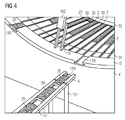
- Fig. 4 shows a detail of the magnet loading apparatus 1 of Fig. 1 , with the distribution ring 12 arranged adjacent to the rotor 3.
- the diagram shows a partially loaded rotor 3.
- Magnet pole pieces 20 of a first magnetic orientation (indicated by cross-hatching) have already been loaded into alternate rotor slots 30. Now, the magnet pole pieces of the opposite orientation (indicated by stippling) are being loaded.
- the diagram shows such a pole piece 20 at the end of a rotor slot 30.
- the diagram also indicates other possible elements of the assembly line.
- a conveyor 17 transports pole pieces 20 to the distribution ring 12.
- a feeder 15 comprising a holding slot 150 atop a horizontally and/or vertically moveable column 151 is fed with a pole piece 20 from the conveyor 17.
- the conveyor 17 and feeder 15 are shown for the sake of clarity at some distance from the ring 12.
- the feeder 15 could be positioned directly in front of the ring 12 so that a magnet pole piece 20 is not at risk of falling down.
- the distribution ring 12 can then be rotated by the amount necessary to bring the next empty holding slot 120 into place in front of the feeder 15.
- the holding slots 120 of the distribution ring 12 are shown to have a T-shaped cross-section.
- the slider wheel can be brought into position and the sliders 14 can be simultaneously actuated to push or slide the pole pieces 20 into the rotor slots 30.
- the sliders need only be moved by an amount sufficient to push the magnet pole pieces into the rotor slots 30.
- the sliders can also be actuated to move them further along the rotor slots 30, as shown here, so that the pole pieces 20 are pushed as far as possible towards the other end 32 of the rotor 3.
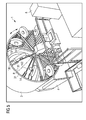
- Fig. 5 shows a magnet loading apparatus 1 according to a second embodiment of the invention.
- the magnet loading apparatus 1 comprises a plurality P of positioning heads 13 which are connected via spokes 161 to the hub 16.
- This spoked arrangement of P positioning heads 13 can be referred to as a "placement wheel”, and can rotate as indicated by the arrows.
- the plurality P is a divisor of the total number N of magnet poles to be loaded onto the rotor 3.
- Each positioning head 13 serves to lift a magnet pole piece 20 from the feeder (not shown here). Once a magnet pole piece 20 has been taken from the feeder 15, the positioning wheel is rotated to allow the next positioning head 13 to grab a magnet pole piece 20.
- each positioning head 13 can comprise an ejector or pushing element to push its magnet pole piece 20 into its designated rotor slot 30.
- the ejectors of the positioning heads are preferably controlled synchronously so that magnetic forces and weight of the pole pieces are evenly distributed during the transfer step.
- This embodiment of the magnet loading apparatus 1 could also comprise a slider arrangement 14, 162 as described above, for sliding the magnet pole pieces 20 further along the rotor slots 30, as shown here.
- a control unit 5 can issue appropriately timed control signals to the conveyer, the feeder, the hub 16, the positioning heads 13, the ejectors, and a sliding arrangement 14, 162 such that these act in a choreographed manner to carry out the loading procedure.
- a technician can monitor the loading procedure from a safe distance and can interact with the control unit 5 as appropriate.
- the various components - distribution ring, positioning wheel, feeder, ejector, slider wheel, etc. are all remotely controlled.
- a combination of the two embodiments above is conceivable, for example by using positioning heads to fill holding slots of a distribution ring, from which the pole pieces are moved by a slider arrangement into their respective rotor slots.
- a distribution ring could be realised to accommodate more than the plurality P of pole pieces, so that the distribution ring can be loaded with, for example, a multiple of the plurality P, while only one plurality P of pole pieces is transferred simultaneously onto the rotor in a transfer step, and the transfer step is completed until the distribution ring is empty once more.
- the present invention has been disclosed in the form of preferred embodiments and variations thereon, it will be understood that numerous additional modifications and variations could be made thereto without departing from the scope of the invention.
- the rotor instead of sliding the pole pieces in a horizontal direction into the rotor slots of a horizontal rotor, the rotor could be arranged vertically so that the pole pieces can be dropped into the vertical rotor slots.
Landscapes
- Engineering & Computer Science (AREA)
- Power Engineering (AREA)
- Manufacturing & Machinery (AREA)
- Permanent Field Magnets Of Synchronous Machinery (AREA)
- Manufacture Of Motors, Generators (AREA)
Priority Applications (6)
| Application Number | Priority Date | Filing Date | Title |
|---|---|---|---|
| EP11176163.1A EP2555393B1 (fr) | 2011-08-01 | 2011-08-01 | Appareil de chargement d'aimant |
| ES11176163.1T ES2439550T3 (es) | 2011-08-01 | 2011-08-01 | Aparato de carga de imán |
| DK11176163.1T DK2555393T3 (da) | 2011-08-01 | 2011-08-01 | Magnetladeapparatur |
| US13/562,987 US8800132B2 (en) | 2011-08-01 | 2012-07-31 | Magnet loading apparatus |
| KR1020120084163A KR102026720B1 (ko) | 2011-08-01 | 2012-07-31 | 자석 적재 장치 |
| CN201210334200.1A CN102916535B (zh) | 2011-08-01 | 2012-08-01 | 磁体装载装置 |
Applications Claiming Priority (1)
| Application Number | Priority Date | Filing Date | Title |
|---|---|---|---|
| EP11176163.1A EP2555393B1 (fr) | 2011-08-01 | 2011-08-01 | Appareil de chargement d'aimant |
Publications (2)
| Publication Number | Publication Date |
|---|---|
| EP2555393A1 true EP2555393A1 (fr) | 2013-02-06 |
| EP2555393B1 EP2555393B1 (fr) | 2013-11-20 |
Family
ID=45463201
Family Applications (1)
| Application Number | Title | Priority Date | Filing Date |
|---|---|---|---|
| EP11176163.1A Active EP2555393B1 (fr) | 2011-08-01 | 2011-08-01 | Appareil de chargement d'aimant |
Country Status (6)
| Country | Link |
|---|---|
| US (1) | US8800132B2 (fr) |
| EP (1) | EP2555393B1 (fr) |
| KR (1) | KR102026720B1 (fr) |
| CN (1) | CN102916535B (fr) |
| DK (1) | DK2555393T3 (fr) |
| ES (1) | ES2439550T3 (fr) |
Cited By (8)
| Publication number | Priority date | Publication date | Assignee | Title |
|---|---|---|---|---|
| EP2806533A1 (fr) * | 2013-05-23 | 2014-11-26 | Siemens Aktiengesellschaft | Machine électrique avec stator déformable |
| EP3624309A1 (fr) * | 2018-09-12 | 2020-03-18 | The Switch Drive Systems Oy | Modules à aimant permanent pour machine électrique |
| CN112928876A (zh) * | 2021-01-29 | 2021-06-08 | 重庆新炬鑫机械有限公司 | 飞轮磁钢快速粘合机 |
| WO2024177791A1 (fr) * | 2023-02-24 | 2024-08-29 | E-Circuit Motors, Inc. | Procédé et appareil de mise en place de segments d'aimant pour moteurs à flux axial |
| EP4447297A1 (fr) | 2023-04-11 | 2024-10-16 | Siemens Gamesa Renewable Energy A/S | Système et procédé de traitement d'éléments magnétiques d'un composant de générateur d'éolienne |
| EP4447295A1 (fr) | 2023-04-11 | 2024-10-16 | Siemens Gamesa Renewable Energy A/S | Système d'extraction et procédé d'extraction d'éléments magnétiques |
| US12176770B2 (en) | 2023-02-24 | 2024-12-24 | E-Circuit Motors, Inc. | Method for placing magnet segments for an axial flux machine |
| EP4554068A1 (fr) | 2023-11-07 | 2025-05-14 | Siemens Gamesa Renewable Energy A/S | Installation de modules d'aimant dans une maison de rotor |
Families Citing this family (4)
| Publication number | Priority date | Publication date | Assignee | Title |
|---|---|---|---|---|
| EP3258099A1 (fr) | 2016-06-16 | 2017-12-20 | Siemens Aktiengesellschaft | Retrait et installation de composants de stator d'un générateur d'éolienne par l'intermédiaire d'un moyeu d'éolienne |
| DE102018109706B4 (de) * | 2018-04-23 | 2024-05-08 | Emil Schmid Maschinenbau GmbH & Co. KG | Bestückungsstation zur Bestückung einer Rotoreinheit oder eines Hilfswerkzeugs mit Magnetelementen und Verfahren zum Bestücken einer ringförmigen Rotoreinheit für einen Elektromotor mit Magnetelementen |
| CN111987870B (zh) * | 2019-05-23 | 2023-03-24 | 北京金风科创风电设备有限公司 | 大直径电机的装配方法 |
| CN119134821B (zh) * | 2024-09-05 | 2025-09-30 | 重庆虎溪电机工业有限责任公司 | 一种辅助电机主极磁钢粘接的装置及粘接方法 |
Citations (2)
| Publication number | Priority date | Publication date | Assignee | Title |
|---|---|---|---|---|
| DE102008063045A1 (de) * | 2008-12-23 | 2010-07-01 | Aerodyn Energiesysteme Gmbh | Synchronmaschine |
| EP2348619A1 (fr) * | 2010-01-20 | 2011-07-27 | Siemens Aktiengesellschaft | Ensemble d'aimants |
Family Cites Families (19)
| Publication number | Priority date | Publication date | Assignee | Title |
|---|---|---|---|---|
| US2494349A (en) * | 1946-08-21 | 1950-01-10 | Gen Electric | Method and means for forming stacked magnetic cores |
| US4144637A (en) * | 1977-01-05 | 1979-03-20 | Institut Fiziki Akademii Nauk Latviiskoi Ssr | Device for making sets of nonmagnetic current-conducting components |
| US4850100A (en) * | 1987-12-23 | 1989-07-25 | General Electric Company | Method of making a rotor assembly |
| JP3804726B2 (ja) * | 1998-05-18 | 2006-08-02 | 日本精工株式会社 | ワンウェイクラッチの製造方法及び製造装置 |
| US6452301B1 (en) * | 2001-11-02 | 2002-09-17 | Electric Boat Corporation | Magnet retention arrangement for high speed rotors |
| JP3960220B2 (ja) * | 2002-12-16 | 2007-08-15 | 株式会社デンソー | 回転電機の磁石式固定子の組付け方法 |
| JP4599088B2 (ja) * | 2004-05-13 | 2010-12-15 | 東芝コンシューマエレクトロニクス・ホールディングス株式会社 | 回転電機の回転子及びその製造方法 |
| JP4187255B2 (ja) | 2005-03-14 | 2008-11-26 | Tdk株式会社 | アクチュエータの製造方法及び製造装置 |
| EP1748533B1 (fr) * | 2005-07-29 | 2010-09-01 | Siemens Aktiengesellschaft | Rotor à aimants permanents pour machine électrique sans balais |
| DE102005048546A1 (de) * | 2005-10-11 | 2007-04-12 | Robert Bosch Gmbh | Rotor für eine elektrische Maschine |
| WO2008070984A1 (fr) * | 2006-12-12 | 2008-06-19 | Tm4 Inc. | Ensemble de rotor à aimant permanent |
| MX2009008346A (es) * | 2007-02-06 | 2009-08-20 | Honda Motor Co Ltd | Motor, estructura de rotor y maquina magnetica. |
| CN101589537A (zh) * | 2007-02-06 | 2009-11-25 | 本田技研工业株式会社 | 电动机、转子构造及磁设备 |
| US7646124B2 (en) * | 2007-02-15 | 2010-01-12 | Hamilton Sundstrand Corporation | Magnet retention system for permanent magnet motors and generators |
| JP5454753B2 (ja) * | 2008-04-21 | 2014-03-26 | 株式会社ジェイテクト | モーターのローター及び電動パワーステアリング装置 |
| JP5308867B2 (ja) * | 2009-02-26 | 2013-10-09 | 信越化学工業株式会社 | 永久磁石回転機用回転盤及び永久磁石回転機の製造方法 |
| US9515529B2 (en) * | 2009-08-18 | 2016-12-06 | Northern Power Systems, Inc. | Method and apparatus for permanent magnet attachment in an electromechanical machine |
| EP2348612A1 (fr) * | 2010-01-20 | 2011-07-27 | Siemens Aktiengesellschaft | Pièce de composant magnétique pour ensemble de rotor |
| EP2555384B1 (fr) * | 2011-08-01 | 2016-06-29 | Siemens Aktiengesellschaft | Structure de champ d'une machine électrique |
-
2011
- 2011-08-01 DK DK11176163.1T patent/DK2555393T3/da active
- 2011-08-01 ES ES11176163.1T patent/ES2439550T3/es active Active
- 2011-08-01 EP EP11176163.1A patent/EP2555393B1/fr active Active
-
2012
- 2012-07-31 KR KR1020120084163A patent/KR102026720B1/ko active Active
- 2012-07-31 US US13/562,987 patent/US8800132B2/en active Active
- 2012-08-01 CN CN201210334200.1A patent/CN102916535B/zh active Active
Patent Citations (2)
| Publication number | Priority date | Publication date | Assignee | Title |
|---|---|---|---|---|
| DE102008063045A1 (de) * | 2008-12-23 | 2010-07-01 | Aerodyn Energiesysteme Gmbh | Synchronmaschine |
| EP2348619A1 (fr) * | 2010-01-20 | 2011-07-27 | Siemens Aktiengesellschaft | Ensemble d'aimants |
Cited By (13)
| Publication number | Priority date | Publication date | Assignee | Title |
|---|---|---|---|---|
| EP2806533A1 (fr) * | 2013-05-23 | 2014-11-26 | Siemens Aktiengesellschaft | Machine électrique avec stator déformable |
| EP3624309A1 (fr) * | 2018-09-12 | 2020-03-18 | The Switch Drive Systems Oy | Modules à aimant permanent pour machine électrique |
| US11251667B2 (en) | 2018-09-12 | 2022-02-15 | The Switch Drive Systems Oy | Permanent magnet modules for an electric machine having axially and circumferentially offset permanent magnet elements, a rotor, permanent magnet electric machine, and a method for assembling thereof |
| CN112928876A (zh) * | 2021-01-29 | 2021-06-08 | 重庆新炬鑫机械有限公司 | 飞轮磁钢快速粘合机 |
| CN112928876B (zh) * | 2021-01-29 | 2022-09-06 | 重庆新炬鑫机械有限公司 | 飞轮磁钢快速粘合机 |
| US12176770B2 (en) | 2023-02-24 | 2024-12-24 | E-Circuit Motors, Inc. | Method for placing magnet segments for an axial flux machine |
| WO2024177791A1 (fr) * | 2023-02-24 | 2024-08-29 | E-Circuit Motors, Inc. | Procédé et appareil de mise en place de segments d'aimant pour moteurs à flux axial |
| EP4447297A1 (fr) | 2023-04-11 | 2024-10-16 | Siemens Gamesa Renewable Energy A/S | Système et procédé de traitement d'éléments magnétiques d'un composant de générateur d'éolienne |
| WO2024213358A1 (fr) | 2023-04-11 | 2024-10-17 | Siemens Gamesa Renewable Energy A/S | Système d'extraction et procédé d'extraction d'éléments magnétiques |
| WO2024213338A1 (fr) | 2023-04-11 | 2024-10-17 | Siemens Gamesa Renewable Energy A/S | Système et procédé de traitement d'éléments magnétiques d'un composant de générateur d'éolienne |
| EP4447295A1 (fr) | 2023-04-11 | 2024-10-16 | Siemens Gamesa Renewable Energy A/S | Système d'extraction et procédé d'extraction d'éléments magnétiques |
| EP4554068A1 (fr) | 2023-11-07 | 2025-05-14 | Siemens Gamesa Renewable Energy A/S | Installation de modules d'aimant dans une maison de rotor |
| WO2025098776A1 (fr) | 2023-11-07 | 2025-05-15 | Siemens Gamesa Renewable Energy A/S | Installation de modules à aimants au niveau d'un logement de rotor |
Also Published As
| Publication number | Publication date |
|---|---|
| ES2439550T3 (es) | 2014-01-23 |
| CN102916535B (zh) | 2016-12-21 |
| CN102916535A (zh) | 2013-02-06 |
| DK2555393T3 (da) | 2013-12-02 |
| US20130202399A1 (en) | 2013-08-08 |
| EP2555393B1 (fr) | 2013-11-20 |
| KR102026720B1 (ko) | 2019-09-30 |
| US8800132B2 (en) | 2014-08-12 |
| KR20130018571A (ko) | 2013-02-25 |
Similar Documents
| Publication | Publication Date | Title |
|---|---|---|
| EP2555393B1 (fr) | Appareil de chargement d'aimant | |
| CN102714450B (zh) | 磁体组件 | |
| CN102714436B (zh) | 用于在电动机械中进行永磁连接的方法和设备 | |
| JP5145406B2 (ja) | 永久磁石ロータ取付けシステム | |
| CN103944325B (zh) | 一种安装电机转子磁钢片的自动化设备 | |
| AU2009328799A1 (en) | Generator for a wind energy installation and method for its production | |
| EP2282397B1 (fr) | Procédé et appareil pour activer une machine électrique et machine électrique | |
| US10742099B2 (en) | Arrangement for mounting a magnet to an electric machine | |
| EP2661799B1 (fr) | Générateur de turbine éolienne comprenant des sous-unités de stator mobiles | |
| CN101009152A (zh) | 用于装配电磁机械的系统和方法 | |
| WO2014072338A1 (fr) | Générateur destiné à une éolienne | |
| CN109802531A (zh) | 一种用于永磁同步电机生产的磁钢加工装置及方法 | |
| EP2611007A3 (fr) | Générateur de moteur synchrone supraconducteur | |
| WO2015173734A1 (fr) | Machine à aimant permanent à flux radial | |
| CN205986547U (zh) | 用于电机转子装配的导向器 | |
| CN101351946A (zh) | 高速组装致动器 | |
| JP2021197903A (ja) | 永久磁石の磁化 | |
| US20110248593A1 (en) | Permanent Magnet Rotor for Axial Airgap Motor | |
| CN118367732A (zh) | 一种电机自动组装设备及其生产线 | |
| CN102545423A (zh) | 横向磁场永磁电机 | |
| CN110171744B (zh) | 一种定子上下料装置及方法 | |
| EP3454348A1 (fr) | Procédé de fabrication d'un ensemble d'aimants pour une machine électrique et ensemble d'aimants | |
| WO2024213358A1 (fr) | Système d'extraction et procédé d'extraction d'éléments magnétiques | |
| EP4529002A1 (fr) | Procédé et dispositif pour actionner une machine électrique tournante | |
| CN202019249U (zh) | 横向磁场永磁电机 |
Legal Events
| Date | Code | Title | Description |
|---|---|---|---|
| PUAI | Public reference made under article 153(3) epc to a published international application that has entered the european phase |
Free format text: ORIGINAL CODE: 0009012 |
|
| AK | Designated contracting states |
Kind code of ref document: A1 Designated state(s): AL AT BE BG CH CY CZ DE DK EE ES FI FR GB GR HR HU IE IS IT LI LT LU LV MC MK MT NL NO PL PT RO RS SE SI SK SM TR |
|
| AX | Request for extension of the european patent |
Extension state: BA ME |
|
| RAP1 | Party data changed (applicant data changed or rights of an application transferred) |
Owner name: SIEMENS AKTIENGESELLSCHAFT |
|
| 17P | Request for examination filed |
Effective date: 20130319 |
|
| RIC1 | Information provided on ipc code assigned before grant |
Ipc: H02K 15/03 20060101AFI20130412BHEP Ipc: H02K 1/27 20060101ALI20130412BHEP Ipc: H02K 7/18 20060101ALI20130412BHEP |
|
| GRAP | Despatch of communication of intention to grant a patent |
Free format text: ORIGINAL CODE: EPIDOSNIGR1 |
|
| INTG | Intention to grant announced |
Effective date: 20130621 |
|
| GRAS | Grant fee paid |
Free format text: ORIGINAL CODE: EPIDOSNIGR3 |
|
| GRAA | (expected) grant |
Free format text: ORIGINAL CODE: 0009210 |
|
| AK | Designated contracting states |
Kind code of ref document: B1 Designated state(s): AL AT BE BG CH CY CZ DE DK EE ES FI FR GB GR HR HU IE IS IT LI LT LU LV MC MK MT NL NO PL PT RO RS SE SI SK SM TR |
|
| REG | Reference to a national code |
Ref country code: GB Ref legal event code: FG4D |
|
| REG | Reference to a national code |
Ref country code: CH Ref legal event code: EP |
|
| REG | Reference to a national code |
Ref country code: DK Ref legal event code: T3 Effective date: 20131128 |
|
| REG | Reference to a national code |
Ref country code: AT Ref legal event code: REF Ref document number: 642131 Country of ref document: AT Kind code of ref document: T Effective date: 20131215 |
|
| REG | Reference to a national code |
Ref country code: IE Ref legal event code: FG4D |
|
| REG | Reference to a national code |
Ref country code: DE Ref legal event code: R096 Ref document number: 602011003823 Country of ref document: DE Effective date: 20140123 Ref country code: ES Ref legal event code: FG2A Ref document number: 2439550 Country of ref document: ES Kind code of ref document: T3 Effective date: 20140123 |
|
| REG | Reference to a national code |
Ref country code: NL Ref legal event code: T3 |
|
| REG | Reference to a national code |
Ref country code: AT Ref legal event code: MK05 Ref document number: 642131 Country of ref document: AT Kind code of ref document: T Effective date: 20131120 |
|
| REG | Reference to a national code |
Ref country code: LT Ref legal event code: MG4D |
|
| PG25 | Lapsed in a contracting state [announced via postgrant information from national office to epo] |
Ref country code: SE Free format text: LAPSE BECAUSE OF FAILURE TO SUBMIT A TRANSLATION OF THE DESCRIPTION OR TO PAY THE FEE WITHIN THE PRESCRIBED TIME-LIMIT Effective date: 20131120 Ref country code: LT Free format text: LAPSE BECAUSE OF FAILURE TO SUBMIT A TRANSLATION OF THE DESCRIPTION OR TO PAY THE FEE WITHIN THE PRESCRIBED TIME-LIMIT Effective date: 20131120 Ref country code: NO Free format text: LAPSE BECAUSE OF FAILURE TO SUBMIT A TRANSLATION OF THE DESCRIPTION OR TO PAY THE FEE WITHIN THE PRESCRIBED TIME-LIMIT Effective date: 20140220 Ref country code: FI Free format text: LAPSE BECAUSE OF FAILURE TO SUBMIT A TRANSLATION OF THE DESCRIPTION OR TO PAY THE FEE WITHIN THE PRESCRIBED TIME-LIMIT Effective date: 20131120 Ref country code: IS Free format text: LAPSE BECAUSE OF FAILURE TO SUBMIT A TRANSLATION OF THE DESCRIPTION OR TO PAY THE FEE WITHIN THE PRESCRIBED TIME-LIMIT Effective date: 20140320 Ref country code: HR Free format text: LAPSE BECAUSE OF FAILURE TO SUBMIT A TRANSLATION OF THE DESCRIPTION OR TO PAY THE FEE WITHIN THE PRESCRIBED TIME-LIMIT Effective date: 20131120 |
|
| PG25 | Lapsed in a contracting state [announced via postgrant information from national office to epo] |
Ref country code: AT Free format text: LAPSE BECAUSE OF FAILURE TO SUBMIT A TRANSLATION OF THE DESCRIPTION OR TO PAY THE FEE WITHIN THE PRESCRIBED TIME-LIMIT Effective date: 20131120 Ref country code: BE Free format text: LAPSE BECAUSE OF FAILURE TO SUBMIT A TRANSLATION OF THE DESCRIPTION OR TO PAY THE FEE WITHIN THE PRESCRIBED TIME-LIMIT Effective date: 20131120 Ref country code: LV Free format text: LAPSE BECAUSE OF FAILURE TO SUBMIT A TRANSLATION OF THE DESCRIPTION OR TO PAY THE FEE WITHIN THE PRESCRIBED TIME-LIMIT Effective date: 20131120 Ref country code: RS Free format text: LAPSE BECAUSE OF FAILURE TO SUBMIT A TRANSLATION OF THE DESCRIPTION OR TO PAY THE FEE WITHIN THE PRESCRIBED TIME-LIMIT Effective date: 20131120 |
|
| PG25 | Lapsed in a contracting state [announced via postgrant information from national office to epo] |
Ref country code: PT Free format text: LAPSE BECAUSE OF FAILURE TO SUBMIT A TRANSLATION OF THE DESCRIPTION OR TO PAY THE FEE WITHIN THE PRESCRIBED TIME-LIMIT Effective date: 20140320 |
|
| PG25 | Lapsed in a contracting state [announced via postgrant information from national office to epo] |
Ref country code: EE Free format text: LAPSE BECAUSE OF FAILURE TO SUBMIT A TRANSLATION OF THE DESCRIPTION OR TO PAY THE FEE WITHIN THE PRESCRIBED TIME-LIMIT Effective date: 20131120 |
|
| REG | Reference to a national code |
Ref country code: DE Ref legal event code: R097 Ref document number: 602011003823 Country of ref document: DE |
|
| PG25 | Lapsed in a contracting state [announced via postgrant information from national office to epo] |
Ref country code: RO Free format text: LAPSE BECAUSE OF FAILURE TO SUBMIT A TRANSLATION OF THE DESCRIPTION OR TO PAY THE FEE WITHIN THE PRESCRIBED TIME-LIMIT Effective date: 20131120 Ref country code: CZ Free format text: LAPSE BECAUSE OF FAILURE TO SUBMIT A TRANSLATION OF THE DESCRIPTION OR TO PAY THE FEE WITHIN THE PRESCRIBED TIME-LIMIT Effective date: 20131120 Ref country code: SK Free format text: LAPSE BECAUSE OF FAILURE TO SUBMIT A TRANSLATION OF THE DESCRIPTION OR TO PAY THE FEE WITHIN THE PRESCRIBED TIME-LIMIT Effective date: 20131120 Ref country code: PL Free format text: LAPSE BECAUSE OF FAILURE TO SUBMIT A TRANSLATION OF THE DESCRIPTION OR TO PAY THE FEE WITHIN THE PRESCRIBED TIME-LIMIT Effective date: 20131120 |
|
| PLBE | No opposition filed within time limit |
Free format text: ORIGINAL CODE: 0009261 |
|
| STAA | Information on the status of an ep patent application or granted ep patent |
Free format text: STATUS: NO OPPOSITION FILED WITHIN TIME LIMIT |
|
| 26N | No opposition filed |
Effective date: 20140821 |
|
| REG | Reference to a national code |
Ref country code: DE Ref legal event code: R097 Ref document number: 602011003823 Country of ref document: DE Effective date: 20140821 |
|
| PG25 | Lapsed in a contracting state [announced via postgrant information from national office to epo] |
Ref country code: SI Free format text: LAPSE BECAUSE OF FAILURE TO SUBMIT A TRANSLATION OF THE DESCRIPTION OR TO PAY THE FEE WITHIN THE PRESCRIBED TIME-LIMIT Effective date: 20131120 |
|
| PG25 | Lapsed in a contracting state [announced via postgrant information from national office to epo] |
Ref country code: MC Free format text: LAPSE BECAUSE OF FAILURE TO SUBMIT A TRANSLATION OF THE DESCRIPTION OR TO PAY THE FEE WITHIN THE PRESCRIBED TIME-LIMIT Effective date: 20131120 Ref country code: LU Free format text: LAPSE BECAUSE OF FAILURE TO SUBMIT A TRANSLATION OF THE DESCRIPTION OR TO PAY THE FEE WITHIN THE PRESCRIBED TIME-LIMIT Effective date: 20140801 |
|
| REG | Reference to a national code |
Ref country code: CH Ref legal event code: PL |
|
| PG25 | Lapsed in a contracting state [announced via postgrant information from national office to epo] |
Ref country code: LI Free format text: LAPSE BECAUSE OF NON-PAYMENT OF DUE FEES Effective date: 20140831 Ref country code: CH Free format text: LAPSE BECAUSE OF NON-PAYMENT OF DUE FEES Effective date: 20140831 |
|
| REG | Reference to a national code |
Ref country code: IE Ref legal event code: MM4A |
|
| PG25 | Lapsed in a contracting state [announced via postgrant information from national office to epo] |
Ref country code: IE Free format text: LAPSE BECAUSE OF NON-PAYMENT OF DUE FEES Effective date: 20140801 |
|
| PG25 | Lapsed in a contracting state [announced via postgrant information from national office to epo] |
Ref country code: SM Free format text: LAPSE BECAUSE OF FAILURE TO SUBMIT A TRANSLATION OF THE DESCRIPTION OR TO PAY THE FEE WITHIN THE PRESCRIBED TIME-LIMIT Effective date: 20131120 |
|
| PG25 | Lapsed in a contracting state [announced via postgrant information from national office to epo] |
Ref country code: BG Free format text: LAPSE BECAUSE OF FAILURE TO SUBMIT A TRANSLATION OF THE DESCRIPTION OR TO PAY THE FEE WITHIN THE PRESCRIBED TIME-LIMIT Effective date: 20131120 Ref country code: CY Free format text: LAPSE BECAUSE OF FAILURE TO SUBMIT A TRANSLATION OF THE DESCRIPTION OR TO PAY THE FEE WITHIN THE PRESCRIBED TIME-LIMIT Effective date: 20131120 Ref country code: GR Free format text: LAPSE BECAUSE OF FAILURE TO SUBMIT A TRANSLATION OF THE DESCRIPTION OR TO PAY THE FEE WITHIN THE PRESCRIBED TIME-LIMIT Effective date: 20140221 Ref country code: MT Free format text: LAPSE BECAUSE OF FAILURE TO SUBMIT A TRANSLATION OF THE DESCRIPTION OR TO PAY THE FEE WITHIN THE PRESCRIBED TIME-LIMIT Effective date: 20131120 |
|
| PG25 | Lapsed in a contracting state [announced via postgrant information from national office to epo] |
Ref country code: HU Free format text: LAPSE BECAUSE OF FAILURE TO SUBMIT A TRANSLATION OF THE DESCRIPTION OR TO PAY THE FEE WITHIN THE PRESCRIBED TIME-LIMIT; INVALID AB INITIO Effective date: 20110801 |
|
| REG | Reference to a national code |
Ref country code: FR Ref legal event code: PLFP Year of fee payment: 6 |
|
| REG | Reference to a national code |
Ref country code: FR Ref legal event code: PLFP Year of fee payment: 7 |
|
| PG25 | Lapsed in a contracting state [announced via postgrant information from national office to epo] |
Ref country code: MK Free format text: LAPSE BECAUSE OF FAILURE TO SUBMIT A TRANSLATION OF THE DESCRIPTION OR TO PAY THE FEE WITHIN THE PRESCRIBED TIME-LIMIT Effective date: 20131120 |
|
| REG | Reference to a national code |
Ref country code: FR Ref legal event code: PLFP Year of fee payment: 8 |
|
| PG25 | Lapsed in a contracting state [announced via postgrant information from national office to epo] |
Ref country code: AL Free format text: LAPSE BECAUSE OF FAILURE TO SUBMIT A TRANSLATION OF THE DESCRIPTION OR TO PAY THE FEE WITHIN THE PRESCRIBED TIME-LIMIT Effective date: 20131120 |
|
| PGFP | Annual fee paid to national office [announced via postgrant information from national office to epo] |
Ref country code: CH Payment date: 20180713 Year of fee payment: 10 |
|
| REG | Reference to a national code |
Ref country code: DE Ref legal event code: R081 Ref document number: 602011003823 Country of ref document: DE Owner name: SIEMENS GAMESA RENEWABLE ENERGY A/S, DK Free format text: FORMER OWNER: SIEMENS AKTIENGESELLSCHAFT, 80333 MUENCHEN, DE |
|
| REG | Reference to a national code |
Ref country code: GB Ref legal event code: 732E Free format text: REGISTERED BETWEEN 20191128 AND 20191204 |
|
| PG25 | Lapsed in a contracting state [announced via postgrant information from national office to epo] |
Ref country code: IT Free format text: LAPSE BECAUSE OF NON-PAYMENT OF DUE FEES Effective date: 20190801 |
|
| REG | Reference to a national code |
Ref country code: NL Ref legal event code: PD Owner name: SIEMENS GAMESA RENEWABLE ENERGY A/S; DK Free format text: DETAILS ASSIGNMENT: CHANGE OF OWNER(S), ASSIGNMENT; FORMER OWNER NAME: SIEMENS AKTIENGESELLSCHAFT Effective date: 20201126 |
|
| REG | Reference to a national code |
Ref country code: ES Ref legal event code: PC2A Owner name: SIEMENS GAMESA RENEWABLE ENERGY A/S Effective date: 20210311 |
|
| REG | Reference to a national code |
Ref country code: FR Ref legal event code: PLFP Year of fee payment: 12 |
|
| PGFP | Annual fee paid to national office [announced via postgrant information from national office to epo] |
Ref country code: NL Payment date: 20240826 Year of fee payment: 14 |
|
| PGFP | Annual fee paid to national office [announced via postgrant information from national office to epo] |
Ref country code: DK Payment date: 20240826 Year of fee payment: 14 |
|
| PGFP | Annual fee paid to national office [announced via postgrant information from national office to epo] |
Ref country code: ES Payment date: 20240918 Year of fee payment: 14 |
|
| PGFP | Annual fee paid to national office [announced via postgrant information from national office to epo] |
Ref country code: TR Payment date: 20240712 Year of fee payment: 14 |
|
| PGFP | Annual fee paid to national office [announced via postgrant information from national office to epo] |
Ref country code: FR Payment date: 20250825 Year of fee payment: 15 |
|
| PGFP | Annual fee paid to national office [announced via postgrant information from national office to epo] |
Ref country code: GB Payment date: 20251223 Year of fee payment: 15 |
|
| REG | Reference to a national code |
Ref country code: DK Ref legal event code: EBP Effective date: 20250831 |
|
| REG | Reference to a national code |
Ref country code: NL Ref legal event code: MM Effective date: 20250901 |
|
| PGFP | Annual fee paid to national office [announced via postgrant information from national office to epo] |
Ref country code: DE Payment date: 20251229 Year of fee payment: 15 |