EP2556650B1 - Surveillance de patient sur des réseaux hétérogènes - Google Patents
Surveillance de patient sur des réseaux hétérogènes Download PDFInfo
- Publication number
- EP2556650B1 EP2556650B1 EP11713366.0A EP11713366A EP2556650B1 EP 2556650 B1 EP2556650 B1 EP 2556650B1 EP 11713366 A EP11713366 A EP 11713366A EP 2556650 B1 EP2556650 B1 EP 2556650B1
- Authority
- EP
- European Patent Office
- Prior art keywords
- data packets
- packet
- patient
- data
- packets
- Prior art date
- Legal status (The legal status is an assumption and is not a legal conclusion. Google has not performed a legal analysis and makes no representation as to the accuracy of the status listed.)
- Active
Links
Images







Classifications
-
- H—ELECTRICITY
- H04—ELECTRIC COMMUNICATION TECHNIQUE
- H04L—TRANSMISSION OF DIGITAL INFORMATION, e.g. TELEGRAPHIC COMMUNICATION
- H04L67/00—Network arrangements or protocols for supporting network services or applications
- H04L67/01—Protocols
- H04L67/06—Protocols specially adapted for file transfer, e.g. file transfer protocol [FTP]
-
- G—PHYSICS
- G16—INFORMATION AND COMMUNICATION TECHNOLOGY [ICT] SPECIALLY ADAPTED FOR SPECIFIC APPLICATION FIELDS
- G16H—HEALTHCARE INFORMATICS, i.e. INFORMATION AND COMMUNICATION TECHNOLOGY [ICT] SPECIALLY ADAPTED FOR THE HANDLING OR PROCESSING OF MEDICAL OR HEALTHCARE DATA
- G16H40/00—ICT specially adapted for the management or administration of healthcare resources or facilities; ICT specially adapted for the management or operation of medical equipment or devices
- G16H40/60—ICT specially adapted for the management or administration of healthcare resources or facilities; ICT specially adapted for the management or operation of medical equipment or devices for the operation of medical equipment or devices
- G16H40/67—ICT specially adapted for the management or administration of healthcare resources or facilities; ICT specially adapted for the management or operation of medical equipment or devices for the operation of medical equipment or devices for remote operation
-
- H—ELECTRICITY
- H04—ELECTRIC COMMUNICATION TECHNIQUE
- H04L—TRANSMISSION OF DIGITAL INFORMATION, e.g. TELEGRAPHIC COMMUNICATION
- H04L67/00—Network arrangements or protocols for supporting network services or applications
- H04L67/01—Protocols
- H04L67/12—Protocols specially adapted for proprietary or special-purpose networking environments, e.g. medical networks, sensor networks, networks in vehicles or remote metering networks
-
- H—ELECTRICITY
- H04—ELECTRIC COMMUNICATION TECHNIQUE
- H04L—TRANSMISSION OF DIGITAL INFORMATION, e.g. TELEGRAPHIC COMMUNICATION
- H04L67/00—Network arrangements or protocols for supporting network services or applications
- H04L67/50—Network services
- H04L67/56—Provisioning of proxy services
- H04L67/565—Conversion or adaptation of application format or content
-
- H—ELECTRICITY
- H04—ELECTRIC COMMUNICATION TECHNIQUE
- H04L—TRANSMISSION OF DIGITAL INFORMATION, e.g. TELEGRAPHIC COMMUNICATION
- H04L69/00—Network arrangements, protocols or services independent of the application payload and not provided for in the other groups of this subclass
- H04L69/14—Multichannel or multilink protocols
-
- H—ELECTRICITY
- H04—ELECTRIC COMMUNICATION TECHNIQUE
- H04L—TRANSMISSION OF DIGITAL INFORMATION, e.g. TELEGRAPHIC COMMUNICATION
- H04L69/00—Network arrangements, protocols or services independent of the application payload and not provided for in the other groups of this subclass
- H04L69/16—Implementation or adaptation of Internet protocol [IP], of transmission control protocol [TCP] or of user datagram protocol [UDP]
-
- H—ELECTRICITY
- H04—ELECTRIC COMMUNICATION TECHNIQUE
- H04L—TRANSMISSION OF DIGITAL INFORMATION, e.g. TELEGRAPHIC COMMUNICATION
- H04L69/00—Network arrangements, protocols or services independent of the application payload and not provided for in the other groups of this subclass
- H04L69/16—Implementation or adaptation of Internet protocol [IP], of transmission control protocol [TCP] or of user datagram protocol [UDP]
- H04L69/161—Implementation details of TCP/IP or UDP/IP stack architecture; Specification of modified or new header fields
-
- H—ELECTRICITY
- H04—ELECTRIC COMMUNICATION TECHNIQUE
- H04L—TRANSMISSION OF DIGITAL INFORMATION, e.g. TELEGRAPHIC COMMUNICATION
- H04L69/00—Network arrangements, protocols or services independent of the application payload and not provided for in the other groups of this subclass
- H04L69/18—Multiprotocol handlers, e.g. single devices capable of handling multiple protocols
-
- H—ELECTRICITY
- H04—ELECTRIC COMMUNICATION TECHNIQUE
- H04L—TRANSMISSION OF DIGITAL INFORMATION, e.g. TELEGRAPHIC COMMUNICATION
- H04L69/00—Network arrangements, protocols or services independent of the application payload and not provided for in the other groups of this subclass
- H04L69/16—Implementation or adaptation of Internet protocol [IP], of transmission control protocol [TCP] or of user datagram protocol [UDP]
- H04L69/166—IP fragmentation; TCP segmentation
-
- H—ELECTRICITY
- H04—ELECTRIC COMMUNICATION TECHNIQUE
- H04L—TRANSMISSION OF DIGITAL INFORMATION, e.g. TELEGRAPHIC COMMUNICATION
- H04L69/00—Network arrangements, protocols or services independent of the application payload and not provided for in the other groups of this subclass
- H04L69/22—Parsing or analysis of headers
-
- Y—GENERAL TAGGING OF NEW TECHNOLOGICAL DEVELOPMENTS; GENERAL TAGGING OF CROSS-SECTIONAL TECHNOLOGIES SPANNING OVER SEVERAL SECTIONS OF THE IPC; TECHNICAL SUBJECTS COVERED BY FORMER USPC CROSS-REFERENCE ART COLLECTIONS [XRACs] AND DIGESTS
- Y02—TECHNOLOGIES OR APPLICATIONS FOR MITIGATION OR ADAPTATION AGAINST CLIMATE CHANGE
- Y02D—CLIMATE CHANGE MITIGATION TECHNOLOGIES IN INFORMATION AND COMMUNICATION TECHNOLOGIES [ICT], I.E. INFORMATION AND COMMUNICATION TECHNOLOGIES AIMING AT THE REDUCTION OF THEIR OWN ENERGY USE
- Y02D30/00—Reducing energy consumption in communication networks
- Y02D30/50—Reducing energy consumption in communication networks in wire-line communication networks, e.g. low power modes or reduced link rate
Definitions
- the following relates to the medical arts, communication arts and related arts. It finds particular application in improving the communication in medical monitoring systems, medical alarm systems, and the like, through underlying networks in hospitals, urgent care centers, homes, nursing homes, assisted care facilities, emergency medical transportation vehicles and systems, and the like.
- patient monitoring systems include one or more patient monitoring devices (PMD), a patient information display and storage system, and auxiliary patient information display systems.
- PMD patient monitoring devices
- a patient information display system where the patient's physiological data is displayed or to a patient data storage system that stores the patient's physiological data.
- the patient's physiological data can also be viewed on auxiliary patient information display systems. For example, a nurse may view a patient's physiological data on another patient's bedside monitor, a central monitoring station, a PDA, or the like.
- the data transmission from the PMD to the patient information display and storage systems or from the patient information display and storage systems to auxiliary patient information display system traverses local area networks such as an Ethernet, IEEE802.11, and other Internet Protocol (IP) centric access networks (General Packet Radio Service (GPRS), CDMA 2000, Wireless LAN, mobile WIMAX).
- IP Internet Protocol
- connecting to a different network typically results in assigning a new IP address to the PMDs or the patient information display and storage systems or the auxiliary patient information display systems.
- a new IP address could also be assigned if a network connection is re-established due to earlier dropout of the connection on the same network.
- Reassignment of a different IP address to a PMD or an auxiliary patient information display system could result in a discontinuity of data being transmitted to/from patient data display and storage systems due to breaks in underlying communication sessions. More importantly, the discontinuity could result in not detecting patient's adverse health condition for timely action by clinicians.
- Another problem occurs when mobile PMDs or auxiliary information display systems are moved behind firewalls. Typically, firewalls have Network Address Translators (NATs) which can alter the IP addresses and port numbers assigned to the PMDs or auxiliary information display systems. The resulting ambiguity in IP addresses or port numbers often results in session establishment failures with the other communicating party. A failure in connection establishment leads to discontinuity of data being transmitted to/from the patient data display and storage systems.
- NATs Network Address Translators
- For a network which has higher bit error rates it is more advantageous to transmit smaller packets and less inter-packet arrival rates.
- networks which have low bit error rate it is more advantageous to transmit bigger packets with large packet inter-arrival rate. Therefore, for a given network, there is an optimal packet size and inter packet generation delay for a given network characteristics.
- WO 2004/109992 discloses a method of controlling wireless data transmission by switching between short-range and long-range radio technologies.
- US 2003/1000308 discloses a device and method for intelligent wireless communication selection. Further prior art is found in "Wireless communication in telemedicine using Bluetooth and IEEE 802.11b" by Magnus Berggren.
- the present application provides new and improved patient monitoring systems and methods which overcomes the above-referenced problems and others.
- a method for transmitting physiological data is provided.
- a communication link is established between a multi-mode patient monitoring device and a plurality of Internet protocol (IP) networks.
- IP Internet protocol
- Physiological data is collected by the patient monitoring device.
- Data packets are generated from the collected physiological data.
- the generated data packets are duplicated.
- the duplicated data packets are transmitted over the plurality of networks.
- the transmitted duplicated data packets are received and a single set of data from the duplicated data packets is forwarded to an end application.
- a patient monitor collects patient data about a patient.
- a packet generator generates data packets from the patient data collected from the patient.
- a communication unit transmits the data packets over an Internet protocol (IP) network, wherein the communication unit includes a first transmitter for transmitting the data packets using a first wireless network and a second transmitter for transmitting the data packets using a second wireless network.
- IP Internet protocol
- One advantage resides in the consistent delivery of physiological data using existing wireless and wired infrastructures.
- Another advantage resides in optimized power consumption, network utilization, and quality of service in the delivery of physiological data using existing wireless infrastructure.
- the invention may take form in various components and arrangements of components, and in various steps and arrangements of steps.
- the drawings are only for purposes of illustrating the preferred embodiments and are not to be construed as limiting the invention.
- a patient is monitored by various medical monitoring devices or sensors 10 that measure physiological parameters of the patient and generate physiological data indicative thereof.
- These medical monitoring devices 10 may include an electrocardiographic (ECG) instrument with ECG electrodes, and a wrist-based medical monitor, which may for example be configured to monitor blood pressure, blood oxygenation (Sp02), pulse, or one or more other physiological parameters.
- ECG electrocardiographic
- Sp02 blood oxygenation
- Other medical monitoring devices 10 can be associated with a patient, and not all of the above-mentioned medical monitoring devices 10 have to be associated with a patient at any given time. It should be appreciated that while only two medical monitoring devices 10 are illustrated, more medical monitoring devices are contemplated.
- medical monitoring devices signify data sources indicating patient health, such as devices that monitor pulse, blood oxygen, ECG, and other vital signs, or the like.
- Electronics for receiving signals from the medical monitoring device 10 and for optionally performing signal processing on such signals are embodied in the illustrated embodiment as a multi-functional patient monitor device (PMD) 12 , or may be embodied partly or wholly as on-board electronics disposed with one or more the medical monitoring devices 10 or so forth.
- PMD 12 may be a monitor that travels with the patient, such as the transmitter of an ambulatory patient worn monitoring system, or the like.
- the medical monitoring devices 10 report the measured or other physiological data to the PMD 12 .
- the PMD 12 serves as a gathering point for the physiological data measured by the medical monitoring devices 10 , and provides temporary storage for the data.
- the collected physiological data is concurrently transmitted to a controller 14 in the PMD 12 .
- the PMD 12 also includes a communication unit 16 for transmitting the physiological data wirelessly through a hospital network 18 to a patient information server 20 where the patient's physiological data is displayed and stored.
- the patient's physiological data can also be transmitted through the hospital network 18 to mobile patient information display systems 22 .
- a nurse may view the patient's physiological data on the patient's bedside monitor, another patient's bedside monitor, a central monitoring station, a PDA, or the like. It should be appreciated that while only three mobile patient information displays 22 are illustrated, more mobile patient information displays are contemplated.
- the communication unit 16 includes a packet generator 24 which generates data packets from the patient's physiological data that are transmitted over the hospital network 18 .
- the communication unit controls a first transmitter 26 and a second transmitter 28 to transmit the physiological data, received by the controller 14 , in the form of data packets on multiple wireless networks or wireless communication interfaces through the hospital network 18 to the patient information server 20 and the mobile patient information displays 22 .
- the first transmitter 26 transmits the data packets to the hospital network 18 through a first wireless communication interface 30 and the second transmitter 28 transmits data packets through a second wireless communication interface 32 .
- the wireless communication interfaces may include different IP centric access networks such as IP Multimedia Subsystem (IMS) GPRS, UMTS, CDMA2000, IS-95, GSM, CDMA, CDMA 1x, CDMA 1X EV-DO, WiMAX, IEEE 802.11, IEEE 802.15,IEEE 802.16, IEEE 802.21, Wi-Fi, UMTS over W-CDMA, UMTS over TDD, CDMA 3X EV-DO, HSPA D, HSPA U, EDGE, Bluetooth, Zigbee, UWB, LTE, Wi-Bree, or the like.
- IMS IP Multimedia Subsystem
- the communication unit 16 also includes a packet splitting unit (splitter) 34 and packet duplicating unit (DUPGEN) 36 .
- the DUPGEN 36 creates duplicates of the data packets created by the packet generator 24 and the communication unit 16 controls the first transmitter 26 and the second transmitter 28 to transmit duplicate data packets on multiple wireless communication interfaces through the hospital network 18 to the patient information server 20 and the mobile patient information displays 22 .
- the splitter 34 modifies the duplicate data packets created by the DUPGEN 36 by resizing the data packet to the most appropriate packet size for each communication interface.
- the determination of the most appropriate packet size, and inter-arrival delay, for each communication interface depends on the each interface's power consumption characteristics, bandwidth and bit error rate, the application delay requirements, and the interface's maximum transmission units (MTU) size among others.
- the modified duplicate data packets are then transmitted through the hospital network 18 to the patient information server 20 and the mobile patient information displays 22 by the first transmitter 26 and the second transmitter 28 using multiple wireless communication interfaces.
- the patient information server 20 and the mobile patient information displays 22 each include a receiving unit 38 for receiving the transmitted data packets from the hospital network 18 .
- the receiving units 38 include a packet merging unit (merger) 40 and a duplicate detection unit (DUPDET) 42 .
- the merger 40 merges together the modified data packets generated by the splitter 34 into a single data stream that accurately represents the data packets that entered the splitter 34 .
- the DUPDET 42 then receives the duplicate data packets that were transmitted over the multiple wireless communication interfaces 30, 32 and forwards only one copy of the data packet to the endpoint application, for example, an information display or storage.
- the DUPDET 42 receives the duplicate merged data packets from the merger 40 and forwards only one copy of the data packet to the to the endpoint application.
- the data packets are communicated to the hospital network 18 via a wireless communication link 46 between the wireless communication interfaces and a wireless access point (WAP) 48 .
- the communication link 46 employs, for example, an IEEE 802.11 protocol including quality of service (QoS) extensions, denoted generically herein as an 802.11-QoS protocol.
- QoS quality of service
- the 802.11-QoS protocol conforms with the IEEE 802.1 1e standard.
- the 802.11-QoS protocol conforms with the IEEE 802.11 EDCA standard, where the acronym "EDCA" represents "enhanced distributed channel access.”
- the 802.11-QoS protocol may also employ a subset of the standard IEEE 802.11e protocol (i.e., some features not implemented), or may employ a superset of the standard IEEE 802.11e protocol (additional features added), or may employ a modified protocol based on IEEE 802.11e but with some features added to the standard and some standard features not implemented.
- the communication links 46 are illustrative examples, and that typically the communication system complying with the 802.11-QoS protocol may support several, several dozen, or more such communication links.
- the communication system complying with the 802.11-QoS protocol may include one, two, three, four, ten, twenty, or more wireless access points distributed through the hospital or other medical setting to provide desired coverage area for the communication system.
- the wireless communication interfaces may communicate with the same WAP 48 or different WAP 48' in a different wireless communication interface through a different wireless protocol.
- a sender 50 may also transmit the data packets to the patient information server 20 and the mobile patient information displays 22 .
- the PMD 12 transmits the data packets to the sender 50 .
- the receiving unit 52 of the sender 50 includes a merger 40 and a DUPDET 42 .
- the merger 40 merges together the modified data packets into a single data stream that accurately represents the data packets.
- the DUPDET 42 receives the duplicate data packets transmitted over the multiple wireless communication interfaces and forwards only one copy of the data packet to the transmitter unit 54 .
- the DUPDET 42 receives the duplicate merged data packets from the merger 40 and forwards only one copy of the data packet to the transmitter unit 54 .
- the transmitter unit 54 includes a splitter 34 and DUPGEN 36 .
- the DUPGEN 36 creates duplicates of the data packets and transmits the duplicate data packets through the hospital network 18 to the patient information server 20 and the mobile patient information displays 22 on multiple wireless or wired communication interfaces on the mobile patient information display server and patient information server.
- the splitter 34 modifies the duplicate data packets created by the DUPGEN 36 with the most appropriate packet size for each communication interface.
- the communication link between the PMD 12 , sender 50 , the patient information server 20 and the mobile patient information displays 22 could be made using industry standard protocols such as SIP.
- the sender 50 establishes a connection with the PMD 12 , the patient information server 20 and the mobile patient information displays 22 using SIP protocols.
- the sender 50 establishes a connection with the PMD 12 , the patient information server 20 and the mobile patient information displays 22 , using H.323 protocol.
- the connections could be unidirectional (send or receive only) or send and receive.
- the sender 50 could transmit the real-time data using RTP (IETF RFC 3550) protocol.
- each of the PMD 12 , the sender 50 , the WAP 48 , the hospital IP network 18 , the patient information server 20 and the mobile patient information display systems 22 described in various embodiments and figures herein include a memory or computer-readable medium (not shown) that stores, and one or more processors (not shown) that execute, computer-executable instructions for performing the various functions, actions, steps, methods, etc., described herein.
- the memory may be a computer-readable medium on which a control program is stored, such as a disk, hard drive, or the like.
- Computer-readable media include, for example, floppy disks, flexible disks, hard disks, magnetic tape, or any other magnetic storage medium, CD-ROM, DVD, or any other optical medium, RAM, ROM, PROM, EPROM, FLASH-EPROM, variants thereof, other memory chip or cartridge, or any other tangible medium from which the processor can read and execute.
- the systems described herein may be implemented on or as one or more general purpose computers, special purpose computer(s), a programmed microprocessor or microcontroller and peripheral integrated circuit elements, an ASIC or other integrated circuit, a digital signal processor, a hardwired electronic or logic circuit such as a discrete element circuit, a programmable logic device such as a PLD, PLA, FPGA, Graphical card CPU (GPU), or PAL, or the like.
- Data packets are received at the DUPGEN 36 .
- the DUPGEN 36 duplicates arriving data packets generated by the packet generator 24 and forwards one copy of the duplicated data packets to each of the connect wireless or wired communication interfaces.
- the duplicated data packets are then transmitted via the various wireless or wired communication interfaces.
- the duplicated packets are further modified by the splitter 34 to resize the packets to the most appropriate packet size for each of the various communication interfaces and then transmitted via the various interfaces.
- Duplicate data packets are received at the DUPDET 42 via the various communication interfaces.
- the DUPDET 42 detects the arriving duplicate data packets and forwards one copy of any of the received packets to an endpoint application.
- the received data packets are received at the merger 40 which merges together the modified data packets into a single data stream that accurately represents the data packets before being received at the DUPDET 42 .
- the underlying networks need not be aware of that a particular data stream belongs to a particular device which is transitioning or may transition to another network.
- the networks would not need to have additional functionality, beyond what is needed to support connections within the same type of network, to support seamless handovers across the networks.
- duplicate data packets of the same size are transmitted through multiple interfaces simultaneously.
- networks with higher bandwidths or data rates transmit packets with large number of bytes, but less frequently, to conserve power consumption. This is due to the fact that overhead remains the same for transmitting a small or large packet, therefore, efficiency increases when transmitting larger packets.
- the maximum packets size is limited by the network protocol, or conversely, large packet size may introduce long delays which might be unacceptable. Therefore, generally, for a given application, there is an optimal packet size and inter packet generation delay for a given network characteristics.
- a network which has higher bit error rates transmits smaller packets and less inter-packet arrival rates.
- the splitter 34 creates packets with the most appropriate packet size for each communication interface. The determination of the most appropriate packet size, and inter-arrival delay, for each communication interface depends on the each interface's power consumption characteristics, bandwidth and bit error rate, the application delay requirements, and the interface's maximum transmission units (MTU) size among others.
- the splitter 34 may modify the data packets by grouping them together into larger packet which is then transmitted over the network in a process called aggregation.
- the splitter 34 may also modify the data packets by fragmenting them into smaller packets in a process called fragmentation.
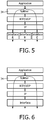
- the splitter 34 has three network interfaces each of which transmits the application flow with the most appropriate network packet size and packet inter arrival time.
- the packet size is a fixed integer number of bytes.
- the packet size is specified in a range from a minimum to a maximum number of bytes. If the interface-specific packet size or the maximum packet size in the range is larger than the application packet size, then multiple application packets are aggregated into a single packet sent over the network.
- the interface-specific splitter aggregates application packets to meet an interface specific, pre-determined packet size range and inter-arrival time range by combining an integer number of application packets.
- the splitter 34 aggregates one or more application packets or parts thereof into interface specific packets, i.e. aggregated packets comprise complete packets and fraction of packets. The aggregation process needs to ensure that the maximum allowed application transmission delay is not violated.
- an application header is added to the application payload.
- the header may include a timestamp, which specifies the time covered by the payload, e.g. in an RTP the timestamp reflects the sampling instant of the first byte of the payload.
- the timestamp in the first aggregated packet transmitted over an interface is the time when the application packet arrived.
- the timestamp is the timestamp of the first application packet in the tx-buffer.
- packets arriving from the local application are split into three flows and transmitted over the same communication interface. If the desired interface-specific packet size or the maximum of the packet size range is smaller than the application packet size, the application packet is fragmented in two or more packets sent over the network. A header with a timestamp and the packet size is added in the beginning of each application layer fragment.
- the merger 40 has three communication interfaces each of which receives one data flow.
- the merger 40 receives three data flows which are then merged and sent to the endpoint application.
- the merging process strives to combine the data received through different packet flows, each of which may use different packet sizes, into the most complete representation possible of the original data flow generated by the transmitter side. For illustration purposes, consider the application data received via three flows over some time as shown in Figure 9 . Three flows are shown in the figure: 1 ) Flow A; 2) Flow B; and, 3) Flow C.
- Each of the flow has a different packet size, represented in the figure by different block lengths, and different packet error rate, represented in the figure by different gap sizes in between the blocks. Note, that each flow, because it traverses over a different wireless link technology, also has a different transmission delay and jitter, which is not depicted in the figure.
- Figure 9 also shows three exemplary time intervals A, B and C. During time interval A, data is received from all the three flows; during time interval B, no data is received, and, during time interval C, data is received only from Flow C.
- the header of the received packets may include a timestamp, and combined with the packet size information and sampling rate information, together could to determine the sampling time interval covered by a received packet.
- the sampling rate information is exchanged during session setup protocol.
- the sampling rate information is contained within each packet. Duplicate packets from multiple received packets are identified and only one copy of the duplicate packets is retained. The packets are ordered in the order of sampling time. The process continues until it is time to forward the reconstructed data to the application.
- the data in the case of data missing for some portion of the time, the data could be marked as NULL (not received), or it could be interpolated between adjacent sets of data or it could be filled by repetition of the adjacent data.
- a packet is received, which is outside the range of the time covered by the receive buffer then it could be discarded.
- the range of the time covered by the received buffer could be updated dynamically in relation to current time or the range of the time covered by the received buffer could be updated at regular intervals of time.
- a communication link is established between patient monitor and patient information server or patient information system through hospital IP network.
- Physiological data is collected by the patient monitor in a step 102 .
- data packets are generated from the physiological data.
- the data packets are duplicated.
- the duplicate data packets are split or aggregated with the most appropriate size for the connected networks.
- the modified duplicated data packets are then transmitted over the appropriate connected networks in a step 110 .
- the modified duplicated packets are received.
- the modified duplicated data packets are merged into a single data stream that accurately represents the duplicate data packets in a step 114 .
- one copy of any data packet is forwarded to the to an endpoint application.
- a step 120 data packets are received.
- the received data packets are duplicated in a step 122 .
- a duplicate of each data packet is forwarded to each connected network.
- the duplicates of the data packets are transmitted over the various connected networks in a step 126 .
- the duplicates of the data packets are received.
- one copy of any packet is forwarded to an endpoint application.
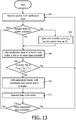
- a step 140 it is determined whether a data packet has arrived.
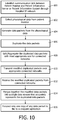
- the current time T current is recorded. All available interfaces as not yet having transmitted a packet are marked in a step 144 .
- a step 146 it is determined whether at least one interface has not transmitted a packet. If at least one interface has transmitted a packet then it is determined whether a packet has arrived in a step 140 . If at least one interface has not transmitted a packet then an interface that has not yet transmitted a packet is picked and the interface transmission procedure for that interface with application data and T current as a parameter is run in a step 148. In a step 150 , that interface is marked as having transmitted a packet.
- a packet is received from the application layer.
- a step 162 it is determined if the partially filled buffer is available. If the buffer is not available then a new buffer (size of Po) is starting and the current time is recorded as Ts in a step 164 . If the partially filled buffer is available then data is added to the buffer until the buffer is full or not more data is available in a step 166 .
- a step 168 it is determined whether the buffer is full. If the buffer is not full then packets are received from the application layer in step 160.
- an application header is added with a timestamp and packet size in the buffer in a step 170 .
- the data in the buffer is transmitted.
- a flowchart diagram of the fragmentation process In a step 180 , up to P 0 bytes are added from the packet into the buffer. In a step 182 , a timestamp and buffer size is calculated. A header is added with the timestamp and packet size in the buffer in a step 184 . In a step 186 , the data in the buffer is transmitted. In a step 188 , it is determined whether more data is in the packet. If more data is in the packet, then up to P 0 bytes are added from the packet into the buffer in step 180 .
- a buffer is initialized.
- a timestamp and payload size is extracted from the application header in a step 204 .
- Data from the received packet is copied to a location corresponding to the sampling time in the buffer in a step 206 .
Landscapes
- Engineering & Computer Science (AREA)
- Computer Networks & Wireless Communication (AREA)
- Signal Processing (AREA)
- Computer Security & Cryptography (AREA)
- Health & Medical Sciences (AREA)
- Medical Informatics (AREA)
- General Health & Medical Sciences (AREA)
- Biomedical Technology (AREA)
- Computing Systems (AREA)
- Epidemiology (AREA)
- General Business, Economics & Management (AREA)
- Primary Health Care (AREA)
- Public Health (AREA)
- Business, Economics & Management (AREA)
- Mobile Radio Communication Systems (AREA)
- Measuring And Recording Apparatus For Diagnosis (AREA)
- Communication Control (AREA)
- Data Exchanges In Wide-Area Networks (AREA)
Claims (15)
- Procédé de transmission de données physiologiques, comprenant :l'établissement d'une liaison de communication entre un dispositif de surveillance de patient multi-mode (12) et une pluralité de réseaux de protocole Internet (IP) (30, 32) ;la collecte de données physiologiques collectées par le dispositif de surveillance de patient (12) ;la génération de paquets de données à partir des données physiologiques collectées ;la duplication des paquets de données générés ;la transmission des paquets de données dupliqués sur la pluralité de réseaux (30, 32) ;la réception des paquets de données dupliqués transmis ; etle transfert d'un seul ensemble de données des paquets de données dupliqués vers une application finale.
- Procédé selon la revendication 1, comprenant en outre :avant l'étape de transmission, le redimensionnement des paquets de données dupliqués à la dimension la plus appropriée aux fins de transmission sur chacun de la pluralité de réseaux ; etaprès l'étape de réception, la fusion des paquets de données redimensionnés en un flux de données qui représente précisément le paquet de données dupliqué.
- Procédé selon la revendication 2, dans lequel le redimensionnement est au moins l'un d'un processus d'agrégation et de fragmentation.
- Procédé selon l'une ou l'autre des revendications 2 et 3, dans lequel la dimension de paquet la plus appropriée dépend d'au moins l'un des caractéristiques de consommation d'énergie, de la largeur de bande et du taux d'erreur binaire de chaque réseau, des exigences de retard d'application, et de la dimension des unités maximales de transmission (MTU) de l'interface.
- Procédé selon l'une quelconque des revendications 1 à 4, comprenant en outre :après l'étape de réception, la détermination d'informations de taux d'échantillonnage pour chaque paquet de données dupliqué reçu d'un horodateur, d'informations de dimension de paquets, et du taux d'échantillonnage de chaque paquet de données dupliqué reçu ; etavant l'étape de transfert, le classement des paquets de données dupliqués reçus à partir des informations de taux d'échantillonnage déterminées.
- Support lisible par ordinateur comportant un logiciel pour commander un ou plusieurs processeurs afin de configurer et réaliser le procédé selon l'une quelconque des revendications 1 à 5.
- Moniteur de patient comprenant :au moins un dispositif de surveillance (10) qui collecte des données de patient concernant un patient ;un générateur de paquets (24) qui génère des paquets de données provenant des données de patient collectées à partir du patient ; etun duplicateur de paquets (36) qui génère des copies des paquets de données ;une unité de communication (16) qui transmet les paquets de données dupliqués sur une pluralité de réseaux de Protocole Internet (IP) (18), dans lequel l'unité de communication (16) comprend un premier émetteur (26) pour transmettre les paquets de données dupliqués à l'aide d'un premier réseau sans fil (30) et un second émetteur (28) pour transmettre les paquets de données dupliqués au moyen d'un second réseau sans fil (32).
- Moniteur de patient selon la revendication 7, dans lequel l'unité de communication (16) comprend en outre :un séparateur de paquets (34) qui redimensionne les paquets de données dupliqués à la dimension la plus appropriée pour chacun des premier et second réseaux sans fil.
- Moniteur de patient selon l'une quelconque des revendications 7 ou 8, dans lequel le moniteur de patient (12) est un moniteur de patient ambulatoire alimenté par batterie porté par un patient.
- Moniteur de patient selon la revendication 8, dans lequel le séparateur de paquets est configuré pour redimensionner les paquets de données au moyen d'au moins l'un d'un processus d'agrégation et d'un processus de fragmentation.
- Moniteur de patient selon la revendication 8 ou 10, dans lequel le séparateur de paquets est configuré pour redimensionner les paquets de données à une dimension de paquet conforme à au moins l'un des caractéristiques de consommation d'énergie, de la largeur de bande et du taux d'erreur binaire de chaque réseau, des exigences de retard d'application, et de la dimension des unités maximales de transmission (MTU) de l'interface.
- Système de surveillance de patient, comprenant :une pluralité des moniteurs de patient (12) selon l'une quelconque des revendications 7 à 11 ; etun serveur d'informations de patient (20) en communication avec le réseau IP hospitalier (18) pour recevoir les paquets de données dupliqués qui ont été transmis via les premier et second réseaux et au moins l'un de la génération d'un affichage des données de patient basée sur les paquets de données dupliqués reçus et du stockage des données de patient concernant le patient.
- Système de surveillance de patient selon la revendication 12, dans lequel le serveur d'informations de patient comprend :un élément de fusion de paquets (40) qui fusionne les paquets de données redimensionnés en un flux de données qui représente précisément le paquet de données dupliqué ; etun détecteur de paquets dupliqués (42) pour transférer l'un des paquets de données dupliqué vers l'application serveur d'informations de patient.
- Système de surveillance de patient selon l'une des revendications 12 et 13, comprenant en outre :un expéditeur (50) qui reçoit des paquets de données de la pluralité de moniteurs de patient (12) et transmet les paquets de données à l'affichage d'informations mobile (22).
- Système de surveillance de patient selon la revendication 14, dans lequel l'expéditeur comprend :une unité de réception comprenant :un élément de fusion de paquets (40) qui fusionne les paquets de données redimensionnés en un flux de données qui représente précisément le paquet de données dupliqué ; etun détecteur de paquets dupliqués (42) pour transférer l'un des paquets de données dupliqué vers l'application serveur d'informations de patient (22) ; etune unité de transmission comprenant :un duplicateur de paquets (36) qui génère des copies des paquets de données ; etéventuellement, un séparateur de paquets (34) qui redimensionne les paquets de données dupliqués à la dimension la plus appropriée pour chacun des premier et second réseaux sans fil.
Applications Claiming Priority (2)
| Application Number | Priority Date | Filing Date | Title |
|---|---|---|---|
| US32190210P | 2010-04-08 | 2010-04-08 | |
| PCT/IB2011/051082 WO2011124996A1 (fr) | 2010-04-08 | 2011-03-15 | Surveillance de patient sur des réseaux hétérogènes |
Publications (2)
| Publication Number | Publication Date |
|---|---|
| EP2556650A1 EP2556650A1 (fr) | 2013-02-13 |
| EP2556650B1 true EP2556650B1 (fr) | 2017-05-17 |
Family
ID=44168808
Family Applications (1)
| Application Number | Title | Priority Date | Filing Date |
|---|---|---|---|
| EP11713366.0A Active EP2556650B1 (fr) | 2010-04-08 | 2011-03-15 | Surveillance de patient sur des réseaux hétérogènes |
Country Status (6)
| Country | Link |
|---|---|
| US (1) | US9762648B2 (fr) |
| EP (1) | EP2556650B1 (fr) |
| JP (1) | JP5873476B2 (fr) |
| CN (1) | CN102823224B (fr) |
| RU (1) | RU2577466C2 (fr) |
| WO (1) | WO2011124996A1 (fr) |
Cited By (16)
| Publication number | Priority date | Publication date | Assignee | Title |
|---|---|---|---|---|
| US10610624B2 (en) | 2013-03-14 | 2020-04-07 | Smith & Nephew, Inc. | Reduced pressure therapy blockage detection |
| US10639502B2 (en) | 2010-10-12 | 2020-05-05 | Smith & Nephew, Inc. | Medical device |
| US11315681B2 (en) | 2015-10-07 | 2022-04-26 | Smith & Nephew, Inc. | Reduced pressure therapy device operation and authorization monitoring |
| US11369730B2 (en) | 2016-09-29 | 2022-06-28 | Smith & Nephew, Inc. | Construction and protection of components in negative pressure wound therapy systems |
| US11602461B2 (en) | 2016-05-13 | 2023-03-14 | Smith & Nephew, Inc. | Automatic wound coupling detection in negative pressure wound therapy systems |
| US11712508B2 (en) | 2017-07-10 | 2023-08-01 | Smith & Nephew, Inc. | Systems and methods for directly interacting with communications module of wound therapy apparatus |
| US11793924B2 (en) | 2018-12-19 | 2023-10-24 | T.J.Smith And Nephew, Limited | Systems and methods for delivering prescribed wound therapy |
| US11974903B2 (en) | 2017-03-07 | 2024-05-07 | Smith & Nephew, Inc. | Reduced pressure therapy systems and methods including an antenna |
| US12002566B2 (en) | 2013-03-14 | 2024-06-04 | Smith & Nephew, Inc. | Attachment system for mounting apparatus |
| US12090264B2 (en) | 2012-05-22 | 2024-09-17 | Smith & Nephew Plc | Apparatuses and methods for wound therapy |
| US12133789B2 (en) | 2014-07-31 | 2024-11-05 | Smith & Nephew, Inc. | Reduced pressure therapy apparatus construction and control |
| US12263294B2 (en) | 2016-09-28 | 2025-04-01 | T.J.Smith And Nephew, Limited | Systems and methods for operating negative pressure wound therapy devices |
| US12370300B2 (en) | 2019-08-15 | 2025-07-29 | T.J.Smith And Nephew, Limited | Systems and methods for monitoring essential performance of wound therapy |
| US12531150B2 (en) | 2019-02-27 | 2026-01-20 | T.J.Smith And Nephew, Limited | Systems and methods for synchronizing a device clock in wound monitoring and/or treatment systems |
| US12533457B2 (en) | 2016-02-12 | 2026-01-27 | Smith & Nephew, Inc. | Systems and methods for detecting operational conditions of reduced pressure therapy |
| US12582763B2 (en) | 2021-04-21 | 2026-03-24 | T.J.Smith And Nephew, Limited | Communication systems and methods for negative pressure wound therapy devices |
Families Citing this family (34)
| Publication number | Priority date | Publication date | Assignee | Title |
|---|---|---|---|---|
| US9596989B2 (en) | 2009-03-12 | 2017-03-21 | Raytheon Company | Networked symbiotic edge user infrastructure |
| US8818260B2 (en) | 2011-01-14 | 2014-08-26 | Covidien, LP | Wireless relay module for remote monitoring systems |
| US8903308B2 (en) | 2011-01-14 | 2014-12-02 | Covidien Lp | System and method for patient identification in a remote monitoring system |
| US8811888B2 (en) | 2011-01-14 | 2014-08-19 | Covidien Lp | Wireless relay module for monitoring network status |
| US8855550B2 (en) | 2011-01-14 | 2014-10-07 | Covidien Lp | Wireless relay module having emergency call functionality |
| US8798527B2 (en) | 2011-01-14 | 2014-08-05 | Covidien Lp | Wireless relay module for remote monitoring systems |
| US8897198B2 (en) | 2011-01-14 | 2014-11-25 | Covidien Lp | Medical device wireless network architectures |
| US9495511B2 (en) | 2011-03-01 | 2016-11-15 | Covidien Lp | Remote monitoring systems and methods for medical devices |
| US8694600B2 (en) | 2011-03-01 | 2014-04-08 | Covidien Lp | Remote monitoring systems for monitoring medical devices via wireless communication networks |
| US9020419B2 (en) | 2011-01-14 | 2015-04-28 | Covidien, LP | Wireless relay module for remote monitoring systems having power and medical device proximity monitoring functionality |
| US20120307626A1 (en) * | 2011-05-31 | 2012-12-06 | Alcatel-Lucent Canada Inc. | Field-deployable protocol message interceptor |
| US9402264B2 (en) * | 2011-09-30 | 2016-07-26 | Intel Corporation | Methods to transport internet traffic over multiple wireless networks simultaneously |
| US20130094518A1 (en) * | 2011-10-13 | 2013-04-18 | Electronics And Telecommunications Research Institute | Method for configuring and transmitting mmt payload |
| US20140033103A1 (en) * | 2012-07-26 | 2014-01-30 | Nellcor Puritan Bennett Llc | System, method, and software for patient monitoring |
| KR20150056580A (ko) | 2012-09-13 | 2015-05-26 | 코비디엔 엘피 | 장내 급식 펌프용 도킹 스테이션 |
| TWI473518B (zh) * | 2012-12-12 | 2015-02-11 | Quanta Comp Inc | 多模作業之通訊裝置 |
| US9398490B2 (en) * | 2013-03-15 | 2016-07-19 | Trane International Inc. | Method of fragmenting a message in a network |
| US20140297322A1 (en) * | 2013-03-30 | 2014-10-02 | Mckesson Financial Holdings | Method and apparatus for delaying propagation of patient healthcare data |
| USD746441S1 (en) | 2013-09-13 | 2015-12-29 | Covidien Lp | Pump |
| CN103479350A (zh) * | 2013-09-29 | 2014-01-01 | 苏州麦迪斯顿医疗科技股份有限公司 | 基于物联网的体征监护的操作方法及装置 |
| CN104683265B (zh) * | 2015-02-27 | 2020-05-01 | 南京中新赛克科技有限责任公司 | 一种用于100g接口的大容量精确包计数方法 |
| JP6335887B2 (ja) * | 2015-03-25 | 2018-05-30 | 株式会社コンテック | データ通信方法、及びデータ処理システム |
| CN106301987B (zh) * | 2015-06-03 | 2020-02-14 | 华为技术有限公司 | 一种报文丢失检测方法、装置及系统 |
| DE102015108859B4 (de) | 2015-06-03 | 2018-12-27 | Cortec Gmbh | Verfahren und System zum Verarbeiten von Datenströmen |
| CN106028168A (zh) * | 2015-09-16 | 2016-10-12 | 展视网(北京)科技有限公司 | 一种基于电视终端的室内空气数据采集方法及装置 |
| JP7100619B2 (ja) | 2016-07-25 | 2022-07-13 | コーニンクレッカ フィリップス エヌ ヴェ | ロバストなデータ送信 |
| CN108235223A (zh) * | 2016-12-14 | 2018-06-29 | 大唐移动通信设备有限公司 | 一种数据监测方法、一种集中器和数据监测系统 |
| US20180310327A1 (en) * | 2017-04-19 | 2018-10-25 | General Electric Company | Wireless patient monitoring system and method with improved physiological data transmission |
| US10874462B2 (en) * | 2017-06-30 | 2020-12-29 | Biosense Webster (Israel) Ltd. | Network sniffer for system watchdog and diagnostic |
| CN109480818B (zh) * | 2017-09-12 | 2021-11-09 | 中国移动通信有限公司研究院 | 一种跨硬件平台的生理数据信号处理方法和装置 |
| US11196834B2 (en) | 2017-09-29 | 2021-12-07 | Arista Networks, Inc. | System and a method for distributing information |
| US11432982B2 (en) * | 2018-03-26 | 2022-09-06 | Augustine Biomedical + Design, LLC | Relocation module and methods for surgical equipment |
| CN110099403B (zh) * | 2019-05-17 | 2022-07-19 | 腾讯科技(深圳)有限公司 | 一种数据传输方法、装置、设备及存储介质 |
| US20220345357A1 (en) * | 2019-07-09 | 2022-10-27 | Sumitomo Electric Industries, Ltd. | In-vehicle communication system, in-vehicle device, and vehicle communication method |
Family Cites Families (19)
| Publication number | Priority date | Publication date | Assignee | Title |
|---|---|---|---|---|
| US6611872B1 (en) | 1999-01-11 | 2003-08-26 | Fastforward Networks, Inc. | Performing multicast communication in computer networks by using overlay routing |
| FI113822B (fi) * | 1999-01-19 | 2004-06-15 | Nokia Corp | Ohjattu dataverkon virheestä toipuminen |
| US6614808B1 (en) | 1999-09-02 | 2003-09-02 | International Business Machines Corporation | Network packet aggregation |
| US6659947B1 (en) * | 2000-07-13 | 2003-12-09 | Ge Medical Systems Information Technologies, Inc. | Wireless LAN architecture for integrated time-critical and non-time-critical services within medical facilities |
| DE60142398D1 (de) * | 2000-08-25 | 2010-07-29 | Research In Motion Ltd | System und verfahren zum weiterleiten von daten zu einem drahtlosen gerät über mehrere kommunikationspfade |
| US6801777B2 (en) | 2001-11-27 | 2004-10-05 | Intel Corporation | Device and method for intelligent wireless communication selection |
| EP1636950A1 (fr) | 2003-06-06 | 2006-03-22 | Philips Intellectual Property & Standards GmbH | Procede de regulation de transmission de donnees sans fil en basculant d'une technologie de transmission a courte portee vers une technologie de transmission a longue portee |
| JP4407369B2 (ja) * | 2004-04-30 | 2010-02-03 | 沖電気工業株式会社 | 無線ネットワークシステム、無線ネットワークシステムのパケットロス軽減方法、及び、無線通信装置 |
| EP2033360B1 (fr) | 2006-05-17 | 2015-12-02 | Audinate Pty Limited | Flux de paquets de supports redondants |
| DE602006005360D1 (de) | 2006-08-24 | 2009-04-09 | Ntt Docomo Inc | Verfahren und Vorrichtung für nahtloses Handover |
| US7839952B2 (en) * | 2006-12-05 | 2010-11-23 | Provigent Ltd | Data rate coordination in protected variable-rate links |
| CA2678154C (fr) | 2007-02-12 | 2013-11-12 | Huseyin Cahit Akin | Procedes et appareil de liaison et de separation de ligne d'acces |
| US8351464B2 (en) | 2007-10-02 | 2013-01-08 | Infineon Technologies Ag | Retransmission in data communication systems |
| US20090245114A1 (en) * | 2008-04-01 | 2009-10-01 | Jayanth Vijayaraghavan | Methods for collecting and analyzing network performance data |
| JP2010011188A (ja) * | 2008-06-27 | 2010-01-14 | Mitsubishi Electric Corp | ネットワークダイバシティシステム、ダイバシティ装置およびハンドオーバ方法 |
| US8094556B2 (en) * | 2009-04-27 | 2012-01-10 | Avaya Inc. | Dynamic buffering and synchronization of related media streams in packet networks |
| US8134927B2 (en) * | 2009-07-31 | 2012-03-13 | Ixia | Apparatus and methods for capturing data packets from a network |
| RU91838U1 (ru) * | 2009-08-10 | 2010-03-10 | Федеральное агентство по науке и инновациям (Роснаука) | Носимый телекоммуникационный комплекс мониторинга функционального состояния человека |
| US9148359B2 (en) * | 2011-12-22 | 2015-09-29 | Voipfuture Gmbh | Correlation of media plane and signaling plane of media services in a packet-switched network |
-
2011
- 2011-03-15 EP EP11713366.0A patent/EP2556650B1/fr active Active
- 2011-03-15 US US13/636,242 patent/US9762648B2/en active Active
- 2011-03-15 JP JP2013503194A patent/JP5873476B2/ja active Active
- 2011-03-15 RU RU2012147440/08A patent/RU2577466C2/ru not_active IP Right Cessation
- 2011-03-15 CN CN201180017755.7A patent/CN102823224B/zh active Active
- 2011-03-15 WO PCT/IB2011/051082 patent/WO2011124996A1/fr not_active Ceased
Cited By (25)
| Publication number | Priority date | Publication date | Assignee | Title |
|---|---|---|---|---|
| US10639502B2 (en) | 2010-10-12 | 2020-05-05 | Smith & Nephew, Inc. | Medical device |
| US11565134B2 (en) | 2010-10-12 | 2023-01-31 | Smith & Nephew, Inc. | Medical device |
| US12403331B2 (en) | 2010-10-12 | 2025-09-02 | Smith & Nephew, Inc. | Medical device |
| US12090264B2 (en) | 2012-05-22 | 2024-09-17 | Smith & Nephew Plc | Apparatuses and methods for wound therapy |
| US12002566B2 (en) | 2013-03-14 | 2024-06-04 | Smith & Nephew, Inc. | Attachment system for mounting apparatus |
| US10905806B2 (en) | 2013-03-14 | 2021-02-02 | Smith & Nephew, Inc. | Reduced pressure wound therapy control and data communication |
| US10610624B2 (en) | 2013-03-14 | 2020-04-07 | Smith & Nephew, Inc. | Reduced pressure therapy blockage detection |
| US11633533B2 (en) | 2013-03-14 | 2023-04-25 | Smith & Nephew, Inc. | Control architecture for reduced pressure wound therapy apparatus |
| US12133789B2 (en) | 2014-07-31 | 2024-11-05 | Smith & Nephew, Inc. | Reduced pressure therapy apparatus construction and control |
| US11315681B2 (en) | 2015-10-07 | 2022-04-26 | Smith & Nephew, Inc. | Reduced pressure therapy device operation and authorization monitoring |
| US11783943B2 (en) | 2015-10-07 | 2023-10-10 | Smith & Nephew, Inc. | Reduced pressure therapy device operation and authorization monitoring |
| US12533457B2 (en) | 2016-02-12 | 2026-01-27 | Smith & Nephew, Inc. | Systems and methods for detecting operational conditions of reduced pressure therapy |
| US11602461B2 (en) | 2016-05-13 | 2023-03-14 | Smith & Nephew, Inc. | Automatic wound coupling detection in negative pressure wound therapy systems |
| US12263294B2 (en) | 2016-09-28 | 2025-04-01 | T.J.Smith And Nephew, Limited | Systems and methods for operating negative pressure wound therapy devices |
| US12420006B2 (en) | 2016-09-29 | 2025-09-23 | Smith & Nephew, Inc. | Construction and protection of components in negative pressure wound therapy systems |
| US11369730B2 (en) | 2016-09-29 | 2022-06-28 | Smith & Nephew, Inc. | Construction and protection of components in negative pressure wound therapy systems |
| US11974903B2 (en) | 2017-03-07 | 2024-05-07 | Smith & Nephew, Inc. | Reduced pressure therapy systems and methods including an antenna |
| US12447059B2 (en) | 2017-03-07 | 2025-10-21 | Smith & Nephew, Inc. | Reduced pressure therapy systems and methods including an antenna |
| US12083262B2 (en) | 2017-07-10 | 2024-09-10 | Smith & Nephew, Inc. | Systems and methods for directly interacting with communications module of wound therapy apparatus |
| US11712508B2 (en) | 2017-07-10 | 2023-08-01 | Smith & Nephew, Inc. | Systems and methods for directly interacting with communications module of wound therapy apparatus |
| US11793924B2 (en) | 2018-12-19 | 2023-10-24 | T.J.Smith And Nephew, Limited | Systems and methods for delivering prescribed wound therapy |
| US12268806B2 (en) | 2018-12-19 | 2025-04-08 | T.J.Smith And Nephew, Limited | Systems and methods for delivering prescribed wound therapy |
| US12531150B2 (en) | 2019-02-27 | 2026-01-20 | T.J.Smith And Nephew, Limited | Systems and methods for synchronizing a device clock in wound monitoring and/or treatment systems |
| US12370300B2 (en) | 2019-08-15 | 2025-07-29 | T.J.Smith And Nephew, Limited | Systems and methods for monitoring essential performance of wound therapy |
| US12582763B2 (en) | 2021-04-21 | 2026-03-24 | T.J.Smith And Nephew, Limited | Communication systems and methods for negative pressure wound therapy devices |
Also Published As
| Publication number | Publication date |
|---|---|
| WO2011124996A1 (fr) | 2011-10-13 |
| JP2013531403A (ja) | 2013-08-01 |
| RU2577466C2 (ru) | 2016-03-20 |
| US9762648B2 (en) | 2017-09-12 |
| CN102823224B (zh) | 2015-11-25 |
| RU2012147440A (ru) | 2014-05-27 |
| JP5873476B2 (ja) | 2016-03-01 |
| CN102823224A (zh) | 2012-12-12 |
| EP2556650A1 (fr) | 2013-02-13 |
| US20130021169A1 (en) | 2013-01-24 |
Similar Documents
| Publication | Publication Date | Title |
|---|---|---|
| EP2556650B1 (fr) | Surveillance de patient sur des réseaux hétérogènes | |
| CN102835158B (zh) | 在异构网络切换期间在终止替换性连接之前的链路评估 | |
| US10938692B2 (en) | Apparatus, system, and method for obtaining quality of service parameter of voice over internet protocol service | |
| JP5789657B2 (ja) | 共有無線チャネルを通じた生命上重要な警報の信頼性の高い配信システム及び方法 | |
| CN112771941B (zh) | 数据同步方法、装置、设备、系统及存储介质 | |
| CN110505076B (zh) | 数据包丢失率的测量方法、获取方法、终端及网络设备 | |
| CN102223263B (zh) | 基于fpga的丢包率监测方法及装置 | |
| EP2754267B1 (fr) | Protocole de retour pour systèmes de réseau à trajets multiples de bout en bout | |
| CN104582561B (zh) | 用于医学体域网的协调器切换方法 | |
| CN102833307A (zh) | 健康信息电信系统和方法 | |
| CN108353296A (zh) | 用于在监测系统内的无线医学设备和传感器的可靠的通信算法 | |
| CN108430311A (zh) | 针对具有多个聚合器设备的mban应用的低功率无线解决方案 | |
| CN101997727A (zh) | 一种通讯管理机主备机无缝切换的装置及其方法 | |
| CN110072278A (zh) | 一种基于低功耗蓝牙的无线多节点生理信号监护系统 | |
| EP3874720B1 (fr) | Protocole de transmission de données | |
| WO2023217008A1 (fr) | Procédé et appareil de synchronisation de numéros de série de paquets de données, et dispositif de communication | |
| WO2023217009A1 (fr) | Procédé et appareil de transmission de données, et dispositif de communication | |
| Yew et al. | Telehealth: Empowering internet of medical things with heterogenous wireless networks | |
| Qiao et al. | Handover strategies in multi-homed body sensor networks | |
| JP5337230B2 (ja) | 通信制御装置、無線通信装置、通信制御方法及び無線通信方法 | |
| CN121284140A (zh) | 接口协议切换方法、装置、设备、存储介质及产品 | |
| Armagan et al. | CLASS-A Cross Layer Algorithm for Smoothed Switchover in Multi-homed Body Sensor Networks | |
| Armagan et al. | Error Rate Based Analytical Switchover Approach for Multi-homed Body Sensor Networks | |
| Armagan et al. | PAL: A Path Selection Algorithm for Life Critical Data |
Legal Events
| Date | Code | Title | Description |
|---|---|---|---|
| PUAI | Public reference made under article 153(3) epc to a published international application that has entered the european phase |
Free format text: ORIGINAL CODE: 0009012 |
|
| 17P | Request for examination filed |
Effective date: 20121108 |
|
| AK | Designated contracting states |
Kind code of ref document: A1 Designated state(s): AL AT BE BG CH CY CZ DE DK EE ES FI FR GB GR HR HU IE IS IT LI LT LU LV MC MK MT NL NO PL PT RO RS SE SI SK SM TR |
|
| DAX | Request for extension of the european patent (deleted) | ||
| RAP1 | Party data changed (applicant data changed or rights of an application transferred) |
Owner name: KONINKLIJKE PHILIPS N.V. |
|
| GRAP | Despatch of communication of intention to grant a patent |
Free format text: ORIGINAL CODE: EPIDOSNIGR1 |
|
| INTG | Intention to grant announced |
Effective date: 20161214 |
|
| GRAS | Grant fee paid |
Free format text: ORIGINAL CODE: EPIDOSNIGR3 |
|
| GRAA | (expected) grant |
Free format text: ORIGINAL CODE: 0009210 |
|
| AK | Designated contracting states |
Kind code of ref document: B1 Designated state(s): AL AT BE BG CH CY CZ DE DK EE ES FI FR GB GR HR HU IE IS IT LI LT LU LV MC MK MT NL NO PL PT RO RS SE SI SK SM TR |
|
| REG | Reference to a national code |
Ref country code: GB Ref legal event code: FG4D |
|
| REG | Reference to a national code |
Ref country code: CH Ref legal event code: EP |
|
| REG | Reference to a national code |
Ref country code: IE Ref legal event code: FG4D |
|
| REG | Reference to a national code |
Ref country code: AT Ref legal event code: REF Ref document number: 895389 Country of ref document: AT Kind code of ref document: T Effective date: 20170615 |
|
| REG | Reference to a national code |
Ref country code: DE Ref legal event code: R096 Ref document number: 602011038012 Country of ref document: DE |
|
| REG | Reference to a national code |
Ref country code: NL Ref legal event code: MP Effective date: 20170517 |
|
| REG | Reference to a national code |
Ref country code: LT Ref legal event code: MG4D |
|
| REG | Reference to a national code |
Ref country code: AT Ref legal event code: MK05 Ref document number: 895389 Country of ref document: AT Kind code of ref document: T Effective date: 20170517 |
|
| PG25 | Lapsed in a contracting state [announced via postgrant information from national office to epo] |
Ref country code: ES Free format text: LAPSE BECAUSE OF FAILURE TO SUBMIT A TRANSLATION OF THE DESCRIPTION OR TO PAY THE FEE WITHIN THE PRESCRIBED TIME-LIMIT Effective date: 20170517 Ref country code: LT Free format text: LAPSE BECAUSE OF FAILURE TO SUBMIT A TRANSLATION OF THE DESCRIPTION OR TO PAY THE FEE WITHIN THE PRESCRIBED TIME-LIMIT Effective date: 20170517 Ref country code: FI Free format text: LAPSE BECAUSE OF FAILURE TO SUBMIT A TRANSLATION OF THE DESCRIPTION OR TO PAY THE FEE WITHIN THE PRESCRIBED TIME-LIMIT Effective date: 20170517 Ref country code: NO Free format text: LAPSE BECAUSE OF FAILURE TO SUBMIT A TRANSLATION OF THE DESCRIPTION OR TO PAY THE FEE WITHIN THE PRESCRIBED TIME-LIMIT Effective date: 20170817 Ref country code: HR Free format text: LAPSE BECAUSE OF FAILURE TO SUBMIT A TRANSLATION OF THE DESCRIPTION OR TO PAY THE FEE WITHIN THE PRESCRIBED TIME-LIMIT Effective date: 20170517 Ref country code: GR Free format text: LAPSE BECAUSE OF FAILURE TO SUBMIT A TRANSLATION OF THE DESCRIPTION OR TO PAY THE FEE WITHIN THE PRESCRIBED TIME-LIMIT Effective date: 20170818 Ref country code: AT Free format text: LAPSE BECAUSE OF FAILURE TO SUBMIT A TRANSLATION OF THE DESCRIPTION OR TO PAY THE FEE WITHIN THE PRESCRIBED TIME-LIMIT Effective date: 20170517 |
|
| PG25 | Lapsed in a contracting state [announced via postgrant information from national office to epo] |
Ref country code: BG Free format text: LAPSE BECAUSE OF FAILURE TO SUBMIT A TRANSLATION OF THE DESCRIPTION OR TO PAY THE FEE WITHIN THE PRESCRIBED TIME-LIMIT Effective date: 20170817 Ref country code: LV Free format text: LAPSE BECAUSE OF FAILURE TO SUBMIT A TRANSLATION OF THE DESCRIPTION OR TO PAY THE FEE WITHIN THE PRESCRIBED TIME-LIMIT Effective date: 20170517 Ref country code: RS Free format text: LAPSE BECAUSE OF FAILURE TO SUBMIT A TRANSLATION OF THE DESCRIPTION OR TO PAY THE FEE WITHIN THE PRESCRIBED TIME-LIMIT Effective date: 20170517 Ref country code: SE Free format text: LAPSE BECAUSE OF FAILURE TO SUBMIT A TRANSLATION OF THE DESCRIPTION OR TO PAY THE FEE WITHIN THE PRESCRIBED TIME-LIMIT Effective date: 20170517 Ref country code: NL Free format text: LAPSE BECAUSE OF FAILURE TO SUBMIT A TRANSLATION OF THE DESCRIPTION OR TO PAY THE FEE WITHIN THE PRESCRIBED TIME-LIMIT Effective date: 20170517 Ref country code: PL Free format text: LAPSE BECAUSE OF FAILURE TO SUBMIT A TRANSLATION OF THE DESCRIPTION OR TO PAY THE FEE WITHIN THE PRESCRIBED TIME-LIMIT Effective date: 20170517 Ref country code: IS Free format text: LAPSE BECAUSE OF FAILURE TO SUBMIT A TRANSLATION OF THE DESCRIPTION OR TO PAY THE FEE WITHIN THE PRESCRIBED TIME-LIMIT Effective date: 20170917 |
|
| PG25 | Lapsed in a contracting state [announced via postgrant information from national office to epo] |
Ref country code: EE Free format text: LAPSE BECAUSE OF FAILURE TO SUBMIT A TRANSLATION OF THE DESCRIPTION OR TO PAY THE FEE WITHIN THE PRESCRIBED TIME-LIMIT Effective date: 20170517 Ref country code: DK Free format text: LAPSE BECAUSE OF FAILURE TO SUBMIT A TRANSLATION OF THE DESCRIPTION OR TO PAY THE FEE WITHIN THE PRESCRIBED TIME-LIMIT Effective date: 20170517 Ref country code: CZ Free format text: LAPSE BECAUSE OF FAILURE TO SUBMIT A TRANSLATION OF THE DESCRIPTION OR TO PAY THE FEE WITHIN THE PRESCRIBED TIME-LIMIT Effective date: 20170517 Ref country code: RO Free format text: LAPSE BECAUSE OF FAILURE TO SUBMIT A TRANSLATION OF THE DESCRIPTION OR TO PAY THE FEE WITHIN THE PRESCRIBED TIME-LIMIT Effective date: 20170517 Ref country code: SK Free format text: LAPSE BECAUSE OF FAILURE TO SUBMIT A TRANSLATION OF THE DESCRIPTION OR TO PAY THE FEE WITHIN THE PRESCRIBED TIME-LIMIT Effective date: 20170517 |
|
| REG | Reference to a national code |
Ref country code: DE Ref legal event code: R097 Ref document number: 602011038012 Country of ref document: DE |
|
| PG25 | Lapsed in a contracting state [announced via postgrant information from national office to epo] |
Ref country code: IT Free format text: LAPSE BECAUSE OF FAILURE TO SUBMIT A TRANSLATION OF THE DESCRIPTION OR TO PAY THE FEE WITHIN THE PRESCRIBED TIME-LIMIT Effective date: 20170517 Ref country code: SM Free format text: LAPSE BECAUSE OF FAILURE TO SUBMIT A TRANSLATION OF THE DESCRIPTION OR TO PAY THE FEE WITHIN THE PRESCRIBED TIME-LIMIT Effective date: 20170517 |
|
| PLBE | No opposition filed within time limit |
Free format text: ORIGINAL CODE: 0009261 |
|
| STAA | Information on the status of an ep patent application or granted ep patent |
Free format text: STATUS: NO OPPOSITION FILED WITHIN TIME LIMIT |
|
| REG | Reference to a national code |
Ref country code: FR Ref legal event code: PLFP Year of fee payment: 8 |
|
| 26N | No opposition filed |
Effective date: 20180220 |
|
| PG25 | Lapsed in a contracting state [announced via postgrant information from national office to epo] |
Ref country code: SI Free format text: LAPSE BECAUSE OF FAILURE TO SUBMIT A TRANSLATION OF THE DESCRIPTION OR TO PAY THE FEE WITHIN THE PRESCRIBED TIME-LIMIT Effective date: 20170517 |
|
| REG | Reference to a national code |
Ref country code: CH Ref legal event code: PL |
|
| PG25 | Lapsed in a contracting state [announced via postgrant information from national office to epo] |
Ref country code: MC Free format text: LAPSE BECAUSE OF FAILURE TO SUBMIT A TRANSLATION OF THE DESCRIPTION OR TO PAY THE FEE WITHIN THE PRESCRIBED TIME-LIMIT Effective date: 20170517 |
|
| REG | Reference to a national code |
Ref country code: BE Ref legal event code: MM Effective date: 20180331 |
|
| REG | Reference to a national code |
Ref country code: IE Ref legal event code: MM4A |
|
| PG25 | Lapsed in a contracting state [announced via postgrant information from national office to epo] |
Ref country code: LU Free format text: LAPSE BECAUSE OF NON-PAYMENT OF DUE FEES Effective date: 20180315 |
|
| PG25 | Lapsed in a contracting state [announced via postgrant information from national office to epo] |
Ref country code: IE Free format text: LAPSE BECAUSE OF NON-PAYMENT OF DUE FEES Effective date: 20180315 |
|
| PG25 | Lapsed in a contracting state [announced via postgrant information from national office to epo] |
Ref country code: BE Free format text: LAPSE BECAUSE OF NON-PAYMENT OF DUE FEES Effective date: 20180331 Ref country code: CH Free format text: LAPSE BECAUSE OF NON-PAYMENT OF DUE FEES Effective date: 20180331 Ref country code: LI Free format text: LAPSE BECAUSE OF NON-PAYMENT OF DUE FEES Effective date: 20180331 |
|
| PG25 | Lapsed in a contracting state [announced via postgrant information from national office to epo] |
Ref country code: MT Free format text: LAPSE BECAUSE OF NON-PAYMENT OF DUE FEES Effective date: 20180315 |
|
| PG25 | Lapsed in a contracting state [announced via postgrant information from national office to epo] |
Ref country code: TR Free format text: LAPSE BECAUSE OF FAILURE TO SUBMIT A TRANSLATION OF THE DESCRIPTION OR TO PAY THE FEE WITHIN THE PRESCRIBED TIME-LIMIT Effective date: 20170517 |
|
| PG25 | Lapsed in a contracting state [announced via postgrant information from national office to epo] |
Ref country code: PT Free format text: LAPSE BECAUSE OF FAILURE TO SUBMIT A TRANSLATION OF THE DESCRIPTION OR TO PAY THE FEE WITHIN THE PRESCRIBED TIME-LIMIT Effective date: 20170517 Ref country code: HU Free format text: LAPSE BECAUSE OF FAILURE TO SUBMIT A TRANSLATION OF THE DESCRIPTION OR TO PAY THE FEE WITHIN THE PRESCRIBED TIME-LIMIT; INVALID AB INITIO Effective date: 20110315 |
|
| PG25 | Lapsed in a contracting state [announced via postgrant information from national office to epo] |
Ref country code: CY Free format text: LAPSE BECAUSE OF FAILURE TO SUBMIT A TRANSLATION OF THE DESCRIPTION OR TO PAY THE FEE WITHIN THE PRESCRIBED TIME-LIMIT Effective date: 20170517 Ref country code: MK Free format text: LAPSE BECAUSE OF NON-PAYMENT OF DUE FEES Effective date: 20170517 |
|
| PG25 | Lapsed in a contracting state [announced via postgrant information from national office to epo] |
Ref country code: AL Free format text: LAPSE BECAUSE OF FAILURE TO SUBMIT A TRANSLATION OF THE DESCRIPTION OR TO PAY THE FEE WITHIN THE PRESCRIBED TIME-LIMIT Effective date: 20170517 |
|
| REG | Reference to a national code |
Ref country code: DE Ref legal event code: R079 Ref document number: 602011038012 Country of ref document: DE Free format text: PREVIOUS MAIN CLASS: H04L0029080000 Ipc: H04L0065000000 |
|
| REG | Reference to a national code |
Ref country code: DE Ref legal event code: R084 Ref document number: 602011038012 Country of ref document: DE |
|
| REG | Reference to a national code |
Ref country code: GB Ref legal event code: 746 Effective date: 20241216 |
|
| PGFP | Annual fee paid to national office [announced via postgrant information from national office to epo] |
Ref country code: GB Payment date: 20260323 Year of fee payment: 16 |
|
| PGFP | Annual fee paid to national office [announced via postgrant information from national office to epo] |
Ref country code: DE Payment date: 20260320 Year of fee payment: 16 |
|
| PGFP | Annual fee paid to national office [announced via postgrant information from national office to epo] |
Ref country code: FR Payment date: 20260323 Year of fee payment: 16 |