EP2557247A1 - Dämmplatte zur thermischen Isolierung der Außenfassaden von Gebäuden - Google Patents
Dämmplatte zur thermischen Isolierung der Außenfassaden von Gebäuden Download PDFInfo
- Publication number
- EP2557247A1 EP2557247A1 EP12450023A EP12450023A EP2557247A1 EP 2557247 A1 EP2557247 A1 EP 2557247A1 EP 12450023 A EP12450023 A EP 12450023A EP 12450023 A EP12450023 A EP 12450023A EP 2557247 A1 EP2557247 A1 EP 2557247A1
- Authority
- EP
- European Patent Office
- Prior art keywords
- layer
- thermal insulation
- amount
- plaster
- polystyrene granules
- Prior art date
- Legal status (The legal status is an assumption and is not a legal conclusion. Google has not performed a legal analysis and makes no representation as to the accuracy of the status listed.)
- Withdrawn
Links
Images
Classifications
-
- B—PERFORMING OPERATIONS; TRANSPORTING
- B32—LAYERED PRODUCTS
- B32B—LAYERED PRODUCTS, i.e. PRODUCTS BUILT-UP OF STRATA OF FLAT OR NON-FLAT, e.g. CELLULAR OR HONEYCOMB, FORM
- B32B5/00—Layered products characterised by the non- homogeneity or physical structure, i.e. comprising a fibrous, filamentary, particulate or foam layer; Layered products characterised by having a layer differing constitutionally or physically in different parts
- B32B5/16—Layered products characterised by the non- homogeneity or physical structure, i.e. comprising a fibrous, filamentary, particulate or foam layer; Layered products characterised by having a layer differing constitutionally or physically in different parts characterised by features of a layer formed of particles, e.g. chips, powder or granules
-
- B—PERFORMING OPERATIONS; TRANSPORTING
- B32—LAYERED PRODUCTS
- B32B—LAYERED PRODUCTS, i.e. PRODUCTS BUILT-UP OF STRATA OF FLAT OR NON-FLAT, e.g. CELLULAR OR HONEYCOMB, FORM
- B32B27/00—Layered products comprising a layer of synthetic resin
- B32B27/18—Layered products comprising a layer of synthetic resin characterised by the use of special additives
- B32B27/20—Layered products comprising a layer of synthetic resin characterised by the use of special additives using fillers, pigments, thixotroping agents
-
- B—PERFORMING OPERATIONS; TRANSPORTING
- B32—LAYERED PRODUCTS
- B32B—LAYERED PRODUCTS, i.e. PRODUCTS BUILT-UP OF STRATA OF FLAT OR NON-FLAT, e.g. CELLULAR OR HONEYCOMB, FORM
- B32B27/00—Layered products comprising a layer of synthetic resin
- B32B27/30—Layered products comprising a layer of synthetic resin comprising vinyl (co)polymers; comprising acrylic (co)polymers
- B32B27/302—Layered products comprising a layer of synthetic resin comprising vinyl (co)polymers; comprising acrylic (co)polymers comprising aromatic vinyl (co)polymers, e.g. styrenic (co)polymers
-
- E—FIXED CONSTRUCTIONS
- E04—BUILDING
- E04B—GENERAL BUILDING CONSTRUCTIONS; WALLS, e.g. PARTITIONS; ROOFS; FLOORS; CEILINGS; INSULATION OR OTHER PROTECTION OF BUILDINGS
- E04B1/00—Constructions in general; Structures which are not restricted either to walls, e.g. partitions, or floors or ceilings or roofs
- E04B1/62—Insulation or other protection; Elements or use of specified material therefor
- E04B1/74—Heat, sound or noise insulation, absorption, or reflection; Other building methods affording favourable thermal or acoustical conditions, e.g. accumulating of heat within walls
- E04B1/76—Heat, sound or noise insulation, absorption, or reflection; Other building methods affording favourable thermal or acoustical conditions, e.g. accumulating of heat within walls specifically with respect to heat only
- E04B1/762—Exterior insulation of exterior walls
-
- E—FIXED CONSTRUCTIONS
- E04—BUILDING
- E04B—GENERAL BUILDING CONSTRUCTIONS; WALLS, e.g. PARTITIONS; ROOFS; FLOORS; CEILINGS; INSULATION OR OTHER PROTECTION OF BUILDINGS
- E04B1/00—Constructions in general; Structures which are not restricted either to walls, e.g. partitions, or floors or ceilings or roofs
- E04B1/62—Insulation or other protection; Elements or use of specified material therefor
- E04B1/74—Heat, sound or noise insulation, absorption, or reflection; Other building methods affording favourable thermal or acoustical conditions, e.g. accumulating of heat within walls
- E04B1/76—Heat, sound or noise insulation, absorption, or reflection; Other building methods affording favourable thermal or acoustical conditions, e.g. accumulating of heat within walls specifically with respect to heat only
- E04B1/78—Heat insulating elements
- E04B1/80—Heat insulating elements slab-shaped
-
- B—PERFORMING OPERATIONS; TRANSPORTING
- B32—LAYERED PRODUCTS
- B32B—LAYERED PRODUCTS, i.e. PRODUCTS BUILT-UP OF STRATA OF FLAT OR NON-FLAT, e.g. CELLULAR OR HONEYCOMB, FORM
- B32B38/00—Ancillary operations in connection with laminating processes
- B32B2038/0052—Other operations not otherwise provided for
- B32B2038/0084—Foaming
-
- B—PERFORMING OPERATIONS; TRANSPORTING
- B32—LAYERED PRODUCTS
- B32B—LAYERED PRODUCTS, i.e. PRODUCTS BUILT-UP OF STRATA OF FLAT OR NON-FLAT, e.g. CELLULAR OR HONEYCOMB, FORM
- B32B2250/00—Layers arrangement
- B32B2250/02—2 layers
-
- B—PERFORMING OPERATIONS; TRANSPORTING
- B32—LAYERED PRODUCTS
- B32B—LAYERED PRODUCTS, i.e. PRODUCTS BUILT-UP OF STRATA OF FLAT OR NON-FLAT, e.g. CELLULAR OR HONEYCOMB, FORM
- B32B2260/00—Layered product comprising an impregnated, embedded, or bonded layer wherein the layer comprises an impregnation, embedding, or binder material
- B32B2260/02—Composition of the impregnated, bonded or embedded layer
- B32B2260/021—Fibrous or filamentary layer
-
- B—PERFORMING OPERATIONS; TRANSPORTING
- B32—LAYERED PRODUCTS
- B32B—LAYERED PRODUCTS, i.e. PRODUCTS BUILT-UP OF STRATA OF FLAT OR NON-FLAT, e.g. CELLULAR OR HONEYCOMB, FORM
- B32B2307/00—Properties of the layers or laminate
- B32B2307/30—Properties of the layers or laminate having particular thermal properties
- B32B2307/304—Insulating
-
- B—PERFORMING OPERATIONS; TRANSPORTING
- B32—LAYERED PRODUCTS
- B32B—LAYERED PRODUCTS, i.e. PRODUCTS BUILT-UP OF STRATA OF FLAT OR NON-FLAT, e.g. CELLULAR OR HONEYCOMB, FORM
- B32B2325/00—Polymers of vinyl-aromatic compounds, e.g. polystyrene
-
- E—FIXED CONSTRUCTIONS
- E04—BUILDING
- E04B—GENERAL BUILDING CONSTRUCTIONS; WALLS, e.g. PARTITIONS; ROOFS; FLOORS; CEILINGS; INSULATION OR OTHER PROTECTION OF BUILDINGS
- E04B1/00—Constructions in general; Structures which are not restricted either to walls, e.g. partitions, or floors or ceilings or roofs
- E04B1/62—Insulation or other protection; Elements or use of specified material therefor
- E04B1/74—Heat, sound or noise insulation, absorption, or reflection; Other building methods affording favourable thermal or acoustical conditions, e.g. accumulating of heat within walls
- E04B1/76—Heat, sound or noise insulation, absorption, or reflection; Other building methods affording favourable thermal or acoustical conditions, e.g. accumulating of heat within walls specifically with respect to heat only
- E04B2001/7691—Heat reflecting layers or coatings
Definitions
- the subject invention relates to an insulation board for thermal insulation of the outer facades of buildings, which insulation board contains two layers, the outer surface of a first layer is intended for contact with the outer facades and the outer surface of the second layer is used for applying a plaster, further the first layer, which is thicker than the second layer, consists of an expanded polystyrene granules containing an addition of athermanic substances in the amount of 3.5 wt .-% to 7 wt .-%, and the second layer of an expanded polystyrene granules consists, which is mainly caused by the first layer, the thermal insulation and by the second layer which is required for their attachment to an exterior facade and required for the application of the plaster stress relief of the insulation board.
- Insulation boards for thermal insulation which are made of an expanded polystyrene granules containing an addition of athermanen substances, but therefore do not meet the requirements, as these after their attachment to the outer facades of buildings and before the application of the plaster through this reaching heat rays can be heated so much that they expand thereby, which can be detached from the outer facades. For this reason, there is the need to apply such insulation boards in their attachment to the exterior facades and, subsequently, so long as to the plaster has been, by means of tarpaulins or nets, which are attached to scaffolding, to protect against this reaching heat rays and thus against their warming.
- the first insulating board which is intended to be brought to the outer facades for investment, consists of an expanded polystyrene, which contains an addition of athermanic substances and is therefore gray.
- the second insulation board which is located after the attachment of the two-piece insulation board on the side facing away from the outside, in contrast, consists of a white polystyrene granules, which contains no additives of athermanic substances and is therefore white.
- the first insulation board has a greater thickness than the second insulation board. Since the second insulating board contains no athermanen substances, are reflected from this incident on these heat rays, whereby heating of exterior panels attached to insulating panels is avoided, so there is no need to protect them until after application of the plaster to heat rays.
- this known insulation board adheres to the disadvantage that the two different insulation boards from which it is made, must be connected to each other, which requires additional effort in the production, which further must be ensured a permanent connection of these two insulation boards.
- the second layer is permanently connected to the first layer.
- this thermal insulation board adheres to the use of the disadvantage that of an outer facade layer therefore because it contains no athermanen additives, a higher thermal conductivity and thus a lower thermal insulation effect than the voltage applied to the outer facade layer.
- the subject invention is therefore based on the object to provide an insulating board for the thermal insulation of buildings, which is also two layers, which not only the desired reflection of heat rays is effected by the off the outer facade layer, but also the thermal conductivity of this layer is reduced whereby the insulation effect caused by this layer is increased and thus the insulating effect of these two-layer insulation board is improved over known such insulation boards for thermal insulation.
- the second layer contains additions of athermanous substances in the amount of 0.5% by weight to 4% by weight and furthermore of organic light colored pigments in the amount of 0.03% by weight to 0, Contains 3 wt .-%, which are largely reflected on these impinging heat rays from the surface, so on the one hand their insulation effect is improved and on the other hand, heating of the insulation board before the application of the plaster is largely avoided.
- the second layer consists of a polystyrene granules, which additions of athermanic substances in the amount of 0.5 wt .-% to 4 wt .-% and light color pigments in the amount of 0.03 wt .-% to Contains 0.3 wt .-%.
- the second layer has a uniform light coloration.
- the second layer comprises on the one hand 10% to 60%, in particular 30%, of a polystyrene granulate which contains athermanic substances in the amount of 0.5% by weight to 4% by weight to the entire layer, and on the other hand to 90% to 40%, in particular to 70%, of a polystyrene granules containing additions of bright organic color pigments in the amount of 0.03 wt .-% to 0.3 wt .-% , based on the entire layer contains.
- the color pigments are in particular formed by yellow, pink or light gray pigments.
- insulation board has two layers 1 and 2, wherein a first layer 1 of an expanded polystyrene granules, which contains an addition of athermanen substances in the amount of 3.5 wt .-% to 7 wt .-%, consists, and the second Layer 2 of an expanded polystyrene granules, which is an addition of ethereal substances in the amount of 0.5 wt .-% to 4 wt .-% and an addition of light, especially yellow, pink or gray, organic color pigments in the amount of 0 , 03 wt .-% to 0.3 wt .-%, consists.
- the first layer 1 has a multiple thickness compared to the second layer 2.
- This insulation board for thermal insulation is intended to be applied to the outer facades of buildings, wherein the outer surface of the first layer 1 brought to the outer facade for conditioning and the insulation board is attached thereto, and on the outer surface of the second layer 2, a plaster is applied ,
- the outer layer 2 which is light gray, pink or yellow, a reflection of impinging on these heat rays is effected.
- the outer layer 2 consists of a polystyrene granules containing an addition of athermanen substances, it has a much better thermal insulation effect compared to a layer of white polystyrene granules, which does not contain athermanen substances.
- a layer 2 of an expanded polystyrene granules which is an addition of 0.5 wt .-% to 4 wt .-% of athermanic substances and further an addition of 0, 03 wt .-% to 0.3 wt .-% of light organic pigments, is introduced.
- a substantially thicker layer 1 of an expanded polystyrene granules which contains an addition of athermanen substances in the amount of 3.5 wt .-% to 7 wt .-%, introduced.
- these two in-mold layers 1 and 2 of polystyrene granules are welded by heating and pressure to a one-piece thermal insulation board.
- the layer 1 of expanded polystyrene granules containing an addition of athermanen substances introduced and is on this layer 1
- the layer 2 of an expanded polystyrene granules, which additives from athermanen substances and from contains bright organic pigments introduced, whereupon these two layers 1 and 2 are welded together to form a one-piece thermal insulation board.
- the layer 2 has a uniform color.
- the layer 2 to 10% to 60%, in particular to 30%, of a polystyrene granules, which on the one hand additions of athermanen substances in the amount of 0.5 wt .-% to 4 wt .-% of the entire layer 2 and on the other hand to 90% to 40%, in particular to 70%, of a polystyrene granules containing bright organic color pigments in the amount of 0.03 wt .-% to 0.3 wt .-%.
- the layer 2 on its surfaces on a pattern.
- This thermal insulation board thus has two layers 1 and 2 of expanded polystyrene granules with different additives, which is caused by the layer 1, the relevant thermal insulation and through the layer 2, both a reflection of impinging heat rays as well as over known such insulation boards improved thermal insulation ,
Landscapes
- Engineering & Computer Science (AREA)
- Physics & Mathematics (AREA)
- Architecture (AREA)
- Acoustics & Sound (AREA)
- Electromagnetism (AREA)
- Civil Engineering (AREA)
- Structural Engineering (AREA)
- Life Sciences & Earth Sciences (AREA)
- Wood Science & Technology (AREA)
- Building Environments (AREA)
Abstract
Dämmplatte zur thermischen Isolierung der Außenfassaden von Gebäuden, welche zwei Schichten (1, 2) enthält, wobei die Außenfläche einer ersten Schicht (1) zur Anlage an die Außenfassaden bestimmt ist und die Außenfläche der zweiten Schicht (2) zur Aufbringung eines Verputzes dient, weiters die erste Schicht (1), welche dicker als die zweite Schicht (2) ist, aus einem expandierten Polystyrol-Granulat, welches einen Zusatz von athermanen Stoffen im Ausmaß von 3,5 Gew.-% bis 7 Gew.-% enthält, besteht, sowie die zweite Schicht (2) aus einem expandierten Polystyrol-Granulat besteht, wobei durch die erste Schicht (1) überwiegend die thermische Isolierung bewirkt wird sowie durch die zweite Schicht (2) die für deren Befestigung an einer Außenfassade und die für die Aufbringung des Verputzes erforderliche Spannungsfreiheit der Dämmplatte bewirkt wird. Dabei enthält die zweite Schicht (2) einen Zusatz von athermanen Stoffen im Ausmaß von 0,5 Gew.-% bis 4 Gew.-% sowie weiters organische helle Farbpigmente im Ausmaß von 0,03 Gew.-% bis 0,3 Gew.-%, durch welchen sie eine helle Färbung erhält, wodurch auf diese auftreffende Wärmestrahlen von deren Oberfläche weitgehend reflektiert werden.
Description
- Die gegenständliche Erfindung betrifft eine Dämmplatte zur thermischen Isolierung der Außenfassaden von Gebäuden, welche Dämmplatte zwei Schichten enthält, wobei die Außenfläche einer ersten Schicht zur Anlage an die Außenfassaden bestimmt ist und die Außenfläche der zweiten Schicht zur Aufbringung eines Verputzes dient, weiters die erste Schicht, welche dicker als die zweite Schicht ist, aus einem expandierten Polystyrol-Granulat besteht, welches einen Zusatz von athermanen Stoffen im Ausmaß von 3,5 Gew.-% bis 7 Gew.-% enthält, sowie die zweite Schicht aus einem expandierten Polystyrol-Granulat besteht, wobei durch die erste Schicht überwiegend die thermische Isolierung bewirkt wird sowie durch die zweite Schicht die für deren Befestigung an einer Außenfassade und die für die Aufbringung des Verputzes erforderliche Spannungsfreiheit der Dämmplatte bewirkt wird.
- Es ist bekannt, Dämmplatten zur thermischen Isolierung der Außenfassaden von Gebäuden aus expandierten Polystyrol-Granulaten herzustellen. Derartige Dämmplatten weisen aufgrund der geringen Wärmeleitfähigkeit von expandierten Polystyrol-Granulaten eine gute Dämmwirkung auf. Um die Dämmwirkung weiter zu verbessern, ist es weiters bekannt, dem Polystyrol athermane Stoffe, wie Ruß, Graphit, Metalloxide, Aluminiumpulver usw., beizufügen, durch welche die Wärmeleitfähigkeit von derartigen aus expandierten Polystyrol-Granulaten hergestellten Dämmplatten weiter vermindert bzw. die Dämmwirkung erhöht wird.
- Betreffend die Eigenschaften von Polystyrol-Granulaten in der Verwendung zur Herstellung von Dämmplatten einerseits und die Verwendung von athermanen Stoffen als Zusätze zu Polystyrol, um die Wärmeleitfähigkeit zu verringern bzw. die Dämmwirkung von aus Polystyrol-Granulaten hergestellten Dämmplatten zu erhöhen andererseits, wird auf die
EP 620246 B1 - Dämmplatten für die thermische Isolierung, welche aus einem expandierten Polystyrol-Granulat, welches einen Zusatz von athermanen Stoffen enthält, hergestellt sind, entsprechen jedoch deshalb nicht den Erfordernissen, da diese nach deren Befestigung an Außenfassaden von Gebäuden und vor der Aufbringung des Verputzes durch auf diese gelangende Wärmestrahlen so stark erwärmt werden können, dass sie sich hierdurch ausdehnen, wodurch sie sich von den Außenfassaden ablösen können. Aus diesem Grund besteht das Erfordernis, derartige Dämmplatten bei deren Befestigung an Außenfassaden und darauffolgend so lange, bis auf diese der Verputz aufgebracht worden ist, mittels Planen oder Netzen, welche z.B. an Baugerüsten befestigt sind, gegenüber auf diese gelangende Wärmestrahlen und damit gegenüber deren Erwärmung zu schützen.
- Diese Maßnahmen bedingen jedoch einen zusätzlichen Aufwand, durch welchen die thermische Isolierung von Gebäuden erschwert und verteuert wird.
- Um diese Nachteile zu vermeiden, ist es aus der
EP 1815077 B1 bekannt, eine derartige Dämmplatte aus zwei miteinander verbundenen Dämmplatten, welche aus expandierten Polystyrol-Granulaten bestehen, herzustellen. Die erste Dämmplatte, welche dazu bestimmt ist, an Außenfassaden zur Anlage gebracht zu werden, besteht aus einem expandierten Polystyrol, welches einen Zusatz von athermanen Stoffen enthält und dadurch grau ist. Die zweite Dämmplatte, welche sich nach der Befestigung der zweiteiligen Dämmplatte an der der Außenseite abliegenden Seite befindet, besteht demgegenüber aus einem weißen Polystyrol-Granulat, welches keine Zusätze von athermanen Stoffen enthält und deshalb weiß ist. Die erste Dämmplatte weist eine größere Dicke als die zweite Dämmplatte auf. Da die zweite Dämmplatte keine athermanen Stoffe enthält, werden von dieser auf diese auftreffende Wärmestrahlen reflektiert, wodurch eine Aufheizung von an Außenfassaden befestigten Dämmplatten vermieden wird, sodass kein Erfordernis besteht, diese bis nach dem Aufbringen des Verputzes gegenüber Wärmestrahlen zu schützen. - Dieser bekannten Dämmplatte haftet jedoch der Nachteil an, dass die beiden unterschiedlichen Dämmplatten, aus welchen sie hergestellt ist, miteinander verbunden werden müssen, was einen zusätzlichen Aufwand in der Herstellung bedingt, wobei weiters eine dauerhafte Verbindung dieser beiden Dämmplatten gewährleistet sein muss.
- Um diesen Nachteil zu vermeiden, ist es aus der
AT 010337 U2 - Der gegenständlichen Erfindung liegt somit die Aufgabe zugrunde, eine Dämmplatte zur thermischen Isolierung von Gebäuden zu schaffen, welche gleichfalls zweischichtig ist, wobei durch die von der Außenfassade abliegende Schicht nicht nur die angestrebte Reflexion von Wärmestrahlen bewirkt wird, sondern auch die Wärmeleitfähigkeit dieser Schicht vermindert ist, wodurch die durch diese Schicht bewirkte Dämmwirkung erhöht und somit die Dämmwirkung dieser zweischichtigen Dämmplatte gegenüber bekannten derartigen Dämmplatten zur thermischen Isolierung verbessert ist.
- Diese Aufgabe wird erfindungsgemäß dadurch gelöst, dass die zweite Schicht Zusätze von athermanen Stoffen im Ausmaß von 0,5 Gew.-% bis 4 Gew.-% sowie weiters von organischen hellen Farbpigmenten im Ausmaß von 0,03 Gew.-% bis 0,3 Gew.-% enthält, wodurch auf diese auftreffende Wärmestrahlen von deren Oberfläche weitgehend reflektiert werden, sodass einerseits deren Dämmwirkung verbessert wird und andererseits eine Erwärmung der Dämmplatte vor der Aufbringung des Verputzes auf diese weitgehend vermieden wird.
- Nach einer ersten Ausführungsvariante besteht die zweite Schicht aus einem Polystyrol-Granulat, welches Zusätze von athermanen Stoffen im Ausmaß von 0,5 Gew.-% bis 4 Gew.-% und von hellen Farbpigmenten im Ausmaß von 0,03 Gew.-% bis 0,3 Gew.-% enthält. Hierbei weist die zweite Schicht eine gleichmäßige helle Färbung auf.
- Nach einer zweiten Ausführungsvariante besteht die zweite Schicht einerseits zu 10 % bis 60 %, insbesondere zu 30 %, aus einem Polystyrol-Granulat, welches Zusätze von athermanen Stoffen im Ausmaß von 0,5 Gew.-% bis 4 Gew.-%, bezogen auf die gesamte Schicht, enthält und andererseits zu 90 % bis 40 %, insbesondere zu 70 %, aus einem Polystyrol-Granulat, welches Zusätze an hellen organischen Farbpigmenten im Ausmaß von 0,03 Gew.-% bis 0,3 Gew.-%, bezogen auf die gesamte Schicht, enthält.
- Die Farbpigmente sind insbesondere durch gelbe, rosa oder hellgraue Pigmente gebildet.
- Der Gegenstand der Erfindung ist nachstehend anhand eines in der Zeichnung dargestellten Ausführungsbeispiels näher erläutert. Es zeigt:
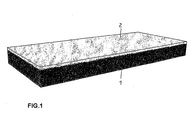
- FIG.1
- eine erfindungsgemäße Dämmplatte zur thermischen Isolierung von Gebäuden, in axonometrischer Darstellung.
- Die in
FIG. 1 dargestellte Dämmplatte weist zwei Schichten 1 und 2 auf, wobei eine erste Schicht 1 aus einem expandierten Polystyrol-Granulat, welches einen Zusatz von athermanen Stoffen im Ausmaß von 3,5 Gew.-% bis 7 Gew.-% enthält, besteht und die zweite Schicht 2 aus einem expandierten Polystyrol-Granulat, welches einen Zusatz von athermanen Stoffen im Ausmaß von 0,5 Gew.-% bis 4 Gew.-% sowie einen Zusatz von hellen, insbesondere gelben, rosa oder grauen, organischen Farbpigmenten im Ausmaß von 0,03 Gew.-% bis 0,3 Gew.-% enthält, besteht. Die erste Schicht 1 weist gegenüber der zweiten Schicht 2 eine mehrfache Dicke auf. - Diese Dämmplatte zur thermischen Isolierung ist dazu bestimmt, auf Außenfassaden von Gebäuden aufgebracht zu werden, wobei die Außenfläche der ersten Schicht 1 an die Außenfassade zur Anlage gebracht und die Dämmplatte an dieser befestigt wird, und auf die Außenfläche der zweiten Schicht 2 ein Verputz aufgebracht wird.
- Durch die innere Schicht 1, welche grau ist, wird die wesentliche Dämmwirkung erbracht und durch die äußere Schicht 2, welche hellgrau, rosa oder gelb ist, wird eine Reflexion von auf diese auftreffenden Wärmestrahlen bewirkt. Da jedoch auch die äußere Schicht 2 aus einem Polystyrol-Granulat besteht, das einen Zusatz von athermanen Stoffen enthält, weist sie gegenüber einer Schicht aus weißem Polystyrol-Granulat, welches keinen Zusatz von athermanen Stoffen enthält, eine wesentlich bessere thermische Dämmwirkung auf.
- Die Herstellung einer derartigen Dämmplatte erfolgt dadurch, dass in eine beheizbare Form eine Schicht 2 aus einem expandierten Polystyrol-Granulat, welches einen Zusatz von 0,5 Gew.-% bis 4 Gew.-% von athermanen Stoffen und weiters einen Zusatz von 0,03 Gew.-% bis 0,3 Gew.-% an hellen organischen Pigmenten enthält, eingebracht wird. Hierauf wird in die Form auf die Schicht 2 eine wesentlich dickere Schicht 1 aus einem expandierten Polystyrol-Granulat, welches einen Zusatz von athermanen Stoffen im Ausmaß von 3,5 Gew.-% bis 7 Gew.-% enthält, eingebracht. In der Folge werden diese beiden in der Form befindlichen Schichten 1 und 2 aus Polystyrol-Granulaten durch Erwärmung und Druck zu einer einstückigen Wärmedämmplatte verschweißt.
- Alternativ dazu wird in die beheizbare Form zuerst die Schicht 1 aus einem expandierten Polystyrol-Granulat, welches einen Zusatz von athermanen Stoffen enthält, eingebracht und wird auf diese Schicht 1 die Schicht 2 aus einem expandierten Polystyrol-Granulat, welches Zusätze aus athermanen Stoffen und aus hellen organischen Pigmenten enthält, eingebracht, worauf diese beiden Schichten 1 und 2 miteinander zu einer einstückigen Wärmedämmplatte verschweißt werden. Dabei weist die Schicht 2 eine gleichmäßige Färbung auf.
- Gemäß einer Ausführungsvariante besteht die Schicht 2 zu 10 % bis 60 %, insbesondere zu 30 %, aus einem Polystyrol-Granulat, welches einerseits Zusätze an athermanen Stoffen im Ausmaß von 0,5 Gew.-% bis 4 Gew.-% der gesamten Schicht 2 enthält und andererseits zu 90 % bis 40 %, insbesondere zu 70 %, aus einem Polystyrol-Granulat, welches helle organische Farbpigmente im Ausmaß von 0,03 Gew.-% bis 0,3 Gew.-% enthält. Dabei weist die Schicht 2 an ihren Oberflächen eine Musterung auf.
- Diese thermische Dämmplatte weist damit zwei Schichten 1 und 2 aus expandierten Polystyrol-Granulaten mit unterschiedlichen Zusätzen auf, wobei durch die Schicht 1 die maßgebliche Wärmedämmung und durch die Schicht 2 sowohl eine Reflexion von auftreffenden Wärmestrahlen als auch gegenüber bekannten derartigen Dämmplatten eine verbesserte Wärmedämmung bewirkt wird.
Claims (4)
- Dämmplatte zur thermischen Isolierung der Außenfassaden von Gebäuden, welche zwei Schichten (1, 2) enthält, wobei die Außenfläche einer ersten Schicht (1) zur Anlage an die Außenfassaden bestimmt ist und die Außenfläche der zweiten Schicht (2) zur Aufbringung eines Verputzes dient, weiters die erste Schicht (1), welche dicker als die zweite Schicht (2) ist, aus einem expandierten Polystyrol-Granulat, welches einen Zusatz von athermanen Stoffen im Ausmaß von 3,5 Gew.-% bis 7 Gew.-% enthält, besteht, sowie die zweite Schicht (2) aus einem expandierten Polystyrol-Granulat besteht, wobei durch die erste Schicht (1) überwiegend die thermische Isolierung bewirkt wird sowie durch die zweite Schicht (2) die für deren Befestigung an einer Außenfassade und die für die Aufbringung des Verputzes erforderliche Spannungsfreiheit der Dämmplatte bewirkt wird, dadurch gekennzeichnet, dass die zweite Schicht (2) einen Zusatz von athermanen Stoffen im Ausmaß von 0,5 Gew.-% bis 4 Gew.-% sowie weiters organische helle Farbpigmente im Ausmaß von 0,03 Gew.-% bis 0,3 Gew.-% enthält, durch welchen sie eine helle Färbung erhält, wodurch auf diese auftreffende Wärmestrahlen von deren Oberfläche weitgehend reflektiert werden, sodass einerseits deren Dämmwirkung verbessert wird und andererseits eine Erwärmung der Dämmplatte vor der Aufbringung des Verputzes auf diese weitgehend vermieden wird.
- Dämmplatte nach Patentanspruch 1, dadurch gekennzeichnet, dass die zweite Schicht (2) aus einem Polystyrol-Granulat besteht, welches Zusätze von athermanen Stoffen im Ausmaß von 0,5 Gew.-% bis 4 Gew.-% und von hellen Farbpigmenten im Ausmaß von 0,03 Gew.-% bis 0,3 Gew.-% enthält.
- Dämmplatte nach Patentanspruch 1, dadurch gekennzeichnet, dass die zweite Schicht (2) einerseits zu 10 % bis 60 %, insbesondere zu 30 %, aus einem Polystyrol-Granulat besteht, welches Zusätze von athermanen Stoffen im Ausmaß von 0,5 Gew.-% bis 4 Gew.-% der gesamten zweiten Schicht enthält, und andererseits zu 90 % bis 40 %, insbesondere zu 70 %, aus einem Polystyrol-Granulat besteht, welches helle organische Farbpigmente im Ausmaß von 0,03 Gew.-% bis 0,3 Gew.-% der gesamten zweiten Schicht enthält.
- Dämmplatte nach einem der Patentansprüche 1 bis 3, dadurch gekennzeichnet, dass die Farbpigmente durch gelbe, rosa oder hellgraue Pigmente gebildet sind.
Applications Claiming Priority (1)
| Application Number | Priority Date | Filing Date | Title |
|---|---|---|---|
| AT11642011 | 2011-08-11 |
Publications (1)
| Publication Number | Publication Date |
|---|---|
| EP2557247A1 true EP2557247A1 (de) | 2013-02-13 |
Family
ID=46046086
Family Applications (1)
| Application Number | Title | Priority Date | Filing Date |
|---|---|---|---|
| EP12450023A Withdrawn EP2557247A1 (de) | 2011-08-11 | 2012-04-16 | Dämmplatte zur thermischen Isolierung der Außenfassaden von Gebäuden |
Country Status (1)
| Country | Link |
|---|---|
| EP (1) | EP2557247A1 (de) |
Cited By (5)
| Publication number | Priority date | Publication date | Assignee | Title |
|---|---|---|---|---|
| DE202013100974U1 (de) * | 2013-03-06 | 2014-06-11 | JOMA Dämmstoffwerk GmbH | Wärmedämmkörper |
| EP2647663A3 (de) * | 2012-04-04 | 2014-07-23 | Sager AG | Wärmedämmplatte |
| EP2873779A1 (de) | 2013-11-13 | 2015-05-20 | STO SE & Co. KGaA | Verfahren zur Herstellung eines mehrschichtigen Formkörpers sowie mehrschichtiger Formkörper zur Wärmedämmung von Gebäuden |
| DE202016106679U1 (de) * | 2016-11-30 | 2018-03-02 | JOMA Dämmstoffwerk GmbH | Dämmplatte |
| EP3581729A1 (de) * | 2018-06-15 | 2019-12-18 | IsoBouw Systems B.V. | Dämmplatte und verfahren zur isolierung einer struktur eines flachdaches eines gebäudes |
Citations (9)
| Publication number | Priority date | Publication date | Assignee | Title |
|---|---|---|---|---|
| EP0620246B1 (de) | 1993-04-13 | 1999-01-27 | ALGOSTAT GmbH & CO. KG | Formkörper aus Polystyrol-Hartschaum |
| EP1201838A1 (de) * | 2000-10-25 | 2002-05-02 | Alcopor Management AG | Dämmplatte und Verfahren zur Herstellung einer mehrschichtigen Dämmplatte |
| WO2007121928A1 (de) * | 2006-04-21 | 2007-11-01 | Deutsche Amphibolin-Werke Von Robert Murjahn Stiftung & Co. Kg | Dämmender geschäumter werkstoff |
| AT10337U2 (de) | 2008-07-24 | 2009-01-15 | Fixit Trockenmoertel Holding Ag | Wärmedämmplatte |
| EP2017075A1 (de) * | 2007-07-20 | 2009-01-21 | Sika Technology AG | Dämmplatte und Verfahren zu ihrer Herstellung |
| DE202010013850U1 (de) * | 2010-08-27 | 2010-12-16 | Sunpor Kunststoff Gesellschaft M.B.H. | Polymerschaumkörper oder teilchenförmige expandierbare Polymerisatpartikel |
| EP1815077B1 (de) | 2004-11-22 | 2011-01-12 | Knauf Dämmstoffe GmbH | Wärmedämmplatte |
| CH701908A2 (de) * | 2009-09-22 | 2011-03-31 | Sager Ag | Dämmplatte und Verfahren zu ihrer Herstellung. |
| EP2353846A1 (de) * | 2010-01-28 | 2011-08-10 | Sager AG | Verfahren zur Herstellung von Dämmplatten |
-
2012
- 2012-04-16 EP EP12450023A patent/EP2557247A1/de not_active Withdrawn
Patent Citations (9)
| Publication number | Priority date | Publication date | Assignee | Title |
|---|---|---|---|---|
| EP0620246B1 (de) | 1993-04-13 | 1999-01-27 | ALGOSTAT GmbH & CO. KG | Formkörper aus Polystyrol-Hartschaum |
| EP1201838A1 (de) * | 2000-10-25 | 2002-05-02 | Alcopor Management AG | Dämmplatte und Verfahren zur Herstellung einer mehrschichtigen Dämmplatte |
| EP1815077B1 (de) | 2004-11-22 | 2011-01-12 | Knauf Dämmstoffe GmbH | Wärmedämmplatte |
| WO2007121928A1 (de) * | 2006-04-21 | 2007-11-01 | Deutsche Amphibolin-Werke Von Robert Murjahn Stiftung & Co. Kg | Dämmender geschäumter werkstoff |
| EP2017075A1 (de) * | 2007-07-20 | 2009-01-21 | Sika Technology AG | Dämmplatte und Verfahren zu ihrer Herstellung |
| AT10337U2 (de) | 2008-07-24 | 2009-01-15 | Fixit Trockenmoertel Holding Ag | Wärmedämmplatte |
| CH701908A2 (de) * | 2009-09-22 | 2011-03-31 | Sager Ag | Dämmplatte und Verfahren zu ihrer Herstellung. |
| EP2353846A1 (de) * | 2010-01-28 | 2011-08-10 | Sager AG | Verfahren zur Herstellung von Dämmplatten |
| DE202010013850U1 (de) * | 2010-08-27 | 2010-12-16 | Sunpor Kunststoff Gesellschaft M.B.H. | Polymerschaumkörper oder teilchenförmige expandierbare Polymerisatpartikel |
Cited By (5)
| Publication number | Priority date | Publication date | Assignee | Title |
|---|---|---|---|---|
| EP2647663A3 (de) * | 2012-04-04 | 2014-07-23 | Sager AG | Wärmedämmplatte |
| DE202013100974U1 (de) * | 2013-03-06 | 2014-06-11 | JOMA Dämmstoffwerk GmbH | Wärmedämmkörper |
| EP2873779A1 (de) | 2013-11-13 | 2015-05-20 | STO SE & Co. KGaA | Verfahren zur Herstellung eines mehrschichtigen Formkörpers sowie mehrschichtiger Formkörper zur Wärmedämmung von Gebäuden |
| DE202016106679U1 (de) * | 2016-11-30 | 2018-03-02 | JOMA Dämmstoffwerk GmbH | Dämmplatte |
| EP3581729A1 (de) * | 2018-06-15 | 2019-12-18 | IsoBouw Systems B.V. | Dämmplatte und verfahren zur isolierung einer struktur eines flachdaches eines gebäudes |
Similar Documents
| Publication | Publication Date | Title |
|---|---|---|
| DE19933408B4 (de) | Brandschutztür oder -fenster | |
| EP2360341B1 (de) | Verfahren zum Herstellen einer Profilanordnung und deren Verwendung | |
| EP2010601B1 (de) | Dämmender geschäumter werkstoff | |
| EP2867421A1 (de) | Wandelement | |
| DE202011100310U1 (de) | Brandschutz-Doppelverglasung | |
| CH706454B1 (de) | Dämmplatte und Verfahren zur Herstellung einer Dämmplatte. | |
| DE102012106345A1 (de) | Verfahren zum Herstellen eines Haustür-türblatts sowie damit hergestelltes Haustür-Türblatt | |
| EP2372069B1 (de) | Brandschutz-Türzarge aus Holz | |
| DE2855691A1 (de) | Schaumbildende abdichtfolie und ihre herstellung | |
| AT12435U1 (de) | Dämmplatte zur thermischen isolierung der aussenfassaden von gebäuden | |
| DE102010006909B4 (de) | Balg als Teil eines Übergangs zwischen zwei gelenkig miteinander verbundenen Fahrzeugen, Verfahren zur Herstellung einer Stoffbahn für einen Balg sowie Verfahren zur Herstellung eines Balges | |
| EP1812675B1 (de) | Hohlkammerprofil aus thermoplastischem kunststoff | |
| DE202019102808U1 (de) | Mehrschichtplatte | |
| DE102005031133B4 (de) | Schaumstoffplatte mit Lichtreflexionsanstrich und deren Verwendung | |
| DE202011100312U1 (de) | Brandschutz-Doppelverglasung | |
| EP2647663B1 (de) | Wärmedämmplatte | |
| DE202007013369U1 (de) | EPS-Schaumstoffplatten mit verminderter Wärmeleitfähigkeit | |
| DE202013103305U1 (de) | Flügelüberdeckende Tür | |
| DE202010018272U1 (de) | Profilanordnung | |
| DE102012111416A1 (de) | Brandschutzfenster | |
| EP3148799A1 (de) | Brandschutzmaterial, ausbauplatte, verfahren zur herstellung eines brandschutzmaterials und verfahren zur herstellung einer ausbauplatte | |
| DE102013109733A1 (de) | Bauelement eines Fensters oder einer Tür sowie Fenster oder Tür mit einem solchen Bauelement | |
| AT411701B (de) | Glasscheibe, insbesondere verbundglasscheibe, für fenster, türen oder eine glasfront | |
| AT520668A2 (de) | Bauelement und Verfahren zur Herstellung eines Bauelements | |
| DE202017107427U1 (de) | Hohlkammerprofil, insbesondere Fenster- oder Türprofil |
Legal Events
| Date | Code | Title | Description |
|---|---|---|---|
| PUAI | Public reference made under article 153(3) epc to a published international application that has entered the european phase |
Free format text: ORIGINAL CODE: 0009012 |
|
| AK | Designated contracting states |
Kind code of ref document: A1 Designated state(s): AL AT BE BG CH CY CZ DE DK EE ES FI FR GB GR HR HU IE IS IT LI LT LU LV MC MK MT NL NO PL PT RO RS SE SI SK SM TR |
|
| AX | Request for extension of the european patent |
Extension state: BA ME |
|
| STAA | Information on the status of an ep patent application or granted ep patent |
Free format text: STATUS: THE APPLICATION IS DEEMED TO BE WITHDRAWN |
|
| 18D | Application deemed to be withdrawn |
Effective date: 20130814 |