EP2557563B1 - Dämpfer für Blechblasinstrument - Google Patents
Dämpfer für Blechblasinstrument Download PDFInfo
- Publication number
- EP2557563B1 EP2557563B1 EP12005760.9A EP12005760A EP2557563B1 EP 2557563 B1 EP2557563 B1 EP 2557563B1 EP 12005760 A EP12005760 A EP 12005760A EP 2557563 B1 EP2557563 B1 EP 2557563B1
- Authority
- EP
- European Patent Office
- Prior art keywords
- pipe
- main pipe
- mute
- auxiliary
- brass instrument
- Prior art date
- Legal status (The legal status is an assumption and is not a legal conclusion. Google has not performed a legal analysis and makes no representation as to the accuracy of the status listed.)
- Not-in-force
Links
- 229910001369 Brass Inorganic materials 0.000 title claims description 110
- 239000010951 brass Substances 0.000 title claims description 110
- 239000011295 pitch Substances 0.000 description 26
- 238000011144 upstream manufacturing Methods 0.000 description 24
- 230000004048 modification Effects 0.000 description 10
- 238000012986 modification Methods 0.000 description 10
- 238000007664 blowing Methods 0.000 description 7
- 230000001902 propagating effect Effects 0.000 description 6
- 230000015572 biosynthetic process Effects 0.000 description 5
- 239000003086 colorant Substances 0.000 description 5
- 230000035807 sensation Effects 0.000 description 5
- 238000005516 engineering process Methods 0.000 description 4
- 230000002745 absorbent Effects 0.000 description 2
- 239000002250 absorbent Substances 0.000 description 2
- 230000003247 decreasing effect Effects 0.000 description 2
- 239000000463 material Substances 0.000 description 2
- 230000007246 mechanism Effects 0.000 description 2
- 238000000034 method Methods 0.000 description 2
- 230000002194 synthesizing effect Effects 0.000 description 2
- 239000003638 chemical reducing agent Substances 0.000 description 1
- 239000007799 cork Substances 0.000 description 1
- 230000000593 degrading effect Effects 0.000 description 1
- 210000005069 ears Anatomy 0.000 description 1
- 230000005284 excitation Effects 0.000 description 1
- 230000001747 exhibiting effect Effects 0.000 description 1
- 239000006260 foam Substances 0.000 description 1
- 230000006698 induction Effects 0.000 description 1
- 238000009434 installation Methods 0.000 description 1
- 239000007779 soft material Substances 0.000 description 1
- 238000009331 sowing Methods 0.000 description 1
- 230000001629 suppression Effects 0.000 description 1
- JOYRKODLDBILNP-UHFFFAOYSA-N urethane group Chemical group NC(=O)OCC JOYRKODLDBILNP-UHFFFAOYSA-N 0.000 description 1
- 238000009423 ventilation Methods 0.000 description 1
Images






Classifications
-
- G—PHYSICS
- G10—MUSICAL INSTRUMENTS; ACOUSTICS
- G10D—STRINGED MUSICAL INSTRUMENTS; WIND MUSICAL INSTRUMENTS; ACCORDIONS OR CONCERTINAS; PERCUSSION MUSICAL INSTRUMENTS; AEOLIAN HARPS; SINGING-FLAME MUSICAL INSTRUMENTS; MUSICAL INSTRUMENTS NOT OTHERWISE PROVIDED FOR
- G10D9/00—Details of, or accessories for, wind musical instruments
- G10D9/06—Mutes
Definitions
- the present invention relates to a mute for a wind instrument such as a brass instrument, in particular to a mute adapted to a horn-shaped sounder of a brass instrument such as a bell of a trumpet.
- JP 2707913 B discloses a musical tone synthesizing apparatus simulating a tone-generation mechanism of a wind instrument including a mouthpiece and a resonating pipe with an excitation part, a junction, and waveguides.
- US 5,438,156 A discloses a wind type tone synthesizer including the same technology as JP 2707913 B relating to a taper theorem simulating resonating property of a wind instrument with a branch pipe using straight pipes.
- JP 2707913 B and US 5,438,156 A disclose the technology for approximately reproducing resonating property of a tapered pipe having a conical surface with two types of straight pipes.
- Fig. 19 shows the structure of a wind instrument 1000A with a tapered pipe 450.
- Fig. 20 shows the structure of a wind instrument 1000B with straight pipes 410, 420 simulating resonating property of the tapered pipe 450 shown in Fig. 19 .
- the wind instrument 1000A includes a mouthpiece 500A and a pipe structure 400A with the tapered pipe 400A.
- the wind instrument 1000B includes a mouthpiece 500B and a pipe structure 400B branching into the straight pipes 410, 420.
- the pipe structure 400B is able to approximately reproduce resonating property of the tapered pipe 450 when the straight pipes 410, 420 are designed with optimum lengths and diameters as disclosed in JP 2707913 B .
- US 2004/0261602 A1 discloses a ring mute which is made of sound absorbent material and attached onto the rim of the bell of a brass instrument instead of inside the bell of the brass instrument.
- US 4,998,959 A discloses a mute, having a resonating dish with an opening and a slit, which is attached to the outside of the bell of a horn-type instrument by use of adjustable fitting means.
- US 5,309,808 A discloses an acoustic practice mute for a brass instrument.
- US 5,373,771 A discloses a sound reflector device which reflects sound rearwardly from the bell of a brass instrument towards the ears of a player.
- US 5,488,893 A discloses a conical-shaped mute including a plurality of ribs and a plurality of plugs.
- US 5,569,864 A and US 5,973,246 A disclose a mute adapted to a brass instrument with an inner surface which is shaped in consideration of nodes of standing waves of harmonic tones.
- US 6,114,619 A discloses a ventilated mute with an electrically-driven ventilation system which is attached to the bell of a wind instrument.
- US 7,049,501 A discloses a ring mute, comprised of a sound absorbent foam urethane ring, which is attached to the rim of the bell of a brass instrument.
- JP 4986091 B discloses a mute for a brass instrument which includes a breath induction pipe and a breath exhaust pipe so as to improve blowing property of a brass instrument with muted sound.
- EP 2 360 767 A1 forms part of the prior art under Art. 54 (3) EPC and discloses a pipe structure of a wind instrument as shown in Figs. 19 and 20 .
- the wind instrument is constituted of a mouthpiece and a pipe structure including tapered/straight pipes.
- the pipe structure is constituted of a blow member and a branch pipe.
- the branch pipe is branched into a main pipe and an auxiliary pipe, which are straight pipes having openings and connected together in a branch shape.
- the blow member is connected to a branch point of the branch pipe.
- the branch pipe simulates resonance characteristic of a tapered pipe having a predetermined length, a predetermined distance between the upper base and the vertex, and a predetermined sectional area of the upper base commensurate with the sectional area of the main pipe.
- US 2,621,553 B discloses a cone-type mute for a brass instrument, wherein the cone-type mute comprises a hollow truncated conical body having its inner truncated end wholly open, the opposite end being flat and formed with a central tone discharge hole, further formed in one side with a small complemental tone discharge hole, provided with an endless compressibly resilient retaining gasket encircling the truncated end portion and further provided with a readily insertable and removable reducer sleeve fitting into the first named tone hole.
- a player needs to play a wind instrument or a brass instrument equipped with a mute which is inserted into a bell pipe.
- a player plays a brass instrument equipped with a conventionally-known mute, it is possible to reduce sound volume owing to the mute, however, which may significantly change the resonating property of a brass instrument so as to unexpectedly change pitches and sound quality.
- pitches and sound quality of brass instruments highly depend on resonating property of brass instruments. Compared to resonating property of a brass instrument not equipped with a mute, resonating property of a brass instrument equipped with a mute may inevitably include additional resonating peaks in the low register, which in turn pushes original resonating peaks in the low register towards the high register, thus increasing resonating frequencies. That is, a mute attached to a brass instrument may increase pitches in the low register. Although conventionally-known mutes are able to reduce sound volume, they may unexpectedly change pitches and sound quality compared with original pitches and sound quality produced with wind instruments not equipped with mutes.
- the present invention relates to a mute detachably attached to a brass instrument which includes a fixed part and at least one branch pipe including a main pipe and an auxiliary pipe.
- the mute is attached to the tapered portion of a bell pipe of a brass instrument in such a way that the fixed part is interposed between the interior of the bell pipe and the exterior of the main pipe.
- the claimed invention is directed to a mute as set forth in claim 1.
- an air flow blown into the bell pipe is introduced into the main pipe, and then the air flow introduced into the main pipe is branched to the auxiliary pipe and emitted from the opening end of the main pipe and the opening end of the auxiliary pipe.
- Fig. 1 is a perspective view of a brass instrument (or a wind instrument) 1 equipped with a mute 100 according to a preferred embodiment of the present invention.
- the bass instrument 1 resembles a generally-known brass instrument such as a trumpet and a trombone, which is equipped with a pitch adjuster 41, a mouthpiece 51, and a bell pipe 71.
- the pitch adjuster 41 includes a piston valve and a bypass pipe. Upon operating the pitch adjuster 41, it is possible to switch over the presence and the absence of routing using the bypass pipe so as to change an effective length of the brass instrument 1.
- the pitch adjuster 41 is able to adjust the length of an air column resonating inside the bell pipe 71 such that the brass instrument 1 can produce sound having pitches belonging to the predetermined musical scale.
- the bell pipe 71 includes a tapered pipe 72 and a bell 73.
- the tapered pipe 72 is a taper-shaped pipe portion which is elongated and gradually changed in its diameter with a predetermined taper ratio.
- the bell 73 is a bell-shaped sounder portion whose taper ratio (or whose curvature) is gradually enlarged in an axial direction.
- a wide-open edge 75L is formed at the distal end of the bell 73 of the bell pipe 71.
- a player's breath is blown into the internal space of the brass instrument 1 via the mouthpiece 51 and then emitted into the external air via the wide-open edge 75L.
- An air flow introduced into the brass instrument 1 is not necessarily limited to a player's breath; hence, it is possible to mechanically produce an air flow and introduce it into the brass instrument 1.
- Fig. 2 is a perspective view of the mute 100.
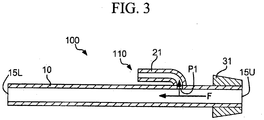
- Fig. 3 is a longitudinal sectional view taken along line A-A in Fig. 2 .
- the mute 100 includes a fixed part 31 and a branch pipe 110 which further includes a main pipe 10 and an auxiliary pipe 21.
- the main pipe 10 is an elongated pipe with a circular section having a relatively large diameter, whilst the auxiliary pipe 21 is formed using a pipe with a circular section having a relatively small diameter.
- these pipes maintain the same cross section entirely in the axial direction; hence, it is possible to employ a straight pipe (which is straightly elongated in its axial direction) or a curved pipe whose cross section is not changed in the axial direction. In either case, these pipes are not changed in their cross-sectional areas so that the same cross section having the same opening area can be secured at any one of normal planes, perpendicular to the axial direction, along the entire length thereof.
- the main pipe 10 has an upstream edge 15U which is positioned close to the mouthpiece 51 and a downstream edge 15L which is positioned close to the wide-open edge 75L of the bell 73 when the mute 100 is installed in the brass instrument 1.
- a player's breath is blown into the upstream edge 15U and then emitted from the downstream edge 15L.
- Openings are formed at the distal end of the upstream edge 15U and the distal end of the downstream edge 15L. These openings are sectioned along the planes normal to the axial direction of the mute 100.
- the internal space of the main pipe 10 is connected to the internal space of the auxiliary pipe 21 at an interconnect part P1.
- the auxiliary pipe 21 is elongated in its axial direction which is parallel to the axial direction of the main pipe 10, but the base portion of the auxiliary pipe 21 is bent and connected to the main pipe 10 at the interconnect part P1.
- the upstream edge (or the right-side edge) of the auxiliary pipe 21 is connected to the main pipe 10, while the downstream edge (or the left-side edge) of the auxiliary pipe 21 is opened in Fig. 3 .
- a player's breath blown into the upstream edge 15U of the main pipe 10 is branched away at the interconnect part P1, at which the internal path of the main pipe 10 is partly branched into the auxiliary pipe 21.
- the reference sign "F" denotes a flow (or a branched flow) of a player's breath. That is, a player's breath blown into the upstream edge 15U of the main pipe 10 is divided into two flows and then emitted from the downstream edge 15L of the main pipe 10 and the downstream edge of the auxiliary pipe 21.
- the fixed part 31 is attached to the main pipe 10 in proximity to the upstream edge 15U of the main pipe 10.
- the fixed part 31 is formed using a soft material (e.g. a cork or a rubber) which is softer than the material of the main pipe 10.
- the fixed part 31 Viewing in the axial direction of the main pipe 10, the fixed part 31 is bonded to the main pipe 10 to cover its external circumference.
- the thickness of the fixed part 31 is gradually reduced in a direction toward the upstream edge 15U of the main pipe 10; hence, the external shape of the fixed part 31 is a conical shape without its top portion which is truncated.
- the taper ratio of the external shape of the fixed part 31 approximately matches the taper ratio of the tapered pipe 72 of the bell pipe 71 of the brass instrument 1.
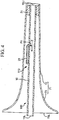
- Fig. 4 is a longitudinal sectional view of the brass instrument 1 equipped with the mute 100.
- the mute 100 is installed inside the bell pipe 71. Specifically, a player holds the mute 100, with the fixed part 31 (or the upstream edge 15L) directing to the internal space of the bell pipe 71, and then inserts it into the wide-open edge 75L of the bell pipe 71. When the mute 100 is completely inserted into the bell pipe 71, the fixed part 31 of the mute 100 is tightly held between the main pipe 10 and the tapered pipe 72 of the bell pipe 71.
- the fixed part 31 of the mute 100 fixes the position of the main pipe 10 relative to the brass instrument, so that the mute 100 is fixed in position in connection with the brass instrument 1.
- the mute 100 is detachably fixed to the brass instrument 1 by means of the fixed part 31 pressed by the main pipe 10 and the tapered pipe 72. For this reason, a player is able to easily pull out the mute 100 from the brass instrument 1 with his/her hand.
- the mute 100 is designed with the predetermined shape and dimensions such that the main pipe 10 and the auxiliary pipe 21 (constituting the branch pipe 110) will not come in contact with the interior face of the bell pipe 71 when the mute 100 is attached to the brass instrument 1.
- Fig. 4 shows that the mute 100 is substantially installed inside the internal space of the bell pipe 71 while the downstream edge 15L of the main pipe 10 of the mute 100 is positioned slightly externally of the wide-open edge 75L of the bell pipe 71; but this is not a restriction. It is possible to determine the shape and the dimensions of the mute 100 such that the mute 100 will be entirely installed inside the internal space of the bell pipe 71. In this case, it is possible to shorten the length of the main pipe 10, or it is possible to form the main pipe 10 by use of a curved pipe or a spirally-curved pipe.
- the pitch adjuster 41 is able to adjust the length of an air column, resonating inside the bell pipe 71, at the predetermined length in connection with the opening of the downstream edge 15L of the main pipe 10 and the opening of the downstream edge of the auxiliary pipe 21.
- the brass instrument 1 is able to produce sound with a desired pitch (belonging to a specific musical scale) owing to a resonating air column whose length is adjusted at the predetermined length.
- the pitch adjuster 41 adjusts the length of a resonating air column so as to produce any one of pitches (belonging to a specific musical scale) in connection with the opening of the downstream edge 15L of the main pipe 10 and the opening of the downstream edge of the auxiliary pipe 21.
- the internal space of the branch pipe 110 of the mute 100 is determined in terms of the shape and the dimensions such that the pitch adjuster 41 is able to adjust the length of a resonating air column so as to produce any one of pitches belonging to a specific musical scale regardless of the installation or disconnection of the mute 100 in the brass instrument 1.
- the present example is designed to determine the length and the sectional area for each of the main pipe 10 and the auxiliary pipe 21 (constituting the branch pipe 110) and the connected position between the main pipe 10 and the auxiliary pipe 21.
- the pitch adjuster 41 is designed to continuously change the length of a resonating air column.
- the brass instrument 1 resembling a trombone may demonstrate a higher degree of freedom in determining the length and the sectional area for each of the main pipe 10 and the auxiliary pipe 21 as well as the connected position between the main pipe 10 and the auxiliary pipe 21 rather than the brass instrument 1 resembling a trumpet. In this case, it is possible to determine the position of a slide pipe (not shown) for generating a specific pitch differently with respect to the brass instrument 1 equipped with the mute 100 and the brass instrument 1 not equipped with the mute 100.
- the branch pipe 110 of the mute 100 exhibits various resonating characteristics depending on parameters regarding the shape of the branch pipe 110, such as the connected position (i.e. the interconnect part P1), at which the auxiliary pipe 21 joins to the main pipe 10 in the axial direction, and the shape of the auxiliary pipe 21 (e.g. the length and the sectional area of the internal space).
- the connected position i.e. the interconnect part P1
- the shape of the auxiliary pipe 21 e.g. the length and the sectional area of the internal space.
- the mute 100 allows the brass instrument 1 to reproduce-resonating characteristics of the bell pipe 71 while suppressing sound volume.
- the mute 100 shown in Fig. 4 differs from conventionally mutes such that the branch pipe 110 thereof does not additionally cause unwanted peaks of resonance in the low register; hence, it is possible to improve pitches and tone colors in correspondence with low-degree peaks of resonance.
- the mute 100 of the present embodiment does not include a suppressing part for rapidly suppressing a player's breath blown into the brass instrument. This may not differentiate a player's blowing sensation between a mute mode of the brass instrument 1 equipped with the mute 100 and a normal mode of the brass instrument 1 not equipped with the mute 100.
- the present embodiment is able to prevent the brass instrument 1 from being changed in sound quality in the mute mode of the brass instrument 1 equipped with the mute 100, compared to the normal mode of the brass instrument 1 not equipped with the mute 100.
- the present embodiment allows a player to play music with the suppressed sound volume but without changing the sound quality of the brass instrument 1. Additionally, it is possible to reduce variation of a player's blowing sensation between the mute mode and the normal mode.
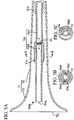
- FIG. 5A is a longitudinal sectional view of the brass instrument 1 equipped with a mute 100a according to a first variation.
- the mute 100a includes a main pipe 10a, an auxiliary pipe 21a, and a fixed part 31a.
- the internal space of the auxiliary pipe 21a is connected to the internal space of the main pipe 10a at the interconnect part P1.
- the auxiliary pipe 21a is laid to partly cover the exterior of the main pipe 10a in its length. Additionally, the auxiliary pipe 21a is laid to entirely cover the external circumference of the main pipe 10a about the axial direction; hence, the internal space of the auxiliary pipe 21a is shaped to match with the exterior shape of the main pipe 10a.
- the main pipe 10a includes a first main pipe 10a1 and a second main pipe 10a2, which are separated from each other in the initial state.
- the interconnect part P1 is interposed between the first main pipe 10a1 and the second main pipe 10a2, which are thus connected together.
- a player's breath is blown into the main pipe 10a and then partly branched into the auxiliary pipe 21a because the auxiliary pipe 21a is connected to the first main pipe 10a1.
- the auxiliary pipe 21a is connected to the second main pipe 10a2 via a support 10a3.
- Fig. 5B is a cross-sectional view taken along line B-B in Fig. 5A .
- the support 10a3 is interposed between the second main pipe 10a2 and the auxiliary pipe 21a partly covering the exterior of the second main pipe 10a2. That is, the first main pipe 10a1 and the second main pipe 10a2 are connected together via the support 10a3 and the auxiliary pipe 21a; hence, these pipes 10a1, 10a2, 21a and the support 10a3 mutually support each other. In this connection, it is possible to replace the support 10a3 with another support (not shown) for connecting the first main pipe 10a1 and the second main pipe 10a2.
- Fig. 5C is a cross-sectional view taken along line B-B in Fig. 5A , wherein Fig. 5C shows another connecting structure different from the structure of Fig. 5B .
- the internal space of the auxiliary pipe 21a joins to the internal space of the second main pipe 10a2.
- the auxiliary pipe 21a partly covers the exterior circumference of the second main pipe 10a2 in a certain angle, and therefore the internal space of the auxiliary pipe 21a is shaped to match with a certain angle of the exterior circumference of the second main pipe 10a2.
- the auxiliary pipe 21a shown in Fig. 5 has a degree of freedom in changing its position close to the front side of the brass instrument 1. This expands a movable range of the auxiliary pipe 21a, thus further increasing the performance ability to produce desired pitches and desired tone colors.
- the interconnect part P1 coupled with the auxiliary pipe 21 is fixed to the side face of the main pipe 10; but this is not a restriction. It is possible to arrange the interconnect part P1 inside the internal space of the main pipe 10.
- Fig. 6 is a longitudinal sectional view of the brass instrument 1 equipped with a mute 100b according to a second variation.
- the mute 100b includes a fixed part a main pipe 10b and an auxiliary pipe 21b, both of which are elongated in the axial direction, as well as a fixed part 31b.
- the auxiliary pipe 21b having a relatively small diameter and a longer length is partly inserted into the internal space of the main pipe 10b having a large diameter; therefore, the internal space of the auxiliary pipe 21b is interconnected to the internal space of the main pipe 10b at the interconnect part P1.
- the interconnect part P1 at which the internal space of the main pipe 10b is interconnected to the internal space of the auxiliary pipe 21b is not set to the side face of the main pipe 10b but set to the inside of the main pipe 10b.
- a player's breath blown into the main pipe 10b is branched into the internal space of the auxiliary pipe 21b at the interconnect part P1.
- a player's breath is partly flown into the space formed between the interior of the main pipe 10b and the exterior of the auxiliary pipe 21b.
- the second variation is similar to the first variation of Fig. 5B in that the main pipe 10b and the auxiliary pipe 21b are connected together via a support (not shown).
- the main pipe 10 maintains the same sectional area between the upstream side and the downstream side divided at the interconnect part P1; but it is possible to change the sectional area of the main pipe 10.
- a mute including a main pipe and an auxiliary pipe, such that the shape of the upstream side of a main pipe approximately matches with the combined shape consisting of the downstream side of a main pipe and an auxiliary pipe.
- the sectional area of the upstream side of a main pipe differs from the sectional area of the downstream side of a main pipe at an interconnect part.
- Fig. 7A is a longitudinal sectional view of the brass instrument 1 equipped with a mute 100c according to a third variation.
- the mute 100c includes a main pipe 10c, an auxiliary pipe 21c, and a fixed part 31c.
- the auxiliary pipe 21c is interconnected to the main pipe 10c at the interconnect part P1.
- the main pipe 10c includes a first main pipe 10c1 (which is laid in the upstream side of the main pipe 10c, i.e. the right side from the interconnect part PI) and a second main pipe 10c2 (which is laid in the downstream side of the main pipe 10c, i.e. the left side from the interconnect part PI).
- the first main pipe 10c1 has a circular sectional shape.
- Fig. 7B is a cross-sectional view taken along line C-C in Fig. 7A .
- both the second main pipe 10c2 and the auxiliary pipe 21c have a semicircular sectional shape.
- the second main pipe 10c2 and the auxiliary pipe 21c are coupled together to form a circular sectional shape which approximately matches with the circular sectional shape of the first main pipe 10c1 in the cross-sectional view of Fig. 7B .
- the main pipe 10 and the auxiliary pipe 21 are configured of straight pipes whose sectional areas are unchanged in the axial direction; but it is possible to employ a tapered pipe, a bell-shaped pipe having a certain curvature, or other types of pipes. It is possible to combine a straight pipe with a tapered pipe, or it is possible to combine other types of pipes.
- Figs. 8 and 9 show examples utilizing a partially tapered main pipe
- Fig. 10 shows an example utilizing a partially tapered auxiliary pipe.
- Fig. 8 is a longitudinal sectional view of the brass instrument 1 equipped with a mute 100d according to the fourth variation.
- the mute 100d includes a main pipe 10d, an auxiliary pipe 21d, and a fixed part 31d.
- the internal space of the auxiliary pipe 21d is connected to the internal space of the main pipe 10d at the interconnect part P1.
- the main pipe 10d includes a first main pipe 10d1 (which is laid in the upstream side of the main pipe 10d, i.e. the right side from the interconnect part PI) and a second main pipe 10d2 (which is laid in the downstream side of the main pipe 10d, i.e. the left side from the interconnect part PI).
- the second main pipe 10d2 is configured of a reverse tapered pipe whose sectional area is gradually decreased towards the distal end. This structure is able to further suppress sound volume of the brass instrument 1 in comparison with the foregoing embodiment.
- Fig. 8 shows that the boundary between the first main pipe 10d1 and the second main pipe 10d2 is set to the intermediate position along the main pipe 10d; but this is not a restriction. It is possible to set the boundary between the first main pipe 10d1 and the second main pipe 10d2 to the upstream side or the downstream side of the main pipe 10d.
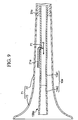
- Fig. 9 is a longitudinal sectional view of the brass instrument 1 equipped with a mute 100e according to the fourth variation.
- the mute 100e includes a main pipe 10e, an auxiliary pipe 21e, and a fixed part 31e.
- the internal space of the main pipe 10e is connected to the internal space of the auxiliary pipe 21e at the interconnect part P1.
- the main pipe 10e includes a first main pipe 10e1 (which is laid in the upstream side of the main pipe 10e, i.e. the right side from the interconnect part PI) and a second main pipe 10e2 (which is laid in the downstream side of the main pipe 10e, i.e. the left side from the interconnect part PI).
- the second main pipe 10e2 is configured of a forward tapered pipe whose sectional area is gradually increased towards the distal end. This structure is able to slightly increase sound volume of the brass instrument 1 in comparison with the foregoing embodiment. In other words, it is possible to reduce suppression of sound volume by use of the mute 100e compared to the mute 100 of the foregoing embodiment.
- Fig. 10 is a longitudinal sectional view of the brass instrument 1 equipped with a mute 100f according to the fourth variation.
- the mute 100f includes a main pipe 10f, an auxiliary pipe 21f, and a fixed part 31f.
- the internal space of the auxiliary pipe 21f is connected to the internal space of the main pipe 10f at the interconnect part P1.
- the mute 100f of Fig. 10 is a modification of the mute 100a of Fig. 5A , wherein the main pipe 10f corresponds to the main pipe 10a while the auxiliary pipe 21f corresponds to the auxiliary pipe 21a.
- the auxiliary pipe 21f is configured of a reverse tapered pipe whose sectional area is gradually decreased toward the distal end.
- the branch pipe 110 of the mute 100 includes two pipes (i.e. the main pipe 10 and the auxiliary pipe 21) and a single interconnect part P1; but it is possible to combine three or more pipes interconnected at two or more interconnect parts.
- Three examples according to a fifth variation will be described with reference to Figs. 11 to 13 , each of which illustrates a branch pipe including two auxiliary pipes interconnected to a main pipe at two interconnect parts.
- each branch pipe is configured of three pipes, i.e. two auxiliary pipes and one main pipe; but it is possible to redesign each branch pipe arranging four or more pipes.
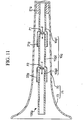
- Fig. 11 is a longitudinal sectional view of the brass instrument equipped with a mute 100g according to a fifth variation.
- the mute 100g of Fig. 11 is a modification of the mute 100a of Fig. 5A .
- the mute 100g includes a main pipe 10g, a first auxiliary pipe 21g, a second auxiliary pipe 22g, and a fixed part 31g.
- the internal space of the first auxiliary pipe 21g is connected to the internal space of the main pipe 10g at an interconnect part P1
- the internal space of the second auxiliary pipe 22g is connected to the internal space of the main pipe 10g at an interconnect part P2.
- a player's breath blown into the main pipe 10g is branched into the first auxiliary pipe 21g at the interconnect part P1, at which the first auxiliary pipe 21g is connected to the upstream side of the main pipe 10g; subsequently, a player's breath propagating inside the main pipe 10g after the interconnect part P1 is branched into the second auxiliary pipe 22g at the interconnect part P2, at which the second auxiliary pipe 22g is connected to the downstream side of the main pipe 10g. That is, the mute 100g is characterized by arranging the two interconnect parts P1, P2 for branching a player's breath propagating through the main pipe 10g.
- the main pipe 10g includes a first main pipe 10g1, a second main pipe 10g2, and a third main pipe 10g3, which can be separated from each other.
- a player's breath blown into the main pipe 10g is partly branched into the first auxiliary pipe 21g at the interconnect part P1 formed between the first main pipe 10g1 and the second main pipe 10g2.
- a player's breath propagating through the main pipe 10g is partly branched into the second auxiliary pipe 22g at the interconnect part P2 formed between the second main pipe 10g2 and the third main pipe 10g3. Similar to the connecting structure of the first variation shown in Fig.
- the first auxiliary pipe 21g is connected between the first main pipe 10g1 and the second main pipe 10g2, while the second auxiliary pipe 22g is connected between the second main pipe 10g2 and the third main pipe 10g3.
- the mute 100g having a plurality of branch pipes with a plurality of interconnect parts is able to reproduce resonating characteristics caused with various shapes of pipes.
- Fig. 12 is a longitudinal sectional view of the brass instrument 1 equipped with a mute 100h according to the fifth variation.
- the mute 100h is a modification of the mute 100b of the second variation shown in Fig. 6 .
- the mute 100h includes a main pipe 10h, a first auxiliary pipe 21h, a second auxiliary pipe 22h, and a fixed part 31h.
- the internal space of the first auxiliary pipe 21h is connected to the internal space of the main pipe 10h at the interconnect part P1, while the internal space of the second auxiliary pipe 22h is connected to the internal space of the first auxiliary pipe 21h at the interconnect part P2.
- a player's breath blown into the main pipe 10h is partly branched into the first auxiliary pipe 21h at the interconnect part P1 at which the first auxiliary pipe 21h is connected to the main pipe 10h.
- a player's breath propagating through the main pipe 10h is partly branched into the second auxiliary pipe 22h at the interconnect part P2 at which the second auxiliary pipe 22h is connected to the first auxiliary pipe 21h.
- the first auxiliary pipe 21h is connected to the main pipe 10h while the second auxiliary pipe 22h is connected to the first auxiliary pipe 21h.
- Fig. 13 is a longitudinal sectional view of the brass instrument 1 equipped with a mute 100k according to the fifth variation.
- the mute 100k is a modification of the mute 100c of the third variation shown in Fig. 7 .
- the mute 100k includes a main pipe 10k, a first auxiliary pipe 21k, a second auxiliary pipe 22k, and a fixed part 31k.
- the main pipe 10k includes a first main pipe 10k1 having a large sectional area and a second main pipe 10k2 having a small sectional area.
- the internal space of the first auxiliary pipe 21k is connected to the internal space of the first main pipe 10k1 at the interconnect part P1, while the internal space of the second auxiliary pipe 22k is connected to the internal space of the second main pipe 10k2 at the interconnect part P2.
- a player's breath blown in to the first main pipe 10k1 is partly branched into the first auxiliary pipe 21k at the interconnect part P1 at which the first auxiliary pipe 21k is connected to the first main pipe 10k1, wherein a part of a player's breath propagating through the first main pipe 10k1 is introduced into the second main pipe 10k2.
- a player's breath propagating through the second main pipe 10k2 is partly branched into the second auxiliary pipe 22k at the interconnect part P2 at which the second auxiliary pipe 22k is connected to the second main pipe 10k2.
- the connecting structure formed between the first main pipe 10k1, the second main pipe 10k2, and the first auxiliary pipe 21k shown in Fig. 13 is similar to the connecting structure formed between the first main pipe 10c1, the second main pipe 10c2, and the auxiliary pipe 21c shown in Fig. 7 .
- the second auxiliary pipe 22k is connected to the lower side face of the second main pipe 10k2, wherein the second auxiliary pipe 22k is deviated in position from the axial direction of the bell pipe 71.
- the fixed part 31 of the mute 100 is filled in the gap between the exterior of the main pipe 10 and the interior of the bell pipe 71 so that a player's breath is entirely flown into the main pipe 10; but this is not a restriction. It is possible to redesign the mute 100 such that a part of a player's breath may be flown into the gap between the exterior of the main pipe 10 and the interior of the bell pipe 71.
- Fig. 14A is a longitudinal sectional view of the brass instrument 1 equipped with a mute 100m according to a sixth variation.
- the mute 100m is a modification of the mute 100g, precluding the first auxiliary pipe 21g and modifying the fixed part 31g.
- the mute 100m includes a main pipe 10m, an auxiliary pipe 22m, and fixed parts 31m having internal spaces 32m (i.e. three fixed parts 31ml, 32ml, 31m3 having internal spaces 32ml, 32m2, 32m3).
- the internal space of the auxiliary pipe 22m is connected to the internal space of the main pipe 10m at the interconnect part P2, wherein the main pipe 10m includes a first main pipe 10ml and a second main pipe 10m2.
- Fig. 14B is a cross-sectional view taken along line D-D in Fig. 14A .
- the mute 100m includes the three fixed parts 31m1, 31m2, 31m3.
- the fixed parts 31m1, 31m2, 31m3 are interposed between the tapered pipe 72 of the bell pipe 71 and the first main pipe 10m1 such that they are placed in contact with the interior of the tapered pipe 72 and the exterior of the first main pipe 10ml, whilst the internal spaces 32ml, 32m2, 32m3 are defined between the interior of the tapered pipe 72 and the exterior of the first main pipe 10m1 in proximity to the fixed parts 31m1, 31m2, 31m3.
- the upstream edges of the internal space 32ml, 32m2, 32m3 are placed in connection with the upstream edge of the first main pipe 10m1.
- a player's breath is flown into the first main pipe 10m1 while partly branched into the internal spaces 32ml, 32m2, 32m3.
- the sum of the sectional areas of the upstream edges of the internal spaces 32ml, 32m2, 32m3 is smaller than the sectional area of the first main pipe 10m1.
- Figs. 15A to 15C are cross-sectional views sowing modified examples of the fixed parts 31m according to the sixth variation.
- Fig. 15A shows a fixed part 31ma with internal spaces 32ma1, 32ma2, 32ma3 which are formed not using the interior of the tapered pipe 72 and the exterior of the first main pipe 10m1.
- the internal spaces 32ma1, 32ma2, 32ma3 are formed inside the fixed part 31ma, and therefore they are not placed in contact with the interior of the tapered pipe 72 and the exterior of the first main pipe 10m1.
- Fig. 15B shows a fixed part 31mb with internal spaces 32mb1, 32mb2, 32mb3 which are formed using the exterior of the first main pipe 10m1 but not using the interior of the tapered pipe 72.
- the internal spaces 32mb1, 32mb2, 32mb3 are formed inside the fixed part 32mb in connection with the exterior of the first main pipe 10ml, but they are not placed in contact with the exterior of the tapered pipe 72.
- Fig. 15C shows a fixed part 31mc with internal spaces 32mc1, 32mc2, 32mc3 which are formed using the interior of the tapered pipe 72 but not using the exterior of the first main pipe 10m1.
- the internal spaces 32mcl, 32mc2, 32mc3 are formed inside the fixed part 31mc in contact with the interior of the tapered pipe 72, but they are not placed in contact with the exterior of the first main pipe 10m1.
- the sixth variation is able to reduce resistance to an air flow owing to the fixed parts rather than the foregoing fixed parts precluding internal spaces, thus improving a user's blowing sensation with playing a brass instrument.
- Fig. 16 is a longitudinal sectional view of the brass instrument 1 equipped with a mute 100p according to a seventh variation.
- the mute 100p includes a main pipe 10p, a first auxiliary pipe 21p, a second auxiliary pipe 22p, and a fixed part 31p.
- the main pipe 10p includes a first main pipe 10p1 and a second main pipe 10p2, which can be separated from each other.
- the internal space of the first auxiliary pipe 21p is connected to the internal space of the main pipe lOp at the interconnect part P1, while the internal space of the second auxiliary pipe 22p is connected to the internal space of the first auxiliary pipe 21p at the interconnect part P2.
- the first auxiliary pipe 21p partially covers the second main pipe 10p2, while the second auxiliary pipe 22p partially covers the first main pipe 10p1.
- a player's breath blown into the main pipe 10p is partially branched into the first auxiliary pipe 21p at the interconnect part P1 at which the first main pipe 10p1 is connected to the second main pipe 10p2. Additionally, a player's breath branched into the first auxiliary pipe 21p is partially branched into the second auxiliary pipe 22p at the interconnect part P2 at which the first auxiliary pipe 21p is connected to the second auxiliary pipe 22p. Similar to the connecting structure of the first variation shown in Fig. 5B , the first auxiliary pipe 21p and the second auxiliary pipe 22p are fixed to the main pipe 10p by use of supports (not shown).
- the interconnect parts P1, P2 are placed in proximity to each other in connection with the integrally unified branch pipe; but this is not a restriction. It is possible to determine the interconnect parts P1, P2 at different positions in connection with different pipes.
- Fig. 17 is a longitudinal sectional view of the brass instrument 1 equipped with a mute 100q according to the seventh variation.
- the mute 100q includes a main pipe 10q, a first auxiliary pipe 21q, a second auxiliary pipe 22q, and a fixed part 31q.
- the internal space of the first auxiliary pipe 21q is connected to the internal space of the main pipe 10q at the interconnect part P1, while the internal space of the second auxiliary pipe 22q is connected to the internal space of the first auxiliary pipe 21q at the interconnect part P2.
- a player's breath blown into the main pipe 10q is partly branched into the first auxiliary pipe 21q at the interconnect part P1.
- a player's breath branched into the first auxiliary pipe 21q is partly branched into the second auxiliary pipe 22q at the interconnect part P2.
- the mute 100 includes a plurality of pipes which are integrally unified together; but this is not a restriction. It is possible to design a mute with a main pipe constituted of a plurality of detachably connectible components.
- Fig. 18 is a longitudinal sectional view of a mute 100r according to an eighth variation.
- the mute 100r includes a first main pipe 10r1, a second main pipe 10r2, a third main pipe 10r3, an auxiliary pipe 21r, a fixed part 31r, a first connector 33r1, and a second connector 33r2.
- the internal space of the auxiliary pipe 21r is connected to the internal space of the second main pipe 10r2.
- the fixed part 31r is attached to an upstream edge 15r1U of the first main pipe 10r1.
- the first connector 33r1 is attached to a downstream edge 15r1L of the first main pipe 10r1.
- the downstream edge 15r1L of the first main pipe 10r1 is connected to an upstream edge 15r2U of the second main pipe 10r2 via the first connector 33r1.
- the second connector 33r2 is attached to a downstream edge 15r2L of the second main pipe 10r2.
- the downstream edge 15r2L of the second main pipe 10r2 is connected to an upstream edge 15r3U of the third main pipe 10r3 via the second connector 33r2.
- the mute 100r of the eighth variation is advantageous in terms of portability because the mute 100r can be easily disassembled into three components (i.e. the three main pipes 10r1, 10r2, 10r3) which are small enough to be collectively kept in a case or the like.
- the fixed part 31 is interposed between the main pipe 10 and the tapered pipe 72; but this is not a restriction. It is possible to modify the fixed part 31 to be interposed between the bell 72 and the main pipe 10 according to a ninth variation. In this modification, a player's breath is temporarily broadened inside the internal space of the bell 73 having a large sectional area and then flown into the internal space of the main pipe 10 having a small sectional area.
- the ninth variation may alter a player's blowing sensation in comparison with the foregoing embodiment.
- the branch pipe 110 of the mute 100 includes a plurality of pipes each of which having an opening at one edge; but this is not a restriction. It is possible to form an opening on the side face of each pipe according to a tenth variation. The tenth variation does not need an opening at one edge of each pipe, which is replaced with an opening on the side face.
- the mute 100 includes the main pipe 10 and the auxiliary pipe 21 whose lengths cannot be changed; but this is not a restriction. It is possible to modify the main pipe 10 and the auxiliary pipe 21 with changeable lengths. For example, it is possible to use a slide pipe which can be partially operated to change its length. In this case, it is necessary to arrange a stopper for fixing the changed part of a slide pipe which is partially operated to change its length. That is, a player may partially operate a slide pipe to change its lengths, and then a player may fix the changed part of a slide pipe in position with a stopper. This makes it possible to change resonating property of a mute. A player is able to play music with various sounds by use of a mute which can be changed in resonating property and attached to a brass instrument.
- the mute 100 includes a plurality of pipes each of which has a circular sectional shape; but this is not a restriction. It is possible to employ pipes with elliptical sectional shapes, polygonal sectional shapes, or the like. Moreover, as long as at least a part of the main pipe has a cross sectional area which is constant in the axial direction, it is possible to employ pipes whose sectional shapes may be differentiated in the axial direction. For example, it is possible to employ pipes with internal spaces whose sectional shapes may be continuously changed or discontinuously changed.
- the mutes according to the foregoing embodiment and variations are each configured of a plurality of pipes whose axial directions are perpendicular to each or parallel to each other; but this is not a restriction. It is possible to design mutes each including a plurality of pipes whose axial directions cross each other with an arbitrary angle except for 0 degrees (i.e. parallel) and 90 degrees (i.e. perpendicular). Alternatively, it is possible to modify the mute 100 such that the axial direction of the auxiliary pipe 21 is slanted to the axial direction of the main pipe 10.
- Fig. 21 is a graph showing resonating property of a brass instrument with/without a conventional mute, wherein P 0 denotes a characteristic curve representing resonating peaks of a brass instrument without a mute, while Cm denotes a characteristic curve representing resonating peaks of a brass instrument with a conventional mute.
- P 0 denotes a characteristic curve representing resonating peaks of a brass instrument without a mute
- Cm denotes a characteristic curve representing resonating peaks of a brass instrument with a conventional mute.
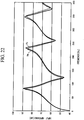
- Fig. 22 is a graph showing resonating property of a brass instrument with/without a mute having two branch pipes (e.g. the mute 100g shown in Fig. 11 ), wherein P 0 denotes a characteristic curve representing resonating peaks of a brass instrument without a mute, while Pm denotes a characteristic curve representing resonating peaks of a brass instrument with the mute 100g.
- Fig. 22 clearly shows that the mute 100g does not cause unwanted resonating peaks in the low register.
- a mute with a single branch pipe does not cause unwanted resonating peaks in the low register, whilst the mute 100g having two branch pipes is able to further improve pitches and tone colors.
- Fig. 22 shows that two characteristic curves Pm, P 0 (relating to a brass instrument with/without the mute 100g) exhibit their resonating properties with small deviations of pitches therebetween. This indicates that the mute 100g is able to reproduce pitches in a more accurate manner than the conventional mute.
Landscapes
- Physics & Mathematics (AREA)
- Engineering & Computer Science (AREA)
- Acoustics & Sound (AREA)
- Multimedia (AREA)
- Electric Vacuum Cleaner (AREA)
- Pipe Accessories (AREA)
- Branch Pipes, Bends, And The Like (AREA)
Claims (5)
- Dämpfer (100) zur lösbaren Anbringung an einem Blechblasinstrument (1) mit Schalltrichterrohr (71), der Folgendes aufweist:einen feststehenden Teil (31) zur Befestigung des Dämpfers (100) an der Stelle relativ zu dem Blechblasinstrument (1); undein Abzweigrohr (110), wobei das Abzweigrohr (110) Folgendes aufweist:ein Hauptrohr (10), wobei zumindest ein Teil des Hauptrohres (10) eine Querschnittsfläche aufweist, die konstant in der axialen Richtung ist; und zumindest ein Hilfsrohr (21),wobei ein Innenraum des Hauptrohres (10) mit einem Innenraum des Hilfsrohrs (21) bei einem Verbindungsteil (P1, P2) verbunden ist.
- Dämpfer gemäß Anspruch 1, wobei eine Luftstrom (F), der in das Schalltrichterrohr (71) geblasen wird, in das Hauptrohr (10) eingeführt wird, und wobei der Luftstrom (F), der in das Hauptrohr (10) eingeführt wird, zu dem Hilfsrohr (21) abgezweigt wird und von einem Öffnungsende des Hauptrohres (10) und einem Öffnungsende des Hilfsrohrs (21) emittiert wird.
- Dämpfer gemäß Anspruch 1 oder 2, wobei das Hauptrohr (10) mit dem feststehenden Teil (31) außerhalb des Hauptrohres (10) ausgestattet ist, und wobei der feststehende Teil (31) an einem verjüngten Teil (72) des Schalltrichterrohrs (73) des Blechblasinstruments (1) angebracht ist.
- Dämpfer gemäß einem der Ansprüche 1 bis 3, wobei das Hilfsrohr (21a) von dem Hauptrohr (10a) so getrennt ist, dass es teilweise einen Außenumfang des Hauptrohres (10a) abdeckt.
- Dämpfer gemäß Anspruch 3, wobei der feststehende Teil (31) zumindest einen Hohlraum (32) aufweist, der teilweise einen Luftstrom (F) überträgt, der in das Schalltrichterrohr (73) des Blechblasinstruments (1) geblasen wird.
Applications Claiming Priority (1)
| Application Number | Priority Date | Filing Date | Title |
|---|---|---|---|
| JP2011175059 | 2011-08-10 |
Publications (3)
| Publication Number | Publication Date |
|---|---|
| EP2557563A2 EP2557563A2 (de) | 2013-02-13 |
| EP2557563A3 EP2557563A3 (de) | 2014-05-14 |
| EP2557563B1 true EP2557563B1 (de) | 2018-09-12 |
Family
ID=46801274
Family Applications (1)
| Application Number | Title | Priority Date | Filing Date |
|---|---|---|---|
| EP12005760.9A Not-in-force EP2557563B1 (de) | 2011-08-10 | 2012-08-08 | Dämpfer für Blechblasinstrument |
Country Status (4)
| Country | Link |
|---|---|
| US (1) | US8962961B2 (de) |
| EP (1) | EP2557563B1 (de) |
| JP (1) | JP6011144B2 (de) |
| CN (1) | CN102930857B (de) |
Families Citing this family (13)
| Publication number | Priority date | Publication date | Assignee | Title |
|---|---|---|---|---|
| JP5825276B2 (ja) * | 2013-02-13 | 2015-12-02 | ヤマハ株式会社 | 消音器 |
| JP6155846B2 (ja) * | 2013-05-28 | 2017-07-05 | ヤマハ株式会社 | 消音器 |
| JP6191379B2 (ja) * | 2013-10-16 | 2017-09-06 | ヤマハ株式会社 | 消音器 |
| JP6569399B2 (ja) * | 2015-09-02 | 2019-09-04 | ヤマハ株式会社 | 消音器 |
| EP3455847A2 (de) * | 2016-05-12 | 2019-03-20 | Cialfi, Maurizio | Resonator für blasinstrumente |
| WO2018008472A1 (ja) * | 2016-07-07 | 2018-01-11 | ヤマハ株式会社 | バスレフポートおよび音響装置 |
| CN109559710A (zh) * | 2017-09-27 | 2019-04-02 | 天津市津宝乐器有限公司 | 次中音萨克斯 |
| CN108091317A (zh) * | 2017-12-20 | 2018-05-29 | 佳木斯大学 | 一种便携式的竹笛弱音器及其使用方法 |
| JP7132635B2 (ja) * | 2018-01-23 | 2022-09-07 | 株式会社鈴木楽器製作所 | 弱音装置 |
| WO2020188155A1 (fr) * | 2019-03-18 | 2020-09-24 | Jose Buendia | Le son vivant par les ondes stationnaires |
| JP6708839B1 (ja) * | 2019-11-07 | 2020-06-10 | 株式会社エンゼルホーン | 金管楽器 |
| JP7435122B2 (ja) | 2020-03-25 | 2024-02-21 | ヤマハ株式会社 | 電子吹奏楽器 |
| US11289063B1 (en) | 2020-07-17 | 2022-03-29 | Whistle Shield LLC | Hygienic whistle with enhanced sound-generating chamber |
Family Cites Families (24)
| Publication number | Priority date | Publication date | Assignee | Title |
|---|---|---|---|---|
| GB232050A (en) * | 1924-05-12 | 1925-04-16 | Ernest Tiller | Improved construction of mute for wind musical instruments |
| US2621553A (en) | 1951-10-22 | 1952-12-16 | Daoust Pierre | Brass instrument cone-type mute |
| GB2017999B (en) | 1978-01-21 | 1982-02-10 | Mackie R | Mutes for wind instruments |
| US4178829A (en) * | 1978-05-24 | 1979-12-18 | Wolford John W | Power tube for flared bell musical instruments |
| DE2967218D1 (en) * | 1979-11-29 | 1984-10-18 | Robert Edwin Bell | An instrumental mute |
| US4998959A (en) | 1990-07-19 | 1991-03-12 | Thomas Purdie | Mute for horn-type instruments |
| JPH0234716Y2 (de) * | 1985-02-19 | 1990-09-18 | ||
| JPH0755593Y2 (ja) * | 1987-02-23 | 1995-12-20 | エヌデ−シ−株式会社 | 消音兼調音装置 |
| US5438156A (en) | 1991-05-09 | 1995-08-01 | Yamaha Corporation | Wind type tone synthesizer adapted for simulating a conical resonance tube |
| JP2707913B2 (ja) | 1991-05-09 | 1998-02-04 | ヤマハ株式会社 | 楽音合成装置 |
| US5373771A (en) | 1993-06-07 | 1994-12-20 | Weik; Christopher C. | Brass and wind musical instrument attachment and method related thereto |
| US5309808A (en) | 1993-07-12 | 1994-05-10 | Tarrant James K | Acoustic practice mute |
| FR2725297B1 (fr) | 1994-09-30 | 1996-12-20 | Creation Maurice Andre | Sourdine pour instrument a vent |
| US5488893A (en) | 1994-10-20 | 1996-02-06 | Robert Lewis | Mute |
| JP2865030B2 (ja) | 1994-11-14 | 1999-03-08 | ヤマハ株式会社 | 金管楽器用消音器 |
| DE29608348U1 (de) * | 1996-05-08 | 1996-08-08 | Weller, Andreas, 01127 Dresden | Stopfdämpfer für Waldhörner |
| CN2308138Y (zh) * | 1997-07-16 | 1999-02-17 | 金钟浩 | 一种小号练功弱音器 |
| US6114619A (en) | 1998-07-15 | 2000-09-05 | Thompson; Robert Shawn | Ventilated mute for wind instrument |
| JP2004240347A (ja) * | 2003-02-10 | 2004-08-26 | Best Brass Corp | 金管楽器用音響変更器 |
| US7049501B2 (en) | 2003-06-24 | 2006-05-23 | Mark Matthew Shellhammer | Ring mute |
| JP2005326810A (ja) * | 2004-12-09 | 2005-11-24 | Takafumi Tanaka | 管楽器弱音方法 |
| JP2011186446A (ja) | 2010-02-12 | 2011-09-22 | Yamaha Corp | 管楽器の管体 |
| JP5454219B2 (ja) | 2010-02-24 | 2014-03-26 | コニカミノルタ株式会社 | 画像形成装置 |
| JP4986091B1 (ja) | 2011-08-23 | 2012-07-25 | 株式会社 ベストブラス | 金管楽器用消音器 |
-
2012
- 2012-08-08 CN CN201210279994.6A patent/CN102930857B/zh not_active Expired - Fee Related
- 2012-08-08 US US13/569,370 patent/US8962961B2/en not_active Expired - Fee Related
- 2012-08-08 EP EP12005760.9A patent/EP2557563B1/de not_active Not-in-force
- 2012-08-10 JP JP2012178433A patent/JP6011144B2/ja not_active Expired - Fee Related
Non-Patent Citations (1)
| Title |
|---|
| None * |
Also Published As
| Publication number | Publication date |
|---|---|
| CN102930857B (zh) | 2015-06-24 |
| JP6011144B2 (ja) | 2016-10-19 |
| US8962961B2 (en) | 2015-02-24 |
| CN102930857A (zh) | 2013-02-13 |
| JP2013054351A (ja) | 2013-03-21 |
| EP2557563A3 (de) | 2014-05-14 |
| US20130036895A1 (en) | 2013-02-14 |
| EP2557563A2 (de) | 2013-02-13 |
Similar Documents
| Publication | Publication Date | Title |
|---|---|---|
| EP2557563B1 (de) | Dämpfer für Blechblasinstrument | |
| US20110219936A1 (en) | Pipe structure of wind instrument | |
| US20110197737A1 (en) | Pipe structure of wind instrument | |
| US5824927A (en) | Keyed free-reed instruments scope | |
| CN113345393B (zh) | 电子吹奏乐器 | |
| JP2011186443A (ja) | 管楽器の管体 | |
| JP5811541B2 (ja) | 管楽器の管体 | |
| US10079007B2 (en) | Woodwind mouthpiece with V-notch table and tone chamber insert | |
| JP5838980B2 (ja) | 消音器 | |
| JP3229586U (ja) | フルート属の音量調整器 | |
| US11127382B1 (en) | Tone-altering apparatus and method for musical wind instruments | |
| RU2856312C1 (ru) | Струнный музыкальный инструмент типа гитары | |
| JP2021179540A (ja) | 吹き口装着型管楽器用消音器 | |
| JP5712617B2 (ja) | 管楽器 | |
| CN221507742U (zh) | 一种多声道卡祖笛 | |
| KR20130110320A (ko) | 관악기 연주장치 | |
| KR200310152Y1 (ko) | 이중 음색을 낼 수 있는 리코더 | |
| JP5857520B2 (ja) | 管楽器およびアタッチメント | |
| US11769474B2 (en) | Flute head joint, method of producing a flute head joint and flute | |
| KR20120121600A (ko) | 관악기 | |
| KR102313695B1 (ko) | 취구와 리드부가 형성된 관악기의 헤드 조인트 및 이를 포함하는 관악기 | |
| KR101453480B1 (ko) | 넓은 음역을 낼 수 있는 목관 악기 | |
| US5351593A (en) | Musical wind instrument with inner horn assembly | |
| JP2005326810A (ja) | 管楽器弱音方法 | |
| TW201331928A (zh) | 修正樂器振動能量的設備與系統 |
Legal Events
| Date | Code | Title | Description |
|---|---|---|---|
| PUAI | Public reference made under article 153(3) epc to a published international application that has entered the european phase |
Free format text: ORIGINAL CODE: 0009012 |
|
| AK | Designated contracting states |
Kind code of ref document: A2 Designated state(s): AL AT BE BG CH CY CZ DE DK EE ES FI FR GB GR HR HU IE IS IT LI LT LU LV MC MK MT NL NO PL PT RO RS SE SI SK SM TR |
|
| AX | Request for extension of the european patent |
Extension state: BA ME |
|
| PUAL | Search report despatched |
Free format text: ORIGINAL CODE: 0009013 |
|
| AK | Designated contracting states |
Kind code of ref document: A3 Designated state(s): AL AT BE BG CH CY CZ DE DK EE ES FI FR GB GR HR HU IE IS IT LI LT LU LV MC MK MT NL NO PL PT RO RS SE SI SK SM TR |
|
| AX | Request for extension of the european patent |
Extension state: BA ME |
|
| RIC1 | Information provided on ipc code assigned before grant |
Ipc: G10D 9/06 20060101AFI20140409BHEP |
|
| 17P | Request for examination filed |
Effective date: 20141110 |
|
| RBV | Designated contracting states (corrected) |
Designated state(s): AL AT BE BG CH CY CZ DE DK EE ES FI FR GB GR HR HU IE IS IT LI LT LU LV MC MK MT NL NO PL PT RO RS SE SI SK SM TR |
|
| GRAP | Despatch of communication of intention to grant a patent |
Free format text: ORIGINAL CODE: EPIDOSNIGR1 |
|
| STAA | Information on the status of an ep patent application or granted ep patent |
Free format text: STATUS: GRANT OF PATENT IS INTENDED |
|
| INTG | Intention to grant announced |
Effective date: 20180329 |
|
| GRAS | Grant fee paid |
Free format text: ORIGINAL CODE: EPIDOSNIGR3 |
|
| GRAA | (expected) grant |
Free format text: ORIGINAL CODE: 0009210 |
|
| STAA | Information on the status of an ep patent application or granted ep patent |
Free format text: STATUS: THE PATENT HAS BEEN GRANTED |
|
| AK | Designated contracting states |
Kind code of ref document: B1 Designated state(s): AL AT BE BG CH CY CZ DE DK EE ES FI FR GB GR HR HU IE IS IT LI LT LU LV MC MK MT NL NO PL PT RO RS SE SI SK SM TR |
|
| REG | Reference to a national code |
Ref country code: GB Ref legal event code: FG4D |
|
| REG | Reference to a national code |
Ref country code: CH Ref legal event code: EP |
|
| REG | Reference to a national code |
Ref country code: IE Ref legal event code: FG4D |
|
| REG | Reference to a national code |
Ref country code: DE Ref legal event code: R096 Ref document number: 602012050877 Country of ref document: DE |
|
| REG | Reference to a national code |
Ref country code: AT Ref legal event code: REF Ref document number: 1041519 Country of ref document: AT Kind code of ref document: T Effective date: 20181015 |
|
| REG | Reference to a national code |
Ref country code: NL Ref legal event code: MP Effective date: 20180912 |
|
| REG | Reference to a national code |
Ref country code: LT Ref legal event code: MG4D |
|
| PG25 | Lapsed in a contracting state [announced via postgrant information from national office to epo] |
Ref country code: FI Free format text: LAPSE BECAUSE OF FAILURE TO SUBMIT A TRANSLATION OF THE DESCRIPTION OR TO PAY THE FEE WITHIN THE PRESCRIBED TIME-LIMIT Effective date: 20180912 Ref country code: RS Free format text: LAPSE BECAUSE OF FAILURE TO SUBMIT A TRANSLATION OF THE DESCRIPTION OR TO PAY THE FEE WITHIN THE PRESCRIBED TIME-LIMIT Effective date: 20180912 Ref country code: NO Free format text: LAPSE BECAUSE OF FAILURE TO SUBMIT A TRANSLATION OF THE DESCRIPTION OR TO PAY THE FEE WITHIN THE PRESCRIBED TIME-LIMIT Effective date: 20181212 Ref country code: GR Free format text: LAPSE BECAUSE OF FAILURE TO SUBMIT A TRANSLATION OF THE DESCRIPTION OR TO PAY THE FEE WITHIN THE PRESCRIBED TIME-LIMIT Effective date: 20181213 Ref country code: SE Free format text: LAPSE BECAUSE OF FAILURE TO SUBMIT A TRANSLATION OF THE DESCRIPTION OR TO PAY THE FEE WITHIN THE PRESCRIBED TIME-LIMIT Effective date: 20180912 Ref country code: BG Free format text: LAPSE BECAUSE OF FAILURE TO SUBMIT A TRANSLATION OF THE DESCRIPTION OR TO PAY THE FEE WITHIN THE PRESCRIBED TIME-LIMIT Effective date: 20181212 Ref country code: LT Free format text: LAPSE BECAUSE OF FAILURE TO SUBMIT A TRANSLATION OF THE DESCRIPTION OR TO PAY THE FEE WITHIN THE PRESCRIBED TIME-LIMIT Effective date: 20180912 |
|
| PG25 | Lapsed in a contracting state [announced via postgrant information from national office to epo] |
Ref country code: AL Free format text: LAPSE BECAUSE OF FAILURE TO SUBMIT A TRANSLATION OF THE DESCRIPTION OR TO PAY THE FEE WITHIN THE PRESCRIBED TIME-LIMIT Effective date: 20180912 Ref country code: LV Free format text: LAPSE BECAUSE OF FAILURE TO SUBMIT A TRANSLATION OF THE DESCRIPTION OR TO PAY THE FEE WITHIN THE PRESCRIBED TIME-LIMIT Effective date: 20180912 Ref country code: HR Free format text: LAPSE BECAUSE OF FAILURE TO SUBMIT A TRANSLATION OF THE DESCRIPTION OR TO PAY THE FEE WITHIN THE PRESCRIBED TIME-LIMIT Effective date: 20180912 |
|
| REG | Reference to a national code |
Ref country code: AT Ref legal event code: MK05 Ref document number: 1041519 Country of ref document: AT Kind code of ref document: T Effective date: 20180912 |
|
| PG25 | Lapsed in a contracting state [announced via postgrant information from national office to epo] |
Ref country code: ES Free format text: LAPSE BECAUSE OF FAILURE TO SUBMIT A TRANSLATION OF THE DESCRIPTION OR TO PAY THE FEE WITHIN THE PRESCRIBED TIME-LIMIT Effective date: 20180912 Ref country code: CZ Free format text: LAPSE BECAUSE OF FAILURE TO SUBMIT A TRANSLATION OF THE DESCRIPTION OR TO PAY THE FEE WITHIN THE PRESCRIBED TIME-LIMIT Effective date: 20180912 Ref country code: PL Free format text: LAPSE BECAUSE OF FAILURE TO SUBMIT A TRANSLATION OF THE DESCRIPTION OR TO PAY THE FEE WITHIN THE PRESCRIBED TIME-LIMIT Effective date: 20180912 Ref country code: IS Free format text: LAPSE BECAUSE OF FAILURE TO SUBMIT A TRANSLATION OF THE DESCRIPTION OR TO PAY THE FEE WITHIN THE PRESCRIBED TIME-LIMIT Effective date: 20190112 Ref country code: RO Free format text: LAPSE BECAUSE OF FAILURE TO SUBMIT A TRANSLATION OF THE DESCRIPTION OR TO PAY THE FEE WITHIN THE PRESCRIBED TIME-LIMIT Effective date: 20180912 Ref country code: NL Free format text: LAPSE BECAUSE OF FAILURE TO SUBMIT A TRANSLATION OF THE DESCRIPTION OR TO PAY THE FEE WITHIN THE PRESCRIBED TIME-LIMIT Effective date: 20180912 Ref country code: EE Free format text: LAPSE BECAUSE OF FAILURE TO SUBMIT A TRANSLATION OF THE DESCRIPTION OR TO PAY THE FEE WITHIN THE PRESCRIBED TIME-LIMIT Effective date: 20180912 Ref country code: IT Free format text: LAPSE BECAUSE OF FAILURE TO SUBMIT A TRANSLATION OF THE DESCRIPTION OR TO PAY THE FEE WITHIN THE PRESCRIBED TIME-LIMIT Effective date: 20180912 Ref country code: AT Free format text: LAPSE BECAUSE OF FAILURE TO SUBMIT A TRANSLATION OF THE DESCRIPTION OR TO PAY THE FEE WITHIN THE PRESCRIBED TIME-LIMIT Effective date: 20180912 |
|
| PG25 | Lapsed in a contracting state [announced via postgrant information from national office to epo] |
Ref country code: SM Free format text: LAPSE BECAUSE OF FAILURE TO SUBMIT A TRANSLATION OF THE DESCRIPTION OR TO PAY THE FEE WITHIN THE PRESCRIBED TIME-LIMIT Effective date: 20180912 Ref country code: SK Free format text: LAPSE BECAUSE OF FAILURE TO SUBMIT A TRANSLATION OF THE DESCRIPTION OR TO PAY THE FEE WITHIN THE PRESCRIBED TIME-LIMIT Effective date: 20180912 Ref country code: PT Free format text: LAPSE BECAUSE OF FAILURE TO SUBMIT A TRANSLATION OF THE DESCRIPTION OR TO PAY THE FEE WITHIN THE PRESCRIBED TIME-LIMIT Effective date: 20190112 |
|
| REG | Reference to a national code |
Ref country code: DE Ref legal event code: R097 Ref document number: 602012050877 Country of ref document: DE |
|
| PLBE | No opposition filed within time limit |
Free format text: ORIGINAL CODE: 0009261 |
|
| STAA | Information on the status of an ep patent application or granted ep patent |
Free format text: STATUS: NO OPPOSITION FILED WITHIN TIME LIMIT |
|
| PG25 | Lapsed in a contracting state [announced via postgrant information from national office to epo] |
Ref country code: DK Free format text: LAPSE BECAUSE OF FAILURE TO SUBMIT A TRANSLATION OF THE DESCRIPTION OR TO PAY THE FEE WITHIN THE PRESCRIBED TIME-LIMIT Effective date: 20180912 |
|
| 26N | No opposition filed |
Effective date: 20190613 |
|
| PG25 | Lapsed in a contracting state [announced via postgrant information from national office to epo] |
Ref country code: SI Free format text: LAPSE BECAUSE OF FAILURE TO SUBMIT A TRANSLATION OF THE DESCRIPTION OR TO PAY THE FEE WITHIN THE PRESCRIBED TIME-LIMIT Effective date: 20180912 |
|
| REG | Reference to a national code |
Ref country code: DE Ref legal event code: R119 Ref document number: 602012050877 Country of ref document: DE |
|
| PG25 | Lapsed in a contracting state [announced via postgrant information from national office to epo] |
Ref country code: TR Free format text: LAPSE BECAUSE OF FAILURE TO SUBMIT A TRANSLATION OF THE DESCRIPTION OR TO PAY THE FEE WITHIN THE PRESCRIBED TIME-LIMIT Effective date: 20180912 |
|
| PG25 | Lapsed in a contracting state [announced via postgrant information from national office to epo] |
Ref country code: CH Free format text: LAPSE BECAUSE OF NON-PAYMENT OF DUE FEES Effective date: 20190831 Ref country code: MC Free format text: LAPSE BECAUSE OF FAILURE TO SUBMIT A TRANSLATION OF THE DESCRIPTION OR TO PAY THE FEE WITHIN THE PRESCRIBED TIME-LIMIT Effective date: 20180912 Ref country code: LU Free format text: LAPSE BECAUSE OF NON-PAYMENT OF DUE FEES Effective date: 20190808 Ref country code: LI Free format text: LAPSE BECAUSE OF NON-PAYMENT OF DUE FEES Effective date: 20190831 |
|
| REG | Reference to a national code |
Ref country code: BE Ref legal event code: MM Effective date: 20190831 |
|
| PG25 | Lapsed in a contracting state [announced via postgrant information from national office to epo] |
Ref country code: FR Free format text: LAPSE BECAUSE OF NON-PAYMENT OF DUE FEES Effective date: 20190831 Ref country code: IE Free format text: LAPSE BECAUSE OF NON-PAYMENT OF DUE FEES Effective date: 20190808 Ref country code: DE Free format text: LAPSE BECAUSE OF NON-PAYMENT OF DUE FEES Effective date: 20200303 |
|
| PG25 | Lapsed in a contracting state [announced via postgrant information from national office to epo] |
Ref country code: BE Free format text: LAPSE BECAUSE OF NON-PAYMENT OF DUE FEES Effective date: 20190831 |
|
| PG25 | Lapsed in a contracting state [announced via postgrant information from national office to epo] |
Ref country code: CY Free format text: LAPSE BECAUSE OF FAILURE TO SUBMIT A TRANSLATION OF THE DESCRIPTION OR TO PAY THE FEE WITHIN THE PRESCRIBED TIME-LIMIT Effective date: 20180912 |
|
| PG25 | Lapsed in a contracting state [announced via postgrant information from national office to epo] |
Ref country code: MT Free format text: LAPSE BECAUSE OF FAILURE TO SUBMIT A TRANSLATION OF THE DESCRIPTION OR TO PAY THE FEE WITHIN THE PRESCRIBED TIME-LIMIT Effective date: 20180912 Ref country code: HU Free format text: LAPSE BECAUSE OF FAILURE TO SUBMIT A TRANSLATION OF THE DESCRIPTION OR TO PAY THE FEE WITHIN THE PRESCRIBED TIME-LIMIT; INVALID AB INITIO Effective date: 20120808 |
|
| PGFP | Annual fee paid to national office [announced via postgrant information from national office to epo] |
Ref country code: GB Payment date: 20210820 Year of fee payment: 10 |
|
| PG25 | Lapsed in a contracting state [announced via postgrant information from national office to epo] |
Ref country code: MK Free format text: LAPSE BECAUSE OF FAILURE TO SUBMIT A TRANSLATION OF THE DESCRIPTION OR TO PAY THE FEE WITHIN THE PRESCRIBED TIME-LIMIT Effective date: 20180912 |
|
| GBPC | Gb: european patent ceased through non-payment of renewal fee |
Effective date: 20220808 |
|
| PG25 | Lapsed in a contracting state [announced via postgrant information from national office to epo] |
Ref country code: GB Free format text: LAPSE BECAUSE OF NON-PAYMENT OF DUE FEES Effective date: 20220808 |