EP2559993A2 - Röntgenstrahldiffraktionsgerät - Google Patents
Röntgenstrahldiffraktionsgerät Download PDFInfo
- Publication number
- EP2559993A2 EP2559993A2 EP12179985A EP12179985A EP2559993A2 EP 2559993 A2 EP2559993 A2 EP 2559993A2 EP 12179985 A EP12179985 A EP 12179985A EP 12179985 A EP12179985 A EP 12179985A EP 2559993 A2 EP2559993 A2 EP 2559993A2
- Authority
- EP
- European Patent Office
- Prior art keywords
- ray
- ray diffraction
- measurement
- standard powder
- diffraction instrument
- Prior art date
- Legal status (The legal status is an assumption and is not a legal conclusion. Google has not performed a legal analysis and makes no representation as to the accuracy of the status listed.)
- Withdrawn
Links
- 238000002441 X-ray diffraction Methods 0.000 title claims abstract description 131
- 239000000843 powder Substances 0.000 claims abstract description 74
- 238000003384 imaging method Methods 0.000 claims description 40
- 229920000642 polymer Polymers 0.000 claims description 27
- OAICVXFJPJFONN-UHFFFAOYSA-N Phosphorus Chemical compound [P] OAICVXFJPJFONN-UHFFFAOYSA-N 0.000 claims description 18
- 239000006185 dispersion Substances 0.000 claims description 13
- 239000002612 dispersion medium Substances 0.000 claims description 6
- 238000005259 measurement Methods 0.000 abstract description 124
- 238000000034 method Methods 0.000 description 14
- 239000011248 coating agent Substances 0.000 description 12
- 238000000576 coating method Methods 0.000 description 12
- 239000000463 material Substances 0.000 description 8
- 238000012986 modification Methods 0.000 description 4
- 230000004048 modification Effects 0.000 description 4
- 239000000523 sample Substances 0.000 description 4
- 238000012360 testing method Methods 0.000 description 4
- 230000015572 biosynthetic process Effects 0.000 description 3
- 238000007689 inspection Methods 0.000 description 3
- 230000005865 ionizing radiation Effects 0.000 description 3
- 230000001678 irradiating effect Effects 0.000 description 3
- 239000004033 plastic Substances 0.000 description 3
- XEEYBQQBJWHFJM-UHFFFAOYSA-N Iron Chemical compound [Fe] XEEYBQQBJWHFJM-UHFFFAOYSA-N 0.000 description 2
- 230000005540 biological transmission Effects 0.000 description 2
- 238000004364 calculation method Methods 0.000 description 2
- 238000011109 contamination Methods 0.000 description 2
- 238000002447 crystallographic data Methods 0.000 description 2
- 230000001066 destructive effect Effects 0.000 description 2
- 238000000761 in situ micro-X-ray diffraction Methods 0.000 description 2
- 238000004020 luminiscence type Methods 0.000 description 2
- 239000011572 manganese Substances 0.000 description 2
- 230000005855 radiation Effects 0.000 description 2
- 229910001220 stainless steel Inorganic materials 0.000 description 2
- 239000010935 stainless steel Substances 0.000 description 2
- 238000011144 upstream manufacturing Methods 0.000 description 2
- 238000012800 visualization Methods 0.000 description 2
- -1 BaFX:Eu2+ (X = Br Chemical compound 0.000 description 1
- RYGMFSIKBFXOCR-UHFFFAOYSA-N Copper Chemical compound [Cu] RYGMFSIKBFXOCR-UHFFFAOYSA-N 0.000 description 1
- LFQSCWFLJHTTHZ-UHFFFAOYSA-N Ethanol Chemical compound CCO LFQSCWFLJHTTHZ-UHFFFAOYSA-N 0.000 description 1
- PWHULOQIROXLJO-UHFFFAOYSA-N Manganese Chemical compound [Mn] PWHULOQIROXLJO-UHFFFAOYSA-N 0.000 description 1
- 229920000535 Tan II Polymers 0.000 description 1
- 230000005856 abnormality Effects 0.000 description 1
- 238000004458 analytical method Methods 0.000 description 1
- 239000011230 binding agent Substances 0.000 description 1
- 230000000903 blocking effect Effects 0.000 description 1
- 238000010276 construction Methods 0.000 description 1
- 230000007797 corrosion Effects 0.000 description 1
- 238000005260 corrosion Methods 0.000 description 1
- 238000005336 cracking Methods 0.000 description 1
- 239000013078 crystal Substances 0.000 description 1
- 230000006378 damage Effects 0.000 description 1
- 238000001514 detection method Methods 0.000 description 1
- 230000006866 deterioration Effects 0.000 description 1
- 238000009826 distribution Methods 0.000 description 1
- 238000001035 drying Methods 0.000 description 1
- 238000005516 engineering process Methods 0.000 description 1
- 230000005284 excitation Effects 0.000 description 1
- 239000004744 fabric Substances 0.000 description 1
- CPBQJMYROZQQJC-UHFFFAOYSA-N helium neon Chemical compound [He].[Ne] CPBQJMYROZQQJC-UHFFFAOYSA-N 0.000 description 1
- 238000002347 injection Methods 0.000 description 1
- 239000007924 injection Substances 0.000 description 1
- 229910052742 iron Inorganic materials 0.000 description 1
- 239000006101 laboratory sample Substances 0.000 description 1
- 229910052748 manganese Inorganic materials 0.000 description 1
- 238000004519 manufacturing process Methods 0.000 description 1
- 239000000203 mixture Substances 0.000 description 1
- 230000035945 sensitivity Effects 0.000 description 1
- 229920002379 silicone rubber Polymers 0.000 description 1
- 239000004945 silicone rubber Substances 0.000 description 1
- 238000003860 storage Methods 0.000 description 1
- XLYOFNOQVPJJNP-UHFFFAOYSA-N water Substances O XLYOFNOQVPJJNP-UHFFFAOYSA-N 0.000 description 1
Images

Classifications
-
- G—PHYSICS
- G01—MEASURING; TESTING
- G01N—INVESTIGATING OR ANALYSING MATERIALS BY DETERMINING THEIR CHEMICAL OR PHYSICAL PROPERTIES
- G01N23/00—Investigating or analysing materials by the use of wave or particle radiation, e.g. X-rays or neutrons, not covered by groups G01N3/00 – G01N17/00, G01N21/00 or G01N22/00
- G01N23/20—Investigating or analysing materials by the use of wave or particle radiation, e.g. X-rays or neutrons, not covered by groups G01N3/00 – G01N17/00, G01N21/00 or G01N22/00 by using diffraction of the radiation by the materials, e.g. for investigating crystal structure; by using scattering of the radiation by the materials, e.g. for investigating non-crystalline materials; by using reflection of the radiation by the materials
- G01N23/20008—Constructional details of analysers, e.g. characterised by X-ray source, detector or optical system; Accessories therefor; Preparing specimens therefor
-
- G—PHYSICS
- G01—MEASURING; TESTING
- G01L—MEASURING FORCE, STRESS, TORQUE, WORK, MECHANICAL POWER, MECHANICAL EFFICIENCY, OR FLUID PRESSURE
- G01L1/00—Measuring force or stress, in general
- G01L1/25—Measuring force or stress, in general using wave or particle radiation, e.g. X-rays, microwaves, neutrons
-
- G—PHYSICS
- G01—MEASURING; TESTING
- G01L—MEASURING FORCE, STRESS, TORQUE, WORK, MECHANICAL POWER, MECHANICAL EFFICIENCY, OR FLUID PRESSURE
- G01L5/00—Apparatus for, or methods of, measuring force, work, mechanical power, or torque, specially adapted for specific purposes
- G01L5/0047—Apparatus for, or methods of, measuring force, work, mechanical power, or torque, specially adapted for specific purposes measuring forces due to residual stresses
-
- G—PHYSICS
- G01—MEASURING; TESTING
- G01N—INVESTIGATING OR ANALYSING MATERIALS BY DETERMINING THEIR CHEMICAL OR PHYSICAL PROPERTIES
- G01N2223/00—Investigating materials by wave or particle radiation
- G01N2223/60—Specific applications or type of materials
- G01N2223/62—Specific applications or type of materials powders
Definitions
- the present invention relates to X-ray diffraction instruments, and particularly to X-ray diffraction instruments for detecting X-ray diffraction patterns two-dimensionally and estimating residual stresses of measurement objects.
- X-ray diffraction instruments are used as a non-destructive inspection tool for measuring various material properties (such as crystallographic structure, composition and residual stress). Goniometers, zero-dimensional scintillation counters (SC), one-dimensional position sensitive detectors (PSD), etc. are commonly and widely used to obtain X-ray diffraction data (such as intensity and angle of diffraction).
- SC zero-dimensional scintillation counters
- PSD one-dimensional position sensitive detectors
- these instruments offer only zero-/one-dimensional diffraction data by a single measurement. Thus, a complicated actuator and a long total measurement time are needed to obtain sufficient diffraction data required for a thoroughly satisfactory material analysis.
- X-ray diffraction instruments including a two-dimensional X-ray detector which provide a larger amount of diffraction information in a shorter period of measurement time are used.
- two-dimensional X-ray detectors include two-dimensional position sensitive proportional counters (PSPC) and imaging plates (IP).
- PSPC position sensitive proportional counters
- IP imaging plates
- JP-A 2000-146871 discloses a micro X-ray diffraction instrument and a method of measurement, in which a micro area of a specimen is irradiated with an X-ray beam and the X-ray beams diffracted by the specimen are detected by a two-dimensional X-ray detector.
- the two-dimensional X-ray detector used in this micro X-ray diffraction instrument is a cylinder made of a photostimulable phosphor, and is placed in such a manner as to surround the specimen.
- the specimen is tilted (e.g., by 45°) so that both the X-ray beams diffracted in directions tangential to the specimen surface and the X-ray beams diffracted in directions normal to the specimen surface can be detected by the photostimulable phosphor X-ray detector.
- the photostimulable phosphor X-ray detector By using the JP-A 2000-146871 X-ray diffraction instrument, sufficient X-ray diffraction data can be captured by the photostimulable phosphor detector by rotating the specimen around only one axis (normal to the specimen surface), which is advantageous over most conventional X-ray diffraction instruments requiring rotations about two axes.
- this X-ray diffraction instrument has the advantage of simple structure, high diffraction intensity and short total measurement time.
- JP-A 2005-351780 discloses an X-ray diffraction instrument including a two-dimensional X-ray detector that provides transmission diffraction measurement.
- This X-ray diffraction instrument includes: a specimen table for horizontally holding a specimen; an X-ray emitter for irradiating the specimen with an X-ray beam; an arm for actuating the X-ray emitter in such a way that the incident angle of the emitted X-ray beam relative to the specimen is set at a desired angle from 0° to 90°; and a partially-open cylinder made of a storage (photostimulable) phosphor that surrounds the specimen table for detecting the X-ray beams diffracted by the specimen.
- the phosphor cylinder is placed in such a manner that its axis is perpendicular to the emitted X-ray beam.
- the phosphor detector portion of the cylinder barrel extends circumferentially from 180° to 360° as measured from the horizontal (parallel to the table surface) on the side of the X-ray emitter, and more preferably from 100° to 360°, and the other portion of the cylinder barrel is open.
- the JP-A 2005-351780 X-ray diffraction instrument provides transmission diffraction measurement as well as reflection diffraction measurement.
- JP-A Hei 6(1994)-317484 discloses an X-ray exposure system for micro-area stress measurement including (from upstream to downstream along the X-ray path): a slit and first (upstream) screen; a sample stage mounted on a rotatable goniometer; an imaging plate on a support that is mounted on an arm rotatable about the emitted X-ray axis; and a second (downstream) screen just in front of the imaging plate.
- the emitted X-ray beam passes through the slit and first screen and is incident on a micro-area (e.g., 100 ⁇ m to 1 mm square) of a sample, and several discrete X-ray diffraction arcs (each being a part of a Debye ring) obtained by changing the X-ray angle incident on the sample several times are exposed on the same single stationary imaging plate.
- a micro-area e.g., 100 ⁇ m to 1 mm square
- several discrete X-ray diffraction arcs each being a part of a Debye ring
- several discrete X-ray arcs can be detected by a single measurement with a high angular accuracy, thus enabling micro-area stress measurement of polycrystalline materials in a short period of time.
- JP-A 2005-241308 discloses an X-ray diffraction system in which a measurement object (a railway rail) is irradiated with X-ray and an image of the X-ray diffraction ring from the measurement object is captured.
- This X-ray system includes: an X-ray emitter for emitting the X-ray and an X-ray detector for storing the energy of the X-ray diffraction ring and producing the image of the diffraction ring.
- the X-ray emitter and the X-ray detector are mounted on a holder in such a manner the X-ray incident angle relative to the measurement object is fixed at a single angle.
- the X-ray diffraction system can perform X-ray diffraction measurement simply and conveniently. Also, the system is easy to use, cheap to manufacture and portable.
- the physical condition (such as residual stress) of a measurement object a railway rail
- a standard specimen an iron standard powder
- the X-ray diffraction instruments of JP-A 2000-146871 and JP-A 2005-351780 require an actuator for adjusting the position and/or orientation of the specimen and/or the X-ray emitter, and thus have disadvantages of complicated structure and large size.
- the two-dimensional X-ray detectors used in the above disclosures are cylindrical in form, and surround a specimen for detecting the X-ray beams diffracted by the specimen. Therefore, there is some limitation on the size and shape of specimens measurable by these X-ray diffraction instruments. In general, specimens measurable by conventional X-ray diffraction instruments are limited to relatively small objects (such as laboratory samples).
- JP-A Hei 6(1994)-317484 requires a goniometer for rotating a sample stage on which a specimen is mounted, and thus has a disadvantage of complicated structure and some limitation on the size and shape of specimens to be measured. Furthermore, JP-A Hei 6(1994)-317484 describes that, in order to measure the micro-area stress of the measurement specimen, a standard powder is placed on the specimen and that the X-ray is irradiated to both the specimen and the standard powder at the same time. However, JP-A Hei 6(1994)-317484 is silent to a fixing method of the standard powder to the specimen.
- JP-A 2005-241308 has advantages in that the X-ray emitter can stably impinge X-ray on a large measurement object at a predetermined fixed incident angle, and any actuator for rotating the measurement object is not required.
- JP-A 2005-241308 does not describe any method for setting the standard specimen required for the residual stress measurement. This is probably because the JP-A 2005-241308 technology is practically limited to the top surface of a railway rail. Also, this disclosure does not describe any measure to prevent leakage of X-ray emitted from the X-ray emitter or scattered by the measurement object.
- the measurement surfaces may often be vertical or face downward. In such cases, it is difficult to stably attach a standard powder on a measurement surface, thus making accurate measurement and estimation difficult. Also, contamination by foreign materials is unacceptable in some plants. In such environments, attaching a standard powder on a measurement surface without scattering the powder is a particularly important requirement. In addition, it is desirable for operator safety to prevent X-ray leakage.
- an objective of the present invention to provide an X-ray diffraction instrument without any actuator for adjusting the position and/or orientation of a measurement object, in which: there is no particular limitation on the size and shape of the measurement object; a standard powder can be stably attached on the surface of the measurement object; and X-ray leakage is prevented.
- an X-ray diffraction instrument including:
- an X-ray diffraction instrument without any actuator for adjusting the position and/or orientation of a measurement object, in which there is no particular limitation on the size and shape of the measurement object and a standard powder can be stably attached on a surface of the measurement object.
- the invented X-ray diffraction instrument is small in size, and can perform accurate X-ray diffraction measurement of stationary immovable objects (e.g., on-site inspection of structural components of large apparatuses) without limitation on an orientation of the measurement surface.
- X-ray leakage is prevented for operator safety.
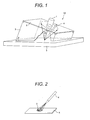
- FIG. 1 is a schematic illustration showing a perspective view of an embodiment of an X-ray diffraction instrument according to the present invention.
- an X-ray diffraction instrument 10 of the present invention includes: a two-dimensional plate-like X-ray detector 2; an X-ray emitter 1 integrated with the X-ray detector 2 so as to penetrate the plate of the X-ray detector 2; and a cylinder-like shield 3 to define an orientation of the X-ray emitter 1 and to prevent X-ray leakage.
- the X-ray detector 2 is attached to one open end of the cylinder-like shield 3 in such a manner that the perimeter of the open end of the cylinder-like shield 3 abuts the perimeter of the detector 2. As illustrated in FIG.
- the X-ray diffraction instrument 10 can perform an X-ray diffraction measurement to a measurement object 5 whose size is larger than the X-ray detector 2.
- the X-ray diffraction instrument 10 further includes, as a standard powder attachment device to attach a standard powder for X-ray diffraction measurement to a surface of the measurement object 5, an injector 4 to inject a dispersion of the standard powder in a dispersion medium.
- An X-ray beam emitted from the X-ray emitter 1 (e.g., X-ray tube) is incident on and diffracted by the measurement object 5, and then the diffracted X-ray beams are incident on and detected by the X-ray detector 2 where the diffraction pattern of the measurement object 5 is recorded.
- the X-ray beams (the emitted X-ray beam and the diffracted X-ray beams) are surrounded and blocked by the cylinder-like shield 3.
- the X-ray emitter 1 is equipped with an unshown sighting device (such as a laser pointer) for visibly showing a point on the measurement object 5 to be irradiated with the emitted X-ray beam.
- an unshown sighting device such as a laser pointer
- the X-ray diffraction instrument 10 can be easily positioned in such a manner that the X-ray emitter 1 emits an X-ray beam onto an exactly desired target area on the measurement object 5.
- the X-ray emitter 1 is integrally and immovably fixed to the X-ray detector 2.
- An angle between the emitting axis of the X-ray emitter 1 and the plane of the X-ray detector 2 may be freely chosen depending on a surface contour of the measurement object 5, a type of X-ray diffraction analysis or other factors. However, the angle is preferably 90° because of the effective use of the X-ray receiving surface of the X-ray detector 2 and the analytical ease of the resulting diffraction pattern.
- a position of the X-ray emitter 1 in the plane of the X-ray detector 2 is not particularly limited, but may be freely chosen depending on a type of X-ray diffraction analysis.
- the X-ray emitter 1 is preferably located near the center of the plane of the X-ray detector 2.
- the X-ray emitter 1 is preferably located near a side edge of the plane of the X-ray detector 2.
- the cylinder-like (tube) shield 3 defines an orientation of the X-ray emitter 1 as well as providing X-ray blocking.
- the incident angle ⁇ can be changed by using a cylinder-like shield 3 having a different tilt angle ⁇ .
- the X-ray detector 2 is preferably detachably attached to the cylinder-like shield 3 when the X-ray emitter 1 is immovably fixed to the X-ray detector 2.
- the injector 4 is integrated with the X-ray detector 2 so as to penetrate the X-ray detector 2 in order to achieve stable injection of the standard powder dispersion and not to block the incident and diffracted X-ray beams.
- the injector 4 is located within the smallest Debye ring on the X-ray detector 2.
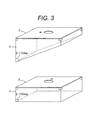
- FIG. 2 is a schematic illustration showing a perspective view of an example of an injector used in the invented X-ray diffraction instrument.
- the injector 4 is used to inject a dispersion of a standard powder for X-ray measurement onto a target measurement surface of the measurement object 5.
- a standard powder coating S can be adhesively formed on the measurement surface of the measurement object 5.
- an X-ray measurement standard powder can be adhesively disposed on a measurement surface even when the measurement surface is vertical or faces downward.
- the standard powder coating S is removed by wiping.
- the injector 4 There is no particular limitation on the injector 4, but, for example, an air brush may be used.
- the above-mentioned standard powder is used to investigate the properties (such as residual stress) of the measurement object 5 by X-ray diffraction measurement.
- a crystalline powder whose internal strain is completely or sufficiently relaxed is used.
- the dispersion medium is preferably alcohol and/or water in order to readily dry the deposited standard powder dispersion.
- An organic binder or the like may be added to the standard powder dispersion to facilitate the formation of the standard powder coating S.
- a volume ratio of the standard powder to the dispersion medium (volume of standard powder)/( volume of dispersion medium) is preferably from 0.5 to 5.
- volume ratio is less than 0.5, the X-ray diffraction intensity from the standard powder is not sufficiently strong or the deposited standard powder dispersion is prone to drip off the surface of the measurement object 5.
- volume ratios higher than 5 reduce the fluidity of the standard powder dispersion and the adhesiveness of the standard powder coating S (and, as a result, the standard powder coating S is prone to partially peel and drop from the measurement object 5.
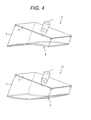
- Figure 3 is a schematic illustration showing perspective views of cylinder-like shields having different tilt angles ⁇ s. As illustrated in FIG. 3 , the incident angle ⁇ can be set at 25° and 0° by using cylinder-like shields 3 having tilt angles ⁇ of 75° and 90°, respectively.
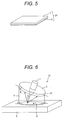
- FIG. 4 is a schematic illustration showing perspective views of another embodiment of an X-ray diffraction instrument according to the present invention.
- each lower end of the cylinder-like shields 3 (on the side of an unshown underlying measurement object, on the opposite side of the X-ray detector) is shaped so as to conform to a surface contour of the underlying measurement object.
- the X-ray diffraction measurement can be performed also for objects having a curved surface (such as outer surfaces of large diameter pipes and inner surfaces of pressure vessels) for which X-ray diffraction measurement has previously been difficult.
- the cylinder-like shield 3 is preferably made of a plastic material because of good formability and light weight.
- the X-ray diffraction instruments 11 and 12 further include, as another type of standard powder attachment device, a polymer sheet 6 having an X-ray measurement standard powder dispersed therein.
- the polymer sheet 6 covers the open end of the cylinder-like shield 3 facing the measurement object.
- the polymer sheet 6 of the cylinder-like shield 3 is pushed against the surface of the measurement object, thereby bringing the polymer sheet 6 into close contact with the surface of the measurement object.
- the polymer sheet 6 will never scatter the standard powder. Therefore, the polymer sheet 6 is particularly advantageously used in X-ray measurement environments where contamination by foreign materials is unacceptable.
- the X-ray diffraction instrument 10 as shown in FIG. 1 may be equipped with the polymer sheet 6 instead of the injector 4.
- the X-ray diffraction instruments 11 and 12 may be equipped with the injector 4 instead of the polymer sheet 6.
- the polymer used for the polymer sheet 6 is not particularly limited so long as the polymer sheet 6 does not attenuate X-ray and is sufficiently flexible so as to conform to the underlying surface of the measurement object.
- silicone rubber may be used.
- a thickness of the polymer sheet 6 is preferably from 0.1 to 0.5 mm.
- a polymer sheet 6 of less than 0.1 mm in thickness is prone to tear easily.
- a polymer sheet 6 of more than 0.5 mm in thickness cannot sufficiently conform to the underlying measurement object.
- FIG. 5 is a schematic illustration showing a perspective view of an imaging plate as an example of a two-dimensional X-ray detector used in the invented X-ray diffraction instrument.
- the imaging plate 21 is illustrated as being rectangular in FIG. 5 , but any other shape is also possible.
- the photostimulable phosphor When the photostimulable phosphor is irradiated with an excitation light (such as He-Ne (helium-neon) laser), the radiation energy stored in the phosphor will be released as a photostimulated luminescence.
- an excitation light such as He-Ne (helium-neon) laser
- the radiation energy stored in the phosphor will be released as a photostimulated luminescence.
- This mechanism is utilized in the imaging plate 21 as follows: After the imaging plate 21 is irradiated with an X-ray diffraction pattern, the phosphor on the imaging plate 21 is photostimulated by scanning a laser beam two-dimensionally across the surface of the imaging plate 21. Then, the resulting photostimulated luminescence signals are sequentially detected with a photomultiplier tube (PMT) or the like and recorded as a time series signal. In this manner, the intensity distribution of the X-ray diffraction pattern recorded can be read out.
- PMT
- the imaging plate 21 using a photostimulable phosphor can be repeatedly used.
- the imaging plate 21 in order to prevent destruction of an X-ray diffraction pattern stored on the imaging plate 21, the imaging plate 21 is preferably prevented from exposure to visible light during the X-ray diffraction measurement.
- the cylinder-like shield 3 preferably shields the imaging plate 21 from both X-ray and visible light.
- the imaging plate 21 may be housed in a cartridge that transmits X-ray but blocks visible light. In this case, the cylinder-like shield 3 does not necessarily block visible light.
- the imaging plate 21 is detachable and easily exchangeable in view of operability and usability of the X-ray diffraction instruments 10 to 12.
- FIG. 6 is a schematic illustration showing a perspective view of still another embodiment of an X-ray diffraction instrument according to the present invention.
- the X-ray diffraction instrument 13 of this embodiment employs a two-dimensional position sensitive proportional counter 22 as the plate-like X-ray detector 2.
- the use of the position-sensitive proportional counter 22 enables simultaneous measurement and recording (imaging) of an X-ray diffraction pattern.
- Figure 6 illustrates an exemplary configuration in which: the polymer sheet 6 is used as a standard powder attachment device; and the integral assembly of the counter 22 and the X-ray emitter 1 is attached obliquely (90° - ⁇ ) to the upper end of the cylinder-like shield 3 (on the side of the counter 22) so that the emitted X-ray beam impinges on the surface of the measurement object 5 at an incident angle ⁇ .
- a two-dimensional plate-like X-ray detector and an X-ray emitter are integrally fixed to each other, which are together attached to a cylinder-like shield.
- the cylinder-like shield works to define an orientation of the X-ray emitter.
- the invented X-ray diffraction instrument does not require any actuator for adjusting the orientation of the X-ray emitter, and thus can be made smaller and lighter than conventional X-ray diffraction instruments.
- the cylinder-like shield works both to protect X-ray and to define the orientation of the X-ray emitter (see FIG. 3 ). It also works to adjust the invented X-ray diffraction instrument to a shape and a size of a measurement object (see FIG. 4 ). Thus, there is no particular limitation on the shape and size of objects measurable by the invented X-ray diffraction instrument.
- the X-ray diffraction instrument of the present invention is equipped with an injector to inject a dispersion of a standard powder for X-ray measurement or a polymer sheet having an X-ray measurement standard powder dispersed therein.
- This configuration enables the X-ray measurement standard powder to be stably attached to surfaces of the measurement objects. Therefore, accurate X-ray measurement can be performed irrespective of the orientation of the measurement surface.
- the X-ray diffraction instrument of the present invention can be particularly advantageously used for large and/or stationary measurement objects that should not or cannot be moved, tilted, rotated, etc.
- Imaging plates have the advantages of simple structure and low cost. In addition, they can be easily formed to a desire shape and size so as to be suited to an object to be measured.
- two-dimensional position sensitive proportional counters have disadvantages of a complicated structure and high cost compared to imaging plates, but have advantages of being able to simultaneously provide both a high precision X-ray diffraction measurement and the recording (imaging) of the measurement result. The choice between these two types is made depending on the application.
- An X-ray emitter 1 was integrally secured to a two-dimensional X-ray detector 2 in such a manner as to perpendicularly penetrate through a central portion of the X-ray detector 2.
- the X-ray detector 2 was attached to a cylinder-like shield 3 in such a manner that the perimeter of the upper end of the cylinder-like shield 3 abutted the perimeter of the X-ray detector 2.
- An injector 4 was integrally extended through the X-ray detector 2 and was oriented in such a manner that it could inject a standard powder dispersion onto an X-ray measurement area of a measurement object 5.
- An imaging plate was used as the two-dimensional X-ray detector 2 and an Mn (manganese) target X-ray tube was used as the X-ray emitter 1.
- test plate 1000 mm ⁇ 500 mm ⁇ 20 mm
- JIS SUS304 stainless steel
- the test plate was machined in such a manner that tensile residual stresses were induced in one of its broad surfaces.
- the test plate was placed in such a manner that its longitudinal direction was perpendicular to the ground and the machined surface was the measurement surface.
- Figure 8A is a schematic illustration showing a side view of the X-ray diffraction measurement of a measurement object by means of the X-ray diffraction instrument of the present invention
- figure 8B is a schematic illustration showing a side view of the X-ray diffraction measurement of a standard powder provided at the measurement point by means of the same X-ray diffraction instrument.
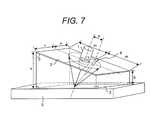
- FIG. 8A first, the X-ray diffraction instrument of FIG. 7 was pushed against the vertical measurement surface of the measurement object 5.
- the resulting distance between the center of the imaging plate 21 and the measurement surface was approximately 20 mm, and the resulting X-ray incident angle ⁇ 0 (between the measurement surface normal and the axis of the X-ray emitter 1) was 30°.
- An X-ray diffraction measurement was performed by irradiating the measurement point A with Mn-K ⁇ line (wavelength: 2.10314 ⁇ 10 -10 m) for 5 to 10 min.
- the X-ray incident on the measurement point A was diffracted at a diffraction angle ⁇ and captured on the receiving surface 8 of the imaging plate 21 as an X-ray diffraction ring (Debye ring) 81 of the measurement point A.
- a dispersion of a standard powder was injected from the injector 4 onto the measurement point A, thereby forming a standard powder coating S.
- a pure copper powder whose internal strain was sufficiently relaxed was used as the standard powder.
- an X-ray diffraction measurement was performed by irradiating the standard powder coating S with Mn-K ⁇ line for 5 to 10 min.
- the X-ray incident on the standard powder coating S was diffracted at a diffraction angle ⁇ s , and captured on the receiving surface 8 of the imaging plate 21 as an X-ray diffraction ring (Debye ring) 82 of the standard powder.
- the standard powder coating S was completely wiped off with a wet cloth.
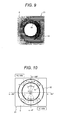
- FIG. 9 shows an example of a visualization of the X-ray diffraction rings from a measurement point and a standard powder. As can be seen, the X-ray diffraction ring 81 from the measurement point A and the X-ray diffraction ring 82 from the standard powder were clearly recorded on the receiving surface 8 of the imaging plate 21.
- the residual stress at the measurement point A can be estimated by cos ⁇ method, a residual stress estimation method based on elastic theory.
- ⁇ is an angle between the incident X-ray beam and a diffracted X-ray beam.
- the "+ ⁇ side” is defined as the side where the distance between any irradiated position and measurement surface is less than the distance between the center O of the imaging plate 21 and the measurement point A
- the "- ⁇ side” is defined as the side where the distance between any irradiated position and measurement surface is greater than the distance between the center O of the imaging plate 21 and the measurement point A.
- ⁇ 0 is the theoretical value of diffraction angle from a measurement object 5 having no strain
- ⁇ s is the theoretical value of diffraction angle from the standard powder.
- Figure 10 is a schematic illustration showing an X-ray diffraction ring for explaining parameters required for the cos ⁇ method calculation.
- the peak intensity position of the X-ray intensity profile in the radial direction is determined by a method of full-width at half maximum.
- the most approximate circle for the X-ray diffraction ring 81 (hereinafter, the "approximate circle 81") is determined by a least squares method.
- the same procedure is made for the X-ray diffraction ring 82 to determine the approximate circle for the ring 82 (hereinafter, the "approximate circle 82").
- the center O corresponding to the X-ray incident point, i.e. the measurement point A
- the radius L" of the approximate circle 82 are determined.
- the difference ⁇ L between the radius of the approximate circle 82 and the radius of the approximate circle 81 is measured at predefined central angles of the approximate circle 82.
- the predefined central angles are "+ ⁇ ", “- ⁇ ”, “ ⁇ + ⁇ ” and “ ⁇ - ⁇ ”, where ⁇ is from 5° to 80° with an increment of 5°.
- the corresponding radius differences ⁇ Ls are represented by “ ⁇ L + ⁇ ", " ⁇ L - ⁇ “ “ ⁇ L ⁇ + ⁇ ", and " ⁇ L ⁇ - ⁇ ".
- the above central angle ⁇ on the approximate circle 81 is measured clockwise, where 0 (deg) is defined as the position with the greatest distance to measurement surface (the bottom point on the approximate circle 82 in FIG. 10 ).
- the residual stress ⁇ x at the measurement point A can be calculated from Equations (1) to (4) below.
- L ⁇ is calculated by substituting ⁇ L + ⁇ , ⁇ L - ⁇ , ⁇ L ⁇ + ⁇ and ⁇ L ⁇ - ⁇ into Eq. (1), and the L ⁇ values are plotted against the cos ⁇ values. Then, the gradient M ⁇ of this L ⁇ -cos ⁇ plot is determined by a least squares method (see Eq. (2)). Next, K ⁇ is calculated from Eq. (3).
- E hkl /(1 + ⁇ nkl ) is the X-ray diffraction elastic constant for the (hkl) diffraction plane of the measurement object 5.
- stainless steel JIS SUS304
- its (311) plane was used as the (hkl) diffraction plane.
- K ⁇ can be calculated from material constants, and is therefore a constant independent of the residual stress.
- the residual stress ⁇ x at the measurement point A can be obtained by substituting these parameter values into Eq. (4). Using the method described above, the residual stress was estimated at several positions on the machined surface of the measurement object 5. The result showed that the machined surface of the test plate had tensile residual stresses of 200 to 300 MPa. The above results demonstrate that the X-ray diffraction instrument according to the present invention can perform accurate X-ray diffraction measurement without any particular limitation on the size or shape of the measurement object or the orientation of the measurement surface.
- the present invention is not limited to such a procedure.
- the standard powder coating can transmit X-ray sufficiently so that the diffracted X-ray from the underlying measurement object has sufficient intensity
- the "X-ray diffraction measurement of the measurement object” and the “X-ray diffraction measurement of the standard powder” may be conducted simultaneously after the "formation of the standard powder coating". If a polymer sheet having a standard powder dispersed therein is used, the "X-ray diffraction measurement of a measurement object" and the "X-ray diffraction measurement of the standard powder” will be conducted simultaneously by necessity.
Landscapes
- General Physics & Mathematics (AREA)
- Physics & Mathematics (AREA)
- Health & Medical Sciences (AREA)
- Chemical & Material Sciences (AREA)
- Analytical Chemistry (AREA)
- Life Sciences & Earth Sciences (AREA)
- Crystallography & Structural Chemistry (AREA)
- Biochemistry (AREA)
- General Health & Medical Sciences (AREA)
- Immunology (AREA)
- Pathology (AREA)
- Toxicology (AREA)
- Analysing Materials By The Use Of Radiation (AREA)
Applications Claiming Priority (1)
| Application Number | Priority Date | Filing Date | Title |
|---|---|---|---|
| JP2011178976A JP5347001B2 (ja) | 2011-08-18 | 2011-08-18 | X線回折装置 |
Publications (2)
| Publication Number | Publication Date |
|---|---|
| EP2559993A2 true EP2559993A2 (de) | 2013-02-20 |
| EP2559993A3 EP2559993A3 (de) | 2013-10-23 |
Family
ID=47010202
Family Applications (1)
| Application Number | Title | Priority Date | Filing Date |
|---|---|---|---|
| EP12179985.2A Withdrawn EP2559993A3 (de) | 2011-08-18 | 2012-08-10 | Röntgenstrahldiffraktionsgerät |
Country Status (4)
| Country | Link |
|---|---|
| US (1) | US8923480B2 (de) |
| EP (1) | EP2559993A3 (de) |
| JP (1) | JP5347001B2 (de) |
| CA (1) | CA2785413A1 (de) |
Cited By (1)
| Publication number | Priority date | Publication date | Assignee | Title |
|---|---|---|---|---|
| EP2980404A1 (de) | 2014-07-31 | 2016-02-03 | Siemens Aktiengesellschaft | Bestimmung der Gierrichtung einer Windturbine |
Families Citing this family (19)
| Publication number | Priority date | Publication date | Assignee | Title |
|---|---|---|---|---|
| JP2012122737A (ja) * | 2010-12-06 | 2012-06-28 | Hitachi-Ge Nuclear Energy Ltd | X線回折装置 |
| JP5861841B2 (ja) * | 2013-05-10 | 2016-02-16 | パルステック工業株式会社 | X線回折測定装置 |
| JP6360894B2 (ja) * | 2013-08-21 | 2018-07-18 | ユナイテッド テクノロジーズ コーポレイションUnited Technologies Corporation | 熱機械構造の状態監視用の原位置マーカーのための方法 |
| JP5955301B2 (ja) * | 2013-11-14 | 2016-07-20 | 株式会社神戸製鋼所 | 残留応力算出方法 |
| JP6037237B2 (ja) * | 2014-02-04 | 2016-12-07 | パルステック工業株式会社 | X線回折測定装置およびx線回折測定装置による測定方法 |
| CN103983653B (zh) * | 2014-05-29 | 2016-08-31 | 中国科学院青海盐湖研究所 | X射线衍射仪用测量块状固体样品的多功能样品台 |
| JP5954642B1 (ja) * | 2015-03-20 | 2016-07-20 | パルステック工業株式会社 | X線回折測定装置および3軸残留応力測定の必要性判定方法 |
| JP5958584B1 (ja) * | 2015-03-24 | 2016-08-02 | パルステック工業株式会社 | X線回折測定装置及びx線回折測定方法 |
| US9939393B2 (en) * | 2015-09-28 | 2018-04-10 | United Technologies Corporation | Detection of crystallographic properties in aerospace components |
| JP6155538B2 (ja) * | 2015-11-30 | 2017-07-05 | パルステック工業株式会社 | X線回折測定装置及びx線回折測定方法 |
| JP6842084B2 (ja) * | 2017-02-03 | 2021-03-17 | 国立大学法人東北大学 | 携帯型3軸応力測定装置 |
| JP6776181B2 (ja) * | 2017-05-31 | 2020-10-28 | 株式会社神戸製鋼所 | 応力測定方法 |
| JP6815933B2 (ja) * | 2017-05-31 | 2021-01-20 | 株式会社神戸製鋼所 | 応力測定方法 |
| JP2019124481A (ja) * | 2018-01-12 | 2019-07-25 | 株式会社神戸製鋼所 | 残留応力測定方法 |
| US11543310B2 (en) * | 2020-12-18 | 2023-01-03 | Metal Industries Research & Development Centre | Method for measuring residual stress of curved-surface bulk material |
| CN111238707A (zh) * | 2020-02-27 | 2020-06-05 | 西安交通大学 | 单色及多色光x射线的单晶/定向晶应力测量系统和方法 |
| US12209926B2 (en) * | 2020-12-18 | 2025-01-28 | Metal Industries Research & Development Centre | Residual stress measurement method of curved surface block |
| JP2023096884A (ja) * | 2021-12-27 | 2023-07-07 | 株式会社不二越 | X線測定装置 |
| CN114062406B (zh) * | 2022-01-04 | 2022-03-22 | 中国工程物理研究院流体物理研究所 | 时间分辨多晶x射线衍射靶装置 |
Citations (4)
| Publication number | Priority date | Publication date | Assignee | Title |
|---|---|---|---|---|
| JPH06317484A (ja) | 1993-04-30 | 1994-11-15 | Nippon Steel Corp | 微小領域応力測定のためのx線露光方法及び装置 |
| JP2000146871A (ja) | 1998-11-13 | 2000-05-26 | Rigaku Corp | 微小部x線回折測定方法及び微小部x線回折装置 |
| JP2005241308A (ja) | 2004-02-24 | 2005-09-08 | Railway Technical Res Inst | X線回折装置及びx線回折システム |
| JP2005351780A (ja) | 2004-06-11 | 2005-12-22 | Rigaku Corp | X線分析装置 |
Family Cites Families (8)
| Publication number | Priority date | Publication date | Assignee | Title |
|---|---|---|---|---|
| US2259708A (en) | 1937-06-14 | 1941-10-21 | Schiebold Ernst | Testing materials by x-ray |
| US2462374A (en) | 1944-10-04 | 1949-02-22 | Philips Lab Inc | Stress analysis by x-ray diffraction |
| US4042825A (en) | 1976-07-09 | 1977-08-16 | Colorado Seminary | Stressed-unstressed standard for X-ray stress analysis and method of making same |
| US4263510A (en) * | 1979-07-30 | 1981-04-21 | General Electric Company | Combined x-ray diffraction and fluorescence spectroscopy apparatus with environmentally controllable chamber |
| US5741707A (en) | 1992-12-31 | 1998-04-21 | Schlumberger Technology Corporation | Method for quantitative analysis of earth samples |
| US6353656B1 (en) | 1998-07-24 | 2002-03-05 | Technology For Energy Corporation | Radioisotope based x-ray residual stress analysis apparatus |
| JP5339253B2 (ja) * | 2009-07-24 | 2013-11-13 | 国立大学法人金沢大学 | X線応力測定方法 |
| JP2012122737A (ja) | 2010-12-06 | 2012-06-28 | Hitachi-Ge Nuclear Energy Ltd | X線回折装置 |
-
2011
- 2011-08-18 JP JP2011178976A patent/JP5347001B2/ja not_active Expired - Fee Related
-
2012
- 2012-08-09 US US13/570,453 patent/US8923480B2/en not_active Expired - Fee Related
- 2012-08-10 CA CA 2785413 patent/CA2785413A1/en not_active Abandoned
- 2012-08-10 EP EP12179985.2A patent/EP2559993A3/de not_active Withdrawn
Patent Citations (4)
| Publication number | Priority date | Publication date | Assignee | Title |
|---|---|---|---|---|
| JPH06317484A (ja) | 1993-04-30 | 1994-11-15 | Nippon Steel Corp | 微小領域応力測定のためのx線露光方法及び装置 |
| JP2000146871A (ja) | 1998-11-13 | 2000-05-26 | Rigaku Corp | 微小部x線回折測定方法及び微小部x線回折装置 |
| JP2005241308A (ja) | 2004-02-24 | 2005-09-08 | Railway Technical Res Inst | X線回折装置及びx線回折システム |
| JP2005351780A (ja) | 2004-06-11 | 2005-12-22 | Rigaku Corp | X線分析装置 |
Cited By (2)
| Publication number | Priority date | Publication date | Assignee | Title |
|---|---|---|---|---|
| EP2980404A1 (de) | 2014-07-31 | 2016-02-03 | Siemens Aktiengesellschaft | Bestimmung der Gierrichtung einer Windturbine |
| US9958528B2 (en) | 2014-07-31 | 2018-05-01 | Siemens Aktiengesellscaft | Determining a yaw direction of a wind turbine |
Also Published As
| Publication number | Publication date |
|---|---|
| CA2785413A1 (en) | 2013-02-18 |
| US20130044864A1 (en) | 2013-02-21 |
| JP2013040876A (ja) | 2013-02-28 |
| JP5347001B2 (ja) | 2013-11-20 |
| EP2559993A3 (de) | 2013-10-23 |
| US8923480B2 (en) | 2014-12-30 |
Similar Documents
| Publication | Publication Date | Title |
|---|---|---|
| US8923480B2 (en) | X-ray diffraction instrument | |
| US20120140888A1 (en) | X-ray diffraction instrument | |
| US7885383B1 (en) | Method for measuring crystallite size with a two-dimensional X-ray diffractometer | |
| US20100172470A1 (en) | Three-dimensional contents determination method using transmitted x-ray | |
| EP1764612B1 (de) | Röntgenfluoreszenzspektrometer und Röntgenfluoreszenzmessmethode | |
| US8953743B2 (en) | X-ray stress measurement method and apparatus | |
| WO2014102919A1 (ja) | 表面加工状態の評価システムおよび評価方法 | |
| CN109374659A (zh) | 一种短波长x射线衍射测试样品的定位方法 | |
| US20130089182A1 (en) | Evaluation System and Evaluation Method of Plastic Strain | |
| EP2941635B1 (de) | Verfahren und vorrichtung zur oberflächenkartierung mit röntgendiffraktometrie mit streifendem einfall in der ebene | |
| JP2009128112A (ja) | 中性子回折装置 | |
| US8976936B1 (en) | Collimator for backscattered radiation imaging and method of using the same | |
| Bokuchava et al. | Residual stress measurements by neutron diffraction at the IBR-2 pulsed reactor | |
| FI67956B (fi) | Pao roentgendiffraktion sig grundande foerfarande och anordning foer maetning av spaenningar | |
| RU2419088C1 (ru) | Рентгеновский спектрометр | |
| US5612987A (en) | X-ray analyzing apparatus | |
| JP2005528594A (ja) | X線回折装置及び方法 | |
| Brechbühl et al. | Measurements of residual stresses in micron regions by using synchrotron excited Kossel diffraction | |
| US4924100A (en) | Strain and temperature measurement | |
| Kobayashi et al. | X-ray thin-film measurement techniques | |
| EP2077449A1 (de) | Reverse-röntgen-photoelektronen-holographie und ihr messverfahren | |
| Dhez et al. | Tests Of Short Period X-Ray Multilayer Mirrors Using A Position Sensitive Proportional Counter | |
| CZ2019727A3 (cs) | Způsob nedestruktivního zkoumání vrstevnaté struktury | |
| Ruud et al. | Residual stress measurement by x-rays: errors, limitations and applications | |
| Hiratsuka et al. | Development of measuring system for stress by means of image plate for laboratory X-ray experiment |
Legal Events
| Date | Code | Title | Description |
|---|---|---|---|
| PUAI | Public reference made under article 153(3) epc to a published international application that has entered the european phase |
Free format text: ORIGINAL CODE: 0009012 |
|
| 17P | Request for examination filed |
Effective date: 20121109 |
|
| AK | Designated contracting states |
Kind code of ref document: A2 Designated state(s): AL AT BE BG CH CY CZ DE DK EE ES FI FR GB GR HR HU IE IS IT LI LT LU LV MC MK MT NL NO PL PT RO RS SE SI SK SM TR |
|
| AX | Request for extension of the european patent |
Extension state: BA ME |
|
| RIN1 | Information on inventor provided before grant (corrected) |
Inventor name: HATOU, HISAMITU Inventor name: KIKUCHI, TOSHIKAZU Inventor name: WANG, YUN |
|
| RIC1 | Information provided on ipc code assigned before grant |
Ipc: G01L 1/25 20060101ALI20130529BHEP Ipc: G01N 23/20 20060101AFI20130529BHEP |
|
| PUAL | Search report despatched |
Free format text: ORIGINAL CODE: 0009013 |
|
| AK | Designated contracting states |
Kind code of ref document: A3 Designated state(s): AL AT BE BG CH CY CZ DE DK EE ES FI FR GB GR HR HU IE IS IT LI LT LU LV MC MK MT NL NO PL PT RO RS SE SI SK SM TR |
|
| AX | Request for extension of the european patent |
Extension state: BA ME |
|
| RIC1 | Information provided on ipc code assigned before grant |
Ipc: G01N 23/20 20060101AFI20130916BHEP Ipc: G01L 1/25 20060101ALI20130916BHEP |
|
| STAA | Information on the status of an ep patent application or granted ep patent |
Free format text: STATUS: THE APPLICATION HAS BEEN WITHDRAWN |
|
| 18W | Application withdrawn |
Effective date: 20150520 |