EP2560003B1 - Complexe d'une sonde marquée et d'un vecteur hydrosoluble - Google Patents
Complexe d'une sonde marquée et d'un vecteur hydrosoluble Download PDFInfo
- Publication number
- EP2560003B1 EP2560003B1 EP11768878.8A EP11768878A EP2560003B1 EP 2560003 B1 EP2560003 B1 EP 2560003B1 EP 11768878 A EP11768878 A EP 11768878A EP 2560003 B1 EP2560003 B1 EP 2560003B1
- Authority
- EP
- European Patent Office
- Prior art keywords
- complex
- fab
- water
- biotinylated
- soluble carrier
- Prior art date
- Legal status (The legal status is an assumption and is not a legal conclusion. Google has not performed a legal analysis and makes no representation as to the accuracy of the status listed.)
- Active
Links
Images

Classifications
-
- G—PHYSICS
- G01—MEASURING; TESTING
- G01N—INVESTIGATING OR ANALYSING MATERIALS BY DETERMINING THEIR CHEMICAL OR PHYSICAL PROPERTIES
- G01N33/00—Investigating or analysing materials by specific methods not covered by groups G01N1/00 - G01N31/00
- G01N33/48—Biological material, e.g. blood, urine; Haemocytometers
- G01N33/50—Chemical analysis of biological material, e.g. blood, urine; Testing involving biospecific ligand binding methods; Immunological testing
- G01N33/53—Immunoassay; Biospecific binding assay; Materials therefor
- G01N33/531—Production of immunochemical test materials
- G01N33/532—Production of labelled immunochemicals
-
- G—PHYSICS
- G01—MEASURING; TESTING
- G01N—INVESTIGATING OR ANALYSING MATERIALS BY DETERMINING THEIR CHEMICAL OR PHYSICAL PROPERTIES
- G01N33/00—Investigating or analysing materials by specific methods not covered by groups G01N1/00 - G01N31/00
- G01N33/48—Biological material, e.g. blood, urine; Haemocytometers
- G01N33/50—Chemical analysis of biological material, e.g. blood, urine; Testing involving biospecific ligand binding methods; Immunological testing
- G01N33/53—Immunoassay; Biospecific binding assay; Materials therefor
- G01N33/543—Immunoassay; Biospecific binding assay; Materials therefor with an insoluble carrier for immobilising immunochemicals
- G01N33/54353—Immunoassay; Biospecific binding assay; Materials therefor with an insoluble carrier for immobilising immunochemicals with ligand attached to the carrier via a chemical coupling agent
-
- G—PHYSICS
- G01—MEASURING; TESTING
- G01N—INVESTIGATING OR ANALYSING MATERIALS BY DETERMINING THEIR CHEMICAL OR PHYSICAL PROPERTIES
- G01N33/00—Investigating or analysing materials by specific methods not covered by groups G01N1/00 - G01N31/00
- G01N33/48—Biological material, e.g. blood, urine; Haemocytometers
- G01N33/50—Chemical analysis of biological material, e.g. blood, urine; Testing involving biospecific ligand binding methods; Immunological testing
- G01N33/58—Chemical analysis of biological material, e.g. blood, urine; Testing involving biospecific ligand binding methods; Immunological testing involving labelled substances
- G01N33/581—Chemical analysis of biological material, e.g. blood, urine; Testing involving biospecific ligand binding methods; Immunological testing involving labelled substances with enzyme label (including co-enzymes, co-factors, enzyme inhibitors or substrates)
-
- G—PHYSICS
- G01—MEASURING; TESTING
- G01N—INVESTIGATING OR ANALYSING MATERIALS BY DETERMINING THEIR CHEMICAL OR PHYSICAL PROPERTIES
- G01N33/00—Investigating or analysing materials by specific methods not covered by groups G01N1/00 - G01N31/00
- G01N33/48—Biological material, e.g. blood, urine; Haemocytometers
- G01N33/50—Chemical analysis of biological material, e.g. blood, urine; Testing involving biospecific ligand binding methods; Immunological testing
- G01N33/58—Chemical analysis of biological material, e.g. blood, urine; Testing involving biospecific ligand binding methods; Immunological testing involving labelled substances
- G01N33/582—Chemical analysis of biological material, e.g. blood, urine; Testing involving biospecific ligand binding methods; Immunological testing involving labelled substances with fluorescent label
Definitions
- the present invention relates to a method for producing the complex of labeled probes and a water-soluble carrier, in which a plurality of probes and further labels are bound to a water-soluble carrier, the complex of labeled probes and a water-soluble carrier produced by said method, and a method of using the same.
- the use of this complex of labeled probes and a water-soluble carrier allows detection and measurement to be performed with high sensitivity and stability.
- the sensitivity is generally determined by the number of molecules of the probe and label. That is to say, since the number of molecules of the label which binds to one molecular of the probe is limited, the ratio thereof determines the sensitivity.
- Patent Literature 2 a label-probe complex having a high molecular weight and a large number of the labels, which is produced by covalently bonding one or more enzymatic labels and probes separately to a carrier such as polylysine and aminodextran, has been proposed (Patent Literature 2).
- Patent Literature 2 a label-probe complex having a high molecular weight and a large number of the labels, which is produced by covalently bonding one or more enzymatic labels and probes separately to a carrier such as polylysine and aminodextran.
- a label-probe complex in which one or more enzymatic labels are bound to a carrier such as polylysine and one or more probes are bound to the carrier through the labels on the carrier
- a water-soluble carrier-probe complex in which one or more probes are bound to a carrier such as dextran and one or more labels are bound to the carrier through the probes on the carrier
- Patent Literature 4 a probe complex in which a hydrophilic intermediate is bound to a carrier and one or more probes and detection markers are bound to the intermediate
- a blocked label-probe in which two or more carriers are bound to an enzymatic label to produce a complex and one or more probes are bound to the complex
- the inventors have thought of utilizing a specific binding between an avidin compound and biotin in binding a probe to a label in the production of the complex of labeled probes and a carrier, and have found out that the performance of the binding of an avidin compound and the probe before the binding of them to the carrier allows an extremely highly sensitive and stable complex to be produced with favorable reproducibility,
- the inventors have found out that, in performing a chemical modification of the probe for the chemical bonding, the introduction of one or more thiol groups into the probe has no influence on the binding capacity of the probe.
- the inventors have used, as a carrier, a water-soluble carrier to construct the complex of labeled probes and a water-soluble carrier useful for detection and measurement with high sensitivity and stability.
- the present invention relates to a method for producing the complex of labeled probes and a water-soluble carrier, which includes the following steps.
- the present invention also relates to the complex of labeled probes and a water-soluble carrier produced by the above-mentioned steps.
- the present invention further relates to a method for measurement, immunoassay or high-sensitive measurement using the complex of labeled probes and a water-soluble carrier produced by the above-mentioned steps.
- the 'probe' means a binding partner that interacts with a target substance, and includes an antibody or an antibody fragment, protein G, protein A, protein L, lectin, or a receptor.
- examples of the antibody or the antibody fragment may include, but not limited to, Fab', F(ab') 2 , Fab, or IgG.
- two or more antibodies or antibody fragments may be used as the antibody or the antibody fragment.
- the 'avidin compound' means a compound that forms a stable complex with a biotin compound, such as avidin, which is a low-molecular basic glycoprotein, and a protein similar thereto or fragments thereof; examples of the 'avidin compound' may include, but not limited to, avidin or streptavidin.
- the 'water-soluble carrier' preferably has a molecular weight of 500,000 or more.
- the water-soluble carrier of the present invention may include, but not limited to, dextran, aminodextran, dextrin, cluster dextrin, ficoll, or pullulan.
- the present invention uses 'biotinylated label'.
- the 'biotin' is one of vitamin B complexes and is known to bind to avidin very strongly.
- the 'biotinylated label' in the present invention may include, but not limited to, biotinylated luciferase, biotinylated alkaline phosphatase, biotinylated POD (peroxidase), biotinylated GOD (glucose oxidase), biotinylated FITC (fluorescein isothiocyanate), biotinylated acridinium, biotinylated acridinium derivative, or biotinylated tris(2,2'bipyridyl)ruthenium(II).
- Any known means including chemical modification may be utilized for binding the biotin and label in the 'biotinylated label', and genetic recombination is utilized particularly preferably, because no chemical modification is required for the chemical bonding and thus the activity of the label is not deteriorated.
- Step 1 in the case where a probe being capable of binding to a target substance does not have sufficient thiol groups, one or more thiol groups are introduced into the probe.
- Any known methods may be used for the introduction of thiol groups; in the case where the probe is an antibody or an antibody fragment, the introduction of thiol groups by using a reducing agent such as 2-mercaptoethanol to reduce one or more inherent disulfide bonds is particularly advantageous because the influence on the binding capacity of the probe may be minimized.
- maleimide groups are introduced into an avidin compound. Any known methods may be used for the introduction of maleimide groups; for example, a known maleimide reagent such as Sulfo-KMUS (DOJINDO LABORATORIES) may be used therefor.
- a known maleimide reagent such as Sulfo-KMUS (DOJINDO LABORATORIES) may be used therefor.
- any known methods may be used for binding the probe having thiol groups, which may bind to a target substance, to the avidin compound having maleimide groups.
- each of the probe and avidin compound is dissolved in a buffer solution at an appropriate concentration and then the both solutions are reacted to perform a binding reaction.
- unreacted maleimide groups may be blocked by using a thiol reagent such as 2-mercaptoethanol after completing the above-mentioned binding reaction.
- a probe-avidin compound conjugate after being blocked may be purified by any known methods such as gel filtration.
- Step 2 first, one or more thiol groups are introduced into the probe-avidin compound conjugate produced in Step 1. Any known methods, such as to use 2-iminothiolane, may be used for the introduction of thiol groups.
- any known methods may be used for the introduction of one or more maleimide groups into a water-soluble carrier.
- a water-soluble carrier is reacted with an acid to introduce one or more carboxyl groups, and after removing the acid by dialysis or the like, the carboxyl groups are replaced with amino groups using a known amino group-introducing reagent such as ethylenediamine. After being replaced, unreacted amino group-introducing reagent is removed by dialysis or the like, and the water-soluble carrier having maleimide groups may be obtained by adding and reacting a known maleimide reagent.
- any known methods may be used for binding the probe-avidin compound conjugate having one or more thiol groups to the water-soluble carrier having one or more maleimide groups. Further, in order to avoid a nonspecific reaction in the subsequent steps, unreacted maleimide groups introduced into the water-soluble carrier are preferably blocked by using a thiol reagent such as 2-mercaptoethanol after completing the binding reaction. A complex of the probe conjugate and the water-soluble carrier after being blocked may be purified by any known methods such as gel filtration.
- Step 3 the above-mentioned complex of the probe conjugate and the water-soluble carrier is mixed with a biotinylated label to bind the avidin compound in the complex of the probe conjugate and the water-soluble carrier to biotin in the biotinylated label.
- affinity between the avidin compound and biotin is so strong that the binding reaction of the avidin compound and biotin may be performed in such a manner that each the complex of the probe conjugate and the water-soluble carrier and the biotinylated label is prepared at an appropriate concentration and then the both prepared solutions are mixed.
- the complex of labeled probes and a water-soluble carrier produced by the steps according to the present invention may be used in any known methods for measurement because the complex is reacted with a target substance, which is a target of the probe, with high sensitivity and stability.
- the probe is an antibody or an antibody fragment
- the complex of labeled probes and a water-soluble carrier according to the present invention may be used in any known methods for immunoassays.
- the complex of labeled probes and a water-soluble carrier produced by the steps according to the present invention is extremely stable even after long-term preservation.
- the stability with time was retained even under an accelerated stability test at 37 °C for one week.
- biotinylated luciferase for the biotinylated label
- Fab' for the probe
- streptavidin for the avidin compound
- dextran T2000
- F(ab') 2 obtained by the digestion of an IgG antibody with pepsin is subjected to a reduction treatment by adding 2-mercaptoethanol thereto and thereafter purified by gel filtration to obtain Fab' having thiol groups.
- streptavidin is treated by adding a maleimide-introducing reagent and thereafter purified by gel filtration to obtain streptavidin introduced with one or more maleimide groups.
- Fab' introduced with one or more thiol groups and streptavidin introduced with one or more maleimide groups thus obtained are mixed and reacted, and then adding thereto 2-mercaptoethanol to block unreacted maleimide groups, followed by purifying by gel filtration to obtain a Fab'-streptavidin conjugate.
- the Fab'-streptavidin conjugate thus obtained is reacted by adding 2-iminothiolane and thereafter purified by gel filtration to obtain a Fab'-streptavidin conjugate introduced with one or more thiol groups.
- One or more amino groups are introduced into dextran (T2000) to produce aminodextran, and then the aminodextran is reacted by adding a maleimide reagent, followed by purified by gel filtration to obtain dextran (T2000) introduced with one or more maleimide groups.
- the Fab'-streptavidin conjugate introduced with one or more thiol groups and the dextran (T2000) introduced with one or more maleimide groups thus obtained are mixed and reacted, and then adding thereto 2-mercaptoethanol to block unreacted maleimide groups, followed by purifying by gel filtration to obtain a complex of the Fab'-streptavidin conjugate and dextran.
- the complex of the Fab'-streptavidin conjugate and dextran (T2000) thus obtained is mixed and reacted with biotinylated luciferase to obtain a complex of luciferase-labeled Fab' and dextran (T2000).
- a method for high-sensitive detection and measurement is completed in such a manner that the obtained complex of luciferase-labeled Fab' and dextran (T2000) is used as a labeled antibody and combined with a solid phase, onto which another antibody prepared separately has been immobilized, to perform sandwich immunoassays.
- the inventors do not intend to be bound by a theory, it is considered that the production of the extremely high-sensitive and stable complex of labeled probes and a water-soluble carrier with favorable reproducibility by the present invention as compared with the prior art results mainly from that the probe and label are bound utilizing a high affinity between the avidin compound and biotin and that the probe and avidin compound are bound before bound to the carrier.
- the ratio of molecular numbers or the like with regard to the binding can be controlled easily; accordingly, the complex of labeled probes and a water-soluble carrier having the same structure will be produced stably with favorable reproducibility.
- the complex of labeled probes and a water-soluble carrier thus produced stably has a structure extremely appropriate for increasing only a specific reaction composing a signal while relatively restricting a nonspecific reaction composing a noise.
- a high-sensitive and stable complex of labeled probes and a water-soluble carrier which specifically binds to a target substance, can be obtained with favorable reproducibility, and by using the complex of labeled probes and a water-soluble carrier, a high-sensitive and stable detection and measurement can be accomplished.
- a target substance in a sample is detected and measured as follows: an insoluble carrier onto which one or more probes, which specifically bind to a target substance, are immobilized is reacted with a sample followed by washing to remove the sample, and thereafter the complex of labeled probes and a water-soluble carrier is added thereto, reacted and washed again, and then finally measuring the activity of a label on the insoluble carrier.
- Anti-HCV core antigen mouse monoclonal IgG antibodies c11-9 and c11-14 were dissolved in 0.1 M phosphate buffer (pH 7.2) to prepare 5 mg/mL solution of each. 30 ⁇ L of 0.2 M 2-mercaptoethanol (Wako Pure Chemical Industries, Ltd.) was added to 300 ⁇ L of each IgG solution, and reacted at 37 °C for 1.5 hours. After being reacted, each solution was purified by gel filtration with PD-10 (GE Healthcare) to obtain IgG having thiol groups obtained by reducing one or more disulfide bonds present inherently in the antibody. As a result of quantification of the number of thiol groups in each solution, the presence of 8.0 thiol groups per one molecule of IgG was confirmed.
- PD-10 GE Healthcare
- Anti-HCV core antigen mouse monoclonal IgG antibodies c11-9 and c11-14 were prepared with 0.1 M sodium acetate buffer (pH 4.5) so as to become 10 mg/mL. Next, 0.2 mg of pepsin was added to 1 mL of these IgG solutions and stirred at 37 °C for 6 hours to complete the pepsin digestion of IgGs. After the pepsin digestion, the solutions were neutralized with 2N NaOH and purified with Superdex 200 column (GE Healthcare) to obtain F(ab') 2 .
- Example 2 Each of the IgGs of c11-9 and c11-14 introduced with one or more thiol groups produced in Example 1 was dissolved in 0.1 M phosphate buffer (pH 7.2) to prepare each 2.5 mg/mL IgG solution introduced with one or more thiol groups.
- the streptavidin introduced with one or more maleimide groups which was produced in Example 3, was dissolved in 0.1 M phosphate buffer (pH 7.2) to prepare a 13.0 mg/mL streptavidin solution introduced with one or more maleimide groups.
- each of the Fab's of c11-9 and c11-14 introduced with one or more thiol groups produced in Example 2 was dissolved in 0.1 M phosphate buffer (pH 7.2) to prepare each 2.6 mg/mL Fab' solution introduced with one or more thiol groups .
- the streptavidin introduced with one or more maleimide groups which was produced in Example 3, was dissolved in 0.1 M phosphate buffer (pH 7.2) to prepare a 13.0 mg/mL streptavidin solution introduced with one or more maleimide groups.
- dextran (T2000) and dextran (T500) and 4.7 g of monochloroacetic acid were dissolved in a 50 mL solution of 3 N NaOH, and stirred at room temperature for 70 minutes to introduce one or more carboxyl groups into dextran (T2000) and dextran (T500).
- 0.2 g of sodium dihydrogen phosphate was added thereto, and then neutralizing the mixed solutions with 6 N HCl to stop the reaction, followed by dialysis to remove unreacted monochloroacetic acid.
- Each 1.5 mg of aminodextran (T2000) and aminodextran (T500) was dissolved in 3 mL of 0.1 M phosphate buffer (pH 7.2), and 30 ⁇ L of a maleimide reagent Sulfo-KMUS (DOJINDO LABORATORIES) dissolved in dimethylformamide so as to become 12 mg/mL was added thereto and reacted at 37 °C for 30 minutes. After being reacted, the solutions were purified by gel filtration with PD-10 (GE Healthcare) to obtain aminodextran (T2000) and aminodextran (T500) introduced with one or more maleimide groups. As a result of quantification of the number of maleimide groups, the presence of 294 maleimide groups per one dextran (T2000) molecule and 65 maleimide groups per one dextran (T500) molecule was confirmed.
- Sulfo-KMUS DOJINDO LABORATORIES
- IgG-streptavidin conjugates (c11-9 or c11-14) produced in Example 4 was dissolved in 0.1 M phosphate buffer (pH 7.2) to obtain each 2.5 mg/mL solution, and then the both were mixed equally in quantity to prepare an IgG-streptavidin conjugate solution.
- IgG-streptavidin conjugate solution 264 ⁇ L of the IgG-streptavidin conjugate solution was mixed with 2 ⁇ L of 2-iminothiolane (PIERCE) dissolved in dimethylformamide so as to become 1 mg/mL and then reacted at 30 °C for 30 minutes. After being reacted, the solution was purified by gel filtration with PD-10 (GE Healthcare) to obtain an IgG-streptavidin conjugate introduced with one or more thiol groups. As a result of quantification of the number of thiol groups, the presence of 4.8 thiol groups per one molecule of the IgG-streptavidin conjugate was confirmed.
- PIERCE 2-iminothiolane
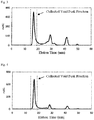
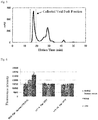
- the solution was purified by gel filtration with Superdex 200 column (GE Healthcare) to obtain a complex of the IgG-streptavidin conjugate and dextran (T2000) from a void peak fraction shown in Fig. 1 .
- the complex of the IgG-streptavidin conjugate and dextran (T2000) produced in Example 9 was prepared using 0.1 M phosphate buffer (pH 7.2) so that the concentration of the IgG-streptavidin conjugate became 570 nM. 300 ⁇ L of said complex solution of the IgG-streptavidin conjugate and dextran (T2000) was mixed with 3.0 ⁇ L solution of 61 ⁇ M biotinylated luciferase (Kikkoman Corp.), and then reacted at 25 °C for 1 hour to obtain a complex of luciferase-labeled IgG and dextran (T2000).
- the four kinds of the complexes of Fab'-streptavidin conjugate and dextran produced in Example 11 were prepared with 0.1 M phosphate buffer (pH 7.2) so that the concentration of the Fab'-streptavidin conjugate became 1.8 ⁇ M.
- Each 100 ⁇ L of the complex solutions of Fab'-streptavidin conjugate and dextran was mixed with 3.0 ⁇ L of 61 ⁇ M biotinylated luciferase (Kikkoman Corp.), and then reacted at 25 °C for 1 hour to produce the following four complexes of luciferase-labeled Fab' and dextran.
- Anti-HCV core antigen mouse monoclonal antibodies c11-3, c11-7, and AOT3 were immobilized onto magnetic particles by a carbodiimide method using WSC to produce 0.2% antibody-immobilized magnetic particles.
- each 100 ⁇ L of normal human serum and two HCV positive sera confirmed by PCR was mixed with 100 ⁇ L of a sample treatment solution (6 M guanidine hydrochloride, 0.5 N HCl, 12.5% TritonX100 and 0.75% Tween20) and then reacted at 37 °C for 15 minutes to complete the pretreatment of the sample.
- Enzyme immunoassay was performed in the same manner as in Example 13 except for using the products in Examples 7 and 12 as the labeled antibodies.
- the complex of luciferase-labeled Fab' and dextran (T2000) or the complex of luciferase-labeled Fab' and dextran (T500) showed a higher luminescence value than the luciferase-labeled Fab's, and it was confirmed that the polymerization improved the reactivity by approximately 50 to 100 times in a similar way to the case of IgG.
- a probe complex was produced by applying the method described in WO 2006/011543 .
- 44 mg of dextran (T2000) was weighed and dissolved in 0.8 mL of 0.1 M phosphate buffer (pH 7.0), and mixed with 0.4 mL of a sodium periodate solution thereto. After being reacted at room temperature for 2 hours, excessive sodium periodate was removed by gel filtration (PD-10; GE Healthcare), and a streptavidin (SA) solution and a CAPS solution (10%) were added and reacted at room temperature for 5 hours to introduce the streptavidin into dextran.
- PD-10 gel filtration
- SA streptavidin
- CAPS CAPS
- the dextran-SA conjugate was prepared using 0.1 M phosphate buffer (pH 7.0) so as to become 2 mg/mL, and 0.5 mL of the dextran-SA conjugate solution was mixed with 5 ⁇ L of a maleimide reagent EMCS (DOJINDO LABORATORIES) dissolved in dimethylformamide so as to become 10 mg/mL, and then reacted at room temperature for 1.5 hours.
- the reaction product was purified by gel filtration with PD-10 (GE Healthcare) to remove unreacted EMCS thereby obtaining the dextran-SA conjugate introduced with one or more maleimide groups.
- Fab's of c11-9 and c11-14 were produced by the method described in Example 2 and then the Fab's were mixed equally in quantity to prepare 0.5 mg/mL of a Fab' solution.
- 1 mL of the 0.5 mg/mL Fab' solution was added to 0.5 mL of the 2 mg/mL dextran-SA conjugate introduced with one or more maleimide groups, and reacted at 4 °C overnight.
- 2-mercaptoethylamine was added thereto so that the final concentration of 2-mercaptoethylamine became 15 mM, and reacted at room temperature for 1 hour thereby blocking unreacted maleimide groups.
- the solution was purified by gel filtration with Sephacryl S-300HR column (GE Healthcare) to obtain a complex of dextran, SA and Fab'.
- the amount of the SA contained in the purified complex of dextran, SA and Fab' was determined using, as an indicator, the color development by HABA reagent, as well as SA solution having a known concentration as a standard.
- the produced polymer of dextran T2000, SA and Fab' was prepared with 0.1 M phosphate buffer so that the SA concentration became 570 nM.
- Anti-HCV core antigen mouse monoclonal antibodies c11-3, c11-7, and AOT3 were immobilized onto magnetic particles by a carbodiimide method using WSC to produce 0.2% antibody-immobilized magnetic particles.
- each 100 ⁇ L of normal human serum and two HCV core antigen positive sera was mixed with 100 ⁇ L of a sample treatment solution (6 M guanidine hydrochloride, 0.5 N HCl, 12.5% TritonX100 and 0.75% Tween20) and then reacted at 37 °C for 15 minutes to complete the pretreatment of the sample.
- the reactivity of the complex of luciferase-labeled IgG and dextran (T2000) was improved by approximately 3 to 5 times than that of the polymerized labeled antibody produced by applying a previous method.
- the S/N ratio was not greatly improved even though the amount of antibody to be used was increased.
- the complex of Fab'-streptavidin conjugate and dextran (T2000), wherein the c11-9 and c11-14 were mixed, produced in Example 11 was prepared with 0.1 M phosphate buffer (pH 7.2) so that the concentration of the Fab'-streptavidin conjugate became 1.4 ⁇ M.
- 1.2 ⁇ L of 56.8 ⁇ M biotinylated POD (Invitrogen Corporation) was added to 50 ⁇ L of said complex solution, and reacted at 4 °C overnight to produce a complex of POD-labeled Fab' and dextran (T2000).
- Anti-HCV core antigen mouse monoclonal antibodies c11-3, c11-7, and AOT3 were immobilized onto magnetic particles by a carbodiimide method using WSC to produce 0.2% antibody-immobilized magnetic particles.
- recombinant HCV core antigen (c11) was diluted with normal human serum so as to become each 0, 0.12 and 1.2 nM.
- Each 100 ⁇ L of these samples was mixed with 100 ⁇ L of a sample treatment solution (6 M guanidine hydrochloride, 0.5 N HCl, 12.5% TritonX100 and 0.75% Tween20) and then reacted at 37 °C for 15 minutes to complete the pretreatment of the sample.
- a substrate solution (luminol) was added to a tube in which the magnetic particles were included, followed by measuring the luminole chemiluminescence catalyzed by POD using Lumat LB9507 (Berthold).
- the luminescence measurement was conducted in such a way that luminescence was integrated for 3 seconds from 12 seconds after adding luminol.
- Table 4 the complex of POD-labeled Fab' and dextran (T2000) showed a higher luminescence value than the POD-labeled Fab', and the amplification of a signal by the present invention was confirmed similarly to the case of luciferase.
- the complex of Fab'-streptavidin conjugate and dextran (T2000), wherein the c11-9 and c11-14 were mixed, produced in Example 11 was prepared with 0.1 M phosphate buffer (pH 7.2) so that the concentration of the Fab'-streptavidin conjugate became 6.3 ⁇ M. 20 ⁇ L of the complex solution was mixed with 1.0 ⁇ L of 160 ⁇ M biotinylated FITC (Invitrogen Corporation) and then reacted at 4 °C overnight to produce a complex of FITC-labeled Fab' and dextran (T2000).
- Anti-HCV core antigen mouse monoclonal antibodies c11-3, c11-7, and AOT3 were immobilized onto magnetic particles by a carbodiimide method using WSC to produce 0.2% antibody-immobilized magnetic particles.
- recombinant HCV core antigen (c11) was diluted with normal human serum so as to become each 0, 0.12 and 1.2 nM, and then 100 ⁇ L of these samples were mixed with 100 ⁇ L of a sample treatment solution (6 M guanidine hydrochloride, 0.5 N HCl, 12.5% TritonX100 and 0.75% Tween20) and reacted at 37 °C for 15 minutes to complete the pretreatment of the sample.
- the complex of FITC-labeled Fab' and dextran (T2000) showed a higher fluorescent activity than the FITC-labeled Fab's, and the amplification of a signal by the present invention was confirmed similarly to the case of luciferase and POD.
- the above result showed that the present invention can be performed even by using a low-molecular label which is not an enzyme.
- the accelerated stability of the complex of labeled probes and a water-soluble carrier according to the present invention was tested. Specifically, with regard to the complex of luciferase labeled c11-9 ⁇ c11-14 Fab' and dextran (T2000) produced in Example 12, the activity under 4 °C preservation and the remaining activity after an acceleration condition at 37 °C for one week were measured and compared for studies. The activities were measured by the same method as Example 13. The results were as shown in Table 6.
- the present invention allowed to obtain a high-sensitive and stable complex of labeled probes and a water-soluble carrier, which specifically binds to a target substance, and the use of this complex of labeled probes and a water-soluble carrier allowed more sensitive and stable detection and measurement as compared with the prior art. Further, it was verified that the present invention was also effective for a low-molecular label which is not an enzyme.
- the use of the complex of labeled probes and a water-soluble carrier according to the present invention allows more sensitive and stable detection and measurement as compared with the prior art.
Landscapes
- Health & Medical Sciences (AREA)
- Life Sciences & Earth Sciences (AREA)
- Immunology (AREA)
- Engineering & Computer Science (AREA)
- Molecular Biology (AREA)
- Biomedical Technology (AREA)
- Chemical & Material Sciences (AREA)
- Hematology (AREA)
- Urology & Nephrology (AREA)
- Cell Biology (AREA)
- Microbiology (AREA)
- Biotechnology (AREA)
- Food Science & Technology (AREA)
- Medicinal Chemistry (AREA)
- Physics & Mathematics (AREA)
- Analytical Chemistry (AREA)
- Biochemistry (AREA)
- General Health & Medical Sciences (AREA)
- General Physics & Mathematics (AREA)
- Pathology (AREA)
- Peptides Or Proteins (AREA)
- Investigating Or Analysing Biological Materials (AREA)
Claims (13)
- Un procédé pour produire le complexe de sondes marquées et un support hydrosoluble, comprenant les étapes suivantes:Etape 1. fixation d'une sonde ayant un ou plusieurs groupes thiol, pouvant se lier à une substance cible, à un composé avidine ayant un ou plusieurs plus de groupes maléimide pour obtenir un conjugué sonde;Etape 2. ensuite, lier le conjugué sonde ayant un ou plusieurs groupes thiol à un véhicule soluble dans l'eau de masse moléculaire élevée ayant un ou plusieurs groupes maléimide pour obtenir un complexe du conjugué sonde et du support soluble dans l'eau; etEtape 3. en outre, mélanger le complexe du conjugué sonde et du support soluble dans l'eau avec un marqueur biotinylé pour lier le composé avidine dans le complexe du conjugué sonde et du support hydrosoluble à la biotine dans le marqueur biotinylé, dans lequel la sonde pouvant se lier à une substance cible est choisi parmi un anticorps ou un fragment d'anticorps, la protéine G, la protéine A, la protéine L, la lectine ou un récepteur.
- Le procédé selon la revendication 1, dans lequel le composé d'avidine est l'avidine ou la streptavidine.
- Le procédé selon la revendication 1 ou 2, dans lequel la masse moléculaire du support hydrosoluble est de 500.000 ou plus.
- Le procédé selon l'une quelconque des revendications 1 à 3, dans lequel le support hydrosoluble est choisi parmi le dextrane, l'aminodextrane, la dextrine, la dextrine en grappes, le ficoll ou le pullulane.
- Le procédé selon l'une quelconque des revendications 1 à 4, dans lequel la sonde pouvant se lier à une substance cible est un anticorps ou un fragment d'anticorps.
- Le procédé selon l'une quelconque des revendications 1 à 5, dans lequel deux ou plusieurs anticorps ou fragments d'anticorps sont utilisés.
- Le procédé selon la revendication 5 ou 6, dans lequel l'anticorps ou le fragment d'anticorps est choisi parmi Fab', F(ab')2, Fab ou IgG.
- Le procédé selon l'une quelconque des revendications 1 à 7, dans lequel le marqueur biotinylé est choisi parmi la luciférase biotinylée, la phosphatase alcaline biotinylée, la POD biotinylée, la GOD biotinylée, la FITC biotinylée, l'acridinium biotinylé, un dérivé biotinylé de l'acridinium, ou le tris (2,2'bipyridyl)ruthénium (II) biotinylé.
- Le procédé selon la revendication 8, dans lequel la luciférase biotinylée est produite par recombinaison génétique.
- Le complexe de sondes marquées et un support hydrosoluble produit par le procédé selon l'une quelconque des revendications 1 à 9.
- Un procédé de mesure utilisant le complexe de sondes marquées et un support hydrosoluble produit par le procédé selon l'une quelconque des revendications 1 à 9, dans lequel le complexe se lie à une substance cible.
- Un procédé d'immuno-essai utilisant le complexe de sondes marquées et un support hydrosoluble produit par le procédé selon l'une quelconque des revendications 1 à 9.
- Un procédé de mesure hautement sensible utilisant le complexe de sondes marquées et un support hydrosoluble produit par le procédé selon l'une quelconque des revendications 1 à 9, dans lequel le complexe se lie à une substance cible.
Applications Claiming Priority (2)
| Application Number | Priority Date | Filing Date | Title |
|---|---|---|---|
| JP2010092953 | 2010-04-14 | ||
| PCT/JP2011/059150 WO2011129357A1 (fr) | 2010-04-14 | 2011-04-13 | Complexe d'une sonde marquée et d'un vecteur hydrosoluble |
Publications (3)
| Publication Number | Publication Date |
|---|---|
| EP2560003A1 EP2560003A1 (fr) | 2013-02-20 |
| EP2560003A4 EP2560003A4 (fr) | 2013-11-20 |
| EP2560003B1 true EP2560003B1 (fr) | 2018-07-04 |
Family
ID=44798728
Family Applications (1)
| Application Number | Title | Priority Date | Filing Date |
|---|---|---|---|
| EP11768878.8A Active EP2560003B1 (fr) | 2010-04-14 | 2011-04-13 | Complexe d'une sonde marquée et d'un vecteur hydrosoluble |
Country Status (7)
| Country | Link |
|---|---|
| US (1) | US9005910B2 (fr) |
| EP (1) | EP2560003B1 (fr) |
| JP (1) | JP5675782B2 (fr) |
| KR (1) | KR101814385B1 (fr) |
| CN (1) | CN102893151B (fr) |
| CA (1) | CA2796366C (fr) |
| WO (1) | WO2011129357A1 (fr) |
Families Citing this family (10)
| Publication number | Priority date | Publication date | Assignee | Title |
|---|---|---|---|---|
| JP6056137B2 (ja) * | 2010-12-22 | 2017-01-11 | 東ソー株式会社 | 抗体 |
| KR101398764B1 (ko) | 2013-08-29 | 2014-05-27 | 강릉원주대학교산학협력단 | 입자의 이동에 의해 분석물질을 검출하는 장치 및 방법 |
| KR20190072520A (ko) * | 2016-10-24 | 2019-06-25 | 도레이 카부시키가이샤 | 반도체 센서 및 그의 제조 방법, 그리고 복합 센서 |
| CN107236055B (zh) * | 2017-05-19 | 2019-10-01 | 华东师范大学 | 一种葡聚糖衍生物及其应用 |
| US11988666B2 (en) | 2019-09-02 | 2024-05-21 | Fujirebio Inc. | Lectin-binding substance measurement method, lectin-binding substance measurement kit, and blocked labeled lectin for use in these |
| US12038440B2 (en) | 2019-09-02 | 2024-07-16 | Fujirebio Inc. | Lectin-binding substance measurement method, lectin-binding substance measurement kit, and capture carrier for use in these |
| CN113960306B (zh) * | 2020-07-20 | 2023-04-28 | 菲鹏生物股份有限公司 | 稳定吖啶酯标识蛋白的试剂及应用 |
| CN111830250A (zh) * | 2020-08-04 | 2020-10-27 | 珠海市丽拓生物科技有限公司 | 一种信号放大的酶标二抗的制备方法 |
| CN113777312B (zh) * | 2021-09-03 | 2024-02-02 | 普十生物科技(北京)有限公司 | 乙肝抗体片段的制备方法、乙肝抗体片段、试剂盒及应用 |
| EP4481383A4 (fr) * | 2022-03-25 | 2025-06-04 | Sekisui Medical Co., Ltd. | Procédé d'analyse immunologique, complexe, procédé de production de complexe et réactif pour analyse immunologique |
Citations (2)
| Publication number | Priority date | Publication date | Assignee | Title |
|---|---|---|---|---|
| US20080153089A1 (en) * | 2004-12-28 | 2008-06-26 | Advanced Life Science Institute, Inc. | Blocked Enzyme-Probe Complex |
| US20110039260A1 (en) * | 2007-11-28 | 2011-02-17 | Great Basin Scientific | Methods and compositions for amplifying a detectable signal |
Family Cites Families (14)
| Publication number | Priority date | Publication date | Assignee | Title |
|---|---|---|---|---|
| JP2619549B2 (ja) * | 1989-06-29 | 1997-06-11 | 日本商事株式会社 | 抗原の定量法およびそれに用いる固相 |
| DE4310141A1 (de) * | 1993-03-29 | 1994-10-06 | Boehringer Mannheim Gmbh | Homobidentale trifunktionelle Linker |
| JPH11295313A (ja) | 1998-04-09 | 1999-10-29 | Eiken Chem Co Ltd | 抗体または抗体断片の重合体とその利用 |
| JP3524401B2 (ja) | 1998-09-16 | 2004-05-10 | 株式会社ニチレイ | 酵素抗体複合体およびその製造方法 |
| JP3781934B2 (ja) | 1999-12-22 | 2006-06-07 | 株式会社ニチレイバイオサイエンス | 酵素−タンパク質複合体 |
| JP2004515208A (ja) | 2000-03-28 | 2004-05-27 | ナノスフェアー インコーポレイテッド | オリゴヌクレオチドを付着させたナノ粒子とその使用方法 |
| JP4086277B2 (ja) | 2001-12-27 | 2008-05-14 | 栄研化学株式会社 | 水溶性担体−抗体複合体の製造方法および使用方法 |
| DE602005023624D1 (de) | 2004-07-30 | 2010-10-28 | Advanced Life Science Inst Inc | Sondenkomplex |
| CN101115847A (zh) * | 2004-11-16 | 2008-01-30 | 希艾娜癌症诊疗有限公司 | 检测样品中的分析物的方法 |
| US20070254311A1 (en) * | 2006-04-26 | 2007-11-01 | Cardiogenics Inc. | Covalent modification and conjugation of luciferase |
| US20080108097A1 (en) * | 2006-07-24 | 2008-05-08 | National Institute Of Advanced Industrial Science And Technology | Method for producing complex of biotin-labeled cypridina (cypridina noctiluca) luciferase with streptoavidin and method for stabilizing the same |
| JP2008122302A (ja) * | 2006-11-15 | 2008-05-29 | Kikkoman Corp | 生体分子測定法 |
| GB0711560D0 (en) * | 2007-06-14 | 2007-07-25 | Innova Biosciences Ltd | Improvements in or relating to production of conjugates |
| JP2009244101A (ja) * | 2008-03-31 | 2009-10-22 | Canon Inc | 被検物質の検出方法 |
-
2011
- 2011-04-13 US US13/640,821 patent/US9005910B2/en not_active Expired - Fee Related
- 2011-04-13 CA CA2796366A patent/CA2796366C/fr not_active Expired - Fee Related
- 2011-04-13 EP EP11768878.8A patent/EP2560003B1/fr active Active
- 2011-04-13 JP JP2012510666A patent/JP5675782B2/ja not_active Expired - Fee Related
- 2011-04-13 WO PCT/JP2011/059150 patent/WO2011129357A1/fr not_active Ceased
- 2011-04-13 CN CN201180018682.3A patent/CN102893151B/zh not_active Expired - Fee Related
- 2011-04-13 KR KR1020127026688A patent/KR101814385B1/ko not_active Expired - Fee Related
Patent Citations (2)
| Publication number | Priority date | Publication date | Assignee | Title |
|---|---|---|---|---|
| US20080153089A1 (en) * | 2004-12-28 | 2008-06-26 | Advanced Life Science Institute, Inc. | Blocked Enzyme-Probe Complex |
| US20110039260A1 (en) * | 2007-11-28 | 2011-02-17 | Great Basin Scientific | Methods and compositions for amplifying a detectable signal |
Also Published As
| Publication number | Publication date |
|---|---|
| CA2796366A1 (fr) | 2011-10-20 |
| JP5675782B2 (ja) | 2015-02-25 |
| KR20130081206A (ko) | 2013-07-16 |
| EP2560003A1 (fr) | 2013-02-20 |
| EP2560003A4 (fr) | 2013-11-20 |
| US20130230897A1 (en) | 2013-09-05 |
| KR101814385B1 (ko) | 2018-01-04 |
| JPWO2011129357A1 (ja) | 2013-07-18 |
| CN102893151A (zh) | 2013-01-23 |
| US9005910B2 (en) | 2015-04-14 |
| WO2011129357A1 (fr) | 2011-10-20 |
| CA2796366C (fr) | 2017-12-05 |
| CN102893151B (zh) | 2015-06-03 |
Similar Documents
| Publication | Publication Date | Title |
|---|---|---|
| EP2560003B1 (fr) | Complexe d'une sonde marquée et d'un vecteur hydrosoluble | |
| Wang et al. | Competitive immunoassays for the detection of small molecules using single molecule arrays | |
| Bi et al. | Multilayers enzyme-coated carbon nanotubes as biolabel for ultrasensitive chemiluminescence immunoassay of cancer biomarker | |
| Daly et al. | Development of surface plasmon resonance-based immunoassay for aflatoxin B1 | |
| Xie et al. | A sandwich ELISA-like detection of C-reactive protein in blood by citicoline-bovine serum albumin conjugate and aptamer-functionalized gold nanoparticles nanozyme | |
| Kim et al. | Ultra-sensitive detection of IgE using biofunctionalized nanoparticle-enhanced SPR | |
| Hu et al. | DLISA: A DNAzyme-based ELISA for protein enzyme-free immunoassay of multiple analytes | |
| CN102998467B (zh) | β人绒毛膜促性腺激素磁微粒化学发光免疫定量检测试剂盒及其制备方法 | |
| Liu et al. | A highly sensitive and dual-readout immunoassay for norfloxacin in milk based on QDs-FM@ ALP-SA and click chemistry | |
| Xu et al. | A highly sensitive bio-barcode immunoassay for multi-residue detection of organophosphate pesticides based on fluorescence anti-quenching | |
| CN110878296B (zh) | 一种高敏hrp酶及其制备方法与应用 | |
| WO2018081757A1 (fr) | Polymérisation rapide de polyphénols | |
| CN105181680A (zh) | 一种三聚氰胺的磁珠分离化学发光免疫检测方法 | |
| Shi et al. | Signal amplification in capillary electrophoresis based chemiluminescent immunoassays by using an antibody–gold nanoparticle–DNAzyme assembly | |
| Luan et al. | A facile colorimetric aptamer assay for small molecule detection in food based on a magnetic single-stranded DNA binding protein-linked composite probe | |
| Peng et al. | Aptamer-barcode based immunoassay for the instantaneous derivatization chemiluminescence detection of IgE coupled to magnetic beads | |
| Singampalli et al. | Highly reusable electrochemical immunosensor for ultrasensitive protein detection | |
| Nikitina et al. | Development and performance of NLISA for C-reactive protein detection based on Prussian blue nanoparticle conjugates | |
| WO2016041022A1 (fr) | Échafaudage de capteur | |
| Leipold et al. | ICP-MS-based multiplex profiling of glycoproteins using lectins conjugated to lanthanide-chelating polymers | |
| KR101661315B1 (ko) | 시료 내 다중 타겟의 동시 검출방법 및 이의 용도 | |
| CN101012483B (zh) | 含核酸适配子的检测试剂及其制备方法和用途 | |
| CN100489528C (zh) | 一种指示高剂量钩状效应的方法 | |
| KR101273453B1 (ko) | 효소가 집적된 미세튜브를 이용한 정량분석법 | |
| CN102375052A (zh) | 一种在同一体系中检测IgM抗体和IgG抗体的方法 |
Legal Events
| Date | Code | Title | Description |
|---|---|---|---|
| PUAI | Public reference made under article 153(3) epc to a published international application that has entered the european phase |
Free format text: ORIGINAL CODE: 0009012 |
|
| 17P | Request for examination filed |
Effective date: 20121012 |
|
| AK | Designated contracting states |
Kind code of ref document: A1 Designated state(s): AL AT BE BG CH CY CZ DE DK EE ES FI FR GB GR HR HU IE IS IT LI LT LU LV MC MK MT NL NO PL PT RO RS SE SI SK SM TR |
|
| AX | Request for extension of the european patent |
Extension state: BA ME |
|
| RIC1 | Information provided on ipc code assigned before grant |
Ipc: G01N 33/53 20060101AFI20131010BHEP Ipc: G01N 33/548 20060101ALI20131010BHEP |
|
| A4 | Supplementary search report drawn up and despatched |
Effective date: 20131021 |
|
| 17Q | First examination report despatched |
Effective date: 20150603 |
|
| STAA | Information on the status of an ep patent application or granted ep patent |
Free format text: STATUS: EXAMINATION IS IN PROGRESS |
|
| RAP1 | Party data changed (applicant data changed or rights of an application transferred) |
Owner name: ADVANCED LIFE SCIENCE INSTITUTE, INC. Owner name: EIKEN KAGAKU KABUSHIKI KAISHA |
|
| REG | Reference to a national code |
Ref country code: DE Ref legal event code: R079 Ref document number: 602011049784 Country of ref document: DE Free format text: PREVIOUS MAIN CLASS: G01N0033530000 Ipc: G01N0033580000 |
|
| GRAP | Despatch of communication of intention to grant a patent |
Free format text: ORIGINAL CODE: EPIDOSNIGR1 |
|
| STAA | Information on the status of an ep patent application or granted ep patent |
Free format text: STATUS: GRANT OF PATENT IS INTENDED |
|
| RIC1 | Information provided on ipc code assigned before grant |
Ipc: G01N 33/532 20060101ALI20180118BHEP Ipc: G01N 33/543 20060101ALI20180118BHEP Ipc: G01N 33/58 20060101AFI20180118BHEP |
|
| INTG | Intention to grant announced |
Effective date: 20180208 |
|
| GRAS | Grant fee paid |
Free format text: ORIGINAL CODE: EPIDOSNIGR3 |
|
| GRAA | (expected) grant |
Free format text: ORIGINAL CODE: 0009210 |
|
| STAA | Information on the status of an ep patent application or granted ep patent |
Free format text: STATUS: THE PATENT HAS BEEN GRANTED |
|
| AK | Designated contracting states |
Kind code of ref document: B1 Designated state(s): AL AT BE BG CH CY CZ DE DK EE ES FI FR GB GR HR HU IE IS IT LI LT LU LV MC MK MT NL NO PL PT RO RS SE SI SK SM TR |
|
| AX | Request for extension of the european patent |
Extension state: BA ME |
|
| REG | Reference to a national code |
Ref country code: GB Ref legal event code: FG4D |
|
| REG | Reference to a national code |
Ref country code: CH Ref legal event code: EP |
|
| REG | Reference to a national code |
Ref country code: AT Ref legal event code: REF Ref document number: 1015071 Country of ref document: AT Kind code of ref document: T Effective date: 20180715 |
|
| REG | Reference to a national code |
Ref country code: IE Ref legal event code: FG4D |
|
| REG | Reference to a national code |
Ref country code: DE Ref legal event code: R096 Ref document number: 602011049784 Country of ref document: DE |
|
| REG | Reference to a national code |
Ref country code: NL Ref legal event code: MP Effective date: 20180704 |
|
| REG | Reference to a national code |
Ref country code: LT Ref legal event code: MG4D |
|
| REG | Reference to a national code |
Ref country code: AT Ref legal event code: MK05 Ref document number: 1015071 Country of ref document: AT Kind code of ref document: T Effective date: 20180704 |
|
| PG25 | Lapsed in a contracting state [announced via postgrant information from national office to epo] |
Ref country code: NL Free format text: LAPSE BECAUSE OF FAILURE TO SUBMIT A TRANSLATION OF THE DESCRIPTION OR TO PAY THE FEE WITHIN THE PRESCRIBED TIME-LIMIT Effective date: 20180704 |
|
| PG25 | Lapsed in a contracting state [announced via postgrant information from national office to epo] |
Ref country code: FI Free format text: LAPSE BECAUSE OF FAILURE TO SUBMIT A TRANSLATION OF THE DESCRIPTION OR TO PAY THE FEE WITHIN THE PRESCRIBED TIME-LIMIT Effective date: 20180704 Ref country code: PL Free format text: LAPSE BECAUSE OF FAILURE TO SUBMIT A TRANSLATION OF THE DESCRIPTION OR TO PAY THE FEE WITHIN THE PRESCRIBED TIME-LIMIT Effective date: 20180704 Ref country code: RS Free format text: LAPSE BECAUSE OF FAILURE TO SUBMIT A TRANSLATION OF THE DESCRIPTION OR TO PAY THE FEE WITHIN THE PRESCRIBED TIME-LIMIT Effective date: 20180704 Ref country code: SE Free format text: LAPSE BECAUSE OF FAILURE TO SUBMIT A TRANSLATION OF THE DESCRIPTION OR TO PAY THE FEE WITHIN THE PRESCRIBED TIME-LIMIT Effective date: 20180704 Ref country code: GR Free format text: LAPSE BECAUSE OF FAILURE TO SUBMIT A TRANSLATION OF THE DESCRIPTION OR TO PAY THE FEE WITHIN THE PRESCRIBED TIME-LIMIT Effective date: 20181005 Ref country code: NO Free format text: LAPSE BECAUSE OF FAILURE TO SUBMIT A TRANSLATION OF THE DESCRIPTION OR TO PAY THE FEE WITHIN THE PRESCRIBED TIME-LIMIT Effective date: 20181004 Ref country code: IS Free format text: LAPSE BECAUSE OF FAILURE TO SUBMIT A TRANSLATION OF THE DESCRIPTION OR TO PAY THE FEE WITHIN THE PRESCRIBED TIME-LIMIT Effective date: 20181104 Ref country code: CZ Free format text: LAPSE BECAUSE OF FAILURE TO SUBMIT A TRANSLATION OF THE DESCRIPTION OR TO PAY THE FEE WITHIN THE PRESCRIBED TIME-LIMIT Effective date: 20180704 Ref country code: LT Free format text: LAPSE BECAUSE OF FAILURE TO SUBMIT A TRANSLATION OF THE DESCRIPTION OR TO PAY THE FEE WITHIN THE PRESCRIBED TIME-LIMIT Effective date: 20180704 Ref country code: AT Free format text: LAPSE BECAUSE OF FAILURE TO SUBMIT A TRANSLATION OF THE DESCRIPTION OR TO PAY THE FEE WITHIN THE PRESCRIBED TIME-LIMIT Effective date: 20180704 Ref country code: BG Free format text: LAPSE BECAUSE OF FAILURE TO SUBMIT A TRANSLATION OF THE DESCRIPTION OR TO PAY THE FEE WITHIN THE PRESCRIBED TIME-LIMIT Effective date: 20181004 |
|
| PG25 | Lapsed in a contracting state [announced via postgrant information from national office to epo] |
Ref country code: HR Free format text: LAPSE BECAUSE OF FAILURE TO SUBMIT A TRANSLATION OF THE DESCRIPTION OR TO PAY THE FEE WITHIN THE PRESCRIBED TIME-LIMIT Effective date: 20180704 Ref country code: ES Free format text: LAPSE BECAUSE OF FAILURE TO SUBMIT A TRANSLATION OF THE DESCRIPTION OR TO PAY THE FEE WITHIN THE PRESCRIBED TIME-LIMIT Effective date: 20180704 Ref country code: LV Free format text: LAPSE BECAUSE OF FAILURE TO SUBMIT A TRANSLATION OF THE DESCRIPTION OR TO PAY THE FEE WITHIN THE PRESCRIBED TIME-LIMIT Effective date: 20180704 Ref country code: AL Free format text: LAPSE BECAUSE OF FAILURE TO SUBMIT A TRANSLATION OF THE DESCRIPTION OR TO PAY THE FEE WITHIN THE PRESCRIBED TIME-LIMIT Effective date: 20180704 |
|
| REG | Reference to a national code |
Ref country code: DE Ref legal event code: R097 Ref document number: 602011049784 Country of ref document: DE |
|
| PG25 | Lapsed in a contracting state [announced via postgrant information from national office to epo] |
Ref country code: RO Free format text: LAPSE BECAUSE OF FAILURE TO SUBMIT A TRANSLATION OF THE DESCRIPTION OR TO PAY THE FEE WITHIN THE PRESCRIBED TIME-LIMIT Effective date: 20180704 Ref country code: EE Free format text: LAPSE BECAUSE OF FAILURE TO SUBMIT A TRANSLATION OF THE DESCRIPTION OR TO PAY THE FEE WITHIN THE PRESCRIBED TIME-LIMIT Effective date: 20180704 Ref country code: IT Free format text: LAPSE BECAUSE OF FAILURE TO SUBMIT A TRANSLATION OF THE DESCRIPTION OR TO PAY THE FEE WITHIN THE PRESCRIBED TIME-LIMIT Effective date: 20180704 |
|
| PLBE | No opposition filed within time limit |
Free format text: ORIGINAL CODE: 0009261 |
|
| STAA | Information on the status of an ep patent application or granted ep patent |
Free format text: STATUS: NO OPPOSITION FILED WITHIN TIME LIMIT |
|
| PG25 | Lapsed in a contracting state [announced via postgrant information from national office to epo] |
Ref country code: DK Free format text: LAPSE BECAUSE OF FAILURE TO SUBMIT A TRANSLATION OF THE DESCRIPTION OR TO PAY THE FEE WITHIN THE PRESCRIBED TIME-LIMIT Effective date: 20180704 Ref country code: SK Free format text: LAPSE BECAUSE OF FAILURE TO SUBMIT A TRANSLATION OF THE DESCRIPTION OR TO PAY THE FEE WITHIN THE PRESCRIBED TIME-LIMIT Effective date: 20180704 Ref country code: SM Free format text: LAPSE BECAUSE OF FAILURE TO SUBMIT A TRANSLATION OF THE DESCRIPTION OR TO PAY THE FEE WITHIN THE PRESCRIBED TIME-LIMIT Effective date: 20180704 |
|
| 26N | No opposition filed |
Effective date: 20190405 |
|
| PG25 | Lapsed in a contracting state [announced via postgrant information from national office to epo] |
Ref country code: SI Free format text: LAPSE BECAUSE OF FAILURE TO SUBMIT A TRANSLATION OF THE DESCRIPTION OR TO PAY THE FEE WITHIN THE PRESCRIBED TIME-LIMIT Effective date: 20180704 |
|
| REG | Reference to a national code |
Ref country code: CH Ref legal event code: PL |
|
| REG | Reference to a national code |
Ref country code: BE Ref legal event code: MM Effective date: 20190430 |
|
| PG25 | Lapsed in a contracting state [announced via postgrant information from national office to epo] |
Ref country code: MC Free format text: LAPSE BECAUSE OF FAILURE TO SUBMIT A TRANSLATION OF THE DESCRIPTION OR TO PAY THE FEE WITHIN THE PRESCRIBED TIME-LIMIT Effective date: 20180704 Ref country code: LU Free format text: LAPSE BECAUSE OF NON-PAYMENT OF DUE FEES Effective date: 20190413 |
|
| PG25 | Lapsed in a contracting state [announced via postgrant information from national office to epo] |
Ref country code: CH Free format text: LAPSE BECAUSE OF NON-PAYMENT OF DUE FEES Effective date: 20190430 Ref country code: LI Free format text: LAPSE BECAUSE OF NON-PAYMENT OF DUE FEES Effective date: 20190430 |
|
| PG25 | Lapsed in a contracting state [announced via postgrant information from national office to epo] |
Ref country code: BE Free format text: LAPSE BECAUSE OF NON-PAYMENT OF DUE FEES Effective date: 20190430 |
|
| PG25 | Lapsed in a contracting state [announced via postgrant information from national office to epo] |
Ref country code: TR Free format text: LAPSE BECAUSE OF FAILURE TO SUBMIT A TRANSLATION OF THE DESCRIPTION OR TO PAY THE FEE WITHIN THE PRESCRIBED TIME-LIMIT Effective date: 20180704 |
|
| PG25 | Lapsed in a contracting state [announced via postgrant information from national office to epo] |
Ref country code: IE Free format text: LAPSE BECAUSE OF NON-PAYMENT OF DUE FEES Effective date: 20190413 |
|
| PG25 | Lapsed in a contracting state [announced via postgrant information from national office to epo] |
Ref country code: PT Free format text: LAPSE BECAUSE OF FAILURE TO SUBMIT A TRANSLATION OF THE DESCRIPTION OR TO PAY THE FEE WITHIN THE PRESCRIBED TIME-LIMIT Effective date: 20181105 |
|
| PGFP | Annual fee paid to national office [announced via postgrant information from national office to epo] |
Ref country code: DE Payment date: 20200420 Year of fee payment: 10 Ref country code: FR Payment date: 20200420 Year of fee payment: 10 |
|
| PGFP | Annual fee paid to national office [announced via postgrant information from national office to epo] |
Ref country code: GB Payment date: 20200427 Year of fee payment: 10 |
|
| PG25 | Lapsed in a contracting state [announced via postgrant information from national office to epo] |
Ref country code: CY Free format text: LAPSE BECAUSE OF FAILURE TO SUBMIT A TRANSLATION OF THE DESCRIPTION OR TO PAY THE FEE WITHIN THE PRESCRIBED TIME-LIMIT Effective date: 20180704 |
|
| PG25 | Lapsed in a contracting state [announced via postgrant information from national office to epo] |
Ref country code: HU Free format text: LAPSE BECAUSE OF FAILURE TO SUBMIT A TRANSLATION OF THE DESCRIPTION OR TO PAY THE FEE WITHIN THE PRESCRIBED TIME-LIMIT; INVALID AB INITIO Effective date: 20110413 Ref country code: MT Free format text: LAPSE BECAUSE OF FAILURE TO SUBMIT A TRANSLATION OF THE DESCRIPTION OR TO PAY THE FEE WITHIN THE PRESCRIBED TIME-LIMIT Effective date: 20180704 |
|
| REG | Reference to a national code |
Ref country code: DE Ref legal event code: R119 Ref document number: 602011049784 Country of ref document: DE |
|
| GBPC | Gb: european patent ceased through non-payment of renewal fee |
Effective date: 20210413 |
|
| PG25 | Lapsed in a contracting state [announced via postgrant information from national office to epo] |
Ref country code: DE Free format text: LAPSE BECAUSE OF NON-PAYMENT OF DUE FEES Effective date: 20211103 Ref country code: FR Free format text: LAPSE BECAUSE OF NON-PAYMENT OF DUE FEES Effective date: 20210430 Ref country code: GB Free format text: LAPSE BECAUSE OF NON-PAYMENT OF DUE FEES Effective date: 20210413 |
|
| PG25 | Lapsed in a contracting state [announced via postgrant information from national office to epo] |
Ref country code: MK Free format text: LAPSE BECAUSE OF FAILURE TO SUBMIT A TRANSLATION OF THE DESCRIPTION OR TO PAY THE FEE WITHIN THE PRESCRIBED TIME-LIMIT Effective date: 20180704 |