EP2562247A2 - Dispositif de pcr comprenant deux blocs de colonne - Google Patents
Dispositif de pcr comprenant deux blocs de colonne Download PDFInfo
- Publication number
- EP2562247A2 EP2562247A2 EP11772265A EP11772265A EP2562247A2 EP 2562247 A2 EP2562247 A2 EP 2562247A2 EP 11772265 A EP11772265 A EP 11772265A EP 11772265 A EP11772265 A EP 11772265A EP 2562247 A2 EP2562247 A2 EP 2562247A2
- Authority
- EP
- European Patent Office
- Prior art keywords
- pcr
- chip
- disposed
- plate
- pcr device
- Prior art date
- Legal status (The legal status is an assumption and is not a legal conclusion. Google has not performed a legal analysis and makes no representation as to the accuracy of the status listed.)
- Granted
Links
Images



Classifications
-
- C—CHEMISTRY; METALLURGY
- C12—BIOCHEMISTRY; BEER; SPIRITS; WINE; VINEGAR; MICROBIOLOGY; ENZYMOLOGY; MUTATION OR GENETIC ENGINEERING
- C12Q—MEASURING OR TESTING PROCESSES INVOLVING ENZYMES, NUCLEIC ACIDS OR MICROORGANISMS; COMPOSITIONS OR TEST PAPERS THEREFOR; PROCESSES OF PREPARING SUCH COMPOSITIONS; CONDITION-RESPONSIVE CONTROL IN MICROBIOLOGICAL OR ENZYMOLOGICAL PROCESSES
- C12Q1/00—Measuring or testing processes involving enzymes, nucleic acids or microorganisms; Compositions therefor; Processes of preparing such compositions
- C12Q1/68—Measuring or testing processes involving enzymes, nucleic acids or microorganisms; Compositions therefor; Processes of preparing such compositions involving nucleic acids
- C12Q1/6844—Nucleic acid amplification reactions
- C12Q1/686—Polymerase chain reaction [PCR]
-
- B—PERFORMING OPERATIONS; TRANSPORTING
- B01—PHYSICAL OR CHEMICAL PROCESSES OR APPARATUS IN GENERAL
- B01L—CHEMICAL OR PHYSICAL LABORATORY APPARATUS FOR GENERAL USE
- B01L7/00—Heating or cooling apparatus; Heat insulating devices
- B01L7/52—Heating or cooling apparatus; Heat insulating devices with provision for submitting samples to a predetermined sequence of different temperatures, e.g. for treating nucleic acid samples
-
- B—PERFORMING OPERATIONS; TRANSPORTING
- B01—PHYSICAL OR CHEMICAL PROCESSES OR APPARATUS IN GENERAL
- B01L—CHEMICAL OR PHYSICAL LABORATORY APPARATUS FOR GENERAL USE
- B01L7/00—Heating or cooling apparatus; Heat insulating devices
- B01L7/52—Heating or cooling apparatus; Heat insulating devices with provision for submitting samples to a predetermined sequence of different temperatures, e.g. for treating nucleic acid samples
- B01L7/525—Heating or cooling apparatus; Heat insulating devices with provision for submitting samples to a predetermined sequence of different temperatures, e.g. for treating nucleic acid samples with physical movement of samples between temperature zones
- B01L7/5255—Heating or cooling apparatus; Heat insulating devices with provision for submitting samples to a predetermined sequence of different temperatures, e.g. for treating nucleic acid samples with physical movement of samples between temperature zones by moving sample containers
-
- C—CHEMISTRY; METALLURGY
- C12—BIOCHEMISTRY; BEER; SPIRITS; WINE; VINEGAR; MICROBIOLOGY; ENZYMOLOGY; MUTATION OR GENETIC ENGINEERING
- C12M—APPARATUS FOR ENZYMOLOGY OR MICROBIOLOGY; APPARATUS FOR CULTURING MICROORGANISMS FOR PRODUCING BIOMASS, FOR GROWING CELLS OR FOR OBTAINING FERMENTATION OR METABOLIC PRODUCTS, i.e. BIOREACTORS OR FERMENTERS
- C12M1/00—Apparatus for enzymology or microbiology
- C12M1/36—Apparatus for enzymology or microbiology including condition or time responsive control, e.g. automatically controlled fermentors
- C12M1/38—Temperature-responsive control
-
- B—PERFORMING OPERATIONS; TRANSPORTING
- B01—PHYSICAL OR CHEMICAL PROCESSES OR APPARATUS IN GENERAL
- B01L—CHEMICAL OR PHYSICAL LABORATORY APPARATUS FOR GENERAL USE
- B01L2200/00—Solutions for specific problems relating to chemical or physical laboratory apparatus
- B01L2200/02—Adapting objects or devices to another
- B01L2200/025—Align devices or objects to ensure defined positions relative to each other
-
- B—PERFORMING OPERATIONS; TRANSPORTING
- B01—PHYSICAL OR CHEMICAL PROCESSES OR APPARATUS IN GENERAL
- B01L—CHEMICAL OR PHYSICAL LABORATORY APPARATUS FOR GENERAL USE
- B01L2300/00—Additional constructional details
- B01L2300/08—Geometry, shape and general structure
- B01L2300/0809—Geometry, shape and general structure rectangular shaped
- B01L2300/0816—Cards, e.g. flat sample carriers usually with flow in two horizontal directions
-
- B—PERFORMING OPERATIONS; TRANSPORTING
- B01—PHYSICAL OR CHEMICAL PROCESSES OR APPARATUS IN GENERAL
- B01L—CHEMICAL OR PHYSICAL LABORATORY APPARATUS FOR GENERAL USE
- B01L2300/00—Additional constructional details
- B01L2300/18—Means for temperature control
- B01L2300/1805—Conductive heating, heat from thermostatted solids is conducted to receptacles, e.g. heating plates, blocks
- B01L2300/1827—Conductive heating, heat from thermostatted solids is conducted to receptacles, e.g. heating plates, blocks using resistive heater
-
- B—PERFORMING OPERATIONS; TRANSPORTING
- B01—PHYSICAL OR CHEMICAL PROCESSES OR APPARATUS IN GENERAL
- B01L—CHEMICAL OR PHYSICAL LABORATORY APPARATUS FOR GENERAL USE
- B01L3/00—Containers or dishes for laboratory use, e.g. laboratory glassware; Droppers
- B01L3/50—Containers for the purpose of retaining a material to be analysed, e.g. test tubes
- B01L3/502—Containers for the purpose of retaining a material to be analysed, e.g. test tubes with fluid transport, e.g. in multi-compartment structures
- B01L3/5027—Containers for the purpose of retaining a material to be analysed, e.g. test tubes with fluid transport, e.g. in multi-compartment structures by integrated microfluidic structures, i.e. dimensions of channels and chambers are such that surface tension forces are important, e.g. lab-on-a-chip
Definitions
- the present invention relates to a polymerase chain reaction (PCR) device including a heating block which is used for nucleic acid amplification.
- PCR polymerase chain reaction
- PCR Polymerase chain reaction
- a PCR device is installed with a container including a sample solution including nucleic acid in one reaction chamber and performs the PCR by repeatedly heating and cooling the container.
- a PCR device is installed with a plurality of reaction chambers at a temperature for the PCR and performs the PCR by allowing a sample solution, including nucleic acid, to flow via one channel which passes through the reaction chambers.
- PCR device of another example uses a plurality of reaction chambers
- a long flow channel that passes through the reaction chambers having high and low temperatures is necessary, and thus, an overall structure may be complicated, and a separate control device is required to control a flow rate of the sample solution, including nucleic acid, which flows via the channel that passes through the reaction chambers.
- a PCR device that may have a simple overall structure, minimize a total PCR reaction time, and obtain reliable PCR yield is desired.
- the present invention provides a polymerase chain reaction (PCR) device exhibiting excellent performance in a nucleic acid amplification reaction.
- PCR polymerase chain reaction
- a polymerase chain reaction (PCR) device including a first heating block disposed on a substrate; a second heating block disposed separate from the first heating block on the substrate; a chip holder that is capable of being moved left-right and/or up-down by a driving means over the first and second heating blocks, and is installed with a chip for PCR.
- PCR polymerase chain reaction
- a heating wire may be disposed in each of the first and second heating blocks.
- the heating wire may be disposed symmetrically in up-down and/or left-right directions based on a center of each surface of the first and second heating blocks to evenly maintain an overall temperature inside the first or second heating block.
- the first and second heating blocks may be manufactured to maintain a denaturing temperature of the PCR.
- the denaturing temperature may be from about 90 to about 100 °C.
- the first and second heating blocks may be manufactured to maintain an annealing and extension (or amplification) temperature of the PCR.
- the annealing and extension (or amplification) temperature may be from about 55 to about 75 °C.
- the first and second heating blocks may replace each other.
- the first and second heating blocks may be separately disposed at a predetermined distance so that heat exchange therebetween does not occur.
- the driving means may include a rail that extends in the left-right direction; and a connection member that is disposed as to enable a sliding motion in the left-right direction via the rail and enables a sliding motion in the up-down direction, wherein the chip holder is disposed at an end of the connection member.
- the chip for PCR may be detachable from the chip holder.
- the chip for PCR may be in contact with the first heating block or the second heating block and contain a sample solution including nucleic acid to be amplified.
- the chip for PCR may be a light transmitting plastic material.
- the PCR chip may include a first plate; a second plate that is disposed on the first plate and includes a through opening channel; and a third plate that is disposed on the second plate and includes a through opening inlet unit, which is formed with respect to a portion of the through opening channel formed, and a through opening outlet unit, which are formed with respect to the other portion of the through opening channel.
- the first and third plates may include a material selected from the group consisting of polydimethylsiloxane (PDMS), cyclic olefin copolymer (COC), polymethyl methacrylate (PMMA), polycarbonate (PC), polypropylene carbonate (PPC), polyether sulfone (PES), polyethylene terephthalate (PET), and a combination thereof
- the second plate may include a thermoplastic or thermosetting resin material selected from the group consisting of polymethyl methacrylate (PMMA), polycarbonate (PC), COC, polyamide (PA), polyethylene (PE), polypropylene (PP), polyphenylene ether (PPE), polystyrene (PS), polyoxymethylene (POM), polyetheretherketone (PEEK), polytetrafluoroethylene (PTFE), polyvinylchloride (PVC), polyvinylidene fluoride (PVDF), polybutylene terephthalate (PBT), fluorinated ethylene propylene
- a diameter of the through opening inlet unit of the third plate may be selected from about 1.0 mm to about 3.0 mm, a diameter of the through opening outlet unit is selected from about 1.0 mm to about 1.5 mm, a thickness of the third plate is selected from about 0.1 mm to about 2 mm, a thickness of the second plate is selected from about 100 ⁇ m to about 200 ⁇ m, a width of the through opening channel is selected from about 0.5 mm to about 3 mm, and a length of the through opening channel is selected from about 20 mm to about 40 mm.
- a light source may be further interposed between the first and second heating blocks, and a light detection unit for detecting the light emitted from the light source is further disposed on the chip holder; or the light detection unit for detecting the light emitted from the light source is further interposed between the first and second heating blocks, and the light source is further disposed on the chip holder.
- the light detection unit may be disposed on the driving means, and a transmission unit for transmitting the light emitted from the light source is disposed in the driving means.
- nucleic acid amplification reactions may be effectively performed.
- FIG. 1 illustrates a PCR device including two heating blocks according to an embodiment of the present invention.
- FIG. 2 illustrates each step of nucleic acid amplification reaction due to movement of a chip holder of the PCR device according to an embodiment of the present invention.
- FIG. 3 illustrates steps of detecting nucleic acid amplification reaction in real time using the PCR device according to an embodiment of the present invention.
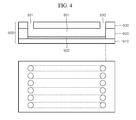
- FIG. 4 illustrates a chip for PCR installed in the chip holder of the PCR device according to an embodiment of the present invention.
- FIG. 5 illustrates a cross-section of the chip for PCR installed in the chip holder of the PCR device according to an embodiment of the present invention which is treated with a double-sided adhesive, thermoplastic resin, or thermosetting resin.
- FIG. 1 illustrates a PCR device 1 including two heating blocks according to an embodiment of the present invention.
- the PCR device 1 includes a first heating block 100 disposed on a substrate 400; a second heating block 200 disposed separate from the first heating block 100 on the substrate 400; and a chip holder 300 that is capable of being moved left-right and/or up-down by a driving means 500 over the first and second heating blocks 100 and 200, and is installed with a chip for PCR 900.
- the PCR device 1 is a device that is used in the PCR (Polymerase Chain Reaction) to amplify nucleic acid having a specific base sequence.
- a PCR device for amplification of DNA (deoxyribonucleic acid) having a specific base sequence performs three steps: denaturing, annealing, and extension, and the DNA having the specific base sequence may be exponentially amplified by repeating, for example, 20 to 40 cycles of the three steps: the denaturing step involves heating a sample solution including double-stranded DNA to a predetermined temperature, for example about 95 °C, to separate the double-stranded DNA into single-stranded DNA; the annealing step involves providing oligonucleotide primers having a sequence complementary to the specific base sequence to be amplified to the sample solution, cooling the separated single-stranded DNA along with the primers to a predetermined temperature, for example 55 °C, and thus binding the primers to a specific base sequence of the single-stranded DNA
- the PCR device may perform the annealing step and the extension (or amplification) step at the same time, and in this regard, the PCR may complete one cycle by performing a two-step process consisting of the annealing step and the annealing and extension (or amplification) step. Therefore, the PCR device 1 according to an embodiment of the present invention refers to a device including modules for performing the steps stated above, and the modules not stated herein in detail are assumed as if they are all included within the obvious scope disclosed in the prior art for performing PCR.
- the PCR device 1 includes the first heating block 100 disposed on the substrate 400 and the second heating block 200 disposed separate from the first heating block 100 on the substrate 400.
- the substrate 400 includes any material having physical and/or chemical properties that do not change due to heating or maintaining the temperature of the first heating block 100 and the second heating block 200 and via which heat exchange between the first heating block 100 and the second heating block 200 does not occur.
- the substrate 400 may include a material such as plastic or may be formed of such material.
- the first heating block 100 and the second heating block 200 are disposed to maintain a temperature for performing the denaturing, annealing, and extension (or amplification) steps to amplify nucleic acid.
- the first heating block 100 and the second heating block 200 may provide a necessary temperature required in each of the steps and may include various modules for maintaining the temperature or may be drivably connected to the modules.
- a sample solution in the chip for PCR 900 may be evenly heated and maintained at a desired temperature since the entire surface of the first heating block 100 or the second heating block 200 in contact with the chip for PCR 900 may be heated or maintained at a desired temperature.
- the PCR device 1 including the two heating blocks according to an embodiment of the present invention may significantly reduce a PCR time as a rate of temperature change of each of the first and second heating blocks 100 and 200 may be in a range of 20 to 40 °C per second.
- a heating wire may be disposed in each of the first and second heating blocks 100 and 200.
- the heating wire may be drivably connected to various heat sources to maintain a temperature for performing the denaturing, annealing, and extension (or amplification) steps or may be drivably connected to various temperature sensors to monitor a temperature of the heating wire.
- the heating wire may be disposed symmetrically in up-down and/or left-right directions based on a center of each surface of the first and second heating blocks 100 and 200 to evenly maintain an overall temperature inside the first and second heating blocks 100 and 200. An arrangement of the heating wire symmetrical in up-down and/or left-right directions may vary.
- thin film heaters (not shown) may be disposed inside the first or second heating block 100 or 200.
- the thin film heaters may be separately disposed with a regular distance in up-down and/or left-right directions based on a center of each surface of the first and second heating blocks 100 and 200 to evenly maintain an overall temperature inside the first and second heating blocks 100 and 200.
- a regular arrangement of the thin film heaters in up-down and/or left-right directions may vary.
- the first and second heating blocks 100 and 200 may include a metal material, for example, may include an aluminum material or may be formed of an aluminum material, for even heat distribution and rapid heat transfer to the same area.
- the first heating block 100 may be manufactured to maintain an appropriate temperature for performing the denaturing step, or the annealing and extension (or amplification) step.
- the first heating block 100 of the PCR device 1 may maintain a temperature from 50 to 100 °C, may maintain a temperature from 90 to 100 °C, preferably 95 °C, when the denaturing step is performed at the first heating block 100, or may maintain a temperature from 55 to about 75 °C, preferably 72 °C, when the annealing and extension (or amplification) step is performed at the first heating block.
- the temperature is not limited thereto as long as the denaturing step, or the annealing and extension (or amplification) step may be performed.
- the second heating block 200 may be manufactured to maintain an appropriate temperature for performing the denaturing step or the annealing and extension (or amplification) step.
- the second heating block 200 of the PCR device 1 may maintain a temperature from 90 to 100 °C, preferably 95 °C, when the denaturing step is performed at the second heating block 200, or may maintain a temperature from 55 to 75 °C, preferably 72 °C, when the annealing and extension (or amplification) step is performed at the second heating block 200.
- the temperature is not limited thereto as long as the denaturing step or the annealing and extension (or amplification) step may be performed.
- the first heating block 100 may maintain a denaturing temperature of PCR.
- a denaturing temperature is lower than 90 °C, the nucleic acid that forms a template for the PCR is denatured, yielding a decrease in efficiency of the PCR, thus a PCR efficiency may be decreased or the PCR may not occur.
- a denaturing temperature is higher than 100 °C, an enzyme used in the PCR may lose its activity, thus the denaturing temperature may be from 90 to 100 °C, preferably 95 °C.
- the second heating block 200 may maintain an annealing and extension (or amplification) temperature of PCR.
- the annealing and extension (or amplification) temperature When the annealing and extension (or amplification) temperature is lower than 55 °C, specificity of the PCR product may be decreased, and when the annealing and extension (or amplification) temperature is higher than 74 °C, a PCR efficiency may be decreased as an extension due to the primers may not occur, thus the annealing and extension (or amplification) temperature may be from 55 to 75 °C, preferably 72 °C.
- the first and second heating blocks 100 and 200 may be separately disposed at a predetermined distance so that heat exchange therebetween may not occur. Accordingly, since heat exchange between the first heating block 100 and second heating block 200 does not occur, accurate temperature control at the denaturing step and the annealing and extension (or amplification) step may be enabled in a nucleic acid amplification reaction which may be significantly affected by a slight temperature change.
- the PCR device 1 includes a chip holder 300 that is capable of being moved left-right and/or up-down by a driving means 500 over the first and second heating blocks 100 and 200, and is installed with a chip for PCR 900. Also, the chip for PCR 900 may be manufactured to contact a surface of the first heating block 100 or the second heating block 200 and to contain a sample solution including nucleic acid to be amplified.
- the chip for PCR 900 may contain a sample solution including nucleic acid, such as double-stranded DNA, oligonucleotide primers having a sequence complementary to a specific base sequence to be amplified, DNA polymerase, deoxyribonucleotide triphosphates (dNTP), or a PCR reaction buffer.
- the chip for PCR 900 may include an inlet unit (not shown) for introducing the sample solution, an outlet unit (not shown) for withdrawing the sample solution that completed the nucleic acid amplification reaction, and a reaction chamber (or channel) (not shown) where the nucleic acid amplification reaction of the sample solution is performed.
- the chip for PCR 900 When the chip for PCR 900 is in contact with the first and second heating block 100 and 200, heat of the first and second heating block 100 and 200 is transferred to the chip for PCR 900, and thus the sample solution included in the reaction chamber (or channel) of the chip for PCR 900 may be heated and maintained at a temperature.
- the chip for PCR 900 may have an overall planar shape, but is not limited thereto.
- an outer wall of the PCR chip 900 may have a shape and structure for the chip for PCR 900 to be fixed in an inner space of the chip holder 300 so that the chip for PCR 900 does not dissociate from the chip holder 300.
- a detailed description of the chip for PCR 900 will be described hereinafter with reference to FIGS. 4 and 5 .
- the chip holder 300 is a module for the chip for PCR 900 to be installed in the PCR device 1.
- an inner wall of the chip holder 300 may have a shape and structure for the chip for PCR 900 to be fixed on the outer wall of the chip for PCR 900 so that the chip for PCR 900 does not dissociate from the chip holder 300.
- the chip holder 300 may be drivably connected to the driving means 500. Also, the chip for PCR 900 may be detachable from the chip holder 300.
- the driving means 500 includes all means enabling the chip holder 300 installed with the chip for PCR 900 to move left-right and/or up-down over the first and second heating blocks 100 and 200. As the driving means 500 moves left-right, the chip holder 300 installed with the chip for PCR 900 may move back and forth between the first heating block 100 and second heating block 200, and as the driving means 500 moves up-down, the chip holder 300 installed with the chip for PCR 900 may be in contact with and be separated from the first and second heating block 100 and 200. As shown in FIG.
- the driving means 500 of the PCR device 1 includes a rail 510 that extends in the left-right direction and a connection member 520 that is disposed as to enable a sliding motion in the left-right direction via the rail 510 and enable a sliding motion in the up-down direction, wherein the chip holder 300 is disposed at an end of the connection member 520.
- the left-right and/or up-down movement of the driving means 500 may be controlled by a controlling means (not shown) drivably disposed inside or outside of the PCR device 1, and the controlling means may control the contact and separation between the chip holder 300 installed with the chip for PCR 900 for denaturing step and annealing and extension (or amplification) step of PCR and the first or second heating block 100 or 200.
- a controlling means (not shown) drivably disposed inside or outside of the PCR device 1
- the controlling means may control the contact and separation between the chip holder 300 installed with the chip for PCR 900 for denaturing step and annealing and extension (or amplification) step of PCR and the first or second heating block 100 or 200.
- FIG. 2 illustrates each step of the nucleic acid amplification reaction due to the movement of the chip holder of the PCR device according to an embodiment of the present invention.
- the nucleic acid amplification reaction due to the PCR device 1 has the following steps: First, a sample solution including nucleic acid, such as double-stranded DNA, oligonucleotide primers having a sequence complementary to a specific base sequence to be amplified, DNA polymerase, dNTP, or a PCR reaction buffer, is introduced to the chip for PCR 900, the chip for PCR 900 may be installed in the chip holder 300.
- the first heating block 100 may be heated up to a temperature for the denaturing step, for example 90 to 100 °C, and maintained at the temperature, preferably heated up to 95 °C and maintained at the temperature.
- the second heating block 200 may be heated up to a temperature for the annealing and extension (or amplification) step, for example 55 to 75 °C, and maintained at the temperature, preferably heated up to 72 °C and maintained at the temperature.
- connection member 520 of the driving means 500 may be controlled to move the chip for PCR 900 downward, thus the chip holder 300 installed with the chip for PCR 900 may be in contact with the first heating block 100 to perform a first denaturing step (step x) of PCR.
- connection member 520 of the driving means 500 may be controlled to move the chip for PCR 900 upward, thus the chip holder 300 installed with the chip for PCR 900 may be separated from the first heating block 100 to terminate the first denaturing step of PCR, the connection member 520 of the driving means 500 may be controlled to perform a step to move the chip for PCR 900 above the second heating block 200 (step y).
- connection member 520 of the driving means 500 may be controlled to move the chip for PCR 900 downward, thus the chip holder 300 installed with the chip for PCR 900 may be in contact with the second heating block 100 to perform the first annealing and extension (or amplification) step of PCR (step z).
- connection member 520 of the driving means 500 may be controlled to move the chip for PCR 900 upward, thus the chip holder 300 installed with the chip for PCR 900 may be separated from the second heating block 100 to terminate the first annealing and extension (or amplification) step of PCR, the connection member 520 of the driving means 500 may be controlled to move the chip for PCR 900 above the first heating block 100 and repeat the steps x, y, and z, thereby performing the nucleic acid amplification reaction (circulating step).
- FIG. 3 illustrates steps of monitoring the nucleic acid amplification reaction in real-time using the PCR device according to an embodiment of the present invention.
- a light source 700 is further interposed between the first and second heating blocks 100 and 200, and a light detection unit 800 for detecting the light emitted from the light source 700 is further disposed on the chip holder 300; or the light detection unit 800 for detecting the light emitted from the light source 700 is further interposed between the first and second heating blocks 100 and 200, and the light source 700 is further disposed on the chip holder 300.
- the light detection unit 800 may be disposed on the driving means 500, and a transmission unit 530 for transmitting the light emitted from the light source 700 may be disposed in the driving means 500.
- the chip for PCR 900 may be a light transmitting material, particularly a light transmitting plastic material. The detailed description of the chip for PCR 900 will be described hereinafter with reference to FIGS. 4 and 5 .
- a degree of the nucleic acid being amplified in the chip for PCR 900 may be detected in real time by disposing the light source 700 and the light detection unit 800.
- a separate fluorescent material may be further added to the sample solution that is introduced to the chip for PCR 900.
- the light source 700 is disposed to distribute over the separate space between the first and second heating blocks 100 and 200 as wide as possible and is disposed to emit possibly the same light.
- the light source 700 may be connected and disposed to be drivable with a lens (not shown) collecting the light emitted from the light source 700 and a light filter (not shown) filtering light at a range of particular wavelengths.
- steps of detecting the degree of the nucleic acid being amplified in the chip for PCR 900 in real time are as follows.
- the connection member 520 of the driving means 500 is controlled to move the chip for PCR 900 from above the first heating block 100 to above the second heating block 200 after completing the first denaturing step of the PCR, or when the connection member 520 of the driving means 500 is controlled to move the chip for PCR 900 from above the second heating block 200 to above the first heating block 100 after completing the first annealing and extension (or amplification) step of the PCR
- the connection member 520 of the driving means 500 is controlled to stop the chip holder 300 installed with the chip for PCR 900 in the separate space between the first and second heating blocks 100 and 200.
- the emitted light transmits through the chip for PCR 900 which is light transparent, particularly the reaction chamber (or channel) of the chip for PCR 900, and in this case, a light signal generated by amplification of the nucleic acid inside the reaction chamber (or channel) is detected by the detection unit 800.
- the light transmitted through the chip for PCR 900 which is light transparent may arrive at the detection unit 800 by transmitting through the driving means 500, particularly the transmission unit 530 disposed in the rail 510.
- an amount of target nucleic acid included in an initial reaction sample may be measured and analyzed in real time by monitoring the reaction results due to amplification of the nucleic acid (to which the fluorescent material is attached) in the reaction chamber (or channel) in real time while each of the circulation steps of the PCR proceeds.
- FIG. 4 illustrates the chip for PCR 900 that is installed in the chip holder 300 of the PCR device 1 according to an embodiment of the present invention.
- the chip for PCR 900 may contain a sample solution including nucleic acid, such as double-stranded DNA, oligonucleotide primers having a sequence complementary to a specific base sequence to be amplified, DNA polymerase, dNTP, or a PCR reaction buffer.
- the chip for PCR 900 may include an inlet unit 931 for introducing the sample solution, an outlet unit 932 for withdrawing the sample solution that completed the nucleic acid amplification reaction, and one or more reaction chambers (or channels) 921 in where the sample solution including nucleic acid to be amplified is contained.
- the chip for PCR 900 When the chip for PCR 900 is in contact with the first heating block 100 or second heating block 200, heat of the first heating block 100 or the second heating block 200 is transferred to the chip for PCR 900, and thus the sample solution included in the reaction chamber (or channel) of the chip for PCR 900 may be heated or cooled and maintained at a constant temperature. Also, the chip for PCR 900 may have an overall planar shape, but is not limited thereto. Moreover, the chip for PCR 900 installed in the chip holder 300 may be disposed in contact with the first or second heating block 100 or 200.
- a fact that the chip for PCR 900 is disposed on one surface of the first or second heating block 100 or 200 may indicate that the chip for PCR 900 installed in the chip holder 300 is disposed in contact with the first or second heating block 100 or 200.
- the chip for PCR 900 may be formed of a light transmitting material, preferably a light transmitting plastic material.
- a light transmitting material preferably a light transmitting plastic material.
- the chip for PCR 900 may include light transmitting properties as a whole, light may be directly irradiated while the chip for PCR 900 is disposed on one surface of the first or second heating block 100 or 200, thus amplification of nucleic acid and a degree of the amplification may be measured and analyzed in real time.
- a first plate 910 is disposed on a second plate 920. As the first plate 910 is disposed in contact with a lower surface of the second plate 920, a through opening channel 921 may form a type of PCR chamber. Also, the first plate 910 may be formed of various materials, preferably a material selected from the group consisting of polydimethylsiloxane (PDMS), cycle olefin copolymer (COC), polymethyl methacrylate (PMMA), polycarbonate (PC), polypropylene carbonate (PPC), polyether sulfone (PES), polyethylene terephthalate (PET), and a combination thereof.
- PDMS polydimethylsiloxane
- COC cycle olefin copolymer
- PMMA polymethyl methacrylate
- PC polycarbonate
- PPC polypropylene carbonate
- PES polyether sulfone
- PET polyethylene terephthalate
- a top surface of the first plate 910 is treated with a hydrophilic material 922 so that the PCR may be smoothly performed.
- a single layer including the hydrophilic material 922 may be formed on the first plate 910 due to the treatment the hydrophilic material 922.
- the hydrophilic material may be various materials, preferably a material selected from the group consisting of a carboxyl group (-COOH), amine group (-NH 2 ), hydroxyl group (-OH), and sulfone group (-SH), and the treatment the hydrophilic material 922 may be performed using a known method in the art.
- the second plate 920 is disposed on the first plate 910.
- the second plate 920 includes the through opening channel 921.
- the through opening channels 921 may be connected to a part corresponding to a through opening inlet unit 931 and a through opening outlet unit 932 and form a type of PCR chamber.
- PCR is performed after the sample solution to be amplified is introduced in the through opening channel 921.
- two or more through opening channels 921 may be used depending on a purpose of use and scope of the PCR device 1 according to an embodiment of the present invention. Referring to FIG. 4 , 6 through opening channels 921 are illustrated.
- the second plate 920 may be formed of various materials, preferably a thermoplastic resin or thermosetting resin material selected from the group consisting of polymethyl methacrylate (PMMA), polycarbonate (PC), cyclic olefin copolymer (COC), polyamide (PA), polyethylene (PE), polypropylene (PP), polyphenylene ether (PPE), polystyrene (PS), polyoxymethylene (POM), polyetheretherketone (PEEK), polytetrafluoroethylene (PTFE), polyvinylchloride (PVC), polyvinylidene fluoride (PVDF), polybutylene terephthalate (PBT), fluorinated ethylene propylene (FEP), perfluoro alkoxyalkane (PFA), and a combination thereof.
- PMMA polymethyl methacrylate
- PC polycarbonate
- COC cyclic olefin copolymer
- PA polyamide
- PE polyethylene
- PP polypropylene
- PPE
- a thickness of the second plate 920 may vary, and may be selected from 100 ⁇ m to 200 ⁇ m.
- a width and length of the through opening channel 921 may vary, preferably a width of the through opening channel 921 may be selected from 0.5 mm to 3 mm, and a length of the through opening channel 921 may be selected from 20 mm to 40 mm.
- an inner wall of the second plate 920 may be coated with a material such as silane-based material or bovine serum albumin (BSA), and the coating may be performed using a known method in the art.
- a material such as silane-based material or bovine serum albumin (BSA)
- the third plate 930 is disposed on the second plate 920.
- the third plate 930 includes a through opening inlet unit 931, which is formed with respect to a portion of the through opening channel 921 formed in the second plate 920, and a the through opening outlet unit 932, which is formed with respect to the other portion of the through opening channel 921.
- the through opening inlet unit 931 is a region where the sample solution including the nucleic acid to be amplified is introduced.
- the through opening outlet unit 932 is a region where the sample solution is withdrawn after completing the PCR.
- the third plate 930 covers the through opening channel 921 formed in the second plate 920 which will be described herein, and the through opening inlet unit 931 and the through opening outlet unit 932 serve as an inlet unit and an outlet unit of the through opening channels 921.
- the third plate 930 may be formed of various materials, preferably a material selected from the group consisting of polydimethylsiloxane (PDMS), cycle olefin copolymer (COC), polymethyl methacrylate (PMMA), polycarbonate (PC), polypropylene carbonate (PPC), polyether sulfone (PES), polyethylene terephthalate (PET), and a combination thereof.
- PDMS polydimethylsiloxane
- COC cycle olefin copolymer
- PMMA polymethyl methacrylate
- PC polycarbonate
- PPC polypropylene carbonate
- PES polyether sulfone
- PET polyethylene terephthalate
- a size of the through opening inlet unit 931 may vary, preferably a diameter of the through opening inlet unit 931 may be selected from 1.0 mm to 3.0 mm.
- a size of the through opening outlet unit 932 may vary, preferably a diameter of the through opening outlet unit 932 may be selected from 1.0 mm to 1.5 mm.
- the through opening inlet unit 931 and the through opening outlet unit 932 include separate cover means (not shown), and thus leakage of the sample solution while the PCR is being performed for the sample solution in the through opening channel 921 may be prevented.
- the cover means may be formed in various shapes, sizes, or materials.
- a thickness of the third plate may vary, preferably may be selected from 0.1 mm to 2.0 mm.
- two or more through opening inlet units 931 and through opening outlet units 932 may be used.
- FIG. 5 illustrates a cross-section of the chip for PCR 900 installed in the chip holder 300 of the PCR device according to an embodiment of the present invention which is treated with a double-sided adhesive, thermoplastic resin, or thermosetting resin.
- the chip for PCR 900 may be easily manufactured by a method including providing the third plate 930 by forming the through opening inlet unit 931 and the through opening outlet unit 932 through a mechanical process; providing the second plate 920 by forming the through opening channels 921 in a board having a size corresponding to the lower surface of the third plate 930 from the region corresponding to the through opening inlet unit 931 of the third plate 930 to the region corresponding to the through opening outlet unit 932 of the third plate 930 via a mechanical process; providing the first plate 910 by forming a surface treated with the hydrophilic material 922 through a surface treatment process on an upper surface of a board having a size corresponding to the lower surface of the second plate 920; and bonding the lower surface of the third plate 930 to the upper surface of the second plate 920 through a bonding process, and the lower surface of the second plate 920 to the upper surface of the first plate 910 through a bonding process.
- the through opening inlet unit 931 and the through opening outlet unit 932 of the third plate 930, and the through opening channel 921 of the second plate 920 may be formed by using a manufacturing method selected from the group consisting of injection molding, hot-embossing, casting, and laser ablation.
- the hydrophilic material 922 on the surface of the first plate 910 may be treated by a method selected from the group consisting of an oxygen-argon plasma treatment, corona discharge treatment, and surfactant coating, or a known method in the art.
- the lower surface of the third plate 930 and the upper surface of the second plate 920, and the lower surface of the second plate 920 and the upper surface of the first plate 910 may be bonded by using a thermal bonding, ultrasonic welding, or solvent bonding process, or by following a known method in the art.
- a double-sided tape, thermoplastic resin, or thermosetting resin 500 may be treated between the third plate 930 and the second plate 920, and between the second plate 920 and the third plate 910.
- a PCR device of another company which is commonly used and the PCR device according to an embodiment of the present invention shown in FIG. 3 were used to compare and analyze the results of performing a nucleic acid amplification reaction using each of the devices.
- the PCR device of another company was LightCycler 1.5 available from ROCHE Co., which is constructed of one heating block.
- a sample solution of a positive control and a sample solution of a negative control were each prepared.
- the sample solution of about 60 ⁇ l including 30 ⁇ l of 2X SYBR green buffer, 4.4 ⁇ l (50 ng/20 ⁇ l) of double-stranded template cDNA, pairs of primers complementarily binding to a specific base sequence, particularly 6 ⁇ l (1 pmole) of forward primers, 6 ⁇ l (1 pmole) of reverse primers, and 13.6 ⁇ l of distilled water was prepared, and for the negative control, the sample solution of about 60 ⁇ l including 30 ⁇ l of 2X SYBR green buffer and 30 ⁇ l of distilled water was prepared.
- a standard and size of the PCR device according to an embodiment of the present invention different from the PCR device of another company about 30 ⁇ l of the sample solutions were introduced to a chip of PCR is installed in the PCR device of another company, and about 5 ⁇ l of the sample solutions were introduced to a chip of PCR is installed in the PCR device according to an embodiment of the present invention.
- PCR device Under the experimental conditions state above, 20 cycles of PCR were first performed using the PCR device according to an embodiment of the present invention.
- a temperature of the first heating block was heated up and maintained at 95 °C, allowed to vary in a range of 90 to 100 °C, and a temperature of the second heating block was heated up and maintained at 72 °C, allowed to vary in a range of 55 to 75 °C.
- the sample solutions of the positive control and negative control were introduced to the chip for PCR, and the chip for PCR was installed in the chip holder of the PCR device. Then, the PCR device was operated.
- the denaturing step was performed for about 10 seconds, subsequently the annealing and extension (or amplification) step was performed for about 10 seconds, and a fluorescent detection value due to the nucleic acid amplification was measured after every cycle of each step.
- the fluorescent detection values showed an increase maintained curve after 5 minutes from the starting point of the PCR device operation.
- 20 cycles of PCR using the PCR device of another company were performed. As a result, 30 or more minutes were required to reach the fluorescent detection values achieved by the PCR device according to an embodiment of the present invention.
Landscapes
- Chemical & Material Sciences (AREA)
- Health & Medical Sciences (AREA)
- Life Sciences & Earth Sciences (AREA)
- Chemical Kinetics & Catalysis (AREA)
- Organic Chemistry (AREA)
- General Health & Medical Sciences (AREA)
- Engineering & Computer Science (AREA)
- Biochemistry (AREA)
- Wood Science & Technology (AREA)
- Zoology (AREA)
- Molecular Biology (AREA)
- Proteomics, Peptides & Aminoacids (AREA)
- Bioinformatics & Cheminformatics (AREA)
- Clinical Laboratory Science (AREA)
- Biotechnology (AREA)
- Microbiology (AREA)
- Genetics & Genomics (AREA)
- Analytical Chemistry (AREA)
- General Engineering & Computer Science (AREA)
- Physics & Mathematics (AREA)
- Biophysics (AREA)
- Immunology (AREA)
- Medicinal Chemistry (AREA)
- Biomedical Technology (AREA)
- Sustainable Development (AREA)
- Dispersion Chemistry (AREA)
- Hematology (AREA)
- Apparatus Associated With Microorganisms And Enzymes (AREA)
- Preparation Of Compounds By Using Micro-Organisms (AREA)
Applications Claiming Priority (3)
| Application Number | Priority Date | Filing Date | Title |
|---|---|---|---|
| KR20100037960 | 2010-04-23 | ||
| KR20110037352A KR101368463B1 (ko) | 2010-04-23 | 2011-04-21 | 2개의 열 블록을 포함하는 pcr 장치 |
| PCT/KR2011/002911 WO2011132977A2 (fr) | 2010-04-23 | 2011-04-22 | Dispositif de pcr comprenant deux blocs de colonne |
Publications (3)
| Publication Number | Publication Date |
|---|---|
| EP2562247A2 true EP2562247A2 (fr) | 2013-02-27 |
| EP2562247A4 EP2562247A4 (fr) | 2014-03-05 |
| EP2562247B1 EP2562247B1 (fr) | 2016-02-10 |
Family
ID=45032143
Family Applications (1)
| Application Number | Title | Priority Date | Filing Date |
|---|---|---|---|
| EP11772265.2A Active EP2562247B1 (fr) | 2010-04-23 | 2011-04-22 | Dispositif de pcr comprenant deux blocs de colonne |
Country Status (10)
| Country | Link |
|---|---|
| US (2) | US9061285B2 (fr) |
| EP (1) | EP2562247B1 (fr) |
| JP (1) | JP5661918B2 (fr) |
| KR (1) | KR101368463B1 (fr) |
| CN (1) | CN102985527B (fr) |
| DK (1) | DK2562247T3 (fr) |
| ES (1) | ES2563805T3 (fr) |
| HU (1) | HUE027355T2 (fr) |
| RS (1) | RS54641B1 (fr) |
| WO (1) | WO2011132977A2 (fr) |
Cited By (1)
| Publication number | Priority date | Publication date | Assignee | Title |
|---|---|---|---|---|
| EP3106510A4 (fr) * | 2014-02-10 | 2017-04-12 | Nanobiosys Inc. | Dispositif de pcr pourvu de moyen de coulissement unidirectionnels et méthode pcr l'utilisant |
Families Citing this family (33)
| Publication number | Priority date | Publication date | Assignee | Title |
|---|---|---|---|---|
| KR101456646B1 (ko) * | 2011-12-09 | 2014-11-03 | 나노바이오시스 주식회사 | 식중독균 검출용 키트 및 이를 이용한 식중독균 검출 방법 |
| KR101969076B1 (ko) * | 2012-02-01 | 2019-08-13 | 주식회사 미코바이오메드 | 광 노이즈 제거 수단이 구현된 실시간 pcr 칩 및 이를 포함하는 pcr 장치 |
| KR101404455B1 (ko) * | 2012-07-04 | 2014-06-10 | 나노바이오시스 주식회사 | 전기화학적 신호를 검출하기 위한 실시간 pcr 장치, 및 이를 이용한 실시간 pcr 방법 |
| KR102003784B1 (ko) * | 2012-10-19 | 2019-07-25 | 주식회사 미코바이오메드 | 마이크로 pcr 칩 및 이를 포함하는 실시간 pcr 장치 |
| KR102028381B1 (ko) * | 2012-12-27 | 2019-10-04 | 주식회사 미코바이오메드 | 식중독 검출용 프라이머 세트를 이용한 pcr 장치, 및 이를 이용한 식중독 검출 방법 |
| KR101427038B1 (ko) * | 2013-03-04 | 2014-08-06 | 이현영 | 핵산 증폭장치 |
| KR101483493B1 (ko) * | 2013-03-22 | 2015-01-19 | 나노바이오시스 주식회사 | 식중독 검출용 프라이머 세트, 이를 이용한 pcr 장치, 및 이를 이용한 식중독 검출 방법 |
| KR102078085B1 (ko) * | 2013-12-31 | 2020-02-17 | 주식회사 미코바이오메드 | 농식품의 식중독균 검출용 랩온어칩 기반의 초고속 실시간 pcr 장치, 및 이를 이용한 식중독 검출방법 |
| CN105316226A (zh) * | 2014-05-31 | 2016-02-10 | 捷普科技(上海)有限公司 | 升降机构及具备该升降机构的生物芯片检测装置 |
| KR101696259B1 (ko) * | 2014-07-23 | 2017-01-13 | 나노바이오시스 주식회사 | 멀티플렉스 pcr 칩 및 이를 포함하는 멀티플렉스 pcr 장치 |
| WO2016017832A1 (fr) * | 2014-07-30 | 2016-02-04 | 이현영 | Dispositif d'amplification de l'acide nucleique |
| KR102336308B1 (ko) * | 2014-12-26 | 2021-12-09 | 주식회사 미코바이오메드 | 반복 슬라이딩 구동 수단을 구비하는 pcr 장치 및 이를 이용하는 pcr 방법 |
| TW201641687A (zh) * | 2014-12-31 | 2016-12-01 | 卡尤迪生物科技(北京)有限公司 | 用于進行化學反應的設備和方法 |
| KR101724281B1 (ko) * | 2015-03-09 | 2017-04-10 | 나노바이오시스 주식회사 | 멀티플렉스 pcr 칩 및 이를 포함하는 멀티플렉스 pcr 장치 |
| KR101753644B1 (ko) | 2015-06-17 | 2017-07-04 | (주)옵토레인 | 리얼타임 피씨알모듈 및 그 제조방법 |
| US20190032114A1 (en) * | 2016-01-20 | 2019-01-31 | Triv Tech, Llc | Point-of-care nucleic acid amplification and detection |
| WO2017204512A1 (fr) * | 2016-05-25 | 2017-11-30 | 옵토레인 주식회사 | Module pcr |
| WO2017204513A1 (fr) * | 2016-05-25 | 2017-11-30 | 옵토레인 주식회사 | Module pcr et procédé d'inspection l'utilisant |
| WO2017213587A1 (fr) | 2016-06-10 | 2017-12-14 | Star Array Pte Ltd | Déplacement de blocs de chaleur pour l'amplification d'acides nucléiques |
| JP2018196365A (ja) * | 2017-05-25 | 2018-12-13 | パナソニックIpマネジメント株式会社 | 核酸増幅装置 |
| KR102246609B1 (ko) * | 2018-08-01 | 2021-04-30 | 주식회사 미코바이오메드 | 복수의 열 블록을 구비한 핵산 증폭 장치 |
| KR102219457B1 (ko) * | 2018-08-01 | 2021-02-24 | 주식회사 미코바이오메드 | 복수의 열 블록을 구비한 핵산 증폭 장치 |
| TWI679276B (zh) * | 2019-04-18 | 2019-12-11 | 奎克生技光電股份有限公司 | 增進傳熱均勻度及熱履歷一致性的熱循環儀裝置 |
| JP6652673B1 (ja) * | 2019-06-07 | 2020-02-26 | 日本板硝子株式会社 | 反応処理容器 |
| CN110564610B (zh) * | 2019-10-15 | 2024-08-23 | 杭州比芯诊断技术有限公司 | 一种双温区pcr扩增装置 |
| CN110724631B (zh) * | 2019-10-30 | 2021-01-19 | 宁波胤瑞生物医学仪器有限责任公司 | 一种核酸扩增仪加热控制装置 |
| KR102478830B1 (ko) * | 2020-07-14 | 2022-12-20 | 주식회사 미루시스템즈 | 서로 다른 온도범위로 구획화된 복수의 챔버를 포함하는 pcr 장치 |
| LU102014B1 (en) * | 2020-08-25 | 2022-02-25 | Toby Overmaat | Micro-Thermocycler |
| CN114181819B (zh) * | 2020-09-15 | 2024-04-12 | 中国科学院大连化学物理研究所 | 一种pcr检测装置 |
| CN112501013A (zh) * | 2020-12-28 | 2021-03-16 | 江苏汇先医药技术有限公司 | 一种加热装置可移动的pcr仪 |
| CN115079741A (zh) * | 2021-03-12 | 2022-09-20 | 中国科学院微电子研究所 | 微流体芯片温控装置 |
| KR102533022B1 (ko) * | 2021-05-27 | 2023-05-16 | 옴니시스템 주식회사 | 유전자 증폭장치의 온도 제어 장치 |
| JP2024519147A (ja) * | 2021-05-28 | 2024-05-08 | チンフン ワン | Pcr装置 |
Family Cites Families (29)
| Publication number | Priority date | Publication date | Assignee | Title |
|---|---|---|---|---|
| US9029A (en) * | 1852-06-15 | Saddle | ||
| US9005A (en) * | 1852-06-08 | Improvement in harvesters | ||
| US6716580B2 (en) * | 1990-06-11 | 2004-04-06 | Somalogic, Inc. | Method for the automated generation of nucleic acid ligands |
| FI915731A0 (fi) * | 1991-12-05 | 1991-12-05 | Derek Henry Potter | Foerfarande och anordning foer reglering av temperaturen i ett flertal prov. |
| JP3113446B2 (ja) * | 1993-03-26 | 2000-11-27 | 三洋電機株式会社 | インキュベータ |
| US5525300A (en) * | 1993-10-20 | 1996-06-11 | Stratagene | Thermal cycler including a temperature gradient block |
| EP1015116A1 (fr) | 1996-05-01 | 2000-07-05 | Visible Genetics Inc. | Procede et dispositif destines a la production de cycles thermiques et a l'automatisation de la preparation d'echantillons au moyen de ces cycles thermiques |
| EP0914608A1 (fr) * | 1996-05-09 | 1999-05-12 | 3-Dimensional Pharmaceuticals, Inc. | Procede d'analyse et appareil a changement thermique et a microplaque pour l'optimisation de la mise au point de ligands et de la chimie des proteines a variables multiples |
| US5985651A (en) * | 1996-06-17 | 1999-11-16 | The Board Of Trustees Of The Leland Stanford Junior University | Thermocycling apparatus and method |
| US20040043479A1 (en) * | 2000-12-11 | 2004-03-04 | Briscoe Cynthia G. | Multilayerd microfluidic devices for analyte reactions |
| JP2002306154A (ja) * | 2001-04-17 | 2002-10-22 | Hitachi Electronics Eng Co Ltd | Dna断片増幅装置 |
| US7442542B2 (en) * | 2003-03-24 | 2008-10-28 | Agency For Science, Technology And Research | Shallow multi-well plastic chip for thermal multiplexing |
| DE10325300A1 (de) * | 2003-06-04 | 2005-01-20 | Siemens Ag | Thermocycler |
| US7585663B2 (en) * | 2004-08-26 | 2009-09-08 | Applied Biosystems, Llc | Thermal device, system, and method, for fluid processing device |
| US20060153745A1 (en) * | 2005-01-11 | 2006-07-13 | Applera Corporation | Fluid processing device for oligonucleotide synthesis and analysis |
| EP1885839B1 (fr) * | 2005-04-26 | 2018-08-08 | Life Technologies Corporation | Systemes et procedes de detection multiple d'analytes |
| KR101091900B1 (ko) * | 2005-05-12 | 2011-12-08 | 삼성테크윈 주식회사 | Pcr 장치의 히터블록 |
| KR20060116984A (ko) * | 2005-05-12 | 2006-11-16 | 삼성테크윈 주식회사 | Dna를 증폭하는 히팅블록 장치 |
| CA2635268C (fr) * | 2006-01-18 | 2021-02-16 | Argos Therapeutics, Inc. | Systemes et procedes destines au traitement d'echantillons dans un receptacle ferme, et dispositifs associes |
| DK3088083T3 (en) * | 2006-03-24 | 2018-11-26 | Handylab Inc | Method of carrying out PCR down a multi-track cartridge |
| JPWO2008004695A1 (ja) | 2006-07-07 | 2009-12-10 | ユニバーサル・バイオ・リサーチ株式会社 | 反応容器及び反応装置 |
| KR20100019409A (ko) * | 2007-01-22 | 2010-02-18 | 웨이퍼젠, 인크. | 고효율 화학 반응을 위한 장치 및 방법 |
| WO2008126827A1 (fr) * | 2007-04-06 | 2008-10-23 | Universal Bio Research Co., Ltd. | Dispositif et procédé de régulation de la température |
| US8828712B2 (en) * | 2007-06-29 | 2014-09-09 | Toppan Printing Co., Ltd. | Genetic detection and determination apparatus and method, gene reactor, and incubator |
| CN101842159B (zh) * | 2007-08-09 | 2014-09-24 | 赛路拉公司 | 关联的多参数单细胞测定及残余生物材料回收的方法和装置 |
| JP5372418B2 (ja) | 2008-06-23 | 2013-12-18 | 株式会社日立ハイテクノロジーズ | 核酸分析装置,自動分析装置、及び分析方法 |
| KR101040489B1 (ko) | 2008-07-16 | 2011-06-09 | 연세대학교 산학협력단 | 실시간 모니터링이 가능한 pcr 장치 |
| CN101363001B (zh) * | 2008-08-22 | 2012-06-27 | 金银杏生物科技(北京)有限公司 | 滑动型传热媒介板块pcr仪 |
| CN101948741B (zh) | 2010-09-21 | 2014-02-05 | 东南大学 | 一种用于核酸测序的微流体基因芯片 |
-
2011
- 2011-04-21 KR KR20110037352A patent/KR101368463B1/ko active Active
- 2011-04-22 ES ES11772265.2T patent/ES2563805T3/es active Active
- 2011-04-22 HU HUE11772265A patent/HUE027355T2/en unknown
- 2011-04-22 US US13/642,877 patent/US9061285B2/en active Active
- 2011-04-22 JP JP2013506087A patent/JP5661918B2/ja active Active
- 2011-04-22 CN CN201180030821.4A patent/CN102985527B/zh not_active Expired - Fee Related
- 2011-04-22 RS RS20160194A patent/RS54641B1/sr unknown
- 2011-04-22 DK DK11772265.2T patent/DK2562247T3/en active
- 2011-04-22 WO PCT/KR2011/002911 patent/WO2011132977A2/fr not_active Ceased
- 2011-04-22 EP EP11772265.2A patent/EP2562247B1/fr active Active
-
2015
- 2015-05-18 US US14/714,701 patent/US9297040B2/en active Active
Cited By (3)
| Publication number | Priority date | Publication date | Assignee | Title |
|---|---|---|---|---|
| EP3106510A4 (fr) * | 2014-02-10 | 2017-04-12 | Nanobiosys Inc. | Dispositif de pcr pourvu de moyen de coulissement unidirectionnels et méthode pcr l'utilisant |
| RU2666925C1 (ru) * | 2014-02-10 | 2018-09-13 | Нанобайосис Инк. | Устройство для проведения полимеразной цепной реакции с однонаправленным раздвижным средством |
| US11084038B2 (en) | 2014-02-10 | 2021-08-10 | Nanobiosys Inc. | PCR device having unidirectional sliding means and method for PCR using same |
Also Published As
| Publication number | Publication date |
|---|---|
| WO2011132977A2 (fr) | 2011-10-27 |
| JP2013524808A (ja) | 2013-06-20 |
| CN102985527A (zh) | 2013-03-20 |
| US20130040377A1 (en) | 2013-02-14 |
| US9061285B2 (en) | 2015-06-23 |
| KR101368463B1 (ko) | 2014-03-03 |
| EP2562247B1 (fr) | 2016-02-10 |
| DK2562247T3 (en) | 2016-04-18 |
| RS54641B1 (sr) | 2016-08-31 |
| WO2011132977A3 (fr) | 2012-01-12 |
| US20150247188A1 (en) | 2015-09-03 |
| US9297040B2 (en) | 2016-03-29 |
| JP5661918B2 (ja) | 2015-01-28 |
| KR20110118572A (ko) | 2011-10-31 |
| CN102985527B (zh) | 2015-11-25 |
| ES2563805T3 (es) | 2016-03-16 |
| HUE027355T2 (en) | 2016-09-28 |
| EP2562247A4 (fr) | 2014-03-05 |
Similar Documents
| Publication | Publication Date | Title |
|---|---|---|
| EP2562247B1 (fr) | Dispositif de pcr comprenant deux blocs de colonne | |
| US9023639B2 (en) | Apparatus for amplifying nucleic acids | |
| EP3239288B1 (fr) | Appareil de pcr comprenant des moyens de coulissement | |
| CN105940097B (zh) | 具备单向滑动驱动工具的pcr装置及利用此的pcr方法 | |
| EP3173469B1 (fr) | Puce à pcr multiplexe et dispositif de pcr multiplexe | |
| KR20120139206A (ko) | 박막형 열 블록 및 박막형 pcr 칩을 포함하는 휴대용 실시간 pcr 장치 | |
| KR101835073B1 (ko) | 히터 유닛이 반복 배치된 열 블록을 포함하는 플루이딕 pcr 칩 및 이를 포함하는 pcr 장치 | |
| KR100758273B1 (ko) | 플라스틱 기반 미소 가열기 및 그 제조방법, 이를 이용한dna 증폭칩 및 그 제조방법 | |
| Kulkarni et al. | A review on recent advancements in chamber-based microfluidic PCR devices | |
| KR101404455B1 (ko) | 전기화학적 신호를 검출하기 위한 실시간 pcr 장치, 및 이를 이용한 실시간 pcr 방법 | |
| KR20120139205A (ko) | 히터 유닛이 반복 배치된 열 블록을 포함하는 플루이딕 pcr 장치 | |
| KR102510230B1 (ko) | 복수의 열 블록을 관통하는 반응 튜브를 포함하는 pcr 장치 | |
| US7398015B2 (en) | Apparatus for controlling fluid-heating using polymer disk | |
| WO2011122216A1 (fr) | Micropuce |
Legal Events
| Date | Code | Title | Description |
|---|---|---|---|
| PUAI | Public reference made under article 153(3) epc to a published international application that has entered the european phase |
Free format text: ORIGINAL CODE: 0009012 |
|
| 17P | Request for examination filed |
Effective date: 20121122 |
|
| AK | Designated contracting states |
Kind code of ref document: A2 Designated state(s): AL AT BE BG CH CY CZ DE DK EE ES FI FR GB GR HR HU IE IS IT LI LT LU LV MC MK MT NL NO PL PT RO RS SE SI SK SM TR |
|
| DAX | Request for extension of the european patent (deleted) | ||
| A4 | Supplementary search report drawn up and despatched |
Effective date: 20140203 |
|
| RIC1 | Information provided on ipc code assigned before grant |
Ipc: C12M 1/38 20060101AFI20140128BHEP Ipc: C12Q 1/68 20060101ALI20140128BHEP Ipc: C12N 15/11 20060101ALI20140128BHEP |
|
| 17Q | First examination report despatched |
Effective date: 20150428 |
|
| GRAP | Despatch of communication of intention to grant a patent |
Free format text: ORIGINAL CODE: EPIDOSNIGR1 |
|
| INTG | Intention to grant announced |
Effective date: 20150814 |
|
| GRAS | Grant fee paid |
Free format text: ORIGINAL CODE: EPIDOSNIGR3 |
|
| GRAA | (expected) grant |
Free format text: ORIGINAL CODE: 0009210 |
|
| AK | Designated contracting states |
Kind code of ref document: B1 Designated state(s): AL AT BE BG CH CY CZ DE DK EE ES FI FR GB GR HR HU IE IS IT LI LT LU LV MC MK MT NL NO PL PT RO RS SE SI SK SM TR |
|
| REG | Reference to a national code |
Ref country code: GB Ref legal event code: FG4D |
|
| REG | Reference to a national code |
Ref country code: AT Ref legal event code: REF Ref document number: 774671 Country of ref document: AT Kind code of ref document: T Effective date: 20160215 Ref country code: CH Ref legal event code: EP Ref country code: CH Ref legal event code: NV Representative=s name: ARNOLD AND SIEDSMA AG, CH |
|
| REG | Reference to a national code |
Ref country code: IE Ref legal event code: FG4D |
|
| REG | Reference to a national code |
Ref country code: SE Ref legal event code: TRGR |
|
| REG | Reference to a national code |
Ref country code: ES Ref legal event code: FG2A Ref document number: 2563805 Country of ref document: ES Kind code of ref document: T3 Effective date: 20160316 |
|
| REG | Reference to a national code |
Ref country code: DE Ref legal event code: R096 Ref document number: 602011023261 Country of ref document: DE |
|
| REG | Reference to a national code |
Ref country code: DK Ref legal event code: T3 Effective date: 20160414 |
|
| REG | Reference to a national code |
Ref country code: PT Ref legal event code: SC4A Free format text: AVAILABILITY OF NATIONAL TRANSLATION Effective date: 20160429 |
|
| REG | Reference to a national code |
Ref country code: FR Ref legal event code: PLFP Year of fee payment: 6 |
|
| REG | Reference to a national code |
Ref country code: LT Ref legal event code: MG4D |
|
| REG | Reference to a national code |
Ref country code: NL Ref legal event code: MP Effective date: 20160210 |
|
| REG | Reference to a national code |
Ref country code: AT Ref legal event code: MK05 Ref document number: 774671 Country of ref document: AT Kind code of ref document: T Effective date: 20160210 |
|
| PG25 | Lapsed in a contracting state [announced via postgrant information from national office to epo] |
Ref country code: HR Free format text: LAPSE BECAUSE OF FAILURE TO SUBMIT A TRANSLATION OF THE DESCRIPTION OR TO PAY THE FEE WITHIN THE PRESCRIBED TIME-LIMIT Effective date: 20160210 Ref country code: GR Free format text: LAPSE BECAUSE OF FAILURE TO SUBMIT A TRANSLATION OF THE DESCRIPTION OR TO PAY THE FEE WITHIN THE PRESCRIBED TIME-LIMIT Effective date: 20160511 Ref country code: NO Free format text: LAPSE BECAUSE OF FAILURE TO SUBMIT A TRANSLATION OF THE DESCRIPTION OR TO PAY THE FEE WITHIN THE PRESCRIBED TIME-LIMIT Effective date: 20160510 |
|
| PG25 | Lapsed in a contracting state [announced via postgrant information from national office to epo] |
Ref country code: LV Free format text: LAPSE BECAUSE OF FAILURE TO SUBMIT A TRANSLATION OF THE DESCRIPTION OR TO PAY THE FEE WITHIN THE PRESCRIBED TIME-LIMIT Effective date: 20160210 Ref country code: PL Free format text: LAPSE BECAUSE OF FAILURE TO SUBMIT A TRANSLATION OF THE DESCRIPTION OR TO PAY THE FEE WITHIN THE PRESCRIBED TIME-LIMIT Effective date: 20160210 Ref country code: IS Free format text: LAPSE BECAUSE OF FAILURE TO SUBMIT A TRANSLATION OF THE DESCRIPTION OR TO PAY THE FEE WITHIN THE PRESCRIBED TIME-LIMIT Effective date: 20160610 Ref country code: LT Free format text: LAPSE BECAUSE OF FAILURE TO SUBMIT A TRANSLATION OF THE DESCRIPTION OR TO PAY THE FEE WITHIN THE PRESCRIBED TIME-LIMIT Effective date: 20160210 Ref country code: AT Free format text: LAPSE BECAUSE OF FAILURE TO SUBMIT A TRANSLATION OF THE DESCRIPTION OR TO PAY THE FEE WITHIN THE PRESCRIBED TIME-LIMIT Effective date: 20160210 Ref country code: NL Free format text: LAPSE BECAUSE OF FAILURE TO SUBMIT A TRANSLATION OF THE DESCRIPTION OR TO PAY THE FEE WITHIN THE PRESCRIBED TIME-LIMIT Effective date: 20160210 Ref country code: BE Free format text: LAPSE BECAUSE OF NON-PAYMENT OF DUE FEES Effective date: 20160430 |
|
| REG | Reference to a national code |
Ref country code: HU Ref legal event code: AG4A Ref document number: E027355 Country of ref document: HU |
|
| PG25 | Lapsed in a contracting state [announced via postgrant information from national office to epo] |
Ref country code: EE Free format text: LAPSE BECAUSE OF FAILURE TO SUBMIT A TRANSLATION OF THE DESCRIPTION OR TO PAY THE FEE WITHIN THE PRESCRIBED TIME-LIMIT Effective date: 20160210 |
|
| REG | Reference to a national code |
Ref country code: DE Ref legal event code: R097 Ref document number: 602011023261 Country of ref document: DE |
|
| PG25 | Lapsed in a contracting state [announced via postgrant information from national office to epo] |
Ref country code: SM Free format text: LAPSE BECAUSE OF FAILURE TO SUBMIT A TRANSLATION OF THE DESCRIPTION OR TO PAY THE FEE WITHIN THE PRESCRIBED TIME-LIMIT Effective date: 20160210 Ref country code: CZ Free format text: LAPSE BECAUSE OF FAILURE TO SUBMIT A TRANSLATION OF THE DESCRIPTION OR TO PAY THE FEE WITHIN THE PRESCRIBED TIME-LIMIT Effective date: 20160210 Ref country code: SK Free format text: LAPSE BECAUSE OF FAILURE TO SUBMIT A TRANSLATION OF THE DESCRIPTION OR TO PAY THE FEE WITHIN THE PRESCRIBED TIME-LIMIT Effective date: 20160210 Ref country code: RO Free format text: LAPSE BECAUSE OF FAILURE TO SUBMIT A TRANSLATION OF THE DESCRIPTION OR TO PAY THE FEE WITHIN THE PRESCRIBED TIME-LIMIT Effective date: 20160210 |
|
| PLBE | No opposition filed within time limit |
Free format text: ORIGINAL CODE: 0009261 |
|
| STAA | Information on the status of an ep patent application or granted ep patent |
Free format text: STATUS: NO OPPOSITION FILED WITHIN TIME LIMIT |
|
| PG25 | Lapsed in a contracting state [announced via postgrant information from national office to epo] |
Ref country code: LU Free format text: LAPSE BECAUSE OF FAILURE TO SUBMIT A TRANSLATION OF THE DESCRIPTION OR TO PAY THE FEE WITHIN THE PRESCRIBED TIME-LIMIT Effective date: 20160422 Ref country code: BE Free format text: LAPSE BECAUSE OF FAILURE TO SUBMIT A TRANSLATION OF THE DESCRIPTION OR TO PAY THE FEE WITHIN THE PRESCRIBED TIME-LIMIT Effective date: 20160210 |
|
| 26N | No opposition filed |
Effective date: 20161111 |
|
| REG | Reference to a national code |
Ref country code: IE Ref legal event code: MM4A |
|
| PG25 | Lapsed in a contracting state [announced via postgrant information from national office to epo] |
Ref country code: SI Free format text: LAPSE BECAUSE OF FAILURE TO SUBMIT A TRANSLATION OF THE DESCRIPTION OR TO PAY THE FEE WITHIN THE PRESCRIBED TIME-LIMIT Effective date: 20160210 Ref country code: BG Free format text: LAPSE BECAUSE OF FAILURE TO SUBMIT A TRANSLATION OF THE DESCRIPTION OR TO PAY THE FEE WITHIN THE PRESCRIBED TIME-LIMIT Effective date: 20160510 |
|
| REG | Reference to a national code |
Ref country code: FR Ref legal event code: PLFP Year of fee payment: 7 |
|
| PG25 | Lapsed in a contracting state [announced via postgrant information from national office to epo] |
Ref country code: IE Free format text: LAPSE BECAUSE OF NON-PAYMENT OF DUE FEES Effective date: 20160422 |
|
| REG | Reference to a national code |
Ref country code: FR Ref legal event code: PLFP Year of fee payment: 8 |
|
| PG25 | Lapsed in a contracting state [announced via postgrant information from national office to epo] |
Ref country code: CY Free format text: LAPSE BECAUSE OF FAILURE TO SUBMIT A TRANSLATION OF THE DESCRIPTION OR TO PAY THE FEE WITHIN THE PRESCRIBED TIME-LIMIT Effective date: 20160210 |
|
| PG25 | Lapsed in a contracting state [announced via postgrant information from national office to epo] |
Ref country code: MT Free format text: LAPSE BECAUSE OF NON-PAYMENT OF DUE FEES Effective date: 20160430 Ref country code: MC Free format text: LAPSE BECAUSE OF FAILURE TO SUBMIT A TRANSLATION OF THE DESCRIPTION OR TO PAY THE FEE WITHIN THE PRESCRIBED TIME-LIMIT Effective date: 20160210 Ref country code: MK Free format text: LAPSE BECAUSE OF FAILURE TO SUBMIT A TRANSLATION OF THE DESCRIPTION OR TO PAY THE FEE WITHIN THE PRESCRIBED TIME-LIMIT Effective date: 20160210 |
|
| PG25 | Lapsed in a contracting state [announced via postgrant information from national office to epo] |
Ref country code: AL Free format text: LAPSE BECAUSE OF FAILURE TO SUBMIT A TRANSLATION OF THE DESCRIPTION OR TO PAY THE FEE WITHIN THE PRESCRIBED TIME-LIMIT Effective date: 20160210 |
|
| PGFP | Annual fee paid to national office [announced via postgrant information from national office to epo] |
Ref country code: GB Payment date: 20240314 Year of fee payment: 14 |
|
| PGFP | Annual fee paid to national office [announced via postgrant information from national office to epo] |
Ref country code: TR Payment date: 20240327 Year of fee payment: 14 Ref country code: SE Payment date: 20240326 Year of fee payment: 14 Ref country code: IT Payment date: 20240326 Year of fee payment: 14 Ref country code: FR Payment date: 20240321 Year of fee payment: 14 |
|
| PGFP | Annual fee paid to national office [announced via postgrant information from national office to epo] |
Ref country code: DE Payment date: 20240313 Year of fee payment: 14 |
|
| PGFP | Annual fee paid to national office [announced via postgrant information from national office to epo] |
Ref country code: DK Payment date: 20240411 Year of fee payment: 14 |
|
| PGFP | Annual fee paid to national office [announced via postgrant information from national office to epo] |
Ref country code: CH Payment date: 20240501 Year of fee payment: 14 Ref country code: RS Payment date: 20240403 Year of fee payment: 14 |
|
| PGFP | Annual fee paid to national office [announced via postgrant information from national office to epo] |
Ref country code: ES Payment date: 20240509 Year of fee payment: 14 |
|
| PGFP | Annual fee paid to national office [announced via postgrant information from national office to epo] |
Ref country code: FI Payment date: 20240412 Year of fee payment: 14 |
|
| PGFP | Annual fee paid to national office [announced via postgrant information from national office to epo] |
Ref country code: PT Payment date: 20240415 Year of fee payment: 14 |
|
| PGFP | Annual fee paid to national office [announced via postgrant information from national office to epo] |
Ref country code: HU Payment date: 20240410 Year of fee payment: 14 |
|
| REG | Reference to a national code |
Ref country code: DE Ref legal event code: R119 Ref document number: 602011023261 Country of ref document: DE |
|
| REG | Reference to a national code |
Ref country code: DK Ref legal event code: EBP Effective date: 20250430 |
|
| REG | Reference to a national code |
Ref country code: CH Ref legal event code: H13 Free format text: ST27 STATUS EVENT CODE: U-0-0-H10-H13 (AS PROVIDED BY THE NATIONAL OFFICE) Effective date: 20251125 |
|
| REG | Reference to a national code |
Ref country code: SE Ref legal event code: EUG |
|
| PG25 | Lapsed in a contracting state [announced via postgrant information from national office to epo] |
Ref country code: PT Free format text: LAPSE BECAUSE OF NON-PAYMENT OF DUE FEES Effective date: 20251022 |
|
| PG25 | Lapsed in a contracting state [announced via postgrant information from national office to epo] |
Ref country code: HU Free format text: LAPSE BECAUSE OF NON-PAYMENT OF DUE FEES Effective date: 20250423 |
|
| GBPC | Gb: european patent ceased through non-payment of renewal fee |
Effective date: 20250422 |
|
| PG25 | Lapsed in a contracting state [announced via postgrant information from national office to epo] |
Ref country code: DE Free format text: LAPSE BECAUSE OF NON-PAYMENT OF DUE FEES Effective date: 20251104 |
|
| PG25 | Lapsed in a contracting state [announced via postgrant information from national office to epo] |
Ref country code: GB Free format text: LAPSE BECAUSE OF NON-PAYMENT OF DUE FEES Effective date: 20250422 |
|
| PG25 | Lapsed in a contracting state [announced via postgrant information from national office to epo] |
Ref country code: FI Free format text: LAPSE BECAUSE OF NON-PAYMENT OF DUE FEES Effective date: 20250422 |
|
| PG25 | Lapsed in a contracting state [announced via postgrant information from national office to epo] |
Ref country code: FR Free format text: LAPSE BECAUSE OF NON-PAYMENT OF DUE FEES Effective date: 20250430 |
|
| PG25 | Lapsed in a contracting state [announced via postgrant information from national office to epo] |
Ref country code: CH Free format text: LAPSE BECAUSE OF NON-PAYMENT OF DUE FEES Effective date: 20250430 |
|
| PG25 | Lapsed in a contracting state [announced via postgrant information from national office to epo] |
Ref country code: SE Free format text: LAPSE BECAUSE OF NON-PAYMENT OF DUE FEES Effective date: 20250423 |
|
| PG25 | Lapsed in a contracting state [announced via postgrant information from national office to epo] |
Ref country code: RS Free format text: LAPSE BECAUSE OF NON-PAYMENT OF DUE FEES Effective date: 20250422 |
|
| PG25 | Lapsed in a contracting state [announced via postgrant information from national office to epo] |
Ref country code: DK Free format text: LAPSE BECAUSE OF NON-PAYMENT OF DUE FEES Effective date: 20250430 |
|
| PG25 | Lapsed in a contracting state [announced via postgrant information from national office to epo] |
Ref country code: IT Free format text: LAPSE BECAUSE OF NON-PAYMENT OF DUE FEES Effective date: 20250422 |