EP2562534A2 - Verfahren zur Analyse einer Kautschukverbindung mit Füllerpartikeln - Google Patents
Verfahren zur Analyse einer Kautschukverbindung mit Füllerpartikeln Download PDFInfo
- Publication number
- EP2562534A2 EP2562534A2 EP12175905A EP12175905A EP2562534A2 EP 2562534 A2 EP2562534 A2 EP 2562534A2 EP 12175905 A EP12175905 A EP 12175905A EP 12175905 A EP12175905 A EP 12175905A EP 2562534 A2 EP2562534 A2 EP 2562534A2
- Authority
- EP
- European Patent Office
- Prior art keywords
- rubber compound
- specimen
- stem
- finite element
- rubber
- Prior art date
- Legal status (The legal status is an assumption and is not a legal conclusion. Google has not performed a legal analysis and makes no representation as to the accuracy of the status listed.)
- Withdrawn
Links
Images








Classifications
-
- G—PHYSICS
- G01—MEASURING; TESTING
- G01N—INVESTIGATING OR ANALYSING MATERIALS BY DETERMINING THEIR CHEMICAL OR PHYSICAL PROPERTIES
- G01N23/00—Investigating or analysing materials by the use of wave or particle radiation, e.g. X-rays or neutrons, not covered by groups G01N3/00 – G01N17/00, G01N21/00 or G01N22/00
- G01N23/02—Investigating or analysing materials by the use of wave or particle radiation, e.g. X-rays or neutrons, not covered by groups G01N3/00 – G01N17/00, G01N21/00 or G01N22/00 by transmitting the radiation through the material
- G01N23/06—Investigating or analysing materials by the use of wave or particle radiation, e.g. X-rays or neutrons, not covered by groups G01N3/00 – G01N17/00, G01N21/00 or G01N22/00 by transmitting the radiation through the material and measuring the absorption
- G01N23/18—Investigating the presence of flaws defects or foreign matter
-
- G—PHYSICS
- G01—MEASURING; TESTING
- G01N—INVESTIGATING OR ANALYSING MATERIALS BY DETERMINING THEIR CHEMICAL OR PHYSICAL PROPERTIES
- G01N2223/00—Investigating materials by wave or particle radiation
- G01N2223/60—Specific applications or type of materials
- G01N2223/607—Specific applications or type of materials strain
Definitions
- the present invention relates to a method for analyzing rubber compound with filler particles, more particularly to a method in which the dispersion of filler particles can be clearly analyzed.
- rubber compounds used in rubber products e.g. tires and the like contain fillers, e.g. carbon black, silica and the like as reinforcing agents. It is generally known in the art that a dispersion of such filler particles in a rubber compound affects characteristics such as strength of the rubber compound. Therefore, it has been desired that the dispersion of filler particles in the rubber compound can be clearly analyzed.
- a method for analyzing rubber compound including a rubber component and filler particles comprises:
- the rubber component (a) can be, for example, natural rubber (NR), isoprene rubber (IR), butyl rubber (IIR), butadiene rubber (BR), styrene butadiene rubber (SBR), styrene isoprene butadiene rubber (SIBR), ethylene-propylene-diene rubber (EPDM), chloroprene rubber (CR), acrylonitrile butadiene rubber (NBR) and the like.
- NR natural rubber
- IR isoprene rubber
- IIR butyl rubber
- BR butadiene rubber
- SBR styrene butadiene rubber
- SIBR styrene isoprene butadiene rubber
- EPDM ethylene-propylene-diene rubber
- CR chloroprene rubber
- NBR acrylonitrile butadiene rubber
- the filler (b) can be carbon black, silica, clay, talc, magnesium carbonate, magnesium hydroxide and the like of course the rubber component (a) and filler (b) are not limited to these examples. Further, various additives, e.g. sulfur, vulcanization accelerator and the like may be added in the rubber compound (c). In this embodiment, a slice of the rubber compound with a constant thickness (t) is used as a specimen 5 (shown in Fig. 3 ).
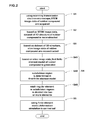
- FIG. 2 A flow chart implementing the analyzing method as an embodiment of the present invention is shown in Fig. 2 . This method comprises the following steps S1-S5.
- the scanning transmission electron microscope (STEM) 100 comprises: an electron gun 1 directed perpendicularly to a horizontal plane and capable of emitting electrons downward; a focusing lens 3 for focusing the electrons as an electron beam 2 on the specimen 5 of the rubber compound (c); scanning coils 4 including an X-direction scanning coil 4X and a Y-direction scanning coil 4Y for deflecting the electron beam 2 in the X-direction and Y-direction to scan the specimen 5; a specimen holder 6 for holding the specimen 5; and a specimen stage 9 on which the specimen holder 6 is detachably fixed.
- STEM scanning transmission electron microscope
- an electron beam pass-through hole 8 is formed along the central axis (o) of the scanning transmission electron microscope 100 so that transmission electrons 7 which penetrate through the specimen 5 can pass through the hole 8.
- an electron beam pass-through hole 10 is formed along the central axis (o) and continuously from the electron beam pass-through hole 8 so that the transmission electrons 7 can pass through the hole 10.
- the detector 20 for the transmission electrons 15 passing through the aperture 11.
- the detector 20 comprises a scintillator 13 and a photoelectron multiplier tube 14.
- the scintillator 13 reemits the energy of the incident electrons 12 passing though the aperture 11, in the form of light.
- the microscope 100 is used to acquire STEM images of the rubber compound (c) as follows. First, the specimen holder 6 with the specimen 5 is attached to the specimen stage 9 by an operating personnel.
- the outgoing electrons 7 travel through the holes 8 and 10 to the scattering angle limiting aperture 11 which allows the electrons having particular scattering angles to pass through it.
- the electrons 12 passing through the scattering angle limiting aperture 11 go into the scintillator 13, and thereby the energy of the incident electrons 12 is reemitted in the form of light. Then by the accompanying photoelectron multiplier tube 14, the light is converted to an electronic signal. The electrical signal is amplified and converted to digital data by an amplifier and A/D converter (not shown). The digital data are transmitted to a display (not shown) in which, according to the transmitted signal, brightness modulation is made, and an electron beam transmission image reflecting the internal structure of the specimen 5 is displayed as a STEM image, and at the same time, the digital data are stored in a memory of the computer. Thus, a plurality of STEM images corresponding to the scan positions are acquired as the STEM images' dataset.
- the intensity and scattering angle of the outgoing electrons 7 are varied depending on the internal state, thickness and/or atomic species of the specimen 5.
- the scattering angle is also varied by the accelerating voltage. For example, if the accelerating voltage is decreased, the electrons are scattered more in the specimen 5, and the scattering angle or outgoing angle from the lower surface of the specimen 5 with respect to the central axis (o) is increased.
- the camera length L1 namely the distance between the specimen 5 and the scintillator 13 is preferably set in a range of from 8 to 150 cm.
- the accelerating voltage for the electron beam may be set in a range of 100 to 3000 kv depending on the specimen 5.
- the STEM image acquiring step S1 in this embodiment a plurality of images of the rubber compound (c) are took from different angles with respect to the central axis (o) of the scanning transmission electron microscope 100.
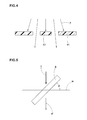
- the microscope 100 is provided with a specimen tilting device (not shown) to tilt the specimen 5 with respect to the central axis (o) with this, as shown in Fig. 5 , the specimen 5 can be held at different tilt angles ⁇ with respect to a horizontal plane H.
- the computer outputs a control signal to the specimen tilting device and according thereto the device tilts the specimen 5 at a specific angle ⁇ .
- variable range of the tilt angle ⁇ of the specimen 5 is -90 to +90 degrees, preferably -70 to +70 degrees. However, if the specimen is a round bar of the rubber compound, the variable range of the angle ⁇ may be -180 to +180 degrees.
- the specimen 5 is tilted at a measuring start angle ⁇ and in this tilted state, the STEM images or the dataset thereof are acquired as explained above. Then, until a measuring stop angle ⁇ , the process of changing the tilt angle of the specimen 5 and acquiring the dataset of the STEM images of the specimen 5 at that tilt angle are repeated at a step in a range of from 0.5 to 4 degrees, preferably 1 to 2 degrees in order to obtain the after-mentioned slice images clearly and efficiently.
- the measuring start angle ⁇ and measuring stop angle ⁇ can be arbitrarily set on the microscope by using a controller.
- the measuring start angle ⁇ is +70 degrees
- the measuring stop angle ⁇ is -70 degrees.
- the focal point F of the electron beam (e) is set in a thickness center region C of the specimen 5 as shown in Fig. 6(a) .
- the focal point F of the electron beam (e) when the focal point F of the electron beam (e) is set in the thickness center region C of the specimen 5 as shown in Fig. 6(a) , the range on the specimen 5 in which a clear image can be obtained becomes increased. It is desirable that the depth (f) of field can completely overlaps or encompass the thickness (t) of the specimen 5.
- the upper surface 5a and the lower surface 5b of the specimen 5 are perpendicular to the electron beam axis (namely, the incidence angle is equal to 90 deg.).
- the upper surface 5a and the lower surface 5b of the specimen 5 are inclined with respect to the electron beam axis (namely, the incidence angle is not equal to 90 deg.). Under such inclined state, the thickness of the specimen 5 measured along the electron beam axis is referred to as apparent thickness (t') in contrast to the real thickness (t) measured perpendicularly to the upper surface 5a.
- ⁇ is the tilt angle of the specimen 5 with respect to the horizontal plane, as shown in Fig. 6(b) .
- the central region C within which the focal point F is set ranges 30 %, preferably 20 %, more preferably 10 % of the real/apparent thickness.
- the central region C may be off-centered, but preferably it is centered on the center of the real/apparent thickness.
- the real thickness (t) may be less than 200 nm as usual, but it is preferably set in a range of from 200 to 1500 nm, more preferably 500 to 1000 nm.
- the focal point F is adjusted by the focusing lens 3 and/or specimen stage 9 by the use of a focal point adjuster of the microscope system 100.
- a three-dimensional structure of the rubber compound is reconstructed as numerical data (hereinafter the "3D dataset") by executing a tomographic method with the computer, and the 3D dataset is stored in a memory of the computer.
- those acquired by changing the tilt angle of the specimen 5 as explained above can be preferably used. But, it is also possible to use those acquired by not changing the tilt angle, namely acquired at a single tilt angle of the specimen 5 preferably zero degree with respect to the horizontal plane.
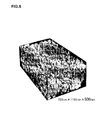
- Fig. 8 shows such created image which is a perspective view of the filler particles dispersed in the rubber compound.
- slice images of the rubber compound (c) taken along predetermined sections of the rubber compound (c) are reconstructed by the computer as numerical data (herein after the "slice image dataset"), and the slice image dataset is stored in a memory of the computer.
- the above-mentioned predetermined sections of the rubber compound can be arbitrarily determined according to the coordinate system (Cartesian or polar or cylindrical) employed in the subsequent step S4.
- Step S4 a finite element model of the rubber compound (c) is generated based on the slice image of the rubber compound (c).
- Step S4 further comprises a first step S41, a second step S42 and a third step S43.
- a first finite element model 5a of the rubber compound is set using only regular elements each with the same shape, as shown in Fig. 9(a) .
- the slice image is subjected to an image processing to divide the entire region of the slice image into a domain of the rubber component (a), a domain of the filler particle (b) and/or a domain of other component if any.
- the image processing method a known method can be used in which, based on threshold levels of gray level, micro regions of the slice image are each identified whether it is a rubber domain or a filler domain (or other domain if any).
- At least one slice image including at least two domains of the rubber component (a) and filler particles (b) is divided by using only regular elements eb each with the same shape, to generate a first finite element model of the rubber compound (c).
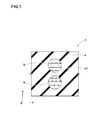
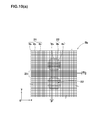
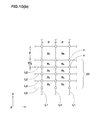
- Fig. 9(a) shows a small part of the first finite element model 5a taken along a corresponding slice image of a simplified example of the rubber compound (c), and Fig. 9(b) shows a closeup thereof.
- each regular element eb is defined as a mesh on a regular grid with boundary GD (L1 and L2) at even pitches P in the x-axis direction, y-axis direction.
- each regular element eb has a square shape with four node points (n) which are located on intersections between lines L1 and L2.
- the first finite element model 5a of the rubber compound comprises a domain 21 of the rubber component and a plurality of domains 22 of the filler particles.
- shadowed areas indicate the filler particle domains 22.
- the filler particle is discretized into a finite number of regular elements eb.
- the rubber component is also discretized into a finite number of regular elements eb.
- the regular grid is defined and superimposed onto the image-processed slice image or images, and for each regular element eb of the grid, it is computed which one of the rubber component and filler particle has the highest proportion of area or volume in the concerned regular element eb. Then, the regular element eb is defined as being one with the highest proportion. Namely, the computer determines whether each regular element eb belongs to the rubber component or the filler particle.
- each regular element eb is defined on each regular element eb, which is required for simulations or numerical analysis conducted by the use of a numerical analysis method, e.g. a finite element method or the like.
- Such information includes at least indexes and coordinate values of node points (n) of each regular element eb.
- material characteristics material properties of the part of the rubber compound which part is represented by the concerned element are defined.
- material constants material constants corresponding to physical properties of the rubber component or filler are defined and stored in a memory of the computer as numerical data.
- a subdivisional region 23 is determined in the first finite element model 5a at least partially.
- the subdivisional region 23 is a region where small elements smaller than regular elements should be employed to make it possible to research the deformation behavior thereof in more detail. By using the subdivisional region 23 in the first finite element model 5a at least partially, accurate computation results may be obtained therefrom. In view of above, the subdivisional region 23 is preferably determined on the location where accurate computation results are required.
- the subdivisional region 23 is determined as the region including the rubber part b1 at least partially.
- the scope of the subdivisional region 23 may be designated by an operating personnel using input devices such as the keyboards or the mouse. In order to identify which regular elements have been designated for the subdivisional region, information is added to the memory in the computer 1.
- subdivisional region 23 may be determined as follows:
- each regular element included in the subdivisional region 23 is divided into two or more elements to generate the finite element model 5b (shown in Fig. 10(a) ) of the rubber compound is carried out.
- pitches P of longitudinal lines L1 and/or lateral lines L2 on the regular grid passing through the subdivisional region 23 are changed so that each regular element eb included in the subdivisional region 23 changes small.
- pitches of the lateral lines L2 passing through the subdivisional region 23 is changed into a half of initial pitch given as the first finite element model 5a of the rubber compound (c), although the pitches of the longitudinal lines L1 is not changed, in this embodiment with this, each regular element eb of the rubber domain 21 between the filler domains 22 is divided into two equal elements as to the y-axis direction. Namely, each regular elements eb in the subdivisional region 23 is divided into the small element es which is a rectangular shape with the same length of x-axis direction and a half length of y-axis compared to the initial regular element eb.
- ratios for changing the initial pitch P between lines L1 and/or L2 of the regular grid can be employed to make the small elements es in the subdivisional region 23, the ratio is not limited as 0.5. Moreover, the subdividing process may be repeated frequently until necessary resolution for the subdivisional region 23 is obtained.
- step S5 using the finite element model 5b of the rubber compound, a simulation of deformation of the rubber compound is carried out under given conditions.
- a known method e.g. homogeneization method (asymptotic expansion homogeneization method) or the like can be employed.
- a two-dimensional finite element model 5b can be generated using one slice image.
- a three-dimensional finite element model 5c can be generated Using a plurality of slice images.
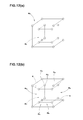
- rectangular solid elements may be employed as the regular elements eb.
- the subdividing process to the three-dimensional finite element model 5c may be done as follows:
- a small element es of a rectangular solid shape smaller than the regular element eb is defined within each regular element eb of a rectangular solid shape in the subdivisional region 23 so that each center of gravities thereof coincides each other:
- each node point ns of the small elements eb is associated with each corresponding node point nb of the regular elements es using a beam (s).
- the regular elements eb is divided into one small center element es having the rectangular solid shape, and six elements (ea) having quadrangular pyramid shapes surrounding the center element es.
- SBR Suditomo Chemical Company, Limited: SBR1502
- vulcanization accelerator A (Ouchi Shinko Chemical Industrial Co., Ltd.: NOCCELER NS)
- the materials except for the sulfur and vulcanization accelerators were kneaded for four minutes at 160 degrees C. Then, the kneaded materials to which the sulfur and vulcanization accelerators were added was further kneaded by the use of a open roll kneader for two minutes at 100 degrees C, and a raw rubber compound was prepared. The raw rubber compound was vulcanized for thirty minutes at 175 degrees C.
- the vulcanized rubber was sliced by using the ultramicrotome, and a specimen with a thickness of 500 nm was prepared.
- STEM images of the specimen were acquired by changing the tilt angle of the specimen from -60 to +60 degrees at a step of 1 degree, wherein, in the case of test condition 1, the focal point was set at the thickness center of the specimen, and in the case of test condition 2, the focal point was set at the upper surface of the specimen.
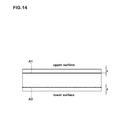
- Fig. 13 shows slice images at the upper position A1 and lower position A2 of each of three-dimensional structures created from the 3D dataset.
- the upper and lower positions A1 and A2 are at 40 nm from the upper and lower surfaces, respectively, as shown in Fig. 14 .
- the image at the lower position became unclear.
- the image at the lower position as well as the image at the upper position became clear.
- the above-mentioned perspective view shown in Fig. 8 was created from the 3D dataset obtained under the test condition 1.
- Example 1 was defined using only regular elements each having square shape.
- Example 2 was defined using regular elements having square shape, and small elements which were defined between a pair of filler particle domains. Each small element had a length of y-axis direction being a half of that of the regular element, and a length of x-axis direction being the same of the regular element.
- the simulation results are shown in Fig. 15 together with the actual measurements obtained from the rubber compound. As shown in Fig. 15 , the simulation result according to Example 2 has a high correlation with the actual measurements.
Landscapes
- Physics & Mathematics (AREA)
- Health & Medical Sciences (AREA)
- Life Sciences & Earth Sciences (AREA)
- Chemical & Material Sciences (AREA)
- Analytical Chemistry (AREA)
- Biochemistry (AREA)
- General Health & Medical Sciences (AREA)
- General Physics & Mathematics (AREA)
- Immunology (AREA)
- Pathology (AREA)
- Analysing Materials By The Use Of Radiation (AREA)
Applications Claiming Priority (3)
| Application Number | Priority Date | Filing Date | Title |
|---|---|---|---|
| JP2011181812A JP2013044607A (ja) | 2011-08-23 | 2011-08-23 | ゴム材料の観察方法 |
| JP2011193098A JP2013054578A (ja) | 2011-09-05 | 2011-09-05 | ゴム材料のシミュレーション方法 |
| JP2011200983A JP5767541B2 (ja) | 2011-09-14 | 2011-09-14 | ゴム材料のシミュレーション方法 |
Publications (2)
| Publication Number | Publication Date |
|---|---|
| EP2562534A2 true EP2562534A2 (de) | 2013-02-27 |
| EP2562534A3 EP2562534A3 (de) | 2014-05-21 |
Family
ID=46466345
Family Applications (1)
| Application Number | Title | Priority Date | Filing Date |
|---|---|---|---|
| EP12175905.4A Withdrawn EP2562534A3 (de) | 2011-08-23 | 2012-07-11 | Verfahren zur Analyse einer Kautschukverbindung mit Füllerpartikeln |
Country Status (3)
| Country | Link |
|---|---|
| US (1) | US20130051656A1 (de) |
| EP (1) | EP2562534A3 (de) |
| CN (1) | CN102954975A (de) |
Families Citing this family (8)
| Publication number | Priority date | Publication date | Assignee | Title |
|---|---|---|---|---|
| JP5395864B2 (ja) * | 2011-09-14 | 2014-01-22 | 住友ゴム工業株式会社 | ゴム材料のシミュレーション方法 |
| JP6239246B2 (ja) * | 2013-03-13 | 2017-11-29 | 株式会社日立ハイテクノロジーズ | 荷電粒子線装置、試料観察方法、試料台、観察システム、および発光部材 |
| JP5913260B2 (ja) * | 2013-11-14 | 2016-04-27 | 住友ゴム工業株式会社 | 高分子材料のシミュレーション方法 |
| EP2882203A1 (de) | 2013-12-06 | 2015-06-10 | Oticon A/s | Hörgerätevorrichtung für freihändige Kommunikation |
| CN105419003B (zh) * | 2015-12-25 | 2017-08-11 | 贵州大学 | 快速监测胶乳共沉法制备nr/cb复合材料共沉行为的方法 |
| CN107505480B (zh) * | 2017-08-16 | 2020-05-08 | 四川理工学院 | 一种检测橡胶复合物材料中填料分散性的方法 |
| CN109916941B (zh) * | 2019-03-25 | 2021-04-30 | 苏州大学 | 一种预混合粉末3d打印分离检测方法 |
| CN114923752B (zh) * | 2022-05-17 | 2025-05-06 | 中国电子产品可靠性与环境试验研究所((工业和信息化部电子第五研究所)(中国赛宝实验室)) | 一种有机硅胶粘剂填料的鉴别方法 |
Family Cites Families (12)
| Publication number | Priority date | Publication date | Assignee | Title |
|---|---|---|---|---|
| US6458883B1 (en) * | 1999-01-14 | 2002-10-01 | Jsr Corporation | Conductive rubber composition and manufacturing method and conductive rubber member thereof |
| US7907765B2 (en) * | 2001-03-28 | 2011-03-15 | University Of Washington | Focal plane tracking for optical microtomography |
| JP3995926B2 (ja) * | 2001-09-18 | 2007-10-24 | 株式会社富士通長野システムエンジニアリング | 構造解析プログラム、構造解析方法、構造解析装置および半導体集積回路の製造方法 |
| EP1548063A4 (de) * | 2002-10-03 | 2008-10-08 | Sekisui Chemical Co Ltd | Thermoplastisches gesättigtes harz auf norbornenbasis enthaltende folie und verfahren zur herstellung der thermoplastisches gesättigtes harz auf norbornenbasis enthaltenden folie |
| EP2063450A1 (de) * | 2007-11-21 | 2009-05-27 | FEI Company | Verfahren zum Erhalten eines Rastertransmissionsbildes einer Probe in einer teilchenoptischen Vorrichtung |
| JP5324820B2 (ja) * | 2008-05-19 | 2013-10-23 | 住友ゴム工業株式会社 | 解析モデルの作成方法 |
| JP2010091330A (ja) * | 2008-10-06 | 2010-04-22 | Sumitomo Chemical Co Ltd | 配向関数の解析方法及び解析システム |
| JP4603082B2 (ja) * | 2009-02-03 | 2010-12-22 | 株式会社ブリヂストン | ゴム材料の変形挙動予測装置及びゴム材料の変形挙動予測方法 |
| JP2010181342A (ja) * | 2009-02-06 | 2010-08-19 | Bridgestone Corp | ゴム材料の変形挙動予測装置及びゴム材料の変形挙動予測方法 |
| CN101672810B (zh) * | 2009-09-14 | 2011-06-08 | 哈尔滨飞机工业集团有限责任公司 | 橡胶材料成份均匀性分析方法 |
| JP5269732B2 (ja) * | 2009-09-28 | 2013-08-21 | 株式会社ブリヂストン | ゴム材料の変形挙動予測方法およびそれに用いられる装置 |
| JP5767477B2 (ja) * | 2011-01-14 | 2015-08-19 | 住友ゴム工業株式会社 | ゴム材料の観察方法 |
-
2012
- 2012-07-11 EP EP12175905.4A patent/EP2562534A3/de not_active Withdrawn
- 2012-07-11 US US13/546,183 patent/US20130051656A1/en not_active Abandoned
- 2012-07-18 CN CN2012102494115A patent/CN102954975A/zh active Pending
Non-Patent Citations (1)
| Title |
|---|
| None |
Also Published As
| Publication number | Publication date |
|---|---|
| US20130051656A1 (en) | 2013-02-28 |
| EP2562534A3 (de) | 2014-05-21 |
| CN102954975A (zh) | 2013-03-06 |
Similar Documents
| Publication | Publication Date | Title |
|---|---|---|
| EP2562534A2 (de) | Verfahren zur Analyse einer Kautschukverbindung mit Füllerpartikeln | |
| US20140324401A1 (en) | Method for simulating rubber material | |
| US7024032B2 (en) | Method for assessing fit and alignment of a manufactured part | |
| EP2568284A2 (de) | Verfahren zur Simulation der Verformung einer Gummiverbindung mit Füllpartikeln | |
| JP2017167002A (ja) | 構造物評価装置、構造物評価システム及び構造物評価方法 | |
| WO2020175654A1 (ja) | 非破壊検査システム及び非破壊検査方法 | |
| EP2570808B1 (de) | Verfahren zur Simulation der Verformung einer Kautschukverbindung | |
| EP3982115A1 (de) | Streuungskorrektur für computertomographische bildgebung | |
| JP5187810B2 (ja) | 膜厚測定方法及び試料作製方法、並びに、膜厚測定装置及び試料作製装置 | |
| JP2013054578A (ja) | ゴム材料のシミュレーション方法 | |
| US20160283624A1 (en) | Simulation method for polymer material | |
| JP5767541B2 (ja) | ゴム材料のシミュレーション方法 | |
| US10690593B2 (en) | Sample analyzer and recording medium recording sample analysis program | |
| DE102019201069A1 (de) | Verfahren zum Ermitteln einer Prüflingsorientierung für eine 2D-Röntgenanlage | |
| EP3982116A1 (de) | Streuungskorrektur für computertomographische bildgebung | |
| Lin et al. | A new method to measure pore radius distribution of powders | |
| JP6904890B2 (ja) | 破壊原因の推定方法および推定システム、並びに応力レベルの推定方法および推定システム | |
| Abdelrehim | Development of a Creep Cavitation-Based Model Incorporating Partial Coalescence for Lifetime Prediction. | |
| JP2021081338A (ja) | ゴム材料の変形解析方法 | |
| WO2018172267A1 (de) | Verfahren und vorrichtung zur bestimmung von mindestens zwei durchstrahlungspositionen | |
| Henschel et al. | „Application of focal curves for X-Ray microdiffraction methods “ | |
| Tillotson | Assessing Lamellae Thickness During Fib Milling with Monte Carlo Modelling | |
| WO2025258055A1 (ja) | 内部形状評価システムおよび内部形状評価方法 | |
| JP2024156329A (ja) | ゴムと金属との化合物の結晶粒の組成および構造の特定方法 | |
| Postek et al. | Nanomanufacturing concerns about measurements made in the SEM I: imaging and its measurement |
Legal Events
| Date | Code | Title | Description |
|---|---|---|---|
| PUAI | Public reference made under article 153(3) epc to a published international application that has entered the european phase |
Free format text: ORIGINAL CODE: 0009012 |
|
| AK | Designated contracting states |
Kind code of ref document: A2 Designated state(s): AL AT BE BG CH CY CZ DE DK EE ES FI FR GB GR HR HU IE IS IT LI LT LU LV MC MK MT NL NO PL PT RO RS SE SI SK SM TR |
|
| AX | Request for extension of the european patent |
Extension state: BA ME |
|
| PUAL | Search report despatched |
Free format text: ORIGINAL CODE: 0009013 |
|
| RIC1 | Information provided on ipc code assigned before grant |
Ipc: G01N 23/18 20060101AFI20140410BHEP |
|
| AK | Designated contracting states |
Kind code of ref document: A3 Designated state(s): AL AT BE BG CH CY CZ DE DK EE ES FI FR GB GR HR HU IE IS IT LI LT LU LV MC MK MT NL NO PL PT RO RS SE SI SK SM TR |
|
| AX | Request for extension of the european patent |
Extension state: BA ME |
|
| STAA | Information on the status of an ep patent application or granted ep patent |
Free format text: STATUS: THE APPLICATION IS DEEMED TO BE WITHDRAWN |
|
| 18D | Application deemed to be withdrawn |
Effective date: 20141122 |