EP2562980A1 - Method and apparatus for secure communications and resource sharing between anonymous non-trusting parties with no central administration - Google Patents
Method and apparatus for secure communications and resource sharing between anonymous non-trusting parties with no central administration Download PDFInfo
- Publication number
- EP2562980A1 EP2562980A1 EP12180918A EP12180918A EP2562980A1 EP 2562980 A1 EP2562980 A1 EP 2562980A1 EP 12180918 A EP12180918 A EP 12180918A EP 12180918 A EP12180918 A EP 12180918A EP 2562980 A1 EP2562980 A1 EP 2562980A1
- Authority
- EP
- European Patent Office
- Prior art keywords
- computing device
- node
- identity
- document
- network
- Prior art date
- Legal status (The legal status is an assumption and is not a legal conclusion. Google has not performed a legal analysis and makes no representation as to the accuracy of the status listed.)
- Withdrawn
Links
- 238000000034 method Methods 0.000 title claims abstract description 58
- 238000004891 communication Methods 0.000 title claims abstract description 28
- 230000004044 response Effects 0.000 claims description 7
- 230000007246 mechanism Effects 0.000 description 40
- 230000006870 function Effects 0.000 description 22
- 230000008569 process Effects 0.000 description 21
- 238000012546 transfer Methods 0.000 description 19
- 230000036961 partial effect Effects 0.000 description 15
- 238000003860 storage Methods 0.000 description 14
- 230000000977 initiatory effect Effects 0.000 description 7
- 238000010276 construction Methods 0.000 description 6
- 230000005540 biological transmission Effects 0.000 description 5
- 230000015556 catabolic process Effects 0.000 description 4
- 238000013468 resource allocation Methods 0.000 description 4
- 230000002776 aggregation Effects 0.000 description 3
- 238000004220 aggregation Methods 0.000 description 3
- 238000013475 authorization Methods 0.000 description 3
- 238000006243 chemical reaction Methods 0.000 description 3
- 230000001419 dependent effect Effects 0.000 description 3
- 230000000694 effects Effects 0.000 description 3
- 238000007726 management method Methods 0.000 description 3
- 238000005259 measurement Methods 0.000 description 3
- 230000004048 modification Effects 0.000 description 3
- 238000012986 modification Methods 0.000 description 3
- 230000008520 organization Effects 0.000 description 3
- 238000012795 verification Methods 0.000 description 3
- 238000006424 Flood reaction Methods 0.000 description 2
- 230000001186 cumulative effect Effects 0.000 description 2
- 230000006378 damage Effects 0.000 description 2
- 238000009826 distribution Methods 0.000 description 2
- 238000009432 framing Methods 0.000 description 2
- 235000003642 hunger Nutrition 0.000 description 2
- 230000000644 propagated effect Effects 0.000 description 2
- 238000002922 simulated annealing Methods 0.000 description 2
- 238000004513 sizing Methods 0.000 description 2
- 238000012360 testing method Methods 0.000 description 2
- 235000008694 Humulus lupulus Nutrition 0.000 description 1
- 238000000137 annealing Methods 0.000 description 1
- 230000008901 benefit Effects 0.000 description 1
- 230000008859 change Effects 0.000 description 1
- 230000000295 complement effect Effects 0.000 description 1
- 230000001010 compromised effect Effects 0.000 description 1
- 238000012790 confirmation Methods 0.000 description 1
- 230000007123 defense Effects 0.000 description 1
- 238000013461 design Methods 0.000 description 1
- 230000001066 destructive effect Effects 0.000 description 1
- 238000001514 detection method Methods 0.000 description 1
- 238000005538 encapsulation Methods 0.000 description 1
- 238000005516 engineering process Methods 0.000 description 1
- 238000011156 evaluation Methods 0.000 description 1
- 238000013467 fragmentation Methods 0.000 description 1
- 238000006062 fragmentation reaction Methods 0.000 description 1
- 230000008676 import Effects 0.000 description 1
- 238000003780 insertion Methods 0.000 description 1
- 230000037431 insertion Effects 0.000 description 1
- 230000010354 integration Effects 0.000 description 1
- 230000003993 interaction Effects 0.000 description 1
- 230000000670 limiting effect Effects 0.000 description 1
- 230000007774 longterm Effects 0.000 description 1
- 238000005457 optimization Methods 0.000 description 1
- 230000001902 propagating effect Effects 0.000 description 1
- 230000006798 recombination Effects 0.000 description 1
- 238000005215 recombination Methods 0.000 description 1
- 230000002441 reversible effect Effects 0.000 description 1
- 238000000926 separation method Methods 0.000 description 1
- 230000037351 starvation Effects 0.000 description 1
- 230000003068 static effect Effects 0.000 description 1
- 230000001131 transforming effect Effects 0.000 description 1
- 230000007723 transport mechanism Effects 0.000 description 1
Images
Classifications
-
- H—ELECTRICITY
- H04—ELECTRIC COMMUNICATION TECHNIQUE
- H04L—TRANSMISSION OF DIGITAL INFORMATION, e.g. TELEGRAPHIC COMMUNICATION
- H04L9/00—Cryptographic mechanisms or cryptographic arrangements for secret or secure communications; Network security protocols
- H04L9/32—Cryptographic mechanisms or cryptographic arrangements for secret or secure communications; Network security protocols including means for verifying the identity or authority of a user of the system or for message authentication, e.g. authorization, entity authentication, data integrity or data verification, non-repudiation, key authentication or verification of credentials
-
- H—ELECTRICITY
- H04—ELECTRIC COMMUNICATION TECHNIQUE
- H04L—TRANSMISSION OF DIGITAL INFORMATION, e.g. TELEGRAPHIC COMMUNICATION
- H04L12/00—Data switching networks
- H04L12/28—Data switching networks characterised by path configuration, e.g. LAN [Local Area Networks] or WAN [Wide Area Networks]
- H04L12/44—Star or tree networks
-
- H—ELECTRICITY
- H04—ELECTRIC COMMUNICATION TECHNIQUE
- H04L—TRANSMISSION OF DIGITAL INFORMATION, e.g. TELEGRAPHIC COMMUNICATION
- H04L12/00—Data switching networks
- H04L12/02—Details
- H04L12/22—Arrangements for preventing the taking of data from a data transmission channel without authorisation
-
- H—ELECTRICITY
- H04—ELECTRIC COMMUNICATION TECHNIQUE
- H04L—TRANSMISSION OF DIGITAL INFORMATION, e.g. TELEGRAPHIC COMMUNICATION
- H04L12/00—Data switching networks
- H04L12/28—Data switching networks characterised by path configuration, e.g. LAN [Local Area Networks] or WAN [Wide Area Networks]
-
- H—ELECTRICITY
- H04—ELECTRIC COMMUNICATION TECHNIQUE
- H04L—TRANSMISSION OF DIGITAL INFORMATION, e.g. TELEGRAPHIC COMMUNICATION
- H04L45/00—Routing or path finding of packets in data switching networks
- H04L45/02—Topology update or discovery
- H04L45/04—Interdomain routing, e.g. hierarchical routing
-
- H—ELECTRICITY
- H04—ELECTRIC COMMUNICATION TECHNIQUE
- H04L—TRANSMISSION OF DIGITAL INFORMATION, e.g. TELEGRAPHIC COMMUNICATION
- H04L45/00—Routing or path finding of packets in data switching networks
- H04L45/46—Cluster building
-
- H—ELECTRICITY
- H04—ELECTRIC COMMUNICATION TECHNIQUE
- H04L—TRANSMISSION OF DIGITAL INFORMATION, e.g. TELEGRAPHIC COMMUNICATION
- H04L47/00—Traffic control in data switching networks
- H04L47/10—Flow control; Congestion control
- H04L47/12—Avoiding congestion; Recovering from congestion
- H04L47/125—Avoiding congestion; Recovering from congestion by balancing the load, e.g. traffic engineering
-
- H—ELECTRICITY
- H04—ELECTRIC COMMUNICATION TECHNIQUE
- H04L—TRANSMISSION OF DIGITAL INFORMATION, e.g. TELEGRAPHIC COMMUNICATION
- H04L47/00—Traffic control in data switching networks
- H04L47/10—Flow control; Congestion control
- H04L47/16—Flow control; Congestion control in connection oriented networks, e.g. frame relay
-
- H—ELECTRICITY
- H04—ELECTRIC COMMUNICATION TECHNIQUE
- H04L—TRANSMISSION OF DIGITAL INFORMATION, e.g. TELEGRAPHIC COMMUNICATION
- H04L47/00—Traffic control in data switching networks
- H04L47/10—Flow control; Congestion control
- H04L47/24—Traffic characterised by specific attributes, e.g. priority or QoS
- H04L47/2441—Traffic characterised by specific attributes, e.g. priority or QoS relying on flow classification, e.g. using integrated services [IntServ]
-
- H—ELECTRICITY
- H04—ELECTRIC COMMUNICATION TECHNIQUE
- H04L—TRANSMISSION OF DIGITAL INFORMATION, e.g. TELEGRAPHIC COMMUNICATION
- H04L47/00—Traffic control in data switching networks
- H04L47/10—Flow control; Congestion control
- H04L47/41—Flow control; Congestion control by acting on aggregated flows or links
-
- H—ELECTRICITY
- H04—ELECTRIC COMMUNICATION TECHNIQUE
- H04L—TRANSMISSION OF DIGITAL INFORMATION, e.g. TELEGRAPHIC COMMUNICATION
- H04L47/00—Traffic control in data switching networks
- H04L47/70—Admission control; Resource allocation
-
- H—ELECTRICITY
- H04—ELECTRIC COMMUNICATION TECHNIQUE
- H04L—TRANSMISSION OF DIGITAL INFORMATION, e.g. TELEGRAPHIC COMMUNICATION
- H04L47/00—Traffic control in data switching networks
- H04L47/70—Admission control; Resource allocation
- H04L47/74—Admission control; Resource allocation measures in reaction to resource unavailability
- H04L47/746—Reaction triggered by a failure
-
- H—ELECTRICITY
- H04—ELECTRIC COMMUNICATION TECHNIQUE
- H04L—TRANSMISSION OF DIGITAL INFORMATION, e.g. TELEGRAPHIC COMMUNICATION
- H04L47/00—Traffic control in data switching networks
- H04L47/70—Admission control; Resource allocation
- H04L47/78—Architectures of resource allocation
- H04L47/782—Hierarchical allocation of resources, e.g. involving a hierarchy of local and centralised entities
-
- H—ELECTRICITY
- H04—ELECTRIC COMMUNICATION TECHNIQUE
- H04L—TRANSMISSION OF DIGITAL INFORMATION, e.g. TELEGRAPHIC COMMUNICATION
- H04L47/00—Traffic control in data switching networks
- H04L47/70—Admission control; Resource allocation
- H04L47/80—Actions related to the user profile or the type of traffic
- H04L47/805—QOS or priority aware
-
- H—ELECTRICITY
- H04—ELECTRIC COMMUNICATION TECHNIQUE
- H04L—TRANSMISSION OF DIGITAL INFORMATION, e.g. TELEGRAPHIC COMMUNICATION
- H04L47/00—Traffic control in data switching networks
- H04L47/70—Admission control; Resource allocation
- H04L47/80—Actions related to the user profile or the type of traffic
- H04L47/806—Broadcast or multicast traffic
-
- H—ELECTRICITY
- H04—ELECTRIC COMMUNICATION TECHNIQUE
- H04L—TRANSMISSION OF DIGITAL INFORMATION, e.g. TELEGRAPHIC COMMUNICATION
- H04L47/00—Traffic control in data switching networks
- H04L47/70—Admission control; Resource allocation
- H04L47/82—Miscellaneous aspects
- H04L47/822—Collecting or measuring resource availability data
-
- H—ELECTRICITY
- H04—ELECTRIC COMMUNICATION TECHNIQUE
- H04L—TRANSMISSION OF DIGITAL INFORMATION, e.g. TELEGRAPHIC COMMUNICATION
- H04L47/00—Traffic control in data switching networks
- H04L47/70—Admission control; Resource allocation
- H04L47/82—Miscellaneous aspects
- H04L47/828—Allocation of resources per group of connections, e.g. per group of users
-
- H—ELECTRICITY
- H04—ELECTRIC COMMUNICATION TECHNIQUE
- H04L—TRANSMISSION OF DIGITAL INFORMATION, e.g. TELEGRAPHIC COMMUNICATION
- H04L63/00—Network architectures or network communication protocols for network security
- H04L63/04—Network architectures or network communication protocols for network security for providing a confidential data exchange among entities communicating through data packet networks
- H04L63/0428—Network architectures or network communication protocols for network security for providing a confidential data exchange among entities communicating through data packet networks wherein the data content is protected, e.g. by encrypting or encapsulating the payload
-
- H—ELECTRICITY
- H04—ELECTRIC COMMUNICATION TECHNIQUE
- H04L—TRANSMISSION OF DIGITAL INFORMATION, e.g. TELEGRAPHIC COMMUNICATION
- H04L63/00—Network architectures or network communication protocols for network security
- H04L63/06—Network architectures or network communication protocols for network security for supporting key management in a packet data network
- H04L63/061—Network architectures or network communication protocols for network security for supporting key management in a packet data network for key exchange, e.g. in peer-to-peer networks
-
- H—ELECTRICITY
- H04—ELECTRIC COMMUNICATION TECHNIQUE
- H04L—TRANSMISSION OF DIGITAL INFORMATION, e.g. TELEGRAPHIC COMMUNICATION
- H04L63/00—Network architectures or network communication protocols for network security
- H04L63/08—Network architectures or network communication protocols for network security for authentication of entities
-
- H—ELECTRICITY
- H04—ELECTRIC COMMUNICATION TECHNIQUE
- H04L—TRANSMISSION OF DIGITAL INFORMATION, e.g. TELEGRAPHIC COMMUNICATION
- H04L63/00—Network architectures or network communication protocols for network security
- H04L63/08—Network architectures or network communication protocols for network security for authentication of entities
- H04L63/083—Network architectures or network communication protocols for network security for authentication of entities using passwords
-
- H—ELECTRICITY
- H04—ELECTRIC COMMUNICATION TECHNIQUE
- H04L—TRANSMISSION OF DIGITAL INFORMATION, e.g. TELEGRAPHIC COMMUNICATION
- H04L63/00—Network architectures or network communication protocols for network security
- H04L63/10—Network architectures or network communication protocols for network security for controlling access to devices or network resources
-
- H—ELECTRICITY
- H04—ELECTRIC COMMUNICATION TECHNIQUE
- H04L—TRANSMISSION OF DIGITAL INFORMATION, e.g. TELEGRAPHIC COMMUNICATION
- H04L63/00—Network architectures or network communication protocols for network security
- H04L63/14—Network architectures or network communication protocols for network security for detecting or protecting against malicious traffic
- H04L63/1441—Countermeasures against malicious traffic
- H04L63/1458—Denial of Service
-
- H—ELECTRICITY
- H04—ELECTRIC COMMUNICATION TECHNIQUE
- H04L—TRANSMISSION OF DIGITAL INFORMATION, e.g. TELEGRAPHIC COMMUNICATION
- H04L9/00—Cryptographic mechanisms or cryptographic arrangements for secret or secure communications; Network security protocols
- H04L9/14—Cryptographic mechanisms or cryptographic arrangements for secret or secure communications; Network security protocols using a plurality of keys or algorithms
-
- H—ELECTRICITY
- H04—ELECTRIC COMMUNICATION TECHNIQUE
- H04L—TRANSMISSION OF DIGITAL INFORMATION, e.g. TELEGRAPHIC COMMUNICATION
- H04L9/00—Cryptographic mechanisms or cryptographic arrangements for secret or secure communications; Network security protocols
- H04L9/30—Public key, i.e. encryption algorithm being computationally infeasible to invert or user's encryption keys not requiring secrecy
- H04L9/3006—Public key, i.e. encryption algorithm being computationally infeasible to invert or user's encryption keys not requiring secrecy underlying computational problems or public-key parameters
- H04L9/302—Public key, i.e. encryption algorithm being computationally infeasible to invert or user's encryption keys not requiring secrecy underlying computational problems or public-key parameters involving the integer factorization problem, e.g. RSA or quadratic sieve [QS] schemes
-
- H—ELECTRICITY
- H04—ELECTRIC COMMUNICATION TECHNIQUE
- H04L—TRANSMISSION OF DIGITAL INFORMATION, e.g. TELEGRAPHIC COMMUNICATION
- H04L9/00—Cryptographic mechanisms or cryptographic arrangements for secret or secure communications; Network security protocols
- H04L9/32—Cryptographic mechanisms or cryptographic arrangements for secret or secure communications; Network security protocols including means for verifying the identity or authority of a user of the system or for message authentication, e.g. authorization, entity authentication, data integrity or data verification, non-repudiation, key authentication or verification of credentials
- H04L9/3247—Cryptographic mechanisms or cryptographic arrangements for secret or secure communications; Network security protocols including means for verifying the identity or authority of a user of the system or for message authentication, e.g. authorization, entity authentication, data integrity or data verification, non-repudiation, key authentication or verification of credentials involving digital signatures
- H04L9/3249—Cryptographic mechanisms or cryptographic arrangements for secret or secure communications; Network security protocols including means for verifying the identity or authority of a user of the system or for message authentication, e.g. authorization, entity authentication, data integrity or data verification, non-repudiation, key authentication or verification of credentials involving digital signatures using RSA or related signature schemes, e.g. Rabin scheme
-
- H—ELECTRICITY
- H04—ELECTRIC COMMUNICATION TECHNIQUE
- H04L—TRANSMISSION OF DIGITAL INFORMATION, e.g. TELEGRAPHIC COMMUNICATION
- H04L41/00—Arrangements for maintenance, administration or management of data switching networks, e.g. of packet switching networks
- H04L41/08—Configuration management of networks or network elements
- H04L41/0894—Policy-based network configuration management
-
- H—ELECTRICITY
- H04—ELECTRIC COMMUNICATION TECHNIQUE
- H04W—WIRELESS COMMUNICATION NETWORKS
- H04W40/00—Communication routing or communication path finding
- H04W40/02—Communication route or path selection, e.g. power-based or shortest path routing
-
- H—ELECTRICITY
- H04—ELECTRIC COMMUNICATION TECHNIQUE
- H04W—WIRELESS COMMUNICATION NETWORKS
- H04W40/00—Communication routing or communication path finding
- H04W40/24—Connectivity information management, e.g. connectivity discovery or connectivity update
- H04W40/246—Connectivity information discovery
-
- H—ELECTRICITY
- H04—ELECTRIC COMMUNICATION TECHNIQUE
- H04W—WIRELESS COMMUNICATION NETWORKS
- H04W40/00—Communication routing or communication path finding
- H04W40/24—Connectivity information management, e.g. connectivity discovery or connectivity update
- H04W40/248—Connectivity information update
-
- H—ELECTRICITY
- H04—ELECTRIC COMMUNICATION TECHNIQUE
- H04W—WIRELESS COMMUNICATION NETWORKS
- H04W84/00—Network topologies
- H04W84/18—Self-organising networks, e.g. ad-hoc networks or sensor networks
-
- Y—GENERAL TAGGING OF NEW TECHNOLOGICAL DEVELOPMENTS; GENERAL TAGGING OF CROSS-SECTIONAL TECHNOLOGIES SPANNING OVER SEVERAL SECTIONS OF THE IPC; TECHNICAL SUBJECTS COVERED BY FORMER USPC CROSS-REFERENCE ART COLLECTIONS [XRACs] AND DIGESTS
- Y02—TECHNOLOGIES OR APPLICATIONS FOR MITIGATION OR ADAPTATION AGAINST CLIMATE CHANGE
- Y02B—CLIMATE CHANGE MITIGATION TECHNOLOGIES RELATED TO BUILDINGS, e.g. HOUSING, HOUSE APPLIANCES OR RELATED END-USER APPLICATIONS
- Y02B70/00—Technologies for an efficient end-user side electric power management and consumption
- Y02B70/30—Systems integrating technologies related to power network operation and communication or information technologies for improving the carbon footprint of the management of residential or tertiary loads, i.e. smart grids as climate change mitigation technology in the buildings sector, including also the last stages of power distribution and the control, monitoring or operating management systems at local level
-
- Y—GENERAL TAGGING OF NEW TECHNOLOGICAL DEVELOPMENTS; GENERAL TAGGING OF CROSS-SECTIONAL TECHNOLOGIES SPANNING OVER SEVERAL SECTIONS OF THE IPC; TECHNICAL SUBJECTS COVERED BY FORMER USPC CROSS-REFERENCE ART COLLECTIONS [XRACs] AND DIGESTS
- Y02—TECHNOLOGIES OR APPLICATIONS FOR MITIGATION OR ADAPTATION AGAINST CLIMATE CHANGE
- Y02D—CLIMATE CHANGE MITIGATION TECHNOLOGIES IN INFORMATION AND COMMUNICATION TECHNOLOGIES [ICT], I.E. INFORMATION AND COMMUNICATION TECHNOLOGIES AIMING AT THE REDUCTION OF THEIR OWN ENERGY USE
- Y02D30/00—Reducing energy consumption in communication networks
- Y02D30/50—Reducing energy consumption in communication networks in wire-line communication networks, e.g. low power modes or reduced link rate
-
- Y—GENERAL TAGGING OF NEW TECHNOLOGICAL DEVELOPMENTS; GENERAL TAGGING OF CROSS-SECTIONAL TECHNOLOGIES SPANNING OVER SEVERAL SECTIONS OF THE IPC; TECHNICAL SUBJECTS COVERED BY FORMER USPC CROSS-REFERENCE ART COLLECTIONS [XRACs] AND DIGESTS
- Y02—TECHNOLOGIES OR APPLICATIONS FOR MITIGATION OR ADAPTATION AGAINST CLIMATE CHANGE
- Y02D—CLIMATE CHANGE MITIGATION TECHNOLOGIES IN INFORMATION AND COMMUNICATION TECHNOLOGIES [ICT], I.E. INFORMATION AND COMMUNICATION TECHNOLOGIES AIMING AT THE REDUCTION OF THEIR OWN ENERGY USE
- Y02D30/00—Reducing energy consumption in communication networks
- Y02D30/70—Reducing energy consumption in communication networks in wireless communication networks
Definitions
- Radio mesh networks which are made possible through advancements in radio technology, such as phased array antennas and consumer and enterprise adoption of wireless 802.11 access points.
- Such decentralized public mesh networks hinge on the ability for non-trusting parties to share and control network resources without the need for central administration.
- the following disclosure is directed to a unifying network model with a structure and architecture configured to address security, interoperability, mobility, and resource management, including priority and quality of services (QOS).
- the network of the network model is structured as a hierarchical mesh network, with dynamically generated routing tables. Every device on the network is capable of being both an endpoint and a forwarder of communications.
- the network model may include underlying networks that are represented with one of two models, the link model or the star model.
- node is used to refer to an active component of the network. Nodes may differ in capability, but all follow the network model's basic routing protocols. Nodes are connected via any number of underlying network protocols.
- the network model supports a hierarchical network concept that allows groups of nodes to be viewed as a single group, allowing the dynamic routing mechanisms to scale to any size.
- the network model employs a circuit based mechanism to create end to end connections between non-directly connected nodes. This mechanism is similar to asynchronous transfer mode (ATM).
- ATM asynchronous transfer mode
- One of the two nodes wishing to communicate sends a circuit establishment request. This request is passed though the network based on routing tables and requirements of the circuit, and the circuit is built as a result of this request. Once the circuit is established, all packets traveling though the circuit take the same path.
- This circuit mechanism gives the nodes some awareness of the higher level end-to-end connections. This allows QOS levels to be attached to given data flows. Decisions about QOS policy can be made at circuit construction time. These decisions are then enforced during course of the circuit's existence. In addition, routing is static per circuit, thus once a circuit is created, packet routing is simple and efficient.
- the information needed to set up circuits; including inter-node connectivity and link quality of service data is transferred though the network via a hierarchical dynamic routing protocol.
- each node is aware only of its name and its local connectivity. This information is propagated though the network in a way which reduces the amount of data which needs to be maintained in each node, while providing enough information for reasonably good circuit construction routing choices.
- Cryptographic methods are used throughout the protocol to insure the safety, authenticity and correctness of the control data moving between nodes. This allows the end-to-end user data transport to be secure, the dynamic routing to be tamper resistant, the QOS to be cryptographically controlled, and generally prevents nearly all attacks on the network, including many denial of service (DOS) attacks.
- DOS denial of service
- a document is a self contained, cryptographically signed, chunk of data understood and used by the network to make decisions. Much of the high level protocols, such as circuit establishment and dynamic routing involve the exchange of documents. The public key distribution mechanism operates on documents.
- policies are used to define policy. This includes user and groups, as well as resource use policies, and delegation of power. Policy documents have names, and one can refer to a policy by its name. Many nodes can share the same policy, and track policy updates.
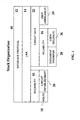
- the protocol stack 10 of the network model does not fit perfectly into the Open System Interconnection (OSI) seven layer network model. This is due, at least in part, to the intentional interdependence between the ability of the nodes to have some awareness of the higher level end-to-end connections and the ability for hop-by-hop routing choices. This interdependence allows detailed QOS to be enforced. In addition, security is embedded at a lower layer, again in an attempt to gain further functionality and integration.
- OSI Open System Interconnection
- the protocol stack 10 includes an interface protocol 12, which is the underlying protocol used for inter-node communications.
- the interface protocol 12 need not be consistent throughout the network; indeed it may differ on a node-by-node or link-by-link basis, and there may even be multiple different interface protocols connecting the same nodes.
- the protocol stack 10 includes a link protocol 14 above the interface protocol 12.
- the link protocol 14 is in charge of initiating communications with a neighbor, determining the neighbor's name, establishing basic link cryptographic communications, etc.
- the link protocol 14 is the base for QOS mechanisms.
- the protocol stack 10 may also include a lightweight reliability protocol 16 that allows for reliable sequenced streams over unreliable packet traffic.
- the reliability protocol 16 is used by both system level and user level protocols, and is used in multiple locations within the protocol stack 10.
- the protocol stack 10 includes a routing protocol 18 to handle the movement of routing data through the network.
- the routing protocol 18 is in charge of making sure the network keeps aware of the current interconnectivity status, as well as the current QOS situation. It deals with the network as a hierarchical system of nodes, networks, networks of networks, etc.
- a circuit protocol (20 and 22) of the protocol stack 10 handles the establishment of end to end connections and the long haul transfer of data.
- the circuit protocol (20 and 22) is divided into the circuit establishment protocol 20, which sets up circuits, and the circuit data protocol 22, which moves data over circuits. All user data is transported over the circuit data protocol 22, either as raw packets (unreliable circuit 24), or as reliable streams by use of the reliability protocol (reliable circuit 26).
- a document transfer protocol 28 of the protocol stack 10 makes use of user signed data components known as "documents" (described in more detail below). Sometimes a node may need to track down a document that it needs for some reason.
- the document transfer protocol 28 handles the process of finding the document by name and moving the document to the requesting node.
- All of the network model's protocol-speaking devices are nodes, including both endpoints and intermediate points.
- Each node has a single unique network address. This takes the form of a hierarchical name. Naming of nodes is used to help determine the routing structure and the propagation of the dynamic routing data.
- Each name is represented as a dot separated list of identifiers, with the most specific portion of the node name coming first, and the most general coming last.
- the highest level part of the name is at a similar level to the autonomous system number of border gateway protocol (BGP).
- BGP border gateway protocol
- This naming format referred to in this document as "dot path naming format" is used to name many aspects of the network, including users, groups, networks, documents, policies, or in this case node. In each case the hierarchy has a well-defined meaning.
- Each node in the network model is able to communicate with one or more other nodes directly. These nodes are referred to as neighbors, or sometimes as direct nodes.
- the underlying protocol used by neighboring nodes to communicate is for the most part unimportant to the network layer. The following guidelines determine what underlying transport protocols are appropriate:
- Each node has a method of determining its neighbors, initiating a physical connection for connection oriented underlying protocols, and exchanging packets. Finding the physical/logical neighbors may be done through some discovery protocol, or the list of desired neighbors could be determined by a user or other configuration.
- the network model supports two basic types of node connectivity: edges and stars.
- edge comes from the graph theory term.
- An edge is a connection between nodes that represents a simple point-to-point connection. This could be for example a node within radio proximity, or a node on the other end of a private T1.
- the fact that a node A has edges to two different nodes, B, and c has no bearing on whether or not B and C have an edge connecting them.
- the requirements of a edge include bidirectionality and some form of packet based transport; although in the case of a non-packetized physical link, packets could be easily be introduced via a framing mechanism of some sort.
- a star is used to represent some form of shared transport mechanism that connects a number of nodes in such a way that the transitive property of connectivity holds among them.
- An example of a star would be a number of nodes connected to an Ethernet switch. If node A can send packets to node B as well as node c via the Ethernet switch, then both B and C can send packets back and forth via the same Ethernet switch. Thus, a star can be thought of as the center of a group of communicating nodes. Radio networks are usually not stars. Another way to look at stars is as the equivalency classed of connectivity.
- nodes introduces a hierarchical structure to the network, in that networks of nodes combine to form networks of networks, and networks of networks of networks, etc.
- a group of nodes, which are part of the same network group, or a group of networks, which are grouped together, are often referred to as a meta-node. This is because whole networks of nodes can be looked at as a single node, and the inter-network connectivity as edges between these meta-nodes.
- the highest level meta-nodes form the global network, or root level network. In the Internet model, these would be the networks assigned ASN's. Each of these root level networks, or meta-nodes, can contain internal structure. The depth of the structure before one hits the actual physical node does not have to be consistent throughout the networks. That is, a meta-node composed of three smaller nodes, and a single individual node can be peers in a network. In terms of dot path node names, a.b.c and x.c could both be nodes, and b.c (a meta-node) and x.c (a real node) would be peers in network c.
- meta-node When grouping nodes into a meta-node, all the nodes in the group are fully connected. That is, for any two chosen nodes in the group, there is a path consisting of only other nodes within the group, which connects them. Obviously nodes which are on the same star make a great grouping. In some cases, a meta-node may "split" in that the failure of certain links causes the meta-node's components to no longer be fully connected. The network attempts to deal with this situation, but certain failure modes are possible, and one should avoid grouping nodes in such a way that one or two key links can split the group.
- the dynamic routing protocol 18 is in charge of propagating node connectivity and QOS data through the network.
- the hierarchical nature of the network and the full connectivity assumption are used to limit the flooding of route messages, and minimize the size of the route tables generated, thus making certain that the dynamic routing scales.
- a document in the network model is a self contained, signed chunk of data understood and used by the network to make decisions.
- the public key distribution mechanism works though documents.
- the dynamic routing involves the exchange of route related documents.
- the QOS mechanism uses documents to define rights and delegations of rights for network usage.
- the actual circuit construction requests sent by users are documents.
- Documents are often signed. This signing uses a public key signature mechanism. Interestingly, documents are also used to distribute keys. There is a chain of trust to allow this mechanism to work, as well as a well-known root public key. Signing documents indicates that the signer "supports" the document. The meaning of "supports" depends upon the document in question. For example, if the document is an identity document, it means the signer vouches that the identity in question is legitimate. If the document is a circuit request, it means the signer is the user requesting the circuit.
- Documents have a type associated with them and many have a name associated with them as well.
- the type is one of a predefined list of types, and each type has a different internal format. New document types may be added in alternative versions of the protocol. Unknown document types are ignored when present.
- Documents may also have a name. This name takes the form of a "dot path".
- a dot path is a dot-separated list of identifiers. An example of a dot path is this.is.a.test.
- a given type and dot path usually corresponds to a single unique document, and the document transfer protocol 28 is designed to find that document.
- not all documents are long-term documents, including circuit request or dynamic routing updates. These documents have no names and propagate though some other means, and are called short term documents.
- Documents also have a time scope. This may include a creation time and an expiration time.
- the expiration time is the time after which the document is no longer considered relevant. For example, dynamic route information from a mobile radio device has a fairly quick expiration, meaning the time during which it is useful is limited. It is assumed that there is fairly universal time synchronization among nodes. However, it is also assumed that while data from a given node can be time ordered with great reliability, inter-node times may be off by a few seconds to a minute. One-hour time skews may be considered unacceptable.
- the document concept supports a number of different document types and document type classes. Some of these, such as identity documents, are used in conjunction with other documents, in that many other documents rely on identity documents to be useful.
- document types involved with the document transfer protocol 28, or in other words, documents relating to document movement and storage.
- a quick overview of document types is provided in this section. A more detailed description of the document format for a given document type is given in the section relating to the use of the document, with a few very basic documents in the section 4 on basic document types.
- a hierarchical identity naming mechanism is defined. This naming mechanism may recognize that a single human user may have more than one identity to correspond with multiple roles. For example, the user may have one identity as an employee of a company and another as a member of a social group. In addition, even within the user's company there may exist multiple roles for the different departments, etc., of which the user is a member. Also, non-human components of the network may have identities, for example every node has an identity, which is actually its network address.
- Each identity is named via a dot path. Both the 'a.b.c' and b.c' can be valid identities at the same time, 'b.c' representing a group, and 'a.b.c' representing an individual or a sub-group. Each identity has a private and public key associated with it. The private key stays with the human or piece of equipment that the identity represents and the public key is distributed.
- the identity document is a document connecting the identity and its public key.
- the identity name is the document name for the purposes of the document transfer protocol 28.
- Each identity document is signed by the public key of an identity higher in the hierarchy. Thus, a group can choose its users and subgroups, which can in turn choose subgroups of there own. In addition, there is a flag associated with the identity document as to whether the identity is a leaf identity, that is, one that cannot have sub-identities.
- the root identity document that is the public key needed to sign the c of a.b.c is assumed to exist on all nodes. Additional details regarding the identity document are provided in Section 4 below.
- the document transfer protocol 28 is used to find documents by name on the network.
- the document transfer protocol 28 relies on documents that link names to actual nodes.
- Storage location documents facilitate this process.
- a storage location document gives a node names of nodes that contain information about a given sub-tree of document names. For example, there may be a storage location for ibm.corp.us that points to a node that is one of IBM's document storage servers.
- the name of the storage location document is the tree for which it is authoritative.
- the node the document points to either contains every document in that tree, or contains storage location records for more specific sub-trees for documents it does not store. There may be more than one storage location record for the same name, allowing for multiple document storage servers.
- For a document storage location to be valid it is signed by an identity, which is equal to or higher than the sub-tree it stores. Additional details regarding the storage location document are provided in Section 11 below.
- Logical name documents can be used to give other types of documents a more human acceptable, or organizationally structured view of the world. Logical name documents can also be used to implement redirection strategies.
- a logical name document is a logical dot path (its key for lookup), an actual dot path, and document type. It is signed by an identity equal or higher than it is logical dot path. It redirects to its actual dot path. Additional details regarding the logical name document are provided in Section 11 below.
- Metric policy documents give nodes information to use in deciding the permissions and delegations used to make circuit establishment and data movement decisions. Basically, they store the QOS policies. They each have a dot path name, which allows policies to reference other policy, and to lookup new policy documents as old policy expiration dates expire. The document is signed by an identity equal to or higher than their name. Additional details regarding the metric policy document are provided in Section 10 below.
- encoding In addition to the logical form of types, some types have an encoding as well. This encoding represents the way the type is turned into a sequence of bytes for movement over the network. To facilitate multiple implementations of the protocol to interoperate, encoding may match the description identically.
- a protocol data unit is a named type, which is also a basic conversational unit of the protocol.
- the protocol can be looked at as the exchange of PDUs, and the associated change in state of the various nodes involved.
- a logical PDU description is used to represent an application programmer interface (API) to lower level aspects of the implementation.
- API application programmer interface
- a PDU-like description is also used to represent the high level API that the protocols export.
- the integer type are U8,U16,U32,U64,S8,S16,S32,S64 and represent unsigned and signed integers of various size ranges.
- the U (or S) represents unsigned or signed respectively and the number following the letter represents the number of bits used to represent the number.
- a U8 can store a number from 0 to 255
- a S16 can store a number from -32768 to 32767.
- unsigned numbers go from 0 to 2 n - 1
- signed numbers go from -2 n -1 to 2 n -1 -1.
- the encoding of the integer types as byte sequences is basic two's complement binary representation.
- network byte order (big-endian) representation is used.
- variable integer type is used to represent unsigned integers. Logically, it is capable of storing a number between 0 and 2 N -1. The variable nature comes in its encoding, where N is a self-sizing variable size, with smaller numbers taking up less space.
- the encoding of the value is one byte, standard binary integer representation. If the value is between 128 and 2 14 -1, it is stored in two bytes. This is a standard network order two byte integer, with the exception that the most significant bit of the first byte is set to 1. If the value is greater than 2 14 -1 the number is stored as a standard network order four-byte integer, with the exception that the two highest order bits of the first byte are both set to 1.
- the time location type represents a point in time. That is, a particular moment. For example, Jan 2, 2002, 7:30 PM, CST could be one way to represent a time location. Time locations represent actual absolute time, not wall time, and are thus not effected by time zones.
- Time locations are encoded as an S64 representing the number of nanoseconds since Jan 1, 2001, UTC.
- the time duration type defines a relative difference between two time locations, or in other words, a duration.
- Time duration is represented as an S64 representing the number of nanoseconds that make up the duration.
- the hash type represents a cryptographic hash of a byte sequence.
- the hash of a logical structure refers to the hash of the byte sequence that is the encoding of the logical structure described.
- a hash is referred to as being over a number of logical components, it is assumed to be the hash of the byte sequence formed by concatenating the encoding of each component in the order they are mentioned in the description of what to be hashed.
- a hash may be "keyed" by some value. This means that the key is encoded and placed both before and after the encoding of the object being hashed, and the hash value is the result of hashing this new sequence. This keying allows for symmetric key signatures, in that one can verify the sender of a piece of data hashed in a keyed manor knew the same hash key.
- the illustrated embodiment uses the MD5 cryptographic hash.
- the details of turning a sequence of bytes into the hash, and representing the resulting 128 bit hash as a sequence of 16 bytes is described in a document available from RSA Security, Inc. ("RSA") of Bedford Massachusetts.
- the signature type represents a public key signature of some data.
- this signature is of a cryptographic hash, which is a hash of some section of data. So long as the cryptographic hash is trusted, the public key signature can be thought of as being over the entire data block which is the input to the hash.
- the public key type represents a public key capable of being used for encoding and signature verification with a certain public key encryption and signing mechanism. If the encryption and signing do not use the same key, a public key type contains both keys.
- the illustrated embodiment uses the RSA public key algorithms.
- the key is a 2048 bit RSA key, encoded as described in the appropriate prior art RSA documentation.
- the symmetric key represents a key that can be used to do encryption and decryption using a symmetric cipher.
- the illustrated embodiment uses DES, the key format of which is developed and documented by RSA.
- the public encoded type represent a public key encoding of some data. Generally, due to the constraints on the size of the data the encoding is made over, this encoding is a symmetric key, which is used to encode other data
- the illustrated embodiment uses the RSA public key encoding algorithm. The details of this algorithm and the representation of the resulting encoding are described in RSA documentation.
- the presymmetric type represents the initialization vector or other preamble needed to make the symmetric cipher secure against certain attacks.
- Three primary complex types include: a sequence type, a set type, and a structure type. All of these types have a well-defined method of encoding, which is related to the method of encoding its base type or types.
- a sequence is an ordered list of elements all of the same type. It is represented by Sequence ⁇ Type> where Type is the type of all the sequence elements. Typical operation on a sequence might include inserting and removing elements, finding an element based on its location, iterating thought the elements in order, etc. When describing an offset within a sequence, a zero based index is used.
- the in memory representation of a sequence is implementation-dependent and may vary from one context to another, even for sequences of the same type, based on how they are manipulated.
- the encoding of a sequence as a sequence of bytes is the concatenation of the number of elements, represented as a VarInteger, with the encoding of each of its elements in order.
- Typical operations on a set might include finding elements that meet a certain requirement, set unions and intersections, modification of certain elements (which is equivalent to removing the original element and inserting the modified one).
- Another operation might be the transversal of the set in a random order, or some specific order based on a comparison function on the elements.
- Like mathematical sets there cannot be two "copies" of identical elements within the set. All the uses of sets described within this document avoid this case.
- sets are often quite complex. While the set may be simply a collection of elements, the need to find elements based on some property quickly often necessitates some form of indexing. Indeed, in this detailed description, sets are often used as maps, which relate one element with another, by inserting the key-value pairs into the set. In addition, the need to transverse the set in some particular order often induces some complexity.
- the encoding of a set as a sequence of bytes is the concatenation of the number of elements, represented as a VarInteger, with the encoding of every element of the set, in no particular order.
- a structure consists of a sequential, named list of elements, each of its own type. It is used to combine various different parts to form a single whole.
- Table 1 below shows a typical definition of a structure: Table 1: Structure TypeOne NameOne TypeTwo NameTwo
- TypeOne In the example of Table 1 there are two parts of types: TypeOne and TypeTwo respectively.
- the names in the case of real structures help explain the meaning of the structure and give a way to refer to elements.
- the encoding of a structure is simply the concatenation of the encoding of all the parts of the structure in the order given.
- Document encapsulation is the name for the process of converting the logical form of a document into a sequence of bytes for transfer via some network protocol, either the reliability protocol 16, or in the case of the link protocol 14, a special fragmentation mechanism.
- This chapter describes the relation between the logical and "physical" form (as the octet stream is referred) of the document.
- a dot path is a dot separated list of identifiers. It is used in multiple locations within the protocols. Each identifier can be any textual sequence of printable glyphs, so long as it does not contain a ".” which is the separating character. The sequence begins with and ends with an identifier and the dot appears only in the interior. Thus "a.b.c.” is illegal as there is a dot at the end with no identifier that follows it.
- the dot path is encoded as a VarInteger representing the number of bytes in its UTF-8 representation, followed by the Unicode UTF-8 of the actual dot path in a textual manner.
- a document type is an enumeration type. Its definition is shown below in Table 2: Table 2: Document Type Definition Name Number Identity ? StorageLocation ? LogicalName ? ControllerFlood ? CosignRequest ? NodeFlood ? EdgeFlood ? NextHopFlood ? InterconnectionFlood ? MetricPolicy ? CircuitRequest ? LinkSetup ?
- the document type is encoded as a VarInteger representing the enumeration number.
- a signature block represents the signature of some thing, usually a cryptographic hash, by a particular identity. Its structure is shown below in Table 3:
- Table 3 Signature Block DotPath SignerIdent Signature SignerSig where SignerIdent is the identity that is signing and SignerSig is the cryptographic signature of that particular signer.
- a document type represents the general format of a document, and the associated encoding.
- a portion of the document, referred to as the document body, is the type dependent portion of the document.
- An example of a document type structure is shown in Table 4 below: Table 4: Document DocumentType Type DotPath Name TimeLocation Expiration ByteSequence DocumentBody Hash DocumentHash Set ⁇ SignatureBlock> Signatures
- the identity document is used to connect an identity name with the identities public key.
- the identity document is signed by an identity higher on the signing tree to be valid. That is, the dot path of the signing identity is the proper suffix of the dot path of the identity document being signed. For example a.b.c could be signed by b.c but not d.c or x.a.b.c, etc.
- the identify document may have a body portion consisting of PublicKey, which is the public key of the identity named in the document name.
- the link 14 and routing 18 protocols collect data for the purpose of determining QOS capabilities along certain paths. Users constructing circuits ask for certain QOS properties. In addition, there may be other factors, which the user might want to affect circuit routing, such as security clearance level, or other similar abstract aspects.
- metric parameter This is an aspect of a circuit or a link that might be a reasonable part of the decision process of circuit routing. All QOS parameters fall into the idea of metric parameters, as well as a number of more abstract things.
- each metric parameter represents a single measurable quantity of some sort.
- bandwidth would be a metric parameter, as would latency.
- Each metric parameter has its own units of measurement. For example bps may be used for bandwidth and microseconds for latency.
- metric parameter values represent some logical aspect of the network the user might care about, such as “division” (for a corporation's internal use) or "ISP” (for the internet). These aspects may also effect routing choice.
- a metric parameter type is used to specify which parameter is being discussed. To this end, each parameter is given a number, thus this type is an enumeration. Additionally, the metric parameters can be divided into four categories, NumericLow, NumericHigh, SymbolicSpec, SymbolicGen, where the first part names the basic type, and the second part specifies which direction is desirable. The type of numeric types is a VarInteger. The parameter type is a U16, with the first two bits deciding the category. An initial list is provided in Table 5 below: Table 5: Metric Parameters Name Units Type Number Bandwidth Bps * 100 NumericHigh 0 Latency Microseconds NumericLow 16384
- the metric parameter type uses standard U16 encoding
- Metric measurement idea can be employed for a number of uses, including:
- a current metric data type gives the total and current metric data of an edge. Included are the total and current best that a single path could receive, as well as the total and current cumulative over all paths.
- Table 6 Current Metric Data MetricParameter WhichMetric VarInteger PerPathBestCapacity VarInteger PerPathBestUnused VarInteger TotalCapacity VarInteger TotalUnused
- Table 7 Symbolic Type MetricParameter WhichMetric DotPath Value
- current metric data uses standard structure encoding, with the choice of structure determined by the first element
- Metric policy documents determine the division of resources into different uses, particularly nodes and users and sub-policies. Each policy has a name, which acts as the key for the policy document via the document transfer protocol 28. The policy then divides resources into groups and assigns each of the groups to a user, a node or meta-node, or a sub-policy. A given node is assigned a single master policy which is used to divide resources going in and out of it.
- a sub-holder type is used to define which of the three types of sub-holders is being used. It is a simple enumeration as, illustrated in Table 8 below; Table 8: Subholder Name Number Sub-Policy ? User ? Node ?
- a metric policy type represents the information about the absolute and relative access to the resource defined by a given metric parameter is and part of the policy document typing.
- An example structure for the metric policy type is shown in Table 9 below: Table 9: Metric Policy MetricParameter ParameterType VarInteger ReservedAmount VarInteger AbsolutePriority VarInteger RelativeOverflowPriorit y
- a policy part represents one of the eventual sub-holders of the resources granted to a policy. It describes the absolute and relative privileges of the sub-holder.
- An example structure for the policy part is shown in Table 10 below:: Table 10: Policy Part SubholderType Type DotPath SubholderName Set ⁇ MetricPolicyCompone nt> Params
- the policy body is the body of the metric policy document.
- the key to a metric policy document is the name of the policy.
- the policy is signed by an identity more general than the policy name.
- An example structure for the policy body is shown in Table 11 below:: Table 11: Policy Body Set ⁇ MetricPolicyPart Subparts
- a third use of the metric system is specifying requirements during circuit construction. This is done using a single requirements type and a metric requirements type, which are illustrated below in Tables 12-14.
- Table 12 Single Requirement Structure MetricParameter Parameter VarInteger Required VarInteger Desired
- Table 13 Symbolic Case Structure MetricParameter Parameter DotPath Required DotPath Desired
- a node of the network model calls a method on the interface API, which then uses the underlying interface's native protocol to transmit a packet, or perform some requested operation. Packets and events that enter the interface via the native protocols are converted to callbacks in the interface protocol 12 and sent up the protocol stack 10.
- the interface API is the layer of abstraction that allows many types of physical networks to be dealt with in an equivalent manner. The process of calling API's and receiving callbacks is very similar to sending and receiving packets.
- this underlying protocol may have some addressing mechanism to allow links to multiple nodes to be reached via the same physical/logical interface, but it may be a simple point-to-point link as well.
- These remote addresses are interface specific and opaque to the higher-level protocols.
- the underlying protocol may be connection orientated, in which case the addresses define the locations to connect to, otherwise the addresses define a per-packet destination.
- the underlying protocol is packet based and each interface is given a well defined MTU for the data portion of the packet.
- interfaces may wish to alert the network layer of newly discovered remote nodes.
- interfaces such as Ethernet
- Some interfaces support broadcast of some form allow some method of node resolution, similar to ARP.
- the API supports both of these mechanisms.
- a remote address type provides an opaque representation of the remote address is understood by the interface. This type is not sent over the network, except by the interface itself perhaps, and thus does not have an encoding. Thus any structure containing it does not have an encoding.
- a seek request ID type provides a number used by the higher level protocol to associate requests with responses.
- the in memory form is identical to a U32. This type is not sent over the network, except possibly by the interface itself, and thus does not have an encoding. Thus any structure containing it does not have an encoding.
- a send packet function sends a packet down to the interface to be transmitted.
- Examples of parameters for the send packet function are illustrated in Table 15 below: Table 15: Send Packet Parameters RemoteAddress Address ByteSequence PacketData In Table 15, Address is the remote address to send the packet to, and PacketData is the packet data, which is smaller than the MTU of the interface.
- a receive packet function is called by the interface when it receives a packet. Examples of parameters for the receive packet function are illustrated in Table 16 below: Table 16: Receive Packet Parameters RemoteAddress Address ByteSequence PacketData Referring to Table 16, Address is the remote address the packet arrived from , and PacketData is the packet data, which is smaller than the MTU of the interface.
- a seek node function sends a packet down to the interface to be transmitted. Examples of parameters for the seek node function are illustrated in Table 17 below: Table 17: Seek Node Parameters SeekRequestID RequestNumber DotName NodeName TimeDuration Timeout Referring to table 17 RequestNumber is a U32 used to associate the resulting callbacks with this call, NodeName is the node name of the node being sought, and Timeout is the amount of time the node seeking is willing to wait to find the node sought.
- a seek found function is called by the interface when it finds a node matching an outstanding request. Examples of parameters for the seek found function are illustrated in Table 18 below. After the seek found, the request ID is no longer in use and can be reused. Table 18: Seek Found Parameters SeekRequestID RequestNumber RemoteAddress Address Referring to Table 18, RequestNumber is the request this response is in relation to, and Address is the remote address of the found node. This remote address is now current (packets can be sent on it).
- a seek failure function is called by the interface when it times out trying to seek a node on the behalf of a caller. Examples of parameters for the seek failure function are illustrated in Table 19. After the seek failure, the request ID is not longer in use and can be reused. Table 19: Seek Failure Parameters SeekRequestID RequestNumber Referring to Table 19, RequestNumber is the request this response is in relation to.
- a detect node function is called when the interface detects another node on the network. Examples of parameters for the detect node function are illustrated in Table 20. This may happen when a node enters radio range, or for example when another node on a broadcast network sends a seek with the local node name.
- Table 20: Detect Node Parameters RemoteAddress Address DotPath NodeName Bool RemoteActive Referring to Table 20, Address is the address of the node detected, and NodeName is the probable name of the node. After receiving this call, Address is current (can have packets written to it). RemoteActive is a flag which indicates some level of initiative on the part of the remote node, and is a hint to not begin link negotiation, as the remote side intends to.
- An address down function is called to alert the node that an address is no longer current and that the node no longer sends packets to it. Examples of parameters for the address down function are illustrated in Table 21. Table 21: Address Down Parameters RemoteAddress Address Referring to Table 21, Address is the address which is no longer current.
- a lightweight reliability protocol 16 is used throughout the design.
- the protocol needs room for three flag bits, and two 32 bit numbers, a sequence and acknowledge. It turns an unreliable, two way, packet transmission mechanism into a reliable one.
- the mechanism is the same as that used by TCP.
- IP & Port IP & Port
- the details of the reliability protocol 16 are not described in this description because they are semantically identical or similar to the reliability mechanisms used by TCP.
- the link protocol 14 is the lowest level of communications between nodes. It is the first line of defense, dealing with the safety and management of all inter-node data, as well as being the base construct from which QOS is derived.
- the link protocol 14 is used to:
- the link protocol 14 establishes the identity of both sides and exchanges a symmetric key used for encryption and per-packet verification. Because of the computational complexity of the necessary public key mechanisms used during link establishment, and the danger of a DOS attack based on CPU starving, a node spends only a portion of its CPU on link establishment. To prevent legitimate attempts from being turned away, a computational challenge is implemented to make the DOS attacker unlikely to be able to send 'correct' requests at a reasonable rate. It is assumed that the correctness testing method is fast enough be checked without penalty.
- link setup document which contains the public encrypted and signed symmetric key.
- link setup document contains the public encrypted and signed symmetric key.
- One this document is processed, the link is considered established, and a reply is returned. Then the link is used to transfer symmetrically encrypted, cryptographically checksummed packets, along with QOS information, which composes the "activated" portion of the link protocol 14.
- the link setup document is used for initial link key exchange. It is an unnamed document. It is signed by the initiating node. Its structure is a single symmetric key, publicly encoded to the destination node.
- a link document part consists of the link setup document, combined with the full identifying documentation of the initiating node, all concatenated together from the link setup documentation. This string of bytes is most likely too large to fit within the link MTU, and thus is broken into parts. These parts are then cryptographically hashed.
- the initial request contains the hash for each of the parts, allowing the acceptance of the primary request to clear the way for the part, without allowing an intervening attacker to forge data before the key has been exchanged.
- Table 22 An example of the structure for the link document part is illustrated in Table 22 below: Table 22: Link Document Part U8 PartNumber VarInterger PartOffset VarInteger PartSize ByteSequence Data
- PartNumber is the integer part number of the current part, 0 based index
- PartOffset is the offset in bytes of the data portion of this part relative to the entire link documentation set
- PartSize is the size in bytes of the data portion
- Data is the actual data of the part.
- the cryptographic hash of the data is sent with the link initial request as described in more detail below.
- a link request type contains information about the requester and the hashes of the documentation to follow.
- the request results in a challenge as described in the next section, and the receiver decides the complexity of the challenge.
- An example of the format of the link request is shown below in Table23: Table 23: Link Request DotPath RemoteNode U8 NumberOfParts VarInteger RequestDocSize Sequence ⁇ Hash> PartHashes
- RemoteNode is the node name of the node requesting
- NumberOfParts is the number of actual data parts that form the documentation as describes in the previous section
- RequestDocSize is the total size of all those parts and PartHashes is the list of hashes of each part, in order of the part number.
- the purpose of the link challenge mechanism is to make the requester do work before the link checks the validity of the link documentation, as the storing, reassembly, and cryptographic verification of the link documentation is a non-trivial process and allowing any unverified node to force the checking node into doing such work could result in resource starvation.
- a node may request a 'challenge' from the node it wishes to establish a link with.
- the node receiving this request makes a new challenge, which is a CPU constrained cryptographic task, and signs the challenge.
- the requesting node returns the signed challenge along with the solution. Note: until it receives the solution, the receiving node does not need to store any state, or perform any large computational functions. Upon receiving an apparent solution, the process of checking the solution is reasonably quick.
- the challenge chosen for this version of the protocol is searching for a missing portion of data which results in a particular cryptographic hash. So long as the hash is strong, this results in a brute force search of the unknown data portion. Thus the receiving node may make the challenge as difficult or simple as is desired by changing the number of unknown bits.
- the challenge and the request data are cryptographically hashed with a key known only to the receiving node.
- a link challenge type is used to represent the actual cryptographic challenge.
- Table 24 Link Challenge Sequence ⁇ U8> PrePart U8 NumberOfBits Hash Result
- PrePart is the first portion of the data used to make the hash Result
- NumberOfBits is the number of additional bits in the hashes pre-image. If the number of bits is not evenly divisible by eight, it is assumed that the final byte has zeros in the low order (less significant) bits.
- Link Packet Types Name Number LinkInitialRequest ? LinkRequestNAK ? LinkRequestChallenge ? LinkChallengeResponse ? LinkInitialACK ? LinkInitialNAK ? LinkPartSend ? LinkPartNAK ? LinkFinalACK ? LinkFinalNAK ? LinkReliablePacket ? LinkUnreliablePacket ? LinkReset ?
- the initial link setup protocol uses the challenge response mechanism to prepare the receiving node to have the link setup documentation transferred to it, while at the same time, forcing the initiating node to do some computational work. It may involve any one of several PDUs, including link initial request, link request NAK, link request challenge, link challenge response, link initial ACK, and link initial NAK.
- the routing protocol 18 is designed to give nodes the information necessary to correctly move circuit establishment requests closer to their final destination. It may also allow nodes to make intelligent choices about the path used based on the metric parameters of the various links and the requirements of the circuit request.
- networks are assumed to be hierarchical in organization. Each node has a node name, and the routing first gets the circuit request to the most general part of the node name, then as the node gets to the most general network, the routing information is more specific, allowing the next portion of the node name to be examined. This process continues until the node arrives at its final destination.
- a network of nodes is collectively called a meta-node. If nodes in two different meta-nodes are connected via an edge, then the two meta-nodes are connected via a meta-edge. There is a mechanism to combine multiple links between meta-nodes into a single meta-edge. Edge and meta-edge information is flooded though the network, with certain rules to limit the data to relevant areas. The highest level meta-edge data flood everywhere.
- the meta-edge data is generated by special meta-node controller nodes. These nodes have the meta-node key as well as their node key. There may be more than one meta-node controller, as they should all come to the same result, and flooding rate is controlled via each node, thus additional meta-node controllers simply send extra updates that are ignored if they are excessive.
- meta-node controllers it would be possible to not have meta-node controllers, however, this would require all nodes to contain the meta-node key (bad), or the security of the meta-link data to require only the signature of one node in each meta-node of the meta-link, which is possibly acceptable, but still more open to compromise than the meta-node controller mechanism, since it requires compromise of a controller in each meta-node.
- meta-node controller mechanism allows much of the routing computation to be somewhat centralized, while still allowing for full failure handling, since there can in theory be any number of meta-node controllers.
- Star networks are related to a meta-node in the illustrated embodiment. However, alternative embodiments may not include this relationship.
- nodes in star networks of the illustrated embodiment do not exchange network routing data for the local network, but only communicate with the meta-node controllers to exchange connectivity information.
- a node may be a meta-node controller for any network level, and possibly more than one at a time. If a node is a meta-node controller for a given level it has full routing information for that level. Otherwise, a node has partial routing information for a given level. All nodes have full routing information for the local network segment.
- the partial routing information is actually derived from the full routing information.
- the partial routing information is the only information used to actually route circuit requests.
- the text below describes the form of the full routing information first, then the partial routing information, then the algorithm to generate the partial information from the full.
- Full routing information consists of all the edges or meta-edges that are part of the network, along with the metric parameters of each edge, and all the nodes or meta-node which are part of the network, along with the metric parameters of the node-interconnect.
- node and edge may possibly mean meta-nodes or meta-edges.
- An edge information type has information about a single edge.
- Table 26 below shows an example format of the edge information:
- NodeA and NodeB are the two nodes that are connected. At least one of these nodes is in the network for which the full routing information is being stored.
- the MetricData contains all the most recent total and current free values for the metrics tracked by the edge.
- a node information type has information about a single node.
- Table 27 below shows an example format of the node information:
- Node is the node in question.
- the MetricData describe the internal capacity and current free capacity of the node. This is more relevant for meta-nodes, since the ability to move data from one side of the meta-node to the other may be limited. Capacity is given in terms of the worst inter-link case. That is, is a meta-node connects to three other meta-nodes, A, B, and C, these numbers are the worst case of the meta-nodes ability to move data from A to B, B to C, and A to C.
- a full route table contains full routing data for a given network at a given level.
- An example of a format for the full route table is shown below in Table 28: Table 28: Full Route Table Set ⁇ EdgeInformation> Edges Set ⁇ NodeInformation> Nodes Referring to Table 28, Edges is the set of all the edge information for all edges in the networks, and Nodes is the set of all node information for all nodes in the network.
- a partial routing state represents the calculated next-hop routing information specific to a given viewpoint within the network. Given a final destination (to the resolution of the network being routed) it results in a list of the destinations one hop from the current location, along with metric information about the total path metric for each of the next hop possibilities. In addition, in the case of meta-routing data there is another table giving all the neighboring meta-nodes, and the edge nodes one level lower which have a connection to the neighboring meta-nodes and the metric data of that particular lower level edge.
- a next hop entry is a particular possible next hop to reach a certain final destination and the associated full path calculated metric information.
- An interconnection entry contains the information about a lower level node or meta-node which acts as an edge node between two meta-nodes, as well as the associated metric data of the actual edge which connects the meta-nodes.
- a partial route table contains partial routing data for a given network at a given level.
- Table 29 Partial Route Table Set ⁇ NextHopEntry> NextHops Set ⁇ InterconnectionEntr y> Interconnects
- NextHops is the set of all the next hop information calculated. It is assumed that the set is indexed by the FinalDestination variable of the NextHopEntry structure. There may be multiple entries that lead to the same final destination. Similarly, the Interconnects variable is indexed by the NeighborMetaNode variable of the InterconnectionEntry type, and again there may be more than one entry.
- the conversion algorithm is in charge transforming full routes into partial routes.
- a method is needed to combine parallel and serially arranges QOS metrics.
- Each QOS metric has a parallel combination algorithm (the total QOS between two point based the QOS on two parallel routes between the points), as well as a serial combination algorithm (the total QOS between two points base on the QOS from the initial point to an intermediate point, and the QOS from an intermediate point to the final point).
- the parallel algorithm for bandwidth is the sum of the two bandwidths
- the serial algorithm is the minimum of the two bandwidths.
- the conversion algorithm determines for each final destination node, and for each next hop, all the paths to the final node via the next hop. It uses the QOS combination mechanisms to convert the acyclic graph of QOS into a single QOS value, which is associated with the next hop.
- the routing protocol 18 There are four basic parts to the routing protocol 18. The first is the meta-node controller flooding protocol which lets all the nodes of a meta-node know about node-controllers. The second is the double signing protocol. This is the method by which one half of a edge or meta-edge sends a partially signed edge to other side for checking and co-signing. The third is base data flooding protocol, by which the edge, meta-edge, node and meta-node data is flooded to everyone who need to know. The fourth is the method by which, after using the base data to compute, meta-node controller nodes flood the calculated partial data to the local network.
- the third is base data flooding protocol, by which the edge, meta-edge, node and meta-node data is flooded to everyone who need to know.
- the fourth is the method by which, after using the base data to compute, meta-node controller nodes flood the calculated partial data to the local network.
- the flooding mechanism works as follows: Each node upon receiving a document from its neighbors checks to see if the document is even relevant to it. If it is not, it is ignored. Next, the node checks if it has seen the same document recently. This is done though a previous document table. To prevent overflow to the table, if a node receives too many documents from a neighbor within a given time, it occasionally drops packets. Either way, if the node has seen the document previously, it drops it. If it is a new, relevant document, the node checks the signature. If it is incorrect, it lowers the allowed data rate for the neighbor from which it received it, as a neighbor should not send a bad document, and the neighbor may be compromised. If all is well, the node checks which neighbors the document is relevant to, and send it to all of those to whom it is likely relevant.
- a controller alert protocol lets nodes know about meta-node controllers.
- the relevancy criteria is whether or not the node belongs to the meta-node the controller is a meta-node controller for.
- the control alert document body may include a network network name of the meta-node that the controller is controller for, and a full node name of the controller node.
- Controller is a more specific dot name of MetaNode.
- the document is signed by the meta-node key for the meta-node in question.
- a given node remembers at least a few controllers for each level of meta-node which it belongs to. It keeps the closest controllers and drops the further one based on hop count.
- a cosigning protocol is used to get an edge update signed by the other party. It involves the transfer of a document known as the CosignRequest document. This includes edge information from one node being sent to the other to be consigned. It is signed by a NodeA parameter of EdgeInfo.
- a cosign request document is directed closer to the network named in the NodeB portion of the EdgeInfo entry. If the request has already entered the network named, then node uses its information about the controllers to send the document closer to the closest known controller.
- a flood body node is signed by the node or meta-node described in the NodeInfo, relevant if the name of the node with its first element removed is a generalization of the current node's node name.
- a flood body edge is signed by both nodes or meta-nodes described in the EdgeInfo, relevant if either node name with its first element removed is a generalization of the current node's node name.
- the flood body next hop is signed by the meta-node for the network layer it describes, relevant if the signing meta-node is a meta-node of the current node.
- a flood body interconnection is signed by the meta-node for the network layer it describes, relevant if the signing meta-node is a meta-node of the current node.
- This chapter defines the protocols used to construct circuits and to move data though circuits. It begins by defining the circuit state tables, which are used by circuit data movement and changed by the circuit establishment process.
- the circuit routing tables store the current circuits passing though a node. Each circuit connects a remote node on one interface with a remote node possibly on another interface. Since there may be more than one circuit between any two nodes, there is a CircuitID which is used to distinguish them. This CircuitID is local to the two nodes, that is, it is used only to separate the multiple circuits between two nodes.
- a Circuit ID identifier allows the separation of multiple circuits between the same node
- the route tables store a relation between the two sides of a circuit, and possibly internal data for QOS accounting and control.
- a circuit side type represents one side of a circuit where a RemoteInterface represents the particular interface this side of the circuit goes out of, and a RemoteNode is the interface specific RemoteAddress of the other node.
- An ID corresponds to a CircuitID relative to the inter-node connection.
- a circuit link defines a relation between two circuit ends, along with implementation specific data to manage the QOS, etc.
- the circuit link may have two sides that communicate and an extra implementation specific data.
- a circuit route table is a set of circuit links, which is the current set of open circuits.
- the circuit data protocol 22 is the sole protocol which rides over the unreliable link protocol 14. Its framing begins immediately in the data section of the unreliable link.
- the circuit data protocol 22 basically consists of the circuitID of the circuit, followed by the actual data being sent over the circuit.
- the official definition is includes a circuit ID and a byte sequence.
- the circuit Upon receiving a packet, the circuit is lookup by the ID and the incoming address to find the entry in the circuit route table. If there is no such entry, the packet is silently dropped. If there is an entry, the packet is redirected to the other side of the entry, that is, if the packet arrived via SideA it is sent to SideB and if it arrived at SideB it is sent to SideA. It is sent over the unreliable link protocol 14 if the interface in non-local, or if the interface is the special local interface it is sent to the user.
- Keep-alives may be sent by sending empty (0 data length) packets. These are NOT delivered to the user.
- the establishment protocol 20 is used to setup circuits. It involves the movement of a circuit request document thought the network over the reliable link protocol 14. As the circuit request moves, it establishes the circuit. Upon reaching the other side, data can be sent both ways. If the receiving side does not have any initial data to send, it sends a keep-alive to verify the circuit bidirectionally.
- a circuit request body contains the actual circuit request. It is signed by the user requesting the circuit be established and includes a destination node, which is the final destination of the circuit; a service name, which is the name of the service desired on the other side (similar to a port number and implementation specific), requirements, which are the QOS and other metric requirements of the circuit; flags, which are the flags for the circuit (e.g., defined are bit 0 (the lowest bit) which is encryption, and bit 1 (second lowest) which is reliability); and a circuit key, which is only part of the structure if the flag for encryption is set. If so, it is the symmetric encryption key, public key encrypted to the recipient.
- the max desired bandwidth may be lower if the previous hop could not theoretically support the original, or the required latency may be less based on latency already used.
- Encryption and reliability layers add additional headers to the circuit packets. Encryption comes before reliability.
- the document transfer protocol 28 is the mechanism used to retrieve a document based on its name and type.
- the mechanism used is similar to DNS.
- DTP is run over a circuit, its service name is simply, "DTP”.
- It uses the reliability protocol 16 over the circuit protocol (20 and 22) to provide reliable stream service. It can be run encrypted or not, although it accepting the requested connection is the decision of the DTP server.
- Table 30 An example of a document request is shown in Table 30: Table 30: Document Request U8 Options (Reserved, set to 0) DocumentType Type DotName Name
- the document request arrives over the reliable link as shown above. If the DTP server knows the value of the current document, it returns it, which simply means sending the document over the reliable link.
- the logical name document redirects the document (e.g., its key and the type described in its body) to another document of the same type with a different key.
- the logical name document is signed by an identity equal to or more general than its key.
- the other, more important mechanism for redirection is the document location mechanism.
- the document location mechanism allows certain portions of the dot path tree to be related to certain DTP servers. If a server does not know the document, it can redirect toward a server that does. At worst, the root DTP servers know the identity of the authoritative machines for the more general portions of the sub-tree. Each of the sub-tree nodes either knows the document or knows another more specific source, until the document is resolved.
- the key of the document location document is the sub-tree served.
- the document is signed by an identity equal to or more general than its key. There can also be more than one document location document for the same key, since there can be multiple redundant, fully authoritative servers.
- This extension is used to allow a single node to broadcast the same stream of data to multiple nodes in an efficient manner.
- the format of a circuit is modified slightly for multicast circuits (which are kept in a separate table from normal circuits).
- a circuit instead of connecting a single CircuitSide to another single CircuitSide, connects one "root" side to one or more "branch” sides.
- circuit data When circuit data is received on the root side, it is duplicated and sent out to each of the branch sides. No actual data flows in the reverse direction (from branch to root), but there may be empty keep-alives to keep the circuit open.
- a keep-alives When a keep-alives is received via a branch, it is forwarded toward the root if there has not been a keep alive from that branch for one half the circuit timeout value, otherwise it is dropped.
- a node When a node has not received a keep-alive from a given branch for the timeout time, it drops the branch. It there are no more branches, the entry in the multicast table is removed.
- Multicast circuits are routed from the root outward.
- a node wishes to join the multicast it sends a multicast prerequest document (defined below) to the multicast sender requesting that it join the multicast.
- a multicast prerequest document defined below
- the multicast sender sends a Multicast Request document, which travels outward. It is routed like a circuit request with two exceptions:
- a multicast prerequest body document is sent to a non-sender to request a circuit establishment be made in an outgoing direction. It is forwarded toward the SendingNode and are signed by the requesting user.
- Table 31 An example of a structure associated with this document is shown in Table 31: Table 31: Multicast Prerequest DotName DestinationNode DotName SendingNode DotName Channel MetricRequirements Requirements U8 Flags PublicEncrypted CircuitKey Referring to Table 31: DestinationNode is the final destination of the circuit;
- SendingNode is the node multicasting, the destination for this prerequest;
- Channel is the name of the channel desired on the other side;
- Requirements are the QOS and other metric requirements of the circuit;
- Flags is the flags for the circuit, currently defined are bit 0 (the lowest bit) which is encryption.
- CircuitKey is only part of the structure if the flag for encryption is set. If so, it is the symmetric encryption key, public key encrypted to the recipient.
- a multicast request body is sent via the sender to establish a circuit. Signed by the sending node.
- a PreRequest either the one sent to initial this request, or one made up by the sender
- the circuit terminate request On receiving a circuit terminate request from one of the branches, the circuit terminate request is forwarded, and the circuit destroyed, if there is only one branch. If there is more than one branch, the branch in question is simply removes. A circuit terminate request from the root is forwarded to all branches, then the circuit is removed.
- Automatic splitting is a process by which a larger meta-node can split into various smaller meta-nodes. It is useful for large networks.
- a new type of meta-node is made, called a 'logical' meta-node. This differs from the standard 'administrative' meta-node, which is established by out of band key exchange.
- the logical meta-node gets its authority from a number of nodes within the logical meta-node. This involves a new document, called the petition document, which establishes the logical meta-node key, and is signed by many members of the same administrative meta-node, which the logical meta-node is a sub-part of. Additionally, these same nodes (the signers) are given new identities signed by the logical meta-node key.
- a logical network controller which is a node that is promoted to the network controller status by having its key signed by its peers as per above.
- These logical network controllers can be ineffective, but not destructive.
- the reason is that the two purposes of the network controller: aggregate routes, and signing inter-meta-node links, both can be verified externally.
- each node can do route aggregation themselves, and may from time to time do so to check the current logical network controller and deny further support (let their current signature timeout) of the NC in the future.
- the information about inter-meta-node connectivity is not propagated unless the other side of the meta-node link cosigns, which will not happen if the results are incorrect.
- nodes determine that a logical NC is behaving badly, they can create another. So long as there is at least one functioning NC within the meta-node, all should work correctly and the malfunctioning (or malicious) NC has no effect.
- the actual process of a split involves (1) turning an administrative or logical meta-node, which is composed directly of node (lowest level), into multiple smaller meta-nodes that form the main meta-node (leveling) or (2) breaking a current logical meta-node into more than one logical meta-node (dividing).
- an NC decides that a split is desirable.
- it is the higher level NC
- the NC which is sub-dividing This involves a split-request message.
- This message (which is a document signed by the NC) is sent to the closest administrative NC (if the current NC is a logical NC) for a co-signature, then flooded though the meta-node, and contains information regarding the reassignment of the nodes currently in its meta-node (which node to which sub-group), and the administrative name of the suggested NC's for each sub-group, as well as the network names.
- the split request specifies a time when the split is to occur. In the case of a node receiving multiple split requests, the one which is to occur the SOONEST is selected, exact identical times are disambiguated via the dictionary ordering of the sending NC's node name.
- nodes sign the new logical NCs petition document, as well as receive their new identity keys from the logical NC. These keys are the administratively assigned local portion of the node, followed by the new networks full name, and are signed by the NC's petition key.
- While the network control which initially decides to split can choose any method to decide the organization of the split (in the sense of which nodes go to which side) it may be limited by requirements and/or optimization criteria. For example, each sub-group be fully internally connected, that is, each member of a sub-group can reach every other member without leaving the sub-group. Additionally, there may be a number of criteria which makes some breakdowns more desirable.
- a fitness is chosen which gives a value to each possible breakdown, an example might be: w 1 ⁇ N a - N b 2 + w 2 ( Avg Bandwidth x : ⁇ Inter / Avg Bandwidth x : x ⁇ Intra where the set Inter is the set of inter-group connections, and Intra is the set of intra-group connections, Bandwidth ( X ) is a function that measures bandwidth, w 1 and w 2 are weights, and N a and N b are the number of nodes in each sub-group. The goal is to minimize the value of the fitness function. This function is normalized to a value between 0 (best) and 1 (worst).
- a split request body document is sent via the NC desiring to split the network under its control. It is signed by the NC for its trip to the ANC if needed, and cosigned by the ANC before it is flooded.
- Table 32 Split Request DotPath SplittingNode Set ⁇ DotParh> SuggestedNCs Set ⁇ DotPath> SubGroupA Set ⁇ DotPath> SubGroupB TimeLocation SplitTime VarInteger RequiredVotes U8 SplitType
- a controller petition body document represents the candidacy of a given node in relation to a split (which follows this document). This document is signed by the candidate and sent (with the required number of votes as signatures) to the ANC once a candidate has received sufficient votes. This document is also sent signed by a single node to represent a vote cast by that node.
- Table 33 Controller Petition Body DotPath CandidateName SymetricHash HashOfSplitRequest PublicKey TheKey
- the logical key assignment document is a document sent by the a candidate, signed by their logical key, to nodes which have voted for it.
- An example for the structure of this document is shown below in Table 34: Table 34: Logical Key Assignment DotPath LogicalName DotPath AdministrativeName
- the logical network control authorization document is sent by the ANC once it is given a Controller Petition signed by the proper number of nodes.
- An example for the structure of this document is shown below in Table 35 Table 35: Logical Network Control Authorization DotPath CandidateName PublicKey TheKey
Landscapes
- Engineering & Computer Science (AREA)
- Computer Networks & Wireless Communication (AREA)
- Signal Processing (AREA)
- Computer Security & Cryptography (AREA)
- Computing Systems (AREA)
- Computer Hardware Design (AREA)
- General Engineering & Computer Science (AREA)
- Theoretical Computer Science (AREA)
- Data Exchanges In Wide-Area Networks (AREA)
- Computer And Data Communications (AREA)
- Mobile Radio Communication Systems (AREA)
Applications Claiming Priority (2)
| Application Number | Priority Date | Filing Date | Title |
|---|---|---|---|
| US44232803P | 2003-01-24 | 2003-01-24 | |
| EP04703985A EP1590915A4 (en) | 2003-01-24 | 2004-01-21 | METHOD AND DEVICE FOR SAFE COMMUNICATION AND JOINT USE OF AGENTS BETWEEN ANONYMS, NON-TRUSTING PARTICIPANTS WITHOUT CENTRAL ADMINISTRATION |
Related Parent Applications (1)
| Application Number | Title | Priority Date | Filing Date |
|---|---|---|---|
| EP04703985.4 Division | 2004-01-21 |
Publications (1)
| Publication Number | Publication Date |
|---|---|
| EP2562980A1 true EP2562980A1 (en) | 2013-02-27 |
Family
ID=32825201
Family Applications (2)
| Application Number | Title | Priority Date | Filing Date |
|---|---|---|---|
| EP12180918A Withdrawn EP2562980A1 (en) | 2003-01-24 | 2004-01-21 | Method and apparatus for secure communications and resource sharing between anonymous non-trusting parties with no central administration |
| EP04703985A Withdrawn EP1590915A4 (en) | 2003-01-24 | 2004-01-21 | METHOD AND DEVICE FOR SAFE COMMUNICATION AND JOINT USE OF AGENTS BETWEEN ANONYMS, NON-TRUSTING PARTICIPANTS WITHOUT CENTRAL ADMINISTRATION |
Family Applications After (1)
| Application Number | Title | Priority Date | Filing Date |
|---|---|---|---|
| EP04703985A Withdrawn EP1590915A4 (en) | 2003-01-24 | 2004-01-21 | METHOD AND DEVICE FOR SAFE COMMUNICATION AND JOINT USE OF AGENTS BETWEEN ANONYMS, NON-TRUSTING PARTICIPANTS WITHOUT CENTRAL ADMINISTRATION |
Country Status (10)
| Country | Link |
|---|---|
| US (4) | US20060136721A1 (pt) |
| EP (2) | EP2562980A1 (pt) |
| JP (1) | JP2006517077A (pt) |
| KR (1) | KR20050103205A (pt) |
| CN (1) | CN1762123A (pt) |
| AU (1) | AU2004207949B8 (pt) |
| BR (1) | BRPI0406978A (pt) |
| CA (1) | CA2513653C (pt) |
| RU (1) | RU2334362C2 (pt) |
| WO (1) | WO2004068722A2 (pt) |
Families Citing this family (44)
| Publication number | Priority date | Publication date | Assignee | Title |
|---|---|---|---|---|
| US6770852B1 (en) * | 2003-02-27 | 2004-08-03 | Lam Research Corporation | Critical dimension variation compensation across a wafer by means of local wafer temperature control |
| US8139507B2 (en) * | 2004-09-15 | 2012-03-20 | Hewlett-Packard Development Company, L.P. | Network graph for alternate routes |
| US8799472B2 (en) * | 2004-10-06 | 2014-08-05 | Riverbed Technology, Inc. | Peer signaling protocol and system for decentralized traffic management |
| US7783728B2 (en) * | 2004-11-22 | 2010-08-24 | International Business Machines Corporation | Concurrent evaluation of policies with synchronization |
| US7675882B2 (en) * | 2005-02-01 | 2010-03-09 | Exs, Inc. | Hierarchical mesh network for wireless access |
| EP1938203B1 (en) | 2005-02-26 | 2019-04-24 | Unium Inc. | Naming system layer |
| US7996841B2 (en) * | 2005-12-12 | 2011-08-09 | Microsoft Corporation | Building alternative views of name spaces |
| US8539481B2 (en) | 2005-12-12 | 2013-09-17 | Microsoft Corporation | Using virtual hierarchies to build alternative namespaces |
| US8312459B2 (en) | 2005-12-12 | 2012-11-13 | Microsoft Corporation | Use of rules engine to build namespaces |
| US8370928B1 (en) * | 2006-01-26 | 2013-02-05 | Mcafee, Inc. | System, method and computer program product for behavioral partitioning of a network to detect undesirable nodes |
| CA2641269C (en) * | 2006-02-01 | 2017-05-02 | Coco Communications Corp. | Protocol circuit layer |
| JP4957075B2 (ja) * | 2006-05-15 | 2012-06-20 | 富士通株式会社 | 信頼度評価プログラムおよび信頼度評価装置 |
| CN100466859C (zh) * | 2006-06-29 | 2009-03-04 | 华为技术有限公司 | 用于无线mesh网的业务QoS保证方法和装置 |
| US9276774B2 (en) * | 2006-08-29 | 2016-03-01 | The Boeing Company | Visualizing and modifying ad-hoc network nodes |
| US20080123586A1 (en) * | 2006-08-29 | 2008-05-29 | Manser David B | Visualization of ad hoc network nodes |
| US7895345B2 (en) * | 2007-04-13 | 2011-02-22 | Microsoft Corporation | Distributed routing table architecture and design |
| KR100901691B1 (ko) * | 2007-12-04 | 2009-06-08 | 한국전자통신연구원 | 메쉬-스타 혼합 온칩 네트워크 통신 시스템 및 그의 통신방법 |
| KR101279500B1 (ko) * | 2011-11-10 | 2013-06-27 | 한국기초과학지원연구원 | 노드의 동적 상태 변화에 따른 라우팅 경로 결정 방법 |
| US8904526B2 (en) * | 2012-11-20 | 2014-12-02 | Bank Of America Corporation | Enhanced network security |
| CN104871501A (zh) * | 2012-12-19 | 2015-08-26 | 日本电气株式会社 | 分组处理装置、流表项配置方法和程序 |
| US9585177B2 (en) | 2013-12-11 | 2017-02-28 | At&T Intellectual Property I, L.P. | Cellular connection sharing |
| WO2015108701A1 (en) | 2014-01-14 | 2015-07-23 | Zsolutionz, LLC | Fuzzy logic-based evaluation and feedback of exercise performance |
| WO2015108700A1 (en) | 2014-01-14 | 2015-07-23 | Zsolutionz, LLC | Sensor-based evaluation and feedback of exercise performance |
| WO2015108702A1 (en) * | 2014-01-14 | 2015-07-23 | Zsolutionz, LLC | Cloud-based initiation of customized exercise routine |
| US10298555B2 (en) * | 2014-04-04 | 2019-05-21 | Zettaset, Inc. | Securing files under the semi-trusted user threat model using per-file key encryption |
| US10873454B2 (en) | 2014-04-04 | 2020-12-22 | Zettaset, Inc. | Cloud storage encryption with variable block sizes |
| US10043029B2 (en) | 2014-04-04 | 2018-08-07 | Zettaset, Inc. | Cloud storage encryption |
| EP3242460B1 (en) * | 2014-12-31 | 2020-08-12 | Huawei Technologies Co., Ltd. | Data transmission method and device |
| US9838870B2 (en) * | 2015-03-25 | 2017-12-05 | Juniper Networks, Inc. | Apparatus and method for authenticating network devices |
| CN105260429B (zh) * | 2015-09-30 | 2019-04-26 | 河南科技大学 | 一种基于多重布隆过滤器的icn网络信息名字查找方法 |
| US10944669B1 (en) | 2018-02-09 | 2021-03-09 | GoTenna, Inc. | System and method for efficient network-wide broadcast in a multi-hop wireless network using packet echos |
| US11243321B2 (en) | 2018-05-04 | 2022-02-08 | Chevron U.S.A. Inc. | Correcting a digital seismic image using a function of speed of sound in water derived from fiber optic sensing |
| CN211668521U (zh) * | 2018-05-31 | 2020-10-13 | 上海快仓智能科技有限公司 | 用于图像采集的自动引导车、以及图像采集和处理系统 |
| US11082324B2 (en) | 2018-07-27 | 2021-08-03 | goTenna Inc. | Vine: zero-control routing using data packet inspection for wireless mesh networks |
| US11303456B2 (en) | 2019-02-15 | 2022-04-12 | International Business Machines Corporation | Compute digital signature authentication sign instruction |
| US11075763B2 (en) * | 2019-02-15 | 2021-07-27 | International Business Machines Corporation | Compute digital signature authentication sign with encrypted key instruction |
| US11108567B2 (en) | 2019-02-15 | 2021-08-31 | International Business Machines Corporation | Compute digital signature authentication verify instruction |
| CN110119129A (zh) * | 2019-05-10 | 2019-08-13 | 上海新联合电气有限公司 | 工业控制网络 |
| RU2722925C1 (ru) * | 2019-10-09 | 2020-06-04 | Общество с ограниченной ответственностью "Доверенные Решения" (ООО "Доверенные Решения") | Способ защищенного информационного обмена данными |
| EP4091365B1 (en) | 2020-01-14 | 2023-04-19 | Signify Holding B.V. | A wireless control system based on a hybrid network |
| RU2748966C1 (ru) * | 2020-02-26 | 2021-06-02 | Акционерное общество "Лаборатория Касперского" | Способ синхронизации анонимных идентификаторов |
| IL274465A (en) * | 2020-05-05 | 2021-12-01 | Nano Mass Concept Ltd | Shetti and Arab wireless network is incorporated |
| US12113801B2 (en) | 2021-12-01 | 2024-10-08 | Bank Of America Corporation | System and method for maintaining network security in a mesh network by analyzing IP stack layer information in communications |
| CN121351939B (zh) * | 2025-12-17 | 2026-05-05 | 湖南科技大学 | 一种基于拆分元学习的分层联邦学习方法及系统 |
Citations (2)
| Publication number | Priority date | Publication date | Assignee | Title |
|---|---|---|---|---|
| US5511122A (en) * | 1994-06-03 | 1996-04-23 | The United States Of America As Represented By The Secretary Of The Navy | Intermediate network authentication |
| US20020035687A1 (en) * | 2000-06-07 | 2002-03-21 | Kristofer Skantze | Method and device for secure wireless transmission of information |
Family Cites Families (34)
| Publication number | Priority date | Publication date | Assignee | Title |
|---|---|---|---|---|
| US5449343A (en) * | 1985-07-30 | 1995-09-12 | Advanced Cardiovascular Systems, Inc. | Steerable dilatation catheter |
| US5495607A (en) * | 1993-11-15 | 1996-02-27 | Conner Peripherals, Inc. | Network management system having virtual catalog overview of files distributively stored across network domain |
| WO1996002993A2 (en) * | 1994-07-19 | 1996-02-01 | Bankers Trust Company | Method for securely using digital signatures in a commercial cryptographic system |
| US5677851A (en) * | 1994-12-15 | 1997-10-14 | Novell, Inc. | Method and apparatus to secure digital directory object changes |
| US6085238A (en) * | 1996-04-23 | 2000-07-04 | Matsushita Electric Works, Ltd. | Virtual LAN system |
| US5987011A (en) * | 1996-08-30 | 1999-11-16 | Chai-Keong Toh | Routing method for Ad-Hoc mobile networks |
| JPH10254960A (ja) * | 1997-03-11 | 1998-09-25 | Hitachi Ltd | 電子商取引方法 |
| US6266704B1 (en) * | 1997-05-30 | 2001-07-24 | The United States Of America As Represented By The Secretary Of The Navy | Onion routing network for securely moving data through communication networks |
| DE19746904B4 (de) * | 1997-10-23 | 2004-09-30 | Telefonaktiebolaget L M Ericsson (Publ) | Verkehrsdaten-Bewertungsgerät und zugeordnetes Verfahren für ein Netzwerk mit dynamischer Vermittlung |
| US6487170B1 (en) * | 1998-11-18 | 2002-11-26 | Nortel Networks Limited | Providing admission control and network quality of service with a distributed bandwidth broker |
| AU774602B2 (en) * | 1998-12-23 | 2004-07-01 | Nokia Inc. | A unified routing scheme for ad-hoc internetworking |
| JP2000235493A (ja) * | 1999-02-12 | 2000-08-29 | Fujitsu Ltd | トレーディング装置 |
| US6721555B1 (en) * | 1999-02-19 | 2004-04-13 | Qualcomm Incorporated | System and method for facilitating device authentication in a wireless communications system |
| US6505254B1 (en) * | 1999-04-19 | 2003-01-07 | Cisco Technology, Inc. | Methods and apparatus for routing requests in a network |
| US6757823B1 (en) * | 1999-07-27 | 2004-06-29 | Nortel Networks Limited | System and method for enabling secure connections for H.323 VoIP calls |
| US6738900B1 (en) * | 2000-01-28 | 2004-05-18 | Nortel Networks Limited | Method and apparatus for distributing public key certificates |
| JP3729051B2 (ja) * | 2000-10-18 | 2005-12-21 | 日本電気株式会社 | インタードメインルーティング装置、システムおよび方法 |
| DE10062303C2 (de) * | 2000-12-14 | 2002-11-28 | Layers Ag 7 | Verfahren zum Betrieb eines Ad Hoc-Netzwerkes zur drahtlosen Datenübertragung von synchronen und asynchronen Nachrichten |
| AU2002234258A1 (en) * | 2001-01-22 | 2002-07-30 | Sun Microsystems, Inc. | Peer-to-peer network computing platform |
| JP2002232410A (ja) * | 2001-01-30 | 2002-08-16 | Nippon Telegr & Teleph Corp <Ntt> | 暗号化データの通信装置および通信方法 |
| EP1386432A4 (en) | 2001-03-21 | 2009-07-15 | John A Stine | ACCESS AND ROUTING PROTOCOL FOR AD-HO NETWORKS USING SYNCHRONOUS COLLISION RESOLUTION AND NODE STATE DISTRIBUTION |
| AU2002314824A1 (en) * | 2001-06-14 | 2003-01-02 | Meshnetworks, Inc. | Routing algorithms in a mobile ad-hoc network |
| EP1282024A1 (en) * | 2001-07-30 | 2003-02-05 | Hewlett-Packard Company | Trusted identities on a trusted computing platform |
| US7089298B2 (en) * | 2001-08-20 | 2006-08-08 | Nokia Corporation | Naming distribution method for ad hoc networks |
| US6987764B2 (en) * | 2001-11-05 | 2006-01-17 | Qualcomm, Incorporated | Method and apparatus for selecting a packet data serving node for multi-cast/broadcast services |
| US7512649B2 (en) * | 2002-03-22 | 2009-03-31 | Sun Microsytems, Inc. | Distributed identities |
| JP2003316576A (ja) * | 2002-04-25 | 2003-11-07 | Hitachi Ltd | アプリケーション制御方法及びその実施装置並びにその処理プログラム |
| US6954435B2 (en) * | 2002-04-29 | 2005-10-11 | Harris Corporation | Determining quality of service (QoS) routing for mobile ad hoc networks |
| US6718394B2 (en) * | 2002-04-29 | 2004-04-06 | Harris Corporation | Hierarchical mobile ad-hoc network and methods for performing reactive routing therein using ad-hoc on-demand distance vector routing (AODV) |
| US6879574B2 (en) * | 2002-06-24 | 2005-04-12 | Nokia Corporation | Mobile mesh Ad-Hoc networking |
| US8046832B2 (en) * | 2002-06-26 | 2011-10-25 | Microsoft Corporation | Spam detector with challenges |
| US7395311B2 (en) * | 2003-01-10 | 2008-07-01 | Microsoft Corporation | Performing generic challenges in a distributed system |
| US7606915B1 (en) * | 2003-02-25 | 2009-10-20 | Microsoft Corporation | Prevention of unauthorized scripts |
| US20050132226A1 (en) * | 2003-12-11 | 2005-06-16 | David Wheeler | Trusted mobile platform architecture |
-
2004
- 2004-01-21 CA CA2513653A patent/CA2513653C/en not_active Expired - Fee Related
- 2004-01-21 CN CNA2004800073308A patent/CN1762123A/zh active Pending
- 2004-01-21 EP EP12180918A patent/EP2562980A1/en not_active Withdrawn
- 2004-01-21 JP JP2006502897A patent/JP2006517077A/ja active Pending
- 2004-01-21 RU RU2005126731/09A patent/RU2334362C2/ru not_active IP Right Cessation
- 2004-01-21 EP EP04703985A patent/EP1590915A4/en not_active Withdrawn
- 2004-01-21 BR BR0406978-1A patent/BRPI0406978A/pt not_active Application Discontinuation
- 2004-01-21 AU AU2004207949A patent/AU2004207949B8/en not_active Ceased
- 2004-01-21 WO PCT/US2004/001458 patent/WO2004068722A2/en not_active Ceased
- 2004-01-21 KR KR1020057013701A patent/KR20050103205A/ko not_active Withdrawn
- 2004-01-21 US US10/542,824 patent/US20060136721A1/en not_active Abandoned
-
2008
- 2008-01-22 US US12/018,032 patent/US20080320305A1/en not_active Abandoned
-
2012
- 2012-06-08 US US13/492,169 patent/US9391806B2/en not_active Expired - Fee Related
-
2016
- 2016-07-11 US US15/207,325 patent/US9866395B2/en not_active Expired - Fee Related
Patent Citations (2)
| Publication number | Priority date | Publication date | Assignee | Title |
|---|---|---|---|---|
| US5511122A (en) * | 1994-06-03 | 1996-04-23 | The United States Of America As Represented By The Secretary Of The Navy | Intermediate network authentication |
| US20020035687A1 (en) * | 2000-06-07 | 2002-03-21 | Kristofer Skantze | Method and device for secure wireless transmission of information |
Non-Patent Citations (4)
| Title |
|---|
| COOPER E B ET AL: "TERABIT-PER-SQUARE-INCH DATE STORAGE WITH THE ATOMIC FORCE MICROSCOPE", APPLIED PHYSICS LETTERS, AIP, AMERICAN INSTITUTE OF PHYSICS, MELVILLE, NY, US, vol. 75, no. 21, 22 November 1999 (1999-11-22), pages 3566 - 3568, XP000875726, ISSN: 0003-6951, DOI: 10.1063/1.125390 * |
| GHAZIZADEH S ET AL: "Security-aware adaptive dynamic source routing protocol", LOCAL COMPUTER NETWORKS, 2002. PROCEEDINGS. LCN 2002. 27TH ANNUAL IEEE CONFERENCE ON 6-8 NOV.2002, PISCATAWAY, NJ, USA,IEEE, 6 November 2002 (2002-11-06), pages 751 - 760, XP010628240, ISBN: 978-0-7695-1591-5 * |
| SANZGIRI K ET AL: "A secure routing protocol for ad hoc networks", NETWORK PROTOCOLS, 2002. PROCEEDINGS. 10TH IEEE INTERNATIONAL CONFEREN CE ON NOV. 12-15, 2002, PISCATAWAY, NJ, USA,IEEE, 12 November 2002 (2002-11-12), pages 78 - 87, XP010632569, ISBN: 978-0-7695-1856-5 * |
| ZHOU L ET AL: "SECURING AD HOC NETWORKS", IEEE NETWORK, IEEE SERVICE CENTER, NEW YORK, NY, US, vol. 13, no. 6, 1 November 1999 (1999-11-01), pages 24 - 30, XP000875728, ISSN: 0890-8044, DOI: 10.1109/65.806983 * |
Also Published As
| Publication number | Publication date |
|---|---|
| KR20050103205A (ko) | 2005-10-27 |
| US20160323113A1 (en) | 2016-11-03 |
| RU2334362C2 (ru) | 2008-09-20 |
| AU2004207949A8 (en) | 2004-08-12 |
| WO2004068722A3 (en) | 2004-12-16 |
| RU2005126731A (ru) | 2006-03-27 |
| CA2513653C (en) | 2013-10-01 |
| US20080320305A1 (en) | 2008-12-25 |
| AU2004207949A1 (en) | 2004-08-12 |
| AU2004207949B8 (en) | 2010-05-13 |
| EP1590915A2 (en) | 2005-11-02 |
| US9391806B2 (en) | 2016-07-12 |
| CN1762123A (zh) | 2006-04-19 |
| AU2004207949B2 (en) | 2009-12-10 |
| BRPI0406978A (pt) | 2006-01-10 |
| JP2006517077A (ja) | 2006-07-13 |
| US20120311334A1 (en) | 2012-12-06 |
| US20060136721A1 (en) | 2006-06-22 |
| WO2004068722A2 (en) | 2004-08-12 |
| EP1590915A4 (en) | 2010-05-19 |
| CA2513653A1 (en) | 2004-08-12 |
| US9866395B2 (en) | 2018-01-09 |
Similar Documents
| Publication | Publication Date | Title |
|---|---|---|
| US9866395B2 (en) | Method and apparatus for secure communications and resource sharing between anonymous non-trusting parties with no central administration | |
| JP5368167B2 (ja) | コンテンツセントリックネットワークにおけるインタレストおよびコンテンツの拡散の制御 | |
| FI118619B (fi) | Menetelmä ja järjestelmä tiedon salaamiseksi ja tallentamiseksi | |
| Jacobson et al. | Networking named content | |
| US8966270B2 (en) | Methods and systems for providing controlled access to the internet | |
| Ding et al. | A survey on future Internet security architectures | |
| US20120240209A1 (en) | Secure information distribution between nodes (network devices) | |
| Amoon et al. | RRAC: Role based reputed access control method for mitigating malicious impact in intelligent IoT platforms | |
| Shukla et al. | Authentication aspects of dynamic routing protocols: associated problem & proposed solution | |
| US9712541B1 (en) | Host-to-host communication in a multilevel secure network | |
| KR20230051668A (ko) | 여러 네트워크 경계들에서의 페이로드 보증 | |
| US8688077B2 (en) | Communication system and method for providing a mobile communications service | |
| Shah et al. | Survey of techniques used for tolerance of flooding attacks in DTN | |
| Banks et al. | Davis social links: integrating social networks with internet routing | |
| Wang et al. | T-IP: A self-trustworthy and secure Internet protocol | |
| Wolf | A credential-based data path architecture for assurable global networking | |
| Filipek et al. | Security architecture for the mobile ad hoc networks | |
| Sharma | ANALYSIS OF SECURITY REQUIREMENTS IN WIRELESS NETWORKS AND MOBILE AD-HOC NETWORKS. | |
| US20250097198A1 (en) | Zero-trust packet routing | |
| Ma et al. | A flow-level architecture for balancing accountability and privacy | |
| IL169781A (en) | System for organizing without central administration a network of non-trusting computing devices | |
| Albakri | Lightweight Cryptographic Protocols for Mobile Devices | |
| Kay et al. | Anonymous Routing in a Peer-to-Peer Network | |
| Hsiao | Toward A Highly Available Future Internet | |
| CN117356073A (zh) | 使用数据包级数据指示基于网络的同意合约 |
Legal Events
| Date | Code | Title | Description |
|---|---|---|---|
| PUAI | Public reference made under article 153(3) epc to a published international application that has entered the european phase |
Free format text: ORIGINAL CODE: 0009012 |
|
| AC | Divisional application: reference to earlier application |
Ref document number: 1590915 Country of ref document: EP Kind code of ref document: P |
|
| AK | Designated contracting states |
Kind code of ref document: A1 Designated state(s): AT BE BG CH CY CZ DE DK EE ES FI FR GB GR HU IE IT LI LU MC NL PT RO SE SI SK TR |
|
| 17P | Request for examination filed |
Effective date: 20130820 |
|
| RBV | Designated contracting states (corrected) |
Designated state(s): AT BE BG CH CY CZ DE DK EE ES FI FR GB GR HU IE IT LI LU MC NL PT RO SE SI SK TR |
|
| 17Q | First examination report despatched |
Effective date: 20140212 |
|
| RIC1 | Information provided on ipc code assigned before grant |
Ipc: H04L 12/801 20130101ALI20160217BHEP Ipc: H04L 12/54 20060101ALI20160217BHEP Ipc: H04L 12/891 20130101ALI20160217BHEP Ipc: H04L 12/24 20060101ALI20160217BHEP Ipc: H04L 12/715 20130101ALI20160217BHEP Ipc: H04W 40/24 20090101ALI20160217BHEP Ipc: H04W 40/02 20090101ALI20160217BHEP Ipc: H04L 29/06 20060101ALI20160217BHEP Ipc: H04L 12/44 20060101AFI20160217BHEP Ipc: H04L 12/927 20130101ALI20160217BHEP Ipc: H04L 12/911 20130101ALI20160217BHEP |
|
| RAP1 | Party data changed (applicant data changed or rights of an application transferred) |
Owner name: UNIUM INC. |
|
| STAA | Information on the status of an ep patent application or granted ep patent |
Free format text: STATUS: THE APPLICATION IS DEEMED TO BE WITHDRAWN |
|
| 18D | Application deemed to be withdrawn |
Effective date: 20190319 |