EP2562999B1 - Informationsverarbeitungsverfahren und benutzergerät - Google Patents
Informationsverarbeitungsverfahren und benutzergerät Download PDFInfo
- Publication number
- EP2562999B1 EP2562999B1 EP11789193.7A EP11789193A EP2562999B1 EP 2562999 B1 EP2562999 B1 EP 2562999B1 EP 11789193 A EP11789193 A EP 11789193A EP 2562999 B1 EP2562999 B1 EP 2562999B1
- Authority
- EP
- European Patent Office
- Prior art keywords
- information
- sensing information
- environment state
- user equipment
- user
- Prior art date
- Legal status (The legal status is an assumption and is not a legal conclusion. Google has not performed a legal analysis and makes no representation as to the accuracy of the status listed.)
- Active
Links
Images



Classifications
-
- G—PHYSICS
- G08—SIGNALLING
- G08C—TRANSMISSION SYSTEMS FOR MEASURED VALUES, CONTROL OR SIMILAR SIGNALS
- G08C17/00—Arrangements for transmitting signals characterised by the use of a wireless electrical link
- G08C17/02—Arrangements for transmitting signals characterised by the use of a wireless electrical link using a radio link
-
- H—ELECTRICITY
- H04—ELECTRIC COMMUNICATION TECHNIQUE
- H04M—TELEPHONIC COMMUNICATION
- H04M1/00—Substation equipment, e.g. for use by subscribers
- H04M1/72—Mobile telephones; Cordless telephones, i.e. devices for establishing wireless links to base stations without route selection
- H04M1/724—User interfaces specially adapted for cordless or mobile telephones
- H04M1/72448—User interfaces specially adapted for cordless or mobile telephones with means for adapting the functionality of the device according to specific conditions
- H04M1/72454—User interfaces specially adapted for cordless or mobile telephones with means for adapting the functionality of the device according to specific conditions according to context-related or environment-related conditions
-
- H—ELECTRICITY
- H04—ELECTRIC COMMUNICATION TECHNIQUE
- H04M—TELEPHONIC COMMUNICATION
- H04M1/00—Substation equipment, e.g. for use by subscribers
- H04M1/72—Mobile telephones; Cordless telephones, i.e. devices for establishing wireless links to base stations without route selection
- H04M1/724—User interfaces specially adapted for cordless or mobile telephones
- H04M1/72403—User interfaces specially adapted for cordless or mobile telephones with means for local support of applications that increase the functionality
- H04M1/7243—User interfaces specially adapted for cordless or mobile telephones with means for local support of applications that increase the functionality with interactive means for internal management of messages
-
- H—ELECTRICITY
- H04—ELECTRIC COMMUNICATION TECHNIQUE
- H04M—TELEPHONIC COMMUNICATION
- H04M19/00—Current supply arrangements for telephone systems
- H04M19/02—Current supply arrangements for telephone systems providing ringing current or supervisory tones, e.g. dialling tone or busy tone
- H04M19/04—Current supply arrangements for telephone systems providing ringing current or supervisory tones, e.g. dialling tone or busy tone the ringing-current being generated at the substations
- H04M19/042—Current supply arrangements for telephone systems providing ringing current or supervisory tones, e.g. dialling tone or busy tone the ringing-current being generated at the substations with variable loudness of the ringing tone, e.g. variable envelope or amplitude of ring signal
-
- H—ELECTRICITY
- H04—ELECTRIC COMMUNICATION TECHNIQUE
- H04M—TELEPHONIC COMMUNICATION
- H04M2250/00—Details of telephonic subscriber devices
- H04M2250/12—Details of telephonic subscriber devices including a sensor for measuring a physical value, e.g. temperature or motion
Definitions
- the present invention relates to the field of communications, and in particular, to an information processing method and a user equipment.
- a user equipment such as a mobile phone is widely used by users.
- the mobile phone when a new event such as an incoming call, an incoming message or a schedule occurs on a mobile phone, the mobile phone usually makes the user perceive the new event through a mobile phone ring or vibration.
- the mobile phone When the user is walking and the surrounding environment is very noisy, if the mobile phone receives a new event at this moment, the user may be unable to perceive the ring or vibration triggered by the mobile phone, and thus the new event received by the mobile phone may not be processed in time. Even when the user walks to a quiet place or stands still, if the user does not watch the mobile phone, the user will not perceive such new events that are not processed in time.
- the user when coming back home, the user usually puts the mobile phone in a place such as the bedroom, and then goes to the living room to watch TV, if a new event occurs on the mobile phone at this moment, the user may be unable to perceive the ring or vibration triggered by the mobile phone. Moreover, when returning to the bedroom, if the user does not watch the mobile phone, the user still can not perceive the new events that are not processed in time.
- US2008/0132290A1 discloses methods and devices for environmental triggering of missed message alerts. If an incoming communication is not answered or accessed by the user, the device generally generates an otherwise audible missed call alert signal that ends after a predetermined period of time. However, in the noisy environment, an audio signal for a missed call alert may not be heard by the user and thus the user will not be alerted to the missed call. It may be beneficial for the device to postpone generating a missed call alert signal at least until the first quiet period after the missed call. By waiting until the ambient or environmental noise is reduced, an audio alert can become audible to a user. Since the user can benefit from the first quiet period and can be alerted to the missed message alert as soon as it is audible above the ambient noise, a user need not check the display device of the device for missed messages while or after being in a noisy environment.
- US 2002/0137552A1 discloses an indication unit for use with a portable wireless device.
- the indication unit senses, via a proximity detector, that the user has returned to the vicinity of the portable wireless device sometime after the user has left and indicates a newly stored message to a user through the use of a predetermined user indication which is different from the normal message waiting indicator associated with the portable wireless device.
- EP1379064A2 discloses a processor decides, based on how its user has programmed it and the data from clock, geo-location sensors, environmental sensors, and physiological sensors, whether to notify the user of the arrival of the incoming message.
- processor decides to notify the user, processor sends a notification to receiver; otherwise processor queues the message, if possible for delivery later, or if the message is a telephone call, sends the calling party to voice mail.
- processor When processor queues the message for later, processor rechecks periodically or sporadically if the circumstances have changed and, therefore, that the user should be notified of the incoming message.
- US2006/0293037A1 discloses a method for alerting a mobile unit of a missed call upon movement of the mobile unit.
- a call request is received for the mobile unit.
- the mobile unit is alerted of the call request.
- the alerting may be audible, such as a ring tone or song, via a vibration, via a visual signal such as a flashing light, or a combination of the above.
- the mobile unit determines if the call request was answered by a user of the mobile unit. If the call request was answered, traditional call processing functionality is performed. If the call request is not answered, the mobile unit determines if it is stationary. If the mobile unit is moving and the user has not answered the call, the user probably is aware of the call request and not interested in answering the call.
- the user of the mobile unit will not be alerted of the missed call, but instead the mobile unit performs missed call processing, such as routing the caller to a voice mailbox, forwarding the call to a predetermined call-forwarding number, or other ways to deal with an unanswered incoming call request.
- missed call processing such as routing the caller to a voice mailbox, forwarding the call to a predetermined call-forwarding number, or other ways to deal with an unanswered incoming call request.
- JP2009 290304A discloses a mobile device which configure to discriminate wheter or not it is a situation in which a user does not easily notice the call reporting when a call is detected through the mobile device. For instance, whether or not it is the situation in which the user does not easily notice the call reporting is discriminated by whether or not the mobile device is in a moving state, or whether or not a surrounding noise level is higher or the like.
- JP2006 295554A discloses a portable telephone terminal which has a storage section storing an information resulting from the absent telephone receiving and a contact sensor detecting the contact of the portable telephone terminal.
- the portable telephone terminal further has an informing section informing the user of the absent telephone receiving on the basis of the information resulting from the absent telephone receiving stored in the storage section when the contact sensor detects the contact of the portable telephone terminal.
- JP2009 171302A discloses a portable electronic device, which receives a call incoming from an external network, includes: a call incoming indication portion that shows the call coming, an illuminance measuring unit for measuring illuminance around the relevant portable electronic device; an acceleration detecting unit for detecting acceleration of the relevant portable electronic device; and a state determining unit for determining a state of the relevant portable electronic device in accordance with the acceleration detected by the acceleration detecting unit and the illuminance measured by the illuminance measuring unit.
- the state determining unit controls a call incoming instruction unit to change an output indicative of call coming.
- the present invention provides an information processing method and a user equipment.
- an information processing method for use in a user equipment includes:
- a user equipment includes:
- the user equipment may generate a prompting information, according to an identified environment state in which the user equipment is, so as to prompt the user to process the information processing request message, thereby the user can be made to in time perceive the information processing request message that has been received by the user equipment but not processed in time, and thus the usability of the user equipment may be effectively improved.
- the invention is applied to overcome the drawbacks in the prior art that a user is unable to in time process a new event received by the user equipment, thereby the usability of the user equipment may be effectively improved.
- FIG. 1 is a flowchart of an information processing method according to an embodiment of the invention. As shown in FIG. 1 , the method according to this embodiment includes:
- a user equipment receives an information processing request message, wherein the information processing request message may be a call, a short message or a schedule, etc.
- the user equipment may be a mobile phone, etc.
- Step 102 Collect at least one type of environment state information if the information processing request message is not processed within a first predetermined time.
- the user equipment when the user equipment receives an information processing request message, if the user does not process the information processing request message through the user equipment within a first predetermined time, the user equipment is triggered to collect at least one type of environment state information, wherein the environment state information may be the information obtained by collecting the movement of the user equipment, the sound in the environment and/or the light in the environment of the user equipment, etc.
- the first predetermined time may be set according to a requirement of the user.
- Step 103 Generate prompting information according to the collected environment state information, so as to prompt the user to process the information processing request message.
- the prompting information may be a special ring and/or vibration.
- the user equipment generates the special ring and/or vibration according to the collected environment state information, so as to prompt the user to process the information processing request message.
- the specific mode in which the user equipment prompts the user is not limited.
- the user equipment may generate the prompting information according to an identified environment state in which the user equipment is, so as to prompt the user to process the information processing request message, thereby the user can perceive in time the information processing request message that has been received by the user equipment but not processed in time.
- the usability of the user equipment is effectively improved.
- step 103 may be specifically the following:
- the preset condition may be the following seven preset conditions:
- the three types of environment state information collected by the user equipment are the first gravity sensing information, the first sound sensing information and the first light sensing information, it indicates that the user equipment is in a still state and the user equipment is in a quiet and bright environment currently, so that the user equipment is triggered to generate the prompting information.
- the user puts the mobile phone in a bag and walks in a place under a noisy environment, the user may be unable to perceive the ring and/or vibration triggered by the user equipment according to the received information processing request message.
- the first gravity sensing information may be the information obtained by the user equipment by collecting the movement status of the user equipment itself.
- the first sound sensing information may be the information obtained by the user equipment by collecting the sound of the environment in which the user equipment exists.
- the first light sensing information may be the information obtained by the user equipment by collecting the light of the environment in which the user equipment exists.
- the content of the preset conditions is not limited, and the preset conditions are not limited to the foregoing mentioned conditions.
- One skilled in the art may arbitrarily set the content of the preset conditions according to the requirements of the environment, etc.
- the method may further include:
- the user equipment may continue to collect these three types of environment state information.
- the three types of environment state information collected by the user equipment are the first gravity sensing information, the first sound sensing information and the first light sensing information, and such three types of environment state information fail to meet the seventh preset condition, for example, the first gravity sensing information is greater than the preset vibration amplitude, the first sound sensing information is greater than the preset decibel, and the first light sensing information is greater than the preset light intensity, then the user equipment may continue to collect these three types of environment state information.
- the method may further include:
- the environment state information or the part of the environment state information that the user equipment continues to collect is not limited, and one skilled in the art may arbitrarily collect the environment state information according to the requirements of the environment, etc.
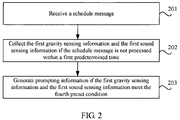
- FIG. 2 is a flowchart of the information processing method according to another embodiment of the invention. As shown in FIG. 2 , in this embodiment, the technical solution of the embodiment is described in detail by using an example in which the two types of environment state information collected by the user equipment are the first gravity sensing information and the first sound sensing information and the preset condition is the fourth preset condition.
- the method according to this embodiment includes:
- step 201 is similar to that of step 101 shown in FIG. 1 , so it is not described again here.
- Step 202 Collect the first gravity sensing information and the first sound sensing information if the schedule message is not processed within a first predetermined time.
- the user equipment is a mobile phone
- the user of the user equipment is on the way to a bus station on foot
- the mobile phone receives a schedule message and reminds the user through a ring and/or vibration triggered by the mobile phone.
- the mobile phone identifies that the schedule message has not been processed by the user, so that the mobile phone is triggered to collect the first gravity sensing information and the first sound sensing information.
- Step 203 Generate the prompting information if the first gravity sensing information and the first sound sensing information meet the fourth preset condition.
- the mobile phone when the user comes back home or is in an elevator, the mobile phone is in a still state at this moment and the surrounding environment is very quiet, so that the mobile phone identifies that the first gravity sensing information is smaller than the preset vibration amplitude and the first sound sensing information is smaller than the preset decibel, thereby the mobile phone identifies that under the current environment of the mobile phone, the user may perceive the ring and/or vibration prompt triggered by the mobile phone. Therefore, the mobile phone generates a special ring and/or vibration to prompt the user that there exists a schedule message that is not processed in time.
- the mobile phone identifies that the first gravity sensing information and the first sound sensing information fail to meet the fourth preset condition, for example, the first gravity sensing information is greater than the preset vibration amplitude and the first sound sensing information is greater than the preset decibel, so that the mobile phone identifies that under the current environment of the mobile phone, the user is unable to perceive the ring and/or vibration prompt triggered by the mobile phone. Therefore, the mobile phone does not generate a special ring and/or vibration prompt at this moment. Then, the method may further include:
- the method may further include:
- the mobile phone may further continue to collect the first gravity sensing information; if the collected first gravity sensing information is smaller than the preset vibration amplitude, the mobile phone generates the prompting information. For example, when the user stops to rest under a noisy environment, at this moment, the first gravity sensing information collected by the mobile phone is smaller than the preset vibration amplitude, then the mobile phone identifies that the mobile phone is in a still environment currently and the user may perceive the vibration triggered by the mobile phone, and thus the mobile phone generates the prompting information to prompt the user that there exists a schedule message that is not processed in time.
- the mobile phone may further continue to collect the first sound sensing information, if the collected first sound sensing information is smaller than the preset decibel, the mobile phone generates the prompting information. For example, when the user walks from a noisy environment into a quiet environment, at this moment, the first sound sensing information collected by the mobile phone is smaller than the preset decibel, then the mobile phone identifies that the mobile phone is in a quiet environment and the user may perceive the ring triggered by the mobile phone, and thus the mobile phone generates the prompting information to prompt the user that there exists a schedule message that is not processed in time.
- the user equipment collects the first gravity sensing information and the first sound sensing information. If the first gravity sensing information and the first sound sensing information meet the fourth preset condition, the user equipment generates the prompting information according to the first gravity sensing information and the first sound sensing information, so that the user equipment identifies whether the user may perceive the prompting information generated by the user equipment according to the movement status of the user equipment itself and the sound in the environment in which the user equipment exists, thereby in the case that the user can perceive the prompting information generated by the user equipment, the user equipment is triggered to generate the prompting information to prompt the user to process the information processing request message.
- the user can be effectively made to in time perceive the information processing request message that has been received by the user equipment but not processed in time, and the usability of the user equipment can be effectively improved.
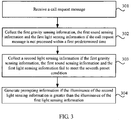
- FIG. 3 is a flowchart of the information processing method according to yet another embodiment of the invention.
- the technical solution of the embodiment is described in detail by using an example in which the three types of environment state information collected by the user equipment are the first gravity sensing information, the first sound sensing information and the first light sensing information, and the preset condition is the seventh preset condition.
- the method of this embodiment includes:
- step 301 is similar to that of step 101 shown in FIG. 1 , so it is not described again here.
- Step 302 Collect the first gravity sensing information, the first sound sensing information and the first light sensing information if the call request message is not processed within a first predetermined time.
- a user puts the mobile phone in the bedroom and then goes to watch TV in the living room. Because the volume of the TV programme is high, when the mobile phone receives a call request, the user that is watching TV in the living room does not perceive the ring and/or vibration triggered by the mobile phone. Moreover, the call request message is not processed within the first predetermined time, that is, the mobile phone identifies that the user does not in time process the call request message, so that the mobile phone is triggered to collect the first gravity sensing information, the first sound sensing information and the first light sensing information.
- Step 303 Collect second light sensing information if the first gravity sensing information, the first sound sensing information and the first light sensing information fail to meet the seventh preset condition.
- the mobile phone identifies that under the current environment, the user cannot perceive the ring and/or vibration triggered by the mobile phone, at this moment, the mobile phone may detect, in real time, the light environment in which the mobile phone exists, that is, the mobile phone may collect the second light sensing information in real time. In this embodiment, the mobile phone may identify, according to the first gravity sensing information, the first sound sensing information and the collected first light sensing information, that the current environment of the mobile phone is noisy and the light environment is dim.
- Step 304 Generate the prompting information if the light intensity of the second light sensing information is greater than the light intensity of the first light sensing information.
- the light intensity of the second light sensing information collected by the mobile phone is greater than the light intensity of the first light sensing information, that is, the mobile phone identifies that at this moment, the light environment in which the mobile phone exists changes from dim to bright, so that the mobile phone identifies that the user may perceive the ring and/or vibration triggered by the mobile phone, thereby the mobile phone is triggered to cause a special ring and/or vibration to prompt the user of the call request message in the mobile phone that is not processed in time.
- the user equipment collects the first gravity sensing information, the first sound sensing information and the first light sensing information. If the first gravity sensing information, the first sound sensing information and the first light sensing information fail to meet the seventh preset condition, the user equipment collects the second light sensing information in real time.
- the user equipment If the light intensity of the second light sensing information is greater than the light intensity of the first light sensing information, the user equipment generates the prompting information, so that the mobile phone can be triggered to generate the prompting information according to the movement status of the mobile phone itself, the change of the light and the sound in the environment in which the mobile phone exists, thereby the user can in time perceive the information processing request message that has been received by the user equipment but not processed in time, and therefore, the usability of the user equipment may also be effectively improved.
- FIG. 4 is a flowchart of the information processing method according to still another embodiment of the invention.
- the technical solution of the embodiment is described in detail by using an example in which the three types of environment state information collected by the user equipment are the first gravity sensing information, the first sound sensing information and the first light sensing information, and the preset condition is the seventh preset condition.
- the method of this embodiment includes:
- step 401 is similar to that of step 101 shown in FIG. 1 , so it is not described again here.
- Step 402 Collect the first gravity sensing information, the first sound sensing information and the first light sensing information if the call request message is not processed within a first predetermined time.
- a user when coming back home, a user puts the mobile phone in the bedroom and then goes to another room.
- the mobile phone receives a call request message, because the user is in another room, the user does not perceive the ring and/or vibration triggered by the mobile phone due to the received call request message, and the user does not process the call request message received by the mobile phone within the first predetermined time, and thus the mobile phone identifies that the user does not in time process the call request message, so that the mobile phone is triggered to collect the first gravity sensing information, the first sound sensing information and the first light sensing information.
- Step 403 Generate the prompting information if the first gravity sensing information, the first sound sensing information and the first light sensing information meet the seventh preset condition.
- the mobile phone when the mobile phone identifies that the first gravity sensing information is smaller than the preset vibration amplitude, the first sound sensing information is smaller than the preset decibel and the first light sensing information is greater than the preset light intensity, the mobile phone identifies that the sound environment in which the mobile phone exists is very quiet and the light environment is very bright, so that the mobile phone identifies that the user can perceive the special ring and/or vibration triggered by the mobile phone, thereby the mobile phone is triggered to trigger a special ring and/or vibration.
- Step 404 Collect second sound sensing information if the information processing request message is not processed within a second predetermined time.
- the mobile phone after the mobile phone generates the prompting information, the user does not process the received information processing request message within the second predetermined time, then the mobile phone identifies that the user may not be at the side of the mobile phone, so that the mobile phone is triggered to store the first gravity sensing information, the first sound sensing information and the first light sensing information.
- the second predetermined time may be equal to the first predetermined time, or may be smaller than the first predetermined time. In this embodiment, it is preferred that the second predetermined time is smaller than the first predetermined time, for example, the first predetermined time may be 5 minutes, and the second predetermined time may be 1 minute.
- the mobile phone after the mobile phone generates the prompting information, if the user does not process the received information processing request message within the second predetermined time, the mobile phone identifies that the user may not be at the side of the mobile phone, so that the mobile phone is triggered to collect the second sound sensing information.
- Step 405 Generate the prompting information if the decibel of the second sound sensing information is greater than the decibel of the first sound sensing information.
- the user returns to the bedroom from another room, and a sound is generated in the bedroom due to activities such as walking or speaking, etc., so that the decibel of the second sound sensing information collected by the mobile phone is greater than the decibel of the first sound sensing information, thereby the mobile phone identifies that the user may be around the mobile phone and may perceive the special ring and/or vibration triggered by the mobile phone.
- the mobile phone is triggered to trigger a special ring and/or vibration to prompt the user of the call request message received by the mobile phone which is not processed in time.
- the user equipment collects the first gravity sensing information, the first sound sensing information and the first light sensing information. If the first gravity sensing information, the first sound sensing information and the first light sensing information meet the seventh preset condition, the user equipment generates the prompting information to prompt the user of the information processing request message that is not processed in time. If the user does not process the information processing request message within the second predetermined time, the user equipment identifies that the user may not be in the vicinity of the mobile phone, thereby the user equipment is triggered to collect the second sound sensing information.
- the user equipment If the decibel of the second sound sensing information is greater than the decibel of the first sound sensing information, the user equipment generates the prompting information again, so that the user equipment can identify, according to the change of environment, whether the user equipment needs to prompt the user of the information processing request message received by the user equipment which is not processed in time, and the user can in time perceive the information processing request message that has been received by the user equipment but not processed in time, and therefore, the usability of the user equipment may also be effectively improved.
- FIG. 5 is a structural schematic diagram of the user equipment according to an embodiment of the invention.
- the user equipment of this embodiment includes: a receiving module 11, a first collecting module 12 and a first generating module 13.
- the receiving module 11 is configured to receive an information processing request message;
- the first collecting module 12 is configured to collect at least one type of environment state information if the information processing request message is not processed within a first predetermined time;
- the first generating module 13 is configured to generate the prompting information according to the collected environment state information, so as to prompt a user to process the information processing request message.
- the user equipment according to this embodiment may be configured to perform the technical solution of the method embodiment shown in FIG. 1 .
- the implementing principle thereof is similar, so it is not described again here.
- the received information processing request message is not processed within the first predetermined time, at least one type of environment state information is collected, and the prompting information is generated according to the collected environment state information, so as to prompt the user to process the information processing request message, so that the user equipment may generate, according to the environment identified under which the user equipment exists, the prompting information to prompt the user of the information processing request message, thereby the user can perceive in time the information processing request message that has been received by the user equipment but not processed in time, and thus the usability of the user equipment may be effectively improved.
- the first generating module 13 is specifically configured to generate the prompting information if the collected environment state information meets a preset condition, wherein the environment state information includes one or any combination of the following information: the first gravity sensing information, the first sound sensing information and the first light sensing information, and the preset condition includes at least one type of the following conditions: the first gravity sensing information is smaller than the preset vibration amplitude, the first sound sensing information is smaller than the preset decibel, and the first light sensing information is greater than the preset light intensity
- FIG. 6 is a structural schematic diagram of the user equipment according to another embodiment of the invention.
- the mobile terminal communication equipment includes: a receiving module 21, a first collecting module 22 and a first generating module 23.
- the receiving module 21 is configured to receive an information processing request message;
- the first collecting module 22 is configured to collect at least one type of environment state information if the information processing request message is not processed within a first predetermined time;
- the first generating module 23 is configured to generate prompting information if the collected environment state information meets a preset condition.
- the first collecting module 22 is further configured to continue to collect the environment state information if the collected environment state information fails to meet the preset condition.
- the first collecting module 22 may be further configured to continue to collect a part of the environment state information if the collected environment state information fails to meet the preset condition, where the part of the environment state information includes: all the environment state information which fails to meet the preset condition in the environment state information; or a part of the environment state information which fails to meet the preset condition in the environment state information; or a part of the environment state information selected from the environment state information.
- the user equipment of this embodiment may be configured to perform the technical solution of the method embodiment shown in FIG. 2 .
- the implementing principle thereof is similar, so it is not described again here.
- the user equipment collects the first gravity sensing information and the first sound sensing information. If the first gravity sensing information and the first sound sensing information meet the fourth preset condition, the user equipment generates the prompting information according to the first gravity sensing information and the first sound sensing information, so that the user equipment identifies whether the user may perceive the prompting information generated by the user equipment according to the movement status of the user equipment itself and the sound in the environment in which the user equipment exists.
- the user equipment is triggered to generate the prompting information to prompt the user to process the information processing request message, and thus the user can be effectively made to in time perceive the information processing request message that has been received by the user equipment but not processed in time, and the usability of the user equipment can be effectively improved.
- FIG. 7 is a structural schematic diagram of the user equipment according to yet another embodiment of the invention.
- the mobile terminal communication equipment includes: a receiving module 31, a first collecting module 32, a second collecting module 33 and a second generating module 34.
- the receiving module 31 is configured to receive an information processing request message; the first collecting module 32 is configured to collect the first gravity sensing information, the first sound sensing information and the first light sensing information if the information processing request message is not processed within a first predetermined time; the second collecting module 33 is configured to collect the second light sensing information if the collected environment state information fails to meet a preset condition; the second generating module 34 is configured to generate the prompting information if the light intensity of the second light sensing information is greater than the light intensity of the first light sensing information.
- the user equipment of this embodiment may be configured to perform the technical solution of the method embodiment shown in FIG. 3 .
- the implementing principle thereof is similar, so it is not described again here.
- the user equipment collects the first gravity sensing information, the first sound sensing information and the first light sensing information. If the first gravity sensing information, the first sound sensing information and the first light sensing information fail to meet the seventh preset condition, the user equipment collects the second light sensing information in real time.
- the user equipment When the light intensity of the second light sensing information is greater than the light intensity of the first light sensing information, the user equipment generates the prompting information, so that the mobile phone can be triggered to generate the prompting information according to the movement status of the mobile phone itself, the change of the light and the sound in the environment in which the mobile phone exists, thereby the user can in time perceive the information processing request message that has been received by the user equipment but not processed in time. Therefore, the usability of the user equipment may also be effectively improved.
- FIG. 8 is a structural schematic diagram of the user equipment according to still another embodiment of the invention.
- the mobile terminal communication equipment includes: a receiving module 41, a first collecting module 42, a first generating module 43, a third collecting module 44 and a third generating module 45.
- the receiving module 41 is configured to receive an information processing request message; the first collecting module 42 is configured to collect the first gravity sensing information, the first sound sensing information and the first light sensing information if the information processing request message is not processed within a first predetermined time; the first generating module 43 is configured to generate the prompting information if the collected environment state information meets a preset condition, wherein the environment state information includes the first gravity sensing information, the first sound sensing information or the first light sensing information, and the preset condition includes at least one type of the following conditions: the first gravity sensing information is smaller than a preset vibration amplitude, the first sound sensing information is smaller than a preset decibel, and the first light sensing information is greater than a preset light intensity.
- the third collecting module 44 is configured to collect the second sound sensing information if the information processing request message is not processed within a second predetermined time.
- the third generating module 45 is configured to generate the prompting information if the decibel of the second sound sensing information is greater than the decibel of the first sound sensing information.
- the user equipment of this embodiment may be configured to perform the technical solution of the method embodiment shown in FIG. 4 .
- the implementing principle thereof is similar, so it is not described again here.
- the user equipment collects the first gravity sensing information, the first sound sensing information and the first light sensing information. If the first gravity sensing information, the first sound sensing information and the first light sensing information meet the seventh preset condition, the user equipment generates the prompting information to prompt the user of the information processing request message that has been received by the user equipment but not processed in time. If the user does not process the information processing request message within the second predetermined time, the user equipment identifies that the user may not be in the vicinity of the mobile phone, thereby the user equipment is triggered to collect the second sound sensing information.
- the user equipment When the decibel of the second sound sensing information is greater than the decibel of the first sound sensing information, the user equipment generates the prompting information again, so that the user equipment can identify, according to the change of environment, whether the user equipment needs to prompt the user to perceive the information processing request message that has been perceived by the user equipment but not processed in time, and the user can in time perceive the information processing request message that has been received by the user equipment but not processed in time. Therefore, the usability of the user equipment may also be effectively improved.
- the foregoing storage medium includes various media that can store program codes, such as ROM, RAM, diskette or compact disc.
Landscapes
- Engineering & Computer Science (AREA)
- Computer Networks & Wireless Communication (AREA)
- Signal Processing (AREA)
- Human Computer Interaction (AREA)
- Physics & Mathematics (AREA)
- General Physics & Mathematics (AREA)
- General Business, Economics & Management (AREA)
- Business, Economics & Management (AREA)
- Environmental & Geological Engineering (AREA)
- Telephone Function (AREA)
- User Interface Of Digital Computer (AREA)
- Telephonic Communication Services (AREA)
- Mobile Radio Communication Systems (AREA)
Claims (7)
- Informationsverarbeitungsverfahren für eine Verwendung in einem Anwendergerät, wobei das Verfahren umfasst:Empfangen (101) einer Nachricht einer Informationsverarbeitungsanfrage;Sammeln (102) von mindestens einem Typ von Informationen über den Umgebungszustand, wenn die Nachricht einer Informationsverarbeitungsanfrage nicht innerhalb einer ersten vorgegebenen Zeitdauer von einem Anwender verarbeitet wird;wenn die gesammelten Informationen über den Umgebungszustand eine vorgegebene Bedingung erfüllen, Erzeugen (103) von Alarmbenachrichtigungsinformationen gemäß den gesammelten Informationen über den Umgebungszustand, um so den Anwender aufzufordern, die Nachricht einer Informationsverarbeitungsanfrage zu verarbeiten;dadurch gekennzeichnet, dass die Informationen über den Umgebungszustand erste Gravitationserfassungsinformationen, erste Schallerfassungsinformationen und erste Lichterfassungsinformationen enthalten; die vorgegebene Bedingung die folgenden Bedingungen enthält: die ersten Gravitationserfassungsinformationen sind kleiner als eine vorgegebene Schwingungsamplitude, die ersten Schallerfassungsinformationen sind kleiner als ein vorgegebener Dezibelwert und die ersten Lichterfassungsinformationen sind größer als eine vorgegebene Lichtintensität;und dass das Verfahren ferner umfasst:Fortfahren, einen Teil der Informationen über den Umgebungszustand zu sammeln, wenn die gesammelten Informationen über den Umgebungszustand nicht die vorgegebene Bedingung erfüllen, wobei der Teil der Informationen über den Umgebungszustand enthält: alle diejenigen Informationen über den Umgebungszustand, die die vorgegebene Bedingung in den Informationen über den Umgebungszustand nicht erfüllen, oder einen Teil der Informationen über den Umgebungszustand, die die vorgegebene Bedingung in den Informationen über den Umgebungszustand nicht erfüllen, oder einen Teil der Informationen über den Umgebungszustand, die aus den Informationen über den Umgebungszustand ausgewählt sind.
- Informationsverarbeitungsverfahren nach Anspruch 1, wobei das Verfahren ferner umfasst:Sammeln von zweiten Lichterfassungsinformationen, wenn die gesammelten Informationen über den Umgebungszustand nicht die vorgegebene Bedingung erfüllen; undErzeugen der Alarmbenachrichtigungsinformationen, wenn eine Lichtintensität der zweiten Lichterfassungsinformationen größer als eine Lichtintensität der ersten Lichterfassungsinformationen ist.
- Informationsverarbeitungsverfahren nach Anspruch 1, wobei nach dem Erzeugen der Alarmbenachrichtigungsinformationen das Verfahren ferner umfasst:Sammeln von zweiten Schallerfassungsinformationen, wenn die Nachricht einer Informationsverarbeitungsanfrage nicht innerhalb einer zweiten vorgegebenen Zeitdauer verarbeitet wird; undErzeugen der Alarmbenachrichtigungsinformationen, wenn ein Dezibelwert der zweiten Schallerfassungsinformationen größer als ein Dezibelwert der ersten Schallerfassungsinformationen ist.
- Informationsverarbeitungsverfahren nach Anspruch 1 bis 3, wobei die Nachricht einer Informationsverarbeitungsanfrage einen Anruf, eine kurze Nachricht oder ein Verzeichnis enthält.
- Anwendergerät, das umfasst:ein Empfangsmodul (11), das konfiguriert ist, um eine Nachricht einer Informationsverarbeitungsanfrage zu empfangen;ein erstes Sammelmodul (12), das konfiguriert ist, um mindestens einen Typ von Informationen über den Umgebungszustand zu sammeln, wenn die Nachricht einer Informationsverarbeitungsanfrage nicht innerhalb einer ersten vorgegebenen Zeitdauer von einem Anwender verarbeitet wird;wobei das Anwendergerät ferner umfasst:ein erstes Erzeugungsmodul (13), das konfiguriert ist, um Alarmbenachrichtigungsinformationen gemäß den gesammelten Informationen über den Umgebungszustand zu erzeugen, wenn die gesammelten Informationen über den Umgebungszustand eine vorgegebene Bedingung erfüllen, um so den Anwender aufzufordern, die Nachricht einer Informationsverarbeitungsanfrage zu verarbeiten;dadurch gekennzeichnet, dass die Informationen über den Umgebungszustand erste Gravitationserfassungsinformationen, erste Schallerfassungsinformationen und erste Lichterfassungsinformationen enthalten; die vorgegebene Bedingung die folgenden Bedingungen enthält: die ersten Gravitationserfassungsinformationen sind kleiner als eine vorgegebene Schwingungsamplitude, die ersten Schallerfassungsinformationen sind kleiner als ein vorgegebener Dezibelwert und die ersten Lichterfassungsinformationen sind größer als eine vorgegebene Lichtintensität;und dass:das erste Sammelmodul (12) ferner konfiguriert ist, um fortzufahren, einen Teil der Informationen über den Umgebungszustand zu sammeln, wenn die gesammelten Informationen über den Umgebungszustand nicht die vorgegebene Bedingung erfüllen; wobei der Teil der Informationen über den Umgebungszustand enthält: alle diejenigen Informationen über den Umgebungszustand, die die vorgegebene Bedingung in den Informationen über den Umgebungszustand nicht erfüllen, oder einen Teil der Informationen über den Umgebungszustand, die die vorgegebene Bedingung in den Informationen über den Umgebungszustand nicht erfüllen, oder einen Teil der Informationen über den Umgebungszustand, die aus den Informationen über den Umgebungszustand ausgewählt sind.
- Anwendergerät nach Anspruch 5, wobei das Anwendergerät ferner umfasst:ein zweites Sammelmodul (33), das konfiguriert ist, um zweite Lichterfassungsinformationen zu sammeln, wenn die gesammelten Informationen über den Umgebungszustand nicht die vorgegebene Bedingung erfüllen; undein zweites Erzeugungsmodul (34), das konfiguriert ist, um die Alarmbenachrichtigungsinformationen zu erzeugen, wenn eine Lichtintensität der zweiten Lichterfassungsinformationen größer als eine Lichtintensität der ersten Lichterfassungsinformationen ist.
- Anwendergerät nach Anspruch 5, wobei das Anwendergerät ferner umfasst:ein drittes Sammelmodul (45), das konfiguriert ist, um zweite Schallerfassungsinformationen zu sammeln, wenn die Nachricht einer Informationsverarbeitungsanfrage nicht innerhalb einer zweiten vorgegebenen Zeitdauer verarbeitet wird; undein drittes Erzeugungsmodul (44), das konfiguriert ist, um die Alarmbenachrichtigungsinformationen zu erzeugen, wenn ein Dezibelwert der zweiten Schallerfassungsinformationen größer als ein Dezibelwert der ersten Schallerfassungsinformationen ist.
Applications Claiming Priority (2)
| Application Number | Priority Date | Filing Date | Title |
|---|---|---|---|
| CN201010188549.XA CN101854435B (zh) | 2010-05-31 | 2010-05-31 | 信息处理方法及用户设备 |
| PCT/CN2011/074939 WO2011150814A1 (zh) | 2010-05-31 | 2011-05-31 | 信息处理方法及用户设备 |
Publications (3)
| Publication Number | Publication Date |
|---|---|
| EP2562999A1 EP2562999A1 (de) | 2013-02-27 |
| EP2562999A4 EP2562999A4 (de) | 2013-06-19 |
| EP2562999B1 true EP2562999B1 (de) | 2016-07-13 |
Family
ID=42805691
Family Applications (1)
| Application Number | Title | Priority Date | Filing Date |
|---|---|---|---|
| EP11789193.7A Active EP2562999B1 (de) | 2010-05-31 | 2011-05-31 | Informationsverarbeitungsverfahren und benutzergerät |
Country Status (6)
| Country | Link |
|---|---|
| US (3) | US9142121B2 (de) |
| EP (1) | EP2562999B1 (de) |
| JP (2) | JP5513680B2 (de) |
| CN (1) | CN101854435B (de) |
| ES (1) | ES2593978T3 (de) |
| WO (1) | WO2011150814A1 (de) |
Families Citing this family (11)
| Publication number | Priority date | Publication date | Assignee | Title |
|---|---|---|---|---|
| CN101854435B (zh) * | 2010-05-31 | 2017-04-12 | 华为终端有限公司 | 信息处理方法及用户设备 |
| CN102567631A (zh) * | 2011-12-20 | 2012-07-11 | 上海交通大学 | 一种虚拟宠物交互仿真电子宠物系统 |
| CN103945041B (zh) * | 2013-01-21 | 2017-02-08 | 展讯通信(上海)有限公司 | 提醒用户的方法、系统与移动终端 |
| CN103152477A (zh) * | 2013-01-31 | 2013-06-12 | 深圳市金立通信设备有限公司 | 一种来电未接的处理方法及终端 |
| CN104023114A (zh) * | 2013-03-01 | 2014-09-03 | 联想(北京)有限公司 | 一种信息处理的方法及电子设备 |
| CN104374463B (zh) * | 2014-11-17 | 2017-10-13 | 北京智谷睿拓技术服务有限公司 | 信息获取方法及信息获取装置 |
| US20170052613A1 (en) * | 2015-08-18 | 2017-02-23 | Motorola Mobility Llc | Method and Apparatus for In-Purse Detection by an Electronic Device |
| JP6601078B2 (ja) * | 2015-09-10 | 2019-11-06 | 富士通株式会社 | システム、情報処理装置、アラーム制御プログラム、およびアラーム制御方法 |
| CN106686246B (zh) * | 2017-01-09 | 2021-06-11 | 腾讯科技(深圳)有限公司 | 一种短消息处理方法及终端 |
| WO2020013061A1 (ja) * | 2018-07-11 | 2020-01-16 | ソニー株式会社 | 情報処理装置および情報処理方法 |
| CN112449051B (zh) * | 2019-08-16 | 2022-03-11 | 华为技术有限公司 | 一种飞行状态的检测方法以及终端设备 |
Citations (6)
| Publication number | Priority date | Publication date | Assignee | Title |
|---|---|---|---|---|
| US20020127998A1 (en) * | 2001-03-02 | 2002-09-12 | Kabushiki Kaisha Toshiba | Communication apparatus |
| JP2002325115A (ja) * | 2001-04-25 | 2002-11-08 | Kyocera Corp | 携帯通信端末装置 |
| JP2006295554A (ja) * | 2005-04-11 | 2006-10-26 | Matsushita Electric Ind Co Ltd | 通信端末、プログラム、及び半導体集積回路 |
| JP2006303565A (ja) * | 2005-04-15 | 2006-11-02 | Nec Saitama Ltd | 携帯通信端末 |
| JP2009171302A (ja) * | 2008-01-17 | 2009-07-30 | Panasonic Corp | 携帯電子機器 |
| JP2009290304A (ja) * | 2008-05-27 | 2009-12-10 | Casio Hitachi Mobile Communications Co Ltd | 携帯端末装置及びプログラム |
Family Cites Families (29)
| Publication number | Priority date | Publication date | Assignee | Title |
|---|---|---|---|---|
| US6954657B2 (en) * | 2000-06-30 | 2005-10-11 | Texas Instruments Incorporated | Wireless communication device having intelligent alerting system |
| US20020137552A1 (en) * | 2001-03-20 | 2002-09-26 | Cannon Joseph M. | Indication unit for a portable wireless device |
| US20020143638A1 (en) * | 2001-03-28 | 2002-10-03 | August Katherine G. | System and method for conducting wireless customer/vendor transactions |
| CN1332590A (zh) * | 2001-08-23 | 2002-01-23 | 中电东方通信研究中心有限责任公司 | 手机未处理信息自动提示方法 |
| US20030188452A1 (en) * | 2002-04-03 | 2003-10-09 | Hines Roy William | Cleated boot attachment system for stalking game and/or for traveling to a fixed position to await game for use with hunting boots |
| US20040203673A1 (en) * | 2002-07-01 | 2004-10-14 | Seligmann Doree Duncan | Intelligent incoming message notification |
| US7818036B2 (en) * | 2003-09-19 | 2010-10-19 | Radeum, Inc. | Techniques for wirelessly controlling push-to-talk operation of half-duplex wireless device |
| US6954659B2 (en) * | 2003-11-24 | 2005-10-11 | World Mobile Technologies, Inc. | Fashion accessory with wireless signal alerting device |
| CN1332590C (zh) | 2004-04-02 | 2007-08-15 | 乐金电子(南京)等离子有限公司 | 平面显示器噪音防止装置 |
| JP3876900B2 (ja) * | 2004-08-24 | 2007-02-07 | 船井電機株式会社 | 遠隔監視システム及びその方法 |
| CN1832501A (zh) * | 2005-03-11 | 2006-09-13 | 鸿富锦精密工业(深圳)有限公司 | 多功能电子装置 |
| US7366548B2 (en) * | 2005-06-27 | 2008-04-29 | Lucent Technologies Inc. | Method for alerting a mobile unit of a missed call upon movement of the mobile unit |
| US20070099601A1 (en) * | 2005-10-28 | 2007-05-03 | Tzung-Shian Yang | Method of varying the behavior of a mobile phone based on unhandled events on the mobile phone |
| CN1980258A (zh) * | 2005-12-08 | 2007-06-13 | 中兴通讯股份有限公司 | 未接来电提示方法 |
| US7528711B2 (en) | 2005-12-19 | 2009-05-05 | Lawrence Kates | Portable monitoring unit |
| US20070149253A1 (en) * | 2005-12-27 | 2007-06-28 | Inventec Corporation | External megaphone system of the mobile phone |
| US7353638B2 (en) * | 2006-02-10 | 2008-04-08 | Salemi, Inc | Sound resistant enclosure |
| CN101018242A (zh) * | 2006-02-11 | 2007-08-15 | 鸿富锦精密工业(深圳)有限公司 | 一种自动调整振铃模式的移动通讯装置及方法 |
| TWI348307B (en) * | 2006-08-08 | 2011-09-01 | High Tech Comp Corp | A method for managing various incoming calling situations of mobile telecommunication devices |
| US20080132290A1 (en) * | 2006-11-30 | 2008-06-05 | Motorola, Inc. | Methods and devices for environmental triggering of missed message alerts |
| CN101009887A (zh) * | 2006-12-26 | 2007-08-01 | 华为技术有限公司 | 移动终端及其通信事件提示方法 |
| CN101227666B (zh) | 2007-01-15 | 2011-11-02 | 致伸科技股份有限公司 | 通信装置 |
| US8942764B2 (en) * | 2007-10-01 | 2015-01-27 | Apple Inc. | Personal media device controlled via user initiated movements utilizing movement based interfaces |
| US8385884B1 (en) * | 2007-10-12 | 2013-02-26 | Google Inc. | Disruption blocking in mobile devices |
| TW200934207A (en) * | 2008-01-21 | 2009-08-01 | Inventec Appliances Corp | Method of automatically playing text information in voice by an electronic device under strong light |
| JP2009206868A (ja) | 2008-02-28 | 2009-09-10 | Kyocera Corp | 携帯通信端末、着信報知方法 |
| CN101252735A (zh) * | 2008-03-26 | 2008-08-27 | 叶志宝 | 一种手机未接提醒的实现方法 |
| CN101640723B (zh) * | 2009-08-18 | 2012-06-13 | 上海华勤通讯技术有限公司 | 红外智能未接电话提醒系统及其使用方法 |
| CN101854435B (zh) | 2010-05-31 | 2017-04-12 | 华为终端有限公司 | 信息处理方法及用户设备 |
-
2010
- 2010-05-31 CN CN201010188549.XA patent/CN101854435B/zh active Active
-
2011
- 2011-05-31 WO PCT/CN2011/074939 patent/WO2011150814A1/zh not_active Ceased
- 2011-05-31 JP JP2013512743A patent/JP5513680B2/ja active Active
- 2011-05-31 EP EP11789193.7A patent/EP2562999B1/de active Active
- 2011-05-31 ES ES11789193.7T patent/ES2593978T3/es active Active
-
2012
- 2012-11-30 US US13/691,428 patent/US9142121B2/en active Active
-
2014
- 2014-02-12 JP JP2014024652A patent/JP5870130B2/ja active Active
-
2015
- 2015-08-11 US US14/823,285 patent/US9514640B2/en active Active
-
2016
- 2016-10-21 US US15/331,497 patent/US10291768B2/en active Active
Patent Citations (6)
| Publication number | Priority date | Publication date | Assignee | Title |
|---|---|---|---|---|
| US20020127998A1 (en) * | 2001-03-02 | 2002-09-12 | Kabushiki Kaisha Toshiba | Communication apparatus |
| JP2002325115A (ja) * | 2001-04-25 | 2002-11-08 | Kyocera Corp | 携帯通信端末装置 |
| JP2006295554A (ja) * | 2005-04-11 | 2006-10-26 | Matsushita Electric Ind Co Ltd | 通信端末、プログラム、及び半導体集積回路 |
| JP2006303565A (ja) * | 2005-04-15 | 2006-11-02 | Nec Saitama Ltd | 携帯通信端末 |
| JP2009171302A (ja) * | 2008-01-17 | 2009-07-30 | Panasonic Corp | 携帯電子機器 |
| JP2009290304A (ja) * | 2008-05-27 | 2009-12-10 | Casio Hitachi Mobile Communications Co Ltd | 携帯端末装置及びプログラム |
Also Published As
| Publication number | Publication date |
|---|---|
| EP2562999A1 (de) | 2013-02-27 |
| ES2593978T3 (es) | 2016-12-14 |
| JP5870130B2 (ja) | 2016-02-24 |
| CN101854435A (zh) | 2010-10-06 |
| US20150350408A1 (en) | 2015-12-03 |
| CN101854435B (zh) | 2017-04-12 |
| JP2014135731A (ja) | 2014-07-24 |
| JP2013529445A (ja) | 2013-07-18 |
| EP2562999A4 (de) | 2013-06-19 |
| US9142121B2 (en) | 2015-09-22 |
| US10291768B2 (en) | 2019-05-14 |
| US20130099939A1 (en) | 2013-04-25 |
| JP5513680B2 (ja) | 2014-06-04 |
| US9514640B2 (en) | 2016-12-06 |
| US20170041453A1 (en) | 2017-02-09 |
| WO2011150814A1 (zh) | 2011-12-08 |
Similar Documents
| Publication | Publication Date | Title |
|---|---|---|
| EP2562999B1 (de) | Informationsverarbeitungsverfahren und benutzergerät | |
| US7848732B2 (en) | Mobile communications devices including environmental hazard monitoring | |
| US10205818B2 (en) | Mobile terminal and event processing method | |
| US7340240B2 (en) | Monitoring device | |
| US9641669B2 (en) | Automatically modifying a do not disturb function in response to device motion | |
| US7853291B2 (en) | Mobile terminal having an event notification function and method thereof | |
| KR20170009866A (ko) | 소음-민감 경보 제시 기법 | |
| US8050665B1 (en) | Alert reminder trigger by motion-detector | |
| US10375518B2 (en) | Device and method for monitoring proximity between two devices | |
| US8306508B1 (en) | Motion-based event notification | |
| US20020137552A1 (en) | Indication unit for a portable wireless device | |
| US20130260784A1 (en) | Personal electronic device locator | |
| CN107580144B (zh) | 一种紧急时自动接听来电的方法、移动终端与系统 | |
| US20080132290A1 (en) | Methods and devices for environmental triggering of missed message alerts | |
| WO2014189665A1 (en) | Auto-adjust of indication characteristics based on user proximity | |
| CN109104525A (zh) | 智能设备的控制方法、系统、设备及存储介质 | |
| WO2010015426A1 (en) | Adaptive ring level | |
| CN108769369A (zh) | 一种预警方法及移动终端 | |
| CN106453805A (zh) | 一种提醒方法和装置 | |
| CN103618828A (zh) | 一种处理来电的方法及终端 | |
| JP2013257295A (ja) | 体重測定システム、サーバ、体重計、体重測定結果通知方法およびプログラム | |
| JP2003163760A (ja) | 救護要請通報装置及び方法 | |
| JP4715455B2 (ja) | 携帯端末、マナーモード制御方法及びプログラム | |
| KR20060036775A (ko) | 이동통신 단말기를 이용한 위급상황 알림 방법 | |
| JP2012010270A (ja) | 携帯端末装置 |
Legal Events
| Date | Code | Title | Description |
|---|---|---|---|
| PUAI | Public reference made under article 153(3) epc to a published international application that has entered the european phase |
Free format text: ORIGINAL CODE: 0009012 |
|
| 17P | Request for examination filed |
Effective date: 20121121 |
|
| AK | Designated contracting states |
Kind code of ref document: A1 Designated state(s): AL AT BE BG CH CY CZ DE DK EE ES FI FR GB GR HR HU IE IS IT LI LT LU LV MC MK MT NL NO PL PT RO RS SE SI SK SM TR |
|
| A4 | Supplementary search report drawn up and despatched |
Effective date: 20130521 |
|
| RIC1 | Information provided on ipc code assigned before grant |
Ipc: H04M 1/725 20060101AFI20130514BHEP Ipc: H04M 19/04 20060101ALI20130514BHEP |
|
| DAX | Request for extension of the european patent (deleted) | ||
| 17Q | First examination report despatched |
Effective date: 20140123 |
|
| REG | Reference to a national code |
Ref country code: DE Ref legal event code: R079 Ref document number: 602011028179 Country of ref document: DE Free format text: PREVIOUS MAIN CLASS: H04M0001725000 Ipc: G08C0017020000 |
|
| RIC1 | Information provided on ipc code assigned before grant |
Ipc: G08C 17/02 20060101AFI20150915BHEP Ipc: H04M 1/725 20060101ALI20150915BHEP |
|
| GRAP | Despatch of communication of intention to grant a patent |
Free format text: ORIGINAL CODE: EPIDOSNIGR1 |
|
| INTG | Intention to grant announced |
Effective date: 20151211 |
|
| GRAS | Grant fee paid |
Free format text: ORIGINAL CODE: EPIDOSNIGR3 |
|
| GRAA | (expected) grant |
Free format text: ORIGINAL CODE: 0009210 |
|
| AK | Designated contracting states |
Kind code of ref document: B1 Designated state(s): AL AT BE BG CH CY CZ DE DK EE ES FI FR GB GR HR HU IE IS IT LI LT LU LV MC MK MT NL NO PL PT RO RS SE SI SK SM TR |
|
| REG | Reference to a national code |
Ref country code: GB Ref legal event code: FG4D |
|
| REG | Reference to a national code |
Ref country code: AT Ref legal event code: REF Ref document number: 812864 Country of ref document: AT Kind code of ref document: T Effective date: 20160715 Ref country code: CH Ref legal event code: EP |
|
| REG | Reference to a national code |
Ref country code: IE Ref legal event code: FG4D |
|
| REG | Reference to a national code |
Ref country code: DE Ref legal event code: R096 Ref document number: 602011028179 Country of ref document: DE |
|
| REG | Reference to a national code |
Ref country code: LT Ref legal event code: MG4D |
|
| REG | Reference to a national code |
Ref country code: NL Ref legal event code: MP Effective date: 20160713 |
|
| REG | Reference to a national code |
Ref country code: ES Ref legal event code: FG2A Ref document number: 2593978 Country of ref document: ES Kind code of ref document: T3 Effective date: 20161214 |
|
| REG | Reference to a national code |
Ref country code: AT Ref legal event code: MK05 Ref document number: 812864 Country of ref document: AT Kind code of ref document: T Effective date: 20160713 |
|
| PG25 | Lapsed in a contracting state [announced via postgrant information from national office to epo] |
Ref country code: IS Free format text: LAPSE BECAUSE OF FAILURE TO SUBMIT A TRANSLATION OF THE DESCRIPTION OR TO PAY THE FEE WITHIN THE PRESCRIBED TIME-LIMIT Effective date: 20161113 Ref country code: HR Free format text: LAPSE BECAUSE OF FAILURE TO SUBMIT A TRANSLATION OF THE DESCRIPTION OR TO PAY THE FEE WITHIN THE PRESCRIBED TIME-LIMIT Effective date: 20160713 Ref country code: NL Free format text: LAPSE BECAUSE OF FAILURE TO SUBMIT A TRANSLATION OF THE DESCRIPTION OR TO PAY THE FEE WITHIN THE PRESCRIBED TIME-LIMIT Effective date: 20160713 Ref country code: RS Free format text: LAPSE BECAUSE OF FAILURE TO SUBMIT A TRANSLATION OF THE DESCRIPTION OR TO PAY THE FEE WITHIN THE PRESCRIBED TIME-LIMIT Effective date: 20160713 Ref country code: FI Free format text: LAPSE BECAUSE OF FAILURE TO SUBMIT A TRANSLATION OF THE DESCRIPTION OR TO PAY THE FEE WITHIN THE PRESCRIBED TIME-LIMIT Effective date: 20160713 Ref country code: NO Free format text: LAPSE BECAUSE OF FAILURE TO SUBMIT A TRANSLATION OF THE DESCRIPTION OR TO PAY THE FEE WITHIN THE PRESCRIBED TIME-LIMIT Effective date: 20161013 Ref country code: LT Free format text: LAPSE BECAUSE OF FAILURE TO SUBMIT A TRANSLATION OF THE DESCRIPTION OR TO PAY THE FEE WITHIN THE PRESCRIBED TIME-LIMIT Effective date: 20160713 |
|
| PG25 | Lapsed in a contracting state [announced via postgrant information from national office to epo] |
Ref country code: PT Free format text: LAPSE BECAUSE OF FAILURE TO SUBMIT A TRANSLATION OF THE DESCRIPTION OR TO PAY THE FEE WITHIN THE PRESCRIBED TIME-LIMIT Effective date: 20161114 Ref country code: BE Free format text: LAPSE BECAUSE OF FAILURE TO SUBMIT A TRANSLATION OF THE DESCRIPTION OR TO PAY THE FEE WITHIN THE PRESCRIBED TIME-LIMIT Effective date: 20160713 Ref country code: LV Free format text: LAPSE BECAUSE OF FAILURE TO SUBMIT A TRANSLATION OF THE DESCRIPTION OR TO PAY THE FEE WITHIN THE PRESCRIBED TIME-LIMIT Effective date: 20160713 Ref country code: AT Free format text: LAPSE BECAUSE OF FAILURE TO SUBMIT A TRANSLATION OF THE DESCRIPTION OR TO PAY THE FEE WITHIN THE PRESCRIBED TIME-LIMIT Effective date: 20160713 Ref country code: SE Free format text: LAPSE BECAUSE OF FAILURE TO SUBMIT A TRANSLATION OF THE DESCRIPTION OR TO PAY THE FEE WITHIN THE PRESCRIBED TIME-LIMIT Effective date: 20160713 Ref country code: GR Free format text: LAPSE BECAUSE OF FAILURE TO SUBMIT A TRANSLATION OF THE DESCRIPTION OR TO PAY THE FEE WITHIN THE PRESCRIBED TIME-LIMIT Effective date: 20161014 Ref country code: PL Free format text: LAPSE BECAUSE OF FAILURE TO SUBMIT A TRANSLATION OF THE DESCRIPTION OR TO PAY THE FEE WITHIN THE PRESCRIBED TIME-LIMIT Effective date: 20160713 |
|
| REG | Reference to a national code |
Ref country code: FR Ref legal event code: PLFP Year of fee payment: 7 |
|
| REG | Reference to a national code |
Ref country code: DE Ref legal event code: R097 Ref document number: 602011028179 Country of ref document: DE |
|
| PG25 | Lapsed in a contracting state [announced via postgrant information from national office to epo] |
Ref country code: EE Free format text: LAPSE BECAUSE OF FAILURE TO SUBMIT A TRANSLATION OF THE DESCRIPTION OR TO PAY THE FEE WITHIN THE PRESCRIBED TIME-LIMIT Effective date: 20160713 Ref country code: RO Free format text: LAPSE BECAUSE OF FAILURE TO SUBMIT A TRANSLATION OF THE DESCRIPTION OR TO PAY THE FEE WITHIN THE PRESCRIBED TIME-LIMIT Effective date: 20160713 |
|
| PLBE | No opposition filed within time limit |
Free format text: ORIGINAL CODE: 0009261 |
|
| STAA | Information on the status of an ep patent application or granted ep patent |
Free format text: STATUS: NO OPPOSITION FILED WITHIN TIME LIMIT |
|
| PG25 | Lapsed in a contracting state [announced via postgrant information from national office to epo] |
Ref country code: SK Free format text: LAPSE BECAUSE OF FAILURE TO SUBMIT A TRANSLATION OF THE DESCRIPTION OR TO PAY THE FEE WITHIN THE PRESCRIBED TIME-LIMIT Effective date: 20160713 Ref country code: CZ Free format text: LAPSE BECAUSE OF FAILURE TO SUBMIT A TRANSLATION OF THE DESCRIPTION OR TO PAY THE FEE WITHIN THE PRESCRIBED TIME-LIMIT Effective date: 20160713 Ref country code: BG Free format text: LAPSE BECAUSE OF FAILURE TO SUBMIT A TRANSLATION OF THE DESCRIPTION OR TO PAY THE FEE WITHIN THE PRESCRIBED TIME-LIMIT Effective date: 20161013 Ref country code: DK Free format text: LAPSE BECAUSE OF FAILURE TO SUBMIT A TRANSLATION OF THE DESCRIPTION OR TO PAY THE FEE WITHIN THE PRESCRIBED TIME-LIMIT Effective date: 20160713 Ref country code: SM Free format text: LAPSE BECAUSE OF FAILURE TO SUBMIT A TRANSLATION OF THE DESCRIPTION OR TO PAY THE FEE WITHIN THE PRESCRIBED TIME-LIMIT Effective date: 20160713 |
|
| 26N | No opposition filed |
Effective date: 20170418 |
|
| PG25 | Lapsed in a contracting state [announced via postgrant information from national office to epo] |
Ref country code: SI Free format text: LAPSE BECAUSE OF FAILURE TO SUBMIT A TRANSLATION OF THE DESCRIPTION OR TO PAY THE FEE WITHIN THE PRESCRIBED TIME-LIMIT Effective date: 20160713 Ref country code: LU Free format text: LAPSE BECAUSE OF NON-PAYMENT OF DUE FEES Effective date: 20170531 |
|
| REG | Reference to a national code |
Ref country code: CH Ref legal event code: PL |
|
| PG25 | Lapsed in a contracting state [announced via postgrant information from national office to epo] |
Ref country code: MC Free format text: LAPSE BECAUSE OF FAILURE TO SUBMIT A TRANSLATION OF THE DESCRIPTION OR TO PAY THE FEE WITHIN THE PRESCRIBED TIME-LIMIT Effective date: 20160713 |
|
| REG | Reference to a national code |
Ref country code: IE Ref legal event code: MM4A |
|
| PG25 | Lapsed in a contracting state [announced via postgrant information from national office to epo] |
Ref country code: LI Free format text: LAPSE BECAUSE OF NON-PAYMENT OF DUE FEES Effective date: 20170531 Ref country code: CH Free format text: LAPSE BECAUSE OF NON-PAYMENT OF DUE FEES Effective date: 20170531 |
|
| REG | Reference to a national code |
Ref country code: FR Ref legal event code: PLFP Year of fee payment: 8 |
|
| PG25 | Lapsed in a contracting state [announced via postgrant information from national office to epo] |
Ref country code: IE Free format text: LAPSE BECAUSE OF NON-PAYMENT OF DUE FEES Effective date: 20170531 |
|
| PG25 | Lapsed in a contracting state [announced via postgrant information from national office to epo] |
Ref country code: MT Free format text: LAPSE BECAUSE OF NON-PAYMENT OF DUE FEES Effective date: 20170531 |
|
| PG25 | Lapsed in a contracting state [announced via postgrant information from national office to epo] |
Ref country code: AL Free format text: LAPSE BECAUSE OF FAILURE TO SUBMIT A TRANSLATION OF THE DESCRIPTION OR TO PAY THE FEE WITHIN THE PRESCRIBED TIME-LIMIT Effective date: 20160713 |
|
| REG | Reference to a national code |
Ref country code: DE Ref legal event code: R081 Ref document number: 602011028179 Country of ref document: DE Owner name: HUAWEI DEVICE CO., LTD., DONGGUAN, CN Free format text: FORMER OWNER: HUAWEI DEVICE CO., LTD., SHENZHEN, GUANGDONG, CN |
|
| REG | Reference to a national code |
Ref country code: GB Ref legal event code: 732E Free format text: REGISTERED BETWEEN 20190124 AND 20190130 |
|
| REG | Reference to a national code |
Ref country code: ES Ref legal event code: PC2A Owner name: HUAWEI DEVICE (SHENZHEN) CO., LTD. Effective date: 20190308 |
|
| REG | Reference to a national code |
Ref country code: ES Ref legal event code: PC2A Owner name: HUAWEI DEVICE CO., LTD. Effective date: 20190321 |
|
| PG25 | Lapsed in a contracting state [announced via postgrant information from national office to epo] |
Ref country code: HU Free format text: LAPSE BECAUSE OF FAILURE TO SUBMIT A TRANSLATION OF THE DESCRIPTION OR TO PAY THE FEE WITHIN THE PRESCRIBED TIME-LIMIT; INVALID AB INITIO Effective date: 20110531 |
|
| PG25 | Lapsed in a contracting state [announced via postgrant information from national office to epo] |
Ref country code: CY Free format text: LAPSE BECAUSE OF NON-PAYMENT OF DUE FEES Effective date: 20160713 |
|
| PG25 | Lapsed in a contracting state [announced via postgrant information from national office to epo] |
Ref country code: MK Free format text: LAPSE BECAUSE OF FAILURE TO SUBMIT A TRANSLATION OF THE DESCRIPTION OR TO PAY THE FEE WITHIN THE PRESCRIBED TIME-LIMIT Effective date: 20160713 |
|
| PG25 | Lapsed in a contracting state [announced via postgrant information from national office to epo] |
Ref country code: TR Free format text: LAPSE BECAUSE OF FAILURE TO SUBMIT A TRANSLATION OF THE DESCRIPTION OR TO PAY THE FEE WITHIN THE PRESCRIBED TIME-LIMIT Effective date: 20160713 |
|
| REG | Reference to a national code |
Ref country code: FR Ref legal event code: PLFP Year of fee payment: 13 |
|
| P01 | Opt-out of the competence of the unified patent court (upc) registered |
Effective date: 20230511 |
|
| PGFP | Annual fee paid to national office [announced via postgrant information from national office to epo] |
Ref country code: DE Payment date: 20250402 Year of fee payment: 15 |
|
| PGFP | Annual fee paid to national office [announced via postgrant information from national office to epo] |
Ref country code: GB Payment date: 20250401 Year of fee payment: 15 Ref country code: ES Payment date: 20250605 Year of fee payment: 15 |
|
| PGFP | Annual fee paid to national office [announced via postgrant information from national office to epo] |
Ref country code: IT Payment date: 20250422 Year of fee payment: 15 |
|
| PGFP | Annual fee paid to national office [announced via postgrant information from national office to epo] |
Ref country code: FR Payment date: 20250401 Year of fee payment: 15 |